EP0100172B1 - Amide derivatives - Google Patents
Amide derivatives Download PDFInfo
- Publication number
- EP0100172B1 EP0100172B1 EP83303998A EP83303998A EP0100172B1 EP 0100172 B1 EP0100172 B1 EP 0100172B1 EP 83303998 A EP83303998 A EP 83303998A EP 83303998 A EP83303998 A EP 83303998A EP 0100172 B1 EP0100172 B1 EP 0100172B1
- Authority
- EP
- European Patent Office
- Prior art keywords
- hydroxy
- trifluoromethyl
- aniline
- acylanilide
- cyano
- Prior art date
- Legal status (The legal status is an assumption and is not a legal conclusion. Google has not performed a legal analysis and makes no representation as to the accuracy of the status listed.)
- Expired
Links
- 0 CC1CC(*)CC1 Chemical compound CC1CC(*)CC1 0.000 description 3
Classifications
-
- C—CHEMISTRY; METALLURGY
- C07—ORGANIC CHEMISTRY
- C07D—HETEROCYCLIC COMPOUNDS
- C07D285/00—Heterocyclic compounds containing rings having nitrogen and sulfur atoms as the only ring hetero atoms, not provided for by groups C07D275/00 - C07D283/00
- C07D285/01—Five-membered rings
- C07D285/02—Thiadiazoles; Hydrogenated thiadiazoles
- C07D285/04—Thiadiazoles; Hydrogenated thiadiazoles not condensed with other rings
- C07D285/12—1,3,4-Thiadiazoles; Hydrogenated 1,3,4-thiadiazoles
- C07D285/125—1,3,4-Thiadiazoles; Hydrogenated 1,3,4-thiadiazoles with oxygen, sulfur or nitrogen atoms, directly attached to ring carbon atoms, the nitrogen atoms not forming part of a nitro radical
-
- A—HUMAN NECESSITIES
- A61—MEDICAL OR VETERINARY SCIENCE; HYGIENE
- A61P—SPECIFIC THERAPEUTIC ACTIVITY OF CHEMICAL COMPOUNDS OR MEDICINAL PREPARATIONS
- A61P15/00—Drugs for genital or sexual disorders; Contraceptives
-
- A—HUMAN NECESSITIES
- A61—MEDICAL OR VETERINARY SCIENCE; HYGIENE
- A61P—SPECIFIC THERAPEUTIC ACTIVITY OF CHEMICAL COMPOUNDS OR MEDICINAL PREPARATIONS
- A61P17/00—Drugs for dermatological disorders
-
- A—HUMAN NECESSITIES
- A61—MEDICAL OR VETERINARY SCIENCE; HYGIENE
- A61P—SPECIFIC THERAPEUTIC ACTIVITY OF CHEMICAL COMPOUNDS OR MEDICINAL PREPARATIONS
- A61P43/00—Drugs for specific purposes, not provided for in groups A61P1/00-A61P41/00
-
- A—HUMAN NECESSITIES
- A61—MEDICAL OR VETERINARY SCIENCE; HYGIENE
- A61P—SPECIFIC THERAPEUTIC ACTIVITY OF CHEMICAL COMPOUNDS OR MEDICINAL PREPARATIONS
- A61P5/00—Drugs for disorders of the endocrine system
-
- C—CHEMISTRY; METALLURGY
- C07—ORGANIC CHEMISTRY
- C07C—ACYCLIC OR CARBOCYCLIC COMPOUNDS
- C07C255/00—Carboxylic acid nitriles
-
- C—CHEMISTRY; METALLURGY
- C07—ORGANIC CHEMISTRY
- C07C—ACYCLIC OR CARBOCYCLIC COMPOUNDS
- C07C321/00—Thiols, sulfides, hydropolysulfides or polysulfides
-
- C—CHEMISTRY; METALLURGY
- C07—ORGANIC CHEMISTRY
- C07C—ACYCLIC OR CARBOCYCLIC COMPOUNDS
- C07C323/00—Thiols, sulfides, hydropolysulfides or polysulfides substituted by halogen, oxygen or nitrogen atoms, or by sulfur atoms not being part of thio groups
-
- C—CHEMISTRY; METALLURGY
- C07—ORGANIC CHEMISTRY
- C07C—ACYCLIC OR CARBOCYCLIC COMPOUNDS
- C07C59/00—Compounds having carboxyl groups bound to acyclic carbon atoms and containing any of the groups OH, O—metal, —CHO, keto, ether, groups, groups, or groups
- C07C59/40—Unsaturated compounds
- C07C59/58—Unsaturated compounds containing ether groups, groups, groups, or groups
- C07C59/64—Unsaturated compounds containing ether groups, groups, groups, or groups containing six-membered aromatic rings
- C07C59/66—Unsaturated compounds containing ether groups, groups, groups, or groups containing six-membered aromatic rings the non-carboxylic part of the ether containing six-membered aromatic rings
- C07C59/68—Unsaturated compounds containing ether groups, groups, groups, or groups containing six-membered aromatic rings the non-carboxylic part of the ether containing six-membered aromatic rings the oxygen atom of the ether group being bound to a non-condensed six-membered aromatic ring
-
- C—CHEMISTRY; METALLURGY
- C07—ORGANIC CHEMISTRY
- C07D—HETEROCYCLIC COMPOUNDS
- C07D213/00—Heterocyclic compounds containing six-membered rings, not condensed with other rings, with one nitrogen atom as the only ring hetero atom and three or more double bonds between ring members or between ring members and non-ring members
- C07D213/02—Heterocyclic compounds containing six-membered rings, not condensed with other rings, with one nitrogen atom as the only ring hetero atom and three or more double bonds between ring members or between ring members and non-ring members having three double bonds between ring members or between ring members and non-ring members
- C07D213/04—Heterocyclic compounds containing six-membered rings, not condensed with other rings, with one nitrogen atom as the only ring hetero atom and three or more double bonds between ring members or between ring members and non-ring members having three double bonds between ring members or between ring members and non-ring members having no bond between the ring nitrogen atom and a non-ring member or having only hydrogen or carbon atoms directly attached to the ring nitrogen atom
- C07D213/60—Heterocyclic compounds containing six-membered rings, not condensed with other rings, with one nitrogen atom as the only ring hetero atom and three or more double bonds between ring members or between ring members and non-ring members having three double bonds between ring members or between ring members and non-ring members having no bond between the ring nitrogen atom and a non-ring member or having only hydrogen or carbon atoms directly attached to the ring nitrogen atom with hetero atoms or with carbon atoms having three bonds to hetero atoms with at the most one bond to halogen, e.g. ester or nitrile radicals, directly attached to ring carbon atoms
- C07D213/62—Oxygen or sulfur atoms
- C07D213/70—Sulfur atoms
-
- C—CHEMISTRY; METALLURGY
- C07—ORGANIC CHEMISTRY
- C07D—HETEROCYCLIC COMPOUNDS
- C07D233/00—Heterocyclic compounds containing 1,3-diazole or hydrogenated 1,3-diazole rings, not condensed with other rings
- C07D233/54—Heterocyclic compounds containing 1,3-diazole or hydrogenated 1,3-diazole rings, not condensed with other rings having two double bonds between ring members or between ring members and non-ring members
- C07D233/66—Heterocyclic compounds containing 1,3-diazole or hydrogenated 1,3-diazole rings, not condensed with other rings having two double bonds between ring members or between ring members and non-ring members with hetero atoms or with carbon atoms having three bonds to hetero atoms with at the most one bond to halogen, e.g. ester or nitrile radicals, directly attached to ring carbon atoms
- C07D233/84—Sulfur atoms
-
- C—CHEMISTRY; METALLURGY
- C07—ORGANIC CHEMISTRY
- C07D—HETEROCYCLIC COMPOUNDS
- C07D239/00—Heterocyclic compounds containing 1,3-diazine or hydrogenated 1,3-diazine rings
- C07D239/02—Heterocyclic compounds containing 1,3-diazine or hydrogenated 1,3-diazine rings not condensed with other rings
- C07D239/24—Heterocyclic compounds containing 1,3-diazine or hydrogenated 1,3-diazine rings not condensed with other rings having three or more double bonds between ring members or between ring members and non-ring members
- C07D239/28—Heterocyclic compounds containing 1,3-diazine or hydrogenated 1,3-diazine rings not condensed with other rings having three or more double bonds between ring members or between ring members and non-ring members with hetero atoms or with carbon atoms having three bonds to hetero atoms with at the most one bond to halogen, directly attached to ring carbon atoms
- C07D239/32—One oxygen, sulfur or nitrogen atom
- C07D239/38—One sulfur atom
-
- C—CHEMISTRY; METALLURGY
- C07—ORGANIC CHEMISTRY
- C07D—HETEROCYCLIC COMPOUNDS
- C07D277/00—Heterocyclic compounds containing 1,3-thiazole or hydrogenated 1,3-thiazole rings
- C07D277/02—Heterocyclic compounds containing 1,3-thiazole or hydrogenated 1,3-thiazole rings not condensed with other rings
- C07D277/20—Heterocyclic compounds containing 1,3-thiazole or hydrogenated 1,3-thiazole rings not condensed with other rings having two or three double bonds between ring members or between ring members and non-ring members
- C07D277/32—Heterocyclic compounds containing 1,3-thiazole or hydrogenated 1,3-thiazole rings not condensed with other rings having two or three double bonds between ring members or between ring members and non-ring members with hetero atoms or with carbon atoms having three bonds to hetero atoms with at the most one bond to halogen, e.g. ester or nitrile radicals, directly attached to ring carbon atoms
- C07D277/36—Sulfur atoms
-
- C—CHEMISTRY; METALLURGY
- C07—ORGANIC CHEMISTRY
- C07D—HETEROCYCLIC COMPOUNDS
- C07D303/00—Compounds containing three-membered rings having one oxygen atom as the only ring hetero atom
- C07D303/02—Compounds containing oxirane rings
- C07D303/48—Compounds containing oxirane rings with hetero atoms or with carbon atoms having three bonds to hetero atoms with at the most one bond to halogen, directly attached to ring carbon atoms, e.g. ester or nitrile radicals
-
- C—CHEMISTRY; METALLURGY
- C07—ORGANIC CHEMISTRY
- C07D—HETEROCYCLIC COMPOUNDS
- C07D333/00—Heterocyclic compounds containing five-membered rings having one sulfur atom as the only ring hetero atom
- C07D333/50—Heterocyclic compounds containing five-membered rings having one sulfur atom as the only ring hetero atom condensed with carbocyclic rings or ring systems
- C07D333/52—Benzo[b]thiophenes; Hydrogenated benzo[b]thiophenes
- C07D333/62—Benzo[b]thiophenes; Hydrogenated benzo[b]thiophenes with hetero atoms or with carbon atoms having three bonds to hetero atoms with at the most one bond to halogen, e.g. ester or nitrile radicals, directly attached to carbon atoms of the hetero ring
Definitions
- This invention relates to new amide derivatives and more particularly it relates to novel acylanilides which possess antiandrogenic properties.
- acylanilides which possess antiandrogenic activity.
- the compound of the formula:- wherein R is hydrogen which compound is known as FLUTAMIDE, is under development for use as an antiandrogen. It is believed that flutamide is oxidised in vivo to the corresponding compound wherein R is hydroxy.
- acylanilides which possess antiandrogenic activity are known from European Specification Nos. 2309, 2892 and 40932, and from Japanese Specification No. 52-128329.
- the acylanilide derivative of the invention possesses an asymmetric carbon atom, namely the carbon atom which bears the substituents R 5 and R 6 , and it can therefore exist in racemic and optically-active forms. It is to be understood that this invention encompasses the racemic form of the acylanilide derivative and any optically-active form which possesses antiandrogenic activity, it being a matter of common general knowledge how a racemic compound may be resolved into its optically-active forms and how any antiandrogenic activity present in any of these forms may be determined.
- a suitable value for R 1 , R 4 or R 10 when it is alkyl, or for an alkyl substituent in R 7 , R 8 or R 9 when R 7 , R 8 or R 9 is phenyl or heterocyclic substituted by alkyl is, for example, methyl or ethyl.
- a suitable value for R 1 when it is alkoxy, or for an alkoxy substituent in R 7 , R 8 or R 9 when R 7 , R 8 or R 9 is phenyl or heterocyclic substituted by alkoxy is, for example, methoxy or ethoxy.
- a suitable value for R 1 or R 2 when it is alkanoyl, or for an alkanoyl substituent in R 7 , R 8 or R 9 when R 7 , R 8 or R 9 is phenyl substituted by alkanoyl is, for example, formyl or acetyl.
- R 1 or R 2 when it is alkylthio, alkylsulphinyl, alkylsulphonyl, perfluoroalkyl, perfluoroalkylthio, perfluoroalkylsulphinyl or perfluoroalkylsulphonyl, or for such a substituent in R 7 , R 8 or R 9 when R 7 , R 8 or R 9 is phenyl or heterocyclic bearing such a substituent is, for example, methylthio, ethylthio, methylsulphinyl, methylsulphonyl, trifluoromethyl, pentafluoroethyl, trifluoromethylthio, trifluoromethylsulphinyl or trifluoromethylsulphonyl.
- a suitable value for R 3 when it is halogen, or for a halogen substituent in R 7 , R 8 or R 9 when R 7 , R 8 or R 9 is phenyl or heterocyclic substituted by halogen, is fluoro, chloro, bromo or iodo.
- R 3 is preferably hydrogen or chloro, especially hydrogen.
- R 4 is preferably hydrogen.
- a suitable value for an alkoxycarbonyl or N-alkylcarbamoyl substituent in R 7 , R 8 or R 9 when R 7 , R 8 or R 9 is phenyl bearing such a substituent is, for example, methoxycarbonyl, ethoxycarbonyl or N-methylcarbamoyl.
- a suitable value for R 5 when it is alkoxy is, for example, methoxy, ethoxy, propyloxy, n-butyloxy or decyloxy.
- a suitable value for R 5 when it is acyloxy is, for example, alkanoyloxy or aroyloxy each of up to 15 carbon atoms, for example acetoxy, propionyloxy, decanoyloxy, dodecanoyloxy or benzoyloxy.
- R 5 is preferably hydroxy.
- a suitable value for R 6 when it is alkyl or halogenoalkyl is, for example, methyl, ethyl, n-propyl, fluoromethyl, difluoromethyl, trifluoromethyl, pentafluoroethyl, chloromethyl, dichloromethyl or trichloromethyl.
- R 6 is preferably methyl or trifluoromethyl, especially methyl.
- a suitable value for A 1 , A 2 , A 3 , A 4 or A 5 when it is alkylene is, for example, methylene, ethylene, ethylidene trimethylene, tetramethylene, 1-methyl-ethylene or 1,1,3-trimethylpropane-1,3-diyl
- a suitable value for R 7 or R 9 when it is alkyl, alkenyl, hydroxyalkyl or cycloalkyl is, for example, methyl, ethyl, n-propyl, isopropyl, n-butyl, allyl, 2-methylprop-2-enyl, 2-hydroxyethyl, cyclopentyl or cyclohexyl.
- a suitable value for R 7 , R 8 or R 9 when it is heterocyclic is, for example, furyl, thienyl, pyrrolyl, pyridyl, imidazolyl, thiazolyl, pyrimidinyl, thiadiazolyl, triazolyl, benzimidazolyl, benzothiazolyl, indolyl, benzothienyl, benzofuryl, quinolyl, isoquinolyl or 1,2-dihydro-2-oxoquinolyl.
- R 1 and R 2 are as follows:
- a preferred acylanilide of the invention has the formula stated above wherein R 1 is cyano, nitro, trifluoromethyl, chloro, methyl or methoxy, R 2 is cyano, nitro, trifluoromethyl or chloro, R 3 and R 4 are both hydrogen, R 5 is hydroxy, R 6 is methyl or trifluoromethyl, A 1 is methylene, ethylene or ethylidene, X 1 is sulphur, sulphinyl or sulphonyl, A 2 is a direct link or methylene and R 7 is alkyl, alkenyl, hydroxyalkyl or cycloalkyl each of up to 6 carbon atoms, or phenyl which is unsubstituted or which bears one fluoro, chloro, ⁇ cyano, nitro, methoxy or methylthio substituent, or thienyl, imidazolyl, thiazolyl, benzothiazolyl, thiadiazolyl,
- a particularly preferred acylanilide of the invention has the formula stated above wherein R 1 is trifluoromethyl, R 2 is cyano or nitro, R 3 and R 4 are both hydrogen, R 5 is hydroxy, R 6 is methyl, A 1 is methylene, X 1 is sulphur, sulphinyl or sulphonyl, A 2 is a direct link and R 7 is alkyl of up to 3 carbon atoms, especially ethyl, or is allyl, phenyl, p-fluorophenyl, thiazol-2-yl, 4-methylthiazol-2-yl, 5-methyl-1,3,4-thiadiazol-2-yl or 2-pyridyl.
- Particularly active compounds are:
- acylanilides of the invention may be manufactured by any chemical process known to be suitable for the manufacture of chemically-analogous compounds.
- One preferred process for the manufacture of an acylanilide of the invention comprises the reaction of an amine of the formula:- wherein R 1 , R 2 , R 3 and R 4 have the meanings stated above, with an acid of the formula:- wherein R 5 , R 6 , R 7 , X 1 , A 1 and A 2 have the meanings stated above, or with a reactive derivative of said acid.
- a suitable reactive derivative of an acid is, for example, an acid anhydride, or an acyl halide, for example an acyl chloride, or a lower alkyl ester of said acid, for example the methyl or ethyl ester.
- the reaction is carried out in N,N-dimethylacetamide solution using an acyl chloride (prepared from the acid and thionyl chloride) as reactant.
- a second preferred process for the manufacture of an acylanilide of the invention wherein R 5 is hydroxy and X 1 is sulphur comprises the reaction of an epoxide of the formula:- wherein R 1 , R 2 , R 3 and R 4 have the meanings stated above and wherein Z 1 has the formula wherein R 6 has the meaning stated above, wherein Z 2 is a displaceable group and wherein R" is such that ⁇ CHR 11 ⁇ is ⁇ A 1 ⁇ as stated above, with a thiol of the formula:- wherein R 7 and A 2 have the meanings stated above.
- a suitable value for Z 2 is, for example, a halogeno or sulphonyloxy group, for example the chloro, bromo, iodo, methanesulphonyloxy or p-toluenesulphonyloxy group.
- the abovementioned reaction is preferably carried out in an inert diluent or solvent, for example tetrahydrofuran, and in the presence of a base, for example sodium hydride.
- the epoxide used as starting material may be obtained by the epoxidation, for example with a peracid, of the corresponding unsaturated acylanilide.
- a third preferred process for the manufacture of an acylanilide of the invention wherein R 5 is hydroxy comprises the reaction of a compound of the formula:- wherein R 1 , R 2 , R 3 , R 4 and R 6 have the meanings stated above, with an organometallic compound of the formula - wherein A 1 , A 2 , R 7 and X 1 have the meanings stated above and M is a metal radical, for example the lithium radical.
- the last-mentioned reaction is preferably carried out in an inert solvent, for example diethyl ether or tetrahydrofuran, at a low temperature, for example at between -60°C and -100°C.
- an inert solvent for example diethyl ether or tetrahydrofuran
- An acylanilide of the invention wherein R 4 and R 5 are joined together to form a carbonyloxy group may be prepared by the reaction of an isocyanate of the formula:- wherein R 1 , R 2 and R 3 have the meanings stated above, with an ester of the formula:- wherein R 6 , R', X 1 , A 1 and A 2 have the meanings stated above, and wherein R is alkyl of up to 6 carbon atoms, for example methyl or ethyl.
- This reaction is preferably carried out in an organic solvent, for example diethyl ether, at laboratory temperature.
- An acylanilide of the invention wherein R 5 is hydroxy may be prepared by the hydrolysis of the corresponding acylanilide wherein R 5 is acyloxy, and an acylanilide of the invention wherein R 5 is hydroxy and R 4 is hydrogen may be prepared by the hydrolysis of the corresponding oxazolidinedione, which may be prepared as described in the preceding paragraph.
- An acylanilide of the invention wherein R 4 is alkyl may be prepared by the alkylation of the corresponding acylanilide wherein R 4 is hydrogen.
- An acylanilide of the invention wherein R 5 is acyloxy may be prepared by the acylation of the corresponding acylanilide wherein R 5 is hydroxy.
- An oxazolidinedione of the invention wherein R 4 and R 5 are joined together to form a carbonyloxy group, may be prepared by the reaction of the corresponding acylanilide wherein R 4 is hydrogen and R 5 is hydroxy with phosgene (COCI 2 ).
- the oxidising agent and conditions used will determine whether a sulphinyl or a sulphonyl compound is obtained.
- oxidation with sodium metaperiodate in methanol solution at or below laboratory temperature will generally convert a thio compound into the corresponding sulphinyl compound; and oxidation with a per-acid, for example m-chloroperbenzoic acid, in methylene chloride solution at or above laboratory temperature will generally convert a thio compound into the corresponding sulphonyl compound.
- a racemic acylanilide of the invention wherein R 5 is hydroxy may be separated into its optical isomers by forming an ester of the hydroxy group R 5 with an optically-active acid, for example (-)-camphanic acid, separating the diastereoisomeric esters thus obtained, by fractional crystallisation or, preferably, by flash-chromatography, and then hydrolysing each separate ester to the alcohol.
- an optically active acylanilide of the invention may be obtained by using any of the processes described above with an optically-active starting material.
- an acylanilide of the invention possesses antiandrogenic properties as demonstrated by its ability to decrease the weight of the seminal vesicles of a mature male rat when administered orally for 4 successive days.
- An acylanilide of the invention may therefore be used in the treatment of, for example, malignant or benign prostatic disease or of androgen dependent disease conditions, such as acne, hirsutism or seborrhoea, in warm-blooded vertebrates including man. It may also be used to improve ovulation in a domestic animal.
- a preferred acylanilide of the invention is up to 10 times more active as an antiandrogen than the known, chemically-related antiandrogens flutamide and hydroxyflutamide. At a dose of an acylanilide of the invention which produces antiandrogenic activity in rats no symptoms of toxicity are apparent.
- the acylanilide of the invention may be administered to a warm-blooded animal in the form of a pharmaceutical or veterinary composition which comprises the acylanilide in association with a pharmaceutically-acceptable diluent or carrier.
- the composition may be in a form suitable for oral dosage, as a tablet, capsule, aqueous or oily solution or suspension or emulsion. It may alternatively be in the form of a sterile solution or suspension suitable for parenteral administration, or be in the form of an ointment or lotion for topical administration, or be in the form of a suppository for anal or vaginal administration.
- the composition may additionally contain one or more drugs selected from anti-oestrogens, for example tamoxifen; aromatase inhibitors, for example testolactone or aminoglutethamide; progestins, for example medroxyprogesterone acetate; inhibitors of gonadotrophin secretion, for example danazol; LH-RH-analogues, for example buserelin; cytotoxic agents, for example cyclophosphamide; antibiotics, for example penicillin or oxytetracyclin; and anti-inflammatory agents, for example, especially for topical use, fluocinolone acetonide.
- anti-oestrogens for example tamoxifen
- aromatase inhibitors for example testolactone or aminoglutethamide
- progestins for example medroxyprogesterone acetate
- inhibitors of gonadotrophin secretion for example danazol
- LH-RH-analogues for example bus
- the acylanilide of the invention will normally be administered to a warm-blooded animal at a dose of between 0.1 mg. and 125 mg. per kg. bodyweight.
- 1,1,1-Trifluoro-3-phenylthiopropan-2-one (13.1 g.) was added dropwise to a cooled stirred solution of potassium cyanide (4.4 g.) in water (16 ml.) at such a rate that the temperature of the mixture was maintained at between 0° and 5°C.
- a 4:1 v/v mixture of water and concentrated sulphuric acid (17.1 mI.) was added at such a rate as to maintain the above temperature, and the mixture was then stirred at laboratory temperature for 15 hours and then extracted three times with diethyl ether (25 ml. each time). The combined extracts were washed three times with water (25 ml. each time), dried over magnesium sulphate and evaporated to dryness under reduced pressure.
- a mixture of the cyanhydrin thus obtained (3.0 g.) and concentrated aqueous hydrochloric acid (30 ml.) was heated in a sealed tube at 110°C. for 6 hours, cooled and poured onto ice.
- the aqueous mixture was extracted four times with diethyl ether (25 ml. each time) and the combined ethereal solutions were extracted twice with saturated aqueous sodium bicarbonate solution (40 ml. each time).
- the combined extracts were acidified with aqueous hydrochloric acid and then extracted twice with diethyl ether (40 ml. each time).
- the combined extracts were dried over magnesium sulphate and evaporated to dryness and the residue was stirred with petroleum ether (b.p.
- thio-alkanones used in Route B were prepared by the reaction of the appropriate thiol with the appropriate bromoketone by conventional means (for example as described in Zhur.org.Khim., 1971, 7, 2221). Those which are novel and were characterised are described in the following table:-
- m-Chloroperbenzoic acid (3.4 g.) was added portionwise to a boiling solution of 3,4-dichloro-N-methacryloylaniline (2.2 g.) and 4-methyl-2,6-di-t-butylphenol (0.05 g.) in 1,1,1-trichloroethane (75 ml.) and the mixture was heated under reflux for 4 hours, cooled and washed successively (25 ml. portions each time) once with saturated aqueous sodium sulphite solution, twice with saturated aqueous sodium bicarbonate solution and once with saturated sodium chloride solution, dried over magnesium sulphate and evaporated to dryness.
- Example 3 The process described in Example 3 was repeated using the appropriate thiol and the appropriate N-(2,3-epoxy-2-methylpropionyl)aniline as starting materials, and there were thus obtained the compounds described in the following table:- Similarly, by using the appropriate thiol and the appropriate N-(2,3-epoxy-2-methylbutyryl)aniline there were obtained:-
- N-(2,3-epoxy-2-methylpropionyl or butyryl)anilines used as starting material were obtained by the epoxidation of the appropriate N-methacryloyl or N-methylcrotonoylaniline by a similar process to that described in the second part of Example 3.
- N-Methacryloyl-4-nitro-3-trifluoromethylaniline had m.p. 102-104°C. and the corresponding epoxy compound had m.p. 119-121°C.;
- 4-cyano-N-methacryloyl-3-trifluoromethylaniline had m.p. 137-139°C. and the corresponding epoxy- compound had m.p. 149-150°C.
- N-(2-methylcrotonoyl)-4-nitro-3-trifluoromethylaniline had m.p. 65-67°C. and the corresponding epoxy compound had m.p. 99-102°C.;
- 4-cyano-N-(2-methylcrotonoyl)-3-trifluoromethylaniline had m.p. 127-128°C. and the corresponding epoxy compound had m.p. 100-103°C.
- n-Butyl-lithium (4.7 ml. of a 1.6 molar solution in hexane) was added during 2 minutes to a stirred solution of methylthiobenzene (0.82 ml.) and 1,4-diazabicyclo[2,2,2]octane (0.78 g.) in tetrahydrofuran (20 ml.) which was maintained at -2°C. under an atmosphere of argon. The mixture was allowed to warm up to +2°C., stirred at that temperature for 2 hours, cooled to -65°C.
Landscapes
- Chemical & Material Sciences (AREA)
- Organic Chemistry (AREA)
- Health & Medical Sciences (AREA)
- Veterinary Medicine (AREA)
- Chemical Kinetics & Catalysis (AREA)
- General Chemical & Material Sciences (AREA)
- Medicinal Chemistry (AREA)
- Nuclear Medicine, Radiotherapy & Molecular Imaging (AREA)
- Bioinformatics & Cheminformatics (AREA)
- Pharmacology & Pharmacy (AREA)
- Life Sciences & Earth Sciences (AREA)
- Animal Behavior & Ethology (AREA)
- General Health & Medical Sciences (AREA)
- Public Health (AREA)
- Engineering & Computer Science (AREA)
- Endocrinology (AREA)
- Diabetes (AREA)
- Reproductive Health (AREA)
- Dermatology (AREA)
- Organic Low-Molecular-Weight Compounds And Preparation Thereof (AREA)
- Pharmaceuticals Containing Other Organic And Inorganic Compounds (AREA)
- Acyclic And Carbocyclic Compounds In Medicinal Compositions (AREA)
- Nitrogen- Or Sulfur-Containing Heterocyclic Ring Compounds With Rings Of Six Or More Members (AREA)
- Heterocyclic Carbon Compounds Containing A Hetero Ring Having Nitrogen And Oxygen As The Only Ring Hetero Atoms (AREA)
- Pyridine Compounds (AREA)
- Thiazole And Isothizaole Compounds (AREA)
- Saccharide Compounds (AREA)
- Cosmetics (AREA)
- Polysaccharides And Polysaccharide Derivatives (AREA)
- Addition Polymer Or Copolymer, Post-Treatments, Or Chemical Modifications (AREA)
- Preparation Of Compounds By Using Micro-Organisms (AREA)
Abstract
Description
- This invention relates to new amide derivatives and more particularly it relates to novel acylanilides which possess antiandrogenic properties.
- Many acylanilides are known which possess antiandrogenic activity. In particular, the compound of the formula:-

- Other acylanilides which possess antiandrogenic activity are known from European Specification Nos. 2309, 2892 and 40932, and from Japanese Specification No. 52-128329.
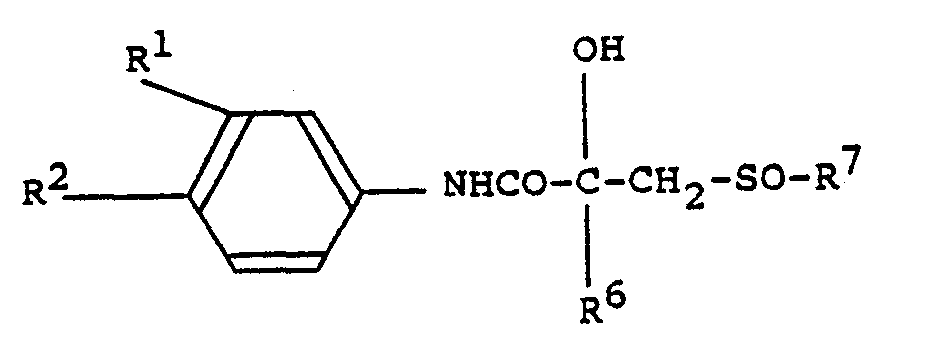
- According to the present invention there is provided an acylanilide of the formula:-

- wherein R1 is cyano, carbamoyl, nitro, fluoro, chloro, bromo, iodo or hydrogen, or alkyl, alkoxy, alkanoyl, alkylthio, alkylsulphinyl, alkylsulphonyl, perfluoroalkyl, perfluoroalkylthio, perfluoroalkylsulphinyl or perfluoroalkylsulphonyl each of up to 4 carbon atoms, or phenylthio, phenylsulphinyl or phenylsulphonyl;
- wherein R2 is cyano, carbamoyl, nitro, fluoro, chloro, bromo or iodo, or alkanoyl, alkylthio, alkylsulphinyl, alkylsulphonyl, perfluoroalkyl, perfluoroalkylthio, perfluoroalkylsulphinyl or perfluoroalkylsulphonyl each of up to 4 carbon atoms, or phenylthio, phenylsulphinyl or phenylsulphonyl;
- wherein R3 is hydrogen or halogen;
- wherein R4 is hydrogen or alkyl of up to 4 carbon atoms, or is joined to R5 as stated below;
- wherein R5 is hydroxy or alkoxy or acyloxy each of up to 15 carbon atoms, or is joined to R4 to form an oxycarbonyl group such that together with the -N-CO-C- part of the molecule it forms an oxazolidinedione group;
- wherein R6 is alkyl or halogenoalkyl of up to 4 carbon atoms, or has the formula ―A3―R8 or ―A4―X2―A5―R9;
- wherein A1 and A4, which may be the same or different, each is alkylene of up to 6 carbon atoms;
- wherein A2, A3 and A5, which may be the same or different, each is a direct link or alkylene of up to 6 carbon atoms;
- wherein X1 and X2, which may be the same or different, each is sulphur, sulphinyl (-SO-) or sulphonyl (-S02-);
- wherein R7 and R9, which may be the same or different, each is alkyl, alkenyl, hydroxyalkyl or cycloalkyl each of up to 6 carbon atoms, or R7 or R9 is phenyl which bears one, two or three substituents selected from hydrogen, halogen, nitro, carboxy, carbamoyl and cyano, and alkyl, alkoxy, alkanoyl, alkylthio, alkylsulphinyl, alkylsulphonyl, perfluoroalkyl, perfluoroalkylthio, perfluoroalkylsulphinyl, perfluoroalkylsulphonyl, alkoxycarbonyl and N-alkylcarbamoyl each of up to 4 carbon atoms, and phenyl, phenylthio, phenylsulphinyl and phenylsulphonyl; or R7 or R9 is naphthyl; or R7 or R9 is 5- or 6-membered saturated or unsaturated heterocyclic which contains one, two or three heteroatoms selected from oxygen, nitrogen and sulphur, which heterocyclic may be a single ring or may be fused to a benzo-ring, and which heterocyclic is unsubstituted or bears one or two halogen, cyano or amino, or alkyl,.alkoxy, alkylthio, alkylsulphinyl or alkylsulphonyl each of up to 4 carbon atoms, or oxy or hydroxy substituents, or which if sufficiently saturated may bear one or two oxo substituents; and wherein R8 is phenyl, naphthyl or heterocyclic as defined above for R7 or R9.
- It will be observed that the acylanilide derivative of the invention possesses an asymmetric carbon atom, namely the carbon atom which bears the substituents R5 and R6, and it can therefore exist in racemic and optically-active forms. It is to be understood that this invention encompasses the racemic form of the acylanilide derivative and any optically-active form which possesses antiandrogenic activity, it being a matter of common general knowledge how a racemic compound may be resolved into its optically-active forms and how any antiandrogenic activity present in any of these forms may be determined.
- A suitable value for R1, R4 or R10 when it is alkyl, or for an alkyl substituent in R7, R8 or R9 when R7, R8 or R9 is phenyl or heterocyclic substituted by alkyl is, for example, methyl or ethyl.
- A suitable value for R1 when it is alkoxy, or for an alkoxy substituent in R7, R8 or R9 when R7, R8 or R9 is phenyl or heterocyclic substituted by alkoxy is, for example, methoxy or ethoxy.
- A suitable value for R1 or R2 when it is alkanoyl, or for an alkanoyl substituent in R7, R8 or R9 when R7, R8 or R9 is phenyl substituted by alkanoyl is, for example, formyl or acetyl.
- A suitable value for R1 or R2 when it is alkylthio, alkylsulphinyl, alkylsulphonyl, perfluoroalkyl, perfluoroalkylthio, perfluoroalkylsulphinyl or perfluoroalkylsulphonyl, or for such a substituent in R7, R8 or R9 when R7, R8 or R9 is phenyl or heterocyclic bearing such a substituent is, for example, methylthio, ethylthio, methylsulphinyl, methylsulphonyl, trifluoromethyl, pentafluoroethyl, trifluoromethylthio, trifluoromethylsulphinyl or trifluoromethylsulphonyl.
- A suitable value for R3 when it is halogen, or for a halogen substituent in R7, R8 or R9 when R7, R8 or R9 is phenyl or heterocyclic substituted by halogen, is fluoro, chloro, bromo or iodo.
- R3 is preferably hydrogen or chloro, especially hydrogen.
- R4 is preferably hydrogen.
- A suitable value for an alkoxycarbonyl or N-alkylcarbamoyl substituent in R7, R8 or R9 when R7, R8 or R9 is phenyl bearing such a substituent is, for example, methoxycarbonyl, ethoxycarbonyl or N-methylcarbamoyl.
- A suitable value for R5 when it is alkoxy is, for example, methoxy, ethoxy, propyloxy, n-butyloxy or decyloxy.
- A suitable value for R5 when it is acyloxy is, for example, alkanoyloxy or aroyloxy each of up to 15 carbon atoms, for example acetoxy, propionyloxy, decanoyloxy, dodecanoyloxy or benzoyloxy.
- R5 is preferably hydroxy.
- A suitable value for R6 when it is alkyl or halogenoalkyl is, for example, methyl, ethyl, n-propyl, fluoromethyl, difluoromethyl, trifluoromethyl, pentafluoroethyl, chloromethyl, dichloromethyl or trichloromethyl. R6 is preferably methyl or trifluoromethyl, especially methyl.
- A suitable value for A1, A2, A3, A4 or A5 when it is alkylene is, for example, methylene, ethylene, ethylidene


- A suitable value for R7 or R9 when it is alkyl, alkenyl, hydroxyalkyl or cycloalkyl is, for example, methyl, ethyl, n-propyl, isopropyl, n-butyl, allyl, 2-methylprop-2-enyl, 2-hydroxyethyl, cyclopentyl or cyclohexyl.
- A suitable value for R7, R8 or R9 when it is heterocyclic is, for example, furyl, thienyl, pyrrolyl, pyridyl, imidazolyl, thiazolyl, pyrimidinyl, thiadiazolyl, triazolyl, benzimidazolyl, benzothiazolyl, indolyl, benzothienyl, benzofuryl, quinolyl, isoquinolyl or 1,2-dihydro-2-oxoquinolyl.
- A preferred combination of values for R1 and R2 is as follows:-
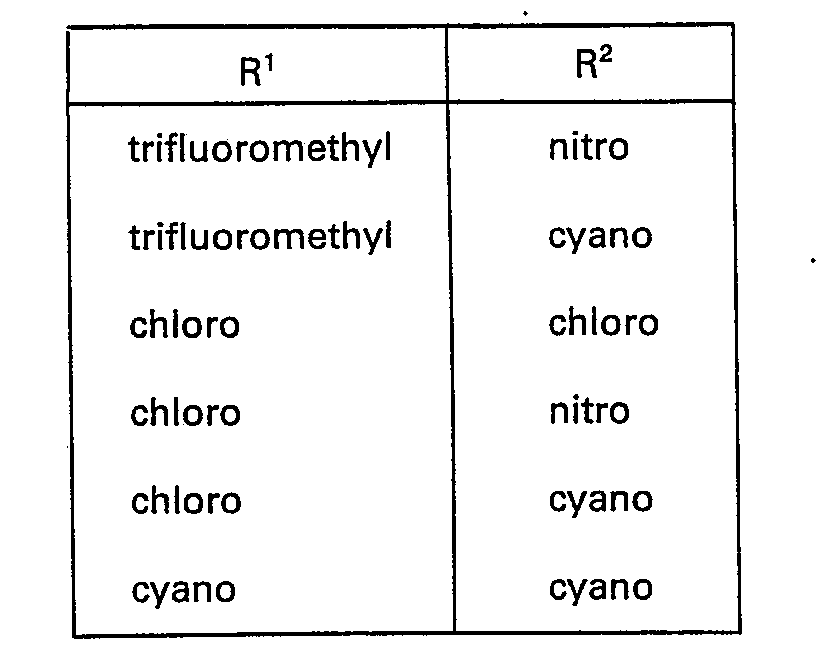
- A preferred acylanilide of the invention has the formula stated above wherein R1 is cyano, nitro, trifluoromethyl, chloro, methyl or methoxy, R2 is cyano, nitro, trifluoromethyl or chloro, R3 and R4 are both hydrogen, R5 is hydroxy, R6 is methyl or trifluoromethyl, A1 is methylene, ethylene or ethylidene, X1 is sulphur, sulphinyl or sulphonyl, A2 is a direct link or methylene and R7 is alkyl, alkenyl, hydroxyalkyl or cycloalkyl each of up to 6 carbon atoms, or phenyl which is unsubstituted or which bears one fluoro, chloro, · cyano, nitro, methoxy or methylthio substituent, or thienyl, imidazolyl, thiazolyl, benzothiazolyl, thiadiazolyl, pyridyl or pyrimidinyl which is unsubstituted or which bears one chloro, bromo or methyl substituent.
- A particularly preferred acylanilide of the invention has the formula stated above wherein R1 is trifluoromethyl, R2 is cyano or nitro, R3 and R4 are both hydrogen, R5 is hydroxy, R6 is methyl, A1 is methylene, X1 is sulphur, sulphinyl or sulphonyl, A2 is a direct link and R7 is alkyl of up to 3 carbon atoms, especially ethyl, or is allyl, phenyl, p-fluorophenyl, thiazol-2-yl, 4-methylthiazol-2-yl, 5-methyl-1,3,4-thiadiazol-2-yl or 2-pyridyl.
- Specific acylanilides of the invention are hereinafter described in the Examples.
- Particularly active compounds are:
- 3-chloro-4-cyano-N-(3-ethylthio-2-hydroxy-2-methylpropionyl)aniline;
- 3-chloro-4-cyano-N-(3-ethylsulphonyl-2-hydroxy-2-methylpropionyl)aniline;
- 4-cyano-3-trifluoromethyl-N-(2-hydroxy-2-methyl-3-phenylsulphonylpropionyl)aniline;
- 4-cyano-3-trifluoromethyl-N-(3-ethylsulphonyl-2-hydroxy-2-methylpropionyl)aniline;
- 4-nitro-3-trifluoromethyl-N-(2-hydroxy-3-phenylsulphonyl-2-methylpropionyl)aniline;
- 4-nitro-3-trifluoromethyl-N-(3-ethylsulphonyl-2-hydroxy-2-methylpropionyl)aniline;
- 3-chloro-4-nitro-N-(2-hydroxy-3-phenylthio-2-methylpropionyl)aniline;
- 4-nitro-3-trifluoromethyl-N-[2-hydroxy-2-methyl-3-(thiazol-2-ylthio)propionyl]aniline;
- 4-nitro-3-trifluoromethyl-N-[3-allylthio-2-hydroxy-2-methylpropionyl)aniline;
- 4-nitro-3-trifluoromethyl-N-(3-p-fluorophenylthio-2-hydroxy-2-methylpropionyl)aniline;
- 4-nitro-3-trifluoromethyl-N-[2-hydroxy-2-methyl-3-(pyrid-2-ylthio)propionyl]aniline;
- 4-nitro-3-trifluoromethyl-N-[2-hydroxy-2-methyl-3-(5-methyl-1,3,4-thiadiazol-2- ylthio)propionyl]aniline;
- 4-nitro-3-trifluoromethyl-N-[2-hydroxy-2-methyl-3-(4-methylthiazol-2-ylthio)propionyl]aniline;
- 4-nitro-3-trifluoromethyl-N-[2-hydroxy-2-methyl-3-(pyrid-2-ylsulphonyl)propionyl]aniline;
- 4-nitro-3-trifluoromethyl-N-(3-p-fluorophenylsulphonyl-2-hydroxy-2-methylpropionyl)aniline;
- 4-cyano-3-trifluoromethyl-N-[2-hydroxy-2-methyl-3-(thiazol-2-ylthio)propionyl]aniline;
- 4-cyano-3-trifluoromethyl-N-[2-hydroxy-2-methyl-3-(pyrid-2-ylthio)propionyl]aniline;
- 4-cyano-3-trifluoromethyl-N-(2-hydroxy-2-methyl-3-methylthiopropionyl)aniline;
- 4-cyano-3-trifluoromethyl-N-(3-p-fluorophenylthio-2-hydroxy-2-methylpropionyl)aniline; and
- 4-cyano-3-trifluoromethyl-N-(3-p-fluorophenylsulphonyl-2-hydroxy-2-methylpropionyl)aniline;
- The acylanilides of the invention may be manufactured by any chemical process known to be suitable for the manufacture of chemically-analogous compounds.
- One preferred process for the manufacture of an acylanilide of the invention comprises the reaction of an amine of the formula:-


- A suitable reactive derivative of an acid is, for example, an acid anhydride, or an acyl halide, for example an acyl chloride, or a lower alkyl ester of said acid, for example the methyl or ethyl ester. Preferably the reaction is carried out in N,N-dimethylacetamide solution using an acyl chloride (prepared from the acid and thionyl chloride) as reactant.
- A second preferred process for the manufacture of an acylanilide of the invention wherein R5 is hydroxy and X1 is sulphur comprises the reaction of an epoxide of the formula:-

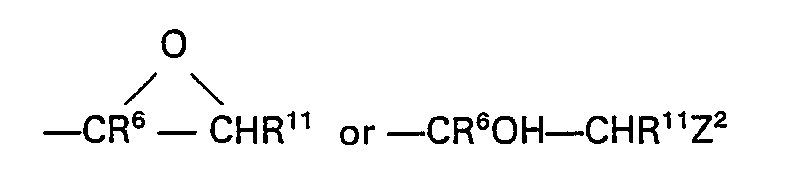

- A suitable value for Z2 is, for example, a halogeno or sulphonyloxy group, for example the chloro, bromo, iodo, methanesulphonyloxy or p-toluenesulphonyloxy group. The abovementioned reaction is preferably carried out in an inert diluent or solvent, for example tetrahydrofuran, and in the presence of a base, for example sodium hydride.
- The epoxide used as starting material may be obtained by the epoxidation, for example with a peracid, of the corresponding unsaturated acylanilide.
- A third preferred process for the manufacture of an acylanilide of the invention wherein R5 is hydroxy comprises the reaction of a compound of the formula:-


- The last-mentioned reaction is preferably carried out in an inert solvent, for example diethyl ether or tetrahydrofuran, at a low temperature, for example at between -60°C and -100°C.
- An acylanilide of the invention wherein R4 and R5 are joined together to form a carbonyloxy group, that is, an oxazolidinedione, may be prepared by the reaction of an isocyanate of the formula:-


- An acylanilide of the invention wherein R5 is hydroxy may be prepared by the hydrolysis of the corresponding acylanilide wherein R5 is acyloxy, and an acylanilide of the invention wherein R5 is hydroxy and R4 is hydrogen may be prepared by the hydrolysis of the corresponding oxazolidinedione, which may be prepared as described in the preceding paragraph.
- An acylanilide of the invention wherein R4 is alkyl may be prepared by the alkylation of the corresponding acylanilide wherein R4 is hydrogen.
- An acylanilide of the invention wherein R5 is acyloxy may be prepared by the acylation of the corresponding acylanilide wherein R5 is hydroxy.
- An oxazolidinedione of the invention, wherein R4 and R5 are joined together to form a carbonyloxy group, may be prepared by the reaction of the corresponding acylanilide wherein R4 is hydrogen and R5 is hydroxy with phosgene (COCI2).
- An acylanilide of the invention wherein X1 or X2 is sulphinyl or sulphonyl or wherein one or more of R1, R2 and a substituent in the phenyl or heterocyclic group R', R8 or R9 is alkylsulphinyl, perfluoroalkylsulphinyl or phenylsulphinyl, or is alkylsulphonyl, perfluoroalkylsulphonyl or phenylsulphonyl, may be prepared by the oxidation of the corresponding acylanilide wherein X1 or X2 is sulphur or wherein one or more of R1, R2 and a substituent in the phenyl or heterocyclic group R7, R8 or R9 is alkylthio, perfluoroalkylthio or phenylthio, respectively. The oxidising agent and conditions used will determine whether a sulphinyl or a sulphonyl compound is obtained. Thus, oxidation with sodium metaperiodate in methanol solution at or below laboratory temperature will generally convert a thio compound into the corresponding sulphinyl compound; and oxidation with a per-acid, for example m-chloroperbenzoic acid, in methylene chloride solution at or above laboratory temperature will generally convert a thio compound into the corresponding sulphonyl compound.
- A racemic acylanilide of the invention wherein R5 is hydroxy may be separated into its optical isomers by forming an ester of the hydroxy group R5 with an optically-active acid, for example (-)-camphanic acid, separating the diastereoisomeric esters thus obtained, by fractional crystallisation or, preferably, by flash-chromatography, and then hydrolysing each separate ester to the alcohol. Alternatively, an optically active acylanilide of the invention may be obtained by using any of the processes described above with an optically-active starting material.
- As stated above, an acylanilide of the invention possesses antiandrogenic properties as demonstrated by its ability to decrease the weight of the seminal vesicles of a mature male rat when administered orally for 4 successive days. An acylanilide of the invention may therefore be used in the treatment of, for example, malignant or benign prostatic disease or of androgen dependent disease conditions, such as acne, hirsutism or seborrhoea, in warm-blooded vertebrates including man. It may also be used to improve ovulation in a domestic animal.
- A preferred acylanilide of the invention is up to 10 times more active as an antiandrogen than the known, chemically-related antiandrogens flutamide and hydroxyflutamide. At a dose of an acylanilide of the invention which produces antiandrogenic activity in rats no symptoms of toxicity are apparent.
- The acylanilide of the invention may be administered to a warm-blooded animal in the form of a pharmaceutical or veterinary composition which comprises the acylanilide in association with a pharmaceutically-acceptable diluent or carrier.
- The composition may be in a form suitable for oral dosage, as a tablet, capsule, aqueous or oily solution or suspension or emulsion. It may alternatively be in the form of a sterile solution or suspension suitable for parenteral administration, or be in the form of an ointment or lotion for topical administration, or be in the form of a suppository for anal or vaginal administration.
- The composition may additionally contain one or more drugs selected from anti-oestrogens, for example tamoxifen; aromatase inhibitors, for example testolactone or aminoglutethamide; progestins, for example medroxyprogesterone acetate; inhibitors of gonadotrophin secretion, for example danazol; LH-RH-analogues, for example buserelin; cytotoxic agents, for example cyclophosphamide; antibiotics, for example penicillin or oxytetracyclin; and anti-inflammatory agents, for example, especially for topical use, fluocinolone acetonide.
- The acylanilide of the invention will normally be administered to a warm-blooded animal at a dose of between 0.1 mg. and 125 mg. per kg. bodyweight.
- The invention is illustrated but not limited by the following Examples:-
- Thionyl chloride (0.6 ml.) was added to a stirred solution of 2-hydroxy-2-methyl-3-phenylthiopropionic acid (1.7 g) in N,N-dimethylacetamide (40 ml.) which was cooled to -15°C., at such a rate that that temperature was maintained, and the mixture was stirred at that temperature for 15 minutes. 4-Cyano-3-trifluoromethylaniline (1.5 g.) was added, the mixture was stirred at -15°C. for 30 minutes and then at laboratory temperature for 15 hours, and was then poured into water (800 ml.). The mixture was extracted six times with diethyl ether (80 ml. each time) and the combined extracts were washed successively (50 ml. portions each time) twice with aqueous 3N-hydrochloric acid, once with saturated aqueous sodium chloride solution, twice with saturated aqueous sodium bicarbonate solution, and again once with saturated aqueous sodium chloride solution, dried over magnesium sulphate and evaporated to dryness under reduced pressure. The residue was purified by chromatography on a silica gel column (Merck 7734) using methylene chloride as eluant. The product was crystallised from a 5:1 v/v mixture of toluene and petroleum ether (b.p. 6080C.) and there was thus obtained 4-cyano-3-trifluromethyl-N-(2-hydroxy-2-methyl-3-phenylthiopropionyl)aniline, m.p. 81.5-83°C.
- The 2-hydroxy-2-methyl-3-phenylthiopropionic acid used as starting material was obtained as follows:-
- A solution of methyl 2,3-epoxy-2-methyl-propionate (4.06 g.) in tetrahydrofuran (40 ml.) was added during 20 minutes to a stirred suspension of thiophenol (7.7 g.) and sodium hydride (2.9 g. of a 60% dispersion in mineral oil) in tetrahydrofuran (75 ml.) which was maintained under an atmosphere of nitrogen, and the mixture was stirred at laboratory temperature for 15 minutes, then at 60°C. for 4 hours, cooled and neutralised by dropwise addition of a solution of concentrated sulphuric acid (0.5 ml.) in ethanol (5 ml.). A solution of potassium hydroxide (10 g.) in a mixture of water (30 ml.) and ethanol (150 ml.) was added and the mixture was heated under reflux for 22 hours. The organic solvents were removed by evaporation under reduced pressure, water (50 ml.) was added and the mixture was washed twice with diethyl ether (25 ml. each time). The aqueous solution was then acidified with concentrated aqueous hydrochloric acid and extracted four times with diethyl ether (100 ml. each time). The combined extracts were washed with saturated aqueous sodium chloride solution (50 mi.), dried over magnesium sulphate and evaporated to dryness, and the residue was crystallised from a 5:1 v/v mixture of petroleum ether (b.p. 6080C.) and toluene. There was thus obtained 2-hydroxy-2-methyl-3-phenylthiopropionic acid, m.p. 95.5-97°C.
- The process described in Example 1 was repeated except that the appropriate aniline and the appropriate 2-hydroxy-substituted-alkanoic acid were used as starting materials. There was thus obtained the compounds described in the following table:-
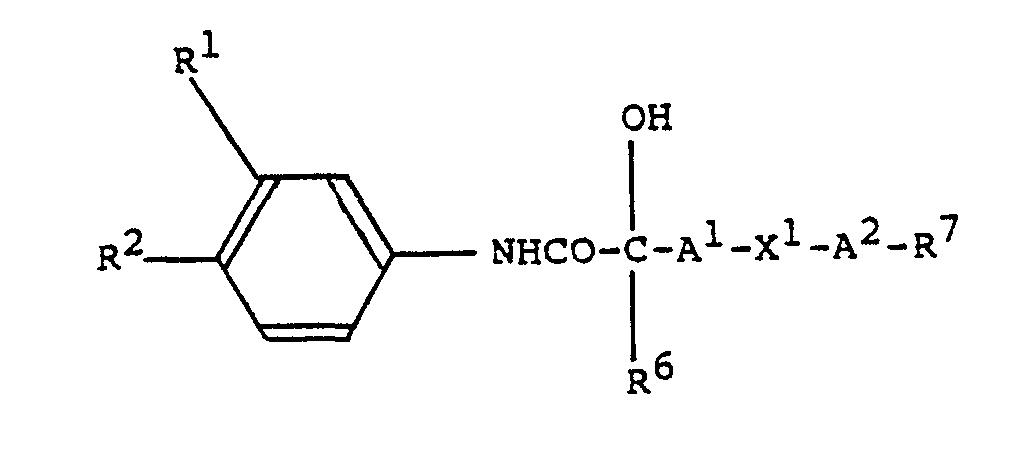


- All the anilines used as starting materials are known compounds. The 2-hydroxy-substituted-alkanoic acids were obtained either by the process described in the second part of Example 1 (Route A), or by the process exemplified below (Route B). Those acids which are novel and which were characterised by melting point are described in the table below:-
- 1,1,1-Trifluoro-3-phenylthiopropan-2-one (13.1 g.) was added dropwise to a cooled stirred solution of potassium cyanide (4.4 g.) in water (16 ml.) at such a rate that the temperature of the mixture was maintained at between 0° and 5°C. A 4:1 v/v mixture of water and concentrated sulphuric acid (17.1 mI.) was added at such a rate as to maintain the above temperature, and the mixture was then stirred at laboratory temperature for 15 hours and then extracted three times with diethyl ether (25 ml. each time). The combined extracts were washed three times with water (25 ml. each time), dried over magnesium sulphate and evaporated to dryness under reduced pressure.
- A mixture of the cyanhydrin thus obtained (3.0 g.) and concentrated aqueous hydrochloric acid (30 ml.) was heated in a sealed tube at 110°C. for 6 hours, cooled and poured onto ice. The aqueous mixture was extracted four times with diethyl ether (25 ml. each time) and the combined ethereal solutions were extracted twice with saturated aqueous sodium bicarbonate solution (40 ml. each time). The combined extracts were acidified with aqueous hydrochloric acid and then extracted twice with diethyl ether (40 ml. each time). The combined extracts were dried over magnesium sulphate and evaporated to dryness and the residue was stirred with petroleum ether (b.p. 60-80°C.). The mixture was filtered and there was thus obtained as solid residue 2-hydroxy-3-phenylthio-2-trifluoromethylpropionic acid, m.p. 83-84°C.
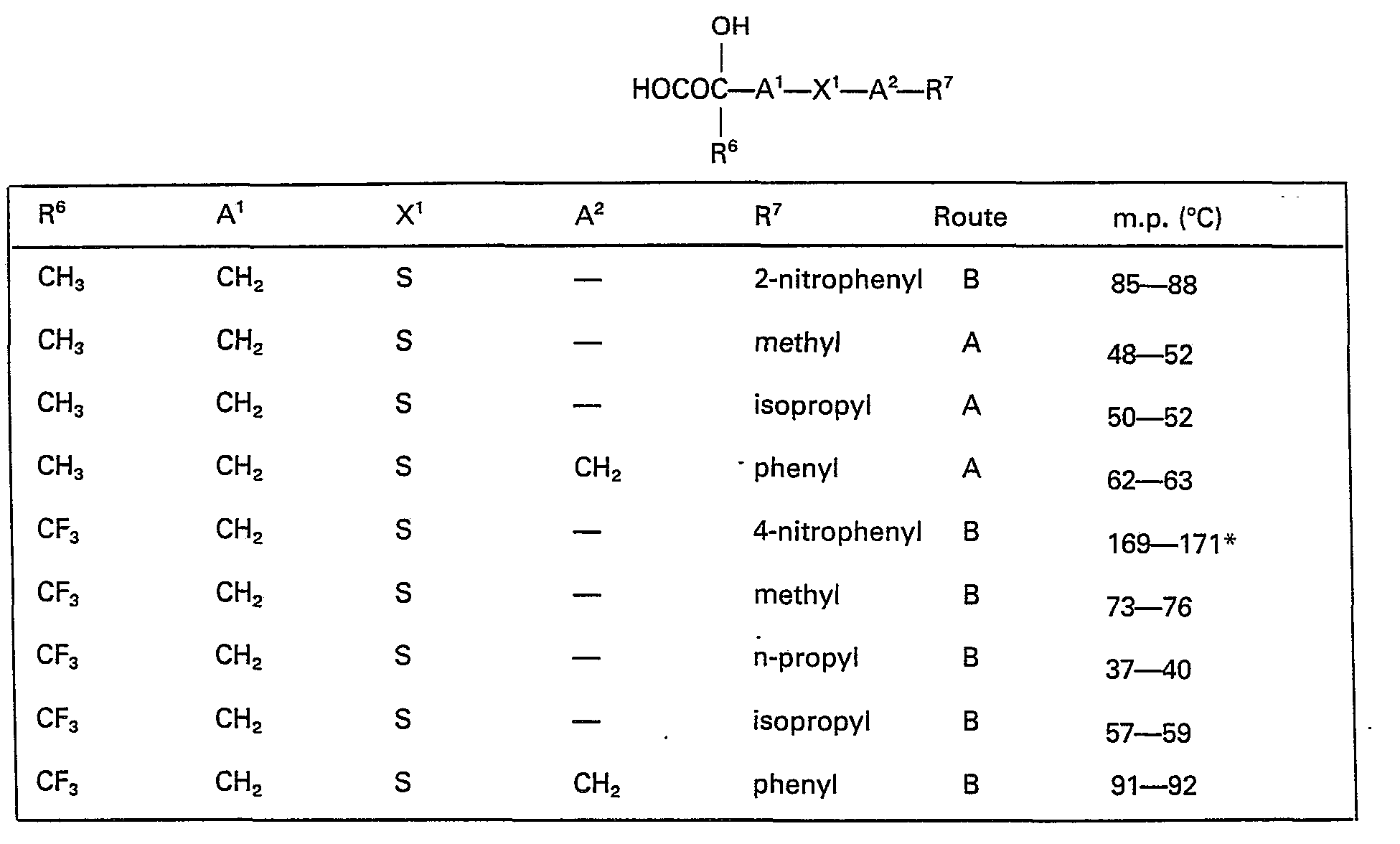
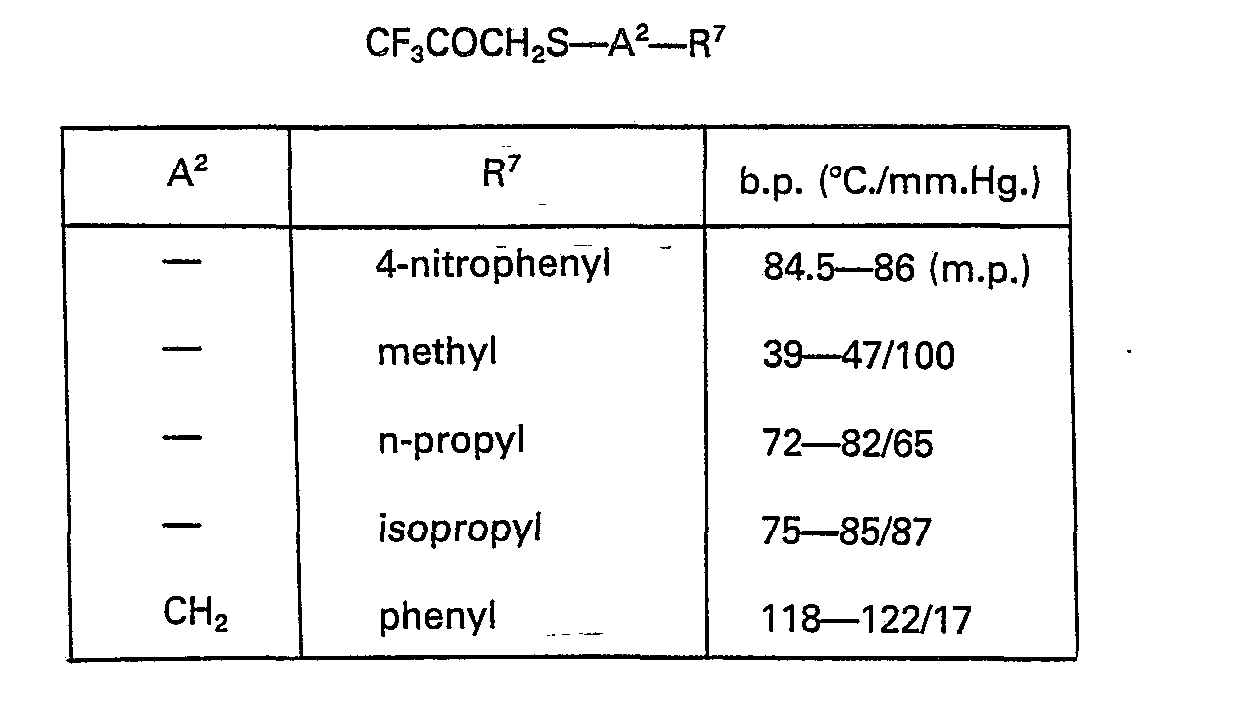
- The thio-alkanones used in Route B were prepared by the reaction of the appropriate thiol with the appropriate bromoketone by conventional means (for example as described in Zhur.org.Khim., 1971, 7, 2221). Those which are novel and were characterised are described in the following table:-
- A solution of ethanethiol (0.45 ml.) in tetrahydrofuran (5 ml.) was added dropwise to a stirred suspension of sodium hydride (0.28 g. of a 60% dispersion in mineral oil) in tetrahydrofuran (10 ml.) which was maintained at 0-50C., and the mixture was then stirred at laboratory temperature for 15 minutes. A solution of 3,4-dichloro-N-(2,3-epoxy-2-methylpropionyl)aniline (1.5 g.) in tetrahydrofuran (15 ml.) was added dropwise and the mixture was stirred at laboratory temperature for 15 hours. Water (50 ml.) was added, the organic layer was separated and the aqueous layer was extracted twice with diethyl ether (25 ml. each time). The combined organic solutions were dried over magnesium sulphate and evaporated to dryness under reduced pressure. The residue was purified by flash-chromatography on silica gel (Merck 9385) using a 1:1 v/v mixture of ethyl acetate and petroleum ether (b.p. 60-80°C.) as eluant. The product was crystallised from a 5:1 v/v mixture of toluene and petroleum ether (b.p. 60-800C.) and there was thus obtained 3,4-dichloro-N-(3-ethylthio-2-hydroxy-2-methylpropionyl)aniline, m.p. 81-83°C.
- The 3,4-dichloro-N-(2,3-epoxy-2-methylpropionyl)aniline used as starting material was obtained as follows:-
- A solution of 3,4-dichloroaniline (10 g.) in dimethylacetamide (25 ml.) was added dropwise to a stirred, cooled solution of methacryloyl chloride (10 ml.) in dimethylacetamide (50 ml.) at such a rate that the internal temperature of the mixture did not exceed 0°C., and the mixture was then stirred at laboratory temperature for 16 hours and then poured into cold water (1 litre). The mixture was extracted 5 times with diethyl ether (100 ml. each time) and the combined extracts were dried and evaporated to dryness. The residue was crystallised from a 1:1 v/v mixture of toluene and petroleum ether (b.p. 60-80°C.) at -50°C., and there was thus obtained 3,4-dichloro-N-methacryloylaniline, m.p. 120-122°C.
- m-Chloroperbenzoic acid (3.4 g.) was added portionwise to a boiling solution of 3,4-dichloro-N-methacryloylaniline (2.2 g.) and 4-methyl-2,6-di-t-butylphenol (0.05 g.) in 1,1,1-trichloroethane (75 ml.) and the mixture was heated under reflux for 4 hours, cooled and washed successively (25 ml. portions each time) once with saturated aqueous sodium sulphite solution, twice with saturated aqueous sodium bicarbonate solution and once with saturated sodium chloride solution, dried over magnesium sulphate and evaporated to dryness. The residue was purified by chromatography on a silica gel (Merck 7734) column using a 1:1 v/v mixture of ethyl acetate and petroleum ether (b.p. 60-80°C.) as eluant. The product was crystallised from petroleum ether (b.p. 60-80°C.) and there was thus obtained 3,4-dichloro-N-(2,3-epoxy-2-methylpropionyl)aniline, m.p. 90-92°C.
- The process described in Example 3 was repeated using the appropriate thiol and the appropriate N-(2,3-epoxy-2-methylpropionyl)aniline as starting materials, and there were thus obtained the compounds described in the following table:-


- 4-cyano-3-trifluoromethyl-N-[(2SR,3RS)-3-p-fluorophenylthio-2-hydroxy-2-methylbutyryl]aniline, m.p. 114-116°C. and 4-nitro-3-trifluoromethyl-N-[(2SR,3RS)-2-hydroxy-2-methyl-3-phenylthiobutyryl]aniline, m.p. 143―145°C.
- The N-(2,3-epoxy-2-methylpropionyl or butyryl)anilines used as starting material were obtained by the epoxidation of the appropriate N-methacryloyl or N-methylcrotonoylaniline by a similar process to that described in the second part of Example 3. N-Methacryloyl-4-nitro-3-trifluoromethylaniline had m.p. 102-104°C. and the corresponding epoxy compound had m.p. 119-121°C.;
- 4-cyano-N-methacryloyl-3-trifluoromethylaniline had m.p. 137-139°C. and the corresponding epoxy- compound had m.p. 149-150°C.
- N-(2-methylcrotonoyl)-4-nitro-3-trifluoromethylaniline had m.p. 65-67°C. and the corresponding epoxy compound had m.p. 99-102°C.;
- 4-cyano-N-(2-methylcrotonoyl)-3-trifluoromethylaniline had m.p. 127-128°C. and the corresponding epoxy compound had m.p. 100-103°C.
- (The last two compounds are derived from trans--tiglic acid as opposed to cis-angelic acid).
- A solution of sodium metaperiodate (0.407 g.) in water (15 ml.) was added dropwise to a stirred solution of 4-cyano-3-trifluoromethyl-N-(3-ethylthio-2-hydroxy-2-trifluoromethylpropionyl)aniline (0.6 g.) in methanol (25 ml.) and the mixture was stirred at laboratory temperature for 48 hours and then filtered. The solid was washed with methanol (25 ml.) and the mixture was filtered, and the combined filtrates were evaporated to dryness under reduced pressure. The residue was dissolved in ethyl acetate (150 ml.) and the solution was washed successively with water (15 ml.), saturated aqueous sodium sulphite solution (25 ml.) and saturated aqueous sodium chloride solution (25 ml.), dried over magnesium sulphate and evaporated to dryness under reduced pressure. The residue was chromatographed on silica gel (Merck 7734) using a 1:1 v/v mixture of ethyl acetate and petroleum ether (b.p. 60-80°C.) as eluant, and the two diastereoisomers of 4-cyano-3-trifluoromethyl-N-(3-ethylsulphinyl-2-hydroxy-2-trifluoromethylpropionyl)-aniline were obtained by evaporation of the appropriate fractions of the eluate. These had m.p. 141-143°C. (more polar isomer) and 160-162°C. (less polar isomer).
- The process described above was repeated using the appropriate thiopropionylaniline as starting material, and there were thus obtained the compounds described in the following table:-

- A solution of m-chloroperbenzoic acid (0.40 g.) in methylene chloride (80 ml.) was added to a stirred solution of 4-cyano-3-trifluoromethyl-N-(2-hydroxy-3-phenylthio-2-trifluoromethylpropionyl)aniline (0.38 g.) in methylene chloride (100 ml.) during 30 minutes and the reaction mixture was then stirred at laboratory temperature for 18 hours. Aqueous 10% w/v sodium sulphite gel solution (15 ml.) was added, the mixture was stirred and the organic layer was separated, washed successively twice with aqueous 10% w/v sodium carbonate solution (15 ml. each time) and once with saturated aqueous sodium chloride solution (15 mI.), dried over anhydrous magnesium sulphate and evaporated to dryness. The residue was dissolved in a 1:1 v/v mixture of ethyl acetate and petroleum ether (b.p. 60-80°C.) and the solution was chromatographed on a silica gel column (Merck 7734) using a 1:1 v/v mixture of ethyl acetate and petroleum ether (b.p. 6080°C.) as eluant. There was thus obtained 4-cyano-3-trifluoromethyl-N-(2-hydroxy-3-phenylsulphonyl-2-trifluoromethylpropionyl)aniline, m.p. 175-176°C.
- The process described above was repeated using the appropriate thiopropionylaniline as starting material and there were thus obtained the compounds described in the following table:-


- (-)-Camphanoyl chloride (4.33 g.) was added portionwise during 5 minutes to a solution of 4-cyano-3-trifluoromethyl-N-(2-hydroxy-3-phenylthio-2-trifluoromethylpropionyl)aniline (5.8 g.) in pyridine (35 ml.) and the mixture was heated at 95°C. for 150 minutes and then evaporated to dryness. Toluene (50 ml.) was added and the mixture was again evaporated to dryness. The residue was dissolved in ethyl acetate (200 ml.) and the solution was washed with water (30 ml.) and then twice with saturated aqueous sodium chloride solution (20 ml. each time), dried over magnesium sulphate and evaporated to dryness under reduced pressure. The residue was dissolved in methylene chloride (10 ml.) and the solution was flash chromatographed on silica gel (Merck 9385) using methylene chloride as eluant. There were thus obtained the two diastereoisomers of 4-cyano-3-trifluoromethyl-N-[2-(-)-camphanoyloxy-3-phenylthio-2-trifluoromethylpropionyl)aniline, the less polar isomer having m.p. 121-123°C. and the more polar isomer having m.p. 140-143°C.
- A mixture of a solution of the less polar isomer (2.0 g.) in methanol (30 ml.) and aqueous 4% w/v sodium hydroxide solution (3.5 ml.) was stirred at laboratory temperature for 30 minutes and then evaporated to dryness under reduced pressure. The residue was dissolved in ethyl acetate (160 ml.) and the solution was washed successively with water (25 ml.), saturated aqueous sodium chloride solution (25 ml.), and saturated aqueous sodium chloride solution (25 ml.), dried over magnesium sulphate and evaporated to dryness. The residue was dissolved in methylene chloride (5 ml.) and flash-chromatographed on silica gel (Merck 9385) using methylene chloride as eluant. The product was crystallised from petroleum ether (b.p. 60-80°C.) and there was thus obtained (-)-4-cyano-3-trifluoromethyl-N-(2-hydroxy-3-phenylthio-2-trifluoromethylpropionyl)aniline, m.p. 156-157°C.,

- The process described in the preceding paragraph was repeated using the more polar isomer of the camphanoyl ester, and the product obtained was crystallised from a 5:1 v/v mixture of toluene and petroleum ether (b.p. 60-80°C.). There was thus obtained (+)-4-cyano-3-trifluoromethyl-N-(2-hydroxy-3-phenylthio-2-trifluoromethylpropionyl)aniline, m.p. 159-160°C.,

- The process described in Example 7 was repeated using 4-cyano-3-trifluoromethyl-N-(3-p-fluorophenylthio-2-hydroxy-2-methylpropionyl)aniline as the compound to be resolved. There were thus obtained the (-)-isomer, m.p. 94-96°C.,


- n-Butyl-lithium (4.7 ml. of a 1.6 molar solution in hexane) was added during 2 minutes to a stirred solution of methylthiobenzene (0.82 ml.) and 1,4-diazabicyclo[2,2,2]octane (0.78 g.) in tetrahydrofuran (20 ml.) which was maintained at -2°C. under an atmosphere of argon. The mixture was allowed to warm up to +2°C., stirred at that temperature for 2 hours, cooled to -65°C. and a solution of N-(3,4-dichlorophenyl)pyruvamide (0.81 g.) in tetrahydrofuran (5 ml) was added during 5 minutes. The mixture was stirred and allowed to warm up to -30°C. during 90 minutes, aqueous 2N-hydrochloric acid (25 ml.) was added, the tetrahydrofuran was removed by evaporation under reduced pressure and the residue was extracted three times with diethyl ether (40 ml. each time). The combined extracts were washed with saturated aqueous sodium chloride solution, dried and evaporated to dryness and the residue was purified by flash chromatography on a silica gel column (Merck 9385) using a 5:2 v/v mixture of petroleum ether (b.p. 60-80°C.) and ethyl acetate as eluant. The product was crystallised from petroleum ether (b.p. 60-80°C.) and there was thus obtained 3,4-dichloro-N-(2-hydroxy-2-methyl-3-phenylthiopropionyl)aniline, m.p. 85-86°C.
- The process described above was repeated using 4-bromo-2-methylsulphonylthiophen as starting material in place of methylthiobenzene. There was thus obtained N-[3-(4-bromothien-2-ylsulphonyl)-2-hydroxy-2-methylpropionyl)-3,4-dichloroaniline, m.p. 170-171°C.
and of these the last-mentioned is especially preferred.
Claims (11)


Priority Applications (1)
| Application Number | Priority Date | Filing Date | Title |
|---|---|---|---|
| AT83303998T ATE28864T1 (en) | 1982-07-23 | 1983-07-08 | AMIDE DERIVATIVES. |
Applications Claiming Priority (2)
| Application Number | Priority Date | Filing Date | Title |
|---|---|---|---|
| GB8221421 | 1982-07-23 | ||
| GB8221421 | 1982-07-23 |
Publications (2)
| Publication Number | Publication Date |
|---|---|
| EP0100172A1 EP0100172A1 (en) | 1984-02-08 |
| EP0100172B1 true EP0100172B1 (en) | 1987-08-12 |
Family
ID=10531878
Family Applications (1)
| Application Number | Title | Priority Date | Filing Date |
|---|---|---|---|
| EP83303998A Expired EP0100172B1 (en) | 1982-07-23 | 1983-07-08 | Amide derivatives |
Country Status (23)
| Country | Link |
|---|---|
| US (1) | US4636505A (en) |
| EP (1) | EP0100172B1 (en) |
| JP (2) | JPS5933250A (en) |
| AT (1) | ATE28864T1 (en) |
| AU (1) | AU556328B2 (en) |
| CA (1) | CA1249823A (en) |
| CS (1) | CS399991A3 (en) |
| DE (1) | DE3372965D1 (en) |
| DK (1) | DK322783D0 (en) |
| ES (4) | ES8601106A1 (en) |
| FI (1) | FI83770C (en) |
| GR (1) | GR79232B (en) |
| HK (1) | HK92690A (en) |
| HU (1) | HU191296B (en) |
| IE (1) | IE55941B1 (en) |
| IL (1) | IL69217A (en) |
| LU (1) | LU88769I2 (en) |
| MX (1) | MX9203451A (en) |
| NL (1) | NL950029I2 (en) |
| NO (2) | NO164974C (en) |
| NZ (1) | NZ204995A (en) |
| PT (1) | PT77087B (en) |
| ZA (1) | ZA835182B (en) |
Cited By (13)
| Publication number | Priority date | Publication date | Assignee | Title |
|---|---|---|---|---|
| EP1406855A2 (en) | 2001-06-13 | 2004-04-14 | Biogal Gyogyszergyar Rt. | Novel process for preparing rac-bicalutamide and its intermediates |
| US7473711B2 (en) | 2004-04-22 | 2009-01-06 | Pfizer Inc. | Androgen modulators |
| US7507860B2 (en) | 2004-04-13 | 2009-03-24 | Pfizer Inc. | Androgen modulators |
| US7576128B2 (en) | 2004-02-13 | 2009-08-18 | Pfizer Inc. | Androgen receptor modulators |
| US7670613B2 (en) | 2004-07-08 | 2010-03-02 | Pfizer Inc. | Androgen modulators |
| US7674819B2 (en) | 2005-05-05 | 2010-03-09 | Warner-Lambert Company Llc | Androgen modulators |
| US8293767B2 (en) | 2005-01-21 | 2012-10-23 | Astex Therapeutics Limited | 4-(2,6-dichloro-benzoylamino)-1H-pyrazole-3-carboxylic acid piperidin-4-ylamide acid addition salts as kinase inhibitors |
| US8404718B2 (en) | 2005-01-21 | 2013-03-26 | Astex Therapeutics Limited | Combinations of pyrazole kinase inhibitors |
| US8779147B2 (en) | 2003-07-22 | 2014-07-15 | Astex Therapeutics, Ltd. | 3,4-disubstituted 1H-pyrazole compounds and their use as cyclin dependent kinase and glycogen synthase kinase-3 modulators |
| US8853266B2 (en) | 2001-12-06 | 2014-10-07 | University Of Tennessee Research Foundation | Selective androgen receptor modulators for treating diabetes |
| US9150501B2 (en) | 2007-09-11 | 2015-10-06 | Gtx, Inc. | Solid forms of selective androgen receptor modulators |
| US9487525B2 (en) | 2012-04-17 | 2016-11-08 | Astrazeneca Ab | Crystalline forms of (s)-4-amino-n-(1-(4-chlorophenyl)-3-hydroxypropyl)-1-(7h-pyrrolo[2,3-d]pyrimidin-4-yl) piperidine-4-carboxamide |
| US9737540B2 (en) | 2011-11-30 | 2017-08-22 | Astrazeneca Ab | Combination treatment of cancer |
Families Citing this family (300)
| Publication number | Priority date | Publication date | Assignee | Title |
|---|---|---|---|---|
| JPS54115075A (en) * | 1978-02-28 | 1979-09-07 | Cho Lsi Gijutsu Kenkyu Kumiai | Plasma etching method |
| FR2540495B1 (en) * | 1983-02-07 | 1986-02-14 | Roussel Uclaf | NOVEL DERIVATIVES OF O-MERCAPTOPROPANAMIDE AND ITS HOMOLOGUES, THEIR PREPARATION METHOD, THEIR APPLICATION AS MEDICAMENTS, THE COMPOSITIONS CONTAINING THEM AND THE NEW INTERMEDIATES OBTAINED |
| GB8617652D0 (en) * | 1986-07-18 | 1986-08-28 | Ici Plc | Acylanilide derivatives |
| GB8617653D0 (en) * | 1986-07-18 | 1986-08-28 | Ici Plc | Amide derivatives |
| US4921941A (en) * | 1987-07-01 | 1990-05-01 | Schering Corporation | Orally active antiandrogens |
| US4970303A (en) * | 1988-02-03 | 1990-11-13 | Xoma Corporation | Linking agents and methods |
| US4895715A (en) * | 1988-04-14 | 1990-01-23 | Schering Corporation | Method of treating gynecomastia |
| US5204337A (en) * | 1988-10-31 | 1993-04-20 | Endorecherche Inc. | Estrogen nucleus derivatives for use in inhibition of sex steroid activity |
| US5364847A (en) * | 1989-03-10 | 1994-11-15 | Endorecherche | Inhibitors of sex steroid biosynthesis and methods for their production and use |
| ZA924811B (en) * | 1991-06-28 | 1993-12-29 | Endorecherche Inc | Controlled release systems and low dose androgens |
| GB9214120D0 (en) * | 1991-07-25 | 1992-08-12 | Ici Plc | Therapeutic amides |
| GB9305295D0 (en) * | 1993-03-15 | 1993-05-05 | Zeneca Ltd | Therapeutic compounds |
| GB9310095D0 (en) * | 1993-05-17 | 1993-06-30 | Zeneca Ltd | Therapeutic compounds |
| AU1687395A (en) * | 1994-01-21 | 1995-08-08 | Sepracor, Inc. | Methods and compositions for treating androgen-dependent diseases using optically pure r-(-)-casodex |
| DE4420777A1 (en) | 1994-06-15 | 1995-12-21 | Bayer Ag | Process for the preparation of 4-fluorothiophenol |
| JPH11505504A (en) * | 1994-06-27 | 1999-05-21 | イオニックス・コーポレーション | Hormone analogs containing boron and methods of using them to image or kill cells having hormone receptors |
| US20090264534A1 (en) * | 1996-11-27 | 2009-10-22 | Dalton James T | Selective androgen receptor modulators |
| US6995284B2 (en) | 2000-08-24 | 2006-02-07 | The University Of Tennessee Research Foundation | Synthesis of selective androgen receptor modulators |
| US7205437B2 (en) * | 1996-11-27 | 2007-04-17 | University Of Tennessee Research Foundation | Selective androgen receptor modulators |
| US6071957A (en) | 1996-11-27 | 2000-06-06 | The University Of Tennessee Research Corporation | Irreversible non-steroidal antagonist compound and its use in the treatment of prostate cancer |
| US7759520B2 (en) | 1996-11-27 | 2010-07-20 | University Of Tennessee Research Foundation | Synthesis of selective androgen receptor modulators |
| US7518013B2 (en) | 2000-08-24 | 2009-04-14 | University Of Tennessee Research Foundation | Selective androgen receptor modulators |
| US20050038110A1 (en) * | 2000-08-24 | 2005-02-17 | Steiner Mitchell S. | Selective androgen receptor modulators and methods of use thereof |
| US6160011A (en) * | 1997-05-30 | 2000-12-12 | The University Of Tennessee Research Corporation | Non-steroidal agonist compounds and their use in male hormone therapy |
| WO1998055153A1 (en) * | 1997-06-04 | 1998-12-10 | The University Of Tennessee Research Corporation | Non-steroidal radiolabeled agonist/antagonist compounds and their use in prostate cancer imaging |
| DE19746512A1 (en) | 1997-10-22 | 1999-04-29 | Bayer Ag | Preparation of arylmercaptan derivatives |
| GB9804648D0 (en) | 1998-03-06 | 1998-04-29 | Zeneca Ltd | Chemical compounds |
| GB9805520D0 (en) | 1998-03-17 | 1998-05-13 | Zeneca Ltd | Chemical compounds |
| US20040176470A1 (en) * | 1998-05-07 | 2004-09-09 | Steiner Mitchell S. | Method for treatment and chemoprevention of prostate cancer |
| GB9811427D0 (en) | 1998-05-29 | 1998-07-22 | Zeneca Ltd | Chemical compounds |
| CA2341711A1 (en) * | 1998-08-28 | 2000-03-09 | Smithkline Beecham Corporation | Process for making 2-amino-5-cyanophenol |
| US6472415B1 (en) * | 1998-12-18 | 2002-10-29 | Biophysica, Inc. | Androgen receptor suppressors in the therapy and diagnosis of prostate cancer, alopecia and other hyper-androgenic syndromes |
| US6184249B1 (en) | 1998-12-18 | 2001-02-06 | Biophysica, Inc. | Androgen receptor suppressors in the therapy and diagnosis of prostate cancer, alopecia and other hyper-androgenic syndromes |
| HU223950B1 (en) | 1999-06-10 | 2005-03-29 | Richter Gedeon Vegyészeti Gyár Rt. | Process for producing racemic and r-(-)- and s-(+)-n-[4-cyano-3-(trifluoromethyl)-phenyl]-3-[(4-fluorophenyl)-sulfonyl]-2-hydroxy-2-methyl-propanecarboxamide |
| US6566372B1 (en) * | 1999-08-27 | 2003-05-20 | Ligand Pharmaceuticals Incorporated | Bicyclic androgen and progesterone receptor modulator compounds and methods |
| US6878712B1 (en) | 1999-09-04 | 2005-04-12 | Astrazeneca Ab | Amides as inhibitors for pyruvate dehydrogenase |
| CA2381581A1 (en) | 1999-09-04 | 2001-03-15 | Astrazeneca Ab | Substituted n-phenyl 2-hydroxy-2-methyl-3,3,3-trifluoropropanamide derivatives which elevate pyruvate dehydrogenase activity |
| US6552225B1 (en) | 1999-09-04 | 2003-04-22 | Astrazeneca Ab | Chemical compounds |
| US6713454B1 (en) * | 1999-09-13 | 2004-03-30 | Nobex Corporation | Prodrugs of etoposide and etoposide analogs |
| HUP0203785A2 (en) | 1999-10-19 | 2003-04-28 | Nobex Corporation | Methods for synthesizing enantiomers of casodex, its derivatives and intermediates thereof |
| CN1413188A (en) * | 1999-10-27 | 2003-04-23 | 诺贝克斯公司 | Resolution of intermediates in synthesis of substantially pure bicalutamide |
| GB9930839D0 (en) * | 1999-12-30 | 2000-02-16 | Pharmacia & Upjohn Spa | Process for treating gynecomastia |
| GB0012291D0 (en) * | 2000-05-23 | 2000-07-12 | Astrazeneca Ab | Pharmaceutical combination |
| GB0012293D0 (en) * | 2000-05-23 | 2000-07-12 | Astrazeneca Ab | Pharmaceutical combination |
| MY128450A (en) | 2000-05-24 | 2007-02-28 | Upjohn Co | 1-(pyrrolidin-1-ylmethyl)-3-(pyrrol-2-ylmethylidene)-2-indolinone derivatives |
| US6828458B2 (en) | 2000-05-25 | 2004-12-07 | Biophysica, Inc. | Topical antiandrogen for hair loss and other hyperandrogenic conditions |
| GB0016426D0 (en) * | 2000-07-05 | 2000-08-23 | Astrazeneca Ab | Pharmaceutical combination |
| US20070173546A1 (en) * | 2000-08-24 | 2007-07-26 | Dalton James T | Selective androgen receptor modulators and method of use thereof |
| DE60137728D1 (en) * | 2000-08-24 | 2009-04-02 | Univ Tennessee Res Foundation | Selective modulators of the androgen receptor and methods for their use |
| IL154425A0 (en) | 2000-08-24 | 2003-09-17 | Univ Tennessee Res H Corp | Selective androgen receptor modulators and methods of use thereof |
| US7855229B2 (en) | 2000-08-24 | 2010-12-21 | University Of Tennessee Research Foundation | Treating wasting disorders with selective androgen receptor modulators |
| US8445534B2 (en) | 2000-08-24 | 2013-05-21 | University Of Tennessee Research Foundation | Treating androgen decline in aging male (ADAM)-associated conditions with SARMs |
| US6838484B2 (en) | 2000-08-24 | 2005-01-04 | University Of Tennessee Research Foundation | Formulations comprising selective androgen receptor modulators |
| US20030232792A1 (en) * | 2000-08-24 | 2003-12-18 | Dalton James T. | Selective androgen receptor modulators and methods of use thereof |
| US7622503B2 (en) | 2000-08-24 | 2009-11-24 | University Of Tennessee Research Foundation | Selective androgen receptor modulators and methods of use thereof |
| US6998500B2 (en) | 2000-08-24 | 2006-02-14 | University Of Tennessee Research Foundation | Selective androgen receptor modulators and methods of use thereof |
| US20040260108A1 (en) * | 2001-06-25 | 2004-12-23 | Dalton James T. | Metabolites of selective androgen receptor modulators and methods of use thereof |
| US7919647B2 (en) | 2000-08-24 | 2011-04-05 | University Of Tennessee Research Foundation | Selective androgen receptor modulators and methods of use thereof |
| US7645898B2 (en) | 2000-08-24 | 2010-01-12 | University Of Tennessee Research Foundation | Selective androgen receptor modulators and method of use thereof |
| US8008348B2 (en) | 2001-12-06 | 2011-08-30 | University Of Tennessee Research Foundation | Treating muscle wasting with selective androgen receptor modulators |
| US7026500B2 (en) | 2000-08-24 | 2006-04-11 | University Of Tennessee Research Foundation | Halogenated selective androgen receptor modulators and methods of use thereof |
| IL155041A0 (en) | 2000-09-21 | 2003-10-31 | Bristol Myers Squibb Co | Process for the preparation of n-(substituted phenyl)-3-alkyl-, aryl-and heteroarylsulfonyl-2-hydroxy-2-alkyl-and haloalkylpropanamide compounds |
| MX368013B (en) | 2001-02-19 | 2019-09-13 | Novartis Ag | Cancer treatment. |
| CZ20032225A3 (en) * | 2001-02-27 | 2003-11-12 | Astrazeneca Ab | Pharmaceutical formulation |
| US6479692B1 (en) * | 2001-05-02 | 2002-11-12 | Nobex Corporation | Methods of synthesizing acylanilides including bicalutamide and derivatives thereof |
| CA2444867C (en) | 2001-05-16 | 2010-08-17 | Novartis Ag | Combination comprising n-{5-[4-(4-methyl-piperazino-methyl)-benzoylamido]-2-methylphenyl}-4-(3-pyridyl)-2pyrimidine-amine and a chemotherapeutic agent |
| US7102026B2 (en) * | 2001-06-13 | 2006-09-05 | Teva Gyógyszergyár Zártkörüen Müködö Részvénytársaság | Process for preparing and isolating rac-bicalutamide and its intermediates |
| US20060287282A1 (en) * | 2001-06-25 | 2006-12-21 | Steiner Mitchell S | Compositions comprising a SARM ad GnRH agonist or a GnRH antagonist, and methods of use thereof |
| WO2003005889A2 (en) * | 2001-07-10 | 2003-01-23 | Ams Research Corporation | Surgical kit for treating prostate tissue |
| US20060004042A1 (en) * | 2001-08-23 | 2006-01-05 | Dalton James T | Formulations comprising selective androgen receptor modulators |
| SE0103424D0 (en) * | 2001-10-15 | 2001-10-15 | Astrazeneca Ab | Pharmaceutical formulation |
| AT410545B (en) * | 2001-11-07 | 2003-05-26 | Dsm Fine Chem Austria Gmbh | METHOD FOR PRODUCING CHIRAL ALPHA HYDROXYCARBOXYLIC ACIDS |
| GB0128510D0 (en) * | 2001-11-28 | 2002-01-23 | Novartis Ag | Organic compounds |
| US20070161608A1 (en) * | 2001-12-06 | 2007-07-12 | Dalton James T | Selective androgen receptor modulators for treating muscle wasting |
| DK1463497T3 (en) * | 2001-12-06 | 2012-01-30 | Gtx Inc | Treatment of muscle wasting with selective androgen receptor modulators |
| NZ533943A (en) * | 2001-12-13 | 2006-06-30 | Sumitomo Chemical Co | Crystal of bicalutamide and production method thereof |
| CA2475108A1 (en) | 2002-02-07 | 2003-08-14 | Mitchell S. Steiner | Treating benign prostate hyperplasia with sarms |
| EP2316468A1 (en) | 2002-02-22 | 2011-05-04 | Shire LLC | Delivery system and methods for protecting and administering dextroamphetamine |
| US7803970B2 (en) | 2002-02-28 | 2010-09-28 | University Of Tennessee Research Foundation | Multi-substitued selective androgen receptor modulators and methods of use thereof |
| US7705182B2 (en) * | 2002-02-28 | 2010-04-27 | University Of Tennessee Research Foundation | Multi-substituted selective androgen receptor modulators and methods of use thereof |
| US7772433B2 (en) | 2002-02-28 | 2010-08-10 | University Of Tennessee Research Foundation | SARMS and method of use thereof |
| AU2003217304A1 (en) | 2002-02-28 | 2003-09-16 | The University Of Tennessee Research Corporation | Radiolabeled selective androgen receptor modulators and their use in prostate cancer imaging and therapy |
| HRP20040818A2 (en) * | 2002-02-28 | 2005-02-28 | University Of Tennessee Research Foundation | Haloacetamide and azide substituted compounds and methods of use thereof |
| GB0206215D0 (en) | 2002-03-15 | 2002-05-01 | Novartis Ag | Organic compounds |
| PT1505959E (en) | 2002-05-16 | 2009-02-05 | Novartis Ag | Use of edg receptor binding agents in cancer |
| US7741371B2 (en) | 2002-06-17 | 2010-06-22 | University Of Tennessee Research Foundation | Selective androgen receptor modulators and methods of use thereof |
| JP2005529952A (en) | 2002-06-17 | 2005-10-06 | ユニバーシティ・オブ・テネシー・リサーチ・ファウンデーション | N-bridge selective androgen receptor modulator and method of using the same |
| AU2003248052A1 (en) | 2002-07-12 | 2004-02-02 | Yamanouchi Pharmaceutical Co., Ltd. | N-phenyl-(2r,5s)dimethylpiperadine derivative |
| US20040063782A1 (en) * | 2002-09-27 | 2004-04-01 | Westheim Raymond J.H. | Bicalutamide forms |
| US6818766B2 (en) | 2002-10-02 | 2004-11-16 | Synthon Bv | Process for making bicalutamide and intermediates thereof |
| CA2502209A1 (en) * | 2002-10-15 | 2004-04-29 | University Of Tennessee Research Foundation | Methylene-bridged selective androgen receptor modulators and methods of use thereof |
| WO2004034978A2 (en) * | 2002-10-15 | 2004-04-29 | Gtx, Inc. | Treating obesity with selective androgen receptor modulators |
| US20040197928A1 (en) * | 2002-10-15 | 2004-10-07 | Dalton James T. | Method for detecting selective androgen receptor modulators |
| EP1562906A4 (en) * | 2002-10-15 | 2009-12-02 | Univ Tennessee Res Foundation | SELECTIVE ANDROGEN RECEPTOR HETEROCYCLIC MODULATORS AND METHODS OF USE THEREOF |
| US20060276539A1 (en) * | 2002-10-16 | 2006-12-07 | Dalton James T | Treating Androgen Decline in Aging Male (ADAM)- associated conditions with SARMS |
| WO2004035739A2 (en) * | 2002-10-16 | 2004-04-29 | Gtx, Inc. | Treating androgen decline in aging male (adam)-associated conditions with sarms |
| US20040087810A1 (en) * | 2002-10-23 | 2004-05-06 | Dalton James T. | Irreversible selective androgen receptor modulators and methods of use thereof |
| PL201541B1 (en) * | 2002-10-30 | 2009-04-30 | Inst Farmaceutyczny | Method of manufacture of N-(4-cyano-3-trifluoromethylo phenylo)-2,3-epoxy-2-methyl prop anamide |
| PL201540B1 (en) * | 2002-10-30 | 2009-04-30 | Inst Farmaceutyczny | Method of manufacture of high purity N-(4-cyano-3-trifluoromethyl phenylo)-3-(4-fluorophenylosulfon ylo)-2-hydroxy-2- methyl propane amide |
| US8309603B2 (en) | 2004-06-07 | 2012-11-13 | University Of Tennessee Research Foundation | SARMs and method of use thereof |
| JP4603528B2 (en) | 2003-01-13 | 2010-12-22 | ジーティーエックス・インコーポレイテッド | Large scale synthesis of selective androgen receptors. |
| US7332525B2 (en) * | 2003-01-17 | 2008-02-19 | Castle Erik P | Method of treatment of prostate cancer and composition for treatment thereof |
| AU2003209667A1 (en) * | 2003-02-21 | 2004-09-09 | Hetero Drugs Limited | Bicalutamide polymorphs |
| US20040167103A1 (en) * | 2003-02-24 | 2004-08-26 | Dalton James T. | Haloacetamide and azide substituted compounds and methods of use thereof |
| CA2517390C (en) | 2003-02-27 | 2012-01-17 | Wisconsin Alumni Research Foundation | Chroman-derived anti-androgens for treatment of androgen-mediated disorders |
| US20050008691A1 (en) * | 2003-05-14 | 2005-01-13 | Arturo Siles Ortega | Bicalutamide compositions |
| WO2005009946A1 (en) * | 2003-06-25 | 2005-02-03 | TEVA Gyógyszergyár Részvénytársaság | Process for purifying and isolating rac-bicalutamide |
| CN100462353C (en) * | 2003-06-27 | 2009-02-18 | 奥赖恩公司 | Propionamide derivatives useful as androgen receptor modulators |
| FI20030958A0 (en) * | 2003-06-27 | 2003-06-27 | Orion Corp | New compounds |
| KR20060035629A (en) * | 2003-06-27 | 2006-04-26 | 오리온 코포레이션 | Propionamide derivatives useful as androgen receptor modulators |
| JP2005060302A (en) * | 2003-08-12 | 2005-03-10 | Sumitomo Chemical Co Ltd | Method for producing and stabilizing N-methacryloyl-4-cyano-3-trifluoromethylaniline |
| MXPA06001751A (en) * | 2003-08-22 | 2006-05-12 | Ligand Pharm Inc | 6-cycloamino-2-quinolinone derivatives as androgen receptor modulator compounds. |
| WO2005037201A2 (en) * | 2003-10-14 | 2005-04-28 | Gtx, Inc. | Treating bone-related disorders with selective androgen receptor modulators |
| TW200523235A (en) * | 2003-10-15 | 2005-07-16 | Gtx Inc | Anti-cancer compounds and methods of use thereof |
| CN1882327A (en) | 2003-11-19 | 2006-12-20 | 症变治疗公司 | Novel phosphorus-containing thyromimetics |
| WO2005060647A2 (en) | 2003-12-16 | 2005-07-07 | Gtx, Inc. | Prodrugs of selective androgen receptor modulators and methods of use thereof |
| US20050250709A1 (en) * | 2003-12-19 | 2005-11-10 | Bionaut Pharmaceuticals | Anti-neoplastic agents, combination therapies and related methods |
| US8519158B2 (en) | 2004-03-12 | 2013-08-27 | Ligand Pharmaceuticals Incorporated | Androgen receptor modulator compounds and methods |
| DK2253614T3 (en) | 2004-04-07 | 2013-01-07 | Novartis Ag | IAP inhibitors |
| US9889110B2 (en) | 2004-06-07 | 2018-02-13 | University Of Tennessee Research Foundation | Selective androgen receptor modulator for treating hormone-related conditions |
| PL1753417T3 (en) * | 2004-06-07 | 2012-09-28 | Univ Tennessee Res Found | A selective androgen receptor modulator and medical uses thereof |
| US9884038B2 (en) | 2004-06-07 | 2018-02-06 | University Of Tennessee Research Foundation | Selective androgen receptor modulator and methods of use thereof |
| US20110237664A1 (en) * | 2004-06-07 | 2011-09-29 | Dalton James T | Selective androgen receptor modulators for treating diabetes |
| ITMI20041222A1 (en) * | 2004-06-17 | 2004-09-17 | Cosma S P A | PROCESS PERFECTED FOR THE SYNTHESIS OF BICALUTAMIDE |
| GB0512324D0 (en) | 2005-06-16 | 2005-07-27 | Novartis Ag | Organic compounds |
| EP1775285B1 (en) | 2004-07-14 | 2011-08-24 | Sumitomo Chemical Company, Limited | Method of crystallizing bicalutamide |
| US20060258628A1 (en) * | 2004-07-20 | 2006-11-16 | Steiner Mitchell S | Compositions comprising 5-alpha reductase inhibitors, and SARMs and methods of use thereof |
| EP1789090A2 (en) * | 2004-09-02 | 2007-05-30 | Bionaut Pharmaceuticals, Inc. | Combinatorial chemotherapy treatment using na+/k+-atpase inhibitors |
| US20070105790A1 (en) * | 2004-09-02 | 2007-05-10 | Bionaut Pharmaceuticals, Inc. | Pancreatic cancer treatment using Na+/K+ ATPase inhibitors |
| US20080027010A1 (en) * | 2004-09-02 | 2008-01-31 | Bionaut Pharmaceuticals, Inc. | Treatment of refractory cancers using Na+/K+-ATPase inhibitors |
| EP1796688B1 (en) * | 2004-09-02 | 2011-05-18 | Bionaut Pharmaceuticals Inc | Pancreatic cancer treatment using na+/k+ atpase inhibitors |
| US20060135468A1 (en) * | 2004-09-02 | 2006-06-22 | Bionaut Pharmaceuticals, Inc. | Treatment of refractory cancers using NA+/K+ ATPase inhibitors |
| EP1812010A2 (en) * | 2004-10-18 | 2007-08-01 | BTG International Limited | Use of na+/ k+-atpase inhibitors and antagonists thereof |
| WO2006069098A1 (en) * | 2004-12-22 | 2006-06-29 | Elan Pharma International Ltd. | Nanoparticulate bicalutamide formulations |
| MX2007008781A (en) | 2005-01-21 | 2007-09-11 | Astex Therapeutics Ltd | Pharmaceutical compounds. |
| RU2436575C2 (en) * | 2005-01-21 | 2011-12-20 | Астекс Терапьютикс Лимитед | Compounds used in pharmaceutics |
| KR20070114343A (en) * | 2005-03-29 | 2007-12-03 | 유에스브이 리미티드 | Method for producing bicalutamide |
| US7709517B2 (en) | 2005-05-13 | 2010-05-04 | The Regents Of The University Of California | Diarylhydantoin compounds |
| GB0510390D0 (en) | 2005-05-20 | 2005-06-29 | Novartis Ag | Organic compounds |
| US7709516B2 (en) | 2005-06-17 | 2010-05-04 | Endorecherche, Inc. | Helix 12 directed non-steroidal antiandrogens |
| BRPI0609191B8 (en) * | 2005-06-17 | 2021-05-25 | Ligand Pharm Inc | androgen receptor modulating methods and compounds |
| CA2513356A1 (en) * | 2005-07-26 | 2007-01-26 | Apotex Pharmachem Inc. | Process for production of bicalutamide |
| US20080255149A1 (en) | 2005-09-27 | 2008-10-16 | Novartis Ag | Carboxyamine Compounds and Methods of Use Thereof |
| US7741317B2 (en) | 2005-10-21 | 2010-06-22 | Bristol-Myers Squibb Company | LXR modulators |
| NO20220050A1 (en) | 2005-11-21 | 2008-08-12 | Novartis Ag | Neuroendocrine tumor treatment |
| US7888376B2 (en) | 2005-11-23 | 2011-02-15 | Bristol-Myers Squibb Company | Heterocyclic CETP inhibitors |
| CA2635461A1 (en) * | 2005-12-27 | 2007-07-05 | Dabur Pharma Limited | An improved process for preparation of bicalutamide |
| AU2007220419B2 (en) * | 2006-03-03 | 2012-03-15 | Orion Corporation | Selective androgen receptor modulators |
| GB0605120D0 (en) | 2006-03-14 | 2006-04-26 | Novartis Ag | Organic Compounds |
| WO2007127010A2 (en) | 2006-03-29 | 2007-11-08 | The Regents Of The University Of California | Diarylthiohydantoin compounds |
| CA2644143C (en) | 2006-04-05 | 2013-10-01 | Novartis Ag | Combinations comprising bcr-abl/c-kit/pdgf-r tk inhibitors for treating cancer |
| US20090098137A1 (en) | 2006-04-05 | 2009-04-16 | Novartis Ag | Combinations of therapeutic agents for treating cancer |
| NZ572299A (en) | 2006-05-09 | 2010-07-30 | Novartis Ag | Combination comprising a substituted 3,5-diphenyl-1,2,4-triazole and a platinum compound and use thereof |
| US7550505B2 (en) * | 2006-07-24 | 2009-06-23 | University Of Delaware | Pan-antagonists for the androgen receptor and androgen receptor mutants associated with anti-androgen withdrawal |
| US10010521B2 (en) | 2006-08-24 | 2018-07-03 | University Of Tennessee Research Foundation | SARMs and method of use thereof |
| US9730908B2 (en) | 2006-08-24 | 2017-08-15 | University Of Tennessee Research Foundation | SARMs and method of use thereof |
| ES2581765T3 (en) | 2006-08-24 | 2016-09-07 | University Of Tennessee Research Foundation | Substituted acilanilides and methods of use thereof |
| US9844528B2 (en) | 2006-08-24 | 2017-12-19 | University Of Tennessee Research Foundation | SARMs and method of use thereof |
| WO2008037477A1 (en) | 2006-09-29 | 2008-04-03 | Novartis Ag | Pyrazolopyrimidines as p13k lipid kinase inhibitors |
| WO2008044033A1 (en) * | 2006-10-11 | 2008-04-17 | Astrazeneca Ab | Amide derivatives |
| WO2008044041A1 (en) | 2006-10-12 | 2008-04-17 | Astex Therapeutics Limited | Pharmaceutical combinations |
| EP2073807A1 (en) | 2006-10-12 | 2009-07-01 | Astex Therapeutics Limited | Pharmaceutical combinations |
| CN101663262B (en) | 2006-12-01 | 2014-03-26 | 百时美施贵宝公司 | N-(3-benzyl)-2,2-(diphenyl)-propan-1amine derivatives as CETP inhibitors for the treatment of atherosclerosis and cardiovascular diseases |
| US9232959B2 (en) | 2007-01-02 | 2016-01-12 | Aquabeam, Llc | Multi fluid tissue resection methods and devices |
| EP3510959B1 (en) | 2007-01-02 | 2021-03-03 | AquaBeam LLC | Minimally invasive devices for the treatment of prostate diseases |
| US12290277B2 (en) | 2007-01-02 | 2025-05-06 | Aquabeam, Llc | Tissue resection with pressure sensing |
| US20100069458A1 (en) | 2007-02-15 | 2010-03-18 | Peter Wisdom Atadja | Combination of lbh589 with other therapeutic agents for treating cancer |
| US20080245375A1 (en) * | 2007-04-05 | 2008-10-09 | Medtronic Vascular, Inc. | Benign Prostatic Hyperplasia Treatments |
| US9284345B2 (en) | 2007-04-12 | 2016-03-15 | Endorecherche, Inc. | 17alpha-substituted steroids as systemic antiandrogens and selective androgen receptor modulators |
| GB2454118B (en) | 2007-06-06 | 2010-06-02 | Univ Maryland | Hdac inhibitors and hormone targeted drugs for the treatment of cancer |
| US20090076158A1 (en) * | 2007-09-13 | 2009-03-19 | Protia, Llc | Deuterium-enriched bicalutamide |
| EP2620432A3 (en) * | 2007-10-26 | 2013-12-18 | The Regents Of the University of California | Diarylhydantoin compounds |
| JP5506702B2 (en) | 2008-03-06 | 2014-05-28 | アクアビーム エルエルシー | Tissue ablation and cauterization by optical energy transmitted in fluid flow |
| AU2009228765B2 (en) | 2008-03-24 | 2012-05-31 | Novartis Ag | Arylsulfonamide-based matrix metalloprotease inhibitors |
| GEP20125708B (en) | 2008-03-26 | 2012-12-10 | Novartis Ag | Hydroxamate-based inhibitors of deacetylases b |
| WO2010083617A1 (en) | 2009-01-21 | 2010-07-29 | Oncalis Ag | Pyrazolopyrimidines as protein kinase inhibitors |
| PL2391366T3 (en) | 2009-01-29 | 2013-04-30 | Novartis Ag | Substituted benzimidazoles for the treatment of astrocytomas |
| WO2010093601A1 (en) | 2009-02-10 | 2010-08-19 | Metabasis Therapeutics, Inc. | Novel sulfonic acid-containing thyromimetics, and methods for their use |
| US9848904B2 (en) | 2009-03-06 | 2017-12-26 | Procept Biorobotics Corporation | Tissue resection and treatment with shedding pulses |
| ITBO20090235A1 (en) * | 2009-04-10 | 2010-10-11 | Consiglio Nazionale Ricerche | COMPOUNDS FOR TREATING TUMOR TO THE PROSTATE AND PROCEDURES FOR THEIR SYNTHESIS |
| WO2010116342A2 (en) * | 2009-04-10 | 2010-10-14 | Consiglio Nazionale Delle Ricerche | Non-steroidal compounds for androgen receptor modulation |
| WO2010149755A1 (en) | 2009-06-26 | 2010-12-29 | Novartis Ag | 1, 3-disubstituted imidazolidin-2-one derivatives as inhibitors of cyp 17 |
| US8450374B2 (en) * | 2009-06-29 | 2013-05-28 | University Of Delaware | Pan-antagonists for the androgen receptor and androgen receptor mutants associated with anti-androgen withdrawal |
| US8389526B2 (en) | 2009-08-07 | 2013-03-05 | Novartis Ag | 3-heteroarylmethyl-imidazo[1,2-b]pyridazin-6-yl derivatives |
| EA201200260A1 (en) | 2009-08-12 | 2012-09-28 | Новартис Аг | HETEROCYCLIC HYDRAZONES AND THEIR APPLICATION FOR THE TREATMENT OF CANCER AND INFLAMMATION |
| CA2771432A1 (en) | 2009-08-20 | 2011-02-24 | Novartis Ag | Heterocyclic oxime compounds |
| IN2012DN01693A (en) | 2009-08-26 | 2015-06-05 | Novartis Ag | |
| CN102596963A (en) | 2009-09-10 | 2012-07-18 | 诺瓦提斯公司 | Ether derivatives of bicyclic heteroaryls |
| AR078793A1 (en) | 2009-10-27 | 2011-12-07 | Orion Corp | DERIVATIVES OF NON-STEROID CARBOXAMIDS AND ACIL HYDRAZONE MODULATORS OF ANDROGENIC RECEPTORS OF SELECTIVE FABRIC (SARM), PHARMACEUTICAL COMPOSITIONS CONTAINING THEM AND USE OF THE SAME IN THE TREATMENT OF PROSTATE CANCER BETWEEN OTHERS |
| AU2010317167B2 (en) | 2009-11-04 | 2012-11-29 | Novartis Ag | Heterocyclic sulfonamide derivatives useful as MEK inhibitors |
| WO2011064211A1 (en) | 2009-11-25 | 2011-06-03 | Novartis Ag | Benzene-fused 6-membered oxygen-containing heterocyclic derivatives of bicyclic heteroaryls |
| WO2011064663A1 (en) | 2009-11-25 | 2011-06-03 | Festuccia, Claudio | Combination treatment employing belinostat and bicalutamide |
| EA201200823A1 (en) | 2009-12-08 | 2013-02-28 | Новартис Аг | HETEROCYCLIC DERIVATIVES OF SULPHONAMIDES |
| US8440693B2 (en) | 2009-12-22 | 2013-05-14 | Novartis Ag | Substituted isoquinolinones and quinazolinones |
| CU24130B1 (en) | 2009-12-22 | 2015-09-29 | Novartis Ag | ISOQUINOLINONES AND REPLACED QUINAZOLINONES |
| CN101759597B (en) * | 2009-12-31 | 2013-09-04 | 上海康鹏化学有限公司 | Preparation method of 2-trifluoromethyl-4-aminobenzonitrile |
| US8791158B2 (en) * | 2010-01-11 | 2014-07-29 | Gtx, Inc. | Methods of treating meibomian gland dysfunction |
| JP2013528635A (en) | 2010-06-17 | 2013-07-11 | ノバルティス アーゲー | Biphenyl-substituted 1,3-dihydro-benzimidazol-2-ylideneamine derivatives |
| WO2011157793A1 (en) | 2010-06-17 | 2011-12-22 | Novartis Ag | Piperidinyl substituted 1,3-dihydro-benzoimidazol-2-ylideneamine derivatives |
| UA112517C2 (en) | 2010-07-06 | 2016-09-26 | Новартіс Аг | TETRAHYDROPYRIDOPYRIMIDINE DERIVATIVES |
| FI20105806A0 (en) * | 2010-07-15 | 2010-07-15 | Medeia Therapeutics Ltd | New arylamide derivatives with antiandrogenic properties |
| JP2013537210A (en) | 2010-09-16 | 2013-09-30 | ノバルティス アーゲー | 17α-hydroxylase / C17,20-lyase inhibitor |
| WO2012042532A1 (en) | 2010-09-29 | 2012-04-05 | Shilpa Medicare Limited | Process for preparing bicalutamide |
| WO2012109387A1 (en) | 2011-02-08 | 2012-08-16 | Halozyme, Inc. | Composition and lipid formulation of a hyaluronan-degrading enzyme and the use thereof for treatment of benign prostatic hyperplasia |
| EP2673277A1 (en) | 2011-02-10 | 2013-12-18 | Novartis AG | [1, 2, 4]triazolo [4, 3 -b]pyridazine compounds as inhibitors of the c-met tyrosine kinase |
| JP2014507465A (en) | 2011-03-08 | 2014-03-27 | ノバルティス アーゲー | Fluorophenyl bicyclic heteroaryl compounds |
| WO2012143599A1 (en) | 2011-04-21 | 2012-10-26 | Orion Corporation | Androgen receptor modulating carboxamides |
| US9029399B2 (en) | 2011-04-28 | 2015-05-12 | Novartis Ag | 17α-hydroxylase/C17,20-lyase inhibitors |
| KR20140045411A (en) | 2011-05-16 | 2014-04-16 | 젠자임 코포레이션 | Use of cxcr4 antagonists |
| EA201391820A1 (en) | 2011-06-09 | 2014-12-30 | Новартис Аг | HETEROCYCLIC SULPHONAMIDE DERIVATIVES |
| US8859586B2 (en) | 2011-06-20 | 2014-10-14 | Novartis Ag | Cyclohexyl isoquinolinone compounds |
| WO2012175520A1 (en) | 2011-06-20 | 2012-12-27 | Novartis Ag | Hydroxy substituted isoquinolinone derivatives |
| KR20140025530A (en) | 2011-06-27 | 2014-03-04 | 노파르티스 아게 | Solid forms and salts of tetrahydro-pyrido-pyrimidine derivatives |
| CA2848809A1 (en) | 2011-09-15 | 2013-03-21 | Novartis Ag | 6-substituted 3-(quinolin-6-ylthio)-[1,2,4]triazolo[4,3-a]pyradines as c-met tyrosine kinase |
| WO2013080141A1 (en) | 2011-11-29 | 2013-06-06 | Novartis Ag | Pyrazolopyrrolidine compounds |
| JO3398B1 (en) | 2011-12-22 | 2019-10-20 | Novartis Ag | 2,3-Dihydro-benzo[1,4]oxazine derivatives and related compounds as phosphoinositide-3 kinase (PI3K) inhibitors for the treatment of e.g. rheumatoid arthritis |
| EP2794594A1 (en) | 2011-12-22 | 2014-10-29 | Novartis AG | Quinoline derivatives |
| EP2794592A1 (en) | 2011-12-23 | 2014-10-29 | Novartis AG | Compounds for inhibiting the interaction of bcl2 with binding partners |
| EP2794591A1 (en) | 2011-12-23 | 2014-10-29 | Novartis AG | Compounds for inhibiting the interaction of bcl2 with binding partners |
| WO2013096051A1 (en) | 2011-12-23 | 2013-06-27 | Novartis Ag | Compounds for inhibiting the interaction of bcl2 with binding partners |
| BR112014015308A8 (en) | 2011-12-23 | 2017-06-13 | Novartis Ag | compounds for inhibiting bcl2 interaction with binding counterparts |
| US9126980B2 (en) | 2011-12-23 | 2015-09-08 | Novartis Ag | Compounds for inhibiting the interaction of BCL2 with binding partners |
| NZ626715A (en) | 2012-01-13 | 2016-07-29 | Medeia Therapeutics Ltd | Novel heteroarylamide derivatives having antiandrogenic properties |
| TW201332949A (en) | 2012-01-13 | 2013-08-16 | Medeia Therapeutics Ltd | Novel arylamide derivatives having antiandrogenic properties |
| WO2013104831A1 (en) | 2012-01-13 | 2013-07-18 | Medeia Therapeutics Ltd | Arylamide derivatives having antiandrogenic properties |
| UY34591A (en) | 2012-01-26 | 2013-09-02 | Novartis Ag | IMIDAZOPIRROLIDINONA COMPOUNDS |
| CN108606773B (en) | 2012-02-29 | 2020-08-11 | 普罗赛普特生物机器人公司 | Automated image-guided tissue resection and processing |
| AU2013243097A1 (en) | 2012-04-03 | 2014-10-09 | Novartis Ag | Combination products with tyrosine kinase inhibitors and their use |
| EP2834216A1 (en) * | 2012-04-04 | 2015-02-11 | Catylix Inc. | Selective androgen receptor modulators |
| UY34807A (en) | 2012-05-16 | 2013-12-31 | Novartis Ag | MONOCYCLIC DERIVATIVES OF HETEROARYL CYCLOALKYL-DIAMINE |
| EP2855483B1 (en) | 2012-05-24 | 2017-10-25 | Novartis AG | Pyrrolopyrrolidinone compounds |
| US9622992B2 (en) | 2012-07-13 | 2017-04-18 | Gtx, Inc. | Method of treating androgen receptor (AR)-positive breast cancers with selective androgen receptor modulator (SARMs) |
| US10314807B2 (en) | 2012-07-13 | 2019-06-11 | Gtx, Inc. | Method of treating HER2-positive breast cancers with selective androgen receptor modulators (SARMS) |
| LT2872482T (en) | 2012-07-13 | 2020-12-28 | Oncternal Therapeutics, Inc. | A method of treating breast cancers with selective androgen receptor modulator (sarm) |
| US10987334B2 (en) | 2012-07-13 | 2021-04-27 | University Of Tennessee Research Foundation | Method of treating ER mutant expressing breast cancers with selective androgen receptor modulators (SARMs) |
| US9744149B2 (en) | 2012-07-13 | 2017-08-29 | Gtx, Inc. | Method of treating androgen receptor (AR)-positive breast cancers with selective androgen receptor modulator (SARMs) |
| US10258596B2 (en) | 2012-07-13 | 2019-04-16 | Gtx, Inc. | Method of treating HER2-positive breast cancers with selective androgen receptor modulators (SARMS) |
| US9969683B2 (en) | 2012-07-13 | 2018-05-15 | Gtx, Inc. | Method of treating estrogen receptor (ER)-positive breast cancers with selective androgen receptor modulator (SARMS) |
| CN104520297B (en) | 2012-08-13 | 2016-08-24 | 瑞士诺华动物保健有限公司 | Bicyclic heteroaryl cycloalkyl diamine derivative as kidney tyrosine kinase inhibitor |
| DK2903968T3 (en) | 2012-10-02 | 2017-01-30 | Gilead Sciences Inc | INHIBITORS OF HISTON DEMETHYLASES |
| TW201422625A (en) | 2012-11-26 | 2014-06-16 | Novartis Ag | Solid form of dihydro-pyrido-oxazine derivative |
| RU2510392C1 (en) * | 2012-12-21 | 2014-03-27 | Федеральное государственное бюджетное учреждение науки Институт химии растворов им. Г.А. Крестова Российской академии наук (ИХР РАН) | Co-crystalline form of bicalutamide |
| US9556180B2 (en) | 2013-01-22 | 2017-01-31 | Novartis Ag | Pyrazolo[3,4-d]pyrimidinone compounds as inhibitors of the P53/MDM2 interaction |
| WO2014115077A1 (en) | 2013-01-22 | 2014-07-31 | Novartis Ag | Substituted purinone compounds |
| JP6403695B2 (en) | 2013-02-14 | 2018-10-10 | プロセプト バイオロボティクス コーポレイション | Aqua ablation aqua beam ophthalmic surgery method and apparatus |
| WO2014128612A1 (en) | 2013-02-20 | 2014-08-28 | Novartis Ag | Quinazolin-4-one derivatives |
| PE20151667A1 (en) | 2013-02-27 | 2015-11-27 | Epitherapeutics Aps | HISTONE DESMETILASE INHIBITORS |
| WO2014155268A2 (en) | 2013-03-25 | 2014-10-02 | Novartis Ag | Fgf-r tyrosine kinase activity inhibitors - use in diseases associated with lack of or reduced snf5 activity |
| US20150018376A1 (en) | 2013-05-17 | 2015-01-15 | Novartis Ag | Pyrimidin-4-yl)oxy)-1h-indole-1-carboxamide derivatives and use thereof |
| UY35675A (en) | 2013-07-24 | 2015-02-27 | Novartis Ag | SUBSTITUTED DERIVATIVES OF QUINAZOLIN-4-ONA |
| US9227969B2 (en) | 2013-08-14 | 2016-01-05 | Novartis Ag | Compounds and compositions as inhibitors of MEK |
| WO2015022664A1 (en) | 2013-08-14 | 2015-02-19 | Novartis Ag | Compounds and compositions as inhibitors of mek |
| WO2015022663A1 (en) | 2013-08-14 | 2015-02-19 | Novartis Ag | Compounds and compositions as inhibitors of mek |
| BR112016005036A2 (en) | 2013-09-06 | 2020-04-07 | Procept Biorobotics Corporation | automated image guided tissue resection device |
| KR20160060100A (en) | 2013-09-22 | 2016-05-27 | 칼리토르 사이언시즈, 엘엘씨 | Substituted aminopyrimidine compounds and methods of use |
| TW201605450A (en) | 2013-12-03 | 2016-02-16 | 諾華公司 | Combination of Mdm2 inhibitor and BRAF inhibitor and their use |
| US9682960B2 (en) | 2013-12-19 | 2017-06-20 | Endorecherche, Inc. | Non-steroidal antiandrogens and selective androgen receptor modulators with a pyridyl moiety |
| CN103772238B (en) * | 2014-01-24 | 2017-03-22 | 苏州伊莱特新药研发有限公司 | Novel ester group-containing aromatic propionamide compound as well as preparation method and application thereof |
| WO2015148867A1 (en) | 2014-03-28 | 2015-10-01 | Calitor Sciences, Llc | Substituted heteroaryl compounds and methods of use |
| CA2943824A1 (en) | 2014-03-31 | 2015-10-08 | Gilead Sciences, Inc. | Inhibitors of histone demethylases |
| WO2015196144A2 (en) | 2014-06-20 | 2015-12-23 | England Pamela M | Androgen receptor antagonists |
| BR112016031037B1 (en) | 2014-06-30 | 2023-02-07 | Procept Biorobotics Corporation | DEVICE FOR ABLATING VASCULAR TISSUE |
| CN104151197B (en) * | 2014-07-25 | 2017-02-22 | 苏州伊莱特新药研发有限公司 | Aromatic amide compound as well as preparation method and application thereof |
| WO2016011658A1 (en) | 2014-07-25 | 2016-01-28 | Novartis Ag | Combination therapy |
| CA2954862A1 (en) | 2014-07-31 | 2016-02-04 | Novartis Ag | Combination therapy |
| SG11201701182VA (en) | 2014-08-27 | 2017-03-30 | Gilead Sciences Inc | Compounds and methods for inhibiting histone demethylases |
| BR112017004431B1 (en) | 2014-09-05 | 2022-11-01 | Procept Biorobotics Corporation | APPLIANCE FOR TREATMENT OF A PATIENT |
| WO2016079522A1 (en) | 2014-11-20 | 2016-05-26 | University College Cardiff Consultants Limited | Androgen receptor modulators and their use as anti-cancer agents |
| WO2016079521A1 (en) | 2014-11-20 | 2016-05-26 | University College Cardiff Consultants Limited | Androgen receptor modulators and their use as anti-cancer agents |
| US10017471B2 (en) | 2015-04-21 | 2018-07-10 | University Of Tennessee Research Foundation | Selective androgen receptor degrader (SARD) ligands and methods of use thereof |
| RU2724103C2 (en) | 2015-04-21 | 2020-06-22 | Джи Ти Икс, ИНК. | Selective androgen receptor destroying agents (sard) and methods of using thereof |
| US10865184B2 (en) | 2015-04-21 | 2020-12-15 | University Of Tennessee Research Foundation | Selective androgen receptor degrader (SARD) ligands and methods of use thereof |
| US10806720B2 (en) | 2015-04-21 | 2020-10-20 | University Of Tennessee Research Foundation | Selective androgen receptor degrader (SARD) ligands and methods of use thereof |
| US9834507B2 (en) | 2015-04-21 | 2017-12-05 | University Of Tennessee Research Foundation | Selective androgen receptor degrader (SARD) ligands and methods of use thereof |
| US10654809B2 (en) | 2016-06-10 | 2020-05-19 | University Of Tennessee Research Foundation | Selective androgen receptor degrader (SARD) ligands and methods of use thereof |
| US10093613B2 (en) | 2015-04-21 | 2018-10-09 | Gtx, Inc. | Selective androgen receptor degrader (SARD) ligands and methods of use thereof |
| US10441570B2 (en) | 2015-04-21 | 2019-10-15 | University Of Tennessee Research Foundation | Selective androgen receptor degrader (SARD) Ligands and methods of use thereof |
| CN107709290B (en) | 2015-04-21 | 2023-02-28 | Gtx公司 | Selective androgen receptor degrader (SARD) ligands and methods of use thereof |
| US10035763B2 (en) | 2015-04-21 | 2018-07-31 | Gtx, Inc. | Selective androgen receptor degrader (SARD) ligands and methods of use thereof |
| JP2018527362A (en) | 2015-09-11 | 2018-09-20 | サンシャイン・レイク・ファーマ・カンパニー・リミテッドSunshine Lake Pharma Co.,Ltd. | Substituted heteroaryl compounds and methods of use |
| US11230523B2 (en) | 2016-06-10 | 2022-01-25 | University Of Tennessee Research Foundation | Selective androgen receptor degrader (SARD) ligands and methods of use thereof |
| CN106748884B (en) * | 2016-12-13 | 2021-08-20 | 山西振东制药股份有限公司 | Preparation method of bicalutamide intermediate |
| WO2019099311A1 (en) | 2017-11-19 | 2019-05-23 | Sunshine Lake Pharma Co., Ltd. | Substituted heteroaryl compounds and methods of use |
| US11602534B2 (en) | 2017-12-21 | 2023-03-14 | Hefei Institutes Of Physical Science, Chinese Academy Of Sciences | Pyrimidine derivative kinase inhibitors |
| KR102737185B1 (en) | 2018-01-20 | 2024-12-05 | 선샤인 레이크 파르마 컴퍼니 리미티드 | Substituted aminopyrimidine compounds and methods of use thereof |
| CA3099155A1 (en) | 2018-05-14 | 2019-11-21 | Nuvation Bio Inc. | Anti-cancer nuclear hormone receptor-targeting compounds |
| WO2020051344A1 (en) | 2018-09-05 | 2020-03-12 | University Of Tennessee Research Foundation | Selective androgen receptor degrader (sard) ligands and methods of use thereof |
| US20210386826A1 (en) | 2018-11-05 | 2021-12-16 | Pfizer Inc. | Combination for Treating Cancer |
| CN109438297B (en) * | 2018-12-03 | 2021-05-14 | 昆明积大制药股份有限公司 | Androgen receptor antagonist, preparation method and application thereof |
| WO2020214834A1 (en) | 2019-04-19 | 2020-10-22 | Ligand Pharmaceuticals Inc. | Crystalline forms and methods of producing crystalline forms of a compound |
| CA3138197A1 (en) | 2019-05-14 | 2020-11-19 | Nuvation Bio Inc. | Anti-cancer nuclear hormone receptor-targeting compounds |
| US12404332B2 (en) | 2020-03-13 | 2025-09-02 | Research Development Foundation | Methods for diagnosing and treating cancers |
| AU2021325426A1 (en) | 2020-08-13 | 2023-03-09 | Astellas Pharma Inc. | Combination therapy |
| WO2022200982A1 (en) | 2021-03-24 | 2022-09-29 | Pfizer Inc. | Combination of talazoparib and an anti-androgen for the treatment of ddr gene mutated metastatic castration-sensitive prostate cancer |
| TWI883565B (en) | 2022-10-02 | 2025-05-11 | 美商輝瑞大藥廠 | Combination of talazoparib and enzalutamide in the treatment of metastatic castration-resistant prostate cancer |
| TW202425976A (en) | 2022-12-17 | 2024-07-01 | 美商輝瑞大藥廠 | Combination of talazoparib and enzalutamide in the treatment of metastatic castration-resistant prostate cancer |
| WO2025045058A1 (en) * | 2023-08-28 | 2025-03-06 | 中国药科大学 | Compound acting as androgen receptor antagonist |
| WO2025067483A1 (en) * | 2023-09-28 | 2025-04-03 | 中国药科大学 | Amide compounds |
| WO2026078615A1 (en) | 2024-10-09 | 2026-04-16 | Pfizer Inc. | Combination of talazoparib and enzalutamide in the treatment of metastatic castration-resistant prostate cancer |
| WO2026078619A1 (en) | 2024-10-09 | 2026-04-16 | Pfizer Inc. | Combination of talazoparib and enzalutamide in the treatment of metastatic castration-resistant prostate cancer |
Family Cites Families (13)
| Publication number | Priority date | Publication date | Assignee | Title |
|---|---|---|---|---|
| US3133119A (en) * | 1961-11-09 | 1964-05-12 | Givaudan Corp | Substituted acetanilides and propionanilides |
| US3995060A (en) * | 1972-06-20 | 1976-11-30 | Schering Corporation | Antiandrogenic agents and method for the treatment of androgen dependent disease states |
| CH493198A (en) * | 1968-05-06 | 1970-07-15 | Ciba Geigy | Pesticides |
| FR2142803A1 (en) * | 1971-06-25 | 1973-02-02 | Scherico Ltd | 3,4-disubstd anilides - having antiandrogenic activity |
| US3875229A (en) * | 1972-11-24 | 1975-04-01 | Schering Corp | Substituted carboxanilides |
| US4144270A (en) * | 1973-04-19 | 1979-03-13 | Schering Corporation | Substituted anilides as anti-androgens |
| US4329364A (en) * | 1974-09-11 | 1982-05-11 | Schering Corporation | Antiandrogenic agents and methods for the treatment of androgen dependent disease states |
| US4039684A (en) * | 1976-03-25 | 1977-08-02 | Schering Corporation | Method for treatment of canine seborrhea |
| JPS6044294B2 (en) * | 1976-04-15 | 1985-10-02 | 帝国臓器製薬株式会社 | Anilide derivative |
| US4139638A (en) * | 1976-09-23 | 1979-02-13 | Schering Corporation | Methods for the treatment of hirsutism |
| EP0002309B1 (en) * | 1977-10-12 | 1982-12-01 | Imperial Chemical Industries Plc | Acylanilides, process for their manufacture and pharmaceutical and veterinary compositions containing them |
| US4191775A (en) * | 1977-12-15 | 1980-03-04 | Imperial Chemical Industries Limited | Amide derivatives |
| NZ197008A (en) * | 1980-05-22 | 1984-10-19 | Ici Ltd | Acylanilide derivatives and pharmaceutical compositions |
-
1983
- 1983-07-08 AT AT83303998T patent/ATE28864T1/en active
- 1983-07-08 DE DE8383303998T patent/DE3372965D1/en not_active Expired
- 1983-07-08 LU LU88769C patent/LU88769I2/en unknown
- 1983-07-08 EP EP83303998A patent/EP0100172B1/en not_active Expired
- 1983-07-12 GR GR71917A patent/GR79232B/el unknown
- 1983-07-13 IL IL69217A patent/IL69217A/en not_active IP Right Cessation
- 1983-07-13 DK DK3227/83A patent/DK322783D0/en not_active Application Discontinuation
- 1983-07-15 US US06/514,332 patent/US4636505A/en not_active Expired - Lifetime
- 1983-07-15 ZA ZA835182A patent/ZA835182B/en unknown
- 1983-07-18 HU HU832531A patent/HU191296B/en unknown
- 1983-07-18 NO NO832599A patent/NO164974C/en not_active IP Right Cessation
- 1983-07-18 AU AU16937/83A patent/AU556328B2/en not_active Expired
- 1983-07-20 CA CA000432811A patent/CA1249823A/en not_active Expired
- 1983-07-20 FI FI832644A patent/FI83770C/en not_active IP Right Cessation
- 1983-07-20 JP JP58131085A patent/JPS5933250A/en active Granted
- 1983-07-22 NZ NZ204995A patent/NZ204995A/en unknown
- 1983-07-22 PT PT77087A patent/PT77087B/en unknown
- 1983-07-22 IE IE1732/83A patent/IE55941B1/en not_active IP Right Cessation
- 1983-07-22 ES ES524392A patent/ES8601106A1/en not_active Expired
-
1985
- 1985-01-16 ES ES539615A patent/ES8607915A1/en not_active Expired
- 1985-01-16 ES ES539614A patent/ES8607936A1/en not_active Expired
- 1985-06-14 ES ES544189A patent/ES8700231A1/en not_active Expired
-
1989
- 1989-09-07 JP JP1230574A patent/JPH02131462A/en active Pending
-
1990
- 1990-11-08 HK HK926/90A patent/HK92690A/en not_active IP Right Cessation
-
1991
- 1991-12-20 CS CS913999A patent/CS399991A3/en unknown
-
1992
- 1992-06-26 MX MX9203451A patent/MX9203451A/en unknown
-
1995
- 1995-11-27 NL NL950029C patent/NL950029I2/en unknown
-
1996
- 1996-12-10 NO NO1996014C patent/NO1996014I1/en unknown
Cited By (16)
| Publication number | Priority date | Publication date | Assignee | Title |
|---|---|---|---|---|
| EP1406855A2 (en) | 2001-06-13 | 2004-04-14 | Biogal Gyogyszergyar Rt. | Novel process for preparing rac-bicalutamide and its intermediates |
| US8853266B2 (en) | 2001-12-06 | 2014-10-07 | University Of Tennessee Research Foundation | Selective androgen receptor modulators for treating diabetes |
| US9051278B2 (en) | 2003-07-22 | 2015-06-09 | Astex Therapeutics, Ltd. | 3,4-disubstituted 1H-pyrazole compounds and their use as cyclin dependent kinase and glycogen synthase kinase-3 modulators |
| US8779147B2 (en) | 2003-07-22 | 2014-07-15 | Astex Therapeutics, Ltd. | 3,4-disubstituted 1H-pyrazole compounds and their use as cyclin dependent kinase and glycogen synthase kinase-3 modulators |
| US7576128B2 (en) | 2004-02-13 | 2009-08-18 | Pfizer Inc. | Androgen receptor modulators |
| US7507860B2 (en) | 2004-04-13 | 2009-03-24 | Pfizer Inc. | Androgen modulators |
| US7473711B2 (en) | 2004-04-22 | 2009-01-06 | Pfizer Inc. | Androgen modulators |
| US7670613B2 (en) | 2004-07-08 | 2010-03-02 | Pfizer Inc. | Androgen modulators |
| US8404718B2 (en) | 2005-01-21 | 2013-03-26 | Astex Therapeutics Limited | Combinations of pyrazole kinase inhibitors |
| US8293767B2 (en) | 2005-01-21 | 2012-10-23 | Astex Therapeutics Limited | 4-(2,6-dichloro-benzoylamino)-1H-pyrazole-3-carboxylic acid piperidin-4-ylamide acid addition salts as kinase inhibitors |
| US7799823B2 (en) | 2005-05-05 | 2010-09-21 | Warner-Lambert Company Llc | Androgen modulators |
| US7674819B2 (en) | 2005-05-05 | 2010-03-09 | Warner-Lambert Company Llc | Androgen modulators |
| US9150501B2 (en) | 2007-09-11 | 2015-10-06 | Gtx, Inc. | Solid forms of selective androgen receptor modulators |
| US9737540B2 (en) | 2011-11-30 | 2017-08-22 | Astrazeneca Ab | Combination treatment of cancer |
| US9487525B2 (en) | 2012-04-17 | 2016-11-08 | Astrazeneca Ab | Crystalline forms of (s)-4-amino-n-(1-(4-chlorophenyl)-3-hydroxypropyl)-1-(7h-pyrrolo[2,3-d]pyrimidin-4-yl) piperidine-4-carboxamide |
| US10039766B2 (en) | 2012-04-17 | 2018-08-07 | Astrazeneca Ab | Crystalline forms of (s)-4-amino-n-(1-(4-chlorophenyl)-3-hydroxypropyl)-1-(7h-pyrrolo[2,3-d] pyrimidin-4-y1) piperidine-4-carboxamide |
Also Published As
Similar Documents
| Publication | Publication Date | Title |
|---|---|---|
| EP0100172B1 (en) | Amide derivatives | |
| EP0253503B1 (en) | Substituted anilides having antiandrogenic properties | |
| EP0040932B1 (en) | Amide derivatives, process for their manufacture and pharmaceutical or veterinary compositions containing them | |
| EP0253500B1 (en) | Acylanilide derivatives | |
| US4535092A (en) | Acylanilides having antiandrogenic activity | |
| US5084478A (en) | Alkene, alkyne or cycloalkylene derivatives | |
| US3847588A (en) | Thiazoles herbicidal | |
| FR2580651A1 (en) | THIO-PROSTAGLANDIN 7-OXABICYCLOHEPTANE-SUBSTITUTED ANALOGUES WITH THERAPEUTIC ACTION | |
| JPH02124869A (en) | Ester prodrugs of leukotriene antagonists | |
| EP0799215B1 (en) | Process for preparing benzyl-substituted rhodanine derivatives | |
| US3674871A (en) | Anti-inflammatory method | |
| CA1085412A (en) | Thienothienylcarbonylphenyl-alkanoic acids and their derivatives; their preparation thereof and compositions that contain them | |
| KR820000141B1 (en) | Process for preparing propionic acid derivatives | |
| CA2022460A1 (en) | Benzothiazimig derivatives, their preparation and applications as medicaments or as intermediates in the systhesis of medicaments | |
| EP0599732B1 (en) | Derivatives of 1-phenylbicyclo-2,2,2-octane, their preparation process and pharmaceutical compositions containing them | |
| US5236953A (en) | Alkene, alkyne or cycloalkylene derivatives | |
| DK166385B (en) | N-acyl-p-substd.-aniline derivs. - useful as antiandrogenic agents | |
| KR820000138B1 (en) | Process for preparing propionic acid derivatives | |
| KR790001382B1 (en) | Method for preparing sulfur-containing heterocyclic compound | |
| GB2227746A (en) | Nitromethane derivatives | |
| EP0761657A1 (en) | Process for preparing benzyl-substituted rhodanine derivatives | |
| HK1013821B (en) | Process for preparing benzyl-substituted rhodanine derivatives | |
| FR2513253A1 (en) | NOVEL DERIVATIVES OF 2-OXO-3- (1,3-DITHIOLAN-2-IMINO) -IMIDAZOLIDINE AND PROCESS FOR THEIR PREPARATION |
Legal Events
| Date | Code | Title | Description |
|---|---|---|---|
| PUAI | Public reference made under article 153(3) epc to a published international application that has entered the european phase |
Free format text: ORIGINAL CODE: 0009012 |
|
| AK | Designated contracting states |
Designated state(s): AT BE CH DE FR GB IT LI LU NL SE |
|
| 17P | Request for examination filed |
Effective date: 19840605 |
|
| GRAA | (expected) grant |
Free format text: ORIGINAL CODE: 0009210 |
|
| AK | Designated contracting states |
Kind code of ref document: B1 Designated state(s): AT BE CH DE FR GB IT LI LU NL SE |
|
| REF | Corresponds to: |
Ref document number: 28864 Country of ref document: AT Date of ref document: 19870815 Kind code of ref document: T |
|
| ITF | It: translation for a ep patent filed | ||
| REF | Corresponds to: |
Ref document number: 3372965 Country of ref document: DE Date of ref document: 19870917 |
|
| ET | Fr: translation filed | ||
| REG | Reference to a national code |
Ref country code: AT Ref legal event code: UEP Ref document number: 83303998 Country of ref document: AT Kind code of ref document: T |
|
| PLBE | No opposition filed within time limit |
Free format text: ORIGINAL CODE: 0009261 |
|
| STAA | Information on the status of an ep patent application or granted ep patent |
Free format text: STATUS: NO OPPOSITION FILED WITHIN TIME LIMIT |
|
| 26N | No opposition filed | ||
| ITTA | It: last paid annual fee | ||
| REG | Reference to a national code |
Ref country code: GB Ref legal event code: 732E |
|
| REG | Reference to a national code |
Ref country code: CH Ref legal event code: PUE Owner name: ZENECA LIMITED |
|
| ITPR | It: changes in ownership of a european patent |
Owner name: CESSIONE;ZENECA LIMITED |
|
| NLS | Nl: assignments of ep-patents |
Owner name: ZENECA LIMITED TE LONDEN, GROOT-BRITTANNIE. |
|
| EPTA | Lu: last paid annual fee | ||
| REG | Reference to a national code |
Ref country code: FR Ref legal event code: TP |
|
| EAL | Se: european patent in force in sweden |
Ref document number: 83303998.5 |
|
| REG | Reference to a national code |
Ref country code: GB Ref legal event code: CTFF Free format text: GBCTFFSPC/GB95/015, 950614 |
|
| REG | Reference to a national code |
Ref country code: FR Ref legal event code: CP Free format text: PRODUCT NAME: BICALUTAMIDE; NAT. REGISTRATION NO/DATE: NL 20612 19950505; FIRST REGISTRATION: GB - 12.619/0102 19950223 Spc suppl protection certif: 95C0040 Filing date: 19950926 |
|
| REG | Reference to a national code |
Ref country code: GB Ref legal event code: CTFG Free format text: GBCTFGSPC/GB95/015, 951108, EXPIRES:20080707 |
|
| REG | Reference to a national code |
Ref country code: NL Ref legal event code: AC1 Free format text: NLAC1 0950029, 951127 |
|
| REG | Reference to a national code |
Ref country code: CH Ref legal event code: SPCF Free format text: PRODUCT NAME: BICALUTAMID; IKS 53312/19950731 Spc suppl protection certif: C00100172/01 Filing date: 19951107 |
|
| REG | Reference to a national code |
Ref country code: CH Ref legal event code: SPCG Free format text: PRODUCT NAME: BICALUTAMID; IKS 53312/19950731 Spc suppl protection certif: C00100172/01 Filing date: 19951107 Extension date: 20080707 |
|
| REG | Reference to a national code |
Ref country code: FR Ref legal event code: CR Free format text: FRCR 95C0040, 950926 |
|
| REG | Reference to a national code |
Ref country code: SE Ref legal event code: SPCF Free format text: 9690027, 960412 |
|
| REG | Reference to a national code |
Ref country code: LU Ref legal event code: CCP Free format text: LUCCP 88769, EXPIRES:20080708 |
|
| REG | Reference to a national code |
Ref country code: FR Ref legal event code: CY Free format text: FRCY 95C0040, 950926, EXPIRES:20080707 |
|
| REG | Reference to a national code |
Ref country code: NL Ref legal event code: KC1 Free format text: NLKC1 950029, 20030708, EXPIRES: 20080707 |
|
| CCPV | Be: grant of a complementary protection certificate |
Free format text: 097C0010, EXPIRES: 20080708 Free format text: 097C0010, EXPIRES:20080708 |
|
| REG | Reference to a national code |
Ref country code: AT Ref legal event code: ESZA Ref document number: 83303998 Country of ref document: AT Kind code of ref document: T Free format text: PRODUCT NAME: BICALUTAMID Spc suppl protection certif: SZ 18/1997 Filing date: 19970604 |
|
| REG | Reference to a national code |
Ref country code: SE Ref legal event code: SPCG Free format text: 9690027, 960412, EXPIRES: 20080708 |
|
| REG | Reference to a national code |
Ref country code: AT Ref legal event code: EEZF Ref document number: 83303998 Country of ref document: AT Kind code of ref document: T Free format text: PRODUCT NAME: BICALUTAMID Spc suppl protection certif: SZ 18/1997 Filing date: 19970604 Extension date: 20080708 Effective date: 19980115 |
|
| REG | Reference to a national code |
Ref country code: FR Ref legal event code: CP |
|
| REG | Reference to a national code |
Ref country code: GB Ref legal event code: 732E |
|
| REG | Reference to a national code |
Ref country code: CH Ref legal event code: SPCM Free format text: ZENECA LIMITED 15 STANHOPE GATE LONDON (GB)TRANSFER-ASTRA ZENECA AB S!DERT?LJE (SE) Ref country code: CH Ref legal event code: NV Representative=s name: A. BRAUN, BRAUN, HERITIER, ESCHMANN AG PATENTANWAE Ref country code: CH Ref legal event code: PUE Owner name: ZENECA LIMITED TRANSFER- ASTRAZENECA AB |
|
| REG | Reference to a national code |
Ref country code: GB Ref legal event code: IF02 |
|
| PGFP | Annual fee paid to national office [announced via postgrant information from national office to epo] |
Ref country code: GB Payment date: 20020613 Year of fee payment: 20 Ref country code: AT Payment date: 20020613 Year of fee payment: 20 |
|
| PGFP | Annual fee paid to national office [announced via postgrant information from national office to epo] |
Ref country code: NL Payment date: 20020618 Year of fee payment: 20 |
|
| PGFP | Annual fee paid to national office [announced via postgrant information from national office to epo] |
Ref country code: FR Payment date: 20020702 Year of fee payment: 20 |
|
| PGFP | Annual fee paid to national office [announced via postgrant information from national office to epo] |
Ref country code: SE Payment date: 20020703 Year of fee payment: 20 |
|
| PGFP | Annual fee paid to national office [announced via postgrant information from national office to epo] |
Ref country code: DE Payment date: 20020731 Year of fee payment: 20 |
|
| PGFP | Annual fee paid to national office [announced via postgrant information from national office to epo] |
Ref country code: CH Payment date: 20020910 Year of fee payment: 20 Ref country code: BE Payment date: 20020910 Year of fee payment: 20 |
|
| PGFP | Annual fee paid to national office [announced via postgrant information from national office to epo] |
Ref country code: LU Payment date: 20020918 Year of fee payment: 20 |
|
| PG25 | Lapsed in a contracting state [announced via postgrant information from national office to epo] |
Ref country code: LI Free format text: LAPSE BECAUSE OF EXPIRATION OF PROTECTION Effective date: 20030707 Ref country code: CH Free format text: LAPSE BECAUSE OF EXPIRATION OF PROTECTION Effective date: 20030707 Ref country code: GB Free format text: LAPSE BECAUSE OF EXPIRATION OF PROTECTION Effective date: 20030707 |
|
| PG25 | Lapsed in a contracting state [announced via postgrant information from national office to epo] |
Ref country code: AT Free format text: LAPSE BECAUSE OF EXPIRATION OF PROTECTION Effective date: 20030708 Ref country code: LU Free format text: LAPSE BECAUSE OF EXPIRATION OF PROTECTION Effective date: 20030708 Ref country code: NL Free format text: LAPSE BECAUSE OF EXPIRATION OF PROTECTION Effective date: 20030708 |
|
| REG | Reference to a national code |
Ref country code: GB Ref legal event code: CTFE Spc suppl protection certif: SPC/GB95/015 Filing date: 20030708 Expiry date: 20080707 Ref country code: GB Ref legal event code: PE20 |
|
| REG | Reference to a national code |
Ref country code: CH Ref legal event code: PL |
|
| NLV7 | Nl: ceased due to reaching the maximum lifetime of a patent |
Effective date: 20030708 |
|
| EUG | Se: european patent has lapsed | ||
| REG | Reference to a national code |
Ref country code: AT Ref legal event code: EELA Ref document number: 28864 Country of ref document: AT Kind code of ref document: T |
|
| REG | Reference to a national code |
Ref country code: NL Ref legal event code: SPCT Spc suppl protection certif: 950029 |
|
| REG | Reference to a national code |
Ref country code: FR Ref legal event code: TP |
|
| REG | Reference to a national code |
Ref country code: CH Ref legal event code: SPCN Free format text: FORMER REPRESENTATIVE: A. BRAUN, BRAUN, HERITIER, ESCHMANN AG PATENTANWAELTE, CH Spc suppl protection certif: C00100172/01 Representative=s name: BOHEST AG, CH |
|
| REG | Reference to a national code |
Ref country code: GB Ref legal event code: SPCE Spc suppl protection certif: SPC/GB95/015 Filing date: 19950614 Expiry date: 20030708 Extension date: 20080707 |
|
| REG | Reference to a national code |
Ref country code: CH Ref legal event code: SPCL Spc suppl protection certif: C00100172/01 Ref country code: BE Ref legal event code: CCRE Free format text: PRODUCT NAME: BICALUTAMIDUM; NAT. REGISTRATION NO/DATE: 624 S 291 F 3 19961014; FIRST REGISTRATION: GB 12619/0102 19950223 Spc suppl protection certif: 97C0010 Filing date: 19970218 Expiry date: 20030708 Extension date: 20080708 Effective date: 20080708 |