EP0094073A2 - Halbleiteranordnung mit der Fähigkeit für strukturelle Selektion - Google Patents
Halbleiteranordnung mit der Fähigkeit für strukturelle Selektion Download PDFInfo
- Publication number
- EP0094073A2 EP0094073A2 EP83104544A EP83104544A EP0094073A2 EP 0094073 A2 EP0094073 A2 EP 0094073A2 EP 83104544 A EP83104544 A EP 83104544A EP 83104544 A EP83104544 A EP 83104544A EP 0094073 A2 EP0094073 A2 EP 0094073A2
- Authority
- EP
- European Patent Office
- Prior art keywords
- semiconductor
- wiring means
- wiring
- semiconductor regions
- semiconductor device
- Prior art date
- Legal status (The legal status is an assumption and is not a legal conclusion. Google has not performed a legal analysis and makes no representation as to the accuracy of the status listed.)
- Granted
Links
Images

Classifications
-
- H10W20/49—
Definitions
- the present invention relates to a semiconductor device and, more particularly, to a switching element which is capable of structural selection.
- a semiconductor device having a redundancy function is conventionally known.
- structural selection may be made by switching the wiring.
- one wiring is disconnected while another wiring is electrically connected.
- Wiring is generally disconnected or cut by supplying a current to polycrystalline silicon, as disclosed in "Redundancy Techniques for Fast Static RAMs", by K. Kokkonen et. al., 1981 ISSCC, Digest of Technical Papers, p. 80.
- a wiring may be connected by irradiating an intrinsic polycrystalline silicon film between two n'-type regions with laser pulses, as disclosed in "HI-CMOSII 4K Static RAM", by 0. Minato et. al., 1981 ISSCC, Digest of Technical Papers, p. 14.
- a first wiring to be connected as needed and second wirings to be disconnected as needed are formed three-dimensionally, with an insulation film interposed therebetween.
- the first wiring consists of at least three first semiconductor regions of a second conductivity type which are formed having predetermined intervals therebetween in a surface of a semiconductor substrate of a first conductivity type, and of second semiconductor regions of the first conductivity type which are formed between each pair of adjacent first semiconductor regions.
- the second wirings are formed on the first wiring through the insulation film.
- the second wirings are formed in correspondence with and having the same number as the second'semiconductor regions.
- Each second wiring and a corresponding second semiconductor region are arranged such that they are located within a spot of a beam which is radiated vertically onto the semiconductor substrate for switching the wirings.
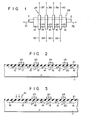
- n +- type semiconductor regions 12, 13, 14, 15 and 16 are formed to have predetermined intervals therebetween on the surface of a p-type silicon .substrate 11.
- P -type semiconductor regions 17, 18, 19 and 20 are respectively formed between each pair of adjacent n +- type semiconductor regions 12 to 16.
- Hydrogen ions are injected in the vicinities of the p +- type semiconductor regions 17 to 20 so as to increase the lattice defects of the crystals and to increase the diffusion coefficient of the impurity.
- the n +- and p +- type semiconductor regions 12 to 16 and 17 to 20, respectively, constitute a first wiring means 26.
- Polycrystalline silicon layers 22, 23, 24 and 25 are formed through an insulation film 21 of SiO 2 on the p +- type semiconductor regions 17 to 20, respectively.
- the polycrystalline silicon layers 22 to 25 extend across the first wiring means 26, and constitute a second wiring means 27.
- the n +- type semiconductor region 12 is connected to a predetermined circuit through an At line 31.
- the n +- type semiconductor region 16 is similarly connected to another predetermined circuit through an Al line 32.
- One end of each of the polycrystalline silicon layers 22 to 25 is connected to still another predetermined circuit through Al lines 33, 34, 35 and 36, respectively.
- the other end of each of the polycrystalline silicon layers 22 to 25 is connected to still another predetermined circuit through Al lines 37, 38, 39 and 40, respectively.
- the required portions of the polycrystalline silicon layers 22 to 25 are irradiated with a pulsed second harmonic beam from an Nd:YAG laser having a wavelength of ° 5,320 A and an energy of about 8 uJoule for several seconds or microseconds.
- the polycrystalline silicon layers are fused and are electrically disconnected.
- Fig. 3 shows a state wherein the polycrystalline silicon layer 22 is electrically disconnected.
- the insulation film 21 does not melt (since silicon oxide has a melting point of 1,610°C). Then, a pair of n +- type semiconductor regions 12 and 13 are heated to a high temperature. The impurity in the n +- type semiconductor regions 12 and 13 diffuses into the p +- type semiconductor region 17, and the n +- type semiconductor regions 12 and 13 are combined with each other. Since the p +- type semiconductor region 17 has many crystal lattice defects, the regions 12 and 13 easily combine with each other.
- a switching element according to the present invention allows the switching of wiring more efficiently than conventional semiconductor devices.
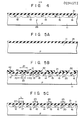
- FIG. 5A an insulation film 21 of silicon oxide and of uniform thickness is formed on a p-type silicon semiconductor substrate 11 by thermal oxidation.
- a resist film as a mask, hydrogen ions and a p-type impurity are injected into the structure to form p +- type semiconductor regions 17 to 20.
- an n-type impurity is diffused to form n +- type semiconductor regions 12 to 16.
- CVD chemical vapor deposition
- An impurity is injected into the polycrystalline silicon layer for a lower resistance, and polycrystalline silicon layers 22 to 25 are formed by a PEP (photoengraving process).
- a diffusion depth Xj of the n + -type semiconductor regions 12 to 16 is about 1.0 ⁇ m, lateral diffusion length Xy is about 0.7 ⁇ m.
- a length l1 of the resist mask 42 is about 2.0 ⁇ m, a length l2 of the p +- type semiconductor regions 17 to 20 is 0.6 ⁇ m.
- a length L of each of the polycrystalline silicon layers 22 to 25 is 2.0 ⁇ m. Then, the respective polycrystalline silicon layers 22 to 25 may be disconnected while pairs of adjacent n + -type semiconductor regions 12 and 13, 13 and 14, 14 and 15, and 15 and 16 are simultaneously connected by radiation of a beam for several seconds or several microseconds.
- the beam may be a pulsed second harmonic beam from an Nd:YAG laser having a wavelength of 5,320 A and an energy of about 8 ⁇ Joule for several seconds or several microseconds, with a spot greater than the length of the polycrystalline silicon layers 22 to 25, that is, 2 ⁇ m.
- a switching element according to a second embodiment of the present invention will now be described with reference to Fig. 6.
- the polycrystalline silicon layers 22 to 25 are formed immediately above the corresponding p +- type semiconductor regions 17 to 20 through the insulation film 21.
- a polycrystalline silicon layer 22 is formed to partially overlap both an n +- type semiconductor region 13 and a p +- type semiconductor region 17 through an insulation film 21.
- Other polycrystalline silicon layers 23, 24 and 25 are similarly formed to partially overlap an n +- type semiconductor region 14 and an p +- type semiconductor region 18, an n +- type semiconductor region 15 and a p +- type semiconductor region 19, and an n +- type semiconductor region 16 and a p +- type semiconductor region 20, respectively, through the insulation film 21.
- the spot diameter of a laser beam may be determined so as to encompass at least the polycrystalline silicon layer 22 and the p +- type semiconductor region 17, as shown in Fig. 6.
- part of the laser beam 41 is not radiated onto the polycrystalline silicon layer 22 but is radiated onto the p +- type semiconductor region 17 and the n +- type semiconductor region 12. Therefore, the n +- type semiconductor regions 12 and 13 may be efficiently connected.
- Other details of the second embodiment remain the same as those of the first embodiment shown in Fig. 2.
- the same reference numerals in Fig. 6 denote the same parts in Fig. 2, and a detailed description thereof will be omitted.
- a polycrystalline silicon layer 22 is formed on an n +- type semiconductor region 13
- a polycrystalline silicon layer 23 is formed on an n +- type semiconductor region 14
- a polycrystalline silicon layer 24 is formed on an n +- type semiconductor region 15
- a polycrystalline silicon layer 25 is formed on an n +- type semiconductor region 16, through an insulation film 21, respectively.
- the spot diameter of a laser beam 41 is selected to encompass the polycrystalline silicon layer 22 and a p +- type semiconductor region 17, as shown in Fig. 7. Similar effects as those obtained in the first and second embodiments described above may also be obtained in this third embodiment.
- the polycrystalline silicon layers 22 to 25 may be arranged within a considerably wide range so that mask alignment precision need not be particularly high.
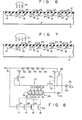
- the signal delay circuit allows selection of a delay time of an input signal IN.
- the input signal IN supplied onto a signal line 51 is delayed by five series-connected inverters 52, 53, 54, 55 and 56 or by an E/D type inverter 57 in which the number of drive MOS transistors may be variable.
- the input signal IN is supplied to the first stage of the series-connected inverters 52 to 56, and an output from the last stage is supplied to an output inverter 59 through an enhancement-type (E-type) MOS transistor 58.
- E-type enhancement-type
- the inverter 57 has a depletion-type (D-type) MOS transistor 60 as a load MOS transistor, and four E-type MOS transistors 61 to 64 as drive MOS transistors.
- the MOS transistors 61 to 64 are connected to the MOS transistor 60 through polycrystalline silicon layers 22 to 25, respectively.
- the n +- type semiconductor region 12 is grounded, and the n +- type semiconductor region 16 is connected to the input end of an inverter 73.
- the input end of the inverter 73 is further connected to a pull-up resistor 74 and to a gate of a MOS transistor 75.
- the output end of the inverter 73 is connected to a gate of the MOS transistor 58.
- An output from the inverter 57 is supplied to the inverter 59 through the MOS transistor 75. Therefore, an output signal OUT corresponding to the input signal IN is obtained from an output line 76 of the inverter 59.
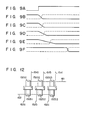
- the surface of the polycrystalline silicon layer 22 is irradiated with a laser beam and the polycrystalline silicon layer 22 is disconnected. Then, the current flowing in the load MOS transistor 60 decreases. Therefore, the waveform of the output signal from the inverter 57 and the waveform of the output signal OUT from the signal line 76 become as indicated by a solid line and a broken line, respectively, shown in Fig. 9C.
- the waveform of the output signal from the inverter 57 and the waveform of the output signal OUT from the signal line 76 become as shown in Figs. 9D and 9E, respectively.
- the laser beam is radiated onto the remaining polycrystalline silicon layer 25. Then, the polycrystalline silicon layer 25 is disconnected while at the same time the n + -type semiconductor regions 15 and 16 combine together. Note that the n+-type semiconductor regions 12, 13, 14 and 15 are already electrically connected when the polycrystalline silicon layers 22, 23 and 24 are disconnected. Therefore, when the polycrystalline silicon layer 25 is disconnected, the first wiring means 26 is electrically connected.
- an input level V to the inverter 73 is given by:
- the circuit is designed such that the MOS transistor 75 is OFF and the MOS transistor 58 is ON when the input level V to the inverter 73 is given by the above equation. Since the input signal IN is significantly delayed by the five series-connected inverters 52 to 56, the output waveform of the last inverter 56 becomes as indicated by a solid line in Fig. 9F. The waveform of the output signal OUT from the signal line 76 becomes as shown by a broken line in Fig. 9F.
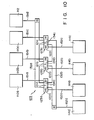
- Fig. 10 shows a switching element according to a fourth embodiment of the present invention.
- the switching element 123 connects the redundancy function circuit block 112 to function circuit blocks 110a, 110b and 110c which are normally used in the device.
- the switching element 123 has a first switching portion 123a connected to the function circuit block 110a, a second switching portion 123b connected to the function circuit block 110b, and a third switching portion 123c connected to the function circuit block 110c.
- the first switching portion 123a comprises a first wiring means 121a and a second wiring means 122a comprising polycrystalline silicon.
- the second switching portion 123b comprises a first wiring means 121b and a second wiring means 122b comprising polycrystalline silicon.
- the third switching portion 123c comprises a first wiring means 121c and a second wiring means 122c comprising polycrystalline silicon.
- One end of each of the first wiring means 121a, 121b and 121c is connected to the p +- type semiconductor region 132a, while the other end of each of the first wiring means 121a, 121b and 121c is connected to the p +- type semiconductor region 132b.
- the first wiring means 121a, 121b and 121c have n +- type semiconductor regions 134a, 134b and 134c which are interposed between the p +- type semiconductor regions 132a and 132b, respectively.
- each of the second wiring means 122a, 122b and 122c is connected to each of the function circuit blocks 110a, 110b and 110c, which are normally used in the device, through each of Al lines 151a, 151b and 151c.
- the other end of each of the second wiring means 122a, 122b and 122c is connected to each of the function circuit blocks 114a, 114b and l14c through each of the Al lines 152a, 152b and 152c.
- the p +- type semiconductor region 132a is connected to the redundancy function circuit block 112 through the Al line 151d, while the p +- type semiconductor region 132b is connected to the function circuit block 114d through the Ai line 152d.
- the switching element 123 with the above arrangement, if one of the function circuit blocks is broken, the broken circuit block is switched to the corresponding redundancy function circuit block. For example, if the function circuit block 110a is broken, the second harmonic Nd:YAG laser beam having a 0 wavelength of about 5,320 A and an energy density of about 8 ⁇ Joules is radiated onto the switching portion 123a to connect the redundancy function circuit block 112 in place of the function circuit block 110a.
- a row decoder using the switching element according to the present invention will be described with reference to Fig. 11.
- a precharge control line PL which receives a precharge signal PS is connected to the gate electrodes of p-channel MOS transistors Qpl, Qp2 and Qp3.
- Address signals A0, Al, A2,... are supplied to address lines ALO, ALl, AL2,..., respectively.
- Inverted address signals A0 , A1, A2,... are supplied to inverted address lines ALO, ALl, AL2,..., respectively.
- a discharge control line DL which receives a discharge signal DS is connected to the gate electrodes of n-channel MOS transistors Qdl, Qd2 and Qd3.
- a source of the MOS transistor Qpl is connected to a power source VDD and a drain thereof is grounded through n-channel MOS transistors Q01, Qll, Q21,..., and Qdl.
- a source of the MOS transistor Qp2 is connected to the power source VDD and a drain thereof is grounded through n-channel MOS transistors Q02, Q12, Q22,..., and Qd2.
- the address line ALO is connected to a gate of the MOS transistor Q02.
- the inverted address line ALO is connected to the gates of the MOS transistors Q01 and Q03.
- the address line ALl is connected to a gate of the MOS transistor Qll.
- the inverted address line ALl is connected to the gates of the MOS transistors Q12 and Q13.
- the inverted address line AL2 is connected to the gates of the MOS transistors Q21, Q22 and Q23.
- the drain of the MOS transistor Q01 is connected to the memory cell through the first switching portion 123a, an inverter Il and a selection line 155.
- the drain of the MOS transistor Q02 is connected to the memory cell through the second switching portion 123b, an inverter I2 and a selection line 156.
- the drain of the MOS transistor Q03 is connected to the memory cell through the third switching portion 123c, an inverter I3 and a selection line 157.
- the switching portions 123a, 123b and 123c constitute the same switching element 123 as that shown in Fig. 10.
- a redundancy decoder is connected to the redundancy memory cell through an inverter I4 and a selection line 158.
- the redundancy decoder comprises the p-channel MOS transistor Qp4 and n-channel MOS transistors Q04, Q14, Q24,..., and Qd4 which are series connected between the power source VDD and the ground.
- a gate of the MOS transistor Qp4 is connected to the p +- type semiconductor region 132a of the switching element 123.
- the p +- type semiconductor region 132b is connected to the precharge control line PL.
- a gate of the MOS transistor Q04 is connected to the address line ALO and the inverted address line ALO through a switching element 123d.
- a gate of the MOS transistor Q14 is connected to the address line ALl and the inverted address line ALl through a switching element 123e.
- a gate of the MOS transistor Q24 is connected to the address line AL2 and the inverted address line AL2 through a switching element 123f.
- a gate of the MOS transistor Qd4 is connected to the discharge line DL through an element 160 which is normally disconnected electrically.
- the element 160 has the same arrangement as the conventional switching element.
- Input ends of the inverters Il to I3 are connected to the power source VDD respectively through resistors Rl to R3.
- a gate of the MOS transistor Qp4 is grounded through a resistor R4.
- the decoder of the type having the arrangement described above if the memory cell connected to the selection line 155 is defective, a laser beam is radiated on the switching portion 123a.
- the gate of the redundancy MOS transistor Qp4 is electrically connected to the precharge line PL.
- the selection line 155 is connected to the power source VDD through the inverter Il and the resistor Rl, so that the selection line 155 is constantly kept at "L" level.
- the laser beam is radiated on the switching element 123d, and the gate of the MOS transistor Q04 is electrically connected to the inverted address line ALO.
- the gate of the MOS transistor Q14 is electrically connected to the address line ALl in the same manner as the MOS transistor Qll, so that the switching element 123e need not be switched. Further, the laser beam is radiated onto the switching element 123f, so that the gate of the MOS transistor Q24 is electrically connected to the inverted address line AL2.
- the laser beam is radiated onto the element 160 which is disconnected, and the gate of the MOS transistor Qd4 is electrically connected to the discharge control line DL. Therefore, the redundancy memory cell connected to the selection line 158 is selected.
- the frequency of laser radiation is decreased as compared with the frequency in the conventional method.
- the redundancy MOS transistors Q04, Q14, Q24,... are first electrically connected to the address lines ALO, ALl, AL2,..., respectively.
- the laser beam is radiated only on the switching element to be switched to the inverted address line, and the frequency of laser radiation is decreased.
- the element 160 is arranged not to set the selection line 158 to "H" level if the redundancy memory cell need not be used.
- Fig. 12 shows a modification of the switching element shown in Fig. 10. Three switching elements are separately formed.
- the switching elements in Fig. 12 have the same arrangement as the switching element in Fig. 10 except that p +- type semiconductor regions 132al, 132a2 and 132a3 which constitute the first wiring means are mutually connected by a line 161 of aluminum and that p +- type semiconductor regions 132bl, 132b2 and 132b3 are connected by a line 162 of aluminum. Therefore, the same reference numerals used in Fig. 10 denote the same parts in Fig. 12, and a detailed description thereof will be omitted.
- the laser beam is only radiated onto the switching portion connected to the broken circuit.
- the broken circuit is readily switched to the redundancy function circuit.
- heating is performed by laser beam radiation.
- radiation of another energy beam such as an electron beam may be used.
- a heating element may be formed inside a semiconductor device and heating may be performed internally by the heating element.
- Conductor layers of aluminum may be used in place of the polycrystalline silicon layers 22 to 25. If an At conductor layer is used, it may be more easily melted than the polycrystalline silicon layers 22 to 25 since the melting temperature of aluminum is 660°C.
- hydrogen ions are injected in the p +- type semiconductor regions 17 to 20 in order to increase the lattice defects of the crystals.
- ions of at least one element selected from helium, neon, argon, krypton, xenon and radon may alternatively be injected.
Landscapes
- Design And Manufacture Of Integrated Circuits (AREA)
Applications Claiming Priority (4)
| Application Number | Priority Date | Filing Date | Title |
|---|---|---|---|
| JP79416/82 | 1982-05-12 | ||
| JP57079416A JPS58197745A (ja) | 1982-05-12 | 1982-05-12 | 半導体装置 |
| JP57079415A JPS58197744A (ja) | 1982-05-12 | 1982-05-12 | 半導体装置 |
| JP79415/82 | 1982-05-12 |
Publications (3)
| Publication Number | Publication Date |
|---|---|
| EP0094073A2 true EP0094073A2 (de) | 1983-11-16 |
| EP0094073A3 EP0094073A3 (en) | 1985-09-11 |
| EP0094073B1 EP0094073B1 (de) | 1988-07-27 |
Family
ID=26420437
Family Applications (1)
| Application Number | Title | Priority Date | Filing Date |
|---|---|---|---|
| EP83104544A Expired EP0094073B1 (de) | 1982-05-12 | 1983-05-09 | Halbleiteranordnung mit der Fähigkeit für strukturelle Selektion |
Country Status (3)
| Country | Link |
|---|---|
| US (1) | US4513310A (de) |
| EP (1) | EP0094073B1 (de) |
| DE (1) | DE3377555D1 (de) |
Cited By (1)
| Publication number | Priority date | Publication date | Assignee | Title |
|---|---|---|---|---|
| EP0258962A3 (de) * | 1986-09-05 | 1988-08-03 | THORN EMI North America Inc. | Halbleiteranordnungen mit selektiven Verbindungen und ein Verfahren zu deren Herstellung |
Families Citing this family (6)
| Publication number | Priority date | Publication date | Assignee | Title |
|---|---|---|---|---|
| JPH02186636A (ja) * | 1989-01-12 | 1990-07-20 | Seiko Epson Corp | 集積回路装置の配線法 |
| USD313458S (en) | 1989-09-28 | 1991-01-01 | Hengesbach Robert W | Combined reversible sprinkler nozzle and support ring |
| IL103566A (en) * | 1992-10-27 | 1995-06-29 | Quick Tech Ltd | Active matrix of a display panel |
| DE4437698A1 (de) * | 1994-10-21 | 1995-03-16 | Hilmann Ruge Thomas Dipl Phys | Struktur zur binären Speicherung von Informationen auf integrierten Schaltungen mittels Laserstrahlung und Verfahren zur nichtflüchtigen Informationsspeicherung |
| DE19604776A1 (de) * | 1996-02-09 | 1997-08-14 | Siemens Ag | Auftrennbare Verbindungsbrücke (Fuse) und verbindbare Leitungsunterbrechung (Anti-Fuse), sowie Verfahren zur Herstellung und Aktivierung einer Fuse und einer Anti-Fuse |
| US20090123356A1 (en) * | 1997-07-22 | 2009-05-14 | Blacklight Power, Inc. | Inorganic hydrogen compounds |
Family Cites Families (3)
| Publication number | Priority date | Publication date | Assignee | Title |
|---|---|---|---|---|
| US3584183A (en) * | 1968-10-03 | 1971-06-08 | North American Rockwell | Laser encoding of diode arrays |
| BE794202A (fr) * | 1972-01-19 | 1973-05-16 | Intel Corp | Liaison fusible pour circuit integre sur substrat semi-conducteur pour memoires |
| US3882532A (en) * | 1972-07-03 | 1975-05-06 | Ibm | Externally accessing mechanically difficult to access circuit nodes in integrated circuits |
-
1983
- 1983-05-09 EP EP83104544A patent/EP0094073B1/de not_active Expired
- 1983-05-09 DE DE8383104544T patent/DE3377555D1/de not_active Expired
- 1983-05-10 US US06/493,226 patent/US4513310A/en not_active Expired - Lifetime
Non-Patent Citations (2)
| Title |
|---|
| APPLIED PHYSICS LETTERS, vol. 26, no. 3, 1st February 1975, pages 124-126, New York, US; P.W.COOK et al.: "Connections and disconnections on integrated circuits using nanosecond laser pulses" * |
| IBM TECHNICAL DISCLOSURE BULLETIN, vol. 21, no. 3, August 1978, page 1086, New York, US; K.BRACK et al.: "Directed activation of implanted semiconductor zones" * |
Cited By (1)
| Publication number | Priority date | Publication date | Assignee | Title |
|---|---|---|---|---|
| EP0258962A3 (de) * | 1986-09-05 | 1988-08-03 | THORN EMI North America Inc. | Halbleiteranordnungen mit selektiven Verbindungen und ein Verfahren zu deren Herstellung |
Also Published As
| Publication number | Publication date |
|---|---|
| DE3377555D1 (en) | 1988-09-01 |
| EP0094073A3 (en) | 1985-09-11 |
| US4513310A (en) | 1985-04-23 |
| EP0094073B1 (de) | 1988-07-27 |
Similar Documents
| Publication | Publication Date | Title |
|---|---|---|
| US5345110A (en) | Low-power fuse detect and latch circuit | |
| US4238839A (en) | Laser programmable read only memory | |
| US4455495A (en) | Programmable semiconductor integrated circuitry including a programming semiconductor element | |
| US7405463B2 (en) | Gate dielectric antifuse circuit to protect a high-voltage transistor | |
| US7210224B2 (en) | Method for forming an antifuse | |
| US20030218487A1 (en) | Programmable latch array using antifuses | |
| EP0663669A2 (de) | Verbesserungen an Schmelz- und Antischmelzsicherungen für integrierte Schaltungen | |
| KR0122103B1 (ko) | 반도체 메모리 장치의 퓨즈 소자 | |
| JPH0410229B2 (de) | ||
| EP0108650A2 (de) | Programmierbarer MOS-Transistor | |
| JPH0428145B2 (de) | ||
| US6713839B2 (en) | Antifuse structure with low resistance | |
| US4783424A (en) | Method of making a semiconductor device involving simultaneous connection and disconnection | |
| EP0094073B1 (de) | Halbleiteranordnung mit der Fähigkeit für strukturelle Selektion | |
| EP0359204A2 (de) | Halbleiterspeicheranordnung, welche ein Herabsetzen der Anzahl mangelhafter Bits erlaubt | |
| JPS63278250A (ja) | 半導体装置 | |
| JPH0578187B2 (de) | ||
| US20010004331A1 (en) | Semiconductor storage device | |
| JPS5843906B2 (ja) | 半導体集積回路とその回路プログラム方法 | |
| JPS5843907B2 (ja) | 半導体集積回路およびその回路プログラム方法 | |
| JPH0516183B2 (de) | ||
| JPS59229838A (ja) | 半導体集積回路 | |
| KR100519513B1 (ko) | 앤티퓨즈의 프로그래밍장치를 갖는 리페어회로 | |
| KR100345369B1 (ko) | 퓨즈 회로 | |
| JPS61187253A (ja) | 半導体装置の製造方法 |
Legal Events
| Date | Code | Title | Description |
|---|---|---|---|
| PUAI | Public reference made under article 153(3) epc to a published international application that has entered the european phase |
Free format text: ORIGINAL CODE: 0009012 |
|
| 17P | Request for examination filed |
Effective date: 19830509 |
|
| AK | Designated contracting states |
Designated state(s): DE FR GB |
|
| RAP1 | Party data changed (applicant data changed or rights of an application transferred) |
Owner name: KABUSHIKI KAISHA TOSHIBA |
|
| PUAL | Search report despatched |
Free format text: ORIGINAL CODE: 0009013 |
|
| AK | Designated contracting states |
Designated state(s): DE FR GB |
|
| 17Q | First examination report despatched |
Effective date: 19870210 |
|
| GRAA | (expected) grant |
Free format text: ORIGINAL CODE: 0009210 |
|
| AK | Designated contracting states |
Kind code of ref document: B1 Designated state(s): DE FR GB |
|
| REF | Corresponds to: |
Ref document number: 3377555 Country of ref document: DE Date of ref document: 19880901 |
|
| ET | Fr: translation filed | ||
| PLBE | No opposition filed within time limit |
Free format text: ORIGINAL CODE: 0009261 |
|
| STAA | Information on the status of an ep patent application or granted ep patent |
Free format text: STATUS: NO OPPOSITION FILED WITHIN TIME LIMIT |
|
| 26N | No opposition filed | ||
| PGFP | Annual fee paid to national office [announced via postgrant information from national office to epo] |
Ref country code: GB Payment date: 19970430 Year of fee payment: 15 |
|
| PGFP | Annual fee paid to national office [announced via postgrant information from national office to epo] |
Ref country code: FR Payment date: 19970513 Year of fee payment: 15 |
|
| PGFP | Annual fee paid to national office [announced via postgrant information from national office to epo] |
Ref country code: DE Payment date: 19970516 Year of fee payment: 15 |
|
| PG25 | Lapsed in a contracting state [announced via postgrant information from national office to epo] |
Ref country code: GB Free format text: LAPSE BECAUSE OF NON-PAYMENT OF DUE FEES Effective date: 19980509 |
|
| PG25 | Lapsed in a contracting state [announced via postgrant information from national office to epo] |
Ref country code: FR Free format text: LAPSE BECAUSE OF NON-PAYMENT OF DUE FEES Effective date: 19980531 |
|
| GBPC | Gb: european patent ceased through non-payment of renewal fee |
Effective date: 19980509 |
|
| PG25 | Lapsed in a contracting state [announced via postgrant information from national office to epo] |
Ref country code: DE Free format text: LAPSE BECAUSE OF NON-PAYMENT OF DUE FEES Effective date: 19990302 |
|
| REG | Reference to a national code |
Ref country code: FR Ref legal event code: ST |