EP0093871A2 - Dielektrisch erwärmbarer Polyolefinschaum - Google Patents
Dielektrisch erwärmbarer Polyolefinschaum Download PDFInfo
- Publication number
- EP0093871A2 EP0093871A2 EP83103010A EP83103010A EP0093871A2 EP 0093871 A2 EP0093871 A2 EP 0093871A2 EP 83103010 A EP83103010 A EP 83103010A EP 83103010 A EP83103010 A EP 83103010A EP 0093871 A2 EP0093871 A2 EP 0093871A2
- Authority
- EP
- European Patent Office
- Prior art keywords
- acid
- polyolefin
- foam
- polyolefins
- foams
- Prior art date
- Legal status (The legal status is an assumption and is not a legal conclusion. Google has not performed a legal analysis and makes no representation as to the accuracy of the status listed.)
- Granted
Links
Classifications
-
- C—CHEMISTRY; METALLURGY
- C08—ORGANIC MACROMOLECULAR COMPOUNDS; THEIR PREPARATION OR CHEMICAL WORKING-UP; COMPOSITIONS BASED THEREON
- C08J—WORKING-UP; GENERAL PROCESSES OF COMPOUNDING; AFTER-TREATMENT NOT COVERED BY SUBCLASSES C08B, C08C, C08F, C08G or C08H
- C08J9/00—Working-up of macromolecular substances to porous or cellular articles or materials; After-treatment thereof
- C08J9/0061—Working-up of macromolecular substances to porous or cellular articles or materials; After-treatment thereof characterized by the use of several polymeric components
-
- B—PERFORMING OPERATIONS; TRANSPORTING
- B29—WORKING OF PLASTICS; WORKING OF SUBSTANCES IN A PLASTIC STATE IN GENERAL
- B29C—SHAPING OR JOINING OF PLASTICS; SHAPING OF MATERIAL IN A PLASTIC STATE, NOT OTHERWISE PROVIDED FOR; AFTER-TREATMENT OF THE SHAPED PRODUCTS, e.g. REPAIRING
- B29C35/00—Heating, cooling or curing, e.g. crosslinking or vulcanising; Apparatus therefor
- B29C35/02—Heating or curing, e.g. crosslinking or vulcanizing during moulding, e.g. in a mould
- B29C35/12—Dielectric heating
-
- C—CHEMISTRY; METALLURGY
- C08—ORGANIC MACROMOLECULAR COMPOUNDS; THEIR PREPARATION OR CHEMICAL WORKING-UP; COMPOSITIONS BASED THEREON
- C08J—WORKING-UP; GENERAL PROCESSES OF COMPOUNDING; AFTER-TREATMENT NOT COVERED BY SUBCLASSES C08B, C08C, C08F, C08G or C08H
- C08J2323/00—Characterised by the use of homopolymers or copolymers of unsaturated aliphatic hydrocarbons having only one carbon-to-carbon double bond; Derivatives of such polymers
- C08J2323/02—Characterised by the use of homopolymers or copolymers of unsaturated aliphatic hydrocarbons having only one carbon-to-carbon double bond; Derivatives of such polymers not modified by chemical after treatment
-
- C—CHEMISTRY; METALLURGY
- C08—ORGANIC MACROMOLECULAR COMPOUNDS; THEIR PREPARATION OR CHEMICAL WORKING-UP; COMPOSITIONS BASED THEREON
- C08J—WORKING-UP; GENERAL PROCESSES OF COMPOUNDING; AFTER-TREATMENT NOT COVERED BY SUBCLASSES C08B, C08C, C08F, C08G or C08H
- C08J2467/00—Characterised by the use of polyesters obtained by reactions forming a carboxylic ester link in the main chain; Derivatives of such polymers
-
- Y—GENERAL TAGGING OF NEW TECHNOLOGICAL DEVELOPMENTS; GENERAL TAGGING OF CROSS-SECTIONAL TECHNOLOGIES SPANNING OVER SEVERAL SECTIONS OF THE IPC; TECHNICAL SUBJECTS COVERED BY FORMER USPC CROSS-REFERENCE ART COLLECTIONS [XRACs] AND DIGESTS
- Y10—TECHNICAL SUBJECTS COVERED BY FORMER USPC
- Y10S—TECHNICAL SUBJECTS COVERED BY FORMER USPC CROSS-REFERENCE ART COLLECTIONS [XRACs] AND DIGESTS
- Y10S264/00—Plastic and nonmetallic article shaping or treating: processes
- Y10S264/18—Cross-linking a thermoplastic linear foam during molding
-
- Y—GENERAL TAGGING OF NEW TECHNOLOGICAL DEVELOPMENTS; GENERAL TAGGING OF CROSS-SECTIONAL TECHNOLOGIES SPANNING OVER SEVERAL SECTIONS OF THE IPC; TECHNICAL SUBJECTS COVERED BY FORMER USPC CROSS-REFERENCE ART COLLECTIONS [XRACs] AND DIGESTS
- Y10—TECHNICAL SUBJECTS COVERED BY FORMER USPC
- Y10T—TECHNICAL SUBJECTS COVERED BY FORMER US CLASSIFICATION
- Y10T428/00—Stock material or miscellaneous articles
- Y10T428/249921—Web or sheet containing structurally defined element or component
- Y10T428/249953—Composite having voids in a component [e.g., porous, cellular, etc.]
-
- Y—GENERAL TAGGING OF NEW TECHNOLOGICAL DEVELOPMENTS; GENERAL TAGGING OF CROSS-SECTIONAL TECHNOLOGIES SPANNING OVER SEVERAL SECTIONS OF THE IPC; TECHNICAL SUBJECTS COVERED BY FORMER USPC CROSS-REFERENCE ART COLLECTIONS [XRACs] AND DIGESTS
- Y10—TECHNICAL SUBJECTS COVERED BY FORMER USPC
- Y10T—TECHNICAL SUBJECTS COVERED BY FORMER US CLASSIFICATION
- Y10T428/00—Stock material or miscellaneous articles
- Y10T428/249921—Web or sheet containing structurally defined element or component
- Y10T428/249953—Composite having voids in a component [e.g., porous, cellular, etc.]
- Y10T428/249981—Plural void-containing components
-
- Y—GENERAL TAGGING OF NEW TECHNOLOGICAL DEVELOPMENTS; GENERAL TAGGING OF CROSS-SECTIONAL TECHNOLOGIES SPANNING OVER SEVERAL SECTIONS OF THE IPC; TECHNICAL SUBJECTS COVERED BY FORMER USPC CROSS-REFERENCE ART COLLECTIONS [XRACs] AND DIGESTS
- Y10—TECHNICAL SUBJECTS COVERED BY FORMER USPC
- Y10T—TECHNICAL SUBJECTS COVERED BY FORMER US CLASSIFICATION
- Y10T442/00—Fabric [woven, knitted, or nonwoven textile or cloth, etc.]
- Y10T442/30—Woven fabric [i.e., woven strand or strip material]
- Y10T442/3325—Including a foamed layer or component
Definitions
- the invention relates to dielectrically weldable polyolefin foams which have been produced in the presence of unsaturated polyester resins.
- plastics can be high-frequency welded with the aid of an electromagnetic field, in which process the plastic molecules are set in vibration and thus generate the heat required for the welding process in the plastic itself without external heating or with only slight external heating.
- high frequency such as polyvinyl chloride.
- high-frequency welding of polyethylenes was achieved by mixing them with ethylene / vinyl acetate copolymers.
- plasticizers of this type cannot be incorporated into them and even in small quantities disrupt the foaming of polyolefins.
- chlorinated polyethylene which leads to an improvement in high-frequency heating, is also an option.
- this heating effect is not sufficient for technical use.
- the invention therefore relates to dielectrically heatable polyolefin foams which contain ⁇ rß-unsaturated polyesters in amounts of 3-20, preferably 5-10% by weight, based on the foam.
- the foams according to the invention can be produced by both continuous and discontinuous methods, such as those e.g. are described in DE-PS 16 94 130 or US-PS 37 11 584.
- the foams according to the invention were preferably produced in such a way that the mixing of the polyolefins with the foaming agents, crosslinking agents, any customary additives and the polyesters used according to the invention in the amounts specified above was carried out on a mixing roll mill or on an extruder with subsequent production of the moldings, such as plates or continuous webs , takes place at temperatures below the decomposition point of the crosslinking and foaming agent.
- the mean residence time in the mixing device is such that crosslinking of the mixture to be foamed essentially does not occur at this stage.
- the polyolefin sheet or web is then crosslinked, preferably at temperatures below the decomposition point of the foaming agent but above the decomposition point of the crosslinking agent by heating or by irradiation with an increase in the melt viscosity of the polyolefin. If the temperature rises further at or above the decomposition temperature of the foaming agent, the molded body foams. Depending on the amount of Foaming agent, the crosslinking agent and the process conditions form a foam with a density of 15 kg / m 3 to 300 kg / m 3 , preferably 20 to 200 kg / m 3 .
- the process according to the invention is preferably used for the production of continuous foam webs, for example according to the process described in DE-AS 16 94 130, according to which heating takes place in an oven while the continuous polyolefin web is supported on an endless conveyor belt.
- a foam-releasing agent is expediently used as the foaming agent, the decomposition temperature of which is higher than that of the crosslinking agent used, preferably an organic peroxide.
- Suitable foaming agents are e.g. Azodicarbonamide and / or p, p'-oxi-bis-benzenesulfonyl hydrazide and / or dinitrosopentamethylenetetramine.
- the preferred foaming agent is azodicarbonamide with a decomposition point or decomposition range from 190 ° C.
- the amount of foaming agent used depends on the desired density of the foam to be produced and is generally between 0.5 to 25% by weight, preferably 1 to 20% by weight, based on the total mixture.
- the foams according to the invention can be crosslinked in a known manner by the action of high-energy rays or with the aid of known crosslinking agents, preferably organic peroxides.
- 2,5-dimethyl-2,5-di- (tert-butylperoxy) hexane, tert-butyl hydroperoxide, cumyl tert-butyl peroxide, di-tert-butyl peroxide, preferably dicumyl peroxide, can be used as the organic peroxide will.
- the peroxides are used in amounts of 0.3 to 1.5% by weight, based on the polyolefin.
- Polyols or polypropylene can be used as polyolefins, preferably polyethylene, namely low-pressure polyethylene with a density of 0.94 to 0.97 g / cm 3 and / or high-pressure polyethylene with a density of 0.91 to about 0.94 g / cm 3 , preferably high pressure polyethylene.
- polyolefins is also understood to mean polyolefin copolymers, preferably those for the production of which monomer mixtures with a predominant proportion of polyolefins are used.
- Such copolymers are e.g. Ethylene-propylene copolymers, ethylene-butylene copolymers, copolymers of ethylene and acrylic acid esters or their derivatives, copolymers of ethylene and methacrylic acid or their derivatives.
- Mixtures of the abovementioned polyolefins with rubbers and / or plastics can also be processed into foams according to the invention. Among them are e.g. Mixtures understood that consist of 50 wt .-% and more than polyolefins. Rubbers miscible with polyolefins are e.g.
- Natural rubber ethylene-propylene rubber, butyl rubber, polyisobutylene, ABS rubber, polybutadiene, polybutene and polyisoprene.
- Plastics miscible with polyolefins are e.g. Polystyrene, chlorinated polyethylene or sulfochlorinated polyethylene or the like.
- Suitable modifiers are OC, ⁇ -unsaturated polyesters.
- Preferred, ⁇ -unsaturated polyesters are the known polycondensation products from at least one, ⁇ -monounsaturated dicarboxylic acid with 4 - 8 C atoms or their derivatives such as e.g. Anhydrides, optionally in a mixture with up to 200 mol%, based on the unsaturated dicarboxylic acid, of at least one saturated aliphatic or cycloaliphatic or aromatic dicarboxylic acid with 8-10 C atoms or their derivatives with at least one aliphatic, cycloaliphatic or aromatic polyhydroxy compound, in particular dihydroxy compound with 2-8 C atoms, preferably polyester, as described in J. Björksten et al., "Polyesters and their Applications", Reinhold Publishing Corp., New York 1956.
- Examples of preferred unsaturated dicarboxylic acids or their derivatives are maleic acid or maleic anhydride and fumaric acid. However, mesaconic acid, citraconic acid, itaconic acid or chloromaleic acid can also be used, for example.
- Examples of the optionally used aromatic, saturated aliphatic or cycloaliphatic dicarboxylic acids or their derivatives are phthalic acid or phthalic anhydride, isophthalic acid, terephthalic acid, tetrahydrophthalic acid or hexa- chlorides or their anhydrides, endomethylene or its anhydride, succinic acid or succinic anhydride and Bernsteinklar and, adipic acid , Sebacic acid.
- Halogenated resins can also be used to manufacture flame-retardant resins
- Dicarboxylic acids such as hexachlorodomethylene-tetrahydrophthalic acid, tetrachlorophthalic acid or tetrabromophthalic acid can also be used.
- dihydric alcohols preferably aliphatic alcohols with C 2 -C 20 ethylene glycol, 1,2-propanediol, 1,3-propanediol, diethylene glycol, dipropylene glycol, 1,3-butanediol, 1,4-butanediol, neopentyl glycol, 1,6-hexanediol , 2,2-bis (4-hydroxycyclohexyl) propane, perhydrobisphenol as phenols, preferably bisoxalkylated bisphenol A, and others can be used.
- Ethylene glycol, 1,2-propanediol, diethylene glycol and dipropylene glycol are preferably used.
- mono-, tri- and tetravalent alcohols with 1-6 C atoms, such as methanol, ethanol, butanol, allyl alcohol, benzyl alcohol, cyclohexanol and tetrahydrofurfuryl alcohol, trimethylpropane, glycerin and pentaerythritol, of mono-, di- and Triallyl ethers and benzyl ethers of trihydric and polyhydric alcohols with 3-6 C atoms according to DE-AS 1 024 654, for example Trimethylolpropane diallyl ether, and by incorporating monocarboxylic acids such as benzoic acid or acrylic acid.
- monocarboxylic acids such as benzoic acid or acrylic acid.
- the acid numbers of the polyesters are preferably between 10 and 100, preferably between 20 and 70, the OH numbers between 10 and 150, preferably between 20 and 100, and the molecular weights determined as number average M n between approximately 500 and 5000, preferably between approximately 1000 and 3000 (measured by vapor pressure osmometry in dioxane and acetone).
- Unsaturated monomers copolymerizable with the unsaturated polyesters are suitable in polyester technology unsaturated compounds which are customary in technology and which preferably carry ⁇ -substituted vinyl or vinylidene groups or ⁇ -substituted allyl groups, preferably styrene; but also, for example, nuclear chlorinated and alkylated or alkenylated styrenes, where the alkyl groups contain 1-4 carbon atoms, for example vinyltoluene, divinylbenzene, ⁇ -methylstyrene, tert-butylstyrene, chlorostyrenes; Vinyl esters of carboxylic acids with 2-6 carbon atoms, preferably vinyl acetate, vinyl propionate, vinyl benzoate, vinyl pyridine, vinyl naphthalene, vinyl cyclohexane, acrylic acid and methacrylic acid and / or their esters (preferably vinyl, allyl and methallyl esters) with 1-4 carbon
- the addition of the unsaturated polyesters in the production quantity of chemically crosslinked polyolefin foams enables the peroxide, which is preferably on the crosslinking agent, to be considerably reduced.
- this reduction means that the sometimes malodorous Zer Settlement products of the preferably used dicumyl peroxide, such as acetophenone, are obtained in much smaller amounts.
- additives commonly used with polyolefin-based plastics such as Light stabilizers, pigments, fillers, flame retardants, antistatic agents, lubricants can be added to the mixture to be crosslinked and foamed before processing into a shaped body.
- the polyolefin foams according to the invention are dielectrically heatable and thus allow advantageous further processing in accordance with the processes known per se, utilizing dielectric heating, e.g. High frequency welding.- Deformation - punching at frequencies of approximately 27 mHz. As a result, in particular temperature-sensitive materials, such as textile fabrics, can be welded to the polyolefin foam in a simple manner.
- a mixture of the following products in the specified parts by weight is extruded into a plate in an extruder:
- the commercially available polyester was produced by polycondensation of maleic anhydride, ethylene, ethylene glycol, dipropylene glycol, benzyl alcohol.
- the extrusion temperature of the molding compound is approximately 130 ° C., so that neither foaming nor crosslinking occurs.
- the plate thus obtained is heated in a hot air oven, as described in DE-PS 16 94 130, to a temperature of approximately 210 ° C., which results in a uniform crosslinked foam web.
- the foam web is cooled by fresh air and contact with cooled rollers.
- the foam has a smooth surface and has a density of 35 kg / m 3 .
- the welded product is flawlessly welded Foam with itself and with different textile fabrics possible.
- Example 1 As described in Example 1, a polyethylene foam sheet with a thickness of 3 mm and a density of 200 kg / m 3 is produced while reducing the amount of blowing agent. A film of an ethylene vinyl acetate copolymer with a thickness of 50 m ⁇ is placed between two foam webs and the webs are high frequency welded in a 4 "high-frequency apparatus with a power of 5 kW. The webs adhere without problems and are practically no longer distinguishable as individual webs.
Landscapes
- Chemical & Material Sciences (AREA)
- Polymers & Plastics (AREA)
- Materials Engineering (AREA)
- Health & Medical Sciences (AREA)
- Chemical Kinetics & Catalysis (AREA)
- Medicinal Chemistry (AREA)
- Engineering & Computer Science (AREA)
- Organic Chemistry (AREA)
- Manufacture Of Porous Articles, And Recovery And Treatment Of Waste Products (AREA)
- Addition Polymer Or Copolymer, Post-Treatments, Or Chemical Modifications (AREA)
- Mattresses And Other Support Structures For Chairs And Beds (AREA)
- Laminated Bodies (AREA)
- Compositions Of Macromolecular Compounds (AREA)
- Detergent Compositions (AREA)
Abstract
Description
- Gegenstand der Erfindung sind dielektrisch verschweißbare Polyolefinschäume, die in Gegenwart von ungesättigten Polyesterharzen hergestellt worden sind.
- Es ist bereits bekannt, daß bestimmte Kunststoffe mit Hilfe eines elektromagnetischen Feldes hochfrequenzgeschweißt werden können, wobei in diesem Verfahren die Kunststoffmoleküle in Schwingungen versetzt werden und so ohne äußeres Erhitzen oder mit nur geringem äußerem Erhitzen die für den Schweißvorgang erforderliche Wärme in dem Kunststoff selbst erzeugen. Das heißt, daß nur ganz bestimmte Kunststoffe hochfrequenzschweißbar sind, wie beispielsweise Polyvinylchlorid. Polyolefine, insbesondere Polyethylene sind es nicht.
- Aber das dielektrische Erwärmen von Polyolefin-Schaumstoffen ist wirtschaftlich sehr interessant, weil dadurch nicht nur ein schonendes Erwärmen des Materials innerhalb weniger Sekunden möglich wird,sondern auch die Elektroden des Hochfrequenzfeldes gleichzeitig als formgebendes Werkzeug benutzt werden können. Es hat nicht an Versuchen gefehlt, auch Polyolefine durch bestimmte Zusätze dielektrisch verschweißbar zu machen.
- Unter anderem wurde eine Hochfrequenzverschweißung von Polyethylenen durch Abmischen mit Ethylen/Vinylacetat-Copolymerisaten erreicht.
- Derartige Mischungen eignen sich aber nicht zur Herstellung von vernetzten Schäumen, da bei der Herstellung der verschäumbaren und vernetzbaren Bahnen bereits im Extruder Vernetzungen auftreten können.
- Weiter ist bekannt, daß durch Zugabe von monomeren Weichmachern wie Dioctylphthalat eine dielektrische Erwärmung bei manchen Kunststoffen ermöglicht werden kann.
- Derartige Weichmacher sind jedoch aufgrund ihrer Unverträglichkeit mit Polyolefinen in diese nicht einarbeitbar und stören auch bereits in geringen Mengen die Verschäumung von Polyolefinen.
- Weiterhin kann über verschiedene Füllstoffe wie z.B. Bariumferrit, ein dielektrisches Erwärmen von Polyolefinen erreicht werden.
- Aber auch diese Zusatzstoffe beeinflussen das Verschäumen von Polyolefinen, so daß Polyolefinschäume mit niedrigen Raumgewichten nicht herstellbar sind.
- Auch der Zusatz von chloriertem Polyethylen, das zu einer Verbesserung der Hochfrequenz-Erwärmung führt, bietet sich an. Jedoch reicht dieser Erwärmungseffekt für eine technische Nutzung nicht aus.
- Überraschenderweise gelingt es nun durch Modifikation von Polyolefinen mit α,β-ungesättigten Polyestern dielektrisch erwärmbare Schäume herzustellen.
- Gegenstand der Erfindung sind daher dielektrisch erwärmbare Polyolefinschäume, die α rß-ungesättigte Polyester in Mengen von 3-20, vorzugsweise 5-10 Gew.-%, bezogen auf den Schaum enthalten.
- Die erfindungsgemäßen Schäume können sowohl nach kontinuierlichen als auch diskontinuierlichen Methoden hergestellt werden, wie sie z.B. in der DE-PS 16 94 130 oder US-PS 37 11 584 beschrieben sind.
- Vorzugsweise wurden die erfindungsgemäßen Schäume so hergestellt, daß das Vermischen der Polyolefine mit den Schäummitteln, Vernetzungsmitteln, gegebenenfalls üblichen Zusatzstoffen sowie den erfindungsgemäß verwendeten in den obigen Mengen angegebenen Polyestern auf einem Mischwalzwerk oder auf einem Extruder unter nachfolgender Herstellung der Formkörper, wie Platten oder kontinuierlicher Bahnen, bei Temperaturen unterhalb des Zersetzungspunkts des Vernetzungs- und Verschäumungsmittels erfolgt. Die mittlere Verweilzeit in der Mischvorrichtung ist so bemessen, daß eine Vernetzung der zu verschäumenden Mischung in diesem Stadium im wesentlichen unterbleibt. Anschließend erfolgt die Vernetzung der Polyolefinplatte - oder Bahn, vorzugsweise bei Temperaturen unterhalb des Zersetzungspunktes des Schäummittels aber oberhalb des Zersetzungspunktes des Vernetzungsmittels durch Erwärmen oder durch Bestrahlung unter Erhöhung der Schmelzviskosität des Polyolefins. Bei weiterer Temperaturerhöhung bei oder oberhalb der Zersetzungstemperatur des Schäummittels verschäumt der Formkörper. Je nach Menge des Schäummittels, des Vernetzungsmittels und der Verfahrensbedingungen entsteht ein Schaum mit einer Dichte von 15 kg/m3 bis 300 kg/m3, vorzugsweise 20 bis 200 kg/m3.
- Bevorzugt wird das erfindungsgemäße Verfahren zur Herstellung fortlaufender Schaumstoffbahnen angewendet, beispielsweise nach dem in der DE-AS 16 94 130 beschriebenen Verfahren, nach dem eine Erhitzung in einem Ofen erfolgt, während die fortlaufende Polyolefinbahn auf einem endlosen Transportband unterstützt wird.
- Als Schäummittel wird zweckmäßig ein in der Hitze gasabspaltendes Mittel verwendet, dessen Zersetzungstemperatur höher liegt als diejenige des verwendeten Vernetzungsmittels, vorzugsweise einem organischen Peroxid. Geeignete Schäummittel sind z.B. Azodicarbonamid und/oder p,p'-Oxi-bis-benzolsulfonyl-hydrazid und/oder Dinitrosopentamethylentetramin.
- Bevorzugtes Schäummittel ist Azodicarbonamid mit einem Zersetzungspunkt bzw. Zersetzungsbereich ab 190°C. Die angewendete Menge an Schäummittel richtet sich nach der angestrebten Dichte des herzustellenden Schaumstoffs und liegt im allgemeinen zwischen 0,5 bis 25 Gew.-%, vorzugsweise bei 1 bis 20 Gew.-%, bezogen auf die Gesamtmischung.
- Die Vernetzung der erfindungsgemäßen Schäume kann in bekannter Weise durch Einwirkung hochenergetischen Strahlen oder mit Hilfe von bekannten Vernetzungsmittel, vorzugsweise organischen Peroxiden erfolgen.
- Als organisches Peroxid können je nach Polyolefinzusammensetzung 2,5-Dimethyl-2,5-di-(tert.-butylperoxy)-hexan, tert.-Butylhydroperoxid, Cumyl-tert.-butylperoxid, Di-tert.-butylperoxid, vorzugsweise Dicumylperoxid verwendet werden. Die Peroxide werden in Mengen von 0,3 bis 1,5 Gew.-% eingesetzt, bezogen auf das Polyolefin.
- Als Polyolefine können Polyethylen oder Polypropylen gegebenenfalls auch deren Gemische eingesetzt werden, vorzugsweise Polyethylen und zwar Niederdruck-Polyethylen der Dichte 0,94 bis 0,97 g/cm3 und/oder Hochdruckpolyethylen der Dichte 0,91 bis etwa 0,94 g/cm3, vorzugsweise Hochdruckpolyethylen. Unter der Bezeichnung Polyolefine werden aber auch Polyolefincopolymere verstanden, vorzugsweise solche, zu deren Herstellung Monomerengemische mit überwiegendem Anteil an Polyolefinen verwendet werden.
- Solche Copolymere sind z.B. Ethylen-Propylen-Copolymere, Ethylen-Butylen-Copolymere, Copolymerisate aus Ethylen und Acrylsäureestern oder deren Derivaten, Copolymere aus Ethylen und Methacrylsäure oder deren Derivaten. Auch Mischungen der obengenannten Polyolefine mit Kautschuken und/oder Kunststoffen können gemäß der Erfindung zu Schaumstoffen verarbeitet werden. Darunter werden z.B. Mischungen verstanden, die zu 50 Gew.-% und mehr als Polyolefinen bestehen. Mit Polyolefinen mischbare Kautschuke sind z.B. Naturkautschuk, Ethylen-Propylen-Kautschuk, Butylkautschuk, Polyisobutylen, ABS-Kautschuk, Polybutadien, Polybuten und Polyisopren. Mit Polyolefinen mischbare Kunststoffe sind z.B. Polystyrol, chloriertes Polyethylen oder sulfochloriertes Polyethylen oder dergleichen.
- Als Modifikatoren kommenOC,ß-ungesättigte Polyester in Frage.
- Bevorzugte ,β-ungesättigte Polyester sind die bekannten Polykondensationsprodukte aus mindestens einer ,ß-einfach ungesättigten Dicarbonsäure mit 4 - 8 C-Atomen oder deren Derivate wie z.B. Anhydriden, gegebenenfalls in Abmischung mit bis zu 200 Mol-%, bezogen auf die ungesättigten Dicarbonsäure, wenigstens einer gesättigten aliphatischen oder cycloaliphatischen oder aromatischen Dicarbonsäure mit 8-10 C-Atomen oder deren Derivate mit mindestens einer aliphatischen, cycloaliphatischen oder aromatischen Polyhydroxyverbindung, insbesondere Dihydroxyverbindung mit 2-8 C-Atomen, vorzugsweise sind es Polyester, wie sie bei J. Björksten et al., "Polyesters and their Applications", Reinhold Publishing Corp., New York 1956, beschrieben sind.
- Beispiele für bevorzugt zu verwendende ungesättigte Dicarbonsäuren oder ihre Derivate sind Maleinsäure oder Maleinsäureanhydrid und Fumarsäure. Verwendet werden können z.B. jedoch auch Mesaconsäure, Citraconsäure, Itaconsäure oder Chlormaleinsäure. Beispiele für die gegebenenfalls mitzuverwendenden aromatischen, gesättigten, aliphatischen oder cycloaliphatischen Dicarbonsäuren oder ihren Derivaten sind Phthalsäure oder Phthalsäureanhydrid, Isophthalsäure, Terephthalsäure, Hexa- oder Tetrahydrophthalsäure bzw. deren Anhydride, Endomethylentetrahydrophthalsäure oder deren Anhydrid, Bernsteinsäure bzw. Bernsteinsäureanhydrid und Bernsteinsäureester und -chloride, Adipinsäure, Sebacinsäure. Um schwerentflammbare Harze herzustellen, können auch halogenierte Dicarbonsäuren wie z.B. Hexachlorendomethylen-tetrahydrophthalsäure, Tetrachlorphthalsäure oder Tetrabromphthalsäure mitverwendet werden. Als zweiwertige Alkohole können vorzugsweise aliphatische Alkohole mit C2-C20 Ethylenglykol, Propandiol-1,2, Propandiol-1,3, Diethylenglykol, Dipropylenglykol, Butandiol-1,3, Butandiol-1,4, Neopentylglykol, Hexandiol-1,6, 2,2-Bis-(4-hydroxy- cyclohexyl)-propan, Perhydrobisphenol als Phenole vorzugsweise Bisoxalkyliertes Bisphenol A, und andere eingesetzt werden. Bevorzugt verwendet werden Ethylenglykol, Propandiol-1,2, Diethylenglykol und Dipropylenglykol.
- Weitere Modifikationen sind möglich durch Einbau ein-, drei- und vierwertiger Alkohole mit 1-6 C-Atomen, wie Methanol, Ethanol, Butanol, Allylalkohol, Benzylalkohol, Cyclohexanol und Tetrahydrofurfurylalkohol, Trimethylpropan, Glycerin und Pentaerythrit, von Mono-, Di- und Triallylethern und Benzylethern drei- und mehrwertiger Alkohole mit 3-6 C-Atomen gemäß DE-AS 1 024 654, z.B. Trimethylolpropandiallylether, sowie durch Einbau von Monocarbonsäuren wie Benzoesäure oder Acrylsäure.
- Die Säurezahlen der Polyester liegen vorzugsweise zwischen 10 und 100, vorzugsweise zwischen 20 und 70, die OH-Zahlen zwischen 10 und 150, vorzugsweise zwischen 20 und 100, und die als Zahlenmittel bestimmten Molekulargewichte
M n zwischen ca. 500 und 5000, vorzugsweise zwischen ca. 1000 und 3000 (dampfdruckosmometrisch gemessen in Dioxan und Aceton). - Als mit den ungesättigten Polyestern copolymerisierbare ungesättigte Monomere eignen sich in der Polyestertechnologie gebräuchliche ungesättigte Verbindungen, die bevorzugt α-substituierte Vinyl- oder Vinylidengruppen oder ß-substituierte Allylgruppen tragen, bevorzugt Styrol; aber auch beispielsweise kernchlorierte und -alkylierte bzw. alkenylierte Styrole, wobei die Alkylgruppen 1-4 Kohlenstoffatome enthalten, können, z.B. Vinyltoluol, Divinylbenzol, α-Methylstyrol, tert.-Butylstyrol, Chlorstyrole; Vinylester von Carbonsäuren mit 2-6 Kohlenstoffatomen, bevorzugt Vinylacetat, Vinylpropionat, Vinylbenzoat, Vinylpyridin, Vinylnaphthalin, Vinylcyclohexan, Acrylsäure und Methacrylsäure und/oder ihre Ester (vorzugsweise Vinyl-, Allyl-und Methallylester) mit 1-4 Kohlenstoffatomen in der Alkoholkomponente, ihre Amide und Nitrile, Maleinsäureanhydrid, -halb- und -diester mit 1-4 Kohlenstoffatomen in der Alkoholkomponente, -halb- und -diamide oder cyclische Imide wie Butylacrylat, Methylmethacrylat, Acrylnitril, N-Hethylmaleinimid oder N-Cyclohexylmaleinimid; Allylverbindungen wie Allylbenzol und Allylester wie Allylacetat, Phthalsäurediallylester, Isophthalsäurediallylester, Fumarsäurediallylester, Allylcarbonate, Diallylcarbonate, Triallylphosphat und Triallylcyanurat.
- Überraschenderweise ermöglicht der Zusatz der ungesättigten Polyester bei der Herstellungsmenge chemisch vernetzter Polyolefinschäume, daß die am Vernetzungsmittel vorzugsweise Peroxid erheblich reduziert werden kann.
- Außer den wirtschaftlichen Vorteilen führt diese Reduzierung dazu, daß die teilweise übelriechenden Zersetzungsprodukte des vorzugsweise verwendeten Dicumylperoxids, z.B. Azetophenon, in weit geringeren Mengen anfallen.
- Auch die üblichen Zusatzstoffe, die gewöhnlich zusammen mit Kunststoffen auf Polyolefinbasis verwendet werden, wie z.B. Lichtschutzmittel, Pigmente, Füllstoffe, flammhemmende Mittel, antistatische Mittel, Gleitmittel können dem zu vernetzenden und zu verschäumenden Gemisch vor der Verarbeitung zu einem Formkörper zugesetzt werden.
- Die erfindungsgemäßen Polyolefinschäume sind dielektrisch erwärmbar und erlauben so eine vorteilhafte Weiterverarbeitung nach den an sich bekannten Verfahren unter Ausnutzung des dielektrischen Erwärmens, z.B. Hochfrequenzschweißen.- Verformen - Stanzen bei Frequenzen von etwa 27 mHz. Dadurch können insbesondere temperaturempfindliche Materialien, wie textile Gewebe, mit dem Polyolefinschaum auf einfache Weise verschweißt werden.
- Auf einem Extruder wird eine Mischung der folgenden Produkte in den angegebenen Gewichtsteilen zu einer Platte extrudiert:
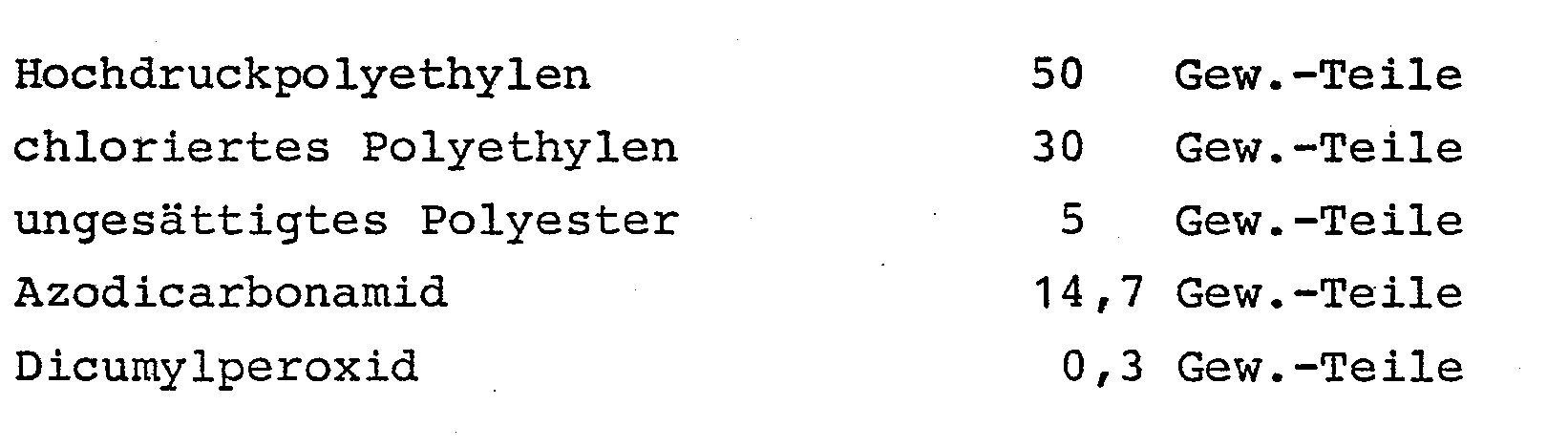
- Die Extrusionstemperatur der Formmasse liegt bei etwa 130°C, so daß weder Verschäumung noch Vernetzung eintritt.
- Die so erhaltene Platte wird in einem Heißluftofen, wie in DE-PS 16 94 130 beschrieben, auf eine Temperatur von etwa 210°C erwärmt, wodurch sich eine gleichmäßige vernetzte Schaumbahn ergibt.
- Die Schaumbahn wird durch Frischluft und Kontakt mit gekühlten Walzen abgekühlt. Der Schaum zeigt eine glatte Oberfläche und hat ein Raumgewicht von 35 kg/m3.
- Bei einer nachfolgenden Verarbeitung auf einer handelsüblichen Hochfrequenzschweißmaschine mit einer Frequenz von 27,12 mHz und einem Arbeitsdruck von 5/7 bar ist eine einwandfreie Verschweißung des so hergestellten Schaumes mit sich selbst und mit verschiedenen, textilen Geweben möglich.
- Wie in Beispiel 1 beschrieben wird unter Verminderung der Treibmittelmenge eine Polyethylenschaumbahn mit einer Dicke von 3 mm und einer Dichte von 200 kg/m3 hergestellt. Zwischen 2 Schaumbahnen wird ein Film aus einem Ethylenvinylacetat copolymeren mit einer Dicke von 50 mµ gelegt und die Bahnen in einer Hochfrequenzapparatur in 4" bei einer Leistung von 5 kW hochfrequenzverschweißt. Die Bahnen haften problemlos und sind praktisch nicht mehr als einzelne Bahnen unterscheidbar.
Claims (6)
Priority Applications (1)
| Application Number | Priority Date | Filing Date | Title |
|---|---|---|---|
| AT83103010T ATE18247T1 (de) | 1982-05-11 | 1983-03-26 | Dielektrisch erwaermbarer polyolefinschaum. |
Applications Claiming Priority (2)
| Application Number | Priority Date | Filing Date | Title |
|---|---|---|---|
| IT2119182 | 1982-05-11 | ||
| IT21191/82A IT1157941B (it) | 1982-05-11 | 1982-05-11 | Materiale espanso poliolefinico saldabile dielettricamente |
Publications (3)
| Publication Number | Publication Date |
|---|---|
| EP0093871A2 true EP0093871A2 (de) | 1983-11-16 |
| EP0093871A3 EP0093871A3 (en) | 1984-03-28 |
| EP0093871B1 EP0093871B1 (de) | 1986-02-26 |
Family
ID=11178139
Family Applications (1)
| Application Number | Title | Priority Date | Filing Date |
|---|---|---|---|
| EP83103010A Expired EP0093871B1 (de) | 1982-05-11 | 1983-03-26 | Dielektrisch erwärmbarer Polyolefinschaum |
Country Status (10)
| Country | Link |
|---|---|
| US (2) | US4454256A (de) |
| EP (1) | EP0093871B1 (de) |
| JP (1) | JPS58210932A (de) |
| AT (1) | ATE18247T1 (de) |
| CA (1) | CA1189250A (de) |
| DE (1) | DE3362242D1 (de) |
| ES (1) | ES522251A0 (de) |
| FI (1) | FI75179C (de) |
| IT (1) | IT1157941B (de) |
| ZA (1) | ZA833324B (de) |
Cited By (2)
| Publication number | Priority date | Publication date | Assignee | Title |
|---|---|---|---|---|
| EP0122944B1 (de) * | 1983-03-28 | 1987-08-12 | Bayer Ag | Verfahren zur Herstellung von Polyolefinschäumen |
| DE102005027019A1 (de) * | 2005-06-08 | 2006-12-14 | Kcd Kunststoffe, Additive Und Beratung Gmbh | Polymercompound und daraus bestehende schäumfähige Formteile |
Families Citing this family (5)
| Publication number | Priority date | Publication date | Assignee | Title |
|---|---|---|---|---|
| JPH0768393B2 (ja) * | 1986-05-28 | 1995-07-26 | 花王株式会社 | 多孔性フィルム |
| US6773798B2 (en) * | 1999-12-23 | 2004-08-10 | Sealed Air Corporation (Us) | Polyolefin foam composite structure and method for making the same |
| GB2466037B (en) | 2008-12-09 | 2012-11-14 | Bifold Fluidpower Ltd | Hydraulic coupling |
| DE102009001826A1 (de) | 2009-03-25 | 2010-09-30 | Trocellen Gmbh | Verfahren zum Prägen von Flächengebilden |
| US9505906B1 (en) * | 2014-05-02 | 2016-11-29 | Fina Technology, Inc. | Polymer foams |
Family Cites Families (11)
| Publication number | Priority date | Publication date | Assignee | Title |
|---|---|---|---|---|
| US3227665A (en) * | 1962-07-11 | 1966-01-04 | Houillers Du Bassin Du Nord Et | Polymerizable, cross-linkable, unsaturated polyester resin composition and method of making same |
| US3260688A (en) * | 1962-08-10 | 1966-07-12 | Toyo Koatsu Ind Inc | Resin compositions for producing cellular masses and process for producing a cellular product |
| CH447588A (de) * | 1966-05-27 | 1967-11-30 | Basf Ag | Verfahren zur Herstellung von Formkörpern aus schaumförmigen Olefinpolymerisaten |
| DE2022208A1 (de) * | 1970-05-06 | 1971-12-02 | Rudolph Koepp & Co Chem Fab Ag | Verbesserte Hochfrequenz-schweissbare Schaumstoffe und Verfahren zu ihrer Herstellung |
| US3855160A (en) * | 1970-10-27 | 1974-12-17 | Leben Utility Co | Thermosetting foamable resinous composition |
| US3786004A (en) * | 1970-12-29 | 1974-01-15 | Dainippon Toryo Kk | Thermosetting resinous composition |
| JPS5732657B2 (de) * | 1975-02-26 | 1982-07-12 | ||
| SE436850B (sv) * | 1975-05-02 | 1985-01-28 | Freudenberg Carl Fa | Vermeisolerande inleggsmaterial med flytegenskaper |
| DE2543248C2 (de) * | 1975-09-27 | 1983-11-24 | Dynamit Nobel Ag, 5210 Troisdorf | Verfahren zur Herstellung von Schaumstoffbahnen aus Olefinpolymerisaten |
| DE7627371U1 (de) * | 1976-09-02 | 1976-12-30 | Fa. Carl Freudenberg, 6940 Weinheim | Schuheinlage |
| US4214034A (en) * | 1978-06-01 | 1980-07-22 | Sekisui Kagaku Kogyo Kabushiki Kaisha | Agricultural covering multilayer film or sheet structure and method for thermal insulation |
-
1982
- 1982-05-11 IT IT21191/82A patent/IT1157941B/it active
-
1983
- 1983-03-26 EP EP83103010A patent/EP0093871B1/de not_active Expired
- 1983-03-26 DE DE8383103010T patent/DE3362242D1/de not_active Expired
- 1983-03-26 AT AT83103010T patent/ATE18247T1/de not_active IP Right Cessation
- 1983-04-29 US US06/490,148 patent/US4454256A/en not_active Expired - Fee Related
- 1983-05-09 CA CA000427689A patent/CA1189250A/en not_active Expired
- 1983-05-09 FI FI831597A patent/FI75179C/fi not_active IP Right Cessation
- 1983-05-09 JP JP58079448A patent/JPS58210932A/ja active Pending
- 1983-05-10 ZA ZA833324A patent/ZA833324B/xx unknown
- 1983-05-10 ES ES522251A patent/ES522251A0/es active Granted
-
1984
- 1984-03-01 US US06/585,268 patent/US4482602A/en not_active Expired - Fee Related
Cited By (3)
| Publication number | Priority date | Publication date | Assignee | Title |
|---|---|---|---|---|
| EP0122944B1 (de) * | 1983-03-28 | 1987-08-12 | Bayer Ag | Verfahren zur Herstellung von Polyolefinschäumen |
| DE102005027019A1 (de) * | 2005-06-08 | 2006-12-14 | Kcd Kunststoffe, Additive Und Beratung Gmbh | Polymercompound und daraus bestehende schäumfähige Formteile |
| EP1731555A3 (de) * | 2005-06-08 | 2007-06-20 | Kcd Kunststoffe, Additive und Beratung GmbH | Polymercompound und daraus bestehende schäumfähige Formteile sowie Verfahren zur Herstellung solcher Polymercompounds |
Also Published As
| Publication number | Publication date |
|---|---|
| IT1157941B (it) | 1987-02-18 |
| DE3362242D1 (en) | 1986-04-03 |
| ES8407072A1 (es) | 1984-08-16 |
| ZA833324B (en) | 1984-05-30 |
| US4454256A (en) | 1984-06-12 |
| FI75179B (fi) | 1988-01-29 |
| US4482602A (en) | 1984-11-13 |
| EP0093871B1 (de) | 1986-02-26 |
| IT8221191A0 (it) | 1982-05-11 |
| CA1189250A (en) | 1985-06-18 |
| ATE18247T1 (de) | 1986-03-15 |
| FI831597A0 (fi) | 1983-05-09 |
| JPS58210932A (ja) | 1983-12-08 |
| EP0093871A3 (en) | 1984-03-28 |
| FI75179C (fi) | 1988-05-09 |
| ES522251A0 (es) | 1984-08-16 |
Similar Documents
| Publication | Publication Date | Title |
|---|---|---|
| DE2926830C2 (de) | ||
| DE2740709C3 (de) | Verfahren zur Herstellung eines geformten, geschäumten und vernetzten Gegenstandes aus Äthylenpolymerisatharzen | |
| DE3032635C2 (de) | Verwendung einer Zusammensetzung aus einem Propylen-Copolymeren und Polyethylen zur Herstellung eines vernetzten Polyolefinschaums | |
| US4166890A (en) | Manufacture of crosslinked foamable moldings from olefin polymers | |
| EP0122944B1 (de) | Verfahren zur Herstellung von Polyolefinschäumen | |
| US3852177A (en) | Method of radiation cross-linking olefin polymers containing acrylate cross-linking promoters | |
| DE2543248C2 (de) | Verfahren zur Herstellung von Schaumstoffbahnen aus Olefinpolymerisaten | |
| DE3006963A1 (de) | Verfahren zum beschichten von fuer konstruktionszwecke geeigneten schaumteilen in der form und die dabei erhaltenen produkte | |
| DE1272533C2 (de) | Schwerentflammbare styrolpolymerisate | |
| DE4236579A1 (de) | Verfahren zur Herstellung von Schaumstoffplatten mit hoher Druckfestigkeit aus Styrolpolymerisaten | |
| EP0093871B1 (de) | Dielektrisch erwärmbarer Polyolefinschaum | |
| US3079312A (en) | Shaped polymeric articles | |
| EP0210760B1 (de) | Verfahren zur Herstellung von vernetzten Polyäthylenschäumen und die so hergestellte Schäume | |
| EP0186887A2 (de) | Verfahren zum Herstellen eines elektrisch leitfähigen vernetzten Polyolefinschaums und seine Verwendung | |
| DE2611491B2 (de) | ||
| DE1769604A1 (de) | Verschaeumbare thermoplastische Massen | |
| DE69109600T2 (de) | Zur Vernetzung geeignetes Ethene (Co)Polymer, seine Herstellung und Vernetzung. | |
| JPH0482014B2 (de) | ||
| DE1669688C3 (de) | Verfahren zur Herstellung von schaumförmigen Äthylencopolymerisaten | |
| DE1120132B (de) | Verfahren zur Herstellung von form- und waermestabilen Formkoerpern aus Polymerisaten von Monoolefinen | |
| DE2606190C2 (de) | Verfahren zur Herstellung von harten Schaumstoffen auf der Basis von Polyvinylchlorid | |
| JPH03221542A (ja) | オレフィン系樹脂発泡体の製造方法 | |
| EP0426346A2 (de) | Verfahren zur Herstellung von Polyolefin-Mischungen und daraus gefertigte Formkörper | |
| JPH0632929A (ja) | オレフィン系樹脂発泡体の製造方法 | |
| JPH047339A (ja) | ポリオレフィン架橋発泡体用組成物 |
Legal Events
| Date | Code | Title | Description |
|---|---|---|---|
| PUAI | Public reference made under article 153(3) epc to a published international application that has entered the european phase |
Free format text: ORIGINAL CODE: 0009012 |
|
| 17P | Request for examination filed |
Effective date: 19830326 |
|
| AK | Designated contracting states |
Designated state(s): AT BE CH DE FR GB IT LI LU NL SE |
|
| PUAL | Search report despatched |
Free format text: ORIGINAL CODE: 0009013 |
|
| AK | Designated contracting states |
Designated state(s): AT BE CH DE FR GB IT LI LU NL SE |
|
| GRAA | (expected) grant |
Free format text: ORIGINAL CODE: 0009210 |
|
| AK | Designated contracting states |
Designated state(s): AT BE CH DE FR GB IT LI LU NL SE |
|
| REF | Corresponds to: |
Ref document number: 18247 Country of ref document: AT Date of ref document: 19860315 Kind code of ref document: T |
|
| ITF | It: translation for a ep patent filed | ||
| ET | Fr: translation filed | ||
| REF | Corresponds to: |
Ref document number: 3362242 Country of ref document: DE Date of ref document: 19860403 |
|
| PLBI | Opposition filed |
Free format text: ORIGINAL CODE: 0009260 |
|
| 26 | Opposition filed |
Opponent name: DYNAMIT NOBEL AKTIENGESELLSCHAFT Effective date: 19861125 |
|
| NLR1 | Nl: opposition has been filed with the epo |
Opponent name: DYNAMIT NOBEL AKTIENGESELLSCHAFT |
|
| PLBN | Opposition rejected |
Free format text: ORIGINAL CODE: 0009273 |
|
| STAA | Information on the status of an ep patent application or granted ep patent |
Free format text: STATUS: OPPOSITION REJECTED |
|
| 27O | Opposition rejected |
Effective date: 19880728 |
|
| NLR2 | Nl: decision of opposition | ||
| PGFP | Annual fee paid to national office [announced via postgrant information from national office to epo] |
Ref country code: FR Payment date: 19910226 Year of fee payment: 9 |
|
| PGFP | Annual fee paid to national office [announced via postgrant information from national office to epo] |
Ref country code: DE Payment date: 19910228 Year of fee payment: 9 Ref country code: AT Payment date: 19910228 Year of fee payment: 9 |
|
| PGFP | Annual fee paid to national office [announced via postgrant information from national office to epo] |
Ref country code: CH Payment date: 19910311 Year of fee payment: 9 |
|
| PGFP | Annual fee paid to national office [announced via postgrant information from national office to epo] |
Ref country code: SE Payment date: 19910318 Year of fee payment: 9 Ref country code: GB Payment date: 19910318 Year of fee payment: 9 |
|
| PGFP | Annual fee paid to national office [announced via postgrant information from national office to epo] |
Ref country code: BE Payment date: 19910327 Year of fee payment: 9 |
|
| ITTA | It: last paid annual fee | ||
| PGFP | Annual fee paid to national office [announced via postgrant information from national office to epo] |
Ref country code: NL Payment date: 19910331 Year of fee payment: 9 |
|
| PGFP | Annual fee paid to national office [announced via postgrant information from national office to epo] |
Ref country code: LU Payment date: 19910403 Year of fee payment: 9 |
|
| ITPR | It: changes in ownership of a european patent |
Owner name: CESSIONE;HLS TROISDORF AKTIENGESELLSCHAFT |
|
| EPTA | Lu: last paid annual fee | ||
| PG25 | Lapsed in a contracting state [announced via postgrant information from national office to epo] |
Ref country code: LU Free format text: LAPSE BECAUSE OF NON-PAYMENT OF DUE FEES Effective date: 19920326 Ref country code: GB Effective date: 19920326 Ref country code: AT Effective date: 19920326 |
|
| PG25 | Lapsed in a contracting state [announced via postgrant information from national office to epo] |
Ref country code: SE Effective date: 19920327 |
|
| PG25 | Lapsed in a contracting state [announced via postgrant information from national office to epo] |
Ref country code: LI Effective date: 19920331 Ref country code: CH Effective date: 19920331 Ref country code: BE Effective date: 19920331 |
|
| BERE | Be: lapsed |
Owner name: BAYER A.G. Effective date: 19920331 |
|
| PG25 | Lapsed in a contracting state [announced via postgrant information from national office to epo] |
Ref country code: NL Effective date: 19921001 |
|
| NLV4 | Nl: lapsed or anulled due to non-payment of the annual fee | ||
| GBPC | Gb: european patent ceased through non-payment of renewal fee | ||
| PG25 | Lapsed in a contracting state [announced via postgrant information from national office to epo] |
Ref country code: FR Effective date: 19921130 |
|
| REG | Reference to a national code |
Ref country code: CH Ref legal event code: PL |
|
| PG25 | Lapsed in a contracting state [announced via postgrant information from national office to epo] |
Ref country code: DE Effective date: 19921201 |
|
| REG | Reference to a national code |
Ref country code: FR Ref legal event code: ST |
|
| EUG | Se: european patent has lapsed |
Ref document number: 83103010.1 Effective date: 19921005 |
|
| ITPR | It: changes in ownership of a european patent |
Owner name: CESSIONE;HT TROPLAST AG |