EP0092899A2 - Verfahren und Vorrichtung zum Messen von Rohrlängen - Google Patents
Verfahren und Vorrichtung zum Messen von Rohrlängen Download PDFInfo
- Publication number
- EP0092899A2 EP0092899A2 EP83301095A EP83301095A EP0092899A2 EP 0092899 A2 EP0092899 A2 EP 0092899A2 EP 83301095 A EP83301095 A EP 83301095A EP 83301095 A EP83301095 A EP 83301095A EP 0092899 A2 EP0092899 A2 EP 0092899A2
- Authority
- EP
- European Patent Office
- Prior art keywords
- pipe
- oscillator
- probe
- sound
- pulse
- Prior art date
- Legal status (The legal status is an assumption and is not a legal conclusion. Google has not performed a legal analysis and makes no representation as to the accuracy of the status listed.)
- Withdrawn
Links
- 238000005259 measurement Methods 0.000 title claims description 47
- 238000000034 method Methods 0.000 title claims description 23
- 238000004891 communication Methods 0.000 claims abstract description 17
- 239000000523 sample Substances 0.000 claims description 94
- 239000003570 air Substances 0.000 claims description 21
- 230000000694 effects Effects 0.000 claims description 8
- 230000004044 response Effects 0.000 claims description 7
- 239000012080 ambient air Substances 0.000 claims description 6
- 230000008878 coupling Effects 0.000 claims description 6
- 238000010168 coupling process Methods 0.000 claims description 6
- 238000005859 coupling reaction Methods 0.000 claims description 6
- 238000006243 chemical reaction Methods 0.000 claims description 4
- 239000003990 capacitor Substances 0.000 claims description 3
- 230000000977 initiatory effect Effects 0.000 claims description 2
- 238000001514 detection method Methods 0.000 claims 6
- 230000003213 activating effect Effects 0.000 claims 3
- 230000004913 activation Effects 0.000 claims 2
- 238000012937 correction Methods 0.000 abstract description 13
- 230000007423 decrease Effects 0.000 abstract 1
- 238000010586 diagram Methods 0.000 description 8
- 230000008859 change Effects 0.000 description 5
- 230000006870 function Effects 0.000 description 4
- 230000004048 modification Effects 0.000 description 4
- 238000012986 modification Methods 0.000 description 4
- 239000013078 crystal Substances 0.000 description 3
- 230000001186 cumulative effect Effects 0.000 description 3
- 238000002592 echocardiography Methods 0.000 description 3
- 239000004973 liquid crystal related substance Substances 0.000 description 2
- 239000000463 material Substances 0.000 description 2
- 230000010355 oscillation Effects 0.000 description 2
- 240000007591 Tilia tomentosa Species 0.000 description 1
- 241000321728 Tritogonia verrucosa Species 0.000 description 1
- 238000009825 accumulation Methods 0.000 description 1
- 230000009471 action Effects 0.000 description 1
- 230000004888 barrier function Effects 0.000 description 1
- 230000005540 biological transmission Effects 0.000 description 1
- 230000006835 compression Effects 0.000 description 1
- 238000007906 compression Methods 0.000 description 1
- 230000009977 dual effect Effects 0.000 description 1
- 230000008030 elimination Effects 0.000 description 1
- 238000003379 elimination reaction Methods 0.000 description 1
- 238000005516 engineering process Methods 0.000 description 1
- 238000011835 investigation Methods 0.000 description 1
- 239000002184 metal Substances 0.000 description 1
- 238000007639 printing Methods 0.000 description 1
- 230000008569 process Effects 0.000 description 1
- 238000007670 refining Methods 0.000 description 1
- 230000000717 retained effect Effects 0.000 description 1
- 239000004065 semiconductor Substances 0.000 description 1
- 239000002023 wood Substances 0.000 description 1
Images





Classifications
-
- G—PHYSICS
- G01—MEASURING; TESTING
- G01B—MEASURING LENGTH, THICKNESS OR SIMILAR LINEAR DIMENSIONS; MEASURING ANGLES; MEASURING AREAS; MEASURING IRREGULARITIES OF SURFACES OR CONTOURS
- G01B17/00—Measuring arrangements characterised by the use of infrasonic, sonic or ultrasonic vibrations
-
- Y—GENERAL TAGGING OF NEW TECHNOLOGICAL DEVELOPMENTS; GENERAL TAGGING OF CROSS-SECTIONAL TECHNOLOGIES SPANNING OVER SEVERAL SECTIONS OF THE IPC; TECHNICAL SUBJECTS COVERED BY FORMER USPC CROSS-REFERENCE ART COLLECTIONS [XRACs] AND DIGESTS
- Y10—TECHNICAL SUBJECTS COVERED BY FORMER USPC
- Y10S—TECHNICAL SUBJECTS COVERED BY FORMER USPC CROSS-REFERENCE ART COLLECTIONS [XRACs] AND DIGESTS
- Y10S367/00—Communications, electrical: acoustic wave systems and devices
- Y10S367/902—Speed of sound compensation
-
- Y—GENERAL TAGGING OF NEW TECHNOLOGICAL DEVELOPMENTS; GENERAL TAGGING OF CROSS-SECTIONAL TECHNOLOGIES SPANNING OVER SEVERAL SECTIONS OF THE IPC; TECHNICAL SUBJECTS COVERED BY FORMER USPC CROSS-REFERENCE ART COLLECTIONS [XRACs] AND DIGESTS
- Y10—TECHNICAL SUBJECTS COVERED BY FORMER USPC
- Y10S—TECHNICAL SUBJECTS COVERED BY FORMER USPC CROSS-REFERENCE ART COLLECTIONS [XRACs] AND DIGESTS
- Y10S367/00—Communications, electrical: acoustic wave systems and devices
- Y10S367/91—Portable sonar devices
Definitions
- the present invention relates to an improved method of and apparatus for accurately measuring and indicating and/ or recording the individual and cumulative lengths of openended tubes such as drill pipes and providing a signal for inventory control.
- Reflection of sound waves also occurs when sound passing down a tube or pipe meets an abrupt change in area.
- This penomena has been the subject of much investigation and has been employed for many purposes including the determination of the location of openings and obstructions in tubes and the measurement of the lengths of pipes.
- Helmholtz in 1897, determined the correction in the length of an open pipe required to compensate for T adiation loss and impedance change for a pipe without a flange at being 0.6 R, R being the pipe internal diameter divided by two. Helmholtz also determined the intensity of a reflected acoustic wave where a change in the pipe internal diameter occurs. See “TECHNICAL ASPECTS OF SOUND,” edited by E. G. Richardson, Elsevier Publishing Company, New York (1953), pages 493 et seq.
- a problem with the method and apparatus of the Kayem et al patent is a requirement for the probe to be placed in closed communication with the interior of the pipe.
- the mathematical equation to be solved and the required electrical circuitry are undesirably complex since correction or compensation is required not only for the distance that the impedance reflective surface is spaced from the end of the pipe but also for the distance that the impedance reflective surface is spaced from the hand-held probe, and in particular, the means for producing sound and the means for detecting reflected acoustic waves.
- a further problem with an alternate method contemplated in the patent is the requirement for the operator, when making pipe length measurements, to manually insert into the computer, in aach case, the diameter of the pipe being measured in order to effect compensation for the impedance reflective surface being spaced from the end of the pipe.
- Another alternative method and apparatus disclosed in the patent utilizes flanged tubes or coupling means having tubes of different length for taking into account the different pipe diameters.
- the requirement for a housing separate from the probe seriously detracts from the portability, and hence, the utility of the apparatus, as does also the need for the use of different flanged tubes.
- An object of the invention is to provide for use in the measurement of the length of open pipe an improved acoustical method and apparatus for compensating for the impedance reflective surface being spaced from the end of the pipe.
- Another object of the invention is to provide such an improved method and apparatus in which compensation is not required for the distance the transducer (sound generator and receiver) is spaced from the impedance reflective surface.
- a further object of the invention is to provide such an improved method and apparatus in which the transducer may be in spaced open air communication with the interior of the pipe at the selected end from which the pipe length measurement is made.
- Still another object of the invention is to provide for such pipe length measurement a light-weight acoustical hand-held probe that contains not only the transducer but also all of the required electrical, display and power components.
- a further object of the invention is to provide a standoff frame that may be permanently attached to the probe to allow the use of simplified circuitry in making the pipe length measurements.
- Another and more specific object of the invention is to provide for use with the standoff frame a small tube that may be welded thereto that isolate: the return echo from the pipe'under measurement from the echoes from other pipes in a stack, such small tube being advantageous for use in the measurement of the lengths of small diameter pipes.
- a further specific object of the invention is to provide an array of transducers that may be removably secured to the probe for making measurements of the lengths of very large diameter pipes.
- a hand-held probe that contains the electrical circuitry and components including a sound transducer and a battery for providing electrical power, and on which a pistol trigger switch and a display device are mounted.
- a logic circuit which may be of the CMOS, TTL or MOS type is employed in conjunction with the transducer for producing a square wave sound pulse that is directed at the end of the pipe the length of which is to be measured, closed communication with the pipe not being required, and for detecting the echo from the far end of the pipe.
- An oscillator provides a count in accordance with the time required for the generated pulse to traverse the length of the pipe and to return, the count being modified in accordance with the ambient temperature. The total count is displayed to provide a measurement of the pipe length.
- a probe coupling mechanical means or standoff device for establishing a distance between the probe, and hence, the transducer, and the near end of the pipe that varies in accordance with the internal diameter of the pipe under measurement.
- a triangular wire frame with a one inch internal diameter tube welded inside may be provided to conduct return echoes from the far end of the pipe back to the transducer.
- Such a small tube is advantageous when measuring the lengths of small diameter pipes that are arranged in stacks to avoid error that could result from reflection from adjacent pipes, the small tube thus serving an isolating purpose.
- the circuitry contained in the hand-held probe includes a microprocessor thereby enabling greater flexibility in the method of pipe length measurement and also utilization of the measurements that are made.
- a microprocessor thereby enabling greater flexibility in the method of pipe length measurement and also utilization of the measurements that are made.
- two square wave sound pulses, each having substantially the same amplitude, are employed in order to avoid a false reading of pipe length due to the impedance reflective circuit being spaced from the end of the pipe.
- the amplitude of the greatest peak echo of the first reflected pulse from the far end of the pipe is sensed and measured.
- the gain of the receiver amplifier is then adjusted to make a timer stop during the reception of the echo from the second pulse when 40% of the amplitude of the peak echo of the first pulse is obtained, the device being compensated for air temperature variations. It has been found that debris in the pipe will produce echo returns of about 5-25% of the echo from the end of the pipe.
- the transmitted pulses have a duration of from 0.0003 to 0.0012 seconds, the frequency being tuned to a maximum , conduction in the pipe.
- the probe may be directed at the end of the pipe up to four times the diameter of the pipe away, and at an angle to the pipe. No acoustic coupling to the pipe to place the probe in closed communication with the pipe interior is required.
- a standoff wire frame as described above in connection with the first embodiment of the invention may be employed.
- the optimum characteristic shape of such standoff device for use in the second embodiment of the invention may be determined experimentally.
- the hand-held probe may be utilized to place into memory the measured length of each pipe for inventory control. This length may be associated with an operator-set, measured internal diameter for the tubes.
- the probe may include a display of individual and cumulative pipe lengths.
- the memory may be used to present the serial data to a larger computer.
- an array of transducers may be associated with the probe to produce a low frequency plane wave, and hence, an echo return.
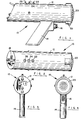
- FIG 1 there is illustrated a preferred embodi-. ment of a self-contained hand-held probe according to the invention.
- the probe indicated generally by the reference numeral 10, includes a cylindrical housing 12 and a pistol- grip handle 14 on which a push button switch 16 is provided.
- a display unit 18 Mounted on the rear of the housing, as shown in Figures 2'and 3 is a display unit 18.
- a plastic screen or grille 20, as shown in Figures 1 and 4 is provided at the front of the housing 12.
- the housing 12 contains the electrical circuitry . and components required for the probe 10 including a suitable battery such as a 7.2 volt Nicad battery for providing a source of electrical power.
- the display device 18 may be of the liquid crystal or light emitting diode type providing a digital readout.
- the push botton switch 16 is provided for initiating a pipe length measurement.
- Three push-button switches 22, 24 and 26 are provided at the top of the housing 12, toward the rear thereof, as seen in Figures 1 and 2. These switches 22, 24 and 26, as described hereinafter, may be employed to enable selection of the desired units of pipe length, that is, in feet or meters, for example, and other desired operations such as.”display to memory tally" and "clear memory.” .
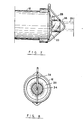
- a standoff wire frame 28 for establishing a distance between the probe 10 and the near or selected end 30 of a pipe 32 under measurement that varies in accordance with the pipe internal diameter, the pipe 32 being shown in phantom in Figure 5.
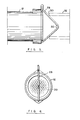
- Figures 7 and 8 there is illustrated a modification of the standoff wire frame 28 that includes a small cylindrical tube 34 that may be of metal and the purpose of which is explained hereinafter.
- the frame 28 and tube 34 are shown associated with the selected end 36 of a pipe 38, shown in phantom, that has a smaller diameter than that of the pipe 32 of Figure 5.
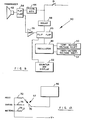
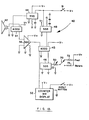
- the electrical circuitry containeed within the housing 12 comprises a logic circuit indicated at 40 in Figure 9.
- the logic circuit 40 includes a transducer 42 that is operative to produce square wave sound pulses and also to detect the echo return from the far end of a pipe- the length of which is under measurement.
- the transducer 42 preferably is of the piezoelectric or crystal type. A preferred form of transducer 42 is illustrated in Figures 10 and 11- described hereinafter.
- Logic circuit 40 which may be of the CMOS, TTL or MO S type, includess the pistol grip push button switch 16, a flip flop 43, a sqquare wave pulse generator 44, an oscillator 46, a delay unit 48, an ambient temperature compensating sensor 50, a counting and display device 52, a flip flop 54, an amplifier 56 and a feet/meter voltage shift 57.
- closing the switch 16 fires the pulse generator 44 and starts the oscillator 46 after a delay, effected by delay unit 48, of 0.0003 seconds.
- the pulse produced is a square wave preferably having a duration of from 0.0003 to 0.0012 seconds for pipes having internal diameters from one-half inch (1/2"; 1.27 cm.) to six inches (6"; 15.24 cm.), and 0.001 to 0.010 seconds for pipes six inches (6"; 15.24 cm) and above.
- Oscillator 46 oscillates at a frequency "f" such that for a four digit display by device 52, in feet, of the length of a pipe under measurement, the following relation exists: at 68°F. and 70% humidity;
- Flip flop 54 is set to conduct the pulse generated by the generator 44 whereby the generated pulse drives the transducer 42.
- the transducer 42 converts the square wave electrical pulse into an acoustical plane wave that is radiated into the open air and into the selected end of the pipe being measured.
- the acoustical plane wave transmitted by transducer 42 is reflected from the impedance reflective surface, that surface being spaced a distance approximately 0.6R beyond the end of the pipe, where R is the inside radius of the pipe for pipe sizes up to eight inches (8"; 20.32 cm.).
- Flip flop 54 switches to allow disabling of the oscillator 46 immediately after the transducer 42 stops ringing, as effected by flip flop 43. This is after a fixed time of about 0.0002 seconds.
- the reflected acoustic pulse is then sensed by transducer 42 and passed through the flip flop 54 to the amplifier 56 and thereby to the oscillator 46, disabling the latter and stopping the count.
- the total pulse count of oscillator 46 is displayed by display device 52. If desired, a hard copy of the total count may be provided by a printing unit.
- the total count may also be entered directly into a computer, into a memory module for a tally count, that is, a count of the total length in feet, for example, of a bundle of pipes, or for a measure of the individual pipe.
- the temperature compensating sensor 50 may be mounted internally of the housing 12 of probe 10, or preferably externally of the housing 12, as shown in Figure 1. Another alternative location is illustrated in Figure 5 wherein the sensor 50 is shown mounted on the inner side of the bend of the wire standoff frame 28. Accordingly, sensor.50 is in a position to sense and to respond to changes in the'air temperature adjacent the near or selected end of each pipe under measurement. Sensor 50 may be a resistor which changes in value with variation in temperature and is associated with a resistance- capacitance (RC) circuit in the oscillator 46 to change the frequency of oscillation thereof as required to compensate for changes in the speed of sound due to changes in air temperature.
- RC resistance- capacitance
- the transducer 42 desirably is mounted internally of the housing 12, immediately behind the grille 20, and may be of the well-known commercially available "dynamic” or “magnetic types” that utilize a moving coil and have a cone-shaped diaphragm for converting electrical energy into acoustical signal energy.
- a separate microphone also of known type and available commercially, is required for converting incident acoustical energy into electrical energy.
- a transducer 42 of the , ⁇ . piezoelectric or crystal type may be employed in each of the embodiments of the present invention. This is for the reason that with a transducer 42 of this type a single diaphragm including an attached piezoelectric element is operable to provide a dual function of generating and detecting acoustical waves. Piezoelectric transducers having a cone-shaped diaphragm are commercially available.
- piezoelectric transducer 42 having a flat diaphragm since a flat diaphragm is best for generating and detecting plane acoustical waves.
- plane acoustical waves has been found to be advantageous in making pipe length measurements.
- Such a preferred form of piezoelectric transducer 42 is illustrated in Figures 10 and 11.
- Transducer 42 includes a flat diaphragm 58 formed of material known in the art to be suitable for the purpose, for example, a thin metallic or plastic material. Diaphragm 58 is captured between mounting rings 60 and 62 which, in addition to providing support for the diaphragm 58, also serve as a baffle. Attached to the diaphragm 58, at the center thereof, is a piezoelectric element 64. A reaction mass 66, in turn, is attached to the piezoelectric element 64. The means of attachment, in each case may be by a suitable bonding method, as known in the art. Alternatively, the mounting ring could support a frame to which the piezoelectric crystal is bonded in addition to the diaphragm 58, thus enabling elimination of the reaction mass 66. Electrical conducting leads indicated at 68 extend from the element 64.
- the thickness of diaphragm 58 may be in the range from 0.0005 to 0.005 inches (0.00127 to 0.0127 cm.) and 1 to 10 inches (2.54 to 25.4 cm.) in diameter, the diameter being selected to be in accord with the diameter of housing 12.
- Piezoelectric element 64 may be a model 70140 manufactured by Linden Laboratories, Inc., State College, Pa.
- the reaction mass 66 may comprise a mass of 0.09 to 10 grams.
- the feet/meter voltage shift device 57 which includes a switch 70 for changing the units of the readout of the counting and display device 52.
- switch 70 Associated with switch 70 are fixed resistors 72, 74 and 76, each having a different value.
- One end of each of resistors 72, 74 and 76 is connected to the positive terminal, V+, of the power supply.
- each resistor 72, 74 and 76 is selectively connected by switch 70 to an RC circuit in the oscillator clock 46 for adjusting the frequency of oscillation as required to produce the desired result, that is, a display by device 52 in feet, meters, etc., as selected by manipulation of switch 70.
- the various components comprising the circuitry are shown to be of commercially available types, such as those manufactured by Motorola, National Semiconductor, Hitachi, etc., or equivalent.
- the pulse generator 44 is seen to comprise a 555 timer chip including required resistor and capacitor connections to ground as known to those skilled in the art.
- the flip flops 43 and 54 are 4020 flip flops.
- the oscillator 46 comprises a 555 timer chip with electrical power connections thereto as well as the connections of the temperature compensating sensor. 50 and the feet/meter resistors of the voltage shift 57.
- the counting and display device 52 may comprise an electronic counter such as Model L04.22-H12-D-I-A being sold commercially by Kessler-Ellis, Atlantic Highlands, New Jersey.
- the delay timer 48 is a type 555 timer.
- the amplifier 56 is a 386 amplifier..
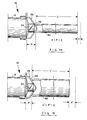
- Figures 14 and 15 For compensating for the impedance reflective surface at the far end of the pipe being spaced beyond the end of the pipe, there is illustrated in Figures 14 and 15 the probe 10 and associated standoff frame 28 for establishing a distance between the probe 10 and the near or selected end of a pipe, the length of which is to be measured, that varies in accordance with the internal pipe diameter:
- the standoff frame 28 establishes a distance designated " 'P' " between the selected end 84 of a larger diameter pipe 86 and the probe 10, the distance from the far end of the pipe 86 to the impedance reflective surface being designated " a' .”
- the angle at the bend or apex of the standoff device 28 is such that, again, the sum of " P' " and " a' " is equal to the constant "C".
- correction factor " ⁇ " can vary for given geometries of probe housing 12 over a range of: from which it can be seen that 8 may vary over a range from 96° to 136°.
- an RC555 Motorola timer chip indicated at 88 between the normally closed terminal NC of the switch 16 and the counter 52 of the detailed schematic circuit of Figure 13. Timer 88 cycles between the NC terminal and the counter and display 52 to delay the input to the counter. A pulse-in transistor in chip 88 switches on after a delay period.
- Figure 18 illustrates another arrangement comprising an operator adjusted potentiameter with exponential diameter calibration for effecting pipe diameter compensation.
- a.spring loaded inside caliper 90 having a compression spring 91 that is tied to a potentiometer 92, the potentiometer 92 being connected to an RC circuit in the counter and display 52 of Figure 13 to automatically set the diameter.
- one of the position sensing arms of the caliper 90 may be connected to the housing 12 so as to extend forward of the grille 20, as illustrated in Figure 18.
- FIG. 19-23 Another and ' preferred embodiment of the present invention is illustrated in Figures 19-23.
- the method according to this embodiment employs two successive sound pulses each having substantially the same amplitude, in order to avoid a false reading of the length of the pipe due to the impedance reflective surface being spaced from the end of the pipe.
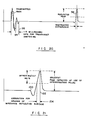
- a first such. sound pulse which may be termed an interrogation pulse, indicated by numeral 94 in Figure 20, traverses the length of the pipe and produces reflected waves such as that indated at 96, at the impedance reflective surface beyond the far end of the pipe.
- the time for the transducer to ring down or dampen out is indicated at 98.
- the amplitude of the reflected wave with the greatest peak from the far end of the pipe resulting from the first transmitted pulse is sensed and measured.
- the gain of the receiver amplifier is then so adjusted, that is, increased, as to make a timer or oscilltor counter stop during the reception of the echo from the second or measuring pulse when approximately 40% of the amplitude of the peak echo of the first pulse is obtained.
- the count of the oscillator counter begins the moment the measurement pulse is transmitted.
- the count of the oscillator ends when the return echo sensed by the transducer reaches an amplitude that is 40% of the greatest reflected peak that is detected resulting from the transmission of the interrogation pulse.
- an adjustment in the duration of the oscillator count to effect a correction in the pipe length measurement for the distance 104, as seen in Figure 21, that the impedance reflective surface is spaced from the end of the pipe. Since the distance 104 is a function of the internal diameter of the pipe, the adjustment in the duration of the oscillator count, in this embodiment of the invention, as in the first embodiment, is in accordance with the internal pipe diameter.
- the transmitted pulses have a duration of from 0.0003 to 0.0012 seconds, the frequency being tuned for maximum conduction in the pipe.
- the probe may be directed at the near end of the pipe up to four diameters of the pipe away, and at an angle to the pipe. That is to say, the probe may be positioned with the transducer in spaced open air communication with the interior of the pipe. No acoustic coupling to the pipe to place the probe in closed acoustical communication with the pipe interior is needed.
- FIG. 19 a circuit in block diagram form, employing a microprocessor 108.
- the microprocessor 108 is connected to receive input data, to process such data in accordance with pre-programmed instructions, and to output the processed data to effect the desired pipe length measurements compensated for air temperature and impedance reflective surface spacing from the far end of the pipe, with the output going to a digital display device and/or to a printer, auxiliary memory, etc.
- a trigger switch which may be the pistol grip push buttom switch 16 of Figure 1
- a temperature sensitive resistor 110 for ambient temperature compensation and three additional switches 22, 24 and 26 which may comprise the correspondingly numbered push button switches of Figure 1
- switch 22 directing the display to a memory tally
- switch 24 to clear the memory
- switch 26 to direct the output display of measured pipe length in "feet" or “meters.” It will be understood that other units of measurement may be employed, if desired.
- a transducer that may be similar or identical to the transducer 42 of Figure 9 and illustrated in Figures 10 and 11.
- This connection includes a first diode rectifier 114 and a first amplifier 116 that are connected in series relation and also a second diode rectifier 118 and a second amplifier 120 that are also connected in series relation, the diode rectifier 114 being connected to conduct in a direction opposite to that of diode rectifier 118.
- Display drivers 122 and a digital display device 124 are also connected to the microprocessor circuit 108.
- the display device.124 may be similar, or if desired, identical to the display device 52 of the circuit of Figure 9.
- the temperature sensitive resistor 110 of Figure 19 senses the temperature of the air inside the pipe under measurement and produces a signal in so-called analog form.
- analog signal is converted to digital data form within the microprocessor circuit 108 and is utilized in modifying the response of the transducer 112 and the microprocessor 108 to the reflected acoustic wave from the far end of the pipe under measurement.
- microprocessor 108 In the operation of this embodiment of the invention, it has been found desirable to maintain the microprocessor 108 in a continuously energized state.
- the electrical current drain of the microprocessor circuit 108 is so small that a single 7.2-volt Nicad battery employed to supply electrical power to the probe 10 can be expected to have an effective life of about two years with :the microprocessor 108 continuously energized.
- a memory is provided in which is retained an accumulation of the individual readings.
- the operator can effect a readout of the accumulated readings on the display device 124.
- the microprocessor 108 Upon actuation of the "clear memory” switch 24, the microprocessor 108 is cleared of all previous accumulated data and information except the programming.
- each measurement may be recorded, if desired, in an auxiliary memory or printed out on a hard copy printer that may be mounted on the probe 10.
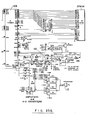
- Figures 23A and 23B collectively comprise a detailed schematic diagram of the microprocessor circuit of the second embodiment of the invention shown in block diagram form in Figure 19.
- the microprocessor 108 is a 6805 chip.
- the erasable programmable memory (EPROM) in the microprocessor is a type 2716 EPROM.
- the amplifiers and analog to digital converters 116 and 120 comprise a 4052 chip.
- the temperature compensating sensor 110 is an LM336 transistor.
- the display drivers 122, shown in Figure 23A, are 4056 liquid crystal display drivers.
- the interface indicated at 125 in Figure 23A is a pin connector. As in the first embodiment of the invention described in connection with Figures 9 and 13, the various components comprising the circuitry of Figures 23A and 23B may be of commercially available types.
- the trigger threshold has to be made greater than the echo resulting from debris in the pipe.
- This error is illustrated graphically in Figure 22 wherein the numeral 126 designates a transmitted pulse, the numeral 128 the return echo from the far end of the pipe, and the numeral 130 echoes from debris in the pipe.
- the numeral 132 indicates the level of response which the trigger threshold must exceed. Because of this, the error indicated at the base of the return echo 128 results.
- a standoff wire frame 134 for use with the probe embodying the microprocessor 108 of Figure 19, a standoff wire frame 134, as illustrated in Figure 24.
- the standoff wire frame 134 may be similar to the wire frame described in connection with Figures 5-8 and 14-16. As shown in Figure 24, however, the characteristic shape of the wire frame 134 is different. The optimum characteristic shape of the frame 134 for compensating for the error illustrated in Figure 22 may be determined experimentally.
- an attachment indicated at 136 for the front end of the probe comprising an array of transducers 112, each with its own grille 20 for protection.
- the attachment 136 desirably is adapted to fit over the front end of the probe and to plug into the curcuitry of Figures 19 and 23, the latter being so modified by such attachment as to accommodate the additional transducers 112 of the array in a manner understood by those skilled in the art.
- a method of and apparatus for the measurement of the lengths of pipe having open ends in which compensation is effected for the impedance reflective surface being spaced from the far end of the pipe, in which compensation is not required for the distance the transducer is spaced from the impedance reflective surface, and in which the transducer may be in spaced open air communication with the interior of the pipe at the selected end, closed communication between the transducer and pipe not being required.
- the apparatus is further characterized in that all of the components required for the pipe length measurements including the power source may be embodied in a light-weight portable probe.
Landscapes
- Physics & Mathematics (AREA)
- General Physics & Mathematics (AREA)
- Length Measuring Devices Characterised By Use Of Acoustic Means (AREA)
Applications Claiming Priority (2)
| Application Number | Priority Date | Filing Date | Title |
|---|---|---|---|
| US358290 | 1982-03-15 | ||
| US06/358,290 US4584676A (en) | 1982-03-15 | 1982-03-15 | Method of and apparatus for pipe length measurement |
Publications (2)
| Publication Number | Publication Date |
|---|---|
| EP0092899A2 true EP0092899A2 (de) | 1983-11-02 |
| EP0092899A3 EP0092899A3 (de) | 1984-12-27 |
Family
ID=23409075
Family Applications (1)
| Application Number | Title | Priority Date | Filing Date |
|---|---|---|---|
| EP83301095A Withdrawn EP0092899A3 (de) | 1982-03-15 | 1983-03-01 | Verfahren und Vorrichtung zum Messen von Rohrlängen |
Country Status (4)
| Country | Link |
|---|---|
| US (1) | US4584676A (de) |
| EP (1) | EP0092899A3 (de) |
| JP (1) | JPS58193409A (de) |
| CA (1) | CA1210127A (de) |
Cited By (6)
| Publication number | Priority date | Publication date | Assignee | Title |
|---|---|---|---|---|
| FR2593909A1 (fr) * | 1986-02-03 | 1987-08-07 | Mtm Leader Sarl | Mesureur d'epaisseurs de revetements par interferometrie ultrasonore |
| EP0296392A1 (de) * | 1987-06-24 | 1988-12-28 | Nippon Kokan Kabushiki Kaisha | Verfahren und Apparat zur Feststellung der Länge von Rohrleitungen bei Anwendung von Schallwellen |
| WO1993011405A1 (fr) * | 1991-11-29 | 1993-06-10 | Dmitry Gennadievich Tretjyakov | Transducteur de deplacement |
| EP0610073A1 (de) * | 1993-02-03 | 1994-08-10 | Tokyo Gas Co., Ltd. | System zur akustischen Messung der Rohrlänge |
| GB2283096A (en) * | 1993-10-20 | 1995-04-26 | Bosch Gmbh Robert | Method and device for ultrasonic distance measurement |
| CN104792284A (zh) * | 2015-01-23 | 2015-07-22 | 浙江万里学院 | 一种超声波厚度测量的方法 |
Families Citing this family (28)
| Publication number | Priority date | Publication date | Assignee | Title |
|---|---|---|---|---|
| JPS61294308A (ja) * | 1985-06-24 | 1986-12-25 | Tokyo Gas Co Ltd | 管長測定法 |
| US4723468A (en) * | 1985-10-26 | 1988-02-09 | Nippon Gakki Seizo Kabushiki Kaisha | Electronic stringed instrument |
| US4730190A (en) * | 1986-10-29 | 1988-03-08 | Winlam Company | Hand-held measuring device |
| GB8718208D0 (en) * | 1987-07-31 | 1987-09-09 | Bode R | Acoustical length measurement |
| US4899591A (en) * | 1987-09-11 | 1990-02-13 | Sps Technologies, Inc. | Ultrasonic load indicating member, apparatus and method |
| US4846001A (en) * | 1987-09-11 | 1989-07-11 | Sps Technologies, Inc. | Ultrasonic load indicating member |
| USD307871S (en) | 1988-01-13 | 1990-05-15 | The Stanley Works | Ultrasonic measuring tool |
| US4935884A (en) * | 1988-04-28 | 1990-06-19 | Champlin Electronics, Inc. | Sonic pipe length detector |
| US4930350A (en) * | 1988-10-06 | 1990-06-05 | Robert Bode | Acoustical length measurement |
| DE58905471D1 (de) * | 1989-01-16 | 1993-10-07 | Armin W Hrdlicka | Verfahren zur Längenmessung und Vorrichtung zur Durchführung des Verfahrens. |
| DE3930424A1 (de) * | 1989-09-12 | 1991-03-21 | Tabac Fab Reunies Sa | Verfahren zur ueberpruefung des bestehens einer rohrleitungsverbindung zwischen zwei endpunkten |
| US5195059A (en) * | 1991-03-27 | 1993-03-16 | Tokyo Gas Co., Ltd. | Acoustic pipe length measuring apparatus |
| US5442592A (en) * | 1994-02-08 | 1995-08-15 | The Whitaker Corporation | Ultrasonic distance meter |
| WO1997020204A1 (en) * | 1995-12-01 | 1997-06-05 | System Planning Corporation | Method and apparatus for detecting recyclable items |
| US5754495A (en) * | 1996-05-13 | 1998-05-19 | Halliburton Energy Services, Inc. | Method for acoustic determination of the length of a fluid conduit |
| US6705158B1 (en) * | 2000-12-22 | 2004-03-16 | Phil Louden | Hot wire anemometer with extendable probe |
| US6772634B2 (en) * | 2001-10-01 | 2004-08-10 | Jerry A. Ibey | Conduit end identifier system |
| US6938488B2 (en) * | 2002-08-21 | 2005-09-06 | Battelle Memorial Institute | Acoustic inspection device |
| US6698290B1 (en) * | 2002-12-30 | 2004-03-02 | Motorola, Inc. | Adaptive equalizer for variable length sound tubes utilizing an acoustical time of flight measurement |
| US7575371B1 (en) | 2004-11-11 | 2009-08-18 | Fieldmetrics, Inc | Temperature sensor and extensometer |
| CN2812027Y (zh) * | 2005-07-08 | 2006-08-30 | 南京德朔实业有限公司 | 超声波测距仪 |
| KR101250243B1 (ko) * | 2008-09-05 | 2013-04-04 | 엘지전자 주식회사 | 배관 거리 감지 장치 및 감지 방법 |
| JP2010147758A (ja) * | 2008-12-18 | 2010-07-01 | Panasonic Corp | 発振回路 |
| US8220332B1 (en) * | 2009-09-19 | 2012-07-17 | Erkan Gunal | Conduit toner and detector |
| US8873806B2 (en) * | 2012-10-04 | 2014-10-28 | Lmk Technologies, Llc | Method and means for determining change in pipe diameter |
| CA2902300C (en) * | 2013-01-25 | 2019-04-30 | The Chugoku Electric Power Co., Inc. | Distance measuring system and distance measuring method |
| GB2539777B (en) | 2013-12-23 | 2020-08-05 | Halliburton Energy Services Inc | Wellbore tubular length determination using pulse-echo measurements |
| RU181215U1 (ru) * | 2018-04-05 | 2018-07-06 | федеральное государственное автономное образовательное учреждение высшего образования "Самарский национальный исследовательский университет имени академика С.П. Королева" | Электронно-акустическое устройство измерения геометрических параметров открытых волноводов |
Family Cites Families (6)
| Publication number | Priority date | Publication date | Assignee | Title |
|---|---|---|---|---|
| US2534830A (en) * | 1947-09-13 | 1950-12-19 | Frank G Philo | Leak detector |
| GB1482592A (en) * | 1975-06-16 | 1977-08-10 | Central Electr Generat Board | Methods of detecting blockages and/or discontinuities in tubes |
| US4192177A (en) * | 1978-01-09 | 1980-03-11 | Huntington Alloys, Inc. | Apparatus and method for pressure testing of tubular bodies |
| US4241430A (en) * | 1979-01-08 | 1980-12-23 | Douglas J. Kayem | Method and apparatus for determining the length of tubular members |
| EP0037196B1 (de) * | 1980-03-20 | 1988-06-01 | Acumet Precision Instruments Ltd | Verfahren und Apparat zum Bestimmen physikalischer Grössen, insbesondere auf die Länge bezogener Grössen |
| GB2098731A (en) * | 1981-05-12 | 1982-11-24 | Planters Powergrind | Determining linear measurement |
-
1982
- 1982-03-15 US US06/358,290 patent/US4584676A/en not_active Expired - Fee Related
-
1983
- 1983-03-01 EP EP83301095A patent/EP0092899A3/de not_active Withdrawn
- 1983-03-09 CA CA000423218A patent/CA1210127A/en not_active Expired
- 1983-03-15 JP JP58043038A patent/JPS58193409A/ja active Pending
Cited By (10)
| Publication number | Priority date | Publication date | Assignee | Title |
|---|---|---|---|---|
| FR2593909A1 (fr) * | 1986-02-03 | 1987-08-07 | Mtm Leader Sarl | Mesureur d'epaisseurs de revetements par interferometrie ultrasonore |
| EP0236175A1 (de) * | 1986-02-03 | 1987-09-09 | Mtm Leader Sarl | Schichtdickenmessung mit Ultraschall-Interferometrie |
| EP0296392A1 (de) * | 1987-06-24 | 1988-12-28 | Nippon Kokan Kabushiki Kaisha | Verfahren und Apparat zur Feststellung der Länge von Rohrleitungen bei Anwendung von Schallwellen |
| WO1993011405A1 (fr) * | 1991-11-29 | 1993-06-10 | Dmitry Gennadievich Tretjyakov | Transducteur de deplacement |
| EP0610073A1 (de) * | 1993-02-03 | 1994-08-10 | Tokyo Gas Co., Ltd. | System zur akustischen Messung der Rohrlänge |
| GB2283096A (en) * | 1993-10-20 | 1995-04-26 | Bosch Gmbh Robert | Method and device for ultrasonic distance measurement |
| US5508974A (en) * | 1993-10-20 | 1996-04-16 | Robert Bosch Gmbh | Method and device for ultrasonic distance measuring |
| GB2283096B (en) * | 1993-10-20 | 1997-09-24 | Bosch Gmbh Robert | Method and device for ultrasonic distance measurement |
| CN104792284A (zh) * | 2015-01-23 | 2015-07-22 | 浙江万里学院 | 一种超声波厚度测量的方法 |
| CN104792284B (zh) * | 2015-01-23 | 2017-06-30 | 浙江万里学院 | 一种超声波厚度测量的方法 |
Also Published As
| Publication number | Publication date |
|---|---|
| JPS58193409A (ja) | 1983-11-11 |
| EP0092899A3 (de) | 1984-12-27 |
| CA1210127A (en) | 1986-08-19 |
| US4584676A (en) | 1986-04-22 |
Similar Documents
| Publication | Publication Date | Title |
|---|---|---|
| US4584676A (en) | Method of and apparatus for pipe length measurement | |
| US4470299A (en) | Ultrasonic liquid level meter | |
| US20050097968A1 (en) | Ultrasonic flow meter and ultrasonic sensor | |
| US5426979A (en) | Frequency spectrum apparatus for determining mechanical properties | |
| KR20000057568A (ko) | 초음파 거리 측정 방법 및 장치 | |
| US6584860B1 (en) | Flow probe insertion gauge | |
| JPH02502123A (ja) | 距離測定装置 | |
| US4894810A (en) | Method and a device for measuring a distance by means of ultrasonic pulses | |
| EP0339057A1 (de) | Akustisches entferungsmessgerät | |
| JPS5828554B2 (ja) | 超音波距離計 | |
| US3683324A (en) | Depth meter having improved time varying gain control | |
| US4930350A (en) | Acoustical length measurement | |
| US3028749A (en) | Ultrasonic fluid density measuring system | |
| CA2063918A1 (en) | Acoustic pipe length measuring apparatus | |
| US3630307A (en) | Mechanism and method for measuring sound absorption | |
| RU2123191C1 (ru) | Эхолот | |
| WO1989001130A1 (en) | Acoustical length measurement of tubular goods | |
| EP0429854A1 (de) | Gerät zum Messen der Dicke von Beschichtungsmaterial | |
| RU2032154C1 (ru) | Ультразвуковой уровнемер | |
| JPH05180810A (ja) | 液体濃度計用超音波送受波器 | |
| JPH0438415A (ja) | パイプ長さ計測装置 | |
| JP3006270B2 (ja) | 超音波位置測定装置 | |
| SU1180709A1 (ru) | Цифровой измеритель скорости ультразвука | |
| KR100439548B1 (ko) | 휴대용 초음파 액체 계면 측정 장치 | |
| JPH0474990A (ja) | 距離計 |
Legal Events
| Date | Code | Title | Description |
|---|---|---|---|
| PUAI | Public reference made under article 153(3) epc to a published international application that has entered the european phase |
Free format text: ORIGINAL CODE: 0009012 |
|
| AK | Designated contracting states |
Designated state(s): AT BE CH DE FR GB IT LI LU NL SE |
|
| PUAL | Search report despatched |
Free format text: ORIGINAL CODE: 0009013 |
|
| AK | Designated contracting states |
Designated state(s): AT BE CH DE FR GB IT LI LU NL SE |
|
| 17P | Request for examination filed |
Effective date: 19850627 |
|
| 17Q | First examination report despatched |
Effective date: 19860915 |
|
| R17C | First examination report despatched (corrected) |
Effective date: 19870506 |
|
| STAA | Information on the status of an ep patent application or granted ep patent |
Free format text: STATUS: THE APPLICATION IS DEEMED TO BE WITHDRAWN |
|
| 18D | Application deemed to be withdrawn |
Effective date: 19890218 |
|
| RIN1 | Information on inventor provided before grant (corrected) |
Inventor name: NEWMAN, JOHN WINSLOW |