EP0088986A2 - Bicyclische Phenolether, Verfahren zu deren Herstellung sowie diese Verbindungen enthaltende Arzneimittel - Google Patents
Bicyclische Phenolether, Verfahren zu deren Herstellung sowie diese Verbindungen enthaltende Arzneimittel Download PDFInfo
- Publication number
- EP0088986A2 EP0088986A2 EP83102247A EP83102247A EP0088986A2 EP 0088986 A2 EP0088986 A2 EP 0088986A2 EP 83102247 A EP83102247 A EP 83102247A EP 83102247 A EP83102247 A EP 83102247A EP 0088986 A2 EP0088986 A2 EP 0088986A2
- Authority
- EP
- European Patent Office
- Prior art keywords
- group
- hydrogen
- radical
- compounds
- lower alkyl
- Prior art date
- Legal status (The legal status is an assumption and is not a legal conclusion. Google has not performed a legal analysis and makes no representation as to the accuracy of the status listed.)
- Granted
Links
Classifications
-
- C—CHEMISTRY; METALLURGY
- C07—ORGANIC CHEMISTRY
- C07D—HETEROCYCLIC COMPOUNDS
- C07D401/00—Heterocyclic compounds containing two or more hetero rings, having nitrogen atoms as the only ring hetero atoms, at least one ring being a six-membered ring with only one nitrogen atom
- C07D401/02—Heterocyclic compounds containing two or more hetero rings, having nitrogen atoms as the only ring hetero atoms, at least one ring being a six-membered ring with only one nitrogen atom containing two hetero rings
- C07D401/12—Heterocyclic compounds containing two or more hetero rings, having nitrogen atoms as the only ring hetero atoms, at least one ring being a six-membered ring with only one nitrogen atom containing two hetero rings linked by a chain containing hetero atoms as chain links
-
- A—HUMAN NECESSITIES
- A61—MEDICAL OR VETERINARY SCIENCE; HYGIENE
- A61P—SPECIFIC THERAPEUTIC ACTIVITY OF CHEMICAL COMPOUNDS OR MEDICINAL PREPARATIONS
- A61P37/00—Drugs for immunological or allergic disorders
- A61P37/08—Antiallergic agents
-
- C—CHEMISTRY; METALLURGY
- C07—ORGANIC CHEMISTRY
- C07D—HETEROCYCLIC COMPOUNDS
- C07D307/00—Heterocyclic compounds containing five-membered rings having one oxygen atom as the only ring hetero atom
- C07D307/77—Heterocyclic compounds containing five-membered rings having one oxygen atom as the only ring hetero atom ortho- or peri-condensed with carbocyclic rings or ring systems
- C07D307/78—Benzo [b] furans; Hydrogenated benzo [b] furans
- C07D307/82—Benzo [b] furans; Hydrogenated benzo [b] furans with hetero atoms or with carbon atoms having three bonds to hetero atoms with at the most one bond to halogen, e.g. ester or nitrile radicals, directly attached to carbon atoms of the hetero ring
- C07D307/83—Oxygen atoms
-
- C—CHEMISTRY; METALLURGY
- C07—ORGANIC CHEMISTRY
- C07D—HETEROCYCLIC COMPOUNDS
- C07D405/00—Heterocyclic compounds containing both one or more hetero rings having oxygen atoms as the only ring hetero atoms, and one or more rings having nitrogen as the only ring hetero atom
- C07D405/02—Heterocyclic compounds containing both one or more hetero rings having oxygen atoms as the only ring hetero atoms, and one or more rings having nitrogen as the only ring hetero atom containing two hetero rings
- C07D405/12—Heterocyclic compounds containing both one or more hetero rings having oxygen atoms as the only ring hetero atoms, and one or more rings having nitrogen as the only ring hetero atom containing two hetero rings linked by a chain containing hetero atoms as chain links
Definitions
- the present invention relates to new bicyclic phenol ethers, processes for their preparation and medicaments containing these compounds.
- the new compounds and their pharmacologically acceptable salts have an oral inhibitory effect on anaphylactic reactions of the skin and the bronchial system, even in low doses. A weak antioedematous effect was observed. At the same time, they also antagonize mediators released by allergens, e.g. Histamine.
- the invention further relates to pharmaceutical preparations containing compounds of the general formula I and the use of compounds of the general formula I for the preparation of such preparations.
- R 1 R 3, R 4 and R 5 stationary lower alkyl radicals have 1-6, in particular 1-4 carbon atoms and may be branched or straight chain.
- the methyl, isopropyl and propyl radical is preferred.
- the alkenyl radicals representing R 4 and R 5 can be straight-chain, branched or cyclic and contain 1 to 3 double bonds.
- An aryl-substituted alkenyl radical is to be understood in particular as the styryl radical.
- the aryl radicals contained in R 3 , R 4 and R 5 are preferably the phenyl radical, which can optionally be substituted by halogen, lower alkyl or lower alkoxy.
- the acyl groups of the substituent R 2 represent lower alkanoyl groups with 1-5 carbon atoms, which are optionally substituted by optionally substituted aryl (for example phenacetyl), lower alkenoyl groups with 3-6 carbon atoms, which are also substituted by aryl, for example a cinnamoyl group, or aroyl groups, which are optionally can be substituted by halogen, hydroxyl, lower alkyl, lower alkoxy, nitro, amino, lower alkylthio, lower alkylsulfinyl, lower alkylsulfonyl or cyano.
- the lower alkyl radicals in all of the groups mentioned each contain 1 to 6, preferably 1 to 4, carbon atoms and can be straight-chain or branched out.
- Aroyl groups are, for example, the benzoyl and naphthoyl radicals.
- R 2 can represent the acid residue of a carbocyclic carboxylic acid with 4 to 8 carbon atoms.
- aryl in the definition of the substituent R 2 preferably denotes phenyl or naphthyl, optionally substituted by halogen, lower alkyl, lower alkoxy, amino or nitro.
- Halogen atoms are fluorine, chlorine and bromine.
- the basic bodies that X and Y can form with the phenyl part are coumaran-2-one, coumaran-3-one, oxindole and thianaphthen-3-one.
- the oxypropyl group is usually in the 4; 5 or 6 position of the respective ring system.
- the present invention relates in particular to all substances which have any possible combination of the substituents mentioned in the examples.
- the reactive radicals L and M of the compounds of the general formula III are chlorine, bromine, mesyloxy and tosyloxy.
- the process according to the invention is carried out, for example, by first condensing a compound of the general formula III with a compound of the general formula IV and isolating the reaction product obtained. This intermediate is then reacted with a compound of the general formula II.
- the reaction is conveniently carried out in an alkaline medium, for example in a lower alcohol such as e.g. Isopropanol in the presence of sodium isopropoxide or in dimethylformamide or tetrahydrofuran in the presence of potassium carbonate or triethylamine.
- Another variant consists in first reacting a compound of the general formula II with a compound of the general formula III; the reaction product obtained is then reacted with a compound of the general formula IV to give the desired end product of the general formula I.
- Reactive radicals Z can be all radicals which are used in peptide chemistry to activate carboxylic acids, for example halogen atoms, the azido group, alkyloxy -, Aryloxy and Acyloxy groups.
- a further possibility of the subsequent conversion of the group R 2 in the general formula I is that one or more substituents of the acyl radical R 2 are used, for example, by esterification, saponification, reduction, alkylation, acylation, hydrogenolysis, oxidation, amidation or by generally known processes Elimination converts into one or more other substituents of the acyl radical R 2 .
- a condensation of a compound of the general formula I in which R 3 denotes a hydrogen atom with a carbonyl compound R 4 COR S or a reactive derivative thereof is conveniently carried out in an organic solvent in the presence of a water-releasing agent, for example in a lower alcohol or in Toluene in the presence of potassium hydroxide or ammonia or toluenesulfonic acid.
- a water-releasing agent for example in a lower alcohol or in Toluene in the presence of potassium hydroxide or ammonia or toluenesulfonic acid.
- the starting compounds of the general formulas II, III and IV are substances known from the literature or can be prepared analogously to processes known from the literature.
- the pharmacologically acceptable salts are obtained in the usual way, e.g. by neutralizing the compounds of formula I with non-toxic inorganic or organic acids such as e.g. Hydrochloric acid, sulfuric acid, phosphoric acid, hydrobromic acid, acetic acid, lactic acid, citric acid, malic acid, salicylic acid, malonic acid, maleic acid or succinic acid.
- non-toxic inorganic or organic acids such as e.g. Hydrochloric acid, sulfuric acid, phosphoric acid, hydrobromic acid, acetic acid, lactic acid, citric acid, malic acid, salicylic acid, malonic acid, maleic acid or succinic acid.
- the compounds of general formula I are mixed in a manner known per se with suitable pharmaceutical carrier substances, flavorings, flavors and colors and shaped, for example, as tablets or dragées or with the addition of appropriate auxiliaries in water or oil, such as e.g. Olive oil, suspended or dissolved.
- the substances of the general formula I can be administered orally and parenterally in liquid or solid form.
- Water is preferably used as the injection medium, which contains the stabilizing agents, solubilizers and / or buffers customary for injection solutions.
- Such usaetze Z are for example tartrate or borate buffers, ethanol, dimethacrylate y lsulfox id, complexing agents (such as ethylenediaminetetraacetic acid sae), high molecular polymers (such as liquid polyethylene oxide) for viscosity regulation or polyethylene derivatives of sorbitol anhydrides.
- Solid carrier materials are e.g. Starch, lactose, mannitol, methyl cellulose, talc, highly disperse silica, high molecular weight polymers (such as polyethylene glycols).
- Preparations suitable for oral administration can optionally contain flavorings and sweeteners.
- the substances I according to the invention can also be used in the form of powders and ointments. You will e.g. mixed with powdery, physiologically compatible diluents or common ointment bases.
- the dosage administered depends on the age, the health and the weight of the recipient, the extent of the disease, the type of further treatments which may be carried out at the same time, the frequency of the treatments and the type of effect desired.
- the daily dose of the active compound is usually 0.1 to 50 mg / kg body weight. Normally 0.5 to 40 and preferably 1.0 to 20 mg / kg / day are effective in one or more applications per day in order to obtain the desired results.
- Example 2 (continued) Example 2 (continued) Example 2 (continued) Example 2 (continued)
- Tablets were produced: Each tablet contains 10 mg of 6- [3- (4-benzamido-piperidino) propoxy] -2-isopropylidene-coumaranone-3.
- the tablets were made according to the following recipe:
- the above compound was finely pulverized and mixed with lactose and starch.
- the mixture was granulated in a conventional manner. Magnesium stearate was added to the granules and the mixture was compressed into 1000 tablets with a single weight of 0.12 g.
Landscapes
- Organic Chemistry (AREA)
- Chemical & Material Sciences (AREA)
- Health & Medical Sciences (AREA)
- Pharmacology & Pharmacy (AREA)
- Nuclear Medicine, Radiotherapy & Molecular Imaging (AREA)
- Bioinformatics & Cheminformatics (AREA)
- Chemical Kinetics & Catalysis (AREA)
- General Chemical & Material Sciences (AREA)
- Medicinal Chemistry (AREA)
- Life Sciences & Earth Sciences (AREA)
- Pulmonology (AREA)
- Engineering & Computer Science (AREA)
- Immunology (AREA)
- Animal Behavior & Ethology (AREA)
- General Health & Medical Sciences (AREA)
- Public Health (AREA)
- Veterinary Medicine (AREA)
- Pharmaceuticals Containing Other Organic And Inorganic Compounds (AREA)
- Organic Low-Molecular-Weight Compounds And Preparation Thereof (AREA)
- Acyclic And Carbocyclic Compounds In Medicinal Compositions (AREA)
- Hydrogenated Pyridines (AREA)
- Plural Heterocyclic Compounds (AREA)
Abstract

Description
- Die vorliegende Erfindung betrifft neue bicyclische Phenolether, Verfahren zu deren Herstellung sowie diese Verbindungen enthaltende Arzneimittel.
- Die neuen Verbindungen sowie ihre pharmakologisch unbedenklichen Salze wirken oral bereits in niedrigen Dosen hemmend auf anaphylaktische Reaktionen der Haut und des Bronchial - systems. Ein schwacher antioedematoeser Effekt wurde beobachtet. Gleichzeitig antagonisieren sie auch durch Allergen freigesetzte Mediatoren, z.B. Histamin.
- Verbindungen aehnlicher Konstitution sind in der DE-A 29 01 336 beansprucht. Es wurde nun gefunden, daß auch Verbindungen, die an Stelle des Cumarinrestes einen Benzofuran-, Benzothiophen-oder Benzonyrrolrest traaen- eine ausqepraeqte antiallergische Wirkung zeiaen.
- Die vorliegende Erfindung betrifft bicyclische Phenolether der allgemeinen Formel I

- R1 Wasserstoff oder einen niederen Alkylrest,
- Rz Wasserstoff oder eine Acylgruppe,
- X ein Sauerstoffatom, Schwefelatom oder eine NH-Grunpe,
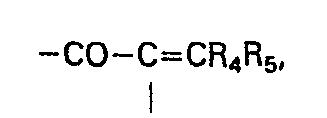
- Y eine Gruppe -CO-CHR3- oder eine Gruppe -CO-C=CR4R5,
- R3 Wasserstoff, einen niederen Alkylrest, der geqebenenfalls durch einen Arylrest substituiert sein kann, oder einen Cycloalkylrest mit 3 bis 7 Kohlenstoffatomen,
- R4 und R5, die gleich oder verschieden sein koennen, jeweils Wasserstoff, einen niederen Alkylrest, einen Alkenylrest mit 2 bis 16 Kohlenstoffatomen, der gegebenenfalls durch einen Arylrest substituiert sein kann, oder einen Arylrest oder
- R4 und R5 zusammen mit dem C-Atom einen Cycloalkylring mit 3 bis 7 Kohlenstoffatomen
- Weiterhin betrifft die Erfinduna pharmazeutische Praeparate mit einem Gehalt an Verbindungen der allgemeinen Formel I sowie die Verwendunq von Verbindungen der allgemeinen Formel I zur Herstellung solcher Praeparate.
- Die fuer R1, R3, R4 und R5 stehenden niederen Alkylreste weisen 1-6, insbesondere 1-4 Kohlenstoffatome auf und koennen geradkettig oder verzweigt sein. Bevorzugt ist der Methyl-, Isopropyl- und Propylrest. Die fuer R4 und R5 stehenden Alkenylreste können qeradkettig, verzweigt oder cyclisch sein und 1 bis 3 Doppelbindungen enthalten. Bevorzugt ist der Farnesyl-, Geranyl- und (2,6,6-Trimethyl-1-cyclohexen-1 yl)-vinylrest. Unter einem durch Aryl substituierten Alkenylrest ist insbesondere der Styryl-Rest zu verstehen.
- Die in R3, R4 und R5 enthaltenen Arylrestesind vorzugsweise der Phenylrest, der gewuenschtenfalls durch Halogen, Niederalkyl oder Niederalkoxy substituiert sein kann. Die Acylgruppen des Substituenten R2 stellen Niederalkanoylgruppen mit 1 - 5 Kohlenstoffatomen, die gegebenenfalls durch gewuenschtenfalls substituiertes Aryl substituiert sind (z.B. Phenacetyl), Niederalkenoylgruppen mit 3 - 6 Kohlenstoffatomen, die geaebenenfalls durch Aryl substituiert sind, beispielsweise eine Cinnamoylgruppe, oder Aroylgruppen, die gegebenenfalls durch Halogen, Hydroxyl, Niederalkyl, Niederalkoxy, Nitro, Amino, Niederalkylthio, Niederalkylsulfinyl, Niederalkylsulfonyl oder Cyano substituiert sein koennen, bedeuten.
- Die Niederalkylrest in sämtlichen genannten Gruppen enthalten eweils 1 bis 6, vorzugsweise 1 bis 4 Kohlenstoffatome und koennen qeradkettig oder verzeiqt sein. Aroylgruppen sind beispielsweise der Benzoyl- und Naphthoylrest.
- Desweiteren kann R2 den Saeurerest einer carbocyclischen Carbonsaeure mit 4 bis 8 Kohlenstoffatomen darstellen. Der Ausdruck Aryl in der Definition des Substituenten R2 bedeutet vorzugsweise Phenyl oder Naphthyl, gegebenenfalls substituiert durch Halogen, Niederalkyl, Niederalkoxy, Amino oder Nitro. Als Halogenatome kommen Fluor, Chlor und Brom in Frage.
- Die Gruppe Y kann sowohl -CO-CHR3- oder -CO-C=CR4R5 als auch R3-CH-CO- bzw. R4R5 C=C-CO- bedeuten.
- Die Grundkörper, die X und Y mit dem Phenylteil bilden können, sind Cumaran-2-on, Cumaran-3-on, Oxindol und Thianaphthen-3-on. Die Oxypropylgruppe steht in der Regel in der 4; 5-oder 6-Stellung des jeweiligen Ringsystems.
- Außer den in den Beispielen genannten Verbindungen sind Gegenstand der vorliegenden Erfindung insbesondere alle Substanzen, die jede moegliche Kombination der in den Beispielen genannten Substituenten aufweisen.
- Das erfindungsgemaeße Verfahren zur Herstellung der Verbindungen der Formel I ist dadurch gekennzeichnet, daß man in an sich bekannter Weise eine Verbindung der allgemeinen Formel II

- R11 X und Y die obengenannte Bedeutung haben, mit einer Verbindung der allgemeinen Formel III

- L und M reaktive Reste bedeuten,
- und einer Verbindung der allgemeinen Formel IV

- R2 die obengenannte Bedeutung hat, umsetzt,
- anschließend gewuenschtenfalls die Gruppe R2 durch bekannte Verfahren in eine andere Gruppe R2 umwandelt,
- Als reaktive Reste L und M der Verbindungen der allgemeinen Formel III kommen Chlor, Brom, Mesyloxy und Tosyloxy in Frage.
- Das erfindungsgemaeße Verfahren fuehrt man beispielsweise so durch, daß man zunaechst eine Verbindung der allgemeinen Formel III mit einer Verbindung der allgemeinen Formel IV kondensiert und das erhaltene Reaktionsprodukt isoliert. Dieses Zwischenprodukt wird dann mit einer Verbindung der allgemeinen Formel II zur Reaktion gebracht. Die Umsetzung erfolgt zweckmaeßig in alkalischem Medium, beispielsweise in einem niederen Alkohol wie z.B. Isopropanol in Anwesenheit von Natriumisopropanolat oder in Dimethylformamid oder Tetrahydrofuran in Gegenwart von Kaliumcarbonat oder Triethylamin.
- Eine andere Variante besteht darin, zunaechst eine Verbindung der allgemeinen Formel II mit einer Verbindung der allgemeinen Formel III zur Reaktion zu bringen; anschließend wird das erhaltene Reaktionsprodukt mit einer Verbindung der allgemeinen Formel IV zum gewuenschten Endprodukt der allgemeinen Formel I umgesetzt.
- Eine nachtraegliche Umwandlung der Gruppe R2 in der allgemeinen Formel I in eine andere Gruppe R2 erfolgt beispielsweise durch Acylierung einer Verbindung der Formel I, in der R2 fuer Wasserstoff steht, mit einer Verbindung R2-Z, wobei Z einen reaktiven Rest darstellt. Verbindungen der Formel I mit der Bedeutung R2 = Wasserstoff stellen somit wertvolle Zwischenprodukte zur Herstellung anderer Verbindungen der Formel I dar. Reaktive Reste Z koennen alle Reste sein, die in der Peptidchemie zur Aktivierung von Carbonsaeuren Verwendung finden, beispielsweise Halogenatome, die Azidogruppe, Alkyloxy-, Aryloxy- und Acyloxy-Gruppen.
- Eine weitere Moeglichkeit der nachtraeglichen Umwandlung der Gruppe R2 in der allgemeinen Formel I besteht darin, daß man nach allgemein bekannten Verfahren einen oder mehrere Substituenten des Acylrestes R2 beispielsweise durch Veresterung, Verseifung, Reduktion, Alkylierung, Acylierung, Hydrogenolyse, Oxidation, Amidierung oder Eliminierung in einen oder mehrere andere Substituenten des Acylrestes R2 umwandelt.
- Eine gewuenschtenfalls vorzunehmende Kondensation einer Verbindung der allgemeinen Formel I, in der R3 ein Wasserstoffatom bedeutet, mit einer Carbonylverbindung R4CORS oder einem reaktiven Derivat hiervon erfolgt zweckmaeßig in einem organischen Loesungsmittel in Gegenwart eines wasserabspaltenden Mittels, beispielsweise in einem niederen Alkohol oder in Toluol in Gegenwart von Kaliumhydroxid oder Ammoniak oder Toluolsulfonsaeure.
- Die Reduktion einer fuer Y stehenden Gruppe -CO-C=CR4R5 kann beispielsweise mit katalytisch erregtem Wasserstoff in Anwesenheit eines Edelmetallkatalysators wie Palladium oder Platin erfolgen.
- Die Ausgangsverbindungen der allgemeinen Formel II, III und IV sind literaturbekannte Substanzen oder koennen in Analogie zu literaturbekannten Verfahren hergestellt werden.
- Die pharmakologisch vertraeglichen Salze erhaelt man in ueblicher Weise, z.B. durch Neutralisation der Verbindungen der Formel I mit nichttoxischen anorganischen oder organischen Saeuren wie z.B. Salzsaeure, Schwefelsaeure, Phosphorsaeure, Bromwasserstoffsaeure, Essigsaeure, Milchsaeure, Zitronensaeure, Aepfelsaeure, Salicylsaeure, Malonsaeure, Maleinsaeure oder Bernsteinsaeure.
- Zur Herstellung von Arzneimitteln werden die Verbindungen der allgemeinen Formel I in an sich bekannter Weise mit geeigneten pharmazeutischen Traegersubstanzen, Aroma-, Geschmacks- und Farbstoffen gemischt und beispielsweise als Tabletten oder Dragees ausgeformt oder unter Zugabe entsprechender Hilfsstoffe in Wasser oder Oel, wie z.B. Olivenoel, suspendiert oder geloest.
- Die Substanzen der allgemeinen Formel I koennen in fluessiger oder fester Form oral und parenteral appliziert werden. Als Injektionsmedium kommt vorzugsweise Wasser zur Anwendung, welches die bei 1-njektionsloesungen ueblichen Stabilisierungsmittel, Loesungsvermittler und / oder Puffer enthaelt. Derartige Zusaetze sind z.B. Tartrat- oder Borat-Puffer, Ethanol, Dimeth- ylsulfoxid, Komplexbildner (wie Ethylendiamintetraessig- saeure), hochmolekulare Polymere (wie fluessiges Polyethylenoxid) zur Viskositaetsregulierung oder Polyethylen-Derivate von Sorbitanhydriden.
- Feste Traegerstoffe sind z.B. Staerke, Lactose, Mannit, Methylcellulose, Talkum, hochdisperse Kieselsaeure, hoehermolekulare Polymere (wie Polyethylenglykole).
- Fuer die orale Applikation geeignete Zubereitungen koennen gewuenschtenfalls Geschmacks-und Sueßstoffe enthalten. Fuer die aeußerliche Anwendung koennen die erfindungsgemaeßen Substanzen I auch in Form von Pudern und Salben verwendet werden. Sie werden dazu z.B. mit pulverfoermigen, physiologisch vertraeglichen Verduennungsmittel bzw. ueblichen Salbengrundlagen vermischt.
- Die verabreichte Dosierung haengt vom Alter, der Gesundheit und dem Gewicht des Empfaengers, dem Ausmaß der Krankheit, der Art gleichzeitiger gegebenenfalls durchgefuehrter weiterer Behandlüngen, der Haeufigkeit der Behandlungen und der Art der gewuenschten Wirkung ab. Ueblicherweise betraegt die taegliche Dosis der aktiven Verbindung 0.1 bis 50 mg/kg Koerpergewicht. Normalerweise sind 0.5 bis 40 und vorzugsweise 1.0 bis 20 mg/ kg/Tag in einer oder mehreren Anwendungen pro Tag wirksam, um die gewuenschten Resultate zu erhalten.
- Außer den in den nachstehenden Beispielen genannten Substanzen sind im Sinne der vorliegenden Anmeldung die folgenden Verbindungen bevorzugt:
- 6-[3-(4-Benzamido-piperidino)propoxy]-2-isopropyliden-benzo[b]thiophen-3-on
- 6-[3-(4-Phenylacetamido-piperidino)propoxy]-2-isopropyliden- benzo[b]thiophen-3-on
- 6- <3-[4-(2-Nitro-benzamido)piperidino)propoxy > -2-isopropyliden- benzo/b/thiophen-3-on
- Zu der Loesung von 0.58 g (25 mmol) Natrium in 75 ml 2-Propanol gibt man bei 40°C 6.1 g (25 mmol) 2-Cyclohexyliden-6-hydroxy-cumaranon-3, ruehrt 10 min bei 40°C, fuegt 8.4 g (30 mmol) 3-(4-Benzamido-piperidino)propylchlorid zu, erhitzt 6 h zum Rueckfluß, kuehlt ab und kristallisiert den Niederschlag aus Ethanol um. Man isoliert 8.7 g Titelverbindung (75 % d.Th.) vom Schmp. 174 - 175°C.
- Das als Ausgangsstoff eingesetzte 2-Cyclohexyliden-6-hydroxy-cumaranon-3 kann wie folgt erhalten werden:
- Eine Mischung aus 20.0 g (0.13 mol) 6-Hydroxy-cumaranon-3, 60 ml Cyclohexanon, 600 ml Ethanol und 50 g Kaliumhydroxid wird 36 h bei Raumtemperatur geruehrt, filtriert und das Filtrat mit Salzsaeure angesaeuert. Es fallen 11.7 g 2-Cyclohexyliden-6-hydroxy-cumaranon-3 (40 % d.Th.) vom Schmp. 210 - 212°C aus.
- In analoger Weise wie in Beispiel 1 beschrieben erhaelt man:


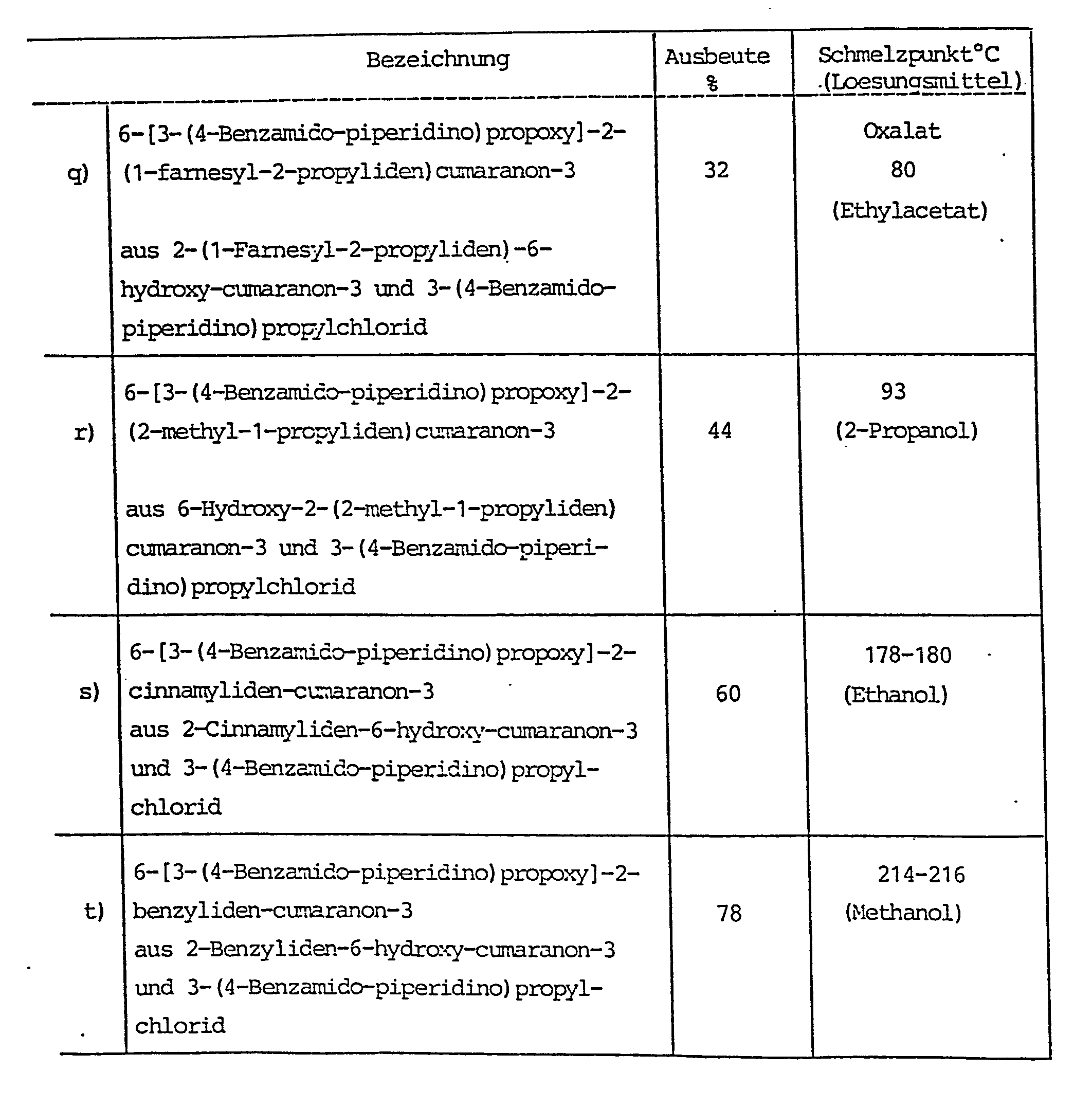
- Beispiel 2 (Fortsetzung)

- Eine Mischung aus 9.8 g (31 mmol) 6-(3-Brom-propoxy)-2-isopropyliden-cumaranon-3, 6.9 g (31 mmol) 4-(2-Amino-benzamido) piperidin, 10.1 g (0.1 mol) Triethylamin und 100 ml Tetrahydrofuran wird 16 h am Rueckfluß erhitzt. Darauf engt man ein, nimmt den Rueckstand in Dichlormethan auf, waescht neutral, engt ein und chromatographiert an Kieselgel (Elutionsmittel: Dichlormethan/Methanol 9 : 1). Man erhaelt nach Anreiben mit Diethylether 4.9 g der Titelverbindung (35 % d.Th.) vom Schmp. 139 - 140°C.
- Das als Ausgangsstoff verwendete 6-(3-Brom-propoxy)-2-isopropyliden-cumaranon-3 kann wie folgt hergestellt werden:
- Zu der Loesung von 25.0 g (0.13 mol) 6-Hydroxy-2-isopropyliden- cumaranon-3 und 40 ml 1,3-Dibrompropan in 130 ml Butanon gibt man bei 75°C innerhalb 3 h 20.0 g (0.15 mol) Kaliumcarbonat, erwaermt 48 h zum Rueckfluß, filtriert, engt das Filtrat ein und verreibt den Rueckstand mit Ligroin. Es verbleiben 29.8 g der gewuenschten Verbindung (74 % d.Th.) vom Schmp. 80 - 82°C.
- In analoger Weise wie in Beispiel 3 beschrieben erhaelt man:

- Eine Loesung von 5.0 g (11 mmol) 6-[3-(4-Benzamido-piperidino) propoxy]-2-isopropyliden-cumaranon-3 (Beispiel 2 g) in 200 ml Methanol wird bei Raumtemperatur und 1 bar Wasserstoffdruck ueber 0.5 g Platinoxid hydriert. Nach Aufnahme der berechneten Menge wird filtriert, eingeengt und der Rueckstand aus 2-Propanol umkristallisiert. Man erhaelt 3.6 g Titelverbindung (75 % d.Th.) vom Schmp. 146 - 147°C.
- In analoger Weise wie in Beispiel 5 beschrieben erhaelt man:

- Zu einer Mischung aus 6.6 g (20 mmol) 6-[3-(4-Amino-piperidino) propoxy]-2-isopropyliden-cumaranon-3 (Beispiel 4 b) und 8.4 g (0:1 mol) Natriumhydrogencarbonat in 150 ml Dichlormethan tropft man die Loesung von 3.65 g (25 mmol) Cyclopropancarbonsaeurechlorid in 50 ml Dichlormethan, ruehrt 5 h bei Raumtemperatur, waescht neutral, engt die organische Phase ein und chromatographiert den Rueckstand an Kieselgel (Elutionsmittel: Dichlormethan/Methanol 9 : 1). Man erhaelt 1.8 g Titelverbindung (23 % d.Th.), identisch mit der Verbindung von Beispiel 2 f.
- In eine Loesung von 9.0 g (20 mmol) 6-[.3-(4-Phenylacetamido- piperidino)propoxy]-7-propyl-cumaranon-3 (Beispiel 2 v) in 50 ml Ethanol und 10 ml Aceton leitet man bei 20°C Ammoniak bis zur Saettigung ein, erwaermt 3 h zum Rueckfluß, engt ein und chromatographiert an Kieselgel (Elutionsmittel: Dichlormethanol 95 : 5). Man isoliert 4.1 g der Titelverbindung (42 % d.Th.), identisch mit der Verbindung von Beispiel 2 n.
- Es wurden Tabletten hergestellt: Jede Tablette enthaelt 10 mg 6-[3-(4-Benzamido-piperidino)propoxy]-2-isopropyliden- cumaranon-3. Die Tabletten wurden gemaeß der folgenden Rezeptur hergestellt:

- Vorstehende Verbindung wurde fein pulverisiert und mit Lactose und Staerke vermischt. Das Gemisch wurde in herkoemmlicher Weise granuliert. Magnesiumstearat wurde zu dem Granulat gegeben und das Gemisch zu 1000 Tabletten mit einem Einzelgewicht von 0.12 g verpreßt.

Claims (10)





Priority Applications (1)
| Application Number | Priority Date | Filing Date | Title |
|---|---|---|---|
| AT83102247T ATE25523T1 (de) | 1982-03-13 | 1983-03-08 | Bicyclische phenolether, verfahren zu deren herstellung sowie diese verbindungen enthaltende arzneimittel. |
Applications Claiming Priority (2)
| Application Number | Priority Date | Filing Date | Title |
|---|---|---|---|
| DE19823209271 DE3209271A1 (de) | 1982-03-13 | 1982-03-13 | Bicyclische phenolether, verfahren zu deren herstellung sowie diese verbindungen enthaltende arzneimittel |
| DE3209271 | 1982-03-13 |
Publications (3)
| Publication Number | Publication Date |
|---|---|
| EP0088986A2 true EP0088986A2 (de) | 1983-09-21 |
| EP0088986A3 EP0088986A3 (en) | 1983-11-09 |
| EP0088986B1 EP0088986B1 (de) | 1987-02-25 |
Family
ID=6158227
Family Applications (1)
| Application Number | Title | Priority Date | Filing Date |
|---|---|---|---|
| EP83102247A Expired EP0088986B1 (de) | 1982-03-13 | 1983-03-08 | Bicyclische Phenolether, Verfahren zu deren Herstellung sowie diese Verbindungen enthaltende Arzneimittel |
Country Status (7)
| Country | Link |
|---|---|
| US (1) | US4486442A (de) |
| EP (1) | EP0088986B1 (de) |
| JP (1) | JPS58167587A (de) |
| AT (1) | ATE25523T1 (de) |
| CA (1) | CA1243320A (de) |
| DE (2) | DE3209271A1 (de) |
| ES (1) | ES520486A0 (de) |
Cited By (4)
| Publication number | Priority date | Publication date | Assignee | Title |
|---|---|---|---|---|
| WO1999006387A3 (en) * | 1997-07-31 | 1999-04-22 | Hoffmann La Roche | O-substituted hydroxycumaranone derivatives as antitumor and antimetastatic agents |
| EP1026165A1 (de) * | 1999-01-30 | 2000-08-09 | Roche Diagnostics GmbH | O-Substituierte Hydroxycoumaranonderivate als Antitumor- und Antimetastasenmittel |
| TR200000254A3 (tr) * | 1999-01-30 | 2000-09-21 | Roche Diagnostics Gmbh | Antitümör ve antimetastaz maddeleri olarak O-ikameli hidroksikumaranon türevleri |
| WO2004076444A3 (en) * | 2003-02-25 | 2004-10-28 | Hoffmann La Roche | Novel hydroxycoumaranone derivatives as antitumor and antimetastatic |
Families Citing this family (1)
| Publication number | Priority date | Publication date | Assignee | Title |
|---|---|---|---|---|
| GB9501567D0 (en) * | 1995-01-26 | 1995-03-15 | Pharmacia Spa | Hydrosoluble 3-arylidene-2-oxindole derivatives as tyrosine kinase inhibitors |
Family Cites Families (4)
| Publication number | Priority date | Publication date | Assignee | Title |
|---|---|---|---|---|
| FR2368952A1 (fr) * | 1976-02-25 | 1978-05-26 | Lipha | Nouveaux aminoalcoxy-4 (2 h) pyranone-2,3 substitues-5,6 condenses |
| DE2901336A1 (de) * | 1979-01-15 | 1980-07-24 | Boehringer Mannheim Gmbh | Neue arylether, verfahren zu deren herstellung sowie diese verbindungen enthaltende arzneimittel |
| DE2905876A1 (de) * | 1979-02-16 | 1980-08-28 | Boehringer Mannheim Gmbh | Neue piperidinopropylderivate, verfahren zu ihrer herstellung und diese verbindungen enthaltende arzneimittel |
| DE2939292A1 (de) * | 1979-09-28 | 1981-04-09 | Boehringer Mannheim Gmbh, 6800 Mannheim | N-phenoxyalkylpiperidin-derivate, verfahrenn zu deren herstellung sowie diese verbindungen enthaltende arzneimittel |
-
1982
- 1982-03-13 DE DE19823209271 patent/DE3209271A1/de not_active Withdrawn
-
1983
- 1983-02-25 CA CA000422393A patent/CA1243320A/en not_active Expired
- 1983-02-25 US US06/469,856 patent/US4486442A/en not_active Expired - Fee Related
- 1983-03-08 AT AT83102247T patent/ATE25523T1/de not_active IP Right Cessation
- 1983-03-08 JP JP58036766A patent/JPS58167587A/ja active Pending
- 1983-03-08 EP EP83102247A patent/EP0088986B1/de not_active Expired
- 1983-03-08 DE DE8383102247T patent/DE3369846D1/de not_active Expired
- 1983-03-10 ES ES520486A patent/ES520486A0/es active Granted
Cited By (7)
| Publication number | Priority date | Publication date | Assignee | Title |
|---|---|---|---|---|
| WO1999006387A3 (en) * | 1997-07-31 | 1999-04-22 | Hoffmann La Roche | O-substituted hydroxycumaranone derivatives as antitumor and antimetastatic agents |
| AU745839B2 (en) * | 1997-07-31 | 2002-04-11 | F. Hoffmann-La Roche Ag | O-substituted hydroxycumaranone derivatives as antitumor and antimetastatic agents |
| EP1026165A1 (de) * | 1999-01-30 | 2000-08-09 | Roche Diagnostics GmbH | O-Substituierte Hydroxycoumaranonderivate als Antitumor- und Antimetastasenmittel |
| TR200000254A3 (tr) * | 1999-01-30 | 2000-09-21 | Roche Diagnostics Gmbh | Antitümör ve antimetastaz maddeleri olarak O-ikameli hidroksikumaranon türevleri |
| US6307051B1 (en) | 1999-01-30 | 2001-10-23 | Roche Diagnostics Gmbh | 2-alkylidene hydroxycoumaranone derivatives |
| KR100387275B1 (ko) * | 1999-01-30 | 2003-06-11 | 로셰 디아그노스틱스 게엠베하 | 항종양 및 항전이 약제로서의 o-치환된 히드록시쿠마라논유도체 |
| WO2004076444A3 (en) * | 2003-02-25 | 2004-10-28 | Hoffmann La Roche | Novel hydroxycoumaranone derivatives as antitumor and antimetastatic |
Also Published As
| Publication number | Publication date |
|---|---|
| ATE25523T1 (de) | 1987-03-15 |
| CA1243320A (en) | 1988-10-18 |
| EP0088986A3 (en) | 1983-11-09 |
| ES8401059A1 (es) | 1983-12-16 |
| DE3369846D1 (en) | 1987-04-02 |
| EP0088986B1 (de) | 1987-02-25 |
| US4486442A (en) | 1984-12-04 |
| ES520486A0 (es) | 1983-12-16 |
| DE3209271A1 (de) | 1983-09-15 |
| JPS58167587A (ja) | 1983-10-03 |
Similar Documents
| Publication | Publication Date | Title |
|---|---|---|
| EP0287907B1 (de) | Pyrazolo[3,4-d]pyrimidine, Verfahren zu ihrer Herstellung und Verwendung als Arzneimittel | |
| DE3025385A1 (de) | Neue tricyclische arylether, verfahren zu ihrer herstellung sowie diese verbindungen enthaltende arzneimittel | |
| DE1695556B2 (de) | 3Alkyl-l,2,3,4,4a,9-hexahydropyrazino [1,2-f] morphanthridinderivate | |
| EP0013894B1 (de) | Neue Arylether, Verfahren zu deren Herstellung sowie diese Verbindungen enthaltende Arzneimittel | |
| DE2628189A1 (de) | 3-phenylindoline, verfahren zu ihrer herstellung und diese verbindungen enthaltende arzneimittel | |
| EP0315009A2 (de) | Chromanderivate, Verfahren zu ihrer Herstelllung und ihre Verwendung in Arzneimitteln | |
| EP0000784B1 (de) | 4-Hydroxy-2-Benzimidazolinon-derivate, Verfahren zu deren Herstellung sowie diese Verbindungen enthaltende Arzneimittel | |
| EP0064255B1 (de) | Benzopyranylether, Verfahren zu deren Herstellung sowie diese Verbindungen enthaltende Arzneimittel und Zwischenprodukte | |
| EP0171645B1 (de) | Neue 2H-1-Benzopyran-2-on-Derivate, Verfahren zu ihrer Herstellung und Arzneimittel, die diese Verbindungen enthalten | |
| DE3326724A1 (de) | In 1-stellung substituierte 4-hydroxymethyl-pyrrolidinone, verfahren zu ihrer herstellung, pharmazeutische zusammensetzungen und zwischenprodukte | |
| EP0088986B1 (de) | Bicyclische Phenolether, Verfahren zu deren Herstellung sowie diese Verbindungen enthaltende Arzneimittel | |
| DE2617955A1 (de) | Neue l-substituierte -aroyl-4-hydroxypiperidine, verfahren zu ihrer herstellung und sie enthaltende arzneimittel | |
| EP0171689B1 (de) | Neue Aminoalkohole, Verfahren zu deren Herstellung sowie diese Verbindungen enthaltende Arzneimittel und Zwischenprodukte | |
| DE3532279A1 (de) | 1,4-benzoxathiin-derivate | |
| EP0072960B1 (de) | 1,5-Diphenylpyrazolin-3-on-Verbindungen sowie Verfahren und Zwischenprodukte zu ihrer Herstellung und diese Verbindungen enthaltende Arzneimittel | |
| DE2619164A1 (de) | Indazolyl-(4)-oxy-propanolamine und verfahren zu ihrer herstellung | |
| EP0233483B1 (de) | Pyrrolo[1,2-a][4,1]benzoxazepine, Verfahren zur ihrer Herstellung, pharmazeutische Präparate enthaltend diese Verbindungen, sowie therapeutische Verwendung | |
| EP0003298B1 (de) | 4-Hydroxy-2-benzimidazolin-thion-Derivate, Verfahren zu deren Herstellung sowie diese Verbindungen enthaltende Arzneimittel | |
| DE2610501A1 (de) | 1,4-disubstituierte piperazinverbindungen, verfahren zu ihrer herstellung und diese verbindungen enthaltende arzneimittel | |
| EP0029992B1 (de) | Neue Aminopropanolderivate, Verfahren zu ihrer Herstellung und diese Verbindungen enthaltende Arzneimittel | |
| CH634315A5 (de) | Verfahren zur herstellung von substituierten 2-vinylchromonen. | |
| AT346841B (de) | Verfahren zur herstellung von neuen 3- phenylindolinen und ihren salzen | |
| DE2508251A1 (de) | Neue derivate des indols, verfahren zu deren herstellung sowie diese enthaltende arzneimittel | |
| AT324342B (de) | Verfahren zur herstellung von neuen 6-aza-3h-1,4-benzodiazepinen und ihren salzen | |
| AT286495B (de) | Verfahren zur Herstellung von neuen Estern des α-Amino-benzylpenicillins |
Legal Events
| Date | Code | Title | Description |
|---|---|---|---|
| PUAI | Public reference made under article 153(3) epc to a published international application that has entered the european phase |
Free format text: ORIGINAL CODE: 0009012 |
|
| PUAL | Search report despatched |
Free format text: ORIGINAL CODE: 0009013 |
|
| 17P | Request for examination filed |
Effective date: 19830308 |
|
| AK | Designated contracting states |
Designated state(s): AT BE CH DE FR GB IT LI LU NL SE |
|
| AK | Designated contracting states |
Designated state(s): AT BE CH DE FR GB IT LI LU NL SE |
|
| GRAA | (expected) grant |
Free format text: ORIGINAL CODE: 0009210 |
|
| AK | Designated contracting states |
Kind code of ref document: B1 Designated state(s): AT BE CH DE FR GB IT LI LU NL SE |
|
| REF | Corresponds to: |
Ref document number: 25523 Country of ref document: AT Date of ref document: 19870315 Kind code of ref document: T |
|
| PG25 | Lapsed in a contracting state [announced via postgrant information from national office to epo] |
Ref country code: SE Effective date: 19870228 |
|
| ITF | It: translation for a ep patent filed | ||
| PG25 | Lapsed in a contracting state [announced via postgrant information from national office to epo] |
Ref country code: LU Free format text: LAPSE BECAUSE OF NON-PAYMENT OF DUE FEES Effective date: 19870331 |
|
| REF | Corresponds to: |
Ref document number: 3369846 Country of ref document: DE Date of ref document: 19870402 |
|
| ET | Fr: translation filed | ||
| PLBE | No opposition filed within time limit |
Free format text: ORIGINAL CODE: 0009261 |
|
| STAA | Information on the status of an ep patent application or granted ep patent |
Free format text: STATUS: NO OPPOSITION FILED WITHIN TIME LIMIT |
|
| 26N | No opposition filed | ||
| PGFP | Annual fee paid to national office [announced via postgrant information from national office to epo] |
Ref country code: DE Payment date: 19890323 Year of fee payment: 7 |
|
| PGFP | Annual fee paid to national office [announced via postgrant information from national office to epo] |
Ref country code: GB Payment date: 19900228 Year of fee payment: 8 |
|
| PGFP | Annual fee paid to national office [announced via postgrant information from national office to epo] |
Ref country code: AT Payment date: 19900312 Year of fee payment: 8 |
|
| PGFP | Annual fee paid to national office [announced via postgrant information from national office to epo] |
Ref country code: FR Payment date: 19900319 Year of fee payment: 8 |
|
| PGFP | Annual fee paid to national office [announced via postgrant information from national office to epo] |
Ref country code: CH Payment date: 19900322 Year of fee payment: 8 |
|
| PGFP | Annual fee paid to national office [announced via postgrant information from national office to epo] |
Ref country code: BE Payment date: 19900330 Year of fee payment: 8 |
|
| ITTA | It: last paid annual fee | ||
| PGFP | Annual fee paid to national office [announced via postgrant information from national office to epo] |
Ref country code: NL Payment date: 19900331 Year of fee payment: 8 |
|
| PG25 | Lapsed in a contracting state [announced via postgrant information from national office to epo] |
Ref country code: DE Effective date: 19901201 |
|
| PG25 | Lapsed in a contracting state [announced via postgrant information from national office to epo] |
Ref country code: GB Effective date: 19910308 Ref country code: AT Effective date: 19910308 |
|
| PG25 | Lapsed in a contracting state [announced via postgrant information from national office to epo] |
Ref country code: LI Effective date: 19910331 Ref country code: CH Effective date: 19910331 Ref country code: BE Effective date: 19910331 |
|
| BERE | Be: lapsed |
Owner name: BOEHRINGER MANNHEIM G.M.B.H. Effective date: 19910331 |
|
| PG25 | Lapsed in a contracting state [announced via postgrant information from national office to epo] |
Ref country code: NL Effective date: 19911001 |
|
| GBPC | Gb: european patent ceased through non-payment of renewal fee | ||
| NLV4 | Nl: lapsed or anulled due to non-payment of the annual fee | ||
| PG25 | Lapsed in a contracting state [announced via postgrant information from national office to epo] |
Ref country code: FR Effective date: 19911129 |
|
| REG | Reference to a national code |
Ref country code: CH Ref legal event code: PL |
|
| REG | Reference to a national code |
Ref country code: FR Ref legal event code: ST |