EP0076683B1 - Apparatus and method for controlling the ph of a continuous process stream - Google Patents
Apparatus and method for controlling the ph of a continuous process stream Download PDFInfo
- Publication number
- EP0076683B1 EP0076683B1 EP82305270A EP82305270A EP0076683B1 EP 0076683 B1 EP0076683 B1 EP 0076683B1 EP 82305270 A EP82305270 A EP 82305270A EP 82305270 A EP82305270 A EP 82305270A EP 0076683 B1 EP0076683 B1 EP 0076683B1
- Authority
- EP
- European Patent Office
- Prior art keywords
- process stream
- backmixing
- sample
- reagent
- conduit
- Prior art date
- Legal status (The legal status is an assumption and is not a legal conclusion. Google has not performed a legal analysis and makes no representation as to the accuracy of the status listed.)
- Expired
Links
Images

Classifications
-
- G—PHYSICS
- G05—CONTROLLING; REGULATING
- G05D—SYSTEMS FOR CONTROLLING OR REGULATING NON-ELECTRIC VARIABLES
- G05D21/00—Control of chemical or physico-chemical variables, e.g. pH value
- G05D21/02—Control of chemical or physico-chemical variables, e.g. pH value characterised by the use of electric means
-
- B—PERFORMING OPERATIONS; TRANSPORTING
- B01—PHYSICAL OR CHEMICAL PROCESSES OR APPARATUS IN GENERAL
- B01D—SEPARATION
- B01D53/00—Separation of gases or vapours; Recovering vapours of volatile solvents from gases; Chemical or biological purification of waste gases, e.g. engine exhaust gases, smoke, fumes, flue gases, aerosols
- B01D53/14—Separation of gases or vapours; Recovering vapours of volatile solvents from gases; Chemical or biological purification of waste gases, e.g. engine exhaust gases, smoke, fumes, flue gases, aerosols by absorption
- B01D53/1412—Controlling the absorption process
-
- B—PERFORMING OPERATIONS; TRANSPORTING
- B01—PHYSICAL OR CHEMICAL PROCESSES OR APPARATUS IN GENERAL
- B01D—SEPARATION
- B01D53/00—Separation of gases or vapours; Recovering vapours of volatile solvents from gases; Chemical or biological purification of waste gases, e.g. engine exhaust gases, smoke, fumes, flue gases, aerosols
- B01D53/14—Separation of gases or vapours; Recovering vapours of volatile solvents from gases; Chemical or biological purification of waste gases, e.g. engine exhaust gases, smoke, fumes, flue gases, aerosols by absorption
- B01D53/1425—Regeneration of liquid absorbents
-
- B—PERFORMING OPERATIONS; TRANSPORTING
- B01—PHYSICAL OR CHEMICAL PROCESSES OR APPARATUS IN GENERAL
- B01D—SEPARATION
- B01D53/00—Separation of gases or vapours; Recovering vapours of volatile solvents from gases; Chemical or biological purification of waste gases, e.g. engine exhaust gases, smoke, fumes, flue gases, aerosols
- B01D53/14—Separation of gases or vapours; Recovering vapours of volatile solvents from gases; Chemical or biological purification of waste gases, e.g. engine exhaust gases, smoke, fumes, flue gases, aerosols by absorption
- B01D53/1456—Removing acid components
- B01D53/1468—Removing hydrogen sulfide
-
- Y—GENERAL TAGGING OF NEW TECHNOLOGICAL DEVELOPMENTS; GENERAL TAGGING OF CROSS-SECTIONAL TECHNOLOGIES SPANNING OVER SEVERAL SECTIONS OF THE IPC; TECHNICAL SUBJECTS COVERED BY FORMER USPC CROSS-REFERENCE ART COLLECTIONS [XRACs] AND DIGESTS
- Y10—TECHNICAL SUBJECTS COVERED BY FORMER USPC
- Y10T—TECHNICAL SUBJECTS COVERED BY FORMER US CLASSIFICATION
- Y10T436/00—Chemistry: analytical and immunological testing
- Y10T436/12—Condition responsive control
Definitions
- This invention relates to an apparatus and method for controlling the pH of a continuous process stream, and more particularly to a process and system for controlling the pH of a continuous effluent stream by the continuous addition of a reagent.
- Emissions and effluents from industrial processes often require the removal or neutralization of offensive substances before they can be discharged into the environment.
- One such emission is that from a fluid catalytic cracker regenerator, which emission requires the removal of sulfur.
- the sulfur from the gaseous emission is generally removed by wet gas scrubbing.
- the gases sent into the air are freed of sulfur, but the effluent scrubber stream, however, requires neutralization of the sulfuric acid formed by the absorbed sulfur.
- the present invention is concerned with the neutralization, or otherwise control of the pH, of effluent process streams.
- the present invention has as one of its objectives to control the pH of a process stream on a continuous basis, while eliminating the need for costly backmixing facilities.
- the present invention also seeks to provide a system and method for controlling the pH of a process stream in a quick, efficient manner.
- the present invention achieves the stability of effluent stream composition by replacing the process stream backmixer with the far less costly sample stream mixer.
- US-A-2,063,140 describes a control process for pH monitoring wherein a sample from a stream is injected with an indicator and passes through an analyzer. The analysis is used to control the addition of acid or base (reagent) to the process stream. A mixer is utilized to mix the reagent with the process stream.
- the present invention differs from the related art in that a sample is obtained from a process stream and is averaged by backmixing in a small vessel.
- the averaged sample is continuously analyzed to control the pH of the stream on an upstream portion thereof. Therefore, the dynamic response of the system is reduced, and pH control is accomplished on a continuous basis.
- NL-A-7902177 describes and claims, in one aspect, equipment for automatically dispensing chemicals in swimming pools with the feature that the pool water feed pipe has a sample line provided with a control valve and the pool water discharge pipe also has a sample line which is provided with a control valve.
- the two sample lines are connected to a mixing vessel in which measuring electrodes are located and which are connected to controls for the supply of chemicals to the pool, and the mixing vessel is fitted with a discharge pipe.
- NL-A-7902177 describes and claims a method of operation for dispensing chemicals into swimming pools, with the feature that part of the inlet flow and part of the outletflow of the pool water is sampled and combined in a mixing unit where desired measurements of the quality of the mixed water sample are taken.
- the ratio of the sampled volumes of inlet and outlet water are controlled by a ratio control operating in the water circuit.
- the said ratio control is set to a constant ratio for the relevant swimming pool with the idle or dead time limited to a few seconds.
- the supply of chemicals is controlled automatically on the basis of the data thus obtained.
- This invention pertains to a method and system for controlling the pH of a continuous process stream.
- the present invention provides, in one aspect, a system for controlling the pH of a continuous process stream comprising:
- the invention provides a method of controlling the pH of a continous process stream, comprising the steps of:
- a conduit for conveying the process stream is substantially, continously sampled.
- the continuous samples is averaged in a small backmixing vessel and substantially, continously analyzed for pH.
- Reagent is added by a pH control means on a substantially, continuous basis in an upstream portion of the process stream in response to the pH analysis.
- the system may also comprise a small vessel for performing rapid oxidation of the backmixed sample prior to pH analysis.
- This oxidation vessel is preferably used in a system having an oxidation basin or alternative oxidation facilities downstream of the control system.
- a static mixer upstream of the backmixing vessel is preferably used to mix the reagent into the process stream.
- the static mixer is preferably included only if the effluent line is not, of itself, long enough to provide sufficient opportunity for cross-sectional mixing.
- the pH control system can be used in combination with a wet-gas scrubber for neutralizing the acidity of the wet-gas scrubber effluent.
- the continuous pH control system of this invention has applicability in a variety of systems and is not to be interpreted as being limited to any particular process.
- the invention features a continuous pH control of a process stream. It is often desirable to control the pH of a continuous process stream by the addition of a reagent.
- the pH process is inherently non-linear by virtue of the logarithmic definition of pH.
- the non-linearityfor a specific process is affected by the type and concentration of buffers which are present in the process stream and which may be variable on a continuous basis. This non-linearity can impose stringent requirements on the pH control system's resolution, rangeability and dynamic response.
- the prior art system of Figure 1 features in the schematic diagram a conduit 10 for conveying an influent process stream.
- the stream is fed to a large backmixing vessel 11, from which it is discharged as treated effluent to the environment via conduit 12.
- the backmixed stream is analyzed by a pH analyzer 13, which controls a pH feedback controller 14, which in turn actuates appropriate valves 15for adding a given amount of pH bufferto line 10, as shown.
- the sample of the treated effluent stream, after analysis in the pH analyzer 13 is returned to the process system as sample return at any convenient downstream location (e.g. for addition to the main treated effluent stream from conduit 12).
- the primary purpose for introducing the backmixed vessel is to reduce the dynamic gain of the process.
- the extent of the gain reduction is a function of the degree of backmixing.
- the backmixed vessel might also serve other process functions such as uniformly distributing the reagent, "averaging" the final pH of the process stream or providing holdup in the process system.
- the invention as shown in Figure 2 features a process stream carried by a conduit 20.
- a continuous sample is drawn from conduit 20 via line 21, which sample enters a small backmixing vessel 22, as depicted.
- a continuous pH analysis of the backmixed sample is performed by analyzer 23, such as Uniloc Model 1003.
- the analyzer 23 feeds an electrical signal to a feedback controller 24, such as Honeywell TDC 2000 or Foxboro Spec 200, indicative of the instantaneous pH of the backmixed sample.
- the feedback controller 24 in response to the analyzer signal operates appropriate valving 25 to add a pH buffer (reagent) into an upstream portion of conduit 20, as illustrated.
- the use of a small backmixing vessel 22 in the sample stream ensures a more complete backmixing, such that maximum gain reduction can be achieved for the inventive system.
- the reagent is added to the influent before entering the backmixed vessel.
- the backmixed vessel decreases the dynamic gain of the process (i.e. averages the sample).
- the pH analyzer sample point is downstream of the backmixed vessel, the reduced dynamic process gain is what is seen by the pH feedback control system. Because of the reduced dynamic gain, stable control can only be achieved with reduced reagent delivery resolution and less dramatic non-linear gain in the feedback controller.
- the reagent is dispersed by a static mixer upstream of the pH analyzer sample point (this also assures a representative sample). The sample is then backmixed resulting in a reduced dynamic gain as seen by the feedback control system with the previously stated benefits to the control system in terms of reduced requirements for reagent delivery resolution and controller gain characteristics.
- the treated effluent from the invention of Figure 2 unlike that of Figure 1, is not “averaged” (the pH along the effluent line may vary substantially) because of the absence of backmixing. This is typically not a problem since there is often some sort of downstream process capacity which will serve to "average” the instantaneous pH variations. When “averaged”, however, the resultant final pH will be the same as seen by the pH analyzer (the desired control pH value).
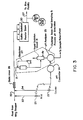
- the influent process steam is a feed discharged from an NH 3 stripper in which NH 3 is removed from a water stream by steam "stripping" in a tower.
- the pH control technique of Figure 3 involves use of a backmixing vessel 22 in the pH analyzer sample line 21 as before.
- a rapid oxidation vessel 31 is added after the backmixing vessel 22 in the analyzer sample stream 21.
- Reagent is injected into the feed line 20 via lines 33 and 34 and mixed in a process static mixer 26 which disperses the reagent and assures a representative analyzer sample.
- a small portion of the feed is taken into the sample system where it first passes through a backmixing vessel 22.
- the backmixing vessel provides a dynamic gain reduction which decreases the resolution and dynamic response requirements of the control system.
- the backmixing vessel would be designed for a nominal holdup (consistent with overall sample system dead time) and better than 90% backmixing. (If reagent addition were controlled based upon the pH at the outlet of the backmixing vessel, this would be the equivalent of controlling the outlet pH to the oxidation basin 30. Therefore, no automatic compensation would be made for the varying effect of acid formation).
- the sample then passes through an oxidation vessel 31, where complete (or nearly complete) oxidation is carried out with a brief (5-10 minute) holdup.
- the sample then goes to the pH analyzer 23.
- the pH analyzer signal is used in a feedback control scheme to regulate the reagent addition.
- the sample is returned to the process at a sample return point at some suitable downstream location.
- the remainder of the pH control system (controller 24 and reagent addition pumps or valves 25) can be designed to meet the requirements of this application.
- the oxidation basin feed sampiing and process pH simulation offers a unique solution to an otherwise difficult pH control problem.
- the treated effluent passes via conduit 27 to a biox facility where the effluent is further treated in the presence of biological agents.
- the quality of the effluent in line 27 is monitored by means of a pH analyzer with a continuous recorder, indicated by reference "A(pH)/R".
- the latter pH analyzer is equipped with alarm devices for high pH (indicated as "AHA”) and low pH (indicated by "ALA").
Landscapes
- Chemical & Material Sciences (AREA)
- Engineering & Computer Science (AREA)
- Analytical Chemistry (AREA)
- General Chemical & Material Sciences (AREA)
- Oil, Petroleum & Natural Gas (AREA)
- Chemical Kinetics & Catalysis (AREA)
- Physics & Mathematics (AREA)
- General Physics & Mathematics (AREA)
- Automation & Control Theory (AREA)
- Investigating Or Analyzing Non-Biological Materials By The Use Of Chemical Means (AREA)
- Control Of Non-Electrical Variables (AREA)
Applications Claiming Priority (2)
| Application Number | Priority Date | Filing Date | Title |
|---|---|---|---|
| US06/308,467 US4762796A (en) | 1981-10-05 | 1981-10-05 | pH control of a process stream |
| US308467 | 1981-10-05 |
Publications (2)
| Publication Number | Publication Date |
|---|---|
| EP0076683A1 EP0076683A1 (en) | 1983-04-13 |
| EP0076683B1 true EP0076683B1 (en) | 1988-11-30 |
Family
ID=23194104
Family Applications (1)
| Application Number | Title | Priority Date | Filing Date |
|---|---|---|---|
| EP82305270A Expired EP0076683B1 (en) | 1981-10-05 | 1982-10-04 | Apparatus and method for controlling the ph of a continuous process stream |
Country Status (5)
| Country | Link |
|---|---|
| US (1) | US4762796A (enExample) |
| EP (1) | EP0076683B1 (enExample) |
| JP (1) | JPS5874184A (enExample) |
| CA (1) | CA1198971A (enExample) |
| DE (1) | DE3279256D1 (enExample) |
Families Citing this family (12)
| Publication number | Priority date | Publication date | Assignee | Title |
|---|---|---|---|---|
| US4648043A (en) * | 1984-05-07 | 1987-03-03 | Betz Laboratories, Inc. | Computerized system for feeding chemicals into water treatment system |
| GB8614530D0 (en) * | 1986-06-14 | 1986-07-23 | Clean Water Co Ltd | Liquid treatment process |
| DE3718338A1 (de) * | 1987-06-01 | 1989-01-05 | Karlsruhe Wiederaufarbeit | Verfahren und vorrichtung zur loesungsmittelwaesche bei der wiederaufarbeitung von bestrahlten kernbrennstoffen |
| DE3723178C2 (de) * | 1987-07-14 | 1996-01-25 | Bodenseewerk Perkin Elmer Co | Verfahren und Vorrichtung zur Fließinjektionsanalyse in Kombination mit Atomabsorptionsspektroskopie |
| GB2230619B (en) * | 1989-03-14 | 1993-07-14 | Philip Kerrison | Chemical dose control |
| DE4117382A1 (de) * | 1991-05-28 | 1992-12-03 | Metallgesellschaft Ag | Verfahren zum regeln des ph-wertes einer sauren waschfluessigkeit |
| US5168065A (en) * | 1991-11-27 | 1992-12-01 | The Babcock & Wilcox Company | Forced oxidation monitoring and control system |
| US5202092A (en) * | 1991-12-03 | 1993-04-13 | Norcross Corporation | Device for monitoring the PH of water based inks |
| US5609180A (en) * | 1992-04-27 | 1997-03-11 | Burlington Chemical Co., Inc. | Liquid alkali system for fiber reactive dyeing |
| DE4300388C2 (de) * | 1993-01-09 | 1995-03-16 | Metallgesellschaft Ag | Verfahren zur kontinuierlichen Einstellung und Regelung des pH-Wertes einer sauren Flüssigkeit, bei dem die kontinuierliche Messung des pH-Wertes mit einer Glaselektrode erfolgt |
| DE4335867A1 (de) * | 1993-10-21 | 1995-05-04 | Hans Dr Remstedt | Verfahren zur gleichzeitigen Entfernung von Schwefeloxiden und Stickoxiden aus Verbrennungsabgasen in einer Ammoniakwäsche |
| US9527010B2 (en) | 2009-09-25 | 2016-12-27 | Ge Healthcare Bio-Sciences Corp. | Separation system and method |
Family Cites Families (9)
| Publication number | Priority date | Publication date | Assignee | Title |
|---|---|---|---|---|
| US3069242A (en) * | 1958-02-25 | 1962-12-18 | Chemithon Corp | Sulfonation and sulfation apparatus |
| US3180699A (en) * | 1959-10-31 | 1965-04-27 | Ballestra Mario | Method for carrying out continuously the stoichiometric neutralization of a sulphonic acid |
| US3791793A (en) * | 1972-01-31 | 1974-02-12 | Leeds & Northrup Co | Adaptive feed forward-feedback control of the concentration of a selected ion of a solution |
| US4033871A (en) * | 1975-11-13 | 1977-07-05 | Paddock Of California, Inc. | Integrated monitor and control system for continuously monitoring and controlling pH and free halogen in swimming pool water |
| US4121767A (en) * | 1976-07-26 | 1978-10-24 | Richard Jensen | Mobile agricultural sprayer with additive concentration control |
| US4164547A (en) * | 1977-05-06 | 1979-08-14 | American Air Filter Company, Inc. | Process for removing sulfur dioxide in a wet scrubber |
| US4181951A (en) * | 1978-04-28 | 1980-01-01 | Jan Boeke | In-line pH and pIon controller |
| US4224283A (en) * | 1979-03-02 | 1980-09-23 | Phillips Petroleum Company | Purification of hydrocarbons |
| NL7902177A (nl) * | 1979-03-20 | 1980-09-23 | Verder Vleuten Bv | Werkwijze voor het automatisch doseren van chemicalieen in zwembaden, alsmede inrichting voor het uitvoeren van deze werkwijze. |
-
1981
- 1981-10-05 US US06/308,467 patent/US4762796A/en not_active Expired - Lifetime
-
1982
- 1982-08-16 CA CA000409507A patent/CA1198971A/en not_active Expired
- 1982-10-04 EP EP82305270A patent/EP0076683B1/en not_active Expired
- 1982-10-04 DE DE8282305270T patent/DE3279256D1/de not_active Expired
- 1982-10-05 JP JP57174097A patent/JPS5874184A/ja active Granted
Non-Patent Citations (1)
| Title |
|---|
| INSTRUMENTS & CONTROL SYSTEMS, vol.49, no.1, January 1976, Radnor (US) F.G. SHINSKEY: "Flue-gas scrubbing. Part II: Control systems", page 65 * |
Also Published As
| Publication number | Publication date |
|---|---|
| EP0076683A1 (en) | 1983-04-13 |
| US4762796A (en) | 1988-08-09 |
| JPH0221875B2 (enExample) | 1990-05-16 |
| DE3279256D1 (en) | 1989-01-05 |
| CA1198971A (en) | 1986-01-07 |
| JPS5874184A (ja) | 1983-05-04 |
Similar Documents
| Publication | Publication Date | Title |
|---|---|---|
| EP0076683B1 (en) | Apparatus and method for controlling the ph of a continuous process stream | |
| US3674672A (en) | Multiparameter process solution analyzer-controller | |
| CA1186424A (en) | Break-point chlorination control system | |
| US5168065A (en) | Forced oxidation monitoring and control system | |
| WO2018163475A1 (ja) | バラスト水測定装置、バラスト水測定装置を備える船舶およびバラスト水測定方法 | |
| DE2935120C2 (de) | Verfahren zur Optimierung des Lufteintrags in ein Abwasser-Belebtschlammgemisch | |
| DE10352638B4 (de) | Verfahren und Anlage zur Gasreinigung | |
| US4126550A (en) | Flash reactor | |
| AU615257B2 (en) | Equipment and process for dissolving gas in liquids | |
| US4968436A (en) | Method for the treatment of sewage containing nitrites | |
| CN119118335A (zh) | 一种基于多级反应罐的尾水碱化调节装置及调节方法 | |
| EP0466303B1 (en) | Method and system for continuously monitoring and controlling a process stream for dechlorination residual | |
| JPS633323B2 (enExample) | ||
| US4795713A (en) | Auto-digestor | |
| US6290850B1 (en) | Method for controlling aeration systems of biological tanks treating waste water | |
| JP2003236570A (ja) | 水熱反応方法および装置 | |
| KR100345736B1 (ko) | 이산화탄소 함유 배가스를 이용한 폐수중의 페하 자동조절방법 | |
| CN220300511U (zh) | 一种全自动折点加氯设备 | |
| JPH03272464A (ja) | 排水中のcodの自動連続分析装置 | |
| CN114025864A (zh) | 通过在线测量和控制洗涤器液体中的夹带的气体来优化湿法洗涤器工艺流程 | |
| SU1006386A1 (ru) | Устройство дл автоматического регулировани процесса нейтрализации промышленных сточных кислых вод | |
| SU1604749A1 (ru) | Способ автоматического регулировани процесса очистки сточных вод от шестивалентного хрома | |
| SU861338A1 (ru) | Автоматизированна установка дл обезвреживани сточных вод | |
| KR19980044846A (ko) | 산세용액의 농도 자동 조절장치 | |
| Eichenlaub et al. | Disposal of Electroplating Wastes by Oneida, Ltd.: V. Plant Operation |
Legal Events
| Date | Code | Title | Description |
|---|---|---|---|
| PUAI | Public reference made under article 153(3) epc to a published international application that has entered the european phase |
Free format text: ORIGINAL CODE: 0009012 |
|
| AK | Designated contracting states |
Designated state(s): DE FR GB IT |
|
| 17P | Request for examination filed |
Effective date: 19830921 |
|
| GRAA | (expected) grant |
Free format text: ORIGINAL CODE: 0009210 |
|
| AK | Designated contracting states |
Kind code of ref document: B1 Designated state(s): DE FR GB IT |
|
| ITF | It: translation for a ep patent filed | ||
| REF | Corresponds to: |
Ref document number: 3279256 Country of ref document: DE Date of ref document: 19890105 |
|
| ET | Fr: translation filed | ||
| PLBE | No opposition filed within time limit |
Free format text: ORIGINAL CODE: 0009261 |
|
| STAA | Information on the status of an ep patent application or granted ep patent |
Free format text: STATUS: NO OPPOSITION FILED WITHIN TIME LIMIT |
|
| 26N | No opposition filed | ||
| ITTA | It: last paid annual fee | ||
| PGFP | Annual fee paid to national office [announced via postgrant information from national office to epo] |
Ref country code: GB Payment date: 20011004 Year of fee payment: 20 |
|
| PGFP | Annual fee paid to national office [announced via postgrant information from national office to epo] |
Ref country code: FR Payment date: 20011005 Year of fee payment: 20 |
|
| PGFP | Annual fee paid to national office [announced via postgrant information from national office to epo] |
Ref country code: DE Payment date: 20011030 Year of fee payment: 20 |
|
| REG | Reference to a national code |
Ref country code: GB Ref legal event code: IF02 |
|
| PG25 | Lapsed in a contracting state [announced via postgrant information from national office to epo] |
Ref country code: GB Free format text: LAPSE BECAUSE OF EXPIRATION OF PROTECTION Effective date: 20021003 |
|
| REG | Reference to a national code |
Ref country code: GB Ref legal event code: PE20 Effective date: 20021003 |