EP0074564A2 - Verwendung 3,4-disubstituierter Aniline als Beschleuniger für ungesättigte Polyesterharze - Google Patents
Verwendung 3,4-disubstituierter Aniline als Beschleuniger für ungesättigte Polyesterharze Download PDFInfo
- Publication number
- EP0074564A2 EP0074564A2 EP82108031A EP82108031A EP0074564A2 EP 0074564 A2 EP0074564 A2 EP 0074564A2 EP 82108031 A EP82108031 A EP 82108031A EP 82108031 A EP82108031 A EP 82108031A EP 0074564 A2 EP0074564 A2 EP 0074564A2
- Authority
- EP
- European Patent Office
- Prior art keywords
- bis
- hydroxyethyl
- unsaturated polyester
- hydroxypropyl
- accelerator
- Prior art date
- Legal status (The legal status is an assumption and is not a legal conclusion. Google has not performed a legal analysis and makes no representation as to the accuracy of the status listed.)
- Granted
Links
Classifications
-
- C—CHEMISTRY; METALLURGY
- C08—ORGANIC MACROMOLECULAR COMPOUNDS; THEIR PREPARATION OR CHEMICAL WORKING-UP; COMPOSITIONS BASED THEREON
- C08F—MACROMOLECULAR COMPOUNDS OBTAINED BY REACTIONS ONLY INVOLVING CARBON-TO-CARBON UNSATURATED BONDS
- C08F299/00—Macromolecular compounds obtained by interreacting polymers involving only carbon-to-carbon unsaturated bond reactions, in the absence of non-macromolecular monomers
- C08F299/02—Macromolecular compounds obtained by interreacting polymers involving only carbon-to-carbon unsaturated bond reactions, in the absence of non-macromolecular monomers from unsaturated polycondensates
- C08F299/04—Macromolecular compounds obtained by interreacting polymers involving only carbon-to-carbon unsaturated bond reactions, in the absence of non-macromolecular monomers from unsaturated polycondensates from polyesters
- C08F299/0442—Catalysts
- C08F299/0457—Nitrogen containing compounds
-
- C—CHEMISTRY; METALLURGY
- C08—ORGANIC MACROMOLECULAR COMPOUNDS; THEIR PREPARATION OR CHEMICAL WORKING-UP; COMPOSITIONS BASED THEREON
- C08K—Use of inorganic or non-macromolecular organic substances as compounding ingredients
- C08K5/00—Use of organic ingredients
- C08K5/16—Nitrogen-containing compounds
- C08K5/17—Amines; Quaternary ammonium compounds
- C08K5/18—Amines; Quaternary ammonium compounds with aromatically bound amino groups
Definitions
- the invention relates to the use of anilines which are substituted in the m- and p-positions by an alkyl radical and a halogen atom, as accelerators for cold-curable unsaturated polyester resins (i.e. at room temperature without external heat input), in particular for fillers based on unsaturated polyester resins.
- the aromatic amines show an extremely different behavior as accelerators (there is no connection between their reactivity and the ability of the filler to be accelerated thereby. In particular, it can be seen that highly reactive amines lead to rapid hardening of the filler, but not necessarily to quick sandability .
- N, N-dialkylarylamines as a polymerization accelerator
- N, N-bis ( ⁇ -hydroxyalkyl) arylamines with saturated or unsaturated dicarboxylic acids to form a polyester or to react with diisocyanates to form a polyurethane and, if appropriate, to mix the resulting products after they have been mixed with amine-free unsaturated polyester resin compositions and after they have been dissolved with polymerizable monomers harden in the cold with the addition of diacyl peroxides (DE-PS 919 431, DE-OS 1 943 945, DE-PS 1 643 927).
- the object of the invention was to demonstrate a method for accelerating unsaturated polyester resin compositions which do not have the aforementioned deficiencies of the amine accelerators customary hitherto.
- R 1 and R 2 are a B-hydroxy-C 2 -C 3 -alkyl radical are particularly preferably used.
- the most preferred representative of the compounds to be used according to the invention is N, N-bis (B-hydroxyethyl) -3-chloro-4-methylaniline.
- the compounds to be used according to the invention can be used in amounts of 1.0 to 10, preferably 1 to 5, in particular 1.0 to 3,% by weight, based on unsaturated polyester resin.
- the compounds to be used according to the invention are used together with the reaction products of N, N-bis ( ⁇ -hydroxyethyl) arylamine and dicarboxylic acids or diisocyanates according to DE-OS 26 49 268 as accelerators.
- the compounds to be used according to the invention can be added to the unsaturated polyester during dissolving in copolymerizable monomers or afterwards.
- Unsaturated polyester resins for the purposes of the invention are mixtures of 30 to 75 parts by weight of ⁇ , ⁇ -ethylenically unsaturated polyester and 70 to 25 parts by weight of unsaturated monomers copolymerizable therewith.
- Such ⁇ , ⁇ -ethylenically unsaturated polyesters are the usual polycondensation products of at least one ⁇ , ⁇ -ethylenically unsaturated dicarboxylic acid with generally 4 or 5 carbon atoms or their ester-forming derivatives, optionally in a mixture with up to 90 mol%, based on the unsaturated acid components, at least one aliphatic saturated dicarboxylic acid with 4 to 10 carbon atoms or a cycloaliphatic dicarboxylic acid with 8 to 10 carbon atoms or an aromatic dicarboxylic acid with 8 to 12 carbon atoms or their ester-forming derivatives with at least one polyhydroxy compound, in particular dihydroxy compound 2 - 8 carbon atoms - i.e.
- polyester as they are, for example at J.R. Lawrence, "Polyester Resins", Reinhold Publ. Corp., New York 1960, pp. 18 f., And in the Kunststoff-Handbuch, Vol. VIII ("Polyester”), Carl Hanser Verlag, Kunststoff 1973, pp. 247-312 , are described.
- the acid numbers of the polyesters should be between 1 and 100, preferably between 20 and 70, the OH numbers between 10 and 150, preferably between 20 and 100, and the molecular weights measured as number average M n are between approximately 500 and 5000, preferably between approximately 1000 and 3000 (measured by vapor pressure osmometry in dioxane and acetone; if the values differ, the lower one is regarded as the correct one).
- the most preferred copolymerizable monomer is styrene.
- polymerization initiators preferably diacyl peroxides or percarbonates
- diacyl peroxides or percarbonates are added to the polyester resins in amounts of 1 to 10% by weight, based on unsaturated polyester resin.
- Preferred initiators are e.g. Diacetyl peroxide, dibenzoyl peroxide, di-p-chlorobenzoyl peroxide, phthaloyl peroxide, succinyl peroxide, dilauroyl peroxide, acetylcyclohexane sulfonyl peroxide, isopropyl percarbonate, cyclohexyl percarbonate and bis (4-tert-butylcyclohexyl) percarbonate.
- fillers 50 to 350 parts by weight, based on 100 parts by weight of polyester resin, of fillers, such as chalk, talc, barite, asbestos, are added to the polyester resins.
- the various components of the molding compositions according to the invention are advantageously mixed in kneaders, dissolvers or on roller mills.
- the leveling compounds are characterized by good dry sandability and high storage stability. They do not show any discolouration and do not suffer from a drop in reactivity even when stored for a long time.
- fillers are suitable e.g. for repairing body panels, plastic plates and stone plates of all kinds. According to the invention, accelerated fillers are preferably used in the auto repair sector.
- a polyester is produced from 89 mol of diethylene glycol, 13 mol of ethylene glycol and 98.1 mol of maleic anhydride by melt condensation. 42.1 mol of dicyclopentadiene are added simultaneously. The resin is then dissolved in a 63% solution in styrene and stabilized with 0.04% chloranil and 0.01% copper naphtenate, based in each case on the pure polyester resin.
- the polyester resin obtained has a viscosity of 480 mPas (measured at 25 ° C.) and an acid number of 10.
- a polyester prepared from 47.1 mol of maleic anhydride, 29.0 mol of tetrahydrophthalic anhydride and 80.6 mol of propylene glycol by melt condensation is dissolved in styrene to give a 65% solution and with 0.04% chloroanil and 0.008% copper naphtenate, based in each case on the pure polyester resin, stabilized.
- the polyester resin obtained has a viscosity of 1050 mPas (measured at 25 ° C.) and an acid number of 26.
- a polyester is prepared from 1 mol of N, N-bis- ( ⁇ -hydroxypropyl) -p-toluidine and 0.774 mol of adipic acid by polycondensation, which is dissolved with the addition of 0.1% hydroquinone with styrene to give a 70% solution.
- polyester resin I or II 100 parts are homogenized with the respective accelerator, 130 parts of talc, 60 parts of heavy spar and 7 parts of titanium dioxide (rutile).
- the amount of accelerator is measured so that the nitrogen content is 0.038% for all fillers made using Resin I and 0.027% for the fillers made using Resin II, based on the total weight of the filler.
- filler 100 g of filler are mixed with approx. 2 g of a commercially available 50% benzoyl peroxide paste. The mass is then applied in a layer thickness of approx. 1 mm to degreased and ground steel plates and the grindability is assessed after certain times.
- the grindability is determined after the addition of peroxide after different times by hand-sanding the hardened filler with medium-sized sandpaper (80s paper) by one and the same person. Both the amount of putty removed and the degree of clogging of the sanding paper are assessed.
- polyester spatulas are stored in tinned tin cans at 50 ° C. The times given indicate the earliest point in time at which an onset of polymerization is observed.
Landscapes
- Chemical & Material Sciences (AREA)
- Health & Medical Sciences (AREA)
- Chemical Kinetics & Catalysis (AREA)
- Medicinal Chemistry (AREA)
- Polymers & Plastics (AREA)
- Organic Chemistry (AREA)
- Macromonomer-Based Addition Polymer (AREA)
- Organic Low-Molecular-Weight Compounds And Preparation Thereof (AREA)
- Compositions Of Macromolecular Compounds (AREA)
- Macromolecular Compounds Obtained By Forming Nitrogen-Containing Linkages In General (AREA)
Abstract
Description
- Die Erfindung betrifft die Verwendung von Anilinen, die in m- und p-Position durch einen Alkylrest und ein Halogenatom substituiert sind, als Beschleuniger für kalt (d.h. bei Raumtemperatur ohne Wärmezufuhr von außen) härtbare ungesättigte Polyesterharze, insbesondere für Spachtelmassen auf Basis ungesättigter Polyesterharze.
- Von Spachtelmassen verlangt man, daß sie schwierig zu vereinende Eigenschaften aufweisen:
- 1. eine "Topfzeit" (potlife), die genügend Zeit für die homogene Verteilung des Härtungskatalysators in der Harzmasse und für das Auftragen der Spachtelmasse läßt, verbunden mit einer hohen Lagerstabilität,
- 2. leichte Schleifbarkeit der Spachteloberfläche möglichst bald nach dem Auftragen der Spachtelmasse und
- 3. nach erfolgter Härtung hohe Flexibilität und Oberflächenhärte.
- Die aromatischen Amine zeigen als Beschleuniger ( ein höchst unterschiedliches Verhalten, ohne daß sich ein Zusammenhang zwischen ihrer Reaktivität und der Schleifbarkeit damit beschleunigter Spachtelmassen ergäbe. Insbesondere zeigt sich, daß hochreaktive Amine zwar zu rascher Aushärtung der Spachtelmasse, nicht aber notwendigerweise auch zu rascher Schleifbarkeit führen.
- Es ist bekannt, Formmassen, insbesondere Spachtelmassen, auf der Grundlage kalt härtbarer Polyestergießharze unter Verwendung von N,N-Dialkylarylaminen als Polymerisationsbeschleuniger auszuhärten (US-PS 2 480 928). Es ist auch bekannt, N,N-Bis-(ß-hydroxyalkyl)-arylamine mit gesättigten oder ungesättigten Dicarbonsäuren zu einem Polyester umzusetzen oder mit Diisocyanaten zu einem Polyurethan umzusetzen und die resultierenden Produkte gegebenenfalls nach Abmischung mit aminfreien ungesättigten Polyesterharzmassen nach Lösen mit polymerisationsfähigen Monomeren unter Zusatz von Diacylperoxiden in der Kälte auszuhärten (DE-PS 919 431, DE-OS 1 943 945, DE-PS 1 643 927).
- Aus der DE-OS 26 49 268 ist bekannt, daß Mischungen zweier bestimmter Beschleuniger Spachtelmassen auf Basis ungesättigter Polyesterharze eine besonders vorteilhafte Kombination von günstiger Topfzeit, hoher Lagerstabilität und rasch erreichbarer Schleifbarkeit verleihen. Allerdings neigen diese Spachtelmassen in ungehärtetem Zustand in Anwesenheit von Chinonen, wie z.B. Dibutylchinon oder Chloranil, zu blauer oder grüner Verfärbung. Auf die erwähnten Inhibitoren möchte man ungern verzichten, weil sie die Lagerstabilität der Polyesterharze und der daraus hergestellten Spachtelmassen stark erhöhen, ohne die Reaktivität allzu sehr zu beeinträchtigen.
- Aufgabe der Erfindung war es, eine Methode zur Beschleunigung ungesättigter Polyesterharzmassen aufzuzeigen, welcher die vorerwähnten Mängel der bisher üblichen Aminbeschleuniger nicht anhaften.
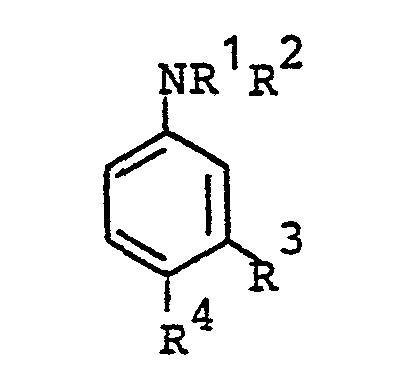
- Gegenstand der Erfindung ist die Verwendung von Verbindungen der Formel
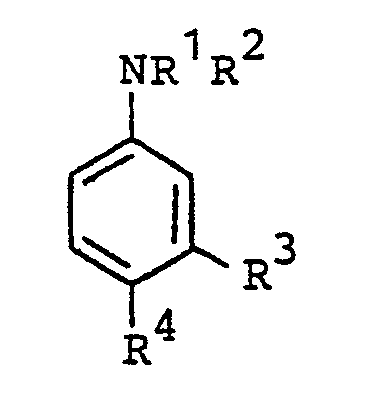
- ) R 1,R 2 einen gesättigten oder ungesättigten, gegebenenfalls OH-substituierten Kohlenwasserstoffrest mit 1 bis 18, vorzugsweise 1 bis 4, C-Atomen, insbesondere einen β-Hydroxy-C2-C3- alkylrest, und
- der eine der beiden Reste R3 und R einen gegebenenfalls Phenyl-substituierten C1-C4-Alkyl- oder einen C5-C6-Cycloalkylrest und
- der andere der beiden Reste R3 und R4 ein Halogenatom, vorzugsweise ein Fluor-, Chlor- oder Bromaton, bedeuten,
- als Beschleuniger für ungesättigte Polyesterharze.
- Besonders bevorzugt verwendet werden Verbindungen, bei denen sowohl R 1 als auch R2 einen B-Hydroxy-C2-C3-alkylrest bedeuten.
- Bevorzugte Vertreter der erfindungsgemäß zu verwendenden Verbindungen sind z.B.
- N,N-Diethyl-3-chlor-4-methylanilin,
- N,N-Di-n-butyl-3-chlor-4-methylanilin,
- N,N-Bis-(ß-hydroxyethyl)-3-chlor-4-methylanilin,
- N-Methyl-N-ß-hydroxyethyl-3-chlor-4-methylahilin,
- N,N-Bis-(B-hydroxypropyl)-3-chlor-4-methylanilin,
- N-Methyl-N-ß-hydroxypropyl-3-chlor-4-methylanilin,
- N,N-Bis-(β-hydroxyethyl)-3-chlor-4-tert.-butyl-anilin,
- N,N-Bis-(ß-hydroxyethyl)-3-chlor-4-phenylisopropylanilin,
- N,N-Bis-(ß-hydroxypropyl)-3-fluor-4-tert.-butyl-anilin,
- N,N-Bis-(ß-hydroxyethyl)-3-fluor-4-ethylanilin,
- N-β-Hydroxyethyl-N-β-hydroxypropyl-3-brom-4-methylanilin,
- N,N-Bis-(β-hydroxypropyl)-3-chlor-4-methylanilin,
- N,N-Bis-(β-hydroxypropyl)-3-brom-4-ethylailin,
- N,N-Bis-(B-hydroxyethyl)-3-fluor-4-methylanilin,
- N,N-Bis-(ß-hydroxyethyl)-3-chlor-4-cyclohexylanilin,
- N,N-Bis-(ß-hydroxypropyl)-3-fluor-4-isopropylanilin,
- N-Methyl-N-ß-hydroxypropyl-3-brom-4-methylanilin,
- N,N-Dimethyl-3-chlor-4-methylanilin,
- N-ß-Hydroxyethyl-N-ß-hydroxypropyl-3-chlor-4-methylanilin,
- N,N-Diethyl-3-methyl-4-chloranilin,
- N,N-Di-n-butyl-3-methyl-4-chloranilin,
- N,N-Bis-(ß-hydroxyethyl)-3-methyl-4-chloranilin,
- N-Methyl-N-β-hydroxyethyl-3-methyl-4-chloranilin,
- N,N-Bis-(B-hydroxypropyl)-3-methyl-4-chloranilin,
- N-Methyl-N-B-hydroxypropyl-3-methyl-4-chloranilin,
- N,N-Bis-(B-hydroxyethyl)-3-tert.-butyl-4-chloranilin,
- N,N-Bis-(B-hydroxyethyl)-3-phenylisopropyl-4-chloranilin,
- N,N-Bis-(β-hydroxypropyl)-3-tert.-butyl-4-fluoranilin,
- N,N-Bis-(β-hydroxyethyl)-3-ethyl-4-fluoranilin,
- N-β-Hydroxyethyl-N-β-hydroxypropyl-3-methyl-4-bromanilin,
- N,N-Bis-(ß-hydroxypropyl)-3-methyl-4-chloranilin,
- N,N-Bis-(ß-hydroxypropyl)-3-ethyl-4-bromanilin,
- N,N-Bis-(B-hydroxyethyl)-3-methyl-4-fluoranilin,
- N,N-Bis-(ß-hydroxyethyl)-3-cyclohexyl-4-chloranilin,
- N,N-Bis-(B-hydroxypropyl)-3-isopropyl-4-fluoranilin,
- N-Methyl-N-β-hydroxypropyl-3-methyl-4-bromanilin,
- N,N-Dimethyl-3-methyl-4-chloranilin und
- N-ß-Hydroxyethyl-N-ß-hydroxypropyl-3-methyl-4-chloranilin.
- Der bevorzugteste Vertreter der erfindungsgemäß zu verwendenden Verbindungen ist N,N-Bis-(B-hydroxyethyl)-3-chlor-4-methylanilin.
- Die erfindungsgemäß zu verwendenden Verbindungen können in Mengen von 1,0 bis 10, vorzugsweise 1 bis 5, insbesondere 1,0 bis 3, Gew.-%, bezogen auf ungesättigtes Polyesterharz, eingesetzt werden.
- Die erfindungsgemäß zu verwendenden Verbindungen können einzeln eingesetzt werden; es können aber auch Mischungen dieser Verbindungen verwendet werden. Es ist auch möglich, diese Verbindungen mit bis zu 50 Mol-%, bezogen auf 1 Mol Gesamtaminmischung, an N,N-Dialkyl- oder N,N-Bis-(hydroxyalkyl)-p-alkyl- arylaminen zu mischen und die erhaltenen Mischungen als Beschleuniger zu verwenden. Bevorzugte p-Alkyl-arylamine dieser Art sind z.B.:
- N,N-Bis-(ß-hydroxypropyl)-p-toluidin,
- N-Methyl-N-ß-hydroxyethyl-p-toluidin,
- N,N-Bis-(ß-hydroxypropyl)-3,4-dimethylanilin,
- N,N-Bis-(ß-hydroxyethyl)-3,4-dimethylanilin,
- N,N-Bis-(ß-hydroxyethyl)-4-tert.-butylanilin und
- N,N-Bis-(ß-hydroxypropyl)-4-cyclohexylanilin.
- Nach einer besonderes bevorzugten Ausführungsform werden die erfindungsgemäß zu verwendenden Verbindungen gemeinsam mit den Umsetzungsprodukten aus N,N-Bis-(ß-hydroxyethyl)-arylaminen und Dicarbonsäuren bzw. Diisocyanaten gemäß DE-OS 26 49 268 als Beschleuniger eingesetzt.
- Die erfindungsgemäß zu verwendenden Verbindungen können dem ungesättigten Polyester während des Lösens in copolymerisierbaren Monomeren oder danach zugesetzt werden.
- "Ungesättigte Polyesterharze" im Sinne der Erfindung sind Mischungen von 30 bis 75 Gewichtsteilen α,β-ethylenisch ungesättigter Polyester und 70 bis 25 Gewichtsteilen damit copolymerisierbarer ungesättigter Monomerer.
- Derartige α,β-ethylenisch ungesättigte Polyester sind die üblichen Polykondensationsprodukte mindestens einer α,β-ethylenisch ungesättigten Dicarbonsäure mit in der Regel 4 oder 5 C-Atomen oder deren esterbildenden Derivate, gegebenenfalls in Abmischung mit bis zu 90 Mol-%, bezogen auf die ungesättigten Säurekomponenten, mindestens einer aliphatischen gesättigten Dicarbonsäure mit 4 - 10 C-Atomen oder einer cycloaliphatischen Dicarbonsäure mit 8 -10 C-Atomen oder einer aromatischen Dicarbonsäure mit 8 - 12 C-Atomen oder deren esterbildenden Derivate mit mindestens einer Polyhydroxyverbindung, insbesondere Dihydroxyverbindung, mit 2 - 8 C-Atomen - also Polyester, wie sie z.B. bei J.R. Lawrence, "Polyester Resins", Reinhold Publ. Corp., New York 1960, S. 18 f., und im Kunststoff-Handbuch, Bd. VIII ("Polyester"), Carl Hanser Verlag, München 1973, S. 247 - 312, beschrieben sind.
- Die Säurezahlen der Polyester sollen zwischen 1 und 100, vorzugsweise zwischen 20 und 70, die OH-Zahlen zwischen 10 und 150, vorzugsweise zwischen 20 und 100, und die als Zahlenmittel gemessenen Molekulargewichte
M n zwischen ca. 500 und 5000, vorzugsweise zwischen ca. 1000 und 3000 liegen (dampfdruckosmometrisch gemessen in Dioxan und Aceton; bei differierenden Werten wird der niedrigere als der korrekte angesehen). - Das bevorzugteste copolymerisierbare Monomere ist Styrol.
- Es können einzelne Inhibitoren, aber auch Gemische verschiedener Inhibitoren verwendet werden. Bevorzugt sind dabei solche Mischungen, die neben Hydrochinon und seinen Derivaten noch Chinone, wie z.B. Chloranil oder Bromanil, Benzochinon, 2,5- oder 2,6-Dibutyl-benzochinon, in Konzentrationen von 0,01 - 0,1 Gew.-%, bezogen auf ungesättigtes Polyesterharz, enthalten.
- Vor der Härtung werden den Polyesterharzen Polymerisationsinitiatoren, vorzugsweise Diacylperoxide oder Percarbonate, in Mengen von 1 bis 10 Gew.-%, bezogen auf ungesättigtes Polyesterharz zugesetzt. Bevorzugte Initiatoren sind z.B. Diacetylperoxid, Dibenzoylperoxid, Di-p-chlorbenzoylperoxid, Phthaloylperoxid, Succinylperoxid, Dilauroylperoxid, Acetylcyclohexansulfonylperoxid, Isopropylpercarbonat, Cyclohexylpercarbonat und Bis-(4-tert.-butylcyclohexyl)-percarbonat.
- Zur Herstellung von Spachtelmassen werden den Polyesterharzen 50 - 350 Gew.-Teile, bezogen auf 100 Gew.-Teile Polyesterharz, Füllstoffe, wie Kreide, Talkum, Baryt, Asbestine, zugesetzt. Farbstoffe, Pigmente und/oder Thixotropiermittel, wie Aerosil oder hydriertes Ricinus- öl, können natürlich ebenfalls zugesetzt werden. Das Mischen der verschiedenen Komponenten der erfindungsgemäßen Formmassen erfolgt zweckmäßig in Knetern, Dissolvern oder auf Walzenstühlen.
- Die Spachtelmassen zeichnen sich durch gute Trockenschleifbarkeit und hohe Lagerstabilität aus. Sie zeigen auch bei längerer Lagerung keinerlei Verfärbung und erleiden keinen Reaktivitätsabfall.
- Diese Spachtelmassen eignen sich z.B. zur Ausbesserung von Karosserieblechen, Kunststoffplatten und Steinplatten jeglicher Art. Bevorzugten Einsatz finden erfindungsgemäß beschleunigte Spachtelmassen auf dem Autoreparatursektor.
- Die in den nachfolgenden Beispielen genannten Teile sind Gewichtsteile; Prozentangaben beziehen sich auf das Gewicht.
- Aus 89 Mol Diethylenglykol, 13 Mol Ethylenglykol und 98,1 Mol Maleinsäureanhydrid wird durch Schmelzkondensation ein Polyester hergestellt. Dabei werden gleichzeitig 42,1 Mol Dicyclopentadien addiert. Anschließend wird das Harz zu einer 63 %igen Lösung in Styrol gelöst und mit 0,04 % Chloranil und 0,01 % Kupfernaphtenat, jeweils bezogen auf das reine Polyesterharz, stabilisiert. Das erhaltene Polyesterharz hat eine Viskosität von 480 mPas (gemessen bei 25°C) und eine Säurezahl von 10.
- Ein aus 47,1 Mol Maleinsäureanhydrid, 29,0 Mol Tetrahydrophthalsäureanhydrid und 80,6 Mol Propylenglykol durch Schmelzkondensation hergestellter Polyester wird in Styrol zu einer 65 %igen Lösung gelöst und mit 0,04.% Chloranil und 0,008 % Kupfernaphtenat, jeweils bezogen auf das reine Polyesterharz, stabilisiert. Das erhaltene Polyesterharz hat eine Viskosität von 1050 mPas (gemessen bei 25°C) und eine Säurezahl von 26.
- Aus 1 Mol N,N-Bis-(ß-hydroxypropyl)-p-toluidin und 0,774 Mol Adipinsäure wird durch Polykondensation ein Polyester hergestellt, der unter Zufügung von 0,1 % Hydrochinon mit Styrol zu einer 70 %igen Lösung gelöst wird.
- N,N-Bis-(ß-hydroxyethyl)-m-toluidin
- N,N-Bis-(β-hydroxyethyl)-3,4-dimethylanilin
- N,N-Bis-(B-hydroxyethyl)-3-chlor-4-methylanilin
- N,N-Bis-(ß-hydroxyethyl)-3-fluor-4-methylanilin
- Mischung aus 65 Teilen Beschleuniger IV und 35 Teilen Beschleuniger I.
- N,N-Bis-(ß-hydroxyethyl)-4-chlor-3-methylanilin.
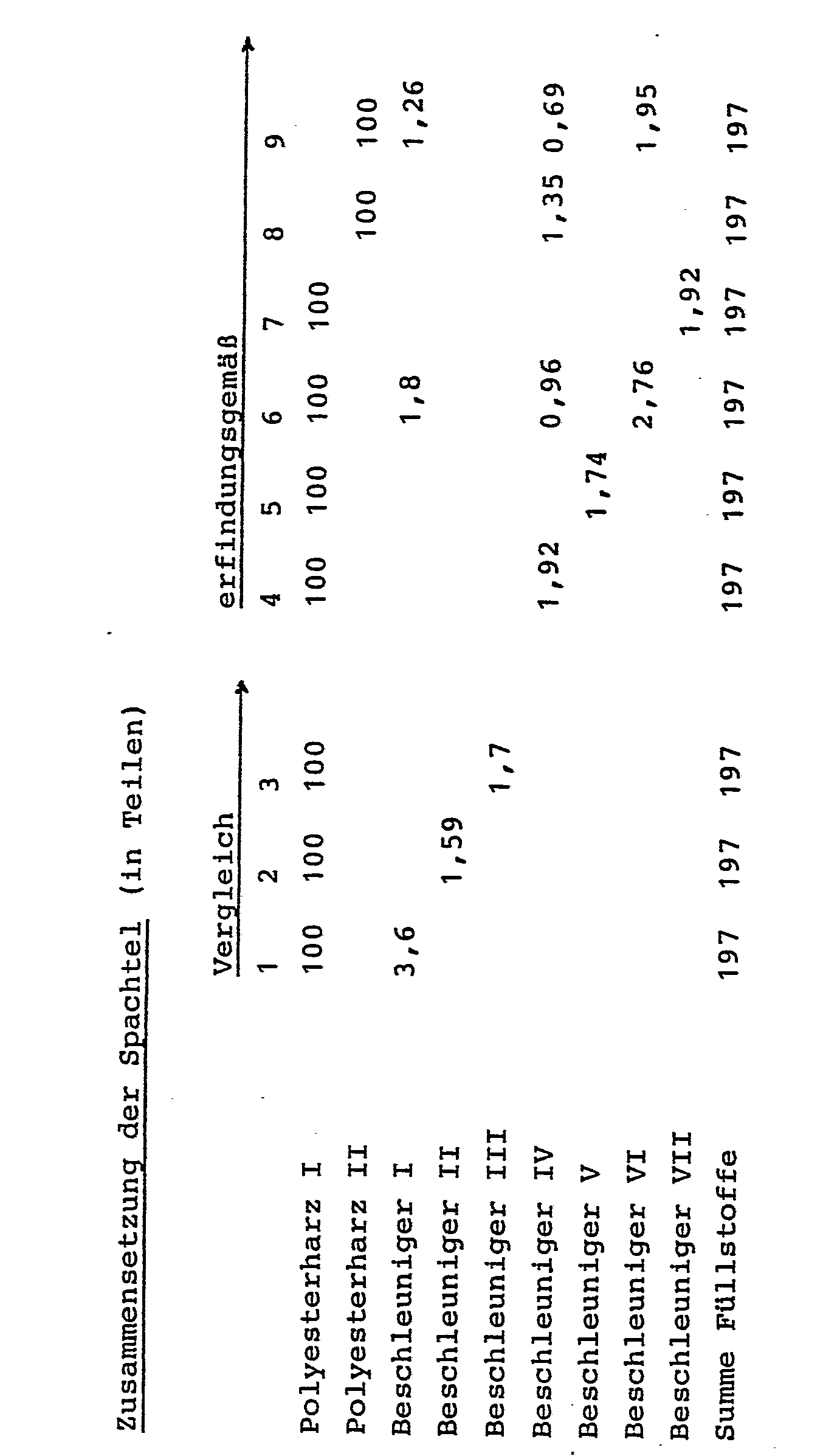
- Jeweils 100 Teile von Polyesterharz I bzw. II werden mit dem jeweiligen Beschleuniger, 130 Teilen Talkum, 60 Teilen Schwerspat und 7 Teilen Titandioxid (Rutil) homogenisiert.
- Die Beschleunigermenge wird so bemessen, daß der Stickstoffgehalt bei allen unter Verwendung von Harz I hergestellten Spachtelmassen 0,038 % und bei den unter Verwendung von Harz II hergestellten Spachtelmassen 0,027 %, bezogen auf das Gesamtgewicht der Spachtelmasse, beträgt.
- Alle Spachtelmassen werden mit unterschiedlichen Mengen an Toluhydrochinon auf ein Potlife von 4 - 5 Minuten/20°C eingestellt.
- Man erhält ca. 300 Teile fertiger Spachtelmasse.
- 100 g Spachtelmasse werden mit ca. 2 g einer handelsüblichen 50 %igen Benzoylperoxidpaste verrührt. Die Masse wird dann in ca. 1 mm Schichtdicke auf entfettete und geschliffene Stahlblechplatten aufgetragen und die Schleifbarkeit nach bestimmten Zeiten beurteilt.
- Die Verfärbung wird in Abhängigkeit von der Zeit bestimmt. Zur Verkürzung der Lagerzeiten werden die Spachtelmassen in verzinnten Weißblechdosen bei 50°C gelagert und nach verschiedenen Zeiten geprüft. Dabei werden folgende Bewertungen gewählt:
- 0 = keine Verfärbung,
- 1 = ganz schwache Verfärbung,
- 2 = deutlich sichtbare Verfärbung,
- 3 = kräftige Verfärbung.
- Die Schleifbarkeit wird nach der Peroxid-Zugabe nach unterschiedlichen Zeiten bestimmt, indem die ausgehärtete Spachtelmasse mit Schleifpapier mittlerer Körnung (80er Papier) von Hand ein und derselben Person geschliffen wird. Dabei wird sowohl die Menge an abgetragenem Spachtel als auch der Grad der Zusetzens des Schleifpapiers beurteilt.
- Im einzelnen bedeuten:
- 1. sehr hoher Abrieb, sehr gut schleifbar,
- 2. hoher Abrieb, gut schleifbar,
- 3. mäßiger Abrieb, mäßig schleifbar,
- 4. kaum Abrieb, schlecht schleifbar,
- 5. nicht schleifbar (Spachtel rollt auf der Schleifpapieroberfläche).
- Die Polyesterspachtel werden in verzinnten Weißblechdosen bei 50°C gelagert. Die angegebenen Zeiten geben den frühesten Zeitpunkt an, an dem eine beginnende Polymerisation beobachtet wird.
- Die geprüften anwendungstechnischen Eigenschaften sind in der folgenden Tabelle zusammengestellt.

Claims (10)
Priority Applications (1)
| Application Number | Priority Date | Filing Date | Title |
|---|---|---|---|
| AT82108031T ATE26723T1 (de) | 1981-09-12 | 1982-09-01 | Verwendung 3,4-disubstituierter aniline als beschleuniger fuer ungesaettigte polyesterharze. |
Applications Claiming Priority (2)
| Application Number | Priority Date | Filing Date | Title |
|---|---|---|---|
| DE19813136292 DE3136292A1 (de) | 1981-09-12 | 1981-09-12 | Verwendung 3,4-disubstituierter aniline als beschleuniger fuer ungesaettigte polyesterharze |
| DE3136292 | 1981-09-12 |
Publications (3)
| Publication Number | Publication Date |
|---|---|
| EP0074564A2 true EP0074564A2 (de) | 1983-03-23 |
| EP0074564A3 EP0074564A3 (en) | 1984-09-12 |
| EP0074564B1 EP0074564B1 (de) | 1987-04-22 |
Family
ID=6141540
Family Applications (1)
| Application Number | Title | Priority Date | Filing Date |
|---|---|---|---|
| EP82108031A Expired EP0074564B1 (de) | 1981-09-12 | 1982-09-01 | Verwendung 3,4-disubstituierter Aniline als Beschleuniger für ungesättigte Polyesterharze |
Country Status (6)
| Country | Link |
|---|---|
| US (1) | US4421879A (de) |
| EP (1) | EP0074564B1 (de) |
| JP (1) | JPS5857415A (de) |
| AT (1) | ATE26723T1 (de) |
| DE (2) | DE3136292A1 (de) |
| ES (1) | ES515622A0 (de) |
Cited By (4)
| Publication number | Priority date | Publication date | Assignee | Title |
|---|---|---|---|---|
| WO1997035916A1 (en) * | 1996-03-28 | 1997-10-02 | First Chemical Corporation | Methods of curing unsaturated polymers using tertiary aromatic amine cure promoters |
| WO1997039074A1 (en) * | 1996-04-15 | 1997-10-23 | Lord Corporation | Free radical polymerizable compositions including para-halogenated aniline derivatives |
| US6774193B2 (en) | 2000-06-14 | 2004-08-10 | Albemarle Corporation | Stabilized unsaturated polymer resin compositions and methods of using the same |
| WO2007067859A1 (en) * | 2005-12-09 | 2007-06-14 | Albemarle Corporation | Initiator systems for use in curing unsaturated resins, and curable compositions and methods for curing them |
Families Citing this family (4)
| Publication number | Priority date | Publication date | Assignee | Title |
|---|---|---|---|---|
| US6771253B2 (en) * | 2001-11-27 | 2004-08-03 | Shin Jiuh Corp. | Switch having light generator |
| KR101526238B1 (ko) | 2006-07-28 | 2015-06-05 | 로드코포레이션 | 이중 경화 접착제 제제 |
| KR101308236B1 (ko) | 2006-09-01 | 2013-09-13 | 동우 화인켐 주식회사 | 경화도가 우수한 경화성 수지 조성물 |
| US12018112B2 (en) * | 2021-03-15 | 2024-06-25 | Illinois Tool Works Inc. | Catalyst for extended work time filler composition |
Family Cites Families (9)
| Publication number | Priority date | Publication date | Assignee | Title |
|---|---|---|---|---|
| US3367994A (en) * | 1965-07-20 | 1968-02-06 | Pittsburgh Plate Glass Co | Novel accelerator for unsaturated polyester resins |
| US3950287A (en) * | 1971-01-29 | 1976-04-13 | Ashland Oil, Inc. | Production of thermoset water-in-oil emulsions |
| US3914200A (en) * | 1972-01-27 | 1975-10-21 | Ferro Corp | Rigid thermosetting load bearing compositions |
| US4012542A (en) * | 1973-04-23 | 1977-03-15 | Ferro Corporation | Rigid thermosetting load bearing compositions |
| GB1535787A (en) * | 1975-05-01 | 1978-12-13 | Bp Chem Int Ltd | Polymerizable unsaturated polyester composition |
| GB1540228A (en) * | 1975-11-28 | 1979-02-07 | Scott Bader Co | Curing unsaturated polyester resins |
| DE2649268C2 (de) | 1976-10-29 | 1982-10-07 | Bayer Ag, 5090 Leverkusen | Beschleunigermischung für ungesättigte Polyesterharzmassen |
| US4259228A (en) * | 1979-03-21 | 1981-03-31 | General Electric Company | Storage stable polyester monomer compositions with inhibitor, promoter, and stabilizer |
| US4284551A (en) * | 1979-11-30 | 1981-08-18 | American Dental Association Health Foundation | Tertiary aromatic amine accelerators derived from para-aminophenethanol |
-
1981
- 1981-09-12 DE DE19813136292 patent/DE3136292A1/de not_active Withdrawn
-
1982
- 1982-08-30 US US06/412,513 patent/US4421879A/en not_active Expired - Fee Related
- 1982-09-01 AT AT82108031T patent/ATE26723T1/de not_active IP Right Cessation
- 1982-09-01 DE DE8282108031T patent/DE3276116D1/de not_active Expired
- 1982-09-01 EP EP82108031A patent/EP0074564B1/de not_active Expired
- 1982-09-10 JP JP57156891A patent/JPS5857415A/ja active Pending
- 1982-09-10 ES ES515622A patent/ES515622A0/es active Granted
Cited By (6)
| Publication number | Priority date | Publication date | Assignee | Title |
|---|---|---|---|---|
| WO1997035916A1 (en) * | 1996-03-28 | 1997-10-02 | First Chemical Corporation | Methods of curing unsaturated polymers using tertiary aromatic amine cure promoters |
| US6114470A (en) * | 1996-03-28 | 2000-09-05 | First Chemical Corporation | Methods of curing unsaturated polymers using tertiary aromatic amine cure promoters |
| US6258894B1 (en) | 1996-03-28 | 2001-07-10 | First Chemical Corporation | Methods of curing unsaturated polymers using tertiary aromatic amine cure promoters |
| WO1997039074A1 (en) * | 1996-04-15 | 1997-10-23 | Lord Corporation | Free radical polymerizable compositions including para-halogenated aniline derivatives |
| US6774193B2 (en) | 2000-06-14 | 2004-08-10 | Albemarle Corporation | Stabilized unsaturated polymer resin compositions and methods of using the same |
| WO2007067859A1 (en) * | 2005-12-09 | 2007-06-14 | Albemarle Corporation | Initiator systems for use in curing unsaturated resins, and curable compositions and methods for curing them |
Also Published As
| Publication number | Publication date |
|---|---|
| US4421879A (en) | 1983-12-20 |
| ES8505394A1 (es) | 1985-05-16 |
| DE3276116D1 (en) | 1987-05-27 |
| ATE26723T1 (de) | 1987-05-15 |
| ES515622A0 (es) | 1985-05-16 |
| DE3136292A1 (de) | 1983-03-24 |
| EP0074564A3 (en) | 1984-09-12 |
| JPS5857415A (ja) | 1983-04-05 |
| EP0074564B1 (de) | 1987-04-22 |
Similar Documents
| Publication | Publication Date | Title |
|---|---|---|
| EP3129441B1 (de) | Ch-acide verbindungen und metallsalze als härtersystem, entsprechende harzzusammensetzungen unter anderem für die befestigungstechnik | |
| EP3164432B1 (de) | Reaktivverdünner für die chemische befestigung | |
| EP0074564B1 (de) | Verwendung 3,4-disubstituierter Aniline als Beschleuniger für ungesättigte Polyesterharze | |
| EP0368083A2 (de) | Verfahren zur herstellung von Beschichtungen | |
| DE1569331A1 (de) | Zu Kunststoffen fuehrende haertbare thixotrope Mischungen,gegebenenfalls loesungsmittelfreie Lacke | |
| EP0632115A2 (de) | Bindemittel- und Überzugsmittelzusammensetzung, deren Herstellung und Verwendung | |
| DE19535936A1 (de) | Acryliertes Polyetherpolyol und dessen Verwendung für strahlenhärtbare Formulierungen | |
| DE3417603A1 (de) | Unter luftausschluss haertende klebstoffmassen | |
| EP0148400B1 (de) | In ungesättigte Harze einpolymerisierbare Arylamin-Derivate, ihre Herstellung und ihre Verwendung als Härtungsbeschleuniger | |
| EP0636153B1 (de) | Additionsprodukte, strahlenhärtbare überzugsmassen auf basis der additionsprodukte sowie deren verwendung zur holzbeschichtung und zur papierbeschichtung | |
| EP0779349A2 (de) | Überzugsmittel, Verfahren zur Herstellung von Mehrschichtüberzügen und Verwendung des Überzugsmittels | |
| DE2649268C2 (de) | Beschleunigermischung für ungesättigte Polyesterharzmassen | |
| DE3611307C2 (de) | ||
| DE3244814A1 (de) | Verwendung von 1.4-dihydroxynaphthalin bei der polymerisation ethylenisch ungesaettigter verbindungen | |
| EP0161581B1 (de) | Verwendung von strahlenhärtbaren Lacken zur Herstellung von UEberzügen und Beschichtungen | |
| EP0567463B1 (de) | 2-komponenten-lacke auf basis von ungesättigten polyestern für die beschichtung von holz und holzwerkstoffen | |
| DE4328960A1 (de) | Durch radikalische Polymerisation aushärtende, geruchsarme (Meth-)acrylatzubereitungen und ihre Verwendung | |
| EP0865468B1 (de) | Strahlenhärtbare überzugsmasse sowie deren verwendung zur beschichtung | |
| EP0701997B1 (de) | Umsetzungsprodukte aus Anilinen und Bisphenolbisglycidylethern, ein Verfahren zu ihrer Herstellung und ihre Verwendung als Härtungsbeschleuniger | |
| DE3409271A1 (de) | Niedrigviskose, ungesaettigte polyester und ihre verwendung als bindemittel fuer monomerenfreie spachtelmassen | |
| DE2551144C2 (de) | Verfahren zur Herstellung von bei Raumtemperaturen stabilen Dispersionen | |
| EP0310972B1 (de) | Unter dem Einfluss von Radikalen härtbare Mischungen und ihre Verwendung als Spachtelmassen | |
| DE3202090A1 (de) | Neue n,n-bis-(ss-hydroxyalkyl)-arylamin-derivate, verfahren zu ihrer herstellung und ihre verwendung als haertungsbeschleuniger | |
| EP0306444B1 (de) | Verwendung von stabilisierten, ungesättigte Polyesterharze enthaltenden Massen als Klebe-, Dübel- oder Spachtelmasse | |
| DE1007995B (de) | Verfahren zur Herstellung von Lackrohstoffen |
Legal Events
| Date | Code | Title | Description |
|---|---|---|---|
| PUAI | Public reference made under article 153(3) epc to a published international application that has entered the european phase |
Free format text: ORIGINAL CODE: 0009012 |
|
| 17P | Request for examination filed |
Effective date: 19820901 |
|
| AK | Designated contracting states |
Designated state(s): AT CH DE FR GB IT LI NL SE |
|
| PUAL | Search report despatched |
Free format text: ORIGINAL CODE: 0009013 |
|
| AK | Designated contracting states |
Designated state(s): AT CH DE FR GB IT LI NL SE |
|
| GRAA | (expected) grant |
Free format text: ORIGINAL CODE: 0009210 |
|
| AK | Designated contracting states |
Kind code of ref document: B1 Designated state(s): AT CH DE FR GB IT LI NL SE |
|
| REF | Corresponds to: |
Ref document number: 26723 Country of ref document: AT Date of ref document: 19870515 Kind code of ref document: T |
|
| ITF | It: translation for a ep patent filed | ||
| REF | Corresponds to: |
Ref document number: 3276116 Country of ref document: DE Date of ref document: 19870527 |
|
| ET | Fr: translation filed | ||
| PLBE | No opposition filed within time limit |
Free format text: ORIGINAL CODE: 0009261 |
|
| STAA | Information on the status of an ep patent application or granted ep patent |
Free format text: STATUS: NO OPPOSITION FILED WITHIN TIME LIMIT |
|
| 26N | No opposition filed | ||
| PGFP | Annual fee paid to national office [announced via postgrant information from national office to epo] |
Ref country code: DE Payment date: 19910820 Year of fee payment: 10 |
|
| PGFP | Annual fee paid to national office [announced via postgrant information from national office to epo] |
Ref country code: CH Payment date: 19910823 Year of fee payment: 10 |
|
| PGFP | Annual fee paid to national office [announced via postgrant information from national office to epo] |
Ref country code: AT Payment date: 19910826 Year of fee payment: 10 |
|
| PGFP | Annual fee paid to national office [announced via postgrant information from national office to epo] |
Ref country code: GB Payment date: 19910827 Year of fee payment: 10 |
|
| PGFP | Annual fee paid to national office [announced via postgrant information from national office to epo] |
Ref country code: FR Payment date: 19910828 Year of fee payment: 10 |
|
| PGFP | Annual fee paid to national office [announced via postgrant information from national office to epo] |
Ref country code: SE Payment date: 19910909 Year of fee payment: 10 |
|
| ITTA | It: last paid annual fee | ||
| PG25 | Lapsed in a contracting state [announced via postgrant information from national office to epo] |
Ref country code: GB Effective date: 19920901 Ref country code: AT Effective date: 19920901 |
|
| PG25 | Lapsed in a contracting state [announced via postgrant information from national office to epo] |
Ref country code: SE Effective date: 19920902 |
|
| PG25 | Lapsed in a contracting state [announced via postgrant information from national office to epo] |
Ref country code: LI Effective date: 19920930 Ref country code: CH Effective date: 19920930 |
|
| PGFP | Annual fee paid to national office [announced via postgrant information from national office to epo] |
Ref country code: NL Payment date: 19920930 Year of fee payment: 11 |
|
| PG25 | Lapsed in a contracting state [announced via postgrant information from national office to epo] |
Ref country code: NL Effective date: 19930401 |
|
| GBPC | Gb: european patent ceased through non-payment of renewal fee |
Effective date: 19920901 |
|
| NLV4 | Nl: lapsed or anulled due to non-payment of the annual fee | ||
| PG25 | Lapsed in a contracting state [announced via postgrant information from national office to epo] |
Ref country code: FR Effective date: 19930528 |
|
| REG | Reference to a national code |
Ref country code: CH Ref legal event code: PL |
|
| PG25 | Lapsed in a contracting state [announced via postgrant information from national office to epo] |
Ref country code: DE Effective date: 19930602 |
|
| REG | Reference to a national code |
Ref country code: FR Ref legal event code: ST |
|
| EUG | Se: european patent has lapsed |
Ref document number: 82108031.4 Effective date: 19930406 |