EP0072115B1 - Fernsteuerungsvorrichtung - Google Patents
Fernsteuerungsvorrichtung Download PDFInfo
- Publication number
- EP0072115B1 EP0072115B1 EP82303818A EP82303818A EP0072115B1 EP 0072115 B1 EP0072115 B1 EP 0072115B1 EP 82303818 A EP82303818 A EP 82303818A EP 82303818 A EP82303818 A EP 82303818A EP 0072115 B1 EP0072115 B1 EP 0072115B1
- Authority
- EP
- European Patent Office
- Prior art keywords
- rotor
- switch operating
- individual electrical
- switch
- tab
- Prior art date
- Legal status (The legal status is an assumption and is not a legal conclusion. Google has not performed a legal analysis and makes no representation as to the accuracy of the status listed.)
- Expired
Links
- 230000000694 effects Effects 0.000 description 11
- 239000000463 material Substances 0.000 description 6
- 230000008859 change Effects 0.000 description 5
- 238000002347 injection Methods 0.000 description 5
- 239000007924 injection Substances 0.000 description 5
- 230000007246 mechanism Effects 0.000 description 4
- 241000233805 Phoenix Species 0.000 description 3
- 230000006835 compression Effects 0.000 description 3
- 238000007906 compression Methods 0.000 description 3
- 230000000717 retained effect Effects 0.000 description 3
- 239000004065 semiconductor Substances 0.000 description 3
- 238000004804 winding Methods 0.000 description 3
- XEEYBQQBJWHFJM-UHFFFAOYSA-N Iron Chemical compound [Fe] XEEYBQQBJWHFJM-UHFFFAOYSA-N 0.000 description 2
- DHKHKXVYLBGOIT-UHFFFAOYSA-N acetaldehyde Diethyl Acetal Natural products CCOC(C)OCC DHKHKXVYLBGOIT-UHFFFAOYSA-N 0.000 description 2
- 125000002777 acetyl group Chemical class [H]C([H])([H])C(*)=O 0.000 description 2
- 239000011521 glass Substances 0.000 description 2
- 239000000696 magnetic material Substances 0.000 description 2
- 239000010445 mica Substances 0.000 description 2
- 229910052618 mica group Inorganic materials 0.000 description 2
- 239000002991 molded plastic Substances 0.000 description 2
- 239000004033 plastic Substances 0.000 description 2
- 229920003023 plastic Polymers 0.000 description 2
- -1 polyethylene terephthalate Polymers 0.000 description 2
- 229920000139 polyethylene terephthalate Polymers 0.000 description 2
- 239000005020 polyethylene terephthalate Substances 0.000 description 2
- RYGMFSIKBFXOCR-UHFFFAOYSA-N Copper Chemical compound [Cu] RYGMFSIKBFXOCR-UHFFFAOYSA-N 0.000 description 1
- 229920004943 Delrin® Polymers 0.000 description 1
- 230000009471 action Effects 0.000 description 1
- 238000001514 detection method Methods 0.000 description 1
- 230000006872 improvement Effects 0.000 description 1
- 238000007373 indentation Methods 0.000 description 1
- 239000011810 insulating material Substances 0.000 description 1
- 229910052742 iron Inorganic materials 0.000 description 1
- 238000004519 manufacturing process Methods 0.000 description 1
- 238000000034 method Methods 0.000 description 1
- 230000004044 response Effects 0.000 description 1
Images
Classifications
-
- H—ELECTRICITY
- H01—ELECTRIC ELEMENTS
- H01H—ELECTRIC SWITCHES; RELAYS; SELECTORS; EMERGENCY PROTECTIVE DEVICES
- H01H67/00—Electrically-operated selector switches
- H01H67/22—Switches without multi-position wipers
-
- H—ELECTRICITY
- H01—ELECTRIC ELEMENTS
- H01H—ELECTRIC SWITCHES; RELAYS; SELECTORS; EMERGENCY PROTECTIVE DEVICES
- H01H3/00—Mechanisms for operating contacts
- H01H3/22—Power arrangements internal to the switch for operating the driving mechanism
- H01H3/26—Power arrangements internal to the switch for operating the driving mechanism using dynamo-electric motor
Definitions
- This invention is directed to a remote control unit capable of selectively operating each of a plurality of centrally located individual electrical load switches.
- Each of the two embodiments disclosed and described in this specification is a remote control unit employing a plurality of conventional individual electrical load switches individually operated by a common switch actuator mechanism that is capable of centrally controlling electrical power to a plurality of electrical circuits and loads.
- the individual electrical load switches may be simple sliding contact type switches that provide high reliability, high current rating and low voltage drop. Each of these switches may be operated between one circuit condition and another circuit condition by an operating tab that is movable in two directions and are of the type that, once operated, _remain in position until the reverse operation is performed.
- the individual electrical load switches are so mounted and oriented that the several operating tabs extend toward a central axis to define a circle substantially normal to the central axis and are operable in two opposite directions substantially in the direction of the central axis.
- the switch actuator mechanism involves a step motor driven rotor, a switch actuator arm tiltably mounted upon the rotor and normally tilted in a first direction in which the ends thereof on opposite sides on the axis of pivot are on respective operating sides of the switch operating tabs and having the ends thereof on opposite sides of the axis of pivot circumferentially offset from each other so that each may be brought into register with each switch operating tab at mutually exclusive angular positions and an electrical solenoid coil arranged to effect the tilting of the actuator arm in the opposite direction.
- the end of the actuator arm normally tilted away from the rotor may operate any of the switch operating tabs substantially in the direction of the central axis toward the rotor and the other end of the actuator arm normally tilted toward the rotor may operate any of the switch operating tabs substantially in the direction of the central axis away from the rotor.
- the end of the actuator arm tilted away from the rotor is brought into register with this operating tab and the solenoid coil is energized to tilt the actuator arm in the opposite direction to operate the operating tab with which it is in register.
- the end of the actuator arm tilted toward the rotor is brought into register with this operating tab and the solenoid coil is energized to tilt the actuator arm in the opposite direction to operate the operating tab with which it is in register.
- the remote control unit of this invention has the desirable features of (1) a single centrally - mounted unit that controls a plurality of switching functions; (2) the load switches have high contact force and good wiping action; (3) all load switches may be identical permitting high volume production; (4) a single switch actuator mechanism controls all of the individual electrical load switches; (5) continuous electrical power is now required to maintain the state of the load switches as is required with electrical relays or power switching transistors; and (6) system power loss does not affect the load switch position.
- a major improvement in the electrical load network may be realized by centrally controlling the several power switching operations near the load or battery at a location outside the passenger compartment.
- Such a system eliminates the requirement that the electrical power wiring for the several automotive load circuits such as head lamps, horn, ignition, cranking motors, turn signals and so forth be brought into the dash and instrument panel area.
- the remote control unit of this invention therefore, is particularly advantageous with automotive applications in that it may be mounted in a remote location out of the passenger compartment such as the engine compartment. So mounted, this remote control unit significantly reduces wiring congestion in the instrument panel and dash area for the reason that, with its use, most load circuits may be removed from this space.
- Electric motor powered control units that are capable of controlling a plurality of electrical switches are disclosed in the United States patents 3,233,066 and 2,993,963.
- a stepper motor drives a rotary switch arm that can be engaged with a fixed contact when an electromagnet is energized.
- an electric motor drives a cam that operates a circular array of switches.
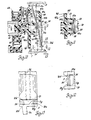
- a remote control unit contains a plurality of individual switches, each of said switches having operating tab means characterized in that said switches are arranged with the respective operating tab means disposed about a central axis to define a circle substantially normal to and concentric with said central axis, each of said operating tab means being movable in substantially the direction of said central axis between a common pair of planes substantially normal to said central axis to establish, respectively, one circuit condition or another circuit condition of the corresponding switch; in that a rotor is supported for rotation substantially about said central axis in a plane substantially normal to said central axis, said rotor carrying an arm that extends across into said circle in radially overlapping relation to said tab means, said arm being tiltable about an axis substantially normal to said central axis and inboard of said circle and having ends circumferentially offset from each other so that said arm registers with each of said tab means at two angular positions; in that means are provided, which are selectively operable to position said rotor with
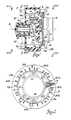
- a substantially cylindrical housing member 9 that may be made of an injection moulded plastics material such as glass and mica-filled polyethylene terephthalate marketed by E. I. DuPont de Nemours & Company of Wilmington, Delaware, under the trade name "Rynite” is designed to securely support a plurality of individual electrical switches in a circumferential arrangement.
- Rynite an injection moulded plastics material
- Each of the individual electrical load switches may be of the conventional sliding contact type having an operating tab that is movable in two opposite directions to establish, respectively, one circuit condition or another circuit condition of the switch.
- the individual electrical switch operating tabs extend toward a central axis to define a circle substantially normal to and concentric with the central axis with each of the operating tabs being movable in substantially the direction of the central axis between a common pair of planes substantially normal to the central axis to establish, respectively, one circuit condition or another circuit condition of the corresponding switch.
- Rotor 10 Located within the substantially cylindrical volume defined by the inboard face surfaces of the individual electrical switches is a rotor 10 supported for rotation substantially about the central axis A in a plane substantially normal to the central axis A.
- Rotor 10 may be made of an injection moulded Acetal plastic such as that marketed by E. I. DuPont de Nemours & Company of Wilmington, Delaware under the trade name "Delrin”.
- Rotor 10 is arranged to carry a switch actuator arm 4 that extends across the diameter of the circle defined by the individual electrical switch operating tabs and is of such a dimension as to be in radially overlapping relationship to the individual electrical switch operating tabs.
- Actuator arm 4 is tiltably mounted upon rotor 10 about a shaft 14 that is supported with the axis thereof substantially normal to central axis A by stanchion members 11 and 12 extending from rotor 10 in the direction of central axis A inboard of the circle defined by the operating tabs of the individual electrical switches. With this arrangement, actuator arm 4 is tiltable about an axis substantially normal to central axis A and inboard of the circle defined by the operating tabs of the individual electrical switches.
- step motor 15 that is selectively operable to position rotor 10 in selected ones of a plurality of angular positions in each of which one of the ends of actuator arm 4 is in register with a selected one of the individual electrical switch operating tabs.
- the unit selected for step motor 15 is a commercially available device marketed by North American Phillips Controls Corporation of Cheshire, Connecticut under the designation model number K-82701-T1.
- a bottom plate 21 is secured by any suitable fastening means such as screws 22, 23, 25 and 26, Figure 2, for accommodating mounting tabs circumferentially located about the bottom of cylindrical housing member 9.
- Motor 15 may be secured to bottom plate 21 by any suitable fastening device such as bolts 27 and 28 extending through mounting flange 29 and accommodating openings in bottom plate 21.
- Actuator arm 4 carried by rotor 10 is of such a dimension in the direction of the diameter of the circle defined by the several individual electrical switch operating tabs that the ends thereof on respective opposite sides of the axis of tilt are in overlapping relationship with all of the individual electrical switch operating tabs.
- the overlapping ends of actuator arm 4 are arranged to be in register with each of the individual electrical switch operating tabs at mutually exclusive angular positions by circumferentially offsetting the ends in such a manner that actuator arm 4 is in register with each individual electrical switch operating tab at two angular positions, one for each end.
- actuator arm 4 is indicated to have a switch operating projection 4a and 4b on respective opposite ends that are circumferentially offset from each other. It is to be specifically understood that any other circumferential offset arrangement for the ends of actuator arm 4 on opposite sides of the axis of tilt may be employed without departing from the spirit of the invention.
- a compression spring 30 is located between opposing face surfaces of actuator arm 4 and rotor 10 on the same side of the axis of pivot and is retained by a pin 31 secured to rotor 10.
- actuator arm 4 is normally tilted in a counterclockwise direction about the axis of pivot whereby the end of actuator arm 4 to the right of the axis of pivot normally lies.
- actuator arm 4 is spring force tilted in a first counterclockwise direction about the axis of pivot by compression spring 30 in advance of rotor rotation to a position in which the ends thereof on opposite sides of the axis of pivot are on the operating side of the several individual electrical switch operating tabs.
- a solenoid coil 35 having a core 36 of a magnetic material is employed.
- actutator arm 4 functions as an armature therefor and is tilted in a second, opposite, clockwise, direction about the axis of pivot.
- actuator arm 4 Should end 4a of actuator arm 4 be in register with operating tab 1a of electrical switch 1 upon the tilt of actuator arm 4 in the clockwise direction under the influence of energized solenoid coil 35, end 4a thereof operatively engages operating tab 1a and moves this tab substantially in the direction of the central axis A toward rotor 10 from the position shown by solid lines to the position shown by dashed lines to operate electrical switch 1 out of one operating condition and to establish another operating condition.
- solenoid housing 37 that may be made of an injection moulded material the same as that of cylindrical housing member 9.
- solenoid housing 37 may be secured to accommodating bosses in housing member 9 by any suitable fastening arrangement such as screws 37a, 37b, 37c, 37d, 37e and 37f.
- each of the individual electrical switches may have spade type terminals extending from each opposite end thereof that are arranged to extend either through accommodating openings in solenoid housing 37 or through accommodating openings in an annular shoulder 9a formed at one end of housing member 9 as best seen in Figure 1.
- ten of these terminals corresponding to individual electrical switches 1, 2, 5, 6, 7, 13, 18, 19, 20 and 24 that extend through accommodating slots in solenoid housing 37 are identified by the respective reference numerals 1T, 2T, 5T, 6T, 7T, 13T, 18T, 19T, 20T and 24T.
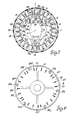
- step motor 15 be arranged to position rotor 10 in each of a plurality of angular positions, hereinafter referred to as switch operating positions, of a number equal.-to twice the number of individual electrical load switches, forty-eight in this embodiment, with each individual electrical switch operating tab and each space between adjacent operating tabs being a switch operating position.
- end 4a of actuator arm 4 is the reference end; that operating tab 1a of individual electrical switch 1 is switch operating position number one and that the switch operating positions are numbered sequentially from position number one in a clockwise direction.
- rotor 10 is shown in Figure 3 to be positioned in switch operating position number two in which end 4a of actuator arm 4 is located in the space between adjacent individual electrical switch operating tabs 1a and 2a of respective individual electrical switches 1 and 2 and end 4b of actuator arm 4 is located in register with individual electrical switch operating tab 13a of individual electrical switch 13.
- actuator arm 4 Upon the energization of solenoid coil 35 with rotor 10 positioned in this switch operating position number two, actuator arm 4 is tilted in a clockwise direction about the axis of pivot and end 4b thereof engages and operates individual electrical switch operating tab 13a of individual electrical switch 13 substantially in the direction of central axis A away from rotor 10 to establish the selected circuit condition of individual electrical switch 13 to which it is operated by end 4b of actuator arm 4.
- end 4a of actuator arm 4 is located in the space between adjacent individual electrical switch operating tabs 1a and 2a of respective individual electrical switches 1 and 2, end 4a does not engage an individual electrical switch operating tab in this switch position.
- each of the several individual electrical switch operating tabs is in an odd numbered switch operating position and each of the several spaces between each adjacent pair of the individual electrical switch operating tabs is in an even numbered switch operating position.
- rotor 10 is positioned by motor 15 to the odd numbered switch operating position of the operating tab desired to be operated.
- rotor 10 is positioned by motor 15 in the even numbered switch operating position in which end 4b of actuator arm 4 is in register with the operating tab desired to be operated.
- step motor 15 To next position rotor 10 in the switch operating position in which individual electrical switch 7 may be operated to establish the selected circuit condition thereof to which it is operated by end 4a of actuator arm 4, rotor 10 is rotated by step motor 15 from switch operating position number two in a clockwise direction through eleven switch operating positions or in a counterclockwise direction through thirty-seven switch operating positions to switch operating position number thirteen in which end 4a of actuator arm 4 is in register with individual electrical switch operating tab 7a of individual electrical switch 7 and end 4b is located in the space between adjacent individual electrical switch operating tabs 18a and 19a of respective individual electrical switches 18 and 19.
- actuator arm 4 Upon the energization of solenoid coil 35 with rotor 10 positioned in this switch operating position number thirteen, actuator arm 4 is tilted in a clockwise direction about the axis of pivot and end 4a thereof engages and operates individual electrical switch operating tab 7a of individual electrical switch 7 substantially in the direction of central axis A toward rotor 10 to establish the selected circuit condition of individual electrical switch 7 to which it is operated by end 4a of actuator arm 4.
- end 4b of actuator arm 4 As end 4b of actuator arm 4 is located in the space between adjacent individual electrical switch operating tabs 18a and 19a of respective individual electrical switches 18 and 19, end 4b does not engage an individual electrical switch operating tab in this switch position.
- step motor 15 To next position rotor 10 in the switch operating position in which individual electrical switch 18 may be operated to establish the selected circuit condition thereof to which it is operated by end 4a of actuator arm 4, rotor 10 is rotated by step motor 15 from switch operating position number thirteen in a clockwise direction through twenty-two switch operating positions or in a counterclockwise direction through twenty-six switch operating positions to switch operating position number thirty-five in which end 4a of actuator arm 4 is in register with individual electrical switch operating tab 18a of individual electrical switch 18 and end 4b is located in the space between adjacent individual electrical switch operating tabs 5a and 6a of respective individual electrical switches 5 and 6.
- actuator arm 4 Upon the energization of solenoid coil 35 with rotor 10 positioned in this switch operating position number thirty-five, actuator arm 4 is tilted in a clockwise direction about the axis of pivot and end 4a thereof engages and operates individual electrical switch operating tab 18a of individual electrical switch 18 substantially in the direction of central axis A toward rotor 10 to establish the selected circuit condition of individual electrical switch 18 to which it is operated by end 4a of actuator arm 4.
- end 4b of actuator arm 4 As end 4b of actuator arm 4 is located in the space between adjacent individual electrical switch operating tabs 5a and 6a of respective individual electrical switches 5 and 6, end 4b does not engage an individual electrical switch operating tab in this switch position.
- step motor 15 To next position rotor 10 in the switch operating position in which individual electrical switch 13 may be operated to establish the selected circuit condition thereof to which it is operated by end 4a of actuator arm 4, rotor 10 is rotated by step motor 15 from switch operating position number thirty-five in a clockwise direction through thirty-eight switch operating positions or in a counterclockwise direction through ten switch operating positions to switch operating position number twenty-five in which end 4a of actuator arm 4 is in register with individual electrical switch operating tab 13a of individual electrical switch 13 and end 4b is located in the space between adjacent individual electrical switch operating tabs 24a and 1a of respective individual electrical switches 24 and 1.
- actuator arm 4 Upon the energization of solenoid coil 35 with rotor 10 positioned in this switch operating position number twenty-five, actuator arm 4 is tilted in a clockwise direction about the axis of pivot and end 4a thereof engages and operates individual electrical switch operating tab 13a of individual electrical switch 13 substantially in the direction of central axis A toward rotor 10 to establish the selected circuit condition of individual electrical switch 13 to which it is operated by end 4a of actuator arm 4.
- end 4b of actuator arm 4 As end 4b of actuator arm 4 is located in the space between adjacent individual electrical switch operating tabs 24a and 1a of respective individual electrical switches 24 and 1, end 4b does not engage an individual electrical switch operating tab in this switch position.
- step motor 15 To next position rotor 10 in the switch operating position in which individual electrical switch 7 may be operated to establish the selected circuit condition thereof to which it is operated by end 4b of actuator arm 4, rotor 10 is rotated by step motor 15 from switch operating position number twenty-five in a clockwise direction through thirteen switch operating positions or in a counterclockwise direction through thirty-five switch operating positions to switch operating position number thirty-eight in which end 4b of actuator arm 4 is in register with individual electrical switch operating tab 7a of individual electrical switch 7 and end 4a is located in the space between adjacent individual electrical switch operating tabs 19a and 20a of respective individual electrical switches 19 and 20.
- actuator arm 4 Upon the energization of solenoid coil 35 with rotor 10 positioned in this switch operating position number thirty-eight, actuator arm 4 is tilted in a clockwise direction about the axis of pivot and end 4b thereof engages and operates individual electrical switch operating tab 7a of individual electrical switch 7 substantially in the direction of central axis A away from the rotor 10 to establish the selected circuit condition of individual electrical switch 7 to which it is operated by end 4b of actuator arm 4. As end 4a of actuator arm 4 is located in the space between adjacent individual electrical switch operating tabs 19a and 20a of respective individual electrical switches 19 and 20, end 4a does not engage an individual electrical switch operating tab in this switch position.
- step motor 15 To next position rotor 10 in the switch operating position in which individual electrical switch 18 may be operated to establish the selected circuit condition thereof to which it is operated by end 4b of actuator arm 4, rotor 10 is rotated by step motor 15 from switch operating position number thirty-eight in a clockwise direction through twenty-two switch operating positions or in a counterclockwise direction through twenty-six switch operating positions to switch operating position number twelve in which end 4b of actuator arm 4 is in register with individual electrical switch operating tab 18a of individual electrical switch 18 and end 4a is located in the space between adjacent individual electrical switch operating tabs 6a and 7a of respective individual electrical switches 6 and 7.
- actuator arm 4 Upon the energization of solenoid coil 35 with rotor 10 positioned in this switch operating position number twelve, actuator arm 4 is tilted in a clockwise direction about the axis of pivot and end 4b thereof engages and operates individual electrical switch operating tab 18a of individual electrical switch 18 substantially in the direction of central axis A away from rotor 10 to establish the selected circuit condition of individual electrical switch 18 to which it is operated by end 4b of actuator arm 4.
- end 4a of actuator arm 4 is located in the space between adjacent individual electrical switch operating tabs 6a and 7a of respective individual electrical switches 6 and 7, end 4a does not engage an individual electrical switch operating tab in this switch position.
- end 4a of actuator arm 4 is in register with one individual electrical switch operating tab in each of the odd numbered switch operating positions; (2) end 4b of actuator arm 4 is in register with one of the individual electrical switch operating tabs in each of the even numbered switch operating positions; and (3) that, depending upon the switch operating position in which rotor 10 is positioned and the next selected switch operating position to which it is to be rotated, there may be a fewer number of switch operating positions to be traversed by clockwise rotor rotation in some instances or by counterclockwise rotor rotation in other instances.
- actuator arm 4 is so arranged that one of the ends thereof is in register with one individual electrical switch operating tab in each of alternate ones of the switch operating positions and the other end thereof is in register with one individual electrical switch operating tab in each of the other alternate ones of the switch operating positions.
- motor 15 is preferably arranged to be selectively operable to rotate rotor 10 in either direction through a succession of discrete angular or switch operating positions.
- step motor 15 is digitally controlled by a microprocessor unit such as the MC6802 microprocessor unit marketed by Motorola Semiconductor Products, Inc. of Phoenix, Arizona.
- a microprocessor unit such as the MC6802 microprocessor unit marketed by Motorola Semiconductor Products, Inc. of Phoenix, Arizona.
- the control of the remote control unit of this invention will be described later in this specification with regard to the embodiment of Figures 5-13.
- a code wheel 40 may be secured to rotor 10, preferably upon the side thereof opposite that upon which actuator arm 4 is mounted.
- code wheel 40 is arranged to produce a unique digital signal representations for each of the switch operating positions. This code wheel 40 and the manner in which the digital signal representations are produced thereby will be described in detail later in this specification with regard to the embodiment set forth in Figures 5-13, inclusive.
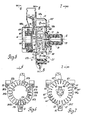
- a two-part housing 48a and 48b is designed to securely support a plurality of individual electrical switches in a circumferential arrangement.
- Both portions 48a and 48b may be made of an injection moulded plastics material such as glass and mica-filled polyethylene terephthalate marketed by E. I. DuPont de Nemours & Co. of Wilmington, Delaware under the trade name "Rynite”.
- the two portions 48a and 48b of the housing may be secured together by any suitable fastening arrangement such as spring latches 51, 52 and 53.
- Each of the individual electrical load switches may be of the conventional sliding contact type having an operating tab that is movable in two opposite directions to establish, respectively, one circuit condition or another circuit condition of the switch.
- a rotor 50 Located within the substantially cylindrical volume defined by the inboard face surfaces of the individual electrical switches is a rotor 50 supported for rotation substantially about central axis A in a plane substantially normal to central axis A by a support member 49.
- Support member 49 and rotor 50 may be made of an injection moulded Acetal plastic such as that marketed by E. I. DuPont de Nemours & Co. of Wilmington, Delaware under the trade name "Deirin".
- Rotor 50 is arranged to carry a switch actuator arm 3 that extends across the diameter of the circle defined by the individual electrical switch operating tabs and is of such a dimension as to be in radially overlapping relationship to the individual electrical switch operating tabs.
- a stanchion 54 carried by rotor 50 is arranged to provide a journal bearing for actuator arm 3 that is maintained in position by a retaining pin 55 as is best seen in Figures 10 and 11.
- Stanchion 54 is provided with two arcuate bearing surfaces 54a and 54b that are formed to accommodate the arcuate journal bearing accommodating surface 3c of actuator arm 3.
- Stanchion 54 is substantially centred about and extends substantially in the direction of central axis A and is arranged to provide a journal bearing for actuator arm 3 and to support retaining pin 55 in such a manner that the axis of tilt of actuator arm 3 is substantially normal to and substantially intersects central axis A at a location displaced from rotor 50.
- a pair of flexible retaining pin accommodating members 57 and 58 also carried by rotor 50 extend substantially in the direction of central axis A on opposite sides of stanchion 54 with the respective center lines thereof being aligned with each other along an axis that substantially intersects central axis A.
- Each of retaining pin accommodating members 57 and 58 has a respective shoulder 57a and 58a that extends toward central axis A at a location to engage respective ends of retaining pin 55.
- retaining pin accommodating members 57 and 58 are flexible, snap-in assembly of retaining pin 55 is provided thereby.
- rotor 50 is connected to the rotor 61 of a step motor 60 that is selectively operable to position rotor 50 in selected ones of a plurality of angular positions in each of which one of the ends of actuator arm 3 is in register with a selected one of the individual electrical switch operating tabs.
- the unit selected for step motor 60 is the functional equivalent of a commercially available device marketed by North American Phillips Controls Corporation of Cheshire, Connecticut under the designation model number K-82701-T1.
- Motor 60 may be secured to support member 49 by any suitable fastening arrangement such as a group of tabs, one of which is referenced by the numeral 63, Figure 5, extending from support member 49 through accommodating openings in motor flange 64.
- Actuator arm 3 carried by rotor 50 is an elongated unitary member of a rigid material adapted for tiltable mounting on a journal bearing that is characterized by an arcuate journal bearing accommodating surface 3c extending across the shorter axis thereof.
- Actuator arm 3 is of such a dimension in the direction of the diameter of the circle defined by the several individual electrical switch operating tabs that the ends thereof on respective opposite sides of the axis of tilt are in overlapping relationship with all of the individual electrical switch operating tabs.
- actuator arm 3 is arranged to be in register with each of the individual electrical switch operating tabs at mutually exclusive angular positions by circumferentially offsetting the ends in such a manner that actuator arm 3 is in register with each individual electrical switch operating tab at two angular positions, one for each end.
- actuator arm 3 is indicated to have a switch operating projection 3a and 3b on respective opposite ends that are circumferentially offset from each other. It is to be specifically understood that any other circumferential offset arrangement for the ends of actuator arm 3 on opposite sides of the axis of tilt may be employed without departing from the spirit of the invention:
- Spring 70 is an elongated unitary spring of a flat spring material characterized by a reverse double arc portion 70a at one extremity thereof, a contiguous flat cantilevered section 70b, a contiguous intermediate section 70c having the parallel edges thereof extending angularly therefrom and a contiguous second reverse double arc section 70d at the opposite extremity thereof.
- the second reverse double arc section 70d is formed to provide a terminating portion 70e that intersects the plane of the intermediate section 70c and has two spaced shoulders 70f and 70g lying in the same plane and extending toward the center line thereof as is best seen in Figure 12. As is best seen in Figures 9 and 13, the shoulders 70f and 70g of terminating portion 70e of spring 70 engage accommodating notches 3f and 3g of actuator arm 3.
- rotor 50 carries another support arrangement such as stanchion 67 that extends substantially in the direction of central axis A and is radially displaced from stanchion 54.
- Stanchion 67 is arranged to provide a fulcrum 68 for the first reverse double arc portion 70a of spring 70 having an axis substantially parallel to and radially displaced from the axis of tilt of actuator arm 3 and lies in a plane displaced therefrom substantially in the direction of central axis A away from rotor 50.
- one of the arcs of the reverse double arc portion 70a is retained by a member 67a formed as a portion of stanchion 67 that has an axis substantially parallel to and radially displaced from that of the fulcrum 68 and lies in a plane displaced therefrom substantially in the direction of central axis A toward rotor 50; the other of the arcs of reverse double arc portion 70a is accommodated by fulcrum 68 and the shoulders 70f and 70g of terminating portion 70e engage the respective notches 3f and 3g of actuator arm 3.
- actuator arm 3 is spring force tilted in advance of rotor rotation in a first counterclockwise direction about the axis of tilt by spring 70 to a position in which the ends thereof on opposite sides of the axis of pivot are on the operating side of the several individual electrical switch operating tabs.
- a solenoid coil 75 having an armature 76 of a magnetic material is employed.
- Armature 76 may be of a circular cross section having a tapered portion reducing down to an actuating rod 77 that passes through a guide 78 and is in operating engagement with portion 70c of spring 70.
- a cap 79 of rubber or any other suitable sound deadening material may be installed over the end of armature 76 opposite operating rod 77. Electrical power may be supplied to solenoid coil 75 through input terminals 80 and 81.
- Solenoid coil 75 may be 440 turns of number 24 copper wire that is so wound that, upon the energization thereof, armature 76 is activated in a direction toward spring 70. Upon the energization of solenoid coil 75, armature 76 is activated in a direction toward spring 70 to tilt actuator arm 3 in a second, opposite, clockwise, direction about the axis of pivot.
- end 3b of actuator arm 3 be in register with operating tab 13a of electrical switch 13 upon the tilt of actuator arm 3 in a clockwise direction under the influence of energized solenoid coil 75, end 3b thereof operatively engages operating tab 13a and moves this tab substantially in the direction of central axis A away from rotor 50 from the position shown by solid lines to the position shown by dashed lines to operate electrical switch 13 out of one operating condition and to establish another operating condition.
- actuator arm 3 Should end 3a of actuator arm 3 be in register with operating tab 2a of electrical switch 2 upon the tilt of actuator arm 3 in a clockwise direction under the influence of energized solenoid coil 75, end 3a thereof operatively engages operating tab 2a and moves this tab substantially in the direction of central axis A toward rotor 50 from the position shown by solid lines to the position shown by dashed lines to operate switch 2 out of one operating condition and to establish another operating condition.
- each of the individual electrical switches may have two spade-type terminals extending from each opposite end thereof that are arranged to extend respectively through accommodating openings in top portion 48a and through accommodating openings in the bottom portion 48b of the housing as is best seen in Figures 6 and 7.
- ten of these terminal pairs corresponding to individual electrical switches 1, 2, 6, 7, 8, 13, 17, 18, 19 and 24 that extend through accommodating slots in housing portion 48a are identified by the respective reference numerals 1T, 2T, 6T, 7T, 8T, 13T, 17T, 18T, 19T and 24T.
- step motor 60 be arranged to position rotor 50 in each of a plurality of angular positions, hereinafter referred to as switch operating positions, of a number equal to twice the number of individual electrical load switches, forty-eight in this embodiment, with each individual electrical switch operating tab and each space between adjacent operating tabs being a switch operating position.
- end 3a of actuator arm 3 is the reference end; that operating tab 1a of individual electrical switch 1 is switch operating position number one and that the switch operating positions are numbered sequentially from position number one in a clockwise direction.
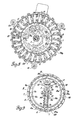
- rotor 50 is shown in Figure 9 to be positioned in switch operating position number two in which end 3a of actuator arm 3 is located in the space between adjacent individual electrical switch operating tabs 1a and 2a of respective individual electrical switches 1 and 2 and end 3b of actuator arm 3 is located in register with individual electrical switch operating tab 13a of individual electrical switch 13.
- actuator arm 3 Upon the energization of solenoid coil 75 with rotor 50 positioned in this switch operating position number two, actuator arm 3 is tilted in a clockwise direction about the axis of pivot and end 3b thereof engages and operates individual electrical switch operating tab 13a of individual electrical switch 13 substantially in the direction of central axis A away from rotor 50 to establish the selected circuit condition of individual electrical switch 13 to which it is operated by end 3b of actuator arm 3.
- end 3a of actuator arm 3 is located in the space between adjacent individual electrical switch operating tabs 1a and 2a of respective individual electrical switches 1 and 2, end 3a does not engage an individual electrical switch operating tab in this switch position.
- each of the several individual electrical switch operating tabs is in an odd numbered switch operating position and each of the several spaces between each adjacent pair of individual electrical switch operating tabs is in an even numbered switch operating position.
- rotor 50 is positioned by motor 60 to the odd numbered switch operating position of the operating tab desired to be operated.
- rotor 50 is positioned by motor 60 to the even numbered switch operating position in which end 3b of actuator arm 3 is in register with the operating tab desired to be operated.
- step motor 60 To next position rotor 50 in the switch operating position in which individual electrical switch 19 may be operated to establish the selected circuit condition thereof to which it is operated by end 3a of actuator arm 3, rotor 50 is rotated by step motor 60 from switch operating position number two in a clockwise direction through thirty-five switch operating positions or in a counterclockwise direction through thirteen switch operating positions to switch operating position number thirty-seven in which end 3a of actuator arm 3 is in register with individual electrical switch operating tab 19a of individual electrical switch 19 and end 3b is located in the space between adjacent individual electrical switch operating tabs 6a and 7a of respective individual electrical switches 6 and 7.
- actuator arm 3 Upon the energization of solenoid coil 75 with rotor 50 positioned in this switch operating position number thirty-seven, actuator arm 3 is tilted in a clockwise direction about the axis of pivot and end 3a thereof engages and operates individual electrical switch operating tab 19a of individual electrical switch 19 substantially in the direction of central axis A toward rotor 50 to establish the selected circuit condition of individual electrical switch 19 to which it is operated by end 3a of actuator arm 3.
- end 3b of actuator arm 3 As end 3b of actuator arm 3 is located in the space between adjacent individual electrical switch operating tabs 6a and 7a of respective individual electrical switches 6 and 7, end 3b does not engage an individual electrical switch operating tab in this switch position.
- step motor 60 To next position rotor 50 in the switch operating position in which individual electrical switch 6 may be operated to establish the selected circuit condition thereof to which it is operated by end 3a of actuator arm 3, rotor 50 is rotated by step motor 60 from switch operating position number thirty-seven in a clockwise direction through twenty-two switch operating positions or in a counterclockwise direction through twenty-six switch operating positions to switch operating position number eleven in which end 3a of actuator arm 3 is in register with individual electrical switch operating tab 6a of individual electrical switch 6 and end 3b is located in the space between adjacent individual electrical switch operating tabs 17a and 18a of respective individual electrical switches 17 and 18.
- actuator arm 3 Upon the energization of solenoid coil 75 with rotor 50 positioned in this switch operating position number eleven, actuator arm 3 is tilted in a clockwise direction about the axis of pivot and end 3a thereof engages and operates individual electrical switch operating tab 6a of individual electrical switch 6 substantially in the direction of central axis A toward rotor 50 to establish the selected circuit condition of individual electrical switch 6 to which it is operated by end 3a of actuator arm 3.
- end 3b of actuator arm 3 As end 3b of actuator arm 3 is located in the space between adjacent individual electrical switch operating tabs 17a and 18a of respective individual electrical switches 17 and 18, end 3b does not engage an individual electrical switch operating tab in this switch position.
- step motor 60 To next position rotor 50 in the switch operating position in which individual electrical switch 13 may be operated to establish the selected circuit condition thereof to which it is operated by end 3a of actuator arm 3, rotor 50 is rotated by step motor 60 from switch operating position number eleven in a clockwise direction through fourteen switch operating positions or in a counterclockwise direction through thirty-four switch operating positions to switch operating position number twenty-five in which end 3a of actuator arm 3 is in register with individual electrical switch operating tab 13a of individual electrical switch 13 and end 3b is located in the space between adjacent individual electrical switch operating tabs 1a and 24a of respective individual electrical switches 1 and 24.
- actuator arm 3 Upon the energization of solenoid coil 75 with rotor 50 positioned in this switch operating position number twenty-five, actuator arm 3 is tilted in a clockwise direction about the axis of pivot and end 3a thereof engages and operates individual electrical switch operating tab 13a of individual electrical switch 13 substantially in the direction of central axis A toward rotor 50 to establish the selected circuit condition of individual electrical switch 13 to which it is operated by end 3a of actuator arm 3.
- end 3b of actuator arm 3 As end 3b of actuator arm 3 is located in the space between adjacent individual electrical switch operating tabs 1a and 24a of respective individual electrical switches 1 and 24, end 3b does not engage an individual electrical switch operating tab in this switch position.
- step motor 60 To next position rotor 50 in the switch operating position in which individual electrical switch 19 may be operated to establish the selected circuit condition thereof to which it is operated by end 3b of actuator arm 3, rotor 50 is rotated by step motor 60 from switch operating position number twenty-five in a clockwise direction through thirty-seven switch operating positions or in a counterclockwise direction through eleven switch operating positions to switch operating position number fourteen in which end 3b of actuator arm 3 is in register with individual electrical switch operating tab 19a of individual electrical switch 19 and end 3a is located in the space between adjacent individual electrical switch operating tabs 7a and 8a of respective individual electrical switches 7 and 8.
- actuator arm 3 Upon the energization of solenoid coil 75 with rotor 50 positioned in this switch operating position number fourteen, actuator arm 3 is tilted in a clockwise direction about the axis of pivot and end 3b thereof engages and operates individual electrical switch operating tab 19a of individual electrical switch 19 substantially in the direction of central axis A away from rotor 50 to establish the selected circuit condition of individual electrical switch 19 to which it is operated by end 3b of actuator arm 3.
- end 3a of actuator arm 3 is located in the space between adjacent individual electrical switch operating tabs 7a and 8a of respective individual electrical switches 7 and 8, end 3a does not engage an individual electrical switch operating tab in this switch position.
- step motor 60 To next position rotor 50 in the switch operating position in which individual electrical switch 6 may be operated to establish the selected circuit condition thereof to which it is operated by end 3b of actuator arm 3, rotor 50 is rotated by step motor 60 from switch operating position number fourteen in a clockwise direction through twenty-two switch operating positions or in a counterclockwise direction through twenty-six switch operating positions to switch operating position number thirty-six in which end 3b of actuator arm 3 is in register with individual electrical switch operating tab 6a of individual electrical switch 6 and end 3a is located in the space between adjacent individual electrical switch operating tabs 18a and 19a of respective individual electrical switches 18 and 19.
- actuator arm 3 Upon the energization of solenoid coil 75 with rotor 50 positioned in this switch operating position number thirty six, actuator arm 3 is tilted in a clockwise direction about the axis of pivot and end 3b thereof engages and operates individual electrical switch operating tab 6a of individual electrical switch 6 substantially in the direction of central axis A away from rotor 50 to establish the selected circut condition of individual electrical switch 6 to which it is operated by end 3b of actuator arm 3. As end 3a of actuator arm 3 is located in the space between adjacent individual electrical switch operating tabs 18a and 19a of respective individual electrical switches 18 and 19, end 3a does not engage an individual electrical switch operating tab in this switch position.
- end 3a of actuator arm 3 is in register with one individual electrical switch operating tab in each of the odd numbered switch operating positions; (2) end 3b of actuator arm 3 is in register with one of the individual electrical switch operating tabs in each of the even numbered switch operating positions; and (3) that, depending upon the switch operating position in which rotor 50 is positioned and the next selected switch operating position to which it is to be rotated, there may be a fewer number of switch operating positions to be traversed by clockwise rotor rotation in some instances or by counterclockwise rotor rotation in other instances.
- actuator arm 3 is so located that one of the ends thereof is in register with one individual electrical switch operating tab in each of alternate ones of the switch operating position and the other end thereof is in register with one individual electrical switch operating tab in each of the other alternate ones of the switch operating positions.
- motor 60 is preferably arranged to be selectively operable to rotate rotor 50 in either direction through a succession of discrete angular or switch operating positions.
- step motor 60 is digitally controlled by a microprocessor unit such as the MC6802 microprocessor unit marketed by Motorola Semiconductor Products, Inc. of Phoenix, Arizona.
- this unit may be programmed to position rotor 50 in response to digital command signals that may be produced by momentary contact electrical switches arranged for manual operation to select each of several different electrical circut control functions.
- rotor 50 of this embodiment carries a code wheel 40 preferably on the side facing motor 60 as is best seen in Figures 5, 8 and 10.
- Code wheel 40 may be a disc of an insulating material that is arranged to support a conductive pattern 40a in a manner well known in the art such as printed circuit techniques.
- Conductive pattern 40a is arranged to have a plurality of concentric tracks, each of which is engaged by a respective sliding contact brush and a common track also engaged by a sliding contact brush through which operating potential is applied to conductive pattern 40a.
- brushes 7A are best illustrated in Figure 10 wherein each is referenced by the respective reference number 1A, 2A, 3A, 4A, 5A, 6A and 7A.
- brush 7A is illustrated as being in sliding electrical contact with the common concentric track of conductive pattern 40a and each of the other brushes is in sliding contact with a respective other concentric track of conductive pattern 40a, and each corresponds to a respective bit position of a digital signal representation.
- Brush 7A may be connected to a source of direct current electrical power, such as an automotive type battery, and each of brushes 1A, 2A, 3A, 4A, 5A and 6A is connected to a point of reference or ground potential through a respective resistor.
- An example of one application of the remote control unit of this invention is to perform the power switching functions of an automotive vehicle.
- Either embodiment described herein may be mounted remote from the passenger compartment such as in the engine compartment and may be controlled by a microprocessor unit such as the Motorola MC6802 marketed by Motorola Semiconductor Products, Inc. of Phoenix, Arizona.
- a microprocessor unit such as the Motorola MC6802 marketed by Motorola Semiconductor Products, Inc. of Phoenix, Arizona.
- Located in the passenger compartment may be a plurality of function select switches, each of which may be of the momentary contact type having an output lead that normally has a logic signal of a selected level thereon while the switch is not operated that changes potential level to another selected logic signal upon the operation thereof.
- Each of these function select switches is arranged to produce, when operated, a change in potential level in the logic signal present upon the output lead thereof.
- the logic signals appearing upon the function select switch output circuit leads are employed as input signals to the microprocessor unit that is arranged to read or sense these output circuit leads through a multiplexer arrangement.
- the rate of scan of these output circuit leads is of the order of approximately five milliseconds.
- a memory device such as a register circuit having an address or bit position corresponding to each load switch is provided for storing in each address or bit position a logic signal indicative of the actual switch operating condition of the corresponding load switch and another memory device such as a register circuit having an address or bit position corresponding to each load switch is provided for storing in each address or bit position a logic signal indicative of the desired switch operating condition of the corresponding load switch.
- microprocessor unit is preprogrammed to:
- each of the output leads of the momentary contact function select switches normally has a "High” electrical signal thereon through a pull up resistor to a direct current potential source such as the automobile battery; that upon the operation of any one of the function select switches, a "low” electrical signal is present upon the corresponding output lead; that the logic signal indicative of an "on” function is a logic 1; that the logic signal indicative of an "off” function is a logic 0; that it is desired to turn the vehicle parking lights on; that load switch 17 of Figure 9 is the load switch selected to control the parking light switching functions; that rotor 50 is in switch operating position 2 as indicated by Figure 9; that the operation of operating tab 17a of load switch 17 must be operated toward rotor 50 for the "on” function; and that all of the load switches are in the "off” operating condition with _ a logic 0 in each of the addresses or bit positions of the actual and desired switch operating condition memory devices.
- the corresponding function select switch located in the passenger compartment is operated to place a logic 0 upon the corresponding output lead thereof.
- the microprocessor detects this change of potential level indicating that a switching function has been selected, the logic signal contained in the address of the actual switch operating condition memory device corresponding to load switch 17 is detected. Since the logic signal contained in this address is a logic 0, a logic 1 signal is placed in the corresponding address of the desired switch operating condition memory device corresponding to load switch 17.
- Step motor 60 is then energized to align rotor 50 in the position as determined by the magnetic field produced by the energized windings and the digital signal representation of rotor position as produced by the code wheel attached to rotor 50 is sensed.
- the binary number of the switch operating position in which the rotor is positioned is sensed in the address corresponding to the digital signal representation produced by the code wheel in the second lookup table which, for purposes of this specification, will be assumed to be switch operating position number two as shown in Figure 9. Since rotor 50 is positioned in switch operating position number two, the desired switch operating position thirty-three is subtracted from the actual switch operating position number two to produce a difference of minus thirty-one. As this is a negative number with an absolute value greater than twenty-four, the absolute value thereof, thirty-one, is subtracted from forty-eight to obtain a difference of seventeen.
- rotor 50 is stepped in a counterclockwise direction through seventeen steps or switch operating positions to switch operating position number thirty-three in which end 3a of actuator arm 3 is in register with operating tab 17a of switch 17.
- the digital signal representation as produced by code wheel 40 is again sensed and the binary number contained in the address of the second lookup table corresponding to this digital signal representation is sensed. If there is agreement between this sensed binary number and the binary number of the desired switch operating position, solenoid 75 is energized to tilt arm 3 in a clockwise direction about the pivot point to effect the operation of operating tab 17a of load switch 17 substantially in the direction of central axis A toward rotor 50 to effect the "on" switch function for load switch 19 to energize the parking lights. Upon the operation of solenoid 75, a logic 1 signal indicating the parking lights are "on” is placed in the address or bit position of the actual switch operating condition memory device corresponding to load switch 17.
- the corresponding function select switch located in the passenger compartment is operated to place a logic 0 upon the corresponding output lead thereof.
- the logic signal contained in the address of the actual switch operating condition memory device corresponding to load switch 17 is detected. Since the logic signal containing in this address is a logic 1 as the parking lights are on, a logic 0 signal is placed in the corresponding address of the desired switch operating condition memory device corresponding to load switch 17.
- Step motor 60 in then energized to align rotor 50 in the position as determined by the magnetic field produced by the energized windings and the digital signal representation of rotor position as produced by the code wheel attached to rotor 52 is sensed.
- the binary number of the switch operating position in which the rotor is positioned is sensed in the address corresponding to the digital signal representation produced by the code wheel in the second lookup table which, for purposes of this specification, will be assumed to be again switch operating position number two. Since rotor 50 is positioned in switch operating position number two, the desired switch operation position ten is subtracted from the actual switch operating position number two to produce a difference of minus eight. As this is a negative number with an absolute value less than twenty-four, rotor 50 is stepped in a clockwise direction a number of steps equal to the absolute value of this difference or eight steps to switch operating position number ten in which end 3b of actuator arm 3 is in register with operating tab 17a of switch 17.
- a system wherein a plurality of electrical load switches may be centrally operated by a single centrally mounted unit including a single switch actuator mechanism that may be selectively controlled by a microprocessor unit.
- remote control unit of this invention is described on the basis of sliding contact type load switches, it is to be specifically understood that other type load switches may be employed.
- type load switches For example, snap-action switches, latching type switches or push-button type load switches may be employed. Further, tab actuated values may also be employed and may be intermixed with electrical switches if so desired.
Landscapes
- Switches With Compound Operations (AREA)
Claims (6)
Applications Claiming Priority (2)
| Application Number | Priority Date | Filing Date | Title |
|---|---|---|---|
| US06/289,787 US4403121A (en) | 1981-08-03 | 1981-08-03 | Remote control unit |
| US289787 | 1999-04-09 |
Publications (2)
| Publication Number | Publication Date |
|---|---|
| EP0072115A1 EP0072115A1 (de) | 1983-02-16 |
| EP0072115B1 true EP0072115B1 (de) | 1985-08-21 |
Family
ID=23113095
Family Applications (1)
| Application Number | Title | Priority Date | Filing Date |
|---|---|---|---|
| EP82303818A Expired EP0072115B1 (de) | 1981-08-03 | 1982-07-21 | Fernsteuerungsvorrichtung |
Country Status (4)
| Country | Link |
|---|---|
| US (1) | US4403121A (de) |
| EP (1) | EP0072115B1 (de) |
| CA (1) | CA1226607A (de) |
| DE (1) | DE3265614D1 (de) |
Families Citing this family (3)
| Publication number | Priority date | Publication date | Assignee | Title |
|---|---|---|---|---|
| US4476449A (en) * | 1983-04-04 | 1984-10-09 | General Motors Corporation | Switch actuator for a remote control unit |
| FR2629359B1 (fr) * | 1988-03-31 | 1991-07-26 | Mongodin Guy | Commande simplifiee a distance de fonctions multiples |
| BR9909905B1 (pt) * | 1998-04-03 | 2012-12-11 | operador para uma chave aérea de energia elétrica e método de operação de uma chave de energia elétrica aérea. |
Family Cites Families (22)
| Publication number | Priority date | Publication date | Assignee | Title |
|---|---|---|---|---|
| DE1072895B (de) | 1960-01-07 | Robert Bosch G.M.B.H., Stuttgart | Handbetätigbarer Schalter für elektrische Anlagen auf Fahrzeugen, insbesondere Kraftfahrzeugen | |
| GB205062A (en) | 1922-10-06 | 1924-05-08 | Frank Robert Mcberty | Improvements in switching apparatus for telephone exchange systems |
| US1680416A (en) * | 1924-01-22 | 1928-08-14 | Westinghouse Electric & Mfg Co | Magnet switch |
| DE681221C (de) | 1935-08-29 | 1939-09-18 | Becker Elektrobahnen H | Vorrichtung zur schrittweisen Fernbedienung eines in Stufen zu verstellenden Geraets |
| US2564246A (en) * | 1948-01-03 | 1951-08-14 | Rotax Ltd | Electromagnetic reversing switch |
| US2760026A (en) * | 1951-01-08 | 1956-08-21 | Clare & Co C P | Relay |
| US2993963A (en) * | 1959-10-13 | 1961-07-25 | Newell S Beardow | Control unit and switch used therein |
| US3233066A (en) * | 1963-02-26 | 1966-02-01 | Cons Electronics Ind | Low-torque stepper switch |
| US3546401A (en) * | 1964-08-21 | 1970-12-08 | Amp Inc | Selector switch provided with selectably actuable contact means |
| US3319019A (en) * | 1964-11-06 | 1967-05-09 | Crouzet Sa | Timed control device with variable programmed sequences |
| GB1196115A (en) | 1966-09-12 | 1970-06-24 | Plessey Co Ltd | Improvements in or relating to Rotary Electrical Switching Devices |
| JPS492230B1 (de) * | 1970-01-31 | 1974-01-19 | ||
| US3743799A (en) * | 1972-02-08 | 1973-07-03 | Gemco Electric Co | Selector switch mechanism with adjustable radial cam insert members having circumferential overlap flange |
| FR2196727A5 (de) * | 1972-08-17 | 1974-03-15 | Sercel Rech Const Elect | |
| US3995206A (en) * | 1972-12-29 | 1976-11-30 | International Business Machines Corporation | Apparatus for transferring articles through various processing sectors of a manufacturing system |
| US3931483A (en) * | 1974-01-15 | 1976-01-06 | General Electric Company | Multiple circuit control switch having articulated cascaded operating mechanism |
| AT339415B (de) * | 1974-01-17 | 1977-10-25 | Siemens Ag | Schalteranordnung |
| US4021714A (en) * | 1975-01-08 | 1977-05-03 | Contraves-Goerz Corporation | Servo system employing a tracking digital angle encoder |
| DE2853681C2 (de) * | 1978-12-13 | 1980-12-18 | Merit-Werk Merten & Co Kg, 5270 Gummersbach | Kraftfahrzeug-Zünd- oder -Gliihanlaßschalter |
| US4281304A (en) * | 1979-02-26 | 1981-07-28 | Koshman Vitaly I | Electric circuit switchgear |
| US4264791A (en) * | 1979-02-26 | 1981-04-28 | Williams Robert A | Devious path rotary switch |
| GB2047964B (en) * | 1979-04-23 | 1983-07-20 | Koshman V I Petrichenko V F | Electric switching devices |
-
1981
- 1981-08-03 US US06/289,787 patent/US4403121A/en not_active Expired - Fee Related
-
1982
- 1982-03-12 CA CA000398283A patent/CA1226607A/en not_active Expired
- 1982-07-21 EP EP82303818A patent/EP0072115B1/de not_active Expired
- 1982-07-21 DE DE8282303818T patent/DE3265614D1/de not_active Expired
Also Published As
| Publication number | Publication date |
|---|---|
| US4403121A (en) | 1983-09-06 |
| DE3265614D1 (en) | 1985-09-26 |
| CA1226607A (en) | 1987-09-08 |
| EP0072115A1 (de) | 1983-02-16 |
Similar Documents
| Publication | Publication Date | Title |
|---|---|---|
| CA1329413C (en) | Remote power mirror switch assembly | |
| US5568026A (en) | Synchronizing windshield wipers | |
| US4481585A (en) | System for selectively controlling motor vehicle electrical loads | |
| EP0771693A1 (de) | Multifunktionsschalter mit Drehverbinder | |
| US4328431A (en) | Lever switch | |
| US6609488B2 (en) | Apparatus and procedure for starting vehicle engine | |
| EP0072115B1 (de) | Fernsteuerungsvorrichtung | |
| US4523115A (en) | Switching device for reversing a portable electric tool | |
| US4857815A (en) | Switch for energizing an electric motor of a wiper system | |
| US5654616A (en) | Windshield wiper system with soft wipe mode for high speed operation | |
| US4399335A (en) | Switch actuator assembly | |
| JPH0646738Y2 (ja) | 回転位置検出装置 | |
| JPS6132246A (ja) | 記録再生装置のモ−ド切換え装置 | |
| US4351991A (en) | Direction indicator blinker light switching arrangement | |
| US3671691A (en) | Multiple switch construction | |
| US4675663A (en) | Apparatus and method for indicating the rotational speed of a fan | |
| JP2023539233A (ja) | 負荷時タップ切換器モジュール | |
| US4093896A (en) | Speed control for rotatable element driven by direct current motors | |
| KR950003075A (ko) | 서보모우터 원격제어스위치 | |
| US5981886A (en) | Multifunction switch assembly | |
| EP0278536B1 (de) | Kontrollvorrichtung zum Öffnen und Schliessen einer Öffnung, insbesondere eines Kraftfahrzeugschiebe-hebedaches | |
| JP3572409B2 (ja) | サンルーフ位置検出器およびサンルーフ位置検出器付モータ | |
| JP4944351B2 (ja) | コンタクトプレーンシステムおよびワイパモータを制御する方法 | |
| KR20230054693A (ko) | 스위칭 모듈 및 스위칭 모듈을 포함하는 온-로드 탭 절환기 | |
| US5874815A (en) | Control arrangement for the function states of a lock of motor vehicles |
Legal Events
| Date | Code | Title | Description |
|---|---|---|---|
| PUAI | Public reference made under article 153(3) epc to a published international application that has entered the european phase |
Free format text: ORIGINAL CODE: 0009012 |
|
| AK | Designated contracting states |
Designated state(s): DE FR GB |
|
| 17P | Request for examination filed |
Effective date: 19830328 |
|
| GRAA | (expected) grant |
Free format text: ORIGINAL CODE: 0009210 |
|
| AK | Designated contracting states |
Designated state(s): DE FR GB |
|
| REF | Corresponds to: |
Ref document number: 3265614 Country of ref document: DE Date of ref document: 19850926 |
|
| ET | Fr: translation filed | ||
| PLBE | No opposition filed within time limit |
Free format text: ORIGINAL CODE: 0009261 |
|
| STAA | Information on the status of an ep patent application or granted ep patent |
Free format text: STATUS: NO OPPOSITION FILED WITHIN TIME LIMIT |
|
| 26N | No opposition filed | ||
| PG25 | Lapsed in a contracting state [announced via postgrant information from national office to epo] |
Ref country code: FR Free format text: LAPSE BECAUSE OF NON-PAYMENT OF DUE FEES Effective date: 19880331 |
|
| PG25 | Lapsed in a contracting state [announced via postgrant information from national office to epo] |
Ref country code: DE Effective date: 19880401 |
|
| GBPC | Gb: european patent ceased through non-payment of renewal fee | ||
| REG | Reference to a national code |
Ref country code: FR Ref legal event code: ST |
|
| PG25 | Lapsed in a contracting state [announced via postgrant information from national office to epo] |
Ref country code: GB Free format text: LAPSE BECAUSE OF NON-PAYMENT OF DUE FEES Effective date: 19881121 |