EP0071515A1 - Procédé d'obtention de polyosides capsulaires, polyosides capsulaires ainsi obtenus et leur application à la préparation de vaccins - Google Patents
Procédé d'obtention de polyosides capsulaires, polyosides capsulaires ainsi obtenus et leur application à la préparation de vaccins Download PDFInfo
- Publication number
- EP0071515A1 EP0071515A1 EP82401343A EP82401343A EP0071515A1 EP 0071515 A1 EP0071515 A1 EP 0071515A1 EP 82401343 A EP82401343 A EP 82401343A EP 82401343 A EP82401343 A EP 82401343A EP 0071515 A1 EP0071515 A1 EP 0071515A1
- Authority
- EP
- European Patent Office
- Prior art keywords
- capsular
- culture
- carried out
- retentate
- polyosides
- Prior art date
- Legal status (The legal status is an assumption and is not a legal conclusion. Google has not performed a legal analysis and makes no representation as to the accuracy of the status listed.)
- Granted
Links
- 238000000034 method Methods 0.000 title claims abstract description 19
- 229960005486 vaccine Drugs 0.000 title claims description 9
- 238000002360 preparation method Methods 0.000 title description 5
- 239000012528 membrane Substances 0.000 claims abstract description 21
- 238000001914 filtration Methods 0.000 claims abstract description 13
- 102000004169 proteins and genes Human genes 0.000 claims abstract description 10
- 108090000623 proteins and genes Proteins 0.000 claims abstract description 10
- 230000000813 microbial effect Effects 0.000 claims abstract description 9
- 102000039446 nucleic acids Human genes 0.000 claims abstract description 9
- 108020004707 nucleic acids Proteins 0.000 claims abstract description 9
- 150000007523 nucleic acids Chemical class 0.000 claims abstract description 9
- 230000002163 immunogen Effects 0.000 claims abstract description 8
- 150000002632 lipids Chemical class 0.000 claims abstract description 8
- 150000004676 glycans Chemical class 0.000 claims description 61
- 229920001282 polysaccharide Polymers 0.000 claims description 61
- 239000005017 polysaccharide Substances 0.000 claims description 61
- 239000012465 retentate Substances 0.000 claims description 18
- 239000000203 mixture Substances 0.000 claims description 17
- 239000006228 supernatant Substances 0.000 claims description 17
- 239000000047 product Substances 0.000 claims description 13
- 239000008346 aqueous phase Substances 0.000 claims description 12
- 241000894006 Bacteria Species 0.000 claims description 10
- 241000193998 Streptococcus pneumoniae Species 0.000 claims description 10
- 229940031000 streptococcus pneumoniae Drugs 0.000 claims description 10
- OAABHEHWRQAHEJ-UHFFFAOYSA-N butan-1-ol;chloroform Chemical compound ClC(Cl)Cl.CCCCO OAABHEHWRQAHEJ-UHFFFAOYSA-N 0.000 claims description 9
- 239000012071 phase Substances 0.000 claims description 9
- 241000588747 Klebsiella pneumoniae Species 0.000 claims description 8
- 241000606768 Haemophilus influenzae Species 0.000 claims description 7
- 241000588724 Escherichia coli Species 0.000 claims description 5
- 238000000502 dialysis Methods 0.000 claims description 5
- 230000003698 anagen phase Effects 0.000 claims description 3
- 230000007071 enzymatic hydrolysis Effects 0.000 claims description 3
- 238000006047 enzymatic hydrolysis reaction Methods 0.000 claims description 3
- 230000012010 growth Effects 0.000 abstract description 3
- 239000000463 material Substances 0.000 abstract 6
- 230000000717 retained effect Effects 0.000 abstract 4
- 239000007791 liquid phase Substances 0.000 abstract 2
- 238000004519 manufacturing process Methods 0.000 abstract 2
- YXFVVABEGXRONW-UHFFFAOYSA-N Toluene Chemical compound CC1=CC=CC=C1 YXFVVABEGXRONW-UHFFFAOYSA-N 0.000 description 18
- 238000000605 extraction Methods 0.000 description 16
- LFQSCWFLJHTTHZ-UHFFFAOYSA-N Ethanol Chemical compound CCO LFQSCWFLJHTTHZ-UHFFFAOYSA-N 0.000 description 15
- XLYOFNOQVPJJNP-UHFFFAOYSA-N water Substances O XLYOFNOQVPJJNP-UHFFFAOYSA-N 0.000 description 14
- 241001465754 Metazoa Species 0.000 description 12
- 108010083644 Ribonucleases Proteins 0.000 description 11
- 102000006382 Ribonucleases Human genes 0.000 description 11
- 238000000746 purification Methods 0.000 description 10
- 238000011026 diafiltration Methods 0.000 description 9
- 102000016911 Deoxyribonucleases Human genes 0.000 description 8
- 108010053770 Deoxyribonucleases Proteins 0.000 description 8
- 239000001963 growth medium Substances 0.000 description 8
- 239000002244 precipitate Substances 0.000 description 8
- ISWSIDIOOBJBQZ-UHFFFAOYSA-N Phenol Chemical compound OC1=CC=CC=C1 ISWSIDIOOBJBQZ-UHFFFAOYSA-N 0.000 description 7
- 238000005119 centrifugation Methods 0.000 description 7
- 239000002609 medium Substances 0.000 description 7
- 238000000926 separation method Methods 0.000 description 7
- VMHLLURERBWHNL-UHFFFAOYSA-M Sodium acetate Chemical compound [Na+].CC([O-])=O VMHLLURERBWHNL-UHFFFAOYSA-M 0.000 description 6
- 239000012153 distilled water Substances 0.000 description 6
- 235000017281 sodium acetate Nutrition 0.000 description 6
- 239000001632 sodium acetate Substances 0.000 description 6
- 241000699670 Mus sp. Species 0.000 description 5
- 108010059712 Pronase Proteins 0.000 description 5
- 239000008363 phosphate buffer Substances 0.000 description 5
- 239000000243 solution Substances 0.000 description 5
- 244000052616 bacterial pathogen Species 0.000 description 4
- 239000012141 concentrate Substances 0.000 description 4
- 239000012228 culture supernatant Substances 0.000 description 4
- 238000011534 incubation Methods 0.000 description 4
- 238000004448 titration Methods 0.000 description 4
- 238000006243 chemical reaction Methods 0.000 description 3
- 108010079502 exoribonuclease T Proteins 0.000 description 3
- 230000003067 hemagglutinative effect Effects 0.000 description 3
- 238000002347 injection Methods 0.000 description 3
- 239000007924 injection Substances 0.000 description 3
- 239000013067 intermediate product Substances 0.000 description 3
- 210000002966 serum Anatomy 0.000 description 3
- 238000007920 subcutaneous administration Methods 0.000 description 3
- 229910019142 PO4 Inorganic materials 0.000 description 2
- 108091005804 Peptidases Proteins 0.000 description 2
- 239000004365 Protease Substances 0.000 description 2
- 102100037486 Reverse transcriptase/ribonuclease H Human genes 0.000 description 2
- 108010046983 Ribonuclease T1 Proteins 0.000 description 2
- 241000194017 Streptococcus Species 0.000 description 2
- 239000000427 antigen Substances 0.000 description 2
- 108091007433 antigens Proteins 0.000 description 2
- 102000036639 antigens Human genes 0.000 description 2
- 230000007123 defense Effects 0.000 description 2
- 244000005700 microbiome Species 0.000 description 2
- 229940031348 multivalent vaccine Drugs 0.000 description 2
- NBIIXXVUZAFLBC-UHFFFAOYSA-K phosphate Chemical compound [O-]P([O-])([O-])=O NBIIXXVUZAFLBC-UHFFFAOYSA-K 0.000 description 2
- 239000010452 phosphate Substances 0.000 description 2
- 238000001556 precipitation Methods 0.000 description 2
- 230000003449 preventive effect Effects 0.000 description 2
- 230000001698 pyrogenic effect Effects 0.000 description 2
- 230000000405 serological effect Effects 0.000 description 2
- 238000005728 strengthening Methods 0.000 description 2
- 238000002255 vaccination Methods 0.000 description 2
- 208000030090 Acute Disease Diseases 0.000 description 1
- CPELXLSAUQHCOX-UHFFFAOYSA-M Bromide Chemical compound [Br-] CPELXLSAUQHCOX-UHFFFAOYSA-M 0.000 description 1
- 229910021555 Chromium Chloride Inorganic materials 0.000 description 1
- 208000014085 Chronic respiratory disease Diseases 0.000 description 1
- 208000035473 Communicable disease Diseases 0.000 description 1
- 102000007260 Deoxyribonuclease I Human genes 0.000 description 1
- 108010008532 Deoxyribonuclease I Proteins 0.000 description 1
- 102000004190 Enzymes Human genes 0.000 description 1
- 108090000790 Enzymes Proteins 0.000 description 1
- -1 KP 2 polysaccharide Chemical class 0.000 description 1
- 206010033799 Paralysis Diseases 0.000 description 1
- 206010034133 Pathogen resistance Diseases 0.000 description 1
- 208000037273 Pathologic Processes Diseases 0.000 description 1
- 241001494479 Pecora Species 0.000 description 1
- 108010009736 Protein Hydrolysates Proteins 0.000 description 1
- 241000700159 Rattus Species 0.000 description 1
- 241000700157 Rattus norvegicus Species 0.000 description 1
- 230000001154 acute effect Effects 0.000 description 1
- 239000003708 ampul Substances 0.000 description 1
- 239000003242 anti bacterial agent Substances 0.000 description 1
- 230000002421 anti-septic effect Effects 0.000 description 1
- 229940088710 antibiotic agent Drugs 0.000 description 1
- 229940064004 antiseptic throat preparations Drugs 0.000 description 1
- 239000007864 aqueous solution Substances 0.000 description 1
- 230000015556 catabolic process Effects 0.000 description 1
- 239000003093 cationic surfactant Substances 0.000 description 1
- 239000003795 chemical substances by application Substances 0.000 description 1
- QSWDMMVNRMROPK-UHFFFAOYSA-K chromium(3+) trichloride Chemical compound [Cl-].[Cl-].[Cl-].[Cr+3] QSWDMMVNRMROPK-UHFFFAOYSA-K 0.000 description 1
- 150000001875 compounds Chemical class 0.000 description 1
- 239000000356 contaminant Substances 0.000 description 1
- 238000009109 curative therapy Methods 0.000 description 1
- 238000006731 degradation reaction Methods 0.000 description 1
- 230000000593 degrading effect Effects 0.000 description 1
- 230000003544 deproteinization Effects 0.000 description 1
- 238000009792 diffusion process Methods 0.000 description 1
- 230000002255 enzymatic effect Effects 0.000 description 1
- 210000003743 erythrocyte Anatomy 0.000 description 1
- 230000002519 immonomodulatory effect Effects 0.000 description 1
- 230000003053 immunization Effects 0.000 description 1
- 238000002649 immunization Methods 0.000 description 1
- 239000012535 impurity Substances 0.000 description 1
- 230000002779 inactivation Effects 0.000 description 1
- 238000002955 isolation Methods 0.000 description 1
- 239000007788 liquid Substances 0.000 description 1
- 238000010899 nucleation Methods 0.000 description 1
- 230000001717 pathogenic effect Effects 0.000 description 1
- 230000009054 pathological process Effects 0.000 description 1
- 239000008188 pellet Substances 0.000 description 1
- 229940124733 pneumococcal vaccine Drugs 0.000 description 1
- 150000004804 polysaccharides Polymers 0.000 description 1
- 230000001681 protective effect Effects 0.000 description 1
- 239000003531 protein hydrolysate Substances 0.000 description 1
- 239000002510 pyrogen Substances 0.000 description 1
- 238000002333 serotherapy Methods 0.000 description 1
- 238000007086 side reaction Methods 0.000 description 1
- 235000020183 skimmed milk Nutrition 0.000 description 1
- 230000001954 sterilising effect Effects 0.000 description 1
- 238000003756 stirring Methods 0.000 description 1
- 239000000126 substance Substances 0.000 description 1
- 230000001988 toxicity Effects 0.000 description 1
- 231100000419 toxicity Toxicity 0.000 description 1
- 239000008215 water for injection Substances 0.000 description 1
- 238000005303 weighing Methods 0.000 description 1
Classifications
-
- A—HUMAN NECESSITIES
- A61—MEDICAL OR VETERINARY SCIENCE; HYGIENE
- A61K—PREPARATIONS FOR MEDICAL, DENTAL OR TOILETRY PURPOSES
- A61K39/00—Medicinal preparations containing antigens or antibodies
- A61K39/02—Bacterial antigens
- A61K39/025—Enterobacteriales, e.g. Enterobacter
- A61K39/0266—Klebsiella
-
- A—HUMAN NECESSITIES
- A61—MEDICAL OR VETERINARY SCIENCE; HYGIENE
- A61K—PREPARATIONS FOR MEDICAL, DENTAL OR TOILETRY PURPOSES
- A61K39/00—Medicinal preparations containing antigens or antibodies
- A61K39/02—Bacterial antigens
- A61K39/09—Lactobacillales, e.g. aerococcus, enterococcus, lactobacillus, lactococcus, streptococcus
- A61K39/092—Streptococcus
-
- A—HUMAN NECESSITIES
- A61—MEDICAL OR VETERINARY SCIENCE; HYGIENE
- A61K—PREPARATIONS FOR MEDICAL, DENTAL OR TOILETRY PURPOSES
- A61K39/00—Medicinal preparations containing antigens or antibodies
- A61K39/02—Bacterial antigens
- A61K39/102—Pasteurellales, e.g. Actinobacillus, Pasteurella; Haemophilus
-
- C—CHEMISTRY; METALLURGY
- C12—BIOCHEMISTRY; BEER; SPIRITS; WINE; VINEGAR; MICROBIOLOGY; ENZYMOLOGY; MUTATION OR GENETIC ENGINEERING
- C12P—FERMENTATION OR ENZYME-USING PROCESSES TO SYNTHESISE A DESIRED CHEMICAL COMPOUND OR COMPOSITION OR TO SEPARATE OPTICAL ISOMERS FROM A RACEMIC MIXTURE
- C12P19/00—Preparation of compounds containing saccharide radicals
- C12P19/04—Polysaccharides, i.e. compounds containing more than five saccharide radicals attached to each other by glycosidic bonds
Definitions
- the present invention relates to a process for obtaining capsular polysaccharides, the polysaccharides obtained by this process and the application of these polysaccharides to the preparation of vaccines.
- capsular polysaccharides are found to be immunogenic in humans, with few side reactions.
- a first application in humans of these capsular polysaccharides is the appearance of the meninococcal vaccine A and C and, quite recently, of the polyvalent vaccine containing purified polysaccharides from fourteen serological types of pneumococcus.
- the microorganism is cultivated using complex culture media. Then, after phenol inactivation, without separating the microorganisms from the culture medium, a first addition of alcohol such as ethanol is carried out, the precipitated impurities are separated, a second addition of alcohol is carried out in order to then precipitate the polysaccharide .
- the resuspended polysaccharide is then freed of contaminating substances (proteins, nucleic acids) by an enzymatic treatment or by a treatment with a cationic surfactant (citrimonium bromide), which can be supplemented by a diafiltration.
- This process is not, in fact, of a general character, because the specific conditions of each stage vary with the polysaccharide to be separated. Thus, it is necessary to make pre-tests in order to determine the conditions of the various precipitations. In addition, due to the use of certain media, this process is likely to cause degradation of the polysaccharide chains.
- the present invention aims to provide a more general, simpler and less degrading process for obtaining polysaccharides of very high molecular weight.
- the subject of the present invention is a process for obtaining immunogenic capsular polysaccharides from capsular bacteria containing them, characterized in that a culture of the bacteria is carried out in a synthetic or semi-synthetic medium, at the end of the phase of growth of this culture, the microbial bodies are separated from a supernatant phase, this supernatant phase is subjected to filtration on a membrane retaining the molecules with a molecular mass equal to or greater than 100,000 daltons, thus obtaining a retentate rich in capsular polysaccharides, and the proteins, nucleic acids and lipids are eliminated from this retentate, thus obtaining a purified capsular polysaccharide.
- the bacteria are cultured in a synthetic or semi-synthetic medium.
- synthetic medium denotes aqueous solutions of known chemical compounds of low molecular mass which are present in predetermined proportions.
- semi-synthetic medium is meant a medium similar to the previous one, but which also contains a small proportion (generally less than 0.5% by weight) of products of natural origin, such as protein hydrolysates.
- the extraction of the polysaccharides is carried out on the culture supernatant freed from microbial bodies and not on the entire culture medium.
- Filtration on a membrane whose porosity is capable of retaining molecules with a molecular mass equal to or greater than 100,000 daltons makes it possible to quickly obtain a retentate containing mainly polysaccharides, as well as, in small proportions, proteins, nucleic acids and lipids.
- the removal of the contaminants is advantageously carried out in the following manner: or subjects the residue to an enzymatic hydrolysis, in particular using a mixture of Pronase, RNase and DNase, a butanol-chloroform mixture is added (preferably a 1: 1 mixture by volume), the aqueous phase is separated, the aqueous phase is subjected to dialysis and filtration is carried out on a retaining membrane molecules with a molecular weight equal to or greater than 100,000 daltons.
- the purified polysaccharide can be separated, in a known manner, from the retentate by precipitation using an alcohol such as ethanol.
- the lyophilized strain is introduced into T broth.
- the culture is carried out for 16 hours at 37 ° C.
- 5 ml of the culture obtained are mixed with 15 ml of sterilized skimmed milk. Distributed in ampoules at a rate of 0.5 ml / ampoule and lyophilized. The lyophilisates are stored at + 4 ° C.
- a seed batch (lyophilisate in a vial) is introduced into a flask containing 200 ml of the semi-synthetic medium indicated below and the culture is carried out at 37 ° C. for 6 hours.
- the actual culture is carried out in a fermenter containing 18 l of the culture medium defined under b. 1% is seeded with the preculture.
- the culture is carried out at 37 ° C., at pH 7.4, with stirring for generally about 16 h, until the end of the exponential growth phase.
- the supernatant is immediately separated by continuous centrifugation at 5000 rpm.
- the supernatant is subjected to sterilizing filtration on a 0.22 g Millipore membrane and used immediately, or else it is stored at -25 ° C.
- a volume of supernatant equal to approximately 20 liters is concentrated to a volume of 2 liters by filtration on a Millipore 10 5 membrane, making it possible to retain molecules with a molecular mass equal to or greater than 100,000 daltons.
- the retentate thus obtained is diafiltered on a Diaflo 10 5 membrane after the addition of 5 liters of water. sterile and pyrogen-free distilled to complete the separation according to molecular weight.
- the lyophilized intermediate product is dissolved in 900 ml of 0.01 M phosphate buffer - pH 7.
- RNase type 1 20 mg of RNase type 1, 20 mg of pancreatic DNase and 180 ⁇ l (20 units / ml) of Rnase T1 are added.
- a 4 h incubation is carried out at 37 ° C.
- 170 mg of Pronase type 8 900 g of pure phenol and 2 drops of toluene are then added.
- the mixture is incubated overnight at 37 ° C.
- the reaction is stopped and an equal volume (900 ml) of a 1: 1 butanol-chloroform mixture is added.
- the mixture is stirred for 1 hour.
- the two phases are decanted by centrifugation at 10,000 rpm for 30 minutes.
- the aqueous phase which contains the polysaccharide is dialyzed against 20 liters of sterile and pyrogen-free distilled water for approximately 60 h.
- the dialysate is diafiltered on an Amicon 10 5 membrane.
- the volume of the retentate is 1140 ml. 160 ml of 40% sodium acetate (final concentration 5%) and 3.9 liters of absolute ethanol (3 volumes) are added.
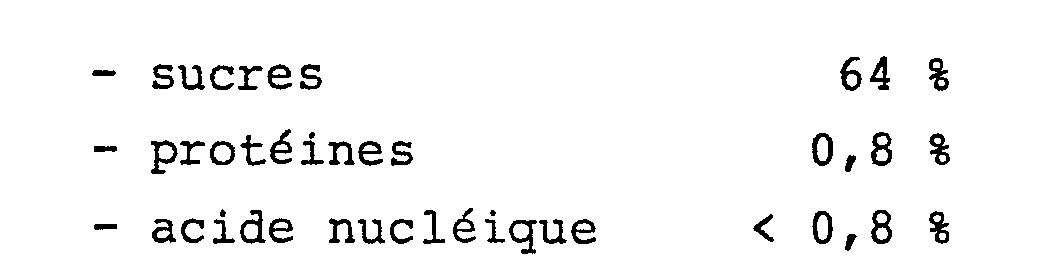
- the precipitate is collected by centrifugation at 12,000 rpm for 30 min. This precipitate is dissolved in pyrogen-free distilled water. The solution is distributed in bottles in a volume of 4 ml. It is lyophilized under vacuum. 9 g of product are obtained. It is the purified polysaccharide which contains:
- Type 23 pneumococcal polysaccharide
- Example 1 The culture and the separation of the supernatant are carried out under the conditions defined in Example 1 (stages a to d)
- a volume of supernatant equal to 15 liters is concentrated to a volume of 1.5 liters under the conditions defined in Example 1-e.
- the lyophilized intermediate product is taken up with 200 ml of 0.01 M phosphate buffer - pH 7. 1 mg of RNase, 1 mg of DNase and 20 units of RNase T1 / ml are added. Incubate for 3 h at 37 ° C. Pronase type 8 (180 gg / ml), 1 ⁇ l / ml of phenol and a drop of toluene are added. Incubate overnight at 37 ° C.
- the final aqueous phase is dialyzed for approximately 60 hours against 4 l of sterile and pyrogen-free distilled water.
- the dialysate is diafiltered on an Amicon 1 0 5 membrane. Concentrate to 50 ml. 3 volumes of absolute ethanol and sodium acetate are added (final concentration 5%). It is left overnight at -20 ° C.
- the precipitate is collected by centrifugation. This precipitate is dissolved in sterile, pyrogen-free distilled water and then lyophilized.
- Type 19 pneumococcal polysaccharide
- Example 1 The culture and the separation of the supernatant are carried out under the conditions defined in Example 1 (stages a to d).
- Example 1-e By operating as in Example 1-e, a volume of supernatant of 75 liters is concentrated by three diafiltration to 2 liters. 2.3 g are obtained, having the following composition:
- the lyophilized intermediate product is dissolved with 150 ml of 0.01 M phosphate buffer - pH 7. 3 mg of Dnase, 3 mg of RNase and 30 ⁇ l of RNase T1 are added. Incubate for 4 h at 37 ° C. 62 mg are then added Pronase, 150 ⁇ l phenol and a drop of toluene. It is left to act overnight at 37 ° C.
- the aqueous phase is dialyzed for 60 hours against 4 liters of sterile and pyrogen-free distilled water. A diafiltration of the dialysate is carried out on an Amicon XM 100 membrane.
- the retentate is precipitated with 3 volumes of ethanol containing 5% sodium acetate.
- Type 1 pneumococcal polysaccharide
- the pellet is taken up in 250 ml of pyrogen-free EDS. Lyophilized in vacuum flasks. 3.7 g of purified polysaccharide are obtained containing:
- the diffusion coefficient in the K D gel of the polysaccharide is 0.05.
- the molecular mass is therefore at least 2 x 10 7 .
- Example 1 The culture and the separation of the supernatant are carried out under the conditions defined in Example 1 (stage a to d), but using the following synthetic culture medium as culture medium:
- the K D of the polysaccharide obtained is 0.1.
- the molecular mass is therefore greater than 10.
- Example 1 The culture and the separation of the supernatant are carried out under the conditions defined in Example 1 (stage a to d) but using the following semi-synthetic culture medium as culture medium:
- the K D is around 0.1, which corresponds to a molecular mass of approximately 10 7 .
- the purified immunogenic capsular polysaccharides obtained according to the present invention can be used for the preparation of vaccines intended to be administered as a preventive (or curative) to humans and animals.
- the vaccines can be prepared by incorporating the purified capsular polysaccharides obtained according to the present invention into a physiologically acceptable liquid vehicle, such as a physiological solution or water for injection.
- polyvalent vaccines can be prepared by incorporating two or more purified capsular polysaccharides obtained from different germs.
- the titration of hemagglutinating antibodies was carried out according to the techniques described in the literature, using the sheep red blood cell sensitized by the polysaccharide using chromium chloride.
- Table I show an increase in the serum titer of hemagglutinating antibodies in animals treated at low doses compared to the control animals and a classic immune paralysis for high doses.
- the batches of 10 animals received an I.P. injection of 2 and 20 gg of Streptococcus pneumoniae polysaccharide, type 3, per animal.
- the titration of hemagglutinating antibodies was carried out on the 4, 6 and 14 days after administration.
- the titer rises gradually to reach its maximum rate on the 6th day.
- mice were immunized with the KP 2 polysaccharide by the subcutaneous route (2 injections one week apart- doses injected: 53 - 533 - 5332gg / kg.
- polysaccharides obtained according to the present invention can be used in particular for the preparation of the following vaccines:
- Pneumococcal vaccine containing purified polysaccharides of the following types of Streptococcus pneumoniae: , 3, 4, 6A, 7F, 8, 9N, 12F, 14, 18L, 19F, 23, 2, 11A, 15F.
- mixture at 50 ⁇ g, in a volume of 0.5 ml of physiological water mixture at 25 ⁇ g in a volume of 0.5 ml of physiological water.
Landscapes
- Health & Medical Sciences (AREA)
- Life Sciences & Earth Sciences (AREA)
- Chemical & Material Sciences (AREA)
- Microbiology (AREA)
- General Health & Medical Sciences (AREA)
- Epidemiology (AREA)
- Mycology (AREA)
- Pharmacology & Pharmacy (AREA)
- Organic Chemistry (AREA)
- Animal Behavior & Ethology (AREA)
- Medicinal Chemistry (AREA)
- Public Health (AREA)
- Veterinary Medicine (AREA)
- Immunology (AREA)
- Engineering & Computer Science (AREA)
- Zoology (AREA)
- Wood Science & Technology (AREA)
- General Chemical & Material Sciences (AREA)
- Chemical Kinetics & Catalysis (AREA)
- Biotechnology (AREA)
- Biochemistry (AREA)
- Bioinformatics & Cheminformatics (AREA)
- General Engineering & Computer Science (AREA)
- Genetics & Genomics (AREA)
- Medicines Containing Antibodies Or Antigens For Use As Internal Diagnostic Agents (AREA)
- Preparation Of Compounds By Using Micro-Organisms (AREA)
- Micro-Organisms Or Cultivation Processes Thereof (AREA)
- Medicinal Preparation (AREA)
- Peptides Or Proteins (AREA)
- Polyesters Or Polycarbonates (AREA)
- Compounds Of Unknown Constitution (AREA)
- Medicines Containing Material From Animals Or Micro-Organisms (AREA)
Abstract
Description
- La présente invention concerne un procédé d'obtention-de polyosides capsulaires, les polyosides obtenus par ce procédé et l'application de ces polyosides à la préparation de vaccins.
- On sait que la lutte contre les maladies infectieuses peut être exercée à deux niveaux : soit par une action directe à l'égard du germe pathogène (antibiotiques, antiseptiques), soit par une action indirecte par le renforcement de défenses de l'organisme (vaccination, sérothérapie, immunomodulation).
- L'utilisation des agents susceptibles d'agir directement se heurte souvent à certaines difficultés pouvant limiter son action (notamment toxicité de la molécule et résistance bactérienne).
- Par contre, le renforcement des défenses de l'organisme par l'acquisition des anticorps spécifiques présente des avantages certains, notamment du point de vue de la durée de la protection et de la spécificité. Mais, la vaccination à l'aide de corps microbiens entiers n'est pas toujours sans inconvénients : phénomènes d'hypersensibilisation, mauvaise tolérance ou pyrogéni- cité sont parmi les plus fréquents. Ils sont liés à la présence de multiples antigènes de la bactérie.
- C'est donc tout naturellement vers l'isolement de l'antigène responsable des anticorps protecteurs que les efforts des chercheurs se sont cristallisés.
- Dans le cas des bactéries capsulées, les polyosides capsulaires se révèlent immunogènes chez l'homme, avec peu de réactions secondaires.
- Une première application chez l'homme de ces polyosides capsulaires est l'apparition du vaccin antiménin- gococcique A et C et, tout récemment, du vaccin polyvalent contenant les polyosides purifiés de quatorze types sérologiques de pneumocoque.
- Plusieurs autres bactéries capsulées sont impliquées dans divers processus pathologiques, par exemple :
- - Hemophilus influenzae, type b,
- - Klebsiella pneumoniae,
- - Escherichia coli, ou
- - Streptocoques, groupe B,
- Dans la demande de brevet européen 0 002 404, on a décrit un procédé d'obtention de polyosides capsulaires à partir de Streptococcus pneumoniae.
- Selon ce procédé, on cultive le microorganisme à l'aide de milieux de culture complexes. Puis, après inactivation au phénol, sans séparer les microorganismes du milieu de culture, on effectue une première addition d'alcool tel que l'éthanol, on sépare les impuretés précipitées, on effectue une deuxième addition d'alcool afin de précipiter alors le polyoside. Le polyoside remis en suspension est ensuite débarrassé des substances conta- minantes (protéines, acides nucléiques) par un traitement enzymatique ou par un traitement par un surfactif cationique (bromure de citrimonium), qui peuvent être complétés par une diafiltration.
- Ce procédé n'a pas, en fait, de caractère général, car les conditions spécifiques de chaque stade varient avec le polyoside à séparer. Ainsi, il est nécessaire de faire des pré-tests afin de déterminer les conditions des diverses précipitations. De plus, en raison de l'utilisation de certains milieux, ce procédé est susceptible d'entraîner une dégradation des chaînes polyosi- diques.
- La présente invention vise à fournir un procédé plus général, plus simple et moins dégradant permettant d'obtenir des polyosides de masse moléculaire très élevée.
- La présente invention a pour objet un procédé d'obtention de polyosides capsulaires immunogènes à partir de bactéries capsulaires les contenant, caractérisé en ce que l'on effectue une culture des bactéries en milieu synthétique ou semi-synthétique, à la fin de la phase de croissance de cette culture on sépare les corps microbiens d'une phase surnageante, on soumet cette phase surnageante à une filtration sur une membrane retenant les molécules d'une masse moléculaire égale ou supérieure à 100.000 daltons, obtenant ainsi un rétentat riche en polyosides capsulaires,et l'on élimine les protéines, les acides nucléiques et les lipides de ce rétentat obtenant ainsi un polyoside capsulaire purifié.
- Ainsi, selon une caractéristique essentielle de la présente invention, on effectue la culture des bactéries en milieu synthétique ou semi-synthétique. Par milieu synthétique, on désigne des solutions aqueuses de composés chimiques connus, de faible masse moléculaire qui sont présents en proportions déterminées.
- Par milieu semi-synthétique, on désigne un milieu analogue au précédent, mais qui contient, en outre, une faible proportion (généralement moins de 0,5 % en poids) de produits d'origine naturelle, tels que des hydrolysats de protéine.
- En outre, selon la présente invention, l'extraction des polyosides est effectuée sur le surnageant de la culture débarrassée des corps microbiens et non pas sur l'ensemble du milieu de culture.
- La filtration sur une membrane dont la porosité est capable de retenir les molécules d'une masse moléculaire égale ou supérieure à 100.000 daltons permet d'obtenir rapidement un rétentat renfermant principalement les polyosides, ainsi que, en faibles proportions, des protéines, des acides nucléiques et des lipides.
- L'élimination des contaminants est avantageusement effectuée de la façon suivante : ou soumet le reten- tat à une hydrolyse enzymatique, notamment à l'aide d'un mélange de Pronase, RNase et DNase, on ajoute un mélange butanol-chloroforme (de préférence un mélange 1:1 en volume), on sépare la phase aqueuse, on soumet la phase aqueuse à une dialyse et on effectue une filtration sur une membrane retenant les molécules ayant une masse moléculaire égale ou supérieure à 100.000 daltons.
- Le polyoside purifié peut être séparé, de manière connue, du rétentat par précipitation à l'aide d'un alcool tel que l'éthanol.
- Les exemples suivants illustrent la présente demande :
- Polyoside pneumococcique du type 3.
- On part d'une souche lyophilisée de Streptococcus pneumoniae de type 3.
- On introduit la souche lyophilisée dans du bouillon T.
- On effectue la culture pendant 16 heures à 37°C.
- On mélange 5 ml de la culture obtenue avec 15 ml de lait écrémé stérilisé. On distribue dans des ampoules à raison de 0,5 ml/ampoule et on lyophilise. Les lyophilisats sont conservés à +4°C.
- On introduit un lot d'ensemencement (lyophi- lisat en ampoule) dans un ballon contenant 200 ml du milieu semi-synthétiaue indiqué ci-après et on effectue la culture à 37°C pendant 6 heures.
- Milieu de culture :


- La culture proprement dite est effectuée dans un fermenteur contenant 18 1 du milieu de culture défini sous b. On ensemence à raison de 1 % avec la préculture.
- La culture est effectuée à 37°C, à pH 7,4, sous agitation pendant généralement environ 16 h, jusqu'à la fin de la phase exponentielle de croissance.
- A la fin de la phase exponentielle, on sépare immédiatement le surnageant par centrifugation en continu à 5000 t/mn. Le surnageant est soumis à une filtration stérilisante sur membrane Millipore 0,22g et utilisé immédiatement ou bien il est conservé à -25°C.
- Un volume de surnageant égal à environ 20 litres est concentré à un volume de 2 litres par filtration sur membrane Millipore 105, permettant de retenir les molécules d'une masse moléculaireégale ou supérieure à 100.000 daltons.
- Le rétentat ainsi obtenu est diafiltré sur membrane Diaflo 105 après addition de 5 litres d'eau distillée stérile et apyrogène pour compléter la séparation selon la masse moléculaire.
- Plusieurs diafiltrations successives permettent de concentrer à environ 350 ml qui sont lyophilisés dans des ballons de 1 litre.
- Toutes ces opérations sont effectuées à une température au plus égale à 8°C.
- Le produit intermédiaire lyophilisé est dissous dans 900 ml de tampon phosphate 0,01 M - pH 7.
- On ajoute ensuite 20 mg de RNase type 1, 20 mg de DNase pancréatique et 180 µl (20 unités/ml) de Rnase T1. On effectue une incubation de 4 h à 37°C. On ajoute alors 170 mg de Pronase type 8, 900 gl de phénol pur et 2 gouttes de toluène.
- On incube le mélange pendant une nuit à 37°C. On arrête la réaction et on ajoute un volume égal (900 ml) d'un mélange butanol-chloroforme 1:1. On agite pendant 1 h. On décante les deux phases par centrifugation à 10.000 t/mn pendant 30 mn.
- La phase aqueuse qui contient le polyoside est dialysée contre 20 litres d'eau distillée stérile et apyrogène pendant environ 60 h.
- On diafiltre le dialysat sur membrane Amicon 105. Le volume du rétentat est de 1140 ml. On ajoute 160 ml d'acétate de sodium 40 % (concentration finale 5 %) et 3,9 litres d'éthanol absolu (3 volumes).
- On recueille le précipité par centrifugation à 12.000 t/mn pendant 30 mn. On dissout ce précipité dans de l'eau distillée apyrogène. On répartit la solution en flacons sous un volume de 4 ml. On lyophilise sous vide. On obtient 9 g de produit. C'est le polysaccharide purifié qui contient:
-
- Toutes les opérations (en dehors des incubations) sont effectuées entre 0 et + 4°C.
- Polyoside pneumococcique du type 23.
- On part d'une souche lyophilisée de Streptococcus pneumoniae du type 23.
- On effectue la culture et la séparation du surnageant dans les conditions définies à l'exemple 1 (stades a à d)
- L'extraction et la purification du polyoside sont effectuées de la façon suivante :
- Un volume de surnageant égal à 15 litres est concentré à un volume de 1,5 litre dans les conditions définies à l'exemple 1-e.
- Trois diafiltrations successives permettent de concentrer, puis de lyophiliser. On obtient 1,8 g de produit ayant la composition suivante :

- On reprend le produit intermédiaire lyophilisé avec 200 ml de tampon phosphate 0,01 M - pH 7. On ajoute 1 mg de RNase, 1 mg de DNase et 20 unités de RNase Tl/ml. On incube pendant 3 h à 37°C. On ajoute de la Pronase type 8 (180 gg/ml), 1 µl/ml de phénol et une goutte de toluène. On incube pendant une nuit à 37°C.
- On effectue trois extractions successives avec un mélange à volume égal (200 ml) de butanol-chloroforme 1:1. Le mélange est agité mécaniquement.
- La phase aqueuse finale est dialysée pendant environ 60 heures contre 4 1 d'eau distillée stérile et apyrogène.
- Le dialysat est diafiltré sur membrane Amicon 105. On concentre à 50 ml. On ajoute 3 volumes d'éthanol absolu et de l'acétate de sodium (concentration finale 5 %). On laisse pendant une nuit à -20°C.
- On recueille le précipité par centrifugation. Ce précipité est dissous dans de l'eau distillée stérile et apyrogène puis lyophilisé.
- On obtient 1050 g d'un produit qui contient :

- Toutes les opérations (sauf indication contraire) sont effectuées entre 0° et +6°C.
- Polyoside pneumococcique du type 19.
- On part d'une souche lyophilisée de Streptococcus pneumoniae du type 19.
- On effectue la culture et la séparation du surnageant dans les conditions définies à l'exemple 1 (stades a à d).
- L'extraction et la purification du polyoside sont effectuées de la façon suivante :
- En opérant comme à l'exemple 1-e, on concentre un volume de surnageant de 75 litres par trois diafiltration à 2 litres. On obtient 2,3 g ayant la composition suivante:

- Le produit intermédiaire lyophilisé est dissous avec 150 ml de tampon phosphate 0,01 M - pH 7. On ajoute 3 mg de Dnase, 3 mg de RNase et 30 µl de RNase T1. On incube pendant 4 h à 37°C. On ajoute ensuite 62 mg de Pronase, 150 µ1 de phénol et une goutte de toluène. On laisse agir pendant une nuit à 37°C.
- On déprotéinise par le mélange chloroforme-butanol 1:1, à volume égal (3 extractions successives).
- La phase aqueuse est dialysée pendant 60 heures contre 4 litres d'eau distillée stérile et apyrogène. On effectue une diafiltration du dialysat sur membrane Amicon XM 100.
- On précipite le rétentat par 3 volumes d'éthanol contenant de l'acétate de sodium à 5 %.
- Après une nuit au congélateur, le précipité est dissous dans l'eau stérile et apyrogène et lyophilisé. On obtient 730 mg de produit qui contient :

- Là encore, toutes les opérations (en dehors des incubations) sont effectuées entre 0 et +4°C.
- On part d'une souche lyophilisée de Streptococcus pneumoniae du type 1. On effectue la culture et la séparation du surnageant dans les conditions définies à l'exemple 1.
- L'extraction et la purification du polyoside sont effectuées de la façon suivante :
- 100 litres de surnageant de culture sontdia- filtrés sur cassettes Pellicon (Millipore, membrane 105). Le volume du rétentat final est de 3 litres. On lyophilise en ballons. On obtient 6,1 g de produit contenant :
-

- On dissout le produit obtenu dans 800 ml d'EDS (eau distillée stérile) apyrogène. On ajoute :
- - 16 mg de RNase
- - 16 mg de DNase
- - 160 µl de RNase T1.
- On incube pendant 4 heures à 37°C. On ajoute alors 300 µl de phénol, 2 gouttes de toluène et 150 mg de Pronase type 8. On incube pendant une nuit à 37°C. On extrait encore les protéines à l'aide d'un mélange à volume égal de chloroforme-butanol (1:1). On dialyse la phase aqueuse pendant 60 heures. On diafiltre sur membrane Amicon XM 100. Le volume de térentat final est de 150 ml. On précipite la solution par 3 volumes d'éthanol froid contenant de l'acétate de sodium 5 %.
- Le culot est repris par 250 ml d'EDS apyrogène. On lyophilise en flacons sous vide. On obtient 3,7 g de polyoside purifié contenant :
-

- Le coefficient de diffusion dans le gel KD du polyoside est de 0,05. La masse moléculaire est donc d'au moins 2 x 10⁷.
- On part d'une souche de Klebsiella pneumoniae du type 2.
- On effectue la culture et la séparation du surnageant dans les conditions définies à l'exemple 1 (stade a à d), mais en utilisant comme milieu de culture le milieu de culture synthétique suivant :

- L'extraction et la purification du polyoside sont effectuées de la façon suivante :
- On utilise 90 litres de surnageant de culture. On diafiltre sur cassette Pellicon (2 cassettes, membrane 105). On effectue 3 lavages par 10 litres d'eau après avoir concentré à 1,5 litre. Le rétentat final est de 2,6 litres. On lyophilise en ballons, on obtient 6,1 g de produit qui contient :

- Le produit obtenu est dissous dans 350 ml d'eau. On ajoute :
- - 7 ml de tampon phosphate 0,5 M, pH 7,0
- - 7 mg de RNase
- - 7 mg de DNase
- - 70 µl de Rnase T1
- (filtration préalable des enzymes sur 0,22µ).
- On incube 4 heures à 37°C. On ajoute ensuite 70 mg de protéase type 8, 350 µl de phénol et 1 goutte de toluène. On incube pendant la nuit à 37°C. On arrête la réaction et on achève la déprotéinisation par 3 extractions au butanol-chloroforme (1:1). On dialyse la phase aqueuse pendant 60 heures contre de l'EDS apyrogène. On diafiltre sur membrane Amicon XM 100. Le volume de rétentat final est de 150 ml. On précipite la solution par 3 volumes d'éthanol absolu froid contenant de l'acétate de sodium 5 %. Le précipité, recueilli par centrifugation est dissous dans 250 ml d'eau, puis lyophilisé en flacons sous vide. On obtient un polyoside pur, contenant :

- Le KD du polyoside obtenu est 0,1. La masse moléculaire est donc supérieure à 10 .
- On part d'une souche lyophilisée d'Hemophilus influenzae du type b.
- On effectue la culture et la séparation du surnageant dans les conditions définies à l'exemple 1 (stade a à d) mais en utilisant comme milieu de culture le milieu de culture semi-synthétique suivant :

- L'extraction et la purification du polyoside sont effectuées de la façon suivante :
- On utilise 30 litres de surnageant de culture. On effectue une diafiltration sur membrane Millipore 100.000 (2 cassettes). La première concentration conduit à un volume de 1 litre. On lave par 3 fois 10 litres d'EDS. On concentre à 1,3 litre. On lyophilise en ballons. On obtient 3,9 g d'un produit qui contient :

- Le produit obtenu est dissous dans 200 ml. On ajoute (après filtration sur 0,22 µ):
- 4,5 ml de tampon phosphate 0,5 M, pH 7,0
- 4 mg RNase
- 4 mg DNase
- 40 µl RNase T
- On effectue une incubation pendant 4 heures à 37°C. Ensuite on ajoute 65 mg de protéase type 8, 200 µl de phénol et 2 gouttes de toluène. On incube pendant une nuit à 37°C. On arrête la réaction par 3 extractions au butanol-chloroforme (1:1). On recueille la phase aqueuse par centrifugation à 12.000 t/mn à +4°C pendant 30 minutes. On dialyse pendant 60 heures contre de l'EDS apyrogène (changements de milieu de dialyse fréquents).
- On concentre sur membrane Amicon XM 100. (2 lavages x 100 ml). Le volume du diafiltrat est de 100 ml. On précipite le diafiltrat par 3 volumes d'éthanol absolu froid contenant de l'acétate de sodium à 5 %. Le précipité, recueilli par centrifugation est repris dans 100 ml d'EDS apyrogène. La solution est lyophilisée en flacons sous vide.
- On obtient 1,3 g de polyoside pur contenant :

- Le KD avoisine 0,1, ce qui correspond à une masse moléculaire d'environ 107.
- Les polyosides capsulaires immunogènes purifiés obtenus selon la présente invention peuvent être utilisés pour la préparation de vaccins destinés à être administrés à titre préventif (ou curatif) à l'homme et aux animaux. Les vaccins peuvent être préparés par incorporation des polyosides capsulaires purifiés obtenus selon la présente invention dans un véhicule liquide physiologiquement acceptable, tel qu'une solution physiologique ou de l'eau pour injection.
- On peut incorporer à cet effet un ou, de préférence, plusieurs polyosides capsulaires purifiés obtenus selon la présente invention et à partir de différents types sérologiques. En outre, des vaccins polyvalents peuvent êtrepréparés par incorporation de deux ou plusieurs polyosides capsulaires purifiés obtenus à partir de différents germes.
- On donnera ci-après des résultats des essais mettant en évidence l'activité immunogène des polyosides obtenus selon la présente invention.
- a - Des souris mâles Swiss de 20 g ont été groupées par lots de 10 animaux :
- 1 lot témoin n'a reçu aucun traitement.
- 1 lot a été traité par voie I.P. à raison de plusieurs doses de polyoside de l'exemple 1 par animal.
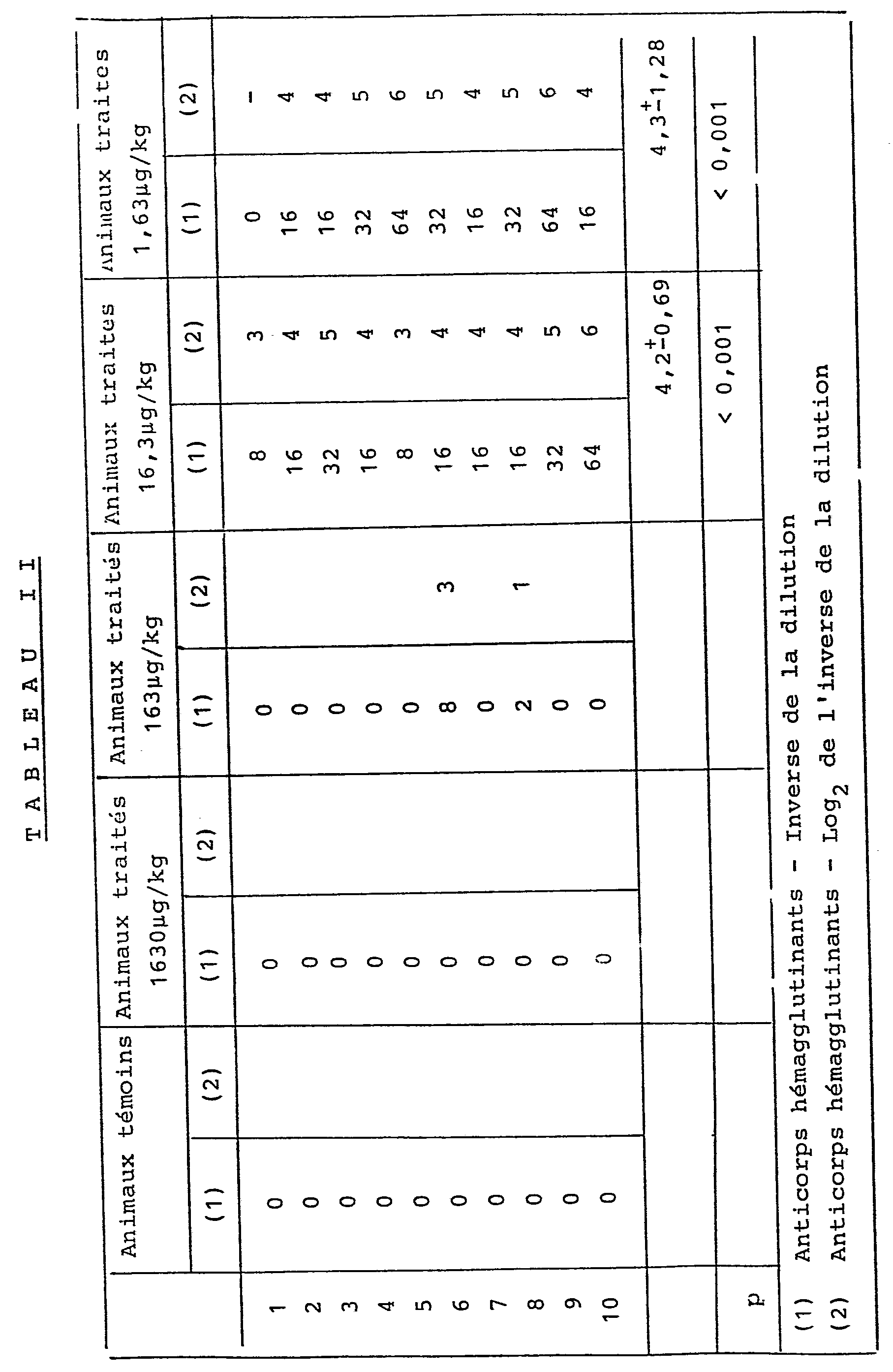
- Le titrage des anticorps hémagglutinants a été effectué selon les techniques décrites dans la littérature, utilisant le globule rouge de mouton sensibilisé par le polyoside à l'aide du chlorure de chrome.
- Les résultats figurant dans le Tableau I mettent en évidence une augmentation du titre sérique des anticorps hémagglutinants chez les animaux traités aux faibles doses par rapport aux animaux témoins et une paralysie immunitaire classique pour les fortes doses.
- β - Des essais analogues ont été effectués chez la souris avec le polyoside de l'exemple 5 (polyoside de Klebsiella pneumoniae, type 2).
- Les résultats sont donnés dans le Tableau II.
-

- La même étude a été réalisée chez le rat Sprague Dawley de 400-450 g mâle.
- Les lots de 10 animaux ont reçu une injection I.P. de 2 et 20 gg de polyoside de Streptococcus pneumoniae, type 3, par animal.
- Le titrage des anticorps hémagglutinants a été effectué les 4, 6 et 14ème jours après l'adminsitration.
- Les résultats sont donnés dans le Tableau III.
- En accord avec la littérature, le titre s'élève progressivement pour atteindre son taux maximal le 6ème jour.

- a - Des lots de 10 souris mâles, d'origine Swiss, ont été immunisés avec le polyoside de Streptococcus pneumoniae de type 1, obtenu selon l'exemple 4, par voie sous-cutanée (deux injections à une semaine d'intervalle); doses injectées : 0,47 - 4,7 - 47 et 470 µg/kg.
- Le 10ème jour après la 2ème immunisation, les animaux ont été infectés avec le pneumocoque virulent du type 1, par voie sous-cutanée (1250 germes/animal).
- La mortalité après dix jours d'observation a été la suivante :

- β - Des lots de 10 souris mâles, d'origine Swiss, ont été immunisés avec le polyoside de KP2 par voie sous-cutanée (2 injections à une semaine d'intervalle- doses injectées: 53 - 533 - 5332gg/kg.
- Le 8ème jour après le dernier traitement, les animaux ont été injectés avec la souche de Klebsiella pneumoniae type 2 à raison de 650 germes par animal. La mortalité après 10 jours d'observation a été la suivante :

- Les polyosides obtenus selon la présente invention peuvent être utilisés notamment pour la préparation des vaccins suivants :
- a) vaccins destinés au traitement préventif et curatif des affections respiratoires aiguës et chroniques contenant un des polyosides purifiés correspondant à chacun des germes suivants :
- Streptococcus pneumoniea
- Hemophilus influenzae, type b
- Klebsiella pneumoniae
- Escherichia coli
- A titre d'exemple

- b) Vaccin antipneumococcique contenant les polyosides purifiés des types suivants de Streptococcus pneumoniae:
, 3, 4, 6A, 7F, 8, 9N, 12F, 14, 18L, 19F, 23, 2, 11A, 15F. - A titre d'exemples :
mélange à 50µg, dans un volume de 0,5 ml d'eau physiologique,
mélange à 25µg dans un volume de 0,5 ml d'eau physiologique.
et des vaccins correspondants peuvent être préparés à partir de leurs polyosides capsulaires.
Claims (10)
Priority Applications (1)
| Application Number | Priority Date | Filing Date | Title |
|---|---|---|---|
| AT82401343T ATE16244T1 (de) | 1981-07-30 | 1982-07-19 | Verfahren zur herstellung von kapselpolyosiden, so erhaltene kapselpolyosiden und ihre verwendung fuer die herstellung von vakzinen. |
Applications Claiming Priority (2)
| Application Number | Priority Date | Filing Date | Title |
|---|---|---|---|
| FR8114842A FR2510606A1 (fr) | 1981-07-30 | 1981-07-30 | Procede d'obtention de polyosides capsulaires, polyosides capsulaires ainsi obtenus et leur application a la preparation de vaccins |
| FR8114842 | 1981-07-30 |
Publications (2)
| Publication Number | Publication Date |
|---|---|
| EP0071515A1 true EP0071515A1 (fr) | 1983-02-09 |
| EP0071515B1 EP0071515B1 (fr) | 1985-10-30 |
Family
ID=9261011
Family Applications (1)
| Application Number | Title | Priority Date | Filing Date |
|---|---|---|---|
| EP82401343A Expired EP0071515B1 (fr) | 1981-07-30 | 1982-07-19 | Procédé d'obtention de polyosides capsulaires, polyosides capsulaires ainsi obtenus et leur application à la préparation de vaccins |
Country Status (11)
| Country | Link |
|---|---|
| EP (1) | EP0071515B1 (fr) |
| AT (1) | ATE16244T1 (fr) |
| CA (1) | CA1206905A (fr) |
| DD (1) | DD202623A5 (fr) |
| DE (1) | DE3267160D1 (fr) |
| DK (1) | DK327182A (fr) |
| ES (1) | ES8305827A1 (fr) |
| FR (1) | FR2510606A1 (fr) |
| IE (1) | IE53582B1 (fr) |
| NO (1) | NO159394C (fr) |
| PT (1) | PT75301B (fr) |
Cited By (9)
| Publication number | Priority date | Publication date | Assignee | Title |
|---|---|---|---|---|
| EP0238739A1 (fr) * | 1986-03-27 | 1987-09-30 | Swiss Serum and Vaccine Institute Berne | Vaccin de polysaccharide capsulaire de Klebsiella |
| US6426074B1 (en) * | 1997-03-19 | 2002-07-30 | The Brigham And Women's Hospital Inc. | Group B Streptococcus vaccine |
| EP1268844A4 (fr) * | 2000-03-16 | 2006-03-29 | Philadelphia Children Hospital | Modulation de la production de polysaccharides capsulaires de pneumocoques |
| WO2007052168A3 (fr) * | 2005-11-01 | 2007-11-29 | Novartis Vaccines & Diagnostic | Procedes de culture semi-continue de streptocoques |
| WO2008129559A2 (fr) | 2007-04-23 | 2008-10-30 | Serum Institute Of India Ltd | Polysaccharides antigéniques et procédé pour leur préparation |
| WO2011151841A1 (fr) * | 2010-05-31 | 2011-12-08 | Panacea Biotec Limited | Procédé de fermentation pour streptococcus pneumoniae |
| WO2018126229A2 (fr) | 2016-12-30 | 2018-07-05 | Sutrovax, Inc. | Conjugués polypeptide-antigène avec des acides aminés non naturels |
| WO2020010016A1 (fr) | 2018-07-04 | 2020-01-09 | Sutrovax, Inc. | Conjugués immunogènes auto-adjuvés |
| US11951165B2 (en) | 2016-12-30 | 2024-04-09 | Vaxcyte, Inc. | Conjugated vaccine carrier proteins |
Families Citing this family (3)
| Publication number | Priority date | Publication date | Assignee | Title |
|---|---|---|---|---|
| NZ511680A (en) | 2001-05-14 | 2004-07-30 | Univ Waikato | Method for preparing nucleic acid or DNA samples and a DNA extraction process using thermophilic proteases |
| WO2011148382A1 (fr) | 2010-05-28 | 2011-12-01 | Biological E Limited | Procédé amélioré de purification de polysaccharides capsulaires de haemophilus influenza - b, neisseria meningitides tels que les sérotypes a, c, y et w-135, et d'autres polysaccharides capsulaires apparentés produits à partir de microorganismes à la fois à gram négatif et à gram positif en utilisant un phosphate d'aluminium avec un alcool. |
| CA3267399A1 (fr) | 2022-09-19 | 2024-03-28 | Biological E Limited | Procédé de purification de polysaccharides capsulaires |
Citations (8)
| Publication number | Priority date | Publication date | Assignee | Title |
|---|---|---|---|---|
| US2166963A (en) * | 1936-11-19 | 1939-07-25 | Sharp & Dohme Inc | Antigenic polysaccharide complex |
| US2528972A (en) * | 1947-05-15 | 1950-11-07 | Western Reserve University | Prophylactic toxoid compound and method of making same |
| EP0001945A1 (fr) * | 1977-10-27 | 1979-05-16 | Roussel-Uclaf | Nouveaux polysaccharides extraits de corps microbiens d'Haemophilus Influenzae, leur procédé de préparation et les compositions pharmaceutiques les renfermant |
| EP0002404A1 (fr) * | 1977-11-28 | 1979-06-13 | Merck & Co. Inc. | Vaccin pneumococcique et son procédé de préparation |
| EP0017322A1 (fr) * | 1979-03-19 | 1980-10-15 | American Cyanamid Company | Stabilisation de polysaccharides capsulaires |
| US4264764A (en) * | 1979-01-12 | 1981-04-28 | Merck & Co., Inc. | Meningitis vaccine |
| EP0030166A1 (fr) * | 1979-09-24 | 1981-06-10 | Merck & Co. Inc. | Composition de vaccin pour la prévention des caries dentaires |
| US4307080A (en) * | 1979-09-24 | 1981-12-22 | Merck & Co., Inc. | Meningitis vaccine |
-
1981
- 1981-07-30 FR FR8114842A patent/FR2510606A1/fr active Granted
-
1982
- 1982-07-15 IE IE1705/82A patent/IE53582B1/en unknown
- 1982-07-19 AT AT82401343T patent/ATE16244T1/de not_active IP Right Cessation
- 1982-07-19 DE DE8282401343T patent/DE3267160D1/de not_active Expired
- 1982-07-19 EP EP82401343A patent/EP0071515B1/fr not_active Expired
- 1982-07-21 DK DK327182A patent/DK327182A/da not_active Application Discontinuation
- 1982-07-23 PT PT75301A patent/PT75301B/fr not_active IP Right Cessation
- 1982-07-28 CA CA000408233A patent/CA1206905A/fr not_active Expired
- 1982-07-28 NO NO822592A patent/NO159394C/no unknown
- 1982-07-29 ES ES514496A patent/ES8305827A1/es not_active Expired
- 1982-07-29 DD DD82242065A patent/DD202623A5/de unknown
Patent Citations (8)
| Publication number | Priority date | Publication date | Assignee | Title |
|---|---|---|---|---|
| US2166963A (en) * | 1936-11-19 | 1939-07-25 | Sharp & Dohme Inc | Antigenic polysaccharide complex |
| US2528972A (en) * | 1947-05-15 | 1950-11-07 | Western Reserve University | Prophylactic toxoid compound and method of making same |
| EP0001945A1 (fr) * | 1977-10-27 | 1979-05-16 | Roussel-Uclaf | Nouveaux polysaccharides extraits de corps microbiens d'Haemophilus Influenzae, leur procédé de préparation et les compositions pharmaceutiques les renfermant |
| EP0002404A1 (fr) * | 1977-11-28 | 1979-06-13 | Merck & Co. Inc. | Vaccin pneumococcique et son procédé de préparation |
| US4264764A (en) * | 1979-01-12 | 1981-04-28 | Merck & Co., Inc. | Meningitis vaccine |
| EP0017322A1 (fr) * | 1979-03-19 | 1980-10-15 | American Cyanamid Company | Stabilisation de polysaccharides capsulaires |
| EP0030166A1 (fr) * | 1979-09-24 | 1981-06-10 | Merck & Co. Inc. | Composition de vaccin pour la prévention des caries dentaires |
| US4307080A (en) * | 1979-09-24 | 1981-12-22 | Merck & Co., Inc. | Meningitis vaccine |
Non-Patent Citations (6)
| Title |
|---|
| BIOCHEMISTRY, vol. 3, no. 10, 25 octobre 1964, pages 1548-1550, New York (USA); M.HEIDELBERGER et al.: "The specific polysaccharide of type XVIIIA Pneumococcus". * |
| MICROBIOLOGY ABSTRACTS, vol. 7, no. 6, juin 1972, section B, no. 5070, page 165, Boston, Mass. (USA); P.ANDERSON et al.: "Immunization of humans with polyribophosphate, the capsular entigen of Hemophilus influenzae, type b". * |
| THE JOURNAL OF IMMUNOLOGY, vol. 110, no. 1, janvier 1973, pages 262-268, New York (USA); D.L.KASPER et al.: "Immunochemical similarity between polysaccharide antigens of Escherichia coli 07: K1 (L): NM and group B Neisseria meningitidis". * |
| THE JOURNAL OF IMMUNOLOGY, vol. 112, no. 2, février 1974, pages 649-55, (USA);M.ARGAMAN et al.: "Polyribitol-phosphate: an antigen of four gram-positive bacteria cross-reactive with the capsular polysaccharide of Haemophilus influenzae type b". * |
| UNLISTED DRUGS, vol. 15, no. 11, novembre 1963, page 84, New York (USA); Référence n: colanic acid. * |
| UNLISTED DRUGS, vol. 28, no. 12, décembre 1976, page 205, New York (USA); Référence d: SSS 8. * |
Cited By (12)
| Publication number | Priority date | Publication date | Assignee | Title |
|---|---|---|---|---|
| EP0238739A1 (fr) * | 1986-03-27 | 1987-09-30 | Swiss Serum and Vaccine Institute Berne | Vaccin de polysaccharide capsulaire de Klebsiella |
| US6426074B1 (en) * | 1997-03-19 | 2002-07-30 | The Brigham And Women's Hospital Inc. | Group B Streptococcus vaccine |
| EP1268844A4 (fr) * | 2000-03-16 | 2006-03-29 | Philadelphia Children Hospital | Modulation de la production de polysaccharides capsulaires de pneumocoques |
| KR100942738B1 (ko) * | 2000-03-16 | 2010-02-17 | 더 칠드런스 호스피탈 오브 필라델피아 | 폐렴구균의 캡슐 다당류 생산의 조절 방법 |
| WO2007052168A3 (fr) * | 2005-11-01 | 2007-11-29 | Novartis Vaccines & Diagnostic | Procedes de culture semi-continue de streptocoques |
| WO2008129559A2 (fr) | 2007-04-23 | 2008-10-30 | Serum Institute Of India Ltd | Polysaccharides antigéniques et procédé pour leur préparation |
| WO2011151841A1 (fr) * | 2010-05-31 | 2011-12-08 | Panacea Biotec Limited | Procédé de fermentation pour streptococcus pneumoniae |
| WO2018126229A2 (fr) | 2016-12-30 | 2018-07-05 | Sutrovax, Inc. | Conjugués polypeptide-antigène avec des acides aminés non naturels |
| US11951165B2 (en) | 2016-12-30 | 2024-04-09 | Vaxcyte, Inc. | Conjugated vaccine carrier proteins |
| US11998599B2 (en) | 2016-12-30 | 2024-06-04 | Vaxcyte, Inc. | Polypeptide-antigen conjugates with non-natural amino acids |
| EP4588521A2 (fr) | 2016-12-30 | 2025-07-23 | Vaxcyte, Inc. | Conjugués polypeptide-antigène avec des acides aminés non naturels |
| WO2020010016A1 (fr) | 2018-07-04 | 2020-01-09 | Sutrovax, Inc. | Conjugués immunogènes auto-adjuvés |
Also Published As
| Publication number | Publication date |
|---|---|
| IE53582B1 (en) | 1988-12-21 |
| IE821705L (en) | 1983-01-30 |
| DK327182A (da) | 1983-01-31 |
| NO822592L (no) | 1983-01-31 |
| NO159394B (no) | 1988-09-12 |
| ES514496A0 (es) | 1983-04-16 |
| NO159394C (no) | 1988-12-21 |
| EP0071515B1 (fr) | 1985-10-30 |
| CA1206905A (fr) | 1986-07-02 |
| ATE16244T1 (de) | 1985-11-15 |
| DE3267160D1 (en) | 1985-12-05 |
| FR2510606B1 (fr) | 1984-10-26 |
| FR2510606A1 (fr) | 1983-02-04 |
| PT75301A (fr) | 1982-08-01 |
| ES8305827A1 (es) | 1983-04-16 |
| PT75301B (fr) | 1984-07-31 |
| DD202623A5 (de) | 1983-09-28 |
Similar Documents
| Publication | Publication Date | Title |
|---|---|---|
| US4687738A (en) | Method for the production of HA fraction containing protective antigens of Bordetella pertussis and pertussis vaccine | |
| EP0071515B1 (fr) | Procédé d'obtention de polyosides capsulaires, polyosides capsulaires ainsi obtenus et leur application à la préparation de vaccins | |
| FR2475900A1 (fr) | Complexe vaccinal contenant un antigene specifique et vaccin le contenant | |
| JPH0641424B2 (ja) | う蝕予防剤 | |
| WO2004093899A1 (fr) | Produit immunomodulateur obtenu a partir d'une culture de bifidobacterium et compositions le contenant | |
| EP0041897B1 (fr) | Antigène de polysaccharide de streptocoque et vaccins | |
| FR2682041A1 (fr) | Vaccin contre les infections a neisseria meningitidis. | |
| US4349540A (en) | Process for preparing vaccines based on antigenic ribosomal fractions | |
| EP0001945A1 (fr) | Nouveaux polysaccharides extraits de corps microbiens d'Haemophilus Influenzae, leur procédé de préparation et les compositions pharmaceutiques les renfermant | |
| JPS58164514A (ja) | 免疫刺激性プロテオグリカンおよびその製造方法 | |
| EP0242301B1 (fr) | Procédé de purification d'antigènes protéiques de bactéries appartenant au genre Bordetella, en vue de l'obtention d'un vaccin acellulaire | |
| FR2682114A1 (fr) | Vaccin de sous-unite contre les infections a neisseria meningitidis et sous-unites correspondantes a l'etat purifie. | |
| EP0652771B2 (fr) | Procede de production d'un vaccin antitetanique | |
| EP0400569A2 (fr) | Methode de préparation d'un vaccin, obtenu à partir de Streptococcus mutans, contre les caries dentaires et composition pour la vaccination contre les caries dentaires sous forme de gouttes nasales | |
| JPS6211090A (ja) | トレポネマ・ハイオジセンテリアエの生育方法 | |
| JPH03501123A (ja) | グラム陰性非腸内病原性桿菌に対する獣医学用の無細胞ワクチンの調製方法 | |
| JPS5852227A (ja) | 淋菌からの免疫原性複合体 | |
| EP0420743B1 (fr) | Vaccin protecteur contre l'hémophilose porcine | |
| CA1122526A (fr) | Substance biologiquement active, sa preparation et les medicaments qui la contiennent | |
| CH640141A5 (en) | Adjuvants for non-specific immunity, method for preparing them and immunotherapeutic preparations | |
| RU2407792C1 (ru) | СПОСОБ ПОЛУЧЕНИЯ IgAl-ПРОТЕАЗЫ ИЗ КУЛЬТУРЫ NEISSERIA MENINGITIDIS СЕРОГРУППЫ А И ИММУНОГЕННЫЙ ПРЕПАРАТ НА ЕЕ ОСНОВЕ | |
| JPH09216830A (ja) | Hsp60ファミリーに属するタンパク質の、タンパク多糖体含有合成抑制剤 | |
| AU783851B2 (en) | Method for preparing a polypeptide soluble in an aqueous solvent in the absence of detergent | |
| EP0088302A2 (fr) | Neurotoxine de E.coli détoxifiée, procédé pour la préparer et compositions immunologiques la contenant | |
| FR2536281A1 (fr) | Compositions pharmaceutiques permettant de reguler les fonctions phagocytaires |
Legal Events
| Date | Code | Title | Description |
|---|---|---|---|
| PUAI | Public reference made under article 153(3) epc to a published international application that has entered the european phase |
Free format text: ORIGINAL CODE: 0009012 |
|
| AK | Designated contracting states |
Designated state(s): AT BE CH DE FR GB IT LI LU NL SE |
|
| 17P | Request for examination filed |
Effective date: 19830714 |
|
| ITF | It: translation for a ep patent filed | ||
| GRAA | (expected) grant |
Free format text: ORIGINAL CODE: 0009210 |
|
| AK | Designated contracting states |
Designated state(s): AT BE CH DE FR GB IT LI LU NL SE |
|
| REF | Corresponds to: |
Ref document number: 16244 Country of ref document: AT Date of ref document: 19851115 Kind code of ref document: T |
|
| REF | Corresponds to: |
Ref document number: 3267160 Country of ref document: DE Date of ref document: 19851205 |
|
| BECN | Be: change of holder's name |
Effective date: 19851030 |
|
| RAP2 | Party data changed (patent owner data changed or rights of a patent transferred) |
Owner name: LABORATOIRES DE THERAPEUTIQUE MODERNE L.T.M. |
|
| PLBE | No opposition filed within time limit |
Free format text: ORIGINAL CODE: 0009261 |
|
| STAA | Information on the status of an ep patent application or granted ep patent |
Free format text: STATUS: NO OPPOSITION FILED WITHIN TIME LIMIT |
|
| 26N | No opposition filed | ||
| NLT2 | Nl: modifications (of names), taken from the european patent patent bulletin |
Owner name: LABORATOIRES DE THERAPEUTIQUE MODERNE L.T.M. TE SU |
|
| ITTA | It: last paid annual fee | ||
| EPTA | Lu: last paid annual fee | ||
| EAL | Se: european patent in force in sweden |
Ref document number: 82401343.7 |
|
| PGFP | Annual fee paid to national office [announced via postgrant information from national office to epo] |
Ref country code: FR Payment date: 19980527 Year of fee payment: 17 |
|
| PGFP | Annual fee paid to national office [announced via postgrant information from national office to epo] |
Ref country code: NL Payment date: 19980618 Year of fee payment: 17 |
|
| PGFP | Annual fee paid to national office [announced via postgrant information from national office to epo] |
Ref country code: AT Payment date: 19980622 Year of fee payment: 17 |
|
| PGFP | Annual fee paid to national office [announced via postgrant information from national office to epo] |
Ref country code: DE Payment date: 19980623 Year of fee payment: 17 |
|
| PGFP | Annual fee paid to national office [announced via postgrant information from national office to epo] |
Ref country code: CH Payment date: 19980701 Year of fee payment: 17 |
|
| PGFP | Annual fee paid to national office [announced via postgrant information from national office to epo] |
Ref country code: GB Payment date: 19980714 Year of fee payment: 17 |
|
| PGFP | Annual fee paid to national office [announced via postgrant information from national office to epo] |
Ref country code: SE Payment date: 19980717 Year of fee payment: 17 Ref country code: LU Payment date: 19980717 Year of fee payment: 17 |
|
| PGFP | Annual fee paid to national office [announced via postgrant information from national office to epo] |
Ref country code: BE Payment date: 19980813 Year of fee payment: 17 |
|
| PG25 | Lapsed in a contracting state [announced via postgrant information from national office to epo] |
Ref country code: LU Free format text: LAPSE BECAUSE OF NON-PAYMENT OF DUE FEES Effective date: 19990719 Ref country code: GB Free format text: LAPSE BECAUSE OF NON-PAYMENT OF DUE FEES Effective date: 19990719 Ref country code: AT Free format text: LAPSE BECAUSE OF NON-PAYMENT OF DUE FEES Effective date: 19990719 |
|
| PG25 | Lapsed in a contracting state [announced via postgrant information from national office to epo] |
Ref country code: SE Free format text: THE PATENT HAS BEEN ANNULLED BY A DECISION OF A NATIONAL AUTHORITY Effective date: 19990720 |
|
| PG25 | Lapsed in a contracting state [announced via postgrant information from national office to epo] |
Ref country code: LI Free format text: LAPSE BECAUSE OF NON-PAYMENT OF DUE FEES Effective date: 19990731 Ref country code: FR Free format text: THE PATENT HAS BEEN ANNULLED BY A DECISION OF A NATIONAL AUTHORITY Effective date: 19990731 Ref country code: CH Free format text: LAPSE BECAUSE OF NON-PAYMENT OF DUE FEES Effective date: 19990731 Ref country code: BE Free format text: LAPSE BECAUSE OF NON-PAYMENT OF DUE FEES Effective date: 19990731 |
|
| BERE | Be: lapsed |
Owner name: LABORATOIRES DE THERAPEUTIQUE MODERNE LTM Effective date: 19990731 |
|
| PG25 | Lapsed in a contracting state [announced via postgrant information from national office to epo] |
Ref country code: NL Free format text: LAPSE BECAUSE OF NON-PAYMENT OF DUE FEES Effective date: 20000201 |
|
| GBPC | Gb: european patent ceased through non-payment of renewal fee |
Effective date: 19990719 |
|
| REG | Reference to a national code |
Ref country code: CH Ref legal event code: PL |
|
| EUG | Se: european patent has lapsed |
Ref document number: 82401343.7 |
|
| NLV4 | Nl: lapsed or anulled due to non-payment of the annual fee |
Effective date: 20000201 |
|
| PG25 | Lapsed in a contracting state [announced via postgrant information from national office to epo] |
Ref country code: DE Free format text: LAPSE BECAUSE OF NON-PAYMENT OF DUE FEES Effective date: 20000503 |
|
| REG | Reference to a national code |
Ref country code: FR Ref legal event code: ST |