EP0070331A2 - Cephalosporinderivate, entsprechende Präparate, die Verwendung dieser Produkte bei der Behandlung von Krankheiten sowie die Herstellung der Werkstoffe - Google Patents
Cephalosporinderivate, entsprechende Präparate, die Verwendung dieser Produkte bei der Behandlung von Krankheiten sowie die Herstellung der Werkstoffe Download PDFInfo
- Publication number
- EP0070331A2 EP0070331A2 EP81106901A EP81106901A EP0070331A2 EP 0070331 A2 EP0070331 A2 EP 0070331A2 EP 81106901 A EP81106901 A EP 81106901A EP 81106901 A EP81106901 A EP 81106901A EP 0070331 A2 EP0070331 A2 EP 0070331A2
- Authority
- EP
- European Patent Office
- Prior art keywords
- methyl
- acid addition
- compound
- acid
- addition salts
- Prior art date
- Legal status (The legal status is an assumption and is not a legal conclusion. Google has not performed a legal analysis and makes no representation as to the accuracy of the status listed.)
- Withdrawn
Links
Classifications
-
- C—CHEMISTRY; METALLURGY
- C07—ORGANIC CHEMISTRY
- C07D—HETEROCYCLIC COMPOUNDS
- C07D249/00—Heterocyclic compounds containing five-membered rings having three nitrogen atoms as the only ring hetero atoms
- C07D249/02—Heterocyclic compounds containing five-membered rings having three nitrogen atoms as the only ring hetero atoms not condensed with other rings
- C07D249/08—1,2,4-Triazoles; Hydrogenated 1,2,4-triazoles
- C07D249/10—1,2,4-Triazoles; Hydrogenated 1,2,4-triazoles with hetero atoms or with carbon atoms having three bonds to hetero atoms with at the most one bond to halogen, e.g. ester or nitrile radicals, directly attached to ring carbon atoms
- C07D249/12—Oxygen or sulfur atoms
Definitions
- the present invention relates to new cephalosporin derivatives of the general formula in which R represents the pivaloyloxymethyl or acetoxymethyl group, as well as acid addition salts of these compounds and hydrates of the compounds of the formula I or of their acid addition salts.
- the compounds of formula I form addition salts with organic or inorganic acids.
- such salts are hydrohalides, for example hydrochlorides, hydrobromides, hydroiodides, and other mineral acid salts, such as sulfates, nitrates, phosphates and the like, alkyl and monoaryl sulfonates such as ethanesulfonates, toluenesulfonates, benzenesulfonates and the like, and also other organic acid salts such as acetates, tartrates, maleates, citrates, benzoates, salicylates, ascorbates and the like.
- the compounds of formula I and their acid addition salts can be hydrated.
- the hydration can take place in the course of the manufacturing process or can gradually occur as a result of hygroscopic properties of an initially anhydrous product.
- the products according to the invention can be in the syn-isomeric form or in the anti-isomeric form or as mixtures of these two forms.
- the syn-isomeric form or mixtures in which the syn-isomeric form predominates is preferred.
- cephalosporin derivatives can be prepared according to the invention by the corresponding dicarboxylic acid, i.e. the (6R, 7R ') - 7- [2- (2-amino-4-thiazolyl) -2- [methoxyimino] acetamido] -3 - [[3-carboxy-1-methyl-1H-1,2,4 -triazol-5-yl) thio] methyl] -8-oxo-5-thia-1-azabicyclo [4.2.0] oct-2-en-2-carboxylic acid (compound II), or a salt of this compound of a corresponding Subjects esterification and, if desired, the product obtained is converted into an acid addition salt or hydrate or a hydrate of this acid addition salt.
- 6R, 7R ' 7- [2- (2-amino-4-thiazolyl) -2- [methoxyimino] acetamido] -3 - [[3-carboxy-1-
- R 1 protective groups are, for example, protective groups which can be removed by hydrolysis, such as, for example, t-butoxycarbonyl or trityl, or else protective groups which can be removed by basic hydrolysis, such as, for example. Trifluoroacetyl.
- Preferred R y protecting groups are chloro, bromine and iodoacetyl, especially chloroacetyl. The latter protective groups can be split off by treatment with thiourea.
- Examples of reactive functional derivatives of carboxylic acids of the formula V which are Halides, i.e. Chlorides, bromides and fluorides; Azides; Anhydrides, especially mixed anhydrides with stronger acids; reactive esters, e.g. N-hydroxysuccinimide esters, and amides, e.g. Imidazolides.
- the reaction of the 7-amino compound IV with the carboxylic acid of the formula V or a reactive functional derivative thereof can be carried out in a manner known per se. So you can, for example, an acid halide, preferably the chloride of a carboxylic acid of formula V with the Implement amine IV.
- the reaction is preferably carried out in the presence of an acid-binding agent, for example in the presence of aqueous alkali, preferably sodium hydroxide solution, or also in the presence of an alkali metal carbonate, such as potassium carbonate, or in the presence of a lower alkylated amine, such as triethylamine.
- Water is preferably used as the solvent, if appropriate in a mixture with an inert organic solvent, such as tetrahydrofuran or dioxane. It can also be carried out in an aprotic organic solvent, such as, for example, dimethylformamide, dimethyl sulfoxide or hexamethylphosphoric acid triamide.
- an inert organic solvent such as tetrahydrofuran or dioxane. It can also be carried out in an aprotic organic solvent, such as, for example, dimethylformamide, dimethyl sulfoxide or hexamethylphosphoric acid triamide.
- the reaction can expediently take place at temperatures between about -40 ° C. and room temperature, for example at about 0-10 ° C.
- the amino protecting group R 1 is then split off in the compound of formula VI obtained, the desired dicarboxylic acid (compound II) being obtained.
- Protective groups which can be split off by acid hydrolysis are preferably removed with the aid of a lower alkane carboxylic acid, which may be halogenated. In particular, formic acid or trifluoroacetic acid is used.
- the temperature is usually room temperature, although slightly elevated or slightly reduced temperature can also be used, for example in the range from about 0 ° C. to + 40 ° C.
- Protective groups which can be split off under alkaline conditions are generally hydrolyzed with dilute aqueous alkali at 0 ° C. to 30 ° C.
- the chloroacetyl, bromoacetyl and iodoacetyl protective groups can be split off using thiourea in an acidic, neutral or alkaline medium at about 0-30 ° C.
- Hydrogenolytic elimination eg elimination of benzyl is unsuitable here, since the oxime function to the amino group would be reduced during hydrogenolysis.
- the dicarboxylic acid II obtained can then be converted into a salt, for example into an acid addition salt as described above for the end products of the formula 1, or into salts with bases, for example alkali metal salts such as that Sodium and potassium salt; the ammonium salt; Alkaline earth metal salts such as the calcium salt; Salts with organic bases, such as salts with amines, for example salts with N-ethylpiperidine, procaine, dibenzylamine, N, N'-dibenzylethylenediamine, alkylamines or dialkylamines, and salts with amino acids, for example salts with arginine or lysine.
- the salts can be mono-salts or also disalts.
- the salts are prepared in a manner known per se, for example by reacting the dicarboxylic acid II with an equivalent amount of the desired acid or base, advantageously in a solvent such as water or in an organic solvent such as ethanol, methanol, acetone and others.
- a solvent such as water or in an organic solvent such as ethanol, methanol, acetone and others.
- a second Ae q uivalents of base salt formation is carried out also at the toast.Carboxyfunktion.
- the temperature of salt formation is not critical. It is generally at room temperature, but can also be slightly above or below, for example in the range from 0 ° C to + 50 ° C.
- the inventive esterification of the dicarboxylic acid II is carried out by reaction with a the pivaloyloxymethyl or Acetoxymethylgru p pe-emitting means, preferably by reaction with the corresponding halide, especially with the iodide.
- the reaction can be carried out using a base, for example an alkali metal hydroxide or carbonate, or an organic amine, such as triethylamine, can be accelerated.
- An excess of the corresponding halide is preferably used.
- the esterification reaction is preferably carried out in an inert organic solvent, if appropriate in a mixture with water, such as dimethylacetamide, hexamethylphosphoric triamide, dimethyl sulfoxide or, preferably, dimethylformamide.
- the temperature is preferably in the range of about 0-40 ° C.
- the acid addition salts and hydrates of the compounds of the formula I or the hydrates of these salts can be prepared in a manner known per se, the acid addition salts e.g. by reacting the compound of formula I with an equivalent amount of the desired acid, conveniently in a solvent such as water or in an organic solvent such as ethanol, methanol, acetone and others.
- the temperature of salt formation is not critical. It is generally at room temperature, but can also be slightly above or below, for example in the range from 0 ° C to + 50 ° C.
- the hydrates are usually produced automatically in the course of the manufacturing process or as a result of hygroscopic properties of an initially anhydrous product.
- a completely or partially anhydrous product in a humid atmosphere e.g. at about + 10 ° C to + 40 ° C.
- any syn / anti mixture of a compound of the formula I obtained can be separated into the corresponding syn and anti forms in a customary manner, for example by recrystallization or by chromatographic methods using a suitable solvent or solvent mixture.
- the compound of the formula I is preferably obtained in the syn-isomeric form by using a starting compound of the formula V in svn form.
- the compounds of formula I and the corresponding acid addition salts or the hydrates of these products have an antibiotic, in particular bactericidal activity. They have a broad spectrum of activity against Gram-positive bacteria, e.g. Streptococci, and against gram-negative bacteria, e.g. Neisseria meningitidis, as well as against various ß-lactamase-forming Gram-negative pathogens, such as Escherichia coli and Serratia marcescens.
- the compounds of formula I and the corresponding acid addition salts or the hydrates of these products can be used for the treatment and prophylaxis of infectious diseases.
- Enteral or parenteral administration is possible, a particular advantage lies in the usability of the products according to the invention for enteral, e.g. oral, administration.
- the oral antimicrobial activity of the products according to the invention can be demonstrated by in vivo tests on the mouse.
- the curative dose (CD 50 , mg / kg) means the dose at which 50% of the mice tested survive.
- Product A is significantly more effective than cephalexin after both oral and subcutaneous administration.
- Product A is at least as non-toxic as cephalexin (LD 50 po on the mouse after 24 hours:> 4000 mg / kg for product A, 1600-4500 mg / kg for cephalexin).
- the products according to the invention can be used as medicaments, for example in the form of pharmaceutical preparations, which they or their salts are mixed with a pharmaceutical, organic or inorganic inert carrier material suitable for enteral or parenteral, preferably enteral, application, such as water, gelatin, gum arabicum, milk sugar, starch, magnesium stearate, talc, vegetable oils, polyalkylene glycols, petroleum jelly, etc. included.
- a pharmaceutical, organic or inorganic inert carrier material suitable for enteral or parenteral, preferably enteral, application such as water, gelatin, gum arabicum, milk sugar, starch, magnesium stearate, talc, vegetable oils, polyalkylene glycols, petroleum jelly, etc. included.
- the pharmaceutical preparations can be in solid Form, for example as tablets, dragees, suppositories, capsules; or in liquid form, for example as solutions, suspensions or emulsions.
- auxiliary substances such as preservatives, stabilizers, wetting agents or emulsifiers, salts for changing the osmotic pressure, anesthetics or buffers. They can also contain other therapeutically valuable substances.
- the compound used as the starting material in the above process can be prepared as follows:
- 75 g of phosphorus pentachloride are added to 600 ml of methylene chloride dried over calcium chloride.
- the suspension is cooled to -10 ° C. with stirring, and 138 ml of N, N-dimethylacetamide are added dropwise over a period of about 5 minutes, the temperature rising to -5 ° C.
- the suspension is cooled to -15 ° C and stirred for 15 minutes.
- 100 g of 2- (2-chloroacetamido-4 - thiazolyl) -2- (Z) -methoxyimino-acetic acid are added and the mixture is stirred at -15 ° C for 45 minutes, a yellow-orange Solution arises.
- This solution is cooled to -30 ° C, mixed with 150 g of ice and stirred at -5 ° C for 10 minutes.
- the methylene chloride phase containing the acid chloride formed is separated off and initially stored at about -15 ° C.
- This acid chloride solution is a solution cooled to 0-5 ° C, which by adding 111.5 g (6R, 7R) -7-amino-3 - [[(3-carboxy-1-methyl-1,2, 4-triazol-5-yl) thio] methyl] -8-oxo-5-thia-1-azabicyclo [4.2.0] oct-2-ene-carboxylic acid with 3N sodium hydroxide solution up to pH 8.2 in 500 ml of water , added dropwise with vigorous stirring during 30 minutes, the pH being adjusted using 3N sodium hydroxide solution using a Autotitrators is held at 8.0-8.2.
- the mixture is stirred at 25 ° C for 2 hours. Then 900 ml of methylene chloride and 6 l of n-butanol are added. Under vigorous. The pH is reset to 2 with 3N hydrochloric acid. The organic phase is separated off, washed three times with 3 l of water each time, stirred with 60 g of decolorizing kettle for 15 minutes and filtered. The light yellow filtrate is concentrated in vacuo at 60 ° C, the reaction product precipitates. The latter is filtered off with suction and washed successively with n-butanol, ether and low-boiling petroleum ether and dried overnight at 40 ° C. in vacuo.
- the beige-colored filter cake is azeotroped with ethanol under reduced pressure, suction filtered, washed with ethanol and low-boiling petroleum ether and dried in vacuo at 40 ° C.
- a gelatin capsule of the following composition is produced in the usual way:
- a tablet of the following composition is produced in the usual way:
- lactose, polyvinylpyrrolidone and 40 parts by weight of corn starch are produced in the usual way. This is mixed with the remaining 25 parts by weight of corn starch and 5 parts by weight of magnesium stearate and pressed into tablets.
Landscapes
- Chemical & Material Sciences (AREA)
- Organic Chemistry (AREA)
- Cephalosporin Compounds (AREA)
- Pharmaceuticals Containing Other Organic And Inorganic Compounds (AREA)
Abstract
Neue Cephalosporinderivate der allgemeinen Formel

in der R die Pivaloyloxymethyl- oder Acetoxymethylgruppe darstellt,
sowie Säureadditionssalze dieser Verbindungen und Hydrate der Verbindungen der Formel l bzw. von deren Säureadditionssalzen, deren Verwendung bei der Behandlung von Infektionskrankheiten, deren Herstellung sowie dabei verwendbare Ausgangsverbindungen.
sowie Säureadditionssalze dieser Verbindungen und Hydrate der Verbindungen der Formel l bzw. von deren Säureadditionssalzen, deren Verwendung bei der Behandlung von Infektionskrankheiten, deren Herstellung sowie dabei verwendbare Ausgangsverbindungen.
Description
- Die vorliegende Erfindung betrifft neue Cephalosporinderivate der allgemeinen Formel

sowie Säureadditionssalze dieser Verbindungen und Hydrate der Verbindungen der Formel I bzw. von deren Säureadditionssalzen. - Die Verbindungen der Formel I bilden Additionssalze mit organischen oder anorganischen Säuren. Beispiele solcher Salze sind Hydrohalogenide, beispielsweise Hydrochloride, Hydrobromide, Hydrojodide, sowie andere Mineralsäuresalze, wie Sulfate, Nitrate, Phosphate und dgl., Alkyl- und Monoaryl-sulfonate, wie Aethansulfonate, Toluolsulfonate, Benzolsulfonate und dgl., und auch andere organische Säuresalze, wie Acetate, Tartrate, Maleate, Citrate, Benzoate, Salicylate, Ascorbate und dgl.
- Die Verbindungen der Formel I sowie deren Säureadditionssalze können hydratisiert sein. Die Hydratisierung kann im Zuge des Herstellungsverfahrens erfolgen oder allmählich als Folge hygroskopischer Eigenschaften eines zunächst wasserfreien Produktes auftreten.
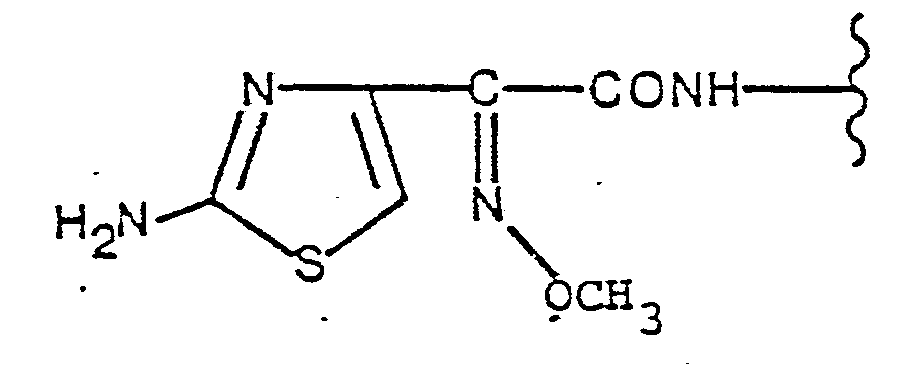
- Die erfindungsgemässen Produkte können in der syn-isomeren Form

- Bevorzugte Produkte sind
- - Methylen(6R,7R)-7-[2-(2-Amino-4-thiazolyl)-2-[(Z)-methoxyimino]-acetamido]-3-[[[2-methyl-5-[[(pivaloyloxy)-methoxy]carbonyl]-2H-1,2,4-triazol-3-yl]thio]methyl]-8-oxo-5-thia-1-azabicyclo[4.2.0]oct-2-en-2-carboxylat-pivalat,
- Die obigen Cephalosporinderivate können erfindungsgemäss dadurch hergestellt werden, dass man die entsprechende Dicarbonsäure, d.h. die (6R,7R')-7-[2-(2-Amino-4-thiazolyl)-2-[methoxyimino]acetamido]-3-[[3-carboxy-1-methyl-1H-1,2,4-triazol-5-yl)thi o]methyl]-8-oxo-5-thia-1-azabicyclo[4.2.0]oct-2-en-2-carbonsäure (Verbindung II), oder ein Salz dieser Verbindung einer entsprechenden Veresterung unterwirft und erwünschtenfalls das erhaltene Produkt in ein Säureadditionssalz oder Hydrat bzw. ein Hydrat dieses Säureadditionssalzes überführt.
- Die im obigen Verfahren verwendete Dicarbonsäure (Verbindung II) kann ausgehend von 7-Aminocephalosporansäure wie folgt hergestellt werden:
- Die 7-Aminocephalosporansäure wird in wässriger Lösung mit 4,5-Dihydro-l-methyl-5-thioxo-lH-l,2,4-triazol-3-carbonsäure (Verbindung III) umgesetzt, z.B. bei einer Temperatur zwischen etwa 40 und 80°C, zweckmässig bei etwa 60°C. Die Lösung wird vorzugsweise bei einem pH' von etwa 6 bis 7, vorzugsweise 6,5, gepuffert.
- Die so erhaltene (6R,7R)-7-Amino-3-/[(3-carboxy-l-methyl-1,2,4-triazol-5-yl)thio]methyl/-8-oxo-5-thia-1-aza- bicyclo[4.2.0]oct-2-en-2-carbonsäure (Verbindung IV) wird anschliessend mit einer Carbonsäure der allgemeinen Formel

- worin R1 eine abspaltbare Gruppe darstellt, oder mit einem reaktionsfähigen funktionellen Derivat dieser Säure umgesetzt, wobei man eine Verbindung der allgemeinen Formel

- worin R1 die obige Bedeutung hat,
- Mögliche R1-Schutzgruppen sind beispielsweise sauerhydrolytisch abspaltbare Schutzgruppen, wie z.B. t-Butoxycarbonyl oder Trityl, oder auch basisch-hydrolytisch abspaltbare Schutzgruppen, wie z.B.. Trifluoracetyl. Bevorzugte Ry-Schutzgruppen sind Chlor-, Brom- und Jodacetyl, insbesondere Chloracetyl. Letztere Schutzgruppen können durch Behandeln mit Thioharnstoff abgespalten werden.
- Als reaktionsfähige funktionelle Derivate von Carbonsäuren der Formel V kommen z.B. Halogenide, d.h. Chloride, Bromide und Fluoride; Azide; Anhydride, insbesondere gemischte Anhydride mit stärkeren Säuren; reaktionsfähige Ester, z.B. N-Hydroxysuccinimidester, und Amide, z.B. Imidazolide, in Betracht.
- Die Umsetzung der 7-Aminoverbindung IV mit der Carbonsäure der Formel V oder einem reaktionsfähigen funktionellen Derivat davon kann in an sich bekannter Weise durchaeführt werden. So kann man z.B. ein Säurehalogenid, vorzuqsweise das Chlorid einer Carbonsäure der Formel V mit dem Amin IV umsetzen. Die Umsetzung erfolgt vorzugsweise in Gegenwart eines säurebindenden Mittels, z.B. in Gegenwart von wässrigem Alkali, vorzugsweise Natronlauge, oder auch in Gegenwart eines Alkalimetallcarbonats, wie Kaliumcarbonat, oder in Gegenwart eines nieder-alkylierten Amins, wie Triäthylamin. Als Lösungsmittel wird vorzugsweise Wasser verwendet, ggfs. im Gemisch mit einem inerten organischen Lösungsmittel, wie Tetrahydrofuran oder Dioxan. Es kann auch in einem aprotischen organischen Lösungsmittel, wie z.B. Dimethylformamid, Dimethylsulfoxid oder Hexamethylphosphorsäuretriamid, gearbeitet werden. Die Umsetzung kann zweckmässig bei Temperaturen zwischen etwa -40°C und Zimmertemperatur, beispielsweise bei etwa 0-10°C, erfolgen.
- Anschliessend wird in der erhaltenen Verbindung der Formel VI die Aminoschutzgruppe R1 abgespalten, wobei die gewünschte Dicarbonsäure (Verbindung II) erhalten wird. Durch saure Hydrolyse abspaltbare Schutzgruppen werden vorzugsweise mit Hilfe einer niederen Alkancarbonsäure, die ggfs. halogeniert sein kann, entfernt. Insbesondere verwendet man Ameisensäure oder Trifluoressigsäure. Die Temperatur ist in der Regel Raumtemperatur, obwohl auch leicht erhöhte bzw. leicht erniedrigte Temperatur angewendet werden kann, z.B. im Bereiche von etwa 0°C bis +40°C. Alkalisch abspaltbare Schutzgruppen werden im allgemeinen mit verdünnter wässriger Lauge bei 0°C bis 30°C hydrolysiert. Die Chloracetyl-, Bromacetyl- und Jodacetyl-Schutzgruppen können mittels Thioharnstoff in saurem, neutralem oder alkalischem Milieu bei etwa 0-30°C abgespalten werden. Hydrogenolytische Abspaltung (z.B. Abspaltung von Benzyl) ist hier ungeeignet, da bei der Hydrogenolyse die Oximfunktion zur Aminogruppe reduziert würde.
- Die erhaltene Dicarbonsäure II kann anschliessend in ein Salz übergeführt werden, z.B. in ein Säureadditionssalz wie oben für die Endprodukte der Formel 1 beschrieben, oder auch in Salze mit Basen, z.B. Alkalimetallsalze, wie das Natrium- und Kaliumsalz; das Ammoniumsalz; Erdalkalimetallsalze, wie das Caiciumsalz; Salze mit organischen Basen, wie Salze mit Aminen, z.B. Salze mit N-Aethyl-piperidin, Procain, Dibenzylamin, N,N'-Dibenzyläthylendiamin, Alkylaminen oder Dialkylaminen, sowie Salze mit Aminosäuren, wile z.B. Salze mit Arginin oder Lysin. Die Salze können Monosalze oder auch Disalze sein. Die Salze werden in an sich bekannter Weise hergestellt, z.B. durch Umsetzung der Dicarbonsäure II mit einer äquivalenten Menge der gewünschten Säure bzw. Base, zweckmässig in einem Lösungsmittel wie Wasser oder in einem organischen Lösungsmittel, wie Aethanol Methanol, Aceton und anderem mehr. Bei,Verwendung eines zweiten Aequivalents an Base erfolgt Salzbildung auch an der zweiten.Carboxyfunktion. Die Temperatur der Salzbildung ist nicht kritisch. Sie liegt im allgemeinen bei Raumtemperatur, kann aber auch leicht darüber oder darunter, etwa im Bereiche von 0°C bis +50°C, sein.
- Die' -4 , 5-Dihydro-1-mezhyl-5=thyl-5-thoxo-1H-1,2,4-triazol-3-carbonsäure steht in tautomerem Gleichgewicht mit dem entsprechenden Thiol im Sinne der nachstehenden Formeln

- Die Herstellung dieser Verbindung wird in Beispiel 1 beschrieben.
- Die erfindungsgemässe Veresterung der Dicarbonsäure II erfolgt durch Umsetzung mit einem die Pivaloyloxymethyl-oder Acetoxymethylgruppe abgebenden Mittel, vorzugsweise durch Umsetzung mit dem entsprechenden Halogenid, insbesondere mit dem Jodid. Die Reaktion kann mit Hilfe einer Base, z.B. einem Alkalimetallhydroxid oder -carbonat, oder einem organischen Amin, wie Triäthylamin, beschleunigt werden. Vorzugsweise verwendet man einen Ueberschuss an dem entsprechenden Halogenid. Die Veresterungsreaktion wird vorzugsweise in einem inerten organischen Lösungsmittel, ggfs. im Gemisch mit Wasser, durchgeführt, wie Dimethylacetamid, Hexamethylphosphorsäuretriamid, Dimethylsulfoxid oder, vorzugsweise, Dimethylformamid. Die Temperatur liegt vorzugsweise im Bereiche von etwa 0-40°C.
- Die Herstellung der Säureadditionssalze und Hydrate der Verbindungen der Formel I bzw. der Hydrate dieser Salze kann in an sich bekannter Weise erfolgen, die Säure- additionssalzez.B. durch Umsetzung der Verbindung der Formel I mit einer äquivalenten Menge der gewünschten Säure, zweckmässig in einem Lösungsmittel wie Wasser oder in einem organischen Lösungsmittel, wie Aethanol, Methanol, Aceton und anderen mehr. Die Temperatur der Salzbildung ist nicht kritisch. Sie liegt im allgemeinen bei Raumtemperatur, kann aber auch leicht darüber oder darunter, etwa im Bereiche von 0°C bis +50°C, sein.
- Die Herstellung der Hydrate erfolgt zumeist automatisch im Zuge des Herstellungsverfahrens oder als Folge hygroskopischer Eigenschaften eines zunächst wasserfreien Produktes. Zur gezielten Herstellung eines Hydrats kann ein ganz oder teilweise wasserfreies Produkt einer feuchten Atmosphäre, z.B. bei etwa +10°C bis +40°C, ausgesetzt werden.
- Ein allenfalls erhaltenes syn/anti-Gemisch einer Verbindung der Formel I kann in die entsprechenden syn-und anti-Formen in üblicher Weise aufgetrennt werden, beispielsweise durch Umkristallisation oder durch chromatographische Methoden unter Verwendung eines geeigneten Lösungsmittels bzw. Lösungsmittelgemisches. Vorzugsweise erhält man aber die Verbindung der Formel I in der syn-isomeren Form, indem man eine Ausgangsverbindung der Formel V in svn-Form einsetzt.
- Die Verbindungen der Formel I sowie die entsprechenden Säureadditionssalze bzw. die Hydrate dieser Produkte sind antibiotisch, insbesondere bakterizid wirksam. Sie besitzen ein breites Wirkungsspektrum gegen Gram-positive Bakterien, z.B. Streptokokken, und gegen Gram-negative Bakterien, wie z.B. Neisseria meningitidis, sowie gegen verschiedene ß-Lactamase-bildende Gram-negative Erreger, wie Escherichia coli und Serratia marcescens.
- Die Verbindungen der Formel I sowie die entsprechenden Säureadditionssalze bzw. die Hydrate dieser Produkte können zur Behandlung und Prophylaxe von Infektionskrankheiten verwendet werden. Für den Erwachsenen kommt eine Tagesdosis von etwa 0,1 g bis etwa 4 g, insbesondere etwa 0,25 g bis etwa 2 g, in Betracht. Enterale oder parenterale Verabreichung ist möglich, ein besonderer Vorzug liegt in der Verwendbarkeit der erfindungsgemässen Produkte für die enterale, z.B. die orale, Verabreichung.
- Die orale antimikrobielle Wirksamkeit der erfindungsgemässen Produkte kann anhand von in vivo-Versuchen an der Maus nachgewiesen werden. Im nachstehenden bedeutet die kurative Dosis (CD50, mg/kg) diejenige Dosis, bei der 50% der getesteten Mäuse überleben.
- Testverbindungen:
- Produkt A: Methylen (6R,7R)-7-[2-(2-Amino-4-thiazolyl)-2-[ (Z)-methoxyimino]-acetamido]-3-[[[2-methyl-5-[[(pivaloyloxy)methoxy]carbonyl]-2H-1,2,4-triazol-3-yl]thio]methyl]-8-oxo-5-thia-1-azabicyclo[4.2.0]oct-2-en-2-carboxylat-pivalat
- Cephalexin (vorbekanntes, anerkannt oral wirksames Cephalosporin)
-
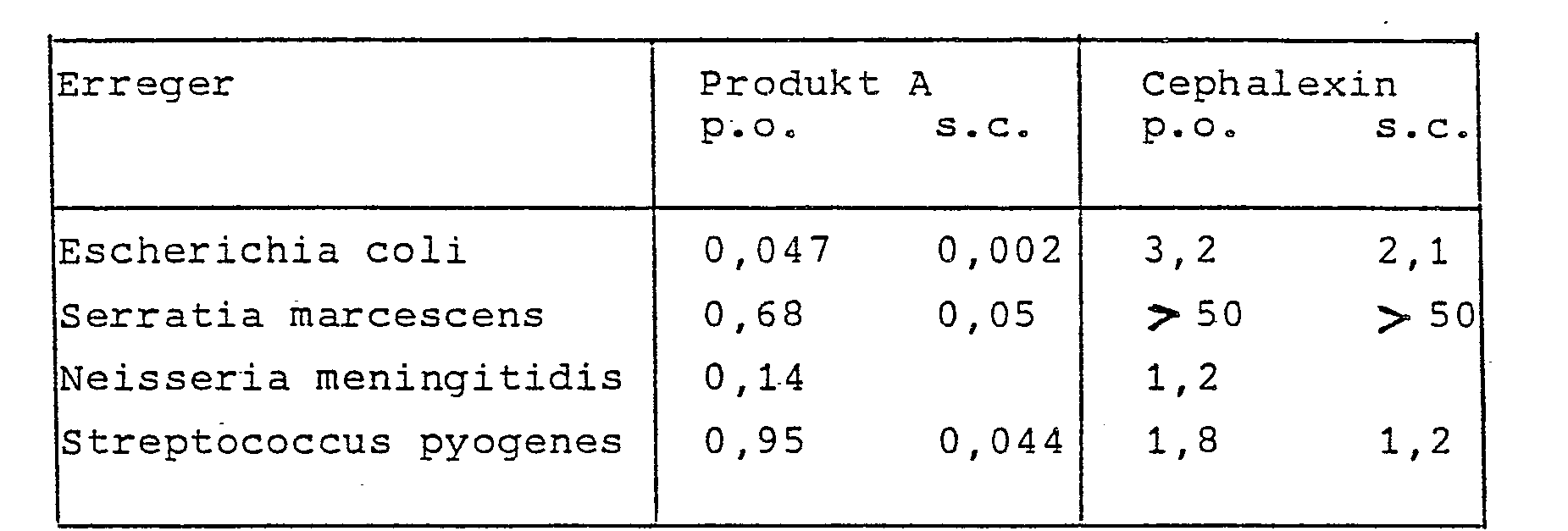
- Das Produkt A ist bedeutend wirksamer als Cephalexin sowohl nach peroraler als auch nach subcutaner Gabe.
- ..Die nach oraler Gabe erzielten Blutspiegelwerte ergeben sich gemäss folgendem Vergleich an der Ratte.

- Das Produkt A ist mindestens so ungiftig wie Cephalexin (LD50 p.o. an der Maus nach 24 Stunden: > 4000 mg/kg für Produkt A, 1600-4500 mg/kg für Cephalexin).
- Die erfindungsgemässen Produkte können als Heilmittel, z.B. in Form pharmazeutischer Präparate Verwendung finden, welche sie oder ihre Salze in Mischung mit einem für die enterale oder parenterale, bevorzugt enterale, Applikation geeigneten pharmazeutischen, organischen oder anorganischen inerten Trägermaterial, wie z.B. Wasser, Gelatine, Gummi arabicum, Milchzucker, Stärke, Magnesiumstearat, Talk, pflanzliche Oele, Polyalkylenglykole, Vaseline, usw. enthalten. Die pharmazeutischen Präparate können in fester Form, z.B. als Tabletten, Dragees, Suppositorien, Kapseln; oder in flüssiger Form, z.B. als Lösungen, Suspensionen oder Emulsionen, vorliegen. Gegebenenfalls sind sie sterilisiert und bzw. oder enthalten Hilfsstoffe, wie Konservierungs-, Stabilisierungs-, Netz- oder Emulgiermittel, Salze zur Veränderung des osmotischen Druckes, Anaesthetica oder Puffer. Sie können auch noch andere therapeutisch wertvolle Stoffe enthalten.
- Herstellung von Methylen (6R,7R)-7-[2-(2-Amino-4-thiazolyl)-2-[(Z)-methoxyimino]-acetamido]-3-[[[2-methyl-5-[[(pivaloyloxy)methoxy]carbonyl]-2H-1,2,4-triazol-3-yl]-thiolmethvl]-8-oxo-5-thia-1-azabicyclo[4.2.0]oct-2-en-2-carboxylat-pivalat:
- 3,9 g des Dinatriumsalzes der (6R,7R)-7-[2-(2-Amino-4-thiazolyl)-2-[(Z)-methoxyimino]acetamido]-3-[[3-carboxy-1-methyl-1H-1,2,4-triazol-5-yl)thio]methyl]-8-oxo-5-thia-1-azabicyclo[4.2.0]oct-2-en-2-carbonsäure werden in einem Gemisch von 100 ml Dimethylformamid und 25 ml Wasser gelöst. Diese Lösung wird,bei 0-5°C unter Stickstoff-Begasung mit 3,13 g Jodmethylpivalat versetzt. Das Reaktionsgemisch wird 30 Minuten bei 0-5°C gerührt, danach auf 500 ml Wasser gegossen und dreimal mit je 200 ml. Aethylacetat extrahiert. Die wässrige Phase wird verworfen. Die vereinigten Aethylacetatphasen weraen nacheinander mit Wasser, verdünnter wässriger Natriumhydrogencarbonatlösung und nochmals mit Wasser gewaschen, über Natriumsulfat getrocknet und im Vakuum bei 40°C stark eingeengt. Nach Zugabe von tiefsiedendem Petroläther wird das ausgefallene Rohprodukt abgenutscht, mit tiefsiedendem Petroläther gewaschen und im Hochvakuum bei 40°C getrocknet. Man erhält beige-farbenes,.amorphes Rohprodukt. Zwecks Reinigung wird dieses Produkt an einer Säule mit 100 g Kieselgel (0,2-0,5 mm) und Aethylacetat als Elutionsmittel chromatographiert. Man erhält reine, beigefarbene, amorphe Titelsubstanz mit Rf = 0,31 in der Dünnschichtchromatographie auf Kieselgel-60F-254-Fertigplatten mit Aethylacetat als Laufmittel. Die spezifische Drehung beträgt [a]D25 = -121,6° (c = 0,4924 in Aceton); das Kernresonanzspektrum und die Mikroanalyse entsprechen der angegebenen Struktur.
- Die im obigen Verfahren als Ausgangsmaterial verwendete Verbindung kann wie folgt hergestellt werden:
- 12,9 g 1-Methoxyoxalyl-2-methyl-thiosemicarbazid werden einer Lösung von 1,6 g Natrium in 200 ml Methanol zugegeben. Das Gemisch wird 4 Stunden unter Rückfluss gekocht. Die nach einer 1/2 Stunde ausgefallene Substanz wird abgetrennt. Die Mutterlauge wird im Vakuum bei 40°C eingedampft. Der Eindampfrückstand wird in 100 ml Wasser gelöst und mit konz. Salzsäure angesäuert. Das dabei ausgeschiedene Kristallisat liefert nach dem Umkristallisieren aus Wasser reinen, farblosen 4,5-Dihydr-o-1-methyl-5-thioxo-1H-1,2,4-thiazol-3-carbonsäure-methylester- vom Schmelzpunkt 188-190°C (Zers.).
- 3,46 g 4,5-Dihydro-1-methyl-5-thoxo-1H-1,2,4-triazol-3-carbonsäure-methylester werden in 50 ml 1N Natronlauge gelöst. Nach halbstündigem Rühren bei 25°C wird die Reaktionslösung mit 25 ml 2N Salzsäure sauer gestellt und im Vakuum bei 40°C eingeengt, wobei die gewünschte Säure kristallisiert. Diese wird abgenutscht, mit Eiswasser gewaschen und im Hochvakuum bei 45°C getrocknet. Man erhält farblose 4,5-Dihydro-1-methyl-5-thioxo-1H-1,2,4-triazol-3-carbonsäure vom Schmelzpunkt 177-178°C (Zers.).
- 34 g 7-Aninocephalosporansäure werden zusammen mit 25,5 g 4,5-Dihydro-1-methyl-5-thioxo-lH-1,2,4-triazol-3-carbonsäure in 500 ml Wasser suspendiert. Das pH wird mit 3N Natronlauge auf 6,5 gestellt. Das Gemisch wird 4 Stunden bei 55°C unter Stickstoffbegasung gerührt, wobei das pH mit 3N Natronlauge mit Hilfe eines Autotitrators konstant bei 6,5 gehalten wird. Die dunkle Lösung wird auf 25°C gekühlt und mit konz. Salzsäure auf pH 3,5 gestellt. Nach 15 Minuten wird das ausgefallene Material abgenutscht, in 500 ml Wasser.suspendiert und mit 3N Natronlauge bei pH 7 in Lösung gebracht. Die orangerote Lösung wird mit konz. Salzsäure auf pH 3 gestellt. Die ausgefallene Substanz wird abgenutscht und nacheinander mit 250 ml Wasser, 500 ml Aceton, 500 ml tiefsiedendem Petroläther gewaschen und über Nacht im Vakuum bei 40-45°C getrocknet. Man erhält (6R,7R)-7-Amino-3-[[(3-carboxy-1-methyl-1,2,4-triazol-5-yl)thio]methyl]-8-oxo-5-thia-1-azabicyclo[4.2.0]oct-2-en-2-carbonsäure als beige gefärbtes Pulver.
- Zu 600 ml über Caiciumchlorid getrocknetem Methylenchlorid werden 75 g Phosphorpentachlorid gegeben. Die Suspension wird unter Rühren auf -10°C abgekühlt, und während ca. 5 Minuten werden 138 ml N,N-Dimethylacetamid zugetropft, wobei die Temperatur auf -5°C ansteigt. Die Suspension wird auf -15°C gekühlt und 15 Minuten gerührt. Nach dem Abkühlen auf -20°C werden 100 g 2-(2-Chloracet- amido-4-thiazolyl)-2-(Z)-methoxyimino-essigsäure zugegeben und 45 Minuten bei -15°C gerührt, wobei eine gelb-orange Lösung entsteht. Diese Lösung wird auf -30°C gekühlt, mit 150 g Eis versetzt und 10 Minuten bei -5°C gerührt. Die das gebildete Säurechlorid enthaltende Methylenchlorid-Phase wird abgetrennt und zunächst bei ca. -15°C aufbewahrt. Diese Säurechlorid-Lösung wird einer auf 0-5°C gekühlten Lösung, die durch Versetzen von 111,5 g (6R,7R)-7-Amino-3-[[(3-carboxy-1-methyl-1,2,4-triazol-5-yl)thio]methyl]-8-oxo-5-thia-1-azabicyclo[4.2.0]oct-2-en-carbonsäure mit 3N Natronlauge bis pH 8,2 in 500 ml Wasser hergestellt wurde, während 30 Minuten unter kräftigem Rühren zugetropft, wobei der pH-Wert mit 3N Natronlauge mit Hilfe eines Autotitrators bei 8,0-8,2 gehalten wird. Das Gemisch wird 2 Stunden bei 25°C gerührt. Danach werden 900 ml Methylenchlorid und 6 1 n-Butanol zugegeben. Unter kräftigem . Rühren wird das pH mit 3N Salzsäure auf 2 zurückgestellt. Die organische Phase wird abgetrennt, dreimal mit je 3 1 Wasser gewaschen, mit 60 g Entfärbungskchle 15 Minuten lang verrührt und filtriert. Das hellgelbe Filtrat wird im Vakuum bei 60°C stark eingeengt, wobei das Reaktionsprodukt ausfällt. Letzteres wird abgenutscht und nacheinander mit n-Butanol, Aether und tiefsiedendem Petroläther gewaschen und über Nacht im Vakuum bei 40°C getrocknet. Man erhält rohe, beige (6R,7R)-3-[[(3-Carboxy-1-methyl-1H-1,2,4-triazol-5-yl)thiolmethyl]-7-(2-(2-chloracetamido)-4-thiazolyl]-2-[(Z)-methoxyimino]acetamido]-8-oxo-5-thia- l-azabicyclo[4.2.0]oct-2-en-2-carbonsäure.
- 53 g (6R,7R)-3-[[(3-Carboxy-1-methyl-1H-1,2,4-triazol-5-yl)thio]methyl]-7-[2-[2-(2-chloracetamido)-4-thiazolyl)-2-[(Z)-methoxyimino]acetamido]-8-oxo-5-thia-1-azabicyclo-[4.2.0]oct-2-en-2-carbonsäure werden in 1 1 Wasser zusammen mit 34 g Thioharnstoff suspendiert. Das pH wird durch Zutropfen von 1N Natronlauge auf 7 gestellt, wobei eine dunkelbraune Lösung entsteht. Diese wird über Nacht unter Stickstoffbegasung bei pH 7 gerührt, wobei das pH mit 1N Natronlauge mit Hilfe eines Autotitrators konstant gehalten wird. Das pH der Reaktionslösung wird mit 1N Salzsäure auf 3,5 unter Rühren zurückgestellt. Die ausgefallene Substanz (Fraktion I) wird abgenutscht, mit 250 ml Wasser gewaschen und im Vakuum bei 40°C getrocknet. Die Fraktion I ist braun gefärbt und stark verunreinigt; sie wird verworfen. Die orange Mutterlauge wird mit 1N Salzsäure unter Rühren auf pH 2,65 zurückgestellt. Das ausgefallene Material wird abgenutscht und mit 250 ml Wasser gewaschen. Das beige-farbene Nutschgut wird unter vermindertem Druck mit Aethanol azeotropiert, abgenutscht, mit Aethanol und tiefsiedendem Petroläther gewaschen und im Vakuum bei 40°C getrocknet. Man erhält so eine beigebraune Fraktion II, welche zwecks Reinigung und Ueberführung in das Dinatriumsalz in 2 1 Methanol suspendiert, mit 50 ml einer 2N Lösung des Natriumsalzes der 2-Aethylcapronsäure in Aethylacetat versetzt und anschliessend mit 200 ml Wasser 30 Minuten gerührt wird. Wenig ungelöstes, braunes Material wird abfiltriert und verworfen. Vom orange gefärbten Filtrat wird.im Vakuum bei 40°C ca. 1 1 abgedampft, dann 1 1 Aethanol zugegeben und im Vakuum auf ein Volumen von ca..500 ml eingeengt. Vom dabei ausgefallenen, schmierigen braunen Harz, welches ein starkes Gemisch darstellt, wird abdekantiert. Die abdekantierte gelborange Lösung wird mit 1 1 Aethanol versetzt und im Vakuum bei 40°C stark eingeengt, wobei teilweise Substanz ausfällt. Nach Zugabe von 2 ,5 1 Methanol entsteht eine gelbe Lösung, welche im Vakuum bei 40°C stark eingeengt wird. Das dabei ausgefallene Dinatriumsalz wird abgenutscht, mit Methanol und tiefsiedendem Petroläther gewaschen und im Hochvakuum bei 35°C getrocknet. Man erhält reines, beige-farbenes Dinatriumsalz der (6R,7R)-7-[2-(2-Amino-4-thiazolyl)-2-[(Z)-methoxyimino]acetamido]-3-[[(3-carboxy-1-methyl-1H-1,2,4-triazol-5-yl)thio]methyl]-8-oxo-5-thia-1-azabicyclo[4.2.0]oct-2-en-2-carbonsäure mit [a]D25 = -38,7° (c = 1 in Wasser).
- Herstellung von Methylen (6R,7R)-7-[2-(2-amino-4-thiazolyl)-2-[(Z)-methoxyimino]-acetamido]-3-[CE2-methyl-5-[[(acetoxy)methoxy]carbonyl]-2H-1,2,4-triazol-3-yl]-thio]methyl]-8-oxo-5-thia-1-azabicyclo[4.2.0]oct-2-en-2-carboxylat-acetat:
- 5,98 g (5R-,7R)-7-Amino-3-[[(3-carboxy-2-methyl-1,2,4-triazol-5-yl)thio]methyl]-8-oxo-5-thia-1-azabicyclo[4.2.0]-oct-2-en-2-carbonsäure-Dinatriumsalz werden-in einem-Gemisch von 70 ml Dimethylformamid und 25 ml Wasser gelöst. Die Lösung wird unter Stickstoff-Begasung bei 0-5°C mit 6,12 g Essigsäure-brommethylester versetzt und 3 Stunden bei 0-5°C gerührt. Das Reaktionsgemisch wird auf 500 ml Wasser gegossen und zweimal mit Aethylacetat unter Zusatz von wenig Aceton extrahiert. Die vereinigten organischen Phasen werden nacheinander mit verdünnter wässriger Natriumhydrogencarbonat-Lösung und Wasser gewaschen, über Natriumsulfat getrocknet und im Vakuum.bei 40°C stark eingeengt. Nach Zugabe von tiefsiedendem Petroläther wird die amorph ausgefallene. Substanz abgenutscht, mit tiefsiedendem'Petroläther gewaschen und über Nacht im Hochvakuum bei 25°C getrocknet. Man erhält ein beiges Rohprodukt, welches, zwecks Reinigung, an einer Säule mit 80 g Kieselgel (0,2-0,5 mm Durchmesser) und Aethylacetat als Elutionsmittel chromatographiert wird. Man erhält reine beige, amorphe Titelsubstanz (aus Aethylacetat/ tiefsiedendem Petroläther) mit [α]D 25 = -107,16° (c = 1,0358 in Aceton). Das Kernresonanzspektrum und die Mikroanalyse entsprechen der angegebenen Struktur.
- Es wird in üblicher Weise eine Gelatine-Steckkapsel folgender Zusammensetzung hergestellt:

- Es wird in üblicher Weise eine Tablette folgender Zusammensetzung hergestellt:

- Mit dem Wirkstoff, der Lactose, dem Polyvinylpyrrolidon und 40 Gewichtsteilen der Maisstärke wird in üblicher Weise ein Granulat hergestellt. Dieses wird mit den restli= chen 25 Gewichtsteilen Maisstärke und 5 Gewichtsteilen Magnesiumstearat vermischt und zu Tabletten gepresst.
und dessen Säureadditionssalze sowie die entsprechenden Hydrate.
erhält.
Claims (12)
1. Verfahren zur Herstellung von Cephalosporinderivaten der allgemeinen Formel

in der R die Pivaloyloxymethyl- oder Acetoxymethylgruppe darstellt,
sowie von Säureadditionssalzen dieser Verbindungen und von Hydraten der Verbindungen der Formel I bzw. von deren Säureadditionssalzen, dadurch gekennzeichnet, dass man die entsprechende Dicarbonsäure, d.h. die (6R,7R)-7-[2-(2-Amino-4-thiazolyl)-2-[methoxyimino]acetamido]-3-[[3-car- boxy-1-methyl-1H-1,2,4-triazol-5-yl)thia]methyl]-8-oxo-5-thia-1-azabicyclo[4.2.0]oct-2-en-2-carbonsäure oder ein Salz dieser Verbindung einer entsprechenden Veresterung unterwirft und erwünschtenfalls das erhaltene Produkt in ein Säureadditionssalz oder Hydrat bzw. ein Hydrat dieses Säureadditionssalzes überführt.
sowie von Säureadditionssalzen dieser Verbindungen und von Hydraten der Verbindungen der Formel I bzw. von deren Säureadditionssalzen, dadurch gekennzeichnet, dass man die entsprechende Dicarbonsäure, d.h. die (6R,7R)-7-[2-(2-Amino-4-thiazolyl)-2-[methoxyimino]acetamido]-3-[[3-car- boxy-1-methyl-1H-1,2,4-triazol-5-yl)thia]methyl]-8-oxo-5-thia-1-azabicyclo[4.2.0]oct-2-en-2-carbonsäure oder ein Salz dieser Verbindung einer entsprechenden Veresterung unterwirft und erwünschtenfalls das erhaltene Produkt in ein Säureadditionssalz oder Hydrat bzw. ein Hydrat dieses Säureadditionssalzes überführt.
2. Verfahren nach Anspruch 1 zur Herstellung von Cephalosporinderivaten gemäss Anspruch 1 in der syn-isomeren Form bzw. von Gemischen, in denen die syn-isomere Form überwiegt, dadurch gekennzeichnet, dass man eine Ausgangsverbindung mit entsprechender Konfiguration einsetzt oder ein erhaltenes syn/anti-Gemisch auftrennt.
3. Verfahren nach Anspruch 2 zur Herstellung von Methylen (6R,7R)-7-[2-(2-Amino-4-thiazolyl)-2-[(Z)-methoxy- imino]-acetamido]-3-[[[2-methyl-5-[[(pivaloyloxy)methoxy]-carbonyl]-2H-1,2,4-triazol-3-yl]thio]methyl]-8-oxo-5-thia- l-azabicyclo[4.2.0]oct-2-en-2-carboxylat-pivalat sowie von Säureadditionssalzen dieser Verbindung und von Hydraten dieser Verbindung bzw. Säureadditionssalze, dadurch gekennzeichnet, dass man ein entsprechendes Veresterungsmittel einsetzt.
4. Verfahren nach Anspruch 2 zur Herstellung von Methylen (6R,7R)-7-[2-(2-Amino-4-thiazolyl)-2-[(Z)-methoxy- imino]-acetamido]-3-[[[2-methyl-5-[[(acetoxy)methoxy]carbonyl]-2H-1,2,4-triazol-3-yl]thio]methyl]-8-oxo-5-thia-1-azabicyclo[4.2.0]oct-2-en-2-carboxylat-acetat sowie von Säureadditionssalzen dieser Verbindung und von Hydraten dieser Verbindung bzw. Säureadditionssalze, dadurch gekennzeichnet, dass man ein entsprechendes Veresterungsmittel einsetzt.
5. Verfahren nach einem der Anprüche 1-3, dadurch gekennzeichnet, dass man als veresterndes Mittel ein Pivaloyloxymethylhalogenid, insbesondere das Jodid, verwendet.
Applications Claiming Priority (4)
| Application Number | Priority Date | Filing Date | Title |
|---|---|---|---|
| US28416081A | 1981-07-17 | 1981-07-17 | |
| US284160 | 1981-07-17 | ||
| CH501881 | 1981-08-04 | ||
| CH5018/81 | 1981-08-04 |
Publications (2)
| Publication Number | Publication Date |
|---|---|
| EP0070331A2 true EP0070331A2 (de) | 1983-01-26 |
| EP0070331A3 EP0070331A3 (de) | 1983-02-23 |
Family
ID=25696765
Family Applications (1)
| Application Number | Title | Priority Date | Filing Date |
|---|---|---|---|
| EP81106901A Withdrawn EP0070331A3 (de) | 1981-07-17 | 1981-09-03 | Cephalosporinderivate, entsprechende Präparate, die Verwendung dieser Produkte bei der Behandlung von Krankheiten sowie die Herstellung der Werkstoffe |
Country Status (31)
| Country | Link |
|---|---|
| EP (1) | EP0070331A3 (de) |
| AT (1) | AT375373B (de) |
| AU (1) | AU7491481A (de) |
| BR (1) | BR8106093A (de) |
| CA (1) | CA1169853A (de) |
| CS (1) | CS701481A2 (de) |
| CU (1) | CU35528A (de) |
| DD (1) | DD201683A5 (de) |
| DE (1) | DE3134937A1 (de) |
| DK (1) | DK379681A (de) |
| ES (1) | ES505718A0 (de) |
| FI (1) | FI812838L (de) |
| FR (1) | FR2509733A1 (de) |
| GB (1) | GB2101581B (de) |
| GR (1) | GR75024B (de) |
| IL (1) | IL63711A0 (de) |
| IN (1) | IN155426B (de) |
| IT (1) | IT1138195B (de) |
| MC (1) | MC1420A1 (de) |
| NL (1) | NL8104133A (de) |
| NO (1) | NO812942L (de) |
| NZ (1) | NZ198191A (de) |
| OA (1) | OA06901A (de) |
| PH (1) | PH17412A (de) |
| PL (1) | PL131752B1 (de) |
| PT (1) | PT73669B (de) |
| RO (1) | RO82723B (de) |
| SE (1) | SE8105628L (de) |
| SU (1) | SU1140688A3 (de) |
| YU (1) | YU217781A (de) |
| ZW (1) | ZW22181A1 (de) |
Cited By (1)
| Publication number | Priority date | Publication date | Assignee | Title |
|---|---|---|---|---|
| CN115433137A (zh) * | 2022-04-15 | 2022-12-06 | 内蒙古京科医药科技有限公司 | 1-甲基-1,2,4-三氮唑-3-甲醇的制备方法 |
Family Cites Families (2)
| Publication number | Priority date | Publication date | Assignee | Title |
|---|---|---|---|---|
| IT8067851A0 (it) * | 1979-06-01 | 1980-05-30 | Sankyo Co | Derivati di cefalosporina sommini strabili per via orale e procedimento per la loro preparazione |
| CA1154009A (en) * | 1980-03-25 | 1983-09-20 | Roland Reiner | Cephalosporin derivatives |
-
1981
- 1981-08-26 DK DK379681A patent/DK379681A/da not_active Application Discontinuation
- 1981-08-26 AT AT0371781A patent/AT375373B/de not_active IP Right Cessation
- 1981-08-27 NZ NZ198191A patent/NZ198191A/en unknown
- 1981-08-28 GB GB08126329A patent/GB2101581B/en not_active Expired
- 1981-08-28 NO NO812942A patent/NO812942L/no unknown
- 1981-09-01 IL IL63711A patent/IL63711A0/xx unknown
- 1981-09-03 EP EP81106901A patent/EP0070331A3/de not_active Withdrawn
- 1981-09-03 DE DE19813134937 patent/DE3134937A1/de not_active Withdrawn
- 1981-09-03 AU AU74914/81A patent/AU7491481A/en not_active Abandoned
- 1981-09-03 IT IT8123775A patent/IT1138195B/it active
- 1981-09-07 NL NL8104133A patent/NL8104133A/nl not_active Application Discontinuation
- 1981-09-09 ZW ZW221/81A patent/ZW22181A1/xx unknown
- 1981-09-10 YU YU02177/81A patent/YU217781A/xx unknown
- 1981-09-10 PH PH26188A patent/PH17412A/en unknown
- 1981-09-11 FI FI812838A patent/FI812838L/fi not_active Application Discontinuation
- 1981-09-14 PT PT73669A patent/PT73669B/pt unknown
- 1981-09-15 IN IN1031/CAL/81A patent/IN155426B/en unknown
- 1981-09-17 DD DD81233367A patent/DD201683A5/de unknown
- 1981-09-18 FR FR8117660A patent/FR2509733A1/fr active Pending
- 1981-09-19 OA OA57496A patent/OA06901A/xx unknown
- 1981-09-21 MC MC811541A patent/MC1420A1/fr unknown
- 1981-09-22 RO RO105369A patent/RO82723B/ro unknown
- 1981-09-23 CS CS817014A patent/CS701481A2/cs unknown
- 1981-09-23 BR BR8106093A patent/BR8106093A/pt unknown
- 1981-09-23 SE SE8105628A patent/SE8105628L/xx not_active Application Discontinuation
- 1981-09-23 PL PL1981233145A patent/PL131752B1/pl unknown
- 1981-09-23 CA CA000386479A patent/CA1169853A/en not_active Expired
- 1981-09-23 SU SU813336150A patent/SU1140688A3/ru active
- 1981-09-23 ES ES505718A patent/ES505718A0/es active Granted
- 1981-09-24 CU CU8135528A patent/CU35528A/es unknown
- 1981-10-02 GR GR65970A patent/GR75024B/el unknown
Cited By (1)
| Publication number | Priority date | Publication date | Assignee | Title |
|---|---|---|---|---|
| CN115433137A (zh) * | 2022-04-15 | 2022-12-06 | 内蒙古京科医药科技有限公司 | 1-甲基-1,2,4-三氮唑-3-甲醇的制备方法 |
Also Published As
Similar Documents
| Publication | Publication Date | Title |
|---|---|---|
| DE2727753C2 (de) | ||
| EP0030294B1 (de) | Verfahren zur Herstellung von Cephalosporinderivaten; Zwischenprodukte und deren Herstellung | |
| EP0005830B1 (de) | Cephalosporinderivate, deren Herstellung und die entsprechenden pharmazeutischen Präparate | |
| EP0134420B1 (de) | Cephalosporinverbindungen, Verfahren zu ihrer Herstellung und pharmazeutische Präparate | |
| AT391137B (de) | Neue cephalosporinderivate und diese enthaltende pharmazeutische praeparate | |
| CH641468A5 (de) | Cephemderivate. | |
| EP0329008B1 (de) | Cephalosporinderivative und Verfahren zu ihrer Herstellung | |
| DE3789720T2 (de) | Cephalosporinverbindungen. | |
| EP0303172A2 (de) | Oxyimino-Cephalosporine | |
| EP0049855B1 (de) | Neue Cephalosporinderivate, Verfahren zu ihrer Herstellung und Zwischenprodukte dafür sowie entsprechende pharmazeutische Präparate | |
| EP0318767A2 (de) | Unter physiologischen Bedingungen spaltbare Ester von pharmakologisch wirksamen Carbonsäuren | |
| US4189479A (en) | Cephalosporin esters | |
| EP0286144A2 (de) | Heterocyclylthiomethyl-cephalosporine | |
| DE69030502T2 (de) | Cephalosporinverbindungen und deren herstellung | |
| EP0144032A2 (de) | Cephalosporine und Verfahren zu ihrer Herstellung | |
| EP0029966A2 (de) | Cephalosporinderivate, und deren Herstellung sowie entsprechende pharmazeutische Präparate | |
| DE2539411A1 (de) | Cephamycine, ihre salze, verfahren zu ihrer herstellung und arzneipraeparate | |
| DE2715038A1 (de) | Neue antibakterielle verbindungen | |
| DD204257A5 (de) | Verfahren zur herstellung von cephalosporinen, die in position 3 substituiert sind | |
| EP0075104A2 (de) | Cephalosporinderivate, Verfahren zu deren Herstellung und Zwischenprodukte dafür sowie entsprechende pharmazeutische Präparate | |
| EP0036652A2 (de) | Cephalosporinderivate, entsprechende Präparate, die Verwendung dieser Produkte bei der Behandlung von Krankheiten, die Herstellung der Wirkstoffe sowie dabei anfallende Zwischenprodukte | |
| DE2442702C2 (de) | Cephalosporinverbindungen, Verfahren zu ihrer Herstellung und antibakterielle Mittel, die diese Verbindungen enthalten | |
| CH634848A5 (de) | Verfahren zur herstellung neuer 7-(n-substituierter 2-phenylglycinamido)-3-substituierte-3-cephem-4-carbonsaeuren. | |
| DE3901405A1 (de) | Cephalosporinderivate und verfahren zu ihrer herstellung | |
| EP0553792A2 (de) | Verfahren zur Herstellung von Ceftriaxon-dinatriumsalzhemiheptahydrat |
Legal Events
| Date | Code | Title | Description |
|---|---|---|---|
| PUAI | Public reference made under article 153(3) epc to a published international application that has entered the european phase |
Free format text: ORIGINAL CODE: 0009012 |
|
| PUAL | Search report despatched |
Free format text: ORIGINAL CODE: 0009013 |
|
| 17P | Request for examination filed |
Effective date: 19810903 |
|
| AK | Designated contracting states |
Designated state(s): AT BE CH DE FR IT LI LU NL SE |
|
| AK | Designated contracting states |
Designated state(s): AT BE CH DE FR IT LI LU NL SE |
|
| STAA | Information on the status of an ep patent application or granted ep patent |
Free format text: STATUS: THE APPLICATION IS DEEMED TO BE WITHDRAWN |
|
| 18D | Application deemed to be withdrawn |
Effective date: 19841218 |
|
| RIN1 | Information on inventor provided before grant (corrected) |
Inventor name: MONTAVON, MARC, DR. Inventor name: REINER, ROLAND, DR. |