EP0065733B1 - Verfahren zur Herstellung von 3-Alkylaminophenolen - Google Patents
Verfahren zur Herstellung von 3-Alkylaminophenolen Download PDFInfo
- Publication number
- EP0065733B1 EP0065733B1 EP82104302A EP82104302A EP0065733B1 EP 0065733 B1 EP0065733 B1 EP 0065733B1 EP 82104302 A EP82104302 A EP 82104302A EP 82104302 A EP82104302 A EP 82104302A EP 0065733 B1 EP0065733 B1 EP 0065733B1
- Authority
- EP
- European Patent Office
- Prior art keywords
- catalyst
- hydrogen
- dehydrogenation
- weight
- amino
- Prior art date
- Legal status (The legal status is an assumption and is not a legal conclusion. Google has not performed a legal analysis and makes no representation as to the accuracy of the status listed.)
- Expired
Links
- 238000004519 manufacturing process Methods 0.000 title 1
- 239000003054 catalyst Substances 0.000 claims description 27
- IJGRMHOSHXDMSA-UHFFFAOYSA-N Atomic nitrogen Chemical compound N#N IJGRMHOSHXDMSA-UHFFFAOYSA-N 0.000 claims description 20
- 229910052739 hydrogen Inorganic materials 0.000 claims description 18
- 239000001257 hydrogen Substances 0.000 claims description 18
- XLYOFNOQVPJJNP-UHFFFAOYSA-N water Substances O XLYOFNOQVPJJNP-UHFFFAOYSA-N 0.000 claims description 16
- UFHFLCQGNIYNRP-UHFFFAOYSA-N Hydrogen Chemical compound [H][H] UFHFLCQGNIYNRP-UHFFFAOYSA-N 0.000 claims description 15
- 238000000034 method Methods 0.000 claims description 14
- 238000006356 dehydrogenation reaction Methods 0.000 claims description 13
- 230000008569 process Effects 0.000 claims description 13
- KDLHZDBZIXYQEI-UHFFFAOYSA-N Palladium Chemical compound [Pd] KDLHZDBZIXYQEI-UHFFFAOYSA-N 0.000 claims description 12
- 238000006243 chemical reaction Methods 0.000 claims description 12
- 229910052757 nitrogen Inorganic materials 0.000 claims description 12
- 239000007789 gas Substances 0.000 claims description 10
- ZZMRPOAHZITKBV-UHFFFAOYSA-N 3-aminocyclohex-2-en-1-one Chemical class NC1=CC(=O)CCC1 ZZMRPOAHZITKBV-UHFFFAOYSA-N 0.000 claims description 8
- VYPSYNLAJGMNEJ-UHFFFAOYSA-N Silicium dioxide Chemical compound O=[Si]=O VYPSYNLAJGMNEJ-UHFFFAOYSA-N 0.000 claims description 8
- 239000000203 mixture Substances 0.000 claims description 6
- OKTJSMMVPCPJKN-UHFFFAOYSA-N Carbon Chemical compound [C] OKTJSMMVPCPJKN-UHFFFAOYSA-N 0.000 claims description 5
- 125000000217 alkyl group Chemical group 0.000 claims description 5
- 229910052799 carbon Inorganic materials 0.000 claims description 5
- 125000004432 carbon atom Chemical group C* 0.000 claims description 5
- 229910052763 palladium Inorganic materials 0.000 claims description 5
- 230000008929 regeneration Effects 0.000 claims description 5
- 238000011069 regeneration method Methods 0.000 claims description 5
- 125000000753 cycloalkyl group Chemical group 0.000 claims description 4
- 239000012442 inert solvent Substances 0.000 claims description 4
- 238000002360 preparation method Methods 0.000 claims description 4
- 230000003197 catalytic effect Effects 0.000 claims description 3
- 239000000377 silicon dioxide Substances 0.000 claims description 3
- OLBVUFHMDRJKTK-UHFFFAOYSA-N [N].[O] Chemical compound [N].[O] OLBVUFHMDRJKTK-UHFFFAOYSA-N 0.000 claims description 2
- 125000002947 alkylene group Chemical group 0.000 claims description 2
- 238000009835 boiling Methods 0.000 claims description 2
- 125000005843 halogen group Chemical group 0.000 claims description 2
- 150000002431 hydrogen Chemical class 0.000 claims description 2
- 150000002829 nitrogen Chemical group 0.000 claims description 2
- 125000004429 atom Chemical group 0.000 claims 1
- 229910052736 halogen Inorganic materials 0.000 claims 1
- 125000004435 hydrogen atom Chemical group [H]* 0.000 claims 1
- 125000004430 oxygen atom Chemical group O* 0.000 claims 1
- 235000012239 silicon dioxide Nutrition 0.000 claims 1
- YXFVVABEGXRONW-UHFFFAOYSA-N Toluene Chemical compound CC1=CC=CC=C1 YXFVVABEGXRONW-UHFFFAOYSA-N 0.000 description 9
- MESJRHHDBDCQTH-UHFFFAOYSA-N 3-(dimethylamino)phenol Chemical compound CN(C)C1=CC=CC(O)=C1 MESJRHHDBDCQTH-UHFFFAOYSA-N 0.000 description 8
- 238000001704 evaporation Methods 0.000 description 8
- 230000008020 evaporation Effects 0.000 description 8
- 239000012071 phase Substances 0.000 description 7
- 239000007858 starting material Substances 0.000 description 7
- 239000000243 solution Substances 0.000 description 6
- BASFCYQUMIYNBI-UHFFFAOYSA-N platinum Chemical compound [Pt] BASFCYQUMIYNBI-UHFFFAOYSA-N 0.000 description 5
- 239000002904 solvent Substances 0.000 description 5
- LLNZJTODFKRLIM-UHFFFAOYSA-N 3-(dimethylamino)cyclohex-2-en-1-one Chemical compound CN(C)C1=CC(=O)CCC1 LLNZJTODFKRLIM-UHFFFAOYSA-N 0.000 description 4
- 238000004821 distillation Methods 0.000 description 4
- 239000000047 product Substances 0.000 description 4
- 150000003254 radicals Chemical class 0.000 description 4
- KWYUFKZDYYNOTN-UHFFFAOYSA-M Potassium hydroxide Chemical compound [OH-].[K+] KWYUFKZDYYNOTN-UHFFFAOYSA-M 0.000 description 3
- 239000007795 chemical reaction product Substances 0.000 description 3
- 125000002496 methyl group Chemical group [H]C([H])([H])* 0.000 description 3
- 239000003960 organic solvent Substances 0.000 description 3
- 239000002244 precipitate Substances 0.000 description 3
- 230000007306 turnover Effects 0.000 description 3
- JBCRNGVTLQWOOW-UHFFFAOYSA-N 3-(methylamino)cyclohex-2-en-1-one Chemical compound CNC1=CC(=O)CCC1 JBCRNGVTLQWOOW-UHFFFAOYSA-N 0.000 description 2
- CWLKGDAVCFYWJK-UHFFFAOYSA-N 3-aminophenol Chemical class NC1=CC=CC(O)=C1 CWLKGDAVCFYWJK-UHFFFAOYSA-N 0.000 description 2
- XEEYBQQBJWHFJM-UHFFFAOYSA-N Iron Chemical compound [Fe] XEEYBQQBJWHFJM-UHFFFAOYSA-N 0.000 description 2
- JLTDJTHDQAWBAV-UHFFFAOYSA-N N,N-dimethylaniline Chemical compound CN(C)C1=CC=CC=C1 JLTDJTHDQAWBAV-UHFFFAOYSA-N 0.000 description 2
- PXHVJJICTQNCMI-UHFFFAOYSA-N Nickel Chemical compound [Ni] PXHVJJICTQNCMI-UHFFFAOYSA-N 0.000 description 2
- KJTLSVCANCCWHF-UHFFFAOYSA-N Ruthenium Chemical compound [Ru] KJTLSVCANCCWHF-UHFFFAOYSA-N 0.000 description 2
- 239000007864 aqueous solution Substances 0.000 description 2
- 239000006227 byproduct Substances 0.000 description 2
- 239000012159 carrier gas Substances 0.000 description 2
- 239000003795 chemical substances by application Substances 0.000 description 2
- 239000003245 coal Substances 0.000 description 2
- HJSLFCCWAKVHIW-UHFFFAOYSA-N cyclohexane-1,3-dione Chemical class O=C1CCCC(=O)C1 HJSLFCCWAKVHIW-UHFFFAOYSA-N 0.000 description 2
- JHIVVAPYMSGYDF-UHFFFAOYSA-N cyclohexanone Chemical compound O=C1CCCCC1 JHIVVAPYMSGYDF-UHFFFAOYSA-N 0.000 description 2
- NNBZCPXTIHJBJL-UHFFFAOYSA-N decalin Chemical compound C1CCCC2CCCCC21 NNBZCPXTIHJBJL-UHFFFAOYSA-N 0.000 description 2
- USIUVYZYUHIAEV-UHFFFAOYSA-N diphenyl ether Chemical compound C=1C=CC=CC=1OC1=CC=CC=C1 USIUVYZYUHIAEV-UHFFFAOYSA-N 0.000 description 2
- 238000001035 drying Methods 0.000 description 2
- 125000001495 ethyl group Chemical group [H]C([H])([H])C([H])([H])* 0.000 description 2
- 230000002349 favourable effect Effects 0.000 description 2
- 229910052741 iridium Inorganic materials 0.000 description 2
- GKOZUEZYRPOHIO-UHFFFAOYSA-N iridium atom Chemical compound [Ir] GKOZUEZYRPOHIO-UHFFFAOYSA-N 0.000 description 2
- 239000000463 material Substances 0.000 description 2
- 229910052751 metal Inorganic materials 0.000 description 2
- 239000002184 metal Substances 0.000 description 2
- 239000012074 organic phase Substances 0.000 description 2
- 229910052762 osmium Inorganic materials 0.000 description 2
- SYQBFIAQOQZEGI-UHFFFAOYSA-N osmium atom Chemical compound [Os] SYQBFIAQOQZEGI-UHFFFAOYSA-N 0.000 description 2
- 229910052697 platinum Inorganic materials 0.000 description 2
- GHMLBKRAJCXXBS-UHFFFAOYSA-N resorcinol Chemical compound OC1=CC=CC(O)=C1 GHMLBKRAJCXXBS-UHFFFAOYSA-N 0.000 description 2
- 229910052703 rhodium Inorganic materials 0.000 description 2
- 239000010948 rhodium Substances 0.000 description 2
- MHOVAHRLVXNVSD-UHFFFAOYSA-N rhodium atom Chemical compound [Rh] MHOVAHRLVXNVSD-UHFFFAOYSA-N 0.000 description 2
- 229910052707 ruthenium Inorganic materials 0.000 description 2
- 150000003839 salts Chemical class 0.000 description 2
- 229910052814 silicon oxide Inorganic materials 0.000 description 2
- MBPQVWGCNCNOQG-UHFFFAOYSA-N 2-aminocyclohex-2-en-1-one Chemical compound NC1=CCCCC1=O MBPQVWGCNCNOQG-UHFFFAOYSA-N 0.000 description 1
- WAVOOWVINKGEHS-UHFFFAOYSA-N 3-(diethylamino)phenol Chemical compound CCN(CC)C1=CC=CC(O)=C1 WAVOOWVINKGEHS-UHFFFAOYSA-N 0.000 description 1
- SIAFQYIKFSTYQF-UHFFFAOYSA-N 3-(dimethylamino)-5-methylcyclohex-2-en-1-one Chemical compound CC1CC(=O)C=C(N(C)C)C1 SIAFQYIKFSTYQF-UHFFFAOYSA-N 0.000 description 1
- PNUJZJDLCOVIBQ-UHFFFAOYSA-N 3-(dimethylamino)-5-methylphenol Chemical compound CN(C)C1=CC(C)=CC(O)=C1 PNUJZJDLCOVIBQ-UHFFFAOYSA-N 0.000 description 1
- KLLOEOPUXBJSOW-UHFFFAOYSA-N 3-(methylamino)phenol Chemical compound CNC1=CC=CC(O)=C1 KLLOEOPUXBJSOW-UHFFFAOYSA-N 0.000 description 1
- RYGMFSIKBFXOCR-UHFFFAOYSA-N Copper Chemical compound [Cu] RYGMFSIKBFXOCR-UHFFFAOYSA-N 0.000 description 1
- -1 Glycol ethers Chemical class 0.000 description 1
- ISWSIDIOOBJBQZ-UHFFFAOYSA-N Phenol Chemical compound OC1=CC=CC=C1 ISWSIDIOOBJBQZ-UHFFFAOYSA-N 0.000 description 1
- BQCADISMDOOEFD-UHFFFAOYSA-N Silver Chemical compound [Ag] BQCADISMDOOEFD-UHFFFAOYSA-N 0.000 description 1
- GWEVSGVZZGPLCZ-UHFFFAOYSA-N Titan oxide Chemical compound O=[Ti]=O GWEVSGVZZGPLCZ-UHFFFAOYSA-N 0.000 description 1
- WGLPBDUCMAPZCE-UHFFFAOYSA-N Trioxochromium Chemical compound O=[Cr](=O)=O WGLPBDUCMAPZCE-UHFFFAOYSA-N 0.000 description 1
- 150000001338 aliphatic hydrocarbons Chemical class 0.000 description 1
- 239000003963 antioxidant agent Substances 0.000 description 1
- 239000008346 aqueous phase Substances 0.000 description 1
- 150000004945 aromatic hydrocarbons Chemical class 0.000 description 1
- 150000008378 aryl ethers Chemical class 0.000 description 1
- QVGXLLKOCUKJST-UHFFFAOYSA-N atomic oxygen Chemical compound [O] QVGXLLKOCUKJST-UHFFFAOYSA-N 0.000 description 1
- 230000009286 beneficial effect Effects 0.000 description 1
- 230000008901 benefit Effects 0.000 description 1
- 125000000484 butyl group Chemical group [H]C([*])([H])C([H])([H])C([H])([H])C([H])([H])[H] 0.000 description 1
- BRPQOXSCLDDYGP-UHFFFAOYSA-N calcium oxide Chemical compound [O-2].[Ca+2] BRPQOXSCLDDYGP-UHFFFAOYSA-N 0.000 description 1
- 239000000292 calcium oxide Substances 0.000 description 1
- ODINCKMPIJJUCX-UHFFFAOYSA-N calcium oxide Inorganic materials [Ca]=O ODINCKMPIJJUCX-UHFFFAOYSA-N 0.000 description 1
- 239000012876 carrier material Substances 0.000 description 1
- 239000003638 chemical reducing agent Substances 0.000 description 1
- 238000004587 chromatography analysis Methods 0.000 description 1
- 229910000423 chromium oxide Inorganic materials 0.000 description 1
- 239000010941 cobalt Substances 0.000 description 1
- 229910017052 cobalt Inorganic materials 0.000 description 1
- GUTLYIVDDKVIGB-UHFFFAOYSA-N cobalt atom Chemical compound [Co] GUTLYIVDDKVIGB-UHFFFAOYSA-N 0.000 description 1
- 238000004939 coking Methods 0.000 description 1
- 239000010949 copper Substances 0.000 description 1
- 229910052802 copper Inorganic materials 0.000 description 1
- 239000013078 crystal Substances 0.000 description 1
- 125000004122 cyclic group Chemical group 0.000 description 1
- 230000009849 deactivation Effects 0.000 description 1
- 230000008021 deposition Effects 0.000 description 1
- SBZXBUIDTXKZTM-UHFFFAOYSA-N diglyme Chemical compound COCCOCCOC SBZXBUIDTXKZTM-UHFFFAOYSA-N 0.000 description 1
- HNPSIPDUKPIQMN-UHFFFAOYSA-N dioxosilane;oxo(oxoalumanyloxy)alumane Chemical class O=[Si]=O.O=[Al]O[Al]=O HNPSIPDUKPIQMN-UHFFFAOYSA-N 0.000 description 1
- 239000003814 drug Substances 0.000 description 1
- 239000000975 dye Substances 0.000 description 1
- 150000002170 ethers Chemical class 0.000 description 1
- LYCAIKOWRPUZTN-UHFFFAOYSA-N ethylene glycol Natural products OCCO LYCAIKOWRPUZTN-UHFFFAOYSA-N 0.000 description 1
- 238000001125 extrusion Methods 0.000 description 1
- 238000001914 filtration Methods 0.000 description 1
- 238000004817 gas chromatography Methods 0.000 description 1
- 239000011521 glass Substances 0.000 description 1
- PCHJSUWPFVWCPO-UHFFFAOYSA-N gold Chemical compound [Au] PCHJSUWPFVWCPO-UHFFFAOYSA-N 0.000 description 1
- 229910052737 gold Inorganic materials 0.000 description 1
- 239000010931 gold Substances 0.000 description 1
- 239000004009 herbicide Substances 0.000 description 1
- 229930195733 hydrocarbon Natural products 0.000 description 1
- 150000002430 hydrocarbons Chemical class 0.000 description 1
- 230000007062 hydrolysis Effects 0.000 description 1
- 238000006460 hydrolysis reaction Methods 0.000 description 1
- WGCNASOHLSPBMP-UHFFFAOYSA-N hydroxyacetaldehyde Natural products OCC=O WGCNASOHLSPBMP-UHFFFAOYSA-N 0.000 description 1
- 238000005470 impregnation Methods 0.000 description 1
- 239000000543 intermediate Substances 0.000 description 1
- 229910052742 iron Inorganic materials 0.000 description 1
- 239000007791 liquid phase Substances 0.000 description 1
- 239000000395 magnesium oxide Substances 0.000 description 1
- CPLXHLVBOLITMK-UHFFFAOYSA-N magnesium oxide Inorganic materials [Mg]=O CPLXHLVBOLITMK-UHFFFAOYSA-N 0.000 description 1
- AXZKOIWUVFPNLO-UHFFFAOYSA-N magnesium;oxygen(2-) Chemical compound [O-2].[Mg+2] AXZKOIWUVFPNLO-UHFFFAOYSA-N 0.000 description 1
- 230000008018 melting Effects 0.000 description 1
- 238000002844 melting Methods 0.000 description 1
- 229910052759 nickel Inorganic materials 0.000 description 1
- 230000003287 optical effect Effects 0.000 description 1
- TWNQGVIAIRXVLR-UHFFFAOYSA-N oxo(oxoalumanyloxy)alumane Chemical compound O=[Al]O[Al]=O TWNQGVIAIRXVLR-UHFFFAOYSA-N 0.000 description 1
- 239000001301 oxygen Substances 0.000 description 1
- 229910052760 oxygen Inorganic materials 0.000 description 1
- YJVFFLUZDVXJQI-UHFFFAOYSA-L palladium(ii) acetate Chemical compound [Pd+2].CC([O-])=O.CC([O-])=O YJVFFLUZDVXJQI-UHFFFAOYSA-L 0.000 description 1
- 239000002245 particle Substances 0.000 description 1
- 239000010695 polyglycol Substances 0.000 description 1
- 229920000151 polyglycol Polymers 0.000 description 1
- 230000002028 premature Effects 0.000 description 1
- 150000003141 primary amines Chemical class 0.000 description 1
- 125000001436 propyl group Chemical group [H]C([*])([H])C([H])([H])C([H])([H])[H] 0.000 description 1
- 238000000746 purification Methods 0.000 description 1
- 239000011541 reaction mixture Substances 0.000 description 1
- 230000009467 reduction Effects 0.000 description 1
- 150000003335 secondary amines Chemical class 0.000 description 1
- 229910052709 silver Inorganic materials 0.000 description 1
- 239000004332 silver Substances 0.000 description 1
- 229910001220 stainless steel Inorganic materials 0.000 description 1
- 239000010935 stainless steel Substances 0.000 description 1
- OGIDPMRJRNCKJF-UHFFFAOYSA-N titanium oxide Inorganic materials [Ti]=O OGIDPMRJRNCKJF-UHFFFAOYSA-N 0.000 description 1
- 239000012808 vapor phase Substances 0.000 description 1
- PXXNTAGJWPJAGM-UHFFFAOYSA-N vertaline Natural products C1C2C=3C=C(OC)C(OC)=CC=3OC(C=C3)=CC=C3CCC(=O)OC1CC1N2CCCC1 PXXNTAGJWPJAGM-UHFFFAOYSA-N 0.000 description 1
Classifications
-
- C—CHEMISTRY; METALLURGY
- C07—ORGANIC CHEMISTRY
- C07D—HETEROCYCLIC COMPOUNDS
- C07D295/00—Heterocyclic compounds containing polymethylene-imine rings with at least five ring members, 3-azabicyclo [3.2.2] nonane, piperazine, morpholine or thiomorpholine rings, having only hydrogen atoms directly attached to the ring carbon atoms
- C07D295/04—Heterocyclic compounds containing polymethylene-imine rings with at least five ring members, 3-azabicyclo [3.2.2] nonane, piperazine, morpholine or thiomorpholine rings, having only hydrogen atoms directly attached to the ring carbon atoms with substituted hydrocarbon radicals attached to ring nitrogen atoms
- C07D295/08—Heterocyclic compounds containing polymethylene-imine rings with at least five ring members, 3-azabicyclo [3.2.2] nonane, piperazine, morpholine or thiomorpholine rings, having only hydrogen atoms directly attached to the ring carbon atoms with substituted hydrocarbon radicals attached to ring nitrogen atoms substituted by singly bound oxygen or sulfur atoms
- C07D295/096—Heterocyclic compounds containing polymethylene-imine rings with at least five ring members, 3-azabicyclo [3.2.2] nonane, piperazine, morpholine or thiomorpholine rings, having only hydrogen atoms directly attached to the ring carbon atoms with substituted hydrocarbon radicals attached to ring nitrogen atoms substituted by singly bound oxygen or sulfur atoms with the ring nitrogen atoms and the oxygen or sulfur atoms separated by carbocyclic rings or by carbon chains interrupted by carbocyclic rings
Definitions
- the invention relates to a process for the preparation of 3-alkylaminophenols by catalytic dehydrogenation of 3-alkylamino-2-cyclohexenones in the gas phase.
- 3-alkylaminophenols are important intermediates for pharmaceuticals, dyes (DE-OS 2458347), herbicides, optical brighteners and antioxidants.
- US Pat. No. 4,212,833 describes a process for the preparation of 3-aminophenols, which is characterized in that 3-amino-2-cyclohexenones are dehydrated in the presence of a dehydrogenation catalyst in the liquid phase at 150-300 ° C. This generally requires an inert solvent that boils between 150 and 300 ° C. In particular, hydrocarbons and polyglycol ethers are used. To achieve high yields, an amount of solvent which is 5 to 10 times the amount of 3-amino-2-cyclohexenone and the resulting 3-aminophenols must be separated from the solvent by distillation.
- a disadvantage of this process is the exposure to large amounts of solvent, some of which are highly flammable at the reaction temperatures.
- 3-alkylamino-2-cyclohexenones in particular 3-dimethylamino-2-cyclohexenone, can be evaporated either alone or in conjunction with an entrainer and can be dehydrogenated in the gas phase over dehydrogenation catalysts to give 3-alkylaminophenols .
- the invention thus relates to a process for the preparation of 3-alkylaminophenols of the general formula where the radicals R 1 to R 5, independently of one another, can be hydrogen, alkyl or cycloalkyl groups with up to 12 C atoms and optionally halogen-substituted, and R 6 can be an alkyl or cycloalkyl group with up to 12 C atoms or, together with R 5, an alkylene ring with 4 to 6 carbon atoms, which may also contain an oxygen or a substituted nitrogen atom, means by catalytic dehydrogenation of 3-amino-2-cyclohexenones of the general formula 11: wherein the radicals R 1 to R 6 have the meaning given above, characterized in that the dehydrogenation is carried out in the gas phase at 200 to 500 ° C and a pressure of 0.1 to 10 bar.
- alkyl groups suitable for the radicals R 1 to R 6 can be straight-chain, branched or cyclic and, in the case of R 1 to R 5, can also be substituted by halogen atoms.
- the 3-alkylamino-2-cyclohexenones required as starting compounds for the process according to the invention are easily accessible by reacting the corresponding 1,3-cyclohexanediones with primary or secondary amines (US Pat. No. 4,212,823).
- R 1 to R 4 are preferably hydrogen, methyl, ethyl, propyl or butyl, in particular hydrogen or methyl.
- R 5 and R 6 are preferably methyl or ethyl.
- Ruthenium, rhodium, palladium, osmium, iridium, platinum, copper, silver, gold, iron, cobalt or nickel are used as dehydrogenation catalysts, preferably ruthenium, rhodium, palladium, osmium, iridium or platinum.
- the use of palladium has proven to be particularly favorable.
- carrier materials such as carbon, aluminum oxide, silicon oxide, chromium oxide, aluminosilicates, zeolites, magnesium oxide, calcium oxide or titanium oxide. Coal and silicon oxide have proven particularly useful.
- the amount of metal applied is generally between 0.1 and 20% by weight, preferably between 0.1 and 5% by weight.
- the carrier particles can have any external shape, preferably balls or extrusions are used.
- the 3-alkylamino-2-cyclohexenones can be evaporated directly.
- an inert solvent which boils between 50 and 300 ° C. as an entrainer for the feed material.
- the amount of solvent is generally between 10 and 200% by weight, based on 3-aminocyclohexenone, preferably between 10 and 90% by weight, in particular 20 to 50% by weight.
- Suitable solvents are, for example: water, aliphatic or aromatic hydrocarbons, such as toluene and decalin, aliphati and aromatic ethers, such as diphenyl ether or diethylene glycol dimethyl ether.
- Water is particularly suitable: while the 3-alkylamino-2-cyclohexenones used as starting material are readily soluble in water, the 3-alkylaminophenols formed during the dehydrogenation are largely insoluble in water. This has the advantage that the latter can be isolated by filtration and are immediately available for further use after drying. The unreacted 3-alkylamino-2-cyclohexenone remains dissolved in the water and can be used again as feed without further purification.
- the dehydrogenation proceeds with a higher selectivity with respect to the desired 3-alkylaminophenols than when organic solvents are used. It has a high space-time yield of up to 300 g / l. h reached. It is surprising that the water does not cause hydrolysis of the 3-alkylamino-2-cyclohexenones; in particular, the conceivable by-products 1,3-cyclohexanedione and resorcinol do not occur.
- the use of water instead of the aforementioned organic solvents is also preferable from the standpoint of operational safety. Water can also be used as an entrainer together with organic solvents, provided they are miscible with water, e.g. Glycol ethers.
- the starting compound is preferably evaporated by dripping its mixture with an entrainer onto a heated evaporation zone located above the catalyst.
- This evaporation zone is filled with an inert material such as glass or stainless steel balls.
- an inert material such as glass or stainless steel balls.
- the supply of an inert carrier gas preheated to 300-500 ° C, e.g. Nitrogen proves to be beneficial for achieving complete evaporation and high selectivity.
- the addition of hydrogen to the inert carrier gas counteracts premature coking of the catalyst and is therefore recommended. 100 to 500 l of nitrogen and 50 to 200 l of hydrogen are preferably used per mole of 3-amino-2-cyclohexenone.
- the evaporation of the starting compound can also be carried out in such a way that its mixture with the entraining agent is sprayed using a preheated nitrogen or nitrogen / hydrogen stream in a two-component nozzle located above the catalyst.
- the dehydrogenation reaction is carried out at 200 to 500 ° C., preferably 250 to 400 ° C., and a pressure of 0.1 to 10 bar, preferably 0.5 to 2 bar and in particular normal pressure.
- Catalysts that are used for a long time generally slowly decrease in their space-time yield.
- One of the possible causes for this deactivation is the deposition of carbon on the catalyst.
- These catalysts can be regenerated by burning off the carbon in an oxygen-nitrogen mixture at a temperature of 350 to 500 ° C. After the carbon has burned off, the metal catalyst must be reduced again by passing hydrogen over it.
- the reaction takes place in a vertical reactor which can be heated from the outside.
- the catalyst is in the middle part. Above this is the evaporation zone, onto which the mixture of starting compound and entrainer is dropped. Pre-heated nitrogen and hydrogen are passed over the catalyst from above.
- the reaction mixture condenses at the lower end of the reactor.
- water is used as an entrainer, the 3-alkylaminophenol precipitates in crystalline form and is filtered off. If organic entraining agents are used, the products are obtained by distillation.
- Coal with a specific surface area of approx. 1000 m 2 / g is coated with 0.6% by weight of Pt by impregnation with an aqueous solution of K 2 p tC1 6 .
- Silica with a specific surface area of 100 m 2 / g is coated with 1% by weight of Pd in the form of palladium acetate and 0.9% by weight of K in the form of potassium hydroxide. 100 ml of this catalyst are introduced into the reactor described in Example 1 and reduced with hydrogen. A 50% by weight solution of 3-dimethyl amino-2-cyclohexenone in toluene as entrainer is evaporated with an LHSV of 0.25 h- 1 and at a reactor temperature of 330 ° C in the presence of 201 / h of hydrogen and dehydrated in the gas phase.
- the catalyst is regenerated by burning off with 20 l / h of air at 400-450 ° C. After the subsequent reduction of the catalyst, the same yield of 3-dimethylaminophenol is obtained as before the regeneration. In a special test run, a catalyst service life of 1000 hours was achieved, with 11 regenerations.
- Example 2 The catalyst and reactor described in Example 2 are used. A 50 wt .-% aqueous solution of 3-dimethylamino-2-cyclohexenone is evaporated and dehydrated in the gas phase at 330 ° C. In addition, 30 l / h of nitrogen and 101 / h of hydrogen are passed through the reactor. With an LHSV of 0.5 h- 1 complete conversion is achieved. The 3-dimethylaminophenol precipitates out of the aqueous product solution in the form of white-brown crystals.
- Example 1 The reactor described in Example 1 is used. 50 ml of a catalyst with 1% by weight of Pd and 0.9% by weight of K on silica with a specific surface area of 100 m 2 / g are used for the dehydrogenation of 3-dimethylamino-2-cyclohexenone. The feed is evaporated as an 80% solution in water. At a reactor temperature of 350 ° C and an LHSV of 0.5 h- 1 , an additional 20 l / h nitrogen and 10 l / h hydrogen are added. The turnover is 100%. The 3-diethylaminophenol precipitates in crystalline form and is filtered off. The yield is 80%.
- 3-methylamino-2-cyclohexenone is evaporated as a 40% solution in water and dehydrated in the gas phase.
- the reaction product forms an aqueous and an organic phase.
- the converted 3-methylamino-2-cyclohexenone remains in the aqueous phase; the turnover is 95%.
- the yield of 3-methylaminophenol is 70% after distillation in vacuo.
- Example 5 As in Example 5, 57 g of 3-dimethylamino-5-methyl-2-cyclohexenone are evaporated as a 50% solution in water and dehydrated in the gas phase. With an LHSV of 0.3 h- 1 , the conversion is 100%. After distillation of the organic phase of the reaction product, 41 g of 3-dimethylamino-5-methylphenol, corresponding to a yield of 72%, are obtained.
Landscapes
- Chemical & Material Sciences (AREA)
- Organic Chemistry (AREA)
- Organic Low-Molecular-Weight Compounds And Preparation Thereof (AREA)
- Low-Molecular Organic Synthesis Reactions Using Catalysts (AREA)
Description
- Die Erfindung betrifft ein Verfahren zur Herstellung von 3-Alkylaminophenolen durch katalytische Dehydrierung von 3-Alkylamino-2-cyclohe- xenonen in der Gasphase.
- 3-Alkylaminophenole sind wichtige Zwischenprodukte für Arzneimittel, Farbstoffe (DE-OS 2458347), Herbizide, optische Aufheller und Antioxidantien.
- Die US-PS 4212833 beschreibt ein Verfahren zur Herstellung von 3-Aminophenolen, das dadurch gekennzeichnet ist, dass 3-Amino-2-cyclo- hexenone in Gegenwart eines Dehydrierungskatalysators in der Flüssigphase bei 150-300°C dehydriert werden. Dabei ist im allgemeinen ein inertes Lösungsmittel erforderlich, das zwischen 150 und 300°C siedet. Insbesondere werden Kohlenwasserstoffe und Polyglykolether verwendet. Zur Erzielung hoher Ausbeuten benötigt man eine Menge an Lösungsmittel, die 5 bis 10 mal so hoch ist wie die Menge an 3-Amino-2-cyclohexenon, und die entstehenden 3-Aminophenole müssen durch Destillation vom Lösungsmittel getrennt werden.
- Nachteilig bei diesem Verfahren ist die Belastung durch grosse Lösungsmittelmengen, die zum Teil bei den Reaktionstemperaturen leicht entzündlich sind.
- Es wurde nun gefunden, dass 3-Alkylamino-2-cyclohexenone, insbesondere das 3-Dimethyl- amino-2-cyclohexenon, entweder allein oder in Verbindung mit einem Schleppmittel verdampft werden können und sich in der Gasphase an Dehydrierungskatalysatoren zu 3-Alkylaminophenolen dehydrieren lassen.
- Die Erfindung betrifft somit ein Verfahren zur Herstellung von 3-Alkylaminophenolen der allgemeinen Formel


- Die für die Reste R1 bis R6 geeigneten Alkylgruppen können dabei geradkettig, verzweigt oder cyclisch sein und im Falle von R1 bis R5 noch durch Halogenatome substituiert sein.
- Die als Ausgangsverbindung für das erfindungsgemässe Verfahren benötigten 3-Alkylami- no-2-cyclohexenone sind leicht zugänglich durch Umsetzung der entsprechenden 1,3-Cyclohexandione mit primären oder sekundären Aminen (US-PS 4212 823).
- Vorzugsweise sind die Reste R1 bis R4 Wasserstoff, Methyl, Ethyl, Propyl oder Butyl, insbesondere Wasserstoff oder Methyl. R5 und R6 sind vorzugsweise Methyl oder Ethyl.
- Als Dehydrierungskatalysatoren werden Ruthenium, Rhodium, Palladium, Osmium, Iridium, Platin, Kupfer, Silber, Gold, Eisen, Kobalt oder Nickel verwendet, vorzugsweise Ruthenium, Rhodium, Palladium, Osmium, Iridium oder Platin. Als besonders günstig hat sich die Verwendung von Palladium erwiesen.
- Diese Elemente werden im allgemeinen als Salze auf Trägermaterialien wie Kohle, Aluminiumoxid, Siliciumoxid, Chromoxid, Alumosilikate, Zeolite, Magnesiumoxid, Calciumoxid oder Titanoxid aufgebracht. Besonders bewährt haben sich Kohle und Siliciumoxid. Die Menge des aufgetragenen Metalls beträgt im allgemeinen zwischen 0,1 und 20 Gew.-%, vorzugsweise zwischen 0,1 und 5 Gew.-%. Die Trägerteilchen können eine beliebige äussere Form besitzen, vorzugsweise werden Kugeln oder Strangpresslinge verwendet.
- Vor Beginn der Umsetzung ist es im allgemeinen zweckmässig, die auf den Träger aufgebrachten Salze durch Überleiten von Wasserstoff bei 250-500°C oder mittels anderer Reduktionsmittel zu reduzieren.
- Die 3-Alkylamino-2-cyclohexenone können direkt verdampft werden. Zur sicheren Vermeidung teeriger Nebenprodukte während des Verdampfungsvorgangs ist es aber vorteilhaft, ein inertes Lösungsmittel, das zwischen 50 und 300°C siedet, als Schleppmittel für das Einsatzmaterial zu verwenden. Die Menge an Lösungsmittel beträgt im allgemeinen zwischen 10 und 200 Gew.-%, bezogen auf 3-Aminocyclohexenon, vorzugsweise zwischen 10 und 90 Gew.-%, insbesondere 20 bis 50 Gew.-%. Als Lösungsmittel sind z.B. geeignet: Wasser, aliphatische oder aromatische Kohlenwasserstoffe, wie Toluol und Dekalin, aliphatische und aromatische Ether, wie Diphenylether oder Diethylenglykoldimethylether.
- Besonders geeignet ist Wasser: während die als Ausgangsmaterial verwendeten 3-Alkylami- no-2-cyclohexenone in Wasser gut löslich sind, sind die bei der Dehydrierung entstehenden 3-AIkylaminophenole in Wasser weitgehend unlöslich. Dies bietet den Vorteil, dass die letzteren durch Abfiltrieren isoliert werden können und nach Trocknung sofort für eine weitere Verwendung zur Verfügung stehen. Das unumgesetzte 3-Alkylamino-2-cyclohexenon bleibt im Wasser gelöst und kann ohne weitere Reinigung wieder als Einsatzmaterial verwendet werden.
- Bei Verwendung von Wasser als Schleppmittel läuft die Dehydrierung mit einer höheren Selektivität in bezug auf die gewünschten 3-Alkylaminophenole ab als bei Verwendung von organischen Lösemitteln. Es wird eine hohe Raum-Zeit-Ausbeute von bis zu 300 g/I. h erreicht. Überraschend ist, dass dabei das Wasser keine Hydrolyse der 3-Alkylamino-2-cyclohexenone bewirkt; insbesondere treten die denkbaren Nebenprodukte 1,3-Cyclohexandion und Resorcin nicht auf. Die Verwendung von Wasser statt der vorgenannten organischen Lösungsmittel ist auch vom Standpunkt der Betriebssicherheit vorzuziehen. Wasser kann auch zusammen mit organischen Lösemitteln, sofern sie mit Wasser mischbar sind, als Schleppmittel eingesetzt werden, z.B. Glykolethern.
- Die Verdampfung der Ausgangsverbindung erfolgt vorzugsweise durch Auftropfen seiner Mischung mit einem Schleppmittel auf eine sich über dem Katalysator befindende beheizte Verdampfungszone. Diese Verdampfungszone ist mit einem inerten Material wie Glas- oder Edelstahlkugeln gefüllt. Bei einer Verdampfungstemperatur von 300-500°C gehen die hochsiedenden 3-Alkylamino-2-cyclohexenone in die Dampfphase über. Die Zufuhr eines auf 300-500°C vorgeheizten inerten Trägergases, z.B. Stickstoff, erweist sich zur Erzielung einer vollständigen Verdampfung und einer hohen Selektivität als günstig. Die Zugabe von Wasserstoff zum inerten Trägergas wirkt einem vorzeitigen Verkoken des Katalysators entgegen und ist daher empfehlenswert. Vorzugsweise setzt man 100 bis 500 I Stickstoff und 50 bis 200 I Wasserstoff pro Mol 3-Ami- no-2-cyclohexenon ein.
- Die Verdampfung der Ausgangsverbindung kann auch in der Weise ausgeführt werden, dass seine Mischung mit dem Schleppmittel mit Hilfe eines vorgeheizten Stickstoff- oder Stickstoff/ Wasserstoffstromes in einer über dem Katalysator befindlichen Zweistoffdüse versprüht wird.
- Die Dehydrierungsreaktion wird bei 200 bis 500°C, vorzugsweise 250 bis 400°C, und einem Druck von 0,1 bis 10 bar, vorzugsweise 0,5 bis 2 bar und insbesondere Normaldruck durchgeführt.
- Katalysatoren, die eine längere Zeit eingesetzt werden, lassen im allgemeinen langsam in ihrer Raum-Zeit-Ausbeute nach. Eine der möglichen Ursachen für diese Desaktivierung ist die Abscheidung von Kohlenstoff auf dem Katalysator. Diese Katalysatoren können regeneriert werden durch Abbrennen des Kohlenstoffs in einem Sauerstoff-Stickstoff-Gemisch bei einer Temperatur von 350 bis 500°C. Nach dem Abbrennen des Kohlenstoffs muss der Metallkatalysator wieder durch Überleiten von Wasserstoff reduziert werden.
- Folgende Arbeitsweise hat sich zur Durchführung des erfindungsgemässen Verfahrens als besonders günstig erwiesen: Die Umsetzung erfolgt in einem senkrecht stehenden, von aussen beheizbaren Reaktor. Der Katalysator befindet sich in dessen mittlerem Teil. Darüber befindet sich die Verdampfungszone, auf die die Mischung aus Ausgangsverbindung und Schleppmittel getropft wird. Vorgeheizter Stickstoff und Wasserstoff werden von oben über den Katalysator geleitet. Das Reaktionsgemisch kondensiert am unteren Reaktorende. Bei Verwendung von Wasser als Schleppmittel fällt das 3-Alkylaminophenol in kristalliner Form aus und wird abfiltriert. Bei Verwendung organischer Schleppmittel werden die Produkte durch Destillation gewonnen.
- Die folgenden Beispiele sollen die Erfindung erläutern; die angegebenen Gasmengen (I/h) sind stets unter Normalbedingungen gemessen.
- Kohle mit einer spezifischen Oberfläche von ca. 1000 m2/g wird mit 0,6 Gew.-% Pt durch Imprägnieren mit einer wässrigen Lösung von K2 ptC16 belegt.
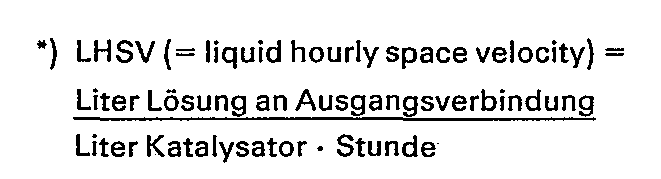
- 40 ml dieses Katalysators werden in den mittleren Teil eines senkrecht stehenden, von aussen beheizbaren Reaktor gefüllt und bei 330°C durch Überleiten von 201/h Stickstoff und 101/h Wasserstoff reduziert. Das Ausgangsmaterial 3-Di- methylamino-2-cyclohexenon wird als 50 Gew.- %ige Lösung in Toluol auf die Verdampfungszone oberhalb des Katalysators getropft und in Dampfform mit einer LHSV* von 0,9 h-1 bei 330°C zusammen mit 20 1/h Stickstoff und 101/h Wasserstoff von oben über den Katalysator geleitet. Die am Unterende des Reaktors erhaltene Produktmischung wird mittels Gaschromatographie analysiert. Bei einem Umsatz von 63% beträgt die Ausbeute an 3-Dimethylaminophenol 7%. Bei Erhöhung der Reaktionstemperatur auf 370°C beträgt die Ausbeute an 3-Dimethylaminophenol 31% bei einem Umsatz von 71%.
- Kieselsäure mit einer spezifischen Oberfläche von 100 m2/g wird mit 1 Gew.-% Pd in Form von Palladiumacetat und 0,9 Gew.-% K in Form von Kaliumhydroxid belegt. 100 ml dieses Katalysators werden in den in Beispiel 1 beschriebenen Reaktor eingefüllt und mit Wasserstoff reduziert. Eine 50 Gew.-prozentige Lösung von 3-Dimethyl- amino-2-cyclohexenon in Toluol als Schleppmittel wird mit einer LHSV von 0,25 h-1 und bei einer Reaktortemperatur von 330°C in Gegenwart von 201/h Wasserstoff verdampft und in der Gasphase dehydriert.
- Die gaschromatographische Analyse ergibt einen Umsatz von 97% und eine Ausbeute an 3-Dimethylaminophenol von 75%. Weiterhin entstehen 6 Gew.-% Cyclohexanon, 4 Gew.-% Phenol und 3 Gew.-% N,N-Dimethylanilin.
- Nach einer Betriebsdauer von etwa 50 Stunden wird der Katalysator durch Abbrennen mit 20 I/h Luft bei 400-450°C regeneriert. Nach der anschliessenden Reduktion des Katalysators wird die gleiche Ausbeute an 3-Dimethylaminophenol erhalten wie vor der Regenerierung. In einem speziellen Versuchslauf wurde eine Katalysatorstandzeit von 1000 Stunden erreicht, wobei 11 mal regeneriert wurde.
- Es wird der in Beispiel 2 beschriebene Katalysator und Reaktor benutzt. Eine 50 Gew.-%ige wässrige Lösung von 3-Dimethylamino-2-cyclo- hexenon wird verdampft und in der Gasphase bei 330°C dehydriert. Dabei werden zusätzlich 30l/h Stickstoff und 101/h Wasserstoff durch den Reaktor geleitet. Bei einer LHSV von 0,5 h-1 wird vollständiger Umsatz erreicht. Das 3-Dimethylaminophenol fällt aus der wässrigen Produktlösung in Form von weiss-braunen Kristallen aus.
- In 52 Stunden Betriebszeit werden 639 des Einsatzmaterials dehydriert. Nach Trocknung werden 617 g 3-Dimethylaminophenol erhalten, entsprechend einer Ausbeute von 98%. Die Raum-Zeit-Ausbeute beträgt 250 g/I. h. Das Produkt hat einen Schmelzpunkt von 70°C. Anschliessend wird der Katalysator durch Abbrennen mit 10 I/h Luft bei 400-450°C regeneriert und dann wieder reduziert.
- Anschliessend wird unter den gleichen Bedingungen wie vor dem Regenerieren aus 804 g Ausgangsmaterial 764g 3-Dimethylaminophenol, entsprechend 96% Ausbeute, erhalten.
- Nach einem nachmaligen Regenerieren des Katalysators werden in 50 Stunden Betriebszeit weitere 595 g 3-Dimethylaminophenol mit einer Ausbeute von 78% erhalten. Der Umsatz beträgt 95%. Das unumgesetzte Einsatzmaterial bleibt im Wasser gelöst, während das Reaktionsprodukt in kristalliner Form anfällt und abfiltriertwird.
- Es wird der in Beispiel 1 beschriebene Reaktor benutzt. 50 ml eines Katalysators mit 1 Gew.-% Pd und 0,9 Gew.-% K auf Kieselsäure mit einer spezifischen Oberfläche von 100 m2/g werden zur Dehydrierung von 3-Dimethylamino-2-cyclohexe- non eingesetzt. Das Einsatzmaterial wird als 80%ige Lösung in Wasser verdampft. Bei einer Reaktortemperatur von 350°C und einer LHSV von 0,5 h-1 werden zusätzlich 20 I/h Stickstoff und 10 I/h Wasserstoff zugeführt. Der Umsatz beträgt 100%. Das 3-Diethylaminophenol fällt in kristalliner Form aus und wird abfiltriert. Die Ausbeute beträgt 80%.
- Mit dem gleichen Katalysator und unter den gleichen Reaktionsbedingungen wie in Beispiel 4 wird 3-Methylamino-2-cyclohexenon als 40%ige Lösung in Wasser verdampft und in der Gasphase dehydriert. Das Reaktionsprodukt bildet eine wässrige und eine organische Phase. Das umgesetzte 3-Methylamino-2-cyclohexenon verbleibt in der wässrigen Phase; der Umsatz beträgt 95%. Die Ausbeute an 3-Methylaminophenol beträgt nach Destillation im Vakuum 70%.
- Ebenso wie in Beispiel 5 werden 57 g 3-Dime- thylamino-5-methyl-2-cyclohexenon als 50%ige Lösung in Wasser verdampft und in der Gasphase dehydriert. Bei einer LHSV von 0,3 h-1 beträgt der Umsatz 100%. Nach Destillation der organischen Phase des Reaktionsproduktes werden 41 g 3-Dimethylamino-5-methylphenol, entsprechend einer Ausbeute von 72%, erhalten.
Claims (6)


Applications Claiming Priority (2)
| Application Number | Priority Date | Filing Date | Title |
|---|---|---|---|
| DE19813120245 DE3120245A1 (de) | 1981-05-21 | 1981-05-21 | "verfahren zur herstellung von 3-alkylaminophenolen" |
| DE3120245 | 1981-05-21 |
Publications (2)
| Publication Number | Publication Date |
|---|---|
| EP0065733A1 EP0065733A1 (de) | 1982-12-01 |
| EP0065733B1 true EP0065733B1 (de) | 1984-07-11 |
Family
ID=6132899
Family Applications (1)
| Application Number | Title | Priority Date | Filing Date |
|---|---|---|---|
| EP82104302A Expired EP0065733B1 (de) | 1981-05-21 | 1982-05-17 | Verfahren zur Herstellung von 3-Alkylaminophenolen |
Country Status (5)
| Country | Link |
|---|---|
| EP (1) | EP0065733B1 (de) |
| JP (1) | JPS57197249A (de) |
| BR (1) | BR8202934A (de) |
| CA (1) | CA1206481A (de) |
| DE (2) | DE3120245A1 (de) |
Families Citing this family (1)
| Publication number | Priority date | Publication date | Assignee | Title |
|---|---|---|---|---|
| US5202488A (en) * | 1991-04-15 | 1993-04-13 | E. I. Du Pont De Nemours And Company | Method for the manufacture of 3-aminophenol |
Family Cites Families (1)
| Publication number | Priority date | Publication date | Assignee | Title |
|---|---|---|---|---|
| DE2402695C3 (de) * | 1974-01-21 | 1980-05-29 | Hoechst Ag, 6000 Frankfurt | Verfahren zur Herstellung von 3-Aminophenolen |
-
1981
- 1981-05-21 DE DE19813120245 patent/DE3120245A1/de not_active Withdrawn
-
1982
- 1982-05-17 EP EP82104302A patent/EP0065733B1/de not_active Expired
- 1982-05-17 DE DE8282104302T patent/DE3260363D1/de not_active Expired
- 1982-05-20 CA CA000403370A patent/CA1206481A/en not_active Expired
- 1982-05-20 BR BR8202934A patent/BR8202934A/pt unknown
- 1982-05-20 JP JP57084146A patent/JPS57197249A/ja active Pending
Also Published As
| Publication number | Publication date |
|---|---|
| DE3120245A1 (de) | 1982-12-09 |
| DE3260363D1 (en) | 1984-08-16 |
| JPS57197249A (en) | 1982-12-03 |
| CA1206481A (en) | 1986-06-24 |
| EP0065733A1 (de) | 1982-12-01 |
| BR8202934A (pt) | 1983-05-03 |
Similar Documents
| Publication | Publication Date | Title |
|---|---|---|
| DE2850680C2 (de) | ||
| EP0099516A1 (de) | Verfahren zur Herstellung von Bis(aminocyclohexyl)dialkylmethanen | |
| EP0499055B1 (de) | Verfahren zur Herstellung von Brenzcatechinen | |
| EP0494455B1 (de) | Verfahren zur Herstellung von Diphenylaminen | |
| EP0325132B1 (de) | Rhodium-Katalysatoren, Verfahren zu ihrer Herstellung und Verfahren zur Herstellung von gegebenenfalls substituiertem Diphenylamin unter Einsatz der Rhodium-Katalysatoren | |
| DE2412371C2 (de) | Herstellung von Resorcin und alkylsubstituierten Resorcinen | |
| EP0535484B1 (de) | Verfahren zur Herstellung von Diphenylaminen | |
| DE2344926C3 (de) | Verfahren zur Herstellung von 3-Halogen- bzw. 3,5-Dihalogen-phenolen | |
| EP0065733B1 (de) | Verfahren zur Herstellung von 3-Alkylaminophenolen | |
| EP0111861B1 (de) | Verfahren zur Herstellung von Aminen | |
| EP0039810A1 (de) | Verfahren zur Herstellung von 2-Trifluormethylanilin | |
| DE19627424A1 (de) | Verfahren zur Herstellung von 4-Hydroxyanilinen | |
| DE910647C (de) | Verfahren zur Herstellung von Oximen | |
| EP0470375B1 (de) | Verfahren zur Herstellung von in p-Stellung durch C1-C4-alkoxysubstituierten aromatischen Aminen | |
| DE2640026C2 (de) | Verfahren zur Herstellung von 6,10,14-Trimethylpentadecan-2-on | |
| EP1437340A1 (de) | Verfahren zur Herstellung von Aminodiphenylaminen | |
| EP0002719B1 (de) | Verfahren zur Herstellung von 3-Pyridazonen | |
| EP1035917A1 (de) | Verfahren zur herstellung eines katalysators und nach diesem verfahren erhältliche katalysatoren | |
| DE3020298C2 (de) | Verfahren zur Herstellung von 2,2,4,5,5-Pentamethyl-3-formyl-3-pyrrolin | |
| EP0051805B1 (de) | Verfahren zur Herstellung von aromatischen Aminen | |
| DE2428879A1 (de) | Verfahren zur herstellung von resorcinmonoaethern | |
| DE69328046T2 (de) | Verfahren zur Herstellung von Diphenylamin oder kernsubstituierten Derivaten | |
| DE102006057296B4 (de) | Verfahren zur Erzeugung α-Alkylzimtaldehydverbindungen | |
| EP0093892B1 (de) | Verfahren zur Herstellung von aromatischen Aminen | |
| DE2921139A1 (de) | Ethylether des isocamphyl-guajakols, verfahren zu ihrer herstellung und ihre verwendung zur herstellung von 3- eckige klammer auf isocamphyl-(5) eckige klammer zu -cyclohexanol |
Legal Events
| Date | Code | Title | Description |
|---|---|---|---|
| PUAI | Public reference made under article 153(3) epc to a published international application that has entered the european phase |
Free format text: ORIGINAL CODE: 0009012 |
|
| AK | Designated contracting states |
Designated state(s): BE CH DE FR GB IT NL |
|
| 17P | Request for examination filed |
Effective date: 19821229 |
|
| ITF | It: translation for a ep patent filed | ||
| GRAA | (expected) grant |
Free format text: ORIGINAL CODE: 0009210 |
|
| AK | Designated contracting states |
Designated state(s): BE CH DE FR GB IT LI NL |
|
| REF | Corresponds to: |
Ref document number: 3260363 Country of ref document: DE Date of ref document: 19840816 |
|
| ET | Fr: translation filed | ||
| PLBE | No opposition filed within time limit |
Free format text: ORIGINAL CODE: 0009261 |
|
| STAA | Information on the status of an ep patent application or granted ep patent |
Free format text: STATUS: NO OPPOSITION FILED WITHIN TIME LIMIT |
|
| 26N | No opposition filed | ||
| PG25 | Lapsed in a contracting state [announced via postgrant information from national office to epo] |
Ref country code: LI Effective date: 19860531 Ref country code: CH Effective date: 19860531 Ref country code: BE Effective date: 19860531 |
|
| BERE | Be: lapsed |
Owner name: HOECHST A.G. Effective date: 19860531 |
|
| GBPC | Gb: european patent ceased through non-payment of renewal fee | ||
| PG25 | Lapsed in a contracting state [announced via postgrant information from national office to epo] |
Ref country code: FR Free format text: LAPSE BECAUSE OF NON-PAYMENT OF DUE FEES Effective date: 19870130 |
|
| REG | Reference to a national code |
Ref country code: CH Ref legal event code: PL |
|
| REG | Reference to a national code |
Ref country code: FR Ref legal event code: ST |
|
| PGFP | Annual fee paid to national office [announced via postgrant information from national office to epo] |
Ref country code: NL Payment date: 19870531 Year of fee payment: 6 |
|
| PG25 | Lapsed in a contracting state [announced via postgrant information from national office to epo] |
Ref country code: GB Effective date: 19881121 |
|
| PG25 | Lapsed in a contracting state [announced via postgrant information from national office to epo] |
Ref country code: NL Effective date: 19881201 |
|
| NLV4 | Nl: lapsed or anulled due to non-payment of the annual fee | ||
| PG25 | Lapsed in a contracting state [announced via postgrant information from national office to epo] |
Ref country code: DE Effective date: 19890201 |