EP0062009A2 - Silencieux pour outillage pneumatique - Google Patents
Silencieux pour outillage pneumatique Download PDFInfo
- Publication number
- EP0062009A2 EP0062009A2 EP82830052A EP82830052A EP0062009A2 EP 0062009 A2 EP0062009 A2 EP 0062009A2 EP 82830052 A EP82830052 A EP 82830052A EP 82830052 A EP82830052 A EP 82830052A EP 0062009 A2 EP0062009 A2 EP 0062009A2
- Authority
- EP
- European Patent Office
- Prior art keywords
- casing
- silencer
- cover
- silencer according
- chamber
- Prior art date
- Legal status (The legal status is an assumption and is not a legal conclusion. Google has not performed a legal analysis and makes no representation as to the accuracy of the status listed.)
- Withdrawn
Links
Images
Classifications
-
- B—PERFORMING OPERATIONS; TRANSPORTING
- B25—HAND TOOLS; PORTABLE POWER-DRIVEN TOOLS; MANIPULATORS
- B25D—PERCUSSIVE TOOLS
- B25D17/00—Details of, or accessories for, portable power-driven percussive tools
- B25D17/11—Arrangements of noise-damping means
- B25D17/12—Arrangements of noise-damping means of exhaust silencers
-
- B—PERFORMING OPERATIONS; TRANSPORTING
- B25—HAND TOOLS; PORTABLE POWER-DRIVEN TOOLS; MANIPULATORS
- B25C—HAND-HELD NAILING OR STAPLING TOOLS; MANUALLY OPERATED PORTABLE STAPLING TOOLS
- B25C1/00—Hand-held nailing tools; Nail feeding devices
- B25C1/04—Hand-held nailing tools; Nail feeding devices operated by fluid pressure, e.g. by air pressure
- B25C1/047—Mechanical details
Definitions
- the invention relates to a silencer that is particularly suitable for deadening the noise caused by compressed air released externally through one or more discharge ducts, either from a pneumatic gun for forcibly inserting fixing elements such as nails, metal staples and similar, or from other items of pneumatic equipment.
- an operating piston controlled by a valve actuated by the trigger is destined, first of all, to place the compressed air tank incorporated in the gun, in communication with the operating cylinder, and then subsequently, to place the said operating cylinder in communication with the outside, via one or more discharge ducts.
- the purpose of fitting a silencer in series with the said discharge duct/s is, essentially, to deaden the noise produced by the very high speed at which the flow of compressed air from the operating cylinder commences intermittently.
- the pressure front downstream of the operating piston becomes, in fact, steeper as it passes along the discharge duct/s, and this is because the velocity of the particles of air in the high pressure zone (roughly the same as the velocity of sound) is greater than in the low pressure zone.
- the said front is reflected from the outlet, then from the operating piston, and so on and-so forth, and it is attenuated by the reflection energy losses; the said energy losses being accompanied by noise.
- the object the invention sets out to achieve is to make available a silencer for pneumatic equipment that consists of a restricted number of component parts, so assembled as to make full use of the system whereby noise is lost through friction, and of that whereby noise is lost through the reflection of sound waves.
- a further object of the invention is to make available a silencer for pneumatic equipment that satisfies the aforementioned object, and wherein the component parts can, furthermore, be easily and rapidly put together and, should the need arise, be taken apart, without in any way prejudicing the functional qualities of the said silencer.
- Yet another object still of the invention is to make available a silencer for pneumatic equipment that can be easily and quickly locked to and unlocked from the body of the compressed air operated device with which it works in conjunction.
- the silencer for pneumatic equipment comprising a casing, open at one extremity and closed at the other by means of a cover in which there is at least one slit, that can be locked in a removable fashion to the body of the compressed gas device with which it is used, in such a way that the open extremity communicates directly with the duct for the discharge of the gases in the said device, there being in the said casing, starting at the open extremity and going towards the cover, stably inserted and, at the same time, closely enshrouded circumferentially by the inside surface of the casing, a first element, a filter, and a second element, of which the first element defines, in cooperation with the relevant part of the inside surface of the casing, a first expansion chamber for the compressed gases, as well as, in cooperation with the second element and with the strip of the inside surface of the casing delimitated by the said elements, a second compressed gas expansion chamber that contains the said filter, while the second element defines, furthermore
- the specific task of the silencer is to cause the compressed gas to pass from the first to the second chamber, from the second to the third chamber and thence to the atmosphere (noise loss through the reflection of sound waves), as well as to cause the said gas to pass through the porous material (filter) that fills the second chamber (noise loss through friction);
- the purpose of the first chamber being to cause the compressed gas to expand (without giving rise to vortical motion) with it tending to keep a laminar flow up to the point corresponding to the inlet orifices of the through holes in the first element, where the pressure of the gas (as a consequence of the aforementioned expansion) is maximum, that is to say, at an optimum level for the gas to pass through the said holes in the first element.
- the surface of the said first element that points towards the open extremity of the casing is of a funnel conformation and is so orientated as to have the minimum area thereof positioned in the region of the said open extremity.
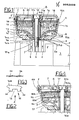
- FIG. 1 shown at 1 diagrammatically is the head of a pneumatic gun, in the top part of which there is a circular indentation 4 that is coaxial and communicating with an annular chamber 1a into which run the extremities of the discharge ducts 2 (destined to place, in accordance with known systems not described herein, the operating cylinder of the gun in communication with the outside atmosphere at the time the operating piston that slides in the inside of the said cylinder adopts afresh the non-operative position) and the extremity of another discharge duct 2a belonging to the (non-illustrated) valve that operates the gun. Furthermore, placed centrally therein the indentation 4 has a threaded hole 3, to which reference will be made in due course.
- the surface 10c of the element 10 turned towards the extremity 5a extends symmetrically with respect to the axis of the hole 10b and is so shaped as to represent a baffle for the compressed gases (flow F) coming from the chamber 1a.
- the said surface 10c extends in funnel form and is orientated in such a way that the relevant minimum cross section be positioned at a point corresponding to the open extremity 5a.
- the said surface 10c and the opposite inside surface of the casing 5 define a first chamber 12 which, starting from the extremity 5a and going upwards, increases in volume : this causes, consequently, the expansion of the compressed gases F.
- the inside surface of the casing 5 opposite the said surface 10c is curved so as not to cause vortices which would bring about energy losses and consequential noise in the flow F of compressed gases.
- the surfaces that laterally delimitate the chamber 12 are, in other words, of a conformation such as to tend to create a laminar flow for the compressed gases F.
- the element 10, close to the outside edge 10a, is provided with a plurality of through holes 13 (parallel to the axis of the hole 10b) which, in one preferred form of embodiment, constitute spaces in a toothing 14 contained in the said edge 10a (Figurs 2-and 3).
- the teeth 34 of the said toothing are bent on one and the same side ( Figure 3) with respect to a plane perpendicular to the axis of the element 10, and the reason for this will be clarified below.
- the element 17 in the region of the cover 6, there is a second element 17 that has the circumference thereof closely enshrouded by the inside surface of the casing and is provided with a plurality of transverse through holes and has in the centre a through hole 17a.
- the element 17 takes the form of a net.
- the position of the element 17 is stabilized with respect to the casing by means of a spacer 16 (constituted by a tubular member coaxial with respect to the holes 10a and 17a) interposed between the said element 17 and the said element 10.
- a second chamber 22 which, in the form of embodiment shown in Figure 1, is filled with a filter constituted by , for example, a layer 15 of porous material.
- the said layer 15 consists of two consecutive parts, 15a and 15b, that mate, one with the element 10 and the other with the element 17.
- the porosity of the material in part 15a is greater than that of the material in the part 15b, and the reason why this is so will be explained hereinafter.
- the element 17 and the opposite surface of the cover 6 define a third expansion chamber 32.
- the locking one to the other of the component parts of the silencer according to the invention, and the locking of the said silencer to the head 1 of the pneumatic gun is achieved by inserting, progressively, the shank 19a of a bolt 19 into a through hole 6a made centrally in the cover 6, into the hole 17a, into the inside of the spacer 16, and into the hole 10b, so that the said shank engages in the hole 3 to which prior reference has been made, until the head 19b of the bolt abuts with the rim of the aforementioned hole 6a.
- the compressed gases F coming from the chamber 1a gradually expand as they are passing along the chamber 12.
- the expansion of the gases causes a decrease in the velocity thereof and, in consequence, an increase in the gas pressure, which becomes maximum in zone S.
- the gases F that pass through the holes 13 are either totally or partially deviated laterally by the bent teeth 34 and they tend to go into the central zone C of the chamber 22 on account of the fact that the porosity of the part 15a is greater than that of the part 15b, the whole purpose of this being to increase the path followed by the gases F in the inside of the chamber where they are slowed down by the layer 15 of porous material, thereby achieving a noise loss through friction.
- the gases F are then released, via the slit 7, into the atmosphere where they undergo a definite expansion. This again results in a further noise loss through the reflection of sound waves.
- the layer 15 can be made with a constant porosity, while in the case of capacities that are considerable, the layer 15 can be constituted by two consecutive parts of different porosity or, by way of an alternative, the variant as per Figure 4 can be utilized.
- a third element (constituted, for example, by a disc containing a plurality of transverse through holes 51) stably positioned in the chamber 22 since it is closely enshrouded by the inside surface of the casing which, as will be recalled, is of truncated cone shape, and is, furthermore, interposed between two spacers 16a and 16b ( Figure 4).
- the element 50 divides the chamber 22 into two parts, namely a lower part 22a and an upper part 22b, the former empty and the latter filled with a filter constituted by a layer 55 of porous material which, in turn, consists qf two consecutive parts, 55a and 55b, of which the former mates with the element 50 and the latter with the element 17; the porosity of the part 55a being lesser than that of the part 55b.
- the cover 6 placed laterally there are a number of equidistant slits 7 (eight for example) and, furthermore, starting at the upper part of the cover, there is a tailpiece 6b that points downwards and is of a circular development, the diameter thereof being greater than that of the part of the cover that contains the slits 7.
- the task of the tailpiece 6b is to deviate downwards the compressed gases F which, via the slits 7, from the chamber 32 are released into the atmosphere.
- the compressed gases F that pass through the holes 13 are deviated laterally by the bent teeth 34 of the element 10 as they invade the part 22a of the chamber 22. In this way, they are deviated out of preference towards the inside of the part 22a.
- the said part 22a constitutes an expansion chamber for the gases F coming from the hole 13 and this is optimal since the passage of the gases into the part 22b.is achieved crossing the full number of holes 51 with which the element 50 is provided.
- the damping action of the part 55a of the layer 55 (the one of a lesser porosity) takes place in the most critical zone in the path followed by the gases F across the layer 55, that is to say, in the region of the discharge orifices of the holes 51 where the velocity of the gases is maximum.
- the gases F from the part 22b (where they expand and, at the same time, are slowed down) invade, via the holes 18, the chamber 32 and pass from there, via the slits 7, into the atmosphere.
- the gases F pass through the slits 7, they are deviated downwards by the tail piece 6a and thus the source of the noise (namely the gases F released into the atmosphere) tends to be kept away from the ears of the operator.
- the silencer in the form of embodiment envisaged in Figure.4, deadens the discharge noise because of noise being lost through the reflection of sound waves (with the gases F passing through the holes 13, 51 and 18 and through the slits 7) and because of noise being lost through friction (with the gases F passing across the layer 55).
Landscapes
- Engineering & Computer Science (AREA)
- Mechanical Engineering (AREA)
- Physics & Mathematics (AREA)
- Fluid Mechanics (AREA)
- Exhaust Silencers (AREA)
- Portable Nailing Machines And Staplers (AREA)
Applications Claiming Priority (2)
| Application Number | Priority Date | Filing Date | Title |
|---|---|---|---|
| IT480581U | 1981-03-31 | ||
| ITBO1981U4805U IT8104805U1 (it) | 1981-03-31 | 1981-03-31 | Silenziatore di scarico in particolare per pistole e attrezzature pneumatiche |
Publications (2)
| Publication Number | Publication Date |
|---|---|
| EP0062009A2 true EP0062009A2 (fr) | 1982-10-06 |
| EP0062009A3 EP0062009A3 (fr) | 1983-02-23 |
Family
ID=11113994
Family Applications (1)
| Application Number | Title | Priority Date | Filing Date |
|---|---|---|---|
| EP82830052A Withdrawn EP0062009A3 (fr) | 1981-03-31 | 1982-03-10 | Silencieux pour outillage pneumatique |
Country Status (4)
| Country | Link |
|---|---|
| US (1) | US4424883A (fr) |
| EP (1) | EP0062009A3 (fr) |
| ES (1) | ES264193Y (fr) |
| IT (1) | IT8104805U1 (fr) |
Cited By (5)
| Publication number | Priority date | Publication date | Assignee | Title |
|---|---|---|---|---|
| EP0147262A1 (fr) * | 1983-11-10 | 1985-07-03 | CHARBONNAGES DE FRANCE, Etablissement public dit: | Carter insonorisant pour marteau pneumatique de foration |
| EP0446726A1 (fr) * | 1990-03-10 | 1991-09-18 | Miksa Marton Dualflex Company Ltd. | Dispositif antibruit |
| AT393982B (de) * | 1987-10-01 | 1992-01-10 | Paslode Gmbh | Druckluftnagelgeraet |
| EP0720892A1 (fr) * | 1995-01-04 | 1996-07-10 | Joh. Friedrich Behrens AG | Outil d'enforcement des moyens de fixation |
| DE102008028938A1 (de) * | 2008-03-28 | 2009-10-01 | TRANMAX MACHINERY Co., Ltd., Taiping | Druckluftwerkzeug mit Lärmminderungsfunktion |
Families Citing this family (33)
| Publication number | Priority date | Publication date | Assignee | Title |
|---|---|---|---|---|
| JPS6047869U (ja) * | 1983-09-09 | 1985-04-04 | 株式会社 共立 | 消音フイルタ− |
| DE3634579A1 (de) * | 1986-10-10 | 1988-04-21 | Paul Schmidt | Pneumatisches rammbohrgeraet |
| JPS6472727A (en) * | 1987-09-14 | 1989-03-17 | Terumo Corp | Automatic hemomanometer |
| US5097924A (en) * | 1988-06-08 | 1992-03-24 | Mcneil (Ohio) Corporation | Muffler for a compressed air driven motor |
| US5731556A (en) * | 1996-09-30 | 1998-03-24 | Ingersoll-Rand Company | Muffler for pneumatic device |
| US6202785B1 (en) | 1999-06-02 | 2001-03-20 | 3M Innovative Properties Company | Muffler with acoustic absorption insert for limited clearance pneumatic device applications |
| US6089346A (en) * | 1999-06-02 | 2000-07-18 | 3M Innovative Properties Company | Muffler with acoustic barrier material for limited clearance pneumatic device applications |
| US6161646A (en) * | 1999-08-17 | 2000-12-19 | Eaton Aeroquip Inc. | Turbo-generator exhaust noise silencer |
| US6325844B1 (en) * | 2000-05-31 | 2001-12-04 | Florida Pneumatic Manufacturing Corporation | Filter and muffler device for vacuum mechanism |
| US7223266B2 (en) * | 2003-02-04 | 2007-05-29 | Cardiodex Ltd. | Methods and apparatus for hemostasis following arterial catheterization |
| US6935460B2 (en) * | 2003-05-21 | 2005-08-30 | Airsep Corporation | Noise muffler for oxygen concentrator |
| JP4367918B2 (ja) * | 2004-01-09 | 2009-11-18 | 本田技研工業株式会社 | 小型エンジンの排気装置 |
| DE102005007290B3 (de) * | 2005-02-17 | 2006-07-27 | Itw-Befestigungssysteme Gmbh | Gasstromschalldämpfer |
| US7530427B2 (en) * | 2006-06-12 | 2009-05-12 | Briggs & Stratton Corporation | Exhaust deflector for a muffler |
| US7530428B2 (en) * | 2006-06-12 | 2009-05-12 | Briggs & Stratton Corporation | Exhaust deflector for a muffler |
| US20080099277A1 (en) * | 2006-10-30 | 2008-05-01 | Basso Industry Corp. | Muffler for pneumatic tools |
| US7900316B2 (en) * | 2007-01-30 | 2011-03-08 | Bissell Homecare Inc. | Filter for a vacuum cleaner |
| DE202007006627U1 (de) * | 2007-05-09 | 2007-07-19 | Knorr-Bremse Systeme für Nutzfahrzeuge GmbH | Schalldämpfer |
| WO2009086619A1 (fr) * | 2008-01-04 | 2009-07-16 | Audeval Solutions Inc. | Silencieux pour outil pneumatique portatif |
| US7878299B2 (en) * | 2008-02-13 | 2011-02-01 | Geyer Iii Robert E | Silencer apparatus with disposable silencer cartridge unit |
| TWI387514B (zh) * | 2010-09-20 | 2013-03-01 | 鑽全實業股份有限公司 | High pressure nail gun that eliminates exhaust noise |
| DE102012112069A1 (de) * | 2012-12-11 | 2014-06-12 | Hella Kgaa Hueck & Co. | Pumpe |
| EP3055597B1 (fr) | 2013-10-08 | 2019-02-27 | Dayco IP Holdings, LLC | Atténuation de bruit dans une unité clapet de retenue ou appareil de production de vide |
| CN105190011B (zh) * | 2013-12-09 | 2018-04-13 | 戴科知识产权控股有限责任公司 | 用于发动机系统的噪声衰减单元 |
| US10107240B2 (en) | 2014-04-04 | 2018-10-23 | Dayco Ip Holdings, Llc | Check valves and Venturi devices having the same |
| US10024339B2 (en) | 2014-05-30 | 2018-07-17 | Dayco Ip Holdings, Llc | Vacuum creation system having an ejector, pneumatic control valve and optionally an aspirator |
| US9382826B1 (en) | 2015-01-09 | 2016-07-05 | Dayco Ip Holdings, Llc | Noise attenuating member for noise attenuating units in engines |
| JP6480589B2 (ja) | 2015-01-09 | 2019-03-13 | デイコ アイピー ホールディングス, エルエルシーDayco Ip Holdings, Llc | クランクケース換気吸引器 |
| JP6554552B2 (ja) | 2015-04-13 | 2019-07-31 | デイコ アイピー ホールディングス, エルエルシーDayco Ip Holdings, Llc | ベンチュリ効果を使用して真空を生じさせるための装置 |
| JP6655162B2 (ja) | 2015-07-17 | 2020-02-26 | デイコ アイピー ホールディングス, エルエルシーDayco Ip Holdings, Llc | 原動セクションに複数の副通路および原動出口を有する、ベンチュリー効果を利用して真空を発生させるためのデバイス |
| WO2017075390A1 (fr) | 2015-10-28 | 2017-05-04 | Dayco IP Holding, LLC | Dispositifs venturi résistant à la formation de glace pour produire un vide à partir de gaz de carter de vilebrequin |
| DE102017122215A1 (de) | 2017-09-26 | 2019-03-28 | Knorr-Bremse Systeme für Nutzfahrzeuge GmbH | Geräuschdämpfer für Druckluftsysteme und ein Verfahren zu dessen Herstellung |
| US11371404B2 (en) * | 2019-08-13 | 2022-06-28 | Herbert Anderson | Engine muffler apparatus |
Family Cites Families (8)
| Publication number | Priority date | Publication date | Assignee | Title |
|---|---|---|---|---|
| US226905A (en) * | 1880-04-27 | Noise-quieting nozzle | ||
| GB191409414A (fr) * | 1900-01-01 | |||
| GB235929A (en) * | 1924-02-28 | 1925-06-29 | Nicholas Straussler | Improvements in or relating to silencers for gaseous currents |
| NL7104328A (fr) * | 1971-03-31 | 1972-10-03 | ||
| CA980258A (en) * | 1973-06-14 | 1975-12-23 | Sherritt Gordon Mines Limited | Exhaust gas silencer |
| DE2601483C3 (de) * | 1976-01-16 | 1980-02-28 | Armaturen- Und Autogengeraetefabrik Ewo Hermann Holzapfel Kg, 7000 Stuttgart | Schalldämpfer |
| US4109753A (en) * | 1976-11-19 | 1978-08-29 | Midas-International Corporation | Muffler assembly |
| DE2933105C2 (de) * | 1979-08-16 | 1983-12-15 | Robert Bosch Gmbh, 7000 Stuttgart | Schalldämpfer |
-
1981
- 1981-03-31 IT ITBO1981U4805U patent/IT8104805U1/it unknown
-
1982
- 1982-03-09 US US06/356,446 patent/US4424883A/en not_active Expired - Fee Related
- 1982-03-10 EP EP82830052A patent/EP0062009A3/fr not_active Withdrawn
- 1982-03-29 ES ES1982264193U patent/ES264193Y/es not_active Expired
Cited By (5)
| Publication number | Priority date | Publication date | Assignee | Title |
|---|---|---|---|---|
| EP0147262A1 (fr) * | 1983-11-10 | 1985-07-03 | CHARBONNAGES DE FRANCE, Etablissement public dit: | Carter insonorisant pour marteau pneumatique de foration |
| AT393982B (de) * | 1987-10-01 | 1992-01-10 | Paslode Gmbh | Druckluftnagelgeraet |
| EP0446726A1 (fr) * | 1990-03-10 | 1991-09-18 | Miksa Marton Dualflex Company Ltd. | Dispositif antibruit |
| EP0720892A1 (fr) * | 1995-01-04 | 1996-07-10 | Joh. Friedrich Behrens AG | Outil d'enforcement des moyens de fixation |
| DE102008028938A1 (de) * | 2008-03-28 | 2009-10-01 | TRANMAX MACHINERY Co., Ltd., Taiping | Druckluftwerkzeug mit Lärmminderungsfunktion |
Also Published As
| Publication number | Publication date |
|---|---|
| IT8104805V0 (it) | 1981-03-31 |
| EP0062009A3 (fr) | 1983-02-23 |
| IT8104805U1 (it) | 1982-10-01 |
| US4424883A (en) | 1984-01-10 |
| ES264193U (es) | 1982-11-16 |
| ES264193Y (es) | 1983-05-16 |
Similar Documents
| Publication | Publication Date | Title |
|---|---|---|
| US4424883A (en) | Silencer for pneumatic equipment | |
| US5029512A (en) | Firearm muzzle silencer | |
| US4267899A (en) | Muffler assembly | |
| EP0219218B1 (fr) | Dispositif d'insonorisation | |
| CA1092984A (fr) | Pare-etincelle et silencieux | |
| US3889776A (en) | Exhaust gas silencer | |
| US3941206A (en) | Noise attenuating snubber | |
| US3680659A (en) | Noise muffler having a unique pressure safety valve | |
| US4550799A (en) | Muffler for exhaust gases | |
| US5200582A (en) | Passive muffler for low pass frequencies | |
| US3688868A (en) | Expansion chambered, fail-safe muffler | |
| GB2056563A (en) | Pneumatic exhaust | |
| US2189424A (en) | Surge filter for pulsating gases | |
| US2329101A (en) | Apparatus for silencing pulsating gas streams and separating particles therefrom | |
| US3679024A (en) | Muffler | |
| KR102000858B1 (ko) | 소음기 | |
| US3117650A (en) | Silencing element for exhaust gas conduit | |
| US3491850A (en) | Sound silencing apparatus | |
| CZ20022795A3 (cs) | Tlumič zvuku pro kompresory | |
| SU1574918A1 (ru) | Глушитель шума вентил тора | |
| KR200234117Y1 (ko) | 소음기 | |
| GB2374385A (en) | I.c. engine exhaust component for removing sparks and attenuating noise | |
| SU1453059A1 (ru) | Способ глушени шума выхлопа двигател внутреннего сгорани и устройство дл его осуществлени | |
| JPS5819285Y2 (ja) | 消音器 | |
| RU15770U1 (ru) | Реактивный глушитель шума пневмотранспорта |
Legal Events
| Date | Code | Title | Description |
|---|---|---|---|
| PUAI | Public reference made under article 153(3) epc to a published international application that has entered the european phase |
Free format text: ORIGINAL CODE: 0009012 |
|
| AK | Designated contracting states |
Designated state(s): AT BE DE FR GB NL SE |
|
| PUAL | Search report despatched |
Free format text: ORIGINAL CODE: 0009013 |
|
| AK | Designated contracting states |
Designated state(s): AT BE DE FR GB NL SE |
|
| STAA | Information on the status of an ep patent application or granted ep patent |
Free format text: STATUS: THE APPLICATION IS DEEMED TO BE WITHDRAWN |
|
| 18D | Application deemed to be withdrawn |
Effective date: 19840204 |
|
| RIN1 | Information on inventor provided before grant (corrected) |
Inventor name: MUSIANI, FRANCO |