EP0057594B1 - Tintenstrahlgerät - Google Patents
Tintenstrahlgerät Download PDFInfo
- Publication number
- EP0057594B1 EP0057594B1 EP82300479A EP82300479A EP0057594B1 EP 0057594 B1 EP0057594 B1 EP 0057594B1 EP 82300479 A EP82300479 A EP 82300479A EP 82300479 A EP82300479 A EP 82300479A EP 0057594 B1 EP0057594 B1 EP 0057594B1
- Authority
- EP
- European Patent Office
- Prior art keywords
- ink jet
- waveguide
- chamber
- ink
- transducer
- Prior art date
- Legal status (The legal status is an assumption and is not a legal conclusion. Google has not performed a legal analysis and makes no representation as to the accuracy of the status listed.)
- Expired
Links
Images

Classifications
-
- B—PERFORMING OPERATIONS; TRANSPORTING
- B41—PRINTING; LINING MACHINES; TYPEWRITERS; STAMPS
- B41J—TYPEWRITERS; SELECTIVE PRINTING MECHANISMS, i.e. MECHANISMS PRINTING OTHERWISE THAN FROM A FORME; CORRECTION OF TYPOGRAPHICAL ERRORS
- B41J2/00—Typewriters or selective printing mechanisms characterised by the printing or marking process for which they are designed
- B41J2/005—Typewriters or selective printing mechanisms characterised by the printing or marking process for which they are designed characterised by bringing liquid or particles selectively into contact with a printing material
- B41J2/01—Ink jet
- B41J2/135—Nozzles
- B41J2/145—Arrangement thereof
-
- B—PERFORMING OPERATIONS; TRANSPORTING
- B41—PRINTING; LINING MACHINES; TYPEWRITERS; STAMPS
- B41J—TYPEWRITERS; SELECTIVE PRINTING MECHANISMS, i.e. MECHANISMS PRINTING OTHERWISE THAN FROM A FORME; CORRECTION OF TYPOGRAPHICAL ERRORS
- B41J2/00—Typewriters or selective printing mechanisms characterised by the printing or marking process for which they are designed
- B41J2/005—Typewriters or selective printing mechanisms characterised by the printing or marking process for which they are designed characterised by bringing liquid or particles selectively into contact with a printing material
- B41J2/01—Ink jet
- B41J2/015—Ink jet characterised by the jet generation process
- B41J2/04—Ink jet characterised by the jet generation process generating single droplets or particles on demand
- B41J2/045—Ink jet characterised by the jet generation process generating single droplets or particles on demand by pressure, e.g. electromechanical transducers
- B41J2/055—Devices for absorbing or preventing back-pressure
-
- B—PERFORMING OPERATIONS; TRANSPORTING
- B41—PRINTING; LINING MACHINES; TYPEWRITERS; STAMPS
- B41J—TYPEWRITERS; SELECTIVE PRINTING MECHANISMS, i.e. MECHANISMS PRINTING OTHERWISE THAN FROM A FORME; CORRECTION OF TYPOGRAPHICAL ERRORS
- B41J2/00—Typewriters or selective printing mechanisms characterised by the printing or marking process for which they are designed
- B41J2/005—Typewriters or selective printing mechanisms characterised by the printing or marking process for which they are designed characterised by bringing liquid or particles selectively into contact with a printing material
- B41J2/01—Ink jet
- B41J2/135—Nozzles
- B41J2/14—Structure thereof only for on-demand ink jet heads
- B41J2/14201—Structure of print heads with piezoelectric elements
- B41J2/14274—Structure of print heads with piezoelectric elements of stacked structure type, deformed by compression/extension and disposed on a diaphragm
Definitions
- This invention relates to ink jets, more particularly, to ink jets adapted to eject a droplet of ink from an orifice for purposes of marking on a copy medium.
- the stimulating element or transducers of such an array are sufficiently bulky so as to impose serious limitations on the density in which ink jets may be arrayed.
- the transducers must typically comprise a certain finite size so as to provide the energy and displacements required to produce a change in ink jet chamber volume which results in the ejection of a droplet of ink from the orifice associated with the ink chamber.
- the ink jet transducers become intimately associated with the fluidic section of the ink jet, i.e., the ink chambers and orifices.
- any failure in the fluidic section of the device which is far more common than a failure of the transducer, necessitates the disposal of the entire apparatus, i.e., both the fluidic section and the transducer.
- jet information is triggered ultrasonically and transmitted along an ultrasonic acoustic waveguide, comprising a bundle of fine wire, which extends through an ink-containing reservoir and terminates at the location of an ink ejecting exit aperture so that the waveguide can apply a pulse of ultrasonic energy locally at an ink meniscus formed at the exit aperture by electrostatic attraction from an electrode located between the exit aperture and the printing medium.
- This applied pulse causes an instability in the meniscus which grows until a droplet can be pulled off by external electrostatic attraction.
- Ink is admitted into the reservoir via an inlet in a side wall of the reservoir.
- an ink jet apparatus comprising an ink jet chamber for receiving ink, said chamber having an ink ejecting outlet orifice, an energiseable transducer located separately from said chamber; and an acoustic waveguide coupled between said ink jet chamber and said transducer for transmitting acoustic pulses generated at said transducer to said ink in response to the state of energisation of said transducer, so as to cause ink droplets to be ejected from said chamber, characterised by an inlet port in said waveguide which comprises a hole for coupling ink from a reservoir to said chamber via a passageway included in said waveguide.
- the acoustic waveguide may be an elongated either solid or tubular acoustic waveguide coupled between the ink jet chamber and the transducer.
- the acoustic waveguide transmits acoustic pulses generated at the transducer to the chamber for changing the volume of the chamber in response to the state of energisation of the transducer.
- acoustic pulses are transmitted along the waveguide in the following manner.
- the ends thereof move in an axial direction in an amount determined by the voltage applied to the transducer. If one end of said transducer is affixed to a solid back piece, the other end will move against the abutted end of the waveguide. The abutted end of the waveguide will then be driven along in the same direction by an amount corresponding to that of the end of the transducer.
- the driving pulse is sharp, e.g., the voltage takes a short time to reach its final value, the end of the transducer will move fast, and only part of said waveguide will be able to follow the fast motion.
- the rest of the waveguide will stay at rest.
- the end of the waveguide that was initially deformed will relax by pushing and elastically deforming consecutive portions along the waveguide. This successive displacement of the elastic deformation ultimately reaches the distal end of the waveguide.
- the last portion thereof causes the fluid within the chamber to be compressed and thus causes the ejection of fluid droplets from the nozzle orifice.
- the physical properties used are those of a true wave travelling along the waveguide length and not those of a push rod whereby when one end of the rod is moved, the other end will move in unison.
- a plurality of such ink jets is utilised in an array such that the spacing from center to center of transducers is substantially greater than the spacing from axis to axis of the orifices.
- This relative spacing of transducers as compared with orifices is accomplished by converging the acoustic waveguide toward the orifices.
- all of the transducers are located at one side of the axis of the orifice at one extremity of the array.
- the waveguides may be of differing lengths along the axes of elongation.
- the waveguides are tapered so that their diameter at the distal ends are substantially smaller than those at the transducer ends. This tapering of the waveguides provides yet closer spacing between the waveguides, thus further increasing the channel density.
- the tapered ends of the waveguides are made of tubular material to provide the fluid feed passageways to thus maintain the chambers filled with fluid.
- the fluid feed passageways can each be provided with an orifice at the distal end having a cross-sectional area smaller than the cross-sectional area of said fluid passageway so as to serve as a restrictor to control the flow of fluid passing therethrough.
- the chambers of the ink jets may include a diaphragm coupled to the waveguide such that the diaphragm contracts and expands in response to the state of energisation of the transducer in a direction having at least a component parallel with the axis of the orifice.
- each waveguide it is possible for each waveguide to abut the transducer and be held thereon by means of a metal or ceramic ferrule that fits both the transducer end and the waveguide end.
- Each acoustic waveguide may be elongated such that the overall length along the axis of elongation greatly exceeds the dimension of the waveguide transverse to the axis.
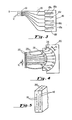
- an ink jet array comprising a plurality of jets 10 are arranged in a line so as to asynchronously eject ink droplets 13 on demand.
- the jets 10 comprise chambers 14 having outlet orifices 16 from which the droplets 12 are ejected.
- the chambers expand and contract in response to the state of energisation of transducers 18, which are coupled to the chambers 14 by acoustic waveguides 20.
- the waveguides 20 may actually penetrate into said chamber by a distance d, as shown in Fig. 2, such penetration being clearly illustrated in Figure 2c, but it will be noticed that the waveguides terminate at a spacing from the outlet orifices 16.
- Acoustic pulses are transmitted along the waveguide 20 in the following manner.
- the ends thereof move in an axial direction, i.e., the direction parallel with the axis of elongation of the waveguide 20, in an amount determined by the voltage applied to the transducer 18. Since one end of the transducer 18 is affixed to a solid back piece, the other end will move against the abutting end of the waveguide 20. The abutting end of the waveguide 20 will then be driven in the same direction by an amount corresponding to the end of the transducer 18.
- the end of the transducer will move fast; the end of the waveguide will move fast in a similar manner, and only part of the waveguide 20 will be able to follow the fast motion.
- the rest of the waveguide will stay at rest.
- the end of the waveguide that was initially deformed will relax by pushing an elastically deforming consecutive portion along the waveguides 20. This successive displacement of the elastic deformation ultimately reaches the distal end of the waveguide 20.
- the last portion thereof causes the fluid within the chamber 14 to be compressed and thus causes the ejection of fluid droplets from the orifice.
- the physical properties used are those of a true waveguide travelling along the waveguide length and not those of a piston whereby one end of the rod is moved and the other end will move in unison.
- the chambers 14 are coupled to a passageway 24 in the waveguide 20 which is terminated at the distal end 22 by an opening 26.
- the opening 26 is of a reduced cross-sectional area as compared with the cross-sectional area of the waveguide a greater distance from the orifice 16 (i.e., the passageway tapers) so as to provide a restrictor at the inlet to the chamber 14.
- Ink enters the passageway 24 in the waveguide 20 through an opening 28, as perhaps best shown in Figs. 2, 2a and 2c.
- the remainder of the waveguide 20 may be filled with a suitable material 30 such as a metal piece or epoxy encapsulant.
- the distal end 22 of the waveguide 20 expands and contracts the volume of the chamber 14 in a direction 32 having at least a component parallel with the axis of the orifice 16. It will, of course, be appreciated that the waveguides 20 necessarily extend in a direction having at least component parallel with the direction of the expansion and contraction of the ends 22 of the waveguides 20.
- the waveguides 20 as shown in Fig. 1 are elongated. As utilized herein, the waveguides 20 are considered elongated as long as the overall length along the axis of acoustic propagation greatly exceeds the dimension of the waveguide transverse to the axis, e.g., more than 10 times greater.
- the waveguides 20 actually penetrate into the chambers 14.
- the position of the waveguides 20 in the chambers 14 may be preserved by maintaining a close tolerance between the external dimension of the waveguides 20 and the walls of the chamber 14 as formed in a block 34.
- the block 34 may comprise a variety of materials including plastics, metals and/or ceramics.
- the transducers 18 are potted within a potting material 36 which may comprise elastomers or foams.
- the waveguides 20 are also encapsulated or potted within a material 38 as shown in Figs. 1 and 2.
- each waveguide 20 may be surrounded by a sleeve 40, which assists in attenuating flexural vibrations or resonances in the waveguide 20.
- sleeve 40 may be eliminated and the potting material 38 may be relied upon to attenuate resonances.
- a suitable potting material 38 includes elastomers, polyethylene or polystyrene.
- the potting material 38 is separated from the chamber block 34 by a gasket 41 which may comprise an elastomer.
- the transducers 18 must be energized in order to transmit an acoustic pulse along the waveguides 20. Although no leads have been shown as coupled to the transducers 18, it will be appreciated that such leads will be provided for energization of the transducers 18.
- ink flows through the inlet ports 28 in each of the waveguides 20 from a chamber 42 which communicates through a channel 44 to a pump 46.
- the pump 46 supplies ink under the appropriate regulated pressure from a supply 48 to the chamber 42.
- the pressure regulation afforded by the pump 46 is important, particularly in a typewriter environment, since considerable liquid sloshing and accompanying changes in liquid pressure within the chamber 42 and a passageway 44 may occur.
- the end of the ink jet array is capped by a member 50 which covers foot members 52 at the ends of the transducers 22 as well as the end of the pump 46.
- some of the waveguides 24 individually extend in a substantially straight line to the respective chambers 14. Others may be bent or curved toward the chambers 14.
- a somewhat different transducer construction is utilized. More particularly, an integral transduer 118 having a plurality of legs 118 (a-f) coupled to, for example, five jets 110 of the type shown in Fig. 1 through waveguides 120.
- the configuration of the transducer block 118 is immaterial so far as the density of the array of ink jets is concerned.
- the disposition of the array of ink jets 110 may be changed vis-a-vis the transducer block 118.
- the arrangement of transducers 118 (a-f) is offset laterally (shown as below) with respect to the axis x through the orifice of the jet 110 located at one extremity (shown as the upper extremity) of the array.
- the ink jet arrays are well suited for use in a printer application requiring last character visibility because of the skewing of the transducers to one side of the array of jets 10.
- a plurality of transducers 218 and jets 210 are mounted on a two-tiered head 200. Once again, the jets 210 are very closely spaced so as to achieve a dense array while the transducers 218 are more substantially spaced.
- Fig. 5 shows an arrangement whereby two or more heads 200 shown in Fig. 4 are sandwiched together to thus form heads that have multiple rows of jets 210 with the purpose of multiplying the writing capability of the heads and thereby increasing the resolution of the characters generated.
- the overall lengths of the waveguides vary. This allows the distance between the transducers to be maximized so as to minimize cross talk between transducers as well as between waveguides.
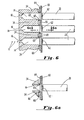
- a somewhat different embodiment is shown wherein the acoustic waveguides 20 are coupled to the chambers 14 in a somewhat different manner.
- the ends of the chambers 14 remote from the orifices 16 are terminated by a diaphragm 60 including protrusions 62 which abut the waveguides 20.
- Ink is capable of flowing into the chambers 14through orifices 65 shown in Fig. 6a adjacent a restrictor plate 64.
- the openings 65 communicate with a reservoir 66 in the manner disclosed in the aforesaid application.
- the block 34 includes lands 68 which form the restrictor openings 65 to the chamber 14 in combination with the restrictor plate 64.
- the pulse from a transducer travels along each of the waveguides 20 in the embodiment shown in Fig. 6 until such time as it reaches a projection 62 on the diaphragm 60.
- the diaphragm 60 expands and contracts in a direction generally corresponding to and parallel with the axis of elongation of the waveguides 20 at the projection 62.
- the fluidic reaction of this embodiment including the chamber 14 may be reparable from the waveguides 20 at the diaphragm 62 in accordance with one important object of the invention.
- Acoustic waveguides suitable for use in the various embodiments of this invention include waveguides made of such material as tungsten, stainless steel or titanium, or other hard materials such as ceramics, or glass fibers. In choosing an acoustic waveguide, it is particularly important that the transmissibility of the waveguide material be a maximum for acoustic waves and its strength also be a maximum.
- the mechanism by which the waveguides operate in conjunction with the transducer may be described as follows.
- An electrical pulse arrives at the transducer.
- the transducer first retracts (fill cycle) and then expands.
- the retraction, followed by expansion results in displacements at the transducer face, which are imposed at the end of the waveguide which is touching the transducer.
- part of the end of the waveguide will be compressed elastically.
- This initial compression will launch a compressional impulse along the waveguide with a speed equal to the speed of sound in the material of the waveguide.
- the impulse will arrive at the distal end of the waveguide; it will, thus, alter the volume of the chamber and generate droplets.
- An impulse, I is defined as a large force acting for a very short time which can never be rigorously realized in practice. However, it is useful to assume this case because it provides insight into the understanding of waveguide operation.
- the kinetic energy provided by unit impulse on the first end of the waveguide is derived as follows:
- the particle velocity is:
- KE kinetic energy
- the KE of the whole wave system is:
- the total energy of the impulse motion per unit volume is:
- the varying compression pressure P at any point relates to particle velocity in the medium as follows: (constant, depending on the material).
- the energy loss from the guide into the environment is calculated by: where R is the total reflected energy from the environment surrounding the waveguide and the material of the waveguide, R 1 is the reflected energy from the material, and R 2 is the reflected energy in the environment surrounding the waveguide.
- P2 is the density of air or material surrounding the wavequide.
Landscapes
- Particle Formation And Scattering Control In Inkjet Printers (AREA)
- Ink Jet (AREA)
Claims (14)
Priority Applications (1)
| Application Number | Priority Date | Filing Date | Title |
|---|---|---|---|
| AT82300479T ATE14543T1 (de) | 1981-01-30 | 1982-01-29 | Tintenstrahlgeraet. |
Applications Claiming Priority (2)
| Application Number | Priority Date | Filing Date | Title |
|---|---|---|---|
| US22999281A | 1981-01-30 | 1981-01-30 | |
| US229992 | 1981-01-30 |
Publications (3)
| Publication Number | Publication Date |
|---|---|
| EP0057594A2 EP0057594A2 (de) | 1982-08-11 |
| EP0057594A3 EP0057594A3 (en) | 1983-04-06 |
| EP0057594B1 true EP0057594B1 (de) | 1985-07-31 |
Family
ID=22863533
Family Applications (1)
| Application Number | Title | Priority Date | Filing Date |
|---|---|---|---|
| EP82300479A Expired EP0057594B1 (de) | 1981-01-30 | 1982-01-29 | Tintenstrahlgerät |
Country Status (5)
| Country | Link |
|---|---|
| EP (1) | EP0057594B1 (de) |
| JP (1) | JPS57146665A (de) |
| AT (1) | ATE14543T1 (de) |
| CA (1) | CA1175359A (de) |
| DE (1) | DE3264965D1 (de) |
Families Citing this family (23)
| Publication number | Priority date | Publication date | Assignee | Title |
|---|---|---|---|---|
| IT1156090B (it) * | 1982-10-26 | 1987-01-28 | Olivetti & Co Spa | Metodo e dispositivo di stampa a getto d inchiostro |
| DE3306098A1 (de) * | 1983-02-22 | 1984-08-23 | Siemens AG, 1000 Berlin und 8000 München | Piezoelektrisch betriebener schreibkopf mit kanalmatrize |
| GB2513884B (en) | 2013-05-08 | 2015-06-17 | Univ Bristol | Method and apparatus for producing an acoustic field |
| GB2530036A (en) | 2014-09-09 | 2016-03-16 | Ultrahaptics Ltd | Method and apparatus for modulating haptic feedback |
| US10101811B2 (en) | 2015-02-20 | 2018-10-16 | Ultrahaptics Ip Ltd. | Algorithm improvements in a haptic system |
| WO2016132144A1 (en) | 2015-02-20 | 2016-08-25 | Ultrahaptics Ip Limited | Perceptions in a haptic system |
| US10818162B2 (en) | 2015-07-16 | 2020-10-27 | Ultrahaptics Ip Ltd | Calibration techniques in haptic systems |
| US10268275B2 (en) | 2016-08-03 | 2019-04-23 | Ultrahaptics Ip Ltd | Three-dimensional perceptions in haptic systems |
| US10943578B2 (en) | 2016-12-13 | 2021-03-09 | Ultrahaptics Ip Ltd | Driving techniques for phased-array systems |
| US11531395B2 (en) | 2017-11-26 | 2022-12-20 | Ultrahaptics Ip Ltd | Haptic effects from focused acoustic fields |
| US11704983B2 (en) | 2017-12-22 | 2023-07-18 | Ultrahaptics Ip Ltd | Minimizing unwanted responses in haptic systems |
| WO2019122912A1 (en) | 2017-12-22 | 2019-06-27 | Ultrahaptics Limited | Tracking in haptic systems |
| SG11202010752VA (en) | 2018-05-02 | 2020-11-27 | Ultrahaptics Ip Ltd | Blocking plate structure for improved acoustic transmission efficiency |
| US11098951B2 (en) | 2018-09-09 | 2021-08-24 | Ultrahaptics Ip Ltd | Ultrasonic-assisted liquid manipulation |
| WO2020141330A2 (en) | 2019-01-04 | 2020-07-09 | Ultrahaptics Ip Ltd | Mid-air haptic textures |
| US12373033B2 (en) | 2019-01-04 | 2025-07-29 | Ultrahaptics Ip Ltd | Mid-air haptic textures |
| US11842517B2 (en) | 2019-04-12 | 2023-12-12 | Ultrahaptics Ip Ltd | Using iterative 3D-model fitting for domain adaptation of a hand-pose-estimation neural network |
| US11374586B2 (en) | 2019-10-13 | 2022-06-28 | Ultraleap Limited | Reducing harmonic distortion by dithering |
| JP7611244B2 (ja) | 2019-10-13 | 2025-01-09 | ウルトラリープ リミテッド | 仮想マイクロフォンによる動的キャッピング |
| US11715453B2 (en) | 2019-12-25 | 2023-08-01 | Ultraleap Limited | Acoustic transducer structures |
| US11816267B2 (en) | 2020-06-23 | 2023-11-14 | Ultraleap Limited | Features of airborne ultrasonic fields |
| US11886639B2 (en) | 2020-09-17 | 2024-01-30 | Ultraleap Limited | Ultrahapticons |
| US12517585B2 (en) | 2021-07-15 | 2026-01-06 | Ultraleap Limited | Control point manipulation techniques in haptic systems |
Family Cites Families (3)
| Publication number | Priority date | Publication date | Assignee | Title |
|---|---|---|---|---|
| JPS5830834B2 (ja) * | 1975-02-13 | 1983-07-01 | ソニー株式会社 | インクプリント装置 |
| DE2756134A1 (de) * | 1977-12-16 | 1979-06-21 | Ibm Deutschland | Piezoelektrisch gesteuerte antriebsanordnung zur erzeugung hoher stossgeschwindigkeiten und/oder gesteuerter huebe |
| DE2808275C2 (de) * | 1978-02-27 | 1983-03-10 | NCR Corp., 45479 Dayton, Ohio | Tintenstrahldruckkopf |
-
1981
- 1981-11-19 CA CA000390482A patent/CA1175359A/en not_active Expired
-
1982
- 1982-01-29 DE DE8282300479T patent/DE3264965D1/de not_active Expired
- 1982-01-29 AT AT82300479T patent/ATE14543T1/de not_active IP Right Cessation
- 1982-01-29 EP EP82300479A patent/EP0057594B1/de not_active Expired
- 1982-01-30 JP JP57012580A patent/JPS57146665A/ja active Granted
Also Published As
| Publication number | Publication date |
|---|---|
| ATE14543T1 (de) | 1985-08-15 |
| CA1175359A (en) | 1984-10-02 |
| JPH0221946B2 (de) | 1990-05-16 |
| JPS57146665A (en) | 1982-09-10 |
| DE3264965D1 (en) | 1985-09-05 |
| EP0057594A2 (de) | 1982-08-11 |
| EP0057594A3 (en) | 1983-04-06 |
Similar Documents
| Publication | Publication Date | Title |
|---|---|---|
| EP0057594A2 (de) | Tintenstrahlgerät | |
| US4468680A (en) | Arrayed ink jet apparatus | |
| EP0021755B1 (de) | Vorrichtung zur Tropfenerzeugung durch Druckimpulse | |
| US4453169A (en) | Ink jet apparatus and method | |
| US4272200A (en) | Horn loaded piezoelectric matrix printer drive method and apparatus | |
| US4216483A (en) | Linear array ink jet assembly | |
| EP0025877A1 (de) | Tintenstrahldruckkopf und Tintenstrahldrucker | |
| EP0107467A2 (de) | Vorrichtung zum Farbstrahldrucken | |
| GB2282569A (en) | Droplet generator. | |
| GB2094233A (en) | Ink jet apparatus | |
| US5854645A (en) | Inkjet array | |
| US4788557A (en) | Ink jet method and apparatus for reducing cross talk | |
| US4688048A (en) | Drop-on-demand ink-jet printing apparatus | |
| CA1140199A (en) | Pressure pulse drop ejector apparatus | |
| US4229751A (en) | Ink jet head | |
| US4326206A (en) | Method of reducing cross talk in ink jet arrays | |
| JP3216664B2 (ja) | インクジェット記録装置 | |
| US6149258A (en) | Ink jet printing head and method for driving the same | |
| KR20020025675A (ko) | 정전기적으로 전환되는 잉크젯 디바이스 및 그 조작 방법 | |
| EP0788432B1 (de) | Tintenstrahldrucker | |
| US4442443A (en) | Apparatus and method to eject ink droplets on demand | |
| CA1191391A (en) | Drop-on-demand method and apparatus using converging nozzles and high viscosity fluids | |
| JPS60157870A (ja) | 液体噴出装置 | |
| JPH09239974A (ja) | インクジェットプリントヘッド | |
| EP0966356A1 (de) | Tintenstrahldrucker |
Legal Events
| Date | Code | Title | Description |
|---|---|---|---|
| PUAI | Public reference made under article 153(3) epc to a published international application that has entered the european phase |
Free format text: ORIGINAL CODE: 0009012 |
|
| AK | Designated contracting states |
Designated state(s): AT DE FR GB IT NL |
|
| PUAL | Search report despatched |
Free format text: ORIGINAL CODE: 0009013 |
|
| AK | Designated contracting states |
Designated state(s): AT DE FR GB IT NL |
|
| 17P | Request for examination filed |
Effective date: 19830907 |
|
| ITF | It: translation for a ep patent filed | ||
| GRAA | (expected) grant |
Free format text: ORIGINAL CODE: 0009210 |
|
| AK | Designated contracting states |
Designated state(s): AT DE FR GB IT NL |
|
| REF | Corresponds to: |
Ref document number: 14543 Country of ref document: AT Date of ref document: 19850815 Kind code of ref document: T |
|
| REF | Corresponds to: |
Ref document number: 3264965 Country of ref document: DE Date of ref document: 19850905 |
|
| ET | Fr: translation filed | ||
| PLBE | No opposition filed within time limit |
Free format text: ORIGINAL CODE: 0009261 |
|
| STAA | Information on the status of an ep patent application or granted ep patent |
Free format text: STATUS: NO OPPOSITION FILED WITHIN TIME LIMIT |
|
| 26N | No opposition filed | ||
| PGFP | Annual fee paid to national office [announced via postgrant information from national office to epo] |
Ref country code: AT Payment date: 19861211 Year of fee payment: 6 |
|
| PGFP | Annual fee paid to national office [announced via postgrant information from national office to epo] |
Ref country code: NL Payment date: 19870131 Year of fee payment: 6 |
|
| PG25 | Lapsed in a contracting state [announced via postgrant information from national office to epo] |
Ref country code: AT Effective date: 19880129 |
|
| REG | Reference to a national code |
Ref country code: GB Ref legal event code: 732 |
|
| ITPR | It: changes in ownership of a european patent |
Owner name: CESSIONE;IMAGING SOLUTIONS INC. |
|
| ITPR | It: changes in ownership of a european patent |
Owner name: CESSIONE;DATAPRODUCTS CORPORATION |
|
| PG25 | Lapsed in a contracting state [announced via postgrant information from national office to epo] |
Ref country code: NL Effective date: 19880801 |
|
| REG | Reference to a national code |
Ref country code: FR Ref legal event code: TP |
|
| NLV4 | Nl: lapsed or anulled due to non-payment of the annual fee | ||
| PG25 | Lapsed in a contracting state [announced via postgrant information from national office to epo] |
Ref country code: GB Effective date: 19890129 |
|
| GBPC | Gb: european patent ceased through non-payment of renewal fee | ||
| PG25 | Lapsed in a contracting state [announced via postgrant information from national office to epo] |
Ref country code: FR Free format text: LAPSE BECAUSE OF NON-PAYMENT OF DUE FEES Effective date: 19890929 |
|
| REG | Reference to a national code |
Ref country code: FR Ref legal event code: ST |
|
| PGFP | Annual fee paid to national office [announced via postgrant information from national office to epo] |
Ref country code: DE Payment date: 19930127 Year of fee payment: 12 |
|
| PG25 | Lapsed in a contracting state [announced via postgrant information from national office to epo] |
Ref country code: DE Effective date: 19941001 |