EP0054567B1 - Internal combustion engine - Google Patents
Internal combustion engine Download PDFInfo
- Publication number
- EP0054567B1 EP0054567B1 EP81901987A EP81901987A EP0054567B1 EP 0054567 B1 EP0054567 B1 EP 0054567B1 EP 81901987 A EP81901987 A EP 81901987A EP 81901987 A EP81901987 A EP 81901987A EP 0054567 B1 EP0054567 B1 EP 0054567B1
- Authority
- EP
- European Patent Office
- Prior art keywords
- fuel
- ammonia
- internal combustion
- engine
- combustion engine
- Prior art date
- Legal status (The legal status is an assumption and is not a legal conclusion. Google has not performed a legal analysis and makes no representation as to the accuracy of the status listed.)
- Expired
Links
- 238000002485 combustion reaction Methods 0.000 title claims abstract description 95
- QGZKDVFQNNGYKY-UHFFFAOYSA-N Ammonia Chemical compound N QGZKDVFQNNGYKY-UHFFFAOYSA-N 0.000 claims abstract description 196
- 239000000446 fuel Substances 0.000 claims abstract description 102
- 229910021529 ammonia Inorganic materials 0.000 claims abstract description 89
- 239000000203 mixture Substances 0.000 claims abstract description 44
- 239000004215 Carbon black (E152) Substances 0.000 claims abstract description 30
- 229930195733 hydrocarbon Natural products 0.000 claims abstract description 30
- 150000002430 hydrocarbons Chemical class 0.000 claims abstract description 30
- 239000003054 catalyst Substances 0.000 claims abstract description 28
- 238000003860 storage Methods 0.000 claims abstract description 16
- 239000007789 gas Substances 0.000 claims description 32
- 239000001257 hydrogen Substances 0.000 claims description 32
- 229910052739 hydrogen Inorganic materials 0.000 claims description 32
- UFHFLCQGNIYNRP-UHFFFAOYSA-N Hydrogen Chemical compound [H][H] UFHFLCQGNIYNRP-UHFFFAOYSA-N 0.000 claims description 27
- IJGRMHOSHXDMSA-UHFFFAOYSA-N Atomic nitrogen Chemical compound N#N IJGRMHOSHXDMSA-UHFFFAOYSA-N 0.000 claims description 24
- 238000010494 dissociation reaction Methods 0.000 claims description 22
- 230000005593 dissociations Effects 0.000 claims description 22
- XEEYBQQBJWHFJM-UHFFFAOYSA-N Iron Chemical compound [Fe] XEEYBQQBJWHFJM-UHFFFAOYSA-N 0.000 claims description 12
- PXHVJJICTQNCMI-UHFFFAOYSA-N Nickel Chemical compound [Ni] PXHVJJICTQNCMI-UHFFFAOYSA-N 0.000 claims description 12
- 238000010438 heat treatment Methods 0.000 claims description 12
- 229910052757 nitrogen Inorganic materials 0.000 claims description 12
- 229910052742 iron Inorganic materials 0.000 claims description 6
- 229910052759 nickel Inorganic materials 0.000 claims description 6
- 238000001816 cooling Methods 0.000 claims description 4
- 239000002918 waste heat Substances 0.000 claims description 2
- 239000003344 environmental pollutant Substances 0.000 abstract description 4
- 231100000719 pollutant Toxicity 0.000 abstract description 4
- 230000006872 improvement Effects 0.000 abstract description 2
- OKKJLVBELUTLKV-UHFFFAOYSA-N Methanol Chemical compound OC OKKJLVBELUTLKV-UHFFFAOYSA-N 0.000 description 21
- QVGXLLKOCUKJST-UHFFFAOYSA-N atomic oxygen Chemical compound [O] QVGXLLKOCUKJST-UHFFFAOYSA-N 0.000 description 8
- 239000001301 oxygen Substances 0.000 description 8
- 229910052760 oxygen Inorganic materials 0.000 description 8
- XLYOFNOQVPJJNP-UHFFFAOYSA-N water Substances O XLYOFNOQVPJJNP-UHFFFAOYSA-N 0.000 description 8
- 238000002347 injection Methods 0.000 description 7
- 239000007924 injection Substances 0.000 description 7
- 230000008901 benefit Effects 0.000 description 6
- 239000007788 liquid Substances 0.000 description 6
- UGFAIRIUMAVXCW-UHFFFAOYSA-N Carbon monoxide Chemical compound [O+]#[C-] UGFAIRIUMAVXCW-UHFFFAOYSA-N 0.000 description 5
- 229910002091 carbon monoxide Inorganic materials 0.000 description 5
- 150000002431 hydrogen Chemical class 0.000 description 5
- RTZKZFJDLAIYFH-UHFFFAOYSA-N Diethyl ether Chemical compound CCOCC RTZKZFJDLAIYFH-UHFFFAOYSA-N 0.000 description 4
- 238000009826 distribution Methods 0.000 description 3
- 238000005868 electrolysis reaction Methods 0.000 description 3
- 239000003502 gasoline Substances 0.000 description 3
- 238000002156 mixing Methods 0.000 description 3
- 239000003921 oil Substances 0.000 description 3
- 238000002407 reforming Methods 0.000 description 3
- CURLTUGMZLYLDI-UHFFFAOYSA-N Carbon dioxide Chemical compound O=C=O CURLTUGMZLYLDI-UHFFFAOYSA-N 0.000 description 2
- 238000009620 Haber process Methods 0.000 description 2
- BAVYZALUXZFZLV-UHFFFAOYSA-N Methylamine Chemical compound NC BAVYZALUXZFZLV-UHFFFAOYSA-N 0.000 description 2
- GQPLMRYTRLFLPF-UHFFFAOYSA-N Nitrous Oxide Chemical compound [O-][N+]#N GQPLMRYTRLFLPF-UHFFFAOYSA-N 0.000 description 2
- 230000006835 compression Effects 0.000 description 2
- 238000007906 compression Methods 0.000 description 2
- 239000004020 conductor Substances 0.000 description 2
- 239000000470 constituent Substances 0.000 description 2
- VNWKTOKETHGBQD-UHFFFAOYSA-N methane Chemical compound C VNWKTOKETHGBQD-UHFFFAOYSA-N 0.000 description 2
- 238000000034 method Methods 0.000 description 2
- 230000009467 reduction Effects 0.000 description 2
- LCGLNKUTAGEVQW-UHFFFAOYSA-N Dimethyl ether Chemical compound COC LCGLNKUTAGEVQW-UHFFFAOYSA-N 0.000 description 1
- LFQSCWFLJHTTHZ-UHFFFAOYSA-N Ethanol Chemical compound CCO LFQSCWFLJHTTHZ-UHFFFAOYSA-N 0.000 description 1
- QUSNBJAOOMFDIB-UHFFFAOYSA-N Ethylamine Chemical compound CCN QUSNBJAOOMFDIB-UHFFFAOYSA-N 0.000 description 1
- LIWAQLJGPBVORC-UHFFFAOYSA-N N-ethyl-N-methylamine Natural products CCNC LIWAQLJGPBVORC-UHFFFAOYSA-N 0.000 description 1
- 229910002651 NO3 Inorganic materials 0.000 description 1
- NHNBFGGVMKEFGY-UHFFFAOYSA-N Nitrate Chemical compound [O-][N+]([O-])=O NHNBFGGVMKEFGY-UHFFFAOYSA-N 0.000 description 1
- 229910000831 Steel Inorganic materials 0.000 description 1
- 229910052770 Uranium Inorganic materials 0.000 description 1
- HCHKCACWOHOZIP-UHFFFAOYSA-N Zinc Chemical compound [Zn] HCHKCACWOHOZIP-UHFFFAOYSA-N 0.000 description 1
- 239000002253 acid Substances 0.000 description 1
- 150000007513 acids Chemical class 0.000 description 1
- 238000013459 approach Methods 0.000 description 1
- 230000015572 biosynthetic process Effects 0.000 description 1
- 238000009835 boiling Methods 0.000 description 1
- 229910002092 carbon dioxide Inorganic materials 0.000 description 1
- 239000001569 carbon dioxide Substances 0.000 description 1
- 230000003197 catalytic effect Effects 0.000 description 1
- 230000008859 change Effects 0.000 description 1
- 150000001875 compounds Chemical class 0.000 description 1
- 238000000354 decomposition reaction Methods 0.000 description 1
- 238000010586 diagram Methods 0.000 description 1
- 238000002845 discoloration Methods 0.000 description 1
- 239000003792 electrolyte Substances 0.000 description 1
- 239000002828 fuel tank Substances 0.000 description 1
- 238000005984 hydrogenation reaction Methods 0.000 description 1
- 238000004519 manufacturing process Methods 0.000 description 1
- 239000000463 material Substances 0.000 description 1
- 230000004048 modification Effects 0.000 description 1
- 238000012986 modification Methods 0.000 description 1
- 239000001272 nitrous oxide Substances 0.000 description 1
- 229910052762 osmium Inorganic materials 0.000 description 1
- SYQBFIAQOQZEGI-UHFFFAOYSA-N osmium atom Chemical compound [Os] SYQBFIAQOQZEGI-UHFFFAOYSA-N 0.000 description 1
- JTJMJGYZQZDUJJ-UHFFFAOYSA-N phencyclidine Chemical compound C1CCCCN1C1(C=2C=CC=CC=2)CCCCC1 JTJMJGYZQZDUJJ-UHFFFAOYSA-N 0.000 description 1
- 238000003825 pressing Methods 0.000 description 1
- 230000008569 process Effects 0.000 description 1
- 230000001105 regulatory effect Effects 0.000 description 1
- 239000002760 rocket fuel Substances 0.000 description 1
- 150000003839 salts Chemical class 0.000 description 1
- 238000004062 sedimentation Methods 0.000 description 1
- 239000000243 solution Substances 0.000 description 1
- 239000010959 steel Substances 0.000 description 1
- DNYWZCXLKNTFFI-UHFFFAOYSA-N uranium Chemical compound [U][U][U][U][U][U][U][U][U][U][U][U][U][U][U][U][U][U][U][U][U][U][U][U][U][U][U][U][U][U][U][U][U][U][U][U][U][U][U][U][U][U][U][U][U][U][U][U][U][U][U][U][U][U][U][U][U][U][U][U][U][U][U][U][U][U][U][U][U][U][U][U][U][U][U][U][U][U][U][U][U][U][U][U][U][U][U][U][U][U][U][U][U][U][U][U][U][U][U][U][U][U][U][U][U][U][U][U][U][U][U][U][U][U] DNYWZCXLKNTFFI-UHFFFAOYSA-N 0.000 description 1
- 230000008016 vaporization Effects 0.000 description 1
- 239000002699 waste material Substances 0.000 description 1
- 210000002268 wool Anatomy 0.000 description 1
- 229910052725 zinc Inorganic materials 0.000 description 1
- 239000011701 zinc Substances 0.000 description 1
Images
Classifications
-
- F—MECHANICAL ENGINEERING; LIGHTING; HEATING; WEAPONS; BLASTING
- F02—COMBUSTION ENGINES; HOT-GAS OR COMBUSTION-PRODUCT ENGINE PLANTS
- F02B—INTERNAL-COMBUSTION PISTON ENGINES; COMBUSTION ENGINES IN GENERAL
- F02B43/00—Engines characterised by operating on gaseous fuels; Plants including such engines
- F02B43/10—Engines or plants characterised by use of other specific gases, e.g. acetylene, oxyhydrogen
-
- F—MECHANICAL ENGINEERING; LIGHTING; HEATING; WEAPONS; BLASTING
- F02—COMBUSTION ENGINES; HOT-GAS OR COMBUSTION-PRODUCT ENGINE PLANTS
- F02B—INTERNAL-COMBUSTION PISTON ENGINES; COMBUSTION ENGINES IN GENERAL
- F02B1/00—Engines characterised by fuel-air mixture compression
- F02B1/02—Engines characterised by fuel-air mixture compression with positive ignition
- F02B1/04—Engines characterised by fuel-air mixture compression with positive ignition with fuel-air mixture admission into cylinder
-
- F—MECHANICAL ENGINEERING; LIGHTING; HEATING; WEAPONS; BLASTING
- F02—COMBUSTION ENGINES; HOT-GAS OR COMBUSTION-PRODUCT ENGINE PLANTS
- F02B—INTERNAL-COMBUSTION PISTON ENGINES; COMBUSTION ENGINES IN GENERAL
- F02B43/00—Engines characterised by operating on gaseous fuels; Plants including such engines
- F02B43/10—Engines or plants characterised by use of other specific gases, e.g. acetylene, oxyhydrogen
- F02B2043/106—Hydrogen obtained by electrolysis
-
- Y—GENERAL TAGGING OF NEW TECHNOLOGICAL DEVELOPMENTS; GENERAL TAGGING OF CROSS-SECTIONAL TECHNOLOGIES SPANNING OVER SEVERAL SECTIONS OF THE IPC; TECHNICAL SUBJECTS COVERED BY FORMER USPC CROSS-REFERENCE ART COLLECTIONS [XRACs] AND DIGESTS
- Y02—TECHNOLOGIES OR APPLICATIONS FOR MITIGATION OR ADAPTATION AGAINST CLIMATE CHANGE
- Y02T—CLIMATE CHANGE MITIGATION TECHNOLOGIES RELATED TO TRANSPORTATION
- Y02T10/00—Road transport of goods or passengers
- Y02T10/10—Internal combustion engine [ICE] based vehicles
- Y02T10/12—Improving ICE efficiencies
-
- Y—GENERAL TAGGING OF NEW TECHNOLOGICAL DEVELOPMENTS; GENERAL TAGGING OF CROSS-SECTIONAL TECHNOLOGIES SPANNING OVER SEVERAL SECTIONS OF THE IPC; TECHNICAL SUBJECTS COVERED BY FORMER USPC CROSS-REFERENCE ART COLLECTIONS [XRACs] AND DIGESTS
- Y02—TECHNOLOGIES OR APPLICATIONS FOR MITIGATION OR ADAPTATION AGAINST CLIMATE CHANGE
- Y02T—CLIMATE CHANGE MITIGATION TECHNOLOGIES RELATED TO TRANSPORTATION
- Y02T10/00—Road transport of goods or passengers
- Y02T10/10—Internal combustion engine [ICE] based vehicles
- Y02T10/30—Use of alternative fuels, e.g. biofuels
Definitions
- the present invention relates to an internal combustion engine having fuel feed means for feeding a fuel-air mixture to said engine combustion chambers, auxiliary fuel storage means, auxiliaryfuel feed means forfeeding said auxiliary fuel from said fuel storage means to said internal combustion engine with said fuel-air mixture charge, electronic control means for metering said auxiliary fuel to said internal combustion engine, said electronic control means connected to said auxiliary fuel feed means for varying the amount of fuel being fed to said internal combustion engine, auxiliary fuel dissociation means, mixture leaning means for leaning said mixture below the normal operating range of said internal combustion engine without said auxiliaryfuel feed; whereby the auxiliary fuel is partially dissociated using the waste heat of said engine and allows the engine to be leaned down to reduce the normal fuel requirements for operating the engine and a heat sensor for sensing the heat in the exhaust of said engine and connected with the electronic control means and where the mixture leaning means is responsive to said heat sensor sensing a predetermined temperature and to an internal combustion engine having fuel feed means for feeding a hydrocarbon fuel-air mixture to at least one combustion chamber,
- a variety of hydrogen fueled engines have been suggested in the past, including those using combinations of hydrogen and oxygen, which in some cases are generated in an electrolytic cell having an electrolyte including solutions of salts, acids or bases in water.
- the electrolytic cell breaks the water down between hydrogen and oxygen through electrolysis and the hydrogen or the hydrogen and oxygen in combination can then be used to run the engine.
- the advantage of the hydrogen and oxygen fuel is that it is an efficient fuel which generates no pollution in that the combustion forms water in very minute quantities.
- Such engines however, have not been brought into general use because of the inefficiency in the generation of hydrogen and oxygen through electrolysis which takes far more power than can be generated from the hydrogen and oxygen used as a fuel, even in high efficiency engines.
- This patent shows a hydrogen generator and means to control the feed of the hydrogen to the engine so that the conventional fuel engine can be run very lean, well below where the engine would normally misfire as the engine approaches the flammability limit offuel.
- the normal flammability limit for hydrocarbon fuel-air mixtures occurs with a relatively high NO X formation rate and thereby imposes severe limitations on the lean limit operation for the fuel. Since hydrogen exhibits a flammability limit well below that of conventional hydrocarbon fuels, it is possible to reduce the NO X simply by using the hydrogen to change the fuel-air mixture to a much leaner mixture than would normally be allowed.
- the extension of the misfire limitto very lean equivalence ratios with hydrogen fuel also yields significant increases in the thermodynamic efficiency of the combustion process, thereby allows a substantial increase in the mileage obtained on a conventional internal combustion fueled engine vehicle.
- the present invention is directed toward the use of an ammonia gas used in combination with a conventional hydrocarbon fuel-air mixture to increase the efficiency of the engine and to reduce pollution in the engine.
- Ammonia has been mentioned as a constituent of various types of fuels in the past, both for internal combustion engines and for jet propulsion.
- One such fuel is a liquid mixture of ammonious nitrate in liquid ammonia which is a self-sustaining fuel combination requiring no addition of an oxident such as air.
- Ammonia is also used to manufacture hydrozene, a well known rocket fuel, and while ammonia does not support combustion it will burn when mixed with oxygen in air to give a variety of products, principally nitrogen and water. Mixtures of nitrous oxide and ammonia in a rate of 3 to 2 will detonate with some violence yielding nitrogen and water.
- a fuel for use in internal combustion engines consists of a mixture of hydrocarbon distillates with ether and a highly volatile basic material, which may be ammonia. This mixture can then be used in internal combustion engines according to the patent.
- US-A-1,748,507 shows a process of reducing stable hydrocarbon oils in which ammonia or certain alkaline compounds are mixed with light hydrocarbon oils to prevent discoloration and sedimentation.
- ammonia is used in small amounts in a fuel mixture, which may then be used as a fuel in an internal combustion engine, while in US-A-2,552,605, expanded ammonia gas is mixed with another gas to form a gaseous fuel mixture for running an internal combustion engine.
- ammonia is useful as a convenient means for transporting small volumes of hydrogen since the gases obtained by decomposition contains 75% by volume of hydrogen and 25% by volume of nitrogen.
- the ammonia is easily liquefied either by cooling to below its normal boiling point of -33.42°C or by compression and can be stored in small compression cylinders.
- Ammonia can be thermally dissociated in the presence of certain catalysts to give nitrogen and hydrogen and dissociation can also be affected by photochemical means or by passing an electrical discharge through the gas.
- Ammonia can be obtained a number of ways, but is normally prepared synthetically by a modification of the Haber process using pressures between 200 and 1,000 atmospheres and temperatures between 400 and 500°C along with a variety of catalysts.
- US-A-2 140 254 teaches an internal combustion engine running on pure ammonia.
- the ammonia gas is combined with air without the use of a carburetor or fuel injection.
- a small portion of the ammonia (3,4-16,2%) is dissociated into hydrogen and nitrogen using the exhaust heat of the engine, presumably after the engine has heated up, for mixing with the bulk of the ammonia gas which is then fed to the engine.
- US-A-4 230 072 teaches an internal combustion engine as defined in the pre-characterizing part of claim 1 and 8, which has a methanol reforming system for use in combination therewith.
- the reforming of the methanol produces hydrogen, even through this is less than 50% of the reformed alcohol and this is metered into a conventional hydrocarbon/air internal combustion engine.
- Methanol has substantially different characteristics than ammonia. It is a liquid at atmospheric pressure, where ammonia is a gas and must be stored under high pressure.
- the methanol needs a separate carburetor for vaporizing the methanol with air, and a separate low pressure ignition of the mixture is required to burn the methanol/air mixture, and this burned mixture is then fed to a reforming chamber which is formed in the exhaust system of the internal combustion engine using a catalyst to reform the burned methanol air mixture to produce a gas containing approximately 45% hydrogen, 26% nitrogen, 20% carbon monoxide, 3% methane, and 6% carbon dioxide, under ideal conditions.
- the auxiliary fuel consists of ammonia
- the auxiliary fuel dissociation means dissociates most of said ammonia fuel into components of said ammonia fuel
- the electronic control means includes an electric throttle sensor for sensing the position of the throttle of the internal combustion engine, said throttle sensor being electrically connected to an electrically operated valve in the ammonia feeding line for actuating the electrically operated valve in accordance with the throttle sensor's sensed position of the throttle.
- said throttle sensor includes a potentiometer moved by a throttle linkage to thereby vary a voltage passing therethrough.
- said throttle potentiometer controls an electrically operated valve for increasing feeding of air to said engine for leaning said internal combustion engine below the normal operating range of said internal combustion engine.
- Said dissociation means may include heating means connected to the exhaust manifold system of said internal combustion engine for heating an ammonia fuel fed therethrough and catalyst means for contacting said ammonia fuel with said catalyst.
- Said dissociation means may further include at least one chamber located inside the exhaust system of said engine and having a catalyst therein for dissociating an ammonia gas passing therethrough.
- Said catalyst may contain iron or nickel.
- the auxiliary fuel consists of ammonia
- the auxiliary fuel dissociation means substantially dissociates said ammonia into hydrogen and nitrogen whereby ammonia is fed into the combustion chamber substantially dissociated
- said feed control valve means is connected to a throttle linkage of said internal combustion engine and actuated responsive to the movement of the throttle and comprises a throttle bracket which actuates a pair of valve elements to increase flow of gas and air as the throttle is moved to increase the feed of hydrocarbon fuel and air to said engine
- said leaning means includes an air feed means for feeding additional air into said intake system of said engine and also includes feeding air mixed with ammonia and dissociated ammonia gas into the intake manifold of said engine, means are provided to switch said internal combustion engine back to a normal hydrocarbon fuel-air mixture when said dissociation means has insufficient heat to dissociate the ammonia and a preheater connected to said internal combustion engine cooling system is provided to preheat said ammonia prior to
- said dissociation means has heating means having a chamber mounted for the engine exhaust gases to pass therearound and having a connection for feeding ammonia in one end portion of said chamber and dissociated ammonia out of the other end portion of said chamber, said chamber having the catalyst therein.
- Said catalyst may include iron or nickel.
- the dissociating means is coupled to said internal combustion engine to heat ammonia passing therethrough above 300°C.
- valve means and said air feed means are electrically controlled.
- said leaning means and said feed control valve means are actuated by control means upon said heat means and catalyst means dissociating ammonia.
- the present invention advantageously can be adapted as an add-on to existing hydrocarbon fueled internal combustion engines as well as designed for new vehicles and allows a substantial increase in the mileage obtained from the hydrocarbon fuels and a reduction of at least certain pollutants in the exhaust of the vehicles and since the dissociated ammonia is metered in accordance with the requirements of the engine and the leaning of the engine can be similarly be controlled, the efficiency can be easily optimized for any particular internal combustion engine.
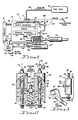
- an internal combustion engine (10) is illustrated with a carburetor (11) feeding into an intake manifold connected to the engine block (13), which also has an exhaust manifold (14) connected thereto and a radiator (15) connected to the engine block (13) by water hoses (16,17).
- the engine (10) is a standard internal combustion engine using refined hydrocarbon fuels fed from a fuel tank (18) through a gas line (20) to the carburetor (11), and connected by throttle linkage (21) to accelerator pedal (22) located in a vehicle.
- the exhaust from the exhaust manifold (14) is fed through the tailpipe (23) through a muffler (24) into the atmosphere, and in recent engines might include a catalytic converter as part of a pollution control package.
- the engine illustrated is a standard internal combustion engine of the type used in vehicles, but the present invention can be easily adapted to an engine having fuel injection rather than a carburetor or to a diesel engine burning oil rather than gasoline.
- a tank of anhidrous ammonia (24') is attached to the engine (10) has a pressure gauge (25) and an ammonia safety release valve (26) attached to the ammonia tank (24').
- the safety release valve is a spring loaded valve which will open momentarily when the pressure exceeds a predetermined pressure, such as 250 psi.
- Ammonia is stored in the ammonia storage tank (24') in a liquid state, but is fed in a gaseous or liquid state out a line (27) and in a gaseous state into an ammonia dissociator (28) having an enlarged cylinder (30) having a spaced inner cylindrical chamber (31) mounted therein so that exhaust gas coming out of the header (32) passes through the enlarged cylinder (30) into the tailpipe (23), around the inner chamber (31).
- the inner chamber (31) is filled with one or more catalysts from a group including iron, nickel, osmium, zinc and uranium.
- the catalyst might be iron and nickel, which may be in the form of steel wool, or the like, so that the gas entering the chamber (31) passes therethrough while being heated by the considerable heat of the engine exhaust, so as to utilize the waste exhaust heat for dissociation.
- the dissociation of ammonia begins as low as 300°C and is nearly complete at 500-600 0 C.
- the ammonia gas enters the dissociator (28) at the input (33) at one end of the chamber (31) while passing through the catalyst.
- the catalyst baffles the gas and assists in the rapid heating of the gas passing therethrough.
- the gas in line (34) is substantially dissociated ammonia, 3 parts hydrogen and 1 part nitrogen, butwould retain at leasttraces of ammonia with the disassociated gas.
- the dissociation of ammonia appears to be analogous to the reverse of the Haber process, which uses high pressure so that it is believed that the negative pressure generated by the intake manifold vacuum enhances the disassociation of the ammonia.
- the gases in line (34) are fed to valve (35), the operation of which is shown more clearly in Figure 2.
- the valve (35) has an air input line (36) and is actuated from a linkage (37) connected to the throttle linkage (21) which is operated by the accelerator pedal (22),.
- the gas from line (34) and the airfrom the air input line (36) are fed through a line (38) and through individual lines (40) into individual inputs to the intake manifold (12) so as to distribute the air mixed with the dissociated ammonia and any ammonia evenly into each cylinder.
- the air is fed through line (36) in a controlled ratio and is an easy method of leaning down the normal air to hydrocarbon fuel mixture of the carburetor (11 That is, the more air fed into line (36) and into the intake manifold, the leaner the intake mixture.
- the amount of air being fed to the combustion chambers, as well as the amount of dissociated ammonia is actuated through a connection to the throttle linkage (21).
- the hydrogen input, aswell as the amount of leaning, is varied in accordance with the operation of the throttle to give a more efficient mixture of hydrogen, hydrocarbon fuel and air.
- An alternate ammonia preheater (41) is illustrated connected to a water line (42) through a T-joint (43) connected in the water line (44) and back into the cooling system of the engine (10).
- An ammonia inlet line (45) can be connected to the line (27), pass through a coiled pipe or heat exchanger located in the preheater (41) where it is connected to the line (33) feeding into the dissociator (28).
- the preheater can remove the chill from the rapidly expanding ammonia gas and thereby reduce the total amount of heat that must be provided in the dissociator (28).
- a preheater can also be made in other ways such as wrapping the ammonia line around the tailpipe without departing from the scope of the invention.
- valve (35) is illustrated in more detail and has a throttle linkage connection member (47) connected to a throttle linkage member (48), attached to a standard linkage (50).
- the throttle linkage (47) abuts against a plate (51) which is spring loaded by spring (52) against stop nut (53).
- Spring (52) is held in place by members (54, 55).
- the pressing on the accelerator pedal pushes the throttle linkage (50) and bracket (58) to push the connecting bracket (47), which may be welded or bolted to the bracket (58) to push the plate (51) against spring (52), driving a pair of sliding rods (55, 56).
- Rod (46) rides in a gas feed housing (57) fed by line (34), as seen in Figure 1, while sliding rod (55) slides in a housing (58) fed by the air input line (36).
- Sliding rod (56) may have an 0-ring seal (60) and a threaded adjusting rod (61) threaded into the shaft (56).
- the adjusting rod (61) slides in a chamber (62) and engages a truncated cone valve element (63), which operates in connection with the valve seat (64).
- the valve element (63) is spring loaded by a spring (65), so that raising or lowering the plate (51) raises or lowers the shaft (56), and threaded member (61) to push against the bottom (69) of the valve element (63) to drive the valve element (63) against the spring (65) thereby opening the valve in proportion to the movement of the throttle linkage to allow gas to pass around the valve seat (64) through a passageway (66) into a T-connection (67) and out line (38).
- the accelerator pedal (22), of Figure 1 is operated in a normal manner, but drives the throttle linkage and thereby the bracket (47) attached to throttle plate (48) to raise and lower plate (51) to vary the input of hydrogen, nitrogen and any residual ammonia from the line (34) and the airfrom the air line (36) into the line (38), which is coupled into the individual intake manifold inlets.
- the valve (35) is supported by a bracket (81) and a bolt (82) and nut (83) to the carburetor (11).
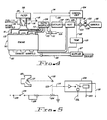
- FIG. 4 a third embodiment of the present invention is illustrated having an internal combustion engine (90) with an intake manifold (91), an exhaust manifold (92) and a standard carburetor (93), having a liquid hydrocarbon fuel line (94) feeding into a fuel bowl (95), forming part of the carburetor (93).
- Air is fed through an air filter (95) into the carburetor (93) and into the intake manifold (91) and thus into the combustion chambers of the internal combustion engine (90).
- exhaust gases from the combustion chambers is fed through a tailpipe (96), a muffler (97) and into the atmosphere.
- An ammonia storage tank (98) stores ammonia in a liquefied state and has a pressure gauge (100) and ammonia safety release valve (101) which is adapted to momentarily open when the pressure exceeds the predetermined set pressure and to close after a short opening.
- the ammonia as a liquid or gas is fed from the tank (98) containing liquid ammonia through a line (102) through an electronically controlled fuel valve (103) which varies in accordance with the voltage applied thereto by a central electronic control (104).
- Ammonia passing through the valve (103) passes through a line (105) into the heating unit (106) capturing heat from the exhaust of the engine.
- the heating unit is located as close to the combustion cylinders as possible, and may be incorporated into the exhaust header.
- Ammonia gas also passes through a catalyst (107) which normally would be combined with the heating unit (106) as illustrated in connection with Figure 1.
- Ammonia gas from the catalyst (107) is fed into a distribution manifold (108) which is connected to an air inlet (110) through a second electronic controlled valve (111) which meters the air being fed to the distribution manifold (108).
- the combination of air and at least partially dissociated ammonia is fed through a plurality of gas lines (112) to individual manifold inlets (113) of the intake manifold (91).
- control unit (104) varies the valves (103, 111) to vary the amount of dissociated ammonia gas and air fed to the intake manifold, thereby varying the input of gas as well as leaning the engine in accordance with the control unit.
- the control unit has an electrical conductor (114) which is connected to the accelerator pedal (115) which is connected to the throttle linkage (116) and to the throttle (117). Conductor (114) then feeds a signal that can vary the output voltage or signal through line (118) to the valve (103) and through the line (120) to the valve (111) to open the normally closed valves in proportion to the movement of the throttle.
- a temperature sensor (121) is inserted in the exhaust system, such as in the exhaust header, to produce a signal through the line (122) to the control unit (104).
- the control unit (104) can be more clearly understood in connection with figure 5, in which the accelerator pedal (115) is connected through a linkage (123) to the movable contact of a potentiometer (124) which is connected from an electrical terminal (125) through the ignition switch (126) through the potentiometer (124) to a ground (127) to thereby vary the voltage in the line (114) to the control unit (104).
- a variable resistance (128) can be used to determine the minimum value of the signal of the moving contact of the potentiometer (124).
- the control unit (104) includes a standard amplifier for amplifying the signal from the line (114) as well as a relay or solenoid switch actuated by the thermal sensor (122). The thermal switch disables the control unit (104) until a sufficient temperature is reached in the exhaust manifold.
- a momentary delay circuit can momentarily delay the signal in the line (120) to the valve (111) to assure that the air and ammonia gas will reach the distribution manifold (108) at the same time, so as not to momentarily lean the engine (90) down, prior to dissociated ammonia being fed to the engine.
- next generation control unit would typically include a microprocesser, receiving signals not only from the throttle, but may include an exhaust sensor which changes its electrical conductivity corresponding to the concentration of certain exhaust gases, oxygen or hydrogen over the sensor.
- exhaust gas control systems such as are commonly used on airplanes may be adapted for use in the control unit, along with sensors indicating engine speed and intake manifold pressure, which input signals can produce an optimum control of the feeding of dissociated ammonia and air to the engine (90) even if the desired feed in non linear.
Landscapes
- Engineering & Computer Science (AREA)
- Chemical & Material Sciences (AREA)
- Combustion & Propulsion (AREA)
- Mechanical Engineering (AREA)
- General Engineering & Computer Science (AREA)
- Output Control And Ontrol Of Special Type Engine (AREA)
- Exhaust Gas After Treatment (AREA)
- Valve Device For Special Equipments (AREA)
- Valve-Gear Or Valve Arrangements (AREA)
Priority Applications (1)
| Application Number | Priority Date | Filing Date | Title |
|---|---|---|---|
| AT81901987T ATE27194T1 (de) | 1980-06-30 | 1981-06-25 | Verbrennungsmotor. |
Applications Claiming Priority (2)
| Application Number | Priority Date | Filing Date | Title |
|---|---|---|---|
| US16403880A | 1980-06-30 | 1980-06-30 | |
| US164038 | 1980-06-30 |
Publications (3)
| Publication Number | Publication Date |
|---|---|
| EP0054567A1 EP0054567A1 (en) | 1982-06-30 |
| EP0054567A4 EP0054567A4 (en) | 1982-11-08 |
| EP0054567B1 true EP0054567B1 (en) | 1987-05-13 |
Family
ID=22592708
Family Applications (1)
| Application Number | Title | Priority Date | Filing Date |
|---|---|---|---|
| EP81901987A Expired EP0054567B1 (en) | 1980-06-30 | 1981-06-25 | Internal combustion engine |
Country Status (6)
| Country | Link |
|---|---|
| EP (1) | EP0054567B1 (cg-RX-API-DMAC10.html) |
| JP (1) | JPS57501134A (cg-RX-API-DMAC10.html) |
| AU (1) | AU551163B2 (cg-RX-API-DMAC10.html) |
| BR (1) | BR8108658A (cg-RX-API-DMAC10.html) |
| DE (1) | DE3176189D1 (cg-RX-API-DMAC10.html) |
| WO (1) | WO1982000175A1 (cg-RX-API-DMAC10.html) |
Families Citing this family (4)
| Publication number | Priority date | Publication date | Assignee | Title |
|---|---|---|---|---|
| DE4423003C2 (de) * | 1993-07-06 | 1999-01-21 | Ford Werke Ag | Verfahren und Vorrichtung zum Reduzieren von NO¶x¶ in den Abgasen von Kraftfahrzeugverbrennungsmotoren |
| GB2353822A (en) * | 1999-09-04 | 2001-03-07 | Ford Global Tech Inc | Injecting atomic nitrogen into i.c. engine combustion chamber to reduce NOx |
| US20040258563A1 (en) | 2003-06-23 | 2004-12-23 | Applera Corporation | Caps for sample wells and microcards for biological materials |
| JP5833326B2 (ja) * | 2011-03-24 | 2015-12-16 | 日立造船株式会社 | 噴射装置 |
Family Cites Families (8)
| Publication number | Priority date | Publication date | Assignee | Title |
|---|---|---|---|---|
| US1899869A (en) * | 1920-08-28 | 1933-02-28 | Firm Schweizerische Lokomotiv | Gas engine |
| US2140254A (en) * | 1936-10-21 | 1938-12-13 | Ammonia Casale Societa Anonima | Device for operating internal combustion engines with mixtures of ammonia, hydrogen, and nitrogen prepared from ammonia |
| US3915125A (en) * | 1971-07-16 | 1975-10-28 | Siemens Ag | Method for the operation of internal-combustion engines and gas reformer for implementing the method |
| DE2306026A1 (de) * | 1973-02-07 | 1974-08-22 | Siemens Ag | Verfahren und vorrichtung zum betrieb einer brennkraftmaschine, insbesondere eines otto-motors, mit einem spaltgasgenerator |
| JPS5228447B2 (cg-RX-API-DMAC10.html) * | 1974-03-06 | 1977-07-27 | ||
| GB1525600A (en) * | 1974-12-20 | 1978-09-20 | Nippon Soken | Internal combustion engines with a methanol reforming system |
| JPS58584B2 (ja) * | 1975-03-05 | 1983-01-07 | カブシキガイシヤ ニツポンジドウシヤブヒンソウゴウケンキユウシヨ | ネンリヨウカイシツソウチツキナイネンキカン |
| US4054423A (en) * | 1975-07-21 | 1977-10-18 | Blenman Orman L | Variable pressure fuel generator and method |
-
1981
- 1981-06-25 JP JP56502417A patent/JPS57501134A/ja active Pending
- 1981-06-25 EP EP81901987A patent/EP0054567B1/en not_active Expired
- 1981-06-25 AU AU74145/81A patent/AU551163B2/en not_active Ceased
- 1981-06-25 WO PCT/US1981/000871 patent/WO1982000175A1/en not_active Ceased
- 1981-06-25 DE DE8181901987T patent/DE3176189D1/de not_active Expired
- 1981-06-25 BR BR8108658A patent/BR8108658A/pt unknown
Also Published As
| Publication number | Publication date |
|---|---|
| JPS57501134A (cg-RX-API-DMAC10.html) | 1982-07-01 |
| EP0054567A4 (en) | 1982-11-08 |
| EP0054567A1 (en) | 1982-06-30 |
| AU551163B2 (en) | 1986-04-17 |
| BR8108658A (pt) | 1982-05-11 |
| AU7414581A (en) | 1982-02-02 |
| WO1982000175A1 (en) | 1982-01-21 |
| DE3176189D1 (en) | 1987-06-19 |
Similar Documents
| Publication | Publication Date | Title |
|---|---|---|
| US4750453A (en) | Internal combustion engine | |
| US4478177A (en) | Internal combustion engine | |
| US4480595A (en) | Internal combustion engine | |
| US4416224A (en) | Internal combustion engine | |
| Stebar et al. | Emission control with lean operation using hydrogen-supplemented fuel | |
| CA1171672A (en) | Hydrogen-oxygen thermochemical combustion initiation | |
| US4140090A (en) | Precombustion chamber, stratified charge internal combustion engine system using a highly combustible gas in the precombustion chamber | |
| US4210103A (en) | Fuel system for and a method of operating a spark-ignited internal combustion engine | |
| Jamal et al. | On-board generation of hydrogen-rich gaseous fuels—a review | |
| US5549083A (en) | Method and apparatus for clean cold starting of internal combustion engines | |
| US4131086A (en) | Fuel reforming apparatus for use with internal combustion engine | |
| US4520763A (en) | Fuel injection system | |
| US5566653A (en) | Method and apparatus for clean cold starting of internal combustion engines | |
| EP0086439B1 (en) | Hydrogen gas injector system for internal combustion engine | |
| RU2205861C1 (ru) | Непрерывная дегидратация спирта до простого эфира и воды, применяемых как топливо для дизельных двигателей | |
| Petkov et al. | An outlook of hydrogen as an automotive fuel | |
| Furuhama et al. | Combustion improvement in a hydrogen fueled engine | |
| US5398663A (en) | Combustion of liquid fuels | |
| US4475484A (en) | Exhaust manifold for an internal combustion engine, apparatus for the catalytic transformation of fuel and improved internal combustion engine | |
| Lucas et al. | The hydrogen/petrol engine-the means to give good part-load thermal efficiency | |
| JPH09508689A (ja) | エンジン | |
| EP0054567B1 (en) | Internal combustion engine | |
| Pettersson et al. | Onboard hydrogen generation by methanol decomposition for the cold start of neat methanol engines | |
| CA1168528A (en) | Internal combustion engine | |
| JPS61171870A (ja) | 改質天然ガスを用いた内燃機関 |
Legal Events
| Date | Code | Title | Description |
|---|---|---|---|
| PUAI | Public reference made under article 153(3) epc to a published international application that has entered the european phase |
Free format text: ORIGINAL CODE: 0009012 |
|
| AK | Designated contracting states |
Designated state(s): AT CH DE FR GB NL SE |
|
| 17P | Request for examination filed |
Effective date: 19820720 |
|
| GRAA | (expected) grant |
Free format text: ORIGINAL CODE: 0009210 |
|
| AK | Designated contracting states |
Kind code of ref document: B1 Designated state(s): AT CH DE FR GB LI NL SE |
|
| PG25 | Lapsed in a contracting state [announced via postgrant information from national office to epo] |
Ref country code: NL Effective date: 19870513 Ref country code: LI Effective date: 19870513 Ref country code: CH Effective date: 19870513 Ref country code: AT Effective date: 19870513 |
|
| REF | Corresponds to: |
Ref document number: 27194 Country of ref document: AT Date of ref document: 19870515 Kind code of ref document: T |
|
| REF | Corresponds to: |
Ref document number: 3176189 Country of ref document: DE Date of ref document: 19870619 |
|
| ET | Fr: translation filed | ||
| REG | Reference to a national code |
Ref country code: CH Ref legal event code: PL |
|
| NLV1 | Nl: lapsed or annulled due to failure to fulfill the requirements of art. 29p and 29m of the patents act | ||
| PLBE | No opposition filed within time limit |
Free format text: ORIGINAL CODE: 0009261 |
|
| STAA | Information on the status of an ep patent application or granted ep patent |
Free format text: STATUS: NO OPPOSITION FILED WITHIN TIME LIMIT |
|
| 26N | No opposition filed | ||
| REG | Reference to a national code |
Ref country code: FR Ref legal event code: ST |
|
| REG | Reference to a national code |
Ref country code: FR Ref legal event code: RC |
|
| PG25 | Lapsed in a contracting state [announced via postgrant information from national office to epo] |
Ref country code: GB Effective date: 19890625 |
|
| PG25 | Lapsed in a contracting state [announced via postgrant information from national office to epo] |
Ref country code: SE Effective date: 19890626 |
|
| REG | Reference to a national code |
Ref country code: FR Ref legal event code: DA |
|
| GBPC | Gb: european patent ceased through non-payment of renewal fee | ||
| PG25 | Lapsed in a contracting state [announced via postgrant information from national office to epo] |
Ref country code: FR Free format text: LAPSE BECAUSE OF NON-PAYMENT OF DUE FEES Effective date: 19900228 |
|
| PG25 | Lapsed in a contracting state [announced via postgrant information from national office to epo] |
Ref country code: DE Effective date: 19900301 |
|
| REG | Reference to a national code |
Ref country code: FR Ref legal event code: ST |
|
| EUG | Se: european patent has lapsed |
Ref document number: 81901987.8 Effective date: 19900412 |