EP0053389B1 - Verfahren zur Herstellung kationischer oberflächenaktiver Verbindungen - Google Patents
Verfahren zur Herstellung kationischer oberflächenaktiver Verbindungen Download PDFInfo
- Publication number
- EP0053389B1 EP0053389B1 EP81110051A EP81110051A EP0053389B1 EP 0053389 B1 EP0053389 B1 EP 0053389B1 EP 81110051 A EP81110051 A EP 81110051A EP 81110051 A EP81110051 A EP 81110051A EP 0053389 B1 EP0053389 B1 EP 0053389B1
- Authority
- EP
- European Patent Office
- Prior art keywords
- hydroxyphenethyl
- moles
- hydroxyethyl
- alkyl
- mole
- Prior art date
- Legal status (The legal status is an assumption and is not a legal conclusion. Google has not performed a legal analysis and makes no representation as to the accuracy of the status listed.)
- Expired
Links
Images
Classifications
-
- D—TEXTILES; PAPER
- D21—PAPER-MAKING; PRODUCTION OF CELLULOSE
- D21C—PRODUCTION OF CELLULOSE BY REMOVING NON-CELLULOSE SUBSTANCES FROM CELLULOSE-CONTAINING MATERIALS; REGENERATION OF PULPING LIQUORS; APPARATUS THEREFOR
- D21C3/00—Pulping cellulose-containing materials
- D21C3/22—Other features of pulping processes
- D21C3/222—Use of compounds accelerating the pulping processes
-
- C—CHEMISTRY; METALLURGY
- C07—ORGANIC CHEMISTRY
- C07C—ACYCLIC OR CARBOCYCLIC COMPOUNDS
- C07C17/00—Preparation of halogenated hydrocarbons
- C07C17/25—Preparation of halogenated hydrocarbons by splitting-off hydrogen halides from halogenated hydrocarbons
-
- C—CHEMISTRY; METALLURGY
- C07—ORGANIC CHEMISTRY
- C07D—HETEROCYCLIC COMPOUNDS
- C07D303/00—Compounds containing three-membered rings having one oxygen atom as the only ring hetero atom
- C07D303/02—Compounds containing oxirane rings
- C07D303/36—Compounds containing oxirane rings with hydrocarbon radicals, substituted by nitrogen atoms
-
- D—TEXTILES; PAPER
- D06—TREATMENT OF TEXTILES OR THE LIKE; LAUNDERING; FLEXIBLE MATERIALS NOT OTHERWISE PROVIDED FOR
- D06M—TREATMENT, NOT PROVIDED FOR ELSEWHERE IN CLASS D06, OF FIBRES, THREADS, YARNS, FABRICS, FEATHERS OR FIBROUS GOODS MADE FROM SUCH MATERIALS
- D06M11/00—Treating fibres, threads, yarns, fabrics or fibrous goods made from such materials, with inorganic substances or complexes thereof; Such treatment combined with mechanical treatment, e.g. mercerising
- D06M11/32—Treating fibres, threads, yarns, fabrics or fibrous goods made from such materials, with inorganic substances or complexes thereof; Such treatment combined with mechanical treatment, e.g. mercerising with oxygen, ozone, ozonides, oxides, hydroxides or percompounds; Salts derived from anions with an amphoteric element-oxygen bond
- D06M11/36—Treating fibres, threads, yarns, fabrics or fibrous goods made from such materials, with inorganic substances or complexes thereof; Such treatment combined with mechanical treatment, e.g. mercerising with oxygen, ozone, ozonides, oxides, hydroxides or percompounds; Salts derived from anions with an amphoteric element-oxygen bond with oxides, hydroxides or mixed oxides; with salts derived from anions with an amphoteric element-oxygen bond
- D06M11/38—Oxides or hydroxides of elements of Groups 1 or 11 of the Periodic Table
Definitions
- This invention relates to a process for preparing specific cationic surface active agents and their uses as a micellar catalyst or phase transfer catalyst. More particularly, the invention is intended to provide the specific cationic surface active agents in which nitrogen atoms are attached to both ends of a long-chain alkylene group or polyoxyalkylene group having, in all, 6 to 24 carbon atoms, at least one of said nitrogen atoms constituting a quaternary ammonium structure, and also at least one 2-hydroxyphenethyl group is bonded to at least one of the two nitrogen atoms.
- cationic surface active agents find their peculiar use as an accelerator which catalytically acts to promote changes in a chemical and/or physical change process involving a hydrolyzing, deacidizing or extracting operation using an aqueous solution of an alkaline metal hydroxide or an alkaline earth metal hydroxide.
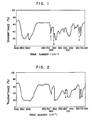
- Fig. 1 is an IR spectrum of N-hydroxyethyl-N,N'-di(2-hydroxyphenethyl)-undecylenediamine which is an intermediate product in Example 1, in which numerals 1, and 3 show the absorption bands indicating presence of benzene nucleus.
- Numeral 4 shows an absorption band of quaternary nitrogen.
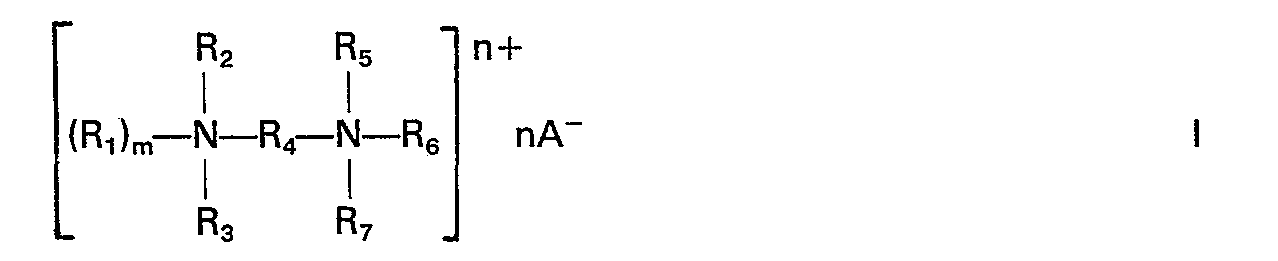
- R 1 is hydrogen, or alkyl or hydroxyalkyl having 1-8 carbon atoms, hydroxypolyoxyalkyl having 2-8 carbon atoms, alkylphenyl or phenyl alkyl having 7-8 carbon atoms, phenyl, methylbenzyl or glycidyl
- R 2 , R 3 , R 5 , R 6 and R 7 are each alkyl or hydroxyalkyl of 1-8 carbon atoms, hydroxypolyoxyalkyl of 2-8 carbon atoms, alkylphenyl or phenylalkyl of 7-8 carbon atoms, phenyl, methylbenzyl or glycidyl
- R 4 is an alkylene or polyoxyalkylene group having 6-24 carbon atoms in total
- m is 0 or 1
- n is
- a,w-alkylenediamines and a,w-polyoxyalkylenediamines used as starting material in the said reaction process (i) there may be cited the following: hexylenediamine, octylenediamine, decylenediamine, undecylenediamine, hexadecylenediamine, octadecylenediamine, tetracosilenediamine, trioxyethylenediamine, tetraoxyethylenediamine, pentaoxyethylenediamine, hexaoxyethylenediamine, heptaoxyethylenediamine, octaoxyethylenediamine, trioxypropylenediamine, tetraoxypropylenediamine, pentaoxypropylenediamine, hexaoxypropylenediamine, heptaoxypropylenediamine, octaoxyethylenediamine and various types of N- and/or N
- Examples of the monoamines used in the above-said reaction process (ii) are: N-methylamine, N-ethylamine, N-propylamine, N-butylamine, N-hexylamine, N-cyclohexylamine, N-octylamine, N-benzylamine, N-methylbenzylamine, aniline, N-hydroxyethylamine, N-hydroxypropylamine, N-hydroxybutylamine, N-hydroxyhexylamine, N-hydroxy- octylamine, N-(2-hydroxy)phenethylamine, N-hydroxyethoxyethylamine, N-hydroxydi(ethoxy)ethylamine, N-hydroxytri(ethoxy)ethylamine, N-hydroxypropoxypropylamine, N-glycidylamine and their styrene oxide addition products, and as examples of the alkylene dihalides and polyoxyalkylene dihalides, the following may be cited: 1,
- alkyl halides hydroxyalkyl halides, hydroxypolyoxyalkyl halides and epoxyalkyl halides
- alkylene oxide examples include, beside styrene oxide, the following: ethylene oxide, propylene oxide, butylene oxide, hexene oxide and octene oxide.
- the organic and inorganic acids used as active hydrogen donor in exiting a quaternarization reaction by an alkylene oxide in the cationic surface active agent preparation process of this invention are not subject to any specific restrictions, but the following are recommended for their easy availability: acetic acid, propionic acid, butyric acid, oxalic acid, hydrochloric acid, sulfuric acid, sulfurous acid, nitric acid, phosphoric acid, phosphorous acid, hypophosphorous acid, perchloric acid, hexafluorosilicic acid and paratoluenesulfonic acid.
- the cationic surface active agent preparing process according to this invention is now described in a more concrete way.
- the reaction between an a,w-alkylenediamine or a,w-polyoxyalkylenediamine and styrene oxide is carried out at a temperature of 100 to 250°C, preferably 150 to 200°C, under a pressure of from atmospheric pressure to 10 kg/cm 2 , preferably 2.5-5 kg/cm 2 .
- the reaction can proceed with no catalyst, it is free to add a non-polar or polar solvent as the reaction solvent.
- the attack reaction of an alkyl halide, hydroxyalkyl halide, hydroxypolyoxyalkyl halide, epoxyalkyl halide or an alkyl ester of an inorganic acid against the nitrogen atoms may be accomplished at a temperature of 3G-200°C, preferably 50-150 0 C, under a pressure of from atmosphere pressure to 10 kg/cm 2 , preferably 2.5-5 kg/cm 2 .
- Use of a catalyst is not essential for this attack reaction, too, but addition of a solvent is effective in accelerating the reaction.
- the nitrogen atom attack reaction by an organic or inorganic acid can proceed under atmospheric pressure at a temperature of from normal temperature to 100°C, preferably 40-80 0 C, but in this case, too, addition of a solvent proves helpful in promoting the reaction.
- the addition reaction of formalin, ethylene carbonate or alkylene oxide to active hydrogen can progress at a temperature of 50 ⁇ 250°C, preferably SG-200°C, under a pressure of from atmospheric pressure to 15 kg/cm 2 , preferably 2.5-5 kg/cm 2.
- the reaction is further promoted by use of an acid or an alkaline catalyst and addition of a reaction solvent.
- the reaction between a monoamine and an alkylene dihalide or polyoxyalkylene dihalide can be accomplished at a temperature of 50-250 0 C, preferably 100 ⁇ 200°C, under a pressure of from atmospheric pressure to 10 kg/cm 2 , preferably 3-7 kg/cm 2 .
- a reaction solvent preferably 1-10%
- the cationic surface active agents of this invention can be prepared advantageously can be ascertained from observing the decrease of the total amine value and by confirming the absorption band of skeletal vibration of quaternary ammonium in the IR spectrum of the product.
- the present inventors have further reached a finding that the cationic surface active agents prepared according to this invention can effectively act as a micellar catalyst or phase transfer catalyst, particularly in a system using an aqueous solution of an alkali metal hydroxide or an alkali earth metal hydroxide, to greatly contribute to promotion of rationalization of the process.
- an aqueous solution of an alkali metal hydroxide or an alkali earth metal hydroxide are, for example, a process in which the fiber molecules are partly hydrolyzed with an alkali, like in georgette working or mercerization of polyester fibres, a process in which 3,4-dichlorobutene-1, which is a butadiene derivative, is dehydrochlorinated by an alkali treatment to convert it into 2-chlorobutadiene, a process in which 1,1,2-trichloroethane or 1,2-dichloroethane is dehydrochlorinated by an alkali treatment to convert it into vinylidene chloride or vinyl chloride, a process in which pulp is digested with an alkali to get rid of lignin, and many other important chemical and physical change processes.
- the cationic surface active agents of this invention have the properties that they are not biased either to the aqueous phase or to the non-aqueous phase and that they tend to gather round the interface, so that they display a catalytic function with small loadings in said processes and are also minimized in release into waste water after use.
- the surface active agents of this invention can work as a lasting catalyst in said processes while arresting increase of organic carbon rate in waste water to conduct to environmental protection. Shown below are the embodiments of the invention.
- Table 1 shows the results of measurement of percent loss in weight of polyester taffeta when the cationic surface active agents synthesized in Examples 1-27 were used as hydrolysis accelerator. The test method was as follows.
- the percent loss of weight was calculated from the following formula:
- the reaction product was subjected to 80°C constant-temperature gas chromatographic analysis by using a column with silicon DC-550 as carrier, and the 2-chlorobutadiene formation rate was calculated from the peak area ratio of 3,4-dichlorobutene-1 to 2-chlorobutadiene given on the chart.
- the reaction-promoting effect of the cationic surface active agents of the invention is shown here by taking the reaction for synthesizing 2-chlorobutadiene from 3,4-dichlorobutene-1 as in the case of Example 29. 3,4-dichlorobutene-1 alone was used as organic phase.
- the test method is as follows.
- test method and test results are as follows.
- N- and/or N'-hydroxyphenethyl-substituted N,N'-Iong chain alkylene type cationic surface active agents according to this invention have far higher catalytic activity than the other types of cationic surface active agents, and also the results of TOC determination indicate less release of the agent into the alkaline solutions. Owing to these properties, the cationic surface active agents of this invention are minimized in wastage in the course of production processes, resulting in an elevated industrial utility and limited influence to environmental pollution. Also, if desired, the cationic surface active agents of this invention may be used in combination with other additives in their use processes.
Landscapes
- Chemical & Material Sciences (AREA)
- Organic Chemistry (AREA)
- Engineering & Computer Science (AREA)
- Textile Engineering (AREA)
- Organic Low-Molecular-Weight Compounds And Preparation Thereof (AREA)
- Epoxy Compounds (AREA)
- Detergent Compositions (AREA)
- Low-Molecular Organic Synthesis Reactions Using Catalysts (AREA)
Claims (23)


Applications Claiming Priority (2)
| Application Number | Priority Date | Filing Date | Title |
|---|---|---|---|
| JP55169264A JPS5836038B2 (ja) | 1980-12-01 | 1980-12-01 | カチオン界面活性剤およびその製造方法 |
| JP169264/80 | 1980-12-01 |
Publications (2)
| Publication Number | Publication Date |
|---|---|
| EP0053389A1 EP0053389A1 (de) | 1982-06-09 |
| EP0053389B1 true EP0053389B1 (de) | 1985-04-03 |
Family
ID=15883279
Family Applications (1)
| Application Number | Title | Priority Date | Filing Date |
|---|---|---|---|
| EP81110051A Expired EP0053389B1 (de) | 1980-12-01 | 1981-12-01 | Verfahren zur Herstellung kationischer oberflächenaktiver Verbindungen |
Country Status (4)
| Country | Link |
|---|---|
| US (1) | US4385184A (de) |
| EP (1) | EP0053389B1 (de) |
| JP (1) | JPS5836038B2 (de) |
| DE (1) | DE3169746D1 (de) |
Families Citing this family (8)
| Publication number | Priority date | Publication date | Assignee | Title |
|---|---|---|---|---|
| EP0112593B1 (de) * | 1982-12-23 | 1989-07-19 | THE PROCTER & GAMBLE COMPANY | Detergenszusammensetzungen ethoxylierte Amine mit Fleckenentfernungs- und Anti-Wiederabsetz-Eigenschaften enthaltend |
| US4664848A (en) * | 1982-12-23 | 1987-05-12 | The Procter & Gamble Company | Detergent compositions containing cationic compounds having clay soil removal/anti-redeposition properties |
| DE3380259D1 (en) * | 1982-12-23 | 1989-08-31 | Procter & Gamble | Detergent compositions containing cationic compounds having clay soil removal/anti-redeposition properties |
| US6177577B1 (en) * | 1991-11-15 | 2001-01-23 | The Dow Chemical Company | Dicationic and polycationic monoprimary alcohols and derivatives thereof |
| EP1204403A4 (de) * | 1999-07-30 | 2005-05-11 | Stepan Co | Verbesserte kalt-hergestellte wasser-in-öl-emulsionen quaternäre ammoniumverbindungen enthaltend und verfahren zu deren herstellung |
| US20060180794A1 (en) * | 2005-02-15 | 2006-08-17 | Goddard Richard J | Polyamine-based corrosion inhibitors |
| JP7086557B2 (ja) * | 2017-10-04 | 2022-06-20 | 日華化学株式会社 | 蒸解促進剤及びパルプの製造方法 |
| CN115028826B (zh) * | 2021-03-08 | 2024-02-02 | 中国石油化工股份有限公司 | 一种双氨基聚醚表面活性剂及其制备方法 |
Family Cites Families (11)
| Publication number | Priority date | Publication date | Assignee | Title |
|---|---|---|---|---|
| US3079436A (en) * | 1955-11-25 | 1963-02-26 | Rohm & Haas | Bis-quaternary ammonium compounds |
| US3055939A (en) * | 1957-06-03 | 1962-09-25 | Irwin Neisler And Co | Unsymmetric bis-ammonium salts |
| GB1034042A (en) * | 1962-09-19 | 1966-06-29 | Geigy Ag J R | Polyoxyalkylene quaternary ammonium compounds as dyeing auxiliaries |
| US3349032A (en) * | 1965-01-04 | 1967-10-24 | Petrolite Corp | Method of preventing the swelling of clays in subterranean formations |
| DE1542790A1 (de) * | 1965-09-27 | 1970-05-06 | Bayer Ag | Mittel gegen phytopathogene Bakterien |
| US3936503A (en) * | 1965-10-22 | 1976-02-03 | Akzona Incorporated | Aryl-substituted aliphatic diquaternary compounds |
| US3992432A (en) * | 1967-04-05 | 1976-11-16 | Continental Oil Company | Phase transfer catalysis of heterogeneous reactions by quaternary salts |
| US4166073A (en) * | 1968-03-27 | 1979-08-28 | Colgate Palmolive Company | Unsymmetrical oligoquaternary ammonium compounds |
| US3769346A (en) * | 1968-09-04 | 1973-10-30 | Roussel Uclaf | Diammonium salts and process for preparation |
| US3775477A (en) * | 1971-03-10 | 1973-11-27 | Sterling Drug Inc | N,n'-bis(2-aryl-2-(hydroxy or oxo)-ethyl)-bridged-bis-carboxamides |
| US4119668A (en) * | 1975-06-02 | 1978-10-10 | Sterling Drug Inc. | N,N'-Bridged-bis[N,N'substituted-2-hydroxy alkaneammonium] salts |
-
1980
- 1980-12-01 JP JP55169264A patent/JPS5836038B2/ja not_active Expired
-
1981
- 1981-02-23 US US06/236,950 patent/US4385184A/en not_active Expired - Fee Related
- 1981-12-01 EP EP81110051A patent/EP0053389B1/de not_active Expired
- 1981-12-01 DE DE8181110051T patent/DE3169746D1/de not_active Expired
Also Published As
| Publication number | Publication date |
|---|---|
| DE3169746D1 (en) | 1985-05-09 |
| JPS5836038B2 (ja) | 1983-08-06 |
| EP0053389A1 (de) | 1982-06-09 |
| US4385184A (en) | 1983-05-24 |
| JPS5791960A (en) | 1982-06-08 |
Similar Documents
| Publication | Publication Date | Title |
|---|---|---|
| EP0053389B1 (de) | Verfahren zur Herstellung kationischer oberflächenaktiver Verbindungen | |
| EP0300490B1 (de) | Trockenmischungsverfahren für die Quatärnisation von Polyvinylalkohol | |
| EP1453863B1 (de) | Verfahren zur herstellung von methylcelluloseether | |
| US4480126A (en) | Process for the preparation of quaternary ammonium compounds | |
| US2965517A (en) | Process for producing antistatic dressings on synthetic fibers | |
| Soignet et al. | Comparison of Properties of Anion-Exchange Cottons in Fabric Form | |
| NZ196825A (en) | Preparation of quaternary ammonium halides with halohydrin functionality | |
| US4376736A (en) | Rate and yield enhancement in the preparation of ethoxylated quaternary ammonium borates using ethylene glycol | |
| US5861537A (en) | Method of producing high-quality polyethylenepolyamines | |
| GB900372A (en) | Water-soluble compounds containing epoxide groups | |
| EP0037379A1 (de) | Umsetzungsproduktsalze aus Epoxyden, Polyalkylenpolyaminoamiden, Fettaminen und Fettsäuren, Fettsäureestern, -halogeniden, -iso-cyanaten oder -ketendimeren, deren Herstellung und Verwendung als Papierleimungsmittel | |
| US3690941A (en) | Process for providing cellulose fibre material with a flame-proof finish fast to washing | |
| US3326927A (en) | Certain pyridinium and quaternary ammonium derivatives of phenolic-polyoxy alkylene compounds and a method for their preparation | |
| GB921994A (en) | Substituted aziridines | |
| CA1053854A (en) | Flame retarding brominated carbamoyl derivatives | |
| CN1187484A (zh) | 3-氯-2-羟丙基三甲基氯化铵的合成方法 | |
| US3681126A (en) | Flame retardant article containing tris-(3 - halo - 2-hydroxypropyl)-hydroxymethylphosphonium chloride | |
| Soignet et al. | Reactions of halogenated 1, 2‐epoxypropanes and diethylaminoethyl cotton | |
| KR101858353B1 (ko) | 트리프로필렌글리콜 용제를 포함하는 섬유유연제 및 이의 제조방법 | |
| US3563692A (en) | Diethylaminoethylated cellulose weak base anion exchanger containing sulfhydryl groups | |
| US2678930A (en) | Nu-chloro-2-substituted imidazolines | |
| US3563688A (en) | Process for adding lead to cotton by use of reaction between deae cellulose and alkaline solution of sodium plumbite | |
| McKelvey et al. | The Treatment of Cotton with Ammonia-Epichlorohydrin Reaction Products | |
| JPH0819619B2 (ja) | 繊維製品の柔軟剤組成物およびそれを用いた繊維材料の柔軟化方法 | |
| US6054618A (en) | Preparation of N-phenyl-1-naphthylamine |
Legal Events
| Date | Code | Title | Description |
|---|---|---|---|
| PUAI | Public reference made under article 153(3) epc to a published international application that has entered the european phase |
Free format text: ORIGINAL CODE: 0009012 |
|
| AK | Designated contracting states |
Designated state(s): DE FR GB |
|
| 17P | Request for examination filed |
Effective date: 19820622 |
|
| RAP1 | Party data changed (applicant data changed or rights of an application transferred) |
Owner name: TOHO CHEMICAL INDUSTRY CO., LTD. |
|
| GRAA | (expected) grant |
Free format text: ORIGINAL CODE: 0009210 |
|
| AK | Designated contracting states |
Designated state(s): DE FR GB |
|
| REF | Corresponds to: |
Ref document number: 3169746 Country of ref document: DE Date of ref document: 19850509 |
|
| ET | Fr: translation filed | ||
| PLBE | No opposition filed within time limit |
Free format text: ORIGINAL CODE: 0009261 |
|
| STAA | Information on the status of an ep patent application or granted ep patent |
Free format text: STATUS: NO OPPOSITION FILED WITHIN TIME LIMIT |
|
| 26N | No opposition filed | ||
| GBPC | Gb: european patent ceased through non-payment of renewal fee | ||
| PG25 | Lapsed in a contracting state [announced via postgrant information from national office to epo] |
Ref country code: FR Free format text: LAPSE BECAUSE OF NON-PAYMENT OF DUE FEES Effective date: 19860829 |
|
| PG25 | Lapsed in a contracting state [announced via postgrant information from national office to epo] |
Ref country code: DE Effective date: 19860902 |
|
| REG | Reference to a national code |
Ref country code: FR Ref legal event code: ST |
|
| PG25 | Lapsed in a contracting state [announced via postgrant information from national office to epo] |
Ref country code: GB Effective date: 19881118 |