EP0051784A1 - Pyrazolsubstituierte Oximino-cyan-acetamid-Derivate, Verfahren zu ihrer Herstellung sowie ihre Verwendung als Fungizide - Google Patents
Pyrazolsubstituierte Oximino-cyan-acetamid-Derivate, Verfahren zu ihrer Herstellung sowie ihre Verwendung als Fungizide Download PDFInfo
- Publication number
- EP0051784A1 EP0051784A1 EP81108890A EP81108890A EP0051784A1 EP 0051784 A1 EP0051784 A1 EP 0051784A1 EP 81108890 A EP81108890 A EP 81108890A EP 81108890 A EP81108890 A EP 81108890A EP 0051784 A1 EP0051784 A1 EP 0051784A1
- Authority
- EP
- European Patent Office
- Prior art keywords
- formula
- carbon atoms
- alkyl
- pyrazole
- oximino
- Prior art date
- Legal status (The legal status is an assumption and is not a legal conclusion. Google has not performed a legal analysis and makes no representation as to the accuracy of the status listed.)
- Withdrawn
Links
- 239000000417 fungicide Substances 0.000 title claims abstract description 11
- 238000002360 preparation method Methods 0.000 title claims abstract description 9
- 239000001257 hydrogen Substances 0.000 claims abstract description 35
- 229910052739 hydrogen Inorganic materials 0.000 claims abstract description 35
- 238000000034 method Methods 0.000 claims abstract description 34
- UFHFLCQGNIYNRP-UHFFFAOYSA-N Hydrogen Chemical compound [H][H] UFHFLCQGNIYNRP-UHFFFAOYSA-N 0.000 claims abstract description 33
- 230000008569 process Effects 0.000 claims abstract description 32
- -1 cyano, hydroxycarbonyl Chemical group 0.000 claims abstract description 31
- 125000000217 alkyl group Chemical group 0.000 claims abstract description 22
- 125000004432 carbon atom Chemical group C* 0.000 claims abstract description 22
- 150000002431 hydrogen Chemical class 0.000 claims abstract description 10
- 125000004453 alkoxycarbonyl group Chemical group 0.000 claims abstract description 4
- 125000003917 carbamoyl group Chemical group [H]N([H])C(*)=O 0.000 claims abstract description 4
- 150000001875 compounds Chemical class 0.000 claims description 32
- CAFXGFHPOQBGJP-UHFFFAOYSA-N 2-cyano-2-hydroxyiminoacetamide Chemical compound NC(=O)C(=NO)C#N CAFXGFHPOQBGJP-UHFFFAOYSA-N 0.000 claims description 7
- 229910052784 alkaline earth metal Inorganic materials 0.000 claims description 6
- 125000002496 methyl group Chemical group [H]C([H])([H])* 0.000 claims description 6
- 239000003513 alkali Substances 0.000 claims description 5
- 125000001495 ethyl group Chemical group [H]C([H])([H])C([H])([H])* 0.000 claims description 5
- 229910052740 iodine Inorganic materials 0.000 claims description 5
- 125000001449 isopropyl group Chemical group [H]C([H])([H])C([H])(*)C([H])([H])[H] 0.000 claims description 5
- WKBOTKDWSSQWDR-UHFFFAOYSA-N Bromine atom Chemical compound [Br] WKBOTKDWSSQWDR-UHFFFAOYSA-N 0.000 claims description 4
- ZAMOUSCENKQFHK-UHFFFAOYSA-N Chlorine atom Chemical compound [Cl] ZAMOUSCENKQFHK-UHFFFAOYSA-N 0.000 claims description 4
- 239000004606 Fillers/Extenders Substances 0.000 claims description 4
- GDTBXPJZTBHREO-UHFFFAOYSA-N bromine Substances BrBr GDTBXPJZTBHREO-UHFFFAOYSA-N 0.000 claims description 4
- 229910052794 bromium Inorganic materials 0.000 claims description 4
- 239000000460 chlorine Substances 0.000 claims description 4
- 229910052801 chlorine Inorganic materials 0.000 claims description 4
- 125000001188 haloalkyl group Chemical group 0.000 claims description 4
- PNDPGZBMCMUPRI-UHFFFAOYSA-N iodine Chemical compound II PNDPGZBMCMUPRI-UHFFFAOYSA-N 0.000 claims description 4
- 239000012948 isocyanate Substances 0.000 claims description 4
- 150000002513 isocyanates Chemical class 0.000 claims description 4
- ZCYVEMRRCGMTRW-UHFFFAOYSA-N 7553-56-2 Chemical compound [I] ZCYVEMRRCGMTRW-UHFFFAOYSA-N 0.000 claims description 3
- 125000005197 alkyl carbonyloxy alkyl group Chemical group 0.000 claims description 3
- 125000005278 alkyl sulfonyloxy group Chemical group 0.000 claims description 3
- 239000002168 alkylating agent Substances 0.000 claims description 3
- 229940100198 alkylating agent Drugs 0.000 claims description 3
- 125000005279 aryl sulfonyloxy group Chemical group 0.000 claims description 3
- 239000002585 base Substances 0.000 claims description 3
- 150000001732 carboxylic acid derivatives Chemical class 0.000 claims description 3
- 125000005843 halogen group Chemical group 0.000 claims description 3
- 239000011630 iodine Substances 0.000 claims description 3
- PVACLFWULIFYKF-UHFFFAOYSA-N n-carbamoyl-2-cyano-2-hydroxyiminoacetamide Chemical compound NC(=O)NC(=O)C(=NO)C#N PVACLFWULIFYKF-UHFFFAOYSA-N 0.000 claims description 3
- 125000002914 sec-butyl group Chemical group [H]C([H])([H])C([H])([H])C([H])(*)C([H])([H])[H] 0.000 claims description 3
- 125000002947 alkylene group Chemical group 0.000 claims description 2
- 150000003863 ammonium salts Chemical class 0.000 claims description 2
- 230000007717 exclusion Effects 0.000 claims description 2
- 125000004123 n-propyl group Chemical group [H]C([H])([H])C([H])([H])C([H])([H])* 0.000 claims description 2
- 239000004094 surface-active agent Substances 0.000 claims description 2
- 241000233866 Fungi Species 0.000 claims 3
- 239000004480 active ingredient Substances 0.000 abstract description 12
- 241000233654 Oomycetes Species 0.000 abstract description 3
- 239000000575 pesticide Substances 0.000 abstract description 2
- 238000006243 chemical reaction Methods 0.000 description 19
- CSCPPACGZOOCGX-UHFFFAOYSA-N Acetone Chemical compound CC(C)=O CSCPPACGZOOCGX-UHFFFAOYSA-N 0.000 description 18
- WEVYAHXRMPXWCK-UHFFFAOYSA-N Acetonitrile Chemical compound CC#N WEVYAHXRMPXWCK-UHFFFAOYSA-N 0.000 description 18
- 241000196324 Embryophyta Species 0.000 description 16
- XLYOFNOQVPJJNP-UHFFFAOYSA-N water Substances O XLYOFNOQVPJJNP-UHFFFAOYSA-N 0.000 description 16
- 239000002904 solvent Substances 0.000 description 14
- 239000000203 mixture Substances 0.000 description 13
- ZMANZCXQSJIPKH-UHFFFAOYSA-N Triethylamine Chemical compound CCN(CC)CC ZMANZCXQSJIPKH-UHFFFAOYSA-N 0.000 description 12
- ZMXDDKWLCZADIW-UHFFFAOYSA-N N,N-Dimethylformamide Chemical compound CN(C)C=O ZMXDDKWLCZADIW-UHFFFAOYSA-N 0.000 description 9
- 238000009472 formulation Methods 0.000 description 9
- RTZKZFJDLAIYFH-UHFFFAOYSA-N Diethyl ether Chemical compound CCOCC RTZKZFJDLAIYFH-UHFFFAOYSA-N 0.000 description 8
- 240000003768 Solanum lycopersicum Species 0.000 description 8
- 239000007788 liquid Substances 0.000 description 8
- 239000000243 solution Substances 0.000 description 7
- ZWEHNKRNPOVVGH-UHFFFAOYSA-N 2-Butanone Chemical compound CCC(C)=O ZWEHNKRNPOVVGH-UHFFFAOYSA-N 0.000 description 6
- YMWUJEATGCHHMB-UHFFFAOYSA-N Dichloromethane Chemical compound ClCCl YMWUJEATGCHHMB-UHFFFAOYSA-N 0.000 description 6
- IAZDPXIOMUYVGZ-UHFFFAOYSA-N Dimethylsulphoxide Chemical compound CS(C)=O IAZDPXIOMUYVGZ-UHFFFAOYSA-N 0.000 description 6
- YXFVVABEGXRONW-UHFFFAOYSA-N Toluene Chemical compound CC1=CC=CC=C1 YXFVVABEGXRONW-UHFFFAOYSA-N 0.000 description 6
- 239000003085 diluting agent Substances 0.000 description 6
- 150000003839 salts Chemical class 0.000 description 6
- 239000000126 substance Substances 0.000 description 6
- 239000000725 suspension Substances 0.000 description 6
- 239000008187 granular material Substances 0.000 description 5
- VYPSYNLAJGMNEJ-UHFFFAOYSA-N silicon dioxide Inorganic materials O=[Si]=O VYPSYNLAJGMNEJ-UHFFFAOYSA-N 0.000 description 5
- 239000002689 soil Substances 0.000 description 5
- 206010061217 Infestation Diseases 0.000 description 4
- 241000233614 Phytophthora Species 0.000 description 4
- WYURNTSHIVDZCO-UHFFFAOYSA-N Tetrahydrofuran Chemical compound C1CCOC1 WYURNTSHIVDZCO-UHFFFAOYSA-N 0.000 description 4
- 239000003795 chemical substances by application Substances 0.000 description 4
- MVPPADPHJFYWMZ-UHFFFAOYSA-N chlorobenzene Chemical compound ClC1=CC=CC=C1 MVPPADPHJFYWMZ-UHFFFAOYSA-N 0.000 description 4
- 230000000694 effects Effects 0.000 description 4
- 239000003995 emulsifying agent Substances 0.000 description 4
- 239000003960 organic solvent Substances 0.000 description 4
- 238000005554 pickling Methods 0.000 description 4
- 239000002798 polar solvent Substances 0.000 description 4
- 239000000843 powder Substances 0.000 description 4
- 239000007858 starting material Substances 0.000 description 4
- 125000001424 substituent group Chemical group 0.000 description 4
- RYHBNJHYFVUHQT-UHFFFAOYSA-N 1,4-Dioxane Chemical compound C1COCCO1 RYHBNJHYFVUHQT-UHFFFAOYSA-N 0.000 description 3
- QTBSBXVTEAMEQO-UHFFFAOYSA-N Acetic acid Chemical compound CC(O)=O QTBSBXVTEAMEQO-UHFFFAOYSA-N 0.000 description 3
- WFDIJRYMOXRFFG-UHFFFAOYSA-N Acetic anhydride Chemical compound CC(=O)OC(C)=O WFDIJRYMOXRFFG-UHFFFAOYSA-N 0.000 description 3
- XEKOWRVHYACXOJ-UHFFFAOYSA-N Ethyl acetate Chemical compound CCOC(C)=O XEKOWRVHYACXOJ-UHFFFAOYSA-N 0.000 description 3
- 235000007688 Lycopersicon esculentum Nutrition 0.000 description 3
- 125000002877 alkyl aryl group Chemical group 0.000 description 3
- JFDZBHWFFUWGJE-UHFFFAOYSA-N benzonitrile Chemical compound N#CC1=CC=CC=C1 JFDZBHWFFUWGJE-UHFFFAOYSA-N 0.000 description 3
- 239000000969 carrier Substances 0.000 description 3
- 239000002270 dispersing agent Substances 0.000 description 3
- 229920000151 polyglycol Polymers 0.000 description 3
- 239000010695 polyglycol Substances 0.000 description 3
- 239000000047 product Substances 0.000 description 3
- 230000001681 protective effect Effects 0.000 description 3
- 239000011435 rock Substances 0.000 description 3
- 239000007787 solid Substances 0.000 description 3
- 239000007921 spray Substances 0.000 description 3
- 150000003512 tertiary amines Chemical class 0.000 description 3
- PSSOLQMYDTWFCH-UHFFFAOYSA-N 1-(chloromethyl)pyrazole;hydrochloride Chemical compound Cl.ClCN1C=CC=N1 PSSOLQMYDTWFCH-UHFFFAOYSA-N 0.000 description 2
- UPTVJAJPBGIRLZ-UHFFFAOYSA-N 2-(trichloromethylsulfanyl)-3a,4,5,7a-tetrahydroisoindole-1,3-dione Chemical compound C1CC=CC2C(=O)N(SC(Cl)(Cl)Cl)C(=O)C21 UPTVJAJPBGIRLZ-UHFFFAOYSA-N 0.000 description 2
- LKDPYACUJRSFNP-UHFFFAOYSA-N 2-cyano-n-(ethylcarbamoyl)-2-hydroxyiminoacetamide Chemical compound CCNC(=O)NC(=O)C(=NO)C#N LKDPYACUJRSFNP-UHFFFAOYSA-N 0.000 description 2
- QGZKDVFQNNGYKY-UHFFFAOYSA-N Ammonia Chemical compound N QGZKDVFQNNGYKY-UHFFFAOYSA-N 0.000 description 2
- CURLTUGMZLYLDI-UHFFFAOYSA-N Carbon dioxide Chemical compound O=C=O CURLTUGMZLYLDI-UHFFFAOYSA-N 0.000 description 2
- HEDRZPFGACZZDS-UHFFFAOYSA-N Chloroform Chemical compound ClC(Cl)Cl HEDRZPFGACZZDS-UHFFFAOYSA-N 0.000 description 2
- XDTMQSROBMDMFD-UHFFFAOYSA-N Cyclohexane Chemical compound C1CCCCC1 XDTMQSROBMDMFD-UHFFFAOYSA-N 0.000 description 2
- LYCAIKOWRPUZTN-UHFFFAOYSA-N Ethylene glycol Chemical compound OCCO LYCAIKOWRPUZTN-UHFFFAOYSA-N 0.000 description 2
- VZCYOOQTPOCHFL-OWOJBTEDSA-N Fumaric acid Chemical compound OC(=O)\C=C\C(O)=O VZCYOOQTPOCHFL-OWOJBTEDSA-N 0.000 description 2
- XEEYBQQBJWHFJM-UHFFFAOYSA-N Iron Chemical class [Fe] XEEYBQQBJWHFJM-UHFFFAOYSA-N 0.000 description 2
- UQSXHKLRYXJYBZ-UHFFFAOYSA-N Iron oxide Chemical compound [Fe]=O UQSXHKLRYXJYBZ-UHFFFAOYSA-N 0.000 description 2
- JGFZNNIVVJXRND-UHFFFAOYSA-N N,N-Diisopropylethylamine (DIPEA) Chemical compound CCN(C(C)C)C(C)C JGFZNNIVVJXRND-UHFFFAOYSA-N 0.000 description 2
- FXHOOIRPVKKKFG-UHFFFAOYSA-N N,N-Dimethylacetamide Chemical compound CN(C)C(C)=O FXHOOIRPVKKKFG-UHFFFAOYSA-N 0.000 description 2
- LRHPLDYGYMQRHN-UHFFFAOYSA-N N-Butanol Chemical compound CCCCO LRHPLDYGYMQRHN-UHFFFAOYSA-N 0.000 description 2
- 229920003171 Poly (ethylene oxide) Polymers 0.000 description 2
- ATUOYWHBWRKTHZ-UHFFFAOYSA-N Propane Chemical compound CCC ATUOYWHBWRKTHZ-UHFFFAOYSA-N 0.000 description 2
- WTKZEGDFNFYCGP-UHFFFAOYSA-N Pyrazole Chemical compound C=1C=NNC=1 WTKZEGDFNFYCGP-UHFFFAOYSA-N 0.000 description 2
- JUJWROOIHBZHMG-UHFFFAOYSA-N Pyridine Chemical compound C1=CC=NC=C1 JUJWROOIHBZHMG-UHFFFAOYSA-N 0.000 description 2
- SMWDFEZZVXVKRB-UHFFFAOYSA-N Quinoline Chemical compound N1=CC=CC2=CC=CC=C21 SMWDFEZZVXVKRB-UHFFFAOYSA-N 0.000 description 2
- KEAYESYHFKHZAL-UHFFFAOYSA-N Sodium Chemical compound [Na] KEAYESYHFKHZAL-UHFFFAOYSA-N 0.000 description 2
- 230000002378 acidificating effect Effects 0.000 description 2
- 239000013543 active substance Substances 0.000 description 2
- 239000000654 additive Substances 0.000 description 2
- 150000001338 aliphatic hydrocarbons Chemical class 0.000 description 2
- 229910001420 alkaline earth metal ion Inorganic materials 0.000 description 2
- 150000001412 amines Chemical class 0.000 description 2
- 230000008901 benefit Effects 0.000 description 2
- 230000015572 biosynthetic process Effects 0.000 description 2
- CODNYICXDISAEA-UHFFFAOYSA-N bromine monochloride Chemical compound BrCl CODNYICXDISAEA-UHFFFAOYSA-N 0.000 description 2
- 238000005266 casting Methods 0.000 description 2
- 239000012141 concentrate Substances 0.000 description 2
- 238000001816 cooling Methods 0.000 description 2
- MLIREBYILWEBDM-UHFFFAOYSA-N cyanoacetic acid Chemical compound OC(=O)CC#N MLIREBYILWEBDM-UHFFFAOYSA-N 0.000 description 2
- JHIVVAPYMSGYDF-UHFFFAOYSA-N cyclohexanone Chemical compound O=C1CCCCC1 JHIVVAPYMSGYDF-UHFFFAOYSA-N 0.000 description 2
- 239000000975 dye Substances 0.000 description 2
- 239000000839 emulsion Substances 0.000 description 2
- 230000001586 eradicative effect Effects 0.000 description 2
- 150000002170 ethers Chemical class 0.000 description 2
- 238000001704 evaporation Methods 0.000 description 2
- 230000000855 fungicidal effect Effects 0.000 description 2
- 239000012442 inert solvent Substances 0.000 description 2
- 208000015181 infectious disease Diseases 0.000 description 2
- 150000002576 ketones Chemical class 0.000 description 2
- 238000004519 manufacturing process Methods 0.000 description 2
- 235000015097 nutrients Nutrition 0.000 description 2
- FDPIMTJIUBPUKL-UHFFFAOYSA-N pentan-3-one Chemical compound CCC(=O)CC FDPIMTJIUBPUKL-UHFFFAOYSA-N 0.000 description 2
- 239000000376 reactant Substances 0.000 description 2
- 239000011541 reaction mixture Substances 0.000 description 2
- 229910000104 sodium hydride Inorganic materials 0.000 description 2
- 239000012312 sodium hydride Substances 0.000 description 2
- 238000005507 spraying Methods 0.000 description 2
- 230000009885 systemic effect Effects 0.000 description 2
- VZGDMQKNWNREIO-UHFFFAOYSA-N tetrachloromethane Chemical compound ClC(Cl)(Cl)Cl VZGDMQKNWNREIO-UHFFFAOYSA-N 0.000 description 2
- YLQBMQCUIZJEEH-UHFFFAOYSA-N tetrahydrofuran Natural products C=1C=COC=1 YLQBMQCUIZJEEH-UHFFFAOYSA-N 0.000 description 2
- 125000006083 1-bromoethyl group Chemical group 0.000 description 1
- DURPTKYDGMDSBL-UHFFFAOYSA-N 1-butoxybutane Chemical compound CCCCOCCCC DURPTKYDGMDSBL-UHFFFAOYSA-N 0.000 description 1
- JWVLEUHXCYDNRH-UHFFFAOYSA-N 2-amino-2-oxo-n-(1h-pyrazol-5-ylmethoxy)ethanimidoyl cyanide Chemical compound NC(=O)C(C#N)=NOCC=1C=CNN=1 JWVLEUHXCYDNRH-UHFFFAOYSA-N 0.000 description 1
- QDSMMCFEDQQODS-UHFFFAOYSA-N 2-cyano-n-(ethylcarbamoyl)acetamide Chemical compound CCNC(=O)NC(=O)CC#N QDSMMCFEDQQODS-UHFFFAOYSA-N 0.000 description 1
- QKDZVNSPTXAAJT-UHFFFAOYSA-N 2-cyano-n-nitroso-2-pyrazol-1-ylpropanamide Chemical class ON=NC(=O)C(C#N)(C)N1C=CC=N1 QKDZVNSPTXAAJT-UHFFFAOYSA-N 0.000 description 1
- BSKHPKMHTQYZBB-UHFFFAOYSA-N 2-methylpyridine Chemical compound CC1=CC=CC=N1 BSKHPKMHTQYZBB-UHFFFAOYSA-N 0.000 description 1
- FJKROLUGYXJWQN-UHFFFAOYSA-N 4-hydroxybenzoic acid Chemical compound OC(=O)C1=CC=C(O)C=C1 FJKROLUGYXJWQN-UHFFFAOYSA-N 0.000 description 1
- MOTMRBLIDLGGQU-UHFFFAOYSA-N 5-(1-chloro-2-methylpropyl)-1h-pyrazole Chemical compound CC(C)C(Cl)C=1C=CNN=1 MOTMRBLIDLGGQU-UHFFFAOYSA-N 0.000 description 1
- 244000215068 Acacia senegal Species 0.000 description 1
- RGCKGOZRHPZPFP-UHFFFAOYSA-N Alizarin Natural products C1=CC=C2C(=O)C3=C(O)C(O)=CC=C3C(=O)C2=C1 RGCKGOZRHPZPFP-UHFFFAOYSA-N 0.000 description 1
- 241000235349 Ascomycota Species 0.000 description 1
- IJGRMHOSHXDMSA-UHFFFAOYSA-N Atomic nitrogen Chemical compound N#N IJGRMHOSHXDMSA-UHFFFAOYSA-N 0.000 description 1
- 241000221198 Basidiomycota Species 0.000 description 1
- ZOXJGFHDIHLPTG-UHFFFAOYSA-N Boron Chemical compound [B] ZOXJGFHDIHLPTG-UHFFFAOYSA-N 0.000 description 1
- 229910021532 Calcite Inorganic materials 0.000 description 1
- 229920002134 Carboxymethyl cellulose Polymers 0.000 description 1
- VEXZGXHMUGYJMC-UHFFFAOYSA-M Chloride anion Chemical compound [Cl-] VEXZGXHMUGYJMC-UHFFFAOYSA-M 0.000 description 1
- 241000760356 Chytridiomycetes Species 0.000 description 1
- 244000060011 Cocos nucifera Species 0.000 description 1
- 235000013162 Cocos nucifera Nutrition 0.000 description 1
- RYGMFSIKBFXOCR-UHFFFAOYSA-N Copper Chemical compound [Cu] RYGMFSIKBFXOCR-UHFFFAOYSA-N 0.000 description 1
- 239000004375 Dextrin Substances 0.000 description 1
- 229920001353 Dextrin Polymers 0.000 description 1
- ZAFNJMIOTHYJRJ-UHFFFAOYSA-N Diisopropyl ether Chemical compound CC(C)OC(C)C ZAFNJMIOTHYJRJ-UHFFFAOYSA-N 0.000 description 1
- LFQSCWFLJHTTHZ-UHFFFAOYSA-N Ethanol Chemical compound CCO LFQSCWFLJHTTHZ-UHFFFAOYSA-N 0.000 description 1
- RYECOJGRJDOGPP-UHFFFAOYSA-N Ethylurea Chemical compound CCNC(N)=O RYECOJGRJDOGPP-UHFFFAOYSA-N 0.000 description 1
- WQZGKKKJIJFFOK-GASJEMHNSA-N Glucose Natural products OC[C@H]1OC(O)[C@H](O)[C@@H](O)[C@@H]1O WQZGKKKJIJFFOK-GASJEMHNSA-N 0.000 description 1
- 229920000084 Gum arabic Polymers 0.000 description 1
- OWIKHYCFFJSOEH-UHFFFAOYSA-N Isocyanic acid Chemical compound N=C=O OWIKHYCFFJSOEH-UHFFFAOYSA-N 0.000 description 1
- 239000005909 Kieselgur Substances 0.000 description 1
- NTIZESTWPVYFNL-UHFFFAOYSA-N Methyl isobutyl ketone Chemical compound CC(C)CC(C)=O NTIZESTWPVYFNL-UHFFFAOYSA-N 0.000 description 1
- UIHCLUNTQKBZGK-UHFFFAOYSA-N Methyl isobutyl ketone Natural products CCC(C)C(C)=O UIHCLUNTQKBZGK-UHFFFAOYSA-N 0.000 description 1
- ZOKXTWBITQBERF-UHFFFAOYSA-N Molybdenum Chemical compound [Mo] ZOKXTWBITQBERF-UHFFFAOYSA-N 0.000 description 1
- JLTDJTHDQAWBAV-UHFFFAOYSA-N N,N-dimethylaniline Chemical compound CN(C)C1=CC=CC=C1 JLTDJTHDQAWBAV-UHFFFAOYSA-N 0.000 description 1
- 244000061176 Nicotiana tabacum Species 0.000 description 1
- 235000002637 Nicotiana tabacum Nutrition 0.000 description 1
- IOVCWXUNBOPUCH-UHFFFAOYSA-N Nitrous acid Chemical compound ON=O IOVCWXUNBOPUCH-UHFFFAOYSA-N 0.000 description 1
- CTQNGGLPUBDAKN-UHFFFAOYSA-N O-Xylene Chemical compound CC1=CC=CC=C1C CTQNGGLPUBDAKN-UHFFFAOYSA-N 0.000 description 1
- YGYAWVDWMABLBF-UHFFFAOYSA-N Phosgene Chemical compound ClC(Cl)=O YGYAWVDWMABLBF-UHFFFAOYSA-N 0.000 description 1
- 241000233622 Phytophthora infestans Species 0.000 description 1
- 241001503460 Plasmodiophorida Species 0.000 description 1
- 239000004372 Polyvinyl alcohol Substances 0.000 description 1
- 241000221535 Pucciniales Species 0.000 description 1
- 241000231139 Pyricularia Species 0.000 description 1
- 239000004113 Sepiolite Substances 0.000 description 1
- 244000061456 Solanum tuberosum Species 0.000 description 1
- 235000002595 Solanum tuberosum Nutrition 0.000 description 1
- CZMRCDWAGMRECN-UGDNZRGBSA-N Sucrose Chemical compound O[C@H]1[C@H](O)[C@@H](CO)O[C@@]1(CO)O[C@@H]1[C@H](O)[C@@H](O)[C@H](O)[C@@H](CO)O1 CZMRCDWAGMRECN-UGDNZRGBSA-N 0.000 description 1
- 229930006000 Sucrose Natural products 0.000 description 1
- LSNNMFCWUKXFEE-UHFFFAOYSA-N Sulfurous acid Chemical compound OS(O)=O LSNNMFCWUKXFEE-UHFFFAOYSA-N 0.000 description 1
- GWEVSGVZZGPLCZ-UHFFFAOYSA-N Titan oxide Chemical compound O=[Ti]=O GWEVSGVZZGPLCZ-UHFFFAOYSA-N 0.000 description 1
- BZHJMEDXRYGGRV-UHFFFAOYSA-N Vinyl chloride Chemical group ClC=C BZHJMEDXRYGGRV-UHFFFAOYSA-N 0.000 description 1
- 241000607479 Yersinia pestis Species 0.000 description 1
- 240000008042 Zea mays Species 0.000 description 1
- 235000005824 Zea mays ssp. parviglumis Nutrition 0.000 description 1
- 235000002017 Zea mays subsp mays Nutrition 0.000 description 1
- HCHKCACWOHOZIP-UHFFFAOYSA-N Zinc Chemical compound [Zn] HCHKCACWOHOZIP-UHFFFAOYSA-N 0.000 description 1
- 238000010521 absorption reaction Methods 0.000 description 1
- 239000000205 acacia gum Substances 0.000 description 1
- 235000010489 acacia gum Nutrition 0.000 description 1
- 230000000895 acaricidal effect Effects 0.000 description 1
- 239000000642 acaricide Substances 0.000 description 1
- 239000002253 acid Substances 0.000 description 1
- 230000009471 action Effects 0.000 description 1
- 239000000853 adhesive Substances 0.000 description 1
- 230000001070 adhesive effect Effects 0.000 description 1
- 239000000443 aerosol Substances 0.000 description 1
- 150000001298 alcohols Chemical class 0.000 description 1
- 150000001299 aldehydes Chemical class 0.000 description 1
- HFVAFDPGUJEFBQ-UHFFFAOYSA-M alizarin red S Chemical compound [Na+].O=C1C2=CC=CC=C2C(=O)C2=C1C=C(S([O-])(=O)=O)C(O)=C2O HFVAFDPGUJEFBQ-UHFFFAOYSA-M 0.000 description 1
- 229910052783 alkali metal Inorganic materials 0.000 description 1
- 150000001340 alkali metals Chemical class 0.000 description 1
- 150000001447 alkali salts Chemical class 0.000 description 1
- 150000001342 alkaline earth metals Chemical class 0.000 description 1
- 150000008055 alkyl aryl sulfonates Chemical class 0.000 description 1
- 150000008051 alkyl sulfates Chemical class 0.000 description 1
- 229940045714 alkyl sulfonate alkylating agent Drugs 0.000 description 1
- 150000008052 alkyl sulfonates Chemical class 0.000 description 1
- 235000012211 aluminium silicate Nutrition 0.000 description 1
- 229910021529 ammonia Inorganic materials 0.000 description 1
- 229940095564 anhydrous calcium sulfate Drugs 0.000 description 1
- 125000000129 anionic group Chemical group 0.000 description 1
- 230000000844 anti-bacterial effect Effects 0.000 description 1
- 239000007864 aqueous solution Substances 0.000 description 1
- 150000004945 aromatic hydrocarbons Chemical class 0.000 description 1
- 229960000892 attapulgite Drugs 0.000 description 1
- 239000003899 bactericide agent Substances 0.000 description 1
- WQZGKKKJIJFFOK-VFUOTHLCSA-N beta-D-glucose Chemical compound OC[C@H]1O[C@@H](O)[C@H](O)[C@@H](O)[C@@H]1O WQZGKKKJIJFFOK-VFUOTHLCSA-N 0.000 description 1
- 239000011230 binding agent Substances 0.000 description 1
- 238000009835 boiling Methods 0.000 description 1
- 229910052796 boron Inorganic materials 0.000 description 1
- 239000001273 butane Substances 0.000 description 1
- 125000000484 butyl group Chemical group [H]C([*])([H])C([H])([H])C([H])([H])C([H])([H])[H] 0.000 description 1
- ZOMBKNNSYQHRCA-UHFFFAOYSA-J calcium sulfate hemihydrate Chemical compound O.[Ca+2].[Ca+2].[O-]S([O-])(=O)=O.[O-]S([O-])(=O)=O ZOMBKNNSYQHRCA-UHFFFAOYSA-J 0.000 description 1
- 239000001569 carbon dioxide Substances 0.000 description 1
- 229910002092 carbon dioxide Inorganic materials 0.000 description 1
- 239000001768 carboxy methyl cellulose Substances 0.000 description 1
- 235000010948 carboxy methyl cellulose Nutrition 0.000 description 1
- 150000001735 carboxylic acids Chemical class 0.000 description 1
- 239000008112 carboxymethyl-cellulose Substances 0.000 description 1
- 239000012876 carrier material Substances 0.000 description 1
- 239000007795 chemical reaction product Substances 0.000 description 1
- 150000008422 chlorobenzenes Chemical class 0.000 description 1
- 239000008199 coating composition Substances 0.000 description 1
- 239000010941 cobalt Substances 0.000 description 1
- 229910017052 cobalt Inorganic materials 0.000 description 1
- GUTLYIVDDKVIGB-UHFFFAOYSA-N cobalt atom Chemical compound [Co] GUTLYIVDDKVIGB-UHFFFAOYSA-N 0.000 description 1
- 229910052802 copper Inorganic materials 0.000 description 1
- 239000010949 copper Substances 0.000 description 1
- 235000005822 corn Nutrition 0.000 description 1
- 235000019425 dextrin Nutrition 0.000 description 1
- 239000008121 dextrose Substances 0.000 description 1
- GUJOJGAPFQRJSV-UHFFFAOYSA-N dialuminum;dioxosilane;oxygen(2-);hydrate Chemical compound O.[O-2].[O-2].[O-2].[Al+3].[Al+3].O=[Si]=O.O=[Si]=O.O=[Si]=O.O=[Si]=O GUJOJGAPFQRJSV-UHFFFAOYSA-N 0.000 description 1
- 235000014113 dietary fatty acids Nutrition 0.000 description 1
- 238000010790 dilution Methods 0.000 description 1
- 239000012895 dilution Substances 0.000 description 1
- XXBDWLFCJWSEKW-UHFFFAOYSA-N dimethylbenzylamine Chemical compound CN(C)CC1=CC=CC=C1 XXBDWLFCJWSEKW-UHFFFAOYSA-N 0.000 description 1
- 238000007598 dipping method Methods 0.000 description 1
- 201000010099 disease Diseases 0.000 description 1
- 231100000676 disease causative agent Toxicity 0.000 description 1
- 208000037265 diseases, disorders, signs and symptoms Diseases 0.000 description 1
- 239000010459 dolomite Substances 0.000 description 1
- 229910000514 dolomite Inorganic materials 0.000 description 1
- 238000001035 drying Methods 0.000 description 1
- 238000010410 dusting Methods 0.000 description 1
- 239000003480 eluent Substances 0.000 description 1
- 238000005538 encapsulation Methods 0.000 description 1
- 238000005516 engineering process Methods 0.000 description 1
- 150000002148 esters Chemical class 0.000 description 1
- WUDNUHPRLBTKOJ-UHFFFAOYSA-N ethyl isocyanate Chemical compound CCN=C=O WUDNUHPRLBTKOJ-UHFFFAOYSA-N 0.000 description 1
- 230000008020 evaporation Effects 0.000 description 1
- 239000000194 fatty acid Substances 0.000 description 1
- 229930195729 fatty acid Natural products 0.000 description 1
- 150000002191 fatty alcohols Chemical class 0.000 description 1
- 235000013312 flour Nutrition 0.000 description 1
- 239000006260 foam Substances 0.000 description 1
- 239000000446 fuel Substances 0.000 description 1
- 239000001530 fumaric acid Substances 0.000 description 1
- 244000053095 fungal pathogen Species 0.000 description 1
- 239000007789 gas Substances 0.000 description 1
- 150000008282 halocarbons Chemical class 0.000 description 1
- 239000004009 herbicide Substances 0.000 description 1
- 238000003898 horticulture Methods 0.000 description 1
- 125000004435 hydrogen atom Chemical group [H]* 0.000 description 1
- XMBWDFGMSWQBCA-UHFFFAOYSA-N hydrogen iodide Chemical compound I XMBWDFGMSWQBCA-UHFFFAOYSA-N 0.000 description 1
- XLYOFNOQVPJJNP-UHFFFAOYSA-M hydroxide Chemical compound [OH-] XLYOFNOQVPJJNP-UHFFFAOYSA-M 0.000 description 1
- WGCNASOHLSPBMP-UHFFFAOYSA-N hydroxyacetaldehyde Natural products OCC=O WGCNASOHLSPBMP-UHFFFAOYSA-N 0.000 description 1
- 238000002329 infrared spectrum Methods 0.000 description 1
- 239000001023 inorganic pigment Substances 0.000 description 1
- 239000002917 insecticide Substances 0.000 description 1
- INQOMBQAUSQDDS-UHFFFAOYSA-N iodomethane Chemical compound IC INQOMBQAUSQDDS-UHFFFAOYSA-N 0.000 description 1
- 150000002500 ions Chemical class 0.000 description 1
- 229910052742 iron Inorganic materials 0.000 description 1
- 229920005610 lignin Polymers 0.000 description 1
- WPBNNNQJVZRUHP-UHFFFAOYSA-L manganese(2+);methyl n-[[2-(methoxycarbonylcarbamothioylamino)phenyl]carbamothioyl]carbamate;n-[2-(sulfidocarbothioylamino)ethyl]carbamodithioate Chemical class [Mn+2].[S-]C(=S)NCCNC([S-])=S.COC(=O)NC(=S)NC1=CC=CC=C1NC(=S)NC(=O)OC WPBNNNQJVZRUHP-UHFFFAOYSA-L 0.000 description 1
- 239000004579 marble Substances 0.000 description 1
- 230000010534 mechanism of action Effects 0.000 description 1
- 238000002844 melting Methods 0.000 description 1
- 230000008018 melting Effects 0.000 description 1
- 229910052751 metal Inorganic materials 0.000 description 1
- 239000002184 metal Substances 0.000 description 1
- 229920000609 methyl cellulose Polymers 0.000 description 1
- 239000001923 methylcellulose Substances 0.000 description 1
- 235000010981 methylcellulose Nutrition 0.000 description 1
- 230000003641 microbiacidal effect Effects 0.000 description 1
- 244000005700 microbiome Species 0.000 description 1
- 238000002156 mixing Methods 0.000 description 1
- 229910052750 molybdenum Inorganic materials 0.000 description 1
- 239000011733 molybdenum Substances 0.000 description 1
- 229910052901 montmorillonite Inorganic materials 0.000 description 1
- IJDNQMDRQITEOD-UHFFFAOYSA-N n-butane Chemical compound CCCC IJDNQMDRQITEOD-UHFFFAOYSA-N 0.000 description 1
- HNHVTXYLRVGMHD-UHFFFAOYSA-N n-butyl isocyanate Chemical compound CCCCN=C=O HNHVTXYLRVGMHD-UHFFFAOYSA-N 0.000 description 1
- XRKQMIFKHDXFNQ-UHFFFAOYSA-N n-cyclohexyl-n-ethylcyclohexanamine Chemical compound C1CCCCC1N(CC)C1CCCCC1 XRKQMIFKHDXFNQ-UHFFFAOYSA-N 0.000 description 1
- OFBQJSOFQDEBGM-UHFFFAOYSA-N n-pentane Natural products CCCCC OFBQJSOFQDEBGM-UHFFFAOYSA-N 0.000 description 1
- 239000005645 nematicide Substances 0.000 description 1
- JCXJVPUVTGWSNB-UHFFFAOYSA-N nitrogen dioxide Inorganic materials O=[N]=O JCXJVPUVTGWSNB-UHFFFAOYSA-N 0.000 description 1
- 238000000655 nuclear magnetic resonance spectrum Methods 0.000 description 1
- 210000000056 organ Anatomy 0.000 description 1
- 150000007530 organic bases Chemical class 0.000 description 1
- 239000011368 organic material Substances 0.000 description 1
- 150000002923 oximes Chemical class 0.000 description 1
- TWNQGVIAIRXVLR-UHFFFAOYSA-N oxo(oxoalumanyloxy)alumane Chemical compound O=[Al]O[Al]=O TWNQGVIAIRXVLR-UHFFFAOYSA-N 0.000 description 1
- 230000020477 pH reduction Effects 0.000 description 1
- 229910052625 palygorskite Inorganic materials 0.000 description 1
- 239000006072 paste Substances 0.000 description 1
- 239000003208 petroleum Substances 0.000 description 1
- 239000001007 phthalocyanine dye Substances 0.000 description 1
- 230000008654 plant damage Effects 0.000 description 1
- 239000004476 plant protection product Substances 0.000 description 1
- 239000003495 polar organic solvent Substances 0.000 description 1
- 229920000642 polymer Polymers 0.000 description 1
- 239000011118 polyvinyl acetate Substances 0.000 description 1
- 229920002689 polyvinyl acetate Polymers 0.000 description 1
- 229920002451 polyvinyl alcohol Polymers 0.000 description 1
- XAEFZNCEHLXOMS-UHFFFAOYSA-M potassium benzoate Chemical compound [K+].[O-]C(=O)C1=CC=CC=C1 XAEFZNCEHLXOMS-UHFFFAOYSA-M 0.000 description 1
- LPNYRYFBWFDTMA-UHFFFAOYSA-N potassium tert-butoxide Chemical compound [K+].CC(C)(C)[O-] LPNYRYFBWFDTMA-UHFFFAOYSA-N 0.000 description 1
- 235000012015 potatoes Nutrition 0.000 description 1
- 239000002244 precipitate Substances 0.000 description 1
- 230000001376 precipitating effect Effects 0.000 description 1
- 150000003141 primary amines Chemical class 0.000 description 1
- YTUKCIYENXFSRX-UHFFFAOYSA-N propan-2-yl 6-isocyanatohexanoate Chemical compound CC(C)OC(=O)CCCCCN=C=O YTUKCIYENXFSRX-UHFFFAOYSA-N 0.000 description 1
- 239000001294 propane Substances 0.000 description 1
- 239000003380 propellant Substances 0.000 description 1
- 125000001436 propyl group Chemical group [H]C([*])([H])C([H])([H])C([H])([H])[H] 0.000 description 1
- 239000011814 protection agent Substances 0.000 description 1
- 239000003531 protein hydrolysate Substances 0.000 description 1
- 239000008262 pumice Substances 0.000 description 1
- UMJSCPRVCHMLSP-UHFFFAOYSA-N pyridine Natural products COC1=CC=CN=C1 UMJSCPRVCHMLSP-UHFFFAOYSA-N 0.000 description 1
- 239000010453 quartz Substances 0.000 description 1
- 230000036632 reaction speed Effects 0.000 description 1
- 230000035484 reaction time Effects 0.000 description 1
- 229910052624 sepiolite Inorganic materials 0.000 description 1
- 235000019355 sepiolite Nutrition 0.000 description 1
- 239000000741 silica gel Substances 0.000 description 1
- 229910002027 silica gel Inorganic materials 0.000 description 1
- 150000004760 silicates Chemical class 0.000 description 1
- 239000000377 silicon dioxide Substances 0.000 description 1
- 239000002002 slurry Substances 0.000 description 1
- 230000000391 smoking effect Effects 0.000 description 1
- 159000000000 sodium salts Chemical class 0.000 description 1
- 238000007711 solidification Methods 0.000 description 1
- 230000008023 solidification Effects 0.000 description 1
- 210000002023 somite Anatomy 0.000 description 1
- 238000003892 spreading Methods 0.000 description 1
- 230000007480 spreading Effects 0.000 description 1
- 239000005720 sucrose Substances 0.000 description 1
- 239000000454 talc Substances 0.000 description 1
- 229910052623 talc Inorganic materials 0.000 description 1
- 238000004809 thin layer chromatography Methods 0.000 description 1
- OGIDPMRJRNCKJF-UHFFFAOYSA-N titanium oxide Inorganic materials [Ti]=O OGIDPMRJRNCKJF-UHFFFAOYSA-N 0.000 description 1
- VZCYOOQTPOCHFL-UHFFFAOYSA-N trans-butenedioic acid Natural products OC(=O)C=CC(O)=O VZCYOOQTPOCHFL-UHFFFAOYSA-N 0.000 description 1
- 150000003672 ureas Chemical class 0.000 description 1
- 238000010626 work up procedure Methods 0.000 description 1
- 239000008096 xylene Substances 0.000 description 1
- 239000011701 zinc Substances 0.000 description 1
- 229910052725 zinc Inorganic materials 0.000 description 1
Classifications
-
- C—CHEMISTRY; METALLURGY
- C07—ORGANIC CHEMISTRY
- C07D—HETEROCYCLIC COMPOUNDS
- C07D231/00—Heterocyclic compounds containing 1,2-diazole or hydrogenated 1,2-diazole rings
- C07D231/02—Heterocyclic compounds containing 1,2-diazole or hydrogenated 1,2-diazole rings not condensed with other rings
- C07D231/10—Heterocyclic compounds containing 1,2-diazole or hydrogenated 1,2-diazole rings not condensed with other rings having two or three double bonds between ring members or between ring members and non-ring members
- C07D231/12—Heterocyclic compounds containing 1,2-diazole or hydrogenated 1,2-diazole rings not condensed with other rings having two or three double bonds between ring members or between ring members and non-ring members with only hydrogen atoms, hydrocarbon or substituted hydrocarbon radicals, directly attached to ring carbon atoms
-
- A—HUMAN NECESSITIES
- A01—AGRICULTURE; FORESTRY; ANIMAL HUSBANDRY; HUNTING; TRAPPING; FISHING
- A01N—PRESERVATION OF BODIES OF HUMANS OR ANIMALS OR PLANTS OR PARTS THEREOF; BIOCIDES, e.g. AS DISINFECTANTS, AS PESTICIDES OR AS HERBICIDES; PEST REPELLANTS OR ATTRACTANTS; PLANT GROWTH REGULATORS
- A01N43/00—Biocides, pest repellants or attractants, or plant growth regulators containing heterocyclic compounds
- A01N43/48—Biocides, pest repellants or attractants, or plant growth regulators containing heterocyclic compounds having rings with two nitrogen atoms as the only ring hetero atoms
- A01N43/56—1,2-Diazoles; Hydrogenated 1,2-diazoles
-
- A—HUMAN NECESSITIES
- A01—AGRICULTURE; FORESTRY; ANIMAL HUSBANDRY; HUNTING; TRAPPING; FISHING
- A01N—PRESERVATION OF BODIES OF HUMANS OR ANIMALS OR PLANTS OR PARTS THEREOF; BIOCIDES, e.g. AS DISINFECTANTS, AS PESTICIDES OR AS HERBICIDES; PEST REPELLANTS OR ATTRACTANTS; PLANT GROWTH REGULATORS
- A01N47/00—Biocides, pest repellants or attractants, or plant growth regulators containing organic compounds containing a carbon atom not being member of a ring and having no bond to a carbon or hydrogen atom, e.g. derivatives of carbonic acid
- A01N47/08—Biocides, pest repellants or attractants, or plant growth regulators containing organic compounds containing a carbon atom not being member of a ring and having no bond to a carbon or hydrogen atom, e.g. derivatives of carbonic acid the carbon atom having one or more single bonds to nitrogen atoms
- A01N47/28—Ureas or thioureas containing the groups >N—CO—N< or >N—CS—N<
- A01N47/34—Ureas or thioureas containing the groups >N—CO—N< or >N—CS—N< containing the groups, e.g. biuret; Thio analogues thereof; Urea-aldehyde condensation products
-
- C—CHEMISTRY; METALLURGY
- C07—ORGANIC CHEMISTRY
- C07D—HETEROCYCLIC COMPOUNDS
- C07D233/00—Heterocyclic compounds containing 1,3-diazole or hydrogenated 1,3-diazole rings, not condensed with other rings
- C07D233/54—Heterocyclic compounds containing 1,3-diazole or hydrogenated 1,3-diazole rings, not condensed with other rings having two double bonds between ring members or between ring members and non-ring members
- C07D233/56—Heterocyclic compounds containing 1,3-diazole or hydrogenated 1,3-diazole rings, not condensed with other rings having two double bonds between ring members or between ring members and non-ring members with only hydrogen atoms or radicals containing only hydrogen and carbon atoms, attached to ring carbon atoms
-
- C—CHEMISTRY; METALLURGY
- C07—ORGANIC CHEMISTRY
- C07D—HETEROCYCLIC COMPOUNDS
- C07D249/00—Heterocyclic compounds containing five-membered rings having three nitrogen atoms as the only ring hetero atoms
- C07D249/02—Heterocyclic compounds containing five-membered rings having three nitrogen atoms as the only ring hetero atoms not condensed with other rings
- C07D249/08—1,2,4-Triazoles; Hydrogenated 1,2,4-triazoles
Definitions
- the present invention relates to new pyrazole-substituted oximino-cyano-acetamide derivatives, several processes. their manufacture and: their use as fungicides.
- the substances of the general formula (I) according to the invention can be present as oxime derivatives in 2 different geometric structures:
- the new pyrazole-substituted oximino-cyanoacetamide derivatives have strong fungicidal properties. They are protective, curative and even eradicative, they also have systemic and / or locosystemic properties. Surprisingly, they show better plant tolerance than the isonitrosocyanacetamide derivatives known from the prior art. Compared to dithiocarbamidates and N-trichloromethylthio-tetrahydrophthalimide, they have the advantage of curative and eradicative effects.
- the compounds according to the invention represent a valuable enrichment of the technology because of the many possibilities of their superior biological application.
- Another essential aspect of this invention is that new active ingredients with properties that are useful in practice are made available at a time, since older active ingredients are caused by signs of resistance fail for the market.
- pyrazole-substituted oximino-cyanoacetamide derivatives of the formula (I) preferred are those in which R 1 and R 2 are hydrogen and methyl, R 3 is hydrogen and alkyl having 1 to 4 carbon atoms, R 4 is hydrogen and the group CO-NH-R, where R 5 is hydrogen and optionally cyano-substituted alkyl having 1 to 5 carbon atoms.
- R 1 and R 2 are hydrogen
- R 3 is hydrogen, methyl, ethyl, isopropyl and sec-butyl
- R 4 is the abovementioned meanings
- R 5 is Is hydrogen, methyl, ethyl, n-propyl and isopropyl.
- N-alkylpyrazoles of the formula (II) required as starting substances according to process variant a) or b) are known (J. Chem. Soc. 1960, 5272-3; DE-OS 2,835 158; Chem. Ber. 85, 820 (1952)). You can e.g. obtained by reacting an aldehyde with a pyrazole, optionally in an inert solvent, and then with e.g. Reacts thionyl halide, in which case the hydrohalides of N-alkylpyrazoles are obtained.
- the 2-oximino-2-cyanoacetamide derivatives of the general formula (III) are required for the reactions according to the invention according to process variant a) or b).
- Some of the compounds are known (cf. Chem. Ber. 42, 738-741 (1909); 54, 1334 (1921); US Pat. No. 4,188,401). You get it if you e.g. Ethyl isocyanate in a first stage with ammonia to N-ethyl-urea, in a second stage this with cyanoacetic acid in the presence of acetic anhydride, and the resulting 1-ethyl-3- (2-cyanoacetyl) urea with nitrous acid oximiart.
- the isocyanates required for process variant c.) are generally known compounds; they are obtained in the usual way, e.g. reacting primary amines with phosgene.
- Suitable diluents for the process according to variant a) are all organic solvents which are inert to the reactants; preferably. polar solvents are used. Examples include acetonitrile, acetone, chloroform, benzonitrile, dimethylacetamide, dimethylformamide, dimethyl sulfoxide, chlorobenzene, ethyl acetate, dioxane, methyl ethyl ketone, methylene chloride and tetrahydrofuran.
- the reactions can also be carried out in mixtures of water and a water-miscible, organic solvent or in heterogeneous systems consisting of water and a water-immiscible or only partially miscible solvent.
- Organic bases preferably terrarial amines, are used as acid binders for the reaction according to process a). These include: quinoline, dimethylbenzylamine, dimethylaniline, ethyldicyclohexylamine, ethyldiisopropylamine, picoline, pyridine and triethylamine.
- reaction temperatures and the reaction time in process a) are determined by the activity of the starting products. In general, you work between about - 50 and + 80 ° C, preferably between -30 and + 40 ° C.
- the diluent used is in the temperature range between the solidification point of the aqueous solution and approximately + 60 ° C., preferably at 0 to + 40 ° C.
- the 2-oximino-2-cyanoacetamide derivative of the formula (III), dispersed or dissolved in the diluents mentioned above, is initially introduced and mixed with a molar amount of a tertiary amine, salt formation can occur. If the reaction is to take place with a salt of the reactive N-alkyl-pyrazole compound of the formula (II), either a molar amount of a tertiary amine is added either before addition of the pyrazole compound or simultaneously with it.
- the reactive pyrazole compound will preferably be introduced into the reaction vessel in liquid form or as a solution.
- the reaction mixture should have an alkaline reaction at the end of the reaction, but should soon be weakly acidified.
- Polar solvents such as. Acetonitrile, dimethylformamide, dimethylacetamide, dimethyl sulfoxide, or, if working in suspension, aromatic hydrocarbons such as. Chlorobenzene and toluene.
- reaction temperatures in process b) can also be varied within a substantial range. In general, one works between -20 and + 60 ° C, preferably between -10 and + 30 ° C.
- an alkali metal or alkaline earth metal salt of the 2-oximino-2-cyanoacetamide derivative is initially introduced in an inert solvent, or the salt is produced by adding a mixture of the 2-oximino 2-cyanoacetamide derivative and a high-boiling solvent alkali, alcoholates or an alkaline earth hydroxide and then carefully dehydrated or distilled off the alcohol.
- Suitable diluents for the process according to variant c) are indifferent anhydrous solvents, such as Ethers, such as diisopropyl ether, dioxane or tetrahydrofuran.
- reaction temperatures in process c) can be varied between -20 and + 80 ° C , preferably one works between +20 and 60 ° C.
- a 2-cyano-2-pyrazol-1-yl-methyloximino-acetamide derivative of the formula (IV) is dissolved in an indifferent solvent as described above with sodium hydride or potassium tert.- Butanolate converted into the corresponding alkali salt and then reacted with the isocyanate of formula (V) in the specified temperature range. After the reaction has ended, acidification is weak in the cold using an organic carboxylic acid.
- Variant d all indifferent solvents in question. Acetonitrile, dioxane or ketones, e.g. Acetone and diethyl ketone.
- reaction temperatures in process d) can be varied between -20 and + 80 ° C, preferably one works between +20 and 60 ° C.
- the 1- (2-cyano-2-pyrazol-1-yl-methyl-oximino) -3 - ( ⁇ -carboxyalkyl) urea derivative obtained in process a) is obtained in the specified solvents salt formation with a Alkali or alkaline earth metal ion or with a tert. React amine with an alkylating agent.
- the active compounds according to the invention precipitate out in crystalline form or remain dissolved in the organic solvent and can then be washed out with water by carefully concentrating the solution or by adding less polar organic solvents, such as cyclohexane, dibutyl ether or. Carbon tetrachloride to be deposited. If necessary, water-miscible polar solvents must be removed by evaporation in vacuo after the reaction.
- the compounds according to the invention are dissolved in a water-miscible solvent, they can also be precipitated by adding water. As far as the special conditions of the work-up processes allow, the solutions of the active substances according to the invention, or the still solvent-moist suspensions of the active substances, are made weakly acidic. Some compounds are also water soluble.
- the compounds according to the invention partly decompose at a higher temperature; in these cases the melting points can only be determined with little accuracy or not at all.
- the presence of certain structural elements is from the NMR spectra refer to.
- the IR spectra also show characteristic absorption bands.
- the active compounds according to the invention have a strong microbicidal action and can be used practically to combat unwanted microorganisms.
- the active ingredients are suitable for use as pesticides.
- Fungicidal agents in crop protection are used to control Plasmodiophoromycetes, Oomycetes, Chytridiomycetes ,. Zygomycetes, Ascomycetes, Basidiomycetes, Deuteromycetes.
- the active compounds according to the invention can be used with particularly good results for controlling oomycetes, e.g. against the causative agent of late blight in potatoes and tomatoes (Phytophthora infestans).
- the active compounds according to the invention not only have the good properties of excellent commercial preparations, but also have considerable advantages. These lie primarily in the ability of the substances according to the invention to penetrate the plant. They can be absorbed by the seed surface, by the roots and also by aerial plant organs after external applications. They also have the advantageous ability to act locosystemically, i.e. exert a deep effect in the plant tissue and thereby eliminate fungal pathogens that have already penetrated into the tissue of the host plant.
- the active compounds can be converted into the customary formulations, such as solutions, emulsions, suspensions, powders, foams, fasting, granules, aerosols, active substance-impregnated natural and synthetic substances, very fine encapsulations in polymeric substances and in coating compositions for seeds, and further in formulations with fuel sets, such as smoking cartridges, cans, spirals, etc., as well as ULV cold and. Warm fog formulations.
- customary formulations such as solutions, emulsions, suspensions, powders, foams, fasting, granules, aerosols, active substance-impregnated natural and synthetic substances, very fine encapsulations in polymeric substances and in coating compositions for seeds, and further in formulations with fuel sets, such as smoking cartridges, cans, spirals, etc., as well as ULV cold and. Warm fog formulations.
- formulations are prepared in a known manner, for example by mixing the active ingredients with extenders, that is to say liquid solvents, pressurized liquefied gases and / or solid carriers, if appropriate using surface-active agents. thus emulsifiers and / or dispersants and / or foam-generating agents. If water is used as an extender, organic solvents can, for example, also be used as auxiliary solvents.
- extenders that is to say liquid solvents, pressurized liquefied gases and / or solid carriers, if appropriate using surface-active agents.
- surface-active agents thus emulsifiers and / or dispersants and / or foam-generating agents.
- organic solvents can, for example, also be used as auxiliary solvents.
- liquid solvents aromatics, such as xylene, toluene, or alkylnaphthalenes, chlorinated aromatics or chlorinated aliphatic hydrocarbons, such as chlorobenzenes, chloroethylene or methylene chloride, aliphatic hydrocarbons, such as cyclohexane or paraffins, for example petroleum fractions, alcohols, such as butanol or glycol as well as their ethers and esters, ketones, such as acetone, methyl ethyl ketone, methyl isobutyl ketone or cyclohexanone, strongly polar solvents such as dimethylformamide and dimethyl sulfoxide, and water;
- Liquefied gaseous extenders or carriers mean liquids which are gaseous at normal temperature and under normal pressure, for example aerosol propellants, such as halogenated hydrocarbons and butane, propane, nitrogen and carbon dioxide;
- Solid carrier materials are suitable: for example natural rock powders
- Ether e.g. Alkylaryl polyglycol ether, alkyl sulfonates, alkyl sulfates, aryl sulfonates and protein hydrolyzates; come into question as dispersants: e.g. Lignin sulfite liquor and methyl cellulose.
- the substances according to the invention together with sucrose, dextrose, dextrins, with anhydrous calcium sulfate or calcium sulfate hemihydrate, and with carboxylic acids, e.g. Fumaric acid or 4-hydroxylbenzoic acid, or can also be formulated with weakly acidic ion exchangers.
- carboxylic acids e.g. Fumaric acid or 4-hydroxylbenzoic acid
- Adhesives such as carboxymethyl cellulose, natural and synthetic powdery, granular and latex-shaped polymers, such as gum arabic, polyvinyl alcohol and polyvinyl acetate, can be used in the formulations.
- Dyes such as inorganic pigments, e.g. Iron oxide, titanium oxide, ferrocyan blue and organic dyes such as alizarin, azole-metal phthalocyanine dyes and trace nutrients such as salts of iron, manganese, boron, copper, cobalt, molybdenum and zinc can be used.
- the formulations generally contain between 0.1 and 95 percent by weight of active compound, preferably between 0.5 and 90%.
- the active compounds according to the invention can be present in the formulations or in the various use forms in a mixture with other known active compounds, such as fungicides, bactericides, insecticides, acaricides, nematicides, herbicides, bird repellants, growth agents, plant nutrients and agents which improve soil structure.
- active compounds such as fungicides, bactericides, insecticides, acaricides, nematicides, herbicides, bird repellants, growth agents, plant nutrients and agents which improve soil structure.
- the active compounds can be used as such, in the form of their formulations or in the use forms prepared therefrom by further dilution, such as ready-to-use solutions, emulsions, suspensions, powders, pastes and granules. They are used in the usual way, e.g. by pouring, dipping, spraying, spraying, atomizing, evaporating, injecting, slurrying, spreading, dusting, scattering, dry pickling, wet pickling, wet pickling ,. Slurry pickling or incrustation.
- the active compound concentrations in the use forms can be varied within a substantial range. They are generally between 1 and 0.0001% by weight, preferably between 0.5 and 0.001%.
- amounts of active ingredient of 0.001 to 50 g per kilogram of seed, preferably 0.01 to 10 g, are generally required.
- active ingredient concentrations of 0.00001 to 0.1% by weight, preferably 0.0001 to 0.02%, are required at the site of action.
- the reaction mixture is left at a pH of 9 for 15 minutes. If necessary, add some triethylamine. Then it is slightly acidified with acetic acid, the cooling bath is removed and the majority of the acetonitrile is evaporated off in vacuo. The residue is mixed with 800 g of ice and water. The crystalline reaction product is separated off and washed with water until a sample no longer contains chloride.
- the product can be further cleaned by dissolving in acetone and precipitating with water. Mp 154 ° C.
- Emulsifier 0.3 parts by weight of alkylaryl polyglycol ether
- the amount of active ingredient required for the desired active ingredient concentration in the spray liquid is mixed with the stated amount of solvent and the concentrate is diluted with the stated amount of water which contains the additives mentioned.
- the spray liquid is used to spray young tomato plants with 2 to 4 leaves until they drip wet.
- the plants remain in the greenhouse for 24 hours at 20 ° C. and a relative humidity of 70%.
- the tomato plants are then inoculated with an aqueous spore suspension of Phytophthora infeatans.
- the plants are placed in a humid chamber with 100 l humidity and a temperature of 18 to 20 ° C.
- the infestation of the tomato plants is determined after 5 days.
- the rating values received are converted to percent infestation. 0% means no infection, 100% means that the plants are completely infected.
- Dispersant 0.3 part by weight of alkyl aryl polyglycol ether
- the amount of active ingredient required for the desired active ingredient concentration in the casting liquid is mixed with the stated amount of solvent and the concentrate is diluted with the stated amount of water which contains the additives mentioned.
- Tomato plants with 2 to 4 leaves, grown in uniform soil, are watered with 10 ccm of the casting liquid in the specified concentration of active ingredient, based on 100 ccm of soil.
- the plants treated in this way are inoculated after treatment with an aqueous spore suspension of Phytophthora infestands.
- the plants are placed in a humidity chamber with a humidity of 100% and a temperature of 18 to 20 ° C.
- the infestation of the tomato plants is determined after 5 days.
- the rating values received are converted to percent infestation. 0% means no infection, 100% means that the plants are completely infected.
Landscapes
- Chemical & Material Sciences (AREA)
- Organic Chemistry (AREA)
- Life Sciences & Earth Sciences (AREA)
- Agronomy & Crop Science (AREA)
- Pest Control & Pesticides (AREA)
- Plant Pathology (AREA)
- Health & Medical Sciences (AREA)
- Engineering & Computer Science (AREA)
- Dentistry (AREA)
- General Health & Medical Sciences (AREA)
- Wood Science & Technology (AREA)
- Zoology (AREA)
- Environmental Sciences (AREA)
- Agricultural Chemicals And Associated Chemicals (AREA)
- Plural Heterocyclic Compounds (AREA)
Abstract
Die Erfindung betrifft pyrazolsubstituierte Oximinocyan-acetamid-Derivate der Formel I, mehrere Verfahren zu ihrer Herstellung sowie ihre Verwendung als Fungizide, <IMAGE> in welcher R¹ und R² Wasserstoff und Alkyl R³ Wasserstoff, Alkyl Halogenalkyl R<4> Wasserstoff und CO-NH-R<5> wobei R<5> Wasserstoff und Alkyl welche durch Cyano-, Hydroxycarbonyl-, Amino-Carbonyl- und Alkoxycarbonyl-Gruppen mit bis zu 4 Kohlenstoffatomen im Alkylteil substituiert sein kann. Die Wirkstoffe sind für den Gebrauch als Pflanzenschutzmittel geeignet und können zur Bekämpfung von Oomyceten eingesetzt werden.
Description
- Die vorliegende Erfindung betrifft neue pyrazolsubstituierte Oximino-cyan-acetamid-Derivate, mehrere Verfahren zu. ihrer Herstellung sowie: ihre Verwendung als Fungizide.
- Wie bereits lange bekannt ist, werden als Fungizide in der Landwirtschaft und im Gartenbau insbesondere das Zink-ethylen-1,2-bis-dithiocarbamidat und das N-Trichlormethylthio-tetrahydrophthalimid verwendet; die genannten Verbindungen besitzen unter den Handelsprddukten eine große Bedeutung (vgl. R. Wegler, "Chemie der Pflanzenschutz- und Schädlingsbekämpfungsmittel", Band 2, Seiten 65 und 108, Berlin/Heidelberg/New York (1970)). Die Wirkung bei niedrigen Aufwandkonzentrationen ist jedoch nicht immer befriedigend. Auch sind diese Fungizide nicht curativ einsetzbar.
- Weiterhin aus einer Reihe von Patentschriften bekannt ist die fungizide Wirkung von einigen Isonitroso-cyan-acetamid-Derivaten (vgl. hierzu z.B. die Deutsche Offenlegungsschrift 2 312 956 und die US-Patentschriften 3 919 284, 3 957 847 und 4 188 401). Auch hier ist die Wirksamkeit bei niedrigen Aufwandmengen nicht zuverlässig und bei normalen Konzentrationen werden oft Pflanzenschäden gesehen.
- Es wurden nun als neue Stoffe die pyrazolsubstituierten Oximino-cyan-acetamid-Derivate der allgemeinen Formel

- R 1 und R2 für Wasserstoff und Alkyl mit bis zu 3 Kohlenstoffatomen stehen,
- R 3 für Wasserstoff, Alkyl mit bis zu 6 Kohlenstoffatomen und Halogenalkyl mit bis zu 2' Kohlenstoffatomen und bis zu 5 Halogenatomen steht,
- R4 für Wasserstoff und die Gruppe CO-NH-R5 steht, wobei
- R für Wasserstoff und Alkyl mit bis zu 8 Kohlenstoffatomen steht, wobei letzteres durch Cyano-, Hydroxycarbonyl-, AminocarbonyL- und Alkoxycarbonyl-Gruppen mit bis zu 4 Kohlenstoffatomen im Alkylteil substituiert sein kann,
- Die erfindungsgemäßen Stoffe der allgemeinen Formel (I) können als Oximderivate in 2 verschiedenen geometrischen Strukturen vorliegen:

- Im folgenden wird auf die Angabe der räumlichen Struktur verzichtet; für die Zwecke der vorliegenden Anmeldung sollen die,angegebenen Formeln in jedem Fall auch die entsgrechende Formel gemäß der geometrischen Struktur E oder Z mitumfassen.
- Weiterhin wurde gefunden, daß man die pyrazolsubstituierten Oximino-cyan-acetamid-Derivate der Formel (I) erhält, wenn man
- a) ein N-Alkylpyrazol. der Formel

- R 1, R 2 und R3 die oben angegebenen Bedeutungen besitzen und
- X für eine Abgangsgruppe wie Chlor, Brom, Jod oder eine Sulfonyloxygruppe steht,
mit einem 2-Oximino-2-cyan-acetamid-Derivat der Formel
- R4 die obengenante Bedeutung besitzt,
umsetzt; ferner daß man - b) diejenigen pyrazolsubstituierten Oximino-cyan-acetamid-Derivate der Formel (I), bei denen R 4 für Wasserstoff und die Gruppe CO-NH2 steht, auch dann erhält, wenn man ein N-Alkylpyrazol der Formel (II) mit einem Alkali- oder Erdalkalisalz von 2-Oximino-2-cyan-acetamid bzw. von N-(2-Oximino-2-cyan-acetyl)-harnstoff (somit mit solchen Verbindungen der allgemeinen Forntel (III), in welchen R 4 für Wasserstoff bzw. die Gruppe CO-NH2, steht) umsetzt; ferner daß man
- c) diejenigen pyrazolsubstituierten Oximino-cyan-acetamid-Derivate der Formel (I), bei denem R4 für die Gruppe CO-NH-R steht, wobei R5 für die obengenannten Bedeutungen unter Ausschluß von Wasserstoff und Hydröxycarbonylalkyl steht, auch dann erhält, wenn man gemäß den Verfahren a) oder b) hergestellte erfindungsgemäße Verbindungen der Formel

- R1, R 2 und R3 die obengenannten Bedeutungen besitzen (die Formel (IV) ist in dem Fall mit Formel (I) identisch,. wenn der Substituent R4 in Formel (I) für Wasserstoff steht),
in Gegenwart einer starken Base mit einem Isocyanat der Formel
- R5 die obengenannten Bedeutungen mit Ausnahme von Wasserstoff und Hydroxycarbonylalkyl besitzt,
umsetzt; und. schließlich gemäß einer weiteren Verfahrensvariante - R1, R 2 und R3 die obengenannten Bedeutungen besitzen (die Formel (IV) ist in dem Fall mit Formel (I) identisch,. wenn der Substituent R4 in Formel (I) für Wasserstoff steht),
- d) zur Herstellung solcher Verbindungen der Formel (I), bei denen R4 für CO-NH-R5 steht und R5 dabei die Bedeutung Alkyl-carbonyloxyalkyl annimmt, eine nach Verfahren a) synthetisierte Carbonsäure der Formel

- R1, R 2 und R3 die obengenannten Bedeutungen besitzen und
- Q für gerades oder verzweigtes Alkylen mit 1 bis 5 Kohlenstoffatomen steht.
(die Verbindungen der Formel (VI) sind mit den Verbindungen der Formel (I) in dem Falle identisch, wenn der Substituent R4 in Formel (I) für die Gruppe CO-NH-R5 steht und dabei R5 die Bedeutung Hydroxycarbonylalkyl besitzt),
in Form ihres Alkali-, Hrdalkali-oder Ammoniumsalzes mit einem Alkylierungsmittel der Formel
- R für Alkyl mit 1 bis 3 Kohlenstoffatomen steht und
- Y für eine Abgangsgruppe wie Chlor, Brom, Jod, Alkoxysulfonyloxy, Alkylsulfonyloxy oder Arylsulfonyloxy steht,
umsetzt. - Die neuen pyrazolsubstituierten Oximino-cyan-acetamid-Derivate weisen starke fungizide Eigenschaften auf. Sie sind protektiv, curativ und sogar eradikativ anwendbar, außerdem haben sie systemische und/oder locosystemische Eigenschaften. Überraschenderweise zeigen sie eine bessere Pflanzenverträglichkiet als die nach dem Stand der Technik bekannten Isonitrosocyanacetamid-Derivate. Gegenüber den Dithiocarbamidaten und dem N-Trichlormethylthio-tetrahydrophthalimid besitzen sie den Vorteil curativer.und eradikativer Wirkung.
- Die erfindungsgemäßen Verbindungen stellen schon wegen der vielen Möglichkeiten ihrer überlegenen biologischen Anwendung eine wertvolle Bereicherung der Technik dar. Ein weiterer wesentlicher Gesichtspunkt dieser Erfindung ist, daß neue Wirkstoffe mit für die Praxis wertvollen Eigenschaften zu einer Zeit zur Verfügung gestellt werden, da durch Resistenzerscheinungen ältere Wirkstoffe für den Markt ausfallen.
- Es besteht daher heute und in absehbarer Zeit ein ausgesprochener Bedarf nach neuen Fungiziden, die dann allein oder ggf in Kombination mit anderen Fungiziden mit nicht gleichem Wirkungsmechanismus oder in alternierenden Bekämpfungsprogrammen mit diesen angewendet werden können.
- Von den erfindungsgemäßen pyrazolsubstituierten Oximino-cyan-acetamid-Derivaten der Formel (I) sind bevorzugt diejenigen, in denen R1 und R 2 für Wasserstoff und Methyl stehen, R3 für Wasserstoff und Alkyl mit 1 bis 4 Kohlenstoffatomen steht, R4 für Wasserstoff und die Gruppe CO-NH-R steht, wobei R5 für Wasserstoff und gegebenenfalls cyansubstituiertes Alkyl mit 1 bis 5 Kohlenstoffatomen steht.
- Besonders bevorzugt sind diejenigen Verbindungen der Formel (I), in denen R1 und R2 für Wasserstoff stehen, R 3 für Wasserstoff, Methyl, Ethyl, Isopropyl und sek.-Butyl und R4 für die obengenannten Bedeutungen steht, wobei R 5 für Wasserstoff, Methyl, Ethyl, n-Propyl und Isopropyl steht.
- Verwendet man zur Herstellung der erfindungsgemäßen Verbindungen der allgemeinen. Formel (I) beispielsweise gemäß Verfahrensvariante a) 1-Chlormethyl-pyrazolhydrochlorid und 1-(2-Oximino-2-cyan-acetyl)-3-ethyl- harnstoff als Ausgangsstoffe, sowie Ethyl-diisopropylamin als Protonenakzeptor, so kann der Reaktionsverlauf durch das folgende Formelschema wiedergegeben werden:

- Verwendet man beispielsweise gemäß Verfahrensvariante b) 1-Chlor-1-pyrazolyl-2-methyl-propan und das Kaliumsalz des 2-0ximino-2-cyan-acetamids als Ausgangsstoffe, so kann der Reaktionsverlauf durch das folgende Formelschema wiedergegeben werden:

- Verwendet man beispielsweise gemäß Verfahrensvariante c) 2-(Pyrazolylmethyl-oximino)-2-cyan-acetamid, Natriumhydrid und n-Butylisocyanat als Ausgangsstoffe, so kann der Reaktionsverlauf durch das folgende Formelschema wiedergegeben werden:

- Verwendet man beispielsweise gemäß Verfahrensvariante d) 1-[2-(Pyrazolylmethyl-oximino)-2-cyan-acety]-3-[5-(hydroxycarbonyl)-pentyl]-harnstoff in Form seines Natriumsalzes und Methyljodid als Ausgangsstoffe, so kann der Reaktionsverlauf durch das folgende Formelschema wiedergegeben werden:

- Die nach Verfahrensvariante a) oder b) als Ausgangssubstanzen benötigten N-Alkylpyrazole der Formel (II) sind teilweise bekannt (J. Chem. Soc. 1960, 5272-3; DE-OS 2. 835 158; Chem. Ber. 85, 820 (1952)). Man kann sie z.B. dadurch erhalten, daß man einen Aldehyd mit einem Pyrazol, gegebenenfalls in einem inerten Lösungsmittel, zur Reaktion bringt und anschließend mit z.B. Thionylhalogenid umsetzt, wobei in diesem Falle die Hydrohalogenide der N-Alkylpyrazole anfallen.
- Zu nennen sind hier beispielsweise die folgenden Verbindungen: 1-Chlormethyl-, 1-(1-Chlor-ethyl)-, 1-(1,2-Dichlorethyl)-, 1-(1-Chlor-2mmethyl-propyl)-, 1-(1-Chlormethyl-propyl)-pyrazol-, -3- bzw. -5-me- thylpyrazol- und -3,5-dimethylpyrazol-hydrochlorid sowie 1-(1-Bromethyl)-pyrazol-nydröbromid.
- Weiterhin werden für die erfindungsgemäßen Umsetzungen nach Verfahrensvariante a) oder b) die 2-Oximino-2-cyan-acetamid-Derivate der allgemeinen Formel (III) benötigt. Die Verbindungen sind teilweise bekannt (vgl. Chem. Ber. 42, 738 - 741 (1909); 54, 1334 (1921); US-PS 4 188 401). Man erhält sie, wenn man z.B. Ethylisocyanat in einer ersten Stufe mit Ammoniak zu N-Ethyl-harnstoff, in einer zweiten Stufe diesen mit Cyanessigsäure in Gegenwart von Acetanhydrid umsetzt, und den so erhaltenen 1-Ethyl-3-(2-cyanacetyl)-harnstoff mit salpetriger Säure oximiart.
- Die für die Verfahrensvariante c.) erforderlichen Isöcyanate sind allgemein bekannte Verbindungen; sie werden in üblicher Weise erhalten, wenn man z.B. primäre Amine mit Phosgen umsetzt.
- Zu nennen sind hier: Methyl-, Ethyl-, Propyl-, Isopropyl-, Butyl-, sek.-Butyl-, ω-Cyanethyl-, 1-Cyan-1-methyl-ethyl-, ω-Cyan-propyl-, ω-Cyanpentyl-, Methoxycarbonyl-methyl-, Ethoxycarbonyl-methyl-, Propoxycarbonyl-ethyl-, 1-Methoxycarbonyl-1-methyl-ethyl-, 1-Ethoxycarbonyl-l-methyl-ethyl-, Ethoxycarbonyl-1-ethyl-ethyl-, Methoxycarbonyl-1-ethyl-ethyl-, Methoxycarbonyl-propyl-, Methoxycarbonylpentyl-, Isopropoxycarbonylpentyl-isocyanat.
- Als Verdünnungsmittel kommen für das Verfahren gemäß Variante a) alle gegenüber den Reaktionspartnern inerten organischen Lösungsmittel in Frage; vorzugsweise. werden polare Lösungsmittel verwendet. Zu nennen sind hier beispielsweise Acetonitril, Aceton, Chloroform, Benzonitril, Dimethylacetamid, Dimethylformamid, Dimethylsulfoxid, Chlorbenzol, Essigsäureethylester, Dioxan, Methylethylketon, Methylenchlorid und Tetrahydrofuran.
- Die Reaktionen können auch in Mischungen aus Wasser und einem wassermischbaren, organischen Lösungsmittel durchgeführt werden oder in heterogenen Systemen, bestehend aus Wasser und einem mit Wasser nicht mischbaren oder nur teilweise mischbaren Lösungsmittel.
- Als Säurebinder für die Umsetzung nach Verfahren a) werden organische Basen verwendet, vorzugsweise terriäre Amine. Zu nennen sind hier: Chinolin, Dimethylbenzylamin, Dimethylanilin, Ethyldicyclohexylamin, Ethyldiisopropylamin, Picolin, Pyridin und Triethylamin.
- Die Reaktionstemperaturen und die Reaktionsdauer beim Verfahren a) werden durch die Aktivität der Ausgangsprodukte bestimmt. Im allgemeinen arbeitet man etwa zwischen -50 und +80°C, vorzugsweise zwischen -30 und +40°C. Bei Verwendung oder Mitverwendung von Wasser als Verdünnungsmittel arbeitet man im Temperaturbereich zwischen dem Erstarrungspunkt der wäßrigen Lösung und etwa +60°C, vorzugsweise bei 0 bis +40°C.
- Zur Durchführung des erfindungsgemäßen Verfahrens nach Variante a) wird das 2-Oximino-2-cyan-acetamid-Derivat der Formel (III), in den oben erwähnten Verdünnungsmitteln dispergiert oder gelöst, vorgelegt und mit einer molaren Menge eines tertiären Amins versetzt, wobei Salzbildung eintreten kann. Soweit die Umsetzung mit einem Salz der reaktiven N-Alkyl-pyrazol-Verbindung der Formel (II) erfolgen soll, wird man entweder vor Zugabe der Pyrazol-Verbindung oder aber gleichzeitig mit dieser nochmals eine molare Menge eines tertiären Amins eintragen. Die reaktive Pyrazol-Verbindung wird man vorzugsweise in flüssiger Form oder als Lösung in das Reaktionsgefäß einbringen. Die Reaktionsmischung sollte am Ende der Umsetzung alkalisch reagieren, danach aber bald schwach angesäuert werden.
- Nach einer besonderen Verfahrensweise setzt man den Mischungen vor Beginn der Reaktion eine kleine Menge eines Jodids zu, wenn man nicht gerade eine Verbindung der Formel II mit Jod als Abgangsgruppe einsetzt. Hierdurch wird die Reaktionsgeschwindigkeit erhöht..
- Als Verdünnungsmittel können beim Verfahren b) alle in Relation zu den Reaktionspartnern inerten Lösungsmittel verwendet werden. Zu nennen sind hier polare Lösungsmittel, wie z.B.. Acetonitril, Dimethylformamid, Dimethylacetamid, Dimethylsulfoxid, oder, wenn in Suspension gearbeitet werden soll, aromatische Kohlenwasserstoffe wie z..B. Chlorbenzol und Toluol.
- Die Reaktionstemperaturen beim Verfahren b) können ebenfalls in einem größeren Bereich variiert werden. Im allgemeinen arbeitet man zwischen -20 und +60°C, vorzugsweise zwischen -10 und +30°C.
- Zur Durchführung des erfindungsgemäßen Verfahrens nach Variante b) wird ein Alkali- oder Erdalkalisalz des 2-Oximino-2-cyan-acetamid-Derivates in einem inerten Lösungsmittel vorgelegt, oder man erzeugt das Salz, indem man zu einer Mischung aus dem 2-Oximino-2-cyan-acetamid-Derivat und einem hochsiedenden Lösungsmittel Alkalilauge, Alkoholate oder ein Erdalkalihydroxid gibt und dann vorsichtig entwässert bzw. den Alkohol abdestilliert.
- Zur Umsetzung der Salze der reaktiven N-Alkylpyrazole ist es zweckmäßig, noch eine molare Menge eines tertiären Amins zusätzlich zu verwenden.
- Als Verdünnungsmittel kommen für das Verfahren gemäß Variante c) indifferente wasserfreie Lösungsmittel in Frage, wie z.B. Ether, wie Diisopropylether, Dioxan oder Tetrahydrofuran.
- Die Reaktionstemperaturen beim Verfahren c) können zwischen -20 und +80°C variiert werden, vorzugsweise-arbeitet man zwischen +20 und 60°C.
- Zur Durchführung des erfindungsgemäßen Verfahrens gemäß Variante c) wird ein 2-Cyan-2-pyrazol-1-yl-methyl- oximino-acetamid-Derivat der Formel (IV) in einem oben näher bezeichneten indifferenten Lösungsmittel mit Natriumhydrid oder Kalium-tert.-butanolat in das entsprechende Alkalisalz überführt und anschließend mit dem Isocyanat der Formel (V) in dem angegebenen Temperaturbereich umgesetzt. Nach beendeter Reaktion wird in der Kälte mit einer organischen Carbonsäure schwach angesäuert.
- Als VerdünnungsmitteL kommen für das Verfahren gemäß. Variante d) alle indifferenten Lösungsmittel in Frage. Vorzugsweise zu nennen sind Acetonitril, Dioxan, oder Ketone, wie z.B. Aceton und Diethylketon.
- Die Reaktionstemperaturen beim Verfahren d) können zwischen -20 und +80°C variiert werden, vorzugsweise arbeitet man zwischen +20 und 60°C.
- Nach Verfahren d) wird man das nach Verfahren a) gewonnene 1-(2-Cyan-2-pyrazol-1-yl-methyl-oximino)-3--(ω-carboxyalkyl)-harnstoff-derivat in den angegebenen Lösungsmitteln, nach erfolgter Salzbildung mit einem Alkali- oder Erdalkaliion bzw. mit einem tert. Amin, mit einem Alkylierungsmittel umsetzen.
- Je nach Arbeitsbedingungen fallen die erfindungsgemäßen Wirkstoffe kristallin aus oder sie bleiben im organischen Lösungsmittel gelöst und können dann nach Auswaschen der Lösung mit Wasser durch vorsichtiges Einengen der Lösung oder durch Zugabe wenig polarer organischer Lösungsmittel, wie Cyclohexan, Dibutylether oder. Tetrachlorkohlenstoff, abgeschieden werden. Gegebenenfalls müssen mit Wasser mischbare polare Lösungsmittel nach der Reaktion durch Abdampfen im Vakuum entfernt werden.
- Sind die erfindungsgemäßen Verbindungen in einem mit Wasser mischbaren Lösungsmiatel gelöst, so können sie auch durch Zugabe von Wasser ausgefällt werden. Soweit es die besonderen Bedingungen der Aufarbeitungsprozesse erlauben, werden die Lösungen der erfindungsgemäßen Wirkstoffe, bzw. die noch Lösungsmittel-feuchten Suspensionen der Wirkstoffe schwach sauer eingestellt. Einige Verbindungen sind auch gut wasserlöslich.
- Die erfindungsgemäßen Verbindungen zersetzen sich zum Teil bei höherer Temperatur; in diesen Fällen können die Schmelzpunkte nur mit geringer Genauigkeit oder überhaupt nicht ermittelt werden. Das Vorliegen bestimmter Strukturelemente ist aus den NMR-Spektren zu entnehmen. Auch zeigen die IR-Spektren charakteristische Absorptionsbanden.
- Die erfindungsgemäßen Wirkstoffe weisen eine starke mikrobizide Wirkung auf und können zur Bekämpfung von unerwünschten Mikroorganismen praktisch eingesetzt werden. Die Wirkstoffe sind für den Gebrauch als Pflanzenschutzmittel geeignet.
- Fungizide Mittel im Pflanzenschutz werden eingesetzt zur Bekämpfung von Plasmodiophoromycetes, Oomycetes, Chytridiomycetes,. Zygomycetes, Ascomycetes, Basidiomycetes, Deuteromycetes.
- Die gute Pflanzenverträglichkeit der Wirkstoffe in den zur Bekämpfung von Pflanzenkrankheiten notwendigen Konzentrationen erlaubt eine Behandlung von ober- .irdischen Pflanzenteilen, von Pflanz- und Saatgut, und des Bodens.
- Als Pflanzenschutzmittel können die erfindungsgemäßen Wirkstoffe mit besonders gutem Erfolg zur Bekämpfung von Oomyceten, z.B. gegen den Erreger der Kraut- und Braunfäule der Kartoffel und Tomate (Phytophthora infestans), eingesetzt werden.
- Sie zeigen eine hohe kurative und protektive Wirksamkeit. Daneben sind gute Wirkungen gegen Pyricularia und gegen Rostpilze festzustellen.
- Die erfindungsgemäßen Wirkstoffe weisen nicht nur die guten Eigenschaften hervorragender Handelspräparate auf, sondern besitzen darüber hinaus noch erhebliche Vorteile. Diese liegen in erster Linie in der Fähigkeit der erfindungsgemäßen Stoffe, in die Pflanze einzudringen. Sie können aufgenommen werden von der Saatgutoberfläche, von den Wurzeln und auch von oberirdischen Pflanzenorganen nach äußerlichen Applikationen. Auch besitzen sie die vorteilhafte Fähigkeit, locosystemisch zur Wirkung zu kommen, d.h. eine Tiefenwirkung im Pflanzengewebe auszuüben und dabei pilzliche Krankheitserreger zu eliminieren, die bereits in das Gewebe der Wirtspflanze eingedrungen sind.
- Die Wirkstoffe können in die üblichen Formulierungen übergeführt werden, wie- Lösungen, Emulsionen, Suspen- sionen, Pulver, Schäume, Fasten, Granulate, Aerosole, Wirkstoff-imprägnierte Natur- und synthetische Stoffe, Feinstverkapselungen in polymeren Stoffen und in Hüllmassen für Saatgut, ferner in Formulierungen mit Brennsätzen, wie Räucherpatronen, -dosen, -spiralen u.ä., sowie ULV-Kalt- und. Warmnebel-Formulierungen.
- Diese Formulierungen werden in bekannter Weise hergestellt, z.B. durch vermischen der Wirkstoffe mit Streckmitteln, also flüssigen Lösungsmitteln, unter Druck stehenden verflüssigten Gasen und/oder festen Trägerstoffen, gegebenenfalls unter Verwendung von oberflächenaktiven Mitteln. also Emulgiermitteln und/oder Dispergiermitteln und/oder schaumerzeugenden Mitteln. Im Falle der Benutzung von Wasser als Streckmittel können z.B. auch organische Lösungsmittel als Hilfslösungsmittel verwendet werden. Als flüssige Lösungsmittel kommen im wesentlichen in Frage: Aromaten, wie Xylol, Toluol, oder Alkylnaphthaline, chlorierte Aromaten oder chlorierte aliphatische Kohlenwasserstoffe, wie Chlorbenzole, Chloräthylene oder Methylenchlorid, aliphatische Kohlenwasserstoffe, wie Cyclohexan oder Paraffine, z.B. Erdölfraktionen, Alkohole, wie Butanol oder Glycol sowie deren Äther und Ester, Ketone, wie Aceton, Methyläthylketon, Methylisobutylketon oder Cyclohexanon, stark polare Lösungsmittel, wie Dimethylformamid und Dimethylsulfoxid, sowie Wasser; mit verflüssigten gasförmigen Streckmitteln oder Trägerstoffen sind solche Flüssigkeiten gemeint, welche bei normaler Temperatur und unter Normaldruck gasförmig sind, z.B. Aerosol-Treibgas, wie Halogenkohlenwasserstoffe sowie Butan, Propan, Stickstoff und Kohlendioxid; als feste Trägerstoffe kommen in Frage: z.B. natürliche Gesteinsmehle, wie Kaoline, Tonerden, Talkum, Kreide, Quarz, Attapulgit, Montmorillonit oder Diatomeenerde und synthetische Gesteinsmehle, wie hochdisperse Kieselsäure, Aluminiumoxid und Silikate; als feste Trägerstoffe für Granulate kommen in Frage: z.B. gebrochene und fraktionierte natürliche Gesteine wie Calcit, Marmor, Bims, Sepiolith, Dolomit sowie synthetische Granulate aus anorganischen und organischen Mehlen sowie Granulate aus organischem Material wie Sägemehl, Kokosnußschalen, Maiskolben und Tabakstengel; als Emulgier-und/oder schaumerzeugende Mittel kommen in Frage: z.B. nichtionogene und anionische Emulgatoren, wie. Polyoxyäthylen-Fettsäure-Ester, Polyoxyäthylen-Fettalkohol-
- Äther, z.B. Alkylarylpolyglykol-äther, Alkylsulfonate, Alkylsulfate, Arylsulfonate sowie Eiweißhydrolysate; als Dispergiermittel kommen, in Frage: z.B. Lignin-Sulfitablaugen und Methylcellulose.
- Zusätzlich zu den obigen Formulierungsmöglichkeiten ist zu bemerken, daß die erfindungsgemäßen Stoffe zusammen mit Saccharose, Dextrose, Dextrinen, mit wasserfreiem Calciumsulfat oder Calciumsulfat-hemihydrat, sowie mit Carbonsäuren, wie z.B. Fumarsäure oder 4-Hydroxylbenzoesäure, oder auch mit schwach sauren Ionenaustauschern formuliert werden können.
- Es können in den Formulierungen Haftmittel wie Carboxymethylcellulose, natürliche und synthetische pulverige, körnige und latexförmige Polymere verwendet werden, wie Gummiarabicum, Polyvinylalkohol, Polyvinylacetat.
- Es können Farbstoffe wie anorganische Pigmente, z.B. Eisenoxid, Titanoxid, Ferrocyanblau und organische Farbstoffe, wie Alizarin-, Azol-Metallphthalocyaninfarbstoffe und Spurennährstoffe wie Salze von Eisen, Mangan, Bor, Kupfer, Kobalt, Molybdän und Zink verwendet werden.
- Die Formulierungen enthalten im allgemeinen zwischen 0,1 und 95 Gewichtsprozent Wirkstoff, vorzugsweise zwischen 0,5 und 90 %.
- Die erfindungsgemäßen Wirkstoffe können in den Formulierungen oder in den verschiedenen Anwendungsformen in'Mischung mit anderen bekannten Wirkstoffen vorliegen, wie Fungiziden, Bakteriziden, Insektiziden, Akariziden, Nematiziden, Herbiziden, Schutzstoffen gegen Vogelfraß, Wuchsstoffen, Pflanzennährstoffen und Bodenstrukturverbesserungsmitteln.
- Die Wirkstoffe können als solche, in Form ihrer Formulierungen oder der daraus durch weiteres Verdünnen bereiteten Anwendungsformen, wie gebrauchsfertige Lösungen, Emulsionen, Suspensionen, Pulver, Pasten und Granulate angewendet werden. Die Anwendung geschieht in üblicher Weise, z.B. durch Gießen, Tauchen, Spritzen, Sprühen, Vernebeln, Verdampfen, Injizieren, Verschlämmen, Verstreichen, Stäuben, Streuen, Trockenbeizen, Feuchtbeizen, Naßbeizen,. Schlämmbeizen oder Inkrustieren.
- Bei der Behandlung von Pflanzenteilen können die Wirkstoffkonzentrationen in den Anwendungsformen in einem größeren Bereich variiert werden. Sie liegen im allgemeinen zwischen 1 und 0,0001 Gew.-%, vorzugsweise zwischen 0,5 und 0,001 %.
- Bei der Saatgutbehandlung werden im allgemeinen Wirkstoffmengen von 0,001 bis 50 g je Kilogramm Saatgut, vorzugsweise 0,01 bis 10 g, benötigt.
- Bei Behandlung des Bodens sind Wirkstoffkonzentrationen von 0,00001 bis 0,1 Gew.-%, vorzugsweise von 0,0001 bis 0,02 %, am Wirkungsort erforderlich.
-

- Nach Zugabe der Pyrazolkomponente wird die Reaktionsmischung 15 Minuten bei einem pH-Wert von 9 belassen. Gegebenenfalls ist noch etwas Triethylamin zuzufügen. Danach wird mit Essigsäure schwach angesäuert, das Kühlbad entfernt und die Hauptmenge des Acetonitrils im Vakuum abgedampft. Der Rückstand wird mit 800 g Eis und Wasser versetzt. Das kristalline Reaktionsprodukt wird abgetrennt und solange mit Wasser gewaschen, bis eine Probe kein Chlorid mehr enthält.
- Ausbeute nach dem Trocknen bei 60°C/0,1 mbar: 379,6 g 1-[-(Pyrazol-1-yl)-methoximino)-2-cyan-acetyl]-3-ethyl-harnstoff.
- Das Produkt kann durch Lösen in Aceton und Ausfällen mit Wasser weiter gereinigt werden. Fp. 154°C.
- Kontrolle durch Dünnschichtchromatographie auf Kieselgel, Fließmittel Choroform-Methanol-Toluol im Volumenteil-Verhältnis 1:1:1.
- In entsprechender Weise werden die folgenden Verbindungen der allgemeinen Formel


- Phytophthora-Test (Tomaten) / Protektiv
- Lösungsmittel 4,7 Gewichtsteile-Aceton
- Emulgator 0,3 Gewichtsteile Alkylarylpolyglykol-äther
- Wasser 95 Gewichtsteile
- Man vermischt die für die gewünschte Wirkstoffkonzentration in der Spritzflüssigkeit nötige Wirkstoffmenge mit der angegebenen Menge des Lösungsmittels und verdünnt das Konzentrat mit der angegebenen Menge Wasser, welches die genannten Zusätze enthält.
- Mit der Spritzflüssigkeit bespritzt man junge Tomatenpflanzen mit 2 bis 4 Laubblättern bis zur Tropfnässe. Die Pflanzen verbleiben 24 Stunden bei 20°C und einer relativen Luftfeuchtigkeit von 70 % im Gewächshaus. Anschließend werden die Tomatenpflanzen mit einer wäßrigen Sporensuspension von Phytophthora infeatans inokuliert. Die Pflanzen werden in eine Feuchtkammer mit einer 100 ligen Luftfeuchtigkeit und einer Temperatur von 18 bis 20°C gebracht.
- Nach 5 Tagen wird der Befall der Tomatenpflanzen bestimmt. Die erhaltenen Boniturwerte werden auf Prozent Befall umgerechnet. 0 % bedeutet keinen Befall, 100 % bedeutet, daß die Pflanzan vollständig befallen sind.
- Eine deutliche Überlegenheit in der Wirksamkeit gegenüber dem Stand der Technik zeigen in diesem Test z.B. die Verbindungen gemäß folgender Herstellungsbeispiele: 5 und 7.
- Phytophthora-Test (Tomaten) / Systemisch
- Lösungsmittel: 4,7 Gewichtsteile Aceton
- Dispergiermittel: 0,3 Gewichtsteile Alkyl-arylpolyglykolether
- Wasser: 95 Gewichtsteile
- Man vermischt die für die gewünschte Wirkstoffkonzentration in der Gießflüssigkeit nötige Wirkstoffmenge mit der angegebenen Menge des Lösungsmittels und verdünnt das Konzentrat mit der angegebenen Menge Wasser, welches die genannten Zusätze enthält.
- In Einheitserde angezogene Tomatenpflanzen mit 2 bis 4 Laubblättern werden mit 10 ccm der Gießflüssigkeit in der angegebenen Wirkstoffkonzentration, bezogen auf 100 ccm Erde, gegossen.
- Die so behandelten Pflanzen werden nach der Behandlung mit einer wäßrigen Sporensuspension von Phytophthora infestands inokuliert. Die Pflanzen werden in eine Feuchtekammer mit einer Luftfeuchtigkeit von 100 % und einer Temperatur von 18 bis 20°C gebracht. Nach 5 Tagen wird der Befall der Tomatenpflanzen bestimmt. Die erhaltenen Boniturwerte werden auf Prozent Befall umgerechnet. 0 % bedeutet keinen Befall, 100 % bedeutet, daß die Pflanzen vollständig befallen sind.
- Eine deutliche Überlegenheit in der Wirksamkeit gegenüber dem Stande der Technik zeigen in diesem Test z.B. die Verbindungen gemäß folgender Herstellungsbeispiele: 2, 1, 4, 5, 7, 9 und 8.
gefunden.
Claims (7)
1. Pyrazolsubstituierte Oximino-cyan-acetamid-Derivate der allgemeinen Formel

in welcher
R 1 und R2 für Wasserstoff und Alkyl mit bis zu 3 Kohlenstoffatomen stehen,
R 3 für Wasserstoff, Alkyl mit bis zu 6 Kohlenstoffatomen und Halogenalkyl mit bis zu 2 Kohlenstoffatomen und bis zu 5 Halogenatomen steht,
R 4 für Wasserstoff und die Gruppe CO-NH-R5 steht, wobei
R5 für Wasserstoff und Alkyl mit bis zu 8 Kohlenstoffatomen steht, wobei letzteres durch Cyano-, Hydroxycarbonyl-, Amino- carbonyl- und Alkoxycarbonyl-Gruppen mit bis zu 4 Kohlenstoffatomen im Alkylteil substituiert sein kann.
2. Pyrazolsubstituierte Oximino-cyan-acetamid-Derivate der allgemeinen Formel (I) in Anspruch 1, wobei
R1 und R2 für Wasserstoff stehen,
R 3 für Wasserstoff, Methyl, Ethyl, Isopropyl und sek.-Butyl steht,
R 4 für Wasserstoff und die Gruppe CO-NH-R5 steht, und.
R5 für Wasserstoff, Methyl, Ethyl, n-Propyl und Isopropyl steht.
3. Verfahren zur Herstellung von pyrazolsubstituierten Oximino-cyan-acetamid-Derivaten der allgemeinen Formel

in welcher
R1 und R2 für Wasserstoff und Alkyl mit bis zu 3 Kohlenstoffatomen stehen,
R 3 für Wasserstoff, Alkyl mit bis zu 6 Kohlenstoffatomen und Halogenalkyl mit bis zu 2 Kohlenstoffatomen und bis zu 5 Halogenatomen steht,
R4 für Wasserstoff und die Gruppe CO-NH-R 5 steht, wobei
R 5 für Wasserstoff und Alkyl mit bis zu 8 Kohlenstoffatomen steht, wobei letzteres durch Cyano-, Hydroxycarbonyl-, Amino- carbonyl- und Alkoxycarbonyl-Gruppen mit bis zu 4 Kohlenstoffatomen im Alkylteil substituiert sein kann,
dadurch gekennzeichnet, daß man
dadurch gekennzeichnet, daß man
a) ein N-Alkylpyrazol der Formel

in welcher
umsetzt; ferner daß man
R1, R2 und R3 die-oben angegebene Bedeutung besitzen., und
X für eine Abgangsgruppe wie Chlor, Brom, Jod oder eine Sul- fonyloxygruppe steht, mit einem 2-Oximino-2-cyan-adetamid-Derivat der Formel

in welcher
R 4 die obengenannte Bedeutung besitzt,
umsetzt; ferner daß man
b) diejenigen pyrazolsubstituierten Oximino-cyan-acetamid-Derivate der Formel (I), bei denen R4 für Wasserstoff und die Gruppe CO-NH2 steht, auch dann erhält, wenn man ein N-Alkylpyrazol der Formel (II) mit einem Alkali-oder Erdalkalisalz von 2-Oximino-2-cyan-acetamid bzw. von N-(2-Oximino-2-cyan-acetyl)-harnstoff umsetzt; ferner daß man
c) diejenigen pyrazolsubstituierten Oximino-cyan-acetamid-Derivate der Formel (I), bei denen R4 für die Gruppe CO-NH-R5 steht, wobei R für die obengenannten Bedeutungen unter Ausschluß von Wasserstoff und Hydroxycarbonylalkyl steht, auch dann erhält, wenn man gemäß den Verfahren a) oder b) hergestellte erfindungsgemäße Verbindung der Formel

in welcher
umsetzt; und schließlich gemäß einer weiteren Verfahrensvariante
R 1, R 2 und R 3 die obengenannten Bedeutungen besitzen,
in Gegenwart einer starken Base mit einem Isocyanat der Formel 
in welcher
in Gegenwart einer starken Base mit einem Isocyanat der Formel
R5 die obengenannten Bedeutungen mit Ausnahme von Wasserstoff und Hydroxycarbonylalkyl besitzt,
umsetzt; und schließlich gemäß einer weiteren Verfahrensvariante
d) zur Herstellung solcher Verbindungen der Formel (I), bei denen R4 für CO-NH-R5 steht und R5 dabei die Bedeutung Alkyl-carbonyloxyalkyl annimmt, eine nach Verfahren a) synthetisierte Carbonsäure der Formel
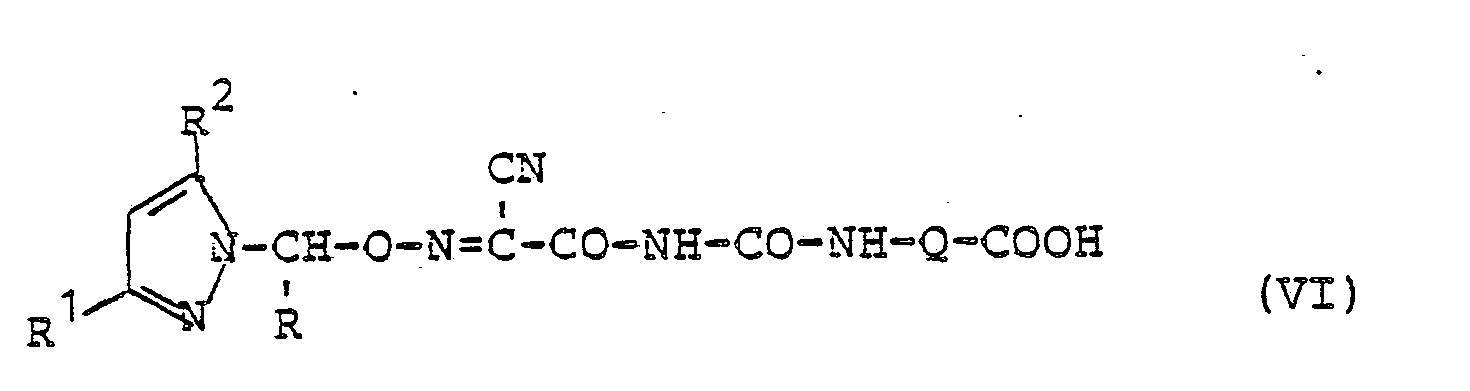
in welcher
umsetzt.
R1, R 2 und R3 die obengenannten Bedeutungen besitzen und
Q für gerades oder verzweigtes Alkylen mit 1 bis 5' Kohlenstoffatomen steht,
in Form ihres Alkali-, Erdalkali- oder Ammoniumsalzes mit einem Alkylierungsmittel der Formel 
in welcher
in Form ihres Alkali-, Erdalkali- oder Ammoniumsalzes mit einem Alkylierungsmittel der Formel
R6 für Alkyl mit 1 bis 3 Kohlenstoffatomen steht und
Y für eine Abgangsgruppe wie Chlor, Brom, Jod, Alkoxysulfonyloxy, Alkylsulfonyloxy oder Arylsulfonyloxy steht,
umsetzt.
4. Fungizide Mittel, gekennzeichnet durch einen Gehalt an mindestens einem pyrazolsubstituierten Oximinocyano-acetamid-Derivat der Formel (I) in Ansprüchen 1 und 3.
5. Verfahren zur Bekämpfung von Pilzen, dadurch gekennzeichnet, daß man pyrazolsubstituierte Oximino-cyan-acetamid-Derivate der Formel (I) in Ansprüchen 1 und 3 auf Pilze oder ihren Lebensraum einwirken läßt.
6. Verwendung von pyrazolsubstituierten Oximino-cyanacefamid-Derivaten der Formel (I) in Ansprüchen 1 und 3 zur Bekämpfung von Pilzen.
7. Verfahren zur Herstellung von fungiziden Mitteln, dadurch gekennzeichnet, daß man pyrazolsubstituierte Oximino-cyan-acetamid-Derivate der Formel (I) in Ansprüchen 1 und 3 mit Streckmitteln und/oder oberflächenaktiven Mitteln vermischt.
Applications Claiming Priority (2)
| Application Number | Priority Date | Filing Date | Title |
|---|---|---|---|
| DE19803041998 DE3041998A1 (de) | 1980-11-07 | 1980-11-07 | Pyrazolsubstituierte oximino-cyan-acetamid-derivate, verfahren zu ihrer herstellung sowie ihre verwendung als fungizide |
| DE3041998 | 1980-11-07 |
Publications (1)
| Publication Number | Publication Date |
|---|---|
| EP0051784A1 true EP0051784A1 (de) | 1982-05-19 |
Family
ID=6116190
Family Applications (1)
| Application Number | Title | Priority Date | Filing Date |
|---|---|---|---|
| EP81108890A Withdrawn EP0051784A1 (de) | 1980-11-07 | 1981-10-24 | Pyrazolsubstituierte Oximino-cyan-acetamid-Derivate, Verfahren zu ihrer Herstellung sowie ihre Verwendung als Fungizide |
Country Status (14)
| Country | Link |
|---|---|
| US (1) | US4368202A (de) |
| EP (1) | EP0051784A1 (de) |
| JP (1) | JPS57108070A (de) |
| AR (1) | AR228164A1 (de) |
| AU (1) | AU526941B2 (de) |
| BR (1) | BR8107218A (de) |
| CS (1) | CS221996B2 (de) |
| DE (1) | DE3041998A1 (de) |
| DK (1) | DK492281A (de) |
| ES (1) | ES8206485A1 (de) |
| IL (1) | IL64212A0 (de) |
| PL (1) | PL233711A1 (de) |
| PT (1) | PT73894B (de) |
| ZA (1) | ZA817672B (de) |
Cited By (3)
| Publication number | Priority date | Publication date | Assignee | Title |
|---|---|---|---|---|
| US4518605A (en) * | 1982-06-19 | 1985-05-21 | Bayer Aktiengesellschaft | Fungicidal azole-substituted oximino-cyano-acetamide derivatives |
| WO1986006457A1 (en) * | 1985-04-24 | 1986-11-06 | Billy Jacquet | Device for preventing leakage in pressure ducts |
| EP3822253A4 (de) * | 2018-07-13 | 2022-04-13 | Shenyang Sinochem Agrochemicals R&D Co., Ltd. | Verfahren zur herstellung einer propandinitriloximetherverbindung und zwischenverbindung |
Families Citing this family (1)
| Publication number | Priority date | Publication date | Assignee | Title |
|---|---|---|---|---|
| US20100272885A1 (en) * | 2006-08-16 | 2010-10-28 | SeekTech, Inc., a California corporation | Marking Paint Applicator for Portable Locator |
Citations (4)
| Publication number | Priority date | Publication date | Assignee | Title |
|---|---|---|---|---|
| DE2312956A1 (de) * | 1972-03-15 | 1973-09-20 | Du Pont | Mittel zum bekaempfen von flunguserkrankungen bei pflanzen |
| US3919284A (en) * | 1974-06-13 | 1975-11-11 | Du Pont | Process for making 2-cyano-2-hydroxyiminoacetamide salts |
| US3957847A (en) * | 1974-03-21 | 1976-05-18 | E. I. Du Pont De Nemours And Company | 2-cyano-2-hydroxyiminoacetamides as plant disease control agents |
| EP0000023A1 (de) * | 1977-06-04 | 1978-12-20 | Bayer Ag | Omega-substituierte Pentyl-harnstoff-Derivate, Verfahren zu ihrer Herstellung sowie ihre Verwendung als Fungizide |
Family Cites Families (2)
| Publication number | Priority date | Publication date | Assignee | Title |
|---|---|---|---|---|
| AT365410B (de) | 1978-08-31 | 1982-01-11 | Ciba Geigy Ag | Mittel zum schutz von kulturpflanzen vor aggressi-ven herbiziden |
| DE2837863A1 (de) | 1978-09-04 | 1980-03-13 | Ciba Geigy Ag | Oxim-derivate zum schutz von pflanzenkulturen |
-
1980
- 1980-11-07 DE DE19803041998 patent/DE3041998A1/de not_active Withdrawn
-
1981
- 1981-10-20 US US06/313,110 patent/US4368202A/en not_active Expired - Fee Related
- 1981-10-24 EP EP81108890A patent/EP0051784A1/de not_active Withdrawn
- 1981-10-28 PT PT73894A patent/PT73894B/pt unknown
- 1981-11-03 AU AU77057/81A patent/AU526941B2/en not_active Ceased
- 1981-11-04 IL IL64212A patent/IL64212A0/xx unknown
- 1981-11-04 CS CS818101A patent/CS221996B2/cs unknown
- 1981-11-05 AR AR287347A patent/AR228164A1/es active
- 1981-11-05 JP JP56176602A patent/JPS57108070A/ja active Pending
- 1981-11-06 PL PL23371181A patent/PL233711A1/xx unknown
- 1981-11-06 ES ES506911A patent/ES8206485A1/es not_active Expired
- 1981-11-06 ZA ZA817672A patent/ZA817672B/xx unknown
- 1981-11-06 BR BR8107218A patent/BR8107218A/pt unknown
- 1981-11-06 DK DK492281A patent/DK492281A/da unknown
Patent Citations (4)
| Publication number | Priority date | Publication date | Assignee | Title |
|---|---|---|---|---|
| DE2312956A1 (de) * | 1972-03-15 | 1973-09-20 | Du Pont | Mittel zum bekaempfen von flunguserkrankungen bei pflanzen |
| US3957847A (en) * | 1974-03-21 | 1976-05-18 | E. I. Du Pont De Nemours And Company | 2-cyano-2-hydroxyiminoacetamides as plant disease control agents |
| US3919284A (en) * | 1974-06-13 | 1975-11-11 | Du Pont | Process for making 2-cyano-2-hydroxyiminoacetamide salts |
| EP0000023A1 (de) * | 1977-06-04 | 1978-12-20 | Bayer Ag | Omega-substituierte Pentyl-harnstoff-Derivate, Verfahren zu ihrer Herstellung sowie ihre Verwendung als Fungizide |
Cited By (4)
| Publication number | Priority date | Publication date | Assignee | Title |
|---|---|---|---|---|
| US4518605A (en) * | 1982-06-19 | 1985-05-21 | Bayer Aktiengesellschaft | Fungicidal azole-substituted oximino-cyano-acetamide derivatives |
| WO1986006457A1 (en) * | 1985-04-24 | 1986-11-06 | Billy Jacquet | Device for preventing leakage in pressure ducts |
| EP3822253A4 (de) * | 2018-07-13 | 2022-04-13 | Shenyang Sinochem Agrochemicals R&D Co., Ltd. | Verfahren zur herstellung einer propandinitriloximetherverbindung und zwischenverbindung |
| US11952355B2 (en) | 2018-07-13 | 2024-04-09 | Shenyang Sinochem Agrochemicals R&D Co., Ltd. | Method of preparing malononitrile oxime ether compound and intermediate compound |
Also Published As
| Publication number | Publication date |
|---|---|
| ES506911A0 (es) | 1982-08-16 |
| CS221996B2 (en) | 1983-04-29 |
| US4368202A (en) | 1983-01-11 |
| DE3041998A1 (de) | 1982-06-09 |
| DK492281A (da) | 1982-05-08 |
| PT73894B (en) | 1983-01-25 |
| AU7705781A (en) | 1982-11-04 |
| BR8107218A (pt) | 1982-07-27 |
| IL64212A0 (en) | 1982-02-28 |
| JPS57108070A (en) | 1982-07-05 |
| ES8206485A1 (es) | 1982-08-16 |
| PT73894A (en) | 1981-11-01 |
| ZA817672B (en) | 1982-10-27 |
| PL233711A1 (de) | 1982-12-20 |
| AU526941B2 (en) | 1983-02-10 |
| AR228164A1 (es) | 1983-01-31 |
Similar Documents
| Publication | Publication Date | Title |
|---|---|---|
| EP0000023B1 (de) | Omega-substituierte Pentyl-harnstoff-Derivate, Verfahren zu ihrer Herstellung sowie ihre Verwendung als Fungizide | |
| EP0037971B1 (de) | Trisubstituierte Cyanguanidine, Verfahren zu ihrer Herstellung sowie ihre Verwendung als Fungizide | |
| EP0072528B1 (de) | (Thio-) Harnstoffe, ein Verfahren zu ihrer Herstellung und ihre Verwendung als Pflanzenschutzmittel | |
| EP0010673B1 (de) | Substituierte N-Propargyl-aniline, Verfahren zu ihrer Herstellung sowie ihre Verwendung als Fungizide | |
| EP0072970A1 (de) | Substituierte Anilinomethylen-oxime, Verfahren zu ihrer Herstellung sowie ihre Verwendung als Pflanzenschutzmittel | |
| EP0002679B1 (de) | 1-Halogen-1-propin-3-ole, Verfahren zu ihrer Herstellung sowie ihre Verwendung als Fungizide | |
| EP0144895B1 (de) | Thiolan-2,4-dion-3-carboxamide | |
| DE3041998A1 (de) | Pyrazolsubstituierte oximino-cyan-acetamid-derivate, verfahren zu ihrer herstellung sowie ihre verwendung als fungizide | |
| EP0097280B1 (de) | Azolsubstituierte Oximino-cyan-acetamid-Derivate | |
| EP0055442B1 (de) | N-Sulfenylierte Biurete, Verfahren zu ihrer Herstellung und ihre Verwendung als Fungizide | |
| DE3139457A1 (de) | Neue substituierte benzanilidether, verfahren zu ihrer herstellung, ihre verwendung als fungizide und zwischenprodukte hierfuer | |
| EP0018509B1 (de) | N-Allenyl-acetanilide, Verfahren zu ihrer Herstellung sowie ihre Verwendung als Fungizide | |
| DE2626828A1 (de) | Neue carbamidsaeureoximester, verfahren zu ihrer herstellung sowie ihre verwendung als fungizide | |
| EP0198191B1 (de) | Piperazinylmethyl-1,2,4-triazolylmethyl-carbinole | |
| EP0154273B1 (de) | Fungizide Mittel | |
| EP0046931A2 (de) | N-Oxiamide, Verfahren zu ihrer Herstellung sowie ihre Verwendung als Fungizide | |
| EP0066771B1 (de) | 1-Iod-1-propin-3-ole, Verfahren zu ihrer Herstellung sowie ihre Verwendung als Pflanzenschutzmittel | |
| EP0087048B1 (de) | Substituierte Oximinoacetanilide, Verfahren zu ihrer Herstellung sowie ihre Verwendung als Schädlingsbekämpfungsmittel | |
| EP0080106A1 (de) | Verfahren zur Herstellung von N-substituierten N-Isocyanatocarbonyl-carbamaten | |
| DE2758108A1 (de) | Neue omega-substituierte pentyl-harnstoff-derivate, verfahren zu ihrer herstellung sowie ihre verwendung als fungizide | |
| DD147611A5 (de) | Fungizide mittel | |
| DE3025219A1 (de) | Benzoyl-azole, verfahren zu ihrer herstellung sowie ihre verwendung als fungizide | |
| DE2623847A1 (de) | Neue oximaether, verfahren zu ihrer herstellung sowie ihre verwendung als fungizide | |
| DE2725315A1 (de) | Neue cyanpentyl-harnstoff-derivate, verfahren zu ihrer herstellung sowie ihre verwendung als fungizide | |
| DE3431856A1 (de) | Fungizide mittel auf acylanilin-derivat-basis |
Legal Events
| Date | Code | Title | Description |
|---|---|---|---|
| PUAI | Public reference made under article 153(3) epc to a published international application that has entered the european phase |
Free format text: ORIGINAL CODE: 0009012 |
|
| 17P | Request for examination filed |
Effective date: 19811024 |
|
| AK | Designated contracting states |
Designated state(s): AT BE CH DE FR GB IT NL SE |
|
| STAA | Information on the status of an ep patent application or granted ep patent |
Free format text: STATUS: THE APPLICATION HAS BEEN WITHDRAWN |
|
| 18W | Application withdrawn |
Withdrawal date: 19830720 |
|
| RIN1 | Information on inventor provided before grant (corrected) |
Inventor name: DAUM, WERNER, DR. Inventor name: BRANDES, WILHELM, DR. |