EP0046931A2 - N-Oxiamide, Verfahren zu ihrer Herstellung sowie ihre Verwendung als Fungizide - Google Patents
N-Oxiamide, Verfahren zu ihrer Herstellung sowie ihre Verwendung als Fungizide Download PDFInfo
- Publication number
- EP0046931A2 EP0046931A2 EP81106468A EP81106468A EP0046931A2 EP 0046931 A2 EP0046931 A2 EP 0046931A2 EP 81106468 A EP81106468 A EP 81106468A EP 81106468 A EP81106468 A EP 81106468A EP 0046931 A2 EP0046931 A2 EP 0046931A2
- Authority
- EP
- European Patent Office
- Prior art keywords
- alkyl
- formula
- halogen
- alkenyl
- alkynyl
- Prior art date
- Legal status (The legal status is an assumption and is not a legal conclusion. Google has not performed a legal analysis and makes no representation as to the accuracy of the status listed.)
- Withdrawn
Links
- 0 **NC(*)C(*)=O Chemical compound **NC(*)C(*)=O 0.000 description 4
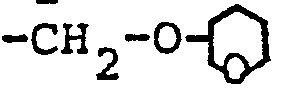
- XTDKZSUYCXHXJM-UHFFFAOYSA-N COC1OCCCC1 Chemical compound COC1OCCCC1 XTDKZSUYCXHXJM-UHFFFAOYSA-N 0.000 description 1
Classifications
-
- A—HUMAN NECESSITIES
- A01—AGRICULTURE; FORESTRY; ANIMAL HUSBANDRY; HUNTING; TRAPPING; FISHING
- A01N—PRESERVATION OF BODIES OF HUMANS OR ANIMALS OR PLANTS OR PARTS THEREOF; BIOCIDES, e.g. AS DISINFECTANTS, AS PESTICIDES OR AS HERBICIDES; PEST REPELLANTS OR ATTRACTANTS; PLANT GROWTH REGULATORS
- A01N43/00—Biocides, pest repellants or attractants, or plant growth regulators containing heterocyclic compounds
- A01N43/02—Biocides, pest repellants or attractants, or plant growth regulators containing heterocyclic compounds having rings with one or more oxygen or sulfur atoms as the only ring hetero atoms
- A01N43/04—Biocides, pest repellants or attractants, or plant growth regulators containing heterocyclic compounds having rings with one or more oxygen or sulfur atoms as the only ring hetero atoms with one hetero atom
- A01N43/06—Biocides, pest repellants or attractants, or plant growth regulators containing heterocyclic compounds having rings with one or more oxygen or sulfur atoms as the only ring hetero atoms with one hetero atom five-membered rings
- A01N43/08—Biocides, pest repellants or attractants, or plant growth regulators containing heterocyclic compounds having rings with one or more oxygen or sulfur atoms as the only ring hetero atoms with one hetero atom five-membered rings with oxygen as the ring hetero atom
-
- A—HUMAN NECESSITIES
- A01—AGRICULTURE; FORESTRY; ANIMAL HUSBANDRY; HUNTING; TRAPPING; FISHING
- A01N—PRESERVATION OF BODIES OF HUMANS OR ANIMALS OR PLANTS OR PARTS THEREOF; BIOCIDES, e.g. AS DISINFECTANTS, AS PESTICIDES OR AS HERBICIDES; PEST REPELLANTS OR ATTRACTANTS; PLANT GROWTH REGULATORS
- A01N37/00—Biocides, pest repellants or attractants, or plant growth regulators containing organic compounds containing a carbon atom having three bonds to hetero atoms with at the most two bonds to halogen, e.g. carboxylic acids
- A01N37/44—Biocides, pest repellants or attractants, or plant growth regulators containing organic compounds containing a carbon atom having three bonds to hetero atoms with at the most two bonds to halogen, e.g. carboxylic acids containing at least one carboxylic group or a thio analogue, or a derivative thereof, and a nitrogen atom attached to the same carbon skeleton by a single or double bond, this nitrogen atom not being a member of a derivative or of a thio analogue of a carboxylic group, e.g. amino-carboxylic acids
- A01N37/46—N-acyl derivatives
-
- C—CHEMISTRY; METALLURGY
- C07—ORGANIC CHEMISTRY
- C07D—HETEROCYCLIC COMPOUNDS
- C07D307/00—Heterocyclic compounds containing five-membered rings having one oxygen atom as the only ring hetero atom
- C07D307/02—Heterocyclic compounds containing five-membered rings having one oxygen atom as the only ring hetero atom not condensed with other rings
- C07D307/34—Heterocyclic compounds containing five-membered rings having one oxygen atom as the only ring hetero atom not condensed with other rings having two or three double bonds between ring members or between ring members and non-ring members
- C07D307/56—Heterocyclic compounds containing five-membered rings having one oxygen atom as the only ring hetero atom not condensed with other rings having two or three double bonds between ring members or between ring members and non-ring members with hetero atoms or with carbon atoms having three bonds to hetero atoms with at the most one bond to halogen, e.g. ester or nitrile radicals, directly attached to ring carbon atoms
- C07D307/68—Carbon atoms having three bonds to hetero atoms with at the most one bond to halogen
Definitions
- the present invention relates to new N-oxiamides, several processes for their preparation and their use as fungicides.
- haloacetanilides such as, for example, N-chloroacetyl-N- (2,6-dimethylphenyl) alanine or -glycine alkyl esters
- haloacetanilides can be used with good success to combat fungal plant diseases (cf. DE-OS 2 350,944 or U.S. Patent 3,780,090).
- their effect is not always entirely satisfactory, especially when low amounts and concentrations are applied, in particular when combating Phytophthora species.
- the new N-oxiamides have strong fungicidal properties. Surprisingly, they show a considerably higher activity than the N-chloroacetyl-N- (2,6-dimethyl-phenyl) -alanine or -glycine-alkyl esters known from the prior art.
- R 1 , R 2 , R 3 , R 4 , R 5 and R 6 preferably represent hydrogen and straight-chain or branched alkyl having 1 to 4 carbon atoms.
- R also preferably represents halogen, such as in particular fluorine, chlorine or bromine.
- R 5 and R 6 also preferably represent C 1-4 -alkyl, alkenyl or alkynyl optionally substituted by halogen, in particular chlorine, and also an alkylene grouping with 2-4 carbon atoms.
- R 7 preferably represents furyl, tetrahydrofuryl, thienyl, tetrahydrothienyl, alkyl optionally substituted by halogen, cyano or thiocyano having 1 to 4 and alkenyl and alkynyl each having 2 to 4 carbon atoms; where fluorine and chlorine are preferably mentioned as halogen atoms, and also for the groupings -CH 2 -Az, -CH 2 -OR 8 , -CH 2 -SR 8 , -OR B , -SR 8 , -CH 2 -OSO 2 R 8 , -COOR 8 and
- R 8 preferably represents alkyl with 1 to 4 and alkenyl optionally substituted by halogen, in particular fluorine, chlorine and bromine, cyano and thiocyano and alkynyl each having 2 to 4 carbon atoms and for alkoxyalkyl having 1 to 4 carbon atoms in each alkyl part.
- N-oxiamides of the formula (I) in which R 1 , R 2 and R are hydrogen, methyl, ethyl, isopropyl, sec-butyl and tert-butyl are very particularly preferred; R 1 also represents chlorine or bromine; R 4 represents hydrogen, methyl or ethyl; R 5 represents hydrogen, methyl, ethyl, allyl and propargyl and R 6 represents hydrogen, methyl, ethyl, allyl and propargyl, where R 5 and R 6 also form a (CH 2 ) n bridge with n 3 or 4 can; and R is 2-furyl, 2-thienyl, 2-tetrahydrofuryl, methoxymethyl, ethoxymethyl, allyloxymethyl, propargyloxymethyl, methoxyethoxymethyl, methoxymethoxymethyl, Methylmercaptomethyl, methoxy, ethoxy, allyloxy, propargyloxy, Methylsulfon
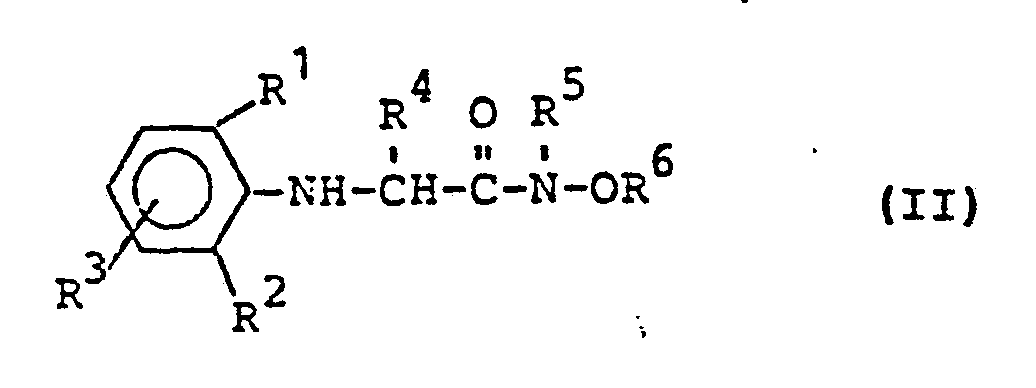
- Formula (II) provides a general definition of the anilines required as starting materials when carrying out process (a) according to the invention.
- R, R 2 , R 3 , R 4 , R 5 and R preferably represent those radicals which have already been mentioned for these radicals in connection with the description of the substances of the formula (I) according to the invention.
- the following compounds may be mentioned individually as examples of compounds of the formula (II):
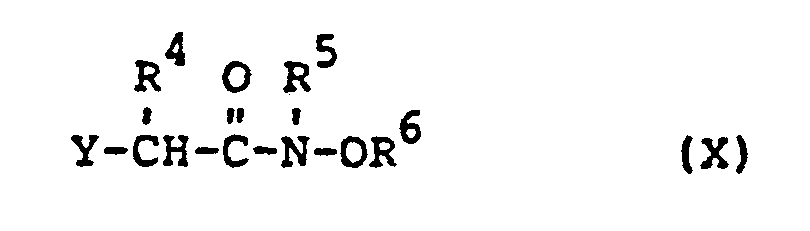
- substituted anilines of the formula (II) are not yet known. They can be obtained by, for example, anilines of the formula IX in which R 1 , R 2 and R 3 have the meaning given above, with substituted oxiamides of the formula (X) in which R 4 , R 5 and R 6 have the meaning given above, and Y represents chlorine or bromine, in the presence of an acid binder, such as, for example, alkali metal carbonates and optionally in the presence of an inert organic solvent, such as, for example, toluene or dimethylformamide, at temperatures between 20 and 160 ° C implemented.
- an acid binder such as, for example, alkali metal carbonates
- an inert organic solvent such as, for example, toluene or dimethylformamide
- anilines of the formula (IX) required as starting materials are generally known compounds of organic chemistry. Examples include:
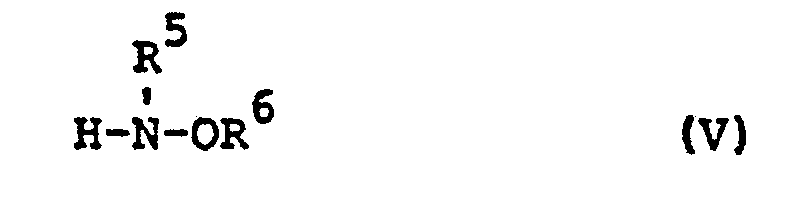
- substituted oxiamides of the formula (X) which are also required as starting materials are known in some cases (cf. US Pat. No. 3,835,205, 3,917,664) or can be by reaction of the ⁇ -halocarboxylic acid chlorides of the formula (XI) in which R 4 and Y have the meaning given above with the hydroxylamines of the formula (V) in which round R 6 have the meaning given above, produce easily.
- the acid derivatives also to be used as starting materials for process (a) according to the invention i.e. Chlorides or bromides or anhydrides are generally defined by the formula (III).
- R preferably represents those radicals which, in connection with the description of the substances of the formula (I) according to the invention, have preferably been mentioned for these substituents.
- the acid chlorides or bromides or anhydrides Formula (III) are generally known compounds of organic chemistry.
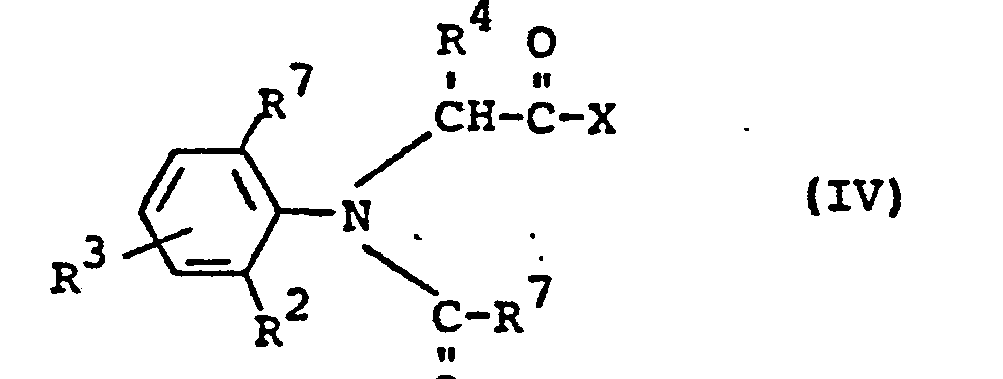
- Formula IV provides a general definition of the acids or their derivatives required as starting materials when carrying out process (b) according to the invention.
- R 1 , R 2 , R 3 and R 7 preferably represent those radicals which have already been mentioned preferably in connection with the description of the substances of the formula (I) according to the invention for these substituents.
- the carboxylic acids or their derivatives of the formula IV can be obtained by saponifying the corresponding methyl or ethyl esters known from DE-OS 2 515 091 and optionally reacting the acids obtained with thionyl chloride or oxalyl chloride in a diluent.
- Formula (VI) provides a general definition of the hydroxyacetanilides required as starting materials when carrying out process (c1) according to the invention.
- R 1 , R 2 , R 3 , R 4 , R 5 and R 6 preferably represent those radicals which, in connection with the description of the substances of the formula (I) according to the invention, are preferably mentioned for these substituents.
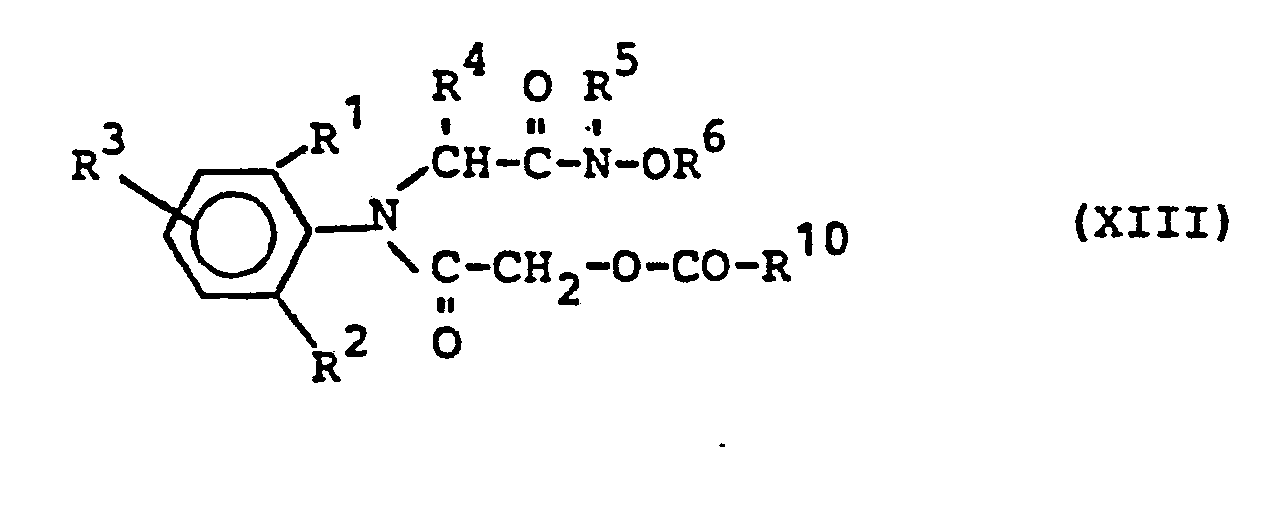
- hydroxyacetanilides of the formula (VI) can be obtained in a generally known manner by using acyloxyacetylanilides of the formula in which R 1 , R 2 , R 3 , R 4 , R 6 have the meaning given above and R 10 represents alkyl having 1 to 4 carbon atoms,
- acyloxyacetylanilides of the formula (XIII) can be obtained in a generally customary and known manner by reacting anilines of the formula (II) with corresponding acyloxyacetyl halides.
- Formula (VII) provides a general definition of the halides to be used as starting materials for process (c / 1) according to the invention.
- R 9 or R 8 preferably represents the radicals which have already been mentioned as preferred for these substituents in connection with the description of the substances of the formula (I) according to the invention.
- Hal preferably represents chlorine, bromine or iodine.
- the halides of the formula (VII) are generally known compounds of organic chemistry.
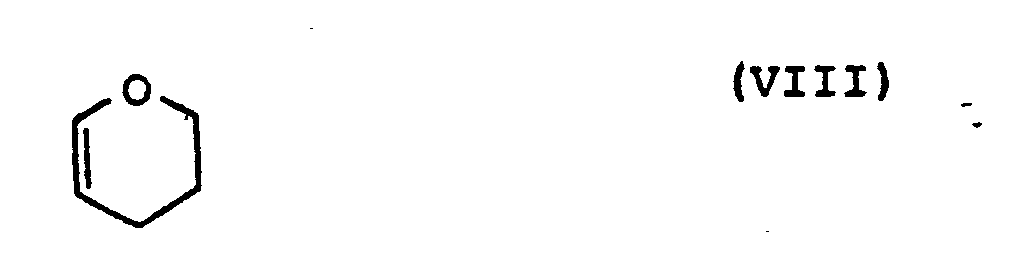
- the dihydropyran also to be used as starting material for process (c / 2) according to the invention is also a known compound of organic chemistry.
- Suitable diluents for the reaction according to the invention in process (a) are organic solvents. These preferably include xetones, such as diethyl ketone, in particular acetone and methyl ethyl ketone; Nitriles, such as propionitrile, especially acetonitrile; Ethers such as tetrahydrofuran or dioxane; aliphatic and aromatic hydrocarbons, such as petroleum ether, benzene, toluene or xylene; halogenated hydrocarbons, such as methylene chloride, carbon tetrachloride, chloroform or chlorobenzene; and esters, such as ethyl acetate.
- xetones such as diethyl ketone, in particular acetone and methyl ethyl ketone
- Nitriles such as propionitrile, especially acetonitrile
- Ethers such as tetrahydrofuran or diox
- process (a) according to the invention can be carried out in the presence of acid binders (hydrogen halide acceptors).
- acid binders hydrogen halide acceptors
- All conventional acid binders can be used as such.
- These preferably include organic bases, such as tertiary amines, for example triethylamine or pyridine, and furthermore inorganic bases, such as, for example, alkali metal hydroxides and alkali metal carbonates.
- reaction temperatures can be varied within a substantial range when carrying out process (a) according to the invention. Generally you work. between 0 ° C and 120 ° C, preferably between 20 and 100 ° C.
- Organic solvents are suitable as diluents for the reaction according to the invention in process (b). These preferably include the solvents already mentioned in process (a).
- reaction temperatures can be varied within a substantial range when carrying out process (b) according to the invention. In general, one works between 0 ° C and 80 ° C, preferably between 0 ° C and 50 ° C.
- a water-releasing agent e.g. Dicyclohexylcarbodiimid used.
- the coupling of the acid (IV) with the hydroxylamines (V) with the participation of the water-releasing reagent dicyclohexylcarbodiimide takes place according to the usual method (cf. Chemiker-Zeitung 183 (1979) p. 19). Equimolar amounts of the reactants are preferably used. Inert organic solvents such as e.g. Methylene chloride, dioxane or toluene in question.
- the reaction temperatures can be varied within a wide range. In general, one works between 0 ° C and 50 ° C, preferably between 20 ° C and 30 ° C.
- Suitable diluents for the reaction according to the invention in process (c) are organic solvents. These preferably include the solvents already mentioned in process (a).
- reaction according to process (c / 1) can optionally be carried out in the presence of an acid binder.
- reaction temperatures can be varied within a wide range in process (c / 1). In general, between 20 and 150 ° C, preferably at the boiling point of the solvent, for example between 60 and 100 ° C.
- a preferred embodiment of the method (c / 1) is expediently carried out by starting from a hydroxyacetanilide of the formula (VI), converting the latter into the alkali metal alkanolate using alkali metal hydride in a suitable inert solvent, and the latter without isolation immediately using a halide of the formula (VII) reacted, the compounds of the formula (I) according to the invention being obtained in one operation with the emergence of alkali halide.
- reaction according to process (c / 2) can optionally be carried out in the presence of a catalyst.
- Hydrogen chloride is preferably used for this purpose (cf. J. Am. Chem. Soc. 69, 2246 (1947), ibid. 70, 4187 (1948)).
- reaction temperatures can be varied within a wide range in process (c / 2). Generally one works between 0 and 100 ° C, preferably between 20 and 60 ° C.
- the process (c / 2) according to the invention is preferably carried out in molar amounts.
- the compounds of the formula (I) are isolated in a customary manner.
- the active compounds according to the invention have a strong microbicidal action and can be used practically to combat unwanted microorganisms.
- the active ingredients are suitable for use as pesticides.
- Fungicidal agents in crop protection are used to control Plasmodiophoromycetes, Oomycetes, Chytridiomycetes, Zygomycetes, Ascomycetes, Basidiomycetes, Deuteromycetes.
- the active ingredients can be converted into the customary formulations, such as solutions, emulsions, suspensions, powders, foams, pastes, granules, aerosols, active ingredient-impregnated natural and synthetic substances, very fine encapsulations in polymeric substances and in coating compositions for seeds, and also in formulations with Fuel sets, such as smoking cartridges, cans, spirals, etc., as well as ULV cold and warm mist formulations.
- customary formulations such as solutions, emulsions, suspensions, powders, foams, pastes, granules, aerosols, active ingredient-impregnated natural and synthetic substances, very fine encapsulations in polymeric substances and in coating compositions for seeds, and also in formulations with Fuel sets, such as smoking cartridges, cans, spirals, etc., as well as ULV cold and warm mist formulations.
- formulations are prepared in a known manner, for example by mixing the active ingredients with extenders 1, that is to say liquid solvents, pressurized liquefied gases and / or solid carriers, if appropriate using surface-active agents, that is to say emulsifiers and / or dispersants and / or foam-generating agents. If water is used as an extender, organic solutions can also be used be used as auxiliary solvents.
- extenders 1 that is to say liquid solvents, pressurized liquefied gases and / or solid carriers, if appropriate using surface-active agents, that is to say emulsifiers and / or dispersants and / or foam-generating agents.
- surface-active agents that is to say emulsifiers and / or dispersants and / or foam-generating agents.
- organic solutions can also be used be used as auxiliary solvents.
- Aromatics such as xylene, toluene, or alkylnaphthalenes, chlorinated aromatics or chlorinated aliphatic hydrocarbons, such as chlorobenzenes, chloroethylene or methylene chloride, aliphatic hydrocarbons, such as cyclohexane or paraffins, for example petroleum fractions, alcohols, such as butanol or glycol, and their ethers and esters, ketones, such as Acetone, methyl ethyl ketone, methyl isobutyl ketone or cyclohexanone, strongly polar solvents such as dimethylformamide and dimethyl sulfoxide, and water;
- Liquefied gaseous extenders or carriers mean those liquids which are gaseous at normal temperature and under normal pressure, for example aerosol propellants, such as halogenated hydrocarbons and butane, propane, nitrogen and carbon dioxide;
- Solid carrier materials are suitable: for example natural rock powders such as xylene, to
- Adhesives such as carboxy-methylcellulose, natural and synthetic powdery, granular and latex-shaped polymers, such as gum arabic, polyvinyl alcohol, polyvinyl acetate, can be used in the formulations.
- Dyes such as inorganic pigments, e.g. Iron oxide, titanium oxide, ferrocyan blue and organic dyes such as alizarin, azo metal phthalocyanine dyes and trace nutrients such as salts of iron, manganese, boron, copper, cobalt, molybdenum and zinc can be used.
- the formulations generally contain between 0.1 and 95 percent by weight of active compound, preferably between 0.5 and 90%.
- the active compounds according to the invention can be present in the formulations or in the various use forms in a mixture with other known active compounds, such as fungicides, bactericides, insecticides, acaricides, nematicides, herbicides, bird repellants, growth agents, plant nutrients and agents which improve soil structure.
- active compounds such as fungicides, bactericides, insecticides, acaricides, nematicides, herbicides, bird repellants, growth agents, plant nutrients and agents which improve soil structure.
- the active compounds can be used as such, in the form of their formulations or in the use forms prepared therefrom by further dilution, such as ready-to-use solutions, emulsions, suspensions, powders, pastes and granules. They are used in the usual way, e.g. by pouring, dipping, spraying, spraying, atomizing, evaporating, injecting, slurrying, spreading, dusting, scattering, dry pickling, wet pickling, wet pickling, slurry pickling or incrusting.
- the active compound concentrations in the use forms can be varied within a substantial range. They are generally between 1 and 0.0001% by weight, preferably between 0.5 and 0.001%.
- amounts of active ingredient of 0.001 to 50 g per kilogram of seed, preferably 0.01 to 10 g, are generally required.
- active ingredient concentrations of 0.00001 to 0.1% by weight, preferably 0.0001 to 0.02%, are required at the site of action.
- active compound 1 part by weight of active compound is mixed with the stated amounts of solvent and emulsifier and the concentrate is diluted with water to the desired concentration.
- the active ingredient preparation is poured onto common soil, in which there are young plants ready for testing. 3 days after the treatment, the plants are inoculated with an aqueous spore suspension of Phytophthora infestans.
- the plants are placed in an incubation cabin with 100% relative humidity at approx. 20 ° C.
- Evaluation is carried out 4 days after the incubation.
Landscapes
- Life Sciences & Earth Sciences (AREA)
- Organic Chemistry (AREA)
- Chemical & Material Sciences (AREA)
- Dentistry (AREA)
- Health & Medical Sciences (AREA)
- Engineering & Computer Science (AREA)
- Plant Pathology (AREA)
- General Health & Medical Sciences (AREA)
- Wood Science & Technology (AREA)
- Zoology (AREA)
- Environmental Sciences (AREA)
- Pest Control & Pesticides (AREA)
- Agronomy & Crop Science (AREA)
- Organic Low-Molecular-Weight Compounds And Preparation Thereof (AREA)
- Agricultural Chemicals And Associated Chemicals (AREA)
Abstract
Description
- Die vorliegende Erfindung betrifft neue N-Oxiamide, mehrere Verfahren zu ihrer Herstellung und ihre Verwendung als Fungizide.
- Es ist bereits bekannt geworden, daß Halogenacetanilide, wie beispielsweise N-Chloracetyl-N-(2,6-dimethylphenyl)-alanin- bzw. -glycin-alkylester mit gutem Erfolg zur Bekämpfung von pilzlichen Pflanzenkrankheiten eingesetzt werden können (vergleiche DE-OS 2 350 944 bzw. US-Patentschrift 3 780 090). Deren Wirkung ist jedoch, insbesondere bei niedrigen Aufwandmengen und -konzentrationen, insbesondere auch bei der Bekämpfung von Phytophthora-Arten, nicht immer ganz befriedigend.
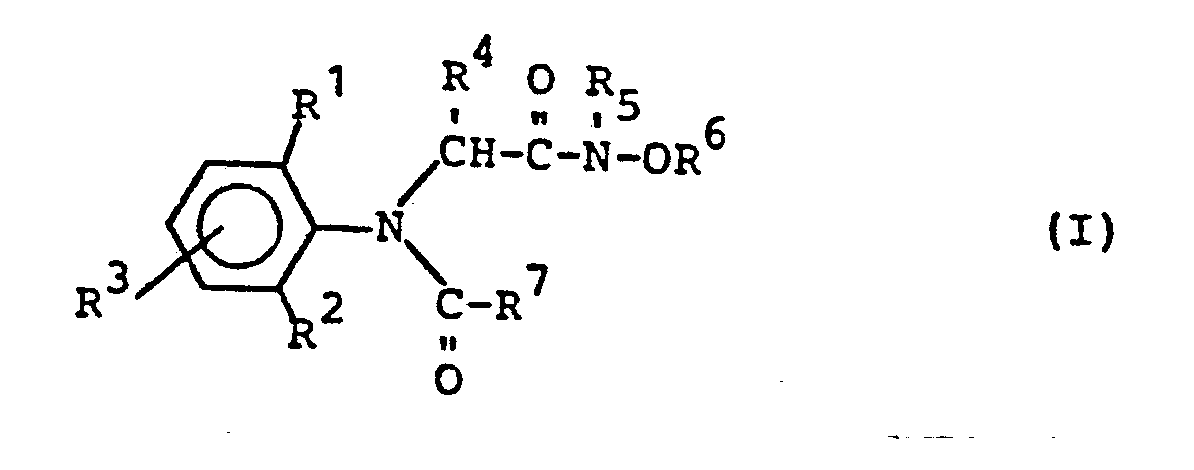
- Es wurden neue N-Oxiamide der allgemeinen Formel I gefunden:
- R1 für Wasserstoff, Alkyl oder Halogen steht,
- R2 für Wasserstoff oder Alkyl steht,
- R 3 für Wasserstoff oder Alkyl steht,
- R 4 für Wasserstoff oder Alkyl steht,
- R5 für Wasserstoff, gegebenenfalls durch Halogen substituiertecAlkyl, Alkenyl, Alkinyl steht,
- R für Wasserstoff, gegebenenfalls durch Halogen substituierterAlkyl, Alkenyl, Alkinyl steht, wobei R5 und R 6 auch eine Alkylenbrücke bilden können,
- R7 für Furyl, Tetrahydrofuryl, Thienyl, Tetrahydrothienyl, gegebenenfalls durch Halogen, Cyano oder Thiocyano substituiertes Alkyl, Alkenyl und Alkinyl; sowie die Gruppierungen -CH2-Az, -CH2-OR8, -CH2-SR8, -OR8, -SR8, -CH2-OSO2R8, -COOR8 und

- R8 für gegebenenfalls substituiertes Alkyl, Alkenyl, Alkinyl und Alkoxyalkyl steht und
- Az für Pyrazol-1-yl, 1,2,4-Triazol-1-yl und Imidazol-1-· yl steht,
- Sie weisen starke fungizide Eigenschaften auf.
- Man erhält die N-Oxiamide der Formel (I), wenn man
- a) substituierte Aniline der Formel II


- R7 die oben angegebene Bedeutung hat und
- Z für Halogen oder R7COO steht,
- in Gegenwart eines Verdünnungsmittels und gegebenenfalls in Gegenwart eines Säurebindemittels umsetzt, oder
- b) Säuren bzw. deren Derivate der Formel IV


- c) Hydroxyacetanilide der Formel VI

- (1) gegebenenfalls nach Aktivierung mittels Alkalimetallhydrid mit Halogeniden der Formel VII

- (2) mit Dihydropyran der Formel VIII

- Die neuen N-Oxiamide weisen starke fungizide Eigenschaften auf. Sie zeigen dabei überraschenderweise eine erheblich höhere Wirkung als die aus dem Stand der Technik bekannten N-Chloracetyl-N-(2,6-dimethyl-phenyl)-alanin- bzw. -glycin-alkylester.
- Die erfindungsgemäßen N-Oxiamide sind durch die Formel (I) allgemein definiert. In dieser Formel stehen R1, R2, R3, R 4, R 5 und R 6 vorzugsweise für Wasserstoff und geradkettiges oder verzweigtes Alkyl mit 1 bis 4 Kohlenstoffatomen. R steht außerdem vorzugsweise für Halogen, wie insbesondere Fluor, Chlor oder Brom. R5 und R6 stehen außerdem vorzugsweise für gegebenenfalls durch Halogen, insbesondere Chlor substituiertes C1-4-Alkyl, Alkenyl oder Alkinyl sowie für eine Alkylengruppierung mit 2-4 Kohlenstoffatomen. R7 steht vorzugsweise für Furyl, Tetrahydrofuryl, Thienyl, Tetrahydrothienyl, für gegebenenfalls durch Halogen, Cyano oder Thiocyano substituiertes Alkyl mit 1 bis 4 und Alkenyl sowie Alkinyl mit jeweils 2 bis 4 Kohlenstoffatomen; wobei als Halogenatome vorzugsweise Fluor und Chlor genannt seien, sowie für die Gruppierungen -CH2-Az, -CH2-OR8, -CH2-SR8, -ORB, -SR8, -CH2-OSO2R8, -COOR8 und
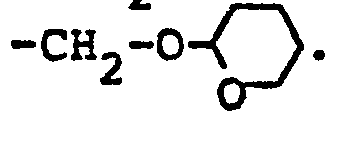
- Az steht dabei für Pyrazol-1-yl, 1,2,4-Triazol-1-yl und 8 Imidazol-1-yl. R8 steht vorzugsweise für gegebenenfalls durch Halogen, insbesondere Fluor, Chlor und Brom, Cyano und Thiocyano substituiertes Alkyl mit 1 bis 4 und Alkenyl sowie Alkinyl mit jeweils 2 bis 4 Kohlenstoffatomen und für Alkoxyalkyl mit 1 bis 4 Kohlenstoffatomen in jedem Alkylteil.
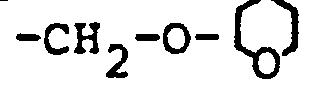
- Ganz besonders bevorzugt sind diejenigen N-Oxiamide der Formel (I), in denen R1 , R2 und R für Wasserstoff, Methyl, Ethyl, Isopropyl, sek.-Butyl und tert.-Butyl stehen; R1 außerdem für Chlor oder Brom steht; R4 für Wasserstoff, Methyl oder Ethyl steht; R5 für Wasserstoff, Methyl, Ethyl, Allyl und Propargyl und R6 für Wasserstoff, Methyl, Ethyl, Allyl und Propargyl steht, wobei R5 und R6 miteinander auch eine (CH2)n-Brücke mit n=3 oder 4 bilden können; und R für 2-Furyl, 2-Thienyl, 2-Tetrahydrofuryl, Methoxymethyl, Ethoxymethyl, Allyloxymethyl, Propargyloxymethyl, Methoxyethoxymethyl, Methoxymethoxymethyl, Methylmercaptomethyl, Methoxy, Ethoxy, Allyloxy, Propargyloxy, Methylsulfonyloxymethyl, Methoxycarbonyl, Ethoxycarbonyl, Allyloxycarbonyl, Propargyloxycarbonyl, Dichlormethyl, Propenyl-1, Cyclopropyl, Ethinyl, Pyrazol-1-yl-methyl, Imidazol-1-yl-methyl, 1,2,4-Triazol-1-yl-methyl und Tetrahydropyran-2-yl-oxy-methyl steht.
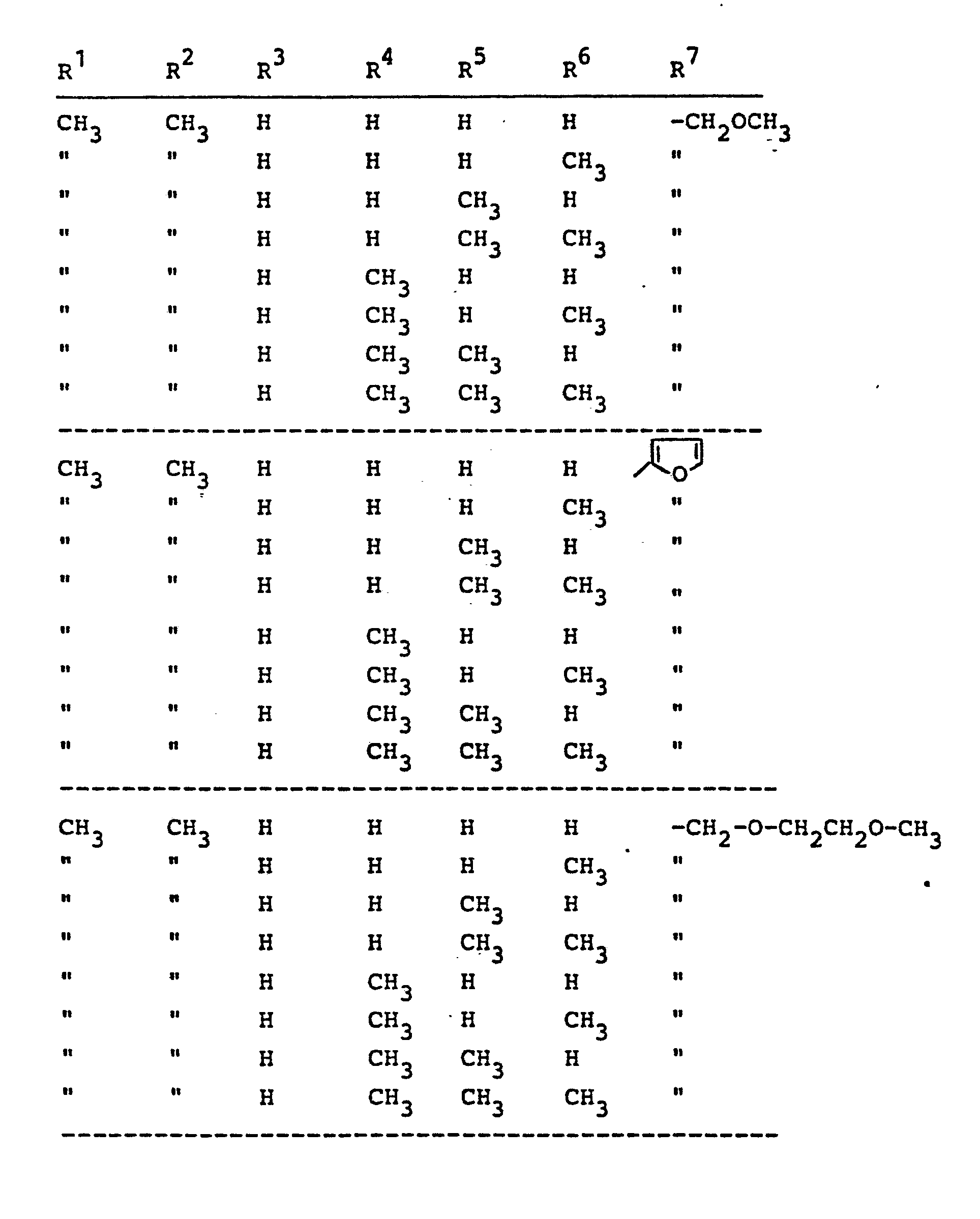
- Im einzelnen seien außer den bei den Herstellungsbeispielen genannten Verbindungen die folgenden Verbindungen der allgemeinen Formel (I) genannt:



- Verwendet man beispielsweise 2-(2', 6'-Dimethyl )-anilino- propionsäure-N,O-dimethyl-oxiamid und Methoxyacetylchlorid als Ausgangsstoffe, so kann der Reaktionsablauf durch das folgende Formelschema wiedergegeben werden (Verfahren a) :

- Verwendet man beispielsweise 2-(2',6'-Dimethyl)-N-methoxyacetyl-anilino-propionsäure und O-Methylhydroxylamin in Gegenwart von Dicyclohexylcarbodiimid als Ausgangsstoffe, so kann der Reaktionsablauf durch das folgende Formelschema wiedergegeben werden (Verfahren b):

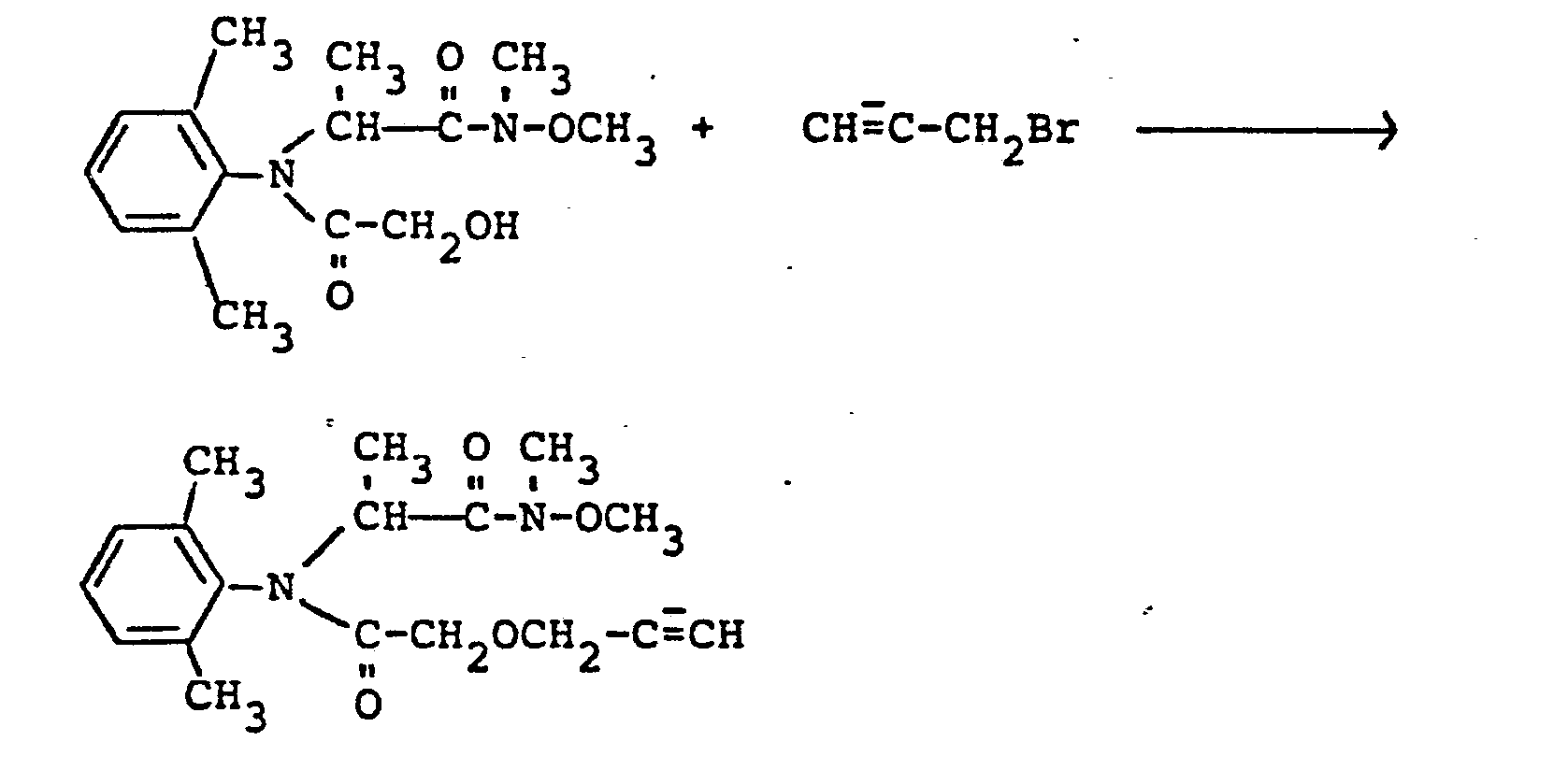
- Verwendet man beispielsweise 2-(2',6'-Dimethyl)-N-hy- droxyacetyl-anilino-propionsäure-N,O-dimethyl-oxiamid und Propargylbromid als Ausgangsstoffe,so kann der Reaktionsablauf durch das folgende Formelschema wiedergegeben werden (Verfahren c/1):
- Verwendet man beispielsweise 2-(2',6'-Dimethyl)-N-hy- droxyacetyl-anilino-propionsäure-N,O-dimethyl-oxiamid und 3,4-Dihydro-2H-pyran als Ausgangsstoffe, so kann der Reaktionsablauf durch das folgende Formelschema wieder- . gegeben werden (Verfahren c/2):

- Die bei der Durchführung des erfindungsgemäßen Verfahrens (a) als Ausgangsstoffe benötigten Aniline sind durch die Formel (II) allgemein definiert. In dieser Formel stehen R , R2, R3, R4, R5 und R vorzugsweise für diejenigen Reste, die bereits im Zusammenhang mit der Beschreibung der erfindungsgemäßen Stoffe der Formel (I) vorzugsweise für diese Reste genannt wurden. Als Beispiele für Verbindungen der Formel (II) seien im einzelnen die folgenden Verbindungen genannt:


- Die substituierten Aniline der Formel (II) sind noch nicht bekannt. Sie können erhalten werden, indem man z.B. Aniline der Formel IX

- Die als Ausgangsstoffe benötigten Aniline der Formel (IX) sind allgemein bekannte Verbindungen der organischen Chemie. Als Beispiele seien genannt:
- Anilin; 2,3-Dimethylanilin; 2,5-Dimethylanilin; 3,5-Dimethylanilin; 2,6-Diethylanilin; 2-Ethyl-6-methylanilin; 2,3,4-Trimethylanilin; 2,4,6-Trimethylanilin; 2,4,5-Trimethylanilin; 2-Ethyl-4,6-dimethylanilin; 2,6-Diethyl- . 4-methylanilin; 2,6-Diisopropyl-4-methylanilin; 2,3,5-Trimethylanilin; 2,3,6-Trimethylanilin; 6-Chlor-2-methyl-anilin; 2-Brom-6-methylanilin; 2-Chlor-6-tert.-butyl-anilin.
- Die außerdem als Ausgangsstoffe benötigten substituierten Oxiamide der Formel (X) sind teilweise bekannt (vgl. US-Patentschrift 3 835 205, 3 917 664) bzw. lassen sich durch Umsetzung der α-Halogencarbonsäurechloride der Formel (XI)


- Die außerdem für das erfindungsgemäße Verfahren (a) als Ausgangsstoffe zu verwendenden Säurederivate d.h. -chloride oder -bromide, bzw. Anhydride sind durch die Formel (III) allgemein definiert. In dieser Formel steht R vorzugsweise für diejenigen Reste, die bereits im Zusammenhang mit der Beschreibung der erfindungsgemäßen Stoffe der Formel (I) vorzugsweise für diesen Substituenten genannt wurden.
- Die Säurechloride oder -bromide bzw. -anhydride der Formel (III) sind allgemein bekannte Verbindungen der organischen Chemie.
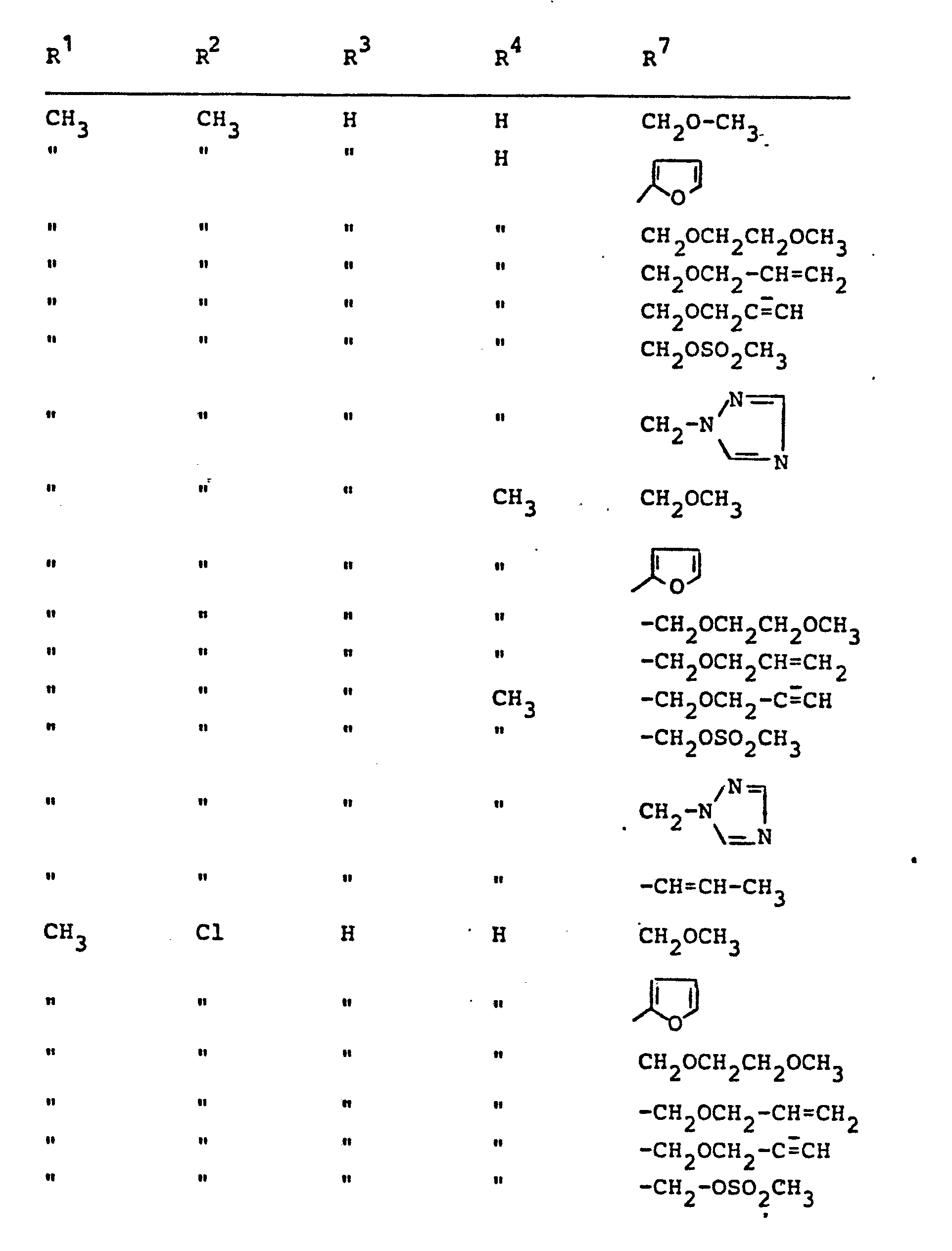
- Die bei der Durchführung des erfindungsgemäßen Verfahrens (b) als Ausgangsstoffe benötigten Säuren bzw. deren Derivate sind durch die Formel IV allgemein definiert. In dieser Formel stehen R1, R2, R3 und R 7 vorzugsweise für diejenigen Reste, die bereits im Zusammenhang mit der Beschreibung der erfindungsgemäßen Stoffe der Formel (I) vorzugsweise für diese Substituenten genannt wurden.
- Die Carbonsäuren bzw. deren Derivate der Formel IV können erhalten werden, indem man die entsprechenden, aus DE-OS 2 515 091 bekannten, Methyl- bzw. Ethylester verseift und die dabei erhaltenen Säuren gegebenenfalls mit Thionylchlorid oder Oxalylchlorid gegebenenfalls in einem Verdünnungsmittel umsetzt.
- Als Beispiele für die Ausgangsstoffe der Formel IV seien genannt:


- Die bei der Durchführung des erfindungsgemäßen Verfahrens (c1) als Ausgangsstoffe benötigten Hydroxyacetanilide sind durch die Formel (VI) allgemein definiert. In dieser Formel stehen R1, R2, R3, R4, R5 und R6 vorzugsweise für diejenigen Reste, die bereits im Zusammenhang mit der Beschreibung der erfindungsgemäßen Stoffe der Formel (I) vorzugsweise für diese Substituenten genannt werden.
- Die Hydroxyacetanilide der Formel (VI) können auf allgemein bekannte Art und Weise erhalten werden, indem man Acyloxyacetylanilide der Formel
- mit Natron- oder Kalilauge bzw. mit einem Alkalialkoholat eines niederen Alkohols wie z.B. Natriummethylat oder Natriumethylat, bei Temperaturen zwischen 20 und 40°C verseift und nach Neutralisation in üblicher Weise die Verbindungen der Formel (VI) isoliert.
- Die Acyloxyacetylanilide der Formel (XIII) können in allgemein üblicher und bekannter Art und Weise erhalten werden, indem man Aniline der Formel (II) mit entsprechenden Acyloxyacetylhalogeniden umsetzt.
- Die außerdem für das erfindungsgemäße Verfahren (c/1) als Ausgangsstoffe zu verwendenden Halogenide sind durch die Formel (VII) allgemein definiert. In dieser Formel steht R9 bzw. R8 vorzugsweise für die Reste, die bereits im Zusammenhang mit der Beschreibung der erfindungsgemäßen Stoffe der Formel (I) vorzugsweise für diesen Substituenten genannt wurden. Hal steht vorzugsweise für Chlor, Brom oder Jod.
- Die Halogenide der Formel (VII) sind allgemein bekannte Verbindungen der organischen Chemie.
- Das für das erfindungsgemäße Verfahren (c/2) außerdem als Ausgangsstoff zu verwendende Dihydropyran ist'ebenfalls eine bekannte Verbindung der organischen Chemie.
- Als Verdünnungsmittel kommen für die erfindungsgemäße Umsetzung gemäß Verfahren (a) organische Lösungsmittel in Frage. Hierzu gehören vorzugsweise Xetone, Wie Diethylketon, insbesondere Aceton und Methylethylketon; Nitrile, wie Propionitril, insbesondere Acetonitril; Ether, wie Tetrahydrofuran oder Dioxan; aliphatische und aromatische Kohlenwasserstoffe, wie Petrolether, Benzol, Toluol oder Xylol; halogenierte Kohlenwasserstoffe, wie Methylenchlorid, Tetrachlorkohlenstoff, Chloroform oder Chlorbenzol; und Ester, wie Essigester.
- Das erfindungsgemäße Verfahren (a) kann gegebenenfalls in Gegenwart von Säurebindern (Halogenwasserstoff-Akzeptoren) durchgeführt werden. Als solche können alle üblichen Säurebindemittel verwendet werden. Hierzu gehören vorzugsweise organische Basen, wie tertiäre Amine, beispielsweise Triethylamin, oder Pyridin, ferner anorganische Basen, wie beispielsweise Alkalihydroxide und Alkalicarbonate.
- Die Reaktionstemperaturen können bei der Durchführung des erfindungsgemäßen Verfahrens (a) in einem größeren Bereich variiert werden. Im allgemeinen arbeitet man . zwischen O°C und 120°C, vorzugsweise zwischen 20 und 100°C.
- Bei der Durchführung des erfindungsgemäßen Verfahrens (a) setzt man vorzugsweise auf 1 Mol der Verbindungen der Formel (II) 1 bis 1,5 Mol Acylierungsmittel und 1 bis 1,5 Mol Säurebinder ein. Die Isolierung der Verbindungen der Formel (I) erfolgt in üblicher Weise.
- Als Verdünnungsmittel kommen für die erfindungsgemäße Umsetzung gemäß Verfahren (b) organische Lösungsmittel in Frage. Hierzu gehören vorzugsweise die bei dem Verfahren (a) bereits genannten Solventien.
- Die Reaktionstemperaturen können bei der Durchführung des erfindungsgemäßen Verfahrens (b) in einem größeren Bereich variiert werden. Im allgemeinen arbeitet man zwischen O°C und 80°C, vorzugsweise zwischen O°C und 50°C. Als wasserabspaltendes Mittel wird z.B. Dicyclohexylcarbodiimid eingesetzt.
- Bei der Durchführung des erfindungsgemäßen Verfahrens (b) arbeitet man vorzugsweise mit äquimolaren Mengen. Es ist jedoch auch möglich, die Hydroxylämine der Formel (V) im Überschuß einzusetzen. Die Aufarbeitung und Isolierung der Reaktionsprodukte erfolgt nach üblichen Methoden.
- Die Kupplung der Säure (IV) mit den Hydroxylaminen (V) unter Mitwirkung des wasserabspaltenden Reagens Dicyclohexylcarbodiimid erfolgt nach der üblichen Methode (vgl. Chemiker-Zeitung 183 (1979) S. 19). Bevorzugt werden äquimolare Mengen der Reaktionspartner eingesetzt. Als Verdünnungsmittel kommen inerte organische Lösungsmittel wie z.B. Methylenchlorid, Dioxan oder Toluol in Frage. Die Reaktionstemperaturen können in einem größeren Bereich variiert werden. Im allgemeinen arbeitet man zwischen 0°C und 50°C, vorzugsweise zwischen 20°C und 30°C.
- Als Verdünnungsmittel kommen für die erfindungsgemäße Umsetzung gemäß Verfahren (c) organische Lösungsmittel in Frage. Hierzu gehören vorzugsweise die beim Verfahren (a) bereits genannten Lösungsmittel.
- Die Umsetzung nach Verfahren (c/1) kann gegebenenfalls in Gegenwart eines Säurebinders durchgeführt werden. Man kann alle üblicherweise verwendbaren anorganischen oder organischen Säurebinder zugeben. Hierzu gehören vorzugsweise die beim Verfahren (a) bereits genannten Verbindungen.
- Die Reaktionstemperaturen können beim Verfahren (c/1) in einem größeren Bereich variiert werden. Im allgemeinen arbeitet man zwischen 20 und 150°C, vorzugsweise bei der Siedetemperatur des Lösungsmittels, beispielsweise zwischen 60 und 100°C.
- Bei der Durchführung des erfindungsgemäßen Verfahrens (c/1) setzt man auf 1 Mol der Verbindungen der Formel (VI), gegebenenfalls nach Zugabe von 1 bis 2 Mol einer starken Base, wie z.B. eines Alkalihydrids, 1 Mol Halogenid der Formel (VII) und gegebenenfalls 1 bis 2 Mol Säurebinder ein. Zur Isolierung der Endprodukte wird das Reaktionsgemisch vom Lösungsmittel befreit und der Rückstand mit Wasser und einem organischen Lösungsmittel versetzt. Die organische Phase wird abgetrennt und in üblicher Weise aufgearbeitet.
- Nach einer bevorzugten Ausführungsform des Verfahrens (c/1) wird zweckmäßigerweise so verfahren, daß man von einem Hydroxyacetanilid der Formel (VI) ausgeht, letzteres in einem geeigneten inerten Lösungsmittel mittels Alkalimetall-hydrid in das Alkalimetallalkanolat überführt, und letzteres ohne Isolierung sofort mit einem Halogenid der Formel (VII) umsetzt, wobei unter Austritt von Alkalihalogenid die erfindungsgemäßen Verbindungen der Formel (I) in einem Arbeitsgang erhalten werden.
- Die Umsetzung nach Verfahren (c/2) kann gegebenenfalls in Gegenwart eines Katalysators durchgeführt werden. Hierzu verwendet man vorzugsweise Chlorwasserstoff (vgl, J. Am. Chem. Soc. 69, 2246 (1947), ibid. 70, 4187 (1948)).
- Die Reaktionstemperaturen können beim Verfahren (c/2) in einem größeren Bereich variiert werden. Im allgemeinen arbeitet man zwischen 0 und 100°C, vorzugsweise zwischen 20 und 60°C.
- Bei der Durchführung des erfindungsgemäßen Verfahrens (c/2) arbeitet man vorzugsweise in molaren Mengen. Die Isolierung der Verbindungen der Formel (I) erfolgt in üblicher Weise.
- Die erfindungsgemäßen Wirkstoffe weisen eine starke mikrobizide Wirkung auf und können zur Bekämpfung von unerwünschten Mikroorganismen praktisch eingesetzt werden. Die Wirkstoffe sind für den Gebrauch als Pflanzenschutzmittel geeignet. Fungizide Mittel im Pflanzenschutz werden eingesetzt zur Bekämpfung von Plasmodiophoromycetes, Oomycetes, Chytridiomycetes, Zygomycetes, Ascomycetes, Basidiomycetes, Deuteromycetes.
- Die gute Pflanzenverträglichkeit der Wirkstoffe in den zur Bekämpfung von Pflanzenkrankheiten notwendigen Konzentrationen erlaubt eine Behandlung von oberirdischen Pflanzenteilen, von Pflanz- und Saatgut, und des Bodens.
- Die Wirkstoffe können in die üblichen Formulierungen übergeführt werden, wie Lösungen, Emulsionen, Suspensionen, Pulver, Schäume, Pasten, Granulate, Aerosole, Wirkstoff-imprägnierte Natur- und synthetische Stoffe, Feinstverkapselungen in polymeren Stoffen und in Hüllmassen für Saatgut, ferner in Formulierungen mit Brennsätzen, wie Räucherpatronen, -dosen, -spiralen u.ä., sowie ULV-Kalt- und Warmnebel-Formulierungen.
- Diese Formulierungen werden in bekannter Weise hergestellt, z.B. durch Vermischen der Wirkstoffe mit Streckmittelnl also flüssigen Lösungsmitteln, unter Druck stehenden verflüssigten Gasen und/oder festen Trägerstoffen, gegebenenfalls unter Verwendung von oberflächenaktiven Mitteln, also Emulgiermitteln und/oder Dispergiermitteln und/oder schaumerzeugenden Mitteln. Im Falle der Benutzung von Wasser als Streckmittel können z.B. auch organische Lösungsmittel als Hilfslösungsmittel verwendet werden. Als flüssige Lösungsmittel kommen im wesentlichen in Frage; Aromaten, wie Xylol, Toluol, oder Alkylnaphthaline, chlorierte Aromaten oder chlorierte aliphatische Kohlenwasserstoffe, wie Chlorbenzole, Chloräthylene oder Methylenchlorid, aliphatische Kohlenwasserstoffe, wie Cyclohexan oder Paraffine, z.B. Erdölfraktionen, Alkohole, wie Butanol oder Glycol sowie deren Äther und Ester, Ketone, wie Aceton, Methyläthylketon, Methylisobutylketon oder Cyclohexanon, stark polare Lösungsmittel, wie Dimethylformamid und Dimethylsulfoxid, sowie Wasser; mit verflüssigten gasförmigen Streckmitteln oder Trägerstoffen sind solche Flüssigkeiten gemeint, welche bei normaler Temperatur und unter Normaldruck gasförmig sind, z.B. Aerosol-Treibgase, wie Halogenkohlenwasserstoffe sowie Butan, Propan, Stickstoff und Kohlendioxid; als feste Trägerstoffe kommen in Frage: z.B. natürliche Gesteinsmehle, wie Kaoline, Tonerden, Talkum, Kreide, Quarz, Attapulgit, Montmorillonit oder Diatomeenerde und synthetische Gesteinsmehle, wie hochdisperse Kieselsäure, Aluminiumoxid und Silikate; als feste Trägerstoffe für Granulate kommen in Frage: z.B. gebrochene und fraktionierte natürliche Gesteine wie Calcit, Marmor, Bims, Sepiolith, Dolomit sowie synthetische Granulate aus anorganischen und organischen Mehlen sowie Granulate aus organischem Material wie Sägemehl, Kokosnußschalen, Maiskolben und Tabakstengel; als Emulgier-und/oder schaumerzeugende Mittel kommen in Frage: z.B. nichtionogene und anionische Emulgatoren, wie Polyoxyäthylen-Fettsäure-Ester, Polyoxyäthylen-Fettalkohol- Äther, z.B. Alkylarylpolyglykol-äther, Alkylsulfonate, Alkylsulfate, Arylsulfonate sowie Eiweißhydrolysate; als Dispergiermittel kommen in Frage: z.B. Lignin-Sulfitablaugen und Methylcellulose.
- Es können in den Formulierungen Haftmittel wie Carboxy- 'methylcellulose, natürliche und synthetische pulverige, körnige und latexförmige Polymere verwendet werden, wie Gummiarabicum, Polyvinylalkohol, Polyvinylacetat.
- Es können Farbstoffe wie anorganische Pigmente, z.B. Eisenoxid, Titanoxid, Ferrocyanblau und organische Farbstoffe, wie Alizarin-, Azo -Metallphthalocyaninfarbstoffe und Spurennährstoffe wie Salze von Eisen, Mangan, Bor, Kupfer, Kobalt, Molybdän und Zink verwendet werden.
- Die Formulierungen enthalten im allgemeinen zwischen 0,1 und 95 Gewichtsprozent Wirkstoff, vorzugsweise zwischen O,5 und 90 %.
- Die erfindungsgemäßen Wirkstoffe können in den Formulierungen oder in den verschiedenen Anwendungsformen in Mischung mit anderen bekannten Wirkstoffen vorliegen, wie Fungiziden, Bakteriziden, Insektiziden, Akariziden, Nematiziden, Herbiziden, Schutzstoffen gegen Vogelfraß, Wuchsstoffen, Pflanzennährstoffen und Bodenstrukturverbesserungsmitteln.
- Die Wirkstoffe können als solche, in Form ihrer Formulierungen oder der daraus durch weiteres Verdünnen bereiteten Anwendungsformen, wie gebrauchsfertige Lösungen, Emulsionen, Suspensionen, Pulver, Pasten und Granulate angewendet werden. Die Anwendung geschieht in üblicher Weise, z.B. durch Gießen, Tauchen, Spritzen, Sprühen, Vernebeln, Verdampfen, Injizieren, Verschlämmen, Verstreichen, Stäuben, Streuen, Trockenbeizen, Feuchtbeizen, Naßbeizen, Schlämmbeizen oder Inkrustieren.
- Bei der Behandlung von Pflanzenteilen können die Wirkstoffkonzentrationen in den Anwendungsformen in einem größeren Bereich variiert werden. Sie liegen im allgemeinen zwischen 1 und 0,0001 Gew.-%, vorzugsweise zwischen 0,5 und 0,001 %.
- Bei der Saatgutbehandlung werden im allgemeinen Wirkstoffmengen von 0,001 bis 50 g je Kilogramm Saatgut, vorzugsweise 0,01 bis 10 g, benötigt.
- Bei Behandlung des Bodens sind Wirkstoffkonzentrationen von 0,00001 bis 0,1 Gew.-%, vorzugsweise von 0,0001 bis 0,02 %, am Wirkungsort erforderlich.
-


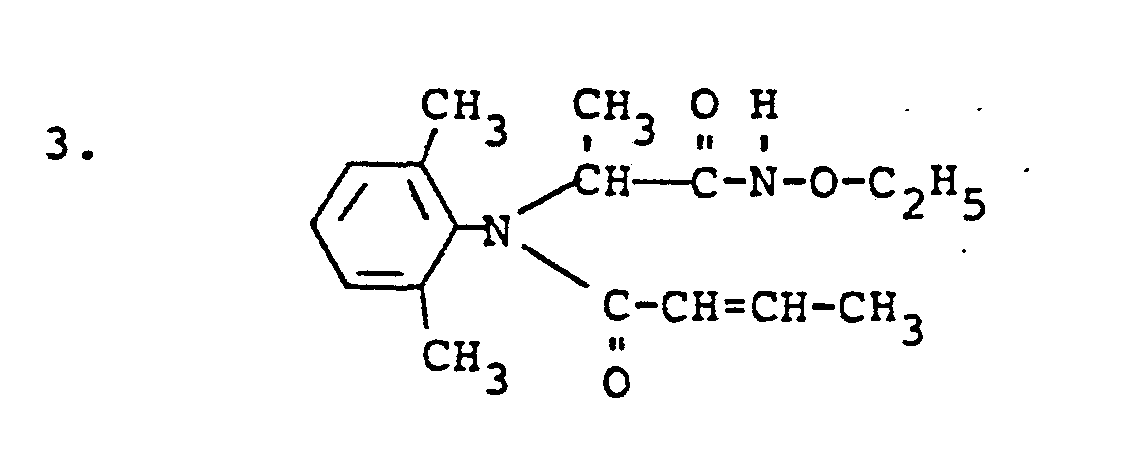
- Entsprechend den Beispielen 1 bis 3 werden die folgenden Verbindungen der allgemeinen Formel


- Phytophthora-Test (Tomate) / protektiv / systemisch
- Lösungsmittel: 4,7 Gewichtsteile:Aceton Emulgator: 0,3 Gewichtsteile:Alkylarylpolyglycolether
- Zur Herstellung einer zweckmäßigen Wirkstoffzubereitung vermischt man 1 Gewichtsteil Wirkstoff mit den angegebenen Mengen Lösungsmittel und Emulgator und verdünnt das Konzentrat mit Wasser auf die gewünschte Konzentration.
- Zur Prüfung auf protektive Wirksamkeit bespritzt man junge Pflanzen mit der Wirkstoffzubereitung bis zur Tropfnässe. Nach Antrocknen des Spritzbelages werden die Pflanzen mit einer wäßrigen Sporensuspension von Phytophthora infestans inokuliert.
- Zur Prüfung auf systemische Eigenschaften wird die Wirkstoffzubereitung auf Einheitserde gegossen, in der sich junge versuchsbereite Pflanzen befinden. 3 Tage nach der Behandlung werden die Pflanzen mit einer wäßrigen Sporensuspension von Phytophthora infestans inokuliert.
- Die Pflanzen werden in einer Inkubationskabine mit 100 % relativer Luftfeuchtigkeit bei ca. 20°C aufgestellt.
- 4 Tage nach der Inkulation erfolgt die Auswertung.
- Eine deutliche Überlegenheit in der Wirksamkeit gegenüber dem Stand der Technik zeigen in diesem Test z.B. die Verbindungen gemäß folgender Herstellungsbeispiele: 1,2,6.
Claims (8)





Applications Claiming Priority (2)
| Application Number | Priority Date | Filing Date | Title |
|---|---|---|---|
| DE19803033160 DE3033160A1 (de) | 1980-09-03 | 1980-09-03 | N-oxiamide, verfahren zu ihrer herstellung sowie ihre verwendung als fungizide |
| DE3033160 | 1980-09-03 |
Publications (2)
| Publication Number | Publication Date |
|---|---|
| EP0046931A2 true EP0046931A2 (de) | 1982-03-10 |
| EP0046931A3 EP0046931A3 (de) | 1982-03-17 |
Family
ID=6111044
Family Applications (1)
| Application Number | Title | Priority Date | Filing Date |
|---|---|---|---|
| EP81106468A Withdrawn EP0046931A3 (de) | 1980-09-03 | 1981-08-20 | N-Oxiamide, Verfahren zu ihrer Herstellung sowie ihre Verwendung als Fungizide |
Country Status (10)
| Country | Link |
|---|---|
| EP (1) | EP0046931A3 (de) |
| JP (1) | JPS5777650A (de) |
| AU (1) | AU7486481A (de) |
| DE (1) | DE3033160A1 (de) |
| DK (1) | DK387981A (de) |
| ES (1) | ES505137A1 (de) |
| IL (1) | IL63696A0 (de) |
| PL (1) | PL232882A1 (de) |
| PT (1) | PT73556B (de) |
| ZA (1) | ZA816082B (de) |
Cited By (4)
| Publication number | Priority date | Publication date | Assignee | Title |
|---|---|---|---|---|
| EP0601477A1 (de) * | 1992-12-08 | 1994-06-15 | Hoechst Schering AgrEvo GmbH | Substituierte Zimtsäurehydroxyamide, Verfahren zu ihrer Herstellung, diese enthaltende Mittel und ihre Verwendung |
| RU2247716C2 (ru) * | 2003-03-27 | 2005-03-10 | Российский химико-технологический университет им. Д.И. Менделеева (РХТУ) | Замещенные метил-n-амидооксамоил-n-фенил-d, l-аланинаты и их способы получения |
| US7156550B2 (en) | 2004-07-22 | 2007-01-02 | Xaloy, Inc. | Apparatus for plasticating thermoplastic resin including polypropylene |
| CN103896837A (zh) * | 2012-12-25 | 2014-07-02 | 上海美迪西生物医药有限公司 | 2-(n-(3-喹啉基)磺酰胺基或酰胺基)-n-羟基乙酰胺衍生物及其制备方法和应用 |
Families Citing this family (1)
| Publication number | Priority date | Publication date | Assignee | Title |
|---|---|---|---|---|
| AT393925B (de) * | 1987-06-02 | 1992-01-10 | Ims Ionen Mikrofab Syst | Anordnung zur durchfuehrung eines verfahrens zum positionieren der abbildung der auf einer maske befindlichen struktur auf ein substrat, und verfahren zum ausrichten von auf einer maske angeordneten markierungen auf markierungen, die auf einem traeger angeordnet sind |
Family Cites Families (1)
| Publication number | Priority date | Publication date | Assignee | Title |
|---|---|---|---|---|
| NL7701888A (nl) * | 1976-03-09 | 1977-09-13 | Ciba Geigy | Hydroxamzuurderivaten ter beinvloeding van de plantengroei. |
-
1980
- 1980-09-03 DE DE19803033160 patent/DE3033160A1/de not_active Withdrawn
-
1981
- 1981-08-20 EP EP81106468A patent/EP0046931A3/de not_active Withdrawn
- 1981-08-24 PT PT73556A patent/PT73556B/pt unknown
- 1981-08-31 IL IL63696A patent/IL63696A0/xx unknown
- 1981-09-01 JP JP56136223A patent/JPS5777650A/ja active Pending
- 1981-09-02 PL PL23288281A patent/PL232882A1/xx unknown
- 1981-09-02 DK DK387981A patent/DK387981A/da unknown
- 1981-09-02 ES ES505137A patent/ES505137A1/es not_active Expired
- 1981-09-02 ZA ZA816082A patent/ZA816082B/xx unknown
- 1981-09-02 AU AU74864/81A patent/AU7486481A/en not_active Abandoned
Cited By (6)
| Publication number | Priority date | Publication date | Assignee | Title |
|---|---|---|---|---|
| EP0601477A1 (de) * | 1992-12-08 | 1994-06-15 | Hoechst Schering AgrEvo GmbH | Substituierte Zimtsäurehydroxyamide, Verfahren zu ihrer Herstellung, diese enthaltende Mittel und ihre Verwendung |
| TR27462A (tr) * | 1992-12-08 | 1995-05-29 | Hoechst Ag | Sübstitüe edilmis sinamik asidi hidroksiamid'leri, bunlarin üretilmesine mahsus usul, bunlari ihtiva eden maddeler ve bunlarin kullanilmasi. |
| US5424480A (en) * | 1992-12-08 | 1995-06-13 | Hoechst Aktiengesellschaft | Substituted N-hydroxycinnamamides, processes for their preparation, compositions containing them, and their use |
| RU2247716C2 (ru) * | 2003-03-27 | 2005-03-10 | Российский химико-технологический университет им. Д.И. Менделеева (РХТУ) | Замещенные метил-n-амидооксамоил-n-фенил-d, l-аланинаты и их способы получения |
| US7156550B2 (en) | 2004-07-22 | 2007-01-02 | Xaloy, Inc. | Apparatus for plasticating thermoplastic resin including polypropylene |
| CN103896837A (zh) * | 2012-12-25 | 2014-07-02 | 上海美迪西生物医药有限公司 | 2-(n-(3-喹啉基)磺酰胺基或酰胺基)-n-羟基乙酰胺衍生物及其制备方法和应用 |
Also Published As
| Publication number | Publication date |
|---|---|
| AU7486481A (en) | 1982-03-11 |
| JPS5777650A (en) | 1982-05-15 |
| PT73556B (en) | 1982-11-03 |
| ZA816082B (en) | 1982-08-25 |
| DE3033160A1 (de) | 1982-04-22 |
| PT73556A (en) | 1981-09-01 |
| ES505137A1 (es) | 1982-08-16 |
| EP0046931A3 (de) | 1982-03-17 |
| IL63696A0 (en) | 1981-11-30 |
| DK387981A (da) | 1982-03-04 |
| PL232882A1 (de) | 1982-08-16 |
Similar Documents
| Publication | Publication Date | Title |
|---|---|---|
| EP0000023A1 (de) | Omega-substituierte Pentyl-harnstoff-Derivate, Verfahren zu ihrer Herstellung sowie ihre Verwendung als Fungizide | |
| EP0010673B1 (de) | Substituierte N-Propargyl-aniline, Verfahren zu ihrer Herstellung sowie ihre Verwendung als Fungizide | |
| EP0017850B1 (de) | N,N-Disubstituierte Ethylglycinester, ihre Herstellung und Verwendung, sie enthaltende Fungizide und deren Herstellung | |
| EP0019858B1 (de) | N-Oximinoalkyl-anilide, Verfahren zu ihrer Herstellung sowie ihre Verwendung als Fungizide | |
| EP0020859A1 (de) | Substituierte N-Allyl-acetanilide, Verfahren zu ihrer Herstellung sowie ihre Verwendung als Fungizide | |
| DE3033160A1 (de) | N-oxiamide, verfahren zu ihrer herstellung sowie ihre verwendung als fungizide | |
| EP0198191B1 (de) | Piperazinylmethyl-1,2,4-triazolylmethyl-carbinole | |
| DE2800544A1 (de) | Carbamoyl-triazolyl-o,n-acetale, verfahren zu ihrer herstellung und ihre verwendung als fungizide | |
| EP0018509B1 (de) | N-Allenyl-acetanilide, Verfahren zu ihrer Herstellung sowie ihre Verwendung als Fungizide | |
| EP0023669B1 (de) | Cycloalkan(alken)carbonsäure-anilide, Verfahren zu ihrer Herstellung sowie ihre Verwendung als Fungizide | |
| EP0161455A1 (de) | Beta-naphthylalkylamine | |
| EP0075167B1 (de) | N-(1-Alkenyl)-carbonsäureanilide, Verfahren zu ihrer Herstellung sowie ihre Verwendung als Fungizide | |
| EP0097280B1 (de) | Azolsubstituierte Oximino-cyan-acetamid-Derivate | |
| EP0003975B1 (de) | Dichlormaleinsäurediamid-Derivate, Verfahren zu ihrer Herstellung und ihre Verwendung als Fungizide | |
| EP0066771B1 (de) | 1-Iod-1-propin-3-ole, Verfahren zu ihrer Herstellung sowie ihre Verwendung als Pflanzenschutzmittel | |
| EP0044482B1 (de) | N-Allenylalkyl-acetanilide, Verfahren zu ihrer Herstellung sowie ihre Verwendung als Fungizide | |
| EP0051784A1 (de) | Pyrazolsubstituierte Oximino-cyan-acetamid-Derivate, Verfahren zu ihrer Herstellung sowie ihre Verwendung als Fungizide | |
| DD221343A5 (de) | Fungizide mittel | |
| EP0017110B1 (de) | N-Dichloracetyl-N-phenyl-alenin(thiol)ester, Verfahren zu ihrer Herstellung sowie ihre Verwendung als Fungizide | |
| EP0278346A1 (de) | 1-(2,4-Difluorphenyl)-1-(1-fluorcyclopropyl)-2-(1,2,4-triazol-1-yl)-ethan-1-ol | |
| EP0270971A2 (de) | Substituierte Benzamide | |
| EP0090936B1 (de) | Substituierte Azolylethyl-oximinoalkyl-ether, Verfahren zu ihrer Herstellung und ihre Verwendung als Fungizide | |
| DE3025219A1 (de) | Benzoyl-azole, verfahren zu ihrer herstellung sowie ihre verwendung als fungizide | |
| DE2847287A1 (de) | Substituierte n-propargyl-aniline, verfahren zu ihrer herstellung sowie ihre verwendung als fungizide | |
| EP0070456A1 (de) | Sulfinyl- und Sulfonyl-acetanilid-Derivate, Verfahren zu ihrer Herstellung sowie ihre Verwendung als Fungizide |
Legal Events
| Date | Code | Title | Description |
|---|---|---|---|
| PUAI | Public reference made under article 153(3) epc to a published international application that has entered the european phase |
Free format text: ORIGINAL CODE: 0009012 |
|
| PUAL | Search report despatched |
Free format text: ORIGINAL CODE: 0009013 |
|
| 17P | Request for examination filed |
Effective date: 19810820 |
|
| AK | Designated contracting states |
Designated state(s): AT BE CH DE FR GB IT NL SE |
|
| AK | Designated contracting states |
Designated state(s): AT BE CH DE FR GB IT NL SE |
|
| STAA | Information on the status of an ep patent application or granted ep patent |
Free format text: STATUS: THE APPLICATION HAS BEEN WITHDRAWN |
|
| 18W | Application withdrawn |
Withdrawal date: 19820616 |
|
| R18W | Application withdrawn (corrected) |
Effective date: 19820607 |
|
| RIN1 | Information on inventor provided before grant (corrected) |
Inventor name: BRANDES, WILHELM, DR. Inventor name: STETTER, JOERG, DR. Inventor name: FUEHRER, WOLFGANG, DR. |