EP0045484B1 - Elektrischer Nähmaschinenantrieb - Google Patents
Elektrischer Nähmaschinenantrieb Download PDFInfo
- Publication number
- EP0045484B1 EP0045484B1 EP81105973A EP81105973A EP0045484B1 EP 0045484 B1 EP0045484 B1 EP 0045484B1 EP 81105973 A EP81105973 A EP 81105973A EP 81105973 A EP81105973 A EP 81105973A EP 0045484 B1 EP0045484 B1 EP 0045484B1
- Authority
- EP
- European Patent Office
- Prior art keywords
- capacitor
- voltage
- sewing machine
- needle position
- brake
- Prior art date
- Legal status (The legal status is an assumption and is not a legal conclusion. Google has not performed a legal analysis and makes no representation as to the accuracy of the status listed.)
- Expired
Links
- 238000009958 sewing Methods 0.000 title claims description 29
- 239000003990 capacitor Substances 0.000 claims description 45
- 230000004044 response Effects 0.000 claims description 4
- 238000009966 trimming Methods 0.000 description 11
- 230000007423 decrease Effects 0.000 description 9
- 230000003247 decreasing effect Effects 0.000 description 5
- 238000010586 diagram Methods 0.000 description 5
- 230000007812 deficiency Effects 0.000 description 4
- 230000007246 mechanism Effects 0.000 description 4
- 238000010276 construction Methods 0.000 description 3
- 230000000994 depressogenic effect Effects 0.000 description 3
- 230000008901 benefit Effects 0.000 description 2
- 230000001934 delay Effects 0.000 description 2
- 230000006866 deterioration Effects 0.000 description 2
- 230000007274 generation of a signal involved in cell-cell signaling Effects 0.000 description 2
- 230000006872 improvement Effects 0.000 description 2
- 238000000034 method Methods 0.000 description 2
- 230000010355 oscillation Effects 0.000 description 2
- 230000009471 action Effects 0.000 description 1
- 230000008859 change Effects 0.000 description 1
- 239000007799 cork Substances 0.000 description 1
- 230000002542 deteriorative effect Effects 0.000 description 1
- 230000000694 effects Effects 0.000 description 1
- 238000002474 experimental method Methods 0.000 description 1
- 230000000977 initiatory effect Effects 0.000 description 1
- 230000007257 malfunction Effects 0.000 description 1
- 230000007935 neutral effect Effects 0.000 description 1
- 230000000630 rising effect Effects 0.000 description 1
- 238000004804 winding Methods 0.000 description 1
Images


Classifications
-
- D—TEXTILES; PAPER
- D05—SEWING; EMBROIDERING; TUFTING
- D05B—SEWING
- D05B69/00—Driving-gear; Control devices
- D05B69/22—Devices for stopping drive when sewing tools have reached a predetermined position
- D05B69/26—Devices for stopping drive when sewing tools have reached a predetermined position with automatic means to reduce speed of drive, e.g. in one or more steps
-
- H—ELECTRICITY
- H02—GENERATION; CONVERSION OR DISTRIBUTION OF ELECTRIC POWER
- H02P—CONTROL OR REGULATION OF ELECTRIC MOTORS, ELECTRIC GENERATORS OR DYNAMO-ELECTRIC CONVERTERS; CONTROLLING TRANSFORMERS, REACTORS OR CHOKE COILS
- H02P3/00—Arrangements for stopping or slowing electric motors, generators, or dynamo-electric converters
- H02P3/02—Details of stopping control
- H02P3/04—Means for stopping or slowing by a separate brake, e.g. friction brake or eddy-current brake
Definitions
- the present invention relates to an electric sewing machine driving apparatus comprising a clutch coil of an electromagnetic clutch for transmitting a torque of a motor to a sewing machine to drive the same; a brake coil of an electromagnetic brake for applying a braking force to said sewing machine; means for generating a needle position signal to stop said sewing machine at a predetermined needle position; a DC power source for energizing said clutch coil and said brake coil; and a capacitor.
- electromagnetic clutch and brake mechanisms in an apparatus of the above type have the structure such that a clutch ring and a brake ring, each thereof comprising a friction member made of cork, etc. are arranged mouably in the axial direction so that the torque of a continuously operating motor is transmitted to an output shaft or the output shaft is braked through the friction member actuated by an electromagnetic force.
- the mechanism includes a pair of coils, namely, a clutch coil and a brake coil, so that the output shaft is accelerated when the clutch coil is energized and the output shaft is decelerated when the brake coil is energized.
- the clutch and brake mechanisms comprise the axially movable clutch and brake rings as mentioned above, the delays in the operations of the clutch and brake coils give rise to fatal deficiencies including the unstable speed control and the deterioration of accuracy of the predetermined needle position stopping operation, etc. More particularly, a delay in the rise of an electric current flowing through the brake coil when it is energized causes, in turn, a delay of a braking force to be applied, which increases the deviation of the actual stopping position from the position of the generation of a stop signal associated, thus presenting a dominant cause of the deterioration of accuracy of the predetermined needle position stopping operation.
- the capacitor is charged to a relatively small voltage over a base emitter junction of a transistor during the normal run of the sewing machine and is discharged upon initiation of a braking operation to serve as a time delay.
- the braking force is applied to the sewing machine to thereby provide for a primary braking operation in order to avoid insufficient braking by the subsequent braking action resulting from the needle position signal at the predetermined needle position.
- the known sewing machine is therefore not able to avoid the delays in the response of the clutch and brake coils but only tries to eliminate the resulting difficulties by the delay in the braking sequence.
- a known means for generating a DC-voltage higher than a supply voltage comprises an inductor element which is energized by a supply voltage of a DC- power source at a certain duty cycle of a switching element whereby the energy stored in the inductor element during the conducting periods of the switching element is transferred to a capacitor which is thus charged to a charging voltage higher than the supply voltage.
- an improved electric sewing machine driving apparatus of the above referenced type so designed that an electric power discharged from a capacitor, which has been charged beforehand to a high voltage, is applied to a brake coil to decrease the deviation of the actual stopping position from the position of the stop signal generation, thereby raising accuracy of the predetermined needle position stopping operation.
- the invention is characterized in that there is provided means for generating a DC voltage higher than a supply voltage of said DC power source and in that said capacitor is disposed to be charged by said voltage generating means whereby an electric charge stored in said capacitor is caused to discharge through said brake coil to energize the same in response to said needle position signal generated by said needle position signal generating means.
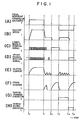
- a clutch current flows and the machine speed is increased.
- the clutch current decreases and a brake current flows.
- the sewing machine is decelerated rapidly and the clutch current is switched on and off to cause the machine to operate stably at a low speed.
- a lower needle position signal is generated at a time t 2 so that the clutch current is decreased and the brake current flows again, and the machine stops at a lower needle position.
- Fig. 2 shows in greater detail the time interval from t 3 to t 4 in Fig. 1 with respect to the machine speed, clutch current and brake current, and the deficiencies of the operation of a conventional machine will now be described with reference to Fig. 2.
- the clutch When the pedal is depressed backwardly at a time a (corresponding to the time t 3 in Fig. 1), the clutch is energized immediately, so that a current starts to flow through the clutch coil and increases in proportion to the inductance of the clutch coil. Due to a delay in the rise of the clutch current and the corresponding delay in the movement of the clutch ring, the machine starts rotating only at a time b.
- the machine is feedback controlled to rotate at a speed b o , but actually the machine speed settles at the speed b o after it has experienced an overshoot and an undershoot during the rising period of the speed.
- the clutch current is turned on and off with a suitable duty cycle in accordance with the detected speed.
- the application of a load for its thread trimming operation is started at a time e and the machine speed starts decreasing.
- the clutch current increases correspondingly and the machine speed drops to a speed b 2 .
- the thread trimming load terminates, the machine speed is restored and is stabilized at the speed b o .
- An upper needle position signal is generated at a time f (corresponding to the time t 4 in Fig. 1) so that the clutch is de-energized and the brake is energized.
- the brake current increases in proportion to the inductance of the brake coil.
- the brake ring is attracted so that the application of the braking force starts at a time g.
- the machine speed decreases along a descending slope corresponding to the inertia of the mechanical system and the braking force, and the machine stops at a time h.
- the angle of rotation of the machine from the time of generation of the upper needle position signal to the time of the stoppage of rotation of the machine is about 15 degrees. This angle of rotation from the signal generation to the stoppage of the machine rotation varies in dependence upon various factors as mentioned below, and the variation determines the needle positioning accuracy.
- the machine is feedback controlled to maintain its speed at b o .
- a deviation of the machine speed from the speed b o such as a speed drop caused by the application of a thread trimming load immediately before the application of a stop signal, an overshoot caused by the reaction of the speed drop, and the like.
- the magnitude of the thread trimming load varies depending on the thickness of the thread and the manner in which the thread is trimmed, so that the machine speed varies correspondingly.
- the rate of rise of the brake current increases with an increase of the power supply voltage, which naturally reduces the time intervals To and T,.
- the brake coil current and the friction coefficient of the friction member decrease as the temperature of the brake mechanism rises, with the result that the braking force decreases and the time intervals To and T, increase.
- the needle positioning accuracy varies in dependence on the above-mentioned various factors, and the deviation of the angle of rotation of the machine with respect to the desired needle stopping position is generally on the order of ⁇ 5 degrees. This deviation presents a main cause of machine malfunctions such as the slipping-off of a thread, the breakage of a needle or the like.
- numeral 1 designates an AC power source
- 2 a power transformer
- 3 a clutch coil (an inductor)
- 4 a brake coil
- 5 a thread trimming solenoid
- 6 a thread wiping solenoid
- 7 a choke coil
- 8 a constant voltage IC
- 9 a microcomputer
- 10 an OP AMP (operational amplifier)
- 11 a comparator
- 12 a lower needle position signal generator
- 13 an upper needle position signal generator
- D to D 15 diodes
- Q 1 to Q 8 transistors C
- C 5 capacitors a capacitors
- R 1 to R 13 resistors R 1 to R 13 resistors.
- An upper power supply line serves as a load driving power source having a large current capacity and an unstabilized power supply voltage of DC 24 V is generated between the terminals of the capacitor C,.
- a lower power supply line serves as a control power source having a small current capacity and a stabilized power supply voltage of DC 5 V is generated between the terminals of the capacitor C 4 . Both power sources are connected respectively to a common ground potential line.
- the microcomputer 9 is supplied with a lower needle position signal from the lower needle position generator 12, an upper needle position signal from the upper needle position signal generator 13, and other signals such as a pedal position signal and a speed signal, which are not shown, and generates signals for driving the respective load transistors. Under the control of the output signal from the microcomputer 9, the transistor Q 1 is turned on and off to cause an interrupted current to flow through the clutch coil 3 as shown in (E) of Fig. 1.
- the resistor R 1 and the diodes D 5 form a flywheel circuit which regulates a decrease in the interrupted current.
- the thread trimming solenoid 5 and the thread wiping solenoid 6 are controlled respectively as shown in (G) and (H) of Fig. 1 under the control of the output signals from the microcomputer 9.
- the combinations of the resistor R 3 and the diode D 9 ; and the resistor R 4 and the diode D 10 form respective flywheel circuits.
- the transistor Q 8 connected to the output of the OP AMP 10 and the transistor Q 5 connected to the output circuit of the transistor Q 8 are respectively turned on and off with this repetition frequency.
- the transistor Q 5 , the choke coil 7, the diode D 11 and the capacitor C 2 form a booster type chopper circuit.
- the electromagnetic energy stored in the choke coil 7 while the transistor Q 5 is conducting discharges through the diode D 11 to charge the capacitor C 2 upon the turning-off of the transistor Q 5 .
- T denotes an oscillation period of the transistor Q 5
- TOFF an "OFF" period of the transistor Q 5
- V c1 a voltage across the capacitor C 1
- V c2 a voltage across the capacitor C 2
- the comparator 11 operates as a voltage comparator.
- the voltage across the capacitor C 2 is divided by the resistors R 6 and R 7 and the divided voltage is applied to the comparator 11.
- the output of the comparator 11 supplies a clamping voltage between the terminals of the capacitor C 5 , so that the oscillation of the OP AMP 10 stops and the transistor Q 5 is held nonconductive.
- the capacitor C 2 stays in a charged state with the voltage thereacross remaining at the level of the predetermined voltage.
- the comparator 11 operates to control the charged voltage of the capacitor C 2 at a constant level in spite of variations in the power supply voltage, variations in the power supply voltage do not cause any change of the braking force and consequently any deviation of the stopping position.
- the operation of the thread wiping solenoid 6 is usually of the pattern shown at (H) of Fig. 1. In other words, it is programmed so that the solenoid 6 is turned on during several tens milliseconds from the time of generation of the final upper needle position signal.
- the turning-on of the transistor Q 7 to discharge the capacitor C 2 in synchronism with the generation of the upper needle position signal is useful in simplifying the circuit construction.
- the booster type chopper circuit is used to charge the capacitor C 2 to a high voltage
- the present invention is not limited to this means.
- these known means fall within the scope of the present invention.
- the charged voltage of the capacitor C 2 is selected to be high and controlled at a constant value
- the present invention is not limited to the construction which controls the charged voltage of the capacitor C 2 at a constant value. It is because that, even if the charged voltage of the capacitor C 2 is not controlled at a constant value but is increased to take a sufficiently high value, it is possible yet to obtain a satisfactory effect in reducing the so-called slipping angle before the actual stoppage of the machine thereby to improve the needle positioning accuracy, and besides it does not depart in any way from the scope of this invention.
- the present invention provides an electric sewing machine driving apparatus in which the charge of a capacitor, which has been charged beforehand to have a high voltage thereacross, is discharged through a brake coil to reduce the so-called slipping angle between the position of the generation of a stop signal and that of the actual stoppage of the sewing machine and thereby to improve the needle positioning accuracy of the sewing machine, and that the present invention bring a great advantage to assure satisfactory needle positioning accuracy of the sewing machine in spite of various external varying conditions such as variations in the thread trimming load, power supply voltage and ambient temperature, thereby preventing the occurrence of machine troubles such as the slipping-off of a thread and the breakage of a needle even when the apparatus of this invention is applied to any type of sewing machines.
Landscapes
- Engineering & Computer Science (AREA)
- Mechanical Engineering (AREA)
- Textile Engineering (AREA)
- Power Engineering (AREA)
- Sewing Machines And Sewing (AREA)
- Control Of Position Or Direction (AREA)
- Stopping Of Electric Motors (AREA)
Claims (6)
Applications Claiming Priority (2)
| Application Number | Priority Date | Filing Date | Title |
|---|---|---|---|
| JP10609980A JPS5731008A (en) | 1980-07-31 | 1980-07-31 | Sewing machine driving device |
| JP106099/80 | 1980-07-31 |
Publications (2)
| Publication Number | Publication Date |
|---|---|
| EP0045484A1 EP0045484A1 (de) | 1982-02-10 |
| EP0045484B1 true EP0045484B1 (de) | 1985-02-20 |
Family
ID=14425070
Family Applications (1)
| Application Number | Title | Priority Date | Filing Date |
|---|---|---|---|
| EP81105973A Expired EP0045484B1 (de) | 1980-07-31 | 1981-07-29 | Elektrischer Nähmaschinenantrieb |
Country Status (6)
| Country | Link |
|---|---|
| US (1) | US4403563A (de) |
| EP (1) | EP0045484B1 (de) |
| JP (1) | JPS5731008A (de) |
| KR (1) | KR840002417B1 (de) |
| CA (1) | CA1179419A (de) |
| DE (1) | DE3169042D1 (de) |
Families Citing this family (6)
| Publication number | Priority date | Publication date | Assignee | Title |
|---|---|---|---|---|
| JPS59136093A (ja) * | 1983-01-25 | 1984-08-04 | Mitsubishi Electric Corp | ミシンの速度制御回路 |
| JPS62106799A (ja) * | 1985-11-06 | 1987-05-18 | 松下電器産業株式会社 | ミシン制御装置 |
| DE3802784C1 (de) * | 1988-01-30 | 1989-08-17 | Pfaff Haushaltmaschinen Gmbh, 7500 Karlsruhe, De | |
| JPH01320088A (ja) * | 1988-06-23 | 1989-12-26 | Matsushita Electric Ind Co Ltd | ミシン駆動装置 |
| JP2876818B2 (ja) * | 1991-05-20 | 1999-03-31 | ブラザー工業株式会社 | 自動糸切り装置付きミシン |
| KR100488522B1 (ko) | 2003-02-07 | 2005-05-11 | 삼성전자주식회사 | 모터제어장치 |
Family Cites Families (8)
| Publication number | Priority date | Publication date | Assignee | Title |
|---|---|---|---|---|
| DE1177732B (de) * | 1961-10-14 | 1964-09-10 | Elektromotoren Und Elek Sche A | Elektrische Antriebseinrichtung, insbesondere fuer Naehmaschinen, mit Mitteln zum genauen Anhalten des Antriebs in vorausbestimmter Stellung |
| US3263099A (en) * | 1962-05-25 | 1966-07-26 | Gen Electric | Power amplifier circuit |
| FR1335709A (fr) * | 1962-08-08 | 1963-08-23 | Frankl & Kirchner | Dispositif électrique d'entraînement notamment pour machines à coudre, comprenant des moyens pour arrêter le mécanisme d'entraînement dans une position déterminée à l'avance |
| US3810438A (en) * | 1970-11-04 | 1974-05-14 | Mitsubishi Electric Corp | Fixed point stop mechanism for sewing needle in sewing machine |
| US3763803A (en) * | 1972-11-27 | 1973-10-09 | Matsushita Electric Industrial Co Ltd | Sewing machine electrical drive device |
| JPS5313125A (en) * | 1976-07-23 | 1978-02-06 | Aisin Seiki | Safety device for sewing machine motor control circuit |
| US4195582A (en) * | 1978-09-14 | 1980-04-01 | Teledyne Mid-America Corporation | Sewing machine stitching control system |
| US4351254A (en) * | 1981-06-08 | 1982-09-28 | The Singer Company | Sewing machine needle positioning |
-
1980
- 1980-07-31 JP JP10609980A patent/JPS5731008A/ja active Granted
-
1981
- 1981-06-27 KR KR1019810002332A patent/KR840002417B1/ko not_active Expired
- 1981-07-21 US US06/287,075 patent/US4403563A/en not_active Expired - Lifetime
- 1981-07-23 CA CA000382342A patent/CA1179419A/en not_active Expired
- 1981-07-29 DE DE8181105973T patent/DE3169042D1/de not_active Expired
- 1981-07-29 EP EP81105973A patent/EP0045484B1/de not_active Expired
Also Published As
| Publication number | Publication date |
|---|---|
| KR840002417B1 (ko) | 1984-12-27 |
| JPS5731008A (en) | 1982-02-19 |
| US4403563A (en) | 1983-09-13 |
| DE3169042D1 (en) | 1985-03-28 |
| CA1179419A (en) | 1984-12-11 |
| EP0045484A1 (de) | 1982-02-10 |
| KR830006513A (ko) | 1983-09-28 |
| JPS6341083B2 (de) | 1988-08-15 |
Similar Documents
| Publication | Publication Date | Title |
|---|---|---|
| US5041771A (en) | Motor starting circuit | |
| US4246634A (en) | Start-up circuit for switch mode power supply | |
| US7898196B2 (en) | Motor driving apparatus for driving and braking brake-equipped motor | |
| US4866590A (en) | Supply having a load invariant auxiliary power supply supplied from a main transformer and a current suppressing inductor | |
| US4511829A (en) | Direct current control in inductive loads | |
| US3715642A (en) | Dc control circuits for direct drive motors continuously coupled to sewing machines for controlling sewing functions | |
| US4801858A (en) | Motor starting circuit | |
| US4574228A (en) | Current controlled motor drive circuit | |
| EP0045484B1 (de) | Elektrischer Nähmaschinenantrieb | |
| US4765267A (en) | Sewing machine drive device | |
| US5471360A (en) | DC electromagnet apparatus | |
| US4084119A (en) | Chopper control system | |
| US3969661A (en) | Motor control apparatus | |
| US3516526A (en) | Control circuits for electromagnetic clutch-brake driving devices | |
| US3123757A (en) | gaudet | |
| US5271346A (en) | Driving device for a sewing machine | |
| US3407910A (en) | Method and means for the automatic stopping of an electric driving arrangement in a predetermined position, particularly for sewing machines | |
| EP0416933A2 (de) | Treiberschaltung für ein Schaltelement mit grosser Eingangskapazität | |
| US3938015A (en) | SCR motor voltage controller | |
| JPS5833979A (ja) | ミシン駆動装置 | |
| US4161919A (en) | Motor control system for sewing machine | |
| GB2251990A (en) | Sewing motor driving device | |
| US3505548A (en) | Control system for electric clutch coupled drive | |
| JP2542820B2 (ja) | 穿孔機制御装置 | |
| US4085692A (en) | Motor control apparatus for electrically-driven sewing machine |
Legal Events
| Date | Code | Title | Description |
|---|---|---|---|
| PUAI | Public reference made under article 153(3) epc to a published international application that has entered the european phase |
Free format text: ORIGINAL CODE: 0009012 |
|
| 17P | Request for examination filed |
Effective date: 19811030 |
|
| AK | Designated contracting states |
Designated state(s): DE FR GB |
|
| GRAA | (expected) grant |
Free format text: ORIGINAL CODE: 0009210 |
|
| AK | Designated contracting states |
Designated state(s): DE FR GB |
|
| REF | Corresponds to: |
Ref document number: 3169042 Country of ref document: DE Date of ref document: 19850328 |
|
| ET | Fr: translation filed | ||
| PLBE | No opposition filed within time limit |
Free format text: ORIGINAL CODE: 0009261 |
|
| STAA | Information on the status of an ep patent application or granted ep patent |
Free format text: STATUS: NO OPPOSITION FILED WITHIN TIME LIMIT |
|
| 26N | No opposition filed | ||
| PGFP | Annual fee paid to national office [announced via postgrant information from national office to epo] |
Ref country code: FR Payment date: 19930610 Year of fee payment: 13 |
|
| PGFP | Annual fee paid to national office [announced via postgrant information from national office to epo] |
Ref country code: GB Payment date: 19930615 Year of fee payment: 13 |
|
| PGFP | Annual fee paid to national office [announced via postgrant information from national office to epo] |
Ref country code: DE Payment date: 19930621 Year of fee payment: 13 |
|
| PG25 | Lapsed in a contracting state [announced via postgrant information from national office to epo] |
Ref country code: GB Effective date: 19940729 |
|
| GBPC | Gb: european patent ceased through non-payment of renewal fee |
Effective date: 19940729 |
|
| PG25 | Lapsed in a contracting state [announced via postgrant information from national office to epo] |
Ref country code: FR Effective date: 19950331 |
|
| PG25 | Lapsed in a contracting state [announced via postgrant information from national office to epo] |
Ref country code: DE Effective date: 19950401 |
|
| REG | Reference to a national code |
Ref country code: FR Ref legal event code: ST |