EP0043802A1 - Synergistisches Mittel und Verfahren zur selektiven Unkrautbekämpfung, insbesondere in Getreide - Google Patents
Synergistisches Mittel und Verfahren zur selektiven Unkrautbekämpfung, insbesondere in Getreide Download PDFInfo
- Publication number
- EP0043802A1 EP0043802A1 EP81810270A EP81810270A EP0043802A1 EP 0043802 A1 EP0043802 A1 EP 0043802A1 EP 81810270 A EP81810270 A EP 81810270A EP 81810270 A EP81810270 A EP 81810270A EP 0043802 A1 EP0043802 A1 EP 0043802A1
- Authority
- EP
- European Patent Office
- Prior art keywords
- dimethylurea
- oxy
- dichloropyridyl
- agent
- phenoxy
- Prior art date
- Legal status (The legal status is an assumption and is not a legal conclusion. Google has not performed a legal analysis and makes no representation as to the accuracy of the status listed.)
- Granted
Links
Classifications
-
- A—HUMAN NECESSITIES
- A01—AGRICULTURE; FORESTRY; ANIMAL HUSBANDRY; HUNTING; TRAPPING; FISHING
- A01N—PRESERVATION OF BODIES OF HUMANS OR ANIMALS OR PLANTS OR PARTS THEREOF; BIOCIDES, e.g. AS DISINFECTANTS, AS PESTICIDES OR AS HERBICIDES; PEST REPELLANTS OR ATTRACTANTS; PLANT GROWTH REGULATORS
- A01N43/00—Biocides, pest repellants or attractants, or plant growth regulators containing heterocyclic compounds
- A01N43/34—Biocides, pest repellants or attractants, or plant growth regulators containing heterocyclic compounds having rings with one nitrogen atom as the only ring hetero atom
- A01N43/40—Biocides, pest repellants or attractants, or plant growth regulators containing heterocyclic compounds having rings with one nitrogen atom as the only ring hetero atom six-membered rings
-
- A—HUMAN NECESSITIES
- A01—AGRICULTURE; FORESTRY; ANIMAL HUSBANDRY; HUNTING; TRAPPING; FISHING
- A01N—PRESERVATION OF BODIES OF HUMANS OR ANIMALS OR PLANTS OR PARTS THEREOF; BIOCIDES, e.g. AS DISINFECTANTS, AS PESTICIDES OR AS HERBICIDES; PEST REPELLANTS OR ATTRACTANTS; PLANT GROWTH REGULATORS
- A01N47/00—Biocides, pest repellants or attractants, or plant growth regulators containing organic compounds containing a carbon atom not being member of a ring and having no bond to a carbon or hydrogen atom, e.g. derivatives of carbonic acid
- A01N47/08—Biocides, pest repellants or attractants, or plant growth regulators containing organic compounds containing a carbon atom not being member of a ring and having no bond to a carbon or hydrogen atom, e.g. derivatives of carbonic acid the carbon atom having one or more single bonds to nitrogen atoms
- A01N47/28—Ureas or thioureas containing the groups >N—CO—N< or >N—CS—N<
- A01N47/30—Derivatives containing the group >N—CO—N aryl or >N—CS—N—aryl
-
- A—HUMAN NECESSITIES
- A01—AGRICULTURE; FORESTRY; ANIMAL HUSBANDRY; HUNTING; TRAPPING; FISHING
- A01N—PRESERVATION OF BODIES OF HUMANS OR ANIMALS OR PLANTS OR PARTS THEREOF; BIOCIDES, e.g. AS DISINFECTANTS, AS PESTICIDES OR AS HERBICIDES; PEST REPELLANTS OR ATTRACTANTS; PLANT GROWTH REGULATORS
- A01N47/00—Biocides, pest repellants or attractants, or plant growth regulators containing organic compounds containing a carbon atom not being member of a ring and having no bond to a carbon or hydrogen atom, e.g. derivatives of carbonic acid
- A01N47/08—Biocides, pest repellants or attractants, or plant growth regulators containing organic compounds containing a carbon atom not being member of a ring and having no bond to a carbon or hydrogen atom, e.g. derivatives of carbonic acid the carbon atom having one or more single bonds to nitrogen atoms
- A01N47/28—Ureas or thioureas containing the groups >N—CO—N< or >N—CS—N<
- A01N47/36—Ureas or thioureas containing the groups >N—CO—N< or >N—CS—N< containing the group >N—CO—N< directly attached to at least one heterocyclic ring; Thio analogues thereof
Definitions
- the present invention relates to a synergistic agent which contains a herbicidal active ingredient combination which is outstandingly suitable for selective weed control in cereal crops.
- the invention also relates to a method for controlling weeds, in particular in cereals, and the use of the new agent.
- the most common and most important weeds in cereals are species of the genus Sinapis (mustard), Chrysanthemum (usury flower) and certain Avena species (wild oats).
- the application rates of the individual compounds I and II are significantly reduced while the effectiveness remains the same.
- the combined mixture still achieves a high degree of weed control where both individual compounds have become completely ineffective in the area of excessively low application rates. This results in a significant broadening of the weed spectrum and an additional increase in the safety margin on cereals, as is necessary and desirable for unintentional drug overdose.
- the agent according to the invention can also be used for selective weed control in other monocotyledon crops with a similar sensitivity to active substances with a similar weed population, e.g. Corn and rice.
- the active ingredient combination according to the invention contains an active ingredient of the formula (I) and one of the formulas (II) in any mixing ratio, as a rule with an excess of one over the other component.
- the active compound combinations according to the invention show an excellent action against weeds, but without cereal crops in influence the usual application rates of 0.2 to 4 kg, preferably 0.5 to 3 kg per hectare.
- the present invention also relates to the use of the agent according to the invention, that is to say a method for selective weed and weed control in cereals using the agent in a post-emergent manner.
- the agent according to the invention with the new active ingredient combination contains, in addition to the active ingredients mentioned, suitable carriers and / or other additives. These can be solid or liquid and correspond to the substances commonly used in formulation technology, e.g. natural or regenerated mineral substances, solvents, dispersants, wetting agents, adhesives, thickeners, binders or fertilizers. Suitable forms of use are therefore e.g. Emulsion concentrates, directly sprayable or dilutable solutions, diluted emulsions, wettable powders, soluble powders, dusts, granules, also encapsulations in e.g. polymeric fabrics.
- the application methods, such as spraying, atomizing, dusting, scattering or pouring, are selected in the same way as the type of agent, in accordance with the desired objectives and the given conditions.
- the formulations i.e. the agents, preparations or compositions containing the active substance mixture according to the invention and optionally a solid or liquid additive are prepared in a known manner, e.g. by intimately mixing and / or grinding the active ingredients with extenders, e.g. with solvents, solid carriers, and optionally surface-active compounds (surfactants).
- extenders e.g. with solvents, solid carriers, and optionally surface-active compounds (surfactants).
- Possible solvents are: aromatic hydrocarbons, preferably fractions C 8 to C.12, such as, for example, xylene mixtures or substituted naphthalenes, phthalic esters such as dibutyl or dioctyl phthalate, aliphatic hydrocarbons such as cyclohexane or paraffins, alcohols and glycols and their ethers and esters, such as ethanol, ethylene glycol, ethylene glycol monomethyl or ethyl ether, ketones such as cyclohexanone, strongly polar solvents such as N-methyl-2-pyrrolidone, dimethyl sulfoxide or dimethylformamide, and optionally epoxidized vegetable oils such as epoxidized coconut oil or soybean oil; or water.
- aromatic hydrocarbons preferably fractions C 8 to C.12, such as, for example, xylene mixtures or substituted naphthalenes, phthalic esters such as dibutyl or dioctyl
- solid carriers e.g. natural dust, such as calcite, talc, kaolin, montmorillonite or attapulgite
- natural dust such as calcite, talc, kaolin, montmorillonite or attapulgite
- highly disperse silica or highly disperse absorbent polymers can also be added.
- the granular, adsorptive granulate carriers are porous types such as Pumice stone, broken brick, sepiolite or bentonite, as non-sorptive carrier materials e.g. Calcite or sand a question.
- a large number of pregranulated materials of inorganic or organic nature such as, in particular, dolomite or comminuted plant residues can be used.
- Nonionic, cationic and / or anionic surfactants with good emulsifying, dispersing and wetting properties are suitable as surface-active compounds.
- Surfactants are also to be understood as mixtures of surfactants.
- Suitable anionic surfactants can be both so-called water-soluble soaps and water-soluble synthetic surface-active compounds.
- soaps are the alkali, alkaline earth or optionally substituted ammonium salts of higher fatty acids (C 10 -C 22 ), such as the Na or K salts of oleic or stearic acid, or of natural fatty acid mixtures, for example from coconut or Tallow oil can be obtained.
- the fatty acid methyl taurine salts should also be mentioned.
- the fatty sulfonates or sulfates are usually present as alkali, alkaline earth or optionally substituted ammonium salts and have an alkyl radical with 8 to 22 carbon atoms, alkyl also including the alkyl part of acyl radicals, e.g. the Na or Ca salt of lignin sulfonic acid, dodecylsulfuric acid ester or a fatty alcohol sulfate mixture made from natural fatty acids.
- This subheading also includes the salts of sulfuric acid esters and sulfonic acids from fatty alcohol / ethylene oxide adducts.
- the sulfonated benzimidazole derivatives preferably contain 2-sulfonic acid groups and a fatty acid residue with 8-22 carbon atoms.
- Alkylarylsulfonates are e.g. the Na, Ca or triethanolamine salts of dodecylbenzenesulfonic acid, dibutylnaphthalenesulfonic acid, or a naphthalenesulfonic acid-formaldehyde condensation product.
- Corresponding phosphates such as e.g. Salts of the phosphoric acid ester of a p-nonylphenol (4-14) ethylene oxide adduct in question.
- Suitable nonionic surfactants are primarily polyglycol ether derivatives of aliphatic or cycloaliphatic alcohols, saturated or unsaturated fatty acids and alkylphenols which contain 3 to 30 glycol ether groups and 8 to 20 carbon atoms in the (aliphatic) hydrocarbon radical and 6 to 18 carbon atoms in the alkyl radical of the alkylphenols can.
- nonionic surfactants are the water-soluble polyethylene oxide adducts containing 20 to 250 ethylene glycol ether groups and 10 to 100 propylene glycol ether groups with polypropylene glycol, ethylene diaminopolypropylene glycol and alkyl polypropylene glycol with 1 to 10 carbon atoms in the alkyl chain.
- the compounds mentioned usually contain 1 to 5 ethylene glycol units per propylene glycol unit.
- nonionic surfactants are nonylphenol polyethoxyethanols, castor oil polyglycol seams, polypropylene-polyethylene oxide adducts, tributylphenoxypolyethoxyethanol, polyethylene glycol and octylphenoxypolyethoxyethanol.
- Fatty acid esters of polyoxyethylene sorbitan such as polyoxyethylene sensoribetane trioleate are also suitable.
- the cationic surfactants are primarily quantitative ammonium salts which contain at least one ylkyl radical having 8 to 22 carbon atoms as N substituents and have low, optionally halogenated alkyl, benzyl or low hydroxyalkyl radicals as further substituents.
- the salts are preferably in the form of halides, methyl sulfates or ethyl sulfates, e.g. the stearyltrimethylammonium chloride or the benzyldi (2-chloroethyl) ethylammonium bromide.
- the active substance content in commercially available agents is between 0.1 to 95 percent by weight, preferably 1 to 80 percent by weight.
- the use forms can be diluted down to 0.001% of active ingredient.
- biocidal active substances or agents can be added to the agents according to the invention described.
- the new agents can e.g. Insecticides, fungicides, bactericides, fungistatic agents, bacteriostatics or nematicides contain to broaden the spectrum of activity.
- a herbicide always has a synergistic effect if the herbicidal action of the active compound combination I + II is greater than the sum of the action of the individually applied active compounds.
- Example 1 The test plants are sown in plastic containers containing 30 l of sterilized garden soil in the greenhouse. After emergence, the plants are sprayed in the 2 to 3 leaf stage with an aqueous dispersion of the active ingredient combination. The amount of dispersion used is 50 ml per m 2 . After 15 days at temperatures of 10-20 ° C, a relative humidity of 60-70% and daily watering of the containers, the evaluation is carried out.
- Example 2 In field trials on wheat fields, the following results were achieved. The growth is stated in percent compared to the untreated control field:
- the mixture of active ingredients is mixed well with the additives and ground well in a suitable mill.
- Spray powder is obtained which can be diluted with water to form suspensions of any desired concentration.
- Any desired concentration can be prepared from these concentrates by dilution with water.
- Ready-to-use dusts are obtained by mixing the active ingredient mixture with the carrier and grinding it in a suitable mill.
- the mixture of active ingredients is mixed with the additives, ground and moistened with water. This mixture is extruded and then dried in an air stream.
- the finely ground mixture of active ingredients is applied evenly in a mixer to the kaolin moistened with polyethylene glycol. In this way, dust-free coating granules are obtained.
- the finely ground mixture of active ingredients is intimately mixed with the additives. This gives a suspension concentrate from which suspensions of any desired concentration can be prepared by dilution with water.
Landscapes
- Life Sciences & Earth Sciences (AREA)
- Agronomy & Crop Science (AREA)
- Pest Control & Pesticides (AREA)
- Plant Pathology (AREA)
- Health & Medical Sciences (AREA)
- Engineering & Computer Science (AREA)
- Dentistry (AREA)
- General Health & Medical Sciences (AREA)
- Wood Science & Technology (AREA)
- Zoology (AREA)
- Environmental Sciences (AREA)
- Agricultural Chemicals And Associated Chemicals (AREA)
- Bakery Products And Manufacturing Methods Therefor (AREA)
- Medicines Containing Plant Substances (AREA)
Abstract
Description
- Die vorliegende Erfindung betrifft ein synergistisches Mittel, welches eine herbizide Wirkstoffkombination enthält, die sich hervorragend eignet zur selektiven Unkrautbekämpfung in Getreidekulturen. Die Erfindung betrifft auch ein Verfahren zur Bekämpfung von Unkräutern, insbesondere in Getreide, und die Verwendung des neuen Mittels.
- Die zur Zeit häufigsten und wichtigsten Unkräuter in Getreide sind Spezies der Gattung Sinapis (Senf), Chrysanthemum (Wucherblume) und gewisse Avena-Arten (Wildhafer).
- Als hervorragende postemergente Selektivherbizide gegen monokotyle Unkräuter haben sich 4-(3',5'-Dichlorpyridyl-2'-oxy)-a-phenoxy- propionsäurepropargylester der Formel I

- Die beiden Verbindungen der Formel I, nämlich 4-(3',5'-Dichlor- pyridyl-2'-oxy)-α-phenoxy-propionsäurepropargylester (Ia), und 4-(3', 5'-Dichlorpyridyl-2'-oxy)-α-phenoxypropionthiolsäure-propargylester (Ib), ihre Herstellung und Verwendung als Selektivherbizide sind in der Europäischen Patentpublikation No. 3114 beschrieben.
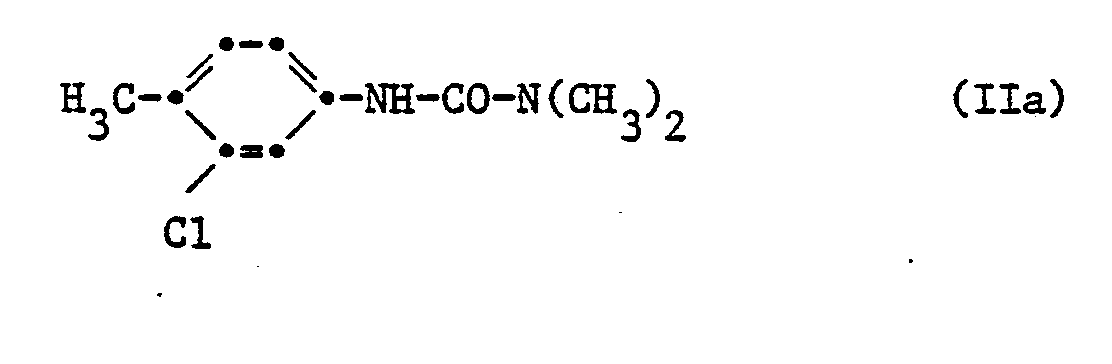
- Bekanntlich können dikotyle Unkräuter in Getreide, aber auch einige monokotyledone Unkräuter bei postemergenter Anwendung oft er folgreich mit 3-(3'-Chlor-4'-methylphenyl)-1,1-dimethylharnstoff (Chlortoluron) der Formel IIa
- oder mit 3-(3'-Chlor-4'-methoxyphenyl)-1,1-dimethylharnstoff (Metoxuron) der Formel IIb

- oder mit 3-(4'-Isopropylphenyl)-1,1-dimethylharnstoff (Isoproturon) der Formel IIc

- oder mit 1-Benzothiazol-2-yl-1,3-dimethylharnstoff (Methabenzthiazuron) der Formel IId

- oder mit 4-Hydroxy-3,5-dijodbenzonitril (Joxynil) der Formel IIe

- oder mit 3,5-Dibrom-4-hydroxybenzaldehyd-0-(2',4'-dinitrophenyl)-oxim (Bromophenoxim) der Formel IIf

- Die Verbindungen der Formeln II und ihre herbizide Wirksamkeit wurden beispielsweise in folgenden Literaturstellen beschrieben:
- Chlortoluron (Verb. IIa) in C.r. 5e Conf.Com. franc.:Mauvaises Herbes (COLUMA), 1969, II, 349,
- Metoxuron (Verb. IIb) in Z. Pflkrankh.,
- PflPath., PflSchutz, 1968, 75, 233,
- Isoproturon (Verb. IIc) in der deutschen Offenlegungsschrift 2 107 774, Methabenzthiazuron (Verb. IId) in PflSchutz-Nachr. Bayer, 1969, 22, 314,
- Joxynil (Verb. IIe) in Nature, Lond., 1963, 200, 28 und
- Bromofenoxim (Verb. IIf) in Proc. 3rd EWRC Symp. "New Herbicides", Paris, 1969., S.177.
- Es hat sich nun überraschenderweise gezeigt, dass eine mengenmässig in bestimmten Grenzen variable Kombination der beiden Wirkstoffklassen I und II eine synergistische Wirkung entfaltet, die die Mehrzahl aller wichtigen Getreideunkräuter zu bekämpfen vermag, ohne die Getreidekultur zu schädigen. Es werden die Hauptunkräuter der Getreidekulturen, wie Arten der Dikotyledonengattung Chrysanthemum und Sinapis sowie gewissse Avena-Arten (Wildhafer) selektiv in den aufgelaufenen Kulturen vernichtet.
- Es ist überraschend, dass die Kombination eines Wirkstoffes der Formel I mit einem Wirkstoff der FormelnII nicht nur eine prinzipiell zu erwartende additive Ergänzung des Wirkungsspektrums auf die üblichen mit Getreide vergesellschafteten Unkräuter hervorruft, sondern dass sie einen synergistischen Effekt erzielt, der die Wirkungsgrenzen beider Präparate unter zwei Aspekten erweitert.
- Einmal werden die Aufwandmengen der Einzelverbindungen I und II bei gleichbleibend guter Wirkung deutlich gesenkt. Zum anderen erzielt die kombinierte Mischung auch dort noch einen hohen Grad der Unkraut-Bekämpfung, wo beide Einzelverbindungen im Bereich allzu geringer Aufwandmengen völlig wirkungslos geworden sind. Dies hat eine wesentliche Verbreiterung des Unkrautspektrums und eine zusätzliche Erhöhung der Sicherheitsmarge auf Getreide zur Folge, wie sie für unbeabsichtigte Wirkstoffüberdosierung notwendig und erwünscht ist.
- Das erfindungsgemässe Mittel kann ausser in Getreidekulturen wie Gerste, Roggen und insbesondere Weizen auch zur selektiven Unkrautbekämpfung in anderen monokotylen Kulturen ähnlicher Wirkstoffempfi Michkeit mit ähnlichem Unkrautbestand eingesetzt werden, wie z.B. Mais und Reis.
- Die erfindungsgemässe Wirkstoffkombination enthält einen Wirk- stoff der Formel (I) und einen der Formeln (II) in beliebigem Mischungsverhältnis, in der Regel mit einem Ueberschuss der einen über die andere Komponente.Besonders bevorzugt sind Ueberschüsse der Komponente II bis 1:25, insbesondere aber das Mischungsverhältnis (I):(II) = 1:1 bis 1:10.
- Die erfindungsgemässe Wirkstoffkombinationen zeigen eine ausgezeichnete Wirkung gegen Unkräuter, ohne aber Getreidekulturen in üblichen Aufwandmengen von 0,2 bis 4 kg, vorzugsweise 0,5 bis 3 kg pro Hektar nennenswert zu beeinflussen.
- . Als ganz besonders wirksame synergistische Wirkstoffgemische haben sich folgende Kombinationen erwiesen:
- a) 4-(3',5'-Dichlorpyridyl-2'-oxy)-α-phenoxy-propionsäurepropargyl- ester (Ia) und 3-(3'-Chlor-4'-methylphenyl)-1,1-dimethylharnstoff (IIa),
- b) 4-(3',5'-Dichlorpyridyl-2'-oxy)-α-phenoxy-thiopropionsäurepropargyl- ester (Ib) und 3-(4'-Chlor-4'-methylphenyl)-1,1-dimethylharnstoff (IIa),
- c) 4-(3',5'-Dichlorpyridyl-2'-oxy)-a-phenoxy-propionsäurepropargyl- ester (Ia) und 3-(4'-Isopropylphenyl)-1,1-dimethylharnstoff (IIc), und
- d) 4-(3',5-Dichlorpyridyl-2'-oxy)-a-phenoxy-thiopropionsäurepropargyl- ester (Ib) und 3-(4'-Isopropylphenyl)-1,1-dimethylharnstoff (IIc).
- Vorliegende Erfindung betrifft auch die Verwendung des erfindungsgemässen Mittels, also ein Verfahren zur selektiven Ungras- und Unkrautbekämpfung in Getreide unter post-emergenter Anwendung des Mittels.
- Das erfindungsgemässe Mittel mit der neuen Wirkstoffkombination enthält neben den genannten Wirkstoffen noch geeignete Träger-und/oder andere Zuschlagstoffe. Diese können fest oder flüssig sein und entsprechen den in der Formulierungstechnik üblichen Stoffen wie z.B. natürlichen oder regenerierten mineralischen Stoffen, Lösungs-, Dispergier-, Netz-, Haft-, Verdickungs-, Bindemittel oder Düngemitteln. Geeignete Anwendungsformen sind daher z.B. Emulsionskonzentrate, direkt versprühbare oder verdünnbare Lösungen, verdünnte Emulsionen, Spritzpulver, lösliche Pulver, Stäubemittel, Granulate, auch Verkapselüngen in z.B. polymeren Stoffen. Die Anwendungsverfahren wie Versprühen, Vernebeln, Verstäuben, Verstreuen oder Giessen werden gleich wie die Art der Mittel den angestrebten Zielen und den gegebenen Verhältnissen entsprechend gewählt.
- Die Formulierungen, d.h. die das erfindungsgemässe Wirkstoffgemisch und gegebenenfalls einen festen oder flüssigen Zusatzstoff enthaltenden Mittel, Zubereitungen oder Zusammensetzungen werden in bekannter Weise hergestellt, z.B. durch inniges Vermischen und/oder Vermahlen der Wirkstoffe mit Streckmitteln, wie z.B. mit Lösungsmitteln, festen Trägerstoffen, und gegebenenfalls oberflächenaktiven Verbindungen (Tensiden).
- Als Lösungsmittel können in Frage kommen: Aromatische Kohlenwasserstoffe, bevorzugt die Fraktionen C8 bis C.12, wie z.B. Xylolgemische oder substituierte Naphthaline, Phthalsäureester wie Dibutyl-oder Dioctylphthalat, aliphatische Kohlenwasserstoffe wie Cyclohexan oder Paraffine, Alkohole und Glykole sowie deren Aether und Ester, wie Aethanol, Aethylenglykol, Aethylenglykolmonomethyl- oder -äthyläther, Ketone wie Cyclohexanon, stark polare Lösungsmittel wie N-Methyl-2-pyrrolidon, Dimethylsulfoxid oder Dimethylformamid, sowie gegebenenfalls epoxidierte Pflanzenöle wie epoxidiertes Kokosnussöl oder Sojaöl; oder Wasser.
- Als feste Trägerstoffe, z.B. für Stäubemittel und dispergierbace Pulver, werden in der Regel natürliche Gesteinsmehle verwendet, wie Calcit, Talkum, Kaolin, Montmorillonit oder Attapulgit. Zur Verbesserung der physikalischen Eigenschaften können auch hochdisperse Kieselsäure oder hochdisperse saugfähige Polymerisate zugesetzt werden. Als gekörnte, adsorptive Granulatträger kommen poröse Typen wie z.B. Bimsstein, Ziegelbruch, Sepiolit oder Bentonit, als nicht sorptive Trägermaterialien z.B. Calcit oder Sand ein Frage. Darüberhinaus kann eine Vielzahl von vorgranulierten Materialien anorganischer oder organischer Natur wie insbesondere Dolomit oder zerkleinerte Pflanzenrückstände verwendet werden.
- Als oberflächenaktive Verbindungen kommen nichtionogene, kation- und/oder anionaktive Tenside mit guten Emulgier-, Dispergier-und Netzeigenschaften in Betracht. Unter Tensiden sind auch Tensidgemische zu verstehen.
- Geeignete anionische Tenside können sowohl sog. wasserlösliche Seifen als auch wasserlösliche synthetische oberflächenaktive Verbindungen sein.
- Als Seifen seien die Alkali-, Erdalkali- oder gegebenenfalls substituierte Ammoniumsalze von höheren Fettsäuren (C10-C22), wie z.B. die Na- oder K-Salze der Oel- oder Stearinsäure, oder von natürlichen Fettsäuregemischen, die z.B. aus Kokosnuss- oder Talgöl gewonnen werden können, genannt. Ferner sind auch die Fettsäuremethyl-taurinsalze zu erwähnen.
- Häufiger werden jedoch sogenannte synthetische Tenside verwendet, insbesondere Fettsulfonate, Fettsulfate, sulfonierte Benzimidazolderivate oder Alkylarylsulfonate.
- Die Fettsulfonate oder -sulfate liegen in der Regel als Alkali-, Erdalkali- oder gegebenenfalls substituierte Ammoniumsalze vor und weisen einen Alkylrest mit 8 bis 22 C-Atomen auf, wobei Alkyl auch den Alkylteil von Acylresten einschliesst, z.B. das Na-oder Ca-Salz der Ligninsulfonsäure, des Dodecylschwefelsäureesters oder eines aus natürlichen Fettsäuren hergestellten Fettalkoholsulfatgemisches. Hierher gehören auch die Salze der Schwefelsäureester und Sulfonsäuren von Fettalkohol-Aethylenoxid-Addukten. Die sulfonierten Benzimidazolderivate enthalten vorzugsweise 2-Sulfonsäuregruppen und einen Fettsäurerest mit 8-22 C-Atomen. Alkylarylsulfonate sind z.B. die Na-, Ca- oder Triäthanolaminsalze der Dodecylbenzolsulfonsäure, der Dibutylnaphthalinsulfonsäure, oder eines Naphthalinsulfonsäure-Formaldehydkondensationsproduktes.
- Ferner kommen auch entsprechende Phosphate wie z.B. Salze des Phosphorsäureesters eines p-Nonylphenol-(4-14)-Aethylenoxid-Adduktes in Frage.
- Als nichtionische Tenside kommen in erster Linie Polyglykol- ätherderivaten von aliphatisehen oder cycloaliphatischen Alkoholen, gesättigten oder ungesättigten Fettsäuren und Alkylphenolen in Frage, die 3 bis 30 Glykoläthergruppen und 8 bis 20 Kohlenstoffatome im (aliphatischen) Kohlenwasserstoffrest und 6 bis 18 Kohlenstoffatome im Alkylrest der Alkylphenole enthalten können.
- Weitere geeignete nichtionische Tenside sind die wasserlöslichen, 20 bis 250 Aethylenglykoläthergruppen und 10 bis 100 Propylenglykoläthergruppen enthaltenden Polyäthylenoxidaddukte an Polypropylenglykal, Aethylendiaminopolypropylenglykol und Alkylpolypropylenglykol mit 1 bis 10 Kohlenstoffatomen in der Alkylkette. Die genannten Verbindungen enthalten üblicherweise pro Propylenglykol-Einheit 1 bis 5 Aethylenglykoleinheiten.
- Als Beispiele nichtionischer Tenside seien Nonylphenolpolyäthoxy- äthanole, Ricinusölpolyglykolähter, Polypropylen-Polyäthylenoxidaddukte, Tributylphenoxypolyäthoxyäthanol, Polyäthylenglykol und Octylphenoxypolyäthoxyäthanol erwähnt.
- Ferner kommen auch Fettsäureester von Polyoxyäthylensorbitan wie das Polyoxyäthylensoribtan-triöleat in Betracht.
- Bei den kationischen Tensiden handelt es sich vor allem um quantäre Ammoniumsalze, welche als N-Substituenten mindestens einen ylkyl rest mit 8 bis 22 C-Atomen enthalten und als weitere Substituenten niedrige, gegebenenfalls halogenierte Alkyl-, Benzyl- oder niedrige Hydroxyalkylreste aufweisen. Die Salze liegen vorzugsweise als Halogenide, Methylsulfate oder Aethylsulfate vor, z.B. das Stearyltrimethylammoniumchlorid oder das Benzyldi(2-chloräthyl)äthylammoniumbromid.
- Die in der Formulierungstechnik gebräuchlichen Tenside sind u.a. in folgenden Publikationen beschrieben:
- "Mc Cutcheon's Detergents and Emuslifiers Annual" MC Publishing Corp., Ringwood, New Jersey, 1979.
- Sisely and Wood, "Encyclopedia of Surface Active Agents", Chemical Publishin Co., Inc. New York, 1964.
- Der Wirkstoffgehalt in handelsfähigen Mitteln liegt zwischen 0,1 bis 95 Gewichtsprozent, vorzugsweise 1 bis 80 Gewichtsprozent.
- Insbesondere setzen sich bevorzugte Formulierungen folgendermassen zusammen: (% = Gewichtsprozent)
-

-

-

-

-

-

- Während als Handelsware eher konzentrierte Mittel bevorzugt werden, verwendet der Endverbraucher in der Regel verdünnte Mittel. Die Anwendungsformen können bis hinab zu 0,001% an Wirkstoff verdünnt werden.
- Den beschriebenen erfindungsgemässen Mitteln lassen sich andere biozide Wirkstoffe oder Mittel beimischen. So können die neuen Mittel ausser den genannten Verbindungen der allgemeinen Formel I und der Formel II z.B. Insektizide, Fungizide, Bakterizide, Fungistatika, Bakteriostatika oder Nematizide zur Verbreiterung des Wirkungsspektrums enthalten.
- Ein synergistischer Effekt liegt bei Herbiziden immer dann vor, wenn die herbizide Wirkung der Wirkstoffkombination I + II grösser ist als die Summe aus der Wirkung der einzeln applizierten Wirkstoffe.
- Das zu erwartende Pflanzenwachstum E für eine gegebene Kombination zweier Herbizide kann (vgl. COLBY, S.R., "Calculating synergistic and antagonistic response of herbicide combinations", Weeds 15, Seiten 20-22, 1967) wie folgt berechnet werden:

- Dabei bedeuten:
- X = Prozent Wachstum (im Vergleich zu unbehandelten Pflanzen) bei Behandlung mit einem Herbizid I mit p kg Aufwandmenge pro Hektar,
- Y = Prozent Wachstum bei Behandlung mit einem Herbizid II mit q kg Aufwandmenge pro Hektar
- E = Erwartetes Wachstum in Prozent zu den Kontrollpflanzen nach Behandlung mit Herbizidgemisch I + II bei einer Aufwandmenge von p + q kg Wirkstoffmenge pro Hektar.
- Ist der tatsächlich beobachtete Wert niedriger als der zu erwartende Wert E, so liegt Synergismus vor.
- Der synergistische Effekt der Kombinationen der Wirkstoffe I und II wird in den folgenden Beispielen demonstriert.
- Beispiel 1: Die Testpflanzen werden in Plastikcontainern, die 30 1 sterilisierte Gartenerde enthalten, im Gewächshaus ausgesät. Nach dem Auflaufen werden die Pflanzen im 2- bis 3-Blattstadium mit einer wässerigen Dispersion der Wirkstoffkombination besprüht. Die Aufwand- menge an Dispersion beträgt 50 ml pro m2. Nach 15 Tagen bei Temperaturen von 10-20°C, einer relativen Luftfeuchtigkeit von 60-70% und täglicher Bewässerung der Container erfolgt die Auswertung.
- Der Schädigungsgrad der Pflanzen wird linear nach folgendem Masstab bewertet:
- 1 : Pflanzen abgestorben
- 5 : mittlere Wirkung
- 9 : Normalzustand.
- Für verschiedene Mischungsverhältnisse und Gesamtwirkstoffmengen werden folgende Ergebnisse erzielt:


- Werden die nach der Methode von Colby für additive Wirkung berechneten Werte mit den Resultaten aus Tabelle 1 verglichen, so erkennt man, dass die beobachteten Wachstumswerte bei Sinapis arvensis und Chrysanthemum segetum kleiner sind, als die errechneten Wirkungen. Damit ist der synergistische Effekt der Mischung von 4-(3',5'-Di- chlorpyridyl-2'-oxy)-α-phenoxypropionsäurspropargyiester mit den Verbindungen IIa bis IIf bewiesen (vgl. Tabelle 2).


- Werden die nach Colby für additive Wirkung berechneten Werte mit den Resultaten aus Tabelle 3 verglichen, so erkennt man, dass die Wachstumswerte bei Sinapis arvensis und Chrysanthemum segetum Kleiner sind, als die errechneten Wirkungen. Damit ist der synergistische Effekt der Mischung von 4-(3',5'-Dichlorpyridyl-2'-oxy)-a-phenoxy- propionthiolsäurepropargylester (Verb. Ib) mit. den Verbindungen IIa bis IIf bewiesen (vgl. Tabelle 4).


- Beispiel 2: In Freilandversuchen auf Weizenfeldern-wurden die folgenden Ergebnisse erzielt. Die Angabe des Wachstums erfolgt in Prozent im Vergleich zum unbehandelten Kontrollfeld:


- Formulierungsbeispiele für synergistische Wirkstoffgemische der Formeln I und II (% =Gewichtsprozent)

- Das Wirkstoffgemisch wird mit den Zusatzstoffen gut vermischt und in einer geeigneten Mühle gut vermahlen. Man erhält Spritzpulver, die sich mit Wasser zu Suspensionen jeder gewünschten Konzentration verdünnen lassen.

- Aus diesen Konzentraten können durch Verdünnen mit Wasser Emulsionen jeden gewünschten Konzentration hergestellt werden.

- Man erhält anwendungsfertige Stäubemittel, indem das Wirkstoffgemisch mit dem Träger vermischt und auf einer geeigneten Mühle vermahlen wird.

- Das Wirkstoffgemisch wird mit den Zusatzstoffen vermischt, vermahlen und mit Wasser angefeuchtet. Dieses Gemisch wird extrudiert und anschliessend im Luftstrom getrocknet.

- Das fein gemahlene Wirkstoffgemisch wird in einem Mischer auf das mit Polyäthylenglykol angefeuchtete Kaolin gleichmässig aufgetragen. Auf diese Weise erhält man staubfreie Umhüllungs-Granulate.

- Das fein gemahlene Wirkstoffgemisch wird mit den Zusatzstoffen innig vermischt. Man erhält so ein Suspensions-Konzentrat, aus welchem durch Verdünnen mit Wasser Suspensionen jeder gewünschten Konzentration hergestellt werden können.
Claims (11)

Priority Applications (1)
| Application Number | Priority Date | Filing Date | Title |
|---|---|---|---|
| AT81810270T ATE6336T1 (de) | 1980-07-09 | 1981-07-03 | Synergistisches mittel und verfahren zur selektiven unkrautbekaempfung, insbesondere in getreide. |
Applications Claiming Priority (2)
| Application Number | Priority Date | Filing Date | Title |
|---|---|---|---|
| CH525380 | 1980-07-09 | ||
| CH5253/80 | 1980-07-09 |
Publications (2)
| Publication Number | Publication Date |
|---|---|
| EP0043802A1 true EP0043802A1 (de) | 1982-01-13 |
| EP0043802B1 EP0043802B1 (de) | 1984-02-22 |
Family
ID=4290492
Family Applications (1)
| Application Number | Title | Priority Date | Filing Date |
|---|---|---|---|
| EP81810270A Expired EP0043802B1 (de) | 1980-07-09 | 1981-07-03 | Synergistisches Mittel und Verfahren zur selektiven Unkrautbekämpfung, insbesondere in Getreide |
Country Status (18)
| Country | Link |
|---|---|
| EP (1) | EP0043802B1 (de) |
| AT (1) | ATE6336T1 (de) |
| AU (1) | AU7266281A (de) |
| CA (1) | CA1168884A (de) |
| CS (2) | CS221841B2 (de) |
| DD (1) | DD201967A5 (de) |
| DE (1) | DE3162368D1 (de) |
| DK (1) | DK302081A (de) |
| ES (1) | ES9000017A1 (de) |
| GR (1) | GR74323B (de) |
| IL (1) | IL63255A (de) |
| MA (1) | MA19203A1 (de) |
| NZ (1) | NZ197643A (de) |
| PL (2) | PL130694B1 (de) |
| PT (1) | PT73332B (de) |
| TR (1) | TR21038A (de) |
| ZA (1) | ZA814620B (de) |
| ZW (1) | ZW15681A1 (de) |
Cited By (7)
| Publication number | Priority date | Publication date | Assignee | Title |
|---|---|---|---|---|
| EP0069705A1 (de) * | 1981-07-08 | 1983-01-12 | Ciba-Geigy Ag | Synergistisches Mittel und Verfahren zur selektiven Unkrautbekämpfung, insbesondere in Getreide |
| EP0084819A3 (de) * | 1982-01-26 | 1983-08-10 | Bayer Ag | Herbizide Mittel enthaltend Methabenzthiazuron in Kombination mit bestimmten Phenoxypropionsäureestern |
| EP0155493A1 (de) * | 1984-02-24 | 1985-09-25 | Bayer Ag | Herbizide Mittel enthaltend Methabenzthiazuron in Kombination mit bestimmten Pyridinyloxyessigsäure-Derivaten |
| EP0144796A3 (en) * | 1983-11-19 | 1986-02-05 | Hoechst Aktiengesellschaft | Herbicidal agents |
| EP0298901A3 (en) * | 1987-07-10 | 1989-05-10 | Hoechst Aktiengesellschaft | Herbicidal agents |
| US5231071A (en) * | 1987-07-10 | 1993-07-27 | Hoechst Aktiengesellschaft | Herbicidial agents |
| WO2000003591A3 (de) * | 1998-07-16 | 2000-06-22 | Aventis Cropscience Gmbh | Herbizide mittel |
Citations (1)
| Publication number | Priority date | Publication date | Assignee | Title |
|---|---|---|---|---|
| EP0004414A1 (de) * | 1978-03-01 | 1979-10-03 | Imperial Chemical Industries Plc | Mischungen von herbiziden Pyridyloxyphenoxypropansäurederivaten mit anderen Herbiziden und Verfahren zur Unkrautbekämpfung |
-
1981
- 1981-07-01 MA MA19403A patent/MA19203A1/fr unknown
- 1981-07-03 EP EP81810270A patent/EP0043802B1/de not_active Expired
- 1981-07-03 AT AT81810270T patent/ATE6336T1/de not_active IP Right Cessation
- 1981-07-03 DE DE8181810270T patent/DE3162368D1/de not_active Expired
- 1981-07-03 CS CS815155A patent/CS221841B2/cs unknown
- 1981-07-07 CA CA000381247A patent/CA1168884A/en not_active Expired
- 1981-07-07 PL PL1981241460A patent/PL130694B1/pl unknown
- 1981-07-07 GR GR65436A patent/GR74323B/el unknown
- 1981-07-07 ZW ZW156/81A patent/ZW15681A1/xx unknown
- 1981-07-07 PL PL1981232076A patent/PL128326B1/pl unknown
- 1981-07-08 ZA ZA814620A patent/ZA814620B/xx unknown
- 1981-07-08 DK DK302081A patent/DK302081A/da not_active Application Discontinuation
- 1981-07-08 NZ NZ197643A patent/NZ197643A/en unknown
- 1981-07-08 PT PT73332A patent/PT73332B/de unknown
- 1981-07-08 IL IL63255A patent/IL63255A/xx unknown
- 1981-07-08 AU AU72662/81A patent/AU7266281A/en not_active Abandoned
- 1981-07-08 TR TR21038A patent/TR21038A/xx unknown
- 1981-07-08 ES ES503777A patent/ES9000017A1/es not_active Expired
- 1981-07-08 DD DD81231584A patent/DD201967A5/de unknown
- 1981-07-30 CS CS819945A patent/CS221842B2/cs unknown
Patent Citations (1)
| Publication number | Priority date | Publication date | Assignee | Title |
|---|---|---|---|---|
| EP0004414A1 (de) * | 1978-03-01 | 1979-10-03 | Imperial Chemical Industries Plc | Mischungen von herbiziden Pyridyloxyphenoxypropansäurederivaten mit anderen Herbiziden und Verfahren zur Unkrautbekämpfung |
Cited By (12)
| Publication number | Priority date | Publication date | Assignee | Title |
|---|---|---|---|---|
| EP0069705A1 (de) * | 1981-07-08 | 1983-01-12 | Ciba-Geigy Ag | Synergistisches Mittel und Verfahren zur selektiven Unkrautbekämpfung, insbesondere in Getreide |
| EP0084819A3 (de) * | 1982-01-26 | 1983-08-10 | Bayer Ag | Herbizide Mittel enthaltend Methabenzthiazuron in Kombination mit bestimmten Phenoxypropionsäureestern |
| EP0144796A3 (en) * | 1983-11-19 | 1986-02-05 | Hoechst Aktiengesellschaft | Herbicidal agents |
| EP0155493A1 (de) * | 1984-02-24 | 1985-09-25 | Bayer Ag | Herbizide Mittel enthaltend Methabenzthiazuron in Kombination mit bestimmten Pyridinyloxyessigsäure-Derivaten |
| EP0298901A3 (en) * | 1987-07-10 | 1989-05-10 | Hoechst Aktiengesellschaft | Herbicidal agents |
| US5231071A (en) * | 1987-07-10 | 1993-07-27 | Hoechst Aktiengesellschaft | Herbicidial agents |
| US5342822A (en) * | 1987-07-10 | 1994-08-30 | Hoechst Aktiengesellschaft | Herbicidal agents |
| US5382564A (en) * | 1987-07-10 | 1995-01-17 | Hoechst Aktiengesellschaft | Herbicidal agents |
| WO2000003591A3 (de) * | 1998-07-16 | 2000-06-22 | Aventis Cropscience Gmbh | Herbizide mittel |
| US8357629B2 (en) | 1998-07-16 | 2013-01-22 | Bayer Cropscience Ag | Herbicidal compositions |
| US8765638B2 (en) | 1998-07-16 | 2014-07-01 | Bayer Intellectual Property Gmbh | Herbicidal compositions |
| US8791050B2 (en) | 1998-07-16 | 2014-07-29 | Bayer Intellectual Property Gmbh | Herbicidal compositions |
Also Published As
| Publication number | Publication date |
|---|---|
| MA19203A1 (fr) | 1982-04-01 |
| DD201967A5 (de) | 1983-08-24 |
| IL63255A0 (en) | 1981-10-30 |
| CS221841B2 (en) | 1983-04-29 |
| DE3162368D1 (en) | 1984-03-29 |
| TR21038A (tr) | 1983-05-27 |
| ZA814620B (en) | 1982-07-28 |
| AU7266281A (en) | 1982-01-14 |
| ES9000017A1 (es) | 1990-05-16 |
| EP0043802B1 (de) | 1984-02-22 |
| DK302081A (da) | 1982-01-10 |
| PT73332A (de) | 1981-08-01 |
| ZW15681A1 (en) | 1982-02-10 |
| ATE6336T1 (de) | 1984-03-15 |
| PL128326B1 (en) | 1984-01-31 |
| IL63255A (en) | 1984-03-30 |
| PL232076A1 (de) | 1982-03-01 |
| PT73332B (de) | 1983-06-20 |
| CS221842B2 (en) | 1983-04-29 |
| GR74323B (de) | 1984-06-22 |
| CA1168884A (en) | 1984-06-12 |
| NZ197643A (en) | 1984-09-28 |
| PL130694B1 (en) | 1984-08-31 |
Similar Documents
| Publication | Publication Date | Title |
|---|---|---|
| DE69625587T2 (de) | Synergistiche herbizide zusammensetzungen mit metolachlor | |
| DE69706530T2 (de) | Herbizide synergistische zusammensetzung und verfahren zur unkrautbekämpfung | |
| DE69702968T2 (de) | Herbizide zusammensetzung und deren verwendung zur unkrautbekämpfung | |
| EP0236273B1 (de) | Synergistisches Mittel und Verfahren zur selektiven Unkrautbekämpfung in Getreide | |
| EP0768034B1 (de) | Herbizides synergistisches Mittel und Verfahren zur Unkrautbekämpfung | |
| EP1290944B1 (de) | Herbizides Mittel | |
| EP0043802B1 (de) | Synergistisches Mittel und Verfahren zur selektiven Unkrautbekämpfung, insbesondere in Getreide | |
| EP0147365A2 (de) | Herbizides Mittel | |
| EP0112799A1 (de) | Herbizides Mittel zur selektiven Unkrautbekämpfung in Getreide | |
| EP0043349B1 (de) | Synergistisches Mittel und Verfahren zur selektiven Unkrautbekämpfung, insbesondere in Getreide und Sojabohnenkulturen | |
| EP0058639B1 (de) | 2-(4-(6-Halogen-chinoxalinyl-2-oxy)-phenoxy)-propionsäureester, Verfahren zu ihrer Herstellung sowie ihre Verwendung als Herbizide und Pflanzenwuchsregulatoren | |
| EP0542687A1 (de) | Synergistisches Mittel und Verfahren zur selektiven Unkrautbekämpfung | |
| EP0495748A1 (de) | Akarizide Mittel | |
| EP0614608B1 (de) | Synergistische Mischungen zur Bekämpfung von Ackerfuchsschwanz | |
| EP0138762B1 (de) | Schädlingsbekämpfungsmittel | |
| EP0318433B1 (de) | Synergistisches Mittel und Verfahren zur selektiven Unkrautbekämpfung | |
| EP0182740A2 (de) | Synergistisches Mittel und Verfahren zur selektiven Unkrautbekämpfung, insbesondere in Getreide | |
| CH651445A5 (en) | Composition and method for the selective control of weeds in transplanted rice or rice which is sown in water | |
| EP0069705B1 (de) | Synergistisches Mittel und Verfahren zur selektiven Unkrautbekämpfung, insbesondere in Getreide | |
| EP0165393B1 (de) | Herbizides Mittel | |
| AT380623B (de) | Herbizides mittel | |
| EP0043800A1 (de) | Synergistisches Mittel und Verfahren zur selektiven Unkrautbekämpfung, insbesondere in Zucker- und Futterrübenkulturen | |
| EP0487454A2 (de) | Synergistisches Mittel und Verfahren zur selektiven Unkrautbekämpfung | |
| DD298341A5 (de) | Herbizide mittel | |
| DE4428982C1 (de) | Neue synergistische Herbizide, insbesondere zur Bekämpfung von Ackerfuchsschwanz |
Legal Events
| Date | Code | Title | Description |
|---|---|---|---|
| PUAI | Public reference made under article 153(3) epc to a published international application that has entered the european phase |
Free format text: ORIGINAL CODE: 0009012 |
|
| 17P | Request for examination filed |
Effective date: 19810706 |
|
| AK | Designated contracting states |
Designated state(s): AT BE CH DE FR GB IT NL |
|
| ITF | It: translation for a ep patent filed | ||
| GRAA | (expected) grant |
Free format text: ORIGINAL CODE: 0009210 |
|
| AK | Designated contracting states |
Designated state(s): AT BE CH DE FR GB IT LI NL |
|
| REF | Corresponds to: |
Ref document number: 6336 Country of ref document: AT Date of ref document: 19840315 Kind code of ref document: T |
|
| REF | Corresponds to: |
Ref document number: 3162368 Country of ref document: DE Date of ref document: 19840329 |
|
| ET | Fr: translation filed | ||
| PGFP | Annual fee paid to national office [announced via postgrant information from national office to epo] |
Ref country code: DE Payment date: 19840608 Year of fee payment: 4 |
|
| PGFP | Annual fee paid to national office [announced via postgrant information from national office to epo] |
Ref country code: AT Payment date: 19840622 Year of fee payment: 4 |
|
| PGFP | Annual fee paid to national office [announced via postgrant information from national office to epo] |
Ref country code: FR Payment date: 19840625 Year of fee payment: 4 |
|
| PGFP | Annual fee paid to national office [announced via postgrant information from national office to epo] |
Ref country code: NL Payment date: 19840731 Year of fee payment: 4 |
|
| PGFP | Annual fee paid to national office [announced via postgrant information from national office to epo] |
Ref country code: CH Payment date: 19840803 Year of fee payment: 4 |
|
| PGFP | Annual fee paid to national office [announced via postgrant information from national office to epo] |
Ref country code: BE Payment date: 19840930 Year of fee payment: 4 |
|
| PLBE | No opposition filed within time limit |
Free format text: ORIGINAL CODE: 0009261 |
|
| STAA | Information on the status of an ep patent application or granted ep patent |
Free format text: STATUS: NO OPPOSITION FILED WITHIN TIME LIMIT |
|
| 26N | No opposition filed | ||
| PG25 | Lapsed in a contracting state [announced via postgrant information from national office to epo] |
Ref country code: AT Effective date: 19850703 |
|
| PG25 | Lapsed in a contracting state [announced via postgrant information from national office to epo] |
Ref country code: LI Effective date: 19850731 Ref country code: CH Effective date: 19850731 Ref country code: BE Effective date: 19850731 |
|
| BERE | Be: lapsed |
Owner name: CIBA-GEIGY A.G. Effective date: 19850731 |
|
| PG25 | Lapsed in a contracting state [announced via postgrant information from national office to epo] |
Ref country code: NL Effective date: 19860201 |
|
| GBPC | Gb: european patent ceased through non-payment of renewal fee | ||
| NLV4 | Nl: lapsed or anulled due to non-payment of the annual fee | ||
| REG | Reference to a national code |
Ref country code: CH Ref legal event code: PL |
|
| PG25 | Lapsed in a contracting state [announced via postgrant information from national office to epo] |
Ref country code: FR Free format text: LAPSE BECAUSE OF NON-PAYMENT OF DUE FEES Effective date: 19860328 |
|
| PG25 | Lapsed in a contracting state [announced via postgrant information from national office to epo] |
Ref country code: DE Effective date: 19860402 |
|
| REG | Reference to a national code |
Ref country code: FR Ref legal event code: ST |
|
| PG25 | Lapsed in a contracting state [announced via postgrant information from national office to epo] |
Ref country code: GB Effective date: 19881118 |