EP0043765A1 - Procédé de séparation des actinides et des lanthanides présents à l'état trivalent dans une solution aqueuse acide - Google Patents
Procédé de séparation des actinides et des lanthanides présents à l'état trivalent dans une solution aqueuse acide Download PDFInfo
- Publication number
- EP0043765A1 EP0043765A1 EP19810401060 EP81401060A EP0043765A1 EP 0043765 A1 EP0043765 A1 EP 0043765A1 EP 19810401060 EP19810401060 EP 19810401060 EP 81401060 A EP81401060 A EP 81401060A EP 0043765 A1 EP0043765 A1 EP 0043765A1
- Authority
- EP
- European Patent Office
- Prior art keywords
- organophosphorus compound
- actinides
- electron
- organic solvent
- acid
- Prior art date
- Legal status (The legal status is an assumption and is not a legal conclusion. Google has not performed a legal analysis and makes no representation as to the accuracy of the status listed.)
- Granted
Links
- 229910052768 actinide Inorganic materials 0.000 title claims abstract description 23
- 150000001255 actinides Chemical class 0.000 title claims abstract description 22
- 238000000034 method Methods 0.000 title claims abstract description 20
- 229910052747 lanthanoid Inorganic materials 0.000 title claims abstract description 19
- 150000002602 lanthanoids Chemical class 0.000 title claims abstract description 18
- 239000011260 aqueous acid Substances 0.000 title 1
- 238000000926 separation method Methods 0.000 claims abstract description 19
- 150000002903 organophosphorus compounds Chemical class 0.000 claims abstract description 14
- 239000007864 aqueous solution Substances 0.000 claims abstract description 12
- 239000003960 organic solvent Substances 0.000 claims abstract description 12
- 239000000243 solution Substances 0.000 claims abstract description 12
- 239000002253 acid Substances 0.000 claims abstract description 8
- 230000007935 neutral effect Effects 0.000 claims abstract description 8
- 125000004430 oxygen atom Chemical group O* 0.000 claims abstract description 7
- STCOOQWBFONSKY-UHFFFAOYSA-N tributyl phosphate Chemical group CCCCOP(=O)(OCCCC)OCCCC STCOOQWBFONSKY-UHFFFAOYSA-N 0.000 claims description 12
- -1 alkyl radical Chemical class 0.000 claims description 10
- AUONHKJOIZSQGR-UHFFFAOYSA-N oxophosphane Chemical compound P=O AUONHKJOIZSQGR-UHFFFAOYSA-N 0.000 claims description 5
- 230000002378 acidificating effect Effects 0.000 claims description 4
- 229910052717 sulfur Inorganic materials 0.000 claims description 4
- 125000004434 sulfur atom Chemical group 0.000 claims description 4
- ZMBHCYHQLYEYDV-UHFFFAOYSA-N trioctylphosphine oxide Chemical group CCCCCCCCP(=O)(CCCCCCCC)CCCCCCCC ZMBHCYHQLYEYDV-UHFFFAOYSA-N 0.000 claims description 4
- NAGJZTKCGNOGPW-UHFFFAOYSA-N dithiophosphoric acid Chemical compound OP(O)(S)=S NAGJZTKCGNOGPW-UHFFFAOYSA-N 0.000 claims description 3
- 150000003254 radicals Chemical class 0.000 claims description 3
- OMLVPEUOCUINNC-UHFFFAOYSA-N 1-(dihexylphosphorylmethoxy)octane Chemical group CCCCCCCCOCP(=O)(CCCCCC)CCCCCC OMLVPEUOCUINNC-UHFFFAOYSA-N 0.000 claims description 2
- 150000005840 aryl radicals Chemical class 0.000 claims description 2
- QVGXLLKOCUKJST-UHFFFAOYSA-N atomic oxygen Chemical compound [O] QVGXLLKOCUKJST-UHFFFAOYSA-N 0.000 claims 1
- 229910052760 oxygen Inorganic materials 0.000 claims 1
- 239000001301 oxygen Substances 0.000 claims 1
- NINIDFKCEFEMDL-UHFFFAOYSA-N Sulfur Chemical group [S] NINIDFKCEFEMDL-UHFFFAOYSA-N 0.000 abstract 1
- 239000003929 acidic solution Substances 0.000 abstract 1
- 239000003795 chemical substances by application Substances 0.000 abstract 1
- 150000001875 compounds Chemical class 0.000 abstract 1
- 229910052693 Europium Inorganic materials 0.000 description 17
- LXQXZNRPTYVCNG-UHFFFAOYSA-N americium atom Chemical compound [Am] LXQXZNRPTYVCNG-UHFFFAOYSA-N 0.000 description 17
- OGPBJKLSAFTDLK-UHFFFAOYSA-N europium atom Chemical compound [Eu] OGPBJKLSAFTDLK-UHFFFAOYSA-N 0.000 description 17
- 238000009826 distribution Methods 0.000 description 15
- 229910052695 Americium Inorganic materials 0.000 description 14
- 238000000605 extraction Methods 0.000 description 14
- SNRUBQQJIBEYMU-UHFFFAOYSA-N dodecane Chemical compound CCCCCCCCCCCC SNRUBQQJIBEYMU-UHFFFAOYSA-N 0.000 description 12
- GRYLNZFGIOXLOG-UHFFFAOYSA-N Nitric acid Chemical compound O[N+]([O-])=O GRYLNZFGIOXLOG-UHFFFAOYSA-N 0.000 description 11
- 150000002500 ions Chemical class 0.000 description 9
- 229940093635 tributyl phosphate Drugs 0.000 description 9
- 239000008346 aqueous phase Substances 0.000 description 8
- 239000012074 organic phase Substances 0.000 description 8
- 229910017604 nitric acid Inorganic materials 0.000 description 7
- 239000000203 mixture Substances 0.000 description 5
- 238000005406 washing Methods 0.000 description 5
- 238000010586 diagram Methods 0.000 description 4
- 239000012071 phase Substances 0.000 description 4
- FGIUAXJPYTZDNR-UHFFFAOYSA-N potassium nitrate Chemical compound [K+].[O-][N+]([O-])=O FGIUAXJPYTZDNR-UHFFFAOYSA-N 0.000 description 4
- NZTYICBZKRWUTH-UHFFFAOYSA-N americium europium Chemical compound [Eu][Am] NZTYICBZKRWUTH-UHFFFAOYSA-N 0.000 description 3
- DQNJHGSFNUDORY-UHFFFAOYSA-N bis(2-ethylhexoxy)-sulfanyl-sulfanylidene-$l^{5}-phosphane Chemical compound CCCCC(CC)COP(S)(=S)OCC(CC)CCCC DQNJHGSFNUDORY-UHFFFAOYSA-N 0.000 description 3
- LNBHUCHAFZUEGJ-UHFFFAOYSA-N europium(3+) Chemical compound [Eu+3] LNBHUCHAFZUEGJ-UHFFFAOYSA-N 0.000 description 3
- 230000007774 longterm Effects 0.000 description 3
- 238000004519 manufacturing process Methods 0.000 description 3
- 230000002285 radioactive effect Effects 0.000 description 3
- 239000002904 solvent Substances 0.000 description 3
- 238000003860 storage Methods 0.000 description 3
- 239000000126 substance Substances 0.000 description 3
- 229910052684 Cerium Inorganic materials 0.000 description 2
- 229910002651 NO3 Inorganic materials 0.000 description 2
- 229910019142 PO4 Inorganic materials 0.000 description 2
- 235000019647 acidic taste Nutrition 0.000 description 2
- 125000000217 alkyl group Chemical group 0.000 description 2
- LXQXZNRPTYVCNG-YPZZEJLDSA-N americium-241 Chemical compound [241Am] LXQXZNRPTYVCNG-YPZZEJLDSA-N 0.000 description 2
- GWXLDORMOJMVQZ-UHFFFAOYSA-N cerium Chemical compound [Ce] GWXLDORMOJMVQZ-UHFFFAOYSA-N 0.000 description 2
- 230000004992 fission Effects 0.000 description 2
- KWGKDLIKAYFUFQ-UHFFFAOYSA-M lithium chloride Chemical compound [Li+].[Cl-] KWGKDLIKAYFUFQ-UHFFFAOYSA-M 0.000 description 2
- 230000007246 mechanism Effects 0.000 description 2
- NBIIXXVUZAFLBC-UHFFFAOYSA-K phosphate Chemical compound [O-]P([O-])([O-])=O NBIIXXVUZAFLBC-UHFFFAOYSA-K 0.000 description 2
- 239000010452 phosphate Substances 0.000 description 2
- 235000010333 potassium nitrate Nutrition 0.000 description 2
- 239000004323 potassium nitrate Substances 0.000 description 2
- 238000011084 recovery Methods 0.000 description 2
- NHNBFGGVMKEFGY-UHFFFAOYSA-N Nitrate Chemical compound [O-][N+]([O-])=O NHNBFGGVMKEFGY-UHFFFAOYSA-N 0.000 description 1
- 229910052778 Plutonium Inorganic materials 0.000 description 1
- ZLMJMSJWJFRBEC-UHFFFAOYSA-N Potassium Chemical compound [K] ZLMJMSJWJFRBEC-UHFFFAOYSA-N 0.000 description 1
- FAPWRFPIFSIZLT-UHFFFAOYSA-M Sodium chloride Chemical compound [Na+].[Cl-] FAPWRFPIFSIZLT-UHFFFAOYSA-M 0.000 description 1
- 125000004183 alkoxy alkyl group Chemical group 0.000 description 1
- 125000004432 carbon atom Chemical group C* 0.000 description 1
- 238000006243 chemical reaction Methods 0.000 description 1
- 239000003153 chemical reaction reagent Substances 0.000 description 1
- 230000003750 conditioning effect Effects 0.000 description 1
- NIWWFAAXEMMFMS-OIOBTWANSA-N curium-244 Chemical compound [244Cm] NIWWFAAXEMMFMS-OIOBTWANSA-N 0.000 description 1
- XPRULOZMJZDZEF-UHFFFAOYSA-N dibutoxy-sulfanyl-sulfanylidene-$l^{5}-phosphane Chemical compound CCCCOP(S)(=S)OCCCC XPRULOZMJZDZEF-UHFFFAOYSA-N 0.000 description 1
- BHAOXUASJHPSJE-UHFFFAOYSA-N dihydroxy-octylsulfanyl-sulfanylidene-$l^{5}-phosphane Chemical compound CCCCCCCCSP(O)(O)=S BHAOXUASJHPSJE-UHFFFAOYSA-N 0.000 description 1
- 239000003085 diluting agent Substances 0.000 description 1
- 238000002474 experimental method Methods 0.000 description 1
- 238000001730 gamma-ray spectroscopy Methods 0.000 description 1
- 239000012442 inert solvent Substances 0.000 description 1
- ACVYVLVWPXVTIT-UHFFFAOYSA-M phosphinate Chemical compound [O-][PH2]=O ACVYVLVWPXVTIT-UHFFFAOYSA-M 0.000 description 1
- UEZVMMHDMIWARA-UHFFFAOYSA-M phosphonate Chemical compound [O-]P(=O)=O UEZVMMHDMIWARA-UHFFFAOYSA-M 0.000 description 1
- OYEHPCDNVJXUIW-UHFFFAOYSA-N plutonium atom Chemical compound [Pu] OYEHPCDNVJXUIW-UHFFFAOYSA-N 0.000 description 1
- 239000011591 potassium Substances 0.000 description 1
- 229910052700 potassium Inorganic materials 0.000 description 1
- 239000002901 radioactive waste Substances 0.000 description 1
- 150000003839 salts Chemical class 0.000 description 1
- 239000011780 sodium chloride Substances 0.000 description 1
- RMZAYIKUYWXQPB-UHFFFAOYSA-N trioctylphosphane Chemical compound CCCCCCCCP(CCCCCCCC)CCCCCCCC RMZAYIKUYWXQPB-UHFFFAOYSA-N 0.000 description 1
- 238000004017 vitrification Methods 0.000 description 1
- 239000002699 waste material Substances 0.000 description 1
Images

Classifications
-
- G—PHYSICS
- G21—NUCLEAR PHYSICS; NUCLEAR ENGINEERING
- G21F—PROTECTION AGAINST X-RADIATION, GAMMA RADIATION, CORPUSCULAR RADIATION OR PARTICLE BOMBARDMENT; TREATING RADIOACTIVELY CONTAMINATED MATERIAL; DECONTAMINATION ARRANGEMENTS THEREFOR
- G21F9/00—Treating radioactively contaminated material; Decontamination arrangements therefor
- G21F9/04—Treating liquids
- G21F9/06—Processing
- G21F9/12—Processing by absorption; by adsorption; by ion-exchange
- G21F9/125—Processing by absorption; by adsorption; by ion-exchange by solvent extraction
Definitions
- the subject of the present invention is a process for the separation of actinides and lanthanides present in the trivalent state in an acidic aqueous solution, usable in particular for the treatment of radioactive effluents.
- actinides are of great interest because they can be used in different fields, for example for the production of radioactive sources. Also, it is of great interest to separate the actinides from the lanthanides, on the one hand, to recover the actinides and, on the other hand, to treat, with a view to long-term storage, only fission products with short life, which present less danger.
- this process can find applications in the production of transuranium elements by neutron irradiation of lighter isotope targets, for example the production of americium 241 and curium 244 from irradiated plutonium.
- the lanthanide actinide separation methods which have been used up to now have many disadvantages because they require the use of concentrated saline media, for example 10 M solutions of LiCl, or relatively high pH, which leads to implementation difficulties.
- the present invention specifically relates to a process for the separation of actinides and lanthanides present in the trivalent state in an aqueous solution. This process overcomes these disadvantages. nient and also allows to obtain a quantitative separation of actinides and lanthanides.
- the process for the separation of actinides and lanthanides present in the trivalent state in an acidic aqueous solution is characterized in that the actinides present in said solution are selectively extracted in an organic solvent, by putting in contact with said aqueous solution with an organic solvent comprising a system of extractants constituted by a acid organophosphorus compound comprising at least one electron donor sulfur atom and with a neutral organophosphorus compound comprising at least one electron donor oxygen atom.
- the method of the invention has in particular the advantage of leading to a satisfactory separation. actinides and lanthanides, without requiring the addition of salts or other reagents to the starting aqueous solution, which is generally a nitric solution.
- the acid organophosphorus compound is advantageously a dialkyl dithiophosphoric acid, such as di- (2-ethyl-hexyl) -dithiophosphoric acid, dibutyl-dithiophosphoric acid and di octyl dithiophosphoric acid.
- dialkyl dithiophosphoric acid such as di- (2-ethyl-hexyl) -dithiophosphoric acid, dibutyl-dithiophosphoric acid and di octyl dithiophosphoric acid.
- HDEHDTP di-2-ethyl-hexyl-dithiophosphoric acid
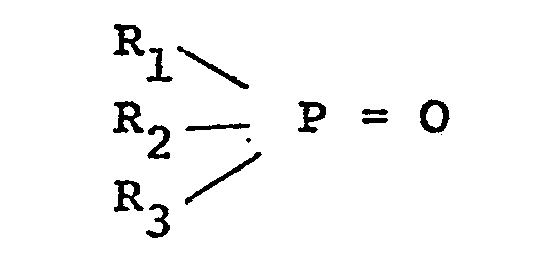
- the neutral organophosphorus compound with an electron donor oxygen atom can consist of a phosphate, a phosphonate, a trialkyl phosphinate, a phosphine oxide in which the alkyl radicals are linear or branched C 4 radicals. to C12, for example, tributyl phosphate (TBP), these oxygenated donors corresponding to the formula: in which the radicals R 1 , R 2 , and R 3 which may be the same or different represent an alkyl, alkoxyalkyl or aryl radical.
- TBP tributyl phosphate
- radicals R 1 , R 2 and R 3 are alkyl or alkoxyalkyl radicals having from 4 to 12 carbon atoms.
- phosphine oxide which can be used, mention may be made of trioctyl phosphine oxide and di-n-hexyl-octoxymethyl phosphine oxide.
- the extractant system is generally diluted in an inert solvent such as dodecane.
- the concentration of each extractant in the organic solvent is such that the molar ratio of the acid organophosphorus compound comprising at least one electron donor sulfur atom to the neutral organophosphorus compound with electron donor oxygen atom is between approximately 2 / 3 and 9/1.
- the method of the invention can be implemented in any conventional extraction device such as batteries of mixer-settlers, pulsed columns, centrifugal extractors, etc.
- dodecane was used as the diluent, and the distribution coefficients of americium and europium by ⁇ spectrometry.
- Americium 241 was present at pocket concentrations of 10 -5 M.1 -1 , europium at concentrations of 2.10 -2 M.1 -1 with 1mCi.1 -1 of the radioactive melagne 152 Eu - 154 Eu.
- the distribution coefficient is equal to the ratio of the concentration of an element in the organic phase to the concentration of this same element in the aqueous phase.
- This example relates to the separation of americium III and europium III by means of an organic solvent comprising a mixture of tributyl phosphate and di-2-ethyl-hexyl- acid. dithiophosphoric in dodecane, the total concentration of extractants from the organic system being 1 M, and the concentration of nitric acid in the aqueous solution being 0.05 M.
- An americium-europium separation can be carried out by countercurrent extraction in a device comprising 6 extraction stages and 3 washing stages, the ratio of the flow rates of the organic phases to the aqueous phase being 0.25 in the extraction part and 0 , 5 in the washing section. Under these conditions, a recovery of approximately 99.5% of the initial americium is obtained and this recovered americium contains approximately 0.4% of the initial europium.
- FIG. 1 which illustrates the variations of the distribution coefficient D Am (curve I) and of the distribution coefficient D Eu (curve II) as a function of the content of di-2-ethyl-hexyl-dithiophosphoric acid of the solvent expressed in molar percentage of the mixture of extractants shows that this example is not limiting as regards the chemical conditions.
- di- (2-ethyl-hexyl) -dithiophosphoric acid 0.75 M and trioctyl phosphine oxide 0.25 M are used as the solvent.
- the separations can then be carried out at stronger acidities than those suggested in Example 1.
- americium-europium separation can be carried out in 0.3 N nitric acid medium using a battery of mixer-settlers. 6 extraction stages and 3 washing stages are used. The ratio of organic phase flow rates to aqueous phase is 0.25 on extraction and 0.25 on washing. 99.5% of the initial americium is then recovered in the organic phase. This recovered americium contains amounts of europium less than 0.1% of the initial europium.
- This example relates to the separation of americium III, cerium III and europium III present in a nitric acid solution 0.05N using an organic solvent consisting of dodecane containing 0.25 M of tributylphosphate and 0.75 M of di-2-ethyl-hexyl-dithiophosphoric acid.
- the separation is carried out in a mixer-settler battery comprising 6 extraction stages with an organic phase / aqueous phase volume ratio of 0.25 and six washing stages with an organic phase / aqueous phase ratio of 0.5. Under these conditions, an organic phase is obtained containing 99.5% of the americium and 0.4% of the starting lanthanides.
- the distribution coefficients are 4.1 for americium, 0.23 for cerium III and 0.17 for europium III, respectively.
Landscapes
- Physics & Mathematics (AREA)
- Engineering & Computer Science (AREA)
- General Engineering & Computer Science (AREA)
- High Energy & Nuclear Physics (AREA)
- Extraction Or Liquid Replacement (AREA)
- Manufacture And Refinement Of Metals (AREA)
- Inorganic Compounds Of Heavy Metals (AREA)
- Compounds Of Alkaline-Earth Elements, Aluminum Or Rare-Earth Metals (AREA)
Abstract
Description
- La présente invention a pour objet un procédé de séparation des actinides et des lanthanides présents à l'état trivalent dans une solution aqueuse acide, utilisable notamment pour le traitement d'effluents radioactifs.
- Dans l'industrie nucléaire, notamment dans le domaine du traitement des effluents aqueux qui contiennent des lanthanides et des actinides tels que des transuraniens, il est d'un grand intérêt de séparer les actinides des lanthanides avant de conditionner ces déchets radioactifs en vue de leur stockage à long terme, par exemple par vitrification.
- En effet, on sait que les lanthanides qui sont des produits de fission émetteurs Q et y ont des périodes beaucoup plus courtes que les actinides qui sont des éléments émetteurs a à vie plus longue. Aussi, il est préférable de conditionner des déchets ne contenant que des émetteurs à vie courte qui deviennent plus rapidement inactifs, ce qui pose moins de problème pour leur stockage à long terme.
- De plus, la récupération des actinides présente un grand intérêt car ils sont utilisables dans différents domaines, par exemple pour la réalisation de sources radioactives. Aussi, il est d'un grand intérêt de séparer les actinides des lanthanides, d'une part, pour récupérer les actinides et, d'autre part, pour ne traiter, en vue du stockage à long terme, que des produits de fission à vie courte, qui présentent un moindre danger.
- De même, ce procédé peut trouver des applications dans la production des transuraniens par irradiation neutronique de cibles d'isotopes plus légers, par exemple la production d'américium 241 et de curium 244 provenant du plutonium irradié.
- Cependant, le problème de la séparation des actinides et des lanthanides est difficile à résoudre car les ions lanthanides (III) et actinides (III) présentent des propriétés chimiques très peu différentes, leurs rayons ioniques sont voisins et la plupart des complexes formés à partir de lanthanides ou d'actinides ont un caractère ionique marqué.
- Les procédés de séparation actinides lanthanides qui ont été utilisés jusqu'à présent, présentent de nombreux inconvénients car ils nécessitent l'utilisation de milieux salins concentrés, par exemple de solutions 10 M en LiCl, ou des pH relativement élevés, ce qui conduit à des difficultés de mise en oeuvre.
- La présente invention a précisément pour objet un procédé de séparation des actinides et des lanthanides présents à l'état trivalent dans une solution aqueuse. Ce procédé pallie ces inconvé-. nients et permet de plus d'obtenir une séparation quantitative des actinides et des lanthanides.
- Selon l'invention, le procédé de séparation des actinides et des lanthanides présents à l'état trivalent dans une solution aqueuse acide, se caractérise en ce que l'on extrait sélectivement dans un solvant organique, les actinides présents dans ladite solution, en mettant en contact ladite solution aqueuse avec un solvant organique comprenant un système d'extractants constitués par un composé organophosphoré acide comportant au moins un atome de soufre donneur d'électrons et par un composé organophosphoré neutre comportant au moins un atome d'oxygène donneur d'électrons.
- Grâce à l'utilisation du système d'ex- tractants précité, le procédé de l'invention présente notamment l'avantage de conduire à une séparation satisfaisante entre. les actinides et les lanthanides, sans nécessiter pour autant l'adjonction de sels ou d'autres réactifs à la solution aqueuse de départ, qui est généralement une solution nitrique.
- Selon l'invention, le composé organophosphoré acide est avantageusement un acide dialkyl dithiophosphorique, tel que l'acide di-(2- éthyl-hexyl)-dithiophosphorique, l'acide dibutyl- dithiophosphorique et l'acide di octyl dithiophosphorique.
- De préférence, on utilise l'acide di-2- éthyl-hexyl-dithiophosphorique (HDEHDTP).
- Selon l'invention, le composé organophosphoré neutre à atome d'oxygène donneur d'électrons peut être constitué par un phosphate, un phosphonate un phosphinate de trialkyle, un oxide de phosphine dans lesquels les radicaux alkyl sont des radicaux linéaires ou ramifiés en C4 à C12, par exemple, le tributyl phosphate (TBP), ces donneurs oxygénés répondant à la formule :

- De préférence, les radicaux R1, R2 et R 3 sont des radicaux alkyle ou alcoxyalkyle ayant de 4 à 12 atomes de carbone.
- A titre d'exemple, d'oxyde de phosphine susceptible d'être utilisé, on peut citer l'oxyde de trioctyl phosphine et l'oxyde de di-n-hexyl- octoxyméthyl-phosphine.
- Pour la mise en oeuvre du procédé de l'invention, on dilue généralement le système d'extractants dans un solvant inerte tel que du dodécane.
- Avantageusement, la concentration de chaque extractant dans le solvant organique est telle que le rapport molaire du composé organophosphoré acide comportant au moins un atome de soufre donneur d'électrons au composé organophosphoré neutre à atome d'oxygène donneur d'électrons soit comprise entre environ 2/3 et 9/1.
- On précise que le procédé de l'invention peut être mis en oeuvre dans tout appareil classique d'extraction tel que des batteries de mélangeurs-décanteurs, des colonnes pulsées, des extracteurs centrifuges, etc...
- D'autres caractéristiques et avantages de l'invention apparaîtront mieux à la lecture des exemples suivants donnés bien entendu à titre illustratif et non limitatif, se référant au dessin annexé sur lequel :
- - la figure 1 est un diagramme représentant les variations des coefficients de distribution DAm de l'américium (courbe I) et DEU de l'europium (courbe II) en fonction de la concentration en tributyl phosphate et en acide di-(2-éthyl- thiophosphorique du solvant organique ; la concentration totale en extractant était constante et égale à 1, la solution aqueuse était constituée par de l'acide nitrique 0,05 M.
- - la figure 2 est un diagramme représentant les variations des coefficients de distribution DAm de l'américium (III) (courbe I) et DEu de l'europium (III) (courbe II) en fonction du pH de la solution aqueuse de départ ; le solvant était constitué d'acide di-2-éthyl-hexyl-dithiophosphô- rique 0,75 M et de phosphate de tributyle 0,25 M en solution dans le dodécane ; la concentration des ions N03 en phase aqueuse était maintenue constante . et égale à 1 M,
- - la figure 3 est un diagramme représentant les variations des coefficients de distribution DAm de l'américium (III) (courbe I) et DEU de l'europium (III) (courbe II), en fonction de la concentration en acide di-2-éthyl-hexyl-dithiophosphorique du solvant organique ; la concentration en tributyl-phosphate a été maintenue constante et égale à 0,1 M, la phase aqueuse était de l'acide nitrique 0,05 N,
- - la figure 4 est un diagramme représentant les variations des coefficients de distribution DAm de l'américium (III) (courbe I) et DEu de l'europium (III) (courbe II) en fonction de la concentration en acide nitrique de la solution aqueuse. La phase organique était constituée par un mélange d'acide di-2-éthyl-hexyl-dithiophosphorique 0,75 M et d'oxyde de trioctylphosphine 0,25 M en solution dans le dodécane. La phase aqueuse contenait des ions NO- 3 en concentration constante provenant soit de l'acide nitrique, soit du nitrate de potassium.
- Dans toutes ces expériences on a utilisé le dodécane comme diluant, et on a déterminé les coefficients de distribution de l'américium et de l'europium par spectrométrie γ. L'américium 241 était présent à des concentrations poches de 10-5M.1-1, l'europium à des concentrations de 2.10-2M.1-1 avec 1mCi.1-1 du mélagne radioactif 152Eu - 154Eu.
- On précise que le coefficient de distribution est égal au rapport de la concentration d'un élément dans la phase organique sur la concentration de ce même élément dans la phase aqueuse.
- Ces résultats indiquent que les mécanismes d'extraction des ions Am (III) et Eu (III) sont différents. Les courbes des figures 1 à 4 suggèrent que ces mécanismes correspondent aux réactions sui-

- En effet, au vu des résultats obtenus sur les figures 2 et 3 où les pentes des courbes (I) et (II) sont respectivement de 3 et de l, il apparaît que 3 ions H et 3 ions (DEHDTP) sont échangés au cours de l'extraction de l'américium, alors qu'un seul ion H+ et un seul ion (DEHDTP)- sont échangés au cours de l'extraction de l'europium.
- Cet exemple se rapporte à la séparation de l'américium III et de l'europium III au moyen d'un solvant organique comprenant un mélange de tributyl phosphate et d'acide di-2-éthyl-hexyl- dithiophosphorique dans du dodécane, la concentration totale en extractants du système organique étant égale à 1 M, et la concentration en acide nitrique de la solution aqueuse étant de 0,05 M.
- On peut effectuer une séparation américium-europium par extraction à contre-courant dans un appareil comportant 6 étages d'extraction et 3 étages de lavage, le rapport des débits des phases organiques sur phase aqueuse étant de 0,25 dans la partie extraction et 0,5 dans la partie lavage. Dans ces conditions, on obtient une récupération d'environ 99,5 % de l'américium initial et cet américium récupéré contient environ 0,4 % de l'europium initial.
- La figure 1 qui illustre les variations du coefficient de distribution DAm (courbe I) et du coefficient de distribution DEu (courbe II) en fonction de la teneur en acide di-2-éthyl-hexyl- dithiophosphorique du solvant exprimée en pourcentage molaire du mélange d'extractants montre que cet exemple n'est pas limitatif en ce qui concerne les conditions chimiques.
- Au vu de cette figure, on constate que l'on obtient le meilleur résultat lorsque le mélange d'extractants comprend 75% de HDEHDTP et 25% de TBP. Par ailleurs, on note que de bons résultats sont obtenus lorsque le rapport molaire de l'acide di-(2-éthyl-hexyl)-dithiophosphorique sur le tributyl phosphate est compris entre environ 2/3 et 9/1.
- Le choix de l'appareil d'extraction et de ses conditions de fonctionnement devra être adapté aux coefficients de distribution de l'américium et de l'europium selon les règles habituelles du génie chimique.
- Dans cet exemple, on utilise comme solvant l'acide di-(2-éthyl-hexyl)-dithiophosphorique 0,75 M et l'oxyde de trioctyl phosphine 0,25 M. On peut alors se permettre d'effectuer les séparations à des acidités plus fortes que celles suggérées dans l'exemple 1. Par exemple, on peut effectuer une séparation américium-europium en milieu acide nitrique 0,3 N à l'aide d'une batterie de mélangeurs-décanteurs. On utilise 6 étages d'extraction et 3 étages de lavage. Le rapport des débits de phase organique sur phase acqueuse est de 0,25 à l'extraction et de 0,25 au lavage. On récupère alors 99,5 % de l'américium initial dans la phase organique. Cet américium récupéré contient des quantités d'europium inférieures à 0,1 % de l'europium initial.
- Comme pour l'exemple 1, ces conditions ne sont pas limitatives, comme le montrent les coefficients de distribution de l'américium et de l'europium de la figure 4. Il faut remarquer que les facteurs de séparation américium-europium peuvent être plus importants que ceux de la figure 4 à acidité identique si on supprime le nitrate de potassium. En effet, les équations (1) et (2) des équilibres d'extraction, montrent que la présence d'ions N03 favorise seulement l'extraction des ions Eu (III). D'autres conditions de fonctionnement de la séparation en contre-courant peuvent être utilisées.
- Cet exemple se rapporte à la séparation de l'américium III, du cérium III et de l'europium III présents dans une solution d'acide nitrique 0,05N au moyen d'un solvant organique constitué par du dodécane contenant 0,25 M de tributylphosphate et 0,75 M d'acide di-2-éthyl-hexyl-dithiophosphorique. On effectue la séparation dans une batterie de mélangeur-décanteur comprenant 6 étages d'extraction avec un rapport en volume phase organique/phase aqueuse de 0,25 et six étages de lavage avec un rapport phase organique/phase aqueuse de 0,5. Dans ces conditions, on obtient une phase organique contenant 99,5 % de l'américium et 0,4 % des lanthanides de départ.
- Les coefficients de distribution sont respectivement de 4,1 pour l'américium, de 0,23 pour le cérium III et de 0,17 pour l'europium III.
- Bien que dans ces exemples, on ait décrit la mise en oeuvre du procédé de l'invention pour la séparation américium/europium ou Am/Ce-En qui constituent des couples d'éléments du groupe des actinides et des lanthanides les plus difficiles à séparer, le procédé de l'invention s'applique également à la séparation des autres éléments du groupe des actinides et des lanthanides.
Claims (8)
Applications Claiming Priority (2)
| Application Number | Priority Date | Filing Date | Title |
|---|---|---|---|
| FR8014840 | 1980-07-03 | ||
| FR8014840A FR2486299A1 (fr) | 1980-07-03 | 1980-07-03 | Procede de separation des actinides et des lanthanides presents a l'etat trivalent dans une solution aqueuse acide |
Publications (2)
| Publication Number | Publication Date |
|---|---|
| EP0043765A1 true EP0043765A1 (fr) | 1982-01-13 |
| EP0043765B1 EP0043765B1 (fr) | 1985-01-16 |
Family
ID=9243809
Family Applications (1)
| Application Number | Title | Priority Date | Filing Date |
|---|---|---|---|
| EP19810401060 Expired EP0043765B1 (fr) | 1980-07-03 | 1981-07-01 | Procédé de séparation des actinides et des lanthanides présents à l'état trivalent dans une solution aqueuse acide |
Country Status (4)
| Country | Link |
|---|---|
| EP (1) | EP0043765B1 (fr) |
| JP (1) | JPS5747729A (fr) |
| DE (1) | DE3168298D1 (fr) |
| FR (1) | FR2486299A1 (fr) |
Cited By (13)
| Publication number | Priority date | Publication date | Assignee | Title |
|---|---|---|---|---|
| DE3718338A1 (de) * | 1987-06-01 | 1989-01-05 | Karlsruhe Wiederaufarbeit | Verfahren und vorrichtung zur loesungsmittelwaesche bei der wiederaufarbeitung von bestrahlten kernbrennstoffen |
| GB2228611A (en) * | 1989-02-27 | 1990-08-29 | British Nuclear Fuels Plc | Removal of thorium from raffinate. |
| US5510090A (en) * | 1991-12-05 | 1996-04-23 | Commissariat A L'energie Atomique | Process for the selective extraction (III) actinides by means of amides having a nitrogenous heterocyclic substituent |
| GB2305291A (en) * | 1995-09-12 | 1997-04-02 | Doryokuro Kakunenryo | A method of separating trivalent actinides and rare earth elements |
| RU2400845C1 (ru) * | 2009-02-09 | 2010-09-27 | Федеральное государственное унитарное предприятие "Научно-производственное объединение "Радиевый институт им. В.Г. Хлопина" | Экстракционная смесь для разделения трансурановых и редкоземельных элементов из кислых и солевых сред |
| RU2517651C1 (ru) * | 2013-05-07 | 2014-05-27 | Александра Валерьевна Ануфриева | Способ экстракционной очистки нитратных растворов, содержащих рзм |
| RU2535332C2 (ru) * | 2013-02-25 | 2014-12-10 | Открытое акционерное общество "Радиевый институт имени В.Г. Хлопина" | Способ переработки облученного топлива аэс |
| RU2576763C1 (ru) * | 2014-08-22 | 2016-03-10 | Открытое акционерное общество "Научно-исследовательский институт двигателей" (ОАО "НИИД") | Способ экстракционного разделения редкоземельных металлов из азотнокислых растворов |
| RU2611001C1 (ru) * | 2016-03-04 | 2017-02-17 | Акционерное общество "Ведущий проектно-изыскательский и научно-исследовательский институт промышленной технологии" (АО "ВНИПИпромтехнологии") | Способ экстракционного разделения скандия и тория |
| RU2623943C1 (ru) * | 2016-02-03 | 2017-06-29 | Акционерное общество "Радиевый институт им. В.Г. Хлопина" | Экстракционная смесь для извлечения тпэ и рзэ из высокоактивного рафината переработки оят аэс и способ её применения (варианты) |
| RU2626206C1 (ru) * | 2016-09-22 | 2017-07-24 | Федеральное государственное бюджетное учреждение науки Институт физической химии и электрохимии им. А.Н. Фрумкина Российской академии наук (ИФХЭ РАН) | Способ выделения скандия из концентратов редкоземельных элементов |
| RU2647047C1 (ru) * | 2017-05-02 | 2018-03-13 | Акционерное общество "Далур" | Способ получения оксида скандия из концентрата скандия |
| RU2669737C1 (ru) * | 2018-01-18 | 2018-10-15 | Общество с ограниченной ответственностью "Объединенная Компания РУСАЛ Инженерно-технологический центр" | Способ получения оксида скандия из скандийсодержащих концентратов |
Families Citing this family (1)
| Publication number | Priority date | Publication date | Assignee | Title |
|---|---|---|---|---|
| RU2106030C1 (ru) * | 1994-10-11 | 1998-02-27 | Научно-производственное объединение "Радиевый институт им.В.Г.Хлопина" | Способ экстракционного извлечения и разделения тпэ и рзэ из азотнокислых растворов |
Citations (2)
| Publication number | Priority date | Publication date | Assignee | Title |
|---|---|---|---|---|
| FR2348728A1 (fr) * | 1976-04-21 | 1977-11-18 | Berol Kemi Ab | Procede pour extraire des ions metalliques d'une solution aqueuse |
| FR2442797A1 (fr) * | 1978-11-28 | 1980-06-27 | Commissariat Energie Atomique | Procede de recuperation de l'uranium present dans les solutions d'acide phosphorique |
-
1980
- 1980-07-03 FR FR8014840A patent/FR2486299A1/fr not_active Withdrawn
-
1981
- 1981-07-01 EP EP19810401060 patent/EP0043765B1/fr not_active Expired
- 1981-07-01 DE DE8181401060T patent/DE3168298D1/de not_active Expired
- 1981-07-02 JP JP56102327A patent/JPS5747729A/ja active Pending
Patent Citations (2)
| Publication number | Priority date | Publication date | Assignee | Title |
|---|---|---|---|---|
| FR2348728A1 (fr) * | 1976-04-21 | 1977-11-18 | Berol Kemi Ab | Procede pour extraire des ions metalliques d'une solution aqueuse |
| FR2442797A1 (fr) * | 1978-11-28 | 1980-06-27 | Commissariat Energie Atomique | Procede de recuperation de l'uranium present dans les solutions d'acide phosphorique |
Cited By (15)
| Publication number | Priority date | Publication date | Assignee | Title |
|---|---|---|---|---|
| DE3718338A1 (de) * | 1987-06-01 | 1989-01-05 | Karlsruhe Wiederaufarbeit | Verfahren und vorrichtung zur loesungsmittelwaesche bei der wiederaufarbeitung von bestrahlten kernbrennstoffen |
| GB2228611A (en) * | 1989-02-27 | 1990-08-29 | British Nuclear Fuels Plc | Removal of thorium from raffinate. |
| GB2228611B (en) * | 1989-02-27 | 1992-08-19 | British Nuclear Fuels Plc | Removal of thorium from raffinate |
| US5510090A (en) * | 1991-12-05 | 1996-04-23 | Commissariat A L'energie Atomique | Process for the selective extraction (III) actinides by means of amides having a nitrogenous heterocyclic substituent |
| GB2305291A (en) * | 1995-09-12 | 1997-04-02 | Doryokuro Kakunenryo | A method of separating trivalent actinides and rare earth elements |
| GB2305291B (en) * | 1995-09-12 | 1999-04-07 | Doryokuro Kakunenryo | A method of seperating trivalent actinides and rare earth elements |
| RU2400845C1 (ru) * | 2009-02-09 | 2010-09-27 | Федеральное государственное унитарное предприятие "Научно-производственное объединение "Радиевый институт им. В.Г. Хлопина" | Экстракционная смесь для разделения трансурановых и редкоземельных элементов из кислых и солевых сред |
| RU2535332C2 (ru) * | 2013-02-25 | 2014-12-10 | Открытое акционерное общество "Радиевый институт имени В.Г. Хлопина" | Способ переработки облученного топлива аэс |
| RU2517651C1 (ru) * | 2013-05-07 | 2014-05-27 | Александра Валерьевна Ануфриева | Способ экстракционной очистки нитратных растворов, содержащих рзм |
| RU2576763C1 (ru) * | 2014-08-22 | 2016-03-10 | Открытое акционерное общество "Научно-исследовательский институт двигателей" (ОАО "НИИД") | Способ экстракционного разделения редкоземельных металлов из азотнокислых растворов |
| RU2623943C1 (ru) * | 2016-02-03 | 2017-06-29 | Акционерное общество "Радиевый институт им. В.Г. Хлопина" | Экстракционная смесь для извлечения тпэ и рзэ из высокоактивного рафината переработки оят аэс и способ её применения (варианты) |
| RU2611001C1 (ru) * | 2016-03-04 | 2017-02-17 | Акционерное общество "Ведущий проектно-изыскательский и научно-исследовательский институт промышленной технологии" (АО "ВНИПИпромтехнологии") | Способ экстракционного разделения скандия и тория |
| RU2626206C1 (ru) * | 2016-09-22 | 2017-07-24 | Федеральное государственное бюджетное учреждение науки Институт физической химии и электрохимии им. А.Н. Фрумкина Российской академии наук (ИФХЭ РАН) | Способ выделения скандия из концентратов редкоземельных элементов |
| RU2647047C1 (ru) * | 2017-05-02 | 2018-03-13 | Акционерное общество "Далур" | Способ получения оксида скандия из концентрата скандия |
| RU2669737C1 (ru) * | 2018-01-18 | 2018-10-15 | Общество с ограниченной ответственностью "Объединенная Компания РУСАЛ Инженерно-технологический центр" | Способ получения оксида скандия из скандийсодержащих концентратов |
Also Published As
| Publication number | Publication date |
|---|---|
| JPS5747729A (en) | 1982-03-18 |
| EP0043765B1 (fr) | 1985-01-16 |
| FR2486299A1 (fr) | 1982-01-08 |
| DE3168298D1 (en) | 1985-02-28 |
Similar Documents
| Publication | Publication Date | Title |
|---|---|---|
| EP0043765B1 (fr) | Procédé de séparation des actinides et des lanthanides présents à l'état trivalent dans une solution aqueuse acide | |
| CA1201597A (fr) | Procede d'extraction et de separation de l'uranium, du thorium et des terres rares par traitement de solutions aqueuses de chlorures de ces elements | |
| EP0070226B1 (fr) | Procédé de séparation des actinides et des lanthanides présents à l'état trivalent, dans une solution aqueuse acide | |
| US3993728A (en) | Bidentate organophosphorus solvent extraction process for actinide recovery and partition | |
| FR2738663A1 (fr) | Procede de separation d'actinides trivalents et d'elements de terres rares d'un dechet liquide fortement acide | |
| EP2459760A1 (fr) | Augmentation du facteur de separation entre l'americium et le curium et/ou entre des lanthanides dans une operation d'extraction liquide-liquide | |
| US20110226694A1 (en) | Methods of reducing radiotoxicity in aqueous acidic solutions and a reaction system for same | |
| US4265861A (en) | Method of reducing radioactive waste and of recovering uranium from it | |
| FR2678104A1 (fr) | Procede d'extraction combinee transuraniens-strontium. | |
| US3987145A (en) | Ferric ion as a scavenging agent in a solvent extraction process | |
| KR980701128A (ko) | 방사성 물질을 제거하는 방법(process for Decontaminating Radioactive Materials) | |
| US4318893A (en) | Process for the separation of americium from curium contained in an aqueous nitric solution | |
| FR2748951A1 (fr) | Procede de separation selective des actinides (iii) et lanthanides (iii) | |
| RU2106030C1 (ru) | Способ экстракционного извлечения и разделения тпэ и рзэ из азотнокислых растворов | |
| EP0270453B1 (fr) | Procédé pour séparer le technetium présent dans un solvant organique avec du zirconium et au moins un autre métal tel que l'uranium ou le plutonium, utilisable notamment pour le retraitement des combustibles nucléaires irradiés | |
| US4461747A (en) | Method for separating actinides from lanthanides in an acidic aqueous solution | |
| US5085834A (en) | Method for separating by using crown compounds plutonium from uranium and from fission products in the initial stages for the reprocessing of irradiated nuclear fuels | |
| US5028402A (en) | Process for separating by means of crown ethers the uranium and plutonium present in an aqueous medium resulting from the reprocessing of irradiated nuclear fuels | |
| US4208377A (en) | Process for recovering actinide values | |
| EP0289390B1 (fr) | Procédé d'élimination de la radioactivité d'effluents par extraction liquide-liquide | |
| EP0527685B1 (fr) | Procédé pour séparer les actinides des lanthanides par extraction sélective des actinides dans un solvant organique comprenant un propanediamide | |
| US4404130A (en) | Process for the plutonium decontamination of an organic solvent | |
| Suzuki et al. | Studies on solvent extraction using radioactive isotope. X. Solvent extraction of zirconium-95 and niobium-95 with acetylacetone | |
| EP0239501B1 (fr) | Procédé de séparation du fer à partir d'une solution organique contenant de l'uranium | |
| US4276235A (en) | Method for purifying bidentate organophosphorous compounds |
Legal Events
| Date | Code | Title | Description |
|---|---|---|---|
| PUAI | Public reference made under article 153(3) epc to a published international application that has entered the european phase |
Free format text: ORIGINAL CODE: 0009012 |
|
| AK | Designated contracting states |
Designated state(s): BE DE GB IT SE |
|
| 17P | Request for examination filed |
Effective date: 19820609 |
|
| ITF | It: translation for a ep patent filed | ||
| GRAA | (expected) grant |
Free format text: ORIGINAL CODE: 0009210 |
|
| AK | Designated contracting states |
Designated state(s): BE DE GB IT SE |
|
| REF | Corresponds to: |
Ref document number: 3168298 Country of ref document: DE Date of ref document: 19850228 |
|
| PG25 | Lapsed in a contracting state [announced via postgrant information from national office to epo] |
Ref country code: SE Effective date: 19850702 |
|
| PG25 | Lapsed in a contracting state [announced via postgrant information from national office to epo] |
Ref country code: BE Effective date: 19850731 |
|
| PLBE | No opposition filed within time limit |
Free format text: ORIGINAL CODE: 0009261 |
|
| STAA | Information on the status of an ep patent application or granted ep patent |
Free format text: STATUS: NO OPPOSITION FILED WITHIN TIME LIMIT |
|
| 26N | No opposition filed | ||
| BERE | Be: lapsed |
Owner name: COMMISSARIAT A L'ENERGIE ATOMIQUE ETABLISSEMENT D Effective date: 19850701 |
|
| GBPC | Gb: european patent ceased through non-payment of renewal fee | ||
| PG25 | Lapsed in a contracting state [announced via postgrant information from national office to epo] |
Ref country code: DE Effective date: 19860402 |
|
| PG25 | Lapsed in a contracting state [announced via postgrant information from national office to epo] |
Ref country code: GB Effective date: 19881118 |
|
| EUG | Se: european patent has lapsed |
Ref document number: 81401060.9 Effective date: 19860730 |