EP0042760B2 - Continuous process for the manufacture of cyanuric acid - Google Patents
Continuous process for the manufacture of cyanuric acid Download PDFInfo
- Publication number
- EP0042760B2 EP0042760B2 EP81302821A EP81302821A EP0042760B2 EP 0042760 B2 EP0042760 B2 EP 0042760B2 EP 81302821 A EP81302821 A EP 81302821A EP 81302821 A EP81302821 A EP 81302821A EP 0042760 B2 EP0042760 B2 EP 0042760B2
- Authority
- EP
- European Patent Office
- Prior art keywords
- reaction mixture
- cyanuric acid
- circulating
- urea
- heat exchanger
- Prior art date
- Legal status (The legal status is an assumption and is not a legal conclusion. Google has not performed a legal analysis and makes no representation as to the accuracy of the status listed.)
- Expired
Links
- ZFSLODLOARCGLH-UHFFFAOYSA-N isocyanuric acid Chemical compound OC1=NC(O)=NC(O)=N1 ZFSLODLOARCGLH-UHFFFAOYSA-N 0.000 title claims description 60
- 238000004519 manufacturing process Methods 0.000 title claims description 7
- 238000010924 continuous production Methods 0.000 title claims description 6
- 239000011541 reaction mixture Substances 0.000 claims description 70
- XSQUKJJJFZCRTK-UHFFFAOYSA-N Urea Chemical compound NC(N)=O XSQUKJJJFZCRTK-UHFFFAOYSA-N 0.000 claims description 35
- 239000004202 carbamide Substances 0.000 claims description 35
- QGZKDVFQNNGYKY-UHFFFAOYSA-N Ammonia Chemical compound N QGZKDVFQNNGYKY-UHFFFAOYSA-N 0.000 claims description 27
- OHJMTUPIZMNBFR-UHFFFAOYSA-N biuret Chemical compound NC(=O)NC(N)=O OHJMTUPIZMNBFR-UHFFFAOYSA-N 0.000 claims description 21
- 238000000034 method Methods 0.000 claims description 18
- 239000002002 slurry Substances 0.000 claims description 15
- 239000002904 solvent Substances 0.000 claims description 15
- 229910021529 ammonia Inorganic materials 0.000 claims description 13
- 239000012442 inert solvent Substances 0.000 claims description 13
- 238000000197 pyrolysis Methods 0.000 claims description 11
- 239000013078 crystal Substances 0.000 claims description 8
- HXJUTPCZVOIRIF-UHFFFAOYSA-N sulfolane Chemical group O=S1(=O)CCCC1 HXJUTPCZVOIRIF-UHFFFAOYSA-N 0.000 claims description 7
- -1 alkyl sulfone Chemical class 0.000 claims description 5
- 125000000217 alkyl group Chemical group 0.000 claims description 2
- 125000004122 cyclic group Chemical group 0.000 claims description 2
- 229910052717 sulfur Inorganic materials 0.000 claims description 2
- 125000004434 sulfur atom Chemical group 0.000 claims description 2
- 230000003134 recirculating effect Effects 0.000 claims 1
- 238000006243 chemical reaction Methods 0.000 description 13
- 239000007788 liquid Substances 0.000 description 10
- 239000000047 product Substances 0.000 description 8
- 239000000243 solution Substances 0.000 description 6
- 238000000184 acid digestion Methods 0.000 description 4
- YSKUZVBSHIWEFK-UHFFFAOYSA-N ammelide Chemical compound NC1=NC(O)=NC(O)=N1 YSKUZVBSHIWEFK-UHFFFAOYSA-N 0.000 description 4
- 239000000725 suspension Substances 0.000 description 4
- MASBWURJQFFLOO-UHFFFAOYSA-N ammeline Chemical compound NC1=NC(N)=NC(O)=N1 MASBWURJQFFLOO-UHFFFAOYSA-N 0.000 description 3
- 239000006227 byproduct Substances 0.000 description 3
- 238000000926 separation method Methods 0.000 description 3
- QQOWHRYOXYEMTL-UHFFFAOYSA-N triazin-4-amine Chemical class N=C1C=CN=NN1 QQOWHRYOXYEMTL-UHFFFAOYSA-N 0.000 description 3
- VEXZGXHMUGYJMC-UHFFFAOYSA-N Hydrochloric acid Chemical compound Cl VEXZGXHMUGYJMC-UHFFFAOYSA-N 0.000 description 2
- QAOWNCQODCNURD-UHFFFAOYSA-N Sulfuric acid Chemical compound OS(O)(=O)=O QAOWNCQODCNURD-UHFFFAOYSA-N 0.000 description 2
- 238000013019 agitation Methods 0.000 description 2
- 150000001408 amides Chemical class 0.000 description 2
- 230000015572 biosynthetic process Effects 0.000 description 2
- 238000009833 condensation Methods 0.000 description 2
- 230000005494 condensation Effects 0.000 description 2
- 239000011552 falling film Substances 0.000 description 2
- 239000012527 feed solution Substances 0.000 description 2
- 239000002244 precipitate Substances 0.000 description 2
- 239000007787 solid Substances 0.000 description 2
- 150000003457 sulfones Chemical class 0.000 description 2
- HHVIBTZHLRERCL-UHFFFAOYSA-N sulfonyldimethane Chemical compound CS(C)(=O)=O HHVIBTZHLRERCL-UHFFFAOYSA-N 0.000 description 2
- JEXYCADTAFPULN-UHFFFAOYSA-N 1-propylsulfonylpropane Chemical compound CCCS(=O)(=O)CCC JEXYCADTAFPULN-UHFFFAOYSA-N 0.000 description 1
- YZEZMSPGIPTEBA-UHFFFAOYSA-N 2-n-(4,6-diamino-1,3,5-triazin-2-yl)-1,3,5-triazine-2,4,6-triamine Chemical compound NC1=NC(N)=NC(NC=2N=C(N)N=C(N)N=2)=N1 YZEZMSPGIPTEBA-UHFFFAOYSA-N 0.000 description 1
- 229920000877 Melamine resin Polymers 0.000 description 1
- 239000002253 acid Substances 0.000 description 1
- 238000010306 acid treatment Methods 0.000 description 1
- BVCZEBOGSOYJJT-UHFFFAOYSA-N ammonium carbamate Chemical compound [NH4+].NC([O-])=O BVCZEBOGSOYJJT-UHFFFAOYSA-N 0.000 description 1
- 238000009835 boiling Methods 0.000 description 1
- KXDHJXZQYSOELW-UHFFFAOYSA-N carbonic acid monoamide Natural products NC(O)=O KXDHJXZQYSOELW-UHFFFAOYSA-N 0.000 description 1
- 238000005119 centrifugation Methods 0.000 description 1
- 239000007795 chemical reaction product Substances 0.000 description 1
- 238000005660 chlorination reaction Methods 0.000 description 1
- 238000010961 commercial manufacture process Methods 0.000 description 1
- 239000013065 commercial product Substances 0.000 description 1
- 239000007859 condensation product Substances 0.000 description 1
- 150000007973 cyanuric acids Chemical class 0.000 description 1
- 239000007857 degradation product Substances 0.000 description 1
- 238000010586 diagram Methods 0.000 description 1
- 238000002474 experimental method Methods 0.000 description 1
- 238000001914 filtration Methods 0.000 description 1
- 239000012467 final product Substances 0.000 description 1
- 239000007791 liquid phase Substances 0.000 description 1
- JDSHMPZPIAZGSV-UHFFFAOYSA-N melamine Chemical compound NC1=NC(N)=NC(N)=N1 JDSHMPZPIAZGSV-UHFFFAOYSA-N 0.000 description 1
- 239000003960 organic solvent Substances 0.000 description 1
- 239000002245 particle Substances 0.000 description 1
- 238000005086 pumping Methods 0.000 description 1
- 239000002994 raw material Substances 0.000 description 1
- 230000000717 retained effect Effects 0.000 description 1
Images

Classifications
-
- C—CHEMISTRY; METALLURGY
- C07—ORGANIC CHEMISTRY
- C07D—HETEROCYCLIC COMPOUNDS
- C07D251/00—Heterocyclic compounds containing 1,3,5-triazine rings
- C07D251/02—Heterocyclic compounds containing 1,3,5-triazine rings not condensed with other rings
- C07D251/12—Heterocyclic compounds containing 1,3,5-triazine rings not condensed with other rings having three double bonds between ring members or between ring members and non-ring members
- C07D251/26—Heterocyclic compounds containing 1,3,5-triazine rings not condensed with other rings having three double bonds between ring members or between ring members and non-ring members with only hetero atoms directly attached to ring carbon atoms
- C07D251/30—Only oxygen atoms
- C07D251/32—Cyanuric acid; Isocyanuric acid
Definitions
- This invention relates to a continuous process for the manufacture of cyanuric acid from urea and/or biuret by the pyrolysis of a solution of urea and/or biuret dissolved in an inert solvent.
- cyanuric acid can be produced by the pyrolysis of urea. This reaction may be expressed by the equation:
- the resulting product, cyanuric acid which has the empirical formula, C 3 H 3 0 3 N 3 , Is generally represented structurally either as: or
- the pyrolysis can be carried out either in a dry state, that is, in the absence of a solvent, such as is described in U.S. Patent No. 2 943 088, issued to R. H. Westfall on June 28, 1960, or in the presence of various organic solvents, such as described in U.S. Patent No. 3 065 233, issued to Hopkins et al. on November 20, 1962; U.S. Patent No. 3 117 968, issued to Merkel et al. on January 14, 1964; U.S. Patent No. 3 164 591, issued to Walles et al. on January 5, 1976; or British Patent 950, 826, issued to Whiffen & Sons, Limited on February 26, 1964.
- cyanuric acid A large range of products, in addition to cyanuric acid, is produced. These products may include the amino substituted cyanuric acids, commonly referred to as amides of cyanuric acid, namely ammelide, ammeline and melamine, as well as other undesirable by-products, such as ammonium carbamate, melam and other condensation products.
- amides of cyanuric acid namely ammelide, ammeline and melamine
- cyanuric acid In order to obtain a purified cyanuric acid, it is the custom in the art to treat crude cyanuric acid to an acid digestion.
- the crude cyanuric acid is digested in a strong acid bath, for example, 3 - 15 % sulfuric or hydrochloric acid.
- This acid treatment selectively hydrolyzes the acid-soluble, cyanuric acid amides, that is, ammelide and ammetine, and converts them to cyanuric acid.
- an acid digestion step is required where the concentration of ammelide or ammeline exceeds 1 % by weight of the cyanuric acid product.
- cyanuric acid may be manufactured of such purity and freedom from cyanuric acid amides that acid digestion of the cyanuric acid product is not required if urea is heated in an inert solvent therefor at temperatures of 200°C - 250°C. under subatmospheric pressures.
- Sulfolane is suggested as a suitable solvent.
- the cyanuric acid crystallizes from the reaction mixture in a crystal separation zone as a mash and is transferred to a falling film evaporator.
- the mash, containing crystallized cyanuric acid is freed from solvent in the falling film evaporator and the solvent is returned to the reaction zone after condensation.
- One disadvantage of this process is that pluggage of the reactor tubes may occur, which could lead to the formation of hot spots, short circuiting and reduction in the rate of ammonia remowal. In this process, the ammonia may be entrained in the reaction mixture for a substantial time before escaping to the gas space.
- a continuous process for the selected conversion of urea and/or biuret into cyanuric acid containing less than about 1 % aminotriazines comprises:
- the solvent used is an alkyl sulfone having the formula:
- each of R 1 and R 2 is lower alkyl or R 1 and R 2 together form a cyclic lower alkyl sulfone in which the sulfur atom is part of the ring.
- the heat exchanger in step (a) is preferably at substantially atmospheric pressure and the forced circulation evaporative crystallizer body at subatmospheric pressure, whereby ammonia gas is removed from the reaction mixture as it enters the crystallizer body and is withdrawn from the system.
- the heated reaction mixture from the heat exchanger enters the evaporative crystallizer body as a liquid stream below and preferably close to the surface level of the reservoir in the bottom section of the crystallizer.
- the liquid stream of reaction mixture is directed into the crystallizer in a manner to maximize agitation of the reaction mixture.
- the separation in (g) may be achieved by pumping the slurry to a filter or centrifuge to separate the cyanuric acid product from the residual reaction mixture.
- the present invention enables the acid digestion step to be eliminated, because of the purity of the cyanuric acid produced. Moreover, the ammonia formed upon pyrolysis of the reaction mixture can be rapidly removed, thereby reducing the formation of undesirable cyanuric acid amides.
- urea and/or biuret are dissolved in the sulfone solvent, which is capable of dissolving urea or biuret in substantial quantities, and in which the final product, cyanuric acid, is relatively insoluble, and which has a boiling point such that it does not boil at atmospheric pressure at the operating temperature of the process, that is, 180°C - 250°C.
- Suitable sulfones include dimethyl sulfone, dipropyl sulfone and tetramethylene sulfone (sulfolane), the latter being especially preferred.
- the solution of urea and biuret is made up in the desired solvent in a feed tank 4 that is external of the circulating loop formed by circulating pump 10, conduits 13, 14 and 15 between the heat exchanger 6 and crystallizer body 5.
- the temperature of the heat exchanger 6 is maintained by the heat source 8.
- the reaction mixture is metered from the feed tank to the circulating reaction mixture at a rate which permits one to maintain the surface level of the liquid reservoir in the evaporative crystallizer body as desired.
- the cyanuric acid will precipitate from the reaction mixture as it circulates to form a slurry, and the concentration of cyanuric acid in the circulating slurry may be varied by adjusting the concentration of urea and/or biuret in the feed solution. It has been found that concentrations between about 5 and about 40 weight percent urea in the solvent gives good results with concentrations of 30 - 35 weight percent being particularly preferred.
- the reaction mixture can be circulated rapidly by the pump 10 at a linear velocity of about 1.2 to 3 meters per second to maintain the cyanuric acid in suspension and provide sufficient agitation to assure that the temperature within the circulating reaction mixture is kept as uniform as possible.
- Circulation rates under 1.2 meters per second should be avoided as the cyanuric acid crystals will settle from suspension.
- Particularly preferred are circulation rates within the range of about 1.5 meters per second to about 3 meters per second. At these velocities, the entire volume of the reaction mixture is circulated from about once to about three times each minute.
- the ammonia that is liberated during pyrolysis is removed from the reaction mixture as it enters the crystallizer which is maintained at a reduced pressure, preferably in the range of 20 to 53.3 kPa (150 - 400 mm Hg).
- the liquid stream of the reaction mixture containing crystallized cyanuric acid in suspension enters the crystallizer body at a point that is below the surface level of the reservoir of reaction mixture 16.
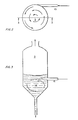
- the liquid stream will enter tangent to the cylindrical wall of the crystallizer body as shown in Figures 2 and 3 so as to form a turbulent vortex of slurry having sufficient surface area to permit the rapid disengagement of ammonia from the reaction mixture.
- the high velocity flow around the loop between the heat exchanger 8 and the crystallizer body maintains the cyanuric acid in suspension and ensures that any ammonia which may be entrained in the reaction mixture will be subject to a reduced absolute pressure of 20 to 53.3 kPa (150 - 400 mm Hg) every minute.
- inert solvent is vaporized as the reaction mixture enters the crystallizer. This volatilized solvent passes with the disengaged ammonia overhead to a condenser 7 where the solvent is condensed and returned to the crystallizer. The ammonia is vented from the condenser 7.
- Both the circulating loop between the heat exchanger and crystallizer body, as well as the crystallizer body itself, are insulated. This combined with the rapid circulation of the reaction mixture through the heat exchanger reduces temperature fluctuation throughout the reaction mixture so that the pyrolysis reaction proceeds at a constant temperature ( ⁇ 2°C) and uniform rate.
- the reaction temperature is maintained within the range of about 180°C to about 250°C the total residence time of the reaction mixture is between one and four and preferably between one and three hours based on the volumetric feed rate. It is preferred for optimum performance of the process that the reaction temperature be within the range of about 200°C to about 220°C, and that the absolute pressure within the crystallizer body be maintained between about 26.7 and 33.3 kPa (200 - 250 mm Hg).
- the circulating slurry of cyanuric acid is continuously removed at a constant rate and is transferred by the pump 11 to a separation zone 9 where the crystalline cyanuric acid is separated (by filtration or centrifugation) from the liquid reaction mixture.
- the cyanuric acid product may be dried and the separated liquid reaction mixture containing 1 % to 8 % unreacted urea and/or biuret is returned to the feed tank 4.
- Urea and additional solvents, as required, are continuously added to the feed tank.
- the reaction mixture from the feed tank 4 is added to the circulating slurry of cyanuric acid at the same rate that the cyanuric acid slurry is removed to the separator zone.
- the solution of urea enters the crystallizer body at a tangent to the cylindrical wall and beneath the surface of the liquid in the crystallizer, as is shown in Figures 2 and 3.
- the temperature of the circulating reaction mixture is maintained at 205°C by the heat input as it passes through the heat exchanger and the absolute pressure within the crystallizer body is 23.3 kPa (175 mm Hg).
- the cyanuric acid slurry withdrawn is pumped to a centrifuge 9 and the cyanuric acid separated by the centrifuge dried in the vacuum oven to give a product analyzing 0.55 % aminotriazine.
- the yield based upon urea conversion is 86 %.
- the liquid reaction mixture from the centrifuge is returned to the feed tank 4.
- Urea and sulfolane are added to the feed tank as required to maintain the concentration of urea and/or biuret in the solvent at 20 weight percent.
- biuret may be continuously pryolyzed to form cyanuric acid.
- Example 1 A laboratory scale version of the process described in Example 1 is performed with the temperature being held at 195°C and the absolute pressure above the liquid surface at 13.3 kPa (100 mm Hg). The concentration of urea in the feed is 30 weight percent. Cyanuric acid yields of 89 % were obtained with a two hour residence time. In a similar manner, good yields of cyanuric acid may be obtained at 180°C and 20 kPa (150 mm Hg) by increasing the residence time to three hours.
- Example 1 The process described in Example 1 above may be repeated except that the temperature of the circulating reaction mixture is maintained at 220°C, and the absolute pressure within the evaporative crystallizer body is maintained at 33.3 kPa (250 mm Hg). Cyanuric acid may be isolated in good yield as a white crystalline solid of large particle size (94 % retained on a 200 U.S. mesh screen, that is, 74 micrometers).
Landscapes
- Chemical & Material Sciences (AREA)
- Organic Chemistry (AREA)
- Organic Low-Molecular-Weight Compounds And Preparation Thereof (AREA)
Applications Claiming Priority (2)
| Application Number | Priority Date | Filing Date | Title |
|---|---|---|---|
| US162718 | 1980-06-25 | ||
| US06/162,718 US4294962A (en) | 1980-06-25 | 1980-06-25 | Continuous process for the manufacture of cyanuric acid |
Publications (3)
| Publication Number | Publication Date |
|---|---|
| EP0042760A1 EP0042760A1 (en) | 1981-12-30 |
| EP0042760B1 EP0042760B1 (en) | 1984-10-10 |
| EP0042760B2 true EP0042760B2 (en) | 1990-02-28 |
Family
ID=22586861
Family Applications (1)
| Application Number | Title | Priority Date | Filing Date |
|---|---|---|---|
| EP81302821A Expired EP0042760B2 (en) | 1980-06-25 | 1981-06-23 | Continuous process for the manufacture of cyanuric acid |
Country Status (7)
| Country | Link |
|---|---|
| US (1) | US4294962A (ja) |
| EP (1) | EP0042760B2 (ja) |
| JP (1) | JPS596307B2 (ja) |
| CA (1) | CA1141762A (ja) |
| DE (1) | DE3166580D1 (ja) |
| ES (1) | ES503357A0 (ja) |
| MX (1) | MX158761A (ja) |
Families Citing this family (3)
| Publication number | Priority date | Publication date | Assignee | Title |
|---|---|---|---|---|
| JPS6115401A (ja) * | 1984-06-30 | 1986-01-23 | Murata Mfg Co Ltd | 分布定数形フイルタ |
| US4567258A (en) * | 1985-04-18 | 1986-01-28 | Olin Corporation | Process and apparatus for producing cyanuric acid |
| CN118812397A (zh) * | 2024-07-30 | 2024-10-22 | 黔南民族师范学院 | 一种草酸脲合成方法 |
Family Cites Families (11)
| Publication number | Priority date | Publication date | Assignee | Title |
|---|---|---|---|---|
| US3065233A (en) * | 1962-11-20 | |||
| US3164591A (en) * | 1965-01-05 | Preparation of cyanuric acid | ||
| US3154545A (en) * | 1964-10-27 | Process for preparing cyanuric acid | ||
| US3236845A (en) * | 1963-04-26 | 1966-02-22 | Grace W R & Co | Production of cyanuric acid from urea |
| US3297697A (en) * | 1963-06-20 | 1967-01-10 | Nipak | Cyanuric acid production |
| DE1770827C3 (de) * | 1968-07-09 | 1975-02-06 | Basf Ag, 6700 Ludwigshafen | Verfahren zur Herstellung von Cyanursäure |
| US3563987A (en) * | 1969-04-01 | 1971-02-16 | Fmc Corp | Preparation of cyanuric acid |
| DE2300037A1 (de) * | 1973-01-02 | 1974-07-04 | Basf Ag | Verfahren zur kontinuierlichen herstellung von cyanursaeure |
| NL7405629A (nl) * | 1974-04-26 | 1975-10-28 | Stamicarbon | Werkwijze voor het bereiden van cyanuurzuur. |
| US4237285A (en) * | 1979-06-06 | 1980-12-02 | Olin Corporation | Process for the production of concentrated cyanuric acid slurries |
| US4303494A (en) * | 1979-08-06 | 1981-12-01 | Mobil Oil Corporation | Continuous reaction/separation method for nucleated growth reactions |
-
1980
- 1980-06-25 US US06/162,718 patent/US4294962A/en not_active Expired - Lifetime
-
1981
- 1981-06-17 CA CA000379956A patent/CA1141762A/en not_active Expired
- 1981-06-23 DE DE8181302821T patent/DE3166580D1/de not_active Expired
- 1981-06-23 EP EP81302821A patent/EP0042760B2/en not_active Expired
- 1981-06-24 MX MX187969A patent/MX158761A/es unknown
- 1981-06-25 JP JP56097626A patent/JPS596307B2/ja not_active Expired
- 1981-06-25 ES ES503357A patent/ES503357A0/es active Granted
Also Published As
| Publication number | Publication date |
|---|---|
| ES8205400A1 (es) | 1982-06-01 |
| EP0042760B1 (en) | 1984-10-10 |
| US4294962A (en) | 1981-10-13 |
| ES503357A0 (es) | 1982-06-01 |
| JPS5756471A (en) | 1982-04-05 |
| MX158761A (es) | 1989-03-13 |
| DE3166580D1 (en) | 1984-11-15 |
| EP0042760A1 (en) | 1981-12-30 |
| JPS596307B2 (ja) | 1984-02-10 |
| CA1141762A (en) | 1983-02-22 |
Similar Documents
| Publication | Publication Date | Title |
|---|---|---|
| JP5612488B2 (ja) | 尿素から高純度メラミンを製造する方法 | |
| US4026997A (en) | Process for the production of ammonium fluoride from fluosilicic acid | |
| PL142730B1 (en) | Method of manufacture of melamine | |
| US4196289A (en) | Process for producing triallyl isocyanurate | |
| SK6192001A3 (en) | Method for producing pure melamine | |
| EP0042760B2 (en) | Continuous process for the manufacture of cyanuric acid | |
| US4950805A (en) | Process for washing and obtaining solids of slurry | |
| CA1110660A (en) | Process for the manufacture of n,n,n',n'- tetraacetylethylenediamine | |
| US2755887A (en) | Melamine purification | |
| US3496176A (en) | Melamine purification | |
| US3590040A (en) | Process for continuous preparation of amino-chloro-s-triazines | |
| Meissner et al. | Continuous production of hexamethylenetetramine | |
| US2872447A (en) | Manufacture of cyanuric acid | |
| US3563987A (en) | Preparation of cyanuric acid | |
| US3057918A (en) | Production of biuret | |
| US4278794A (en) | Process for preparing pure cyanuric acid | |
| US3172886A (en) | Production of cyanuric acid from urea | |
| EP0075612A1 (en) | Process for trimerizing isocyanic acid to make cyanuric acid | |
| US3388533A (en) | Process for the preparationof melamine | |
| US3279885A (en) | Process of preparing ammonium dicyanamide | |
| WO2008009540A1 (en) | Process for preparing triallyl cyanurate | |
| US3296266A (en) | Purification of melamine | |
| US4288594A (en) | Caustic-free process for the production of monochloro-diamino-s-triazines | |
| US3297697A (en) | Cyanuric acid production | |
| US4282359A (en) | Purification of cyanuric acid |
Legal Events
| Date | Code | Title | Description |
|---|---|---|---|
| PUAI | Public reference made under article 153(3) epc to a published international application that has entered the european phase |
Free format text: ORIGINAL CODE: 0009012 |
|
| AK | Designated contracting states |
Designated state(s): BE DE FR GB IT NL |
|
| 17P | Request for examination filed |
Effective date: 19820602 |
|
| ITF | It: translation for a ep patent filed | ||
| GRAA | (expected) grant |
Free format text: ORIGINAL CODE: 0009210 |
|
| AK | Designated contracting states |
Designated state(s): BE DE FR GB IT NL |
|
| REF | Corresponds to: |
Ref document number: 3166580 Country of ref document: DE Date of ref document: 19841115 |
|
| BECH | Be: change of holder |
Free format text: 841010 *OLIN CORP. |
|
| ET | Fr: translation filed | ||
| PLBI | Opposition filed |
Free format text: ORIGINAL CODE: 0009260 |
|
| 26 | Opposition filed |
Opponent name: NAAMLOZE VENNOOTSCHAP DSM Effective date: 19850710 |
|
| NLR1 | Nl: opposition has been filed with the epo |
Opponent name: NAAMLOZE VENNOOTSCHAP DSM |
|
| REG | Reference to a national code |
Ref country code: GB Ref legal event code: 732 |
|
| NLS | Nl: assignments of ep-patents |
Owner name: OLIN CORPORATION TE STAMFORD, CONNECTICUT, VER. ST |
|
| REG | Reference to a national code |
Ref country code: FR Ref legal event code: TP |
|
| ITPR | It: changes in ownership of a european patent |
Owner name: CESSIONE;OLIN CORPORATION |
|
| PUAH | Patent maintained in amended form |
Free format text: ORIGINAL CODE: 0009272 |
|
| STAA | Information on the status of an ep patent application or granted ep patent |
Free format text: STATUS: PATENT MAINTAINED AS AMENDED |
|
| 27A | Patent maintained in amended form |
Effective date: 19900228 |
|
| AK | Designated contracting states |
Kind code of ref document: B2 Designated state(s): BE DE FR GB IT NL |
|
| ITF | It: translation for a ep patent filed | ||
| NLR2 | Nl: decision of opposition | ||
| ET3 | Fr: translation filed ** decision concerning opposition | ||
| NLR3 | Nl: receipt of modified translations in the netherlands language after an opposition procedure | ||
| REG | Reference to a national code |
Ref country code: FR Ref legal event code: TP |
|
| ITTA | It: last paid annual fee | ||
| PGFP | Annual fee paid to national office [announced via postgrant information from national office to epo] |
Ref country code: FR Payment date: 19950316 Year of fee payment: 15 |
|
| PGFP | Annual fee paid to national office [announced via postgrant information from national office to epo] |
Ref country code: GB Payment date: 19950324 Year of fee payment: 15 |
|
| PGFP | Annual fee paid to national office [announced via postgrant information from national office to epo] |
Ref country code: BE Payment date: 19950328 Year of fee payment: 15 |
|
| PGFP | Annual fee paid to national office [announced via postgrant information from national office to epo] |
Ref country code: NL Payment date: 19950418 Year of fee payment: 15 |
|
| PGFP | Annual fee paid to national office [announced via postgrant information from national office to epo] |
Ref country code: DE Payment date: 19950630 Year of fee payment: 15 |
|
| PG25 | Lapsed in a contracting state [announced via postgrant information from national office to epo] |
Ref country code: GB Effective date: 19960623 |
|
| PG25 | Lapsed in a contracting state [announced via postgrant information from national office to epo] |
Ref country code: BE Effective date: 19960630 |
|
| BERE | Be: lapsed |
Owner name: OLIN CORP. Effective date: 19960630 |
|
| PG25 | Lapsed in a contracting state [announced via postgrant information from national office to epo] |
Ref country code: NL Effective date: 19970101 |
|
| GBPC | Gb: european patent ceased through non-payment of renewal fee |
Effective date: 19960623 |
|
| PG25 | Lapsed in a contracting state [announced via postgrant information from national office to epo] |
Ref country code: FR Effective date: 19970228 |
|
| PG25 | Lapsed in a contracting state [announced via postgrant information from national office to epo] |
Ref country code: DE Effective date: 19970301 |
|
| NLV4 | Nl: lapsed or anulled due to non-payment of the annual fee |
Effective date: 19970101 |
|
| REG | Reference to a national code |
Ref country code: FR Ref legal event code: ST |