EP0035502B1 - A cloth snag repair tool - Google Patents
A cloth snag repair tool Download PDFInfo
- Publication number
- EP0035502B1 EP0035502B1 EP80901106A EP80901106A EP0035502B1 EP 0035502 B1 EP0035502 B1 EP 0035502B1 EP 80901106 A EP80901106 A EP 80901106A EP 80901106 A EP80901106 A EP 80901106A EP 0035502 B1 EP0035502 B1 EP 0035502B1
- Authority
- EP
- European Patent Office
- Prior art keywords
- cloth
- snag
- shaft
- repair tool
- surface section
- Prior art date
- Legal status (The legal status is an assumption and is not a legal conclusion. Google has not performed a legal analysis and makes no representation as to the accuracy of the status listed.)
- Expired
Links
- 239000004744 fabric Substances 0.000 title claims abstract description 61
- 230000035515 penetration Effects 0.000 claims abstract description 7
- 229910003460 diamond Inorganic materials 0.000 claims abstract description 3
- 239000010432 diamond Substances 0.000 claims abstract description 3
- 239000000835 fiber Substances 0.000 claims description 4
- 239000000463 material Substances 0.000 claims description 4
- CBECDWUDYQOTSW-UHFFFAOYSA-N 2-ethylbut-3-enal Chemical compound CCC(C=C)C=O CBECDWUDYQOTSW-UHFFFAOYSA-N 0.000 claims description 2
- QTBSBXVTEAMEQO-UHFFFAOYSA-M Acetate Chemical compound CC([O-])=O QTBSBXVTEAMEQO-UHFFFAOYSA-M 0.000 claims description 2
- JTHNLKXLWOXOQK-UHFFFAOYSA-N n-propyl vinyl ketone Natural products CCCC(=O)C=C JTHNLKXLWOXOQK-UHFFFAOYSA-N 0.000 claims description 2
- 239000002245 particle Substances 0.000 claims description 2
- 229920003023 plastic Polymers 0.000 claims description 2
- 239000004033 plastic Substances 0.000 claims description 2
- 239000011248 coating agent Substances 0.000 claims 2
- 238000000576 coating method Methods 0.000 claims 2
- 239000002184 metal Substances 0.000 description 7
- 229910052751 metal Inorganic materials 0.000 description 7
- 230000000149 penetrating effect Effects 0.000 description 6
- 229910001111 Fine metal Inorganic materials 0.000 description 2
- 239000002923 metal particle Substances 0.000 description 2
- 229910000831 Steel Inorganic materials 0.000 description 1
- 239000011230 binding agent Substances 0.000 description 1
- 230000005923 long-lasting effect Effects 0.000 description 1
- 239000006223 plastic coating Substances 0.000 description 1
- 238000005498 polishing Methods 0.000 description 1
- 238000004544 sputter deposition Methods 0.000 description 1
- 239000010959 steel Substances 0.000 description 1
- 230000007704 transition Effects 0.000 description 1
- UONOETXJSWQNOL-UHFFFAOYSA-N tungsten carbide Chemical compound [W+]#[C-] UONOETXJSWQNOL-UHFFFAOYSA-N 0.000 description 1
- 238000001771 vacuum deposition Methods 0.000 description 1
Images
Classifications
-
- A—HUMAN NECESSITIES
- A41—WEARING APPAREL
- A41H—APPLIANCES OR METHODS FOR MAKING CLOTHES, e.g. FOR DRESS-MAKING OR FOR TAILORING, NOT OTHERWISE PROVIDED FOR
- A41H31/00—Other aids for tailors
Definitions
- This invention relates to devices for repairing damaged cloth and more particularly to devices for removing snags from cloth items such as garments, curtains and upholstery.
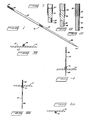
- the invention as illustrated in the drawings relates to a cloth snag repair tool that is generally designated with the numeral 10.
- the tool 10 is particularly useful in removing snags from clothing, upholstery and curtains. Other snagged cloth products also may be repaired utilizing such tool.
- a typical snag 16 is illustrated in Fig. 3 projecting from one side of the cloth 12.
- the front or right side of the cloth is designated with the numeral 13 and the back or wrong side of the cloth is designated with the numeral 14.
- the front or right side 13 generally projects outward from the wearer whereas the back or wrong side 14 generally projects toward the wearer.
- Snags such as that designated with the numeral 16 are comprised of cloth fibers that have been pulled from the normal plane of the cloth and project outward from the side 13.
- Figs. 3-6 illustrate the sequence of removing the snag 16 from the right or front side 13 and pulling the snag through the cloth utilizing the subject tool 10.
- the cloth snag repair tool 10 is formed of an elongated rigid shaft 20 that extends from a forward extremity 24 to a rear extremity 26.
- the maximum diameter of the shaft between the extremities is operable between 0.635 mm and 1.65 mm.
- the maximum diameter of the shaft 20, between the extremities is between 0.81 mm and 1.14 mm.
- the shaft 20 has a circular cross section and has a length of between 60.0 mm and 90.0 mm.
- the shaft 20 has a cloth penetrating surface section 28 beginning with the forward extremity 24 and extending rearward therefrom. It is important that the penetrating surface section 28 has low frictional surface characteristics sufficient to enable the penetrating surface section to be easily inserted through the cloth of the snag location without substantially disturbing the snag. Preferably, at least a portion of the cloth penetrating surface section 28 is tapered forming a pointed end with a progressively increasing diameter from the forward extremity 24.
- the shaft 20 further has a frictional surface section 30 intermediate the cloth penetrating surface 28 and the rear extremity 26. It is very important that the frictional surface section 30 has a high frictional surface characteristic sufficient to cause the section 30 to frictionally pull or draw the snag 16 through the cloth alongside the section 30 as illustrated in Fig. 5. Additionally the frictional characteristics of the surface section 30 are such that the section 30 does not tear, sever or break the cloth fibers, either those in the snag or those surrounding the shaft as the shaft is forced through the cloth. A fine balance must be obtained to achieve effective results. Because of the almost infinite varieties of cloth, it is a practical impossibility to determine a value of the coefficient of friction between the cloth and the surface section 30 as the section 30 passes through the cloth. The effective high frictional surface characteristic may be readily determined through modest experimentation.
- the frictional section 30 comprises a machine roughened surface 32 extending along a substantial portion of the length of the shaft 20. Applicant has found that excellent results are obtained by machine knurling a substantial portion of the shaft 20 to create a roughened high frictional surface 32.
- the machine knurled segment extends over more than twenty five percent (25%) of the length of the shaft 20. Preferably the knurled segment extends between one third and two thirds of the length of the shaft 20.
- the machine roughened surface 32 is formed by subjecting the secton 30 to an abrasive grinding machine capable of greatly increasing the frictional surface characteristics of an otherwise rather smooth surface.
- the shaft 20 is formed of hard metal such as steel.
- the desired low frictional surface characteristics of the section 28 is preferably obtained by polishing the hard metal shaft.
- the metal shaft 20 may be plated to obtain the effective low frictional surface characteristics.
- the roughened frictional surface 32 may be formed by metal bonding fine metal particles 34 (Fig. 7) onto an otherwise rather smooth metal surface to create effective high frictional surface characteristics.
- metal bonding may be achieved by vacuum deposition or electrode sputtering.
- Fine metal particles of tungsten carbide are preferred.
- metal or other abrasive small particles mounted in a binder may be adhered to the shaft 20 to form the roughened surface 32.
- the frictional surface section 30 has a smooth surface 36 formed of a high frictional characteristic material coated onto the shaft 20.
- a high frictional characteristic material coated onto the shaft 20.
- a multitude of formulated rigid plastic or rubber materials may be utilized having effective high frictional surface characteristics.
- a preferred rigid plastic coating material is vinyl butyral acetate.
- Fig. 6 illustrates the cloth with the snag removed from the front or right side 13.
- the tool 10 provides for a very effective means of easily removing snags in which the tool has an extremely long, if not indefinite, life. Users of the tool are particularly pleased that a garment snag may be removed while the garment is still being worn.
Landscapes
- Engineering & Computer Science (AREA)
- Textile Engineering (AREA)
- Treatment Of Fiber Materials (AREA)
- Woven Fabrics (AREA)
- Knitting Machines (AREA)
- Sewing Machines And Sewing (AREA)
Priority Applications (1)
| Application Number | Priority Date | Filing Date | Title |
|---|---|---|---|
| AT80901106T ATE9010T1 (de) | 1979-09-10 | 1980-05-08 | Werkzeug zum reparieren gezogener faeden im stoff. |
Applications Claiming Priority (2)
| Application Number | Priority Date | Filing Date | Title |
|---|---|---|---|
| US73998 | 1979-09-10 | ||
| US06/073,998 US4280641A (en) | 1979-09-10 | 1979-09-10 | Cloth snag repair tool |
Publications (3)
| Publication Number | Publication Date |
|---|---|
| EP0035502A1 EP0035502A1 (en) | 1981-09-16 |
| EP0035502A4 EP0035502A4 (en) | 1982-01-26 |
| EP0035502B1 true EP0035502B1 (en) | 1984-08-15 |
Family
ID=22117088
Family Applications (1)
| Application Number | Title | Priority Date | Filing Date |
|---|---|---|---|
| EP80901106A Expired EP0035502B1 (en) | 1979-09-10 | 1981-03-23 | A cloth snag repair tool |
Country Status (6)
| Country | Link |
|---|---|
| US (1) | US4280641A (index.php) |
| EP (1) | EP0035502B1 (index.php) |
| JP (1) | JPS6254905B2 (index.php) |
| CA (1) | CA1140510A (index.php) |
| DE (2) | DE8035125U1 (index.php) |
| WO (1) | WO1981000731A1 (index.php) |
Families Citing this family (10)
| Publication number | Priority date | Publication date | Assignee | Title |
|---|---|---|---|---|
| USD273347S (en) | 1981-01-26 | 1984-04-10 | Clover Mfg. Co., Ltd. | Crochet hook |
| USD270783S (en) | 1981-01-26 | 1983-10-04 | Clover Mfg. Co., Ltd. | Crochet hook |
| US4749111A (en) * | 1987-06-25 | 1988-06-07 | J. Evans Keller | Fabric sleeve inversion device |
| US7210603B2 (en) * | 2004-03-01 | 2007-05-01 | Gregory J. Smith | Glove inverter |
| US7874182B1 (en) * | 2009-01-28 | 2011-01-25 | Sandra Kay Lindahl | Crochet hook with ergonomic configuration |
| US7874181B1 (en) * | 2009-01-28 | 2011-01-25 | Sandra Kay Lindahl | Knitting needle with ergonomic configuration |
| US8561433B2 (en) * | 2010-11-10 | 2013-10-22 | Bonnie Lee Kellogg | Device and method for repairing a knitted article |
| CN103255596A (zh) * | 2013-05-30 | 2013-08-21 | 山东南山纺织服饰有限公司 | 一种精纺毛涤混纺织物吊经疵点的修补方法 |
| USD735470S1 (en) * | 2013-11-27 | 2015-08-04 | Knitpro International | Single pointed knitting needle |
| USD851907S1 (en) * | 2016-08-29 | 2019-06-25 | Nicole Lynn Hiza | Hand sewing needle having periodic markings |
Family Cites Families (12)
| Publication number | Priority date | Publication date | Assignee | Title |
|---|---|---|---|---|
| CA649469A (en) * | 1962-10-02 | Melville Marjorie | Marking needle | |
| US2364649A (en) * | 1944-12-12 | Cable needle for knitting | ||
| GB189402750A (en) * | 1894-02-08 | 1894-05-25 | Ernest Henry Norbury | Improvements in Lithographic Colour Printing, and in Preparations therefor. |
| US1012768A (en) * | 1910-10-20 | 1911-12-26 | Joseph Anthony Vogelmann | Needle. |
| GB191029032A (en) * | 1910-12-14 | 1911-11-02 | Sarah Garth Wicking | Improvements in Pins and the like. |
| GB191129032A (en) * | 1911-12-23 | 1912-12-19 | Rose Brothers Ltd | Improvements in Apparatus for Capping Bottles and the like. |
| US1793225A (en) * | 1929-03-27 | 1931-02-17 | Stelos Company Inc | Method of mending |
| DE1485382A1 (index.php) * | 1964-04-29 | 1969-09-25 | ||
| US3404707A (en) * | 1966-06-29 | 1968-10-08 | Henry Heckmann | Thread pulling needle devices |
| US3542632A (en) * | 1969-02-28 | 1970-11-24 | Standard Oil Co | Fibrillated fabrics and a process for the preparation thereof |
| CH557913A (de) * | 1972-11-02 | 1975-01-15 | Huser Josef Paul | Fadenziehvorrichtung. |
| US3916645A (en) * | 1973-10-26 | 1975-11-04 | David D Hart | Device for repairing snagged knitwear fabrics |
-
1979
- 1979-09-10 US US06/073,998 patent/US4280641A/en not_active Expired - Lifetime
-
1980
- 1980-05-08 JP JP55501305A patent/JPS6254905B2/ja not_active Expired
- 1980-05-08 DE DE19808035125U patent/DE8035125U1/de not_active Expired
- 1980-05-08 DE DE8080901106T patent/DE3068943D1/de not_active Expired
- 1980-05-08 WO PCT/US1980/000535 patent/WO1981000731A1/en not_active Ceased
- 1980-09-04 CA CA000359514A patent/CA1140510A/en not_active Expired
-
1981
- 1981-03-23 EP EP80901106A patent/EP0035502B1/en not_active Expired
Also Published As
| Publication number | Publication date |
|---|---|
| WO1981000731A1 (en) | 1981-03-19 |
| US4280641A (en) | 1981-07-28 |
| JPS56501094A (index.php) | 1981-08-06 |
| EP0035502A4 (en) | 1982-01-26 |
| EP0035502A1 (en) | 1981-09-16 |
| CA1140510A (en) | 1983-02-01 |
| JPS6254905B2 (index.php) | 1987-11-17 |
| DE3068943D1 (en) | 1984-09-20 |
| DE8035125U1 (de) | 1982-12-09 |
Similar Documents
| Publication | Publication Date | Title |
|---|---|---|
| EP0035502B1 (en) | A cloth snag repair tool | |
| US3990619A (en) | Fastener attachment needle | |
| EP0652023A3 (en) | Catheter needle having surface indication thereon and process for forming such catheter. | |
| US2507174A (en) | Band type knitting needle | |
| US1907370A (en) | Vacuum cleaner | |
| US3154229A (en) | Tufting needle | |
| US2608698A (en) | Burling tool | |
| US3674187A (en) | Method of forming a ruffle or the like | |
| US1810363A (en) | Pulleb | |
| TW202009343A (zh) | 可撕式布餐墊的製作方法 | |
| US2789287A (en) | Drapery hook inserter | |
| CN107923090A (zh) | 改善的针织用针以及用于制造圆形针织用针的方法 | |
| CN113005571B (zh) | 一种用于梳理含金属丝面料的弹性起毛针布 | |
| US3566452A (en) | Button holder | |
| US1611878A (en) | Rug needle | |
| CN209162383U (zh) | 一种具有回吸线环功能的缝纫机 | |
| US2774978A (en) | Cutting attachment for sewing thimble | |
| US3006518A (en) | Needle threaders | |
| JP4597309B2 (ja) | 織ラベルおよびラベル加工方法 | |
| JPH10110377A (ja) | 織編物およびその製造方法 | |
| US2382852A (en) | Stand hook | |
| CN217170038U (zh) | 一种防脱散的针织布 | |
| JPH11235209A (ja) | 接着用テープ及びその製造方法 | |
| CN215283752U (zh) | 一种羊毛针织卫衣面料 | |
| JPH08158238A (ja) | タフティング装置用中空針 |
Legal Events
| Date | Code | Title | Description |
|---|---|---|---|
| PUAI | Public reference made under article 153(3) epc to a published international application that has entered the european phase |
Free format text: ORIGINAL CODE: 0009012 |
|
| 17P | Request for examination filed |
Effective date: 19810423 |
|
| AK | Designated contracting states |
Designated state(s): AT CH DE FR GB SE |
|
| GRAA | (expected) grant |
Free format text: ORIGINAL CODE: 0009210 |
|
| AK | Designated contracting states |
Designated state(s): AT CH DE FR GB LI SE |
|
| PG25 | Lapsed in a contracting state [announced via postgrant information from national office to epo] |
Ref country code: SE Effective date: 19840815 Ref country code: LI Effective date: 19840815 Ref country code: CH Effective date: 19840815 Ref country code: AT Effective date: 19840815 |
|
| REF | Corresponds to: |
Ref document number: 9010 Country of ref document: AT Date of ref document: 19840915 Kind code of ref document: T |
|
| REF | Corresponds to: |
Ref document number: 3068943 Country of ref document: DE Date of ref document: 19840920 |
|
| ET | Fr: translation filed | ||
| REG | Reference to a national code |
Ref country code: CH Ref legal event code: PL |
|
| PLBE | No opposition filed within time limit |
Free format text: ORIGINAL CODE: 0009261 |
|
| STAA | Information on the status of an ep patent application or granted ep patent |
Free format text: STATUS: NO OPPOSITION FILED WITHIN TIME LIMIT |
|
| 26N | No opposition filed | ||
| PG25 | Lapsed in a contracting state [announced via postgrant information from national office to epo] |
Ref country code: GB Effective date: 19880508 |
|
| PG25 | Lapsed in a contracting state [announced via postgrant information from national office to epo] |
Ref country code: FR Free format text: LAPSE BECAUSE OF NON-PAYMENT OF DUE FEES Effective date: 19890131 |
|
| GBPC | Gb: european patent ceased through non-payment of renewal fee | ||
| PG25 | Lapsed in a contracting state [announced via postgrant information from national office to epo] |
Ref country code: DE Effective date: 19890201 |
|
| REG | Reference to a national code |
Ref country code: FR Ref legal event code: ST |