EP0033397B1 - Procédé de préparation de biocatalyseurs poreux, mécaniquement et chimiquement stables, à haute activité enzymatique - Google Patents
Procédé de préparation de biocatalyseurs poreux, mécaniquement et chimiquement stables, à haute activité enzymatique Download PDFInfo
- Publication number
- EP0033397B1 EP0033397B1 EP80200089A EP80200089A EP0033397B1 EP 0033397 B1 EP0033397 B1 EP 0033397B1 EP 80200089 A EP80200089 A EP 80200089A EP 80200089 A EP80200089 A EP 80200089A EP 0033397 B1 EP0033397 B1 EP 0033397B1
- Authority
- EP
- European Patent Office
- Prior art keywords
- stage
- mixture
- weight
- solution
- beads
- Prior art date
- Legal status (The legal status is an assumption and is not a legal conclusion. Google has not performed a legal analysis and makes no representation as to the accuracy of the status listed.)
- Expired
Links
- 108090000790 Enzymes Proteins 0.000 title claims abstract description 56
- 102000004190 Enzymes Human genes 0.000 title claims abstract description 56
- 239000011942 biocatalyst Substances 0.000 title claims abstract description 46
- 230000002255 enzymatic effect Effects 0.000 title claims abstract description 12
- 238000004519 manufacturing process Methods 0.000 title claims abstract description 11
- 239000011324 bead Substances 0.000 claims abstract description 68
- 239000003054 catalyst Substances 0.000 claims abstract description 56
- 239000000203 mixture Substances 0.000 claims abstract description 31
- 239000002245 particle Substances 0.000 claims abstract description 23
- 229920000867 polyelectrolyte Polymers 0.000 claims abstract description 20
- 238000001556 precipitation Methods 0.000 claims abstract description 17
- 239000002028 Biomass Substances 0.000 claims abstract description 16
- 238000001035 drying Methods 0.000 claims abstract description 16
- 239000013543 active substance Substances 0.000 claims abstract description 14
- 229920000642 polymer Polymers 0.000 claims abstract description 14
- 239000007864 aqueous solution Substances 0.000 claims abstract description 10
- 150000001875 compounds Chemical class 0.000 claims abstract description 7
- 238000004132 cross linking Methods 0.000 claims abstract description 7
- 150000002500 ions Chemical class 0.000 claims abstract description 7
- 239000000126 substance Substances 0.000 claims abstract description 7
- 238000005406 washing Methods 0.000 claims abstract description 6
- XLYOFNOQVPJJNP-UHFFFAOYSA-N water Substances O XLYOFNOQVPJJNP-UHFFFAOYSA-N 0.000 claims abstract description 6
- 238000002347 injection Methods 0.000 claims abstract description 4
- 239000007924 injection Substances 0.000 claims abstract description 4
- 230000008602 contraction Effects 0.000 claims abstract 3
- 238000007711 solidification Methods 0.000 claims abstract 3
- 230000008023 solidification Effects 0.000 claims abstract 3
- 238000007599 discharging Methods 0.000 claims abstract 2
- 239000012266 salt solution Substances 0.000 claims abstract 2
- 238000000034 method Methods 0.000 claims description 48
- 239000000243 solution Substances 0.000 claims description 44
- 229920000615 alginic acid Polymers 0.000 claims description 25
- 229940072056 alginate Drugs 0.000 claims description 23
- FHVDTGUDJYJELY-UHFFFAOYSA-N 6-{[2-carboxy-4,5-dihydroxy-6-(phosphanyloxy)oxan-3-yl]oxy}-4,5-dihydroxy-3-phosphanyloxane-2-carboxylic acid Chemical compound O1C(C(O)=O)C(P)C(O)C(O)C1OC1C(C(O)=O)OC(OP)C(O)C1O FHVDTGUDJYJELY-UHFFFAOYSA-N 0.000 claims description 18
- 235000010443 alginic acid Nutrition 0.000 claims description 18
- 239000004593 Epoxy Substances 0.000 claims description 11
- 238000003756 stirring Methods 0.000 claims description 10
- 239000003792 electrolyte Substances 0.000 claims description 7
- 239000003822 epoxy resin Substances 0.000 claims description 7
- 229920000647 polyepoxide Polymers 0.000 claims description 7
- 238000006068 polycondensation reaction Methods 0.000 claims description 6
- 229920002134 Carboxymethyl cellulose Polymers 0.000 claims description 4
- 235000010948 carboxy methyl cellulose Nutrition 0.000 claims description 4
- 239000007787 solid Substances 0.000 claims description 4
- 239000001768 carboxy methyl cellulose Substances 0.000 claims description 3
- 239000008112 carboxymethyl-cellulose Substances 0.000 claims description 3
- 230000000737 periodic effect Effects 0.000 claims description 2
- UXVMQQNJUSDDNG-UHFFFAOYSA-L Calcium chloride Chemical compound [Cl-].[Cl-].[Ca+2] UXVMQQNJUSDDNG-UHFFFAOYSA-L 0.000 claims 2
- 229910000329 aluminium sulfate Inorganic materials 0.000 claims 2
- DIZPMCHEQGEION-UHFFFAOYSA-H aluminium sulfate (anhydrous) Chemical compound [Al+3].[Al+3].[O-]S([O-])(=O)=O.[O-]S([O-])(=O)=O.[O-]S([O-])(=O)=O DIZPMCHEQGEION-UHFFFAOYSA-H 0.000 claims 2
- 229920001448 anionic polyelectrolyte Polymers 0.000 claims 2
- 239000001110 calcium chloride Substances 0.000 claims 2
- 229910001628 calcium chloride Inorganic materials 0.000 claims 2
- VCJMYUPGQJHHFU-UHFFFAOYSA-N iron(III) nitrate Inorganic materials [Fe+3].[O-][N+]([O-])=O.[O-][N+]([O-])=O.[O-][N+]([O-])=O VCJMYUPGQJHHFU-UHFFFAOYSA-N 0.000 claims 2
- 229920005615 natural polymer Polymers 0.000 claims 2
- 150000003839 salts Chemical class 0.000 claims 2
- IISBACLAFKSPIT-UHFFFAOYSA-N bisphenol A Chemical class C=1C=C(O)C=CC=1C(C)(C)C1=CC=C(O)C=C1 IISBACLAFKSPIT-UHFFFAOYSA-N 0.000 claims 1
- 238000007385 chemical modification Methods 0.000 claims 1
- 150000008040 ionic compounds Chemical class 0.000 claims 1
- 125000002924 primary amino group Chemical group [H]N([H])* 0.000 claims 1
- 230000008569 process Effects 0.000 description 20
- 210000004027 cell Anatomy 0.000 description 19
- 238000011068 loading method Methods 0.000 description 13
- JGSARLDLIJGVTE-MBNYWOFBSA-N Penicillin G Chemical compound N([C@H]1[C@H]2SC([C@@H](N2C1=O)C(O)=O)(C)C)C(=O)CC1=CC=CC=C1 JGSARLDLIJGVTE-MBNYWOFBSA-N 0.000 description 11
- 239000000499 gel Substances 0.000 description 11
- 239000011049 pearl Substances 0.000 description 11
- FAPWRFPIFSIZLT-UHFFFAOYSA-M Sodium chloride Chemical compound [Na+].[Cl-] FAPWRFPIFSIZLT-UHFFFAOYSA-M 0.000 description 10
- 230000000694 effects Effects 0.000 description 10
- 241000588724 Escherichia coli Species 0.000 description 9
- 238000006243 chemical reaction Methods 0.000 description 7
- 229920002401 polyacrylamide Polymers 0.000 description 7
- 230000008901 benefit Effects 0.000 description 6
- 230000001057 ionotropic effect Effects 0.000 description 6
- 244000005700 microbiome Species 0.000 description 6
- 238000012360 testing method Methods 0.000 description 6
- PPBRXRYQALVLMV-UHFFFAOYSA-N Styrene Chemical compound C=CC1=CC=CC=C1 PPBRXRYQALVLMV-UHFFFAOYSA-N 0.000 description 5
- 239000011159 matrix material Substances 0.000 description 5
- 229940056360 penicillin g Drugs 0.000 description 5
- 102000008186 Collagen Human genes 0.000 description 4
- 108010035532 Collagen Proteins 0.000 description 4
- WQZGKKKJIJFFOK-GASJEMHNSA-N Glucose Natural products OC[C@H]1OC(O)[C@H](O)[C@@H](O)[C@@H]1O WQZGKKKJIJFFOK-GASJEMHNSA-N 0.000 description 4
- 230000015572 biosynthetic process Effects 0.000 description 4
- 229920001436 collagen Polymers 0.000 description 4
- 239000000835 fiber Substances 0.000 description 4
- 239000008103 glucose Substances 0.000 description 4
- 230000007774 longterm Effects 0.000 description 4
- 239000000463 material Substances 0.000 description 4
- 239000004848 polyfunctional curative Substances 0.000 description 4
- 239000000047 product Substances 0.000 description 4
- 239000011347 resin Substances 0.000 description 4
- 229920005989 resin Polymers 0.000 description 4
- 239000011780 sodium chloride Substances 0.000 description 4
- MYRTYDVEIRVNKP-UHFFFAOYSA-N 1,2-Divinylbenzene Chemical compound C=CC1=CC=CC=C1C=C MYRTYDVEIRVNKP-UHFFFAOYSA-N 0.000 description 3
- 229920002284 Cellulose triacetate Polymers 0.000 description 3
- YMWUJEATGCHHMB-UHFFFAOYSA-N Dichloromethane Chemical compound ClCCl YMWUJEATGCHHMB-UHFFFAOYSA-N 0.000 description 3
- LFQSCWFLJHTTHZ-UHFFFAOYSA-N Ethanol Chemical compound CCO LFQSCWFLJHTTHZ-UHFFFAOYSA-N 0.000 description 3
- 108010073038 Penicillin Amidase Proteins 0.000 description 3
- -1 Polymethacrylamid Polymers 0.000 description 3
- 240000004808 Saccharomyces cerevisiae Species 0.000 description 3
- YXFVVABEGXRONW-UHFFFAOYSA-N Toluene Chemical compound CC1=CC=CC=C1 YXFVVABEGXRONW-UHFFFAOYSA-N 0.000 description 3
- NNLVGZFZQQXQNW-ADJNRHBOSA-N [(2r,3r,4s,5r,6s)-4,5-diacetyloxy-3-[(2s,3r,4s,5r,6r)-3,4,5-triacetyloxy-6-(acetyloxymethyl)oxan-2-yl]oxy-6-[(2r,3r,4s,5r,6s)-4,5,6-triacetyloxy-2-(acetyloxymethyl)oxan-3-yl]oxyoxan-2-yl]methyl acetate Chemical compound O([C@@H]1O[C@@H]([C@H]([C@H](OC(C)=O)[C@H]1OC(C)=O)O[C@H]1[C@@H]([C@@H](OC(C)=O)[C@H](OC(C)=O)[C@@H](COC(C)=O)O1)OC(C)=O)COC(=O)C)[C@@H]1[C@@H](COC(C)=O)O[C@@H](OC(C)=O)[C@H](OC(C)=O)[C@H]1OC(C)=O NNLVGZFZQQXQNW-ADJNRHBOSA-N 0.000 description 3
- 238000005299 abrasion Methods 0.000 description 3
- 229920001577 copolymer Polymers 0.000 description 3
- 230000007423 decrease Effects 0.000 description 3
- 238000010586 diagram Methods 0.000 description 3
- 230000000813 microbial effect Effects 0.000 description 3
- 231100000252 nontoxic Toxicity 0.000 description 3
- 230000003000 nontoxic effect Effects 0.000 description 3
- 238000006116 polymerization reaction Methods 0.000 description 3
- 230000008961 swelling Effects 0.000 description 3
- BJEPYKJPYRNKOW-REOHCLBHSA-N (S)-malic acid Chemical compound OC(=O)[C@@H](O)CC(O)=O BJEPYKJPYRNKOW-REOHCLBHSA-N 0.000 description 2
- NGHVIOIJCVXTGV-ALEPSDHESA-N 6-aminopenicillanic acid Chemical compound [O-]C(=O)[C@H]1C(C)(C)S[C@@H]2[C@H]([NH3+])C(=O)N21 NGHVIOIJCVXTGV-ALEPSDHESA-N 0.000 description 2
- 229920001817 Agar Polymers 0.000 description 2
- 229930091371 Fructose Natural products 0.000 description 2
- RFSUNEUAIZKAJO-ARQDHWQXSA-N Fructose Chemical compound OC[C@H]1O[C@](O)(CO)[C@@H](O)[C@@H]1O RFSUNEUAIZKAJO-ARQDHWQXSA-N 0.000 description 2
- 239000005715 Fructose Substances 0.000 description 2
- 108010036781 Fumarate Hydratase Proteins 0.000 description 2
- 102100036160 Fumarate hydratase, mitochondrial Human genes 0.000 description 2
- 210000000712 G cell Anatomy 0.000 description 2
- OFOBLEOULBTSOW-UHFFFAOYSA-N Propanedioic acid Natural products OC(=O)CC(O)=O OFOBLEOULBTSOW-UHFFFAOYSA-N 0.000 description 2
- 239000008272 agar Substances 0.000 description 2
- 229920001525 carrageenan Polymers 0.000 description 2
- 239000003795 chemical substances by application Substances 0.000 description 2
- 238000009833 condensation Methods 0.000 description 2
- 230000005494 condensation Effects 0.000 description 2
- 238000009792 diffusion process Methods 0.000 description 2
- 239000012634 fragment Substances 0.000 description 2
- 230000005764 inhibitory process Effects 0.000 description 2
- 238000011835 investigation Methods 0.000 description 2
- 239000003456 ion exchange resin Substances 0.000 description 2
- 229920003303 ion-exchange polymer Polymers 0.000 description 2
- 239000011976 maleic acid Substances 0.000 description 2
- 238000000691 measurement method Methods 0.000 description 2
- 239000008055 phosphate buffer solution Substances 0.000 description 2
- 239000002904 solvent Substances 0.000 description 2
- 231100000331 toxic Toxicity 0.000 description 2
- 230000002588 toxic effect Effects 0.000 description 2
- VZCYOOQTPOCHFL-UHFFFAOYSA-N trans-butenedioic acid Natural products OC(=O)C=CC(O)=O VZCYOOQTPOCHFL-UHFFFAOYSA-N 0.000 description 2
- CHRJZRDFSQHIFI-UHFFFAOYSA-N 1,2-bis(ethenyl)benzene;styrene Chemical compound C=CC1=CC=CC=C1.C=CC1=CC=CC=C1C=C CHRJZRDFSQHIFI-UHFFFAOYSA-N 0.000 description 1
- NGHVIOIJCVXTGV-UHFFFAOYSA-N 6beta-amino-penicillanic acid Natural products OC(=O)C1C(C)(C)SC2C(N)C(=O)N21 NGHVIOIJCVXTGV-UHFFFAOYSA-N 0.000 description 1
- 239000001729 Ammonium fumarate Substances 0.000 description 1
- 241000186145 Corynebacterium ammoniagenes Species 0.000 description 1
- 239000004971 Cross linker Substances 0.000 description 1
- CKLJMWTZIZZHCS-UHFFFAOYSA-N D-OH-Asp Natural products OC(=O)C(N)CC(O)=O CKLJMWTZIZZHCS-UHFFFAOYSA-N 0.000 description 1
- 241000282326 Felis catus Species 0.000 description 1
- 108010073178 Glucan 1,4-alpha-Glucosidase Proteins 0.000 description 1
- SXRSQZLOMIGNAQ-UHFFFAOYSA-N Glutaraldehyde Chemical compound O=CCCCC=O SXRSQZLOMIGNAQ-UHFFFAOYSA-N 0.000 description 1
- 206010061217 Infestation Diseases 0.000 description 1
- CKLJMWTZIZZHCS-UWTATZPHSA-N L-Aspartic acid Natural products OC(=O)[C@H](N)CC(O)=O CKLJMWTZIZZHCS-UWTATZPHSA-N 0.000 description 1
- CKLJMWTZIZZHCS-REOHCLBHSA-N L-aspartic acid Chemical compound OC(=O)[C@@H](N)CC(O)=O CKLJMWTZIZZHCS-REOHCLBHSA-N 0.000 description 1
- 229930182555 Penicillin Natural products 0.000 description 1
- 108700040099 Xylose isomerases Proteins 0.000 description 1
- 230000002378 acidificating effect Effects 0.000 description 1
- BJEPYKJPYRNKOW-UHFFFAOYSA-N alpha-hydroxysuccinic acid Natural products OC(=O)C(O)CC(O)=O BJEPYKJPYRNKOW-UHFFFAOYSA-N 0.000 description 1
- 235000019297 ammonium fumarate Nutrition 0.000 description 1
- 239000012736 aqueous medium Substances 0.000 description 1
- 229960005261 aspartic acid Drugs 0.000 description 1
- CKKXWJDFFQPBQL-SEPHDYHBSA-N azane;(e)-but-2-enedioic acid Chemical compound N.N.OC(=O)\C=C\C(O)=O CKKXWJDFFQPBQL-SEPHDYHBSA-N 0.000 description 1
- 239000006227 byproduct Substances 0.000 description 1
- 239000000969 carrier Substances 0.000 description 1
- 239000012876 carrier material Substances 0.000 description 1
- 230000015556 catabolic process Effects 0.000 description 1
- 230000003197 catalytic effect Effects 0.000 description 1
- 150000001768 cations Chemical class 0.000 description 1
- 229920006184 cellulose methylcellulose Polymers 0.000 description 1
- 230000008859 change Effects 0.000 description 1
- 239000000084 colloidal system Substances 0.000 description 1
- 238000010924 continuous production Methods 0.000 description 1
- 230000006378 damage Effects 0.000 description 1
- 238000011038 discontinuous diafiltration by volume reduction Methods 0.000 description 1
- 238000005516 engineering process Methods 0.000 description 1
- 238000006911 enzymatic reaction Methods 0.000 description 1
- 150000002118 epoxides Chemical class 0.000 description 1
- 230000007717 exclusion Effects 0.000 description 1
- 238000002474 experimental method Methods 0.000 description 1
- 238000000605 extraction Methods 0.000 description 1
- 230000009969 flowable effect Effects 0.000 description 1
- 239000008187 granular material Substances 0.000 description 1
- 238000000227 grinding Methods 0.000 description 1
- 230000002779 inactivation Effects 0.000 description 1
- 238000009776 industrial production Methods 0.000 description 1
- 230000001788 irregular Effects 0.000 description 1
- 229940116298 l- malic acid Drugs 0.000 description 1
- VZCYOOQTPOCHFL-UPHRSURJSA-N maleic acid Chemical compound OC(=O)\C=C/C(O)=O VZCYOOQTPOCHFL-UPHRSURJSA-N 0.000 description 1
- 235000011090 malic acid Nutrition 0.000 description 1
- 238000005259 measurement Methods 0.000 description 1
- 229940049954 penicillin Drugs 0.000 description 1
- 239000008363 phosphate buffer Substances 0.000 description 1
- 230000001766 physiological effect Effects 0.000 description 1
- 229930010796 primary metabolite Natural products 0.000 description 1
- 238000012545 processing Methods 0.000 description 1
- 230000001681 protective effect Effects 0.000 description 1
- 230000009257 reactivity Effects 0.000 description 1
- 230000003252 repetitive effect Effects 0.000 description 1
- 238000011160 research Methods 0.000 description 1
- 230000002441 reversible effect Effects 0.000 description 1
- 238000001878 scanning electron micrograph Methods 0.000 description 1
- 229930000044 secondary metabolite Natural products 0.000 description 1
- FCPVYOBCFFNJFS-UHFFFAOYSA-N sodium;3,3-dimethyl-7-oxo-6-[(2-phenylacetyl)amino]-4-thia-1-azabicyclo[3.2.0]heptane-2-carboxylic acid Chemical compound [Na+].O=C1N2C(C(O)=O)C(C)(C)SC2C1NC(=O)CC1=CC=CC=C1 FCPVYOBCFFNJFS-UHFFFAOYSA-N 0.000 description 1
- 239000007858 starting material Substances 0.000 description 1
- 239000000758 substrate Substances 0.000 description 1
- 239000003440 toxic substance Substances 0.000 description 1
- 238000002166 wet spinning Methods 0.000 description 1
Images
Classifications
-
- C—CHEMISTRY; METALLURGY
- C12—BIOCHEMISTRY; BEER; SPIRITS; WINE; VINEGAR; MICROBIOLOGY; ENZYMOLOGY; MUTATION OR GENETIC ENGINEERING
- C12N—MICROORGANISMS OR ENZYMES; COMPOSITIONS THEREOF; PROPAGATING, PRESERVING, OR MAINTAINING MICROORGANISMS; MUTATION OR GENETIC ENGINEERING; CULTURE MEDIA
- C12N11/00—Carrier-bound or immobilised enzymes; Carrier-bound or immobilised microbial cells; Preparation thereof
- C12N11/02—Enzymes or microbial cells immobilised on or in an organic carrier
- C12N11/04—Enzymes or microbial cells immobilised on or in an organic carrier entrapped within the carrier, e.g. gel or hollow fibres
Definitions
- biocatalyst in technical microbiology and in “microbial engineering” is understood to mean a biological system composed of whole-cell microorganisms or enzymes fixed by means of a macroscopic carrier. More recently, the use of fixed microorganisms as a biocatalyst has been preferred for reasons of manufacturing costs and the flexibility of the manufacturing process, particularly from the standpoint of multi-enzyme reactions.
- this type of catalyst has the restriction that it is hardly possible to use it in a fixed bed reactor because of the not very high mechanical strength.
- the production of the cellulose triacetate catalyst using a wet spinning process using highly toxic solvents such as toluene or methylene chloride is a fixation method that is only suitable for a few microorganisms.
- the fiber shape dictates the one-sided use of the catalytic converter in fixed bed reactors.
- the production of the collagen catalysts is very complex. Its use is limited to the spiral reactor because of its menebran shape. The toxic step of curing with glutardialdehyde is indispensable.
- the loads to be achieved are too low, so that only an unfavorable space-time yield can be achieved.
- One of the best known methods uses physical inclusion in a polymer network.
- Examples are: polyacrylamide / polymethacrylamide, collagen, cellulose triacetate, ionotropic gels.
- ionotropic gels is a process which, in contrast to the polyacrylamide or polymethacrylamide gels, is used with practically non-toxic substances, such as, for example, B. with alginate, Ca 2+ .
- the object of the patent application is to provide biocatalyst beads with high compressive strength (pond / bead) and high loading of enzymatically active substance (in grams of enzymatically active substance per gram of catalyst beads) in the form of catalyst beads by polymer inclusion of biomass.
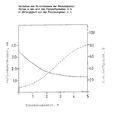
- the diameter of the biocatalyst beads decreases rapidly up to a drying time of 2 hours and then changes into a flat curve for up to 5 hours and thus a slower decrease in the diameter.
- the increase in the solids content shows a flat turning point after 1 and 4 h and runs in between with an almost uniform gradient.
- the increase in the solids content can be described as fairly regular.
- Examples 1-3 relate to claims 1-6 and examples 4-5 relate to claims 7-14.
- mixture (A) by suspending 150 g press yeast, which was made up to 150 ml with water, as an enzymatically active substance (A 1 ) in 450 ml of an 8% by weight Na alginate solution as an aqueous solution of a polyelectrolyte.
- a 0.2 molar CaCl 2 solution is used as the precipitation bath (B) with a compound which contains polyvalent ions which are charged opposite to the polyelectrolyte of the mixture (A).
- step 1 the mixture (A) is then added dropwise to the mixture (B) by means of a capillary with a diameter of 0.4 mm. Pearl-shaped particles with a diameter of 4 mm are formed. These are solidified with further stirring with a residence time of 15 min.
- stage 2 the catalyst beads formed are then filtered off with the enclosed, enzymatically active substance and washed with physiological NaCl solution.
- stage 3 the catalyst beads are then subjected to gentle drying by passing air over them at a temperature of 30 ° C. in a drying cabinet for 20 hours. This causes the catalyst beads to shrink and solidify.
- the relative shrinkage compared to the state before drying is about 2 / 5th.
- the catalyst beads are cured by introduction into the precipitation bath (C) from an Al 2 (SO 4 ) 3 solution having a concentration of 0.1 mol / l in 30 min.
- stage 5 the catalyst beads are subjected to a washing process with physiological NaCl solution and carried out in the moist state.
- the catalyst beads of this example have a loading of enzymatically active substance of 0.88 g press yeast per g biocatalyst.
- the breaking point is 750 p / pearl.
- Mixture (A) is first prepared.
- 100 g of E. coli ATCC 11105 (in the form of the centrifuge-moist mass) are made up to a total of 150 ml in water and suspended in 450 ml of an 8% by weight aqueous Na alginate solution as a polyelectrolyte. Otherwise, the procedure is as in Example 1.
- 165 ml of biocatalyst beads are obtained from 600 ml of starting solution (A). This results in a loading with bio-moist mass (BFM) of 0.6 g BFM / ml bio-catalyst.
- the compressive strength is 800 p / pearl.
- the mixture (A) is first prepared by dissolving 100 mg of amyloglucosidase (A 1 ) in 10 ml of an 8% aqueous Na alginate solution. A 0.5 molar CaCl 2 solution is used as the precipitation bath (B) with a compound which contains polyvalent ions which are charged opposite to the polyelectrolyte of the mixture (A).
- step 1 the mixture (A) from a capillary with a diameter of 0.4 mm is then dripped into the mixture (B) with stirring, resulting in pearl-shaped particles with a diameter of 4 mm. These are solidified with further stirring with a residence time of 15 min.
- stage 2 the catalyst beads formed are filtered off with the enclosed enzymatically active substance and washed with physiological NaCl solution.
- the catalyst beads are then dried in stage 3 of gentle drying by passing air over at a temperature of 30 ° C. for 20 hours. With this measure, the catalyst beads shrink and solidify. With a diameter of 1.5 mm now, the relative shrinkage is about 2 / 5th.
- the catalyst beads are cured by introduction into the precipitation bath (C), consisting of a 0.1 molar Al 2 (SO 4 ) 3 solution, over a period of 30 min.
- the precipitation bath (C) consisting of a 0.1 molar Al 2 (SO 4 ) 3 solution
- the catalyst beads are subjected to a washing process with physiological NaCl solution and carried out in a moist state.
- the biocatalyst beads In the final state, the biocatalyst beads have a diameter of 1.8 mm, which, according to the quantity balance, results in a loading of 32 mg enzyme / ml biocatalyst.
- the compressive strength test gives a strength of 780 p / pearl.
- the measurement method for determining the compressive strength is described below.
- the mechanical part of the test set-up consists of a firmly clamped test table, a ram arranged above it, which is rigidly connected to a force transducer (Hottinger Baldwin Messtechnik, Darmstadt; force transducer U 1 / I kpond) and a drive unit made up of a motor and gearbox.
- the signal from the force transducer is amplified in a measuring amplifier, type KWS 3072 (from HBM, Darmstadt) and sent to a recorder.
- one ball is placed on the sample table.
- the plunger then presses on the catalyst grain at a feed rate of 1.45 mm / min.
- the force acting on the ball is recorded directly by the recorder in a force-time diagram using a stamp, force transducer and amplifier.
- This diagram can be used to make reproducible statements about the breaking strength in that the breaking process can be clearly marked by a tooth-like discontinuity in the force-time diagram.
- the error limit of the force measurement itself is below 1%.
- ⁇ 5% The error limit of the force measurement itself
- This measuring method also defines the compressive strength in the dimension “pond / pearl” as a quantity linked to the geometry of the respective pearl.
- biocatalyst beads produced by the process of the invention (claims 1-6) have an enrichment of the biomass due to the achievable volume reduction, which cannot be achieved according to the prior art.
- German Offenlegungsschriften 2 252 815, 2 420 102, 2 414 128 only loads of 0.04 to 0.1 g BFM / cm 3 cat. Are achieved when fixed in polyacrylamide gels.
- biocatalyst beads produced by the process of the invention have a loading of 0.88 g BFM / g catalyst beads.
- the catalyst beads produced by the process of the invention also have a high porosity, as can be seen from photographs taken with a scanning electron microscope (SEM).
- the high loading of enzymatic activity is confirmed, for example, in the implementation of penicillin G with immobilized E. coli cells by a relative activity of 61% and an absolute activity of 4400 U (units) / liter of catalyst.
- E.coli ATCC 11105 cells are in the form of the centrifuged, flowable, bio-moisturizing mass (BFM) (component (A 1 )) with 10 g of the epoxy resin «Epikote Dx-255 (Deutsche Shell AG, Frankfurt) as resin component (A 2 ) mixed.
- BFM bio-moisturizing mass
- stage 1 20 g of a 25% aqueous solution of "Casamide CA 360" (Akzo-Chemie, Düren) as polyaminoamide hardener (component (B 1 )) are then distributed well in the mixture by stirring, thereby causing the polycondensation of the epoxy resin is initiated.
- This system (A 2 ) + (B 1 ) + (A 1 ) is now used as a solution with 20 ml of an 8% by weight aqueous Na alginate solution (“Mannucol LD” from Alginate Ind., Hamburg) (D) mixed well.
- the mixture is then injected into a precipitation bath (a 2% strength by weight CaCl 2 solution (component (E)) by means of a capillary with a diameter of 0.4 mm by applying excess pressure, thereby forming pearl-shaped particles with a diameter of 3-4 mm After 20 minutes of stirring, the particles are now removed as stable particles from the CaCl 2 solution.
- a precipitation bath a 2% strength by weight CaCl 2 solution (component (E)
- stage 3 this process is followed by gentle drying by passing air at 28 ° C over a period of 24 hours.
- the beads shrink to about 2/5 of their original diameter.
- the dry beads hardened with respect to components (A 2 ) and (B 1 ) in stage 4 are washed in stage 5 for 40 minutes in a 0.1 molar phosphate buffer solution with stirring, the alginate as pearl electrolyte component (D) from the balls is removed and the beads swell back to a diameter of 3 mm.
- the porous biocatalyst obtained in this way has a high loading of cell mass with high activity and high mechanical stability, as the following data show:
- the compressive strength of the pearls is 651 p / pearl.
- stage 1 20 g of a 25% by weight aqueous solution of "Casamide CA 360" (Akzo Chemie, Düren) as the polyaminoamide hardener component (B 1 ) are well distributed by stirring, which initiates the polycondensation of the epoxy resin .
- This system (A 2 ) + (B 1 ) + (A 1 ) is now mixed with 35 ml of an 8% by weight Na alginate solution ("Mannucol LD"; Alginat Ind., Hamburg) as a solution ( D) well mixed and injected into a 1% by weight CaCl 2 solution as component (E) from a capillary with a diameter of 0.4 mm by applying excess pressure. Pearl-shaped particles with a diameter of 3-4 mm are formed.
- the biocatalyst beads finally have a diameter of 3 mm.
- the loading is 1.18 g of bio-moist mass per g of biocatalyst.
- the absolute activity, measured by the breakdown of glucose to ethanol, is 0.18 g glucose / ml catalyst.h.
- the compressive strength is 650 p / pearl biocatalyst.
- the technical advantage lies in the fact that, with a suitable selection of the reaction components, the polymer structure proceeds at room temperature without the formation of by-products.
- the polymer network has high mechanical and chemical stability. The treatment with saline solution and extreme pH values in the acidic and alkaline range do not affect the material network properties.
- the direct introduction of the moist biomass (A 1 ) into the viscous epoxy resin component (A 2 ) leads to the covering of the cells with the component (A 2 ), the non-toxic resin additionally taking on the function of a protective colloid during the fixation.
- the catalyst beads produced by the process of the invention have a high enzymatic activity even in the technically necessary grain size.
- stage 3 The long time to about 30 hours for drying, preferably at room temperature (stage 3) with hardening of the catalyst beads (stage 4), which is also referred to as the long pot life of the starting materials, offers the advantage of the time reserves desired in technical fixing processes.
- a disadvantage of the working method according to the prior art is the large expenditure of grinding energy. In addition, there is a considerable abrasion of the irregularly dried, brittle particles, as well as the reaction inhibition by diffusion limitation. These disadvantages are avoided by the method of the invention.
- the combination (A 2 ) + (B 1 ) with the ionotropic gel formation (D) + (A 1 ) produces a pearly, porous biocatalyst which has a high mechanical and.
- biocatalysts has chemical stability, as well as a high loading of enzymatic biomass, which also has a high enzymatic activity in the technically important grain area of about 2 to 5 mm and can be used in the known reactor systems due to its pearl-like shape and its strength.
- a preferred embodiment (claim 12) consists in adding a polyelectrolyte (D), such as Na alginate, to the epoxy hardener biomass (A 2 ) + (B 1 ) + (A 1 ) by periodic injection into a precipitation bath (E ) from aqueous CaC1 2 solution, which enables the direct ionic crosslinking of the alginate on the drop surface and thus the formation of the pearly catalyst.
- D polyelectrolyte
- E precipitation bath
- the polycondensation of the resin-hardener system (A 2 ) + (B 1 ) begins to take place within the Ca-alginate shell.
- the drops After a few minutes, the drops are solidified into beads so that they can be separated and washed and subjected to gentle drying by passing air over them and curing.
- the alginate After completion of the drying process of about 20 h at room temperature, the alginate, evenly distributed in the catalyst beads, z. B. washed out by means of phosphate buffer solution. Through these measures, continuous capillary paths are formed and the porous, pearl-shaped biocatalyst is formed which essentially consists of epoxy (A 2 ) + (B 1 ) and the biomass (A i ).
- the additional porosity gained by the inclusion of the alginate in stage 1 and by the dissolving out in stage 5, as can be seen from the SEM images, can be seen from a swelling of the catalyst beads when the alginate is washed out by 30% compared to the beads containing dried alginate.
- the following table shows the technical superiority of the catalyst beads according to the invention compared to those according to the prior art in terms of the compressive strength, expressed in pond / bead.
- a pearl-shaped biocatalyst produced by the process of the invention and having E. coli cells fixed in epoxy beads and stored at 9 ° C. in 0.9% NaCl solution still has about 21% of the original activity after 120 days . Free cells stored under the same conditions are unusable after 3-4 days.
- the enzymatic activity of the biocatalyst remains practically constant within 30 days.
- the long-term test carried out comparatively with a known polyacrylamide biocatalyst with fixed E. coli cells has a half-life of 17 days at 40 ° C.
- the pearl form of the biocatalyst produced according to the invention permits very good space-time yield and long-term stability for universal use in a wide variety of reactor types. In this respect, the superiority of the biocatalyst produced according to the invention over those according to the prior art is also demonstrated.
- the method of the invention further offers the advantage of a wide range in the variation of Selection of the polymer component (A 2 ) and the crosslinker (B 1 ).
- the ionotropic gel can thus be adapted to the physiological properties of the biomass.
- the breadth of the variation also results from the possibility of using whole cells and enzymes as biomass.
- Another technical and economic advantage of the method of the invention is that the crosslinking reaction to form ionotropic gels is reversible.
- the polymer component of the biocatalyst can be recovered after its use in technical processes by dissolving the network.
Landscapes
- Chemical & Material Sciences (AREA)
- Genetics & Genomics (AREA)
- Wood Science & Technology (AREA)
- Life Sciences & Earth Sciences (AREA)
- Engineering & Computer Science (AREA)
- Bioinformatics & Cheminformatics (AREA)
- Organic Chemistry (AREA)
- Health & Medical Sciences (AREA)
- Zoology (AREA)
- Microbiology (AREA)
- Dispersion Chemistry (AREA)
- Biotechnology (AREA)
- Biochemistry (AREA)
- General Engineering & Computer Science (AREA)
- General Health & Medical Sciences (AREA)
- Biomedical Technology (AREA)
- Immobilizing And Processing Of Enzymes And Microorganisms (AREA)
Claims (14)
Priority Applications (2)
| Application Number | Priority Date | Filing Date | Title |
|---|---|---|---|
| EP80200089A EP0033397B1 (fr) | 1980-02-01 | 1980-02-01 | Procédé de préparation de biocatalyseurs poreux, mécaniquement et chimiquement stables, à haute activité enzymatique |
| AT80200089T ATE10205T1 (de) | 1980-02-01 | 1980-02-01 | Verfahren zur herstellung von mechanisch und chemisch stabilen poroesen biokatalysatoren mit hoher enzymatischer aktivitaet. |
Applications Claiming Priority (1)
| Application Number | Priority Date | Filing Date | Title |
|---|---|---|---|
| EP80200089A EP0033397B1 (fr) | 1980-02-01 | 1980-02-01 | Procédé de préparation de biocatalyseurs poreux, mécaniquement et chimiquement stables, à haute activité enzymatique |
Publications (2)
| Publication Number | Publication Date |
|---|---|
| EP0033397A1 EP0033397A1 (fr) | 1981-08-12 |
| EP0033397B1 true EP0033397B1 (fr) | 1984-11-07 |
Family
ID=8186958
Family Applications (1)
| Application Number | Title | Priority Date | Filing Date |
|---|---|---|---|
| EP80200089A Expired EP0033397B1 (fr) | 1980-02-01 | 1980-02-01 | Procédé de préparation de biocatalyseurs poreux, mécaniquement et chimiquement stables, à haute activité enzymatique |
Country Status (2)
| Country | Link |
|---|---|
| EP (1) | EP0033397B1 (fr) |
| AT (1) | ATE10205T1 (fr) |
Families Citing this family (4)
| Publication number | Priority date | Publication date | Assignee | Title |
|---|---|---|---|---|
| DE3005632C2 (de) * | 1980-02-15 | 1985-06-05 | Joachim Prof. Dr. Klein | Verfahren zur Herstellung von Biokatalysatoren mit hoher mechanischer Festigkeit und hoher Beladung an enzymatisch aktiver Substanz |
| DE3280147D1 (de) * | 1981-12-30 | 1990-05-17 | New York Blood Center Inc | Groessenspezifischer katalysator enthaltend fibrin-gel. |
| FR2681591A1 (fr) * | 1991-09-20 | 1993-03-26 | Pronatec | Materiau pour l'epuration des eaux, comprenant des cellules naturelles, et procede pour l'obtenir. |
| US8667706B2 (en) * | 2008-08-25 | 2014-03-11 | David N. Smith | Rotary biomass dryer |
-
1980
- 1980-02-01 EP EP80200089A patent/EP0033397B1/fr not_active Expired
- 1980-02-01 AT AT80200089T patent/ATE10205T1/de not_active IP Right Cessation
Also Published As
| Publication number | Publication date |
|---|---|
| ATE10205T1 (de) | 1984-11-15 |
| EP0033397A1 (fr) | 1981-08-12 |
Similar Documents
| Publication | Publication Date | Title |
|---|---|---|
| DE2721829C3 (de) | Verfahren zur Herstellung eines immobilisierte mikrobielle Zellen enthaltenden hydrophilen komplexen Xerogels | |
| DE3520001C2 (de) | Verfahren zur Herstellung immobilisierter Mikroorganismen oder Enzyme | |
| DE2639234A1 (de) | Immobilisierte proteine und verfahren zu deren herstellung | |
| DE2915135A1 (de) | Verfahren zur herstellung von immobilisierten enzymprodukten, die dabei erhaltenen produkte und deren verwendung | |
| DE2717965A1 (de) | Poroese zelluloseperlen | |
| DE3801053C2 (fr) | ||
| DE2815908C2 (fr) | ||
| US4334027A (en) | Preparation of immobilized enzymatically-active substance | |
| DE19827552C1 (de) | Verfahren zur Herstellung eines Gels aus Polyvinylalkohol und nach dem Verfahren hergestelltes mechanisch hochstabiles Gel | |
| DE2835874C3 (de) | Verfahren zur Herstellung von mechanisch und chemisch stabilen, porösen Biokatalysatoren mit hoher enzymatischer Aktivität und perlförmiger Biokatalysator | |
| DE2929872C2 (de) | Verfahren zur Herstellung von hydrophilen, gelförmig oder geschäumten Biokatalysatoren mit hoher Beladung an enzymatisch aktiver Substanz | |
| JPH0849188A (ja) | バクテリアセルロース含有高力学強度シート | |
| DE69208878T2 (de) | Verfahren zur herstellung optisch aktiver cyanhydrine durch enzyme | |
| DE2835875C2 (de) | Verfahren zur Herstellung von Biokatalysatoren mit hoher mechanischer Festigkeit und hoher Beladung an enzymatisch aktiver Substanz und perlförmiger Biokatalysator | |
| EP0033397A1 (fr) | Procédé de préparation de biocatalyseurs poreux, mécaniquement et chimiquement stables, à haute activité enzymatique | |
| EP0017176B1 (fr) | Procédé d'immobilisation de préparations enzymatiquement actives | |
| JPH0835155A (ja) | 固定化担体補強材 | |
| EP0097281B1 (fr) | Procédé de préparation d'un biocatalyseur insoluble | |
| EP0222289B1 (fr) | Procédé d'immobilisation d'une matière biologique, coagulats particulaires contenant une matière biologique immobilisée et leur application comme catalyseur | |
| CH634876A5 (en) | Immobilised, support-fixed, enzyme | |
| DE3882523T2 (de) | Verfahren zur Immobilisierung von Mikroben. | |
| DE3005632C2 (de) | Verfahren zur Herstellung von Biokatalysatoren mit hoher mechanischer Festigkeit und hoher Beladung an enzymatisch aktiver Substanz | |
| DE3005633C2 (de) | Verfahren zur Herstellung von perlförmigen Biokatalysatoren mit extrem empfindlicher enzymatisch aktiver Substanz | |
| DE69120319T2 (de) | Durch Einschliessen immobilisierte Biokatalysatoren und Verfahren zu ihrer Herstellung | |
| DE2714629C2 (de) | Verfahren zur Herstellung immobilisierter Enzymmischungen |
Legal Events
| Date | Code | Title | Description |
|---|---|---|---|
| PUAI | Public reference made under article 153(3) epc to a published international application that has entered the european phase |
Free format text: ORIGINAL CODE: 0009012 |
|
| 17P | Request for examination filed |
Effective date: 19810526 |
|
| AK | Designated contracting states |
Designated state(s): AT BE CH FR GB IT LU NL SE |
|
| GRAA | (expected) grant |
Free format text: ORIGINAL CODE: 0009210 |
|
| AK | Designated contracting states |
Designated state(s): AT BE CH FR GB IT LU NL SE |
|
| PG25 | Lapsed in a contracting state [announced via postgrant information from national office to epo] |
Ref country code: SE Effective date: 19841107 Ref country code: NL Effective date: 19841107 Ref country code: IT Free format text: LAPSE BECAUSE OF FAILURE TO SUBMIT A TRANSLATION OF THE DESCRIPTION OR TO PAY THE FEE WITHIN THE PRESCRIBED TIME-LIMIT;WARNING: LAPSES OF ITALIAN PATENTS WITH EFFECTIVE DATE BEFORE 2007 MAY HAVE OCCURRED AT ANY TIME BEFORE 2007. THE CORRECT EFFECTIVE DATE MAY BE DIFFERENT FROM THE ONE RECORDED. Effective date: 19841107 Ref country code: FR Free format text: THE PATENT HAS BEEN ANNULLED BY A DECISION OF A NATIONAL AUTHORITY Effective date: 19841107 Ref country code: BE Effective date: 19841107 |
|
| REF | Corresponds to: |
Ref document number: 10205 Country of ref document: AT Date of ref document: 19841115 Kind code of ref document: T |
|
| PG25 | Lapsed in a contracting state [announced via postgrant information from national office to epo] |
Ref country code: AT Effective date: 19850201 |
|
| PG25 | Lapsed in a contracting state [announced via postgrant information from national office to epo] |
Ref country code: LU Free format text: LAPSE BECAUSE OF NON-PAYMENT OF DUE FEES Effective date: 19850228 Ref country code: CH Effective date: 19850228 |
|
| NLV1 | Nl: lapsed or annulled due to failure to fulfill the requirements of art. 29p and 29m of the patents act | ||
| PLBE | No opposition filed within time limit |
Free format text: ORIGINAL CODE: 0009261 |
|
| STAA | Information on the status of an ep patent application or granted ep patent |
Free format text: STATUS: NO OPPOSITION FILED WITHIN TIME LIMIT |
|
| EN | Fr: translation not filed | ||
| GBPC | Gb: european patent ceased through non-payment of renewal fee | ||
| REG | Reference to a national code |
Ref country code: CH Ref legal event code: PL |
|
| 26N | No opposition filed | ||
| PG25 | Lapsed in a contracting state [announced via postgrant information from national office to epo] |
Ref country code: GB Effective date: 19881118 |