EP0032984A2 - Verfahren und Vorrichtung zum Messen von Sauerstoffspuren - Google Patents
Verfahren und Vorrichtung zum Messen von Sauerstoffspuren Download PDFInfo
- Publication number
- EP0032984A2 EP0032984A2 EP80107239A EP80107239A EP0032984A2 EP 0032984 A2 EP0032984 A2 EP 0032984A2 EP 80107239 A EP80107239 A EP 80107239A EP 80107239 A EP80107239 A EP 80107239A EP 0032984 A2 EP0032984 A2 EP 0032984A2
- Authority
- EP
- European Patent Office
- Prior art keywords
- oxygen
- charge ratio
- ion
- mass charge
- ionized
- Prior art date
- Legal status (The legal status is an assumption and is not a legal conclusion. Google has not performed a legal analysis and makes no representation as to the accuracy of the status listed.)
- Granted
Links
Images

Classifications
-
- G—PHYSICS
- G01—MEASURING; TESTING
- G01N—INVESTIGATING OR ANALYSING MATERIALS BY DETERMINING THEIR CHEMICAL OR PHYSICAL PROPERTIES
- G01N27/00—Investigating or analysing materials by the use of electric, electrochemical, or magnetic means
- G01N27/62—Investigating or analysing materials by the use of electric, electrochemical, or magnetic means by investigating the ionisation of gases, e.g. aerosols; by investigating electric discharges, e.g. emission of cathode
- G01N27/68—Investigating or analysing materials by the use of electric, electrochemical, or magnetic means by investigating the ionisation of gases, e.g. aerosols; by investigating electric discharges, e.g. emission of cathode using electric discharge to ionise a gas
-
- G—PHYSICS
- G01—MEASURING; TESTING
- G01N—INVESTIGATING OR ANALYSING MATERIALS BY DETERMINING THEIR CHEMICAL OR PHYSICAL PROPERTIES
- G01N27/00—Investigating or analysing materials by the use of electric, electrochemical, or magnetic means
- G01N27/62—Investigating or analysing materials by the use of electric, electrochemical, or magnetic means by investigating the ionisation of gases, e.g. aerosols; by investigating electric discharges, e.g. emission of cathode
- G01N27/622—Ion mobility spectrometry
- G01N27/623—Ion mobility spectrometry combined with mass spectrometry
-
- Y—GENERAL TAGGING OF NEW TECHNOLOGICAL DEVELOPMENTS; GENERAL TAGGING OF CROSS-SECTIONAL TECHNOLOGIES SPANNING OVER SEVERAL SECTIONS OF THE IPC; TECHNICAL SUBJECTS COVERED BY FORMER USPC CROSS-REFERENCE ART COLLECTIONS [XRACs] AND DIGESTS
- Y10—TECHNICAL SUBJECTS COVERED BY FORMER USPC
- Y10T—TECHNICAL SUBJECTS COVERED BY FORMER US CLASSIFICATION
- Y10T436/00—Chemistry: analytical and immunological testing
- Y10T436/20—Oxygen containing
- Y10T436/207497—Molecular oxygen
- Y10T436/209163—Dissolved or trace oxygen or oxygen content of a sealed environment
Definitions
- This invention relates to means for measuring trace amounts of oxygen, and more particularly to apparatus and method for monitoring trace amounts of oxygen especially suitable in semiconductor fabricating processes.
- the object of the invention is to present a novel method and apparatus for measuring trace amounts of oxygen over a wide dynamic range extending from parts per billion (ppb) to percent amounts of oxygen and to provide means for monitoring or measuring trace amounts or trace levels of oxygen in semiconductor device fabrication processes or levels adsorbed on device surfaces.
- ppb parts per billion
- the object of the invention as it is characterized by the attached claims is achieved by the formation (from the trace oxygen and controlled water) of a preferred O(H 2 O) 2 ion of m/e (mass to charge ratio) of 52 formed at atmospheric pressure which is measured and related through a calibration curve to the concentration of oxygen.
- the present invention has a particular advantage in the detection of low level 0 2 contaminants in gases or oxygen absorbed in various solid surfaces, e.g. wafers.
- the trace oxygen detector system described in this application can detect oxygen at the part per billion (ppb) level, with the advantage that it can detect oxygen that is present in the gas phase as well as oxygen that is adsorbed on a surface. Also by extending the method of this invention, the bond strength of the adsorbed oxygen to the surface can be determined.
- the basis of the technique of this invention is the formation (from the trace oxygen and controlled water) of a preferred O(H 2 O) 2 ion of m/e (mass to charge ratio) of 52 formed at atmospheric pressure which is measured and related through a calibration curve to the concentration of oxygen. The formation of the O(H 2 0)2 ion will be described below.
- the instrument or apparatus comprises an atmospheric pressure ionization source, a reaction region, and a quadrupole mass spectrometer.
- the ionization source utilizes a 63 Ni foil for initiating the ionization process.
- Ultra high purity nitrogen N 2 is used as the carrier gas to bring the oxygen into the instrument.
- the method used to sample the trace oxygen and mix it with the carrier gas depends upon the state the oxygen exists in (gases or adsorbed film).
- High purity nitrogen with 10 ppm water is used as the flush gas to flush out the ionization source and also supply the source of water for the clustering reaction with oxygen and as such can also be considered as the reagent gas.
- the ionization source is operated at atmospheric pressure with a small electric field of approximately 200 V/cm being applied across the ionization source and the length of the reaction region.
- the field is biased in such a way as to repel the negative ions down through the reaction region towards a pinhole aperture which separates the reaction region from the quadrupole mass filter section of the instrument.
- the ions pass through the pinhole aperture (e.g. about 1 mil diameter) they are focused onto the quadrupole mass filter by an ion lens focusing arrangement.
- the quadrupole mass filter is tuned, in its context, to respond only to m/e values of 32, 50, 52, and 68 which correspond to O 2 , O 2 (H 2 O) , O(H 2 O) 2 and and 0 2 ( H 2 0) 2 , respectively.
- An electron multiplier is mounted on the axis and serves as the detector for these ions.
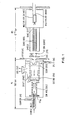
- the specific mass filter section of this instrument operates at approximately 4 x 10⁻⁸ ⁇ bar. A schematic diagram of this instrument is shown in Fig. 1.
- the chemical reactions which take place in the ionization source at atmospheric pressure are very complex.
- the basic functional and preferred ion to be employed in this invention is the O(H 2 0) 2 because it is very stable under analysis conditions.
- the 0 2 molecular oxygen ion which is the most familiar ion form of oxygen, is unstable and undergoes charge transfer reaction with other molecules. Therefore, the 0 2- ion is undesirable in some applications.
- the temperature of the ionization source is maintained above 483 K .
- the coefficient of thermal detachment of an electron from the 0 2 ion is greater than the coefficient of electron attachment.
- reaction (1) when an electron is captured by oxygen it forms a highly energetically excited ion and at temperatures above 483 K there is enough thermal energy to cause thermal electron detachment as shown in reaction (2). In other words, at temperatures above 483 K the rate of reaction (2) is greater than the rate of reaction (1).
- the predominant mode of ionization for oxygen is by dissociative electron capture as shown in reaction (3).
- the atomic oxygen ion will, under a hydration reaction in the presence of water, form the stable O(H 2 O) 2 ion as shown in reaction (4). It is this ion which is monitored as a function of the oxygen concentration.
- reaction (5) As the oxygen concentration of the gas to be measured increases into the percent range a side reaction starts to compete with reaction 2 as shown in reaction (5)
- molecular oxygen 0 2' reacts with the excited molecular oxygen ion O 2 , and adsorbs the excess energy and thus stabilizes the 0 2 ion.
- a peak at m/e of 32 is noted in the mass spectrum. This ion can be used at higher (percent) concentration as a monitor of the oxygen concentration.
- a significant advantage of this instrument or method is its wide dynamic range of operation; that is, parts per billion (ppb) to percent concentration of oxygen. Using this method/instrument it is possible to detect instantaneous changes in oxygen concentrations and therefore it can be used as a continuous oxygen monitor.
- the method/instrument is capable of being easily automated with any microprocessor or minicomputer such as an IBM Model 5100 or IBM Model 5110.
- Another significant advantage is that no or very little sample preparation is needed (primarily bacause there is no vacuum associated with the sample housing).
- the Alpha-II plasma chromatograph/mass spectrometer manufactured by Franklin GNO Corporation was adapted for use in this invention.
- This instrument consists of a Beta-VII plasma chromatograph coupled to a specially modified Extranuclear Laboratories Spectr-E1 quadrupole mass spectrometer.
- the operating parameters of the plasma chromatograph used in this study are summarized in Table I.
- FIG. 1 A schematic of the combined PC-MS system is shown in Fig. 1.
- This instrument has the capability of operating in several modes so that ion mobility spectra, mass spectra, total ion mobility spectra, and mass identified mobility spectra can be obtained.
- the ionic mobility may be measured in either a one-grid or two-grid pulsing procedure with the Beta-VII plasma chromatograph mode of operation. Both grids of the drift tube are held open, allowing all the ions produced in the ionization source to continually drift down the tube and into the quadrupole mass spectrometer, which results in atmospheric pressure ionization mass spectra.
- Total ion mobility spectral can be obtained by operating the plasma chromatograph in the normal one-grid pulsing mode and the quadrupole mass spectrometer in the total ion mode, which enables the channeltron electron multiplier detector to measure the ionic distrubution as a function of time.
- the mass analyzer By adjusting the mass analyzer to respond only to a single m/4 value and operating the plasma chromatograph in the normal one-grid pulsing mode, the distribution of an individual ion as a function of time can be obtained.
- the arrival time of the individual ions can then be compared with the arrival time of the ions measured in the total ion mode to produce the mass-identified mobility spectra.
- a Nicolet Model SD-72IA integrating ADC (analog-digital converter) mounted in a Nicolet Model 1074, 4096-channel signal averager was used to digitize the accumulated plasmagrams.
- a Nicolet Model NIC-28A magnetic tape coupler and Kennedy Model 9700 tape deck was used as the data was being accumulated in memory, the information was displayed on a Tektronix Model D10 oscilloscope.
- the data stored on the magnetic tape was entered into an IBM System/370 computer and was subsequently analyzed using the VSAPL program under the operating system VM/370. The position and intensity of the peaks in the mobility spectra along with a plot of the mobility spectra were then displayed on a graphics terminal from which hard copies could be obtained.
- the instrument consists of an atmospheric pressure ionization source, a reaction region, and a quadrupole mass instrument.
- the ionization source utilizes a 63 N i foil for initiating the ionization process.
- 6 3 Ni emits a 60 keV B ray which is the source of electrons used for the formation of the O(H 2 0) 2 .
- Ultra high purity grade nitrogen, N 2 is used as the carrier gas to bring the oxygen containing gas into the instrument.
- the method used to sample the trace oxygen and mix it with the carrier gas depends upon the state in which the oxygen exist (namely a gas or absorbed on a surface).
- High purity nitrogen with 10 ppm water is used as the flush gas to flush out the ionization source and also to supply the source of water for the clustering reaction with the atomic oxygen ion and, as such, can also be considered as the reagent gas.
- the ionization source is operated at atmospheric pressure and at 210 0 C (483 K) or above.
- a small electric flield of approximately 200 v/cm is applied across the ionization source and the length of the reaction region and is biased in such a way as to repel the negatively charged ions down through the reaction region towards a pinhole aperture which separates the reaction region from the quadrupole mass spectrometer section of the instrument.
- ions As the ions pass through the pinhole aperture they are focused into the quadrupole mass filter by an ion lens focusing arrangement.
- An electron multiplier is mounted on axis and serves as the detector for the ions.
- the mass spectrometer section of this instrument operates at approximately 4 x 10 -8 ubar pressure.
- the system of this invention is characterized by the use of atmospheric pressure ionization using 63 Ni; a negative ion made of operation; specific ion detection e.g. m/e 32 [O 2 ], 50 [O 2 (H 2 O) ], the optimum and preferred 52 [O(H 2 O) 2 ], and 68 [ 02 ( H2 0)2]; ultra high purity N 2 as a carrier gas; ultra high purity N 2 with 10 ppm H 2 0 as a reagent gas; an ionization source temperature of at least 210°C; and an electric field strength of 200 V/cm.
- the instrument of this invention differs from conventional plasma chromatograph-mass spectrometers in that no gating or scan grids are employed and therefore there is no drift spectrometer and no ion mobility spectrum.
- the instrument of this invention also differs from an API (atmospheric pressure ionization) mass spectrometer in two ways: 1, a reagent gas is used in addition to a carrier gas and 2, the use of a reaction region with an applied electric field biased along it.
- API atmospheric pressure ionization
- One unobvious feature is the use of the negatively charged oxygen water clusters to monitor the amount of oxygen.
- a particularly unobvious feature is the operation of the ionization source at or above 210°C. This feature is of prime importance to form the O(H 2 0) 2 ion.
- This ion of m/e value of 52 is the preferred and optimum ion to be monitored at extremely low oxygen levels (sub picogram level, sub ppb).
- the ions of m/e 32, 50, and 68 can be used to monitor the oxygen level at high concentrations (ppm).
- This instrument has the advantage that there is no vacuum associated with the sample inlet assembly and therefore there is very little sample preparation.
- Another significant advantage of this instrument is its wide dynamic range of operation e.g. ppb. to percent amount of oxygen.
- This instrument will also respond to instantaneous changes in oxygen concentrations and therefore can be used as a continuous oxygen monitor.
- the instrument is capable of being easily automated with any microprocessor such as an IBM Model 5100.
Landscapes
- Chemical & Material Sciences (AREA)
- Physics & Mathematics (AREA)
- Health & Medical Sciences (AREA)
- Life Sciences & Earth Sciences (AREA)
- Analytical Chemistry (AREA)
- Electrochemistry (AREA)
- Chemical Kinetics & Catalysis (AREA)
- Biochemistry (AREA)
- General Health & Medical Sciences (AREA)
- General Physics & Mathematics (AREA)
- Immunology (AREA)
- Pathology (AREA)
- Spectroscopy & Molecular Physics (AREA)
- Molecular Biology (AREA)
- Other Investigation Or Analysis Of Materials By Electrical Means (AREA)
Applications Claiming Priority (2)
| Application Number | Priority Date | Filing Date | Title |
|---|---|---|---|
| US06/114,549 US4261698A (en) | 1980-01-23 | 1980-01-23 | Trace oxygen detector |
| US114549 | 1987-10-28 |
Publications (3)
| Publication Number | Publication Date |
|---|---|
| EP0032984A2 true EP0032984A2 (de) | 1981-08-05 |
| EP0032984A3 EP0032984A3 (en) | 1982-01-13 |
| EP0032984B1 EP0032984B1 (de) | 1984-11-07 |
Family
ID=22355942
Family Applications (1)
| Application Number | Title | Priority Date | Filing Date |
|---|---|---|---|
| EP80107239A Expired EP0032984B1 (de) | 1980-01-23 | 1980-11-20 | Verfahren und Vorrichtung zum Messen von Sauerstoffspuren |
Country Status (3)
| Country | Link |
|---|---|
| US (1) | US4261698A (de) |
| EP (1) | EP0032984B1 (de) |
| DE (1) | DE3069605D1 (de) |
Cited By (4)
| Publication number | Priority date | Publication date | Assignee | Title |
|---|---|---|---|---|
| EP0122006A3 (en) * | 1983-03-04 | 1987-01-21 | Uti Instruments Company | Electron impact ion source for trace analysis |
| EP0195296A3 (de) * | 1985-03-22 | 1987-11-25 | Gesellschaft für Strahlen- und Umweltforschung mbH (GSF) | Verfahren zur analytischen Bestimmung von organischen Stoffen |
| WO1988002181A1 (en) * | 1986-09-18 | 1988-03-24 | Allied Corporation | Ion mobility spectrometer |
| EP0260469A3 (en) * | 1986-09-19 | 1989-12-27 | Gesellschaft Fur Strahlen- Und Umweltforschung M.B.H. | Apparatus for analytically determining organic substances |
Families Citing this family (24)
| Publication number | Priority date | Publication date | Assignee | Title |
|---|---|---|---|---|
| US4311669A (en) * | 1980-08-21 | 1982-01-19 | The Bendix Corporation | Membrane interface for ion mobility detector cells |
| US4317797A (en) * | 1980-08-25 | 1982-03-02 | The United States Of America As Represented By The Secretary Of The Navy | Resin purger |
| GB8725459D0 (en) * | 1987-10-30 | 1987-12-02 | Nat Research Dev Corpn | Generating particle beams |
| US5109157A (en) * | 1991-03-21 | 1992-04-28 | Loen Andrew E | Ion mobility detector |
| DE4202123C2 (de) * | 1992-01-27 | 1995-04-06 | Bruker Franzen Analytik Gmbh | Vorrichtung für die massenspektrometrische Untersuchung schneller organischer Ionen |
| JP3186262B2 (ja) * | 1992-10-14 | 2001-07-11 | ソニー株式会社 | 半導体装置の製造方法 |
| US5670378A (en) * | 1995-02-23 | 1997-09-23 | The United States Of America As Represented By The Administrator Of The National Aeronautics And Space Administration | Method for trace oxygen detection |
| US6461982B2 (en) * | 1997-02-27 | 2002-10-08 | Micron Technology, Inc. | Methods for forming a dielectric film |
| US5905258A (en) * | 1997-06-02 | 1999-05-18 | Advanced Research & Techology Institute | Hybrid ion mobility and mass spectrometer |
| US6498342B1 (en) | 1997-06-02 | 2002-12-24 | Advanced Research & Technology Institute | Ion separation instrument |
| US6323482B1 (en) | 1997-06-02 | 2001-11-27 | Advanced Research And Technology Institute, Inc. | Ion mobility and mass spectrometer |
| US6960761B2 (en) | 1997-06-02 | 2005-11-01 | Advanced Research & Technology Institute | Instrument for separating ions in time as functions of preselected ion mobility and ion mass |
| US6040573A (en) * | 1997-09-25 | 2000-03-21 | Indiana University Advanced Research & Technology Institute Inc. | Electric field generation for charged particle analyzers |
| US6943392B2 (en) * | 1999-08-30 | 2005-09-13 | Micron Technology, Inc. | Capacitors having a capacitor dielectric layer comprising a metal oxide having multiple different metals bonded with oxygen |
| US6558517B2 (en) * | 2000-05-26 | 2003-05-06 | Micron Technology, Inc. | Physical vapor deposition methods |
| US6606899B1 (en) * | 2000-07-07 | 2003-08-19 | Air Products And Chemicals, Inc. | Total impurity monitor for gases |
| US6566147B2 (en) * | 2001-02-02 | 2003-05-20 | Micron Technology, Inc. | Method for controlling deposition of dielectric films |
| US20030017266A1 (en) * | 2001-07-13 | 2003-01-23 | Cem Basceri | Chemical vapor deposition methods of forming barium strontium titanate comprising dielectric layers, including such layers having a varied concentration of barium and strontium within the layer |
| US6838122B2 (en) * | 2001-07-13 | 2005-01-04 | Micron Technology, Inc. | Chemical vapor deposition methods of forming barium strontium titanate comprising dielectric layers |
| US7011978B2 (en) * | 2001-08-17 | 2006-03-14 | Micron Technology, Inc. | Methods of forming capacitor constructions comprising perovskite-type dielectric materials with different amount of crystallinity regions |
| US6956206B2 (en) * | 2001-10-03 | 2005-10-18 | Drexel University | Negative ion atmospheric pressure ionization and selected ion mass spectrometry using a 63NI electron source |
| DE10236344B4 (de) * | 2002-08-08 | 2007-03-29 | Bruker Daltonik Gmbh | Ionisieren an Atmosphärendruck für massenspektrometrische Analysen |
| GB0424426D0 (en) | 2004-11-04 | 2004-12-08 | Micromass Ltd | Mass spectrometer |
| CN102107158B (zh) * | 2009-12-24 | 2013-03-20 | 同方威视技术股份有限公司 | 过滤装置、过滤方法以及痕量检测仪器 |
Family Cites Families (6)
| Publication number | Priority date | Publication date | Assignee | Title |
|---|---|---|---|---|
| US2412236A (en) * | 1943-12-09 | 1946-12-10 | Cons Eng Corp | Mass spectrometry |
| US3247375A (en) * | 1960-12-23 | 1966-04-19 | James E Lovelock | Gas analysis method and device for the qualitative and quantitative analysis of classes of organic vapors |
| US3647387A (en) * | 1970-03-19 | 1972-03-07 | Stanford Research Inst | Detection device |
| US3752652A (en) * | 1972-02-11 | 1973-08-14 | Texaco Belgium Nv Sa | Method and apparatus for measurement of minute quantities of oxygen |
| US4169708A (en) * | 1977-06-03 | 1979-10-02 | Muggli Robert Z | Method and apparatus for gas analysis |
| US4147515A (en) * | 1977-12-22 | 1979-04-03 | The United States Of America As Represented By The Secretary Of The Navy | Electro-chemical sensors for gas detection in electron tubes |
-
1980
- 1980-01-23 US US06/114,549 patent/US4261698A/en not_active Expired - Lifetime
- 1980-11-20 DE DE8080107239T patent/DE3069605D1/de not_active Expired
- 1980-11-20 EP EP80107239A patent/EP0032984B1/de not_active Expired
Cited By (5)
| Publication number | Priority date | Publication date | Assignee | Title |
|---|---|---|---|---|
| EP0122006A3 (en) * | 1983-03-04 | 1987-01-21 | Uti Instruments Company | Electron impact ion source for trace analysis |
| EP0310210A1 (de) * | 1983-03-04 | 1989-04-05 | UTI Instruments Company | Messung von Komponenten in einem Gas |
| EP0195296A3 (de) * | 1985-03-22 | 1987-11-25 | Gesellschaft für Strahlen- und Umweltforschung mbH (GSF) | Verfahren zur analytischen Bestimmung von organischen Stoffen |
| WO1988002181A1 (en) * | 1986-09-18 | 1988-03-24 | Allied Corporation | Ion mobility spectrometer |
| EP0260469A3 (en) * | 1986-09-19 | 1989-12-27 | Gesellschaft Fur Strahlen- Und Umweltforschung M.B.H. | Apparatus for analytically determining organic substances |
Also Published As
| Publication number | Publication date |
|---|---|
| EP0032984B1 (de) | 1984-11-07 |
| DE3069605D1 (en) | 1984-12-13 |
| US4261698A (en) | 1981-04-14 |
| EP0032984A3 (en) | 1982-01-13 |
Similar Documents
| Publication | Publication Date | Title |
|---|---|---|
| US4261698A (en) | Trace oxygen detector | |
| US7015464B2 (en) | Apparatus for detecting chemical substances and method therefor | |
| US8003935B2 (en) | Chemical ionization reaction or proton transfer reaction mass spectrometry with a quadrupole mass spectrometer | |
| US5083019A (en) | Preconcentrator for ion mobility spectrometer | |
| US7560688B2 (en) | Mass analysis of mobility selected ion populations | |
| EP3138117B1 (de) | Verfahren zum nachweis und zur quantifizierung von selen und silicium in proben | |
| US8003936B2 (en) | Chemical ionization reaction or proton transfer reaction mass spectrometry with a time-of-flight mass spectrometer | |
| EP1672363B1 (de) | Verfahren zur Leistungssteigerung eines Ionenbeweglichkeitsspektrometers zur Detektion atmosphärischer Spurenverunreinigungen in Gasen | |
| Mowry et al. | Gas Analysis by Mass Spectrometry. | |
| EP0311224B1 (de) | Elektroneneinschlag-Ionenquelle zur Analysierung von Komponenten | |
| JPH0748371B2 (ja) | 高圧質量分析法のためのイオン化方法及び装置 | |
| EP0292974B1 (de) | Entladungsionisierungsquelle zum Analysieren der Atmosphäre | |
| Todd | Secondary ion emission from glycerol under continuous and pulsed primary ion current | |
| Carr | Analysis of surface contaminants by plasma chromatography-mass spectroscopy | |
| US5670378A (en) | Method for trace oxygen detection | |
| Duan et al. | Measurements of calcium isotopes and isotope ratios: a new method based on helium plasma source “off-cone” sampling time-of-flight mass spectrometry | |
| US20040108454A1 (en) | Negative ion atmospheric pressure ionization and selected ion mass spectrometry using a 63Ni electron source | |
| Siefering et al. | Improved APIMS Methods: I. Analysis of Nonstandard Contaminants in Nitrogen and Argon | |
| Gerhardt | Gas chromatography—Mass spectrometry | |
| Man et al. | Resonant Attachment Method for Trace Oxygen Detection | |
| Proctor et al. | Mass-analysed ion mobility studies of nitrobenzene | |
| Suzuki et al. | Temperature Programmed Desorption of Quench-condensed Krypton and Acetone in Air; Selective Concentration of Ultra-trace Gas Components | |
| Man et al. | Method for Trace Oxygen Detection | |
| SU1690023A1 (ru) | Масс-спектрометр дл газового анализа | |
| Hirata | New reduction technique for isobaric interferences on Ba using ICP-Mass spectrometry |
Legal Events
| Date | Code | Title | Description |
|---|---|---|---|
| PUAI | Public reference made under article 153(3) epc to a published international application that has entered the european phase |
Free format text: ORIGINAL CODE: 0009012 |
|
| AK | Designated contracting states |
Designated state(s): DE FR GB |
|
| PUAL | Search report despatched |
Free format text: ORIGINAL CODE: 0009013 |
|
| 17P | Request for examination filed |
Effective date: 19810923 |
|
| AK | Designated contracting states |
Designated state(s): DE FR GB |
|
| GRAA | (expected) grant |
Free format text: ORIGINAL CODE: 0009210 |
|
| AK | Designated contracting states |
Designated state(s): DE FR GB |
|
| REF | Corresponds to: |
Ref document number: 3069605 Country of ref document: DE Date of ref document: 19841213 |
|
| ET | Fr: translation filed | ||
| PLBE | No opposition filed within time limit |
Free format text: ORIGINAL CODE: 0009261 |
|
| STAA | Information on the status of an ep patent application or granted ep patent |
Free format text: STATUS: NO OPPOSITION FILED WITHIN TIME LIMIT |
|
| 26N | No opposition filed | ||
| PGFP | Annual fee paid to national office [announced via postgrant information from national office to epo] |
Ref country code: GB Payment date: 19901012 Year of fee payment: 11 |
|
| PGFP | Annual fee paid to national office [announced via postgrant information from national office to epo] |
Ref country code: FR Payment date: 19901020 Year of fee payment: 11 |
|
| PGFP | Annual fee paid to national office [announced via postgrant information from national office to epo] |
Ref country code: DE Payment date: 19901124 Year of fee payment: 11 |
|
| PG25 | Lapsed in a contracting state [announced via postgrant information from national office to epo] |
Ref country code: GB Effective date: 19911120 |
|
| GBPC | Gb: european patent ceased through non-payment of renewal fee | ||
| PG25 | Lapsed in a contracting state [announced via postgrant information from national office to epo] |
Ref country code: FR Effective date: 19920731 |
|
| PG25 | Lapsed in a contracting state [announced via postgrant information from national office to epo] |
Ref country code: DE Effective date: 19920801 |
|
| REG | Reference to a national code |
Ref country code: FR Ref legal event code: ST |