EP0029082B1 - 1-Benzylierte Ergometrinderivate, Verfahren zu ihrer Herstellung sowie diese enthaltende pharmazeutische Zusammensetzungen - Google Patents
1-Benzylierte Ergometrinderivate, Verfahren zu ihrer Herstellung sowie diese enthaltende pharmazeutische Zusammensetzungen Download PDFInfo
- Publication number
- EP0029082B1 EP0029082B1 EP80103892A EP80103892A EP0029082B1 EP 0029082 B1 EP0029082 B1 EP 0029082B1 EP 80103892 A EP80103892 A EP 80103892A EP 80103892 A EP80103892 A EP 80103892A EP 0029082 B1 EP0029082 B1 EP 0029082B1
- Authority
- EP
- European Patent Office
- Prior art keywords
- formula
- ergometrine
- benzylated
- fluorobenzyl
- compound
- Prior art date
- Legal status (The legal status is an assumption and is not a legal conclusion. Google has not performed a legal analysis and makes no representation as to the accuracy of the status listed.)
- Expired
Links
- WVVSZNPYNCNODU-XTQGRXLLSA-N Lysergic acid propanolamide Chemical class C1=CC(C=2[C@H](N(C)C[C@@H](C=2)C(=O)N[C@H](CO)C)C2)=C3C2=CNC3=C1 WVVSZNPYNCNODU-XTQGRXLLSA-N 0.000 title claims abstract description 22
- 238000000034 method Methods 0.000 title claims description 14
- 239000008194 pharmaceutical composition Substances 0.000 title claims 2
- 238000002360 preparation method Methods 0.000 title description 6
- 229910052736 halogen Inorganic materials 0.000 claims abstract description 16
- 150000002367 halogens Chemical class 0.000 claims abstract description 14
- 239000002253 acid Substances 0.000 claims abstract description 10
- 125000003545 alkoxy group Chemical group 0.000 claims abstract description 10
- 125000000217 alkyl group Chemical group 0.000 claims abstract description 10
- 125000002023 trifluoromethyl group Chemical group FC(F)(F)* 0.000 claims abstract description 10
- 150000003839 salts Chemical class 0.000 claims abstract description 7
- 125000001424 substituent group Chemical group 0.000 claims abstract description 7
- 150000007513 acids Chemical class 0.000 claims abstract description 4
- 229960001405 ergometrine Drugs 0.000 claims description 26
- 239000000243 solution Substances 0.000 claims description 24
- ZMXDDKWLCZADIW-UHFFFAOYSA-N N,N-Dimethylformamide Chemical compound CN(C)C=O ZMXDDKWLCZADIW-UHFFFAOYSA-N 0.000 claims description 22
- QGZKDVFQNNGYKY-UHFFFAOYSA-N Ammonia Chemical compound N QGZKDVFQNNGYKY-UHFFFAOYSA-N 0.000 claims description 19
- 150000001875 compounds Chemical class 0.000 claims description 18
- 239000002585 base Substances 0.000 claims description 14
- 238000006243 chemical reaction Methods 0.000 claims description 12
- ZAGRKAFMISFKIO-QMTHXVAHSA-N lysergic acid Chemical compound C1=CC(C2=C[C@H](CN([C@@H]2C2)C)C(O)=O)=C3C2=CNC3=C1 ZAGRKAFMISFKIO-QMTHXVAHSA-N 0.000 claims description 10
- 239000000203 mixture Substances 0.000 claims description 10
- ZAGRKAFMISFKIO-UHFFFAOYSA-N Isolysergic acid Natural products C1=CC(C2=CC(CN(C2C2)C)C(O)=O)=C3C2=CNC3=C1 ZAGRKAFMISFKIO-UHFFFAOYSA-N 0.000 claims description 8
- ODZPKZBBUMBTMG-UHFFFAOYSA-N sodium amide Chemical compound [NH2-].[Na+] ODZPKZBBUMBTMG-UHFFFAOYSA-N 0.000 claims description 8
- 238000009835 boiling Methods 0.000 claims description 5
- 229910052739 hydrogen Inorganic materials 0.000 claims description 5
- NPXOKRUENSOPAO-UHFFFAOYSA-N Raney nickel Chemical compound [Al].[Ni] NPXOKRUENSOPAO-UHFFFAOYSA-N 0.000 claims description 4
- QAOWNCQODCNURD-UHFFFAOYSA-N Sulfuric acid Chemical compound OS(O)(=O)=O QAOWNCQODCNURD-UHFFFAOYSA-N 0.000 claims description 4
- 238000004519 manufacturing process Methods 0.000 claims description 4
- 239000007868 Raney catalyst Substances 0.000 claims description 3
- 229910000564 Raney nickel Inorganic materials 0.000 claims description 3
- 150000008044 alkali metal hydroxides Chemical class 0.000 claims description 3
- 239000007795 chemical reaction product Substances 0.000 claims description 3
- 239000003814 drug Substances 0.000 claims description 3
- AFVFQIVMOAPDHO-UHFFFAOYSA-M methanesulfonate group Chemical class CS(=O)(=O)[O-] AFVFQIVMOAPDHO-UHFFFAOYSA-M 0.000 claims description 3
- 150000003892 tartrate salts Chemical class 0.000 claims description 3
- 238000002347 injection Methods 0.000 claims description 2
- 239000007924 injection Substances 0.000 claims description 2
- 239000004480 active ingredient Substances 0.000 claims 2
- 125000005843 halogen group Chemical group 0.000 claims 2
- 229910001854 alkali hydroxide Inorganic materials 0.000 claims 1
- 150000008064 anhydrides Chemical class 0.000 claims 1
- 230000002460 anti-migrenic effect Effects 0.000 claims 1
- 238000009903 catalytic hydrogenation reaction Methods 0.000 claims 1
- 239000008298 dragée Substances 0.000 claims 1
- 125000004175 fluorobenzyl group Chemical group 0.000 claims 1
- 125000006178 methyl benzyl group Chemical group 0.000 claims 1
- 239000003826 tablet Substances 0.000 claims 1
- OKKJLVBELUTLKV-UHFFFAOYSA-N Methanol Chemical compound OC OKKJLVBELUTLKV-UHFFFAOYSA-N 0.000 description 63
- RTZKZFJDLAIYFH-UHFFFAOYSA-N Diethyl ether Chemical compound CCOCC RTZKZFJDLAIYFH-UHFFFAOYSA-N 0.000 description 18
- HEDRZPFGACZZDS-UHFFFAOYSA-N Chloroform Chemical compound ClC(Cl)Cl HEDRZPFGACZZDS-UHFFFAOYSA-N 0.000 description 14
- CSCPPACGZOOCGX-UHFFFAOYSA-N Acetone Chemical compound CC(C)=O CSCPPACGZOOCGX-UHFFFAOYSA-N 0.000 description 12
- XLYOFNOQVPJJNP-UHFFFAOYSA-N water Chemical compound O XLYOFNOQVPJJNP-UHFFFAOYSA-N 0.000 description 12
- 230000000694 effects Effects 0.000 description 9
- WVVSZNPYNCNODU-CJBNDPTMSA-N Ergometrine Natural products C1=CC(C=2[C@H](N(C)C[C@@H](C=2)C(=O)N[C@@H](CO)C)C2)=C3C2=CNC3=C1 WVVSZNPYNCNODU-CJBNDPTMSA-N 0.000 description 8
- FEWJPZIEWOKRBE-UHFFFAOYSA-N Tartaric acid Natural products [H+].[H+].[O-]C(=O)C(O)C(O)C([O-])=O FEWJPZIEWOKRBE-UHFFFAOYSA-N 0.000 description 8
- 239000011975 tartaric acid Substances 0.000 description 8
- 235000002906 tartaric acid Nutrition 0.000 description 8
- 0 CC(*C1CC(*(C)C2)[S@@]34I*3C2C(*=C(*)CO)=O)Nc2c1c4ccc2 Chemical compound CC(*C1CC(*(C)C2)[S@@]34I*3C2C(*=C(*)CO)=O)Nc2c1c4ccc2 0.000 description 7
- -1 benzyl halide Chemical class 0.000 description 7
- 239000011734 sodium Substances 0.000 description 7
- OKTJSMMVPCPJKN-UHFFFAOYSA-N Carbon Chemical compound [C] OKTJSMMVPCPJKN-UHFFFAOYSA-N 0.000 description 6
- CURLTUGMZLYLDI-UHFFFAOYSA-N Carbon dioxide Chemical compound O=C=O CURLTUGMZLYLDI-UHFFFAOYSA-N 0.000 description 6
- XEEYBQQBJWHFJM-UHFFFAOYSA-N Iron Chemical compound [Fe] XEEYBQQBJWHFJM-UHFFFAOYSA-N 0.000 description 6
- 208000019695 Migraine disease Diseases 0.000 description 6
- 206010027599 migraine Diseases 0.000 description 6
- QAOWNCQODCNURD-UHFFFAOYSA-L Sulfate Chemical compound [O-]S([O-])(=O)=O QAOWNCQODCNURD-UHFFFAOYSA-L 0.000 description 5
- 229910021529 ammonia Inorganic materials 0.000 description 5
- DHMQDGOQFOQNFH-UHFFFAOYSA-N Glycine Chemical compound NCC(O)=O DHMQDGOQFOQNFH-UHFFFAOYSA-N 0.000 description 4
- 125000001797 benzyl group Chemical group [H]C1=C([H])C([H])=C(C([H])=C1[H])C([H])([H])* 0.000 description 4
- UMGDCJDMYOKAJW-UHFFFAOYSA-N thiourea Chemical compound NC(N)=S UMGDCJDMYOKAJW-UHFFFAOYSA-N 0.000 description 4
- UYJMLMSPENDICV-IIBYNOLFSA-N (6ar,9r)-4-[(4-chlorophenyl)methyl]-7-methyl-6,6a,8,9-tetrahydroindolo[4,3-fg]quinoline-9-carboxylic acid Chemical compound C([C@@H]1C(C=2C=CC=C3C4=2)=C[C@H](CN1C)C(O)=O)C4=CN3CC1=CC=C(Cl)C=C1 UYJMLMSPENDICV-IIBYNOLFSA-N 0.000 description 3
- BKMMTJMQCTUHRP-VKHMYHEASA-N (S)-2-aminopropan-1-ol Chemical compound C[C@H](N)CO BKMMTJMQCTUHRP-VKHMYHEASA-N 0.000 description 3
- AWFDCTXCTHGORH-HGHGUNKESA-N 6-[4-[(6ar,9r,10ar)-5-bromo-7-methyl-6,6a,8,9,10,10a-hexahydro-4h-indolo[4,3-fg]quinoline-9-carbonyl]piperazin-1-yl]-1-methylpyridin-2-one Chemical class O=C([C@H]1CN([C@H]2[C@@H](C=3C=CC=C4NC(Br)=C(C=34)C2)C1)C)N(CC1)CCN1C1=CC=CC(=O)N1C AWFDCTXCTHGORH-HGHGUNKESA-N 0.000 description 3
- QTBSBXVTEAMEQO-UHFFFAOYSA-N Acetic acid Chemical compound CC(O)=O QTBSBXVTEAMEQO-UHFFFAOYSA-N 0.000 description 3
- VHUUQVKOLVNVRT-UHFFFAOYSA-N Ammonium hydroxide Chemical compound [NH4+].[OH-] VHUUQVKOLVNVRT-UHFFFAOYSA-N 0.000 description 3
- XEKOWRVHYACXOJ-UHFFFAOYSA-N Ethyl acetate Chemical compound CCOC(C)=O XEKOWRVHYACXOJ-UHFFFAOYSA-N 0.000 description 3
- WMFOQBRAJBCJND-UHFFFAOYSA-M Lithium hydroxide Chemical compound [Li+].[OH-] WMFOQBRAJBCJND-UHFFFAOYSA-M 0.000 description 3
- JUJWROOIHBZHMG-UHFFFAOYSA-N Pyridine Chemical compound C1=CC=NC=C1 JUJWROOIHBZHMG-UHFFFAOYSA-N 0.000 description 3
- HEMHJVSKTPXQMS-UHFFFAOYSA-M Sodium hydroxide Chemical compound [OH-].[Na+] HEMHJVSKTPXQMS-UHFFFAOYSA-M 0.000 description 3
- 235000011114 ammonium hydroxide Nutrition 0.000 description 3
- 239000003420 antiserotonin agent Substances 0.000 description 3
- 238000001035 drying Methods 0.000 description 3
- 238000001953 recrystallisation Methods 0.000 description 3
- 238000003756 stirring Methods 0.000 description 3
- 238000002560 therapeutic procedure Methods 0.000 description 3
- VZCYOOQTPOCHFL-UHFFFAOYSA-N trans-butenedioic acid Natural products OC(=O)C=CC(O)=O VZCYOOQTPOCHFL-UHFFFAOYSA-N 0.000 description 3
- RWBFCYJYNNQMHK-IIBYNOLFSA-N (6ar,9r)-4-[(4-fluorophenyl)methyl]-7-methyl-6,6a,8,9-tetrahydroindolo[4,3-fg]quinoline-9-carboxylic acid Chemical compound C([C@@H]1C(C=2C=CC=C3C4=2)=C[C@H](CN1C)C(O)=O)C4=CN3CC1=CC=C(F)C=C1 RWBFCYJYNNQMHK-IIBYNOLFSA-N 0.000 description 2
- FFWQLZFIMNTUCZ-UHFFFAOYSA-N 1-(bromomethyl)-2-fluorobenzene Chemical compound FC1=CC=CC=C1CBr FFWQLZFIMNTUCZ-UHFFFAOYSA-N 0.000 description 2
- KQNBRMUBPRGXSL-UHFFFAOYSA-N 1-(bromomethyl)-4-chlorobenzene Chemical compound ClC1=CC=C(CBr)C=C1 KQNBRMUBPRGXSL-UHFFFAOYSA-N 0.000 description 2
- NLXLAEXVIDQMFP-UHFFFAOYSA-N Ammonium chloride Substances [NH4+].[Cl-] NLXLAEXVIDQMFP-UHFFFAOYSA-N 0.000 description 2
- DGAQECJNVWCQMB-PUAWFVPOSA-M Ilexoside XXIX Chemical compound C[C@@H]1CC[C@@]2(CC[C@@]3(C(=CC[C@H]4[C@]3(CC[C@@H]5[C@@]4(CC[C@@H](C5(C)C)OS(=O)(=O)[O-])C)C)[C@@H]2[C@]1(C)O)C)C(=O)O[C@H]6[C@@H]([C@H]([C@@H]([C@H](O6)CO)O)O)O.[Na+] DGAQECJNVWCQMB-PUAWFVPOSA-M 0.000 description 2
- 229910002651 NO3 Inorganic materials 0.000 description 2
- NHNBFGGVMKEFGY-UHFFFAOYSA-N Nitrate Chemical compound [O-][N+]([O-])=O NHNBFGGVMKEFGY-UHFFFAOYSA-N 0.000 description 2
- OFOBLEOULBTSOW-UHFFFAOYSA-N Propanedioic acid Natural products OC(=O)CC(O)=O OFOBLEOULBTSOW-UHFFFAOYSA-N 0.000 description 2
- FAPWRFPIFSIZLT-UHFFFAOYSA-M Sodium chloride Chemical compound [Na+].[Cl-] FAPWRFPIFSIZLT-UHFFFAOYSA-M 0.000 description 2
- XSQUKJJJFZCRTK-UHFFFAOYSA-N Urea Natural products NC(N)=O XSQUKJJJFZCRTK-UHFFFAOYSA-N 0.000 description 2
- 229940082988 antihypertensives serotonin antagonists Drugs 0.000 description 2
- 239000008346 aqueous phase Substances 0.000 description 2
- 239000006227 byproduct Substances 0.000 description 2
- 239000001569 carbon dioxide Substances 0.000 description 2
- 229910002092 carbon dioxide Inorganic materials 0.000 description 2
- 235000011089 carbon dioxide Nutrition 0.000 description 2
- 239000003054 catalyst Substances 0.000 description 2
- 239000000284 extract Substances 0.000 description 2
- 238000000605 extraction Methods 0.000 description 2
- 239000000706 filtrate Substances 0.000 description 2
- 238000001914 filtration Methods 0.000 description 2
- 229960002449 glycine Drugs 0.000 description 2
- 235000013905 glycine and its sodium salt Nutrition 0.000 description 2
- 239000008187 granular material Substances 0.000 description 2
- 238000005984 hydrogenation reaction Methods 0.000 description 2
- 229910052742 iron Inorganic materials 0.000 description 2
- VCJMYUPGQJHHFU-UHFFFAOYSA-N iron(3+);trinitrate Chemical compound [Fe+3].[O-][N+]([O-])=O.[O-][N+]([O-])=O.[O-][N+]([O-])=O VCJMYUPGQJHHFU-UHFFFAOYSA-N 0.000 description 2
- HQKMJHAJHXVSDF-UHFFFAOYSA-L magnesium stearate Chemical compound [Mg+2].CCCCCCCCCCCCCCCCCC([O-])=O.CCCCCCCCCCCCCCCCCC([O-])=O HQKMJHAJHXVSDF-UHFFFAOYSA-L 0.000 description 2
- VZCYOOQTPOCHFL-UPHRSURJSA-N maleic acid Chemical compound OC(=O)\C=C/C(O)=O VZCYOOQTPOCHFL-UPHRSURJSA-N 0.000 description 2
- 239000011976 maleic acid Substances 0.000 description 2
- 239000012071 phase Substances 0.000 description 2
- 238000005191 phase separation Methods 0.000 description 2
- 239000002244 precipitate Substances 0.000 description 2
- 239000000047 product Substances 0.000 description 2
- 239000011541 reaction mixture Substances 0.000 description 2
- QZAYGJVTTNCVMB-UHFFFAOYSA-N serotonin Chemical compound C1=C(O)C=C2C(CCN)=CNC2=C1 QZAYGJVTTNCVMB-UHFFFAOYSA-N 0.000 description 2
- 229910052708 sodium Inorganic materials 0.000 description 2
- 239000000126 substance Substances 0.000 description 2
- 229940124597 therapeutic agent Drugs 0.000 description 2
- RYHBNJHYFVUHQT-UHFFFAOYSA-N 1,4-Dioxane Chemical compound C1COCCO1 RYHBNJHYFVUHQT-UHFFFAOYSA-N 0.000 description 1
- JQZAEUFPPSRDOP-UHFFFAOYSA-N 1-chloro-4-(chloromethyl)benzene Chemical compound ClCC1=CC=C(Cl)C=C1 JQZAEUFPPSRDOP-UHFFFAOYSA-N 0.000 description 1
- MXZROAOUCUVNHX-UHFFFAOYSA-N 2-Aminopropanol Chemical compound CCC(N)O MXZROAOUCUVNHX-UHFFFAOYSA-N 0.000 description 1
- 229910018072 Al 2 O 3 Inorganic materials 0.000 description 1
- JSMRMEYFZHIPJV-UHFFFAOYSA-N C1C2CCC1C2 Chemical compound C1C2CCC1C2 JSMRMEYFZHIPJV-UHFFFAOYSA-N 0.000 description 1
- ZGTMUACCHSMWAC-UHFFFAOYSA-L EDTA disodium salt (anhydrous) Chemical compound [Na+].[Na+].OC(=O)CN(CC([O-])=O)CCN(CC(O)=O)CC([O-])=O ZGTMUACCHSMWAC-UHFFFAOYSA-L 0.000 description 1
- 229910000608 Fe(NO3)3.9H2O Inorganic materials 0.000 description 1
- 108010010803 Gelatin Proteins 0.000 description 1
- UFHFLCQGNIYNRP-UHFFFAOYSA-N Hydrogen Chemical compound [H][H] UFHFLCQGNIYNRP-UHFFFAOYSA-N 0.000 description 1
- GUBGYTABKSRVRQ-QKKXKWKRSA-N Lactose Natural products OC[C@H]1O[C@@H](O[C@H]2[C@H](O)[C@@H](O)C(O)O[C@@H]2CO)[C@H](O)[C@@H](O)[C@H]1O GUBGYTABKSRVRQ-QKKXKWKRSA-N 0.000 description 1
- 241000209056 Secale Species 0.000 description 1
- 229920005654 Sephadex Polymers 0.000 description 1
- 239000012507 Sephadex™ Substances 0.000 description 1
- PMZURENOXWZQFD-UHFFFAOYSA-L Sodium Sulfate Chemical compound [Na+].[Na+].[O-]S([O-])(=O)=O PMZURENOXWZQFD-UHFFFAOYSA-L 0.000 description 1
- 150000001298 alcohols Chemical class 0.000 description 1
- 239000003513 alkali Substances 0.000 description 1
- 239000012670 alkaline solution Substances 0.000 description 1
- 238000005804 alkylation reaction Methods 0.000 description 1
- 230000008485 antagonism Effects 0.000 description 1
- 230000000794 anti-serotonin Effects 0.000 description 1
- 238000013459 approach Methods 0.000 description 1
- 239000000010 aprotic solvent Substances 0.000 description 1
- 125000003710 aryl alkyl group Chemical group 0.000 description 1
- 238000007630 basic procedure Methods 0.000 description 1
- 238000005574 benzylation reaction Methods 0.000 description 1
- 230000003197 catalytic effect Effects 0.000 description 1
- 239000003153 chemical reaction reagent Substances 0.000 description 1
- 239000012141 concentrate Substances 0.000 description 1
- 235000008504 concentrate Nutrition 0.000 description 1
- 238000007796 conventional method Methods 0.000 description 1
- 238000001816 cooling Methods 0.000 description 1
- 239000012043 crude product Substances 0.000 description 1
- 239000013078 crystal Substances 0.000 description 1
- 230000001419 dependent effect Effects 0.000 description 1
- 230000008021 deposition Effects 0.000 description 1
- 238000011161 development Methods 0.000 description 1
- 230000018109 developmental process Effects 0.000 description 1
- 239000003480 eluent Substances 0.000 description 1
- 238000010828 elution Methods 0.000 description 1
- RHGUXDUPXYFCTE-ZWNOBZJWSA-N ergoline Chemical class C1=CC([C@@H]2[C@H](NCCC2)C2)=C3C2=CNC3=C1 RHGUXDUPXYFCTE-ZWNOBZJWSA-N 0.000 description 1
- 239000002024 ethyl acetate extract Substances 0.000 description 1
- 230000002349 favourable effect Effects 0.000 description 1
- 238000011049 filling Methods 0.000 description 1
- 229920000159 gelatin Polymers 0.000 description 1
- 239000008273 gelatin Substances 0.000 description 1
- 235000019322 gelatine Nutrition 0.000 description 1
- 235000011852 gelatine desserts Nutrition 0.000 description 1
- 239000003979 granulating agent Substances 0.000 description 1
- 239000001257 hydrogen Substances 0.000 description 1
- 239000008101 lactose Substances 0.000 description 1
- 229910003002 lithium salt Inorganic materials 0.000 description 1
- 159000000002 lithium salts Chemical group 0.000 description 1
- 231100000053 low toxicity Toxicity 0.000 description 1
- 235000019359 magnesium stearate Nutrition 0.000 description 1
- 238000002844 melting Methods 0.000 description 1
- 230000008018 melting Effects 0.000 description 1
- 239000012528 membrane Substances 0.000 description 1
- 238000007069 methylation reaction Methods 0.000 description 1
- 230000007935 neutral effect Effects 0.000 description 1
- 229930015720 peptide alkaloid Natural products 0.000 description 1
- 230000000144 pharmacologic effect Effects 0.000 description 1
- 229920001592 potato starch Polymers 0.000 description 1
- 239000000843 powder Substances 0.000 description 1
- 108090000765 processed proteins & peptides Proteins 0.000 description 1
- 238000012545 processing Methods 0.000 description 1
- UMJSCPRVCHMLSP-UHFFFAOYSA-N pyridine Natural products COC1=CC=CN=C1 UMJSCPRVCHMLSP-UHFFFAOYSA-N 0.000 description 1
- 239000000376 reactant Substances 0.000 description 1
- 238000010992 reflux Methods 0.000 description 1
- 229940076279 serotonin Drugs 0.000 description 1
- 239000011780 sodium chloride Substances 0.000 description 1
- 229940037001 sodium edetate Drugs 0.000 description 1
- 229910052938 sodium sulfate Inorganic materials 0.000 description 1
- 235000011152 sodium sulphate Nutrition 0.000 description 1
- 239000007787 solid Substances 0.000 description 1
- 239000002904 solvent Substances 0.000 description 1
- 238000001228 spectrum Methods 0.000 description 1
- 238000006277 sulfonation reaction Methods 0.000 description 1
- 239000006188 syrup Substances 0.000 description 1
- 235000020357 syrup Nutrition 0.000 description 1
- 239000000454 talc Substances 0.000 description 1
- 229910052623 talc Inorganic materials 0.000 description 1
Classifications
-
- C—CHEMISTRY; METALLURGY
- C07—ORGANIC CHEMISTRY
- C07D—HETEROCYCLIC COMPOUNDS
- C07D457/00—Heterocyclic compounds containing indolo [4, 3-f, g] quinoline ring systems, e.g. derivatives of ergoline, of the formula:, e.g. lysergic acid
- C07D457/04—Heterocyclic compounds containing indolo [4, 3-f, g] quinoline ring systems, e.g. derivatives of ergoline, of the formula:, e.g. lysergic acid with carbon atoms having three bonds to hetero atoms with at the most one bond to halogen, e.g. ester or nitrile radicals, directly attached in position 8
-
- C—CHEMISTRY; METALLURGY
- C07—ORGANIC CHEMISTRY
- C07D—HETEROCYCLIC COMPOUNDS
- C07D457/00—Heterocyclic compounds containing indolo [4, 3-f, g] quinoline ring systems, e.g. derivatives of ergoline, of the formula:, e.g. lysergic acid
- C07D457/04—Heterocyclic compounds containing indolo [4, 3-f, g] quinoline ring systems, e.g. derivatives of ergoline, of the formula:, e.g. lysergic acid with carbon atoms having three bonds to hetero atoms with at the most one bond to halogen, e.g. ester or nitrile radicals, directly attached in position 8
- C07D457/06—Lysergic acid amides
Definitions
- the invention relates to new 1-benzylated ergometrine derivatives which can be used as therapeutic agents, in particular for the treatment of therapy-resistant forms of migraine, and to processes for their production.
- GB-PS 99 44 86 shows lysergic acid and dihydrolysergic acid derivatives which also have aralkyl groups or a benzyl group in the 1-position, the serotonin-antagonistic effect of some of such derivatives being addressed.
- the invention is based on the surprising finding that ergometrine derivatives which have benzyl groups substituted in the 1-position have an unexpected, significantly stronger antiserotonin activity than corresponding derivatives with unsubstituted benzyl groups in the 1-position.
- the object of the invention is to provide new, highly effective serotonin antagonists with low toxicity, a wide range of applications and reduced side effects, which can be used in particular for the treatment of therapy-resistant forms of migraine and with which new fields of application can be opened up by influencing the spectrum of action, and also processes for their production.
- the task is solved according to the requirements.
- the compounds of the formula I can also be in the form of physiologically tolerable salts, in particular in the form of the maleinates, tartrates and methanesulfonates.
- the reduction (9.10-hydrogenation) is carried out catalytically with Raney-Ni in lower alcohols or dioxane at 70 ° C and 4.9 MPa (50 atü) hydrogen pressure.
- the first of the two basic procedures described above is based on the known 1-alkylation of compounds of the formula II, which has been transferred to corresponding nucleus-substituted benzyl halides of the formula V.
- a molar ratio of lysergic acid or 9.10-dihydrolysergic acid NaNH 2 : benzyl halide of 1: 3: 4.
- the reaction is carried out in such a way that a sodium amide solution is prepared by introducing sodium in liquid ammonia in the presence of catalytic amounts of iron (111) nitrate, the ergoline base of the formula II is introduced and the solution of the substituted benzyl halide is then allowed to flow rapidly in a little ether.
- the mixture is stirred for a further 30 min at the boiling point of the liquid ammonia and then the solvent is distilled off.
- the dry residue is taken up in aqueous tartaric acid and the solution is purified by shaking with ether. After making alkaline, the base of the end product is suctioned off or obtained by extraction and converted into a physiologically compatible salt.
- a lysergic acid derivative of the formula III is aralkylated instead of the alkanolamides of the formula II; the derivatives of formula IV obtained are isolated by dulling the tartaric acid solution to pH 5.5 to 7.0, converted into an activated form by one of the methods customary in peptide chemistry, for example by reaction with DMF / SO 3 , and then with aminopropanol in DMF connected.
- Another process for the preparation of the compounds I, in which A ⁇ B stands for the grouping ⁇ CH 2 ⁇ CH, consists in the reaction of 11 with excess alkali metal hydroxide and V preferably in a dipolar aprotic solvent.
- a sodium amide solution is prepared as in Example 1 from 300 ml of liquid ammonia, 80 mg of iron (III) nitrate and 630 mg of Na. 5.14 g of 9.10-dihydroergometrine base are added, and after 15 min a solution of 5.78 g of 2-fluorobenzyl bromide in 10 ml of dry ether. It is then stirred for a further 30 min and worked up as in Example 1. By adding ethereal tartaric acid to the methanolic solution cleaned with activated carbon, the 1- (2'-fluorobenzyl) -9.10-dihydroergometrin is obtained as ditartrate.
- Example 1 In an apparatus as described in Example 1, to 400 mg of liquefied ammonia, 360 mg of Fe (NO 3 ) 3 .9H 2 O, 2.4 g of sodium. 9.4 g of lysergic acid and 29 g of p-chlorobenzyl bromide were added.
- the residue which remains after the ammonia has evaporated is distributed between 500 ml of ether and 500 ml of water. After filtration and phase separation, the aqueous phase is concentrated to about 1/3 of the starting volume and precipitated as sulfate with 20% strength sulfuric acid to pH 1.
- the precipitate obtained is separated off, washed with a little water and dried at 80 ° C. for 5 h. 12.5 g of a light brown crystal powder are obtained.
- the substance is dissolved in aqueous alkali, cleaned with activated carbon as usual and precipitated again as sulfate.
- the pre-cleaned substance is chromatographed in an aqueous alkaline solution on 20 times the amount of Sephadex ®G 15.
- the 1- (4'-chlorobenzyl) -d-lysergic acid is precipitated from the filtrate at pH 5.5 to 6.0 with 10% acetic acid.
- the reaction mixture is evaporated to dryness in a vacuum rotary evaporator at a bath temperature of 40 ° C. in an oil pump vacuum.
- the residue obtained (approx. 1.9 g) is taken up in the necessary amount of CHCl 3 and chromatographed on 50 times the amount of Al 2 O 3 (activity level 1, neutral) using chloroform as the eluent. After the elution of by-products which do not give a blue color with Secale reagent, the 1- (4'-chlorobenzyl) -9.10-dihydroergometrin is washed into the filtrate.
- the mixed melting point with the base obtained according to Example 6 showed no depression.
- the reaction mixture is concentrated in a vacuum rotary evaporator at 40 ° C. bath temperature in an oil pump vacuum to about 1/3 of the initial volume and then mixed with 20% tartaric acid to pH 4. Then it is extracted three times with the same volume of chloroform and, after making alkaline with conc. Ammonia solution (pH 9 to 10) extracted three times with chloroform as above.
- the organic extracts of the aqueous alkaline phase are combined, washed with water, dried over sodium sulfate and evaporated to dryness in a vacuum rotary evaporator at a bath temperature of 35 ° C. After drying, the residue is dissolved in acetone and the calculated amount of solid tartaric acid is added. After standing at 3 ° C.
- 0.20 g of aminoacetic acid and 0.50 g of thiourea are dissolved in about 800 ml of water for ad inj., Which was previously gassed with carbon dioxide.
- 0.20 g of 1- (4'-chlorobenzyl) -ergometrine dimeinate are introduced into this solution and dissolved within about 1 h.
- 8.50 g of sodium chloride are dissolved in about 100 ml of CO 2 -gassed water ad inj. and mixes this solution into the approach. Then it is injected with gassed water. finally made up to 1,000.0 ml and mixed well.
- the finished batch is post-gassed with carbon dioxide for 15 minutes. After filtration through a suitable sterilized membrane filter, the solution is filled to 1.1 ml in sterilized ampoules under sterile conditions.
Landscapes
- Chemical & Material Sciences (AREA)
- Organic Chemistry (AREA)
- Pharmaceuticals Containing Other Organic And Inorganic Compounds (AREA)
- Acyclic And Carbocyclic Compounds In Medicinal Compositions (AREA)
Description
- Die Erfindung betrifft neue 1-benzylierte Ergometrinderivate, die als Therapeutika, insbesondere zur Behandlung therapieresistenter Migräneformen, Verwendung finden können, sowie Verfahren zu ihrer Herstellung.
- Es ist bekannt, daß neben den nativen Peptidalkaloiden des Mutterkorns auch halbsynthetische Ergolinderivate wie z. B. der N-(D-6-methyl-8-isoergolenyl)-N.N-diethylharnstoff (A. Cerny und M. Semonsky, Collect. Czechoslov. Chem. Commun. 27 (1962) 1585 ; CS-PS 100832) den für die Migränetherapie wichtigen Serotoninantagonismus zeigen. Es ist weiter bekannt, daß einige, vorzugsweise uterutonisch wirksame Ergoline wie das D-Lysergsäurebutanolamid oder das D-Lysergsäurepropanolamid durch 1-Methylierung in wertvolle Migränetherapeutika mit ausgeprägt serotoninantagonistischer Wirkung übergeführt werden können. (W. Richtzenhain, Ärztliche Praxis 17 (1965) 1738 ; GB-PS 98 27 37).
- Aus der GB-PS 98 27 37 sind Lysergsäurederivate bekannt, die in 1-Stellung aralkyliert bzw. benzyliert sind. Die serotoninantagonistische Wirkung dieser Verbindungen ist genannt.
- Der GB-PS 99 44 86 sind Lysergsäure- und Dihydrolysergsäurederivate zu entnehmen, die ebenfalls in 1-Stellung Aralkylgruppen bzw. eine Benzylgruppe aufweisen, wobei die serotoninantagonistische Wirkung einiger derartiger Derivate angesprochen ist.
- In der US-PS 3 218 324 sind ferner 1-Benzyldihydroergocristine, 1-Benzyldihydroergocornine und 1-Benzyldihydroergokryptine angegeben, die ebenfalls als Serotoninantagonisten wirken und damit z. B. als Migränemittel pharmazeutisch brauchbar sind.
- Alle eingeführten Präparate sind jedoch in der Anwendungsbreite teils durch Nebenwirkungen, teils durch unzureichende Wirkung bei bestimmten Migränefällen eingeschränkt. Versuche, die Wirkung von Ergometrinderivaten durch Einführung substituierter Benzylreste in 1-Stellung günstig zu beeinflussen, wurden nicht beschrieben.
- Die Erfindung geht von der überraschenden Feststellung aus, daß Ergometrinderivate, die in 1-Stellung substituierte Benzylgruppen aufweisen, eine unerwartete, signifikant stärkere Antiserotoninwirksamkeit aufweisen als entsprechende Derivate mit unsubstituierten Benzylgruppen in 1-Stellung.
- Aufgabe der Erfindung ist die Bereitstellung neuer, hochwirksamer Serotoninantagonisten mit niedriger Toxizität, großer Anwendungsbreite und verminderten Nebenwirkungen, die insbesondere zur Behandlung therapieresistenter Migräneformen Anwendung finden können und mit denen durch Beeinflussung des Wirkungsspektrums neue Anwendungsgebiete erschlossen werden können, sowie von Verfahren zu ihrer Herstellung.
- Die Aufgabe wird anspruchsgemäß gelöst.
- Vorteilhafte Weiterbildungen sind Gegenstand der Unteransprüche.
- Die erfindungsgemäßen 1-benzylierten Ergometrinderivate besitzen die allgemeine Formel I

-


- RI, R2 und R3 zugleich oder unabhängig H, Halogen, niederes Alkyl, Trifluormethyl oder Alkoxy wobei mindestens einer der Substituenten Rl, R2 und R3 nicht gleich H ist.
- Die Verbindungen der Formel I können auch in Form physiologisch verträglicher Salze vorliegen, insbesondere in Form der Maleinate, Tartrate und Methansulfonate.
- Bevorzugte erfindungsgemäße Verbindungen sind
- 1-(2'-Fluorbenzyl)-ergometrin,
- 1-(2'-Fluorbenzyl)-9.10-dihydroergometrin,
- 1-(3'-Fluorbenzyl)-ergometrin,
- 1-(3'-Fluorbenzyl)-9.10-dihydroergometrin,
- 1-(4'-Fluorbenzyl)-ergometrin,
- 1-(4'-Chlorbenzyl)-ergometrin,
- 1-(4'-Chlorbenzyl)-9.10-dihydroergometrin,
- 1-(2'-Brombenzyl)-ergometrin und
- 1-(2'-Methylbenzyl)-ergometrin.
- Das erfindungsgemäße Verfahren zur Herstellung der 1-benzylierten Ergometrinderivate der obigen Formel I ist gekennzeichnet durch Umsetzung eines Ergometrinderivats der allgemeinen Formel II,

- A ···· B ―CH = C oder ―CH2―CH
- X Halogen
- R1, R2 und R3 zugleich oder unabhängig H, Halogen, niederes Alkyl, Trifluormethyl oder Alkoxy, wobei mindestens einer dieser Substituenten nicht gleich H ist, in flüssigem Ammoniak bei dessen Siedetemperatur in Gegenwart von Natriumamid zur entsprechenden Verbindung der Formel I.
- Ein weiteres erfindungsgemäßes Verfahren zur Herstellung der 1-benzylierten Ergometrinderivate der Formel I, ist gekennzeichnet durch
- a) Umsetzung einer Lysergsäure der allgemeinen Formel III,

- A ···· B ―CH = C oder ―CH2 ―CH
bedeuten, mit einem substituierten Benzylhalogenid der Formel
- X Halogen
und- R1, R2 und R3 zugleich oder unabhängig H, Halogen, niederes Alkyl, Trifluormethyl oder Alkoxy, wobei mindestens einer dieser Substituenten nicht gleich H ist, in flüssigem Ammoniak bei dessen Siedetemperatur in Gegenwart von Natriumamid zu einer Verbindung der Formel IV
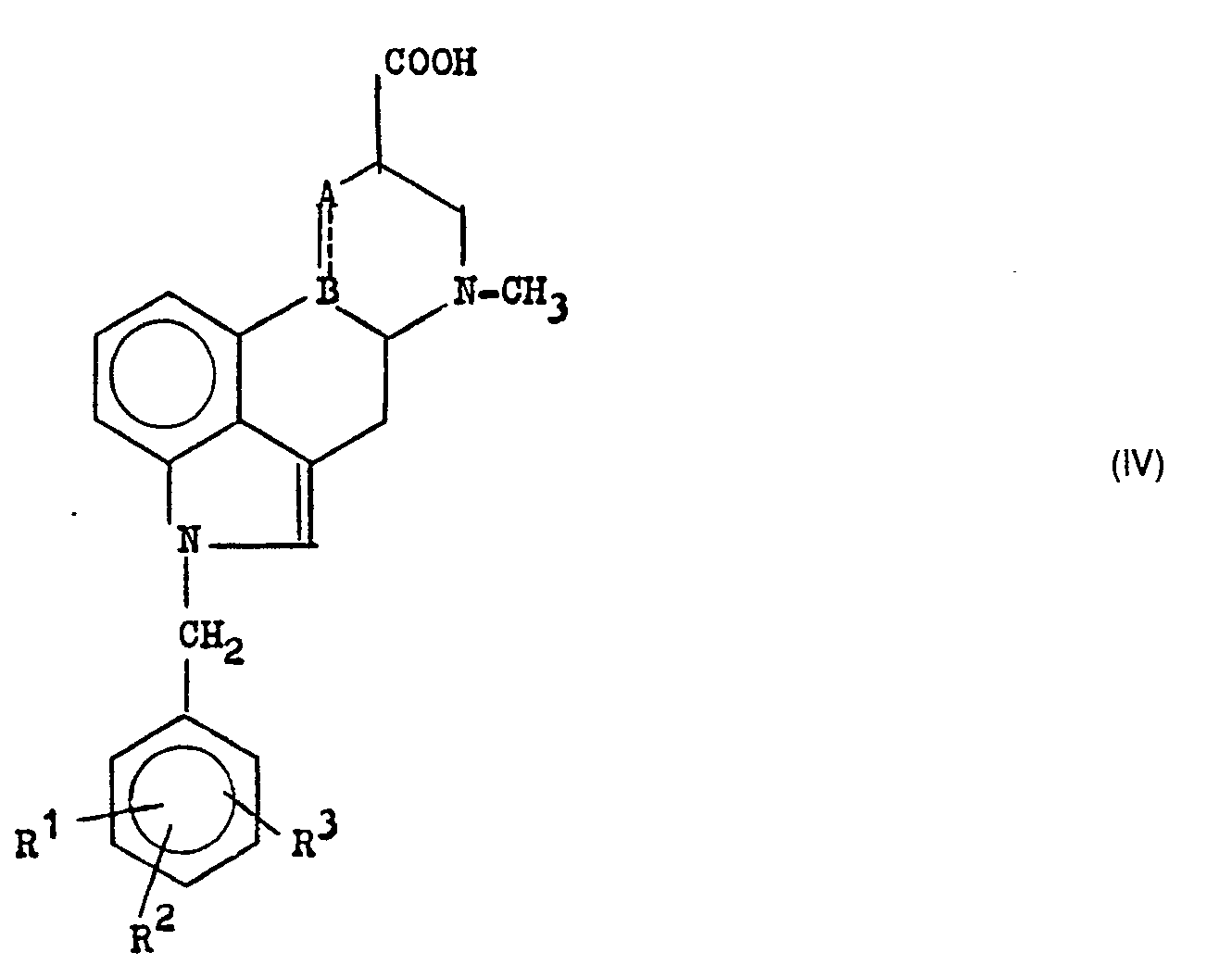
- b) Umsetzung der Verbindung der Formel IV in aktivierter Form mit L-(+)-2-Aminopropan-1-ol zur entsprechenden Verbindung der Formel I.
- Wenn Verbindungen der Formel I hergestellt werden sollen, in der die Gruppierung A ···· B - CH2 -CH bedeutet, kann ein Reaktionsprodukt der Formel I mit A ···· B gleich ―CH=C durch katalytische Hydrierung an Raney-Nickel in das entsprechende 9.10-Dihydroderivat übergeführt werden.
- Die Reduktion (9.10-Hydrierung) erfolgt katalytisch mit Raney-Ni in niederen Alkoholen oder Dioxan bei 70 °C und 4,9 MPa (50 atü) Wasserstoffdruck.
- Die erste der beiden oben erläuterten prinzipiellen Verfahrensweisen beruht auf der an sich bekannten 1-Alkylierung von Verbindungen der Formel II, die auf entsprechende kernsubstituierte Benzylhalogenide der Formel V übertragen wurde.
- Da bei dieser Umsetzung eine Reihe von Nebenprodukten entstehen, vorzugsweise die 8-alkylierten Derivate (Troxler, F. und Hofmann, A., Helv. Chim. Acta 40 (1957) 1721 - 32 ; Hempel, R., Grawert, W. und Dauth Ch., Pharmazie 34 (1979) H 5/6, S. 357), ist zur Erzielung hoher Ausbeuten die Einhaltung eines bestimmten Molverhältnisses der Reaktionspartner erforderlich. Für die Benzylierung wurde ein Molverhältnis Ergolinbase : NaNH2: Benzylhalogenid von 1 : 1,4 : 1,2 als optimal ermittelt. Für die Umsetzung von Lysergsäure und 9.10-Dihydrolysergsäure ist es günstiger, ein Molverhältnis Lysergsäure bzw. 9.10-Dihydrolysergsäure : NaNH2: Benzylhalogenid von 1 : 3 : 4 anzuwenden. Praktisch wird die Reaktion so ausgeführt, daß man durch Eintragen von Natrium in flüssigen Ammoniak in Gegenwart katalytischer Mengen Eisen (111) nitrat eine Natriumamidlösung herstellt, die Ergolinbase der Formel II einträgt und anschließend die Lösung des substituierten Benzylhalogenids in wenig Äther rasch zufließen läßt. Man rührt noch 30 min bei der Siedetemperatur des flüssigen Ammoniaks und destilliert anschließend das Lösungsmittel ab. Der trockene Rückstand wird in wässeriger Weinsäure aufgenommen und die Lösung durch Ausschütteln mit Ether gereinigt. Nach dem Alkalischmachen wird die Base des Endprodukts abgesaugt bzw. durch Extraktion gewonnen und in ein physiologisch verträgliches Salz übergeführt.
- Bei der zweiten oben erläuterten Verfahrensweise wird anstelle der Alkanolamide der Formel II ein Lysergsäurederivat der Formel III aralkyliert ; die erhaltenen Derivate der Formel IV werden durch Abstumpfen der weinsauren Lösung auf pH 5,5 bis 7,0 isoliert, nach einem der in der Peptidchemie üblichen Verfahren beispielsweise durch Umsetzung mit DMF/S03 in eine aktivierte Form überführt und dann mit Aminopropanol in DMF verknüpft.
- Ein weiteres Verfahren zur Herstellung der Verbindungen I, bei denen A ···· B für die Gruppierung ―CH2―CH steht, besteht in der Umsetzung von 11 mit überschüssigem Alkalihydroxid und V vorzugsweise in einem dipolaren aprotischen Lösungsmittel.
- So können z. B. 1-benzylierte 9.10-Dihydroergometrine vorteilhaft durch Umsetzung mit einem entsprechenden Benzylhalogenid und Alkalihydroxid in Dimethylformamid erhalten werden, wobei die technologisch aufwendige Ammoniakverflüssigung entfällt.
- Die erfindungsgemäß hergestellten Derivate der Formel I und ihre Salze mit physiologisch verträglichen Säuren besitzen einige wertvolle pharmakologische Eigenschaften, wie beispielsweise aus nachstehenden Tabelle hervorgeht.

- Die Erfindung wird im folgenden anhand von Ausführungsbeispielen näher erläutert.
- In einem 1,5 1-Sulfierkolben mit Rührer, Tropftrichter, Trockeneiskühltasche mit Ableitungsrohr werden nach Füllen der Kühltasche mit Aceton/Trockeneis 400 ml Ammoniak verflüssigt. Dazu gibt man 65 mg Eisen (111) nitrat und anschließend portionsweise 395 mg Na in dem Maße, wie die auftretende Blaufärbung wieder verschwindet. Darauf trägt man 4.0 g trockene Ergometrinbase ein, rührt 20 min und läßt eine Lösung von 2,82 g 2-Fluorbenzylbromid in 5 ml trockenem Ether rasch zufließen. Man rührt noch 30 min unter Rückfluß und arbeitet dann wie folgt auf :
- Nach völligem Abdestillieren des Ammoniaks wird der trockene Rückstand in 250 ml 3 %iger wässeriger Weinsäure gelöst, die Lösung zweimal mit je 100 ml Ether gewaschen und die wässerige Phase abgetrennt. Man unterschichtet mit 150 ml Chloroform, stellt mit Ammoniakwasser auf pH 9 ein und wiederholt nach Phasentrennung die Chloroformextraktion. Der Gesamtextrakt wird mit Wasser gewaschen, über Na2S04 getrocknet und im Vakuumrotationsverdampfer zur Trockne eingedampft. Darauf löst man die Rohbase (5,22 g) in 15 ml Methanol und fällt mit etherischer Maleinsäurelösung das Dimaleinat aus. Man erhält 5,17 g 1-(2'-Fluorbenzyl)-ergometrindimaleinat.
- C26H28FN3O2 · C4H4O4 (M = 549,6) ;
- F. 167,5 °C ; [α]D 20 = 3,1° (c = 0,2, Methanol)
- In analoger Weise wurden erhalten :
- 1-(3'-Fluorbenzyl)-ergometrindimaleinat, F. 184,6 °C,
- [α]D 20 = + 4,2° (c = 0,2, Methanol) ;
- 1-(4'-Fluorbenzyl)-ergometrindimaleinat, F. 170,0 °C ;
- 1-(2'-Brombenzyl)-ergometrindimaleinat, F. 192,0 °C,
- [α]546 20 = + 6,1° (c = 0.4, Pyridin) ;
- 1-(2'-Methylbenzyl)-ergometrindimaleinat, F. 184,5 °C,
- [α]D 20 = + 4,6° (c = 0,2, Methanol).
- 4.0 g Ergometrinbase werden mit 2,38 g 4-Chlorbenzylchlorid analog Beispiel 1 umgesetzt. Man erhält 4,7 g Rohbase und daraus 4,45 g 1-(4'-Chlorbenzyl)-ergometrindimaleinat.
- C26H28ClN3O2 (M = 566,04) ; F. 175,0 °C,
- [α]D 20 = + 2,3° (c = 0,2, Methanol).
- Aus 300 ml flüssigem Ammoniak, 80 mg Eisen (III)-nitrat und 630 mg Na wird wie in Beispiel 1 eine Natriumamidlösung hergestellt. Dazu gibt man 5,14 g 9.10-Dihydroergometrinbase und nach 15 min eine Lösung von 5,78 g 2-Fluorbenzylbromid in 10 ml trockenem Ether. Darauf wird noch 30 min gerührt und wie in Beispiel 1 aufgearbeitet. Durch Versetzen der mit Aktivkohle gereinigten methanolischen Lösung mit etherischer Weinsäure erhält man das 1-(2'-Fluorbenzyl)-9.10-dihydroergometrin als Ditartrat.
- C26H30FN3O2 · C4H6Oa (M = 585,6) ;
- F. 126,0 °C ; [α]D 20 = + 2,5° (c = 0,2, Methanol).
- 5.0 g des gemäß Beispiel 1 hergestellten 1-(3'-Fluorbenzyl)-ergometrins werden in Form der Base in 200 ml Methanol gelöst, mit 4 g Raney-Nickel als Katalysator versetzt und 2 h bei 70 °C und 4,9 MPa (50 atü) hydriert. Nach Absaugen des Katalysators wird die Lösung im Vakuum zur Trockne eingedampft und die Rohbase mit etherischer Weinsäure in das Ditartrat übergeführt. Man erhält 4,3 g 1-(3'-Fluorbenzyl)-9.10-dihydroergometrinditartrat.
- C26H30FN3O2 · C4H6O6 (M = 585,6) ;
- F. 124.0 °C ; [α]D 20 = - 37,8° (c = 0,2, Methanol)
- In einer Apparatur wie in Beispiel 1 beschrieben werden zu 400 mg verflüssigtem Ammoniak 360 mg Fe(NO3)3 · 9H2O, 2,4 g Natrium. 9,4 g Lysergsäure sowie 29 g p-Chlorbenzylbromid gegeben.
- Der nach Abdunsten des Ammoniaks verbleibende Rückstand wird zwischen 500 ml Ether und 500 ml Wasser verteilt. Nach Filtration und Phasentrennung wird die wässerige Phase auf etwa 1/3 des Ausgangsvolumens konzentriert und mit 20%iger Schwefelsäure bis pH 1 als Sulfat ausgefällt.
- Der erhaltene Niederschlag wird abgetrennt, mit wenig Wasser gewaschen und 5 h bei 80 °C getrocknet. Man erhält 12,5 g eines hellbraunen Kristallpulvers. Die Substanz wird in wässerigem Alkali gelöst, wie üblich mit Aktivkohle gereinigt und erneut als Sulfat ausgefällt. Die so vorgereinigte Substanz wird in wässerig-alkalischer Lösung an der 20-fachen Menge Sephadex ®G 15 chromatographiert. Aus dem Filtrat fällt man die 1-(4'-Chlorbenzyl)-d-lysergsäure bei pH 5,5 bis 6,0 mit 10 %iger Essigsäure aus.
- C23H21ClN2O2 (M = 392,6) ;
- F. 136 bis 140 °C.
- Nach Umkristallisation mit Aceton :
- F. 144 bis 146 °C.
- Sulfat C23H21ClN2O2 · H2SO4 (M = 490,6) : F. 171 °C.
- Auf analoge Weise wurden z. B. erhalten :
- 1-(4'-Fluorbenzyl)-d-lysergsäure ; C23H21FN2O2 ;
- F. als Sulfat : 178 °C ;
- 1-(4'-Chlorbenzyl)-9.10-dihydrolysergsäure ;
- C23H23ClN2O2
- F. als Sulfat : 209 °C ; [α]D 20 = - 45,3° (c = 0,2, Methanol).
- Eine Lösung von 5,14 g im Vakuum getrockneter 1-(4'-Chlorbenzyl)-d-lysergsäure und 310 mg getrocknetes Lithiumhydroxid in 50 ml Methanol wird im Vakuum bis zur beginnenden. Abscheidung des Lithiumsalzes eingeengt. Man versetzt das Konzentrat sofort mit 200 ml wasserfreiem Dimethylformamid und dampft im Ölpumpenvakuum bei ca 40 °C Badtemperatur bis auf 60 ml ein. Darauf gibt man unter Rühren und Eiskühlung 26 ml einer 1 M Lösung von DMF - S03-Komplex zu und gießt diese Mischung nach 20 min auf 6,2 ml (+)-2-Aminopropan-1-ol. Nach weiteren 20 min Rühren versetzt man mit 340 ml dest. Wasser und nach 10 min mit 340 ml 20 %iger wässeriger Weinsäure. Die Mischung wird zunächst dreimal mit 100 ml Chloroform und nach anschließendem Alkalischmachen mit konz. Ammoniaklösung (pH 9 bis 10) nochmals dreimal mit je 200 ml Essigester extrahiert. Die Essigesterextrakte werden vereinigt, mit Wasser gewaschen und nach Trocknung über Na2S04 im Vakuum zu einem Sirup eingedampft. Der Rückstand wird in der gerade notwendigen Menge Methanol gelöst und mit einer Lösung von 2,5 g Maleinsäure in 5 ml Methanol bis ph 4 versetzt. Das so erhaltene Rohprodukt (3,1 g) wird durch Umkristallisation mit Methanol/Aktivkohle gereinigt. Man erhält 2,9 g 1-(4'-Chlorbenzyl)-ergometrindimaleinat.
- C26H28ClN3O2 · C4H4O4 (M = 566,04) ; F. 175°C.
- Auf analoge Weise wurde z. B. erhalten :
- 1-(4'-Chlorbenzyl)-9.10-dihydroergometrinditartrat, C26H30ClN3O2 · C4H6O6, (M = 601,8) ;
- [α]D 20 Base = - 68,8° (c = 0,4, Methanol),
- F. 124 °C aus 1-(4'-Chlorbenzyl)-9.10-dihydrolysergsäure (vgl. Beispiel 5).
- Eine Mischung von 1 g 9.10-Dihydroergometrin und 0,65 g gemörsertes NaOH in 65 ml Dimethylformamid wird 30 min bei Raumtemperatur gerührt. Unter weiterem Rühren werden 1,4 g p-Chlorbenzylbromid, gelöst in 10 ml Dimethylformamid, zugetropft. Die Aufarbeitung kann nach zwei Verfahrensvarianten geschehen :
- Das Reaktionsgemisch wird im Vakuumrotationsverdampfer bei 40 °C Badtemperatur im Ölpumpenvakuum zur Trockne eingedampft. Der erhaltene Rückstand (ca 1,9 g) wird in der notwendigen Menge CHCl3 aufgenommen und an der 50-fachen Menge Al2O3 (Aktivitätsstufe 1, neutral) mit Chloroform als Elutionsmittel chromatographiert. Nach der Elution von Nebenprodukten, die keine Blaufärbung mit Secale-Reagens ergeben, wird das 1-(4'-Chlorbenzyl)-9.10-dihydroergometrin ins Filtrat gewaschen.
- F. 201 °C. (Nadeln, aus Methanol).
- Der Mischschmelzpunkt mit der nach Beispiel 6 gewonnenen Base zeigte keine Depression.
- Das Reaktionsgemisch wird im Vakuumrotationsverdampfer bei 40 °C Badtemperatur im Ölpumpenvakuum auf ca. 1/3 des Ausgangsvolumens konzentriert und danach mit 20 %iger Weinsäure bis pH 4 versetzt. Anschließend wird dreimal mit dem gleichen Volumen Chloroform extrahiert und nach Alkalischmachen mit konz. Ammoniaklösung (pH 9 bis 10) wie oben dreimal mit Chloroform extrahiert. Die organischen Extrakte der wässerig-alkalischen Phase werden vereinigt, mit Wasser gewaschen, über Natriumsulfat getrocknet und im Vakuumrotationsverdampfer bei 35 °C Badtemperatur zur Trockne eingedampft. Der Rückstand wird nach Trocknung in Aceton gelöst und mit der berechneten Menge fester Weinsäure versetzt. Nach 12 h Stehen bei 3 °C wird abgesaugt und der Niederschlag mit Ether gewaschen. Umkristallisation aus Aceton/Ether liefert 1-(4'-Chlorbenzyl)-9.10-dihydroergometrinditar- trat ; F. 124 °C.
- [α]D 20 = - 38,1° (c = 1, Methanol) (vgl. Beisp. 6).
- Zu einer Lösung von 1,76 g Aminoessigsäure, 0,88 g Thioharnstoff und 0,86 g Natriumedetat in 50 ml Wasser gibt man 1,2 110%ige Gelatinelösung. Mit diesem Granuliermittelgemisch werden 4. 200 kg Lactose, 2,600 kg Kartoffelstärke und 0,140 kg 1-(3'-Fluorbenzyl)-ergometrindimaleinat in der Wirbelschicht granuliert und bei 60 bis 70 °C getrocknet. Nach dem Zumischen von 0,140 kg Talk und 0, 070 kg Magnesiumstearat wird durch ein 0,8-mm-Sieb gesiebt. Das fertige Granulat (ca 7,0 kg) wird zu Drageekernen von 5 mm Durchmesser und 50 mg Bruttomasse verpreßt. Die Kerne werden anschließend nach einem üblichen Verfahren dragiert oder lackiert.
- Man löst 0,20 g Aminoessigsäure und 0,50 g Thioharnstoff in etwa 800 ml Wasser zur ad inj., das vorher mit Kohlendioxid begast wurde. In diese Lösung werden 0,20 g 1-(4'-Chlorbenzyl)-ergometrindi- maleinat eingetragen und innerhalb von etwa 1 h gelöst. Getrennt davon löst man 8,50 g Natriumchlorid in etwa 100 ml ebenfalls CO2-begastem Wasser ad inj. und mischt diese Lösung dem Ansätz zu. Danach wird mit begastem Wasser ad inj. schließlich auf 1 000,0 ml aufgefüllt und gut gemischt. Der fertige Ansatz wird 15 min lang mit Kohlendioxid nachbegast. Nach der Filtration durch ein geeignetes sterilisiertes Membranfilter wird die Lösung unter sterilen Bedingungen zu 1,1 ml in sterilisierte Ampullen abgefüllt.
und
bedeutet, mit einem substituierten Benzylhalogenid der Formel V,

und
Claims (20)


bedeutet, mit einem substituierten. Benzylhalogenid der Formel V,

und

bedeuten, mit einem substituierten Benzylhalogenid der Formel


Applications Claiming Priority (2)
| Application Number | Priority Date | Filing Date | Title |
|---|---|---|---|
| DD216876 | 1979-11-14 | ||
| DD79216876A DD146460A1 (de) | 1979-11-14 | 1979-11-14 | Verfahren zur herstellung 1-benzylierter ergometrinderivate |
Publications (2)
| Publication Number | Publication Date |
|---|---|
| EP0029082A1 EP0029082A1 (de) | 1981-05-27 |
| EP0029082B1 true EP0029082B1 (de) | 1983-04-20 |
Family
ID=5521046
Family Applications (1)
| Application Number | Title | Priority Date | Filing Date |
|---|---|---|---|
| EP80103892A Expired EP0029082B1 (de) | 1979-11-14 | 1980-07-08 | 1-Benzylierte Ergometrinderivate, Verfahren zu ihrer Herstellung sowie diese enthaltende pharmazeutische Zusammensetzungen |
Country Status (4)
| Country | Link |
|---|---|
| EP (1) | EP0029082B1 (de) |
| AT (1) | ATE3112T1 (de) |
| DD (1) | DD146460A1 (de) |
| DE (1) | DE3062821D1 (de) |
Families Citing this family (2)
| Publication number | Priority date | Publication date | Assignee | Title |
|---|---|---|---|---|
| DD238051A1 (de) * | 1985-06-10 | 1986-08-06 | Dresden Arzneimittel | Verfahren zur herstellung neuer lysergsaeureamide |
| CA2895829A1 (en) * | 2012-12-21 | 2014-06-26 | Map Pharmaceuticals, Inc. | Novel methysergide derivatives |
Family Cites Families (3)
| Publication number | Priority date | Publication date | Assignee | Title |
|---|---|---|---|---|
| CH344731A (de) * | 1956-05-18 | 1960-02-29 | Sandoz Ag | Verfahren zur Herstellung von neuen, am Indolstickstoff alkylierten Derivaten der Lysergsäure-Reihe |
| GB994486A (en) * | 1961-01-30 | 1965-06-10 | Sandoz Ag | Improvements in or relating to lysergic acid amide derivatives |
| GB982737A (en) * | 1961-05-08 | 1965-02-10 | Westminster Bank Ltd | Improvements in or relating to lysergic acid compounds |
-
1979
- 1979-11-14 DD DD79216876A patent/DD146460A1/de not_active IP Right Cessation
-
1980
- 1980-07-08 EP EP80103892A patent/EP0029082B1/de not_active Expired
- 1980-07-08 DE DE8080103892T patent/DE3062821D1/de not_active Expired
- 1980-07-08 AT AT80103892T patent/ATE3112T1/de not_active IP Right Cessation
Also Published As
| Publication number | Publication date |
|---|---|
| ATE3112T1 (de) | 1983-05-15 |
| EP0029082A1 (de) | 1981-05-27 |
| DE3062821D1 (en) | 1983-05-26 |
| DD146460A1 (de) | 1981-02-11 |
Similar Documents
| Publication | Publication Date | Title |
|---|---|---|
| DE3131365A1 (de) | Neue diglycidyl-substituierte heterocyclische verbindungen, verfahren zu ihrer herstellung und ihre verwendung in arzneimittelzubereitungen mit cytostatischer wirksamkeit | |
| DE3839385A1 (de) | Neue quinuclidine, ihre herstellung als arzneimittel und verfahren zu ihrer herstellung | |
| DE2238540B2 (de) | N-(d-6-methyl-8-isoergolin-i-yl)- n', n'-diaethylharnstoff, dessen salze, deren herstellung sowie arzneimittel | |
| EP0001115A2 (de) | 2-Bromergosin und seine Säureadditionssalze, Verfahren zu deren Herstellung sowie deren Verwendung als Heilmittel | |
| DE2124640C2 (de) | 1-Methyl-9,10-dihydrolysergyl-omega-nitro-L-argininol sowie seine Salze und diese Verbindungen enthaltende Arzneimittel | |
| EP0019172B1 (de) | 6-Substituierte 11-Alkylen-morphantridine, Verfahren zu ihrer Herstellung und diese enthaltende therapeutische Mittel | |
| EP0132811A1 (de) | In 1-Stellung substituierte 4-Hydroxymethyl-pyrrolidinone, Verfahren zu ihrer Herstellung, pharmazeutische Zusammensetzungen und Zwischenprodukte | |
| EP0012822B1 (de) | Neue 3,4-disubstituierte 2-Phenylimino-imidazolidine, deren Säureadditionssalze, diese enthaltende Arzneimittel und Verfahren zu deren Herstellung | |
| DE2632118A1 (de) | Apovincaminolester und verfahren zu deren herstellung | |
| EP0290003A2 (de) | Neue Imidazole | |
| DE2601473A1 (de) | 2,3-dihydroergoline und verfahren zu ihrer herstellung | |
| EP0029082A1 (de) | 1-Benzylierte Ergometrinderivate, Verfahren zu ihrer Herstellung sowie diese enthaltende pharmazeutische Zusammensetzungen | |
| DE2852945A1 (de) | Benzodioxanyl-hydroxyaethylpiperidyl- imidazolidinone, verfahren zu ihrer herstellung und diese enthaltende arzneimittel | |
| AT394724B (de) | Verfahren zur herstellung von n7-amidino-substituierten mitomycin-c-derivaten | |
| DE2459630C3 (de) | 2-Pyrimidyl-aminomethylergolinderivate, Verfahren zu ihrer Herstellung und pharmazeutische Mittel | |
| EP0006451B1 (de) | Neue Imidazo(1,2-a)imidazole, deren Säureadditionssalze, diese enthaltende Arzneimittel und Verfahren zu deren Herstellung | |
| EP0046565B1 (de) | Neues Sparteinderivat, Verfahren zu seiner Herstellung, das Derivat enthaltende Arzneimittel und Verfahren zur Herstellung der Arzneimittel | |
| EP0136661B1 (de) | N- (2,10-Dioxa-tricyclo-(5,3,1,03,8)-undecan-5-yl)-tryptamin-Derivate | |
| EP0136662B1 (de) | 2,6-Dioxa-Bicyclo-[2,2,2]-octan-7-yl-acetaldehyde | |
| EP0001546A1 (de) | 2-Guanidinomethyl-indoline; Verfahren zu ihrer Herstellung und ihre pharmazeutische Verwendung | |
| CH648558A5 (de) | 1,1-disubstituierte octahydroindolo(2,3-a)chinolizine, diese verbindungen enthaltendes arzneimittel sowie verfahren zu ihrer herstellung. | |
| EP0175293A1 (de) | Bicyclische Lactame, Verfahren zu ihrer Herstellung und ihre Verwendung sowie diese Verbindungen enthaltende Zubereitungen | |
| DE2824291A1 (de) | Neue benzylalkoholderivate und verfahren zu ihrer herstellung | |
| DE2002107A1 (de) | Neue organische Verbindungen und Verfahren zu deren Herstellung | |
| DE2560038C2 (de) | H2-Chloräthyl)-1 nitroso-3-(hydroxycyclohexyl)harnstoffe, dieselben enthaltende Arzneimittel und Verfahren zur Herstellung der ersteren |
Legal Events
| Date | Code | Title | Description |
|---|---|---|---|
| PUAI | Public reference made under article 153(3) epc to a published international application that has entered the european phase |
Free format text: ORIGINAL CODE: 0009012 |
|
| AK | Designated contracting states |
Designated state(s): AT CH DE IT |
|
| 17P | Request for examination filed |
Effective date: 19810904 |
|
| ITF | It: translation for a ep patent filed | ||
| GRAA | (expected) grant |
Free format text: ORIGINAL CODE: 0009210 |
|
| AK | Designated contracting states |
Designated state(s): AT CH DE IT LI |
|
| REF | Corresponds to: |
Ref document number: 3112 Country of ref document: AT Date of ref document: 19830515 Kind code of ref document: T |
|
| REF | Corresponds to: |
Ref document number: 3062821 Country of ref document: DE Date of ref document: 19830526 |
|
| PGFP | Annual fee paid to national office [announced via postgrant information from national office to epo] |
Ref country code: AT Payment date: 19840529 Year of fee payment: 5 |
|
| PGFP | Annual fee paid to national office [announced via postgrant information from national office to epo] |
Ref country code: DE Payment date: 19840712 Year of fee payment: 5 |
|
| PGFP | Annual fee paid to national office [announced via postgrant information from national office to epo] |
Ref country code: CH Payment date: 19841017 Year of fee payment: 5 |
|
| PG25 | Lapsed in a contracting state [announced via postgrant information from national office to epo] |
Ref country code: AT Effective date: 19850708 |
|
| PG25 | Lapsed in a contracting state [announced via postgrant information from national office to epo] |
Ref country code: LI Effective date: 19850731 Ref country code: CH Effective date: 19850731 |
|
| REG | Reference to a national code |
Ref country code: CH Ref legal event code: PL |
|
| PG25 | Lapsed in a contracting state [announced via postgrant information from national office to epo] |
Ref country code: DE Effective date: 19860402 |
|
| PLBE | No opposition filed within time limit |
Free format text: ORIGINAL CODE: 0009261 |
|
| STAA | Information on the status of an ep patent application or granted ep patent |
Free format text: STATUS: NO OPPOSITION FILED WITHIN TIME LIMIT |