EP0018917A1 - Procédé d'aération, d'évacuation des gaz de fermentation et d'élimination de calories dans les cultures de micro-organismes en milieu solide et dispositifs permettant de le mettre en oeuvre - Google Patents
Procédé d'aération, d'évacuation des gaz de fermentation et d'élimination de calories dans les cultures de micro-organismes en milieu solide et dispositifs permettant de le mettre en oeuvre Download PDFInfo
- Publication number
- EP0018917A1 EP0018917A1 EP80400606A EP80400606A EP0018917A1 EP 0018917 A1 EP0018917 A1 EP 0018917A1 EP 80400606 A EP80400606 A EP 80400606A EP 80400606 A EP80400606 A EP 80400606A EP 0018917 A1 EP0018917 A1 EP 0018917A1
- Authority
- EP
- European Patent Office
- Prior art keywords
- air
- pressure
- medium
- evacuation
- fermentation
- Prior art date
- Legal status (The legal status is an assumption and is not a legal conclusion. Google has not performed a legal analysis and makes no representation as to the accuracy of the status listed.)
- Withdrawn
Links
- 238000000034 method Methods 0.000 title claims abstract description 41
- 239000007789 gas Substances 0.000 title claims abstract description 35
- 238000000855 fermentation Methods 0.000 title claims abstract description 25
- 230000004151 fermentation Effects 0.000 title claims abstract description 25
- 239000007787 solid Substances 0.000 title claims description 20
- 244000005700 microbiome Species 0.000 title claims description 17
- 230000008030 elimination Effects 0.000 title claims description 5
- 238000003379 elimination reaction Methods 0.000 title claims description 5
- 238000005273 aeration Methods 0.000 title claims description 4
- 239000002609 medium Substances 0.000 claims abstract description 43
- 239000001963 growth medium Substances 0.000 claims abstract description 11
- 230000007269 microbial metabolism Effects 0.000 claims abstract description 3
- 238000006243 chemical reaction Methods 0.000 claims abstract 2
- 238000000605 extraction Methods 0.000 claims abstract 2
- 239000001301 oxygen Substances 0.000 claims description 13
- 229910052760 oxygen Inorganic materials 0.000 claims description 13
- QVGXLLKOCUKJST-UHFFFAOYSA-N atomic oxygen Chemical compound [O] QVGXLLKOCUKJST-UHFFFAOYSA-N 0.000 claims description 12
- 239000007788 liquid Substances 0.000 claims description 11
- XLYOFNOQVPJJNP-UHFFFAOYSA-N water Chemical compound O XLYOFNOQVPJJNP-UHFFFAOYSA-N 0.000 claims description 10
- 238000002347 injection Methods 0.000 claims description 8
- 239000007924 injection Substances 0.000 claims description 8
- 238000012423 maintenance Methods 0.000 claims description 5
- 230000035515 penetration Effects 0.000 claims description 5
- 230000012010 growth Effects 0.000 claims description 4
- 238000004519 manufacturing process Methods 0.000 claims description 3
- 230000001105 regulatory effect Effects 0.000 claims description 3
- 238000006213 oxygenation reaction Methods 0.000 claims description 2
- 239000012530 fluid Substances 0.000 claims 1
- 238000005086 pumping Methods 0.000 claims 1
- 239000003795 chemical substances by application Substances 0.000 abstract 1
- 239000012071 phase Substances 0.000 description 14
- 239000002245 particle Substances 0.000 description 8
- 239000000203 mixture Substances 0.000 description 6
- 240000004808 Saccharomyces cerevisiae Species 0.000 description 5
- CURLTUGMZLYLDI-UHFFFAOYSA-N Carbon dioxide Chemical compound O=C=O CURLTUGMZLYLDI-UHFFFAOYSA-N 0.000 description 4
- 238000013019 agitation Methods 0.000 description 4
- 230000000750 progressive effect Effects 0.000 description 4
- 239000000758 substrate Substances 0.000 description 4
- 229910002092 carbon dioxide Inorganic materials 0.000 description 3
- 238000001704 evaporation Methods 0.000 description 3
- 230000008020 evaporation Effects 0.000 description 3
- MBMQEIFVQACCCH-UHFFFAOYSA-N trans-Zearalenon Natural products O=C1OC(C)CCCC(=O)CCCC=CC2=CC(O)=CC(O)=C21 MBMQEIFVQACCCH-UHFFFAOYSA-N 0.000 description 3
- MBMQEIFVQACCCH-QBODLPLBSA-N zearalenone Chemical compound O=C1O[C@@H](C)CCCC(=O)CCC\C=C\C2=CC(O)=CC(O)=C21 MBMQEIFVQACCCH-QBODLPLBSA-N 0.000 description 3
- UHPMCKVQTMMPCG-UHFFFAOYSA-N 5,8-dihydroxy-2-methoxy-6-methyl-7-(2-oxopropyl)naphthalene-1,4-dione Chemical compound CC1=C(CC(C)=O)C(O)=C2C(=O)C(OC)=CC(=O)C2=C1O UHPMCKVQTMMPCG-UHFFFAOYSA-N 0.000 description 2
- 241000233866 Fungi Species 0.000 description 2
- 241000223218 Fusarium Species 0.000 description 2
- 239000001569 carbon dioxide Substances 0.000 description 2
- 238000011161 development Methods 0.000 description 2
- 230000018109 developmental process Effects 0.000 description 2
- 239000011148 porous material Substances 0.000 description 2
- 238000012360 testing method Methods 0.000 description 2
- 235000001674 Agaricus brunnescens Nutrition 0.000 description 1
- 229920000742 Cotton Polymers 0.000 description 1
- 241000223195 Fusarium graminearum Species 0.000 description 1
- 240000007594 Oryza sativa Species 0.000 description 1
- 235000007164 Oryza sativa Nutrition 0.000 description 1
- 239000000654 additive Substances 0.000 description 1
- 230000000996 additive effect Effects 0.000 description 1
- 238000005054 agglomeration Methods 0.000 description 1
- 230000002776 aggregation Effects 0.000 description 1
- 230000003698 anagen phase Effects 0.000 description 1
- 238000004500 asepsis Methods 0.000 description 1
- 230000000721 bacterilogical effect Effects 0.000 description 1
- 230000000295 complement effect Effects 0.000 description 1
- 239000007799 cork Substances 0.000 description 1
- 238000012136 culture method Methods 0.000 description 1
- 238000009792 diffusion process Methods 0.000 description 1
- 238000004090 dissolution Methods 0.000 description 1
- 238000009826 distribution Methods 0.000 description 1
- 238000009950 felting Methods 0.000 description 1
- 238000001914 filtration Methods 0.000 description 1
- 239000003112 inhibitor Substances 0.000 description 1
- 239000002054 inoculum Substances 0.000 description 1
- 239000007791 liquid phase Substances 0.000 description 1
- 238000006241 metabolic reaction Methods 0.000 description 1
- 239000002207 metabolite Substances 0.000 description 1
- 238000013508 migration Methods 0.000 description 1
- 230000005012 migration Effects 0.000 description 1
- 230000000050 nutritive effect Effects 0.000 description 1
- 150000002926 oxygen Chemical class 0.000 description 1
- 238000010926 purge Methods 0.000 description 1
- 235000009566 rice Nutrition 0.000 description 1
- 230000001954 sterilising effect Effects 0.000 description 1
- 238000004659 sterilization and disinfection Methods 0.000 description 1
- 239000000126 substance Substances 0.000 description 1
- 239000000725 suspension Substances 0.000 description 1
- 238000009423 ventilation Methods 0.000 description 1
Images
Classifications
-
- C—CHEMISTRY; METALLURGY
- C12—BIOCHEMISTRY; BEER; SPIRITS; WINE; VINEGAR; MICROBIOLOGY; ENZYMOLOGY; MUTATION OR GENETIC ENGINEERING
- C12M—APPARATUS FOR ENZYMOLOGY OR MICROBIOLOGY; APPARATUS FOR CULTURING MICROORGANISMS FOR PRODUCING BIOMASS, FOR GROWING CELLS OR FOR OBTAINING FERMENTATION OR METABOLIC PRODUCTS, i.e. BIOREACTORS OR FERMENTERS
- C12M41/00—Means for regulation, monitoring, measurement or control, e.g. flow regulation
- C12M41/40—Means for regulation, monitoring, measurement or control, e.g. flow regulation of pressure
-
- C—CHEMISTRY; METALLURGY
- C12—BIOCHEMISTRY; BEER; SPIRITS; WINE; VINEGAR; MICROBIOLOGY; ENZYMOLOGY; MUTATION OR GENETIC ENGINEERING
- C12M—APPARATUS FOR ENZYMOLOGY OR MICROBIOLOGY; APPARATUS FOR CULTURING MICROORGANISMS FOR PRODUCING BIOMASS, FOR GROWING CELLS OR FOR OBTAINING FERMENTATION OR METABOLIC PRODUCTS, i.e. BIOREACTORS OR FERMENTERS
- C12M21/00—Bioreactors or fermenters specially adapted for specific uses
- C12M21/16—Solid state fermenters, e.g. for koji production
-
- C—CHEMISTRY; METALLURGY
- C12—BIOCHEMISTRY; BEER; SPIRITS; WINE; VINEGAR; MICROBIOLOGY; ENZYMOLOGY; MUTATION OR GENETIC ENGINEERING
- C12M—APPARATUS FOR ENZYMOLOGY OR MICROBIOLOGY; APPARATUS FOR CULTURING MICROORGANISMS FOR PRODUCING BIOMASS, FOR GROWING CELLS OR FOR OBTAINING FERMENTATION OR METABOLIC PRODUCTS, i.e. BIOREACTORS OR FERMENTERS
- C12M29/00—Means for introduction, extraction or recirculation of materials, e.g. pumps
- C12M29/14—Pressurized fluid
Definitions
- the invention relates to a method applicable to cultures of microorganisms in a solid medium and which allows, at the same time, the oxygenation of microorganisms, the elimination of fermentation gases and all or part of the calories produced by microbial metabolism. ; the invention extends to fermentation devices for implementing the process.
- the microorganisms are immersed in the culture broth.
- the oxygen they need is supplied by an injection of air to purge the liquid.
- This oxygen must pass from the gas phase to the liquid phase, that is to say, must be dissolved in the liquid before being assimilated by the cells.
- Dissolving oxygen is costly in energy because only a small part of the oxygen injected is dissolved and because satisfactory dissolution rates are only obtained at the cost of mechanical agitation of the culture medium (conventional process) or a significant mixing ensured by a massive injection of compressed or supercharged air (air lift process).
- Aerobic microorganisms therefore develop on the particles located in the zones of preferential passages, do not develop in the other zones which are subjected to anaerobic conditions.
- certain methods consist in mechanically agitating the entire mass of the particles: fermenters in rotating drums, for example. In most cases, this agitation, either is insufficient, or else leads to agglomeration of the particles between them and aerobic culture is made impossible.
- the injected air or gas first invades the preferential passages.
- a pressure gradient is then created between the preferred passage zones (high pressure) and the other zones (low pressure).
- the pressure gradient gradually disappears in the reactor because the air, by migrating from the high pressure zones to the low pressure zones, invades the entire mass of the solid medium.
- Gas exchanges can then occur at any point in the environment. The fermentation gases mix with the injected air and the oxygen diffuses into the cells that line the interparticle spaces or pores.
- pressurization has the consequence of increasing the partial pressure of air rich in oxygen and poor in carbon dioxide in the atmosphere of the interparticle spaces which, for its part, is rich in carbon dioxide and poor in oxygen.
- gas exchanges are encouraged and accelerated.
- the migration of the gas injected through the entire mass of the medium can be more or less rapid depending on the degree of vacuum and the pressure drops to be overcome. It is therefore necessary to adjust the duration of the first phase of pressurization and maintenance of the maximum pressure P1 so that the injected gas reaches all the points of the mass of medium.
- the opposite phenomenon occurs: the mixture of injected air and fermentation gas leaves the reactor. Pressure drops quickly in some areas, while it drops less quickly in the least accessible interparticle spaces. A pressure gradient is therefore established between these different zones. This gradient will gradually cancel out because the gases migrate from the least accessible points to the outlet of the reactor.
- the duration of the evacuation depends on the pressure drops to overcome to cross the culture. It is therefore advisable to adjust the duration of depressurization and keeping at the minimum pressure P2 according to the type of culture and medium.
- the amplitude and frequency of the pressurization-depressurization cycle must be regulated according to the type of culture and medium; the amplitude can vary from 0.1 to 10 bars and the frequency can be of the order of 1 minute to several hours as will be seen in the examples described later.
- the method according to the invention therefore makes it possible to solve the problem posed by the phenomena of preferential passages.
- the c y cle pressurization-depressurization requires indeed the injected gas to leave a remedy.homo founded at all points of the mass of the medium which are that the mechanical resistance to penetration and the reactor volume.
- the process therefore makes it possible to supply the aerobic microorganisms with the oxygen they need, regardless of their position within the reactor. It also makes it possible to carry out a mixture between the injected gases and the fermentation gases in all the interparticle spaces or all the pores of the solid medium, and consequently, to entrain and evacuate, with the air, the fermentation gases.
- the means for implementing the process may be different depending on the pressure cycle which it is desired to obtain and which is most suitable for the type of culture carried out.
- the invention therefore extends to fermentation devices which allow the implementation of the process and, in general, to all devices which can make it possible to create, inside a culture in solid medium, a pressurization cycle. depressurization with air or other gas.
- These devices can be discontinuous culture devices or continuous culture devices. In the latter case, solid medium is continuously introduced at the inlet of the reactor and the corresponding quantity of fermented medium is drawn off at the outlet.
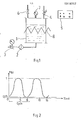
- FIG. 1 represents, by way of nonlimiting example, one of the devices that can be used to implement the method. This device makes it possible to obtain pressurization-depressurization cycles such as that shown on the curve of Figure 2.
- FIG. 1 there is a fermentor 1 containing the solid medium.
- a fermentor 1 containing the solid medium.
- the pressure of the air entering the reactor cannot exceed a threshold imposed by the pressure regulator 3.
- the air which has passed through the fermenter is evacuated through the solenoid valve 4.
- the opening and closing cycle of this solenoid valve 4 is controlled by the programmer 5.
- a tube 6 allows the inoculum and any additive necessary for the culture to be injected into the reactor.
- the pressure gauges 3 and 7 make it possible to monitor the pressure variations at the inlet and at the outlet of the reactor.
- a heat exchanger 8 ensures a certain constant temperature within the mass.
- the pressure regulator is adjusted to a maximum relative pressure of 1 bar; it therefore allows air to pass as long as the pressure in the fermenter has not reached 1 bar.
- the solenoid valve 4 is kept closed for 5 minutes, then opened for 3 minutes.
- the pressure cycle in FIG. 2 is applied using the device in FIG. 1 where the volume of the fermenter is 2 liters.
- the solid support here consists of cork sawdust (60g) soaked in 200ml of medium having the following composition:
- the medium the pH of which is adjusted to 7, is mixed with sawdust.
- the medium soaked in medium is introduced into the fermenter.
- the liar, fitted with its air filter, is autoclaved for 30 minutes at 120 ° C. After sterilization, it is placed in a thermosstated bath at 30 ° C and the air pressure variation cycle; is started in the first case, while air is continuously injected in the second case. In both cases, the average air flow is 0.5 vvm.
- the medium is aseptically seeded with a suspension of yeasts (Saccharoyces cerevisiae). After 48 hours of culture, 250 ml of the medium defined above are added; the growth results are shown in the table below:
- the process makes it possible to obtain a quantity of yeasts much greater than that which is obtained by continuous injection of air.
- concentration of yeasts is homogeneous in the culture carried out according to the method.
- the lower number of yeasts obtained by continuous air injection is explained by a non-homogeneous distribution of yeasts which have only multiplied in the zones of preferential passages.
- the growth speed is higher when the air injection is carried out according to the method.
- This same device of FIG. 1 can be used for other types of culture, such as for example the culture of a Fusarium graminearum fungus.
- the objective of the culture is the production of zearalenone, metabolite synthesized by this strain of Fusarium.
- the culture medium consists of rice soaked in water.
- the pressurization-depressurization cycle applied to the fermenter is that shown in Figure 2 during the growth phase (1 week at 27 ° C). During this phase, the average air flow is maintained at 0.5 vvm. Then, the culture is maintained at 14 ° C for 3 weeks. During this maintenance at low temperature, the average air flow rate is reduced to 0.1 vvm. We can see a normal development of the strain, both macroscopic point of view than microscopic point of view.
- test is carried out in parallel on a thin layer of substrate (1 to 2 cm) in a 1 liter Erlenmeyer flask capped with cotton, a classic technique used in the laboratory for the production of zearalenone.
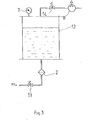
- FIG. 3 represents a device different from FIG. 1, in that the pressure cycle is obtained by operating a vacuum device 11 which creates the vacuum in the fermenter 12 while the solenoid valve 13 is closed.
- the solenoid valve 14 closes while the solenoid valve 13 opens.
- air sterilized by filtration is admitted into the fermenter and the pressure rises to atmospheric pressure.
- the air spreads throughout the solid medium insofar as the resistance to penetration up to these various points does not exceed the value of the relative depression obtained during the previous phase.
Landscapes
- Chemical & Material Sciences (AREA)
- Life Sciences & Earth Sciences (AREA)
- Health & Medical Sciences (AREA)
- Organic Chemistry (AREA)
- Zoology (AREA)
- Engineering & Computer Science (AREA)
- Bioinformatics & Cheminformatics (AREA)
- Wood Science & Technology (AREA)
- Genetics & Genomics (AREA)
- General Engineering & Computer Science (AREA)
- Sustainable Development (AREA)
- Biochemistry (AREA)
- Biomedical Technology (AREA)
- General Health & Medical Sciences (AREA)
- Microbiology (AREA)
- Biotechnology (AREA)
- Analytical Chemistry (AREA)
- Molecular Biology (AREA)
- Apparatus Associated With Microorganisms And Enzymes (AREA)
- Micro-Organisms Or Cultivation Processes Thereof (AREA)
- Fertilizers (AREA)
- Preparation Of Compounds By Using Micro-Organisms (AREA)
Applications Claiming Priority (2)
| Application Number | Priority Date | Filing Date | Title |
|---|---|---|---|
| FR7911956 | 1979-05-08 | ||
| FR7911956A FR2456139A1 (fr) | 1979-05-08 | 1979-05-08 | Procede d'aeration, d'evacuation des gaz de fermentation et d'elimination de calories dans les cultures de micro-organismes en milieu solide et dispositifs permettant de le mettre en oeuvre |
Publications (1)
| Publication Number | Publication Date |
|---|---|
| EP0018917A1 true EP0018917A1 (fr) | 1980-11-12 |
Family
ID=9225328
Family Applications (1)
| Application Number | Title | Priority Date | Filing Date |
|---|---|---|---|
| EP80400606A Withdrawn EP0018917A1 (fr) | 1979-05-08 | 1980-05-06 | Procédé d'aération, d'évacuation des gaz de fermentation et d'élimination de calories dans les cultures de micro-organismes en milieu solide et dispositifs permettant de le mettre en oeuvre |
Country Status (4)
| Country | Link |
|---|---|
| EP (1) | EP0018917A1 (OSRAM) |
| JP (1) | JPS5621589A (OSRAM) |
| ES (1) | ES8104399A1 (OSRAM) |
| FR (1) | FR2456139A1 (OSRAM) |
Cited By (1)
| Publication number | Priority date | Publication date | Assignee | Title |
|---|---|---|---|---|
| FR2572091A1 (fr) * | 1984-10-24 | 1986-04-25 | Inst Biokhim Fiziol | Procede de culture de champignons a mycelium sur un substrat solide et champignons obtenus par ledit procede |
Families Citing this family (1)
| Publication number | Priority date | Publication date | Assignee | Title |
|---|---|---|---|---|
| JPH0684035B2 (ja) * | 1986-06-04 | 1994-10-26 | 三菱重工業株式会社 | 成形機用スクリュ |
Citations (5)
| Publication number | Priority date | Publication date | Assignee | Title |
|---|---|---|---|---|
| DE346460C (de) * | 1916-08-27 | 1921-12-30 | Deutsch Koloniale Gerb & Farbs | Verfahren zur Herstellung von organischen Verbindungen durch Vergaerung |
| DE486282C (de) * | 1925-05-07 | 1929-11-13 | Fritz Noldin Dr Ing | Eintauchverfahren fuer die Essigherstellung |
| US2970088A (en) * | 1959-01-16 | 1961-01-31 | Robert R Freeman | Method for the cultivation of microorganisms |
| FR2090548A5 (en) * | 1970-04-24 | 1972-01-14 | Intermag Getranke Techni | Acceleration of life processes of microorganisms by - short pressure changes |
| FR2285454A1 (fr) * | 1974-09-19 | 1976-04-16 | Giovanola Freres Sa | Procede de transformation d'un substrat microbiologique et dispositif pour la realisation de ce procede |
-
1979
- 1979-05-08 FR FR7911956A patent/FR2456139A1/fr active Granted
-
1980
- 1980-05-06 EP EP80400606A patent/EP0018917A1/fr not_active Withdrawn
- 1980-05-08 ES ES491722A patent/ES8104399A1/es not_active Expired
- 1980-05-08 JP JP6002580A patent/JPS5621589A/ja active Pending
Patent Citations (5)
| Publication number | Priority date | Publication date | Assignee | Title |
|---|---|---|---|---|
| DE346460C (de) * | 1916-08-27 | 1921-12-30 | Deutsch Koloniale Gerb & Farbs | Verfahren zur Herstellung von organischen Verbindungen durch Vergaerung |
| DE486282C (de) * | 1925-05-07 | 1929-11-13 | Fritz Noldin Dr Ing | Eintauchverfahren fuer die Essigherstellung |
| US2970088A (en) * | 1959-01-16 | 1961-01-31 | Robert R Freeman | Method for the cultivation of microorganisms |
| FR2090548A5 (en) * | 1970-04-24 | 1972-01-14 | Intermag Getranke Techni | Acceleration of life processes of microorganisms by - short pressure changes |
| FR2285454A1 (fr) * | 1974-09-19 | 1976-04-16 | Giovanola Freres Sa | Procede de transformation d'un substrat microbiologique et dispositif pour la realisation de ce procede |
Cited By (1)
| Publication number | Priority date | Publication date | Assignee | Title |
|---|---|---|---|---|
| FR2572091A1 (fr) * | 1984-10-24 | 1986-04-25 | Inst Biokhim Fiziol | Procede de culture de champignons a mycelium sur un substrat solide et champignons obtenus par ledit procede |
Also Published As
| Publication number | Publication date |
|---|---|
| ES491722A0 (es) | 1981-04-16 |
| FR2456139B1 (OSRAM) | 1983-09-16 |
| ES8104399A1 (es) | 1981-04-16 |
| FR2456139A1 (fr) | 1980-12-05 |
| JPS5621589A (en) | 1981-02-28 |
Similar Documents
| Publication | Publication Date | Title |
|---|---|---|
| EP0640124B1 (fr) | Dispositif du type reacteur a volume variable et procede de culture de material cellulaire | |
| FR2601690A1 (fr) | Procede de production de methane a rendement eleve par culture de methanobacterium thermoautotrophicum ou de toute bacterie methanogene ayant les memes proprietes physiologiques de croissance | |
| FR2466503A1 (fr) | Procede de culture de cellules animales sous forme de cultures en suspension et monocouches dans des recipients de fermentation | |
| FR2924126A1 (fr) | Nouveau procede de culture d'une microalgue heterotrophe | |
| BE1006589A3 (fr) | Procede et appareil pour produire un acide amine par fermentation. | |
| EP0130116A1 (fr) | Paroi transparente en mousse de polyuréthane contenant des microorganismes, procédé pour sa préparation et utilisation de cette paroi dans un biophotoréacteur | |
| EP0018917A1 (fr) | Procédé d'aération, d'évacuation des gaz de fermentation et d'élimination de calories dans les cultures de micro-organismes en milieu solide et dispositifs permettant de le mettre en oeuvre | |
| US2707683A (en) | Method for the production of vinegar acids by oxidative fermentation of alcohols | |
| EP0277340B1 (fr) | Procédé et appareil pour la production d'alcool | |
| EP2771290B1 (fr) | Procédé de valorisation de déchets | |
| SU991954A3 (ru) | Способ получени монокариотического мицели гриба coRIoLUS VeRSIcoLoR (FR) QUeL | |
| EP0139592A2 (fr) | Procédé et installation de production d'amino-acides par fermentation | |
| US2053769A (en) | Removal of volatile compounds from a fermenting medium | |
| EP1891199B1 (fr) | Procede de preparation d'une boisson fermentee peu alcoolisee | |
| EP1180134B1 (fr) | Procede et dispositif de culture de cellules a applications multiples | |
| FR2645170A1 (fr) | Appareil pour la mise en oeuvre de procedes biocatalytiques en presence de biocatalyseurs en phase solide | |
| Hansson et al. | Effects of cultivation techniques and media on yields and morphology of the basidiomycete Armillaria mellea | |
| JP3004509B2 (ja) | 微細藻からのエタノール製造方法及び装置 | |
| CA1163937A (fr) | Procede et appareil pour la fermentation aerobie acceleree d'une substance dans un milieu nutritif | |
| FR2818659A1 (fr) | Procede et appareil de culture aerobie utilisant une membrane en metal fritte | |
| WO1999028438A1 (fr) | Dispositif d'amplification de cellules hematopoietiques et ses applications | |
| FR2616798A1 (fr) | Procede et installation de culture de microorganismes | |
| FR2886650A1 (fr) | Procede d'enrichissement de residus lignocellulosiques en proteines de levure | |
| CN114455694B (zh) | 一种快速实现生物转盘挂膜启动的方法 | |
| RU2814474C2 (ru) | Улучшенный петлевой ферментер |
Legal Events
| Date | Code | Title | Description |
|---|---|---|---|
| PUAI | Public reference made under article 153(3) epc to a published international application that has entered the european phase |
Free format text: ORIGINAL CODE: 0009012 |
|
| AK | Designated contracting states |
Designated state(s): AT CH DE GB IT NL |
|
| 17P | Request for examination filed |
Effective date: 19810507 |
|
| STAA | Information on the status of an ep patent application or granted ep patent |
Free format text: STATUS: THE APPLICATION IS DEEMED TO BE WITHDRAWN |
|
| 18D | Application deemed to be withdrawn |
Effective date: 19821111 |
|
| RIN1 | Information on inventor provided before grant (corrected) |
Inventor name: SANCHEZ, CHRISTIAN Inventor name: CHELLE, RENE |