EP0010406B1 - Polyimidfasern und Verfahren zu ihrer Herstellung - Google Patents
Polyimidfasern und Verfahren zu ihrer Herstellung Download PDFInfo
- Publication number
- EP0010406B1 EP0010406B1 EP79302187A EP79302187A EP0010406B1 EP 0010406 B1 EP0010406 B1 EP 0010406B1 EP 79302187 A EP79302187 A EP 79302187A EP 79302187 A EP79302187 A EP 79302187A EP 0010406 B1 EP0010406 B1 EP 0010406B1
- Authority
- EP
- European Patent Office
- Prior art keywords
- diamines
- diamine
- heterocyclic
- diamino diphenyl
- diamino
- Prior art date
- Legal status (The legal status is an assumption and is not a legal conclusion. Google has not performed a legal analysis and makes no representation as to the accuracy of the status listed.)
- Expired
Links
- 239000000835 fiber Substances 0.000 title claims description 28
- 239000004642 Polyimide Substances 0.000 title claims description 18
- 238000000034 method Methods 0.000 title claims description 18
- 229920001721 polyimide Polymers 0.000 title claims description 18
- 150000004985 diamines Chemical class 0.000 claims description 28
- 239000002243 precursor Substances 0.000 claims description 19
- 150000004984 aromatic diamines Chemical class 0.000 claims description 13
- 150000002148 esters Chemical class 0.000 claims description 13
- 239000000203 mixture Substances 0.000 claims description 11
- 238000005187 foaming Methods 0.000 claims description 10
- -1 heterocyclic diamine Chemical class 0.000 claims description 9
- IJGRMHOSHXDMSA-UHFFFAOYSA-N Atomic nitrogen Chemical compound N#N IJGRMHOSHXDMSA-UHFFFAOYSA-N 0.000 claims description 8
- 125000000623 heterocyclic group Chemical group 0.000 claims description 7
- UITKHKNFVCYWNG-UHFFFAOYSA-N 4-(3,4-dicarboxybenzoyl)phthalic acid Chemical compound C1=C(C(O)=O)C(C(=O)O)=CC=C1C(=O)C1=CC=C(C(O)=O)C(C(O)=O)=C1 UITKHKNFVCYWNG-UHFFFAOYSA-N 0.000 claims description 6
- 150000005690 diesters Chemical class 0.000 claims description 6
- 238000002844 melting Methods 0.000 claims description 6
- 230000008018 melting Effects 0.000 claims description 6
- 125000001931 aliphatic group Chemical group 0.000 claims description 5
- 238000010438 heat treatment Methods 0.000 claims description 5
- 125000003118 aryl group Chemical group 0.000 claims description 4
- 229910052757 nitrogen Inorganic materials 0.000 claims description 4
- VHNQIURBCCNWDN-UHFFFAOYSA-N pyridine-2,6-diamine Chemical compound NC1=CC=CC(N)=N1 VHNQIURBCCNWDN-UHFFFAOYSA-N 0.000 claims description 4
- WZCQRUWWHSTZEM-UHFFFAOYSA-N 1,3-phenylenediamine Chemical compound NC1=CC=CC(N)=C1 WZCQRUWWHSTZEM-UHFFFAOYSA-N 0.000 claims description 3
- CBCKQZAAMUWICA-UHFFFAOYSA-N 1,4-phenylenediamine Chemical compound NC1=CC=C(N)C=C1 CBCKQZAAMUWICA-UHFFFAOYSA-N 0.000 claims description 3
- LXJLFVRAWOOQDR-UHFFFAOYSA-N 3-(3-aminophenoxy)aniline Chemical compound NC1=CC=CC(OC=2C=C(N)C=CC=2)=C1 LXJLFVRAWOOQDR-UHFFFAOYSA-N 0.000 claims description 3
- MQJKPEGWNLWLTK-UHFFFAOYSA-N Dapsone Chemical compound C1=CC(N)=CC=C1S(=O)(=O)C1=CC=C(N)C=C1 MQJKPEGWNLWLTK-UHFFFAOYSA-N 0.000 claims description 3
- 238000006243 chemical reaction Methods 0.000 claims description 3
- 150000003949 imides Chemical class 0.000 claims description 3
- ABYXFACYSGVHCW-UHFFFAOYSA-N pyridine-3,5-diamine Chemical compound NC1=CN=CC(N)=C1 ABYXFACYSGVHCW-UHFFFAOYSA-N 0.000 claims description 3
- LJGHYPLBDBRCRZ-UHFFFAOYSA-N 3-(3-aminophenyl)sulfonylaniline Chemical compound NC1=CC=CC(S(=O)(=O)C=2C=C(N)C=CC=2)=C1 LJGHYPLBDBRCRZ-UHFFFAOYSA-N 0.000 claims description 2
- ICNFHJVPAJKPHW-UHFFFAOYSA-N 4,4'-Thiodianiline Chemical compound C1=CC(N)=CC=C1SC1=CC=C(N)C=C1 ICNFHJVPAJKPHW-UHFFFAOYSA-N 0.000 claims description 2
- HLBLWEWZXPIGSM-UHFFFAOYSA-N 4-Aminophenyl ether Chemical compound C1=CC(N)=CC=C1OC1=CC=C(N)C=C1 HLBLWEWZXPIGSM-UHFFFAOYSA-N 0.000 claims description 2
- 229920000642 polymer Polymers 0.000 claims description 2
- 150000001412 amines Chemical class 0.000 claims 2
- 238000012643 polycondensation polymerization Methods 0.000 claims 2
- 239000002253 acid Substances 0.000 claims 1
- 239000007795 chemical reaction product Substances 0.000 claims 1
- LTYMSROWYAPPGB-UHFFFAOYSA-N diphenyl sulfide Chemical compound C=1C=CC=CC=1SC1=CC=CC=C1 LTYMSROWYAPPGB-UHFFFAOYSA-N 0.000 claims 1
- 239000012768 molten material Substances 0.000 claims 1
- 239000003039 volatile agent Substances 0.000 description 10
- 235000019441 ethanol Nutrition 0.000 description 5
- LFQSCWFLJHTTHZ-UHFFFAOYSA-N Ethanol Chemical compound CCO LFQSCWFLJHTTHZ-UHFFFAOYSA-N 0.000 description 4
- 239000002904 solvent Substances 0.000 description 4
- 229920005575 poly(amic acid) Polymers 0.000 description 3
- 239000000779 smoke Substances 0.000 description 3
- 239000007787 solid Substances 0.000 description 3
- XKRFYHLGVUSROY-UHFFFAOYSA-N Argon Chemical compound [Ar] XKRFYHLGVUSROY-UHFFFAOYSA-N 0.000 description 2
- 239000006260 foam Substances 0.000 description 2
- 238000004519 manufacturing process Methods 0.000 description 2
- 238000006116 polymerization reaction Methods 0.000 description 2
- 239000000843 powder Substances 0.000 description 2
- 239000000047 product Substances 0.000 description 2
- 238000010992 reflux Methods 0.000 description 2
- 238000009987 spinning Methods 0.000 description 2
- 239000004094 surface-active agent Substances 0.000 description 2
- 239000012209 synthetic fiber Substances 0.000 description 2
- 229920002994 synthetic fiber Polymers 0.000 description 2
- RTZKZFJDLAIYFH-UHFFFAOYSA-N Diethyl ether Chemical compound CCOCC RTZKZFJDLAIYFH-UHFFFAOYSA-N 0.000 description 1
- 239000000654 additive Substances 0.000 description 1
- 150000001298 alcohols Chemical class 0.000 description 1
- 150000008064 anhydrides Chemical class 0.000 description 1
- 229910052786 argon Inorganic materials 0.000 description 1
- 230000015572 biosynthetic process Effects 0.000 description 1
- 239000006227 byproduct Substances 0.000 description 1
- 125000004432 carbon atom Chemical group C* 0.000 description 1
- 230000015556 catabolic process Effects 0.000 description 1
- 150000001875 compounds Chemical class 0.000 description 1
- 238000009833 condensation Methods 0.000 description 1
- 230000005494 condensation Effects 0.000 description 1
- 239000000470 constituent Substances 0.000 description 1
- 238000006731 degradation reaction Methods 0.000 description 1
- 239000003398 denaturant Substances 0.000 description 1
- 238000002845 discoloration Methods 0.000 description 1
- 238000009826 distribution Methods 0.000 description 1
- 238000001035 drying Methods 0.000 description 1
- 230000000694 effects Effects 0.000 description 1
- 230000032050 esterification Effects 0.000 description 1
- 238000005886 esterification reaction Methods 0.000 description 1
- 239000004744 fabric Substances 0.000 description 1
- 230000009970 fire resistant effect Effects 0.000 description 1
- 239000011261 inert gas Substances 0.000 description 1
- 230000001788 irregular Effects 0.000 description 1
- 239000007788 liquid Substances 0.000 description 1
- 239000000463 material Substances 0.000 description 1
- 239000000155 melt Substances 0.000 description 1
- 231100000252 nontoxic Toxicity 0.000 description 1
- 230000003000 nontoxic effect Effects 0.000 description 1
- 238000010525 oxidative degradation reaction Methods 0.000 description 1
- 239000011347 resin Substances 0.000 description 1
- 229920005989 resin Polymers 0.000 description 1
- 239000006188 syrup Substances 0.000 description 1
- 235000020357 syrup Nutrition 0.000 description 1
- 150000000000 tetracarboxylic acids Chemical class 0.000 description 1
- 231100000331 toxic Toxicity 0.000 description 1
- 230000002588 toxic effect Effects 0.000 description 1
- XLYOFNOQVPJJNP-UHFFFAOYSA-N water Substances O XLYOFNOQVPJJNP-UHFFFAOYSA-N 0.000 description 1
Images
Classifications
-
- C—CHEMISTRY; METALLURGY
- C08—ORGANIC MACROMOLECULAR COMPOUNDS; THEIR PREPARATION OR CHEMICAL WORKING-UP; COMPOSITIONS BASED THEREON
- C08J—WORKING-UP; GENERAL PROCESSES OF COMPOUNDING; AFTER-TREATMENT NOT COVERED BY SUBCLASSES C08B, C08C, C08F, C08G or C08H
- C08J9/00—Working-up of macromolecular substances to porous or cellular articles or materials; After-treatment thereof
- C08J9/02—Working-up of macromolecular substances to porous or cellular articles or materials; After-treatment thereof using blowing gases generated by the reacting monomers or modifying agents during the preparation or modification of macromolecules
-
- D—TEXTILES; PAPER
- D01—NATURAL OR MAN-MADE THREADS OR FIBRES; SPINNING
- D01D—MECHANICAL METHODS OR APPARATUS IN THE MANUFACTURE OF ARTIFICIAL FILAMENTS, THREADS, FIBRES, BRISTLES OR RIBBONS
- D01D5/00—Formation of filaments, threads, or the like
- D01D5/24—Formation of filaments, threads, or the like with a hollow structure; Spinnerette packs therefor
- D01D5/247—Discontinuous hollow structure or microporous structure
-
- D—TEXTILES; PAPER
- D01—NATURAL OR MAN-MADE THREADS OR FIBRES; SPINNING
- D01F—CHEMICAL FEATURES IN THE MANUFACTURE OF ARTIFICIAL FILAMENTS, THREADS, FIBRES, BRISTLES OR RIBBONS; APPARATUS SPECIALLY ADAPTED FOR THE MANUFACTURE OF CARBON FILAMENTS
- D01F6/00—Monocomponent artificial filaments or the like of synthetic polymers; Manufacture thereof
- D01F6/58—Monocomponent artificial filaments or the like of synthetic polymers; Manufacture thereof from homopolycondensation products
- D01F6/74—Monocomponent artificial filaments or the like of synthetic polymers; Manufacture thereof from homopolycondensation products from polycondensates of cyclic compounds, e.g. polyimides, polybenzimidazoles
-
- C—CHEMISTRY; METALLURGY
- C08—ORGANIC MACROMOLECULAR COMPOUNDS; THEIR PREPARATION OR CHEMICAL WORKING-UP; COMPOSITIONS BASED THEREON
- C08J—WORKING-UP; GENERAL PROCESSES OF COMPOUNDING; AFTER-TREATMENT NOT COVERED BY SUBCLASSES C08B, C08C, C08F, C08G or C08H
- C08J2379/00—Characterised by the use of macromolecular compounds obtained by reactions forming in the main chain of the macromolecule a linkage containing nitrogen with or without oxygen, or carbon only, not provided for in groups C08J2361/00 - C08J2377/00
- C08J2379/04—Polycondensates having nitrogen-containing heterocyclic rings in the main chain; Polyhydrazides; Polyamide acids or similar polyimide precursors
- C08J2379/08—Polyimides; Polyester-imides; Polyamide-imides; Polyamide acids or similar polyimide precursors
-
- Y—GENERAL TAGGING OF NEW TECHNOLOGICAL DEVELOPMENTS; GENERAL TAGGING OF CROSS-SECTIONAL TECHNOLOGIES SPANNING OVER SEVERAL SECTIONS OF THE IPC; TECHNICAL SUBJECTS COVERED BY FORMER USPC CROSS-REFERENCE ART COLLECTIONS [XRACs] AND DIGESTS
- Y10—TECHNICAL SUBJECTS COVERED BY FORMER USPC
- Y10S—TECHNICAL SUBJECTS COVERED BY FORMER USPC CROSS-REFERENCE ART COLLECTIONS [XRACs] AND DIGESTS
- Y10S264/00—Plastic and nonmetallic article shaping or treating: processes
- Y10S264/05—Use of one or more blowing agents together
Definitions
- the present invention relates to synthetic fibers and, more particularly, to novel, improved methods for making polyimide fibers having a unique porous, microcellular structure.
- Synthetic fibers are used in huge quantities in an almost unlimited variety of applications at this time.
- polyimides are highly fire resistant with improved versions of those materials being able to withstand temperatures as high as 650°F (343°C) or higher without significant oxidative degradation (see U.S. Patent No. 3,966,652 issued June 29, 1976, to John V. Long et al for METHOD OF MAKING FOAMED COPOLYIMIDES AND PRODUCT OBTAINED THEREFROM.
- those polyimides degrade into non-toxic compounds; and they do not give off smoke, both important advantages in applications where occupancy by humans or other animal life is concerned.
- polyimide fibers are made by melting and foaming a particulate precursor and then forming it into fibers which are heated to a temperature in the range of 280-315°C, optionally in an inert atmosphere, to effect imidization of the precursor.
- precursors we employ in the novel process just described are completely different from those heretofore used in making polyimide fibers in that they are essentially unreacted (or, preferably, incipiently polymerized), stoichiometric mixtures of aromatic and heterocyclic diamines and half esters of a benzophenonetetracarboxylic acid.
- At least one of the diamines we employ must be a heterocyclic diamine, and a second diamine is preferably an aromatic, meta or para- substituted diamine which contains no aliphatic moieties.
- the resulting fiber will be significantly less structurally stable. Also, smoke will be produced if the fiber is heated above its thermal degradation temperature.
- aromatic diamines examples include 3,3'-diamino diphenyl sulfone; 4,4'-diamino diphenyl sulfone; 4,4'-diamino diphenyl sulfide; 3,3'-diamino diphenyl ether; 4,4'-diamino diphenyl ether; meta-phenylene diamine; para-phenylene diamine; and mixtures of the foregoing.
- heterocyclic diamines we employ include 2,6-diamino pyridine and 3,5-diamino pyridine and mixtures thereof.
- the ester component of the precursor is prepared by reacting the tetracarboxylic acid or its anhydride with one or more aliphatic alcohols at up to reflux temperature to esterify it.
- the alcohols we use are those containing from 1 to 3 carbon atoms. Ethyl alcohol free of denaturants and additives is in many cases preferred.
- the mixture present after esterification is complete will typically be cooled before the diamines are added strictly as a safety measure.
- the diamines are then added and the mixture stirred, typically at reflux, until the diamines are dissolved.
- the resinoid is pulverized into a powder and then further processed to reduce its volatiles content to a value which is one to five percent lower than the theoretical volatiles content of the resinoid (the theoretical volatiles content is the weight percent of alcohol and water in the benzophenonetetracarboxylic ester and diamine molecules released during the condensation polymerication reactions. It is these volatiles that foam the resinoid during the foaming process).
- the volatiles content of the resin is lowered below the theoretical value to avoid the presence of free solvent as this tends to interfere with the foaming process. If the volatiles content is not reduced prior to foaming, volatilization may occur too fast in the foaming step, causing large voids and irregular cell structure.
- the volatiles content of the precursor can be reduced to the desired level by heating it at a temperature of from 65 to 121 °C for a period of five minutes to 24 hours. After this step the resinoid is again pulverized.
- the resulting resinoid powder has a long shelf life; it is free-flowing even after being stored for several months.
- One preferred precursor of the character just described consists of the diethyl ester of 3,3', 4,4'-benzophenonetetracarboxylic acid, 2-6 diamino pyridine, and 4,4'-diamino diphenyl sulfone in a ratio of 1.0:0.5:05 moles with 2.4 percent by weight of Union Carbide L-5430 surfactant and a reduced volatiles content obtained by heating the foregoing mixture at 200°C for six hours after the removal of the excess solvent.
- a related, important, and also primary object of our invention resides in the provision of polyimide fibers which have a novel expanded, microcellular structure.
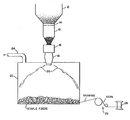
- That apparatus includes a foaming chamber 10 into which the particulate polyimide precursor is fed as from a hopper 12 by a metering pump 14. Chamber 10 is maintained at a temperature in the range of 100-200°C by a conventional heater (not shown).
- An inert atmosphere is preferably maintained in chamber 10. This can be accomplished by, for example, effecting a flow of an inert gas such as nitrogen or argon through the chamber.
- the precursor begins to melt and foam in chamber 10, producing a semi-molten mass which is transferred by a second pump 16 to a conventional spinning disk 18 (or, optionally, a perforated disk extruder) which forms the melt into fibers 20.
- a second pump 16 to a conventional spinning disk 18 (or, optionally, a perforated disk extruder) which forms the melt into fibers 20.
- the latter are discharged into a polymerization chamber 22 heated, again conventionally, to a temperature in the range of 280-315°C to complete the polymerization reactions.
- An inert atmosphere may also be maintained in this chamber by exhausting air and volatiles through outlet 24.
- the fibers are then drawn and processed conventionally with apparatus identified generally by reference character 26 and wound onto a spindle 28 to complete the process.
Landscapes
- Chemical & Material Sciences (AREA)
- Engineering & Computer Science (AREA)
- Textile Engineering (AREA)
- Chemical Kinetics & Catalysis (AREA)
- Materials Engineering (AREA)
- Mechanical Engineering (AREA)
- General Chemical & Material Sciences (AREA)
- Health & Medical Sciences (AREA)
- Medicinal Chemistry (AREA)
- Polymers & Plastics (AREA)
- Organic Chemistry (AREA)
- Macromolecular Compounds Obtained By Forming Nitrogen-Containing Linkages In General (AREA)
- Artificial Filaments (AREA)
- Manufacture Of Porous Articles, And Recovery And Treatment Of Waste Products (AREA)
- Polymers With Sulfur, Phosphorus Or Metals In The Main Chain (AREA)
Claims (7)
Applications Claiming Priority (2)
| Application Number | Priority Date | Filing Date | Title |
|---|---|---|---|
| US05/952,738 US4299787A (en) | 1978-10-19 | 1978-10-19 | Melt spinning polyimide fibers |
| US952738 | 1978-10-19 |
Publications (2)
| Publication Number | Publication Date |
|---|---|
| EP0010406A1 EP0010406A1 (de) | 1980-04-30 |
| EP0010406B1 true EP0010406B1 (de) | 1983-03-02 |
Family
ID=25493188
Family Applications (1)
| Application Number | Title | Priority Date | Filing Date |
|---|---|---|---|
| EP79302187A Expired EP0010406B1 (de) | 1978-10-19 | 1979-10-11 | Polyimidfasern und Verfahren zu ihrer Herstellung |
Country Status (5)
| Country | Link |
|---|---|
| US (1) | US4299787A (de) |
| EP (1) | EP0010406B1 (de) |
| JP (1) | JPS5557011A (de) |
| CA (1) | CA1132320A (de) |
| DE (1) | DE2964969D1 (de) |
Families Citing this family (17)
| Publication number | Priority date | Publication date | Assignee | Title |
|---|---|---|---|---|
| US4296208A (en) * | 1980-09-12 | 1981-10-20 | International Harvester Company | Methods of preparing polyimides and polyimide precursors |
| US4360604A (en) * | 1981-04-10 | 1982-11-23 | International Harvester Co. | Polyimide foams |
| US4369261A (en) * | 1981-04-10 | 1983-01-18 | International Harvester Company | Polyimide foams |
| US4355120A (en) * | 1981-04-10 | 1982-10-19 | International Harvester Co. | Polyimide foams |
| JPS58186073U (ja) * | 1982-06-04 | 1983-12-10 | 日本フネン株式会社 | ドアの錠前装置 |
| EP0291801A3 (de) * | 1987-05-21 | 1990-09-12 | Akzo N.V. | Verfahren zum Herstellen von Fasern aus Polyätherimid und Fasern aus Polyätherimid |
| US4892896A (en) * | 1988-04-04 | 1990-01-09 | Ethyl Corporation | Processing polyimide precursor compositions |
| US4814357A (en) * | 1988-04-28 | 1989-03-21 | Ethyl Corporation | Polyimide foams and their preparation |
| US4839398A (en) * | 1988-04-28 | 1989-06-13 | Ethyl Corporation | Polyimide foams and their preparation |
| US4866104A (en) * | 1988-05-26 | 1989-09-12 | Ethyl Corporation | Polyimide foams and their production |
| US4855332A (en) * | 1988-05-26 | 1989-08-08 | Ethyl Corporation | Polyimide foams and their production |
| US4826886A (en) * | 1988-05-26 | 1989-05-02 | Ethyl Corporation | Polyimide foams and their production |
| US4952611A (en) * | 1988-05-26 | 1990-08-28 | Ethyl Corporation | Polyimide foams and their production |
| US4855331A (en) * | 1988-06-20 | 1989-08-08 | Ethyl Corporation | Production of foamed polymer structures |
| US4897432A (en) * | 1988-06-20 | 1990-01-30 | Ethyl Corporation | Production of foamed polymer structures |
| US4879182A (en) * | 1988-10-24 | 1989-11-07 | Ethyl Corporation | Method of coating carbon bodies |
| CN118852617A (zh) * | 2023-04-28 | 2024-10-29 | 上海大学 | 一种聚酰亚胺保温材料及制备方法 |
Family Cites Families (18)
| Publication number | Priority date | Publication date | Assignee | Title |
|---|---|---|---|---|
| DE1202981C2 (de) | 1959-04-01 | 1975-06-12 | Du Pont | Verfahren zur herstellung von aromatischen polyimidformkoerpern |
| CH481167A (de) * | 1960-03-11 | 1969-11-15 | Du Pont | Verfahren zur Herstellung von Polyimid-Formgegenständen oder -Überzügen |
| US3415782A (en) * | 1964-03-30 | 1968-12-10 | Du Pont | Formation of polypyromellitimide filaments |
| GB1038738A (en) | 1964-03-30 | 1966-08-10 | Du Pont | Polyimide filaments |
| US3420795A (en) * | 1964-09-01 | 1969-01-07 | Du Pont | Polyamides and polyimides from diamines containing alkoxy phenol groups |
| GB1151821A (en) * | 1964-11-11 | 1969-05-14 | Ici Ltd | Dry Spun Filaments. |
| GB1121325A (en) | 1964-11-11 | 1968-07-24 | Ici Ltd | Aqueous solutions of polyamide acids |
| GB1188936A (en) | 1966-09-06 | 1970-04-22 | Ici Ltd | Obtaining Filaments from Polyamide Acid Salts |
| US3494823A (en) * | 1967-01-17 | 1970-02-10 | Minnesota Mining & Mfg | Shaped polyimides and method |
| DE1720884B2 (de) * | 1968-01-08 | 1976-06-16 | Enka Glanzstoff Ag, 5600 Wuppertal | Verfahren zur herstellung stickstoffhaltiger polykondensate |
| US3506583A (en) * | 1968-03-14 | 1970-04-14 | Int Harvester Co | Monomeric,solid state solutions of certain aromatic diamines in derivatives of benzophenonetetracarboxylic acid |
| US3832330A (en) * | 1968-08-12 | 1974-08-27 | Ici Ltd | Polymerization of tetracarboxylic acid derivatives and urea or urethane derivatives of diamines |
| US3726834A (en) * | 1972-07-03 | 1973-04-10 | Int Harvester Co | Thermoplastic copolyimides |
| US3793281A (en) * | 1972-07-14 | 1974-02-19 | Int Harvester Co | Thermoplastic copolyimides |
| US4094862A (en) * | 1974-03-05 | 1978-06-13 | The United States Of America As Represented By The Administrator Of The National Aeronautics And Space Administration | Process for preparing thermoplastic aromatic polyimides |
| US3985934A (en) * | 1974-07-26 | 1976-10-12 | The Upjohn Company | Polyimide fiber having a serrated surface and a process of producing same |
| US3966652A (en) * | 1974-11-11 | 1976-06-29 | International Harvester Company | Method of making foamed copolyimides and product obtained therefrom |
| US4070312A (en) * | 1975-05-27 | 1978-01-24 | International Harvester Company | Closed cell polyimides |
-
1978
- 1978-10-19 US US05/952,738 patent/US4299787A/en not_active Expired - Lifetime
-
1979
- 1979-10-01 CA CA336,769A patent/CA1132320A/en not_active Expired
- 1979-10-11 EP EP79302187A patent/EP0010406B1/de not_active Expired
- 1979-10-11 DE DE7979302187T patent/DE2964969D1/de not_active Expired
- 1979-10-18 JP JP13472779A patent/JPS5557011A/ja active Granted
Also Published As
| Publication number | Publication date |
|---|---|
| DE2964969D1 (en) | 1983-04-07 |
| EP0010406A1 (de) | 1980-04-30 |
| JPS5557011A (en) | 1980-04-26 |
| US4299787A (en) | 1981-11-10 |
| JPS5754569B2 (de) | 1982-11-18 |
| CA1132320A (en) | 1982-09-28 |
Similar Documents
| Publication | Publication Date | Title |
|---|---|---|
| EP0010406B1 (de) | Polyimidfasern und Verfahren zu ihrer Herstellung | |
| US4153783A (en) | Copolyimides | |
| USRE30213E (en) | Method of making foamed copolyimides and product obtained therefrom | |
| US4255488A (en) | Polyimide fibers | |
| US3726834A (en) | Thermoplastic copolyimides | |
| US4708972A (en) | Steam resistant modified polyimide foams | |
| EP0036330B1 (de) | Verfahren zur kontinuierlichen Herstellung einer aromatischen Polyimidfolie | |
| CA1162699A (en) | Methods of preparing polyimides and polyimide precursors | |
| US4360604A (en) | Polyimide foams | |
| JP4825112B2 (ja) | 高いTg、高いTOS、および低い水分率を有するポリイミド成形品 | |
| JPS61195126A (ja) | ポリイミド発泡体の材料組成物の製造方法及びポリイミド発泡体の製造方法 | |
| JP2002012688A (ja) | 発泡ポリイミドおよびその製法 | |
| US4539336A (en) | Modified polyimide/polyimide-amide foams and methods of making same | |
| US3961009A (en) | Process for the production of a shaped article of a heat resistant polymer | |
| KR100560649B1 (ko) | 셀룰러 발포 재료를 제조하는 방법 및 이로부터 수득될 수 있는 셀룰러 발포 재료 | |
| EP0450505A2 (de) | Polyetherimidschaum-Vorläufer und Schäume mit verbesserten physikalischen Eigenschaften sowie Verfahren zu ihrer Herstellung | |
| EP0052793A1 (de) | Oligomere Äthylenterephthalat-Körner | |
| EP1000109B1 (de) | Feste ruckständen aus polyimidvorläufer | |
| EP0046074B1 (de) | Verfahren zur Herstellung von Polyimidlösung | |
| US4956450A (en) | Process for forming end-capped polyamic acids polyimides | |
| JPS5952662B2 (ja) | アミドイミド重合体の製造方法 | |
| US4973661A (en) | Process for forming end capped polyamic acids polyimides | |
| JPH0248571B2 (de) | ||
| US5122546A (en) | Polyimide foam precursor | |
| US4092274A (en) | Polymeric foams from cross-linkable poly-N-ary lenebenzimidazoles |
Legal Events
| Date | Code | Title | Description |
|---|---|---|---|
| PUAI | Public reference made under article 153(3) epc to a published international application that has entered the european phase |
Free format text: ORIGINAL CODE: 0009012 |
|
| AK | Designated contracting states |
Designated state(s): DE FR GB IT NL SE |
|
| 17P | Request for examination filed |
Effective date: 19801020 |
|
| ITF | It: translation for a ep patent filed | ||
| GRAA | (expected) grant |
Free format text: ORIGINAL CODE: 0009210 |
|
| AK | Designated contracting states |
Designated state(s): DE FR GB IT NL SE |
|
| PG25 | Lapsed in a contracting state [announced via postgrant information from national office to epo] |
Ref country code: SE Effective date: 19830302 |
|
| REF | Corresponds to: |
Ref document number: 2964969 Country of ref document: DE Date of ref document: 19830407 |
|
| RAP2 | Party data changed (patent owner data changed or rights of a patent transferred) |
Owner name: I M L CORPORATION |
|
| ET | Fr: translation filed | ||
| PG25 | Lapsed in a contracting state [announced via postgrant information from national office to epo] |
Ref country code: NL Effective date: 19840501 |
|
| NLV4 | Nl: lapsed or anulled due to non-payment of the annual fee | ||
| PG25 | Lapsed in a contracting state [announced via postgrant information from national office to epo] |
Ref country code: FR Free format text: LAPSE BECAUSE OF NON-PAYMENT OF DUE FEES Effective date: 19840629 |
|
| PG25 | Lapsed in a contracting state [announced via postgrant information from national office to epo] |
Ref country code: DE Effective date: 19840703 |
|
| REG | Reference to a national code |
Ref country code: FR Ref legal event code: ST |
|
| PG25 | Lapsed in a contracting state [announced via postgrant information from national office to epo] |
Ref country code: GB Effective date: 19881118 |
|
| PLBE | No opposition filed within time limit |
Free format text: ORIGINAL CODE: 0009261 |
|
| STAA | Information on the status of an ep patent application or granted ep patent |
Free format text: STATUS: NO OPPOSITION FILED WITHIN TIME LIMIT |