EP0010374B1 - A method of and apparatus for monitoring platelet aggregation and test cell for use in such method and apparatus - Google Patents
A method of and apparatus for monitoring platelet aggregation and test cell for use in such method and apparatus Download PDFInfo
- Publication number
- EP0010374B1 EP0010374B1 EP79302067A EP79302067A EP0010374B1 EP 0010374 B1 EP0010374 B1 EP 0010374B1 EP 79302067 A EP79302067 A EP 79302067A EP 79302067 A EP79302067 A EP 79302067A EP 0010374 B1 EP0010374 B1 EP 0010374B1
- Authority
- EP
- European Patent Office
- Prior art keywords
- electrodes
- sample
- test cell
- monitoring
- aggregation
- Prior art date
- Legal status (The legal status is an assumption and is not a legal conclusion. Google has not performed a legal analysis and makes no representation as to the accuracy of the status listed.)
- Expired
Links
- 238000012360 testing method Methods 0.000 title claims description 33
- 238000012544 monitoring process Methods 0.000 title claims description 20
- 238000000034 method Methods 0.000 title claims description 18
- 208000010110 spontaneous platelet aggregation Diseases 0.000 title claims description 14
- 210000004027 cell Anatomy 0.000 claims description 46
- 210000001772 blood platelet Anatomy 0.000 claims description 44
- 230000002776 aggregation Effects 0.000 claims description 19
- 238000004220 aggregation Methods 0.000 claims description 19
- 230000008859 change Effects 0.000 claims description 13
- 102000008186 Collagen Human genes 0.000 claims description 6
- 108010035532 Collagen Proteins 0.000 claims description 6
- 229920001436 collagen Polymers 0.000 claims description 6
- 239000011248 coating agent Substances 0.000 claims 1
- 238000000576 coating method Methods 0.000 claims 1
- 210000004369 blood Anatomy 0.000 description 19
- 239000008280 blood Substances 0.000 description 19
- 230000003287 optical effect Effects 0.000 description 10
- BASFCYQUMIYNBI-UHFFFAOYSA-N platinum Chemical compound [Pt] BASFCYQUMIYNBI-UHFFFAOYSA-N 0.000 description 8
- 230000004931 aggregating effect Effects 0.000 description 7
- 239000003795 chemical substances by application Substances 0.000 description 7
- 239000007788 liquid Substances 0.000 description 6
- 230000004044 response Effects 0.000 description 6
- 238000003756 stirring Methods 0.000 description 5
- YZXBAPSDXZZRGB-DOFZRALJSA-N arachidonic acid Chemical compound CCCCC\C=C/C\C=C/C\C=C/C\C=C/CCCC(O)=O YZXBAPSDXZZRGB-DOFZRALJSA-N 0.000 description 4
- CGIGDMFJXJATDK-UHFFFAOYSA-N indomethacin Chemical compound CC1=C(CC(O)=O)C2=CC(OC)=CC=C2N1C(=O)C1=CC=C(Cl)C=C1 CGIGDMFJXJATDK-UHFFFAOYSA-N 0.000 description 4
- 239000000463 material Substances 0.000 description 4
- 229910052697 platinum Inorganic materials 0.000 description 4
- 230000008569 process Effects 0.000 description 4
- 230000005540 biological transmission Effects 0.000 description 3
- 230000023555 blood coagulation Effects 0.000 description 3
- 238000006243 chemical reaction Methods 0.000 description 3
- KAQKFAOMNZTLHT-VVUHWYTRSA-N epoprostenol Chemical compound O1C(=CCCCC(O)=O)C[C@@H]2[C@@H](/C=C/[C@@H](O)CCCCC)[C@H](O)C[C@@H]21 KAQKFAOMNZTLHT-VVUHWYTRSA-N 0.000 description 3
- 229960001123 epoprostenol Drugs 0.000 description 3
- 238000002474 experimental method Methods 0.000 description 3
- 239000011521 glass Substances 0.000 description 3
- 210000002381 plasma Anatomy 0.000 description 3
- 238000000926 separation method Methods 0.000 description 3
- 241000283973 Oryctolagus cuniculus Species 0.000 description 2
- 229940114079 arachidonic acid Drugs 0.000 description 2
- 235000021342 arachidonic acid Nutrition 0.000 description 2
- 210000004204 blood vessel Anatomy 0.000 description 2
- 238000010276 construction Methods 0.000 description 2
- 230000000694 effects Effects 0.000 description 2
- 230000005284 excitation Effects 0.000 description 2
- 238000001727 in vivo Methods 0.000 description 2
- 229960000905 indomethacin Drugs 0.000 description 2
- 150000002500 ions Chemical class 0.000 description 2
- 230000002427 irreversible effect Effects 0.000 description 2
- 230000000873 masking effect Effects 0.000 description 2
- 239000012528 membrane Substances 0.000 description 2
- 238000011160 research Methods 0.000 description 2
- 230000035945 sensitivity Effects 0.000 description 2
- 239000002356 single layer Substances 0.000 description 2
- 208000011580 syndromic disease Diseases 0.000 description 2
- 210000001519 tissue Anatomy 0.000 description 2
- 208000037157 Azotemia Diseases 0.000 description 1
- 208000001593 Bernard-Soulier syndrome Diseases 0.000 description 1
- 206010053567 Coagulopathies Diseases 0.000 description 1
- 208000028702 Congenital thrombocyte disease Diseases 0.000 description 1
- 208000013607 Glanzmann thrombasthenia Diseases 0.000 description 1
- 208000013544 Platelet disease Diseases 0.000 description 1
- 229910000971 Silver steel Inorganic materials 0.000 description 1
- FAPWRFPIFSIZLT-UHFFFAOYSA-M Sodium chloride Chemical compound [Na+].[Cl-] FAPWRFPIFSIZLT-UHFFFAOYSA-M 0.000 description 1
- 108090000190 Thrombin Proteins 0.000 description 1
- 208000027276 Von Willebrand disease Diseases 0.000 description 1
- 208000027418 Wounds and injury Diseases 0.000 description 1
- 230000002159 abnormal effect Effects 0.000 description 1
- 230000009471 action Effects 0.000 description 1
- 230000001070 adhesive effect Effects 0.000 description 1
- 239000003146 anticoagulant agent Substances 0.000 description 1
- 229940127219 anticoagulant drug Drugs 0.000 description 1
- 230000010100 anticoagulation Effects 0.000 description 1
- 238000003556 assay Methods 0.000 description 1
- QVGXLLKOCUKJST-UHFFFAOYSA-N atomic oxygen Chemical compound [O] QVGXLLKOCUKJST-UHFFFAOYSA-N 0.000 description 1
- 230000002051 biphasic effect Effects 0.000 description 1
- 230000036760 body temperature Effects 0.000 description 1
- 239000003990 capacitor Substances 0.000 description 1
- 230000007248 cellular mechanism Effects 0.000 description 1
- 238000005119 centrifugation Methods 0.000 description 1
- 238000004140 cleaning Methods 0.000 description 1
- 230000035602 clotting Effects 0.000 description 1
- 210000002808 connective tissue Anatomy 0.000 description 1
- 238000012937 correction Methods 0.000 description 1
- 230000008878 coupling Effects 0.000 description 1
- 238000010168 coupling process Methods 0.000 description 1
- 238000005859 coupling reaction Methods 0.000 description 1
- 230000006378 damage Effects 0.000 description 1
- 230000007547 defect Effects 0.000 description 1
- 238000013461 design Methods 0.000 description 1
- 238000003745 diagnosis Methods 0.000 description 1
- 238000010586 diagram Methods 0.000 description 1
- 208000037265 diseases, disorders, signs and symptoms Diseases 0.000 description 1
- 229940079593 drug Drugs 0.000 description 1
- 239000003814 drug Substances 0.000 description 1
- 230000005294 ferromagnetic effect Effects 0.000 description 1
- 239000012530 fluid Substances 0.000 description 1
- ZZUFCTLCJUWOSV-UHFFFAOYSA-N furosemide Chemical compound C1=C(Cl)C(S(=O)(=O)N)=CC(C(O)=O)=C1NCC1=CC=CO1 ZZUFCTLCJUWOSV-UHFFFAOYSA-N 0.000 description 1
- 230000003760 hair shine Effects 0.000 description 1
- 230000002489 hematologic effect Effects 0.000 description 1
- 208000015181 infectious disease Diseases 0.000 description 1
- 208000012461 inherited thrombocytopenia Diseases 0.000 description 1
- 208000014674 injury Diseases 0.000 description 1
- 239000010410 layer Substances 0.000 description 1
- 230000005291 magnetic effect Effects 0.000 description 1
- 238000005259 measurement Methods 0.000 description 1
- 229910052760 oxygen Inorganic materials 0.000 description 1
- 239000001301 oxygen Substances 0.000 description 1
- 230000000737 periodic effect Effects 0.000 description 1
- 210000004623 platelet-rich plasma Anatomy 0.000 description 1
- 229920001343 polytetrafluoroethylene Polymers 0.000 description 1
- 150000003180 prostaglandins Chemical class 0.000 description 1
- 108090000623 proteins and genes Proteins 0.000 description 1
- 102000004169 proteins and genes Human genes 0.000 description 1
- 210000001243 pseudopodia Anatomy 0.000 description 1
- 230000002441 reversible effect Effects 0.000 description 1
- 238000012216 screening Methods 0.000 description 1
- 239000004332 silver Substances 0.000 description 1
- 239000011780 sodium chloride Substances 0.000 description 1
- 229910001220 stainless steel Inorganic materials 0.000 description 1
- 239000010935 stainless steel Substances 0.000 description 1
- 239000010902 straw Substances 0.000 description 1
- 239000000126 substance Substances 0.000 description 1
- 238000001356 surgical procedure Methods 0.000 description 1
- 229960004072 thrombin Drugs 0.000 description 1
- 206010043554 thrombocytopenia Diseases 0.000 description 1
- 230000009424 thromboembolic effect Effects 0.000 description 1
- 208000009852 uremia Diseases 0.000 description 1
- 230000002792 vascular Effects 0.000 description 1
- 208000012137 von Willebrand disease (hereditary or acquired) Diseases 0.000 description 1
Images

Classifications
-
- G—PHYSICS
- G01—MEASURING; TESTING
- G01N—INVESTIGATING OR ANALYSING MATERIALS BY DETERMINING THEIR CHEMICAL OR PHYSICAL PROPERTIES
- G01N33/00—Investigating or analysing materials by specific methods not covered by groups G01N1/00 - G01N31/00
- G01N33/48—Biological material, e.g. blood, urine; Haemocytometers
- G01N33/50—Chemical analysis of biological material, e.g. blood, urine; Testing involving biospecific ligand binding methods; Immunological testing
- G01N33/86—Chemical analysis of biological material, e.g. blood, urine; Testing involving biospecific ligand binding methods; Immunological testing involving blood coagulating time or factors, or their receptors
-
- G—PHYSICS
- G01—MEASURING; TESTING
- G01N—INVESTIGATING OR ANALYSING MATERIALS BY DETERMINING THEIR CHEMICAL OR PHYSICAL PROPERTIES
- G01N27/00—Investigating or analysing materials by the use of electric, electrochemical, or magnetic means
- G01N27/02—Investigating or analysing materials by the use of electric, electrochemical, or magnetic means by investigating impedance
- G01N27/04—Investigating or analysing materials by the use of electric, electrochemical, or magnetic means by investigating impedance by investigating resistance
- G01N27/06—Investigating or analysing materials by the use of electric, electrochemical, or magnetic means by investigating impedance by investigating resistance of a liquid
- G01N27/07—Construction of measuring vessels; Electrodes therefor
-
- G—PHYSICS
- G01—MEASURING; TESTING
- G01N—INVESTIGATING OR ANALYSING MATERIALS BY DETERMINING THEIR CHEMICAL OR PHYSICAL PROPERTIES
- G01N15/00—Investigating characteristics of particles; Investigating permeability, pore-volume or surface-area of porous materials
- G01N15/04—Investigating sedimentation of particle suspensions
- G01N15/05—Investigating sedimentation of particle suspensions in blood
Definitions
- the present invention relates to a method of, and apparatus for monitoring blood platelet aggregation and to a test cell for use in such a method and apparatus.
- Blood consists of cells suspended in a protein rich fluid called plasma.
- the most numerous are the “red cells” (in man, about 5.5 x 10 6 /mm 3 ) which emphasize in oxygen transport.
- the "white cells” (about 7000/mm 3 ) are involved one way or the other in combating infection.
- the third group are the platelets (250,000/mm 3 ) - these are small disc-shaped cells and their chief function is to maintain the integrity of the vascular system - not only during injury, but also day-to-day wear and tear. To do this, platelets can, when they come into contact with certain materials and chemicals (especially those released from damaged cells), undergo a process known as the aggregation-adhesion reaction.
- the phenomenon of aggregation is the most widely studied property of platelets: it is of interest not only for scientific reasons (platelets make an ideal test system for examining cellular mechanisms and drug action), but also has diagnostic significance since there are many conditions in which platelet function is abnormal, and screening of platelet function is in fact a common haematological test.
- the method most often used for measuring the platelet aggregation-adhesion reaction is the "Born aggregometer", first described in 1962.
- the principle of the method is quite simple: After the addition of a suitable anticoagulant a blood sample is gently centrifuged. This separates the blood into two fractions; the red and white cells which are heavy settle at the bottom of the tube leaving the straw coloured plasma containing the platelets at the top of the tube. This top layer is carefully removed and is generally referred to as "platelet rich plasma” (PRP for short).
- PRP platelet rich plasma
- small aliquots of PRP are transferred to a small glass cuvette, referenced 1 in Figure 1 of the accompanying drawings, which is maintained at body temperature (37°C) by being positioned in a heated block 2 and constantly stirred (at a known speed) by a bar 3 to facilitate mixing.
- a narrow light beam from a light source L shines through the glass cuvette containing the PRP and the transmitted light is measured the other side of the cuvette by means of a sensitive photocell P.
- untreated PRP the majority of the light is scattered by the platelets. and transmission is minimal; when an aggregating agent is added to the cuvette the platelets clump together and the light transmission increases.
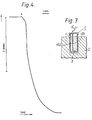
- the aggregating agent is collagen (a type of connective tissue found in blood vessels and many other places in the body) and notable features of the aggregation include a delay time and an irreversible aggregation. Not all aggregating agents are irreversible, and some may induce aggregation immediately with no delay time.
- the invention thus seeks to provide a method of and apparatus for monitoring platelet aggregation which avoids the disadvantages of the previous optical and membrane capacitance aggregometers.
- our solution thus relies upon a different principle for its operation from the prior aggregometers and because it does not require a light transmitting sample it can be utilized with whole blood as well as with PRP.
- our apparatus relies upon the covering by platelets of foreign objects placed in the cuvette.
- these "foreign objects" are electrodes, e.g. two fine platinum wires. During the initial contact with the sample the electrodes become coated with a platelet monolayer. In the presence of aggregating agents, however, further platelets then stick to the monolayer and progressively build up on the electrodes. This build-up of platelets can be quantized by measuring the increase in resistance between the platinum wires.
- a method of monitoring blood-platelet aggregation in a platelet-containing sample characterised by the step of monitoring, using an AC signal, the change in electrical resistance between electrodes in the sample while relative movement of the sample and electrodes occurs, the electrodes being formed by wires not more than approximately 0.25 mm in diameter extending in a direction transverse to the path of relative movement of the sample and electrodes.
- the invention also provides apparatus for monitoring blood-platelet aggregation comprising: a test cell for a platelet-containing sample, means being provided so as in use to cause movement of the sample in the cell characterised by a plurality of electrodes and associated means for mounting them in predetermined positions with respect to one another in the test cell, the electrodes each being formed by wires not more than approximately 0.25 mm in diameter extending transverse to the path of said movement of the sample in the cell; and circuitry for monitoring the change in electrical resistance between the electrodes, using an AC signal applied to the electrodes.
- the change in resistance between the electrodes which takes place during platelet aggregation appears not to result from e.g. changes in ion concentrations, but rather from the masking effect which the platelets have as they adhere to the electrodes thereby reducing the surface area of the electrodes which is in contact with the liquid.
- the shape and dimensions of the electrodes are of significance both from the point of view of their surface area, which should be minimised (since although the number of platelets in a sample may be very large, the area which they are capable of masking, and thus the attendant change in resistance, is quite small) and because platelets seem to "prefer" to adhere to fine wires.
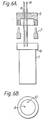
- One electrode configuration which we found to be particularly advantageous consists of two parallel wires each of 0.25 mm diameter spaced apart by about 1 mm and each having up to approximately 1.5 cm, preferably about 1 cm, of their length exposed to the liquid these being mounted on a removable lid of the test cell.
- the sample and electrodes While the resistance monitoring is taking place, relative movement of the sample and electrodes needs to occur as this increases the likelihood of aggregating platelets coming into contact with the electrodes.
- This relative movement may be achieved by stirring in the case of a unit sample and is of course inherent when the test cell is adapted for a through-flow of blood.
- the electrodes are preferably mounted off-centre with respect to the test cell holding the sample since the centre is of course where the flow of liquid during stirring is at a minimum.
- test cells have been produced with an electrode separation of 2 mm and have worked satisfactorily; this separation is at the upper limit of values which would give satisfactory results.
- test cells may be produced as a disposable item to avoid the need for cleaning of a cell between tests.
- the invention also provides a test cell for use in monitoring aggregation of blood platelets in a platelet-containing sample, the test cell comprising a cuvette, and being characterised by having mounted in predetermined positions therein electrodes each formed of wire of not more than approximately 0.25 mm diameter, so that the aggregation can be monitored by monitoring the electrical resistance between the electrodes via the sample using an AC signal applied across the electrodes.
- the present invention is not to be confused with prior proposals for monitoring blood clotting by electrical means.
- the electrical apparatus used for measuring blood clotting is superficially similar, the electrodes are designed with quite different considerations in mind and therefore different in structure as a result (see e.g. US-A-3 840 806, US-A-3 699 437 and US-A-2 555 937).
- US-A-3 840 806, US-A-3 699 437 and US-A-2 555 937 it is believed to be the change in ion concentration which brings about a change in resistance which is monitored and for this purpose the surface area of the electrodes should in general be maximised while in the present invention it should be minimised.
- the tube 9 serves as a guide for a microsyringe by means of which material may be injected into the liquid sample in cuvette 1.
- each of the electrodes 4A and 4B should be located off-centre with respect to the cuvette (i.e. displaced from its longitudinal axis) so as to increase the likelihood of platelets adhering to the electrodes.
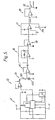
- the test cell is connected to the circuit shown in Figure 5 which detects the change in resistance between the electrodes as aggregation proceeds. To this end, it applies a known high frequency AC voltage across a potential divider, one arm of which is formed by the test cell and produces an output e.g. to a moving chart recorder representative of the resistance between the electrodes 4A and 4B. An AC signal is used to avoid polarisation of the electrode.
- the circuit shown in Figure 5 comprises a reference oscillator 11 based on a type 8038 waveform generator producing a sine wave output of approximately 15 khz which is applied via a buffer 12 and a decoupling capacitor (not referenced) to a potential divider 13, one arm of which is constituted by a 25 K variable resistor VR1 and the other arm of which is the test cell.
- the voltage at the junction of these two elements is amplified by an amplifier 14 and applied to a full-wave rectifier which comprises an operational amplifier in the so-called "perfect rectifier" configuration, that is to say the rectifying diodes are connected in its feed-back loop so that the forward voltage drop across these diodes is eliminated from the output of the rectifier.
- the output of the rectifier is buffered by an amplifier 16 and applied to a 1 Hz break point low pass filter 17 which produces a DC output voltage with an amplitude proportional to the amplitude of the voltage across the cell 100.
- This DC voltage is applied together with a voltage from a biasing network, to a zero shifting circuit 18 and a zero correction switch 19 to a chart recorder.
- variable resistor VR1 is set to give an output as indicated at the chart recorder corresponding to 100 millivolts across the cell 100.
- the preset potentiometer PS is then set to give zero output on the chart recorder and VR1 can then be used to adjust the output to zero with different samples i.e. blood or plasma.
- the apparatus is simple and easy to use.
- a suitable aliquot of PRP or blood (usually 1 ml) is put into a siliconised-glass cuvette 1 which may be of the type ordinarily used with optical aggregometers.
- the cuvette is warmed to 37°C, the liquid stirred, at constant speed, and the electrode assembly lid 5 is placed in position.
- the apparatus is turned to "record” and the baseline adjusted so that it is exactly “zero” (this guarantees that the correct voltage is applied across the cell) and a few minutes “baseline” recorded.
- the aggregating agent under test is added with a microsyringe through the guide tube 10 in the electrode assembly lid 5. This ensures the agents are delivered to exactly the same spot each time, which aids reproducibility.
- the efficient operation of the apparatus depends very much upon accurate control of temperature and stirring rate, but it is extremely simple to use and is suitable for measuring the aggregation of platelets within 1-2 minutes of obtaining the sample. It is therefore ideal for the assay with labile mediators such as prostacyclin.
- test cell and electrodes may be provided as a disposable unit to avoid the need to clean the cell between tests.
- One of the electrodes could be coated with collagen - the apparatus could then be used to measure the adhesive property of the platelets.
- the construction of the cell may be varied.
- the cell could be arranged so that blood can flow through it during use.
- the waveform of the cell excitation voltage may be changed. Any periodic AC waveform may be satisfactory although it should have no net DC level as otherwise undesirable polarisation may result.
- the 8038 IC is capable of producing, inter alia pulse, sine and triangular waveforms.
- thrombocytopenias or defects such as Von Willebrands disease, the Bernard-Soulier Syndrome, Wiscott-Aldrich Syndrome and May-Heggling anomaly, Glanz- manns Thrombasthenia and the Portsmouth Syndrome as well as acquired conditions, such as essential thrombocytopenia or uremia.
- the apparatus may be used to provide a rapid check of the platelet aggregation of the blood of patients about to under surgery, etc.
Landscapes
- Health & Medical Sciences (AREA)
- Life Sciences & Earth Sciences (AREA)
- Chemical & Material Sciences (AREA)
- Engineering & Computer Science (AREA)
- Immunology (AREA)
- Hematology (AREA)
- Biomedical Technology (AREA)
- Pathology (AREA)
- Analytical Chemistry (AREA)
- General Physics & Mathematics (AREA)
- Molecular Biology (AREA)
- Urology & Nephrology (AREA)
- General Health & Medical Sciences (AREA)
- Biochemistry (AREA)
- Physics & Mathematics (AREA)
- Cell Biology (AREA)
- Medicinal Chemistry (AREA)
- Food Science & Technology (AREA)
- Microbiology (AREA)
- Biotechnology (AREA)
- Chemical Kinetics & Catalysis (AREA)
- Electrochemistry (AREA)
- Investigating Or Analysing Biological Materials (AREA)
- Investigating Or Analyzing Materials By The Use Of Electric Means (AREA)
Applications Claiming Priority (2)
| Application Number | Priority Date | Filing Date | Title |
|---|---|---|---|
| GB3900678 | 1978-10-02 | ||
| GB7839006 | 1978-10-02 |
Publications (2)
| Publication Number | Publication Date |
|---|---|
| EP0010374A1 EP0010374A1 (en) | 1980-04-30 |
| EP0010374B1 true EP0010374B1 (en) | 1984-01-25 |
Family
ID=10500059
Family Applications (1)
| Application Number | Title | Priority Date | Filing Date |
|---|---|---|---|
| EP79302067A Expired EP0010374B1 (en) | 1978-10-02 | 1979-10-01 | A method of and apparatus for monitoring platelet aggregation and test cell for use in such method and apparatus |
Country Status (6)
| Country | Link |
|---|---|
| US (1) | US4319194A (cg-RX-API-DMAC7.html) |
| EP (1) | EP0010374B1 (cg-RX-API-DMAC7.html) |
| JP (1) | JPS5550162A (cg-RX-API-DMAC7.html) |
| CA (1) | CA1140212A (cg-RX-API-DMAC7.html) |
| DE (1) | DE2966583D1 (cg-RX-API-DMAC7.html) |
| FI (1) | FI793043A7 (cg-RX-API-DMAC7.html) |
Families Citing this family (48)
| Publication number | Priority date | Publication date | Assignee | Title |
|---|---|---|---|---|
| JPS5810573B2 (ja) * | 1978-11-21 | 1983-02-26 | 日産自動車株式会社 | 火花点火式内燃機関 |
| SE423829B (sv) * | 1980-09-29 | 1982-06-07 | Hedelin Lars G B | Kamanordning med roterbart kamorgan, vars form er variabel |
| JPS57168041A (en) * | 1981-04-09 | 1982-10-16 | Mazda Motor Corp | Engine idle rpm control device |
| US4543339A (en) * | 1982-03-16 | 1985-09-24 | Oneill Christopher | Early pregnancy detection by detecting enhanced blood platelet activation |
| US4591793A (en) * | 1984-06-14 | 1986-05-27 | Freilich Arthur H | Aggregometer electrode structures |
| GB8621757D0 (en) * | 1986-09-10 | 1986-10-15 | Gorog P | Blood testing device |
| GB8701368D0 (en) * | 1987-01-22 | 1987-02-25 | Ecc Int Ltd | Monitoring flocculation state of particles in suspension |
| US4986964A (en) * | 1990-04-19 | 1991-01-22 | Center For Innovative Technology | Clot retractometer |
| US5316730A (en) * | 1992-12-07 | 1994-05-31 | Xylum Corporation | Disposable cartridge for investigating physical properties of blood |
| US5447440A (en) * | 1993-10-28 | 1995-09-05 | I-Stat Corporation | Apparatus for assaying viscosity changes in fluid samples and method of conducting same |
| US6004819A (en) * | 1996-11-04 | 1999-12-21 | Xylum Corporation | Blood testing device |
| US6043871A (en) * | 1997-03-03 | 2000-03-28 | Brigham Young University | System and method for measuring blood platelet function |
| WO1998039643A1 (en) * | 1997-03-05 | 1998-09-11 | Diametrics | Method and apparatus for measurement of whole blood coagulation parameters |
| US6004818A (en) * | 1997-08-07 | 1999-12-21 | Chrono-Log Corporation | Aggregometer with disposable test cell |
| AU2003900285A0 (en) * | 2003-01-20 | 2003-02-06 | Universal Biosensors Pty Limited | Electrochemical detection method |
| AU2004206032B2 (en) * | 2003-01-20 | 2008-09-25 | Universal Biosensors Pty Limited | Electrochemical detection method |
| GB0313015D0 (en) * | 2003-06-06 | 2003-07-09 | Hall Effect Technologies Ltd | Method and device for analysing a liquid |
| CA2547544C (en) * | 2003-12-16 | 2013-04-02 | Dynabyte Informationssysteme Gmbh | Cartridge device for blood analysis |
| ES2425082T3 (es) | 2003-12-16 | 2013-10-11 | F. Hoffmann-La Roche Ag | Método de análisis de sangre |
| EP2063273A1 (en) * | 2007-11-21 | 2009-05-27 | Pentapharm GmbH | Method for assessing the fibrinogen contribution in coagulation |
| WO2009111615A2 (en) | 2008-03-05 | 2009-09-11 | Thrombovision, Inc. | Systems for measuring properties of a physiological fluid suspension |
| DE102008022884A1 (de) * | 2008-05-08 | 2009-11-12 | Zander, Rolf, Prof. Dr.Med. | Vorrichtung und Verfahren für die Blutgerinnungsdiagnostik |
| US8448499B2 (en) | 2008-12-23 | 2013-05-28 | C A Casyso Ag | Cartridge device for a measuring system for measuring viscoelastic characteristics of a sample liquid, a corresponding measuring system, and a corresponding method |
| ES2692943T3 (es) * | 2008-12-23 | 2018-12-05 | C A Casyso Gmbh | Un dispositivo de cartucho para un sistema de medición para medir las características viscoelásticas de un líquido de muestra, un sistema de medición correspondiente y un procedimiento correspondiente |
| US8383045B2 (en) * | 2009-01-16 | 2013-02-26 | C A Casyso Ag | Measuring unit for measuring characteristics of a sample liquid, in particular viscoelastic characteristics of a blood sample |
| FR2955392B1 (fr) * | 2010-01-20 | 2017-11-17 | Comte Roger Le | Procede, dispositif et embout de mesure de vitesse d'agregation |
| EP2371284A1 (en) * | 2010-03-24 | 2011-10-05 | C A Casyso AG | Method and apparatus for determining at least one evaluation parameter of a blood sample |
| US8617468B2 (en) | 2011-10-18 | 2013-12-31 | Chrono-Log Corporation | Platelet aggregation test and device |
| US8772040B2 (en) * | 2012-08-31 | 2014-07-08 | Korea University Research And Business Foundation | Apparatus and method of platelet multi-function analysis, and micro stirring chip |
| JP2014115256A (ja) | 2012-12-12 | 2014-06-26 | Sony Corp | 電気的測定用容器、並びに電気的測定用装置および電気的測定方法 |
| BR112015016634A2 (pt) * | 2013-01-18 | 2017-07-11 | Sony Corp | dispositivo de medição de característica elétrica |
| JP6816792B2 (ja) * | 2014-01-07 | 2021-01-20 | ソニー株式会社 | 電気的測定用カートリッジ、並びに電気的測定装置及び電気的測定方法 |
| JP6569209B2 (ja) * | 2014-01-07 | 2019-09-04 | ソニー株式会社 | 電気的測定用カートリッジ、並びに電気的測定装置及び電気的測定方法 |
| US10288630B2 (en) | 2014-09-29 | 2019-05-14 | C A Casyso Gmbh | Blood testing system and method |
| US9897618B2 (en) | 2014-09-29 | 2018-02-20 | C A Casyso Gmbh | Blood testing system |
| US10175225B2 (en) | 2014-09-29 | 2019-01-08 | C A Casyso Ag | Blood testing system and method |
| US10816559B2 (en) | 2014-09-29 | 2020-10-27 | Ca Casyso Ag | Blood testing system and method |
| US10539579B2 (en) | 2014-09-29 | 2020-01-21 | C A Casyso Gmbh | Blood testing system and method |
| USD777343S1 (en) | 2015-05-28 | 2017-01-24 | C A Casyso Ag | Body fluid cartridge device |
| US10295554B2 (en) | 2015-06-29 | 2019-05-21 | C A Casyso Gmbh | Blood testing system and method |
| US20190049428A1 (en) * | 2016-02-17 | 2019-02-14 | Sony Corporation | Platelet aggregability analyzing device, platelet aggregability analyzing system, platelet aggregability analyzing program, and method of analyzing platelet aggregability |
| JP6070892B2 (ja) * | 2016-08-08 | 2017-02-01 | ソニー株式会社 | 電気的測定用容器、並びに電気的測定用装置および電気的測定方法 |
| US10473674B2 (en) | 2016-08-31 | 2019-11-12 | C A Casyso Gmbh | Controlled blood delivery to mixing chamber of a blood testing cartridge |
| US20200055044A1 (en) * | 2016-11-02 | 2020-02-20 | Atantares Corp. | Methods and systems for micro platelet function testing using an integrated miniaturized platelet function analyzer |
| JP6414234B2 (ja) * | 2017-01-05 | 2018-10-31 | ソニー株式会社 | 電気的測定用容器、並びに電気的測定用装置および電気的測定方法 |
| US10843185B2 (en) | 2017-07-12 | 2020-11-24 | Ca Casyso Gmbh | Autoplatelet cartridge device |
| JP6791220B2 (ja) * | 2018-09-18 | 2020-11-25 | ソニー株式会社 | 電気的測定用容器、並びに電気的測定装置および電気的測定方法 |
| CN114460153A (zh) * | 2022-01-27 | 2022-05-10 | 安邦(厦门)生物科技有限公司 | 一种用于检测全血血小板聚集功能的装置和方法 |
Family Cites Families (18)
| Publication number | Priority date | Publication date | Assignee | Title |
|---|---|---|---|---|
| US2555937A (en) * | 1949-08-25 | 1951-06-05 | Robert L Rosenthal | Method and apparatus for measuring resistance of blood during clotting |
| US2651751A (en) * | 1949-12-14 | 1953-09-08 | Howard R Heath | Apparatus for measuring resistance |
| US2769141A (en) * | 1953-06-01 | 1956-10-30 | Indiana University Foundation | Apparatus for measuring blood coagulation time and enzyme activity |
| DE1022822B (de) | 1954-05-10 | 1958-01-16 | Dr Heinrich Schnitger | Apparat zur Ermittlung der Fibrinbildung im Blute oder in Blutplasmaloesungen und zum Registrieren der Blutgerinnungszeit |
| GB973807A (en) * | 1959-12-24 | 1964-10-28 | Yellow Springs Instr | Improvements in instruments for determining characteristics of blood |
| NL298730A (cg-RX-API-DMAC7.html) * | 1962-04-18 | |||
| US3267362A (en) * | 1962-04-18 | 1966-08-16 | Becton Dickinson Co | Electrode carrier assembly |
| US3524727A (en) * | 1965-06-16 | 1970-08-18 | Corning Glass Works | Method and device for determining serological data by an agglomeration test |
| US3555937A (en) * | 1968-05-17 | 1971-01-19 | Kennametal Inc | Diamond drill |
| GB1299363A (en) * | 1968-09-27 | 1972-12-13 | Amiram Ur | Monitoring of chemical, bio-chemical and biological reactions, particularly blood-clotting |
| FR2079841A5 (cg-RX-API-DMAC7.html) * | 1970-02-13 | 1971-11-12 | Girolami Antoine | |
| US3648159A (en) * | 1970-03-11 | 1972-03-07 | Us Air Force | Portable, self-contained system for analyzing biological fluids or the like |
| NL7303522A (cg-RX-API-DMAC7.html) * | 1973-03-13 | 1974-09-17 | ||
| US3840806A (en) * | 1973-08-20 | 1974-10-08 | G Stoner | Instrument for measuring blood clotting times |
| US3861877A (en) * | 1974-01-21 | 1975-01-21 | Clinical Technology Inc | Optical analysis of fluids |
| FR2301011A1 (fr) * | 1975-02-12 | 1976-09-10 | Inst Nat Sante Rech Med | Appareil combine formant agregometre et coagulometre |
| US4002739A (en) * | 1975-02-18 | 1977-01-11 | Warner-Lambert Company | Soluble collagen |
| US4027660A (en) * | 1976-04-02 | 1977-06-07 | Wardlaw Stephen C | Material layer volume determination |
-
1979
- 1979-10-01 DE DE7979302067T patent/DE2966583D1/de not_active Expired
- 1979-10-01 CA CA000336751A patent/CA1140212A/en not_active Expired
- 1979-10-01 JP JP12672079A patent/JPS5550162A/ja active Granted
- 1979-10-01 EP EP79302067A patent/EP0010374B1/en not_active Expired
- 1979-10-01 US US06/080,525 patent/US4319194A/en not_active Expired - Lifetime
- 1979-10-01 FI FI793043A patent/FI793043A7/fi not_active Application Discontinuation
Also Published As
| Publication number | Publication date |
|---|---|
| EP0010374A1 (en) | 1980-04-30 |
| FI793043A7 (fi) | 1981-01-01 |
| DE2966583D1 (en) | 1984-03-01 |
| JPS5550162A (en) | 1980-04-11 |
| CA1140212A (en) | 1983-01-25 |
| US4319194A (en) | 1982-03-09 |
| JPS6312261B2 (cg-RX-API-DMAC7.html) | 1988-03-18 |
Similar Documents
| Publication | Publication Date | Title |
|---|---|---|
| EP0010374B1 (en) | A method of and apparatus for monitoring platelet aggregation and test cell for use in such method and apparatus | |
| US3699437A (en) | Blood coagulation detection method and apparatus | |
| EP0177858B1 (en) | Ultrasonic coagulation monitor and method | |
| CA1333754C (en) | Method for measurement of viscosity change in blood or the like and sensor thereof | |
| US20050015001A1 (en) | Acoustic blood analyzer for assessing blood properties | |
| US6004818A (en) | Aggregometer with disposable test cell | |
| JP7070641B2 (ja) | 血小板凝集能解析装置、血小板凝集能解析システム、血小板凝集能解析用プログラム及び血小板凝集能の解析方法 | |
| US4149405A (en) | Process for measuring the viscosity of a fluid substance | |
| US4026671A (en) | Test apparatus circuit | |
| JPS5915849A (ja) | 赤血球の変形能力測定装置 | |
| US4797369A (en) | Method and apparatus for detecting a blood clot | |
| CN106164669B (zh) | 血液状况分析装置和系统以及血液状况分析方法和程序 | |
| McKenzie et al. | Clinical utility of available methods for determining platelet function | |
| WO2014162285A1 (en) | Apparatus for analyzing the process of formation of aggregates in a biological fluid and corresponding method of analysis | |
| Hussain | Prothrombin Time (PT) for human plasma on QCM-D platform: A better alternative to'gold standard' | |
| JP6747491B2 (ja) | 血液状態解析装置、血液状態解析システム、血液状態解析方法、および該方法をコンピューターに実現させるための血液状態解析プログラム | |
| Podczasy et al. | Evaluation of whole-blood lumiaggregation | |
| US3267363A (en) | Electrical apparatus for fiber detection | |
| EP2845002B1 (en) | Method to analyze the cluster formation process in a biological fluid and corresponding analysis apparatus | |
| SU1347013A1 (ru) | Способ определени резистентности эритроцитов | |
| JPH06308130A (ja) | 材料の抗血栓性判定方法及び判定装置 | |
| JPH0470577B2 (cg-RX-API-DMAC7.html) | ||
| JPH02151768A (ja) | 血餅を検出する装置及び方法 | |
| Rooney et al. | AN ULTRASONIC DEVICE FOR USE IN THE HEMATOLOGY LABORATORY | |
| JPS56138238A (en) | Corpuscle analysis equipment |
Legal Events
| Date | Code | Title | Description |
|---|---|---|---|
| PUAI | Public reference made under article 153(3) epc to a published international application that has entered the european phase |
Free format text: ORIGINAL CODE: 0009012 |
|
| AK | Designated contracting states |
Designated state(s): CH DE FR GB IT SE |
|
| 17P | Request for examination filed |
Effective date: 19801016 |
|
| ITF | It: translation for a ep patent filed | ||
| GRAA | (expected) grant |
Free format text: ORIGINAL CODE: 0009210 |
|
| AK | Designated contracting states |
Designated state(s): CH DE FR GB IT SE |
|
| REF | Corresponds to: |
Ref document number: 2966583 Country of ref document: DE Date of ref document: 19840301 |
|
| ET | Fr: translation filed | ||
| PLBE | No opposition filed within time limit |
Free format text: ORIGINAL CODE: 0009261 |
|
| STAA | Information on the status of an ep patent application or granted ep patent |
Free format text: STATUS: NO OPPOSITION FILED WITHIN TIME LIMIT |
|
| 26N | No opposition filed | ||
| ITPR | It: changes in ownership of a european patent |
Owner name: CESSIONE;CHRONO LOG CORPORATION |
|
| REG | Reference to a national code |
Ref country code: CH Ref legal event code: PUE Owner name: CHRONO-LOG CORPORATION |
|
| REG | Reference to a national code |
Ref country code: FR Ref legal event code: TP |
|
| ITTA | It: last paid annual fee | ||
| PGFP | Annual fee paid to national office [announced via postgrant information from national office to epo] |
Ref country code: CH Payment date: 19940923 Year of fee payment: 16 |
|
| PGFP | Annual fee paid to national office [announced via postgrant information from national office to epo] |
Ref country code: SE Payment date: 19941017 Year of fee payment: 16 |
|
| EAL | Se: european patent in force in sweden |
Ref document number: 79302067.8 |
|
| PG25 | Lapsed in a contracting state [announced via postgrant information from national office to epo] |
Ref country code: SE Effective date: 19951002 |
|
| PG25 | Lapsed in a contracting state [announced via postgrant information from national office to epo] |
Ref country code: CH Effective date: 19951031 |
|
| REG | Reference to a national code |
Ref country code: CH Ref legal event code: PL |
|
| EUG | Se: european patent has lapsed |
Ref document number: 79302067.8 |
|
| PGFP | Annual fee paid to national office [announced via postgrant information from national office to epo] |
Ref country code: DE Payment date: 19961004 Year of fee payment: 18 |
|
| PGFP | Annual fee paid to national office [announced via postgrant information from national office to epo] |
Ref country code: GB Payment date: 19970922 Year of fee payment: 19 |
|
| PGFP | Annual fee paid to national office [announced via postgrant information from national office to epo] |
Ref country code: FR Payment date: 19971009 Year of fee payment: 19 |
|
| PG25 | Lapsed in a contracting state [announced via postgrant information from national office to epo] |
Ref country code: DE Free format text: LAPSE BECAUSE OF NON-PAYMENT OF DUE FEES Effective date: 19980701 |
|
| PG25 | Lapsed in a contracting state [announced via postgrant information from national office to epo] |
Ref country code: GB Free format text: LAPSE BECAUSE OF NON-PAYMENT OF DUE FEES Effective date: 19981001 |
|
| GBPC | Gb: european patent ceased through non-payment of renewal fee |
Effective date: 19981001 |
|
| PG25 | Lapsed in a contracting state [announced via postgrant information from national office to epo] |
Ref country code: FR Free format text: LAPSE BECAUSE OF NON-PAYMENT OF DUE FEES Effective date: 19990630 |
|
| REG | Reference to a national code |
Ref country code: FR Ref legal event code: ST |