EP0008434B1 - Ramextruder und Verfahren zur Herstellung von Kunststoffrohren in dem Ramextruder - Google Patents
Ramextruder und Verfahren zur Herstellung von Kunststoffrohren in dem Ramextruder Download PDFInfo
- Publication number
- EP0008434B1 EP0008434B1 EP79102953A EP79102953A EP0008434B1 EP 0008434 B1 EP0008434 B1 EP 0008434B1 EP 79102953 A EP79102953 A EP 79102953A EP 79102953 A EP79102953 A EP 79102953A EP 0008434 B1 EP0008434 B1 EP 0008434B1
- Authority
- EP
- European Patent Office
- Prior art keywords
- ram
- extrusion
- extruder
- mandrel
- die
- Prior art date
- Legal status (The legal status is an assumption and is not a legal conclusion. Google has not performed a legal analysis and makes no representation as to the accuracy of the status listed.)
- Expired
Links
- 229920003023 plastic Polymers 0.000 title claims description 15
- 239000004033 plastic Substances 0.000 title claims description 14
- 238000000034 method Methods 0.000 title claims description 13
- 238000004519 manufacturing process Methods 0.000 title claims description 11
- 239000004698 Polyethylene Substances 0.000 claims description 28
- 238000001125 extrusion Methods 0.000 claims description 22
- -1 polyethylene Polymers 0.000 claims description 10
- 229920000573 polyethylene Polymers 0.000 claims description 7
- 238000010438 heat treatment Methods 0.000 claims description 5
- 238000001816 cooling Methods 0.000 claims description 3
- 230000008602 contraction Effects 0.000 claims 1
- 239000000463 material Substances 0.000 description 9
- 229910000831 Steel Inorganic materials 0.000 description 8
- 239000010959 steel Substances 0.000 description 8
- 229920001343 polytetrafluoroethylene Polymers 0.000 description 3
- 239000004810 polytetrafluoroethylene Substances 0.000 description 3
- 239000000843 powder Substances 0.000 description 3
- 239000000155 melt Substances 0.000 description 2
- 238000003825 pressing Methods 0.000 description 2
- RYGMFSIKBFXOCR-UHFFFAOYSA-N Copper Chemical compound [Cu] RYGMFSIKBFXOCR-UHFFFAOYSA-N 0.000 description 1
- 239000004705 High-molecular-weight polyethylene Substances 0.000 description 1
- 238000005299 abrasion Methods 0.000 description 1
- 239000003245 coal Substances 0.000 description 1
- 230000006835 compression Effects 0.000 description 1
- 238000007906 compression Methods 0.000 description 1
- 238000010276 construction Methods 0.000 description 1
- 230000009193 crawling Effects 0.000 description 1
- 238000005485 electric heating Methods 0.000 description 1
- 239000000945 filler Substances 0.000 description 1
- 230000001771 impaired effect Effects 0.000 description 1
- 230000002452 interceptive effect Effects 0.000 description 1
- 238000002844 melting Methods 0.000 description 1
- 230000008018 melting Effects 0.000 description 1
- 239000000203 mixture Substances 0.000 description 1
- 230000000704 physical effect Effects 0.000 description 1
- 238000005086 pumping Methods 0.000 description 1
- 239000010453 quartz Substances 0.000 description 1
- 239000004576 sand Substances 0.000 description 1
- VYPSYNLAJGMNEJ-UHFFFAOYSA-N silicon dioxide Inorganic materials O=[Si]=O VYPSYNLAJGMNEJ-UHFFFAOYSA-N 0.000 description 1
- 239000007787 solid Substances 0.000 description 1
- 239000000725 suspension Substances 0.000 description 1
- 230000007704 transition Effects 0.000 description 1
- XLYOFNOQVPJJNP-UHFFFAOYSA-N water Substances O XLYOFNOQVPJJNP-UHFFFAOYSA-N 0.000 description 1
Images

Classifications
-
- B—PERFORMING OPERATIONS; TRANSPORTING
- B29—WORKING OF PLASTICS; WORKING OF SUBSTANCES IN A PLASTIC STATE IN GENERAL
- B29C—SHAPING OR JOINING OF PLASTICS; SHAPING OF MATERIAL IN A PLASTIC STATE, NOT OTHERWISE PROVIDED FOR; AFTER-TREATMENT OF THE SHAPED PRODUCTS, e.g. REPAIRING
- B29C48/00—Extrusion moulding, i.e. expressing the moulding material through a die or nozzle which imparts the desired form; Apparatus therefor
- B29C48/25—Component parts, details or accessories; Auxiliary operations
- B29C48/78—Thermal treatment of the extrusion moulding material or of preformed parts or layers, e.g. by heating or cooling
- B29C48/86—Thermal treatment of the extrusion moulding material or of preformed parts or layers, e.g. by heating or cooling at the nozzle zone
- B29C48/87—Cooling
-
- B—PERFORMING OPERATIONS; TRANSPORTING
- B29—WORKING OF PLASTICS; WORKING OF SUBSTANCES IN A PLASTIC STATE IN GENERAL
- B29C—SHAPING OR JOINING OF PLASTICS; SHAPING OF MATERIAL IN A PLASTIC STATE, NOT OTHERWISE PROVIDED FOR; AFTER-TREATMENT OF THE SHAPED PRODUCTS, e.g. REPAIRING
- B29C48/00—Extrusion moulding, i.e. expressing the moulding material through a die or nozzle which imparts the desired form; Apparatus therefor
- B29C48/022—Extrusion moulding, i.e. expressing the moulding material through a die or nozzle which imparts the desired form; Apparatus therefor characterised by the choice of material
-
- B—PERFORMING OPERATIONS; TRANSPORTING
- B29—WORKING OF PLASTICS; WORKING OF SUBSTANCES IN A PLASTIC STATE IN GENERAL
- B29C—SHAPING OR JOINING OF PLASTICS; SHAPING OF MATERIAL IN A PLASTIC STATE, NOT OTHERWISE PROVIDED FOR; AFTER-TREATMENT OF THE SHAPED PRODUCTS, e.g. REPAIRING
- B29C48/00—Extrusion moulding, i.e. expressing the moulding material through a die or nozzle which imparts the desired form; Apparatus therefor
- B29C48/03—Extrusion moulding, i.e. expressing the moulding material through a die or nozzle which imparts the desired form; Apparatus therefor characterised by the shape of the extruded material at extrusion
- B29C48/09—Articles with cross-sections having partially or fully enclosed cavities, e.g. pipes or channels
-
- B—PERFORMING OPERATIONS; TRANSPORTING
- B29—WORKING OF PLASTICS; WORKING OF SUBSTANCES IN A PLASTIC STATE IN GENERAL
- B29C—SHAPING OR JOINING OF PLASTICS; SHAPING OF MATERIAL IN A PLASTIC STATE, NOT OTHERWISE PROVIDED FOR; AFTER-TREATMENT OF THE SHAPED PRODUCTS, e.g. REPAIRING
- B29C48/00—Extrusion moulding, i.e. expressing the moulding material through a die or nozzle which imparts the desired form; Apparatus therefor
- B29C48/25—Component parts, details or accessories; Auxiliary operations
- B29C48/36—Means for plasticising or homogenising the moulding material or forcing it through the nozzle or die
- B29C48/475—Means for plasticising or homogenising the moulding material or forcing it through the nozzle or die using pistons, accumulators or press rams
-
- B—PERFORMING OPERATIONS; TRANSPORTING
- B29—WORKING OF PLASTICS; WORKING OF SUBSTANCES IN A PLASTIC STATE IN GENERAL
- B29C—SHAPING OR JOINING OF PLASTICS; SHAPING OF MATERIAL IN A PLASTIC STATE, NOT OTHERWISE PROVIDED FOR; AFTER-TREATMENT OF THE SHAPED PRODUCTS, e.g. REPAIRING
- B29C48/00—Extrusion moulding, i.e. expressing the moulding material through a die or nozzle which imparts the desired form; Apparatus therefor
- B29C48/25—Component parts, details or accessories; Auxiliary operations
- B29C48/78—Thermal treatment of the extrusion moulding material or of preformed parts or layers, e.g. by heating or cooling
- B29C48/80—Thermal treatment of the extrusion moulding material or of preformed parts or layers, e.g. by heating or cooling at the plasticising zone, e.g. by heating cylinders
- B29C48/83—Heating or cooling the cylinders
- B29C48/832—Heating
-
- B—PERFORMING OPERATIONS; TRANSPORTING
- B29—WORKING OF PLASTICS; WORKING OF SUBSTANCES IN A PLASTIC STATE IN GENERAL
- B29K—INDEXING SCHEME ASSOCIATED WITH SUBCLASSES B29B, B29C OR B29D, RELATING TO MOULDING MATERIALS OR TO MATERIALS FOR MOULDS, REINFORCEMENTS, FILLERS OR PREFORMED PARTS, e.g. INSERTS
- B29K2023/00—Use of polyalkenes or derivatives thereof as moulding material
Definitions
- High molecular weight low pressure polyethylene with a molecular weight of more than 500,000 differs fundamentally from the usual polyethylenes in its melting and viscosity behavior. While in polyethylenes up to a molecular weight of 200,000 the transition in a melt with good flow properties is achieved by increasing the temperature, UHMW-PE only change to a viscous-elastic state by increasing the temperature.
- ram extrusion can be used to continuously produce plates or rods from high-molecular low-pressure polyethylene (see e.g. DE-A-17 29 174 and DE-C-1778 258).
- the production of pipes from transparent plastics is the subject of US-A-3 382 220.
- the material used is polyethylene, which has a molecular weight of 50,000 to 100,000 due to the melt index, the density and the high crystallinity. This material is extruded using various extrusion tools that either have constrictions or extensions. However, such devices are not suitable for the extrusion of high molecular weight polyethylene with a molecular weight of more than 500,000.
- the object of the invention is to provide pipes made of UHM-W-PE, the typical material properties of the UHMW-PE should not be impaired.
- the pipe dimensions should correspond to the dimensional tolerances contained in DIN 8074.
- a method and a device for ram extrusion of plastic pipes are to be developed, high extrusion pressures being avoided.
- the design of the ram extruder should be as simple and inexpensive as possible.
- the invention consists in a ram extruder for the production of plastic pipes, consisting of a tool heated with heating elements, a piston moving back and forth in the tool and a mandrel that determines the pipe inner diameter and is rigidly connected to the stamp, characterized in that one the mandrel, the cross-section of the tool filling guide bush is pressed out of the extruder by means of the extrudate that forms to ensure a constant cross-section of the extrudate over the entire length of the tool.
- the new ram extruder construction can be used not only for the manufacture of UHMW-PE pipes, but also in general for the ram extrusion of plastic pipes, i.e. for all plastics that are rame extruded due to their special material properties, i.e. usually cannot be processed in a screw extruder.
- the length of the mandrel is usually the same as that of the tool from the feed zone to the exit.
- the mandrel diameter corresponds to the inside diameter of the pipe to be extruded, taking the shrink mass into account.
- the mandrel which is rigidly connected to the punch on one side, is usually not supported on the discharge side of the tool, since this would impair the production of a uniform tube.
- a guide bush enveloping the mandrel is therefore pushed into the tool and is carried out of the tool with the extrudate. With this start-up aid, the mandrel remains centered until it is completely surrounded by the extrudate and ensures a uniform wall thickness.
- the wall thicknesses achieved are in the tolerance range for thick-walled pipes in accordance with DIN 8074.
- the tubes which shrink on cooling, to be specifically cooled in a section immediately following the extrusion, in which the tube is guided (calibration), to undergo.
- This calibration is usually 3 to 8 times the length of the outer diameter of the pipe manufactured and is either cylindrical or tapered ( ⁇ 1:50).
- the calibration section is best cooled by jacket cooling with water at a temperature of 50 to 100 ° C.
- the process for the production of plastic tubes by means of the ram extruder according to the invention is characterized in that high-molecular low-pressure polyethylene with a molecular weight of over 500,000 is used as the plastic.
- the method is further characterized in that the extruded tubes are cooled and guided in the calibration during the shrinkage following the extrusion.
- Pipes produced in this way are to be used in particular for the lining of steel pipes.
- the UHMW-PE pipe is inserted into the steel pipe and its protruding ends are flanged.
- This new way of lining steel pipes is much simpler than the conventional pipe lining with plates made of UHMW-PE, e.g. is described in DE-B-24 19 898.
- the seamless lining prevents transported material in the pipes from crawling between the steel pipe and the UHMW-PE lining. This is particularly important when pumping media that can attack the steel pipe.
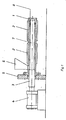
- a ram extruder according to the invention is shown. It consists of a tool 1, which is surrounded by heating elements 2 and is carried by the holding plate 5.
- the feed hopper 6 serves to supply the plastic powder to be extruded.
- the punch 3, which moves back and forth in the tool, is driven by the hydraulic unit 4. It causes the transport and compression of the plastic powder.
- the mandrel 7, which determines the inside diameter of the extruded tube, is rigidly attached to the punch 3.
- the guide bush 8 is used to support the mandrel when starting the ram extruder.
- FIG. 2 shows a steel pipe 9 lined with a pipe made of UHMW-PE 12.
- the UHMW-PE pipe is flanged at 11 on the flanges 10 of the steel pipe.
- the process was carried out with a tool that has a length of 937 mm and an inner diameter of 83 mm.
- the tools were heated using two electric heating tapes, each 350 mm long, with a total output of 3 KW, which are controlled by two temperature controllers.
- the selected temperature profile is 220 ° C in the heating zone on the inlet side and 160 ° C in the heating zone on the outlet side.
- a maximum pressure of 152 bar was set with an output of 3.9 kg UHMW-PE / h in the extruder.
- the extruded tube had the dimensions of 100 x 10 mm.
- the physical properties of the UHMW-PE were not affected in the extruder.
- Example 2 Under otherwise identical test conditions as in Example 1, a mandrel with a diameter of 95 mm was used. When the procedure was carried out without calibration, a maximum pressure of 223 bar was set with an output of 7.3 kg UHMW-PE / h in the extruder. Using a calibration resulted in a pressure of 371 bar at the same throughput.
Landscapes
- Engineering & Computer Science (AREA)
- Mechanical Engineering (AREA)
- Physics & Mathematics (AREA)
- Thermal Sciences (AREA)
- Extrusion Moulding Of Plastics Or The Like (AREA)
- Injection Moulding Of Plastics Or The Like (AREA)
Description
- Hochmolekulares Niederdruckpolyethylen (UHMW-PE) mit einem Molekulargewicht von über 500 000 unterscheidet sich grundlegend von den üblichen Polyethylenen durch sein Schmelz-und Viskositätsverhalten. Während bei Polyethylenen bis zu einem Molekulargewicht von 200 000 durch Temperaturerhöhung der Übergang in einer Schmelze mit guten Fließeigenschaften erreicht wird, gehen UHMW-PE durch Temperaturerhöhung lediglich in einen viskos-elastischen Zustand über.
- Die hohe Viskosität und die schlechten Fließeigenschaften lassen die Verarbeitung dieses Werkstoffes zu Rohren auf Ein- bzw. Doppelschneckenextruder mit herkömmlichen Rohrwerkzeugen ohne Zerstörung der Materiaieigenschaften nicht zu. Da die mechanischen Eigenschaften von UHMW-PE (Festigkeit, SpannungsrlBbeständigkeit, hohe Kerbschlagzähigkeit, Gleitverhalten) ideale Voraussetzungen bieten für Rohre, die im pneumatischen und hydraulischen Feststofftransport (Quarz, Sand, Kohlesuspension) eingesetzt werden, schien es notwendig, ein Verfahren zu entwickeln, das eine Verarbeitung dieses Werkstoffes zu Rohren ermöglicht und ihm damit ein neues Anwendungsgebiet eröffnet.
- Es ist bekannt, daß man mit Hilfe der Ramextrusion kontinuierlich Platten oder Stangen aus hochmolekularem Niederdruckpolyethylen anfertigen kann (siehe z.B. DE-A-17 29 174 und DE-C-1778 258).
- Die Herstellung von Rohren aus transparenten Kunststoffen ist Gegenstand der US-A-3 382 220. Bei dem verwendeten Material handelt es sich um Polyethylen, das aufgrund des Schmeizindexes, der Dichte und der hohen Kristallinität ein Molekulargewicht von 50 000 bis 100 000 aufweist. Die Extrusion dieses Materials erfolgt mittels verschiedener Extrusionswerkzeuge, die entweder Verengungen oder Erweiterungen aufweisen. Derartige Vorrichtungen sind jedoch für die Extrusion von hochmolekularem Polyethylen mit einem Molgewicht von über 500 000 nicht geeignet.
- Rohre aus UHMW-PE mit der erforderlichen Maßhaltigkeit nach DIN 8074 und den typischen Festigkeitseigenschaften des UHMW-PE konnten dagegen bisher nicht hergestellt werden.
- Die Herstellung von Polytetrafluorethylenrohren mittels Ramextrusion ist von Steininger und Stamprecht in dem Aufsatz « Extrusionsverarbeitung von Polytetrafluorethylen-Füllstoff-Mischungen In Kunststoffe 1973, S. 558 ff., beschrieben worden. Der bei der Rohrherstellung entstehende Druck ist dabei ein Vielfaches des Druckes, der zur Erzeugung von Profilen mit Vollquerschnitt benötigt wird. Da die bei der Ramextrusion von UHMW-PE entstehenden Drücke erheblich höher sind als die Drücke, die sich bei der Ramextrusion von Polytetrafluorethylen einstellen, wäre bei der Rohrextrusion von UHMW-PE nach dem genannten Verfahren eine Schädigung der Materiaieigenechaften zu erwarten. Auch würde die Extruderkonstruktion infolge des hohen Auslegungsdruckes wirtschaftlich uninteressant werden.
- Aufgabe der Erfindung ist es, Rohre aus UHM-W-PE bereitzustellen, wobei die typischen Materialeigenschaften des UHMW-PE nicht beeinträchtigt sein sollen. Die Rohrabmessungen sollen den in DIN 8074 enthaltenden Maßtoleranzen entsprechen. Hierzu ist ein Verfahren und eine Vorrichtung zur Ramextrusion von Kunststoffrohren zu entwickeln, wobei hohe Extrusionsdrücke vermieden werden. Die Konstruktion des Ramextruders sollte möglichst einfach und kostengünstig sein.
- Die Erfindung besteht in einem Ramextruder zur Herstellung von Kunststoffrohren, bestehend aus einem mit Heizelementen beheizten Werkzeug, einem sich im Werkzeug hin- und herbewegenden Stempel und einem Dorn, der den Rohrinnendurchmesser bestimmt und starr mit dem Stempel verbunden ist, dadurch gekennzeichnet, daß eine auf den Dorn aufgesetzte, den Querschnitt des Werkzeuges ausfüllende Führungsbuchse beim Anfahren aus dem Extruder mittels des sich bildenden Extrudates herausgepreßt wird, um über die gesamte Länge des Werkzeuges einen gleichbleibenden Querschnitt des Extrudates sicherzustellen.
- Es zeigte sich, daß der Transport des Kunststoffpulvers sowie dessen Verpressung unter Plastifizierung zum gewünschten Rohr durch gemeinsame Vorwärts- und Rückwärtsbewegung von Dom und Stempel durchgeführt werden kann, ohne daß es zu Störungen im Ablauf der Ramextrusion kommt. Es ist also weder erforderlich, daß der Dorn dauernd feststeht, noch ist es notwendig, daß der Stempel in Preßstellung gehalten wird, während der Dorn in die Ausgangsstellung zurückgezogen wird, wie es in dem genannten Artikel von Steininger und Stamprech auf S. 559, rechte Spalte, Abschnitt d, für den dort beschriebenen Ramextruder für Polytetrafluorethylen angegeben ist.
- Es hat sich gezeigt, daß bei der Ramextrusion von Rohren aus UHMW-PE in dem erfindungsgemäß ausgestalteten Extruder erheblich niedrigere Extrusionsdrücke entstehen als bei der Ramextrusion eines entsprechenden Vollprofils. Neben dem niedrigen entstehenden Extrusionsdruck bringt die starre verbindung von Dorn und Stempel eine erhebliche Vereinfachung des Extruderantriebes mit sich, in dem Stempel und Dorn durch ein einziges Hydraulikaggregat betätigt werden.
- Die neue Ramextruderkonstruktion läßt sich nicht nur für die Herstellung von UHMW-PE-Rohren einsetzen, sondern ganz allgemein für die Ramextrusion von Kunststoffrohren, also für alle Kunststoffe, die aufgrund ihrer besonderen Materialeigenschaften ramextrudiert werden, also üblicherweise im Schneckenextruder nicht verarbeitet werden können.
- Wegen der verhältnismäßig geringen Drücke, die bei der Extrusion mit dem neuen Ramextruder entstehen, ist dieser besonders für die Herstellung von Rohren aus UHMW-PE geeignet.
- Die Länge des Dorns ist üblicherweise gleich der des Werkzeuges von der Einzugszone bis zum Austritt. Der Dorndurchmesser entspricht dem Innendurchmesser des zu extrudierenden Rohres unter Berücksichtigung der Schrumpfmasse. Der Dorn, der auf der einen Seite starr mit dem Stempel verbunden ist, wird üblicherweise auf der Austragsseite des Werkzeuges nicht gelagert, da dies die Herstellung eines gleichmäßigen Rohres beeinträchtigen würde. Es wird daher während des Anfahrvorganges eine den Dorn umhüllende Führungsbuchse ins Werkzeug geschoben, die mit dem Extrudat aus dem Werkzeug herausgetragen wird. Durch diese Anfahrhilfe bleibt der Dorn zentrisch geführt, bis er, vom Extrudat voll umgeben, eine gleichmäßige Wandstärke sicherstellt. Die erreichten Wandstärken liegen im Toleranzbereich für dickwandige Rohre entsprechend DIN 8074.
- Um die Unrundheit der extrudierten Rohre so gering wie möglich zu halten, hat es sich als zweckmäßig erwiesen, die Rohre, die beim Abkühlen schrumpfen, einer gezielten Kühlung in einer unmittelbar an die Extrusion anschließenden Strecke, in der das Rohr geführt wird (Kalibrierung), zu unterziehen. Diese Kalibrierung hat üblicherweise die 3- bis 8-fache Länge des Außendurchmessers des hergestellten Rohres und ist entweder zylindrisch oder sich konisch verjüngend (≤ 1 : 50) ausgeführt. Die Kühlung der Kalibrierstrecke erfolgt am besten durch Mantelkühlung mit Wasser bei einer Temperatur von 50 bis 100 °C.
- Das Verfahren zur Herstellung von KunststoffRohren mittels des erfindungsgemäßen Ramextruders ist dadurch gekennzeichnet, daß als Kunststoff hochmolekulares Niederdruckpolyethylen mit einem Molekulargewicht von über 500 000 eingesetzt wird.
- Das Verfahren ist weiterhin dadurch gekennzeichnet, daß die extrudierten Rohre während der im Anschluß an die Extrusion erfolgende Schrumpfung in der Kalibrierung gekühlt und geführt werden.
- Derartig hergestellte Rohre sind insbesondere für die Auskleidung von Stahlrohren zu verwenden. Hierzu wird das UHMW-PE-Rohr in das Stahlrohr eingeführt und seine überstehenden Enden werden umgebördelt. Diese neue Art der Auskleidung von Stahlrohren ist wesentlich einfacher als die herkömmliche Rohrauskleidung mit Platten aus UHMW-PE, wie sie z.B. in der DE-B-24 19 898 beschrieben ist. Durch die fugenlose Auskleidung wird verhindert, daß in den Rohren transportiertes Fördergut zwischen Stahlrohr und UHMW-PE-Auskleidung kriechen kann. Das ist bei der Förderung von Medien, die das Stahlrohr angreifen können, besonders wichtig.
- Bei den in dieser Weise ausgekleideten Rohren lassen sich die hohe mechanische Festigkeit von Stahl und die hohe Abriebfestigkeit sowie die geringe Wärmeleitfähigkeit des UHMW-PE optimal kombinieren.
- In der Zeichnung Fig. 1 ist ein Ramextruder entsprechend der Erfindung dargestellt. Er besteht aus einem Werkzeug 1, das von Heizelementen 2 umgeben ist und von der Halteplatte 5 getragen wird. Der Aufgabetrichter6 dient zur Zufuhr des zu extrudierenden Kunststoffpulvers. Der Stempel 3, der sich im Werkzeug hin- und herbewegt, wird durch das Hydraulikaggregat 4 angetrieben. Er bewirkt den Transport und die Verdichtung des Kunststoffpulvers. An dem Stempel3 ist der Dorn 7. der den Innendurchmesser des extrudierten Rohres bestimmt, starr befestigt. Die Führungsbuchse 8 dient zur lagerung des Dorns beim Anfahren des Ramextruders.
- Fig. 2 zeigt ein mit einem Rohr aus UHMW-PE 12 ausgekleidetes Stahlrohr9. Das UHMW-PE-Rohr ist an den Flanschen 10 des Stahlrohres bei 11 umgebördelt.
- Das Verfahren wurde mit einem Werkzeug, das eine Länge von 937 mm und einen Innendurchmesser von 83 mm hat, durchgeführt. Die Werkzeugbeheizung erfolgte über zwei elektrische Heizbänder von je 350 mm Länge mit einer Gesamtleistung von 3 KW, die über zwei Temperaturregler gesteuert werden. Das gewählte Temperaturprofil liegt in der eintragsseitigen Heizzone bei 220 °C und in der austragsseitigen Heizzone bei 160 °C. Bei Durchführung des Verfahrens ohne Verwendung einer Kalibrierung stellte sich bei einem Ausstoß von 3,9 kg UHMW-PE/h im Extruder ein maximaler Druck von 152 bar ein.
- Bei Verwendung einer Kalibrierung ergab sich bei gleichem Durchsatz ein Druck von 208 bar. Das extrudierte Rohr hatte die Abmessungen von 100 x 10 mm. Die physikalischen Eigenschaften des UHMW-PE wurden beim Extruder nicht beeinträchtigt.
- Bei ansonsten gleichen Versuchsbedingungen wie in Beispiel 1 wurde mit einem Dorn mit einem Durchmesser von 95 mm gearbeitet. Bei Durchführung des Verfahrens ohne Kalibrierung stellte sich bei einem Ausstoß von 7,3 kg UHMW-PE/h im Extruder ein maximaler Druck von 223 bar ein. Bei Verwendung einer Kalibrierung ergab sich beim gleichen Durchsatz ein Druck von 371 bar.
Claims (4)
Applications Claiming Priority (2)
| Application Number | Priority Date | Filing Date | Title |
|---|---|---|---|
| DE2836052A DE2836052C2 (de) | 1978-08-17 | 1978-08-17 | Ramextruder zum Herstellen von Kunststoffrohren |
| DE2836052 | 1978-08-17 |
Publications (2)
| Publication Number | Publication Date |
|---|---|
| EP0008434A1 EP0008434A1 (de) | 1980-03-05 |
| EP0008434B1 true EP0008434B1 (de) | 1982-11-24 |
Family
ID=6047283
Family Applications (1)
| Application Number | Title | Priority Date | Filing Date |
|---|---|---|---|
| EP79102953A Expired EP0008434B1 (de) | 1978-08-17 | 1979-08-14 | Ramextruder und Verfahren zur Herstellung von Kunststoffrohren in dem Ramextruder |
Country Status (8)
| Country | Link |
|---|---|
| US (1) | US4547142A (de) |
| EP (1) | EP0008434B1 (de) |
| JP (2) | JPS5528896A (de) |
| CA (1) | CA1149120A (de) |
| DE (1) | DE2836052C2 (de) |
| FI (1) | FI69004C (de) |
| NL (1) | NL175596C (de) |
| YU (1) | YU40231B (de) |
Families Citing this family (16)
| Publication number | Priority date | Publication date | Assignee | Title |
|---|---|---|---|---|
| JPS60245898A (ja) * | 1984-05-22 | 1985-12-05 | Mitsui Petrochem Ind Ltd | 超高分子量ポリエチレン製フレキシブルチユ−ブ、溶融流動性の悪い熱可塑性樹脂製チユ−ブの製造方法及びその製造装置 |
| FI843544A0 (fi) * | 1984-09-10 | 1984-09-10 | Rakennusvalmiste Oy | Glidgjutmaskin foer framstaellning av betongelement. |
| FI843545A7 (fi) * | 1984-09-10 | 1986-03-11 | Rakennusvalmiste Oy | Sullomisperiaatteella toimiva liukuvalukone. |
| GB8628730D0 (en) * | 1986-12-02 | 1987-01-07 | Mackley M R | Polymer forming process |
| DE3644521A1 (de) * | 1986-12-24 | 1988-07-14 | Ruhrchemie Ag | Verfahren zum extrudieren von ultrahochmolekularem polyethylen |
| JP2541151B2 (ja) * | 1994-05-16 | 1996-10-09 | 日本電気株式会社 | 紙切断装置 |
| US6814561B2 (en) * | 2001-10-30 | 2004-11-09 | Scimed Life Systems, Inc. | Apparatus and method for extrusion of thin-walled tubes |
| US7597775B2 (en) * | 2001-10-30 | 2009-10-06 | Boston Scientific Scimed, Inc. | Green fluoropolymer tube and endovascular prosthesis formed using same |
| US7600537B2 (en) * | 2005-09-16 | 2009-10-13 | Honeywell International Inc. | Reinforced plastic pipe |
| TWI302493B (en) * | 2006-06-13 | 2008-11-01 | Advanced Semiconductor Eng | System for supplying molding compound |
| DE102006035960A1 (de) * | 2006-08-02 | 2008-02-07 | Biotronik Vi Patent Ag | Vorrichtung zur Herstellung von strangförmigen Gütern |
| US20080146362A1 (en) * | 2006-12-14 | 2008-06-19 | John Xianzhong Cui | Apparatus and method for golf practice and simulation |
| US8087923B1 (en) | 2007-05-18 | 2012-01-03 | C. R. Bard, Inc. | Extremely thin-walled ePTFE |
| CN111873278A (zh) * | 2020-06-14 | 2020-11-03 | 湖南省湘福高新塑胶有限责任公司 | 一种采用硫酸钙改性的pe管及其生产设备 |
| JP7341353B2 (ja) | 2020-08-18 | 2023-09-08 | 三井化学株式会社 | エチレン系重合体組成物およびその用途 |
| JPWO2024203987A1 (de) | 2023-03-31 | 2024-10-03 |
Family Cites Families (14)
| Publication number | Priority date | Publication date | Assignee | Title |
|---|---|---|---|---|
| US2336193A (en) * | 1939-09-22 | 1943-12-07 | Armstrong Cork Co | Cork spinning cot and method of making the same |
| US2435282A (en) * | 1943-11-19 | 1948-02-03 | Lester Engineering Co | Process and apparatus for extruding plastic materials |
| US3008187A (en) * | 1959-01-05 | 1961-11-14 | Raybestos Manhattan Inc | Method and apparatus for extruding polytetrafluoroethylene tubing |
| US3382220A (en) * | 1964-02-03 | 1968-05-07 | Phillips Petroleum Co | Transparent linear polymers |
| CA930116A (en) * | 1967-02-01 | 1973-07-17 | E. Murray Coyt | Reinforced extruder for high molecular weight polyethylene |
| US3526020A (en) * | 1968-06-11 | 1970-09-01 | Jerome H Lemelson | Extrusion techniques and apparatus |
| CH513716A (de) * | 1969-10-06 | 1971-10-15 | Loeckmann Hans | Verfahren zur Herstellung von Polyamidwerkstücken mittels Polymerisation in situ |
| US3804567A (en) * | 1970-04-06 | 1974-04-16 | Chevron Res | Apparatus for cooling and sizing hot thermoplastic extrudates |
| US3820374A (en) * | 1970-06-16 | 1974-06-28 | Dow Chemical Co | Mandrel for extruding tubing |
| BE791771A (fr) * | 1972-01-12 | 1973-03-16 | Pont A Mousson | Dispositif de conformation par extrusion de tubes en matiere thermoplastique |
| GB1423138A (en) * | 1972-03-04 | 1976-01-28 | Dunlop Ltd | Method of making articles |
| DE2249484A1 (de) * | 1972-10-10 | 1974-05-02 | Sued West Chemie Gmbh | Kolbenstrangpresse fuer pressmasse |
| JPS5022049U (de) * | 1973-06-25 | 1975-03-12 | ||
| FR2358973A1 (fr) * | 1976-07-19 | 1978-02-17 | Pont A Mousson | Procede de fabrication de produits en matieres thermoplastiques reticulees et dispositif pour sa mise en oeuvre |
-
1978
- 1978-08-17 DE DE2836052A patent/DE2836052C2/de not_active Expired
- 1978-11-09 NL NLAANVRAGE7811121,A patent/NL175596C/xx not_active IP Right Cessation
-
1979
- 1979-08-06 YU YU1905/79A patent/YU40231B/xx unknown
- 1979-08-10 FI FI792483A patent/FI69004C/fi not_active IP Right Cessation
- 1979-08-10 CA CA000333549A patent/CA1149120A/en not_active Expired
- 1979-08-14 EP EP79102953A patent/EP0008434B1/de not_active Expired
- 1979-08-17 JP JP10414679A patent/JPS5528896A/ja active Pending
-
1981
- 1981-12-31 US US06/336,119 patent/US4547142A/en not_active Expired - Fee Related
-
1983
- 1983-02-03 JP JP1983013779U patent/JPS58151018U/ja active Pending
Also Published As
| Publication number | Publication date |
|---|---|
| NL7811121A (nl) | 1980-02-19 |
| FI69004C (fi) | 1985-12-10 |
| US4547142A (en) | 1985-10-15 |
| JPS58151018U (ja) | 1983-10-11 |
| FI792483A7 (fi) | 1980-02-18 |
| NL175596B (nl) | 1984-07-02 |
| YU190579A (en) | 1983-02-28 |
| NL175596C (nl) | 1984-12-03 |
| JPS5528896A (en) | 1980-02-29 |
| CA1149120A (en) | 1983-07-05 |
| EP0008434A1 (de) | 1980-03-05 |
| DE2836052C2 (de) | 1984-08-30 |
| DE2836052A1 (de) | 1980-02-28 |
| YU40231B (en) | 1985-08-31 |
| FI69004B (fi) | 1985-08-30 |
Similar Documents
| Publication | Publication Date | Title |
|---|---|---|
| EP0008434A1 (de) | Ramextruder und Verfahren zur Herstellung von Kunststoffrohren in dem Ramextruder | |
| DE69717107T2 (de) | Verfahren und vorrichtung zum extrudieren eines kunststoffgegenstandes | |
| US7425291B2 (en) | Apparatus and method for extrusion of thin-walled tubes | |
| DE2450818C3 (de) | Verfahren zum Abkühlen der äußeren Oberfläche eines rohrförmigen Stranges vor dessen Blasformung | |
| DE3843576A1 (de) | Verfahren und vorrichtung zur herstellung von kunststoffformteilen | |
| DE102009038280A1 (de) | Herstellung mit anorganischen Stoffen hoch gefüllter Kunststoffe | |
| EP1884341A2 (de) | Vorrichtung zur Herstellung von strangförmigen Gütern | |
| DE69119375T2 (de) | Extrusionsverfahren und Extruder zum Herstellen eines Rohres aus Phenolharz | |
| DE7804100U1 (de) | Vorrichtung zur herstellung von produkten aus einem vernetzten thermoplastischen material | |
| DE69017910T2 (de) | Vorrichtung zum Herstellen von Rippenrohren. | |
| DE1928843A1 (de) | Verfahren und Vorrichtungen zum Herstellen von endlosen Kunststoff-Profilen und -Hohlkoerpern,wie Rohre od.dgl. | |
| DE102024107704A1 (de) | Austragsdüse | |
| EP0429516B1 (de) | Vorrichtung und verfahren zur formgebung von halbzeug aus hochmolekularen kunststoffen | |
| EP3790729A1 (de) | Vorrichtung und verfahren zum kontinuierlichen blasformen faserverstärkter thermoplastischer hohlprofile mit einem konstanten oder sich änderndem querschnitt | |
| DE102017106097A1 (de) | Extrudervorrichtung und Extrusionsverfahren | |
| CH642906A5 (de) | Verfahren und vorrichtung zur herstellung von formkoerpern aus hochmolekularem niederdruckpolyaethylen sowie einen ramextruder zur durchfuehrung des verfahrens. | |
| DE2166064A1 (de) | Verfahren zur Herstellung eines Wellrohrs aus thermoplastischem Kunststoff. Ausscheidung aus: 2124094 | |
| DE3043306A1 (de) | Doppelschneckenextruder mit verschleissfestem bimetall-einsatz | |
| DE2601815A1 (de) | Verfahren und vorrichtung zur blasformung von werkstoffen aus hitzehaertenden hochmolekularen verbindungen | |
| DE7824485U1 (de) | Vorrichtung zur herstellung von kunststoffrohren | |
| DE102020114448A1 (de) | Verfahren und vorrichtung zum herstellen eines extrudierten produkts | |
| DE1989597U (de) | Heissschmelze-extruder. | |
| DE19934871A1 (de) | Extrusionswerkzeug | |
| DE19744515A1 (de) | Verfahren zur Herstellung eines endlos extrudierten Profilstranges durch Coextrusion unterschiedlicher Materialien und Extrusionsvorrichtung | |
| DE1196857B (de) | Strangpressduese zur Herstellung von endlosen profilierten Straengen oder Rohren aus thermo-plastischen Kunststoffen |
Legal Events
| Date | Code | Title | Description |
|---|---|---|---|
| PUAI | Public reference made under article 153(3) epc to a published international application that has entered the european phase |
Free format text: ORIGINAL CODE: 0009012 |
|
| AK | Designated contracting states |
Designated state(s): BE FR GB IT |
|
| 17P | Request for examination filed | ||
| ITF | It: translation for a ep patent filed | ||
| GRAA | (expected) grant |
Free format text: ORIGINAL CODE: 0009210 |
|
| AK | Designated contracting states |
Designated state(s): BE FR GB IT |
|
| ET | Fr: translation filed | ||
| PGFP | Annual fee paid to national office [announced via postgrant information from national office to epo] |
Ref country code: FR Payment date: 19890717 Year of fee payment: 11 |
|
| PGFP | Annual fee paid to national office [announced via postgrant information from national office to epo] |
Ref country code: BE Payment date: 19890809 Year of fee payment: 11 |
|
| ITTA | It: last paid annual fee | ||
| PGFP | Annual fee paid to national office [announced via postgrant information from national office to epo] |
Ref country code: GB Payment date: 19890831 Year of fee payment: 11 |
|
| PG25 | Lapsed in a contracting state [announced via postgrant information from national office to epo] |
Ref country code: GB Effective date: 19900814 |
|
| PG25 | Lapsed in a contracting state [announced via postgrant information from national office to epo] |
Ref country code: BE Effective date: 19900831 |
|
| BERE | Be: lapsed |
Owner name: HOECHST A.G. Effective date: 19900831 |
|
| GBPC | Gb: european patent ceased through non-payment of renewal fee | ||
| PG25 | Lapsed in a contracting state [announced via postgrant information from national office to epo] |
Ref country code: FR Effective date: 19910430 |
|
| REG | Reference to a national code |
Ref country code: FR Ref legal event code: ST |
|
| PLBE | No opposition filed within time limit |
Free format text: ORIGINAL CODE: 0009261 |
|
| STAA | Information on the status of an ep patent application or granted ep patent |
Free format text: STATUS: NO OPPOSITION FILED WITHIN TIME LIMIT |