EP0003083B1 - Liquid-liquid extraction - Google Patents
Liquid-liquid extraction Download PDFInfo
- Publication number
- EP0003083B1 EP0003083B1 EP78300893A EP78300893A EP0003083B1 EP 0003083 B1 EP0003083 B1 EP 0003083B1 EP 78300893 A EP78300893 A EP 78300893A EP 78300893 A EP78300893 A EP 78300893A EP 0003083 B1 EP0003083 B1 EP 0003083B1
- Authority
- EP
- European Patent Office
- Prior art keywords
- liquid phase
- phase
- vessel
- aqueous
- stage
- Prior art date
- Legal status (The legal status is an assumption and is not a legal conclusion. Google has not performed a legal analysis and makes no representation as to the accuracy of the status listed.)
- Expired
Links
- 238000000622 liquid--liquid extraction Methods 0.000 title claims description 5
- 238000000638 solvent extraction Methods 0.000 title claims description 5
- 239000012071 phase Substances 0.000 claims description 51
- 239000007791 liquid phase Substances 0.000 claims description 49
- 239000008346 aqueous phase Substances 0.000 claims description 39
- MHAJPDPJQMAIIY-UHFFFAOYSA-N Hydrogen peroxide Chemical compound OO MHAJPDPJQMAIIY-UHFFFAOYSA-N 0.000 claims description 38
- 239000012074 organic phase Substances 0.000 claims description 38
- 150000004965 peroxy acids Chemical class 0.000 claims description 26
- 238000000605 extraction Methods 0.000 claims description 24
- 238000000034 method Methods 0.000 claims description 23
- 239000007789 gas Substances 0.000 claims description 18
- 239000007864 aqueous solution Substances 0.000 claims description 15
- 239000003960 organic solvent Substances 0.000 claims description 15
- 239000002904 solvent Substances 0.000 claims description 15
- 239000000243 solution Substances 0.000 claims description 14
- 239000007788 liquid Substances 0.000 claims description 12
- 238000001816 cooling Methods 0.000 claims description 8
- 230000000694 effects Effects 0.000 claims description 8
- 230000005484 gravity Effects 0.000 claims description 8
- 238000013019 agitation Methods 0.000 claims description 4
- 238000004581 coalescence Methods 0.000 claims description 4
- 238000005192 partition Methods 0.000 claims description 2
- 150000001732 carboxylic acid derivatives Chemical class 0.000 claims 1
- 230000003068 static effect Effects 0.000 claims 1
- 238000006243 chemical reaction Methods 0.000 description 27
- XBDQKXXYIPTUBI-UHFFFAOYSA-N dimethylselenoniopropionate Natural products CCC(O)=O XBDQKXXYIPTUBI-UHFFFAOYSA-N 0.000 description 24
- QAOWNCQODCNURD-UHFFFAOYSA-N Sulfuric acid Chemical compound OS(O)(=O)=O QAOWNCQODCNURD-UHFFFAOYSA-N 0.000 description 21
- 239000001117 sulphuric acid Substances 0.000 description 21
- 235000011149 sulphuric acid Nutrition 0.000 description 21
- XLYOFNOQVPJJNP-UHFFFAOYSA-N water Substances O XLYOFNOQVPJJNP-UHFFFAOYSA-N 0.000 description 16
- 150000001735 carboxylic acids Chemical class 0.000 description 13
- 235000019260 propionic acid Nutrition 0.000 description 13
- IUVKMZGDUIUOCP-BTNSXGMBSA-N quinbolone Chemical compound O([C@H]1CC[C@H]2[C@H]3[C@@H]([C@]4(C=CC(=O)C=C4CC3)C)CC[C@@]21C)C1=CCCC1 IUVKMZGDUIUOCP-BTNSXGMBSA-N 0.000 description 12
- 241000196324 Embryophyta Species 0.000 description 11
- KNKRKFALVUDBJE-UHFFFAOYSA-N 1,2-dichloropropane Chemical group CC(Cl)CCl KNKRKFALVUDBJE-UHFFFAOYSA-N 0.000 description 10
- 239000002253 acid Substances 0.000 description 7
- CZPZWMPYEINMCF-UHFFFAOYSA-N propaneperoxoic acid Chemical compound CCC(=O)OO CZPZWMPYEINMCF-UHFFFAOYSA-N 0.000 description 7
- UHOVQNZJYSORNB-UHFFFAOYSA-N Benzene Chemical compound C1=CC=CC=C1 UHOVQNZJYSORNB-UHFFFAOYSA-N 0.000 description 6
- 238000004519 manufacturing process Methods 0.000 description 5
- 239000000376 reactant Substances 0.000 description 5
- 239000000126 substance Substances 0.000 description 5
- 238000000354 decomposition reaction Methods 0.000 description 4
- 238000006735 epoxidation reaction Methods 0.000 description 4
- YMWUJEATGCHHMB-UHFFFAOYSA-N Dichloromethane Chemical compound ClCCl YMWUJEATGCHHMB-UHFFFAOYSA-N 0.000 description 3
- CFXQEHVMCRXUSD-UHFFFAOYSA-N TCP Natural products ClCC(Cl)CCl CFXQEHVMCRXUSD-UHFFFAOYSA-N 0.000 description 3
- YXFVVABEGXRONW-UHFFFAOYSA-N Toluene Chemical compound CC1=CC=CC=C1 YXFVVABEGXRONW-UHFFFAOYSA-N 0.000 description 3
- 150000001336 alkenes Chemical class 0.000 description 3
- 238000010276 construction Methods 0.000 description 3
- 239000002826 coolant Substances 0.000 description 3
- 238000002156 mixing Methods 0.000 description 3
- 239000000203 mixture Substances 0.000 description 3
- IJGRMHOSHXDMSA-UHFFFAOYSA-N nitrogen Substances N#N IJGRMHOSHXDMSA-UHFFFAOYSA-N 0.000 description 3
- 239000012044 organic layer Substances 0.000 description 3
- 238000002360 preparation method Methods 0.000 description 3
- QPFMBZIOSGYJDE-UHFFFAOYSA-N 1,1,2,2-tetrachloroethane Chemical compound ClC(Cl)C(Cl)Cl QPFMBZIOSGYJDE-UHFFFAOYSA-N 0.000 description 2
- UBOXGVDOUJQMTN-UHFFFAOYSA-N 1,1,2-trichloroethane Chemical compound ClCC(Cl)Cl UBOXGVDOUJQMTN-UHFFFAOYSA-N 0.000 description 2
- WSLDOOZREJYCGB-UHFFFAOYSA-N 1,2-Dichloroethane Chemical compound ClCCCl WSLDOOZREJYCGB-UHFFFAOYSA-N 0.000 description 2
- RTZKZFJDLAIYFH-UHFFFAOYSA-N Diethyl ether Chemical compound CCOCC RTZKZFJDLAIYFH-UHFFFAOYSA-N 0.000 description 2
- IMNFDUFMRHMDMM-UHFFFAOYSA-N N-Heptane Chemical compound CCCCCCC IMNFDUFMRHMDMM-UHFFFAOYSA-N 0.000 description 2
- 150000007513 acids Chemical class 0.000 description 2
- 150000001338 aliphatic hydrocarbons Chemical class 0.000 description 2
- 150000004945 aromatic hydrocarbons Chemical class 0.000 description 2
- 150000008280 chlorinated hydrocarbons Chemical class 0.000 description 2
- -1 chloro-substituted butanes Chemical class 0.000 description 2
- MVPPADPHJFYWMZ-UHFFFAOYSA-N chlorobenzene Chemical compound ClC1=CC=CC=C1 MVPPADPHJFYWMZ-UHFFFAOYSA-N 0.000 description 2
- 150000001875 compounds Chemical class 0.000 description 2
- DMEGYFMYUHOHGS-UHFFFAOYSA-N cycloheptane Chemical compound C1CCCCCC1 DMEGYFMYUHOHGS-UHFFFAOYSA-N 0.000 description 2
- DIOQZVSQGTUSAI-UHFFFAOYSA-N decane Chemical compound CCCCCCCCCC DIOQZVSQGTUSAI-UHFFFAOYSA-N 0.000 description 2
- 230000007547 defect Effects 0.000 description 2
- 239000006185 dispersion Substances 0.000 description 2
- 238000004821 distillation Methods 0.000 description 2
- 229930195733 hydrocarbon Natural products 0.000 description 2
- 239000010410 layer Substances 0.000 description 2
- VLKZOEOYAKHREP-UHFFFAOYSA-N n-Hexane Chemical class CCCCCC VLKZOEOYAKHREP-UHFFFAOYSA-N 0.000 description 2
- 229910052757 nitrogen Inorganic materials 0.000 description 2
- 238000000926 separation method Methods 0.000 description 2
- 238000003860 storage Methods 0.000 description 2
- QVLAWKAXOMEXPM-UHFFFAOYSA-N 1,1,1,2-tetrachloroethane Chemical compound ClCC(Cl)(Cl)Cl QVLAWKAXOMEXPM-UHFFFAOYSA-N 0.000 description 1
- FEKGWIHDBVDVSM-UHFFFAOYSA-N 1,1,1,2-tetrachloropropane Chemical class CC(Cl)C(Cl)(Cl)Cl FEKGWIHDBVDVSM-UHFFFAOYSA-N 0.000 description 1
- UOCLXMDMGBRAIB-UHFFFAOYSA-N 1,1,1-trichloroethane Chemical compound CC(Cl)(Cl)Cl UOCLXMDMGBRAIB-UHFFFAOYSA-N 0.000 description 1
- AVGQTJUPLKNPQP-UHFFFAOYSA-N 1,1,1-trichloropropane Chemical compound CCC(Cl)(Cl)Cl AVGQTJUPLKNPQP-UHFFFAOYSA-N 0.000 description 1
- GRSQYISVQKPZCW-UHFFFAOYSA-N 1,1,2-trichloropropane Chemical compound CC(Cl)C(Cl)Cl GRSQYISVQKPZCW-UHFFFAOYSA-N 0.000 description 1
- URWHLZCXYCQNSY-UHFFFAOYSA-N 1,1,3-trichloropropane Chemical compound ClCCC(Cl)Cl URWHLZCXYCQNSY-UHFFFAOYSA-N 0.000 description 1
- SCYULBFZEHDVBN-UHFFFAOYSA-N 1,1-Dichloroethane Chemical compound CC(Cl)Cl SCYULBFZEHDVBN-UHFFFAOYSA-N 0.000 description 1
- WIHMGGWNMISDNJ-UHFFFAOYSA-N 1,1-dichloropropane Chemical compound CCC(Cl)Cl WIHMGGWNMISDNJ-UHFFFAOYSA-N 0.000 description 1
- DAIIXVPKQATIMF-UHFFFAOYSA-N 1,2,2-trichloropropane Chemical compound CC(Cl)(Cl)CCl DAIIXVPKQATIMF-UHFFFAOYSA-N 0.000 description 1
- YHRUOJUYPBUZOS-UHFFFAOYSA-N 1,3-dichloropropane Chemical compound ClCCCCl YHRUOJUYPBUZOS-UHFFFAOYSA-N 0.000 description 1
- ZEOVXNVKXIPWMS-UHFFFAOYSA-N 2,2-dichloropropane Chemical compound CC(C)(Cl)Cl ZEOVXNVKXIPWMS-UHFFFAOYSA-N 0.000 description 1
- 229910000619 316 stainless steel Inorganic materials 0.000 description 1
- VEXZGXHMUGYJMC-UHFFFAOYSA-M Chloride anion Chemical compound [Cl-] VEXZGXHMUGYJMC-UHFFFAOYSA-M 0.000 description 1
- HEDRZPFGACZZDS-UHFFFAOYSA-N Chloroform Chemical compound ClC(Cl)Cl HEDRZPFGACZZDS-UHFFFAOYSA-N 0.000 description 1
- IAYPIBMASNFSPL-UHFFFAOYSA-N Ethylene oxide Chemical compound C1CO1 IAYPIBMASNFSPL-UHFFFAOYSA-N 0.000 description 1
- CTQNGGLPUBDAKN-UHFFFAOYSA-N O-Xylene Chemical compound CC1=CC=CC=C1C CTQNGGLPUBDAKN-UHFFFAOYSA-N 0.000 description 1
- 235000011054 acetic acid Nutrition 0.000 description 1
- 150000001243 acetic acids Chemical class 0.000 description 1
- 125000001931 aliphatic group Chemical group 0.000 description 1
- 239000011260 aqueous acid Substances 0.000 description 1
- 239000012736 aqueous medium Substances 0.000 description 1
- 230000015572 biosynthetic process Effects 0.000 description 1
- 238000009835 boiling Methods 0.000 description 1
- 125000004432 carbon atom Chemical group C* 0.000 description 1
- 229950005499 carbon tetrachloride Drugs 0.000 description 1
- 230000015556 catabolic process Effects 0.000 description 1
- 239000003054 catalyst Substances 0.000 description 1
- 238000006555 catalytic reaction Methods 0.000 description 1
- HRYZWHHZPQKTII-UHFFFAOYSA-N chloroethane Chemical compound CCCl HRYZWHHZPQKTII-UHFFFAOYSA-N 0.000 description 1
- 229960001701 chloroform Drugs 0.000 description 1
- 238000006731 degradation reaction Methods 0.000 description 1
- 230000018044 dehydration Effects 0.000 description 1
- 238000006297 dehydration reaction Methods 0.000 description 1
- 230000001419 dependent effect Effects 0.000 description 1
- 238000010494 dissociation reaction Methods 0.000 description 1
- 230000005593 dissociations Effects 0.000 description 1
- 229920001971 elastomer Polymers 0.000 description 1
- 239000000839 emulsion Substances 0.000 description 1
- 229960003750 ethyl chloride Drugs 0.000 description 1
- 238000010438 heat treatment Methods 0.000 description 1
- 150000002430 hydrocarbons Chemical class 0.000 description 1
- 239000001257 hydrogen Substances 0.000 description 1
- 229910052739 hydrogen Inorganic materials 0.000 description 1
- 125000004435 hydrogen atom Chemical class [H]* 0.000 description 1
- 230000002706 hydrostatic effect Effects 0.000 description 1
- 239000012535 impurity Substances 0.000 description 1
- 238000011065 in-situ storage Methods 0.000 description 1
- 230000010354 integration Effects 0.000 description 1
- ULYZAYCEDJDHCC-UHFFFAOYSA-N isopropyl chloride Chemical compound CC(C)Cl ULYZAYCEDJDHCC-UHFFFAOYSA-N 0.000 description 1
- 238000011031 large-scale manufacturing process Methods 0.000 description 1
- 230000007257 malfunction Effects 0.000 description 1
- 239000000463 material Substances 0.000 description 1
- 150000002763 monocarboxylic acids Chemical class 0.000 description 1
- UNFUYWDGSFDHCW-UHFFFAOYSA-N monochlorocyclohexane Chemical compound ClC1CCCCC1 UNFUYWDGSFDHCW-UHFFFAOYSA-N 0.000 description 1
- SNMVRZFUUCLYTO-UHFFFAOYSA-N n-propyl chloride Chemical compound CCCCl SNMVRZFUUCLYTO-UHFFFAOYSA-N 0.000 description 1
- QJGQUHMNIGDVPM-UHFFFAOYSA-N nitrogen group Chemical group [N] QJGQUHMNIGDVPM-UHFFFAOYSA-N 0.000 description 1
- 150000002924 oxiranes Chemical class 0.000 description 1
- 238000009931 pascalization Methods 0.000 description 1
- 239000003208 petroleum Substances 0.000 description 1
- 150000004672 propanoic acids Chemical class 0.000 description 1
- 238000005086 pumping Methods 0.000 description 1
- 238000000746 purification Methods 0.000 description 1
- 230000009257 reactivity Effects 0.000 description 1
- 238000004064 recycling Methods 0.000 description 1
- 230000000284 resting effect Effects 0.000 description 1
- 229920006395 saturated elastomer Polymers 0.000 description 1
- 238000013341 scale-up Methods 0.000 description 1
- 230000009528 severe injury Effects 0.000 description 1
- 238000007086 side reaction Methods 0.000 description 1
- 239000011877 solvent mixture Substances 0.000 description 1
- 241000894007 species Species 0.000 description 1
- 239000007921 spray Substances 0.000 description 1
- VZGDMQKNWNREIO-UHFFFAOYSA-N tetrachloromethane Chemical compound ClC(Cl)(Cl)Cl VZGDMQKNWNREIO-UHFFFAOYSA-N 0.000 description 1
- 239000002699 waste material Substances 0.000 description 1
- 239000008096 xylene Substances 0.000 description 1
Images

Classifications
-
- B—PERFORMING OPERATIONS; TRANSPORTING
- B01—PHYSICAL OR CHEMICAL PROCESSES OR APPARATUS IN GENERAL
- B01D—SEPARATION
- B01D11/00—Solvent extraction
- B01D11/04—Solvent extraction of solutions which are liquid
- B01D11/0446—Juxtaposition of mixers-settlers
- B01D11/0453—Juxtaposition of mixers-settlers with narrow passages limited by plates, walls, e.g. helically coiled tubes
-
- B—PERFORMING OPERATIONS; TRANSPORTING
- B01—PHYSICAL OR CHEMICAL PROCESSES OR APPARATUS IN GENERAL
- B01D—SEPARATION
- B01D11/00—Solvent extraction
- B01D11/04—Solvent extraction of solutions which are liquid
- B01D11/0446—Juxtaposition of mixers-settlers
-
- C—CHEMISTRY; METALLURGY
- C07—ORGANIC CHEMISTRY
- C07C—ACYCLIC OR CARBOCYCLIC COMPOUNDS
- C07C407/00—Preparation of peroxy compounds
- C07C407/003—Separation; Purification; Stabilisation; Use of additives
Definitions
- the present invention relates to a process and apparatus for the extraction of a peracid (by which we mean herein peroxycarboxylic acids) from aqueous solution into an organic solution.
- a peracid by which we mean herein peroxycarboxylic acids
- the use of such peracids is well known in the epoxidation of alkenes, especially lower alkenes.
- extraction columns and mixer-settlers
- mixing columns are two main classes of apparatus used.
- extraction columns are different residence times can be used for the two phases but one disadvantage is that imperfect contacting of the two phases may occur due chiefly to nonuniform flow of the phases, particularly in large columns.
- mixer-settlers is that efficient contacting is ensured.
- the residence times of the two phases are normally the same regardless of the relative rates of flow of the two phases, unless special recycling stages are provided.
- a process for the extraction of a peracid into an organic solution from an aqueous solution comprising passing an aqueous liquid phase continuously through a series of extraction stages, passing an organic liquid phase continuously through said series in counter current to the aqueous phase, such organic liquid phase being a solvent for the peracid and being lighter than the aqueous liquid phase and, in each said stage, providing for the organic liquid phase to be dispersed at a location below the main body of the aqueous liquid phase in that stage and to rise freely through said aqueous liquid phase, coalesce and separate into a settled body above the aqueous liquid phase and from which settled body the organic liquid phase is withdrawn and passed under control to the next adjacent stage as aforesaid, the flow of the aqueous liquid phase in each stage being substantially horizontal and the flow of the organic liquid phase being substantially vertical.
- the above process may be modified by employing an organic liquid phase which is heavier than the aqueous liquid phase and accordingly is dispersed adjacent to the upper part of the aqueous liquid phase in each stage and forms a settled body below the aqueous liquid phase.
- liquid-liquid extraction apparatus comprising a plurality of vessels arranged in a series, means to introduce a first liquid phase into the first vessel of the series and to cause or permit it to flow through the series, means to withdraw the first phase from the last vessel of the series, means to introduce a second liquid phase into said last vessel, means to withdraw the second phase from the first vessel of the series, dispersing means for said second phase in each of the vessels adapted to effect dispersal of the second phase throughout the first phase in each vessel, a space in each vessel permitting coalescence of said second phase at a location above or below the dispersing means, the inlets and outlets for the two phases being so arranged that the flows of the two phases in each vessel are substantially transverse to each other, means for collecting such settled second phase and means for permitting or causing transfer of such collected second phase to the next adjacent vessel in the series for introduction thereinto, and cooling means in each vessel together with agitation means to cause a forced flow of liquid over the cooling means under shut-down conditions.
- the aqueous solution of the peracid may be generated in situ by supplying an aqueous solution of hydrogen peroxide in counter-current to an organic solution of a carboxylic acid.
- the first phase flows generally horizontally through each vessel and throughout the series whilst the second phase flows generally vertically in each vessel from the dispersing means, there being a single dispersal in each vessel
- This arrangement is clearly distinguished from “cross-current extraction" as above described, since the flows of the two phases through the overall system are counter-current.
- Pump means will normally be required to convey the second phase from vessel to vessel, the pump means also conveniently serving to control the transfer of the second phase from stage to stage.
- the second phase (which forms the dispersed phase) is the phase having the larger volume passing through the apparatus in unit time.
- the difference in specific gravities of the two phases will determine whether the dispersed phase moves upwardly or downwardly in each vessel.
- Dispersion of the second phase may be effected by suitable dispersing means for example spray head, sieve plates, or the like, but it will be understood that the dispersion is not effected by a stirrer or the like in such a way as to prevent coalescence of the second phase since this take place in the same vessel and not in a separate vessel or compartment as is common in a "mixer/settler". Nevertheless each vessel may be provided with agitation means, for example a stirrer or sparge pipe, for use only under shutdown conditions.
- the dispersed phase may have its flow pulsed.
- the most relevant forms of prior art are the conventional sieve plate column and the conventional mixer/settler battery.
- the present invention can be considered to be a hybrid between these two conventional extraction devices. Thus it behaves and can be controlled in much the same way as a sieve plate column but without suffering from the defects known to exist in sieve plate columns.
- the physical disposition of the stages is similar to a mixer/settler battery with the known advantages of that arrangement but without the disadvantages of the restriction on residence time in a mixer/settler battery.
- the specific gravity of the aqueous phase is influenced by the concentration of sulphuric acid which also influences the rate of the reaction.
- the arrangement is such as to ensure that in each vessel of the series, the organic phase is distributed by a sieve plate as efficiently as is reasonably practicable and that the droplets of organic phase can rise through the aqueous phase and coalesce to form a settled body of the organic phase resting above the aqueous phase.
- this settled body can be arranged to be of any convenient depth which is not in general determined by the resistance to flow imposed by the sieve plate of the next higher stage, as happens in conventional columns. It is therefore possible to ensure that only settled phase is passed to the sieve plate in each stage. This transfer will normally be by a pump and is effected under control in such a way as to maintain a proper depth of settled phase in each vessel.
- the apparatus of the present invention is therefore capable of being designed so as to be easier to control, more efficient and safer than a conventional large diameter column.
- the apparatus of the present invention closely resembles a battery of mixer-settlers but it achieves the desired technical result without incurring the disadvantages known in mixer-settlers.
- carboxylic acid has its normal meaning but it is necessary to emphasise that in practising the invention a proper selection of the "carboxylic acid” and "organic solvent” is desirable in order to provide optimum efficiencies. However with the guide lines given herein such selection is within the ability of one skilled in the art. It is clearly necessary to select a carboxylic acid which is sufficiently soluble in water to permit the reaction to take place and such that it and the peracid are also sufficiently soluble in the organic solvent to permit extraction to take place. Moreover the carboxylic acid and peracid should not undergo undesirable side reactions. For these reasons we prefer to use unsubstituted monocarboxylic acids having at least two but less than six carbon atoms.
- the preferred carboxylic acids are acetic and propionic acids.
- the prime function of the organic solvent is to provide a discrete organic phase in which the carboxylic acid and peracid are soluble. Additional desirable criteria for the organic solvent are a low solvent power for water, a low solubility in aqueous sulphuric acid and non-reactivity under the conditions of the reaction in the presence of the other reactants. It will be understood that although various solvents are listed herein the selection of a solvent for practical use must depend on the precise process and reactants, and on the end use for the peracid.
- the solvent may be a halogenated, e.g., fluorinated or chlorinated, aliphatic, cycloaliphatic or aromatic hydrocarbon for example:
- Chlorinated hydrocarbons although normally considered very inert, may give rise to chloride species, which in the presence of water and/or sulphuric acid can be very corrosive. It may therefore be desirable to select the solvent from among non-chlorinated hydrocarbons, such as aliphatic hydrocarbons, cycloaliphatic hydrocarbons, aromatic hydrocarbons and alkyl-aryl hydrocarbons for example:-
- a solvent mixture can be used, for example that known as petroleum ether which is a mixture of aliphatic hydrocarbons or mixtures of solvents mentioned individually above.
- organic solvent should be a saturated compound provided that any unsaturation is not epoxidisable under the conditions of the process.
- 1,2-dichloroethahe ethylene dichloride
- 1,2-dichioropropane propylene dichloride
- benzene ethylene dichloride
- an aqueous phase comprising sulphuric acid, hydrogen peroxide and water
- an organic phase comprising carboxylic acid and organic solvent
- the components will partition between the two phases and, in the aqueous phase, the reaction of hydrogen peroxide with carboxylic acid to give peracid will be catalysed by the sulphuric acid. This reaction is normally slow to reach equilibrium but is accelerated by the extraction of the peracid into the organic phase.
- the sulphuric acid In addition to its function as catalyst; the sulphuric acid also has the function of adjusting the specific gravity of the aqueous phase to assist separation of the phases.
- the relative specific gravity of the organic and aqueous phases will determine their direction of movement in separation after admixture.
- concentration of the sulphuric acid is maintained so as to be sufficient for catalysis but insufficient to cause degradation of any of the organic components by dehydration, etc.
- Optimisation of the sulphuric acid concentration on chemical and extraction criteria tends to lead to relative densities, plate dimensions, residence times, etc which are difficult to handle in conventional apparatus but which pose few problems in the apparatus of the present invention.
- the aqueous solution removed from the extraction device has, in effect, had some or all of its hydrogen peroxide replaced by water. It is therefore desirably concentrated by the removal of water and recycled after addition of hydrogen peroxide.
- an aqueous phase is supplied to the extraction device to pass therethrough.
- This aqueous phase comprises sulphuric acid, hydrogen peroxide and water.
- the proportion of sulphuric acid is desirably between 30% and 60% by weight and is preferably approximately 40% by weight.
- the sulphuric acid is derived from 75% by weight sulphuric acid solution in water which forms a feedback from the purification stages which will be described hereinafter, together with make-up acid.
- the hydrogen peroxide is conveniently between 10% and 35% by weight of the aqueous phase and in practice 29% is very satisfactory. This hydrogen is very conveniently supplied as approximately 70% by weight solution in water. ,
- the organic phase is fed into the extraction device to pass in counter-current with the aqueous phase and comprises, for the production of perptropionic acid, a solution of propionic acid in propylene dichloride.
- the concentration of the propionic acid is preferably between 15% and 30% of the organic phase and desirably 20%.
- This ratio may be from 1:0.5 to 1:4 by moles but is conveniently about 1:1.4, the stoichiometrical ratio being 1:1.
- the hydrogen peroxide feed can be divided into two or more portions introduced at spaced locations.
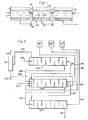
- the plant comprises a series of individual cells each of which is equipped with a sieve plate 11 adjacent to the base and with an inlet 12 for organic phase located in such a position that organic phase collects at 13 below the sieve plate 11 in the conventional manner.
- the organic phase passes through the sieve plate 11 and collects as an upper organic layer 14 at the top of the cell.
- the organic phase is withdrawn from the layer 14 via an outlet 15 and is passed by a pump 16 to the next adjacent cell.
- each cell is provided with an aqueous phase inlet 17 and an aqueous phase outlet 18 so arranged that the aqueous phase passes through each cell of the series but in counter-current with the organic phase, the outlet 18 of one cell being connected to the inlet 17 of the next cell, the movement of the two liquids in each cell being transverse to each other.
- FIG. 2 shows the arrangement of a single cell in greater detail.
- the cell comprises a conventional tank 10 having side walls 20 and a base 21, the tank having a lid 36 to prevent accidental ingress of material and a freely opening cover 37 to a vent 38 so that effectively there can be no build-up of pressure in the cell.
- the upper level of liquid within the cell 10 is defined by a weir 23 which is arranged to guard the organic phase outlet 15 and ensure firstly that the level of liquid within the cell 10 is maintained correctly and secondly that only organic phase passes out of the outlet 15.
- aqueous phase flows from cell to cell without requiring any inter-cell pumping.
- the organic phase however overflows from the top of one cell and requires to be pumped in order to introduce it into the base of the next cell.
- conventional mechanically or electrically driven pumps could be used, the power requirements are so small that it is possible to use alternative forms of pump.
- the form that we prefer is known as a gas lift pump and is illustrated in Figure 2.
- Organic phase enters the pump through a side limb 25 coupled to the outlet 15 of the previous stage and enters the open limb of a U-tube 26.
- the second limb of the U-tube 26 contains a gas injector 27 which forces a gas/liquid mixture up to a disengaging chamber 28.
- the gas is separated in the disengaging chamber 28 and is taken away by a line 29 for recycle, whilst the organic liquid flows by gravity down a pipe 30 to the inlet 12.
- a suitable gas for the gas lift is nitrogen. It will be apparent that the efficiency of the operation of the gas lift as a pump depends upon the level of the liquid in the U-tube 26 and this in turn depends upon the rate of overflow over the weir 23 of the preceding stage. The system is therefore inherently self-compensating.
- each of the cells may be equipped with a helical cooling coil and a stirrer. Under normal operation of the cells the stirrer will be inoperative and the coil ineffective. However under shut down conditions coolant is supplied to the coil and the stirrer is activated so that each cell is effectively converted to a cooled, stirred tank.
- FIG. 3 illustrates an alternative arrangement in which coolant tubes 31 are located adjacent to one wall of the cell as a vertical bank with adjacent vertical baffles 32 and 32a which define, with the side wall of the cell, vertical cooling channels 33 and 33a for the aqueous and organic phases respectively. These cooling channels 33 and 33a terminate as is shown, below the upper surfaces of each liquid phase.
- gas for example the nitrogen or other gas used in the gas lift pumps, can be supplied to a sparge pipe 34 at the base of the coolant channel 33. It will be appreciated that under shut down conditions the gas lift pumps are inoperative. If dumping of the contents of any selected vessel is necessary, this can be effected through operation of a dump valve 39.
- FIG 4 An alternative construction to Figure 1 which obviates the need for the baffle 24 shown in Figure 2 is illustrated in Figure 4, the sieve plates being omitted for clarity.
- the cells are located side by side and are, comparatively speaking, long and thin.
- the organic phase moves as indicated through the pipes 30 (the pumps not being shown), whilst the construction is such as to cause the aqueous phase to flow in a sinuous manner through the series of cells, the inlets and outlets 17, 18 being replaced by apertures 35.
- the arrangement can be considered as a plug flow reactor.
- FIG. 5 A suitable arrangement for a complete plant is illustrated in Figure 5. Purely by way of example the plant has been illustrated as having 27 separate cells arranged in three series but it should be understood that the first and/or last of the series of cells may be replaced by one or more conventional columns generally as described in the said DOS.
- the plant illustrated in Figure 5 is intended for use with an epoxidation plant to which is supplied a solution of peracid in organic solvent and from which it receives separate-recycle streams of carboxylic acid in organic solvent and of organic solvent. More specifically the plant illustrated in Figure 5 is intended for the manufacture of perpropionic acid, using propionic acid as the carboxylic acid, and using propylene dichloride as the solvent.
- the three series of cells are arranged to operate in series and in counter-current.
- the main reaction takes place in the centre series of cells, conveniently called the "reaction stage” 102.
- the organic phase from the reaction stage 102 is subject to treatment in an acid backwash stage 103 and the aqueous phase to treatment in an organic backwash stage 101.
- Aqueous hydrogen peroxide is supplied to the right hand of the reaction stage 102 by means of a line 104 from a hydrogen peroxide storage tank 105.
- Aqueous sulphuric acid is also supplied to the right hand end of the reaction stage 102 by a line 106, being in fact a recycle phase as will be apparent hereinafter.
- Aqueous sulphuric acid is also supplied to the right hand end of the reaction stage 102 by a line 107 from the left hand end of the acid backwash stage 103.
- the hydrogen peroxide, sulphuric acid and water supplied by the lines 104, 106 and 107 together constitute the aqueous phase.
- An organic solution of propionic acid in propylene dichloride is supplied to the left hand end of the reaction stage 102 by a line 108 from the right hand end of the organic backwash stage 101.
- Fresh propionic acid in propylene dichloride from a make-up storage tank 110 is also supplied to the left hand end of the stage 102 by a line 109.
- a recycle phase comprising propionic acid in propylene dichloride is supplied to the left hand end of the reaction stage 102 by a line 111.
- the organic and aqueous phases pass through the stage 102 in counter-current flow and will react to produce perpropionic acid, which is extracted into the organic phase.
- an aqueous solution comprising sulphuric acid and water is taken from the left hand end of stage 102 by a line 112 and is taken to the right hand end of the organic backwash stage 101.
- Solvent, substantially free of propionic acid, is supplied to the left hand end of the stage 101 by a line 113 and passes in counter-current to the aqueous solution in order to backwash it and strip from it as much propionic acid as possible.
- the conditions are such that the aqueous effluent from the backwash stage 101 which is taken from the left hand end by line 114 contains substantially no propionic acid, perpropionic acid or hydrogen peroxide.
- the organic solution from the right hand end of the stage 102 comprises a solution of perpropionic acid in propylene dichloride and is taken by a line 115 to the left hand end of the stage 103 which acts as an aqueous backwash stage.
- the right hand end of the stage 103 is provided with fresh sulphuric acid in aqueous solution by a line 116 from a make-up tank 117, this sulphuric acid passing out of the stage 103 by the line 107.
- the function of this aqueous acid backwash is to strip the organic phase flowing through the stage 103 to remove from it as much of the unreacted hydrogen peroxide as possible.
- the organic solution of perpropionic acid leaves the right hand end of the acid backwash stage 103 by a line 118 as product.
- the aqueous solution taken from the left hand end of the organic backwash stage 101 by the line 114 is to be utilised at least in part as a recycle stream, but it will be appreciated that this aqueous solution contains too much water for direct recycle since the original hydrogen peroxide content has reacted to give water.
- the line 114 therefore leads to a distillation column 151 where the aqueous solution is distilled in order to provide a light fraction whic is substantially water and which is taken off by a line 152 and passed to waste.
- the heavy fraction from the column 151 comprises sulphuric acid in water and could conveniently be redistilled in order to remove high boiling impurities which could otherwise accumulate in the aqueous phase.
- a bleed from the aqueous phase is taken from the heavy fraction from the distillation column 151 by a line 153 and the remainder is passed back by the line 106 to the right hand end of the stage 102.
- the stages 101, 102 and 103 preferably operate at normal temperature, that is to say without any added heating or cooling, and under normal hydrostatic pressure.
- the column 151 operating in the recycle stream can conveniently operate at a temperature and pressure of 130°C and 100 torr. ⁇ respectively.
- the apparatus was substantially identical to the Figure 4 arrangement except that 6 cells or vessels were provided in each of the three series. Each cell was of length 5 metres and width 2.5 metres, the whole being arranged within a 15 metre shell. The height of each cell was 3.3 metres, the upper surface of the liquid being 2.6 metres from the base so as to give a free space of 700 mm below the lid.
- the apparatus was made of grade 316 stainless steel.
- the sieve plates 11 were spaced 200 mm from the base 21, and were mounted on levelling feet in order to ensure that they were truly horizontal. Each plate had approximately 12,000 holes 3 mm in diameter and arranged on a 30 mm square pitch. Under normal operating conditions the interface between the aqueous and organic phases was 2.4 metres from the base of the apparatus so as to give a settled layer of organic phase of approximately 200 mm depth.
- the designed residence time for the aqueous phase in stage 102 was 80 minutes per cell, giving a total residence time of 480 minutes whilst the designed residence of the organic phase was about 3 minutes per cell giving a total residence time of 18 minutes. Because of the relatively large settled organic phase the organic phase spent a large part of its residence time out of contact with the aqueous phase and the total contact time was probably of the order of 10 minutes. However, the aqueous phase was in contact with the organic phase for substantially the same length of time as its residence time.
- the total aqueous volume inflow was approximately 19 cubic metres per hour.
- the aqueous outflow volume in line 112 was 18.6 cubic metres per hour, and comprised in tonnes per hour:-
- the organic inflow at 30 to the last vessel of the stage 102 comprised; in tonnes per hour,
- the total organic volume inflow was approximately 110 cubic metres per hour.
- the organic outflow volume in line 115 was 112 cubic metres per hour and comprised, in tonnes per hour,
Landscapes
- Chemical & Material Sciences (AREA)
- Organic Chemistry (AREA)
- Chemical Kinetics & Catalysis (AREA)
- Extraction Or Liquid Replacement (AREA)
- Organic Low-Molecular-Weight Compounds And Preparation Thereof (AREA)
Applications Claiming Priority (2)
| Application Number | Priority Date | Filing Date | Title |
|---|---|---|---|
| GB133578 | 1978-01-13 | ||
| GB133578 | 1978-01-13 |
Publications (3)
| Publication Number | Publication Date |
|---|---|
| EP0003083A2 EP0003083A2 (en) | 1979-07-25 |
| EP0003083A3 EP0003083A3 (en) | 1979-08-22 |
| EP0003083B1 true EP0003083B1 (en) | 1982-01-06 |
Family
ID=9720204
Family Applications (1)
| Application Number | Title | Priority Date | Filing Date |
|---|---|---|---|
| EP78300893A Expired EP0003083B1 (en) | 1978-01-13 | 1978-12-22 | Liquid-liquid extraction |
Country Status (5)
| Country | Link |
|---|---|
| EP (1) | EP0003083B1 (enExample) |
| JP (1) | JPS54101772A (enExample) |
| DE (1) | DE2861527D1 (enExample) |
| ES (1) | ES476816A1 (enExample) |
| IT (1) | IT1113453B (enExample) |
Families Citing this family (2)
| Publication number | Priority date | Publication date | Assignee | Title |
|---|---|---|---|---|
| US4891101A (en) * | 1988-11-23 | 1990-01-02 | Arco Chemical Technology, Inc. | Purification of tertiary hydroperoxides containing primary and secondary hydroperoxide contaminants |
| CN108654138B (zh) * | 2017-04-01 | 2023-06-16 | 四川大学 | 一种离心力微流体萃取装置及其萃取方法 |
Family Cites Families (3)
| Publication number | Priority date | Publication date | Assignee | Title |
|---|---|---|---|---|
| US1660235A (en) * | 1926-04-05 | 1928-02-21 | William S Pierce | Method of and apparatus for separating oils |
| GB769641A (en) * | 1954-04-30 | 1957-03-13 | Bayer Ag | Process and apparatus for extracting liquids |
| DE2519287C3 (de) * | 1975-04-30 | 1979-04-19 | Bayer Ag, 5090 Leverkusen | Verfahren zur kontinuierlichen Herstellung von wasserfreien oder weitgehend wasserfreien Percarbonsäurelösungen |
-
1978
- 1978-12-22 DE DE7878300893T patent/DE2861527D1/de not_active Expired
- 1978-12-22 EP EP78300893A patent/EP0003083B1/en not_active Expired
-
1979
- 1979-01-11 JP JP106979A patent/JPS54101772A/ja active Granted
- 1979-01-12 ES ES476816A patent/ES476816A1/es not_active Expired
- 1979-01-12 IT IT47619/79A patent/IT1113453B/it active
Also Published As
| Publication number | Publication date |
|---|---|
| ES476816A1 (es) | 1979-12-16 |
| JPS54101772A (en) | 1979-08-10 |
| IT1113453B (it) | 1986-01-20 |
| JPS624161B2 (enExample) | 1987-01-29 |
| EP0003083A2 (en) | 1979-07-25 |
| IT7947619A0 (it) | 1979-01-12 |
| EP0003083A3 (en) | 1979-08-22 |
| DE2861527D1 (en) | 1982-02-25 |
Similar Documents
| Publication | Publication Date | Title |
|---|---|---|
| JP4891480B2 (ja) | 気−液反応、液−液反応、または気−液−固反応を連続的に行うための反応器 | |
| CA2278400C (en) | Improved reactor system | |
| EP0264905B1 (en) | Process and apparatus for mixing of gases and liquids | |
| EP0682005A1 (en) | Terephthalic acid production using evaporative cooling | |
| CN1124176A (zh) | 气-液混合系统里先进的气体控制 | |
| Peel et al. | Process intensification: Higee seawater deaeration | |
| RU2611513C2 (ru) | Экстракционная колонна и способ для ее использования | |
| CA1094296A (en) | Effecting liquid-liquid contact | |
| EP3903925B1 (en) | Method for oxidizing ethylbenzene | |
| US4325888A (en) | Preparation of peracid by liquid-liquid extraction | |
| EP0003083B1 (en) | Liquid-liquid extraction | |
| US2501114A (en) | Fractionation apparatus | |
| US4160778A (en) | Epoxidation | |
| US5360926A (en) | Process for producing methyl methacrylate | |
| JP3859701B2 (ja) | ホルムアルデヒドからトリオキサンを製造する方法 | |
| EP0580403B1 (en) | Thermosyphonic reaction of oxygen with isobutane | |
| AU2022418834A1 (en) | Novel process for the production of hydrogen peroxide | |
| HU209279B (en) | Process and apparatus for treating liquides in alkylating process | |
| US5387349A (en) | Liquid phase reaction process | |
| JPH0597736A (ja) | 環状オレフインの水和反応方法 | |
| EP0075828A1 (en) | Oxidizing fused ring compounds to quinones with aqueous acidic solutions of cerium | |
| US20020143075A1 (en) | Low-profile moving bed reactor | |
| KR830000369B1 (ko) | 액체-액체 추출방법 | |
| JP3088875B2 (ja) | 環状オレフィンの水和反応方法 | |
| GB1584355A (en) | Epoxidation |
Legal Events
| Date | Code | Title | Description |
|---|---|---|---|
| PUAI | Public reference made under article 153(3) epc to a published international application that has entered the european phase |
Free format text: ORIGINAL CODE: 0009012 |
|
| PUAL | Search report despatched |
Free format text: ORIGINAL CODE: 0009013 |
|
| AK | Designated contracting states |
Designated state(s): BE CH DE FR GB IT LU NL SE |
|
| AK | Designated contracting states |
Designated state(s): BE CH DE FR GB IT LU NL SE |
|
| 17P | Request for examination filed | ||
| ITF | It: translation for a ep patent filed | ||
| GRAA | (expected) grant |
Free format text: ORIGINAL CODE: 0009210 |
|
| AK | Designated contracting states |
Designated state(s): BE CH DE FR GB IT LU NL SE |
|
| REF | Corresponds to: |
Ref document number: 2861527 Country of ref document: DE Date of ref document: 19820225 |
|
| PG25 | Lapsed in a contracting state [announced via postgrant information from national office to epo] |
Ref country code: LU Free format text: LAPSE BECAUSE OF NON-PAYMENT OF DUE FEES Effective date: 19821231 Ref country code: CH Effective date: 19821231 |
|
| REG | Reference to a national code |
Ref country code: CH Ref legal event code: PL |
|
| PGFP | Annual fee paid to national office [announced via postgrant information from national office to epo] |
Ref country code: SE Payment date: 19841231 Year of fee payment: 7 |
|
| REG | Reference to a national code |
Ref country code: FR Ref legal event code: CA |
|
| PGFP | Annual fee paid to national office [announced via postgrant information from national office to epo] |
Ref country code: NL Payment date: 19871231 Year of fee payment: 10 |
|
| PGFP | Annual fee paid to national office [announced via postgrant information from national office to epo] |
Ref country code: DE Payment date: 19890227 Year of fee payment: 11 |
|
| PGFP | Annual fee paid to national office [announced via postgrant information from national office to epo] |
Ref country code: FR Payment date: 19891116 Year of fee payment: 12 |
|
| PGFP | Annual fee paid to national office [announced via postgrant information from national office to epo] |
Ref country code: BE Payment date: 19891117 Year of fee payment: 12 |
|
| PG25 | Lapsed in a contracting state [announced via postgrant information from national office to epo] |
Ref country code: GB Effective date: 19891222 |
|
| PG25 | Lapsed in a contracting state [announced via postgrant information from national office to epo] |
Ref country code: SE Effective date: 19891223 |
|
| PG25 | Lapsed in a contracting state [announced via postgrant information from national office to epo] |
Ref country code: NL Effective date: 19900701 |
|
| NLV4 | Nl: lapsed or anulled due to non-payment of the annual fee | ||
| GBPC | Gb: european patent ceased through non-payment of renewal fee | ||
| PG25 | Lapsed in a contracting state [announced via postgrant information from national office to epo] |
Ref country code: DE Effective date: 19900901 |
|
| PG25 | Lapsed in a contracting state [announced via postgrant information from national office to epo] |
Ref country code: BE Effective date: 19901231 |
|
| BERE | Be: lapsed |
Owner name: PROPYLOX S.A. Effective date: 19901231 |
|
| PG25 | Lapsed in a contracting state [announced via postgrant information from national office to epo] |
Ref country code: FR Effective date: 19910830 |
|
| REG | Reference to a national code |
Ref country code: FR Ref legal event code: ST |
|
| EUG | Se: european patent has lapsed |
Ref document number: 78300893.1 Effective date: 19900830 |
|
| PLBE | No opposition filed within time limit |
Free format text: ORIGINAL CODE: 0009261 |
|
| STAA | Information on the status of an ep patent application or granted ep patent |
Free format text: STATUS: NO OPPOSITION FILED WITHIN TIME LIMIT |