EP0002005A1 - Verfahren zur Endgruppenblockierung polymerer Polyalkylpiperidinderivate, die so erhaltenen endgruppenblockierten Produkte und ihre Verwendung als Lichtschutzmittel für Kunststoffe - Google Patents
Verfahren zur Endgruppenblockierung polymerer Polyalkylpiperidinderivate, die so erhaltenen endgruppenblockierten Produkte und ihre Verwendung als Lichtschutzmittel für Kunststoffe Download PDFInfo
- Publication number
- EP0002005A1 EP0002005A1 EP78101286A EP78101286A EP0002005A1 EP 0002005 A1 EP0002005 A1 EP 0002005A1 EP 78101286 A EP78101286 A EP 78101286A EP 78101286 A EP78101286 A EP 78101286A EP 0002005 A1 EP0002005 A1 EP 0002005A1
- Authority
- EP
- European Patent Office
- Prior art keywords
- atoms
- alkyl
- hydrogen
- polyalkylpiperidine
- formula
- Prior art date
- Legal status (The legal status is an assumption and is not a legal conclusion. Google has not performed a legal analysis and makes no representation as to the accuracy of the status listed.)
- Granted
Links
- 239000004611 light stabiliser Substances 0.000 title claims abstract description 22
- 230000000903 blocking effect Effects 0.000 title claims abstract description 10
- 238000000034 method Methods 0.000 title claims description 25
- 229920002994 synthetic fiber Polymers 0.000 title 1
- 125000004432 carbon atom Chemical group C* 0.000 claims abstract description 68
- 229920000642 polymer Polymers 0.000 claims abstract description 60
- 150000001875 compounds Chemical class 0.000 claims abstract description 47
- 125000000217 alkyl group Chemical group 0.000 claims abstract description 31
- 229910052739 hydrogen Inorganic materials 0.000 claims abstract description 29
- 239000001257 hydrogen Substances 0.000 claims abstract description 29
- 125000004435 hydrogen atom Chemical group [H]* 0.000 claims abstract description 26
- 125000003710 aryl alkyl group Chemical group 0.000 claims abstract description 12
- 238000009833 condensation Methods 0.000 claims abstract description 10
- 230000005494 condensation Effects 0.000 claims abstract description 10
- 125000003342 alkenyl group Chemical group 0.000 claims abstract description 8
- 125000000304 alkynyl group Chemical group 0.000 claims abstract description 8
- 125000001589 carboacyl group Chemical group 0.000 claims abstract description 8
- 238000002360 preparation method Methods 0.000 claims abstract description 8
- UFHFLCQGNIYNRP-UHFFFAOYSA-N Hydrogen Chemical compound [H][H] UFHFLCQGNIYNRP-UHFFFAOYSA-N 0.000 claims abstract description 3
- 229920001577 copolymer Polymers 0.000 claims description 33
- 229920000728 polyester Polymers 0.000 claims description 31
- -1 cyclic anhydride Chemical class 0.000 claims description 28
- 229920002647 polyamide Polymers 0.000 claims description 18
- PPBRXRYQALVLMV-UHFFFAOYSA-N Styrene Chemical compound C=CC1=CC=CC=C1 PPBRXRYQALVLMV-UHFFFAOYSA-N 0.000 claims description 17
- 125000001997 phenyl group Chemical group [H]C1=C([H])C([H])=C(*)C([H])=C1[H] 0.000 claims description 16
- 229920003023 plastic Polymers 0.000 claims description 15
- 239000004033 plastic Substances 0.000 claims description 15
- 239000004952 Polyamide Substances 0.000 claims description 13
- 125000000113 cyclohexyl group Chemical group [H]C1([H])C([H])([H])C([H])([H])C([H])(*)C([H])([H])C1([H])[H] 0.000 claims description 9
- 229920000570 polyether Polymers 0.000 claims description 8
- 229920002635 polyurethane Polymers 0.000 claims description 8
- 239000004814 polyurethane Substances 0.000 claims description 8
- 229920002396 Polyurea Polymers 0.000 claims description 6
- 150000002148 esters Chemical class 0.000 claims description 6
- OFOBLEOULBTSOW-UHFFFAOYSA-N Malonic acid Chemical compound OC(=O)CC(O)=O OFOBLEOULBTSOW-UHFFFAOYSA-N 0.000 claims description 5
- 239000003513 alkali Substances 0.000 claims description 5
- 125000001797 benzyl group Chemical group [H]C1=C([H])C([H])=C(C([H])=C1[H])C([H])([H])* 0.000 claims description 5
- 150000002762 monocarboxylic acid derivatives Chemical class 0.000 claims description 5
- 239000003381 stabilizer Substances 0.000 claims description 5
- 239000004721 Polyphenylene oxide Substances 0.000 claims description 4
- 125000002777 acetyl group Chemical group [H]C([H])([H])C(*)=O 0.000 claims description 4
- QVGXLLKOCUKJST-UHFFFAOYSA-N atomic oxygen Chemical compound [O] QVGXLLKOCUKJST-UHFFFAOYSA-N 0.000 claims description 4
- 125000002496 methyl group Chemical group [H]C([H])([H])* 0.000 claims description 4
- 229910052760 oxygen Inorganic materials 0.000 claims description 4
- 239000001301 oxygen Substances 0.000 claims description 4
- 229920000768 polyamine Polymers 0.000 claims description 4
- 229920006149 polyester-amide block copolymer Polymers 0.000 claims description 4
- 125000003944 tolyl group Chemical group 0.000 claims description 4
- 125000003903 2-propenyl group Chemical group [H]C([*])([H])C([H])=C([H])[H] 0.000 claims description 3
- 239000004215 Carbon black (E152) Substances 0.000 claims description 3
- 239000000654 additive Substances 0.000 claims description 3
- 230000015556 catabolic process Effects 0.000 claims description 3
- 238000006731 degradation reaction Methods 0.000 claims description 3
- 125000001495 ethyl group Chemical group [H]C([H])([H])C([H])([H])* 0.000 claims description 3
- 229930195733 hydrocarbon Natural products 0.000 claims description 3
- 150000008064 anhydrides Chemical class 0.000 claims description 2
- 238000005516 engineering process Methods 0.000 claims description 2
- 229920000098 polyolefin Polymers 0.000 claims description 2
- 230000000087 stabilizing effect Effects 0.000 claims description 2
- 238000004519 manufacturing process Methods 0.000 claims 2
- HTSVYUUXJSMGQC-UHFFFAOYSA-N 2-chloro-1,3,5-triazine Chemical compound ClC1=NC=NC=N1 HTSVYUUXJSMGQC-UHFFFAOYSA-N 0.000 claims 1
- VEXZGXHMUGYJMC-UHFFFAOYSA-M Chloride anion Chemical compound [Cl-] VEXZGXHMUGYJMC-UHFFFAOYSA-M 0.000 claims 1
- 125000004429 atom Chemical group 0.000 claims 1
- 150000002430 hydrocarbons Chemical group 0.000 claims 1
- 150000002763 monocarboxylic acids Chemical class 0.000 abstract description 3
- OKKJLVBELUTLKV-UHFFFAOYSA-N Methanol Chemical compound OC OKKJLVBELUTLKV-UHFFFAOYSA-N 0.000 description 60
- 150000003254 radicals Chemical class 0.000 description 14
- IJGRMHOSHXDMSA-UHFFFAOYSA-N Atomic nitrogen Chemical compound N#N IJGRMHOSHXDMSA-UHFFFAOYSA-N 0.000 description 12
- YXFVVABEGXRONW-UHFFFAOYSA-N Toluene Chemical compound CC1=CC=CC=C1 YXFVVABEGXRONW-UHFFFAOYSA-N 0.000 description 12
- 239000000203 mixture Substances 0.000 description 10
- CTQNGGLPUBDAKN-UHFFFAOYSA-N O-Xylene Chemical compound CC1=CC=CC=C1C CTQNGGLPUBDAKN-UHFFFAOYSA-N 0.000 description 9
- 150000001991 dicarboxylic acids Chemical class 0.000 description 9
- 239000011541 reaction mixture Substances 0.000 description 9
- 239000008096 xylene Substances 0.000 description 9
- 239000000843 powder Substances 0.000 description 8
- WOZVHXUHUFLZGK-UHFFFAOYSA-N dimethyl terephthalate Chemical compound COC(=O)C1=CC=C(C(=O)OC)C=C1 WOZVHXUHUFLZGK-UHFFFAOYSA-N 0.000 description 7
- 229910052757 nitrogen Inorganic materials 0.000 description 7
- HEMHJVSKTPXQMS-UHFFFAOYSA-M Sodium hydroxide Chemical compound [OH-].[Na+] HEMHJVSKTPXQMS-UHFFFAOYSA-M 0.000 description 6
- FPCJKVGGYOAWIZ-UHFFFAOYSA-N butan-1-ol;titanium Chemical compound [Ti].CCCCO.CCCCO.CCCCO.CCCCO FPCJKVGGYOAWIZ-UHFFFAOYSA-N 0.000 description 6
- 125000002887 hydroxy group Chemical group [H]O* 0.000 description 6
- VLKZOEOYAKHREP-UHFFFAOYSA-N n-Hexane Chemical compound CCCCCC VLKZOEOYAKHREP-UHFFFAOYSA-N 0.000 description 6
- 229920002857 polybutadiene Polymers 0.000 description 6
- 238000006068 polycondensation reaction Methods 0.000 description 6
- 238000006116 polymerization reaction Methods 0.000 description 6
- 239000000047 product Substances 0.000 description 6
- 238000000214 vapour pressure osmometry Methods 0.000 description 6
- 238000006243 chemical reaction Methods 0.000 description 5
- 150000001993 dienes Chemical class 0.000 description 5
- 150000002009 diols Chemical class 0.000 description 5
- 229920006324 polyoxymethylene Polymers 0.000 description 5
- LFQSCWFLJHTTHZ-UHFFFAOYSA-N Ethanol Chemical compound CCO LFQSCWFLJHTTHZ-UHFFFAOYSA-N 0.000 description 4
- VGGSQFUCUMXWEO-UHFFFAOYSA-N Ethene Chemical compound C=C VGGSQFUCUMXWEO-UHFFFAOYSA-N 0.000 description 4
- 229920000877 Melamine resin Polymers 0.000 description 4
- 150000001298 alcohols Chemical class 0.000 description 4
- 230000000694 effects Effects 0.000 description 4
- 238000005227 gel permeation chromatography Methods 0.000 description 4
- 125000003386 piperidinyl group Chemical group 0.000 description 4
- 229920000058 polyacrylate Polymers 0.000 description 4
- 229920001155 polypropylene Polymers 0.000 description 4
- 238000003756 stirring Methods 0.000 description 4
- FIDRAVVQGKNYQK-UHFFFAOYSA-N 1,2,3,4-tetrahydrotriazine Chemical compound C1NNNC=C1 FIDRAVVQGKNYQK-UHFFFAOYSA-N 0.000 description 3
- STEYNUVPFMIUOY-UHFFFAOYSA-N 4-Hydroxy-1-(2-hydroxyethyl)-2,2,6,6-tetramethylpiperidine Chemical compound CC1(C)CC(O)CC(C)(C)N1CCO STEYNUVPFMIUOY-UHFFFAOYSA-N 0.000 description 3
- YYROPELSRYBVMQ-UHFFFAOYSA-N 4-toluenesulfonyl chloride Chemical compound CC1=CC=C(S(Cl)(=O)=O)C=C1 YYROPELSRYBVMQ-UHFFFAOYSA-N 0.000 description 3
- ORLGPUVJERIKLW-UHFFFAOYSA-N 5-chlorotriazine Chemical class ClC1=CN=NN=C1 ORLGPUVJERIKLW-UHFFFAOYSA-N 0.000 description 3
- QTBSBXVTEAMEQO-UHFFFAOYSA-N Acetic acid Chemical compound CC(O)=O QTBSBXVTEAMEQO-UHFFFAOYSA-N 0.000 description 3
- WFDIJRYMOXRFFG-UHFFFAOYSA-N Acetic anhydride Chemical compound CC(=O)OC(C)=O WFDIJRYMOXRFFG-UHFFFAOYSA-N 0.000 description 3
- WVDDGKGOMKODPV-UHFFFAOYSA-N Benzyl alcohol Chemical compound OCC1=CC=CC=C1 WVDDGKGOMKODPV-UHFFFAOYSA-N 0.000 description 3
- 0 CC(CC(C)(C)[C@@](C)C1(C)N=*)C1N Chemical compound CC(CC(C)(C)[C@@](C)C1(C)N=*)C1N 0.000 description 3
- MUXOBHXGJLMRAB-UHFFFAOYSA-N Dimethyl succinate Chemical compound COC(=O)CCC(=O)OC MUXOBHXGJLMRAB-UHFFFAOYSA-N 0.000 description 3
- 229920002292 Nylon 6 Polymers 0.000 description 3
- 239000005062 Polybutadiene Substances 0.000 description 3
- 125000003277 amino group Chemical group 0.000 description 3
- 125000003178 carboxy group Chemical group [H]OC(*)=O 0.000 description 3
- 238000001816 cooling Methods 0.000 description 3
- 150000004985 diamines Chemical class 0.000 description 3
- JRBPAEWTRLWTQC-UHFFFAOYSA-N dodecylamine Chemical compound CCCCCCCCCCCCN JRBPAEWTRLWTQC-UHFFFAOYSA-N 0.000 description 3
- 229920000515 polycarbonate Polymers 0.000 description 3
- 239000004417 polycarbonate Substances 0.000 description 3
- 239000002244 precipitate Substances 0.000 description 3
- QQONPFPTGQHPMA-UHFFFAOYSA-N propylene Natural products CC=C QQONPFPTGQHPMA-UHFFFAOYSA-N 0.000 description 3
- JDLQSLMTBGPZLW-UHFFFAOYSA-N 1-(1-hydroxyethyl)-2,2,6,6-tetramethylpiperidin-4-ol Chemical compound CC(O)N1C(C)(C)CC(O)CC1(C)C JDLQSLMTBGPZLW-UHFFFAOYSA-N 0.000 description 2
- QIJIUJYANDSEKG-UHFFFAOYSA-N 2,4,4-trimethylpentan-2-amine Chemical compound CC(C)(C)CC(C)(C)N QIJIUJYANDSEKG-UHFFFAOYSA-N 0.000 description 2
- NLHHRLWOUZZQLW-UHFFFAOYSA-N Acrylonitrile Chemical compound C=CC#N NLHHRLWOUZZQLW-UHFFFAOYSA-N 0.000 description 2
- 239000005977 Ethylene Substances 0.000 description 2
- KFZMGEQAYNKOFK-UHFFFAOYSA-N Isopropanol Chemical compound CC(C)O KFZMGEQAYNKOFK-UHFFFAOYSA-N 0.000 description 2
- HPEUJPJOZXNMSJ-UHFFFAOYSA-N Methyl stearate Chemical compound CCCCCCCCCCCCCCCCCC(=O)OC HPEUJPJOZXNMSJ-UHFFFAOYSA-N 0.000 description 2
- 229930040373 Paraformaldehyde Natural products 0.000 description 2
- 239000004698 Polyethylene Substances 0.000 description 2
- 229920002367 Polyisobutene Polymers 0.000 description 2
- 239000004743 Polypropylene Substances 0.000 description 2
- WQDUMFSSJAZKTM-UHFFFAOYSA-N Sodium methoxide Chemical compound [Na+].[O-]C WQDUMFSSJAZKTM-UHFFFAOYSA-N 0.000 description 2
- WETWJCDKMRHUPV-UHFFFAOYSA-N acetyl chloride Chemical compound CC(Cl)=O WETWJCDKMRHUPV-UHFFFAOYSA-N 0.000 description 2
- 239000012346 acetyl chloride Substances 0.000 description 2
- NIXOWILDQLNWCW-UHFFFAOYSA-N acrylic acid group Chemical group C(C=C)(=O)O NIXOWILDQLNWCW-UHFFFAOYSA-N 0.000 description 2
- 150000001412 amines Chemical class 0.000 description 2
- 150000001414 amino alcohols Chemical class 0.000 description 2
- WPYMKLBDIGXBTP-UHFFFAOYSA-N benzoic acid Chemical compound OC(=O)C1=CC=CC=C1 WPYMKLBDIGXBTP-UHFFFAOYSA-N 0.000 description 2
- PASDCCFISLVPSO-UHFFFAOYSA-N benzoyl chloride Chemical compound ClC(=O)C1=CC=CC=C1 PASDCCFISLVPSO-UHFFFAOYSA-N 0.000 description 2
- HQABUPZFAYXKJW-UHFFFAOYSA-N butan-1-amine Chemical compound CCCCN HQABUPZFAYXKJW-UHFFFAOYSA-N 0.000 description 2
- 125000006309 butyl amino group Chemical group 0.000 description 2
- KBPLFHHGFOOTCA-UHFFFAOYSA-N caprylic alcohol Natural products CCCCCCCCO KBPLFHHGFOOTCA-UHFFFAOYSA-N 0.000 description 2
- 229910052799 carbon Inorganic materials 0.000 description 2
- 229920002678 cellulose Polymers 0.000 description 2
- 239000001913 cellulose Substances 0.000 description 2
- 229920002301 cellulose acetate Polymers 0.000 description 2
- DHZSIQDUYCWNSB-UHFFFAOYSA-N chloroethene;1,1-dichloroethene Chemical compound ClC=C.ClC(Cl)=C DHZSIQDUYCWNSB-UHFFFAOYSA-N 0.000 description 2
- IJOOHPMOJXWVHK-UHFFFAOYSA-N chlorotrimethylsilane Chemical compound C[Si](C)(C)Cl IJOOHPMOJXWVHK-UHFFFAOYSA-N 0.000 description 2
- PAFZNILMFXTMIY-UHFFFAOYSA-N cyclohexylamine Chemical compound NC1CCCCC1 PAFZNILMFXTMIY-UHFFFAOYSA-N 0.000 description 2
- JQVDAXLFBXTEQA-UHFFFAOYSA-N dibutylamine Chemical compound CCCCNCCCC JQVDAXLFBXTEQA-UHFFFAOYSA-N 0.000 description 2
- VNGOYPQMJFJDLV-UHFFFAOYSA-N dimethyl benzene-1,3-dicarboxylate Chemical compound COC(=O)C1=CC=CC(C(=O)OC)=C1 VNGOYPQMJFJDLV-UHFFFAOYSA-N 0.000 description 2
- 238000004821 distillation Methods 0.000 description 2
- LQZZUXJYWNFBMV-UHFFFAOYSA-N dodecan-1-ol Chemical compound CCCCCCCCCCCCO LQZZUXJYWNFBMV-UHFFFAOYSA-N 0.000 description 2
- 229920001971 elastomer Polymers 0.000 description 2
- MTZQAGJQAFMTAQ-UHFFFAOYSA-N ethyl benzoate Chemical compound CCOC(=O)C1=CC=CC=C1 MTZQAGJQAFMTAQ-UHFFFAOYSA-N 0.000 description 2
- 125000000031 ethylamino group Chemical group [H]C([H])([H])C([H])([H])N([H])[*] 0.000 description 2
- 125000000524 functional group Chemical group 0.000 description 2
- 229920000578 graft copolymer Polymers 0.000 description 2
- 150000002367 halogens Chemical group 0.000 description 2
- AHAREKHAZNPPMI-UHFFFAOYSA-N hexa-1,3-diene Chemical compound CCC=CC=C AHAREKHAZNPPMI-UHFFFAOYSA-N 0.000 description 2
- IQPQWNKOIGAROB-UHFFFAOYSA-N isocyanate group Chemical group [N-]=C=O IQPQWNKOIGAROB-UHFFFAOYSA-N 0.000 description 2
- 239000000463 material Substances 0.000 description 2
- QPJVMBTYPHYUOC-UHFFFAOYSA-N methyl benzoate Chemical compound COC(=O)C1=CC=CC=C1 QPJVMBTYPHYUOC-UHFFFAOYSA-N 0.000 description 2
- 229920000609 methyl cellulose Polymers 0.000 description 2
- 239000001923 methylcellulose Substances 0.000 description 2
- 235000010981 methylcellulose Nutrition 0.000 description 2
- 150000005673 monoalkenes Chemical class 0.000 description 2
- HNHVTXYLRVGMHD-UHFFFAOYSA-N n-butyl isocyanate Chemical compound CCCCN=C=O HNHVTXYLRVGMHD-UHFFFAOYSA-N 0.000 description 2
- GLDOVTGHNKAZLK-UHFFFAOYSA-N octadecan-1-ol Chemical compound CCCCCCCCCCCCCCCCCCO GLDOVTGHNKAZLK-UHFFFAOYSA-N 0.000 description 2
- QIQXTHQIDYTFRH-UHFFFAOYSA-N octadecanoic acid Chemical compound CCCCCCCCCCCCCCCCCC(O)=O QIQXTHQIDYTFRH-UHFFFAOYSA-N 0.000 description 2
- DGTNSSLYPYDJGL-UHFFFAOYSA-N phenyl isocyanate Chemical compound O=C=NC1=CC=CC=C1 DGTNSSLYPYDJGL-UHFFFAOYSA-N 0.000 description 2
- AQSJGOWTSHOLKH-UHFFFAOYSA-N phosphite(3-) Chemical class [O-]P([O-])[O-] AQSJGOWTSHOLKH-UHFFFAOYSA-N 0.000 description 2
- 229920002492 poly(sulfone) Polymers 0.000 description 2
- 229920002037 poly(vinyl butyral) polymer Polymers 0.000 description 2
- 229920002401 polyacrylamide Polymers 0.000 description 2
- 229920000647 polyepoxide Polymers 0.000 description 2
- 229920000573 polyethylene Polymers 0.000 description 2
- 229920001195 polyisoprene Polymers 0.000 description 2
- 229920000193 polymethacrylate Polymers 0.000 description 2
- 229920002223 polystyrene Polymers 0.000 description 2
- 229920002451 polyvinyl alcohol Polymers 0.000 description 2
- 229920000915 polyvinyl chloride Polymers 0.000 description 2
- 229920002620 polyvinyl fluoride Polymers 0.000 description 2
- 125000004805 propylene group Chemical group [H]C([H])([H])C([H])([*:1])C([H])([H])[*:2] 0.000 description 2
- 239000005060 rubber Substances 0.000 description 2
- 238000007493 shaping process Methods 0.000 description 2
- 229920000638 styrene acrylonitrile Polymers 0.000 description 2
- 239000000758 substrate Substances 0.000 description 2
- 239000000725 suspension Substances 0.000 description 2
- 150000003673 urethanes Chemical class 0.000 description 2
- 125000000391 vinyl group Chemical group [H]C([*])=C([H])[H] 0.000 description 2
- RMCLVYNUTRHDDI-UHFFFAOYSA-N 1,1-dichloroethene;ethenyl acetate Chemical compound ClC(Cl)=C.CC(=O)OC=C RMCLVYNUTRHDDI-UHFFFAOYSA-N 0.000 description 1
- NWHNXXMYEICZAT-UHFFFAOYSA-N 1,2,2,6,6-pentamethylpiperidin-4-ol Chemical compound CN1C(C)(C)CC(O)CC1(C)C NWHNXXMYEICZAT-UHFFFAOYSA-N 0.000 description 1
- RBACIKXCRWGCBB-UHFFFAOYSA-N 1,2-Epoxybutane Chemical compound CCC1CO1 RBACIKXCRWGCBB-UHFFFAOYSA-N 0.000 description 1
- JIHQDMXYYFUGFV-UHFFFAOYSA-N 1,3,5-triazine Chemical compound C1=NC=NC=N1 JIHQDMXYYFUGFV-UHFFFAOYSA-N 0.000 description 1
- NBRKAPCOWLGAHN-UHFFFAOYSA-N 1-(2,2,6,6-tetramethylpiperidin-1-yl)ethanol Chemical compound CC(O)N1C(C)(C)CCCC1(C)C NBRKAPCOWLGAHN-UHFFFAOYSA-N 0.000 description 1
- YIDSTEJLDQMWBR-UHFFFAOYSA-N 1-isocyanatododecane Chemical compound CCCCCCCCCCCCN=C=O YIDSTEJLDQMWBR-UHFFFAOYSA-N 0.000 description 1
- DYQFCTCUULUMTQ-UHFFFAOYSA-N 1-isocyanatooctane Chemical compound CCCCCCCCN=C=O DYQFCTCUULUMTQ-UHFFFAOYSA-N 0.000 description 1
- HECLRDQVFMWTQS-RGOKHQFPSA-N 1755-01-7 Chemical compound C1[C@H]2[C@@H]3CC=C[C@@H]3[C@@H]1C=C2 HECLRDQVFMWTQS-RGOKHQFPSA-N 0.000 description 1
- RNFJDJUURJAICM-UHFFFAOYSA-N 2,2,4,4,6,6-hexaphenoxy-1,3,5-triaza-2$l^{5},4$l^{5},6$l^{5}-triphosphacyclohexa-1,3,5-triene Chemical compound N=1P(OC=2C=CC=CC=2)(OC=2C=CC=CC=2)=NP(OC=2C=CC=CC=2)(OC=2C=CC=CC=2)=NP=1(OC=1C=CC=CC=1)OC1=CC=CC=C1 RNFJDJUURJAICM-UHFFFAOYSA-N 0.000 description 1
- VDVUCLWJZJHFAV-UHFFFAOYSA-N 2,2,6,6-tetramethylpiperidin-4-ol Chemical compound CC1(C)CC(O)CC(C)(C)N1 VDVUCLWJZJHFAV-UHFFFAOYSA-N 0.000 description 1
- RKMGAJGJIURJSJ-UHFFFAOYSA-N 2,2,6,6-tetramethylpiperidine Chemical group CC1(C)CCCC(C)(C)N1 RKMGAJGJIURJSJ-UHFFFAOYSA-N 0.000 description 1
- VUAXHMVRKOTJKP-UHFFFAOYSA-M 2,2-dimethylbutanoate Chemical compound CCC(C)(C)C([O-])=O VUAXHMVRKOTJKP-UHFFFAOYSA-M 0.000 description 1
- JVSFQJZRHXAUGT-UHFFFAOYSA-N 2,2-dimethylpropanoyl chloride Chemical compound CC(C)(C)C(Cl)=O JVSFQJZRHXAUGT-UHFFFAOYSA-N 0.000 description 1
- LCSNESAHHGTVLP-UHFFFAOYSA-N 2-(2,2,6,6-tetramethylpiperidin-4-yl)ethanamine Chemical compound CC1(C)CC(CCN)CC(C)(C)N1 LCSNESAHHGTVLP-UHFFFAOYSA-N 0.000 description 1
- YSUQLAYJZDEMOT-UHFFFAOYSA-N 2-(butoxymethyl)oxirane Chemical compound CCCCOCC1CO1 YSUQLAYJZDEMOT-UHFFFAOYSA-N 0.000 description 1
- NGNBDVOYPDDBFK-UHFFFAOYSA-N 2-[2,4-di(pentan-2-yl)phenoxy]acetyl chloride Chemical compound CCCC(C)C1=CC=C(OCC(Cl)=O)C(C(C)CCC)=C1 NGNBDVOYPDDBFK-UHFFFAOYSA-N 0.000 description 1
- WPAYYYDSSCOEHN-UHFFFAOYSA-N 2-chloro-4,6-diphenoxy-1,3,5-triazine Chemical compound N=1C(OC=2C=CC=CC=2)=NC(Cl)=NC=1OC1=CC=CC=C1 WPAYYYDSSCOEHN-UHFFFAOYSA-N 0.000 description 1
- ZNQVEEAIQZEUHB-UHFFFAOYSA-N 2-ethoxyethanol Chemical compound CCOCCO ZNQVEEAIQZEUHB-UHFFFAOYSA-N 0.000 description 1
- 229940093475 2-ethoxyethanol Drugs 0.000 description 1
- LYIMSMCQBKXQDK-UHFFFAOYSA-N 2-ethyl-2-methylhexanoic acid Chemical compound CCCCC(C)(CC)C(O)=O LYIMSMCQBKXQDK-UHFFFAOYSA-N 0.000 description 1
- OBETXYAYXDNJHR-UHFFFAOYSA-M 2-ethylhexanoate Chemical compound CCCCC(CC)C([O-])=O OBETXYAYXDNJHR-UHFFFAOYSA-M 0.000 description 1
- VSKJLJHPAFKHBX-UHFFFAOYSA-N 2-methylbuta-1,3-diene;styrene Chemical compound CC(=C)C=C.C=CC1=CC=CC=C1.C=CC1=CC=CC=C1 VSKJLJHPAFKHBX-UHFFFAOYSA-N 0.000 description 1
- OMOQPPSMVPKCRB-UHFFFAOYSA-N 3-(2,2,6,6-tetramethylpiperidin-4-yl)oxypropan-1-amine Chemical compound CC1(C)CC(OCCCN)CC(C)(C)N1 OMOQPPSMVPKCRB-UHFFFAOYSA-N 0.000 description 1
- ZAMLGGRVTAXBHI-UHFFFAOYSA-N 3-(4-bromophenyl)-3-[(2-methylpropan-2-yl)oxycarbonylamino]propanoic acid Chemical compound CC(C)(C)OC(=O)NC(CC(O)=O)C1=CC=C(Br)C=C1 ZAMLGGRVTAXBHI-UHFFFAOYSA-N 0.000 description 1
- JDCCCHBBXRQRGU-UHFFFAOYSA-N 5-phenylpenta-2,4-dienenitrile Chemical compound N#CC=CC=CC1=CC=CC=C1 JDCCCHBBXRQRGU-UHFFFAOYSA-N 0.000 description 1
- MCAKMOGADGETCM-UHFFFAOYSA-N 6-chloro-2-n,4-n-bis(2,2,6,6-tetramethylpiperidin-4-yl)-1,3,5-triazine-2,4-diamine Chemical compound C1C(C)(C)NC(C)(C)CC1NC1=NC(Cl)=NC(NC2CC(C)(C)NC(C)(C)C2)=N1 MCAKMOGADGETCM-UHFFFAOYSA-N 0.000 description 1
- LQOPXMZSGSTGMF-UHFFFAOYSA-N 6004-79-1 Chemical compound C1CC2C3C(=O)OC(=O)C3C1C2 LQOPXMZSGSTGMF-UHFFFAOYSA-N 0.000 description 1
- KXDHJXZQYSOELW-UHFFFAOYSA-N Carbamic acid Chemical class NC(O)=O KXDHJXZQYSOELW-UHFFFAOYSA-N 0.000 description 1
- 229920001634 Copolyester Polymers 0.000 description 1
- RPNUMPOLZDHAAY-UHFFFAOYSA-N Diethylenetriamine Chemical compound NCCNCCN RPNUMPOLZDHAAY-UHFFFAOYSA-N 0.000 description 1
- UDSFAEKRVUSQDD-UHFFFAOYSA-N Dimethyl adipate Chemical compound COC(=O)CCCCC(=O)OC UDSFAEKRVUSQDD-UHFFFAOYSA-N 0.000 description 1
- YIIMEMSDCNDGTB-UHFFFAOYSA-N Dimethylcarbamoyl chloride Chemical compound CN(C)C(Cl)=O YIIMEMSDCNDGTB-UHFFFAOYSA-N 0.000 description 1
- 229920002943 EPDM rubber Polymers 0.000 description 1
- 239000004593 Epoxy Chemical group 0.000 description 1
- IAYPIBMASNFSPL-UHFFFAOYSA-N Ethylene oxide Chemical compound C1CO1 IAYPIBMASNFSPL-UHFFFAOYSA-N 0.000 description 1
- OAKJQQAXSVQMHS-UHFFFAOYSA-N Hydrazine Chemical compound NN OAKJQQAXSVQMHS-UHFFFAOYSA-N 0.000 description 1
- RJUFJBKOKNCXHH-UHFFFAOYSA-N Methyl propionate Chemical compound CCC(=O)OC RJUFJBKOKNCXHH-UHFFFAOYSA-N 0.000 description 1
- XTUVJUMINZSXGF-UHFFFAOYSA-N N-methylcyclohexylamine Chemical compound CNC1CCCCC1 XTUVJUMINZSXGF-UHFFFAOYSA-N 0.000 description 1
- 229920000571 Nylon 11 Polymers 0.000 description 1
- 229920000299 Nylon 12 Polymers 0.000 description 1
- 229920003171 Poly (ethylene oxide) Polymers 0.000 description 1
- 239000004793 Polystyrene Substances 0.000 description 1
- 239000004372 Polyvinyl alcohol Substances 0.000 description 1
- 229920001328 Polyvinylidene chloride Polymers 0.000 description 1
- XBDQKXXYIPTUBI-UHFFFAOYSA-N Propionic acid Chemical class CCC(O)=O XBDQKXXYIPTUBI-UHFFFAOYSA-N 0.000 description 1
- 235000021355 Stearic acid Nutrition 0.000 description 1
- AWMVMTVKBNGEAK-UHFFFAOYSA-N Styrene oxide Chemical compound C1OC1C1=CC=CC=C1 AWMVMTVKBNGEAK-UHFFFAOYSA-N 0.000 description 1
- 239000002174 Styrene-butadiene Substances 0.000 description 1
- 229920001807 Urea-formaldehyde Polymers 0.000 description 1
- QROGIFZRVHSFLM-QHHAFSJGSA-N [(e)-prop-1-enyl]benzene Chemical compound C\C=C\C1=CC=CC=C1 QROGIFZRVHSFLM-QHHAFSJGSA-N 0.000 description 1
- 229940081735 acetylcellulose Drugs 0.000 description 1
- 239000002253 acid Substances 0.000 description 1
- 150000008065 acid anhydrides Chemical class 0.000 description 1
- 150000007513 acids Chemical class 0.000 description 1
- 239000000853 adhesive Substances 0.000 description 1
- 230000001070 adhesive effect Effects 0.000 description 1
- 150000001299 aldehydes Chemical class 0.000 description 1
- 150000004703 alkoxides Chemical class 0.000 description 1
- 229920000180 alkyd Polymers 0.000 description 1
- 125000005599 alkyl carboxylate group Chemical group 0.000 description 1
- 125000005907 alkyl ester group Chemical group 0.000 description 1
- XYLMUPLGERFSHI-UHFFFAOYSA-N alpha-Methylstyrene Chemical compound CC(=C)C1=CC=CC=C1 XYLMUPLGERFSHI-UHFFFAOYSA-N 0.000 description 1
- 239000003963 antioxidant agent Substances 0.000 description 1
- 125000003118 aryl group Chemical group 0.000 description 1
- IUKQLMGVFMDQDP-UHFFFAOYSA-N azane;piperidine Chemical compound N.C1CCNCC1 IUKQLMGVFMDQDP-UHFFFAOYSA-N 0.000 description 1
- CSKNSYBAZOQPLR-UHFFFAOYSA-N benzenesulfonyl chloride Chemical compound ClS(=O)(=O)C1=CC=CC=C1 CSKNSYBAZOQPLR-UHFFFAOYSA-N 0.000 description 1
- 235000019445 benzyl alcohol Nutrition 0.000 description 1
- 239000011230 binding agent Substances 0.000 description 1
- 229920001400 block copolymer Polymers 0.000 description 1
- KFJIKMQQWOUHGU-UHFFFAOYSA-N but-3-enoic acid;1,1-dichloroethene Chemical compound ClC(Cl)=C.OC(=O)CC=C KFJIKMQQWOUHGU-UHFFFAOYSA-N 0.000 description 1
- WMFJYFYTNMFICM-UHFFFAOYSA-N but-3-enoic acid;chloroethene Chemical compound ClC=C.OC(=O)CC=C WMFJYFYTNMFICM-UHFFFAOYSA-N 0.000 description 1
- FACXGONDLDSNOE-UHFFFAOYSA-N buta-1,3-diene;styrene Chemical compound C=CC=C.C=CC1=CC=CC=C1.C=CC1=CC=CC=C1 FACXGONDLDSNOE-UHFFFAOYSA-N 0.000 description 1
- MTAZNLWOLGHBHU-UHFFFAOYSA-N butadiene-styrene rubber Chemical compound C=CC=C.C=CC1=CC=CC=C1 MTAZNLWOLGHBHU-UHFFFAOYSA-N 0.000 description 1
- 125000000484 butyl group Chemical group [H]C([*])([H])C([H])([H])C([H])([H])C([H])([H])[H] 0.000 description 1
- DVECBJCOGJRVPX-UHFFFAOYSA-N butyryl chloride Chemical compound CCCC(Cl)=O DVECBJCOGJRVPX-UHFFFAOYSA-N 0.000 description 1
- 235000013877 carbamide Nutrition 0.000 description 1
- BVKZGUZCCUSVTD-UHFFFAOYSA-N carbonic acid Chemical class OC(O)=O BVKZGUZCCUSVTD-UHFFFAOYSA-N 0.000 description 1
- 229920003086 cellulose ether Polymers 0.000 description 1
- 229920006218 cellulose propionate Polymers 0.000 description 1
- 239000007795 chemical reaction product Substances 0.000 description 1
- MNKYQPOFRKPUAE-UHFFFAOYSA-N chloro(triphenyl)silane Chemical compound C=1C=CC=CC=1[Si](C=1C=CC=CC=1)(Cl)C1=CC=CC=C1 MNKYQPOFRKPUAE-UHFFFAOYSA-N 0.000 description 1
- HGAZMNJKRQFZKS-UHFFFAOYSA-N chloroethene;ethenyl acetate Chemical compound ClC=C.CC(=O)OC=C HGAZMNJKRQFZKS-UHFFFAOYSA-N 0.000 description 1
- 229920006037 cross link polymer Polymers 0.000 description 1
- 239000003431 cross linking reagent Substances 0.000 description 1
- 238000002425 crystallisation Methods 0.000 description 1
- 230000008025 crystallization Effects 0.000 description 1
- MGNCLNQXLYJVJD-UHFFFAOYSA-N cyanuric chloride Chemical compound ClC1=NC(Cl)=NC(Cl)=N1 MGNCLNQXLYJVJD-UHFFFAOYSA-N 0.000 description 1
- 125000004122 cyclic group Chemical group 0.000 description 1
- 125000000753 cycloalkyl group Chemical group 0.000 description 1
- HPXRVTGHNJAIIH-UHFFFAOYSA-N cyclohexanol Chemical compound OC1CCCCC1 HPXRVTGHNJAIIH-UHFFFAOYSA-N 0.000 description 1
- KQWGXHWJMSMDJJ-UHFFFAOYSA-N cyclohexyl isocyanate Chemical compound O=C=NC1CCCCC1 KQWGXHWJMSMDJJ-UHFFFAOYSA-N 0.000 description 1
- 238000011161 development Methods 0.000 description 1
- GYZLOYUZLJXAJU-UHFFFAOYSA-N diglycidyl ether Chemical class C1OC1COCC1CO1 GYZLOYUZLJXAJU-UHFFFAOYSA-N 0.000 description 1
- 125000002147 dimethylamino group Chemical group [H]C([H])([H])N(*)C([H])([H])[H] 0.000 description 1
- WEHWNAOGRSTTBQ-UHFFFAOYSA-N dipropylamine Chemical compound CCCNCCC WEHWNAOGRSTTBQ-UHFFFAOYSA-N 0.000 description 1
- 238000002845 discoloration Methods 0.000 description 1
- PBULHKIPTBIZHO-UHFFFAOYSA-N dodecane-1-sulfonyl chloride Chemical compound CCCCCCCCCCCCS(Cl)(=O)=O PBULHKIPTBIZHO-UHFFFAOYSA-N 0.000 description 1
- 238000010828 elution Methods 0.000 description 1
- 150000002118 epoxides Chemical class 0.000 description 1
- CAMHHLOGFDZBBG-UHFFFAOYSA-N epoxidized methyl oleate Natural products CCCCCCCCC1OC1CCCCCCCC(=O)OC CAMHHLOGFDZBBG-UHFFFAOYSA-N 0.000 description 1
- 125000003700 epoxy group Chemical group 0.000 description 1
- 239000003822 epoxy resin Substances 0.000 description 1
- 150000002170 ethers Chemical class 0.000 description 1
- 125000004494 ethyl ester group Chemical group 0.000 description 1
- 125000000219 ethylidene group Chemical group [H]C(=[*])C([H])([H])[H] 0.000 description 1
- 238000001704 evaporation Methods 0.000 description 1
- 230000008020 evaporation Effects 0.000 description 1
- 238000000605 extraction Methods 0.000 description 1
- 239000000835 fiber Substances 0.000 description 1
- 239000000706 filtrate Substances 0.000 description 1
- 239000003063 flame retardant Substances 0.000 description 1
- 239000011888 foil Substances 0.000 description 1
- SLGWESQGEUXWJQ-UHFFFAOYSA-N formaldehyde;phenol Chemical compound O=C.OC1=CC=CC=C1 SLGWESQGEUXWJQ-UHFFFAOYSA-N 0.000 description 1
- 150000004820 halides Chemical class 0.000 description 1
- 229910052736 halogen Inorganic materials 0.000 description 1
- 125000005843 halogen group Chemical group 0.000 description 1
- LNEPOXFFQSENCJ-UHFFFAOYSA-N haloperidol Chemical compound C1CC(O)(C=2C=CC(Cl)=CC=2)CCN1CCCC(=O)C1=CC=C(F)C=C1 LNEPOXFFQSENCJ-UHFFFAOYSA-N 0.000 description 1
- 229920001519 homopolymer Polymers 0.000 description 1
- 125000005462 imide group Chemical group 0.000 description 1
- 238000010348 incorporation Methods 0.000 description 1
- 238000009776 industrial production Methods 0.000 description 1
- 150000003951 lactams Chemical class 0.000 description 1
- 150000002596 lactones Chemical class 0.000 description 1
- VZCYOOQTPOCHFL-UPHRSURJSA-N maleic acid Chemical compound OC(=O)\C=C/C(O)=O VZCYOOQTPOCHFL-UPHRSURJSA-N 0.000 description 1
- JDSHMPZPIAZGSV-UHFFFAOYSA-N melamine Chemical compound NC1=NC(N)=NC(N)=N1 JDSHMPZPIAZGSV-UHFFFAOYSA-N 0.000 description 1
- 150000007974 melamines Chemical class 0.000 description 1
- YEWZFIGYPGLHLR-UHFFFAOYSA-N methyl 2-ethyl-2-methylhexanoate Chemical compound CCCCC(C)(CC)C(=O)OC YEWZFIGYPGLHLR-UHFFFAOYSA-N 0.000 description 1
- KICUISADAVMYCJ-UHFFFAOYSA-N methyl 2-ethylhexanoate Chemical compound CCCCC(CC)C(=O)OC KICUISADAVMYCJ-UHFFFAOYSA-N 0.000 description 1
- 229940095102 methyl benzoate Drugs 0.000 description 1
- HAMGRBXTJNITHG-UHFFFAOYSA-N methyl isocyanate Chemical compound CN=C=O HAMGRBXTJNITHG-UHFFFAOYSA-N 0.000 description 1
- NYBDEQVBEYXMHK-UHFFFAOYSA-N methyl prop-2-enoate;5-phenylpenta-2,4-dienenitrile Chemical compound COC(=O)C=C.N#CC=CC=CC1=CC=CC=C1 NYBDEQVBEYXMHK-UHFFFAOYSA-N 0.000 description 1
- 229940017219 methyl propionate Drugs 0.000 description 1
- 238000002156 mixing Methods 0.000 description 1
- 238000012986 modification Methods 0.000 description 1
- 230000004048 modification Effects 0.000 description 1
- UKJARPDLRWBRAX-UHFFFAOYSA-N n,n'-bis(2,2,6,6-tetramethylpiperidin-4-yl)hexane-1,6-diamine Chemical compound C1C(C)(C)NC(C)(C)CC1NCCCCCCNC1CC(C)(C)NC(C)(C)C1 UKJARPDLRWBRAX-UHFFFAOYSA-N 0.000 description 1
- XNJCKSPPODMDNL-UHFFFAOYSA-N n,n-dibutyl-4-chloro-6-methoxy-1,3,5-triazin-2-amine Chemical compound CCCCN(CCCC)C1=NC(Cl)=NC(OC)=N1 XNJCKSPPODMDNL-UHFFFAOYSA-N 0.000 description 1
- TVMXDCGIABBOFY-UHFFFAOYSA-N n-Octanol Natural products CCCCCCCC TVMXDCGIABBOFY-UHFFFAOYSA-N 0.000 description 1
- GOQYKNQRPGWPLP-UHFFFAOYSA-N n-heptadecyl alcohol Natural products CCCCCCCCCCCCCCCCCO GOQYKNQRPGWPLP-UHFFFAOYSA-N 0.000 description 1
- 229920005615 natural polymer Polymers 0.000 description 1
- 125000004433 nitrogen atom Chemical group N* 0.000 description 1
- OQCDKBAXFALNLD-UHFFFAOYSA-N octadecanoic acid Natural products CCCCCCCC(C)CCCCCCCCC(O)=O OQCDKBAXFALNLD-UHFFFAOYSA-N 0.000 description 1
- UUEVFMOUBSLVJW-UHFFFAOYSA-N oxo-[[1-[2-[2-[2-[4-(oxoazaniumylmethylidene)pyridin-1-yl]ethoxy]ethoxy]ethyl]pyridin-4-ylidene]methyl]azanium;dibromide Chemical compound [Br-].[Br-].C1=CC(=C[NH+]=O)C=CN1CCOCCOCCN1C=CC(=C[NH+]=O)C=C1 UUEVFMOUBSLVJW-UHFFFAOYSA-N 0.000 description 1
- 239000003973 paint Substances 0.000 description 1
- 239000002245 particle Substances 0.000 description 1
- 229920001568 phenolic resin Polymers 0.000 description 1
- 150000002989 phenols Chemical class 0.000 description 1
- XNGIFLGASWRNHJ-UHFFFAOYSA-L phthalate(2-) Chemical compound [O-]C(=O)C1=CC=CC=C1C([O-])=O XNGIFLGASWRNHJ-UHFFFAOYSA-L 0.000 description 1
- ZDCHZHDOCCIZIY-UHFFFAOYSA-N phthalic acid;propane-1,2,3-triol Chemical compound OCC(O)CO.OC(=O)C1=CC=CC=C1C(O)=O ZDCHZHDOCCIZIY-UHFFFAOYSA-N 0.000 description 1
- 229920001084 poly(chloroprene) Polymers 0.000 description 1
- 229920002239 polyacrylonitrile Polymers 0.000 description 1
- 229920001707 polybutylene terephthalate Polymers 0.000 description 1
- 229920000139 polyethylene terephthalate Polymers 0.000 description 1
- 239000005020 polyethylene terephthalate Substances 0.000 description 1
- 229920000307 polymer substrate Polymers 0.000 description 1
- ODGAOXROABLFNM-UHFFFAOYSA-N polynoxylin Chemical compound O=C.NC(N)=O ODGAOXROABLFNM-UHFFFAOYSA-N 0.000 description 1
- 229920006380 polyphenylene oxide Polymers 0.000 description 1
- 229920001451 polypropylene glycol Polymers 0.000 description 1
- 229920005996 polystyrene-poly(ethylene-butylene)-polystyrene Polymers 0.000 description 1
- 229920002689 polyvinyl acetate Polymers 0.000 description 1
- 239000011118 polyvinyl acetate Substances 0.000 description 1
- 239000004800 polyvinyl chloride Substances 0.000 description 1
- 239000005033 polyvinylidene chloride Substances 0.000 description 1
- LPNYRYFBWFDTMA-UHFFFAOYSA-N potassium tert-butoxide Chemical compound [K+].CC(C)(C)[O-] LPNYRYFBWFDTMA-UHFFFAOYSA-N 0.000 description 1
- 238000001556 precipitation Methods 0.000 description 1
- 125000002924 primary amino group Chemical group [H]N([H])* 0.000 description 1
- 238000012545 processing Methods 0.000 description 1
- SCUZVMOVTVSBLE-UHFFFAOYSA-N prop-2-enenitrile;styrene Chemical compound C=CC#N.C=CC1=CC=CC=C1 SCUZVMOVTVSBLE-UHFFFAOYSA-N 0.000 description 1
- RIBFXMJCUYXJDZ-UHFFFAOYSA-N propanoyl bromide Chemical compound CCC(Br)=O RIBFXMJCUYXJDZ-UHFFFAOYSA-N 0.000 description 1
- WYVAMUWZEOHJOQ-UHFFFAOYSA-N propionic anhydride Chemical compound CCC(=O)OC(=O)CC WYVAMUWZEOHJOQ-UHFFFAOYSA-N 0.000 description 1
- 102000004169 proteins and genes Human genes 0.000 description 1
- 108090000623 proteins and genes Proteins 0.000 description 1
- 230000001105 regulatory effect Effects 0.000 description 1
- 229920005989 resin Polymers 0.000 description 1
- 239000011347 resin Substances 0.000 description 1
- 229920006395 saturated elastomer Polymers 0.000 description 1
- QDRKDTQENPPHOJ-UHFFFAOYSA-N sodium ethoxide Chemical compound [Na+].CC[O-] QDRKDTQENPPHOJ-UHFFFAOYSA-N 0.000 description 1
- 239000012265 solid product Substances 0.000 description 1
- 239000002904 solvent Substances 0.000 description 1
- 239000007858 starting material Substances 0.000 description 1
- 239000008117 stearic acid Substances 0.000 description 1
- 239000011115 styrene butadiene Substances 0.000 description 1
- 229920003048 styrene butadiene rubber Polymers 0.000 description 1
- 229920000468 styrene butadiene styrene block copolymer Polymers 0.000 description 1
- 125000001424 substituent group Chemical group 0.000 description 1
- 150000005846 sugar alcohols Polymers 0.000 description 1
- YBBRCQOCSYXUOC-UHFFFAOYSA-N sulfuryl dichloride Chemical class ClS(Cl)(=O)=O YBBRCQOCSYXUOC-UHFFFAOYSA-N 0.000 description 1
- 230000002195 synergetic effect Effects 0.000 description 1
- KKEYFWRCBNTPAC-UHFFFAOYSA-L terephthalate(2-) Chemical compound [O-]C(=O)C1=CC=C(C([O-])=O)C=C1 KKEYFWRCBNTPAC-UHFFFAOYSA-L 0.000 description 1
- 229920001897 terpolymer Polymers 0.000 description 1
- VZCYOOQTPOCHFL-UHFFFAOYSA-N trans-butenedioic acid Natural products OC(=O)C=CC(O)=O VZCYOOQTPOCHFL-UHFFFAOYSA-N 0.000 description 1
- 238000005809 transesterification reaction Methods 0.000 description 1
- 150000003918 triazines Chemical class 0.000 description 1
- 239000005051 trimethylchlorosilane Substances 0.000 description 1
- 229920006337 unsaturated polyester resin Polymers 0.000 description 1
- 150000003672 ureas Chemical class 0.000 description 1
Classifications
-
- C—CHEMISTRY; METALLURGY
- C08—ORGANIC MACROMOLECULAR COMPOUNDS; THEIR PREPARATION OR CHEMICAL WORKING-UP; COMPOSITIONS BASED THEREON
- C08G—MACROMOLECULAR COMPOUNDS OBTAINED OTHERWISE THAN BY REACTIONS ONLY INVOLVING UNSATURATED CARBON-TO-CARBON BONDS
- C08G73/00—Macromolecular compounds obtained by reactions forming a linkage containing nitrogen with or without oxygen or carbon in the main chain of the macromolecule, not provided for in groups C08G12/00 - C08G71/00
- C08G73/06—Polycondensates having nitrogen-containing heterocyclic rings in the main chain of the macromolecule
- C08G73/0622—Polycondensates containing six-membered rings, not condensed with other rings, with nitrogen atoms as the only ring hetero atoms
- C08G73/0627—Polycondensates containing six-membered rings, not condensed with other rings, with nitrogen atoms as the only ring hetero atoms with only one nitrogen atom in the ring
-
- C—CHEMISTRY; METALLURGY
- C08—ORGANIC MACROMOLECULAR COMPOUNDS; THEIR PREPARATION OR CHEMICAL WORKING-UP; COMPOSITIONS BASED THEREON
- C08L—COMPOSITIONS OF MACROMOLECULAR COMPOUNDS
- C08L101/00—Compositions of unspecified macromolecular compounds
Definitions
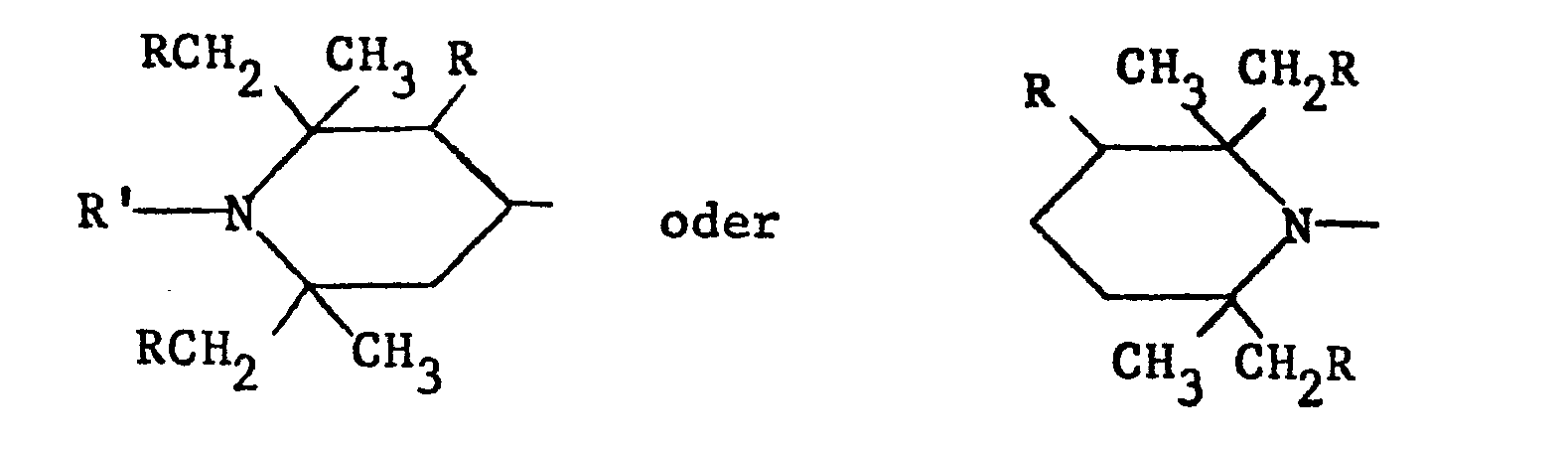
- DE-OS 27 19 131 describes condensation and addition polymers whose recurring structural unit is a polyalkylpiperidine radical of the formula contains or by a polyalkylpiperidine side group of the formula is substituted, wherein R is hydrogen or alkyl with 1-5 C-atoms and R 'hydrogen, alkyl with 1-12 C-atoms, alkenyl with 3-8 C-atoms, alkynyl with 3-6 C-atoms, aralkyl with 7-12 C-atoms, alkanoyl with 1 -8 carbon atoms or alkenoyl with 3-5 carbon atoms, and copolymers with one another or with polyalkylpiperidine-free components which can be used as light stabilizers for plastics.
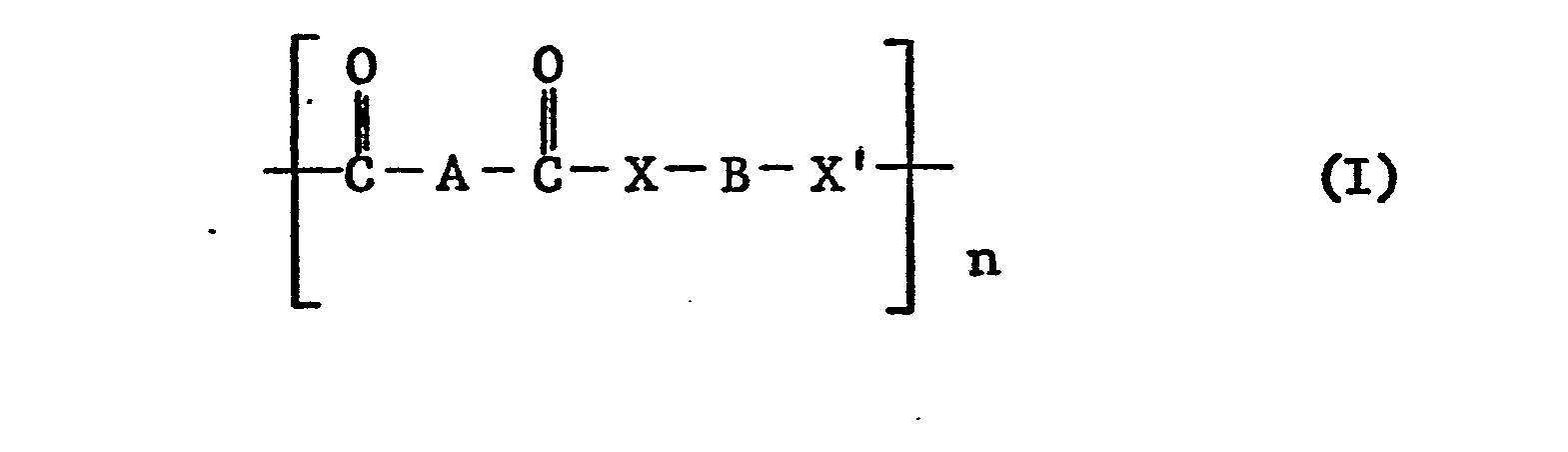
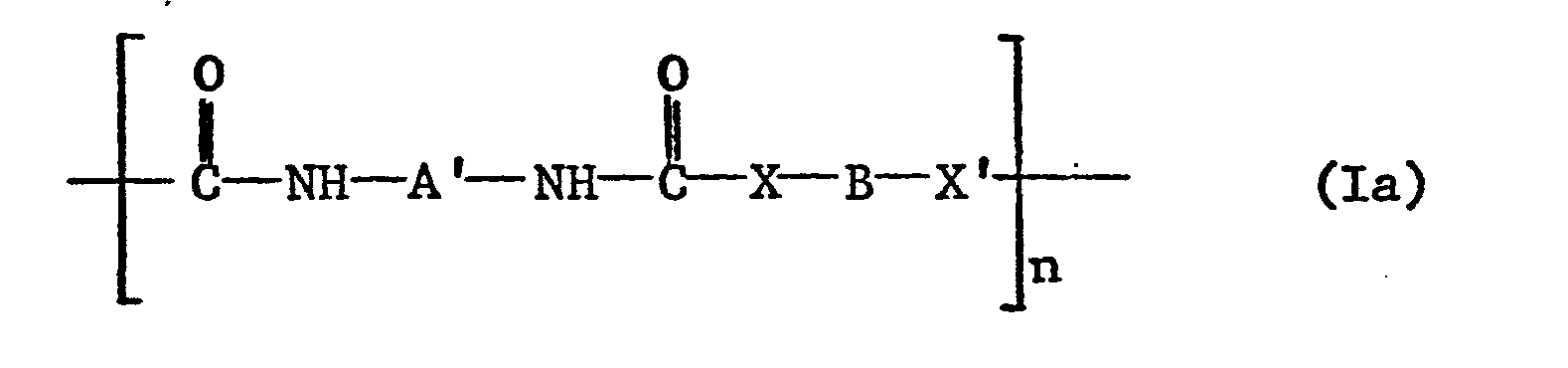
- the polymers claimed there, which can be used as light stabilizers are preferably polyesters, polyamides, polyurethanes, polyureas, polysilyl esters, polyethers, polyamines, polycarbonates and their copolymers, the repeating molecular unit of which contains a polyalkylpiperidine residue, in particular those polymers which are represented by the general formulas I - VII can be represented wherein X and X 'are oxygen or NY, Y is hydrogen, alkyl, cycloalkyl, aralkyl, aryl or a polyalkylpi peridine radical, R 1 and R 2 are methyl, ethyl or phenyl, A, A ', B, B', D, E, and F are divalent organic radicals and G is a monovalent organic radical, in each of the formulas I to VII at least one of the radicals Y, A, A ', B, B', D, E, F, G contains a polyalkylpiperidine
- the index n represents a value of 2-50, which means that the polymers are of relatively low molecular weight.
- these polymers carry end groups which predominantly correspond to the functional groups of the starting materials used for their preparation.
- polyesters made from diols and dicarboxylic acids have hydroxyl and carboxyl end groups.
- the end groups can be predominantly hydroxyl groups or predominantly carboxyl groups, or the two types of end groups are present in approximately the same amount.
- Other types of end groups which may be present in the polymers of the formulas I to VII are amino groups, lower alkyl carboxylate groups, halogen groups, isocyanate groups or epoxy groups.
- Such end groups can have a disadvantageous effect when the polymers are used as light stabilizers in plastics, especially if the degree of polymerization n is low and the quantitative proportion of the end groups is therefore relatively high.
- temperatures can occur at which the end groups are no longer stable.
- An undesirable reaction with the plastic can occur or the polymeric light stabilizer can partially decompose. This can cause discoloration, the light protection effect can be reduced or the properties of the plastics can be changed.
- Hydroxyl and amino groups can also be blocked by monochlorotriazines, by monoepoxides, or by monoisocyanates.
- Isocyanate end groups and epoxy end groups can be blocked by monoalcohols or by primary or secondary monoamines.
- Halogen end groups can be blocked by monoamines, by alkali alkoxides or by trialkyl phosphites.
- Cyclic anhydrides of dicarboxylic acids can also react monofunctionally to primary amino groups by forming a cyclic imide group.
- the molecular weight of the products can be regulated in this way. This can be of technical interest when you have a product of limited molecular weight. However, this is also of interest in order to obtain products with a constant molecular weight in the industrial production of such light stabilizers.
- the invention therefore relates to a process for end group blocking of condensation and addition polymers which can be used as light stabilizers and whose recurring structural unit is a polyalkylpiperidine radical of the formula contains or by a polyalkylpiperidine side group of the formula where R is hydrogen or alkyl having 1-5 C atoms and R 'is hydrogen, alkyl having 1-12 C atoms, alkenyl having 3-8 C atoms, alkynyl having 3-6 C atoms, aralkyl having 7 -12 carbon atoms, alkanoyl with 1-8 carbon atoms or alkenoyl with 3-5 carbon atoms, or their copolymers, which is characterized in that a monofunctional compound is added during the preparation of the polymer or that the finished product Polymers with a implements monofunctional connection.
- Condensation and addition polymers are understood to mean those polymers which are produced by polycondensation or polyaddition, for example polyesters, polyamides, polyurethanes, polyureas, polyethers, polyamines or polyamino-triazines.
- Mixed polymers are to be understood as meaning those which belong to different types of polymer, e.g. Polyester amides, polyether amines, polyamide urethanes or polyester urethanes, or those which belong to the same type of polymer but consist of different structural units, e.g. a polyester made from a diol and two different dicarboxylic acids.
- at least one structural unit must contain a polyalkylpiperidine radical, the other structural unit can be free of polyalkylpiperidine radicals.
- the polyalkylpiperidine residues can be bonded to the rest of the polymer molecule by a wide variety of types of bonds, for example by C-C, N-C or O-C bonds.
- the piperidine ring can be bound to the rest of the polymer molecule by 1, 2 or 3 bonds.
- the piperidine residues carry at least 4 alkyl groups, preferably 2,2,6,6-tetramethylpiperidine residues.
- the substituent on the piperidine nitrogen R ' is preferably hydrogen, alkyl having 1-6 C atoms, allyl, benzyl or acetyl.
- the monofunctional compound used according to the invention for end group blocking can be, for example, a monocarboxylic acid or its functional derivative Monoalcohol or its alkali compound, a primary or secondary monoamine, a cyclic anhydride of a dicarboxylic acid, a monoisocyanate, a monochlorotriazine or a monoepoxide.
- Examples of monocarboxylic acids or their derivatives which can be used according to the invention are acetic acid, acetyl chloride, acetic anhydride, methyl propionate, propionic anhydride, propionyl bromide, butyryl chloride, benzoyl chloride, ethyl benzoate, methyl pivalate, 2-ethylcaproate.
- Examples of usable alcohols or their alkali compounds are methanol, ethanol, isopropanol and sodium ethoxide or potassium tert-butoxide.
- higher alcohols are preferably used, such as n-octanol, 2-ethoxyethanol, cyclohexanol, lauryl alcohol, stearyl alcohol, technical mixtures of higher alcohols, benzyl alcohol etc.
- Examples of usable monoamines are dipropylamine, butylamine, dibutylamine, dodecylamine, cyclohexylamine or methylcyclohexylamine.
- Examples of usable monoisocyanates are methyl isocyanate, n-octyl isocyanate, n-dodecyl isocyanate, phenyl isocyanate or cyclohexyl isocyanate.
- cyclic anhydrides of dicarboxylic acids which can be used are phthalic, hexahydrophthalic, maleic, succinic or bicyclo [2.2.1] heptane-2,3-dicarboxylic anhydride.
- Examples of usable monochlorotriazines are 2,4-diphenoxy-6-chloro-1,3,5-triazine, 2,4-bis (dimethylamino) -6-chloro-l, 3,5-triazine or 2-methoxy -4-dibutylamino-6-chloro-1,3,5-triazine.
- End tendencyblockieren monofunctional compounds include, for example, sulfonyl chlorides such as Methansulfonchlorid, dodecane-1-sulfonyl chloride, benzenesulfonyl chloride or p-toluenesulfonyl chloride, monoepoxides such as propylene, 1-butene oxide, styrene oxide, butyl glycidyl ether or Phenylglycid y läth it to th e M onochlorsilane as such as trimethylchlorosilane or triphenylchlorosilane.
- sulfonyl chlorides such as Methansulfonchlorid, dodecane-1-sulfonyl chloride, benzenesulfonyl chloride or p-toluenesulfonyl chloride
- monoepoxides such as propylene, 1-butene oxide,
- the monofunctional compounds used can also be monofunctional derivatives of polyalkylpiperidines.
- 4-hydroxy-1,2,2,6,6-pentamethylpiperidine, 4-hydroxy-2,2,6,6-tetramethylpiperidine or 1-hydroxyethyl-2,2,6,6-tetramethylpiperidine can be used as mono alcohol or 4-methylamino-1,2,2,6, -6-pentamethylpiperidine or 4- (3'-aminopropyloxy) -2,2,6,6-tetramethylpiperidine can be used as the monoamine.
- the reaction conditions are determined by the conditions necessary for polycondensation or polyaddition.
- the monofunctional end group-blocking compound can be added at the beginning of the polycondensation or polyaddition or in the course or at the end thereof.
- the addition at the end of the polycondensation is equivalent to a conversion of the finished polymer without it being isolated. In certain cases, however, it can also be advantageous or necessary to first isolate the non-end-group-blocked polymer and to aftertreat the monofunctional compound in a separate reaction step.
- both end groups are of the same type in a non-end group blocked polymer, then both end groups are blocked in the reaction with the monofunctional end group blocking compound. If the two end groups are different, you can either use a monofunctional compound that blocks both types of end groups, you can only block one end group and leave the other unchanged, or you can use two different monofunctional compounds.
- the monofunctional compound is added at the beginning or at a relatively early stage of the polymerization, it can react quantitatively in an end group blocking manner yaw.
- the molecular weight of the blocked polymer depends on the amount of monofunctional compound added.
- the amount of monofunctional compound used depends on the desired molecular weight. The smaller the degree of polymerization, the more monofunctional compound you have to use.
- the monofunctional compound is added at the end of the polymerization, there is generally no change in the degree of polymerization already achieved. Only as much of the monofunctional compound reacts as reactive end groups; the excess can be removed again by distillation or by precipitation and elution of the polymer. The amount of monofunctional compound used is not critical in such cases, it will be used in excess.
- the monofunctional compound it is also possible for the monofunctional compound to react with the polymer already formed, reducing the degree of polymerization, for example when transesterifying a polyester with a monoalcohol or a monocarboxylic acid alkyl ester.
- the amount of monofunctional compound used must also depend on the desired molecular weight of the polymer.
- the invention also relates to the products of the process described, namely the end group-blocked condensation and addition polymers which can be used as light stabilizers and whose recurring structural unit is a polyalkylpiperidine radical of the formula contains or by a polyalkylpiperidine side group of the formula where R is hydrogen or alkyl having 1-5 C atoms and R 'is hydrogen, alkyl having 1-12 C atoms, alkenyl having 3-8 C atoms, alkynyl having 3-6 C atoms, aralkyl having 7 -12 C atoms, alkanoyl with 1-8 C atoms or alkenoyl with 3-5 C atoms, and their copolymers with one another or with polyalkylpiperidine-free components whose end groups are blocked by the fact that a monofunctional compound was added during their preparation or that they were subsequently implemented with a monofunctional compound.
- Polyesters polyamides, polyurethanes, polyureas, polyethers, polyamides and polyaminotriazines which contain polyalkylpiperidine residues are preferred.
- polymers in which the polyalkylpiperidine radicals R is hydrogen and R 'is hydrogen, alkyl having 1-4 C atoms, allyl, benzyl or acetyl, in particular H or CH 3 .
- Polyesters, polyamides and polyesteramides of the general formula VIII are also preferred, wherein X and X 'are oxygen or NY and Y is hydrogen, alkyl having 1-12 C atoms, cyclohexyl, aralkyl having 7-9 C atoms, phenyl or a polyalkylpiperidine radical, A and B are divalent organic radicals and at least one of A, B and Y contains a polyalkylpiperidine residue, n is a value from 2 to about 50, T is an end group of the formula -OH or -O (C 1 -C 4 alkyl) and T 'is a blocked end group of the formula -CO-R 3 , -CO- NH -R 4 , -SO 2 -R 5 , -CH 2 CH (OH) R 6 or -CH 2 CH (OH) -CH2-0-R7, where R 3 , R 4 , R 5 , R6 and R 7 represent monovalent hydrocarbon radicals, in particular
- Such polymers of the formula VIII are formed by polycondensation of dicarboxylic acids or their alkyl esters with diols, diamines or amino alcohols in a stoichiometric ratio and simultaneous or subsequent addition of a monofunctional compound which introduces the radical T 'as the end group.
- Polyesters, polyamides and polyesteramides of the formula IX are also preferred wherein X, X ', A, B, n and T have the meaning given above and T "is a monovalent hydrocarbon radical, preferably C 1 -C 12 alkyl, cyclohexyl, benzyl, phenyl or tolyl.
- Such polymers of the formula IX are formed by polycondensation of n moles of a dicarboxylic acid or its ethyl esters and (n-1) moles of a diol, diamine or amino alcohol with 1 mole of a monohydroxyl or monoamino compound T "-XH.
- the polymeric stabilizers are incorporated into the substrates in a concentration of 0.005 to 5% by weight, calculated on the material to be stabilized.
- 0.01 to 1.0, particularly preferably 0.02 to 0.5% by weight of the compounds, calculated on the material to be stabilized, are preferably incorporated into the latter.
- the incorporation can be carried out, for example, by mixing in at least one of the polymeric light stabilizers and, if appropriate, further additives by the methods customary in industry, before or during shaping, or by applying the dissolved or dispersed compounds to the polymer, optionally with subsequent evaporation of the solvent.
- the invention therefore also relates to the plastics stabilized by adding 0.005 to 5% by weight of a polymeric polyalkylpiperidine derivative which is end group-blocked according to the invention.
- a polymeric polyalkylpiperidine derivative which is end group-blocked according to the invention.
- These can be used in various forms, e.g. as foils, fibers, tapes, profiles or as binders for paints, adhesives or putties.
- the plastic stabilized in this way can also contain other stabilizers or other additives customary in plastics technology, such as are listed, for example, in DE- OS 2 349 962, pages 25-32.
- antioxidants in stabilizing polyolefins is particularly important.
- the reaction mixture is then poured into 2 liters of methanol at about 80 ° with stirring.
- the resulting suspension is stirred for 2 hours at room temperature, filtered, the residue washed with 500 ml of methanol and then dried under vacuum at 80 ° for 72 hours.
- the polyester obtained is a colorless powder with an average molecular weight M w - 4750 (gel chromatography) and a softening point of 120-130 °.
- the reaction mixture After the reaction mixture has cooled to about 80 °, it is poured into 2.5 liters of methanol. The resulting suspension is stirred for 3 hours at room temperature, filtered, the residue washed with 500 ml of methanol and dried under vacuum at 80 ° for 72 hours.
- Polyester as a pale yellowish powder with an average molecular weight (vapor pressure osmometry) of 2400 and a softening point of 65-70 °.
- an end group-modified polyester is obtained as a colorless powder with an average molecular weight of 2250 and a softening point of 120-30 °.
- an end group-modified polyester is obtained as a slightly yellowish powder with an average molecular weight of 2160 and a softening point of 120-30 °.
- Cyanuric chloride is reacted with tert.-octylamine (1,1,3,3-tetramethyl-butylamine) in a conventional manner to give 2,4-dichloro-6-tert.octyl-amino-1,3,5-triazine. Mp 80-81 ° after crystallization from hexane.
Landscapes
- Chemical & Material Sciences (AREA)
- Health & Medical Sciences (AREA)
- Chemical Kinetics & Catalysis (AREA)
- Medicinal Chemistry (AREA)
- Polymers & Plastics (AREA)
- Organic Chemistry (AREA)
- Polyesters Or Polycarbonates (AREA)
- Compositions Of Macromolecular Compounds (AREA)
- Other Resins Obtained By Reactions Not Involving Carbon-To-Carbon Unsaturated Bonds (AREA)
Abstract
Description
- Die DE-OS 27 19 131 beschreibt Kondensations- und Additionspolymere, deren wiederkehrende Struktureinheit einen Polyalkylpiperidinrest der Formel

- Vorzugsweise handelt es sich bei den dort beanspruchten, als Lichtschutzmittel verwendbaren Polymeren um Polyester, Polyamide, Polyurethane, Polyharnstoffe, Polysilylester, Polyäther, Polyamine, Polycarbonate und deren Mischpolymere, deren wiederkehrende MolekUleinheit einen Polyalkylpiperidinrest enthält, insbesondere um solche Polymere, die durch die allgemeinen Formeln I - VII dargestellt werden können,


- In Weiterbildung der in der DE-OS 27 19 131 beschriebenen Erfindung wurde gefunden, dass die nachteiligen Wirkungen solcher Endgruppen dadurch ausgeschaltet werden können, dass man die Endgruppen während oder nach der Herstellung der Polymeren durch Zusatz von Verbindungen, die mit den Endgruppen monofunktionell reagieren, blockiert. Beispielsweise können bei einem Polyester, der sowohl Hydroxyl- wie Carboxylgruppen trägt, die Hydroxylgruppen dadurch blokkiert werden, dass man den fertigen Polyester mit einer Monocarbonsäure oder einem funktionellen Derivat davon (z.B. Säurechlorid oder Säureanhydrid) reagieren lässt oder dass man bei der Herstellung aus einer Dicarbonsäure und einem Diol eine kleine Menge einer Monocarbonsäure oder deren Derivat zusetzt. Analog können auch Aminogruppen durch Monocarbonsäuren oder deren funktionelle Derivate blockiert werden.
- Hydroxyl- und Aminogruppen können aber auch durch Monochlortriazine, durch Monoepoxyde, oder durch Monoisocyanate blockiert werden. Isocyanat-Endgruppen und Epoxyd-Endgruppen können durch Monoalkohole oder durch primäre oder sekundäre Monoamine blockiert werden. Halogenendgruppen können durch Monoamine, durch Alkalialkoxide oder durch Trialkylphosphite blockiert werden.
- Monofunktionell können gegenüber primären Aminogruppen auch cyclische Anhydride von Dicarbonsäuren reagieren, indem sie eine cyclische Imidgruppe bilden.
- Wird die Endgruppenblockierung durch Zusatz einer monofunktionellen Verbindung während der Herstellung der polymeren Lichtschutzmittel durchgeführt, so kann man dadurch das Molekulargewicht der Produkte regulieren. Dies kann dann von technischem Interesse sein, wenn man ein Produkt von begrenztem Molekulargewicht bekommen will. Dies ist aber auch von Interesse, um bei der technischen Herstellung solcher Lichtschutzmittel Produkte mit gleichbleibendem Molekulargewicht zu erhalten.
- Gegenstand der Erfindung ist daher ein Verfahren zur Endgruppenblockierung von als Lichtschutzmittel verwendbaren Kondensations- und Additionspolymeren, deren wiederkehrende Struktureinheit einen Polyalkylpiperidinrest der Formel


- Unter Kondensations- und Additionspolymeren werden solche Polymere verstanden, die durch Polykondensation oder Polyaddition hergestellt werden, beispielsweise Polyester, Polyamide, Polyurethane, Polyharnstoffe, Polyäther, Polyamine oder Polyamino-triazine.
- Unter Mischpolymeren sind solche zu verstehen, die verschiedenen Polymertypen angehören, wie z.B. Polyesteramide, Polyäther-amine, Polyamid-urethane oder Polyesterurethane, oder solche, die demselben Polymertyp angehören, aber aus verschiedenen Struktureinheiten bestehen, wie z.B. ein Polyester aus einem Diol und zwei verschiedenen Dicarbonsäuren. Bei den Mischpolymeren muss mindestens eine Struktureinheit einen Polyalkylpiperidinrest enthalten, die andere Struktureinheit kann frei von Polyalkylpiperidinresten sein.
- Die Polyalkylpiperidinreste können an den Rest des Polymermoleküls durch die verschiedensten Arten von Bindungen gebunden sein, beispielsweise durch C-C, N-C oder O-C-Bindungen. Dabei kann der Piperidinring durch 1, 2 oder 3 Bindungen an den Rest des Polymermoleküls gebunden sein. Die Piperidinreste tragen mindestens 4 Alkylgruppen, bevorzugt handelt es sich um 2,2,6,6-Tetramethylpiperidinreste. Der Substituent am Piperidinstickstoff R' ist bevorzugt Wasserstoff, Alkyl mit 1-6 C-Atomen, Allyl, Benzyl oder Acetyl.
- Die erfindungsgemäss zur Endgruppenblockierung verwendete monofunktionelle Verbindung kann beispielsweise eine Monocarbonsäure oder deren funktionelles Derivat sein, ein Monoalkohol oder dessen Alkaliverbindung, ein primäres oder sekundäres Monoamin, ein cyclisches Anhydrid einer Dicarbonsäure, ein Monoisocyanat, ein Monochlortriazin oder ein Monoepoxyd.
- Bevorzugt verwendet man
- 1. eine Monocarbonsäure oder deren Ester, Halogenid oder Anhydrid;
- 2. einen Monoalkohol oder dessen Alkaliverbindung;
- 3. ein primäres oder sekundäres Monoamin;
- 4. ein Monoisocyanat;
- 5. ein cyclisches Anhydrid einer Dicarbonsäure;
- 6. ein Monochlor-l,3,5-triazin.
- Beispiele für erfindungsgemäss verwendbare Monocarbonsäuren oder deren Derivate sind Essigsäure, Acetylchlorid, Essigsäureanhydrid, Propionsäuremethylester, Propionsäureanhydrid, Propionylbromid, Butyrylchlorid, Benzoylchlorid, Benzoesäureäthylester, Pivalinsäuremethylester, 2-Aethylcapronsäuremethylester.
- Beispiele für verwendbare Alkohole oder deren Alkaliverbindungen sind Methanol, Aethanol, Isopropanol und Natriumäthoxid oder Kalium-tert.butoxid. Bevorzugt werden jedoch höhere Alkohole verwendet wie n-Octanol, 2-Aethoxy- äthanol, Cyclohexanol, Laurylalkohol, Stearylalkohol, technische Mischungen von höheren Alkoholen, Benzylalkohol etc.
- Beispiele für verwendbare Monoamine sind Dipropylamin, Butylamin, Dibutylamin, Dodecylamin, Cyclohexylamin oder Methyl-cyclohexylamin.
- Beispiele für verwendbare Monoisocyanate sind Methylisocyanat, n-Octylisocyanat, n-Dodecylisocyanat, Phenylisocyanat oder Cyclohexylisocyanat.
- Beispiele für verwendbare cyclische Anhydride von Dicarbonsäuren sind Phthalsäure-, Hexahydrophthalsäure-, Maleinsäure-, Bernsteinsäure- oder Bicyclo[2.2.1]heptan-2,3-dicarbonsäureanhydrid.
- Beispiele für verwendbare Monochlortriazine sind 2,4-Di- phenoxy-6-chlor-1,3,5-triazin, 2,4-Bis-(dimethylamino)-6-chlor-l,3,5-triazin oder 2-Methoxy-4-dibutylamino-6-chlor-1,3,5-triazin.
- Weitere zum Endgruppenblockieren verwendbare monofunktionelle Verbindungen sind beispielsweise Sulfonsäurechloride wie z.B. Methansulfonchlorid, Dodecan-1-sulfochlorid, Benzolsulfochlorid oder p-Toluolsulfochlorid, Monoepoxide wie z.B. Propylenoxid, 1-Butenoxid, Styroloxid, Butylglycidyläther oder Phenylglycidyläthertoder Monochlorsilane wie z.B. Trimethylchlorsilan oder Triphenylchlorsilan.
- Die verwendeten monofunktionellen Verbindungen können auch monofunktionelle Derivate von Polyalkylpiperidinen sein. Beispielsweise kann als Monoalkohol 4-Hydroxy-1,2,2,6,6-pentamethylpiperidin, 4-Hydroxy-2,2,6,6-tetramethylpiperidin oder 1-Hydroxyäthyl-2,2,6,6-tetramethylpiperidin verwendet werden oder als Monoamin 4-Methylamino-1,2,2,6,-6-pentamethylpiperidin oder 4-(3'-Aminopropyloxy)-2,2,6,6-tetramethylpiperidin verwendet werden. Ferner kann man monofunktionell Triazine mit Piperidin-Substituenten verwenden verwenden, beispielsweise 2-Chlor-4,6-bis(2,2,6,6-tetramethyl-4-piperidylamino)-1,3,5-triazin, 2-Chlor-4,6- bis[N(2,2,6,6-tetramethyl-4-piperidyl)-butylamino]-1,3,5-triazin oder 2-Chlor-4-tert.octylamino-6[N(2,2,6,6-tetramethyl-4-piperidyl)butylamino]-1,3,S-triazin verwenden. Der Aminostickstoff des Piperidinringes reagiert dabei unter den üblichen Bedingungen nicht im Sinne einer funktionellen Gruppe unter Blockierung einer Endgruppe, sodass die oben genannten Beispiele als monofunktionelle Verbindungen im Sinne der Erfindung aufzufassen sind.
- Die Reaktionsbedingungen sind bestimmt durch die zur Polykondensation oder Polyaddition notwendigen Bedingungen. Der Zusatz der monofunktionellen endgruppenblockierenden Verbindung kann am Beginn der Polykondensation bzw. Polyaddition geschehen oder in deren Verlauf oder an deren Ende. Der Zusatz am Ende der Polykondensation kommt einer Umsetzung des fertigen Polymeren gleich, ohne dass dieses isoliert wird. Es kann in gewissen Fällen aber auch vorteilhaft oder notwendig sein, dass man zuerst das nichtendgruppenblockierte Polymer isoliert und in einem getrennten Reaktionsschritt mit der monofunktionellen Verbindung nachbehandelt.
- Wenn in einem nicht-endgruppenblockierten Polymer beide Endgruppen von der gleichen Art sind, so werden bei der Reaktion mit der monofunktionellen endgruppenblockierenden Verbindung beide Endgruppen blockiert. Sind die beiden Endgruppen verschieden, so kann man entweder eine monofunktionelle Verbindung verwenden, die beide Arten von Endgruppen blockiert, oder man blockiert nur die eine Endgruppe und lässt die andere unverändert, oder man verwendet zwei verschiedene monofunktionelle Verbindungen.
- Wenn die monofunktionelle Verbindung am Beginn oder in einem relativ frühen Stadium der Polymerisation zugesetzt wird, so kann sie quantitativ endgruppenblockierend reagieren. Von der Menge der zugesetzten monofunktionellen Verbindung hängt das Molekulargewicht des blockierten Polymeren ab. Die verwendete Menge an monofunktioneller Verbindung richtet sich also nach dem gewünschten Molekulargewicht. Je kleiner der Polymerisationsgrad werden soll, desto mehr monofunktionelle Verbindung muss man verwenden.
- Wird die monofunktionelle Verbindung am Ende der Polymerisation zugesetzt, so tritt dadurch im allgemeinen keine Veränderung des bereits erreichten Polymerisationsgrades ein. Es reagiert nur so viel von der monofunktionellen Verbindung als reaktive Endgruppen vorhanden sind, der Ueberschuss kann durch Destillation oder durch Fällung und Elution des Polymeren wieder entfernt werden. Die verwendete Menge an monofunktioneller Verbindung ist in solchen Fällen also nicht kritisch, man wird sie im Ueberschuss einsetzen.
- Es ist jedoch auch möglich, dass die monofunktionelle Verbindung mit dem bereits gebildeten Polymer unter Abbau des Polymerisationsgrades reagiert, beispielsweise bei Umesterung eines Polyesters mit einem Monoalkohol oder einem Monocarbonsäurealkylester. In diesem Fall muss sich die verwendete Menge an monofunktioneller Verbindung ebenfalls nach dem gewünschten Molekulargewicht des Polymeren richten.
- Gegenstand der Erfindung sind'auch die Produkte des beschriebenen Verfahrens, nämlich die als Lichtschutzmittel verwendbaren endgruppenblockierten Kondensations- und Additionspolymere, deren wiederkehrende Struktureinheit einen Polyalkylpiperidinrest der Formel
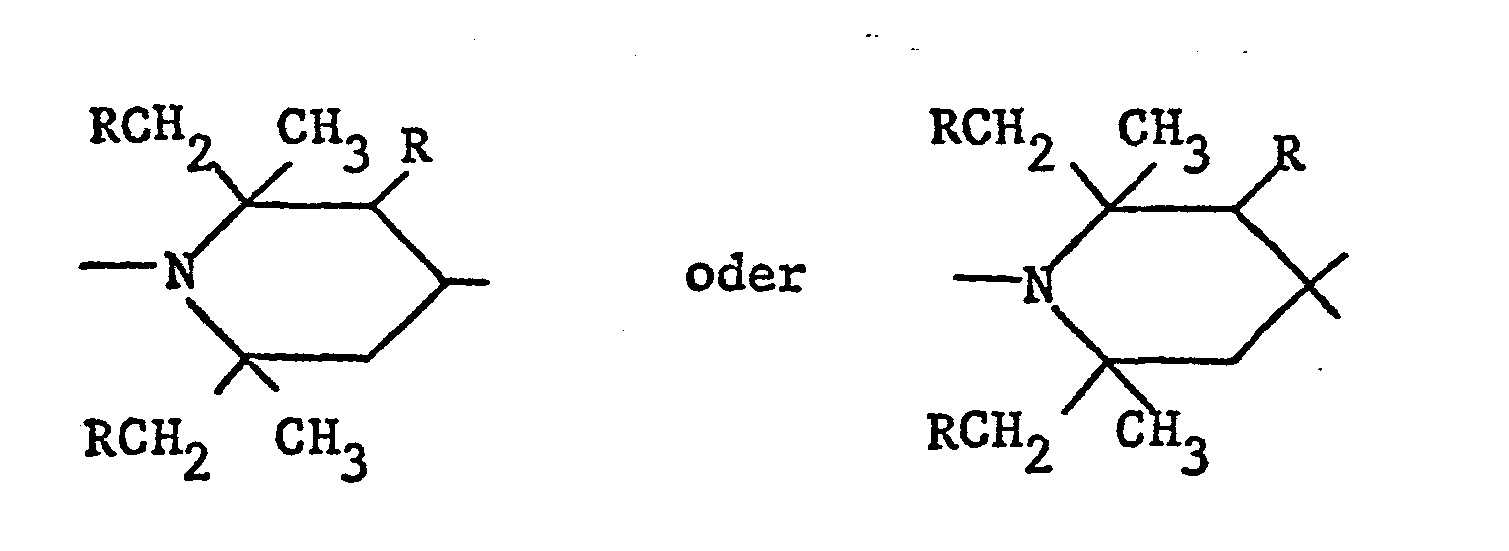

- Bevorzugt sind dabei Polyester, Polyamide, Polyurethane, Polyharnstoffe, Polyäther, Polyamide und Polyaminotriazine, die Polyalkylpiperidinreste enthalten.
- Bevorzugt sind weiterhin solche Polymere, in deren Polyalkylpiperidinresten R Wasserstoff ist und R' Wasserstoff, Alkyl mit 1-4 C-Atomen, Allyl, Benzyl oder Acetyl, insbesondere H oder CH3 bedeutet.
- Bevorzugt sind weiterhin Polyester, Polyamide und Poly - esteramide der allgemeinen Formel VIII,

- Solche Polymere der Formel VIII entstehen durch Polykondensation von Dicarbonsäuren oder deren Alkylestern mit Diolen, Diaminen oder Aminoalkoholen im stöchiometrischen Verhältnis und gleichzeitiger oder anschliessender Zugabe einer monofunktionellen Verbindung, die den Rest T' als Endgruppe einführt.
- Bevorzugt sind weiterhin Polyester, Polyamide und Polyesteramide der Formel IX

- Solche Polymere der Formel IX entstehen durch Polykondensation von n Molen einer Dicarbonsäure oder deren Aethylestern und (n-1) Molen eines Diols, Diamins oder Aminoalkohols mit 1 Mol einer Monohydroxyl- oder Monoaminoverbindung T"-XH.
- Die nach dem beschriebenen Verfahren endgruppenblockierten Polyalkylpiperidinreste enthaltenden Kondensations- und Additionspolymeren können als Lichtstabilisatoren für Kunststoffe verwendet werden und zeichnen sich dabei durch hohe Extraktionsbeständigkeit aus. Polymere Substrate, die auf diese Weise gegen Lichtabbau stabilisiert werden können, sind z.B. die folgenden:
- 1. Polymere von Mono- und Diolefinen, beispielsweise Polyäthylen (das gegebenenfalls vernetzt sein kann), Polypropylen, Polyisobutylen, Polymethylbuten-1, Polymethylpenten-1, Polyisopren oder Polybutadien.
- 2. Mischungen der unter 1) genannten Polymeren, z.B. Mischungen von Polypropylen mit Polyäthylen oder mit Polyisobutylen.
- 3. Copolymere von Mono- und Diolefinen, wie z.B. Aethylen-Propylen-Copolymere, Propylen-Buten-l-Copolymere, Propylen-Isobutylen-Copolymere, Aethylen-Buten-l-Copolymere sowie Terpolymere von Aethylen mit Propylen und einem Dien, wie Hexadien, Dicyclopentadien oder Aethylidennorboren.
- 4. Polystyrol.
- 5. Copolymere von Styrol oder a-Methylstyrol mit Dienen oder Acrylderivaten, wie z.B. Styrol-Butadien, Styrol-Acrylnitril, Styrol-Acrylnitril-Methylacrylat; Mischungen von hoher Schlagzähigkeit aus Styrol-Copolymeren und einem anderen Polymer wie z.B. einem Polyacrylat, einem Dien-Polymeren oder einem Aethylen-Propylen-Dien-Terpolymeren; sowie Block-Copolymere des Styrols, wie z.B. Styrol-Butadien-Styrol, Styrol-Isopren-Styrol oder Styrol-Aethylen/Butylen-Styrol.
- 6. Graft- oder Pfropfcopolymere von Styrol, wie z.B. Styrol auf Polybutadien, Styrol und Acrylnitril auf Polybutadien sowie deren Mischungen mit den unter 5) genannten Copolymeren, wie sie als sogenannte ABS-Polymere bekannt sind.
- 7. Halogenhaltige Polymere, wie z.B. Polyvinylchlorid, Polyvinylidenchlorid, Polyvinylfluorid, Polychloropren, Chlorkautschuke und Copolymere wie Vinylchlorid-Vinylidenchlorid, Vinylchlorid-Vinylacetat oder Vinylidenchlorid-Vinylacetat.
- 8. Polymere, die sich von α,8-ungesättigten Säuren und deren Derivaten ableiten, wie Polyacrylate und Polymethacrylate, Polyacrylamide und Polyacrylnitril.
- 9. Polymere, die sich von ungesättigten Alkoholen und Aminen bzw. deren Acrylderivaten oder Acetalen ableiten, wie Polyvinylalkohol, Polyvinylacetat-, -stearat, -benzoat, -maleat, Polyvinylbutyral, Polyallylphthalat, Polyallylmelamin und deren Copolymere mit anderen Vinylverbindungen, wie Aethylen/Vinylacetat-Copolymere.
- 10. Homo- und Copolymere von Epoxyden, wie Polyäthylenoxyd, Polypropylenoxyd oder deren Copolymere mit Bisgycidyläthern.
- 11. Polyacetale, wie Polyoxymethylen, sowie solche Polyoxymethylene, die als Comonomeres Aethylenoxyd enthalten.
- 12. Polyphenylenoxyde.
- 13. Polyurethane und Polyharnstoffe
- 14. Polycarbonate
- 15. Polysulfone
- 16. Polyamide und Copolyamide, die sich von Diaminen und Dicarbonsäuren und/oder von Aminocarbonsäuren oder den entsprechenden Lactamen ableiten, wie Polyamid 6, Polyamid 6/6, Polyamid 6/10, Polyamid 11, Polyamid 12.
- 17. Polyester, die sich von Dicarbonsäuren und Dialkoholen und/oder von Hydroxycarbonsäuren oder den entsprechenden Lactonen ableiten, wie Polyäthylenterephthalat, Polybutylenterephthalat, Poly-l,4-dimethylolcyclohexanterephthalat, sowie Block-Polyäther-ester, die sich von Polyäthern mit Hydroxylendgruppen und Dicarbonsäuren ableiten.
- 18. Vernetzte Polymerisate, die sich von Aldehyden einerseits und Phenolen, Harnstoffen und Melaminen andererseits ableiten, wie Phenol-Formaldehyd-, Harnstoff-Formaldehyd- und Melamin-Formaldehydharze.
- 19. Alkydharze, wie Glycerin-Phthalsäure-Harze und deren Gemische mit Melamin-Formaldehydharzen.
- 20. Ungesättigte Polyesterharze, die sich von Copolyestern gesättigter- und ungesättigter Dicarbonsäuren mit mehrwertigen Alkoholen, sowie Vinylverbindungen als Vernetzungsmitteln ableiten, wie auch deren har logenhaltige, schwerbrennbare Modifikationen.
- 21. Vernetzte Epoxidharze, die sich von Polyepoxiden ableiten, z.B. von Bis-glycidyläthern oder von cycloaliphatischen Diepoxiden.
- 22. NatUrliche Polymere, wie Cellulose, Gummi, Proteine, sowie deren polymerhomolog chemisch abgewandelte Derivate, wie Celluloseacetate, -propionate und -butyrate, bzw. die Celluloseäther, wie Methylcellulose.
- Von diesen Polymeren sind die Gruppen 1-6, 13, 16 und 17 hervorzuheben, da in diesen Substraten die erfindungsgemässen Stabilisatoren eine besonders markante Wirkung haben.
- Die polymeren Stabilisatoren werden den Substraten in einer Konzentration von 0,005 bis 5 Gew.-%, berechnet auf das zu stabilisierende Material, einverleibt.
- Vorzugsweise werden 0,01 bis 1,0, besonders bevorzugt 0,02 bis 0,5 Gew.-% der Verbindungen, berechnet auf das zu stabilisierende Material, in dieses eingearbeitet.
- Die Einarbeitung kann beispielsweise durch Einmischen mindestens eines der polymeren Lichtschutzmittels und gegebenenfalls weiterer Additive nach den in der Technik üblichen Methoden, vor oder während der Formgebung, oder auch durch Aufbringen der gelösten oder dispergierten Verbindungen auf das Polymere, gegebenenfalls unter nachträglichem Verdunsten des Lösungsmittels erfolgen.
- Die Erfindung betrifft daher auch die durch Zusatz von 0,005 bis 5 Gew.-% eines erfindungsgemäss endgruppenblockierten polymeren Polyalkylpiperidinderivates stabilisierten Kunststoffe. Diese können in verschiedenster Form angewendet werden, z.B. als Folien, Fasern, Bändchen, Profile oder als Bindemittel für Lacke, Klebemittel oder Kitte.
- Der so stabilisierte Kunststoff kann ausserdem noch andere Stabilisatoren oder sonstige in der Kunststofftechnologie übliche Zusätze enthalten, wie sie beispielsweise in der DE-OS 2 349 962, Seite 25-32, aufgeführt sind.
- Bei der Mitverwendung bekannter Stabilisatoren können synergistische Effekte auftreten, was besonders bei Mitverwendung von anderen Lichtschutzmitteln oder von organischen Phosphiten häufig der Fall ist.
- Von besonderer Bedeutung ist die Mitverwendung von Antioxydantien bei der Stabilisierung von Polyolefinen.
- Die nachfolgenden Beispiele erläutern die Erfindung noch näher, ohne sie zu begrenzen. Die Temperaturen sind in Celsius-Graden angegeben.
- 201,3 g 1-(2-Hydroxyäthyl)-2,2,6,6-tetramethyl-4-hydroxypiperidin werden mit 146,1 g Bernsteinsäuredimethylester und 3 g Tetrabutylorthotitanat in 200 ml Xylol 24 Stunden unter schwachem Stickstoffstrom auf 130-135° erwärmt, wobei langsam Methanol abdestilliert wird. Man lässt das Reaktionsgemisch auf ca. 100° abkühlen, gibt 17,2 g 2-Aethyl-2-methylcapronsäuremethylester 0,5 g Tetrabutylorthotitanat hinzu und rührt weitere 8 Stunden bei 130-135° unter Destillation des gebildeten Methanols. Das Reaktionsgemisch wird dann bei ca. 80° unter Rühren in 2 Liter Methanol gegossen. Die entstandene Suspension wird 2 Stunden bei Raumtemperatur gerührt, filtriert, der Rückstand mit 500 ml Methanol gewaschen und dann 72 Stunden unter Vakuum bei 80° getrocknet. Der erhaltene Polyester ist ein farbloses Pulver mit einem mittleren Molekulargewicht Mw - 4750 (Gelchromatographie) und einem Erweichungspunkt von 120-130°.
- Verwendet man anstelle von 2-Aethyl-2-methylcapronsäure- methylester 15,8 g 2-Aethyl-capronsäuremethylester und verfährt man im übrigen wie oben beschrieben, so erhält man einen farblosen Polyester mit einem mittleren Molekulargewicht Mw = 3000 (Gelchromatographie) und einem Erweichungspunkt von 106-116°.
- 201,3 g 1-(2-Hydroxyäthyl)-2,2,6,6-tetramethyl-4-hydroxypiperidin werden mit 146,1 g Bernsteinsäure-dimethylester und 3 g Tetrabutylorthotitanat in 200 ml Xylol 24 Stunden unter schwachem Stickstoffstrom auf 130-135° erwärmt, wobei langsam Methanol abdestilliert wird. Das Reaktionsgemisch wird mit 100 ml Xylol verdünnt und auf 50° abgekühlt. Bei dieser Temperatur wird eine Lösung von 10 g Butylisocyanat in 50 ml Xylol in 10 Minuten zugetropft und dann die Temperatur in 2 Stunden bis auf 130° erhöht. Nach dem Abkühlen des Reaktionsgemisches auf ca. 80° wird es in 2,5 Liter Methanol gegossen. Die entstandene Suspension wird 3 Stunden bei Raumtemperatur gerührt, filtriert, der Rückstand mit 500 ml Methanol gewaschen und 72 Stunden bei 80° unter Vakuum getrocknet. Der erhaltene Polyester ist ein farbloses Pulver mit einem mittleren Molekulargewicht
M W = 7300 (Gelchromatographie) und einem Erweichungspunkt von 120-128°. - Verwendet man anstelle von Butylisocyanat 12 g Phenylisocyanat und verfährt man im übrigen wie oben beschrieben, so erhält man einen farblosen Polyester mit einem mittleren Molekulargewicht Mw = 6900 (Gelchromatographie) und einem Erweichungspunkt von 115-135°.
- 201,3 g 1-(2-Hydroxyäthyl)-2,2,6,6-tetramethyl-4-hydroxypiperidin werden mit 146,1 g Bernsteinsäuredimethylester und 3 g Tetrabutylorthotitanat in 200 ml Xylol 24 Stunden Stickstoffstrom auf 130-135° erwärmt, wobei langsam Methanol abdestilliert wird. Das Reaktionsgemisch wird mit 200 ml Xylol verdünnt, auf ca. 70° abgekühlt und dann langsam, unter Rühren in 3000 ml Methanol gegossen. Der entstandene Niederschlag wird abfiltriert, mit 300 ml Methanol gewaschen und im Vakuum bei 50-60° getrocknet. Der erhaltene Polyester weist ein Molekulargewicht von 4050 auf (Dampfdruck-Osmometrie).
- 40,5 g dieses Polyesters werden mit 1,85 g n-Dodecylamin unter schwachem Stickstoffstrom während 6 Stunden auf 200° erhitzt. Nach dem Abkühlen wird das Reaktionsprodukt in ca. 200 ml Toluol aufgenommen, von wenigen, unlöslichen Partikeln abfiltriert und die Toluollösung dann unter Vakuum vollständig eingedampft. Man erhält eine glasige Masse, die sich nach dem Abkühlen pulverisieren lässt. Der erhaltene, amidmodifizierte Polyester ist ein schwach gelbliches Pulver mit einem mittleren Molekulargewicht (Dampfdruck-Osmometrie) von 2960 und einem Erweichungspunkt von ca. 55°.
- Setzt man 40,5 g des oben hergestellten Polyesters mit 1,84 g 2,2,6,6-Tetramethyl-4-ß-aminoäthylpiperidin anstelle von n-Dodecylamin um und verfährt man im übrigen wie oben beschrieben, so erhält man einen amidterminierten Polyester als schwach gelbliches Pulver mit einem mittleren Molekulargewicht (Dampfdruck-Osmometrie) von 2400 und einem Erweichungspunkt von 65-70°.
- 100,7 g l-Hydroxyläthyl-2,2,6,6-tetramethyl-4-hydroxypiperidin, 7,5 g Stearinsäuremethylester , 87,5 g Terephthalsäuredimethylester und 1,5 g Tetrabutylorthotitanat werden in 300 ml Xylol unter Stickstoffstrom aufgeheizt. Bei ca. 120° entsteht eine klare Lösung und Methanol beginnt abzudestillieren. Man hält das Reaktionsgemisch während 10 Stunden bei 130-135° bis praktisch kein Methanol mehr abdestilliert. Das Reaktionsgemisch wird unter gutem Rühren in 1500 ml Methanol gegossen. Der farblose Niederschlag wird abfiltriert, mit 300 ml Methanol gewaschen und im Vakuum bei 80° getrocknet. Der erhaltene, mit Stearinsäureesterendgruppen modifizierte Polyester ist ein farbloses Pulver mit einem mittleren Molekulargewicht (Dampfdruck-Osmometrie) von 2300 und einem Erweichungspunkt von 245-250°.
- Verwendet man anstelle von Terephthalsäuredimethylester die gleiche Menge Isophthalsäuredimethylester und verfährt man im übrigen wie oben beschrieben, so erhält man einen endgruppenmodifizierten Polyester als farbloses Pulver mit einem mittleren Molekulargewicht von 2250 und einem Erweichungspunkt von 120-30°.
- 100,7 g 1-Hydroxyäthyl-2,2,6,6-tetramethyl-4-hydroxypiperidin, 82,7 g Adipinsäuredimethylester, 3,4 g Benzoesäuremethylester und 2,0 g Natriummethylat werden in 200 ml Xylol unter schwachem Stickstoffstrom langsam erwärmt. Bei ca. 120° setzt die Umesterung ein und Methanol destilliert ab. Man rührt das Reaktionsgemisch 10 Stunden bei 130-35°, verdünnt es mit 300 ml Toluol und klärt die erhaltene, schwach bräunliche Lösung. Diese wird eingedampft, der der Rückstand 12 Stunden am Hochvakuum getrocknet und die erhaltene, schwach bräunliche Masse nach dem Erhalten pulverisiert. Der erhaltene, mit Benzoesäureesterendgruppen modifizierte Polyester weist ein mittleres Molekulargewicht (Dampfdruck-Osmometrie) von 2500 auf und erweicht bei 45-50°.
- 85,5 g 1-Hydroxyäthyl-2,2,6,6-tetramethyl-4-hydroxypiperidin, 14,0 g Laurylalkohol, 97,1 g Terephthalsäuredimethylester und 2,0 g Tetrabutylorthotitanat werden in 300 ml Xylol unter schwachem Stickstoffatom erhitzt. Bei ca. 120° fängt Methanol an abzudestillieren. Das Reaktionsgemisch wird 8 Stunden bei 130-135° gerührt bis praktisch kein Methanol mehr abdestilliert und nach dem Abkühlen in 1500 ml Methanol gegossen. Der erhaltene farblose Niederschlag wird abfiltriert mit 200 ml Methanol gewaschen und im Vakuum bei 80° getrocknet. Der erhaltene, endgruppenmodifizierte Polyester ist ein farbloses Pulver mit einem mittleren Molekulargewicht (Dampfdruck-Osmometrie) von 2270 und einem Erweichungspunkt von 180°.
- Verwendet man anstelle von Terephthalsäuredimethylester eine gleiche Menge Isophthalsäuredimethylester und verfährt man im übrigen wie oben beschrieben, so erhält man einen endgruppenmodifizierten Polyester als schwach gelbliches Pulver mit einem mittleren Molekulargewicht von 2160 und einem Erweichungspunkt von 120-30°.
- Cyanurchlorid wird mit tert.Octylamin(1,1,3,3-Tetramethyl- butylamin) in üblicher Weise zum 2,4-Dichlor-6-tert.octyl- amino-1,3,5-triazin umgesetzt. Smp. 80-81° nach Kristallisation aus Hexan.
- Die Mischung von 11,1 g 2,4-Dichlor-6-tert.octylamino -1,3,5-triazin, 19,7 g 1,6-Bis(2,2,6,6-tetramethyl-4-piperidyl- amino)hexan, 3,2 g fein pulverisiertes Natriumhydroxyd und 200 ml Toluol wird 24 Std. bei gutem Rühren unter Rückfluss gekocht. Anschliessend werden 9,6 g 2-Chlor-4,6- bis[N(2,2,6,6-tetramethyl-4-piperidyl)äthylamino]l,3,5-triazin und 1 g fein pulv. Natriumhydroxyd ugegeben und den Ansatz nochmals 24 Std. gekocht. Die Mischung wird filtriert. Das Filtrat wird eingedampft und das feste Produkt aus Hexan kristallisiert.
- Aehnliche Produkte erhält man, wenn man in obigem Beispiel an Stelle des 2-Chlor-4,6-bis[N(2,2,6,6-tetramethyl-4-pi- peridyl)äthylamino]-1,3,5-triazins äquivalente Mengen Acetylchlorid, Pivalinsäurechlorid, Benzoylchlorid, Dimethylcarbaminsäurechlorid oder p-Toluolsulfochlorid verwendet.
Claims (24)
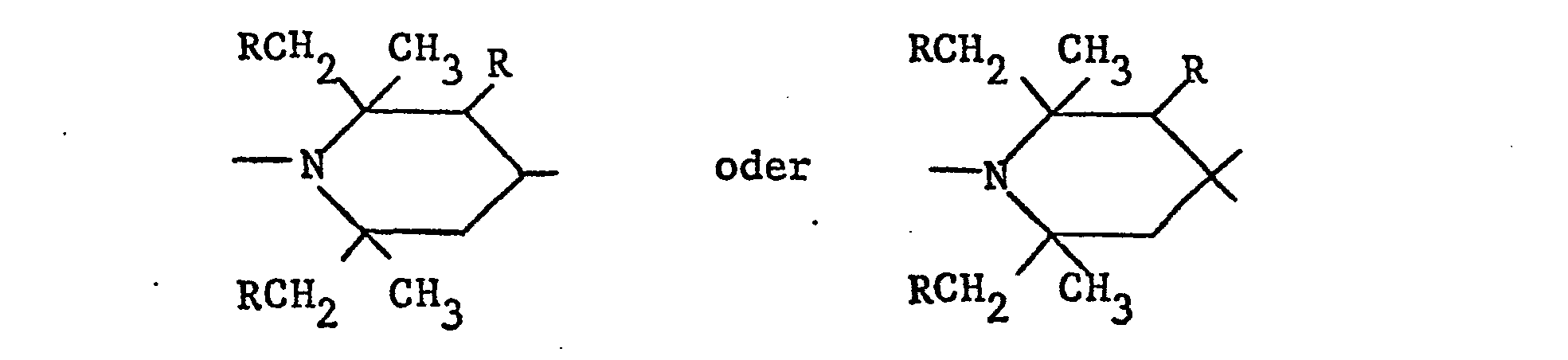


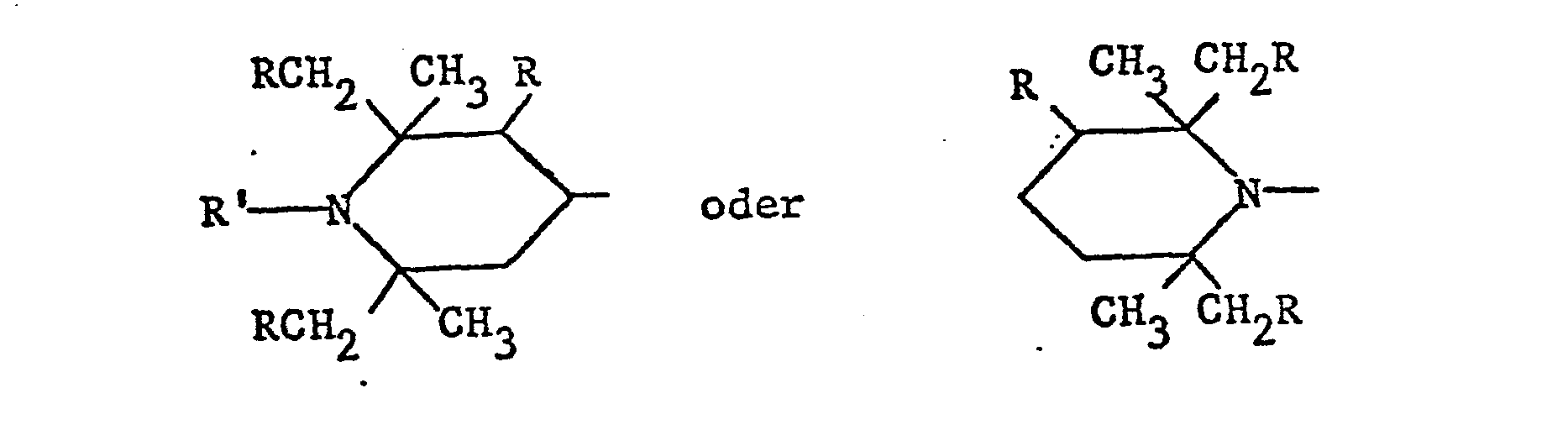


Applications Claiming Priority (2)
| Application Number | Priority Date | Filing Date | Title |
|---|---|---|---|
| CH1372277 | 1977-11-10 | ||
| CH13722/77 | 1977-11-10 |
Publications (2)
| Publication Number | Publication Date |
|---|---|
| EP0002005A1 true EP0002005A1 (de) | 1979-05-30 |
| EP0002005B1 EP0002005B1 (de) | 1983-01-19 |
Family
ID=4394755
Family Applications (1)
| Application Number | Title | Priority Date | Filing Date |
|---|---|---|---|
| EP78101286A Expired EP0002005B1 (de) | 1977-11-10 | 1978-11-02 | Verfahren zur Endgruppenblockierung polymerer Polyalkylpiperidinderivate, die so erhaltenen endgruppenblockierten Produkte und ihre Verwendung als Lichtschutzmittel für Kunststoffe |
Country Status (4)
| Country | Link |
|---|---|
| US (1) | US4234707A (de) |
| EP (1) | EP0002005B1 (de) |
| JP (1) | JPS5490292A (de) |
| DE (1) | DE2862161D1 (de) |
Cited By (5)
| Publication number | Priority date | Publication date | Assignee | Title |
|---|---|---|---|---|
| EP0047967A1 (de) * | 1980-09-10 | 1982-03-24 | The B.F. GOODRICH Company | Piperidin-Derivate mit hochmolekularem Gewicht als UV-Stabilisatoren |
| EP0119961A1 (de) * | 1983-03-21 | 1984-09-26 | Ciba-Geigy Ag | Oligoester mit Polyalkylpiperidingruppen |
| EP0357223A3 (de) * | 1988-08-29 | 1991-09-25 | Vyskumny Ustav Chemickej Technologie Vyskumna A Vyvojova Organizacia | Polyaminotriazine und Verfahren zu ihrer Herstellung |
| WO2006109599A1 (ja) | 2005-04-05 | 2006-10-19 | Jms Co., Ltd. | 3,4-DGEに由来するAGEsに特異的に反応する抗体 |
| EP3778536A1 (de) | 2019-08-12 | 2021-02-17 | Yara International ASA | Verbesserte harnstoffbasierte zusammensetzung und verfahren zur herstellung davon |
Families Citing this family (17)
| Publication number | Priority date | Publication date | Assignee | Title |
|---|---|---|---|---|
| US4381372A (en) * | 1981-04-08 | 1983-04-26 | American Cyanamid Company | Polymers derived from 4-bis(carbalkoxyethyl)-phosphinoxy-2,2,6,6-tetramethylpiperidine |
| US4439565A (en) * | 1982-11-10 | 1984-03-27 | Ciba-Geigy Corporation | Oligomeric esteramides containing pendant hindered amine groups |
| CA1242918A (en) * | 1982-11-18 | 1988-10-11 | David G. Leppart | Colour-photographic recording material |
| US4507463A (en) * | 1983-05-11 | 1985-03-26 | Ciba-Geigy Corporation | Process for producing polyesters from aliphatic dicarboxylic acids and polyalkylpiperidyldiols |
| US5246777A (en) * | 1990-04-25 | 1993-09-21 | Sumitomo Chemical Company, Limited | Fiber or film formed from a stabilized polyolefin composition |
| JPH05156094A (ja) * | 1991-12-11 | 1993-06-22 | Sumitomo Chem Co Ltd | 安定化ポリオレフィン組成物 |
| US5449777A (en) * | 1993-07-08 | 1995-09-12 | Ciba-Geigy Corporation | Phenolic s-triazines |
| US6046304A (en) | 1995-12-04 | 2000-04-04 | Ciba Specialty Chemicals Corporation | Block oligomers containing 2,2,6,6-tetramethyl-4-piperidyl groups as stabilizers for organic materials |
| DE69719004T2 (de) | 1996-12-24 | 2003-07-24 | Ciba Speciality Chemicals Holding Inc., Basel | Triazinverbindungen die 2,2,6,6-Tetramethyl-4-piperidingruppen enthalten als Stabilisatoren für organische Materialen |
| CN1106397C (zh) | 1997-05-27 | 2003-04-23 | 西巴特殊化学品控股有限公司 | 作为有机材料稳定剂的含有1-烃氧基-2,2,6,6-四甲基-4-哌啶基的嵌段低聚物 |
| TW491872B (en) * | 1997-05-27 | 2002-06-21 | Ciba Sc Holding Ag | Block oligomers containing l-hydrocarbyloxy-2,2,6,6-tetramethyl-4- piperidyl groups as stabilizers for lower polyolefin |
| TW589341B (en) | 1997-05-27 | 2004-06-01 | Ciba Sc Holding Ag | Block oligomers containing 1-hydrocarbyloxy-2,2,6,6-tetramethyl-4-piperidyl groups as stabilizers for organic materials |
| TW509683B (en) * | 1997-05-27 | 2002-11-11 | Ciba Sc Holding Ag | Triazine derivatives containing 2,2,6,6-tetramethyl-4-piperidyl groups |
| GB2340492B (en) | 1997-05-27 | 2001-07-04 | Ciba Sc Holding Ag | Block oligomers containing 1-hydrocarbyloxy-2,2,6,6-tetramethyl-4-piperidyl groups as stabilizers for organic materials |
| TW428008B (en) | 1997-05-27 | 2001-04-01 | Ciba Sc Holding Ag | Block oligomers containing 1-hydrocarbyloxy-2,2,6,6-tetramethy1-4-piperidyl groups as stabilizers for organic materials |
| CN101137697B (zh) * | 2005-03-07 | 2011-05-18 | M-I有限公司 | 用于钻井液中的聚合物涂覆的暂堵剂固体和加重剂 |
| DK3649177T3 (da) * | 2017-07-06 | 2022-12-12 | T En Zimmer Gmbh | Fremgangsmåde til fremstilling af polyestere under anvendelse af et additiv |
Citations (6)
| Publication number | Priority date | Publication date | Assignee | Title |
|---|---|---|---|---|
| FR943927A (fr) * | 1946-03-28 | 1949-03-22 | Ici Ltd | Stabilisation des esters linéaires à haut degré de polymérie |
| FR1031569A (fr) * | 1949-05-28 | 1953-06-24 | Thomson Houston Comp Francaise | Polyesters à chaînes linéaires limitées et leurs applications |
| US4001189A (en) * | 1973-09-17 | 1977-01-04 | E. I. Du Pont De Nemours And Company | Fibers of acid-dyeable polyester having tetramethylpiperidine groups attached through oxyalkalene linkages to ends of polymer chains |
| DE2636143A1 (de) * | 1975-11-18 | 1977-05-26 | Chimosa Chimica Organica Spa | Neue polyharnstoffverbindungen |
| DE2636144A1 (de) * | 1975-12-04 | 1977-06-08 | Chimosa Chimica Organica Spa | Neue polytriazinverbindungen |
| DE2752740A1 (de) * | 1976-11-26 | 1978-06-01 | Chimosa Chimica Organica Spa | Stabilisatorverbindungen, verfahren zu deren herstellung und diese enthaltende mittel |
Family Cites Families (7)
| Publication number | Priority date | Publication date | Assignee | Title |
|---|---|---|---|---|
| US3035025A (en) * | 1959-04-24 | 1962-05-15 | Standard Oil Co | Polyester resin containing pyridine dicarboxylic acid |
| US3910860A (en) * | 1972-09-20 | 1975-10-07 | Du Pont | Fibers of acid-dyeable polyester having terminal tetramethylpiperidine groups |
| US3974127A (en) * | 1973-09-17 | 1976-08-10 | E. I. Du Pont De Nemours And Company | Alkylene oxide condensates of tetramethylpiperidine alcohols or glycols |
| US4001190A (en) * | 1973-09-17 | 1977-01-04 | E. I. Du Pont De Nemours And Company | Acid-dyeable fibers of polyester modified with tetramethylpiperidine polyether glycols |
| JPS51132230A (en) * | 1974-12-16 | 1976-11-17 | Toyobo Co Ltd | Polyester adhesive |
| US4079045A (en) * | 1976-06-30 | 1978-03-14 | Allied Chemical Corporation | Esterification of terephthalic acid with an alkylene glycol in the presence of a pyridine dicarboxylic acid compound |
| JPH0721112B2 (ja) * | 1986-07-31 | 1995-03-08 | 丸山工業株式会社 | 日除けシート |
-
1978
- 1978-11-01 US US05/956,715 patent/US4234707A/en not_active Expired - Lifetime
- 1978-11-02 DE DE7878101286T patent/DE2862161D1/de not_active Expired
- 1978-11-02 EP EP78101286A patent/EP0002005B1/de not_active Expired
- 1978-11-10 JP JP13876778A patent/JPS5490292A/ja active Pending
Patent Citations (6)
| Publication number | Priority date | Publication date | Assignee | Title |
|---|---|---|---|---|
| FR943927A (fr) * | 1946-03-28 | 1949-03-22 | Ici Ltd | Stabilisation des esters linéaires à haut degré de polymérie |
| FR1031569A (fr) * | 1949-05-28 | 1953-06-24 | Thomson Houston Comp Francaise | Polyesters à chaînes linéaires limitées et leurs applications |
| US4001189A (en) * | 1973-09-17 | 1977-01-04 | E. I. Du Pont De Nemours And Company | Fibers of acid-dyeable polyester having tetramethylpiperidine groups attached through oxyalkalene linkages to ends of polymer chains |
| DE2636143A1 (de) * | 1975-11-18 | 1977-05-26 | Chimosa Chimica Organica Spa | Neue polyharnstoffverbindungen |
| DE2636144A1 (de) * | 1975-12-04 | 1977-06-08 | Chimosa Chimica Organica Spa | Neue polytriazinverbindungen |
| DE2752740A1 (de) * | 1976-11-26 | 1978-06-01 | Chimosa Chimica Organica Spa | Stabilisatorverbindungen, verfahren zu deren herstellung und diese enthaltende mittel |
Cited By (5)
| Publication number | Priority date | Publication date | Assignee | Title |
|---|---|---|---|---|
| EP0047967A1 (de) * | 1980-09-10 | 1982-03-24 | The B.F. GOODRICH Company | Piperidin-Derivate mit hochmolekularem Gewicht als UV-Stabilisatoren |
| EP0119961A1 (de) * | 1983-03-21 | 1984-09-26 | Ciba-Geigy Ag | Oligoester mit Polyalkylpiperidingruppen |
| EP0357223A3 (de) * | 1988-08-29 | 1991-09-25 | Vyskumny Ustav Chemickej Technologie Vyskumna A Vyvojova Organizacia | Polyaminotriazine und Verfahren zu ihrer Herstellung |
| WO2006109599A1 (ja) | 2005-04-05 | 2006-10-19 | Jms Co., Ltd. | 3,4-DGEに由来するAGEsに特異的に反応する抗体 |
| EP3778536A1 (de) | 2019-08-12 | 2021-02-17 | Yara International ASA | Verbesserte harnstoffbasierte zusammensetzung und verfahren zur herstellung davon |
Also Published As
| Publication number | Publication date |
|---|---|
| US4234707A (en) | 1980-11-18 |
| JPS5490292A (en) | 1979-07-17 |
| DE2862161D1 (en) | 1983-02-24 |
| EP0002005B1 (de) | 1983-01-19 |
Similar Documents
| Publication | Publication Date | Title |
|---|---|---|
| EP0002005B1 (de) | Verfahren zur Endgruppenblockierung polymerer Polyalkylpiperidinderivate, die so erhaltenen endgruppenblockierten Produkte und ihre Verwendung als Lichtschutzmittel für Kunststoffe | |
| DE2760429C2 (de) | ||
| EP0014683B1 (de) | Neue Polyalkylpiperidinderivate von s-Triazinen, deren Verwendung als Stabilisatoren für Polymere und mit diesen Verbindungen stabilisierte Polymerzusammensetzungen | |
| DE3315115C2 (de) | ||
| EP0024338B1 (de) | Neue Triazinderivate, ihre Herstellung und ihre Verwendung als Stabilisatoren für synthetische Polymere | |
| EP0045721B1 (de) | Piperidylderivate von Triazincopolymeren, Verfahren zu deren Herstellung und solche Derivate enthaltende stabilisierte Zusammensetzung | |
| EP0029522B1 (de) | s-Triazinderivate, ihre Herstellung aus Halogentriazinylaminen und Polyaminen, und ihre Verwendung als Stabilisatoren | |
| EP0003542B1 (de) | Neue Polyalkylpiperidinderivate von s-Triazinen, ihre Verwendung als Stabilisatoren für Polymere und die so stabilisierten Polymere | |
| EP0053775B1 (de) | Poly-bis-triazinylamine, Verfahren zu ihrer Herstellung, ihre Verwendung zum Stabilisieren von synthetischen Polymeren und die so stabilisierten Polymeren | |
| DE3852956T2 (de) | Verfahren zur herstellung von polymergebundenen stabilisatoren aus nicht polymerisierbaren stabilisatoren. | |
| EP0057885B1 (de) | Substituierte Diazaspirodecane, ihre Herstellung, ihre Verwendung als Stabilisatoren für organische Polymere, sowie die so stabilisierten Polymere | |
| DE2456864A1 (de) | Stabilisatoren fuer synthetische polymere | |
| DE2621870A1 (de) | Neue derivate von 4-aminopiperidin | |
| DE3229640A1 (de) | Copolymere polyalkylpiperidine | |
| DE3304266A1 (de) | Piperidin derivate und ihre anwendung als stabilisatoren fuer polymere | |
| EP0020293B1 (de) | Stabilisatoren, Verfahren zu ihrer Herstellung und diese enthaltende Zusammensetzungen | |
| EP0044499B1 (de) | Triazinylaminotriazine, ihre Herstellung, ihre Verwendung zum Stabilisieren von synthetischen Polymeren sowie die mit ihnen stabilisierten Produkte | |
| EP0013443B1 (de) | 2,2,6,6-Tetramethylpiperidin-Derivate, Verfahren zu ihrer Herstellung und mit ihrer Hilfe stabilisierte synthetische Polymere | |
| DE2621841A1 (de) | Lichtschutzmittel fuer polymere | |
| EP0061659B1 (de) | Piperidingruppenhaltige Ester, Verfahren zu ihrer Herstellung, ihre Verwendung als Stabilisatoren für Polymere sowie diese Verbindungen enthaltende Polymere | |
| EP0042554B1 (de) | Polytriazinylamine, Verfahren zu ihrer Herstellung, ihre Verwendung als Stabilisatoren für synthetische Polymere und mit diesen Verbindungen stabilisierte Polymere | |
| DE68920845T2 (de) | Verbindungen auf Triazinbasis, als Lichtstabilisatoren für Kunststoffe. | |
| DE68920846T2 (de) | Verbindungen auf Melaminbasis, als Lichtstabilisatoren für Kunststoffe. | |
| DE2805821A1 (de) | Neue metallsalze von hydroxybenzoesaeuren, die durch polyalkylpiperidin-liganden komplexiert sind | |
| EP0068083A1 (de) | Poly-bis-triazinylimide, ihre Herstellung, ihre Verwendung als Lichtschutzmittel für Polymere sowie die mit ihnen stabilisierten Polymeren |
Legal Events
| Date | Code | Title | Description |
|---|---|---|---|
| PUAI | Public reference made under article 153(3) epc to a published international application that has entered the european phase |
Free format text: ORIGINAL CODE: 0009012 |
|
| AK | Designated contracting states |
Designated state(s): BE CH DE FR GB NL SE |
|
| 17P | Request for examination filed | ||
| GRAA | (expected) grant |
Free format text: ORIGINAL CODE: 0009210 |
|
| AK | Designated contracting states |
Designated state(s): CH DE FR GB |
|
| REF | Corresponds to: |
Ref document number: 2862161 Country of ref document: DE Date of ref document: 19830224 |
|
| EN | Fr: translation not filed | ||
| PG25 | Lapsed in a contracting state [announced via postgrant information from national office to epo] |
Ref country code: CH Effective date: 19831130 |
|
| REG | Reference to a national code |
Ref country code: CH Ref legal event code: PL |
|
| PGFP | Annual fee paid to national office [announced via postgrant information from national office to epo] |
Ref country code: FR Payment date: 19920918 Year of fee payment: 15 |
|
| PGFP | Annual fee paid to national office [announced via postgrant information from national office to epo] |
Ref country code: DE Payment date: 19921001 Year of fee payment: 15 |
|
| PGFP | Annual fee paid to national office [announced via postgrant information from national office to epo] |
Ref country code: GB Payment date: 19921026 Year of fee payment: 15 |
|
| PG25 | Lapsed in a contracting state [announced via postgrant information from national office to epo] |
Ref country code: GB Effective date: 19931102 |
|
| GBPC | Gb: european patent ceased through non-payment of renewal fee |
Effective date: 19931102 |
|
| PG25 | Lapsed in a contracting state [announced via postgrant information from national office to epo] |
Ref country code: FR Effective date: 19940729 |
|
| PG25 | Lapsed in a contracting state [announced via postgrant information from national office to epo] |
Ref country code: DE Effective date: 19940802 |
|
| REG | Reference to a national code |
Ref country code: FR Ref legal event code: ST |
|
| PLBE | No opposition filed within time limit |
Free format text: ORIGINAL CODE: 0009261 |
|
| STAA | Information on the status of an ep patent application or granted ep patent |
Free format text: STATUS: NO OPPOSITION FILED WITHIN TIME LIMIT |