EP0001751B1 - N-(Imidazolylmethyl)-acetanilide, ihre Verwendung als Herbizide und Verfahren zur Bekämpfung unerwünschten Pflanzenwuchses - Google Patents
N-(Imidazolylmethyl)-acetanilide, ihre Verwendung als Herbizide und Verfahren zur Bekämpfung unerwünschten Pflanzenwuchses Download PDFInfo
- Publication number
- EP0001751B1 EP0001751B1 EP78100999A EP78100999A EP0001751B1 EP 0001751 B1 EP0001751 B1 EP 0001751B1 EP 78100999 A EP78100999 A EP 78100999A EP 78100999 A EP78100999 A EP 78100999A EP 0001751 B1 EP0001751 B1 EP 0001751B1
- Authority
- EP
- European Patent Office
- Prior art keywords
- methyl
- acetanilide
- parts
- weight
- chloro
- Prior art date
- Legal status (The legal status is an assumption and is not a legal conclusion. Google has not performed a legal analysis and makes no representation as to the accuracy of the status listed.)
- Expired
Links
- 229960001413 acetanilide Drugs 0.000 title claims description 7
- 239000004009 herbicide Substances 0.000 title claims description 5
- 238000000034 method Methods 0.000 title claims description 5
- 230000008635 plant growth Effects 0.000 title claims description 4
- -1 alkyl radicals Chemical class 0.000 claims description 36
- RAXXELZNTBOGNW-UHFFFAOYSA-N imidazole Natural products C1=CNC=N1 RAXXELZNTBOGNW-UHFFFAOYSA-N 0.000 claims description 33
- 239000004480 active ingredient Substances 0.000 claims description 23
- 150000008061 acetanilides Chemical class 0.000 claims description 10
- 125000000217 alkyl group Chemical group 0.000 claims description 10
- 230000002363 herbicidal effect Effects 0.000 claims description 8
- 150000003839 salts Chemical class 0.000 claims description 8
- FZERHIULMFGESH-UHFFFAOYSA-N N-phenylacetamide Chemical compound CC(=O)NC1=CC=CC=C1 FZERHIULMFGESH-UHFFFAOYSA-N 0.000 claims description 7
- 125000004432 carbon atom Chemical group C* 0.000 claims description 6
- 229910052736 halogen Inorganic materials 0.000 claims description 6
- 150000002367 halogens Chemical group 0.000 claims description 6
- ZAMOUSCENKQFHK-UHFFFAOYSA-N Chlorine atom Chemical compound [Cl] ZAMOUSCENKQFHK-UHFFFAOYSA-N 0.000 claims description 4
- 239000000460 chlorine Substances 0.000 claims description 3
- 229910052801 chlorine Inorganic materials 0.000 claims description 3
- 229910052757 nitrogen Inorganic materials 0.000 claims description 3
- 125000004433 nitrogen atom Chemical group N* 0.000 claims description 3
- UENGBOCGGKLVJJ-UHFFFAOYSA-N 2-chloro-1-(2,4-difluorophenyl)ethanone Chemical compound FC1=CC=C(C(=O)CCl)C(F)=C1 UENGBOCGGKLVJJ-UHFFFAOYSA-N 0.000 claims description 2
- 239000001257 hydrogen Substances 0.000 claims description 2
- 229910052739 hydrogen Inorganic materials 0.000 claims description 2
- SUOXVEZNHOQWAP-UHFFFAOYSA-N 2-chloro-n-[(4,5-dichloroimidazol-1-yl)methyl]-n-(2,6-diethylphenyl)acetamide Chemical compound CCC1=CC=CC(CC)=C1N(C(=O)CCl)CN1C(Cl)=C(Cl)N=C1 SUOXVEZNHOQWAP-UHFFFAOYSA-N 0.000 claims 2
- ZTLDKLKBIJBLJK-UHFFFAOYSA-N 2-chloro-n-[(4,5-dichloroimidazol-1-yl)methyl]-n-(2,6-dimethylphenyl)acetamide Chemical compound CC1=CC=CC(C)=C1N(C(=O)CCl)CN1C(Cl)=C(Cl)N=C1 ZTLDKLKBIJBLJK-UHFFFAOYSA-N 0.000 claims 2
- WHFUUOFFTNUPIU-UHFFFAOYSA-N 2-chloro-n-[(4,5-dichloroimidazol-1-yl)methyl]-n-(2-ethyl-6-methylphenyl)acetamide Chemical compound CCC1=CC=CC(C)=C1N(C(=O)CCl)CN1C(Cl)=C(Cl)N=C1 WHFUUOFFTNUPIU-UHFFFAOYSA-N 0.000 claims 2
- HJSJYYRROYNFGT-UHFFFAOYSA-N 2-chloro-n-[(4,5-dichloro-2-ethylimidazol-1-yl)methyl]-n-(2-ethyl-6-methylphenyl)acetamide Chemical compound CCC1=NC(Cl)=C(Cl)N1CN(C(=O)CCl)C1=C(C)C=CC=C1CC HJSJYYRROYNFGT-UHFFFAOYSA-N 0.000 claims 1
- 125000004435 hydrogen atom Chemical class [H]* 0.000 claims 1
- 239000002689 soil Substances 0.000 claims 1
- XLYOFNOQVPJJNP-UHFFFAOYSA-N water Chemical compound O XLYOFNOQVPJJNP-UHFFFAOYSA-N 0.000 description 14
- 150000001875 compounds Chemical class 0.000 description 11
- 239000006185 dispersion Substances 0.000 description 11
- RTZKZFJDLAIYFH-UHFFFAOYSA-N Diethyl ether Chemical compound CCOCC RTZKZFJDLAIYFH-UHFFFAOYSA-N 0.000 description 10
- 241000196324 Embryophyta Species 0.000 description 9
- VYPSYNLAJGMNEJ-UHFFFAOYSA-N Silicium dioxide Chemical compound O=[Si]=O VYPSYNLAJGMNEJ-UHFFFAOYSA-N 0.000 description 9
- YXFVVABEGXRONW-UHFFFAOYSA-N Toluene Chemical compound CC1=CC=CC=C1 YXFVVABEGXRONW-UHFFFAOYSA-N 0.000 description 9
- 239000000203 mixture Substances 0.000 description 9
- 239000002904 solvent Substances 0.000 description 9
- HEDRZPFGACZZDS-UHFFFAOYSA-N Chloroform Chemical compound ClC(Cl)Cl HEDRZPFGACZZDS-UHFFFAOYSA-N 0.000 description 8
- 239000000243 solution Substances 0.000 description 8
- 239000002253 acid Substances 0.000 description 7
- 239000003921 oil Substances 0.000 description 7
- ZWEHNKRNPOVVGH-UHFFFAOYSA-N 2-Butanone Chemical compound CCC(C)=O ZWEHNKRNPOVVGH-UHFFFAOYSA-N 0.000 description 6
- CSCPPACGZOOCGX-UHFFFAOYSA-N Acetone Chemical compound CC(C)=O CSCPPACGZOOCGX-UHFFFAOYSA-N 0.000 description 6
- WEVYAHXRMPXWCK-UHFFFAOYSA-N Acetonitrile Chemical compound CC#N WEVYAHXRMPXWCK-UHFFFAOYSA-N 0.000 description 6
- IAZDPXIOMUYVGZ-UHFFFAOYSA-N Dimethylsulphoxide Chemical compound CS(C)=O IAZDPXIOMUYVGZ-UHFFFAOYSA-N 0.000 description 6
- OKKJLVBELUTLKV-UHFFFAOYSA-N Methanol Chemical compound OC OKKJLVBELUTLKV-UHFFFAOYSA-N 0.000 description 6
- ZMXDDKWLCZADIW-UHFFFAOYSA-N N,N-Dimethylformamide Chemical compound CN(C)C=O ZMXDDKWLCZADIW-UHFFFAOYSA-N 0.000 description 6
- IAYPIBMASNFSPL-UHFFFAOYSA-N Ethylene oxide Chemical compound C1CO1 IAYPIBMASNFSPL-UHFFFAOYSA-N 0.000 description 5
- 239000013543 active substance Substances 0.000 description 5
- 229910052783 alkali metal Inorganic materials 0.000 description 5
- 150000001340 alkali metals Chemical class 0.000 description 5
- 244000038559 crop plants Species 0.000 description 5
- 239000000741 silica gel Substances 0.000 description 5
- 229910002027 silica gel Inorganic materials 0.000 description 5
- WBIQQQGBSDOWNP-UHFFFAOYSA-N 2-dodecylbenzenesulfonic acid Chemical compound CCCCCCCCCCCCC1=CC=CC=C1S(O)(=O)=O WBIQQQGBSDOWNP-UHFFFAOYSA-N 0.000 description 4
- VEXZGXHMUGYJMC-UHFFFAOYSA-N Hydrochloric acid Chemical compound Cl VEXZGXHMUGYJMC-UHFFFAOYSA-N 0.000 description 4
- AFVFQIVMOAPDHO-UHFFFAOYSA-N Methanesulfonic acid Chemical compound CS(O)(=O)=O AFVFQIVMOAPDHO-UHFFFAOYSA-N 0.000 description 4
- 229910052784 alkaline earth metal Inorganic materials 0.000 description 4
- 239000004359 castor oil Substances 0.000 description 4
- 235000019438 castor oil Nutrition 0.000 description 4
- 239000003795 chemical substances by application Substances 0.000 description 4
- MVPPADPHJFYWMZ-UHFFFAOYSA-N chlorobenzene Chemical compound ClC1=CC=CC=C1 MVPPADPHJFYWMZ-UHFFFAOYSA-N 0.000 description 4
- JHIVVAPYMSGYDF-UHFFFAOYSA-N cyclohexanone Chemical compound O=C1CCCCC1 JHIVVAPYMSGYDF-UHFFFAOYSA-N 0.000 description 4
- 229940060296 dodecylbenzenesulfonic acid Drugs 0.000 description 4
- 239000000839 emulsion Substances 0.000 description 4
- ZEMPKEQAKRGZGQ-XOQCFJPHSA-N glycerol triricinoleate Natural products CCCCCC[C@@H](O)CC=CCCCCCCCC(=O)OC[C@@H](COC(=O)CCCCCCCC=CC[C@@H](O)CCCCCC)OC(=O)CCCCCCCC=CC[C@H](O)CCCCCC ZEMPKEQAKRGZGQ-XOQCFJPHSA-N 0.000 description 4
- 239000008187 granular material Substances 0.000 description 4
- BDAGIHXWWSANSR-UHFFFAOYSA-N methanoic acid Natural products OC=O BDAGIHXWWSANSR-UHFFFAOYSA-N 0.000 description 4
- 239000000843 powder Substances 0.000 description 4
- 159000000000 sodium salts Chemical class 0.000 description 4
- 239000007787 solid Substances 0.000 description 4
- 239000000126 substance Substances 0.000 description 4
- VZGDMQKNWNREIO-UHFFFAOYSA-N tetrachloromethane Chemical compound ClC(Cl)(Cl)Cl VZGDMQKNWNREIO-UHFFFAOYSA-N 0.000 description 4
- 238000011282 treatment Methods 0.000 description 4
- ZWRYWVBALYOSPQ-UHFFFAOYSA-N 4,5-dichloro-2-methyl-1h-imidazole Chemical compound CC1=NC(Cl)=C(Cl)N1 ZWRYWVBALYOSPQ-UHFFFAOYSA-N 0.000 description 3
- UHOVQNZJYSORNB-UHFFFAOYSA-N Benzene Chemical compound C1=CC=CC=C1 UHOVQNZJYSORNB-UHFFFAOYSA-N 0.000 description 3
- YMWUJEATGCHHMB-UHFFFAOYSA-N Dichloromethane Chemical compound ClCCl YMWUJEATGCHHMB-UHFFFAOYSA-N 0.000 description 3
- LFQSCWFLJHTTHZ-UHFFFAOYSA-N Ethanol Chemical compound CCO LFQSCWFLJHTTHZ-UHFFFAOYSA-N 0.000 description 3
- XEKOWRVHYACXOJ-UHFFFAOYSA-N Ethyl acetate Chemical compound CCOC(C)=O XEKOWRVHYACXOJ-UHFFFAOYSA-N 0.000 description 3
- UFHFLCQGNIYNRP-UHFFFAOYSA-N Hydrogen Chemical compound [H][H] UFHFLCQGNIYNRP-UHFFFAOYSA-N 0.000 description 3
- CTQNGGLPUBDAKN-UHFFFAOYSA-N O-Xylene Chemical compound CC1=CC=CC=C1C CTQNGGLPUBDAKN-UHFFFAOYSA-N 0.000 description 3
- 150000001408 amides Chemical class 0.000 description 3
- 238000009835 boiling Methods 0.000 description 3
- 239000000969 carrier Substances 0.000 description 3
- 239000002480 mineral oil Substances 0.000 description 3
- 235000010446 mineral oil Nutrition 0.000 description 3
- 150000002790 naphthalenes Chemical class 0.000 description 3
- 229920003023 plastic Polymers 0.000 description 3
- 239000000047 product Substances 0.000 description 3
- 241000894007 species Species 0.000 description 3
- 125000001424 substituent group Chemical group 0.000 description 3
- 239000008096 xylene Substances 0.000 description 3
- HXVNBWAKAOHACI-UHFFFAOYSA-N 2,4-dimethyl-3-pentanone Chemical compound CC(C)C(=O)C(C)C HXVNBWAKAOHACI-UHFFFAOYSA-N 0.000 description 2
- NFAOATPOYUWEHM-UHFFFAOYSA-N 2-(6-methylheptyl)phenol Chemical class CC(C)CCCCCC1=CC=CC=C1O NFAOATPOYUWEHM-UHFFFAOYSA-N 0.000 description 2
- SULQOTGFPPFUMG-UHFFFAOYSA-N 2-bromo-4,5-dichloro-1h-imidazole Chemical compound ClC=1N=C(Br)NC=1Cl SULQOTGFPPFUMG-UHFFFAOYSA-N 0.000 description 2
- OCVXSFKKWXMYPF-UHFFFAOYSA-N 2-chloroimidazole Chemical compound ClC1=NC=CN1 OCVXSFKKWXMYPF-UHFFFAOYSA-N 0.000 description 2
- LXBGSDVWAMZHDD-UHFFFAOYSA-N 2-methyl-1h-imidazole Chemical compound CC1=NC=CN1 LXBGSDVWAMZHDD-UHFFFAOYSA-N 0.000 description 2
- FOGYNLXERPKEGN-UHFFFAOYSA-N 3-(2-hydroxy-3-methoxyphenyl)-2-[2-methoxy-4-(3-sulfopropyl)phenoxy]propane-1-sulfonic acid Chemical class COC1=CC=CC(CC(CS(O)(=O)=O)OC=2C(=CC(CCCS(O)(=O)=O)=CC=2)OC)=C1O FOGYNLXERPKEGN-UHFFFAOYSA-N 0.000 description 2
- MYYYOBVDIRECDX-UHFFFAOYSA-N 4,5-dibromo-1h-imidazole Chemical compound BrC=1N=CNC=1Br MYYYOBVDIRECDX-UHFFFAOYSA-N 0.000 description 2
- DBFMQNPRKMLHLK-UHFFFAOYSA-N 4,5-dibromo-2-methyl-1h-imidazole Chemical compound CC1=NC(Br)=C(Br)N1 DBFMQNPRKMLHLK-UHFFFAOYSA-N 0.000 description 2
- QAJJXHRQPLATMK-UHFFFAOYSA-N 4,5-dichloro-1h-imidazole Chemical compound ClC=1N=CNC=1Cl QAJJXHRQPLATMK-UHFFFAOYSA-N 0.000 description 2
- 239000005995 Aluminium silicate Substances 0.000 description 2
- QGZKDVFQNNGYKY-UHFFFAOYSA-N Ammonia Chemical compound N QGZKDVFQNNGYKY-UHFFFAOYSA-N 0.000 description 2
- LSNNMFCWUKXFEE-UHFFFAOYSA-M Bisulfite Chemical compound OS([O-])=O LSNNMFCWUKXFEE-UHFFFAOYSA-M 0.000 description 2
- CSNNHWWHGAXBCP-UHFFFAOYSA-L Magnesium sulfate Chemical compound [Mg+2].[O-][S+2]([O-])([O-])[O-] CSNNHWWHGAXBCP-UHFFFAOYSA-L 0.000 description 2
- LRHPLDYGYMQRHN-UHFFFAOYSA-N N-Butanol Chemical compound CCCCO LRHPLDYGYMQRHN-UHFFFAOYSA-N 0.000 description 2
- UFWIBTONFRDIAS-UHFFFAOYSA-N Naphthalene Chemical compound C1=CC=CC2=CC=CC=C21 UFWIBTONFRDIAS-UHFFFAOYSA-N 0.000 description 2
- ISWSIDIOOBJBQZ-UHFFFAOYSA-N Phenol Chemical compound OC1=CC=CC=C1 ISWSIDIOOBJBQZ-UHFFFAOYSA-N 0.000 description 2
- 241000209504 Poaceae Species 0.000 description 2
- WQDUMFSSJAZKTM-UHFFFAOYSA-N Sodium methoxide Chemical compound [Na+].[O-]C WQDUMFSSJAZKTM-UHFFFAOYSA-N 0.000 description 2
- QAOWNCQODCNURD-UHFFFAOYSA-L Sulfate Chemical compound [O-]S([O-])(=O)=O QAOWNCQODCNURD-UHFFFAOYSA-L 0.000 description 2
- QAOWNCQODCNURD-UHFFFAOYSA-N Sulfuric acid Chemical compound OS(O)(=O)=O QAOWNCQODCNURD-UHFFFAOYSA-N 0.000 description 2
- LSNNMFCWUKXFEE-UHFFFAOYSA-N Sulfurous acid Chemical compound OS(O)=O LSNNMFCWUKXFEE-UHFFFAOYSA-N 0.000 description 2
- WYURNTSHIVDZCO-UHFFFAOYSA-N Tetrahydrofuran Chemical compound C1CCOC1 WYURNTSHIVDZCO-UHFFFAOYSA-N 0.000 description 2
- 229920001807 Urea-formaldehyde Polymers 0.000 description 2
- 150000001342 alkaline earth metals Chemical class 0.000 description 2
- 235000012211 aluminium silicate Nutrition 0.000 description 2
- RDOXTESZEPMUJZ-UHFFFAOYSA-N anisole Chemical compound COC1=CC=CC=C1 RDOXTESZEPMUJZ-UHFFFAOYSA-N 0.000 description 2
- 239000000010 aprotic solvent Substances 0.000 description 2
- 239000011230 binding agent Substances 0.000 description 2
- 159000000007 calcium salts Chemical class 0.000 description 2
- 235000013877 carbamide Nutrition 0.000 description 2
- 229940125904 compound 1 Drugs 0.000 description 2
- 229940126214 compound 3 Drugs 0.000 description 2
- 239000012141 concentrate Substances 0.000 description 2
- HPXRVTGHNJAIIH-UHFFFAOYSA-N cyclohexanol Chemical compound OC1CCCCC1 HPXRVTGHNJAIIH-UHFFFAOYSA-N 0.000 description 2
- 230000006378 damage Effects 0.000 description 2
- 239000002270 dispersing agent Substances 0.000 description 2
- 239000003995 emulsifying agent Substances 0.000 description 2
- 238000001704 evaporation Methods 0.000 description 2
- 238000002474 experimental method Methods 0.000 description 2
- 235000019253 formic acid Nutrition 0.000 description 2
- 230000012010 growth Effects 0.000 description 2
- 239000012433 hydrogen halide Substances 0.000 description 2
- 229910000039 hydrogen halide Inorganic materials 0.000 description 2
- 229910052500 inorganic mineral Inorganic materials 0.000 description 2
- ZXEKIIBDNHEJCQ-UHFFFAOYSA-N isobutanol Chemical compound CC(C)CO ZXEKIIBDNHEJCQ-UHFFFAOYSA-N 0.000 description 2
- 125000000959 isobutyl group Chemical group [H]C([H])([H])C([H])(C([H])([H])[H])C([H])([H])* 0.000 description 2
- HJOVHMDZYOCNQW-UHFFFAOYSA-N isophorone Chemical compound CC1=CC(=O)CC(C)(C)C1 HJOVHMDZYOCNQW-UHFFFAOYSA-N 0.000 description 2
- 125000001449 isopropyl group Chemical group [H]C([H])([H])C([H])(*)C([H])([H])[H] 0.000 description 2
- NLYAJNPCOHFWQQ-UHFFFAOYSA-N kaolin Chemical compound O.O.O=[Al]O[Si](=O)O[Si](=O)O[Al]=O NLYAJNPCOHFWQQ-UHFFFAOYSA-N 0.000 description 2
- 150000002576 ketones Chemical class 0.000 description 2
- 229940098779 methanesulfonic acid Drugs 0.000 description 2
- WSFSSNUMVMOOMR-NJFSPNSNSA-N methanone Chemical compound O=[14CH2] WSFSSNUMVMOOMR-NJFSPNSNSA-N 0.000 description 2
- 125000002496 methyl group Chemical group [H]C([H])([H])* 0.000 description 2
- 239000011707 mineral Substances 0.000 description 2
- 235000010755 mineral Nutrition 0.000 description 2
- 150000007522 mineralic acids Chemical class 0.000 description 2
- 125000004108 n-butyl group Chemical group [H]C([H])([H])C([H])([H])C([H])([H])C([H])([H])* 0.000 description 2
- 125000004123 n-propyl group Chemical group [H]C([H])([H])C([H])([H])C([H])([H])* 0.000 description 2
- PSZYNBSKGUBXEH-UHFFFAOYSA-N naphthalene-1-sulfonic acid Chemical class C1=CC=C2C(S(=O)(=O)O)=CC=CC2=C1 PSZYNBSKGUBXEH-UHFFFAOYSA-N 0.000 description 2
- 150000007524 organic acids Chemical class 0.000 description 2
- 235000005985 organic acids Nutrition 0.000 description 2
- 239000006072 paste Substances 0.000 description 2
- QZHDEAJFRJCDMF-UHFFFAOYSA-N perfluorohexanesulfonic acid Chemical compound OS(=O)(=O)C(F)(F)C(F)(F)C(F)(F)C(F)(F)C(F)(F)C(F)(F)F QZHDEAJFRJCDMF-UHFFFAOYSA-N 0.000 description 2
- 239000004033 plastic Substances 0.000 description 2
- 238000002360 preparation method Methods 0.000 description 2
- HXJUTPCZVOIRIF-UHFFFAOYSA-N sulfolane Chemical compound O=S1(=O)CCCC1 HXJUTPCZVOIRIF-UHFFFAOYSA-N 0.000 description 2
- 150000003457 sulfones Chemical class 0.000 description 2
- 239000000725 suspension Substances 0.000 description 2
- 239000000454 talc Substances 0.000 description 2
- 229910052623 talc Inorganic materials 0.000 description 2
- YNJBWRMUSHSURL-UHFFFAOYSA-N trichloroacetic acid Chemical compound OC(=O)C(Cl)(Cl)Cl YNJBWRMUSHSURL-UHFFFAOYSA-N 0.000 description 2
- ITMCEJHCFYSIIV-UHFFFAOYSA-N triflic acid Chemical compound OS(=O)(=O)C(F)(F)F ITMCEJHCFYSIIV-UHFFFAOYSA-N 0.000 description 2
- 150000003672 ureas Chemical class 0.000 description 2
- 235000013311 vegetables Nutrition 0.000 description 2
- 238000005406 washing Methods 0.000 description 2
- 239000002699 waste material Substances 0.000 description 2
- 239000000080 wetting agent Substances 0.000 description 2
- WHOZNOZYMBRCBL-OUKQBFOZSA-N (2E)-2-Tetradecenal Chemical class CCCCCCCCCCC\C=C\C=O WHOZNOZYMBRCBL-OUKQBFOZSA-N 0.000 description 1
- WSLDOOZREJYCGB-UHFFFAOYSA-N 1,2-Dichloroethane Chemical compound ClCCCl WSLDOOZREJYCGB-UHFFFAOYSA-N 0.000 description 1
- KKFBZUNYJMVNFV-UHFFFAOYSA-N 1,2-bis(2-methylpropyl)naphthalene Chemical compound C1=CC=CC2=C(CC(C)C)C(CC(C)C)=CC=C21 KKFBZUNYJMVNFV-UHFFFAOYSA-N 0.000 description 1
- RYHBNJHYFVUHQT-UHFFFAOYSA-N 1,4-Dioxane Chemical compound C1COCCO1 RYHBNJHYFVUHQT-UHFFFAOYSA-N 0.000 description 1
- XUJLWPFSUCHPQL-UHFFFAOYSA-N 11-methyldodecan-1-ol Chemical compound CC(C)CCCCCCCCCCO XUJLWPFSUCHPQL-UHFFFAOYSA-N 0.000 description 1
- IWDUDCDZGOLTTJ-UHFFFAOYSA-N 1h-imidazole;silver Chemical class [Ag].C1=CNC=N1 IWDUDCDZGOLTTJ-UHFFFAOYSA-N 0.000 description 1
- QFUSCYRJMXLNRB-UHFFFAOYSA-N 2,6-dinitroaniline Chemical class NC1=C([N+]([O-])=O)C=CC=C1[N+]([O-])=O QFUSCYRJMXLNRB-UHFFFAOYSA-N 0.000 description 1
- PAWQVTBBRAZDMG-UHFFFAOYSA-N 2-(3-bromo-2-fluorophenyl)acetic acid Chemical compound OC(=O)CC1=CC=CC(Br)=C1F PAWQVTBBRAZDMG-UHFFFAOYSA-N 0.000 description 1
- YHZUNJIVPRPTSP-UHFFFAOYSA-N 2-chloro-n-(chloromethyl)-n-(2,6-dimethylphenyl)acetamide Chemical compound CC1=CC=CC(C)=C1N(CCl)C(=O)CCl YHZUNJIVPRPTSP-UHFFFAOYSA-N 0.000 description 1
- REEXLQXWNOSJKO-UHFFFAOYSA-N 2h-1$l^{4},2,3-benzothiadiazine 1-oxide Chemical class C1=CC=C2S(=O)NN=CC2=C1 REEXLQXWNOSJKO-UHFFFAOYSA-N 0.000 description 1
- BMYNFMYTOJXKLE-UHFFFAOYSA-N 3-azaniumyl-2-hydroxypropanoate Chemical compound NCC(O)C(O)=O BMYNFMYTOJXKLE-UHFFFAOYSA-N 0.000 description 1
- QCJPFRGDWAGMDB-UHFFFAOYSA-N 4,5-dichloro-2-ethyl-1h-imidazole Chemical compound CCC1=NC(Cl)=C(Cl)N1 QCJPFRGDWAGMDB-UHFFFAOYSA-N 0.000 description 1
- BLTWATTXUZKZPB-UHFFFAOYSA-N 4,5-dichloro-2-propan-2-yl-1h-imidazole Chemical compound CC(C)C1=NC(Cl)=C(Cl)N1 BLTWATTXUZKZPB-UHFFFAOYSA-N 0.000 description 1
- OSWFIVFLDKOXQC-UHFFFAOYSA-N 4-(3-methoxyphenyl)aniline Chemical compound COC1=CC=CC(C=2C=CC(N)=CC=2)=C1 OSWFIVFLDKOXQC-UHFFFAOYSA-N 0.000 description 1
- 241000894006 Bacteria Species 0.000 description 1
- BVKZGUZCCUSVTD-UHFFFAOYSA-M Bicarbonate Chemical class OC([O-])=O BVKZGUZCCUSVTD-UHFFFAOYSA-M 0.000 description 1
- DKPFZGUDAPQIHT-UHFFFAOYSA-N Butyl acetate Natural products CCCCOC(C)=O DKPFZGUDAPQIHT-UHFFFAOYSA-N 0.000 description 1
- 0 CC(C1)(CCC2)C3C4C1(*)CCC2(*)C4C3 Chemical compound CC(C1)(CCC2)C3C4C1(*)CCC2(*)C4C3 0.000 description 1
- OYPRJOBELJOOCE-UHFFFAOYSA-N Calcium Chemical compound [Ca] OYPRJOBELJOOCE-UHFFFAOYSA-N 0.000 description 1
- XDTMQSROBMDMFD-UHFFFAOYSA-N Cyclohexane Chemical compound C1CCCCC1 XDTMQSROBMDMFD-UHFFFAOYSA-N 0.000 description 1
- FBPFZTCFMRRESA-FSIIMWSLSA-N D-Glucitol Natural products OC[C@H](O)[C@H](O)[C@@H](O)[C@H](O)CO FBPFZTCFMRRESA-FSIIMWSLSA-N 0.000 description 1
- ZAFNJMIOTHYJRJ-UHFFFAOYSA-N Diisopropyl ether Chemical compound CC(C)OC(C)C ZAFNJMIOTHYJRJ-UHFFFAOYSA-N 0.000 description 1
- XTHFKEDIFFGKHM-UHFFFAOYSA-N Dimethoxyethane Chemical compound COCCOC XTHFKEDIFFGKHM-UHFFFAOYSA-N 0.000 description 1
- 241000233866 Fungi Species 0.000 description 1
- 239000005909 Kieselgur Substances 0.000 description 1
- 235000019738 Limestone Nutrition 0.000 description 1
- 208000002720 Malnutrition Diseases 0.000 description 1
- SECXISVLQFMRJM-UHFFFAOYSA-N N-Methylpyrrolidone Chemical compound CN1CCCC1=O SECXISVLQFMRJM-UHFFFAOYSA-N 0.000 description 1
- GRYLNZFGIOXLOG-UHFFFAOYSA-N Nitric acid Chemical compound O[N+]([O-])=O GRYLNZFGIOXLOG-UHFFFAOYSA-N 0.000 description 1
- IGFHQQFPSIBGKE-UHFFFAOYSA-N Nonylphenol Natural products CCCCCCCCCC1=CC=C(O)C=C1 IGFHQQFPSIBGKE-UHFFFAOYSA-N 0.000 description 1
- 239000005662 Paraffin oil Substances 0.000 description 1
- FOIXSVOLVBLSDH-UHFFFAOYSA-N Silver ion Chemical compound [Ag+] FOIXSVOLVBLSDH-UHFFFAOYSA-N 0.000 description 1
- 206010044278 Trace element deficiency Diseases 0.000 description 1
- 241000607479 Yersinia pestis Species 0.000 description 1
- DHKHKXVYLBGOIT-UHFFFAOYSA-N acetaldehyde Diethyl Acetal Natural products CCOC(C)OCC DHKHKXVYLBGOIT-UHFFFAOYSA-N 0.000 description 1
- 239000000853 adhesive Substances 0.000 description 1
- 230000001070 adhesive effect Effects 0.000 description 1
- 230000002411 adverse Effects 0.000 description 1
- 125000001931 aliphatic group Chemical group 0.000 description 1
- 150000008044 alkali metal hydroxides Chemical class 0.000 description 1
- 229910001413 alkali metal ion Inorganic materials 0.000 description 1
- 229910052936 alkali metal sulfate Inorganic materials 0.000 description 1
- 229910001420 alkaline earth metal ion Inorganic materials 0.000 description 1
- 150000008055 alkyl aryl sulfonates Chemical class 0.000 description 1
- 150000005215 alkyl ethers Chemical class 0.000 description 1
- 150000008051 alkyl sulfates Chemical class 0.000 description 1
- 229940045714 alkyl sulfonate alkylating agent Drugs 0.000 description 1
- 150000008052 alkyl sulfonates Chemical class 0.000 description 1
- 229910021529 ammonia Inorganic materials 0.000 description 1
- 150000003863 ammonium salts Chemical class 0.000 description 1
- BFNBIHQBYMNNAN-UHFFFAOYSA-N ammonium sulfate Chemical compound N.N.OS(O)(=O)=O BFNBIHQBYMNNAN-UHFFFAOYSA-N 0.000 description 1
- 229910052921 ammonium sulfate Inorganic materials 0.000 description 1
- 235000011130 ammonium sulphate Nutrition 0.000 description 1
- 229940051881 anilide analgesics and antipyretics Drugs 0.000 description 1
- 150000003931 anilides Chemical class 0.000 description 1
- 150000004945 aromatic hydrocarbons Chemical class 0.000 description 1
- 239000002585 base Substances 0.000 description 1
- 239000011575 calcium Substances 0.000 description 1
- OSGAYBCDTDRGGQ-UHFFFAOYSA-L calcium sulfate Inorganic materials [Ca+2].[O-]S([O-])(=O)=O OSGAYBCDTDRGGQ-UHFFFAOYSA-L 0.000 description 1
- 150000001732 carboxylic acid derivatives Chemical class 0.000 description 1
- 238000012512 characterization method Methods 0.000 description 1
- 239000013043 chemical agent Substances 0.000 description 1
- 239000007795 chemical reaction product Substances 0.000 description 1
- 125000001309 chloro group Chemical group Cl* 0.000 description 1
- 239000004927 clay Substances 0.000 description 1
- 239000011280 coal tar Substances 0.000 description 1
- 239000007931 coated granule Substances 0.000 description 1
- 229940125782 compound 2 Drugs 0.000 description 1
- 150000001907 coumarones Chemical class 0.000 description 1
- 125000004122 cyclic group Chemical group 0.000 description 1
- 150000004891 diazines Chemical class 0.000 description 1
- 239000002283 diesel fuel Substances 0.000 description 1
- 235000005911 diet Nutrition 0.000 description 1
- 230000037213 diet Effects 0.000 description 1
- SBZXBUIDTXKZTM-UHFFFAOYSA-N diglyme Chemical compound COCCOCCOC SBZXBUIDTXKZTM-UHFFFAOYSA-N 0.000 description 1
- 238000007865 diluting Methods 0.000 description 1
- 238000010790 dilution Methods 0.000 description 1
- 239000012895 dilution Substances 0.000 description 1
- USIUVYZYUHIAEV-UHFFFAOYSA-N diphenyl ether Chemical class C=1C=CC=CC=1OC1=CC=CC=C1 USIUVYZYUHIAEV-UHFFFAOYSA-N 0.000 description 1
- LQZZUXJYWNFBMV-UHFFFAOYSA-N dodecan-1-ol Chemical compound CCCCCCCCCCCCO LQZZUXJYWNFBMV-UHFFFAOYSA-N 0.000 description 1
- 239000010459 dolomite Substances 0.000 description 1
- 229910000514 dolomite Inorganic materials 0.000 description 1
- 238000001035 drying Methods 0.000 description 1
- 239000000428 dust Substances 0.000 description 1
- 238000010410 dusting Methods 0.000 description 1
- 150000002148 esters Chemical class 0.000 description 1
- 125000001495 ethyl group Chemical group [H]C([H])([H])C([H])([H])* 0.000 description 1
- LYCAIKOWRPUZTN-UHFFFAOYSA-N ethylene glycol Natural products OCCO LYCAIKOWRPUZTN-UHFFFAOYSA-N 0.000 description 1
- 241001233957 eudicotyledons Species 0.000 description 1
- 230000008020 evaporation Effects 0.000 description 1
- 150000002191 fatty alcohols Chemical class 0.000 description 1
- 239000003337 fertilizer Substances 0.000 description 1
- 239000000706 filtrate Substances 0.000 description 1
- 238000001914 filtration Methods 0.000 description 1
- 235000013312 flour Nutrition 0.000 description 1
- UQSQSQZYBQSBJZ-UHFFFAOYSA-N fluorosulfonic acid Chemical compound OS(F)(=O)=O UQSQSQZYBQSBJZ-UHFFFAOYSA-N 0.000 description 1
- 238000009472 formulation Methods 0.000 description 1
- 239000000499 gel Substances 0.000 description 1
- 230000035784 germination Effects 0.000 description 1
- 238000000227 grinding Methods 0.000 description 1
- 230000009422 growth inhibiting effect Effects 0.000 description 1
- 150000008282 halocarbons Chemical class 0.000 description 1
- 150000003977 halocarboxylic acids Chemical class 0.000 description 1
- FUZZWVXGSFPDMH-UHFFFAOYSA-N hexanoic acid Chemical compound CCCCCC(O)=O FUZZWVXGSFPDMH-UHFFFAOYSA-N 0.000 description 1
- 239000003864 humus Substances 0.000 description 1
- 150000004678 hydrides Chemical class 0.000 description 1
- 229930195733 hydrocarbon Natural products 0.000 description 1
- 150000002430 hydrocarbons Chemical class 0.000 description 1
- WGCNASOHLSPBMP-UHFFFAOYSA-N hydroxyacetaldehyde Natural products OCC=O WGCNASOHLSPBMP-UHFFFAOYSA-N 0.000 description 1
- 230000002401 inhibitory effect Effects 0.000 description 1
- 150000007529 inorganic bases Chemical class 0.000 description 1
- 239000003350 kerosene Substances 0.000 description 1
- 229920005610 lignin Polymers 0.000 description 1
- 239000006028 limestone Substances 0.000 description 1
- 239000000395 magnesium oxide Substances 0.000 description 1
- CPLXHLVBOLITMK-UHFFFAOYSA-N magnesium oxide Inorganic materials [Mg]=O CPLXHLVBOLITMK-UHFFFAOYSA-N 0.000 description 1
- 229910052943 magnesium sulfate Inorganic materials 0.000 description 1
- 235000019341 magnesium sulphate Nutrition 0.000 description 1
- AXZKOIWUVFPNLO-UHFFFAOYSA-N magnesium;oxygen(2-) Chemical compound [O-2].[Mg+2] AXZKOIWUVFPNLO-UHFFFAOYSA-N 0.000 description 1
- 239000000463 material Substances 0.000 description 1
- 235000012054 meals Nutrition 0.000 description 1
- UZKWTJUDCOPSNM-UHFFFAOYSA-N methoxybenzene Substances CCCCOC=C UZKWTJUDCOPSNM-UHFFFAOYSA-N 0.000 description 1
- 229920000609 methyl cellulose Polymers 0.000 description 1
- 239000001923 methylcellulose Substances 0.000 description 1
- 235000010981 methylcellulose Nutrition 0.000 description 1
- 238000002156 mixing Methods 0.000 description 1
- 229910017604 nitric acid Inorganic materials 0.000 description 1
- 150000002825 nitriles Chemical class 0.000 description 1
- SNQQPOLDUKLAAF-UHFFFAOYSA-N nonylphenol Chemical compound CCCCCCCCCC1=CC=CC=C1O SNQQPOLDUKLAAF-UHFFFAOYSA-N 0.000 description 1
- 235000016709 nutrition Nutrition 0.000 description 1
- ZQPPMHVWECSIRJ-KTKRTIGZSA-N oleic acid group Chemical group C(CCCCCCC\C=C/CCCCCCCC)(=O)O ZQPPMHVWECSIRJ-KTKRTIGZSA-N 0.000 description 1
- 150000007530 organic bases Chemical class 0.000 description 1
- 239000012188 paraffin wax Substances 0.000 description 1
- 239000003208 petroleum Substances 0.000 description 1
- 229940044654 phenolsulfonic acid Drugs 0.000 description 1
- 125000001997 phenyl group Chemical group [H]C1=C([H])C([H])=C(*)C([H])=C1[H] 0.000 description 1
- PWXJULSLLONQHY-UHFFFAOYSA-N phenylcarbamic acid Chemical class OC(=O)NC1=CC=CC=C1 PWXJULSLLONQHY-UHFFFAOYSA-N 0.000 description 1
- 230000003032 phytopathogenic effect Effects 0.000 description 1
- 239000002798 polar solvent Substances 0.000 description 1
- 229920000570 polyether Polymers 0.000 description 1
- 229920000151 polyglycol Polymers 0.000 description 1
- 239000010695 polyglycol Substances 0.000 description 1
- BDERNNFJNOPAEC-UHFFFAOYSA-N propan-1-ol Chemical compound CCCO BDERNNFJNOPAEC-UHFFFAOYSA-N 0.000 description 1
- 239000011814 protection agent Substances 0.000 description 1
- 150000003254 radicals Chemical class 0.000 description 1
- 230000026267 regulation of growth Effects 0.000 description 1
- 239000004576 sand Substances 0.000 description 1
- 125000002914 sec-butyl group Chemical group [H]C([H])([H])C([H])([H])C([H])(*)C([H])([H])[H] 0.000 description 1
- 150000004760 silicates Chemical class 0.000 description 1
- 239000000377 silicon dioxide Substances 0.000 description 1
- UKHWJBVVWVYFEY-UHFFFAOYSA-M silver;hydroxide Chemical compound [OH-].[Ag+] UKHWJBVVWVYFEY-UHFFFAOYSA-M 0.000 description 1
- 239000011877 solvent mixture Substances 0.000 description 1
- 239000000600 sorbitol Substances 0.000 description 1
- 239000007921 spray Substances 0.000 description 1
- 238000005507 spraying Methods 0.000 description 1
- 239000007858 starting material Substances 0.000 description 1
- 238000003756 stirring Methods 0.000 description 1
- 150000003462 sulfoxides Chemical class 0.000 description 1
- 125000000999 tert-butyl group Chemical group [H]C([H])([H])C(*)(C([H])([H])[H])C([H])([H])[H] 0.000 description 1
- 150000003512 tertiary amines Chemical class 0.000 description 1
- YLQBMQCUIZJEEH-UHFFFAOYSA-N tetrahydrofuran Natural products C=1C=COC=1 YLQBMQCUIZJEEH-UHFFFAOYSA-N 0.000 description 1
- CXWXQJXEFPUFDZ-UHFFFAOYSA-N tetralin Chemical compound C1=CC=C2CCCCC2=C1 CXWXQJXEFPUFDZ-UHFFFAOYSA-N 0.000 description 1
- 150000003918 triazines Chemical class 0.000 description 1
- YFNKIDBQEZZDLK-UHFFFAOYSA-N triglyme Chemical compound COCCOCCOCCOC YFNKIDBQEZZDLK-UHFFFAOYSA-N 0.000 description 1
- 239000002023 wood Substances 0.000 description 1
Classifications
-
- C—CHEMISTRY; METALLURGY
- C07—ORGANIC CHEMISTRY
- C07D—HETEROCYCLIC COMPOUNDS
- C07D231/00—Heterocyclic compounds containing 1,2-diazole or hydrogenated 1,2-diazole rings
- C07D231/02—Heterocyclic compounds containing 1,2-diazole or hydrogenated 1,2-diazole rings not condensed with other rings
- C07D231/10—Heterocyclic compounds containing 1,2-diazole or hydrogenated 1,2-diazole rings not condensed with other rings having two or three double bonds between ring members or between ring members and non-ring members
- C07D231/12—Heterocyclic compounds containing 1,2-diazole or hydrogenated 1,2-diazole rings not condensed with other rings having two or three double bonds between ring members or between ring members and non-ring members with only hydrogen atoms, hydrocarbon or substituted hydrocarbon radicals, directly attached to ring carbon atoms
-
- A—HUMAN NECESSITIES
- A01—AGRICULTURE; FORESTRY; ANIMAL HUSBANDRY; HUNTING; TRAPPING; FISHING
- A01N—PRESERVATION OF BODIES OF HUMANS OR ANIMALS OR PLANTS OR PARTS THEREOF; BIOCIDES, e.g. AS DISINFECTANTS, AS PESTICIDES OR AS HERBICIDES; PEST REPELLANTS OR ATTRACTANTS; PLANT GROWTH REGULATORS
- A01N43/00—Biocides, pest repellants or attractants, or plant growth regulators containing heterocyclic compounds
- A01N43/48—Biocides, pest repellants or attractants, or plant growth regulators containing heterocyclic compounds having rings with two nitrogen atoms as the only ring hetero atoms
- A01N43/50—1,3-Diazoles; Hydrogenated 1,3-diazoles
-
- C—CHEMISTRY; METALLURGY
- C07—ORGANIC CHEMISTRY
- C07D—HETEROCYCLIC COMPOUNDS
- C07D233/00—Heterocyclic compounds containing 1,3-diazole or hydrogenated 1,3-diazole rings, not condensed with other rings
- C07D233/54—Heterocyclic compounds containing 1,3-diazole or hydrogenated 1,3-diazole rings, not condensed with other rings having two double bonds between ring members or between ring members and non-ring members
- C07D233/56—Heterocyclic compounds containing 1,3-diazole or hydrogenated 1,3-diazole rings, not condensed with other rings having two double bonds between ring members or between ring members and non-ring members with only hydrogen atoms or radicals containing only hydrogen and carbon atoms, attached to ring carbon atoms
-
- C—CHEMISTRY; METALLURGY
- C07—ORGANIC CHEMISTRY
- C07D—HETEROCYCLIC COMPOUNDS
- C07D233/00—Heterocyclic compounds containing 1,3-diazole or hydrogenated 1,3-diazole rings, not condensed with other rings
- C07D233/54—Heterocyclic compounds containing 1,3-diazole or hydrogenated 1,3-diazole rings, not condensed with other rings having two double bonds between ring members or between ring members and non-ring members
- C07D233/66—Heterocyclic compounds containing 1,3-diazole or hydrogenated 1,3-diazole rings, not condensed with other rings having two double bonds between ring members or between ring members and non-ring members with hetero atoms or with carbon atoms having three bonds to hetero atoms with at the most one bond to halogen, e.g. ester or nitrile radicals, directly attached to ring carbon atoms
- C07D233/68—Halogen atoms
-
- C—CHEMISTRY; METALLURGY
- C07—ORGANIC CHEMISTRY
- C07D—HETEROCYCLIC COMPOUNDS
- C07D249/00—Heterocyclic compounds containing five-membered rings having three nitrogen atoms as the only ring hetero atoms
- C07D249/02—Heterocyclic compounds containing five-membered rings having three nitrogen atoms as the only ring hetero atoms not condensed with other rings
- C07D249/08—1,2,4-Triazoles; Hydrogenated 1,2,4-triazoles
Definitions
- the present invention relates to acetanilides, herbicides which contain these compounds and methods for controlling unwanted vegetation using these compounds.
- Haloacetanilides with herbicidal or growth-regulating properties are known. N-Methoxymethyl-a-chloroacet-2,6-diethylanilide (US Pat. No. 3,547,620) is of considerable economic importance. An active ingredient which carries a 1,3-dioxolan-2-yl-methyl group is also known (DT-OS 2 405 510).
- DT-OS 2 405 510 An active ingredient which carries a 1,3-dioxolan-2-yl-methyl group.
- the strength of known acetanilides lies in their herbicidal activity against numerous grasses that originate from seeds. Of the compounds mentioned first, a few dicotyledon species will also be controlled. However, there are no active ingredients which, in addition to the herbicidal action against grasses, also have an improved action against broad-leaved species and, above all, show a marked increase in the tolerance in crop plants which have been damaged by known active ingredients.
- the new active ingredients are suitable for the selective control of undesirable plants in certain crop plants, consisting of herbaceous or woody plant species, for growth regulation by inhibiting plant growth or, at correspondingly high application rates, for total control of plant growth.
- the compounds according to the formula I according to the invention have a particularly pronounced selectivity towards useful plants, in which R and R 'are substituents in the 2- and 6-position on the phenyl nucleus and in each case mean alkyl having up to 5 carbon atoms.
- radical A can also be salt-like to one of the usual strong inorganic or organic acids, such as hydrochloric acid, hydrobromic acid, nitric acid, sulfuric acid, tetrafluoroboric acid, fluorosulfonic acid, formic acid, a halogenated carboxylic acid, e.g. Trichloroacetic acid, an alkanesulfonic acid, e.g. Methanesulfonic acid, a halogenated alkanesulfonic acid, e.g. Trifluoromethanesulfonic acid, perfluorohexanesulfonic acid, an arylsulfonic acid, e.g. Dodecylbenzenesulfonic acid.
- hydrochloric acid hydrobromic acid, nitric acid, sulfuric acid, tetrafluoroboric acid, fluorosulfonic acid, formic acid, a halogenated carboxylic acid, e.g. Trichloroacetic
- the new acetanilides of the formula I can be prepared by the following processes:
- acetanilides of the formula I are obtained by reacting 2-halogen-N-halogenomethyl-acetanilides of the formula with an imidazole of the formula HA using the following reaction equation:
- 2-halogen-N-halogenomethyl-acetanilides of the formula II are known from DT-AS 15 42 950; others can be prepared in an analogous manner by reacting the corresponding azomethines with a haloacetyl halide.
- the imidazole is expediently used in at least an equimolar amount based on 2-halogen-N-halogenomethyl-acetanilide.
- the hydrogen halide liberated in the reaction is expediently trapped by suitable binders, such as organic bases, for example tertiary amines or inorganic bases, for example alkali metal or alkaline earth metal carbonates or bicarbonates.
- suitable binders such as organic bases, for example tertiary amines or inorganic bases, for example alkali metal or alkaline earth metal carbonates or bicarbonates.
- the hydrogen halide binder is added in at least an equimolar amount, based on the imidazole used.
- hydrocarbons such as petroleum ether, ligroin, cyclohexane, toluene, xylene; Ether like diet ether; Diisopropyl ether, dimethoxyethane, tetrahydrofuran, dioxane, anisole; halogenated hydrocarbons, such as dichloromethane, chloroform, 1,2-dichloroethane, carbon tetrachloride, chlorobenzene; Ketones such as acetone, methyl ethyl ketone; Esters such as ethyl acetate, butyl acetate, sulfones such as dimethyl sulfoxide, tetrahydrothiophene-1,1-dioxide. Mixtures of these solvents can also be used.
- the reaction can be carried out at temperatures from 0 ° C upwards. To accelerate the reaction, it is advantageous to work at the boiling point of the solvent or solvent mixture, but not above 200 ° C. Is preferably carried out at temperatures in the range of 50 to 150 ° C.
- the product is filtered off and the product is isolated from the filtrate in one of the conventional ways, if appropriate after prior washing. When using a water-miscible solvent, it is usually advantageous to remove it after the filtration by evaporation and to replace it with a water-immiscible solvent.
- the new acetanilides of the formula can be prepared by reacting the 2-halogen-N-halogenomethyl-acetanilides of the formula 11 with a salt of the imidazole of the formula M ⁇ A ⁇ according to the following reaction equation:
- R, R ', R 2 , A and X have the meanings given above, M ⁇ stands for the silver ion, an alkali metal ion or an equivalent alkaline earth metal ion.
- the alkali metal, alkaline earth metal or silver imidazoles M ⁇ A ⁇ are in a known manner by reacting the imidazole HA with alkali metals or strong bases, such as alkali metal hydroxide, alcoholate, amide or hydride or silver hydroxide, with the release of hydrogen, alcohol or ammonia.
- alkali metals or strong bases such as alkali metal hydroxide, alcoholate, amide or hydride or silver hydroxide
- the reaction of the salts M ⁇ A ⁇ with the 2-halo-N-halomethyl acetanilides of the formula II is advantageously carried out in polar, aprotic solvents, such as nitriles, e.g. Acetonitrile such as amides, e.g. Dimethylformamide, such as polyethers, e.g. Diethylene glycol dimethyl ether, triethylene glycol dimethyl ether such as sulfones, e.g. Tetrahydrothiophene-1,1-dioxide, sulfoxides, e.g. Dimethyl sulfoxide, ketones, e.g.
- polar, aprotic solvents such as nitriles, e.g. Acetonitrile such as amides, e.g. Dimethylformamide, such as polyethers, e.g. Diethylene glycol dimethyl ether, triethylene glycol dimethyl ether such as sulfones, e.g.
- the starting materials are expediently used in an equimolar ratio.
- Reaction products are usually isolated, if appropriate after separating off the inorganic salts M ⁇ X ⁇ formed and, if appropriate, after replacing the polar, aprotic solvent with a water-immiscible solvent.
- the salts of the acetanilides of the formula can be halogenated in a manner known per se from the acetanilides of the formula I, which can be prepared by one of the processes described above, by adding at least equimolar amounts of strong inorganic or organic acids, such as hydrochloric acid, hydrobromic sulfonic acid, formic acid Carboxylic acids, e.g. Trichloroacetic acid, alkanesulfonic acid, e.g. Methanesulfonic acid, halogenated alkanesulfonic acid, e.g. Trifluoromethanesulfonic acid, perfluorohexanesulfonic acid, arylsulfonic acid, e.g. Dodecylbenzenesulfonic acid can be obtained.
- strong inorganic or organic acids such as hydrochloric acid, hydrobromic sulfonic acid, formic acid
- Carboxylic acids e.g. Trichloro
- the active compounds according to the invention are used, for example, in the form of directly sprayable solutions, powders, suspensions, and also high-strength aqueous, oily or other suspensions or dispersions, emulsions, old dispersions, pastes, dusts, scattering agents, granules by spraying, atomizing, dusting, scattering or pouring.
- the application forms depend entirely on the purposes; in any case, they should ensure the finest possible distribution of the active compounds according to the invention.
- mineral oil fractions from medium to high boiling points such as kerosene or diesel oil, also coal tar oils, and oils of vegetable or animal origin, aliphatic, cyclic and aromatic hydrocarbons, for example benzene, toluene, xylene; Paraffin, tetrahydronaphthalene, alkylated naphthalenes or their derivatives, for example methanol, ethanol, propanol, butanol, chloroform, carbon tetrachloride, cyclohexanol, cyclohexanone, chlorobenzene, isophorone, strongly polar solvents such as dimethylformamide, dimethyl sulfoxide, N-methylpyrrilidone, water.
- mineral oil fractions from medium to high boiling points such as kerosene or diesel oil, also coal tar oils, and oils of vegetable or animal origin, aliphatic, cyclic and aromatic hydrocarbons, for example benzene, toluene, x
- Aqueous application forms can be prepared from emulsion concentrates, pastes or wettable powders (wettable powders), oil dispersions by adding water.
- emulsions, pastes or oil dispersions the substances as such or dissolved in an oil or solvent can be homogenized in water by means of wetting agents, adhesives, dispersants or emulsifiers.
- concentrates consisting of an active substance, wetting agent, tackifier, dispersant or emulsifier and possibly solvent or oil, which are suitable for dilution with water.
- Suitable surface-active substances are: alkali metal, alkaline earth metal, ammonium salts of lignosulfonic acid, naphthalenesulfonic acid, phenolsulfonic acid, alkylarylsulfonates, alkyl sulfates, alkyl sulfonates, alkali metal and alkaline earth metal salts, dibutylnaphthalenesulfate sulfate, fatty sulfate alkali metal sulfate , Octadecanöle, salts of sulfated fatty alcohol glycol ethers, condensates of sulfonated naphthalene and naphthalene derivatives with formaldehyde, condensates of naphthalene or of naphthalenesulfonic acid with phenol and formaldehyde, Polyoxyäthylenoctylphenol expertsher, ethoxylated Isooctylphenol-,
- Powders, materials for spreading and dusts can be prepared by mixing or grinding the active substances together with a solid carrier.
- Granules for example coated granules, impregnated granules and homogeneous granules, can be prepared by binding the active ingredients to solid carriers.
- Solid carriers are, for example, mineral earths such as silica gel, silicas, silica gels, silicates, talc, kaolin; Attaclay, limestone, chalk, talc, bolus, Loess, clay, dolomite, diatomaceous earth, calcium and magnesium sulfate, magnesium oxide, ground plastics, fertilizers such as ammonium sulfate, ammonium nitrate, ureas and vegetable products such as flour, tree bark, wood and nutshell meal, cellulose powder and other solid carriers.
- mineral earths such as silica gel, silicas, silica gels, silicates, talc, kaolin
- Attaclay limestone, chalk, talc, bolus, Loess, clay, dolomite, diatom
- the formulations contain between 0.1 and 95 percent by weight of active ingredient, preferably between 0.5 and 90 percent by weight.
- the application rates are 0.1 to 10 kg of active ingredient / ha.
- the new herbicidal anilides according to the invention can be mixed with numerous representatives of other herbicidal or growth-regulating active ingredient groups and applied together.
- diazines, benzothiadiazinones, 2,6-dinitroanilines, N-phenylcarbamates, discarbamates, thiolcarbamates, halocarboxylic acids, triazines, amides, ureas, diphenyl ethers, triazinones, uracils and benzofuran derivatives are suitable as mixture components.
- Plastic flower pots with a content of 300 cm 3 and loamy sand with about 1.5% humus served as culture vessels.
- the seeds of the test plants according to Table 1 were sown flat according to species.
- the active ingredients were applied to the earth's surface during pre-emergence treatment. They were suspended or emulsified in water as a distribution agent and sprayed using finely distributing nozzles.
- the vessels were lightly irrigated to get germination and growth going and at the same time to activate the chemical agents.
- the containers were covered with transparent plastic covers until the plants had grown. This cover caused the test plants to germinate evenly, unless this was adversely affected by the chemicals, and prevented the volatilization of volatile substances.
- the experiments were set up in the greenhouse, warmer areas (25 ° to 40 °) being preferred for heat-loving species and 15 to 30 ° C. being preferred for those with moderate climates.
- the trial period was 4 to 6 weeks.
- the plants were cared for and their reaction to the individual treatments evaluated.
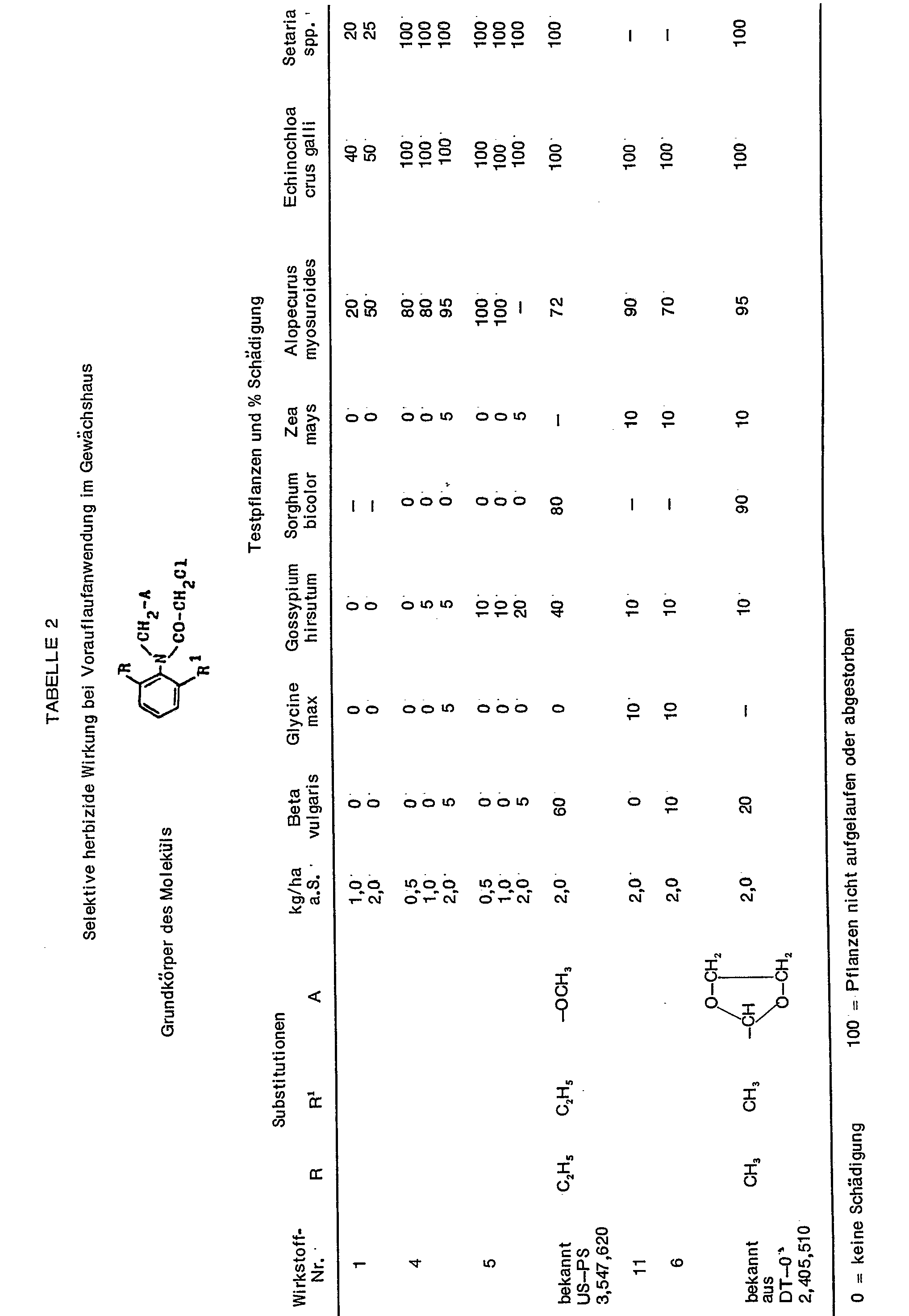
- Table 2 contains the test substances, the respective dosages in kg / ha of active substance and the test plant types. It is rated on a scale from 0 to 100. 0 means no damage or normal emergence and 100 means no emergence of the plants or complete destruction of at least the above-ground shoots.
- Table 2 contains some numerical values for the biological characterization of the new compounds. One recognizes from it above all the clearly better tolerance for certain crop plants in contrast to the known active substances.
- the table contains results from pre-emergence treatments.
- the new active ingredients can also be used for post-emergence treatment. Depending on the dose of the active ingredients, this leads to complete death or, at lower application rates, only a growth-inhibiting effect.
- active ingredient 2 20 parts by weight of active ingredient 2 are mixed well with 3 parts by weight of the sodium salt of diisobutylnaphthalene: sulfonic acid, 17 parts by weight of the sodium salt of lignosulfonic acid from a sulfite waste liquor and 60 parts by weight of powdered silica gel and ground in a hammer mill.
- sulfonic acid 3 parts by weight of the sodium salt of diisobutylnaphthalene: sulfonic acid
- 17 parts by weight of the sodium salt of lignosulfonic acid from a sulfite waste liquor 60 parts by weight of powdered silica gel and ground in a hammer mill.
- active ingredient 1 40 parts by weight of active ingredient 1 are intimately mixed with 10 parts of sodium salt of a phenolsulfonic acid-urea-formaldehyde condensate, 2 parts of silica gel and 48 parts of water. A stable aqueous dispersion is obtained. Diluting 100,000 parts by weight of water gives an aqueous dispersion which contains 0.04% by weight of active ingredient.
- active ingredient 2 20 parts are intimately mixed with 2 parts of calcium salt of dodecylbenzenesulfonic acid, 8 parts of fatty alcohol polyglycol ether, 2 parts of sodium salt of a phenolsulfonic acid-urea-formaldehyde condensate and 68 parts of a paraffinic mineral oil. A stable oily dispersion is obtained.
Landscapes
- Chemical & Material Sciences (AREA)
- Organic Chemistry (AREA)
- Life Sciences & Earth Sciences (AREA)
- Agronomy & Crop Science (AREA)
- Pest Control & Pesticides (AREA)
- Plant Pathology (AREA)
- Health & Medical Sciences (AREA)
- Engineering & Computer Science (AREA)
- Dentistry (AREA)
- General Health & Medical Sciences (AREA)
- Wood Science & Technology (AREA)
- Zoology (AREA)
- Environmental Sciences (AREA)
- Agricultural Chemicals And Associated Chemicals (AREA)
- Plural Heterocyclic Compounds (AREA)
- Pharmaceuticals Containing Other Organic And Inorganic Compounds (AREA)
Description
- Die vorliegende Erfindung betrifft Acetanilide, Herbizide, welche diese Verbindungen enthalten, sowie Verfahren zur Bekämpfung unerwünschten Pflanzenwuchses mit diesen Verbindungen.
- Halogenacetanilide mit herbiziden oder wachstumsregulierenden Eigenschaften sind bekannt. Eine beachtliche wirtschaftliche Bedeutung hat das N-Methoxymethyl-a-chloracet-2,6-diäthylanilid (US-PS 3.547.620). Auch ein Wirkstoff, der eine 1,3-Dioxolan-2-yl-methylgruppe trägt, ist bekannt (DT-OS 2 405 510). Die Stärke bekannter Acetanilide liegt in ihrer herbiciden Wirkung gegen zahlreiche aus Samen hervorgehende Gräser. Von der oben zuerst genannten Verbindungen werden außerdem noch einige wenige dikotyle Arten bekämpfen. Es fehlen jedoch Wirkstoffe, welche neben der herbiciden Wirkung gegen Gräser auch eine verbesserte Wirkung gegen breitblättrige Arten haben und vor allem eine markante Steigerung der Verträglichkeit bei bislang von bekannten Wirkstoffen geschädigten Kulturpflanzen zeigen.
- Es wurde gefunden, daß Acetanilide der Formel

- R und R' für Alkyl mit bis zu 5 Kohlenstoffatomen steht,
- R2 für Wasserstoff,
- X für Chlor steht und
- A für ein über ein Ring-Stickstoffatom gebundenes Imidazol steht, das einfach oder mehrfach durch Halogen oder Alkyl oder Halogen und Alkyl mit jeweils bis zu 4 Kohlenstoffatomen substituiert sein kann, wobei A auch für ein Salz des Imidazols stehen kann,
- bei guter herbizider Wirkung eine vorzügliche Selektivität bei wichtigen Kulturpflanzen aufweisen.
- Aufgrund des Standes der Technik war es überraschend, daß sich gerade die erfindungsgemäßen imidazolsubstituierten Acetanilide durch dieses hohe Maß an Kulturpflanzenverträglichkeit auszeichnen.
- Die neuen Wirkstoffe sind je nach Zielsetzung und Dosis geeignet zur selektiven Bekämpfung von unerwünschten Pflanzen in bestimmten Kulturpflanzenbeständen, bestehend aus krautigen oder verholzenden Pflanzenarten, zur Wachstumsregulierung durch Hemmung des Pflanzenwachstums oder bei entsprechenden hohen Aufwandmengen zur totalen Bekämpfung des Pflanzenwuchses.
- Bei niedrigen Dosierungen besitzen eine besonders ausgeprägte Selektivität gegenüber Nutzpflanzen die erfindungsgemäßen Verbindungen entsprechend Formel I, bei denen R und R' Substituenten in 2- und 6-Stellung am Phenylkern sind und jeweils Alkyl mit bis zu 5 Kohlenstoffatomen bedeuten.
- Für die Symbole R, R1, R2, X und Y in der Formel 1 kommen in Betracht:
- Für R und R' Alkyl bis zu 5 Kohlenstoffatomen wie Methyl, Äthyl, n-Propyl, i-Propyl, n-Butyl, sec.-Butyl, i-Butyl, tert.-Butyl, normale und verzweigte Pentylreste;
- für X Chlor;
- für A ein über ein Ring-Stickstoffatom gebundenes Imidazol, wie Imidazol, 2-Methylimidazol, 4(5)-Chlorimidazol, 2-Chlorimidazol, 4,5-Dichlorimidazol, Trichlorimidazol, 2-Methyl-4,5-dichlorimidazol, 2-Äthyl-4,5-dichlorimidazol, 2-lsopropyl-4,5-dichlorimidazol, 4(5)-Bromimidazol, 4,5-Dibromimidazol, Tribromimidazol, 2-Methyl-4,5-dibromimidazol, 2-Brom-4,5-Dichlorimidazol.
- Darüber hinaus kann der Rest A auch salzartig an eine der üblichen starken anorganischen oder organischen Säuren, wie Chlorwasserstoffsäure, Bromwasserstoffsäure, Salpetersäure, Schwefelsäure, Tetrafluorborsäure, Fluorsulfonsäure, Ameisensäure, eine halogenierte Carbonsäure, z.B. Trichloressigsäure, eine Alkansulfonsäure, z.B. Methansulfonsäure, eine halogenierte Alkansulfonsäure, z.B. Trifluormethansulfonsäure, Perfluorhexansulfonsäure, eine Arylsulfonsäure, z.B. Dodecylbenzolsulfonsäure, gebunden sein.
- Die neuen Acetanilide der Formel I können nach folgenden Verfahren hergestellt werden:
- Die Acetanilide der Formel I werden durch Umsetzung von 2-Halogen-N-halogenmethyl-acetaniliden der Formel mit einem Imidazol der Formel H-A nach folgender Reaktionsgleichung erhalten:

- Dabei haben die Substituenten R, R1, R2, A und X die oben genannte Bedeutung.
- Einige der 2-Halogen-N-halogenmethyl-acetanilide der Formel II sind aus der DT-AS 15 42 950 bekannt; andere können auf analoge Weise durch Umsetzung der entsprechenden Azomethine mit einem Halogenacetylhalogenid hergestellt werden.
- Das Imidazol wird zweckmäßig in mindestens äquimolarer Menge bezogen auf 2-Halogen-N-halogenmethyl-acetanilid, eingesetzt.
- Der bei der Umsetzung freiwerdende Halogenwasserstoff wird zweckmäßigerweise durch geeignete Bindemittel, wie organischen Basen, beispielsweise tertiäre Amine oder anorganische Basen, beispielsweise Alkalimetall- oder Erdalkalimetallcarbonate bzw. -bicarbonate, abgefangen. Das Halogenwasserstoff-Bindemittel wird in mindestens äquimolarer Menge, bezogen auf eingesetztes Imidazol zugegeben.
- Es ist zweckmäßig, die Reaktion in einem Lösungsmittel durchzuführen, das gegenüber 2-Halogen-N-halogenmethyl-acetaniliden inert ist. Hierzu eignen sich: Kohlenwasserstoffe, wie Petroläther, Ligroin, Cyclohexan, Toluol, Xylol; Äther wie Diäthyäther; Diisopropyläther, Dimethoxy- äthan, Tetrahydrofuran, Dioxan, Anisol; halogenierte Kohlenwasserstoffe, wie Dichlormethan, Chloroform, 1,2-Dichloräthan, Tetrachlorkohlenstoff, Chlorbenzol; Ketone, wie Aceton, Methyläthylketon; Ester, wie Essigester, butylacetat, Sulfone, wie Dimethylsulfoxid, Tetrahydrothiophen-1,1-dioxid. Auch Gemische dieser Lösungsmittel können verwendet werden.
- Die Reaktion kann bei Temperaturen ab 0°C aufwärts durchgeführt werden. Zur Beschleunigung der Umsetzung ist es vorteilhaft, beim Siedepunkt des Lösungsmittels bzw. des Lösungsmittelgemisches zu arbeiten, jedoch nicht über 200°C. Vorzugsweise arbeitet man bei Temperaturen im Bereich von 50 bis 150°C. Nach Ende der Reaktion wird abfiltriert, und das Produkt wird, gegebenenfalls nach vorheriger Waschung, aus dem Filtrat auf eine der herkömmlichen Weisen isoliert. Bei Verwendung eines mit Wasser mischbaren Lösungsmittels ist es meist vorteilhaft, dieses nach der Filtration durch Verdampfen zu entfernen und durch ein mit Wasser nicht mischbares Solvens zu ersetzen.
- Weiterhin können die neuen Acetanilide der Formel durch Umsetzung der 2-Halogen-N-halogenmethyl-acetanilide der Formel 11 mit einem Salz des Imidazols der Formel M⊕A⊖ nach folgender Reaktionsgleichung hergestellt werden:

- Dabei haben die Substituenten R, R', R2, A und X die oben genannten Bedeutungen, M⊕ steht für das Silberion, ein Alkalimetallion oder ein Äquivalent Erdalkalimetallion.
- Die Alkalimetall-, Erdalkalimetall- bzw. Silber-Imidazole M⊕A⊖ werden in bekannter Weise durch Umsetzung des Imidazols H-A mit Alkalimetallen oder starken Basen, wie Alkalimetallhydroxid, -alkoholat, -amid oder -hyrid oder Silberhydroxid, unter Freisetzung von Wasserstoff, Alkohol bzw. Ammoniak hergestellt.
- Die Umsetzung der Salze M⊕A⊖ mit den 2-Halogen-N-halogenmethylacetaniliden der Formel II wird vorteilhafterweise in polaren, aprotischen Lösungsmitteln, wie Nitrilen, z.B. Acetonitril, wie .Amiden, z.B. Dimethylformamid, wie Polyäthern, z.B. Diäthylenglykoldimethyläther, Triäthylenglykoldimethyläther, wie Sulfonen, z.B. Tetrahydrothiophen-1,1-dioxid, Sulfoxiden, z.B. Dimethylsulfoxid, Ketonen, wie z.B. Aceton, Methyläthylketon, Diisopropylketon, bei Temperaturen zwischen -30° bis +50°C, vorzugsweise bei Raumtemperatur, durchgeführt. Die Ausgangsstoffe werden dabei zweckmäßigerweise in äquimolarem Verhältnis eingesetzt. Reaktionsprodukte werden-gegebenenfalls nach Abtrennen der gebildeten anorganischen Salze M⊕X⊖ und gegebenenfalls nach Austausch des polaren, aprotischen Solvens durch ein mit Wasser nicht mischbares Lösungsmittel-in üblicherweise isoliert.
- Die Salze der Acetanilide der Formel können in an sich bekannter Weise aus den Acetaniliden der Formel I, die nach einem der vorher beschriebenen Verfahren hergestellt werden können, durch Zusatz von mindestens äquimolaren Mengen starker anorganischer oder organischer Säuren, wie Chlorwasserstoffsäure, Bromwasserstoffsulfonsäure, Ameisensäure, halogenierte Carbonsäuren, z.B. Trichloressigsäure, Alkansulfonsäure, z.B. Methansulfonsäure, halogenierte Alkansulfonsäure, z.B. Trifluormethansulfonsäure, Perfluorhexansulfonsäure, Arylsulfonsäure, z.B. Dodecylbenzolsulfonsäure, erhalten werden.
- Das folgende Beispiel erläutert die Herstellung der neuen Acetanilide und ihrer Salze. In dem Beispiel verhalten sich Gewichtsteile zu Volumenteilen wie Kilogramm zu Liter.
- 30,2 Gewichsteile 2-Methyl-4,5-dichlorimidazol werden unter Zusatz von 60 Volumenteilen Methanol in 35,0 Gewichtsteilen 30%iger methanolischer Natriummethylatlösung aufgelöst und im Vakuum bei 30° zur Trockne eingeengt. Der kristalline Rückstand wird in 200 Volumenteilen trockenem Acetonitril suspendiert. Unter Rühren werden bei 10°C 49,2 Gewichtsteile 2-Chlor-2',6'-dimethyl-N-chlormethylacetanilid portionsweise eingetragen und 16 Stunden bei Raumtemperatur gerührt. Nach dem Verdampfen des Lösungsmittels im Vakuum wird der Rückstand zwischen Chloroform und Wasser verteilt. Aus der Chloroformphase isoliert man nach dreimaligem Waschen mit Wasser, Trocknen und Umkristallisieren aus Toluol 50,0 Gewichtsteile 2 - Chlor - 2',6' - dimethyl - N - (2 - methyl - 4,5 - dichlorimidazol - 1 - yl - methyl) - acetanilid vom Fp. 170°C (Verbindung Nr. 8).
- Folgende Verbindungen erhält man in entsprechender Weise:


- Die Erfindungsgemäßen Wirkstoffe werden beispielsweise in Form von direkt versprühbaren Lösungen, Pulvern, Suspensionen, auch hochprozentige wäßrige, ölige oder sonstige Suspensionen oder Dispersionen, Emulsionen, Oldispersionen, Pasten, Stäubemitteln, Streumitteln, Granulaten durch Versprühen, Vernebeln, Verstäuben, Verstreuen oder Gießen angewendet. Die Anwendungsformen richten sich ganz nach den Verwendungszwecken; sie sollten in jedem Fall möglichst die feinste Verteilung der erfindungsgemäßen Wirkstoffe gewährleisten.
- Zur Herstellung von direkt versprühbaren Lösungen, Emulsionen, Pasten und Öldispersionen kommen Mineralölfraktionen von mittlerem bis hohem Siedepunkt, wie Kerosin oder Dieselöl, ferner Kohlenteeröle, sowie Öle pflanzlichen oder tierischen Ursprungs, aliphatische, cyclische und aromatische Kohlenwasserstoffe, zum Beispiel Benzol, Toluol, Xylol; Paraffin, Tetrahydronaphthalin, alkylierte Naphthaline oder deren Derivate zum Beispiel Methanol, Äthanol, Propanol, Butanol, Chloroform, Tetrachlorkohlenstoff, Cyclohexanol, Cyclohexanon, Chlorbenzol, Isophoron, stark polare Lösungsmittel, wie Dimethylformamid, Dimethylsulfoxid, N-Methylpyrrilidon, Wasser in Betracht.
- Wäßrige Anwendungsformen können aus Emulsionskonzentraten, Pasten oder netzbaren Pulvern (Spritzpulvern), Öldispersionen durch Zusatz von Wasser bereitet werden. Zur Herstellung von Emulsionen, Pasten oder Öldispersionen können die Substanzen als solche oder in einem Öl oder Lösungsmittel gelöst, mittels Netz-, Haft-, Dispergier- oder Emulgiermittel in Wasser homogenisiert werden. Es können aber auch aus wirksamer Substanz, Netz-, Haft-, Dispergier- oder Emulgiermittel und eventuell Lösungsmittel oder ÖI bestehende Konzentrate hergestellt werden, die zur Verdünnung mit Wasser geeignet sind.
- Als oberflächenaktive Stoffe kommen in Betracht: Alkalimetall-, Erdalkalimetall-, Ammoniumsalze von Ligninsulfonsäure, Naphthalinsulfonsäure, Phenolsulfonsäure, Alkylarylsulfonate, Akylsulfate, Alkylsulfonate, Alkalimetall- und Erdalkalimetall- salze der Dibutylnaphthalinsulfonsäure, Lauryläthersulfat, Fettalkoholsulfate fettsaure Alkalimetall- und Erdalkalimetallsalze, Salze sulfatierter Hexadecanole, Heptadecanole, Octadecanöle, Salze von sulfatierten Fettalkoholglykoläther, Kondensationsprodukte von sulfoniertem Naphthalin und Naphthalinderivaten mit Formaldehyd, Kondensationsprodukte des Naphthalins bzw. der Naphthalinsulfonsäure mit Phenol Und Formaldehyd, Polyoxyäthylenoctylphenoläther, äthoxyliertes Isooctylphenol-, Octylphenol-, Nonylphenol, Alkylphenolpolyglykol- äther, Tributylphenylpolyglykoläther, Alkalarylpolyätheralkohole, Isotridecylalkohol, Fettalkoholäthylenoxid Kondensate, äthoxyliertes Rizinusöl, Polyoxäthylenalkyläther, äthoxyliertes Polyoxypropylen, Laurylalkoholpolyglykolätheracetal, Sorbitester, Lignin, Sulfitablaugen und Methylcellulose.
- Pulver, Streu- und Stäubemittel können durch Mischen oder gemeinsames Vermahlen der wirksamen Substanzen mit einem festen Trägerstoff hergestellt werden.
- Granulate, z.B. Umhüllungs-, Imprägnierungs- und Homogengranulate, können durch Bindung der Wirkstoffe an feste Trägerstoffe hergestellt werden. Feste Trägerstoffe sind z.B. Mineralerden wie Silicagel, Kieselsäuren, Kieselgele, Silikate,'Talkum, Kaolin; Attaclay, Kalkstein, Kreide, Talkum, Bolus, Löß, Ton, Dolomit, Diatomeenerde, Calcium- und Magnesiumsulfat, Magnesiumoxid, gemahlene Kunststoffe, Düngemittel, wie Ammoniumsulfat, Ammoniumnitrat, Harnstoffe und pflanzliche Produkte, wie Getreidemehle, Baumrinden-, Holz- und Nußschalenmehl, Cellulosepulver und andere feste Trägerstoffe.
- Die Formulierungen enthalten zwischen 0,1 und 95 Gewichtsprozent Wirkstoff, vorzugsweise zwischen 0,5 und 90 Gewichtsprozent. Die Aufwandmengen betragen 0,1 bis 10 kg Wirkstoff/ha.
- Die neuen erfindungsgemäßen herbiziden Anilide können mit zahlreichen Vertretern anderer herbizider oder wachstumsregulierender Wirkstoffgruppen gemischt und gemeinsam ausgebracht werden. Beispielsweise kommen als Mischungskomponenten Diazine, Benzothiadiazinone, 2,6-Dinitroaniline, N-Phenyl-carbamate, Discarbamate, Thiolcarbamate, Halogencarbonsäuren, Triazine, Amide, Harnstoffe, Diphenyläther, Triazinone, Uracile und Benzofuranderivate in Betracht.
- Außerdem ist es nützlich, die neuen erfindungsgemäßen Verbindungen allein oder in Kombinationi mit anderen Herbiziden auch noch mit weiteren Pflanzenschutzmitteln gemischt gemeinsam auszubringen, beispielsweise mit Mitteln zur Bekämpfung von Schädlingen oder phytopathogenen Pilzen bzw. Bakterien. Von Interesse ist ferner die Mischbarkeit mit Mineralstofflösungen, welche zur Behebung zon Ernährungs- oder Spurenelementmängeln eingesetzt werden.
- Der Einfluß verschiedener Vertreter der erfindungsgemäßen Verbindungen auf das Wachstum von unerwünschten und erwünschten Pflanzen im Vergleich zu bekannten, chemisch ähnlichen Wirkstoffen wird in den folgenden Versuchen demonstriert. Die Versuchsserien werden im Gewächshaus durchgeführt.
- Als Kulturgefäße dienten Plastikblumentöpfe mit 300 cm3 Inhalt und lehmiger Sand mit etwa 1,5% Humus als Substrat. Die Samen der Testpflanzen entsprechend Tabelle 1 wurden nach Arten getrennt flach eingesät. Unmittelbar danach erfolgte bei Vorauflaufbehandlung das Aufbringen der Wirkstoffe auf die Erdoberfläche. Sie wurden hierbei in Wasser als Verteilungsmittel suspendiert oder emulgiert und mittels fein verteilender Düsen gespritzt. Nach dem Aufbringen der Mittel wurden die Gefäße leicht beregnet, um Keimung und Wachstum in Gang zu bringen und auch gleichzeitig die chemischen Mittel zu aktivieren. Danach deckte man die Gefäße mit durchsichtigen Plastikhauben ab, bis die Pflanzen angewachsen waren. Diese Abdeckung bewirkte ein gleichmäßiges Keimen der Testpflanzen, sofern dies nicht durch die Chemikalien beeinträchtigt wurde, und verhinderte das Verdampfen leicht flüchtiger Substanzen.
- Die Aufstellung der Versuche erfolgte im Gewächshaus, wobei für wärmeliebende Arten wärmere Bereiche (25° bis 40°) und für solche gemäßigter Klimate 15 bis 30°C bevorzugt werden. Die Versuchsperiode erstreckte sich über 4 bis 6 Wochen. Während dieser Zeit wurden die Pflanzen gepflegt und ihre Reaktion auf die einzelnen Behandlungen ausgewertet. Die Tabelle 2 enthält die Prüfsubstanzen, die jeweiligen Dosierungen in kg/ha Aktivsubstanz und die Testpf!anzenarten. Bewertet wird nach einer Skala von 0 bis 100. Dabei bedeutet 0 keine Schädigung oder normaler Auflauf und 100 kein Aufgang der Pflanzen bzw. völlige Zerstörung zumindest der oberirdischen Sproßteile.
- Tabelle 2 enthält einige Zahlenwerte zur biologischen Charakterisierung der neuen Verbindungen. Man erkennt daraus vor allem die deutlich bessere Verträglichkeit für gewisse Kulturpflanzen im Gegensatz zu den bekannten Wirkstoffen.
- Die Tabelle enthält Resultate aus Vorauflaufbehandlungen. Natürlich können die neuen Wirkstoffe auch zur Nachauflaufbehandlung eingesetzt werden. Hierbei erreicht man je nach Dosis der Wirkstoffe ein vollständiges Absterben oder bei geringeren Aufwandmengen lediglich eine wuchshemmende Wirkung.

- Man vermischt 90 Gewichtsteile der Verbindung 1 mit 10 Gewichtsteilen N-Methyl-α-pyrrolidon und erhält eine Lösung, die zur Anwendung in Form kleinster Tropfen geeignet ist.
- 20 Gewichtsteile der Verbindung 2 werden in einer Mischung gelöst, die aus 80 Gewichtsteilen Xylol, 10 Gewichtsteilen des Anlagerungsproduktes von 8 bis 10 Mol Athylenoxid an 1 Mol Ölsäure-N-monoäthanolamid, 5 Gewichtsteilen Calciumsalz der Dodecylbenzolsulfonsäure und 5 Gewichtsteilen des Anlagerungsproduktes von 40 Mol Äthylenoxid an 1 Mol Ricinusöl besteht. Durch Ausgießen und feines Verteilen der Lösung in 100 000 Gewichtsteilen Wasser erhält man eine wäßrige Dispersion, die 0,02 Gewichtsprozent des Wirkstoffs enthält.
- 20 Gewichtsteile der Verbindung 3 werden in einer Mischung gelöst, die aus 40 Gewichtsteilen Cyclohexanon, 30 Gewichtsteilen Isobutanol, 20 Gewichtsteilen des Anlagerungsproduktes von 7 Mol Äthylenoxid an 1 Mol Isooctylphenol und 10 Gewichtsteilen des Anlagerungsproduktes von 40 Mol Äthylenoxid an 1 Mol Ricinusöl besteht. Durch Eingießen und feines Verteilen der Lösung in 100 000 Gewichtsteilen Wasser erhält man eine wäßrige Dispersion, die 0.02 Gewichtsprozent des Wirkstoffs enthält.
- 20 Gewichtsteile der Verbindung 1 werden in einer Mischung gelöst, die aus 25 Gewichtsteilen Cyclohexanol, 65 Gewichtsteilen einer Mineralölfraktion vom Siedepunkt 210 bis 280°C und 10 Gewichtsteilen des Anlagerungsproduktes von 40 Mol Athylenoxid an 1 Mol Ricinusöl besteht. Durch Eingießen und feines Verteilen der Lösung in 100 000 Gewichtsteilen Wasser erhält man eine wäßrige Dispersion, die 0,02 Gewichtsprozent des Wirkstoffs enthält.
- 20 Gewichtsteile des Wirkstoffs 2 werden mit 3 Gewichtsteilen des Natriumsalzes der Diisobutylnaphthalin- :-sulfonsäure, 17 Gewichtsteilen des Natriumsalzes einer Ligninsulfonsäure aus einer Sulfit-Ablauge und 60 Gewichtsteilen pulverförmigem Kieselsäuregel gut vermischt und in einer Hammermühle vermahlen. Durch feines Verteilen der Mischung in 20000 Gewichtsteilen Wasser erhält man eine Spritzbrühe, die 0,1 Gewichtsprozent des Wirkstoffs enthält.
- 3 Gewichtsteile der Verbindung 3 werden mit 97 Gewichtsteilen feinteiligem Kaolin innig vermischt. Man erhält auf diese Weise ein Stäubemittel, das 3 Gewichtsprozent des Wirkstoffs enthält.
- 30 Gewichtsteile der Verbindung 4 werden mit einer Mischung aus 92 Gewichtsteilen pulverförmigem Kieselsäuregel und 8 Gewichtsteilen Paraffinöl, das auf die Oberfläche dieses Kieselsäuregels besprüht wurde, innig vermischt. Man erhält auf diese Weise eine Aufbereitung des Wirkstoffs mit guter Haftfähigkeit.
- 40 Gewichtsteile des Wirkstoffs 1 werden mit 10 Teilen Natriumsalz eines Phenolsulfonsäureharnstoff-formaldehyd-Kondensats, 2 Teilen Kieselgel und 48 Teilen Wasser innig vermischt. Man erhält eine stabile wäßrige Dispersion. Durch Verdünnen 100000 Gewichtsteilen Wasser erhält man eine wäßrige Dispersion, die 0,04 Gewichtsprozent Wirkstoff enthält.
- 20 Teile des Wirkstoffs 2 werden mit 2 Teilen Calciumsalz der Dodecylbenzolsulfonsäure, 8 Teilen Fettalkohol-polyglykoläther, 2 Teilen Natriumsalz eines Phenolsulfonsäure-harnstoff-formaldehyd-Kondensats und 68 Teilen eines paraffinischen Mineralöls innig vermischt. Man erhält eine stabile ölige Dispersion.
Claims (8)

Applications Claiming Priority (2)
| Application Number | Priority Date | Filing Date | Title |
|---|---|---|---|
| DE2744396 | 1977-10-03 | ||
| DE19772744396 DE2744396A1 (de) | 1977-10-03 | 1977-10-03 | Acetanilide |
Publications (2)
| Publication Number | Publication Date |
|---|---|
| EP0001751A1 EP0001751A1 (de) | 1979-05-16 |
| EP0001751B1 true EP0001751B1 (de) | 1980-09-17 |
Family
ID=6020512
Family Applications (1)
| Application Number | Title | Priority Date | Filing Date |
|---|---|---|---|
| EP78100999A Expired EP0001751B1 (de) | 1977-10-03 | 1978-09-27 | N-(Imidazolylmethyl)-acetanilide, ihre Verwendung als Herbizide und Verfahren zur Bekämpfung unerwünschten Pflanzenwuchses |
Country Status (23)
| Country | Link |
|---|---|
| EP (1) | EP0001751B1 (de) |
| JP (1) | JPS5459333A (de) |
| AT (1) | AT362188B (de) |
| AU (1) | AU519478B2 (de) |
| BR (1) | BR7806544A (de) |
| CS (1) | CS199747B2 (de) |
| DD (1) | DD140407A5 (de) |
| DE (2) | DE2744396A1 (de) |
| DK (1) | DK434978A (de) |
| EG (1) | EG13522A (de) |
| ES (1) | ES473865A1 (de) |
| FI (1) | FI782986A7 (de) |
| GR (1) | GR64118B (de) |
| HU (1) | HU176749B (de) |
| IE (1) | IE47388B1 (de) |
| IL (1) | IL55656A0 (de) |
| IN (1) | IN149745B (de) |
| IT (1) | IT1107472B (de) |
| NZ (1) | NZ188564A (de) |
| OA (1) | OA06061A (de) |
| PL (1) | PL210032A1 (de) |
| PT (1) | PT68586A (de) |
| ZA (1) | ZA785558B (de) |
Families Citing this family (9)
| Publication number | Priority date | Publication date | Assignee | Title |
|---|---|---|---|---|
| DE2830764A1 (de) * | 1978-07-13 | 1980-01-31 | Basf Ag | Acetanilide |
| DE2832046A1 (de) | 1978-07-21 | 1980-01-31 | Basf Ag | Herbizide mittel auf der basis von acetaniliden |
| DE2832950A1 (de) * | 1978-07-27 | 1980-02-21 | Basf Ag | Herbizide mittel |
| DE2832940A1 (de) * | 1978-07-27 | 1980-02-14 | Basf Ag | Herbizide mittel |
| DE2948535A1 (de) * | 1979-12-03 | 1981-06-25 | Basf Ag, 6700 Ludwigshafen | Dichloracetamide, herbizide mittel, die acetanilide als herbizide wirkstoffe und diese dichloracetamide als antagonistische mittel enthalten, sowie ihre verwendung zur bekaempfung unerwuenschten pflanzenwuchses |
| DE2920300A1 (de) * | 1979-05-19 | 1980-11-20 | Basf Ag | Herbizide mittel auf der basis von n-azolyl-methyl-acetaniliden und cyclohexan-1,3-dionderivaten |
| CA1231710A (en) * | 1979-07-19 | 1988-01-19 | Haken Pieter Ten | Heterocyclic compounds having fungicidal, herbicidal and plant-growth regulating properties |
| US4546048A (en) * | 1984-03-23 | 1985-10-08 | Dana Corporation | Composite thermal shield for engine components |
| BR112014017216A8 (pt) | 2012-01-13 | 2017-07-04 | Basf Se | processo para a preparação das acetanilidas |
Family Cites Families (4)
| Publication number | Priority date | Publication date | Assignee | Title |
|---|---|---|---|---|
| US3547620A (en) * | 1969-01-23 | 1970-12-15 | Monsanto Co | N-(oxamethyl)alpha-halo-acetanilide herbicides |
| IL39562A (en) * | 1971-06-01 | 1977-10-31 | Monsanto Co | Herbicidal substituted haloacetanilides |
| CA1019752A (en) * | 1973-02-12 | 1977-10-25 | Sidney B. Richter | Heterocyclic anilids |
| DE2648008C3 (de) * | 1976-10-23 | 1980-09-04 | Basf Ag, 6700 Ludwigshafen | Acetanilide |
-
1977
- 1977-10-03 DE DE19772744396 patent/DE2744396A1/de not_active Withdrawn
-
1978
- 1978-09-18 GR GR57251A patent/GR64118B/el unknown
- 1978-09-22 PT PT68586A patent/PT68586A/pt unknown
- 1978-09-27 DE DE7878100999T patent/DE2860175D1/de not_active Expired
- 1978-09-27 IL IL7855656A patent/IL55656A0/xx unknown
- 1978-09-27 EP EP78100999A patent/EP0001751B1/de not_active Expired
- 1978-09-28 JP JP11870578A patent/JPS5459333A/ja active Pending
- 1978-09-29 IE IE1957/78A patent/IE47388B1/en unknown
- 1978-10-01 EG EG581/78A patent/EG13522A/xx active
- 1978-10-02 ZA ZA00785558A patent/ZA785558B/xx unknown
- 1978-10-02 PL PL21003278A patent/PL210032A1/xx unknown
- 1978-10-02 DD DD78208226A patent/DD140407A5/de not_active IP Right Cessation
- 1978-10-02 IT IT51332/78A patent/IT1107472B/it active
- 1978-10-02 DK DK434978A patent/DK434978A/da not_active Application Discontinuation
- 1978-10-02 AT AT709078A patent/AT362188B/de not_active IP Right Cessation
- 1978-10-02 FI FI782986A patent/FI782986A7/fi unknown
- 1978-10-02 ES ES473865A patent/ES473865A1/es not_active Expired
- 1978-10-02 HU HU78BA3711A patent/HU176749B/hu not_active IP Right Cessation
- 1978-10-02 NZ NZ188564A patent/NZ188564A/xx unknown
- 1978-10-02 BR BR7806544A patent/BR7806544A/pt unknown
- 1978-10-03 CS CS786396A patent/CS199747B2/cs unknown
- 1978-10-03 AU AU40352/78A patent/AU519478B2/en not_active Expired
- 1978-10-03 OA OA56621A patent/OA06061A/xx unknown
- 1978-10-07 IN IN1099/CAL/78A patent/IN149745B/en unknown
Also Published As
| Publication number | Publication date |
|---|---|
| OA06061A (fr) | 1981-06-30 |
| JPS5459333A (en) | 1979-05-12 |
| AT362188B (de) | 1981-04-27 |
| AU4035278A (en) | 1980-04-17 |
| PL210032A1 (pl) | 1979-05-21 |
| BR7806544A (pt) | 1979-05-02 |
| DE2744396A1 (de) | 1979-04-12 |
| ES473865A1 (es) | 1979-10-16 |
| IT1107472B (it) | 1985-11-25 |
| IN149745B (de) | 1982-04-03 |
| IE781957L (en) | 1979-04-03 |
| PT68586A (fr) | 1978-10-01 |
| CS199747B2 (en) | 1980-07-31 |
| FI782986A7 (fi) | 1979-04-04 |
| DE2860175D1 (en) | 1980-12-18 |
| AU519478B2 (en) | 1981-12-03 |
| DD140407A5 (de) | 1980-03-05 |
| IE47388B1 (en) | 1984-03-07 |
| IT7851332A0 (it) | 1978-10-02 |
| ZA785558B (en) | 1979-10-31 |
| EG13522A (en) | 1981-12-31 |
| DK434978A (da) | 1979-04-04 |
| IL55656A0 (en) | 1978-12-17 |
| HU176749B (en) | 1981-05-28 |
| GR64118B (en) | 1980-01-25 |
| ATA709078A (de) | 1980-09-15 |
| EP0001751A1 (de) | 1979-05-16 |
| NZ188564A (en) | 1980-11-28 |
Similar Documents
| Publication | Publication Date | Title |
|---|---|---|
| EP0007990B1 (de) | Pyrazolätherderivate, Verfahren zu ihrer Herstellung und Herbizide, die diese Verbindungen enthalten | |
| DE2648008B2 (de) | Acetanilide | |
| EP0003805B1 (de) | Pyridazonverbindungen und diese enthaltende herbizide Zusammensetzungen | |
| EP0071794A1 (de) | 5-Amino-1-phenyl-pyrazol-4-carbonsäurederivate, Verfahren zu ihrer Herstellung und ihre Verwendung zur Bekämpfung unerwünschten Pflanzenwuchses | |
| EP0037925B1 (de) | Substituierte Pyridazone, Verfahren zu ihrer Herstellung, diese enthaltende Herbizide und ihre Anwendung als Herbizide | |
| EP0099535A2 (de) | Cyclohexan-1,3-dionderivate, Verfahren zu ihrer Herstellung und ihre Verwendung zur Bekämpfung unerwünschten Pflanzenwuchses | |
| EP0332009A1 (de) | N-Aryltetrahydrophthalimidverbindungen | |
| EP0037971B1 (de) | Trisubstituierte Cyanguanidine, Verfahren zu ihrer Herstellung sowie ihre Verwendung als Fungizide | |
| EP0001751A1 (de) | N-(Imidazolylmethyl)-acetanilide, ihre Verwendung als Herbizide und Verfahren zur Bekämpfung unerwünschten Pflanzenwuchses | |
| EP0053699B1 (de) | 2'-Phenylhydrazino-2-cyanacrylsäureester und diese enthaltende Herbizide | |
| EP0368212A2 (de) | Herbizide Mittel, die 2-(4-Heteroaryloxy)- oder 2-(4-Aryloxy)-phenoxy-essig- oder -propionsäurederivate und/oder Cyclohexenonderivate als herbizide Wirkstoffe und Naphthalinderivate als Antidots enthalten, sowie ihre Verwendung zur Bekämpfung unerwünschten Pflanzenwuchses | |
| EP0090258B1 (de) | 3-Chlor-8-cyano-chinoline, Verfahren zu ihrer Herstellung und ihre Verwendung zur Bekämpfung unerwünschten Pflanzenwuchses | |
| EP0013873B1 (de) | N-Azolylessigsäureanilide, Verfahren zu ihrer Herstellung und ihre Anwendung als Herbizide | |
| EP0103252A2 (de) | Aryloxyalkylamine, Verfahren zu ihrer Herstellung und ihre Verwendung zur Bekämpfung unerwünschten Pflanzenwuchses | |
| EP0401582B1 (de) | Fünfring-heterocyclisch anellierte Chinolinderivate | |
| EP0098972A2 (de) | Neue 5-Phenoxybenzisothiazol-4'-harnstoffderivate, Verfahren zu ihrer Herstellung und ihre Verwendung als Herbizide | |
| EP0065189B1 (de) | Heterocyclische Dihalogenacetamide, Verfahren zu ihrer Herstellung und herbizide Mittel, die Acetanilide als herbizide Wirkstoffe und diese Dihalogenacetamide als antagonistische Mittel enthalten | |
| EP0084673A1 (de) | Aminothiadiazole, Verfahren zu ihrer Herstellung und ihre Verwendung zur Bekämpfung unerwünschten Pflanzenwuchses | |
| EP0018585B1 (de) | Parabansäurederivate, Herbizide, die diese Verbindungen enthalten, und Verfahren zur Herstellung der Herbizide | |
| EP0107123B1 (de) | Anilinderivate, Verfahren zu ihrer Herstellung und ihre Verwendung zur Bekämpfung unerwünschten Pflanzenwuchses | |
| EP0098440B1 (de) | 3,7-Dichlor-chinolinderivate, Verfahren zu ihrer Herstellung und ihre Verwendung zur Bekämpfung unerwünschten Pflanzenwuchses | |
| EP0144052A2 (de) | Chinolinoxyphenylharnstoffe, Verfahren zu ihrer Herstellung und ihre Verwendung zur Bekämpfung unerwünschten Pflanzenwuchhses | |
| EP0013759B1 (de) | N-sulfenylierte Diurethane, ein Verfahren zu ihrer Herstellung sowie Herbizide, die diese Diurethane als Wirkstoffe enthalten | |
| EP0067381B1 (de) | Anilide, Verfahren zu ihrer Herstellung und diese enthaltende Herbizide | |
| EP0407888A1 (de) | Pyrimido(5,4-e)-as-triazin-5,7(6H,8H)-dione zur Bekämpfung unerwünschten Pflanzenwuchses |
Legal Events
| Date | Code | Title | Description |
|---|---|---|---|
| PUAI | Public reference made under article 153(3) epc to a published international application that has entered the european phase |
Free format text: ORIGINAL CODE: 0009012 |
|
| AK | Designated contracting states |
Designated state(s): BE CH DE FR GB LU NL SE |
|
| 17P | Request for examination filed | ||
| GRAA | (expected) grant |
Free format text: ORIGINAL CODE: 0009210 |
|
| AK | Designated contracting states |
Designated state(s): BE CH DE FR GB LU NL SE |
|
| PG25 | Lapsed in a contracting state [announced via postgrant information from national office to epo] |
Ref country code: LU Free format text: LAPSE BECAUSE OF NON-PAYMENT OF DUE FEES Effective date: 19800930 |
|
| REF | Corresponds to: |
Ref document number: 2860175 Country of ref document: DE Date of ref document: 19801218 |
|
| PGFP | Annual fee paid to national office [announced via postgrant information from national office to epo] |
Ref country code: LU Payment date: 19830907 Year of fee payment: 6 |
|
| PGFP | Annual fee paid to national office [announced via postgrant information from national office to epo] |
Ref country code: SE Payment date: 19840930 Year of fee payment: 7 |
|
| PG25 | Lapsed in a contracting state [announced via postgrant information from national office to epo] |
Ref country code: SE Effective date: 19880928 |
|
| PGFP | Annual fee paid to national office [announced via postgrant information from national office to epo] |
Ref country code: FR Payment date: 19890821 Year of fee payment: 12 |
|
| PGFP | Annual fee paid to national office [announced via postgrant information from national office to epo] |
Ref country code: CH Payment date: 19890822 Year of fee payment: 12 |
|
| PGFP | Annual fee paid to national office [announced via postgrant information from national office to epo] |
Ref country code: DE Payment date: 19890912 Year of fee payment: 12 Ref country code: BE Payment date: 19890912 Year of fee payment: 12 |
|
| PGFP | Annual fee paid to national office [announced via postgrant information from national office to epo] |
Ref country code: NL Payment date: 19890930 Year of fee payment: 12 Ref country code: GB Payment date: 19890930 Year of fee payment: 12 |
|
| PG25 | Lapsed in a contracting state [announced via postgrant information from national office to epo] |
Ref country code: DE Effective date: 19900921 |
|
| PG25 | Lapsed in a contracting state [announced via postgrant information from national office to epo] |
Ref country code: GB Effective date: 19900927 |
|
| PG25 | Lapsed in a contracting state [announced via postgrant information from national office to epo] |
Ref country code: CH Effective date: 19900930 Ref country code: BE Effective date: 19900930 |
|
| BERE | Be: lapsed |
Owner name: BASF A.G. Effective date: 19900930 |
|
| PG25 | Lapsed in a contracting state [announced via postgrant information from national office to epo] |
Ref country code: NL Effective date: 19910401 |
|
| NLV4 | Nl: lapsed or anulled due to non-payment of the annual fee | ||
| GBPC | Gb: european patent ceased through non-payment of renewal fee | ||
| PG25 | Lapsed in a contracting state [announced via postgrant information from national office to epo] |
Ref country code: FR Effective date: 19910530 |
|
| REG | Reference to a national code |
Ref country code: CH Ref legal event code: PL |
|
| REG | Reference to a national code |
Ref country code: FR Ref legal event code: ST |
|
| EUG | Se: european patent has lapsed |
Ref document number: 78100999.8 Effective date: 19890614 |
|
| PLBE | No opposition filed within time limit |
Free format text: ORIGINAL CODE: 0009261 |
|
| STAA | Information on the status of an ep patent application or granted ep patent |
Free format text: STATUS: NO OPPOSITION FILED WITHIN TIME LIMIT |