CN102696525A - Pool for tilapia and freshwater shrimp three-dimensional aquaculture and method thereof - Google Patents
Pool for tilapia and freshwater shrimp three-dimensional aquaculture and method thereof Download PDFInfo
- Publication number
- CN102696525A CN102696525A CN2012102404602A CN201210240460A CN102696525A CN 102696525 A CN102696525 A CN 102696525A CN 2012102404602 A CN2012102404602 A CN 2012102404602A CN 201210240460 A CN201210240460 A CN 201210240460A CN 102696525 A CN102696525 A CN 102696525A
- Authority
- CN
- China
- Prior art keywords
- pond
- shrimp
- net cage
- meters
- tilapia
- Prior art date
- Legal status (The legal status is an assumption and is not a legal conclusion. Google has not performed a legal analysis and makes no representation as to the accuracy of the status listed.)
- Pending
Links
Images

Classifications
-
- Y—GENERAL TAGGING OF NEW TECHNOLOGICAL DEVELOPMENTS; GENERAL TAGGING OF CROSS-SECTIONAL TECHNOLOGIES SPANNING OVER SEVERAL SECTIONS OF THE IPC; TECHNICAL SUBJECTS COVERED BY FORMER USPC CROSS-REFERENCE ART COLLECTIONS [XRACs] AND DIGESTS
- Y02—TECHNOLOGIES OR APPLICATIONS FOR MITIGATION OR ADAPTATION AGAINST CLIMATE CHANGE
- Y02A—TECHNOLOGIES FOR ADAPTATION TO CLIMATE CHANGE
- Y02A40/00—Adaptation technologies in agriculture, forestry, livestock or agroalimentary production
- Y02A40/80—Adaptation technologies in agriculture, forestry, livestock or agroalimentary production in fisheries management
- Y02A40/81—Aquaculture, e.g. of fish
Landscapes
- Farming Of Fish And Shellfish (AREA)
Abstract
本发明公布了一种罗非鱼、青虾立体养殖的池塘,其特征在于:包括池塘本体,设置在池塘上部的敞口网箱,设置在池塘底部的虾巢;所述池塘长方形,面积2亩左右,水深约1.5米,池塘硬底或沙底,少淤泥,池塘内则坡度较平缓;所述敞口网箱上宽下窄,上部高出水面约30厘米,底部高于池塘底面约50厘米;所述虾巢设置在坡度较平缓的池塘四周,距池边2米处,虾巢间隔距离4米。一种罗非鱼、青虾立体养殖的方法,在同一池塘内用网片分成不同的区域,进行罗非鱼和虾的养殖,达成生态位互补,共栖互惠,节约池塘水面,增加效益。
The invention discloses a pond for three-dimensional cultivation of tilapia and freshwater shrimp, which is characterized in that it includes a pond body, an open net cage arranged on the upper part of the pond, and a shrimp nest arranged at the bottom of the pond; the pond is rectangular and has an area of 2 The pond has a hard bottom or sandy bottom, less silt, and the slope in the pond is relatively gentle; the open cage is wide at the top and narrow at the bottom, and the upper part is about 30 cm higher than the water surface, and the bottom is about 30 cm higher than the bottom of the pond. 50 centimeters; the shrimp nest is arranged around the pond with a gentle slope, 2 meters away from the edge of the pond, and the distance between the shrimp nest is 4 meters. The invention discloses a three-dimensional culture method for tilapia and freshwater shrimp. The same pond is divided into different areas by mesh sheets, and the tilapia and shrimp are cultivated, so as to achieve ecological niche complementarity, symbiosis and mutual benefit, save pond water surface, and increase benefits.
Description
技术领域 technical field
本项发明属于水产养殖技术,尤其是能在同一池塘内进行罗非鱼和虾的立体养殖,使鱼虾生态位相互隔开,饲养相对独立,池塘空间、资源充分利用的一种养殖技术。 The invention belongs to the aquaculture technology, especially a culture technology capable of carrying out three-dimensional culture of tilapia and shrimp in the same pond, so that the ecological niches of fish and shrimp are separated from each other, the breeding is relatively independent, and the pond space and resources are fully utilized.
背景技术 Background technique
目前,罗非鱼的养殖采用在池塘中单养或套养其他鱼类的一些方法;虾的养殖一般采用虾塘单独养殖的方法或养鱼池中套养的方法。 At present, the culture of tilapia adopts some methods of raising other fishes alone or in nests in ponds; the culture of shrimp generally adopts the method of single culture in shrimp ponds or the method of nesting in fish ponds.
罗非鱼生活在池塘水层中(水-水介质中),杂食性,摄食人工饲料和滤食水中浮游生物。成鱼有在池塘底部挖泥筑巢的习性,需要消耗大量体力、期间摄食行为也减少,生长受到影响。在罗非鱼池塘一般套养少量滤食性的鲢、鳙鱼和肉食性的鳜鱼等, 套养滤食性的鲢、鳙鱼与罗非鱼具有争肥、争水矛盾,套养的数量有限或不套养。套养的肉食性鳜鱼由于饵料鱼的数量有限,每亩也就3~5尾。总套养鱼的价值十分有限,套养鱼类也生活在水层中。在罗非鱼的养殖过程中要大量投喂人工颗粒饲料,部分饲料碎屑和池塘中一些其他有机碎屑沉入水底,不能被利用而且腐烂变质后还会败坏水质。 Tilapia live in the pond water layer (water-water medium), are omnivorous, feed on artificial feed and filter feed on plankton in the water. Adult fish have the habit of digging mud at the bottom of the pond to build their nests, which requires a lot of physical energy, and their feeding behavior is also reduced during this period, which affects their growth. In tilapia ponds, a small amount of filter-feeding silver carp, bighead carp, and carnivorous mandarin fish are generally nested, and filter-feeding silver carp, bighead carp, and tilapia have conflicts in competition for fat and water, and the number of nested fish is limited. Or not set up. Due to the limited number of bait fish, the carnivorous mandarin fishes raised in sets are only 3 to 5 fish per mu. The value of total set fish farming is very limited, and set fish also live in the water layer. In the tilapia culture process, a large amount of artificial pellet feed is fed, and some feed debris and some other organic debris in the pond sink to the bottom of the water, which cannot be used and will deteriorate the water quality after rotting.
虾类生活在池塘的底部和四周(水-固介面上),或水草上,游泳能力较差,很少在水层中游动。虾塘水体中上层空间处地闲置状态。在虾的主要生长季节大量投饵还会使水肥度增大,大量滋生蓝藻,产生毒害作用,严重影响虾的存活和生长,大大增加养虾风险。在鱼池中套养虾的成活率低,产量只有几千克左右。 Shrimp live at the bottom and around the pond (water-solid surface), or on aquatic plants, have poor swimming ability and rarely swim in the water layer. The middle and upper layers of the water body of the shrimp pond are in an idle state. Feeding a large amount of bait during the main growing season of shrimp will also increase the fertility of the water, breed a large number of blue-green algae, produce toxic effects, seriously affect the survival and growth of shrimp, and greatly increase the risk of shrimp farming. The survival rate of nested shrimps in fish ponds is low, and the output is only about a few kilograms.
发明内容 Contents of the invention
为了解决目前养殖罗非鱼纯为养鱼,养虾纯为养虾,池塘水面紧张,池塘部分水体空间闲置浪费,饵料资源不能充分利用,池塘养殖品种的生态位单一的弊端,本发明提供一种池塘养殖方法,能在同一池塘内用网片分成不同的区域,进行罗非鱼和虾的养殖,达成生态位互补,共栖互惠,节约池塘水面,增加效益。 In order to solve the current disadvantages that tilapia farming is purely fish farming, shrimp farming is pure shrimp farming, pond water surface is tense, part of the water body space in the pond is idle and wasted, bait resources cannot be fully utilized, and the ecological niche of pond cultured species is single. The present invention provides a The pond culture method can divide the same pond into different areas with nets for cultivating tilapia and shrimp, achieving ecological niche complementarity, symbiosis and mutual benefit, saving pond water surface and increasing benefits.
本发明为实现上述目的,采用如下技术方案: In order to achieve the above object, the present invention adopts the following technical solutions:
一种罗非鱼、青虾立体养殖的池塘,其特征在于:包括池塘本体,设置在池塘上部的敞口网箱,设置在池塘底部的虾巢;所述池塘长方形,面积2亩左右,水深约1.5米,池塘硬底或沙底,少淤泥,池塘内则坡度较平缓;所述敞口网箱上宽下窄,上部高出水面约30厘米,底部高于池塘底面约50厘米;所述虾巢设置在坡度较平缓的池塘四周,距池边2米处,虾巢间隔距离4米。 A pond for three-dimensional culture of tilapia and freshwater shrimp is characterized in that: it comprises a pond body, an open net cage arranged on the upper part of the pond, and a shrimp nest arranged at the bottom of the pond; the pond is rectangular, with an area of about 2 mu and a water depth About 1.5 meters, the pond has a hard bottom or sandy bottom, less silt, and the slope in the pond is relatively gentle; the open cage is wide at the top and narrow at the bottom, the upper part is about 30 cm higher than the water surface, and the bottom is about 50 cm higher than the bottom of the pond; The shrimp nests are arranged around the ponds with a gentle slope, 2 meters away from the pool edge, and the shrimp nests are separated by 4 meters.
其进一步特征在于:所述敞口网箱的纵、横切面均为上宽、下狭的敞口等腰梯形,敞口网箱由4条两两相同的等腰梯形网片和箱底缝合而成;箱底的长与宽比箱口处的长与宽均缩短约4米;网箱底部设置底部固定桩,底部固定桩高出池塘底部约50厘米,桩顶端距离池塘四周水平距离约7米,桩间距4米,用于网箱底部四周的支撑、拉张;网箱口设置顶部固定桩,顶部固定桩高出池塘底部约1.9米,距底部固定桩2米并在外侧与之平行设置,桩间距4米,用于网箱口的支撑、拉张,稳固作用。 It is further characterized in that: the longitudinal and cross-sections of the open net cage are all open isosceles trapezoids with a wide top and a narrow bottom. The length and width of the bottom of the box are about 4 meters shorter than the length and width of the mouth of the box; bottom fixed piles are set at the bottom of the cage, and the bottom fixed piles are about 50 cm higher than the bottom of the pond, and the top of the pile is about 7 meters away from the horizontal distance around the pond , the pile spacing is 4 meters, which is used for support and tension around the bottom of the cage; the top fixed pile is set at the mouth of the cage, and the top fixed pile is about 1.9 meters higher than the bottom of the pond, 2 meters away from the bottom fixed pile and set parallel to it on the outside , The pile spacing is 4 meters, which is used for the support, tension and stabilization of the cage mouth.
所述虾巢,由茶树枝制成,茶树枝分枝要求5个扎在一起。 The shrimp nest is made of tea tree branches, and five tea tree branches are required to be tied together.
进一步的:在所述敞口网箱的底部邻近池塘起捕鱼的台阶处,用重物把箱底压低约20厘米面积约6个平方米,便于干塘时起鱼。 Further: at the bottom of the open net cage adjacent to the pond where fishing is performed, use heavy objects to lower the bottom of the case by about 20 centimeters to an area of about 6 square meters, so that fish can be picked up when the pond is dry.
一种罗非鱼、青虾立体养殖的方法,包括下述步骤: A method for three-dimensional cultivation of tilapia and freshwater shrimp, comprising the steps of:
(1)罗非鱼种的放养: (1) Stocking of tilapia species:
罗非鱼鱼种放养在当年7月初,放养早繁鱼种或越冬后的鱼种,规格为100克左右,平均每亩池塘水面放1000尾;鱼种放养网箱内,后按正常的养殖方法进行饲养; The tilapia fingerlings were stocked in early July of that year, and the early-breeding fish fingerlings or fish fingerlings after overwintering were stocked. The size was about 100 grams, and an average of 1,000 fish were placed on the water surface of each mu of ponds; method for feeding;
(2)虾苗的放养: (2) Stocking of shrimp seedlings:
虾苗放养在6月底,放养量每亩4万尾,规格为每千克/2000尾左右,虾苗放在网箱外的池塘四周,均匀放养,虾苗放养后,按正常成虾养殖的方法进行饲养; Shrimp seedlings are stocked at the end of June, with a stocking volume of 40,000 tails per mu, and the specification is about 2,000 tails per kilogram. Shrimp seedlings are placed around the pond outside the net cage and stocked evenly. After the shrimp seedlings are stocked, follow the normal method of adult shrimp farming to feed;
(3)饲养管理: (3) Feeding management:
鱼种和虾苗放养前要清塘消毒,清除池塘内野杂鱼类和虾的敌害生物;增氧机设置在池塘内的网箱里,平均2亩设一个2千瓦的增氧机,保持池塘溶氧在4毫克/升以上; Before fish fingerlings and shrimp seedlings are stocked, clear ponds should be disinfected to remove harmful organisms of wild fish and shrimps in the ponds; the aerators are installed in cages in the ponds, and an average of 2 mu is equipped with a 2 kilowatt aerator to maintain The dissolved oxygen in the pond is above 4 mg/L;
(4)收获: (4) Harvest:
幼虾养殖1个月后,就可以选捕,每半个月捕捞1次,捕大留小,把体重2.5克以上的选捕上市;养殖至10月底,虾全部起水,罗非鱼一次性起捕;虾和罗非鱼的产量达到了单养的产量。 After 1 month of young shrimp breeding, they can be selected and caught once every half a month. The big ones are kept small, and the ones weighing more than 2.5 grams are selected and listed; until the end of October, all the shrimps are out of the water, and the tilapias are caught once. harvesting; shrimp and tilapia production reached monoculture production.
池塘用网片分隔成两部分立体水域,一部分包括:池塘水面的中间、水层的中上部分,用于养殖罗非鱼;另一部分为池塘的固-水介面,与网片-水介面之间的区域,用于养虾。罗非鱼摄食的大量残饵和池塘内有机物质沉入水底,可作为虾的部分饵料;投喂的虾饲料的营养含量很高,水质易变肥,大量的浮游生物可作为罗非鱼的部分饵料;罗非鱼滤食浮游生物如蓝藻等,能增加水体透明度和减少对虾的危害,促进虾的生长;罗非鱼的筑巢行为被阻止,节省体力,增加摄食,有利于生长。 The pond is divided into two parts of three-dimensional waters with mesh, one part includes: the middle of the pond water surface, the middle and upper part of the water layer, which is used for cultivating tilapia; the other part is the solid-water interface of the pond, and the mesh-water interface. The area in between is used for shrimp farming. A large amount of residual bait eaten by tilapia and organic matter in the pond sinks to the bottom of the water, which can be used as part of the bait for shrimp; the nutrient content of the shrimp feed is very high, the water quality is easy to become fat, and a large amount of plankton can be used as a feed for tilapia. Part of the bait; tilapia filter-feeds plankton such as blue-green algae, etc., which can increase the transparency of the water body and reduce the harm to shrimp, and promote the growth of shrimp; the nesting behavior of tilapia is prevented, which saves energy and increases food intake, which is conducive to growth. the
该种养殖方法,能大量节省池塘,节约用水。养殖效益高,生态效果明显,病害发生少,管理方便。能有效缓解日益紧张的土地资源和宝贵的水资源对水产养殖业的限制作用。 This breeding method can greatly save ponds and save water. The breeding benefit is high, the ecological effect is obvious, the occurrence of diseases is small, and the management is convenient. It can effectively alleviate the restrictive effect of increasingly tense land resources and precious water resources on the aquaculture industry.
附图说明 Description of drawings
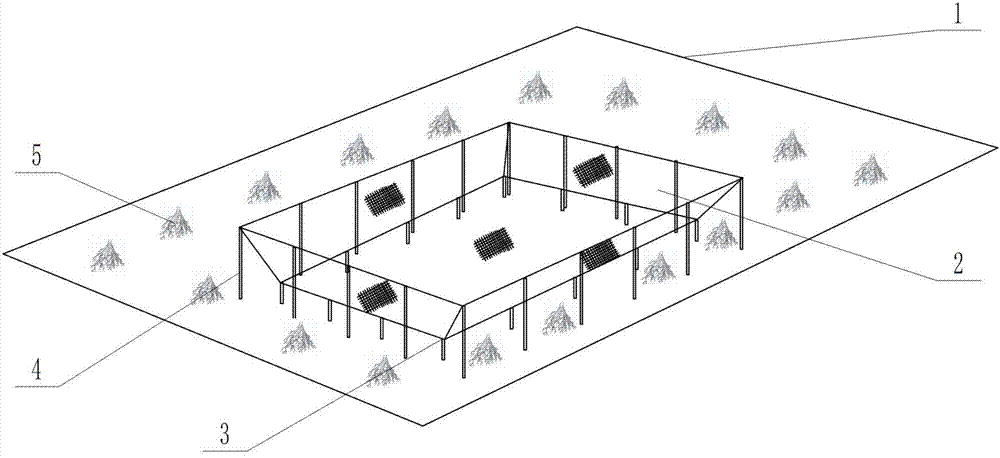
图1本发明池塘、网箱和虾巢设置示意图。 Fig. 1 present invention pond, net cage and shrimp nest are arranged schematic diagram.
具体实施方式 Detailed ways
如图1所示一种罗非鱼、青虾立体养殖的池塘。 A kind of pond of tilapia, freshwater shrimp three-dimensional culture as shown in Figure 1.
下述为本发明的一个实施例: Following is an embodiment of the present invention:
一、网箱的设置 First, the setting of the cage
(一)池塘条件:池塘1为长方形,面积2亩多,水深1.5米,池塘1硬底,少淤泥,池塘1内则坡度较平缓。
(1) Pond conditions:
(二)网箱的设计:网箱2的纵、横切面均为上宽、下狭的敞口等腰梯形。网箱2由4条两两相同的等腰梯形网片和箱底缝合而成。箱底的长与宽比箱口处的长与宽均缩短约4米。如果网箱2底长L米、宽W米,那么网箱口处的长为(2+L+2)米、宽为(2+W+2)米, 4条等腰梯形网片的高度约为2.4米。
(2) Design of the net cage: the longitudinal and cross-sections of the
L、W的数量计算。L、W的数量根据池塘1具体大小与形态进行设置。测量出距池塘1底部高50厘米处的池塘长46米,宽30米。由于虾的活动范围有限,根据虾的活动能力,设计L=A-14=46-14=32(米),W=B-14=30-14=16(米)。
Calculate the quantity of L and W. The quantity of L and W is set according to the specific size and shape of the
(三)网箱架设 (3) Cage erection
1、网箱底部支撑构架设置。要求底部固定桩3高出池塘1底部50厘米,桩顶端距离池塘1四周水平距离7米,桩间距4米。用于网箱2底部四周的支撑、拉张作用。
1. The support frame setting at the bottom of the cage. The fixed
2、网箱口支撑构架设置。要求顶部固定桩4高出池塘1底部1.9米,距箱底桩2米并在外侧与之平行设置。桩间距4米。用于网箱口的支撑、拉张,稳固作用。
2. The setting of the supporting frame of the cage mouth. It is required that the top
3、架设好的网箱2内水深1米,网箱2高出水面30厘米,高于池塘1底面50厘米。在邻近池塘起捕鱼的台阶处,用重物把箱底压低20厘米面积约6个平方米,便于干塘时起鱼。
3. The water depth in the erected
二、虾巢设置 2. Shrimp Nest Settings
在坡度较平缓的池塘1四周,距池边2米处,放置茶树枝,茶树枝分枝较多,5个扎在一起作为虾巢5,便于虾的隐藏脱皮,虾巢5间隔距离4米。
Around the
三、罗非鱼种的放养 3. Stocking of tilapia species
罗非鱼鱼种放养在当年7月2号,放养早繁鱼种鱼种,规格为90克左右,平均每亩池塘水面放2100尾。鱼种放养网箱内,后按正常的养殖方法进行饲养。 The tilapia fingerlings were stocked on July 2 of that year, and the early-breeding fish fingerlings were stocked, with a size of about 90 grams, and an average of 2,100 fish per mu of pond water. Fish fingerlings are stocked in net cages, and then reared according to normal breeding methods.
四、虾苗的放养 4. Stocking of shrimp seedlings
虾苗放养在6月30日,放养量8万尾,规格为每千克/2400尾,虾苗放在网箱外的池塘四周,均匀放养,虾苗放养后,按正常成虾养殖的方法进行饲养。 Shrimp seedlings were stocked on June 30, with a stocking quantity of 80,000 fish and a specification of 2,400 fish per kilogram. Shrimp seedlings were placed around the pond outside the net cage and stocked evenly. feeding.
五、饲养管理 5. Feeding management
鱼种和虾苗放养前要清塘消毒,清除池塘内野杂鱼类和虾的敌害生物;2千瓦的增氧机一台,设置在池塘内的网箱里,按增氧机的开机原则开机,养殖期间池塘溶氧在4.5毫克/升以上。 Before the fish fingerlings and shrimp seedlings are stocked, the pond should be disinfected to remove the harmful organisms of wild fish and shrimp in the pond; a 2kw aerator should be installed in the net cage in the pond, and should be operated according to the principle of the aerator Start the machine, and the dissolved oxygen in the pond is above 4.5 mg/L during the breeding period.
六、收获 6. Harvest
幼虾养殖1个月后,就可以选捕。每半个月用虾笼捕捞1次,捕大留小,把体重2.5克以上的选捕上市。养殖至10月25日,抽水干池,虾全部起水,罗非鱼一次性起捕。平均虾产量为每亩76千克,罗非鱼产量为每亩800余千克。 After 1 month of young shrimp culture, they can be selected and caught. Catch once every half a month with shrimp pots, catch the big ones and keep the small ones, and select and market the ones weighing more than 2.5 grams. Breeding until October 25th, the pond was pumped to dry up, all the prawns came out of the water, and the tilapia was caught at one time. The average yield of shrimp is 76 kilograms per mu, and that of tilapia is more than 800 kilograms per mu.
Claims (5)
Priority Applications (1)
| Application Number | Priority Date | Filing Date | Title |
|---|---|---|---|
| CN2012102404602A CN102696525A (en) | 2012-07-12 | 2012-07-12 | Pool for tilapia and freshwater shrimp three-dimensional aquaculture and method thereof |
Applications Claiming Priority (1)
| Application Number | Priority Date | Filing Date | Title |
|---|---|---|---|
| CN2012102404602A CN102696525A (en) | 2012-07-12 | 2012-07-12 | Pool for tilapia and freshwater shrimp three-dimensional aquaculture and method thereof |
Publications (1)
| Publication Number | Publication Date |
|---|---|
| CN102696525A true CN102696525A (en) | 2012-10-03 |
Family
ID=46889831
Family Applications (1)
| Application Number | Title | Priority Date | Filing Date |
|---|---|---|---|
| CN2012102404602A Pending CN102696525A (en) | 2012-07-12 | 2012-07-12 | Pool for tilapia and freshwater shrimp three-dimensional aquaculture and method thereof |
Country Status (1)
| Country | Link |
|---|---|
| CN (1) | CN102696525A (en) |
Cited By (5)
| Publication number | Priority date | Publication date | Assignee | Title |
|---|---|---|---|---|
| CN103120134A (en) * | 2011-11-21 | 2013-05-29 | 德清县吴越水产养殖有限公司 | Pollution-free freshwater shrimp cultivation method |
| CN103229736A (en) * | 2013-04-19 | 2013-08-07 | 中国水产科学研究院淡水渔业研究中心 | Anti-biting net cage for mating breeding of tilapia |
| CN103392663A (en) * | 2013-07-24 | 2013-11-20 | 吴江市水产养殖有限公司 | Circulating water flowing fishpond and fish-farming method |
| CN107466926A (en) * | 2017-08-31 | 2017-12-15 | 广西吉朋投资有限公司 | A kind of method of pond culture sandworm |
| CN113412811A (en) * | 2021-07-31 | 2021-09-21 | 南京市水产科学研究所 | Fish and shrimp polyculture pond and fish and shrimp polyculture method |
Citations (4)
| Publication number | Priority date | Publication date | Assignee | Title |
|---|---|---|---|---|
| CN101622962A (en) * | 2009-07-31 | 2010-01-13 | 中国水产科学研究院珠江水产研究所 | Ecological breeding method for mixedly breeding tilapia mossambica and litopenaeus vannamei boon |
| CN102428887A (en) * | 2011-10-10 | 2012-05-02 | 中国水产科学研究院淡水渔业研究中心 | A method for cultivating freshwater shrimp by comprehensively utilizing aquatic plants and artificial shrimp nests |
| CN202269276U (en) * | 2011-10-10 | 2012-06-13 | 中国水产科学研究院淡水渔业研究中心 | Artificial shrimp nest of freshwater shrimps |
| CN202714084U (en) * | 2012-07-12 | 2013-02-06 | 中国水产科学研究院淡水渔业研究中心 | Pond for stereoscopic cultivation of tilapia mossambica and freshwater shrimps |
-
2012
- 2012-07-12 CN CN2012102404602A patent/CN102696525A/en active Pending
Patent Citations (4)
| Publication number | Priority date | Publication date | Assignee | Title |
|---|---|---|---|---|
| CN101622962A (en) * | 2009-07-31 | 2010-01-13 | 中国水产科学研究院珠江水产研究所 | Ecological breeding method for mixedly breeding tilapia mossambica and litopenaeus vannamei boon |
| CN102428887A (en) * | 2011-10-10 | 2012-05-02 | 中国水产科学研究院淡水渔业研究中心 | A method for cultivating freshwater shrimp by comprehensively utilizing aquatic plants and artificial shrimp nests |
| CN202269276U (en) * | 2011-10-10 | 2012-06-13 | 中国水产科学研究院淡水渔业研究中心 | Artificial shrimp nest of freshwater shrimps |
| CN202714084U (en) * | 2012-07-12 | 2013-02-06 | 中国水产科学研究院淡水渔业研究中心 | Pond for stereoscopic cultivation of tilapia mossambica and freshwater shrimps |
Non-Patent Citations (5)
| Title |
|---|
| 常明雪等: "《特种水产养殖技术》", 31 May 1999, 中国农业出版社 * |
| 朱华平等: "《罗非鱼健康养殖实用新技术》", 31 January 2008, 海洋出版社 * |
| 王吉桥等: "鲈-中国对虾-罗非鱼混养的实验研究", 《中国水产科学》 * |
| 肖超: "中国对虾与新吉富罗非鱼混养新技术", 《水产养殖》 * |
| 陈学锋等: "池塘虾鳝立体生态养殖技术", 《渔业致富指南》 * |
Cited By (8)
| Publication number | Priority date | Publication date | Assignee | Title |
|---|---|---|---|---|
| CN103120134A (en) * | 2011-11-21 | 2013-05-29 | 德清县吴越水产养殖有限公司 | Pollution-free freshwater shrimp cultivation method |
| CN103120134B (en) * | 2011-11-21 | 2015-06-03 | 德清县吴越水产养殖有限公司 | Pollution-free freshwater shrimp cultivation method |
| CN103229736A (en) * | 2013-04-19 | 2013-08-07 | 中国水产科学研究院淡水渔业研究中心 | Anti-biting net cage for mating breeding of tilapia |
| CN103229736B (en) * | 2013-04-19 | 2015-03-25 | 中国水产科学研究院淡水渔业研究中心 | Anti-biting net cage for mating breeding of tilapia |
| CN103392663A (en) * | 2013-07-24 | 2013-11-20 | 吴江市水产养殖有限公司 | Circulating water flowing fishpond and fish-farming method |
| CN107466926A (en) * | 2017-08-31 | 2017-12-15 | 广西吉朋投资有限公司 | A kind of method of pond culture sandworm |
| CN113412811A (en) * | 2021-07-31 | 2021-09-21 | 南京市水产科学研究所 | Fish and shrimp polyculture pond and fish and shrimp polyculture method |
| CN113412811B (en) * | 2021-07-31 | 2022-10-04 | 南京市水产科学研究所 | Fish and shrimp polyculture pond and fish and shrimp polyculture method |
Similar Documents
| Publication | Publication Date | Title |
|---|---|---|
| CN102550457B (en) | Early propagation method for hyriopsis cumingii seeds | |
| CN102823529B (en) | Sepia lycidas fry breeding method | |
| CN101836607B (en) | Method for breeding macrobrachium nipponensis | |
| CN104273074B (en) | A kind of method for cultivating cuttlefish seedling | |
| CN104351098B (en) | Method for intercropping giant Macrobrachium rosenbergii by using net or pool | |
| CN106804496B (en) | High-density layered intensive culture method for macrobrachium rosenbergii | |
| CN100577002C (en) | Production method of summer fingerlings of Trachidermus fasciatus | |
| CN104304099B (en) | A kind of cultural method of trunk freshwater mussel Lutraria sieboldii Reeve juvenile mollusk outdoor tank-culture intermediate rearings | |
| CN104982359B (en) | Soil pond ecological raising and culturing method of palaemon carinicauda | |
| CN106954571A (en) | Cray, the double stubble alternate culture sets in river crab pond support Micropterus salmonoides cultural method | |
| CN107581106B (en) | A kind of artificial propagation method of round swallowfish | |
| CN103749222A (en) | Symbiotic culture method of shrimp, soft-shelled turtle and rice | |
| CN103503837A (en) | Novel soilless cultivation method of leeches | |
| CN107646763A (en) | A kind of artificial reproduction method of macular basketfish | |
| CN101946728B (en) | High-yield large-scale breeding method carried out by scientifically utilizing autumn cannon-head macrobrachium nipponense larvae | |
| CN101790967B (en) | Culture method of early-breeding seedlings of Charybdis japonica | |
| CN103734052A (en) | Device and method for portunus trituberculatus trotline type single body floating basket cultivation | |
| CN103598123A (en) | Vulgaris half-isolated mariculture cages and farming method | |
| CN103636545B (en) | A kind of ecological cultivation method of takifugu flavidus exopalaemon carinicauda | |
| CN102487867A (en) | Mixed culture method for sepia esculenta offspring seed and cynoglossus semilaevis offspring seed | |
| CN103766261B (en) | Exopalaemon carinicauda 1 year continuous many batches of artificial cultivating method | |
| CN106719183A (en) | Culture method in the sea area of picture-weaving in silk Ba Fei clam seeds | |
| CN106135079A (en) | A kind of method of cultchless oyster pond intermediate rearing | |
| CN102144585A (en) | Mixed culture method of hyriopsis schlegeli and bulk freshwater fishes | |
| CN202714084U (en) | Pond for stereoscopic cultivation of tilapia mossambica and freshwater shrimps |
Legal Events
| Date | Code | Title | Description |
|---|---|---|---|
| C06 | Publication | ||
| PB01 | Publication | ||
| C10 | Entry into substantive examination | ||
| SE01 | Entry into force of request for substantive examination | ||
| C12 | Rejection of a patent application after its publication | ||
| RJ01 | Rejection of invention patent application after publication |
Application publication date: 20121003 |