CN101681663B - A device for and a method of processing audio data - Google Patents
A device for and a method of processing audio data Download PDFInfo
- Publication number
- CN101681663B CN101681663B CN2008800167962A CN200880016796A CN101681663B CN 101681663 B CN101681663 B CN 101681663B CN 2008800167962 A CN2008800167962 A CN 2008800167962A CN 200880016796 A CN200880016796 A CN 200880016796A CN 101681663 B CN101681663 B CN 101681663B
- Authority
- CN
- China
- Prior art keywords
- audio
- item
- audio item
- transition portion
- manipulation unit
- Prior art date
- Legal status (The legal status is an assumption and is not a legal conclusion. Google has not performed a legal analysis and makes no representation as to the accuracy of the status listed.)
- Expired - Fee Related
Links
Images


Classifications
-
- H—ELECTRICITY
- H04—ELECTRIC COMMUNICATION TECHNIQUE
- H04S—STEREOPHONIC SYSTEMS
- H04S1/00—Two-channel systems
- H04S1/007—Two-channel systems in which the audio signals are in digital form
-
- G—PHYSICS
- G11—INFORMATION STORAGE
- G11B—INFORMATION STORAGE BASED ON RELATIVE MOVEMENT BETWEEN RECORD CARRIER AND TRANSDUCER
- G11B27/00—Editing; Indexing; Addressing; Timing or synchronising; Monitoring; Measuring tape travel
- G11B27/02—Editing, e.g. varying the order of information signals recorded on, or reproduced from, record carriers
- G11B27/031—Electronic editing of digitised analogue information signals, e.g. audio or video signals
- G11B27/038—Cross-faders therefor
-
- G—PHYSICS
- G11—INFORMATION STORAGE
- G11B—INFORMATION STORAGE BASED ON RELATIVE MOVEMENT BETWEEN RECORD CARRIER AND TRANSDUCER
- G11B27/00—Editing; Indexing; Addressing; Timing or synchronising; Monitoring; Measuring tape travel
- G11B27/02—Editing, e.g. varying the order of information signals recorded on, or reproduced from, record carriers
- G11B27/031—Electronic editing of digitised analogue information signals, e.g. audio or video signals
-
- G—PHYSICS
- G11—INFORMATION STORAGE
- G11B—INFORMATION STORAGE BASED ON RELATIVE MOVEMENT BETWEEN RECORD CARRIER AND TRANSDUCER
- G11B27/00—Editing; Indexing; Addressing; Timing or synchronising; Monitoring; Measuring tape travel
- G11B27/10—Indexing; Addressing; Timing or synchronising; Measuring tape travel
- G11B27/102—Programmed access in sequence to addressed parts of tracks of operating record carriers
- G11B27/105—Programmed access in sequence to addressed parts of tracks of operating record carriers of operating discs
-
- H—ELECTRICITY
- H04—ELECTRIC COMMUNICATION TECHNIQUE
- H04R—LOUDSPEAKERS, MICROPHONES, GRAMOPHONE PICK-UPS OR LIKE ACOUSTIC ELECTROMECHANICAL TRANSDUCERS; ELECTRIC HEARING AIDS; PUBLIC ADDRESS SYSTEMS
- H04R3/00—Circuits for transducers
- H04R3/12—Circuits for transducers for distributing signals to two or more loudspeakers
-
- H—ELECTRICITY
- H04—ELECTRIC COMMUNICATION TECHNIQUE
- H04S—STEREOPHONIC SYSTEMS
- H04S3/00—Systems employing more than two channels, e.g. quadraphonic
Landscapes
- Engineering & Computer Science (AREA)
- Multimedia (AREA)
- Physics & Mathematics (AREA)
- Acoustics & Sound (AREA)
- Signal Processing (AREA)
- Health & Medical Sciences (AREA)
- General Health & Medical Sciences (AREA)
- Otolaryngology (AREA)
- Stereophonic System (AREA)
Abstract
根据本发明的一个示例性实施例,提供了一种用于处理音频数据(101,102)的设备(100),其中该设备(100)包括操纵单元(103)(特别地,重采样单元),其适用于以修改第一音频项目(104)的转换部分的与时间有关的音频属性的方式选择性地操纵(特别地,重采样)第一音频项目(104)的转换部分(特别地,也可以以逼真的方式模拟运动的时间延迟效果)。
According to an exemplary embodiment of the present invention, an apparatus (100) for processing audio data (101, 102) is provided, wherein the apparatus (100) includes a manipulation unit (103) (in particular, a resampling unit) adapted to selectively manipulate (in particular, resample) the transition portion of the first audio item (104) in a manner that modifies the time-related audio properties of the transition portion of the first audio item (104) (in particular, it can also realistically simulate the time delay effect of motion).
Description
技术领域 technical field
本发明涉及用于处理音频数据的设备。The invention relates to devices for processing audio data.
除此之外,本发明涉及处理音频数据的方法。Among other things, the invention relates to a method of processing audio data.
并且,本发明涉及程序单元。Furthermore, the invention relates to program elements.
进一步地,本发明涉及计算机可读介质。Further, the present invention relates to computer readable media.
背景技术 Background technique
音频重放(playback)设备变得越来越重要。特别地,越来越多的用户购买基于头戴式耳机的音频播放器和基于扬声器的音频环绕系统。Audio playback (playback) devices are becoming more and more important. In particular, more and more users are purchasing headphone-based audio players and speaker-based audio surround systems.
当通过音频播放器逐个重放不同的音频项目时,期望在两个相继的轨道之间具有明显无缝的转换(transition)。这可被表示为“混音(mix)”。在“交叉渐变(cross-fade)”期间,可能在从一个轨道到另一个轨道的转换阶段期间交叉渐变轨道。在自动化系统中,为了提供轨道间的无缝转换,离去的轨道的放大率(ampiification)典型地将以与进来的轨道的放大率增大相同的速率减小。When playing back different audio items one by one through an audio player, it is desirable to have an apparently seamless transition between two successive tracks. This can be expressed as "mix". During a "cross-fade", it is possible to cross-fade tracks during a transition phase from one track to another. In an automated system, to provide seamless transitions between tracks, the amplification of the outgoing track will typically decrease at the same rate as the amplification of the incoming track increases.
包括混音和交叉渐变以实现连续歌曲间平滑转换的、允许歌曲能够自动重放的方法是已知的。这样的技术可被表示为自动DJ。当提供了播放列表时,不可能根据定义播放在播放列表中的所有歌曲,使得在转换期间音频质量的主观感知是合适的。Methods are known that allow songs to be played back automatically, including mixing and crossfading to achieve smooth transitions between successive songs. Such a technique may be denoted as Auto DJ. When a playlist is provided, it is not possible by definition to play all the songs in the playlist, so that a subjective perception of audio quality is appropriate during transitions.
传统的自动DJ系统允许盲目地执行交叉渐变,允许节奏和和声的冲突。这可能给出感知上地令人不愉快(“差劲的DJ”)的体验。在普通用户定义的播放列表的情况下,不相称转换的出现率(occurrence)甚至比由专业的唱片选播者(disc jockey)制作的播放列表中的更大。Traditional automated DJ systems allow crossfades to be executed blindly, allowing rhythmic and harmonic clashes. This may give a perceptually unpleasant ("bad DJ") experience. In the case of common user-defined playlists, the occurrence of disproportionate transitions is even greater than in playlists made by professional disc jockeys.
另一种传统系统基于在两个重放项目间留出短暂停顿的规则,使得和声的混音不会发生,并且节奏的连续性被破坏。即,声音被减弱。该方法有效地使两个重放列表项目在时间上分离,并且如果暂停足够长,不会有旋律或和声的不连续的体验。任何自动DJ效果在这样的概念中明显不存在。Another traditional system is based on the rule of leaving short pauses between two playback items so that harmonic mixing does not occur and rhythmic continuity is broken. That is, the sound is attenuated. This approach effectively separates the two playback list items in time, and if the pause is long enough, there is no melodic or harmonic discontinuous experience. Any automatic DJ effects are conspicuously absent in such a concept.
当听音频播放列表、记录或其他音乐收藏品时,用户通常做的是例如通过分别按播放器上的“下一首”或“上一首”按钮从一个项目向前或向后跳转到另一个项目。这可以在音频项目的开头和结尾之间的任何地方实施。这在音频播放器中实现的方式是当前项目的声音被减弱而新的轨道开始播放。When listening to an audio playlist, recording, or other music collection, what users typically do is jump forward or backward from one item to another, for example by pressing the "Next" or "Previous" buttons on the player another project. This can be implemented anywhere between the beginning and end of the audio project. The way this works in the audio player is that the sound of the current project is muted and a new track starts playing.
从一个音频轨道移动到另一个的更先进的方法是旨在以以下方式混音两个轨道的自动DJ系统:类似于舞曲唱片选播者如何将一个项目的结尾结合到另一个的开头来完成从一个轨道移动到另一个。这两个信号可被同步并且信号逐渐地被交叉渐变,以给出从一个项目到另一个平滑转换的印象。A more advanced method of moving from one audio track to another is an automated DJ system designed to mix the two tracks in a manner similar to how a dance recordist would do it by joining the end of one project to the beginning of the other Move from one track to another. The two signals can be synchronized and the signals gradually cross-faded to give the impression of a smooth transition from one item to the other.
US 2005/0047614 A1公开了一种用于在诸如环绕环境这样的多声道(multi-channel)音频环境中加强歌曲间转换的系统和方法。在该方法中,通过在转换期间独立操纵(manipulate)每个节目的各个声道的音量,给正在结束的节目运动的错觉(illusion of motion)以创建歌曲正在退出的印象,而给正在开始的节目运动(motion)以创建歌曲正在进入的印象。US 2005/0047614 A1 discloses a system and method for enhancing transitions between songs in a multi-channel (multi-channel) audio environment such as a surround environment. In this method, the ending program is given the illusion of motion to create the impression that the song is exiting, while the beginning one is given the illusion of motion by independently manipulating the volume of the individual channels of each program during the transition. Motion is shown to create the impression that the song is coming in.
然而,根据US 2005/0047614 A1的两段音频之间的转换因为移动被以过分简单化的方法模拟的缘故对于人类收听者来说听上去仍然可能显得不自然。However, transitions between two pieces of audio according to US 2005/0047614 A1 may still sound unnatural to a human listener because the movement is simulated in a simplistic way.
发明内容 Contents of the invention
本发明的一个目的是提供一种允许音频项目的开头或结尾处的适当音频体验的音频系统。It is an object of the present invention to provide an audio system that allows a proper audio experience at the beginning or end of an audio project.
为了达到上述目标,提供了根据独立权利要求的用于处理音频数据的设备、处理音频数据的方法、程序单元和计算机可读介质。有益的实施例在从属权利要求中限定。In order to achieve the above objects, a device for processing audio data, a method of processing audio data, a program element and a computer-readable medium are provided according to the independent claims. Advantageous embodiments are defined in the dependent claims.
根据本发明的示例性实施例,提供了一种用于处理音频数据的设备,其中该设备包括操纵单元(特别地,重采样单元),适用于以修改音频数据第一音频项目的转换部分的与时间有关的音频属性的方式选择性地操纵(特别地,重采样)音频数据第一音频项目的转换部分(特别地,也可以以逼真的方式模拟移动的时间延迟效果);并且,其中操纵单元被设置为通过虚拟扬声器-收听者模型的参数的参数操纵来重现第一音频项目以获得动态空间转换效果。According to an exemplary embodiment of the present invention, there is provided a device for processing audio data, wherein the device comprises a manipulation unit (in particular a resampling unit) adapted to modify the converted portion of the first audio item of the audio data selectively manipulating (in particular, resampling) the transition portion of the audio data first audio item in a time-dependent manner of the audio properties (in particular, the time-delay effect of movement can also be simulated in a realistic manner); and, wherein the manipulation The unit is arranged to reproduce the first audio item by parametric manipulation of parameters of the virtual speaker-listener model to obtain a dynamic spatial transformation effect.
根据本发明的另一个示例性实施例,提供了一种处理音频数据的方法,其中该方法包括以修改音频数据的第一音频项目的转换部分的与时间有关的音频属性的方式选择性地操纵音频数据的第一音频项目的转换部分;其中所述操纵包括通过虚拟扬声器-收听者模型的参数的参数操纵来重现第一音频项目(104)以获得动态空间转换效果。According to another exemplary embodiment of the present invention there is provided a method of processing audio data, wherein the method comprises selectively manipulating in a manner which modifies the time-dependent audio properties of a transition portion of a first audio item of audio data A transformed portion of a first audio item of audio data; wherein said manipulation comprises reproducing the first audio item (104) by parametric manipulation of parameters of a virtual speaker-listener model to obtain a dynamic spatial transformation effect.
根据本发明的又一个示例性实施例,提供了一种程序单元(例如源代码或可执行代码形式的软件程序),当被处理器执行时,其适用于控制或实施具有上述特征的数据处理方法。According to a further exemplary embodiment of the present invention there is provided a program element (such as a software program in the form of source code or executable code), which, when executed by a processor, is adapted to control or carry out a data processing with the above-mentioned features method.
根据本发明的再一个示例性实施例,提供了一种计算机可读介质(例如CD、DVD、USB棒、软盘或硬盘),在其中存储了计算机程序,当它被处理器执行时,适用于控制或完成具有上述特征的数据处理方法。According to yet another exemplary embodiment of the present invention, there is provided a computer readable medium (such as a CD, DVD, USB stick, floppy disk or hard disk) in which is stored a computer program which, when executed by a processor, is suitable for Controlling or performing a data processing method having the above characteristics.
根据本发明实施例被实施的用于音频节奏操纵(tempo manipulation)和/或频率改变(frequency alteration)目的的数据处理可通过计算机程序即通过软件实现,或者通过使用一个或多个特殊的电子优化电路即以硬件实现,或者以混合的形式即借助于软件部件和硬件部件来实现。Data processing for audio tempo manipulation and/or frequency alteration purposes implemented according to embodiments of the present invention may be implemented by a computer program, i.e. by software, or by using one or more special electronically optimized The circuits are implemented either in hardware or in a mixed form, ie by means of software and hardware components.
在本申请的上下文中,术语“操纵”可特别地表示重新计算音频数据流或音频数据片段(audio data piece)特定部分以选择性地修改这个部分的时间或频率相关的属性,即对关于声音表现的节奏和音高的可听体验有影响的参数。因此,诸如节奏和/或音高这样的属性可通过这样的操纵得以修改,特别地以获得多普勒效应。因此,操纵或重采样可通过重新计算具有与原始记录的文件中的属性不同的属性的声音文件中的样本来进行。这可包括以某种方式移除样本、修改可获得的频率范围、引入暂停、增加或减少音调的再现次数等以改善音频片段间转换的感知。特别地,因为允许结尾和开头轨道的感知解耦的音高转换效果可避免相继的音频片段间的节奏和和声冲突。In the context of this application, the term "manipulation" may especially denote the recomputation of a specific part of an audio data stream or audio data piece to selectively modify time- or frequency-related properties of this part, i.e. The rhythm and pitch of the performance are parameters that influence the audible experience. Thus, properties such as tempo and/or pitch can be modified by such manipulations, in particular to obtain the Doppler effect. Thus, manipulation or resampling may be performed by recomputing samples in the sound file that have properties different from those in the originally recorded file. This may include removing samples in some way, modifying the available frequency range, introducing pauses, increasing or decreasing the number of times a tone is reproduced, etc. to improve the perception of transitions between audio segments. In particular, rhythmic and harmonic conflicts between successive audio segments can be avoided because the pitch-shifting effect allows perceptual decoupling of the ending and opening tracks.
音频项目的术语“转换部分”可特别地表示该音频项目的开头部分和/或结尾部分,在所述部分,转换发生在所述音频项目与另一个(在前的或随后的)音频项目之间或者该音频项目与无声时间间隔之间。The term "transition part" of an audio item may especially denote the beginning and/or end part of the audio item where a transition takes place between the audio item and another (preceding or subsequent) audio item or between the audio item and the silence interval.
术语“与时间有关的音频属性”可特别地表示可以以特定方式调整时间特性和相应的音频参数,例如以强调淡入(fading in)或淡出(fading out)音频片段的印象。这可以包括被称为所谓的声学多普勒效应的、用于指示音频项目淡入或淡出的直观测量的频率变化。The term "time-dependent audio properties" may especially denote that temporal characteristics and corresponding audio parameters may be adjusted in a specific way, for example to emphasize the impression of an audio segment being faded in or faded out. This can include a change in frequency known as the so-called acoustic Doppler effect, an intuitive measure used to indicate an audio item is fading in or out.
根据本发明的一个示例性实施例,音频片段的转换部分可选择地被处理以改善对于人耳来说的该音频项目和在前或随后的音频信息之间转换的感知。通过在淡入和/或淡出期间改变与时间有关的音频重放属性,可以生成接近或离开声源的印象,这在心理上可分别被关联为新歌曲的开始或当前被重放歌曲的结束。According to an exemplary embodiment of the present invention, transition portions of an audio segment are optionally processed to improve the human ear's perception of transitions between the audio item and preceding or following audio information. By changing time-dependent audio playback properties during fade-in and/or fade-out, the impression of approaching or moving away from a sound source can be created, which can be psychologically associated with the start of a new song or the end of the currently played back song, respectively.
因此,根据示例性实施例,可以使用于自动地选播音乐(DJing)的动态混音(mixing)成为可能。在自动唱片选播系统中,可以使歌曲转换不出现令人烦人的中断。这一般可以通过交叉渐变两首连续的歌曲来完成。为了获得平滑的转换,要求歌曲的节奏和旋律在混音区域被调准,并且这些歌曲具有在混音区域中匹配的和声属性。这通常在可在另一首之后播放的歌曲上施加约束。根据一个示例性实施例,调准节奏、旋律和和声的需要通过在转换期间对每首歌曲施加采样频率的不同的滑动的变化而得以克服。滑动的采样频率可创建被混音的两首歌曲的自然解耦,使得节奏、旋律和和声冲突不重要。因此,本发明的实施例可克服不是每个播放列表(或者每对歌曲)都能采用自动DJ方法来交叉渐变这一限制。本发明实施例所依据的认识是除了通过暂停的时间上的分离之外,还有其他可能的方法使两个播放列表项目感知上分离。出于这个目的,可以使用一个或两个音频信号的频谱的动态系统的操纵。特别地,可以执行一种方法,其中在歌曲的混音区域中,执行歌曲的操纵/重采样,使得一首歌曲具有滑动下降的频率和节奏,而另一首歌曲具有滑动上升的节奏和频率。因此,自动DJ应用和强制转换中音频项目的时间上的操纵可得以使用,并且可基于这样的考虑:可引起导致频率滑移效果的足够强大的多普勒频移效应。因此,使得自动DJ应用的动态混音成为可能。可使在自动DJ系统中被混音的两首歌曲的自然解耦成为可能,使得这些歌曲不需要在节奏、旋律、和声内容等方面相似。这可以通过在转换期间操纵这两首歌曲而得以创建,使得正在结束的歌曲的节奏和/或频率从原始频率滑动地下降到较低的频率,而正在开始的歌曲的节奏和/或频率平滑地向具有不同频率轮廓(frequency contour)的原始频率下降。这也能作为空间转换效果的副产品而得以实现。可以创建两首歌曲的虚拟源的移动错觉,并且可以生成多普勒效应。取决于创建源移动错觉的方法,这常常还可以产生多普勒效应,即多普勒效应是移动效果的结果。Therefore, according to an exemplary embodiment, dynamic mixing for automatically selecting music (DJing) can be enabled. In an automatic disc play system, song changes can be made without annoying interruptions. This can generally be done by crossfading two consecutive songs. In order to obtain a smooth transition, it is required that the tempo and melody of the songs are tuned in the mixing area, and that the songs have matching harmonic properties in the mixing area. This usually places constraints on which songs can be played after another. According to one exemplary embodiment, the need to tune tempo, melody and harmony is overcome by applying a different sliding change in sampling frequency to each song during conversion. The sliding sample rate creates a natural decoupling of the two songs being mixed, making rhythmic, melodic, and harmonic clashes unimportant. Thus, embodiments of the present invention can overcome the limitation that not every playlist (or every pair of songs) can be cross-faded using an automatic DJ approach. Embodiments of the present invention are based on the recognition that there are other possible ways of perceptually separating two playlist items than temporal separation by pausing. For this purpose, a dynamic systematic manipulation of the frequency spectrum of one or two audio signals can be used. In particular, a method can be performed wherein, in the mix area of songs, manipulation/resampling of songs is performed such that one song has a frequency and tempo that slides down and another song has a tempo and frequency that slides up . Thus, temporal manipulation of audio items in automatic DJ applications and forcing transitions can be used and can be based on the consideration that a sufficiently strong Doppler shift effect can be induced resulting in a frequency slip effect. Thus, dynamic mixing for automatic DJ applications is made possible. A natural decoupling of two songs being mixed in an automated DJ system may be enabled such that the songs need not be similar in rhythm, melody, harmonic content, etc. This can be created by manipulating the two songs during the transition so that the tempo and/or frequency of the ending song slides down from the original frequency to a lower frequency, while the tempo and/or frequency of the beginning song smoothly The ground drops towards the original frequency with a different frequency contour. This can also be achieved as a by-product of the space transformation effect. The illusion of movement of the virtual source of the two songs can be created and the Doppler effect can be generated. Depending on the method used to create the illusion of source movement, this can often also produce a Doppler effect, ie the Doppler effect is the result of the effect of movement.
接下来,将解释用于处理音频数据的设备的另一个示例性实施例。然而,这些实施例也应用于处理音频数据的方法、程序元件和计算机可读介质。Next, another exemplary embodiment of an apparatus for processing audio data will be explained. However, these embodiments also apply to the method of processing audio data, the program element and the computer-readable medium.
第一音频项目的转换部分可以是第一音频项目的结尾部分。换句话说,通过以渐进或逐步的方式调节时间属性,可以执行操纵以平滑地淡出第一音频项目的结尾。The transition portion of the first audio item may be an ending portion of the first audio item. In other words, by adjusting the time attribute in a gradual or stepwise manner, manipulation can be performed to smoothly fade out the end of the first audio item.
附加地或可选地,第一音频项目的转换部分可以是第一音频项目的开头部分。换句话说,通过以渐进或逐步的方式调节时间属性,可以执行操纵以淡入第一音频项目的开头。因此,可以仅操纵音频项目的开头部分、仅处理音频项目的结尾部分或者处理音频项目的开头部分和结尾部分这两者。也可以以这样的方式处理音频项目的中间部分,例如,用户可以在第一首歌曲的中间停止重放,并从第二首歌曲的开头或从其中间的任何地方开始播放第二首歌曲。换句话说,音频项目的自然开头或自然结尾可以或不可以与转换部分一致/结合在一起。因此,根据本发明示例性实施例的选择性的时间操纵也可以在歌曲的中间进行。Additionally or alternatively, the transition portion of the first audio item may be a beginning portion of the first audio item. In other words, by adjusting the time attribute in a gradual or stepwise manner, a manipulation can be performed to fade in the beginning of the first audio item. Thus, it is possible to manipulate only the beginning part of the audio item, process only the end part of the audio item, or process both the beginning part and the end part of the audio item. The middle part of the audio item can also be handled in such a way that, for example, the user can stop playback in the middle of the first song and start the second song from the beginning of the second song or from anywhere in the middle. In other words, the natural beginning or natural end of the audio item may or may not coincide with/join the transition. Therefore, selective time manipulation according to exemplary embodiments of the present invention can also be performed in the middle of a song.
特别地,操纵单元可适用于以由第一音频项目受操纵的结尾部分的节奏和频率组成的组中的至少一个滑出(glide out)的方式操纵第一音频项目的结尾部分。因此,通过考虑当重放这样的音频内容时对音频感知有影响的这样的与时间有关的音频参数,可以获得声学多普勒效应的印象,正如从离开的救护车喇叭可知,它不仅幅度下降,而且频率也下降(应当注意,离开的救护车喇叭声音的频率比接近的救护车的声音低,但是频率没有减小(滑动),除非救护车正相对于观察者加速或减速)。特别地,当操纵淡出音频项目的结尾部分时,节奏和/或频率可被减小。In particular, the manipulation unit may be adapted to manipulate the ending of the first audio item in such a way that at least one of the group consisting of tempo and frequency of the manipulated ending of the first audio item glides out. Thus, by taking into account such time-dependent audio parameters that have an impact on audio perception when replaying such audio content, an impression of the acoustic Doppler effect can be obtained, as seen from the departing ambulance horn, which not only drops in amplitude , and the frequency also drops (it should be noted that the sound of the departing ambulance horn is lower in frequency than the sound of the approaching ambulance, but the frequency does not decrease (slip) unless the ambulance is accelerating or decelerating relative to the observer). In particular, the tempo and/or frequency may be reduced when manipulating the fade out end of an audio item.
虽然本发明的实施例可以专注于提供接连再现的音频项目间的平滑转换,但可以处理确切地仅一个音频项目,例如将在结尾部分轻柔地减弱的音频项目。While embodiments of the present invention may focus on providing smooth transitions between successively reproduced audio items, exactly one audio item may be handled, eg an audio item to be softly faded at the end.
然而,操纵单元也可以适用于以修改第二音频项目(可能接在第一音频项目之后)的转换部分的与时间有关的音频属性的方式操纵第二音频项目(可能接在第一音频项目之后)的转换部分。因此,可以通过考虑两个转换部分之间的与时间有关的音频属性来使第一音频项目和第二音频项目之间的转换平滑。在转换部分(一个或多个)期间,第一音频项目和第二音频项目这两者可以都被同时重放,但是具有不同的音频参数。However, the manipulation unit may also be adapted to manipulate a second audio item (possibly following the first audio item) in a manner that modifies the time-dependent audio properties of a transition portion of the second audio item (possibly following the first audio item) ) of the conversion part. Thus, the transition between the first audio item and the second audio item can be smoothed by taking into account the time-dependent audio properties between the two transition parts. During the transition portion(s), both the first audio item and the second audio item may be played back simultaneously, but with different audio parameters.
特别地,第二音频项目的转换部分可以是第二音频项目的开头部分。则操纵单元可适用于以使由第二音频项目受操纵的开头部分的节奏和频率组成的组中的至少一个滑入/淡入的方式操纵第二音频项目的开头部分。为了这样的淡入效果,(以渐进或逐步的方式)增大节奏和频率直到第二音频项目的转换部分已被完成可以是合适的。In particular, the transition part of the second audio item may be the beginning part of the second audio item. The manipulation unit may then be adapted to manipulate the beginning of the second audio item in such a way that at least one of the group consisting of tempo and frequency of the manipulated beginning of the second audio item slides/fades in. For such a fade-in effect, it may be appropriate to increase the tempo and frequency (in a progressive or step-by-step manner) until the transition part of the second audio item has been completed.
操纵单元可适用于选择性地操纵第一音频项目的仅一个转换部分(开头部分或结尾部分)或多个转换部分(开头部分和结尾部分),而第一音频项目的剩余(中央)部分将保持不被采样,即是说不改变。因此,在平滑地淡入随后将被重放的音频信号后,原始数据将被重放,使得在转换区(regime)完成后不发生音频失真(audio artefact)。The manipulation unit may be adapted to selectively manipulate only one transition part (beginning part or ending part) or a plurality of transition parts (beginning part and ending part) of the first audio item, while the remaining (central) part of the first audio item will Remains unsampled, ie does not change. Therefore, after smoothly fading in the audio signal to be played back later, the original data will be played back so that no audio artefact occurs after the transition region (regime) is completed.
操纵单元可适用于以协同方式操纵第一音频项目的转换部分和第二音频项目的转换部分。因此,淡出项目的节奏和频率的降低(引起离开音频源的多普勒效应)可以以协调的方式与其中节奏和频率被增大(接近的音频源的多普勒效应)的随后音频信号的淡入相结合。这可以允许甚至在起源非常不同的音频内容之间的听觉上合适的转换部分,使得将被混音的两首歌曲不必在节奏、旋律或和声冲突方面彼此对应。The manipulation unit may be adapted to manipulate the transformed portion of the first audio item and the transformed portion of the second audio item in a coordinated manner. Thus, the decrease in tempo and frequency of the faded item (causing the Doppler effect away from the audio source) can be coordinated in a coordinated manner with the reduction in tempo and frequency of the subsequent audio signal in which the tempo and frequency are increased (Doppler effect of the approaching audio source). Fade combined. This may allow aurally appropriate transitions even between audio content of very different origin, so that the two songs to be mixed do not necessarily correspond to each other in terms of rhythm, melody or harmonic conflict.
操纵单元还可用作运动体验(motion experience)生成单元,其适用于以生成再现第一音频项目的音频源在转换期间正在移动的可听体验的方式处理第一音频项目。然而,这样的移动音频源印象不必受限于音频项目响度的简单变化(对于接近的对象增大响度,对于离开的对象减小响度),但是可以通过考虑产生与音频源的实际运动有关的交叉声道时延的时间修改来进一步改进这样的运动感知。特别地,声学多普勒效应不仅修改离开或接近的声音源的响度,还修改频率、节奏和其他与时间有关的音频参数。通过考虑这样的与时间有关的属性,与简单的响度调节系统相比,被重放的音频数据的移动将被感知为显著地更加自然,或者更明确地更加接近移动的声音源的感知。The manipulation unit may also be used as a motion experience generating unit adapted to process the first audio item in such a way as to generate an audible experience that an audio source reproducing the first audio item is moving during the transition. However, such impressions of moving audio sources are not necessarily limited to simple changes in the loudness of audio items (increasing loudness for approaching objects, decreasing loudness for moving objects), but can be produced by considering crossovers related to the actual motion of the audio source Time modification of channel delay to further improve such motion perception. In particular, the acoustic Doppler effect not only modifies the loudness of departing or approaching sound sources, but also frequency, tempo and other time-dependent audio parameters. By taking such time-dependent properties into account, the movement of the reproduced audio data will be perceived as significantly more natural, or more definitely closer to the perception of a moving sound source, than a simple loudness adjustment system.
这样的运动体验生成单元可适用于生成再现第一音频项目的音频源在第一音频项目的结尾部分期间正在离开的可听体验。因此,相应音频项目部分的操纵可以以模拟离开的声音源的声学多普勒效应的方式来进行。Such a motion experience generating unit may be adapted to generate an audible experience that an audio source reproducing the first audio item is leaving during an end portion of the first audio item. Thus, manipulation of the corresponding audio item portion can be performed in a manner that simulates the acoustic Doppler effect of a departing sound source.
运动体验生成单元可进一步适用于以生成再现第二音频项目的音频源在转换部分期间正在移动(特别地,在第二音频数据的开头部分期间正在接近)的可听体验的方式处理第二音频项目。换句话说,在这样的实施例中,第二音频项目的开头部分的处理可以以人耳能够感知到接近的音频源的声学多普勒效应的印象的方式来进行。The motion experience generation unit may be further adapted to process the second audio in a manner that generates an audible experience that an audio source reproducing the second audio item is moving during the transition portion, in particular approaching during the beginning portion of the second audio data project. In other words, in such an embodiment, the processing of the beginning of the second audio item may be done in such a way that the human ear can perceive the impression of the acoustic Doppler effect of an approaching audio source.
从心理学视角看来,淡出与离开的声音源有关以及淡入与接近的声音源有关是非常直观的。From a psychological point of view, it is quite intuitive that fade-outs are related to departing sound sources and fade-ins are related to approaching sound sources.
运动体验生成单元可适用于根据下面的测量生成第一音频项目结尾部分和第二音频项目开头部分之间的转换。首先,可处理第二音频项目转换部分的第一部分,使得第二音频项目转换部分的再现可感知为源于遥远的开始位置。换句话说,第二音频项目被打开并且将被感知为来自位于远处的声音源,这可以通过小音量和相应的方向属性来模拟。随后,第一音频项目转换部分的第一部分可以以第一音频项目转换部分的再现可感知为源于从中央位置移动到遥远的最终位置的位置的方式来处理。换句话说,在第一音频项目的中央部分的重放期间,该音频数据将以人类听众具有发出第一音频项目的声音源位于中央位置的印象的方式来配置。为了指示第一音频项目随后将淡出,可以虚拟地(virtually)将在转换部分的第一部分中发出第一音频项目的声音源从该中央位置移动到遥远的最终位置。该运动可以逐渐地来进行。同时,随着发出第一音频项目的虚拟声音源的离开,第二音频项目的第二转换部分可以以第二音频项目的转换部分的第二部分的再现可感知为源于正从遥远的开始位置(例如逐渐地)移动到中央位置的位置(与发出第一音频项目的(虚拟)声音源预先所处位置相同的位置,或者另一个位置)的方式来处理。因此,由于第二音频项目将被淡入,人类听众将获得发出指示第二音频项目的声波的虚拟音频源正在接近第二音频项目的主要部分将被再现的位置的印象。随后,处理第一音频项目的转换部分的第三部分,使得第一音频项目的转换部分的声音被减弱。因此,在第二音频项目已(虚拟地)接近最终或中间的位置后,可以(渐进地或以逐步的方式)降低第一音频项目的音量,从而完成淡出过程。可选地,然后发出第二音频项目的主要部分的虚拟声音源可被再次重新定位,或者可维持在中央位置。The motion experience generation unit may be adapted to generate transitions between the end of the first audio item and the beginning of the second audio item according to the following measurements. Firstly, a first portion of the transitional portion of the second audio item may be processed such that reproduction of the transitional portion of the second audio item is perceivably originating from a remote start position. In other words, the second audio item is turned on and will be perceived as coming from a sound source located far away, which can be simulated by a low volume and corresponding directional properties. Subsequently, the first portion of the first audio item transition portion may be processed in such a way that the reproduction of the first audio item transition portion is perceivably originating from a position moving from the central position to the remote final position. In other words, during playback of the central portion of the first audio item, the audio data will be configured in such a way that a human listener has the impression that the sound source emitting the first audio item is centrally located. In order to indicate that the first audio item will then fade out, the sound source emitting the first audio item in the first part of the transition section may be moved virtually from this central position to a remote final position. This exercise can be done gradually. At the same time, with the departure of the virtual sound source emitting the first audio item, the second transition portion of the second audio item can be perceived as originating from a distant start with the reproduction of the second portion of the transition portion of the second audio item. The position is moved (eg gradually) to a central position (the same position as the (virtual) sound source emitting the first audio item was previously located, or another position). Thus, since the second audio item will be faded in, the human listener will get the impression that the virtual audio source emitting the sound waves indicative of the second audio item is approaching the location where the main part of the second audio item will be reproduced. Subsequently, a third portion of the transition portion of the first audio item is processed such that the sound of the transition portion of the first audio item is muted. Thus, after the second audio item has (virtually) approached the final or intermediate position, the volume of the first audio item may be decreased (gradually or in a step-by-step manner), thereby completing the fade-out process. Optionally, the virtual sound source emitting the main part of the second audio item may then be repositioned again, or may remain in a central position.
“中央位置”可指头戴式耳机信号如何在音频的“中央部分”期间从原始音频信号生成的方式。例如,当没有进行转换时,左信号未经处理地到达左耳,而右信号未经处理地到达右耳。在音频轨道的“中央部分”,可使用被表示为“中央位置(重现/再现/)”的处理模型。在中央位置,表现(立体声信号的)原始左、右音频声道的信号可典型地被直接发送至左、右头戴式耳机,或者对信号施加某个与转换期间的处理无关的处理。这种类型的附加处理可与频谱均衡、空间扩展(spatial widening)、动态压缩、多声道-立体声变换(在原始音频数据具有非立体声格式的情况下)、或者在音频轨道的中央部分期间独立于在转换部分期间所使用的转换方法施加的其他类型的音频处理效果和增强相关。"Central position" may refer to how the headphone signal is generated from the original audio signal during the "central part" of the audio. For example, when no conversion is done, the left signal goes unprocessed to the left ear and the right signal goes unprocessed to the right ear. In the "central part" of the audio track, a processing model denoted "central position (reproduction/reproduction/)" may be used. At the central location, the signals representing the original left and right audio channels (of a stereo signal) can typically be sent directly to the left and right headphones, or some processing is applied to the signals independent of the processing during conversion. This type of additional processing can be independent of spectral equalization, spatial widening, dynamic compression, multichannel-to-stereo conversion (in case the original audio data has a monaural format), or during the central part of the audio track Other types of audio processing effects and enhancements are applied to the conversion method used during the conversion part.
设备可包括适用于再现经处理的音频数据的音频再现单元。这样的(物理的或真实的)音频再现单元可以是例如头戴式耳机、耳机或扬声器,其被提供用于重放的经处理的音频数据。音频数据可以以收听重放的音频数据的用户得到(虚拟的)音频重放单元被置于另一个位置的印象的方式来处理。The device may comprise an audio reproduction unit adapted to reproduce the processed audio data. Such a (physical or real) audio reproduction unit may be, for example, a headset, earphones or loudspeakers, which are provided with processed audio data for playback. The audio data can be handled in such a way that a user listening to the reproduced audio data gets the impression that the (virtual) audio reproduction unit is placed in another location.
第一音频项目可以是音乐项目(例如音乐剪辑或CD上的音乐轨道)、语音项目(例如电话对话的一部分)或者可以是视频/视听项目(例如音乐视频、电影等)。因此,本发明的实施例可被实施于所有其中必须处理音频数据的领域中,特别是实施于其中将以平滑方式把两个音频项目相互连接的领域中。The first audio item may be a music item (eg a music clip or a music track on a CD), a speech item (eg a part of a telephone conversation) or may be a video/audiovisual item (eg a music video, movie, etc.). Embodiments of the invention can thus be implemented in all fields in which audio data has to be processed, in particular in fields in which two audio items are to be connected to each other in a smooth manner.
本发明示例性实施例的示例性应用领域为自动唱片选播系统、用于在播放列表中搜索音频项目的系统、广播频道切换系统、公共因特网页面切换系统、电话信道切换系统、音频项目重放开始系统和音频项目重放停止系统。用于在播放列表中搜索音频项目的系统可允许针对特定的音频项目搜索或扫描播放列表,并随后重放这样的音频项目。在两个相继的这样的音频项目之间的转换部分,可实施本发明的实施例。另外,当在不同电视或无线电频道之间切换时,即在广播频道切换系统中切换时,可根据本发明的示例性实施例来进行在前频道的淡出和随后频道的淡入。当操作计算机的用户在不同因特网页面间切换从而使用公共因特网页面切换系统时,也可以根据本发明的示例性实施例来进行相同的淡出、淡入。在电话对话期间,当进行不同信道或通信方之间的切换时,可以针对这样的电话信道切换系统实施本发明的实施例。同样针对简单地开始或停止音频重放,即针对无声的重放模式和高声的重放模式之间的切换,可以实施本发明的实施例。Exemplary fields of application of exemplary embodiments of the present invention are automatic disc selection systems, systems for searching for audio items in playlists, broadcast channel switching systems, public Internet page switching systems, telephone channel switching systems, audio item playback Start system and audio item playback stop system. A system for searching for audio items in a playlist may allow the playlist to be searched or scanned for specific audio items and then played back such audio items. During transitions between two successive such audio items, embodiments of the present invention may be implemented. In addition, when switching between different television or radio channels, ie, switching in a broadcast zapping system, fading out of a preceding channel and fading in of a subsequent channel may be performed according to an exemplary embodiment of the present invention. When a user operating a computer switches between different Internet pages to use the public Internet page switching system, the same fade-out and fade-in can also be performed according to the exemplary embodiment of the present invention. Embodiments of the present invention may be implemented for such a telephone channel switching system when switching between different channels or communicating parties during a telephone conversation. Embodiments of the present invention may also be implemented for simply starting or stopping audio playback, ie for switching between a silent playback mode and a loud playback mode.
本发明的实施例可与附加的可能性相结合以使用空间转换结果来创建两首歌曲之间空间分离的错觉。“交叉渐变”的两首歌曲可具有不同的移动轨迹,使得现存的源(第一首歌曲)向例如左侧离开,而新的歌曲(第二源)从右边移动进声像(sound image)。Embodiments of the present invention can be combined with the additional possibility to use the spatial transformation result to create the illusion of spatial separation between two songs. The two songs of the "crossfade" can have different movement trajectories, so that the existing source (first song) goes out to the left, for example, while the new song (second source) moves into the sound image from the right .
在使两个项目分离中使用上升和声模式(harmonic pattern)和下降和声模式可以也具有来自实验心理学的有力支持,其中观察到两个音调综合体的不同频率调制轨迹引起这两个音调综合体分离为两个不同的感知流(例如参见A.S.Bregman(1990),“Auditory Scheme Analysis:ThePerceptual Organization of Sound”,Cambridge,MA:Bradford Books,MITPress)。The use of ascending and descending harmonic patterns in separating the two items may also have strong support from experimental psychology, where it was observed that different frequency modulation trajectories of the two tonal complexes elicited The complex separates into two distinct perceptual streams (see for example A.S. Bregman (1990), "Auditory Scheme Analysis: The Perceptual Organization of Sound", Cambridge, MA: Bradford Books, MITPress).
操纵与时间有关的音频参数的效果是歌曲在混音区域中被在感知上解耦,使得它们不再被感知为不和谐的。因此,使用该方法,对于确保节奏、旋律或和声匹配,只需给予较低的特别关注。这允许任何任意歌曲对的混音,进而允许需要通过根据本发明示例性实施例的自动DJ方法重放的任何播放列表。The effect of manipulating time-related audio parameters is that the songs are perceptually decoupled in the mix region such that they are no longer perceived as dissonant. Thus, using this method, less special attention needs to be paid to ensuring rhythmic, melodic or harmonic matching. This allows the remixing of any arbitrary pair of songs, and thus any playlist that needs to be played back by the automated DJ method according to an exemplary embodiment of the present invention.
本发明的示例性实施例可以应用于通过混音两首连续歌曲的开头和结尾来创建歌曲转换以获得平滑转换的应用中,例如应用于自动DJ应用中。Exemplary embodiments of the present invention may be applied in applications where song transitions are created by mixing the beginning and end of two consecutive songs to achieve smooth transitions, such as in automatic DJ applications.
根据本发明的另一个示例性实施例,可使转换效果和普通收听之间的空间转换成为可能。空间转换效果可被用于音频项目之间的强制转换。所述转换效果基于典型地在基于模型的重现场景中的音频流的动态专门化(dynamic specialisation)。不期望在普通头戴式耳机收听中运行基于模型的空间处理,因此可以定义转换,用于普通收听到转换重现以及返回。According to another exemplary embodiment of the present invention, spatial conversion between conversion effect and normal listening can be made possible. The Space Transform effect can be used to force transitions between audio items. The transformation effect is based on a dynamic specialization of the audio stream typically in a model-based reproduction scenario. It is not desirable to run model-based spatial processing in normal headphone listening, so transformations can be defined for normal listening to transformation reproduction and back.
因此,可使用音频信号的空间操纵来完成从一个轨道到另一个轨道的移动。目标可以是给出一个轨道物理地离开而另一个轨道进入的感知。例如,以这样的方式:当前音乐轨道文件远离地飞到右手侧而另一个轨道从左手侧滑进。当在音频播放器列表的情境下完成了该操作时,它给出了对播放列表的非常强烈的空间印象。在空间坐标中的这种类型的音频播放列表项目的表现将在音频技术中提供新的应用。Thus, movement from one track to another can be accomplished using spatial manipulation of the audio signal. The goal may be to give the perception that one track is physically leaving and the other is entering. For example, in such a way that the current music track file flies away to the right hand side and another track slides in from the left hand side. When this is done in the context of an audio player list, it gives a very strong spatial impression of the playlist. The representation of this type of audio playlist item in spatial coordinates will provide new applications in audio technology.
在头戴式耳机收听中,清楚地定义了什么是左、什么是右。一个明显的解决方案是使用例如标准的幅度平移规则(amplitude panning rule),以立体声图像(stereo image)逐渐衰减并仅移动到右耳信号、并同时增大始于左耳的另一个轨道的音量的方式改变平衡的立体声图像。然而,以这种方式获得的转换效果既不是非常令人感兴趣,又没有给出轨道改变的非常强烈的空间印象。一个问题可能是,立体声音频记录的两个声道可以包含取决于记录的生产的类型非常不同的听觉线索。In headphone listening, clearly define what is left and what is right. An obvious solution is to use e.g. the standard amplitude panning rule, with the stereo image gradually attenuated and moved only to the right ear signal, while simultaneously increasing the volume of the other track starting at the left ear way to change the balance of the stereo image. However, the transformation effect obtained in this way is neither very interesting nor gives a very strong spatial impression of orbital changes. One problem may be that the two channels of a stereo audio recording can contain very different auditory cues depending on the type of production of the recording.
通常,立体声音频项目的两个声道是关联的。然而,例如在幅度平移或立体声混响中创建的这个关联并不具有与任何可识别的空间属性(例如音频源的距离,或者例如个体音乐乐器的声音到达的明确角度)的直接关系。因此,产生令人信服的空间音频轨道变化的挑战在于,因为音频轨道在第一地方(place)中没有空间位置,则将它远远地扔到右边的某处是不合适的。使用基于虚拟扬声器收听者系统的重现场景可能遇到这样的挑战。然而,可以考虑普通收听场景(在头戴式耳机中,或立体声或多声道扬声器再现场景)和轨道转换效果之间的转换。Typically, the two channels of a stereo audio project are linked. However, this association created eg in amplitude panning or stereo reverberation does not have a direct relationship to any identifiable spatial properties such as distance of audio sources, or eg explicit angles of arrival of sounds of individual musical instruments. Thus, the challenge of producing convincing spatial audio track variation is that since the audio track has no spatial position in the first place, it would not be appropriate to throw it somewhere far to the right. Such challenges may be encountered with reproducing scenarios based on virtual loudspeaker listener systems. However, transitions between normal listening scenarios (in headphones, or stereo or multi-channel speaker reproduction scenarios) and track transition effects can be considered.
接下来,将解释与音频项目之间的空间转换相关的实施例。可以提供一种用于在头戴式耳机收听中实施从一个音频流到另一个的强制转换中的直观空间音频效果的方法。例如当用户在全面检查播放列表或浏览无线电频道列表中按“下一首”或“上一首”按扭时,所建议的效果向收听体验提供新的空间维度。该方法基于将立体声信号映射至虚拟扬声器收听者模型,其中能够使空间转换直观和清楚。Next, an embodiment related to space conversion between audio items will be explained. A method for implementing intuitive spatial audio effects in forcing transitions from one audio stream to another in headphone listening may be provided. The suggested effects provide a new spatial dimension to the listening experience, for example when the user presses the "next" or "previous" buttons while comprehensively reviewing a playlist or browsing a radio channel list. The method is based on mapping a stereo signal to a virtual loudspeaker listener model, where spatial transformations can be made intuitive and clear.
可提供一种使用音频信号的空间操纵来从一个轨道移动到另一个轨道的方法,以给出一个轨道物理地离开而另一个进入的感知。例如,以这样的方式:当前的音乐轨道朝第一方向离去,而另一个轨道从可与第一方向相反的第二方向滑进。当在音频播放列表的情境中执行该方法时,它给出了非常强烈的播放列表空间印象。例如,用户可记得第一首歌曲就在第二首歌曲的左手侧,而另一首歌曲很远地在右边的某处。自然地,该场景可直接延伸到诸如北、东、南和西这样的方向以给用户音频材料的两维的表现。因此,可使一维、两维或者甚至三维的空间效果成为可能。因此,可以将立体声音频材料的两个音频声道定位至其中扬声器和收听者耳朵具有明确几何位置的模拟扬声器收听者场景。一旦执行该操作,可以将虚拟扬声器移动到任意位置以创建期望的空间效果。在从一个音频项目换到另一个中,可执行模拟,使得两个播放第一音频项目的虚拟扬声器从用户耳朵远远地移动到左边,而播放另一个项目的另一对扬声器可从右边被带入到合适的或最优的重放位置。因此,可以提供不同空间音频收听场景的几何特性,并且可使用虚拟声学环境中的声音传播的模拟。A method of moving from one track to another using spatial manipulation of the audio signal may be provided to give the perception of one track physically leaving and another entering. For example, in such a way that the current music track slides away in a first direction and another track slides in from a second direction which may be opposite to the first direction. When this method is implemented in the context of an audio playlist, it gives a very strong impression of the space of the playlist. For example, a user may remember that a first song is just to the left of a second song, while another song is somewhere far to the right. Naturally, the scene can be extended directly to directions such as north, east, south and west to give the user a two-dimensional representation of the audio material. Thus, one-dimensional, two-dimensional or even three-dimensional spatial effects can be made possible. Thus, two audio channels of stereophonic audio material can be positioned to simulate a loudspeaker listener scene in which the loudspeaker and the listener's ears have well-defined geometric positions. Once this is done, the virtual speakers can be moved anywhere to create the desired spatial effect. In switching from one audio item to another, a simulation can be performed such that two virtual speakers playing the first audio item are moved far from the user's ears to the left, while another pair of speakers playing the other item can be moved from the right. Bring into the appropriate or optimal playback position. Thus, the geometry of different spatial audio listening scenarios can be provided and a simulation of sound propagation in a virtual acoustic environment can be used.
当一个音频项目必须结束,而另一个必须开始时,创建了第一音频项目朝一个方向远离收听者而移动、第二音频项目朝向收听者而移动的听觉图像。可提供一种在强制转换和头戴式耳机收听期间转换音频的方法。该方法可包括通过模拟虚拟扬声器在某个位置开始新项目,将当前项目从头戴式耳机移动到虚拟扬声器配置,将当前项目移动到目标位置,以及同时将新项目的扬声器位置移动到该虚拟扬声器位置,将新项目从扬声器位置移动到头戴式耳机收听,并减弱当前项目的声音。When one audio item has to end and another has to start, an aural image of the first audio item moving away from the listener in one direction and the second audio item moving towards the listener is created. Provides a way to convert audio during casting and headphone listening. The method may include starting a new project at a location by simulating a virtual speaker, moving the current project from the headset to the virtual speaker configuration, moving the current project to the target location, and simultaneously moving the new project's speaker location to the virtual speaker configuration. Speaker Position, moves new items from the speaker position to headphone listening, and mutes the sound of the current item.
当在播放列表上预览项目以便项目(虚拟地)传递到收听者前面时,或当暂时减弱一个项目的声音时,也可以使用该方法。This method can also be used when previewing items on a playlist so that the items are (virtually) passed in front of the listener, or when temporarily muting the sound of an item.
用于处理音频数据的设备可被实现为由音频环绕系统、移动电话、头戴耳机、扬声器、助听器、电视设备、录像机、监视器、游戏设备、膝上型电脑、音频播放器、DVD播放器、CD播放器、基于硬盘的媒体播放器、互联网无线电设备、公共娱乐设备、MP3播放器、hi-fi系统、车载娱乐设备、汽车娱乐设备、医疗通信系统、体佩式(body-worn)设备、语音通信设备、家庭影院系统、家庭剧场系统、平板电视、气氛创建设备、亚低音扬声器(subwoofer)和音乐厅系统组成的组中的至少一个。其他应用也是可能的。A device for processing audio data may be implemented as an audio surround system, a mobile phone, headphones, a speaker, a hearing aid, a television device, a video recorder, a monitor, a gaming device, a laptop computer, an audio player, a DVD player , CD players, hard disk-based media players, Internet radio equipment, public entertainment equipment, MP3 players, hi-fi systems, car entertainment equipment, car entertainment equipment, medical communication systems, body-worn equipment , a voice communication device, a home theater system, a home theater system, a flat panel television, an atmosphere creating device, a subwoofer, and a concert hall system. Other applications are also possible.
然而,虽然根据本发明实施例的系统主要意欲改善声音或音频数据的质量,但也可以将该系统应用于音频数据和视觉数据的结合。例如,本发明的实施例可被实现在视听应用中,视听应用例如视频播放器或家庭影院系统,其中发生不同视听项目(例如音乐剪辑或视频序列)间的转换。However, although the system according to an embodiment of the present invention is mainly intended to improve the quality of sound or audio data, it is also possible to apply the system to a combination of audio data and visual data. For example, embodiments of the present invention may be implemented in audiovisual applications, such as video players or home theater systems, where transitions between different audiovisual items (eg, music clips or video sequences) occur.
根据下文将要描述的实施例的实例,本发明的上述方面和其他方面将变得清楚明白,并且将参考这些实施例的实例进行阐述。The above and other aspects of the invention will be apparent from and elucidated with reference to the examples of embodiment to be described hereinafter.
附图说明 Description of drawings
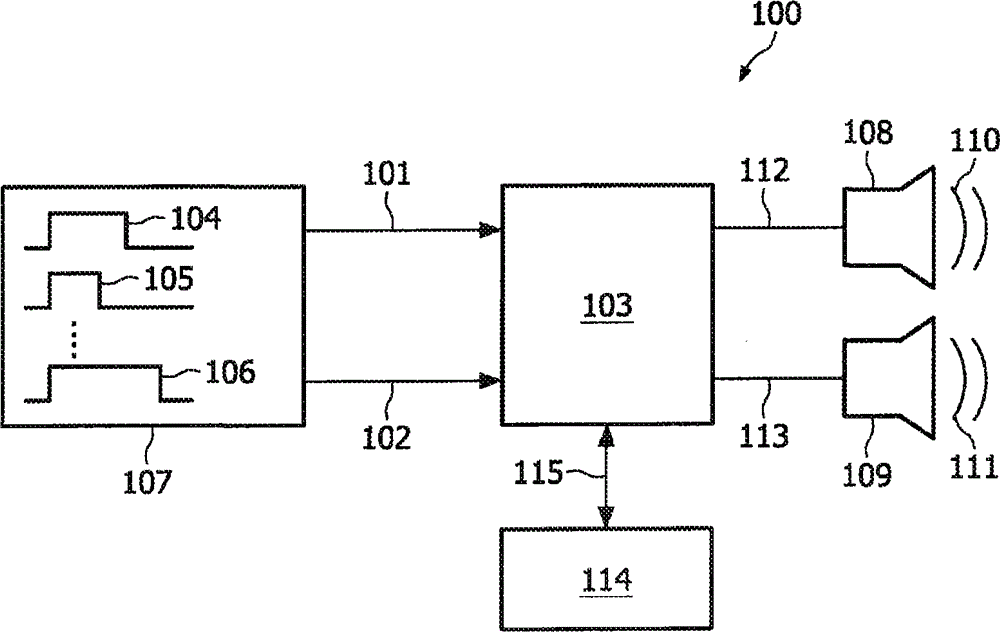
下面将参考实施例的实例更详细地描述本发明,本发明不限于实施例的实例图1图解了根据本发明示例性实施例的音频数据处理设备。The present invention will be described in more detail below with reference to examples of embodiments to which the present invention is not limited. FIG. 1 illustrates an audio data processing apparatus according to an exemplary embodiment of the present invention.
图2至图5图解了转换至和自转换模型,该模型通过基于本发明示例性实施例的转换模型的声音重现的参数操纵来实现。2 to 5 illustrate the transition to and from transition models implemented by parameter manipulation of sound reproduction based on the transition model of an exemplary embodiment of the present invention.
图6图解了作为扬声器收听者模型的特殊情形的通用头戴式耳机的几何描述。Figure 6 illustrates a geometric description of a generic headphone as a special case of a loudspeaker listener model.
图7图解了以两声道扬声器收听配置对收听者的模拟。Figure 7 illustrates a simulation of a listener in a two-channel loudspeaker listening configuration.
图8示出了表现从虚拟麦克风对移开的一个音频轨道的扬声器对,以及播放另一个轨道的新的扬声器对被移动到收听位置。Figure 8 shows a speaker pair representing one audio track removed from the virtual microphone pair, and a new speaker pair playing another track moved to the listening position.
图9图解了根据本发明示例性实施例的立体声扬声器收听中的轨道转换。FIG. 9 illustrates track switching in stereo speaker listening according to an exemplary embodiment of the present invention.
具体实施方式 Detailed ways
附图中的图解是示意性的。在不同的附图中,为类似或相同的元件提供相同的附图标记。The illustrations in the figures are schematic. In different figures, similar or identical elements are provided with the same reference signs.
在下文中,参考图1,将说明根据本发明一个示例性实施例的用于处理音频数据101、102的设备100。In the following, referring to Fig. 1, an
图1中所示的设备100包括诸如CD、硬盘等的音频数据源107。在音频数据源107上存储了多个音乐轨道,例如第一音频项目104、第二音频项目105和第三音频项目106(例如三个音乐片段)。The
一旦接收到相应的控制信号,音频数据101、102(例如用于扬声器左侧和右侧的数据)可从音频数据源107发送到诸如微处理器或中央处理单元(CPU)这样的控制单元103。
控制单元103与用户接口单元114双向通信,并且能够与用户接口单元114交换信号115。用户接口单元114包括诸如LCD显示器或等离子体设备这样的显示元件,并且包括诸如按钮、小键盘、操纵杆或者甚至话音识别系统的麦克风这样的输入元件。人类用户能够控制控制单元103的操作,并且因此可以调节设备100的用户偏好。例如,人类用户可以完全地对播放列表的项目进行切换。并且,控制单元103能够输出相应的重放或经处理的信息。The
在以下文将更详细地描述的方式处理音频数据101、102之后,第一经处理的音频数据112被应用于第一扬声器108以供重放,由此生成声波110,获得第二经处理的音频数据113,音频数据113可由连接的第二扬声器109再现,第二扬声器109能够生成声波111。After processing the
在第一音频项目104将被再现并且随后第二音频项目105将被再现的场景中,期望在在前的第一音频项目104和随后的第二音频项目105之间具有平滑或无缝的转换部分。出于这个目的,控制单元103可作为操纵单元,用于以修改第一音频项目104和第二音频项目105之间的转换部分的与时间有关的音频属性的方式操纵第一音频项目104和第二音频项目105之间的转换部分。更特别地,可以处理第一音频项目104的结尾部分和第二音频项目105的起始部分或开头部分。因此,可获得第一音频项目104滑出或淡出、第二音频项目105滑入或淡入的可听感知。出于这个目的,第一和第二音频项目104、105的时间属性仅在转换部分可被调整,而第一和第二音频项目104、105的中央部分可不加修改地被重放。这可包括修改音频数据101、102的频率和节奏值,使得滑出的第一音频项目104将根据声学多普勒效应得以操纵,从而人类收听者对经操纵的第一音频项目104的感知是音量和频率/节奏两者在结尾部分都被减小。In a scenario where a
因此,根据声学多普勒效应操纵第二音频项目105的起始部分,使得第二音频项目105的开头部分的感知的可听效果是增大的响度和增大的频率/节奏。通过采取这种措施,可获得非常直观的淡入特性。Thus, the beginning part of the
可同时或以重叠的方式重放第一音频项目104的经操纵的结尾部分和第二音频项目105的经操纵的开头部分。The manipulated end portion of the
协调或调整第一音频项目104的结尾部分和第二音频项目105的开头部分的时间特性的变化,以获得合适的声音。The changes in temporal characteristics of the end portion of the
特别地,控制单元103还可以生成这样的感知:在重放第一音频项目104的结尾部分的期间根据第一音频项目104的结尾部分发出声波的虚拟音频源离开了。更特别地,这样的运动实验(experiment)生成特征可生成重放第二音频项目105的开头部分的虚拟重放设备接近人类收听者的可听感知。In particular, the
图1的系统可被用作自动DJ系统。The system of Fig. 1 can be used as an automatic DJ system.
本发明的实施例基于这样的领悟(insight):任何空间转换效果都隐含地或明显地基于扬声器-收听者系统的模型。该模型可被用来控制由音频作品的原始音频信号的数字滤波实现的动态重现操作。在普通收听场景中,音频信号可通过再现系统的扬声器直接重放。根据一个示例性实施例,扬声器系统可以是从立体声耳机到诸如5.1环绕音频系统或波场合成系统(wave field synthesis system)这样的多声道扬声器系统范围内的任何配置。Embodiments of the invention are based on the insight that any spatial transformation effect is implicitly or explicitly based on a model of the speaker-listener system. The model can be used to control the dynamic reproduction operation achieved by digital filtering of the original audio signal of the audio work. In normal listening scenarios, the audio signal can be reproduced directly through the loudspeakers of the reproduction system. According to an exemplary embodiment, the speaker system may be any configuration ranging from stereo headphones to a multi-channel speaker system such as a 5.1 surround audio system or a wave field synthesis system.
根据一个示例性实施例,提供了一种用于从普通收听到在空间轨道转换效果中使用的重现模型的转换以及反转换回普通收听模式的通用方法。在这样的实施例中,可能的是,普通收听场景通常可以识别为在空间转换效果中使用的重现模型的特殊情形。因此,到和从转换模式的转换可以通过基于转换模型的声音重现的参数操纵来进行。这在图2至图5中得以解释并且将在下文中更详细地描述。According to an exemplary embodiment, there is provided a general method for converting from normal listening to a reproduction model used in a spatial orbital transition effect and back to normal listening mode. In such embodiments, it is possible that common listening scenarios can generally be identified as special cases of the reproduction model used in the spatial transformation effect. Thus, switching to and from switching modes can be performed by parameter manipulation of the sound reproduction based on the switching model. This is explained in Figures 2 to 5 and will be described in more detail below.
图2示出了方案200。FIG. 2 shows
方案200示出了音频作品201,它在普通收听202中的音频再现路径中被重放。音频再现系统用附图标记203表示,可被实现为头戴式耳机、立体声系统或5.1系统。The
另外,虚拟扬声器-收听者模型用附图标记204表示,并且包括代表普通收听的模型的特殊情形205、转换效果的音频再现路径206和转换效果的另一个音频再现路径207。In addition, the virtual speaker-listener model is denoted by
图3显示了方案300。在方案300中,还显示了第二音频作品301。FIG. 3 shows
从图3可以得出,在转换开始时,第一音频作品201通过代表转换模型的普通收听的模型的特殊情形205而被发送。从代表普通收听的模型的特殊情形205到转换效果的音频再现路径206的转换开始,并且它基于虚拟扬声器-收听者模型204的参数的参数操纵。第二音频作品301的动态转换重现可在这个阶段通过转换效果的另一个音频再现路径207开始。It can be drawn from Fig. 3 that at the beginning of the transition, the
图4随后示出了方案400。FIG. 4 then shows the
在连续的转换中,采用虚拟扬声器-收听者模型204重现第一音频作品201和第二音频作品301这两者以实现期望的动态空间转换效果。典型地,以第一音频作品201似乎远离收听者而第二音频作品301正在接近收听者的方式再现第一音频作品201。In successive transformations, both the
在图5中示出随后的方案500。A
参考图5,以其结束代表普通收听场景的等同模式的方式修改第二音频作品301的动态重现。换句话说,第二音频作品301从转换效果的音频再现路径207被移动到代表普通收听的模式的特殊情形205。最终,对于第二音频作品301,再现被从虚拟扬声器收听者重现场景的特殊模式转换到图2的普通音频再现场景。Referring to Fig. 5, the dynamic reproduction of the
根据本发明的一个示例性实施例,可以使用一种模型,在该模型中,使用虚拟的麦克风来捕获从虚拟扬声器播放的信号x(n),使得所捕获的信号由下式给出:According to an exemplary embodiment of the invention, a model can be used in which a virtual microphone is used to capture a signal x(n) played from a virtual speaker such that the captured signal is given by:
y(n)=x(n)*δ(dT)/d2和T=F/c,y(n)=x(n)*δ(dT)/ d2 and T=F/c,
其中星号表示卷积,d是虚拟扬声器和麦克风之间以米为单位的距离,其中F是采样频率,c是声音的速度。实际上,对应于分数时间指数(fractionaltime index)dT的信号值可使用诸如拉格朗日插值滤波器(Lagrangeinterpolator filter)这样的分数延迟滤波器来实现。where the asterisk indicates convolution, d is the distance in meters between the virtual speaker and the microphone, where F is the sampling frequency, and c is the speed of sound. In practice, the signal value corresponding to the fractional time index dT can be realized using a fractional delay filter such as a Lagrange interpolator filter.
图6示出了涉及作为扬声器-收听者模型的特殊情形的通用头戴式耳机收听的几何描述的排列610。Fig. 6 shows an
图6显示了用于再现音频内容的头戴式耳机600。还示出了左虚拟扬声器601和右虚拟扬声器602。进一步地,示出了左虚拟麦克风603和右虚拟麦克风604。无穷大的距离由附图标记605表示。Figure 6 shows a
基于前面的讨论,立体声声道之间的串音(crosstalk)或关联(correlation)被看作是同时发生的,使得几何声学意义上信号间的关联不被建模为从一个音频声道到另一个音频声道的泄漏。Based on the previous discussion, the crosstalk or correlation between stereo channels is considered to occur simultaneously, so that the correlation between signals in the geometric acoustic sense is not modeled as a signal from one audio channel to another. Leakage of one audio channel.
在本发明的一个实施例中的普通收听模式是头戴式耳机收听。图6中图示了作为提出的扬声器-收听者模型的特殊情形的根据排列610的这样的通用头戴式音频收听场景的几何描述。声音从左、右虚拟扬声器601、602播放,理论上左、右虚拟扬声器601、602彼此相离无穷远地放置。声音被放置在左、右虚拟扬声器601、602附近的左、右虚拟麦克风603、604捕获。捕获的信号然后通过头戴式耳机600向用户重放。来自原始左、右声道的立体声记录的合成在头戴式耳机收听中准确地产生了原始信号。该几何描述的无穷大的距离仅是建立没有两个信号间串音的模型的一个实施例,可以通过给予麦克风(或扬声器,或两者)减少或消除串音的方向性属性(directivity property)来获得相似的结果。The normal listening mode in one embodiment of the invention is headphone listening. A geometric description of such a generic head-mounted audio listening scenario according to an
根据一个示例性实施例,仅考虑了自由场(free field)中的全方向虚拟扬声器和麦克风。然而,本发明的实施例还包括方向性和声场模拟的使用。技术人员已知将更多的实际方向性属性和房间模型包括在声学模型中所需的措施。实际上,不需要或不可能在即使具有全方向换能器(trahsducer)的源之间具有无穷大的距离。自由声场条件下和对于全方向源的声音(单位为分贝)的衰减由下式给出:According to an exemplary embodiment, only omni-directional virtual speakers and microphones in a free field are considered. However, embodiments of the invention also include the use of directionality and sound field simulation. The skilled person knows the measures needed to include more realistic directional properties and room models in the acoustic model. In practice, it is not necessary or possible to have an infinite distance between sources even with omnidirectional transducers (trahsducers). The attenuation of sound (in decibels) under free-field conditions and for omnidirectional sources is given by:
LR=20log10(R)L R =20log 10 (R)
例如,20米的间隔已经给出了26dB的串音衰减,这对在典型的立体声音频材料中的空间图像具有可忽略的影响。这样的表现在感知上类似于原始立体声再现,并且也不立即提供直观的特殊轨道转换方法。然而,可以做出另一个变换,该变换将左、右虚拟扬声器601、602和左、右虚拟麦克风603、604的位置移动至图7中图示的另一个设置700,图7附加地显示了人类收听者的头701。For example, a separation of 20 meters already gives a crosstalk attenuation of 26dB, which has a negligible effect on the spatial image in typical stereo audio material. Such a representation is perceptually similar to the original stereo reproduction, and also does not immediately provide an intuitive method for special track transitions. However, another transformation can be made which moves the positions of the left and right
在图7中,左、右虚拟扬声器601、602被移动至典型的扬声器收听中左、右扬声器的位置。左、右虚拟麦克风603、604被移动至典型的收听情形下表示收听者耳朵位置的位置。In FIG. 7, the left and right
因此,图7示出了对在两声道的扬声器收听系统中收听者头701的模拟。Figure 7 thus shows a simulation of a listener's
在从图6场景到图7场景的转换中左虚拟扬声器601和左虚拟麦克风603之间的距离保持不变。因此,立体声音频再现的整个音量保持近似相同。然而,这对于当前的实施例不绝对必要。The distance between the left
图8示意性地显示了方案800,其包括将被重放的音频数据的第一音频项目104和第二音频项目105。Fig. 8 schematically shows a scheme 800 comprising a
表现第一音频项目104的左、右虚拟扬声器601、602对将被从左、右虚拟麦克风603、604转移走,与第二音频项目105有关的新扬声器801、802对被移向收听位置。The pair of left and right
在典型的应用中,从一个音频项目A跳到音频项目B可以进行如下步骤。该序列可从其中用户正在收听项目A的情形开始。In a typical application, jumping from an audio item A to an audio item B can proceed as follows. The sequence may begin with a situation where the user is listening to item A.
1.将项目B的扬声器装置放置到开始位置。该开始位置可以例如是在右侧远离用户耳朵的位置。1. Place the item B speaker unit to the starting position. The starting position may be, for example, a position on the right side away from the user's ear.
2.将项目A从头戴式耳机收听(图6)移动到扬声器收听(图7),并将虚拟扬声器放置于收听位置。2. Move item A from Headphone Listening (Figure 6) to Speaker Listening (Figure 7), and place the virtual speaker in the listening position.
3.将项目A移动到目标位置(例如左边远离用户耳朵的某处),并且同时将项目B从开始位置移动到收听位置。3. Move item A to a target location (eg somewhere to the left away from the user's ear), and at the same time move item B from the starting location to the listening location.
4.将表现项目B的扬声器从扬声器模拟移动到头戴式耳机模拟配置。4. Move the speaker representing item B from the speaker simulation to the headphone simulation configuration.
5.减弱项目A的声音。5. Reduce the sound of Item A.
类似的算法也可被用于在播放列表中快速地扫描或搜索音频项目。在这种情况下,音频项目序列从右边流向左边(或者反之亦然)以给予用户播放列表内容的概览(预览),或帮助识别特定项目。在这个特殊的应用中,发出头戴式耳机收听模拟是有用的,使得项目在扬声器重放配置中被重放。该选择提供了传递给收听者的音频项目的平滑流。在这种类型的场景中,播放列表也可以被表示为二维或三维图,在该图上用户自由地在左/右、前/后、上/下或它们的组合的方向上导航。Similar algorithms can also be used to quickly scan or search for audio items in playlists. In this case, the sequence of audio items flows from right to left (or vice versa) to give the user an overview (preview) of the content of the playlist, or to help identify specific items. In this particular application, it is useful to emit a headphone listening simulation so that the item is played back in a speaker playback configuration. This selection provides a smooth flow of the audio item delivered to the listener. In this type of scenario, the playlist can also be represented as a two-dimensional or three-dimensional graph on which the user freely navigates in directions of left/right, forward/backward, up/down, or combinations thereof.
类似的实施例也可以被直接应用于涉及不同音频流间转换的其他可能应用。例如,可以在改变无线电或TV频道、具有背景音频的因特网页面中应用所述类似实施例,可以在在个人计算机中从一个音频应用改变到另一个中应用所述类似实施例,等等。Similar embodiments can also be directly applied to other possible applications involving switching between different audio streams. For example, the similar embodiments can be applied in changing radio or TV channels, Internet pages with background audio, in changing from one audio application to another in a personal computer, etc.
类似的场景也可以被用来为仅涉及一个项目的转换创建新类型的效果。例如,当开始和停止音频项目的重放时,或在暂时减弱音频项目的声音时,可使用空间转换效果。Similar scenarios can also be used to create new types of effects for transitions involving only one item. For example, use the spatial transformation effect when starting and stopping playback of an audio item, or when temporarily muting the sound of an audio item.
另外,用于空间转换的相同机制还可以被用于各种不同的电话应用中以在不同通话者(talker)之间切换。Additionally, the same mechanism used for space translation can also be used in various telephony applications to switch between different talkers.
在另一个实施例中,再现系统可以是如图9中所示的立体声扬声器系统900。In another embodiment, the reproduction system may be a stereo speaker system 900 as shown in FIG. 9 .
图9显示了重放第二音频项目105的虚拟扬声器901、902和重放第二音频项目105的虚拟扬声器903、904。并且显示了左、右附加扬声器905、906。因此图9显示了在立体声扬声器收听中的轨道转换。通过使用本领域技术人员已知的3D音频重现技术处理供给左、右附加扬声器905、906的音频信号来创建虚拟扬声器901至904。FIG. 9 shows virtual speakers 901 , 902 playing back the
在图9的场景中,通过以使重现的虚拟扬声器的位置和方向属性与真实的扬声器一致的方式移动包含虚拟扬声器901至904的“泡(bubble)”,获得到其中直接通过左、右附加扬声器905、906播放信号的普通音频收听的转换。In the scene of Fig. 9, by moving the "bubble" containing the virtual speakers 901 to 904 in such a way that the position and orientation properties of the reproduced virtual speakers are consistent with the real speakers, the Additional speakers 905, 906 play a conversion of the signal for normal audio listening.
就处理而言,对于从通过虚拟扬声器收听者系统的第二音频项目105的重放到通过立体声装置的真实左、右附加扬声器905、906的重放的转换,可以给出以下描述。动态重现算法基于输入信号的线性数字滤波,其可由以下不同的方程式描述:In terms of processing, the following description can be given for the transition from playback of the
y(n)l=x(n)l*h(n,t)ll+x(n)r*h(n,t)rl y(n) l = x(n) l *h(n, t) ll + x(n) r *h(n, t) rl
y(n)r=x(n)l*h(n,t)rl+x(n)r*h(n,t)rr y(n) r = x(n) l *h(n,t) rl +x(n) r *h(n,t) rr
其中星号表示卷积,重现滤波器(rendering filter)由冲激响应表示。该重现模型的一个特殊情形是直接的左到左(ll)和右到右(rr)滤波器被减小至单位增益并且串音项(左到右(lr)和右到左(rl))消失。该特殊的情况与使用扬声器的普通收听相同。在动态重现中,转换因此能通过使用实施系数从原始重现滤波器到代表特殊情形的函数的平滑演变的动态转换路径从任何空间重现场景得以实现。Where the asterisk represents convolution, and the rendering filter is represented by an impulse response. A special case of this reproduction model is that the direct left-to-left (ll) and right-to-right (rr) filters are reduced to unity gain and the crosstalk terms (left-to-right (lr) and right-to-left (rl) )disappear. This special case is the same as normal listening using speakers. In dynamic reconstruction, transformation can thus be achieved from any spatial reconstruction scene using a dynamic transformation path that implements a smooth evolution of the coefficients from the original reconstruction filter to a function representing the special case.
应当注意术语“包括”不排除其他元件或特征,“一”或“一个”不排除多个。同样,联合不同实施例而描述的元件可被组合。It should be noted that the term "comprising" does not exclude other elements or features, and "a" or "an" does not exclude a plurality. Likewise, elements described in connection with different embodiments may be combined.
还应当注意在权利要求中的附图标记将不被解释为限制权利要求的范围。It should also be noted that reference signs in the claims shall not be construed as limiting the scope of the claims.
Claims (23)
Applications Claiming Priority (4)
| Application Number | Priority Date | Filing Date | Title |
|---|---|---|---|
| EP071086011 | 2007-05-22 | ||
| EP07108601 | 2007-05-22 | ||
| EP07108601.1 | 2007-05-22 | ||
| PCT/IB2008/051998 WO2008142651A1 (en) | 2007-05-22 | 2008-05-21 | A device for and a method of processing audio data |
Publications (2)
| Publication Number | Publication Date |
|---|---|
| CN101681663A CN101681663A (en) | 2010-03-24 |
| CN101681663B true CN101681663B (en) | 2013-10-16 |
Family
ID=39680996
Family Applications (1)
| Application Number | Title | Priority Date | Filing Date |
|---|---|---|---|
| CN2008800167962A Expired - Fee Related CN101681663B (en) | 2007-05-22 | 2008-05-21 | A device for and a method of processing audio data |
Country Status (6)
| Country | Link |
|---|---|
| US (1) | US20100215195A1 (en) |
| EP (1) | EP2153441A1 (en) |
| JP (1) | JP5702599B2 (en) |
| KR (1) | KR101512992B1 (en) |
| CN (1) | CN101681663B (en) |
| WO (1) | WO2008142651A1 (en) |
Families Citing this family (46)
| Publication number | Priority date | Publication date | Assignee | Title |
|---|---|---|---|---|
| US9318108B2 (en) | 2010-01-18 | 2016-04-19 | Apple Inc. | Intelligent automated assistant |
| TWM333022U (en) * | 2007-05-08 | 2008-05-21 | Hsin-Yuan Kuo | Surrounding-audio earphone |
| US8384916B2 (en) * | 2008-07-24 | 2013-02-26 | Massachusetts Institute Of Technology | Dynamic three-dimensional imaging of ear canals |
| US8676904B2 (en) | 2008-10-02 | 2014-03-18 | Apple Inc. | Electronic devices with voice command and contextual data processing capabilities |
| US10255566B2 (en) | 2011-06-03 | 2019-04-09 | Apple Inc. | Generating and processing task items that represent tasks to perform |
| US20120288122A1 (en) | 2010-01-15 | 2012-11-15 | Bang & Olufsen A/S | Method and a system for an acoustic curtain that reveals and closes a sound scene |
| US10276170B2 (en) | 2010-01-18 | 2019-04-30 | Apple Inc. | Intelligent automated assistant |
| JPWO2012002467A1 (en) * | 2010-06-29 | 2013-08-29 | 茂良 北澤 | Music information processing apparatus, method, program, music information processing system for cochlear implant, music information manufacturing method and medium for cochlear implant |
| US8963722B2 (en) * | 2010-10-14 | 2015-02-24 | Sony Corporation | Apparatus and method for playing and/or generating audio content for an audience |
| EP2659483B1 (en) * | 2010-12-30 | 2015-11-25 | Dolby International AB | Song transition effects for browsing |
| RU2595910C2 (en) | 2011-06-24 | 2016-08-27 | Конинклейке Филипс Н.В. | Audio signal processor for processing encoded multi-channel audio signals and method therefor |
| US20130290818A1 (en) * | 2012-04-27 | 2013-10-31 | Nokia Corporation | Method and apparatus for switching between presentations of two media items |
| US20130308800A1 (en) * | 2012-05-18 | 2013-11-21 | Todd Bacon | 3-D Audio Data Manipulation System and Method |
| CN113470641B (en) | 2013-02-07 | 2023-12-15 | 苹果公司 | Voice triggers for digital assistants |
| CN104035826A (en) * | 2013-03-07 | 2014-09-10 | 安凯(广州)微电子技术有限公司 | Method and device for eliminating software noises |
| US10652394B2 (en) | 2013-03-14 | 2020-05-12 | Apple Inc. | System and method for processing voicemail |
| US10748529B1 (en) | 2013-03-15 | 2020-08-18 | Apple Inc. | Voice activated device for use with a voice-based digital assistant |
| US10176167B2 (en) | 2013-06-09 | 2019-01-08 | Apple Inc. | System and method for inferring user intent from speech inputs |
| EP3020042B1 (en) | 2013-07-08 | 2018-03-21 | Dolby Laboratories Licensing Corporation | Processing of time-varying metadata for lossless resampling |
| US10791216B2 (en) | 2013-08-06 | 2020-09-29 | Apple Inc. | Auto-activating smart responses based on activities from remote devices |
| US9654076B2 (en) * | 2014-03-25 | 2017-05-16 | Apple Inc. | Metadata for ducking control |
| US10170123B2 (en) | 2014-05-30 | 2019-01-01 | Apple Inc. | Intelligent assistant for home automation |
| US9715875B2 (en) | 2014-05-30 | 2017-07-25 | Apple Inc. | Reducing the need for manual start/end-pointing and trigger phrases |
| CN106688253A (en) * | 2014-09-12 | 2017-05-17 | 杜比实验室特许公司 | Rendering audio objects in a reproduction environment that includes surround and/or height speakers |
| US9774974B2 (en) * | 2014-09-24 | 2017-09-26 | Electronics And Telecommunications Research Institute | Audio metadata providing apparatus and method, and multichannel audio data playback apparatus and method to support dynamic format conversion |
| US9886953B2 (en) | 2015-03-08 | 2018-02-06 | Apple Inc. | Virtual assistant activation |
| US20160378747A1 (en) | 2015-06-29 | 2016-12-29 | Apple Inc. | Virtual assistant for media playback |
| US10747498B2 (en) | 2015-09-08 | 2020-08-18 | Apple Inc. | Zero latency digital assistant |
| US10671428B2 (en) | 2015-09-08 | 2020-06-02 | Apple Inc. | Distributed personal assistant |
| US10691473B2 (en) | 2015-11-06 | 2020-06-23 | Apple Inc. | Intelligent automated assistant in a messaging environment |
| WO2017114650A1 (en) * | 2015-12-28 | 2017-07-06 | Zound Industries International Ab | Multi-function control of one or several multimedia playback devices |
| US10586535B2 (en) | 2016-06-10 | 2020-03-10 | Apple Inc. | Intelligent digital assistant in a multi-tasking environment |
| DK201670540A1 (en) | 2016-06-11 | 2018-01-08 | Apple Inc | Application integration with a digital assistant |
| DK3280159T3 (en) * | 2016-08-03 | 2019-09-23 | Oticon As | BINAURAL HEARING DEVICE |
| CN108076415B (en) * | 2016-11-16 | 2020-06-30 | 南京大学 | A Real-time Implementation Method of Doppler Sound Effects |
| US10726832B2 (en) | 2017-05-11 | 2020-07-28 | Apple Inc. | Maintaining privacy of personal information |
| DK179745B1 (en) | 2017-05-12 | 2019-05-01 | Apple Inc. | SYNCHRONIZATION AND TASK DELEGATION OF A DIGITAL ASSISTANT |
| DK201770429A1 (en) | 2017-05-12 | 2018-12-14 | Apple Inc. | Low-latency intelligent automated assistant |
| US10818288B2 (en) | 2018-03-26 | 2020-10-27 | Apple Inc. | Natural assistant interaction |
| US11145294B2 (en) | 2018-05-07 | 2021-10-12 | Apple Inc. | Intelligent automated assistant for delivering content from user experiences |
| US10928918B2 (en) | 2018-05-07 | 2021-02-23 | Apple Inc. | Raise to speak |
| US10892996B2 (en) | 2018-06-01 | 2021-01-12 | Apple Inc. | Variable latency device coordination |
| DK179822B1 (en) | 2018-06-01 | 2019-07-12 | Apple Inc. | Voice interaction at a primary device to access call functionality of a companion device |
| CN109714697A (en) * | 2018-08-06 | 2019-05-03 | 上海头趣科技有限公司 | The emulation mode and analogue system of three-dimensional sound field Doppler's audio |
| DK201970511A1 (en) | 2019-05-31 | 2021-02-15 | Apple Inc | Voice identification in digital assistant systems |
| CN116206616B (en) * | 2022-12-30 | 2026-07-03 | 沈阳雅译网络技术有限公司 | Speech translation and speech recognition method based on sequence dynamic compression |
Citations (4)
| Publication number | Priority date | Publication date | Assignee | Title |
|---|---|---|---|---|
| EP1162621A1 (en) * | 2000-05-11 | 2001-12-12 | Hewlett-Packard Company, A Delaware Corporation | Automatic compilation of songs |
| EP1511351A2 (en) * | 2003-08-25 | 2005-03-02 | Magix Ag | System and method for generating sound transitions in a surround environment |
| CN1694579A (en) * | 2004-05-07 | 2005-11-09 | 雅马哈株式会社 | Signal level adjustment apparatus and control method for the adjustment apparatus |
| CN1879450A (en) * | 2003-11-12 | 2006-12-13 | 莱克技术有限公司 | Audio signal processing system and method |
Family Cites Families (14)
| Publication number | Priority date | Publication date | Assignee | Title |
|---|---|---|---|---|
| US5337363A (en) * | 1992-11-02 | 1994-08-09 | The 3Do Company | Method for generating three dimensional sound |
| US5521981A (en) * | 1994-01-06 | 1996-05-28 | Gehring; Louis S. | Sound positioner |
| JPH07230283A (en) * | 1994-02-18 | 1995-08-29 | Roland Corp | Sound image localization device |
| JP3464290B2 (en) * | 1994-10-13 | 2003-11-05 | ローランド株式会社 | Automatic performance device |
| JP3472643B2 (en) * | 1995-04-14 | 2003-12-02 | ローランド株式会社 | Interpolator |
| US6011851A (en) * | 1997-06-23 | 2000-01-04 | Cisco Technology, Inc. | Spatial audio processing method and apparatus for context switching between telephony applications |
| GB2378626B (en) * | 2001-04-28 | 2003-11-19 | Hewlett Packard Co | Automated compilation of music |
| JP4646099B2 (en) * | 2001-09-28 | 2011-03-09 | パイオニア株式会社 | Audio information reproducing apparatus and audio information reproducing system |
| JP3799360B2 (en) * | 2004-04-19 | 2006-07-19 | 株式会社ソニー・コンピュータエンタテインメント | Music sound reproducing device, music sound reproducing method, music sound reproducing program, and recording medium |
| US20050259532A1 (en) * | 2004-05-13 | 2005-11-24 | Numark Industries, Llc. | All-in-one disc jockey media player with fixed storage drive and mixer |
| JP4397330B2 (en) * | 2005-01-24 | 2010-01-13 | ヤマハ株式会社 | Music playback device and music playback program |
| WO2006104162A1 (en) * | 2005-03-28 | 2006-10-05 | Pioneer Corporation | Musical composition data adjuster |
| JPWO2007066813A1 (en) * | 2005-12-09 | 2009-05-21 | ソニー株式会社 | Music editing apparatus, music editing information creation method, and recording medium on which music editing information is recorded |
| US8280539B2 (en) * | 2007-04-06 | 2012-10-02 | The Echo Nest Corporation | Method and apparatus for automatically segueing between audio tracks |
-
2008
- 2008-05-21 CN CN2008800167962A patent/CN101681663B/en not_active Expired - Fee Related
- 2008-05-21 US US12/600,041 patent/US20100215195A1/en not_active Abandoned
- 2008-05-21 WO PCT/IB2008/051998 patent/WO2008142651A1/en not_active Ceased
- 2008-05-21 KR KR1020097026429A patent/KR101512992B1/en not_active Expired - Fee Related
- 2008-05-21 EP EP08751276A patent/EP2153441A1/en not_active Withdrawn
- 2008-05-21 JP JP2010508954A patent/JP5702599B2/en not_active Expired - Fee Related
Patent Citations (4)
| Publication number | Priority date | Publication date | Assignee | Title |
|---|---|---|---|---|
| EP1162621A1 (en) * | 2000-05-11 | 2001-12-12 | Hewlett-Packard Company, A Delaware Corporation | Automatic compilation of songs |
| EP1511351A2 (en) * | 2003-08-25 | 2005-03-02 | Magix Ag | System and method for generating sound transitions in a surround environment |
| CN1879450A (en) * | 2003-11-12 | 2006-12-13 | 莱克技术有限公司 | Audio signal processing system and method |
| CN1694579A (en) * | 2004-05-07 | 2005-11-09 | 雅马哈株式会社 | Signal level adjustment apparatus and control method for the adjustment apparatus |
Also Published As
| Publication number | Publication date |
|---|---|
| JP2010528335A (en) | 2010-08-19 |
| CN101681663A (en) | 2010-03-24 |
| EP2153441A1 (en) | 2010-02-17 |
| KR101512992B1 (en) | 2015-04-17 |
| KR20100017860A (en) | 2010-02-16 |
| US20100215195A1 (en) | 2010-08-26 |
| JP5702599B2 (en) | 2015-04-15 |
| WO2008142651A1 (en) | 2008-11-27 |
Similar Documents
| Publication | Publication Date | Title |
|---|---|---|
| JP5702599B2 (en) | Device and method for processing audio data | |
| Emmerson et al. | Electro-acoustic music | |
| CN1419796B (en) | Audio-video positioning processing device and audio-video positioning processing method | |
| JP5467105B2 (en) | Apparatus and method for generating an audio output signal using object-based metadata | |
| JP5956994B2 (en) | Spatial audio encoding and playback of diffuse sound | |
| CN105210387B (en) | System and method for providing three-dimensional enhancing audio | |
| CN108476367B (en) | Synthesis of signals for immersive audio playback | |
| JP5688030B2 (en) | Method and apparatus for encoding and optimal reproduction of a three-dimensional sound field | |
| JP5050721B2 (en) | Information processing apparatus, information processing method, and program | |
| CN105323702B (en) | Audio mixing method and system | |
| KR101381396B1 (en) | Multiple viewer video and 3d stereophonic sound player system including stereophonic sound controller and method thereof | |
| JPS63183495A (en) | Sound field controller | |
| JP2001503942A (en) | Multi-channel audio emphasis system for use in recording and playback and method of providing the same | |
| WO2022248729A1 (en) | Stereophonic audio rearrangement based on decomposed tracks | |
| JP7503257B2 (en) | Content collection and distribution system | |
| JPH0415693A (en) | Sound source information controller | |
| Baxter | Immersive sound production using ambisonics and advance audio practices | |
| JP2006287878A (en) | Mobile phone terminal | |
| JPH09163500A (en) | Binaural audio signal generation method and binaural audio signal generation device | |
| JP2005250199A (en) | Audio equipment | |
| Malyshev | Sound production for 360 videos: in a live music performance case study | |
| CN1244094A (en) | Three-dimensional sound effect processing system and method | |
| Brandenburg et al. | Audio Codecs: Listening pleasure from the digital world | |
| CN116887122A (en) | Mixing device and mixing method based on intelligent system | |
| RS20210527A1 (en) | SYSTEM FOR INTELLIGENT 3D SOUND PROCESSING |
Legal Events
| Date | Code | Title | Description |
|---|---|---|---|
| C06 | Publication | ||
| PB01 | Publication | ||
| C10 | Entry into substantive examination | ||
| SE01 | Entry into force of request for substantive examination | ||
| C14 | Grant of patent or utility model | ||
| GR01 | Patent grant | ||
| CF01 | Termination of patent right due to non-payment of annual fee | ||
| CF01 | Termination of patent right due to non-payment of annual fee |
Granted publication date: 20131016 Termination date: 20170521 |