BR112014028362B1 - Fluorine substituted (3r, 4r, 5s)-5-guanidino-4-acetamido-3-(pentan-3-yloxy)cyclohexene-1-carboxylic acids, their esters, pharmaceutical composition and use thereof - Google Patents
Fluorine substituted (3r, 4r, 5s)-5-guanidino-4-acetamido-3-(pentan-3-yloxy)cyclohexene-1-carboxylic acids, their esters, pharmaceutical composition and use thereof Download PDFInfo
- Publication number
- BR112014028362B1 BR112014028362B1 BR112014028362-1A BR112014028362A BR112014028362B1 BR 112014028362 B1 BR112014028362 B1 BR 112014028362B1 BR 112014028362 A BR112014028362 A BR 112014028362A BR 112014028362 B1 BR112014028362 B1 BR 112014028362B1
- Authority
- BR
- Brazil
- Prior art keywords
- cyclohexene
- pentan
- yloxy
- guanidino
- pharmaceutical composition
- Prior art date
Links
Classifications
-
- C—CHEMISTRY; METALLURGY
- C07—ORGANIC CHEMISTRY
- C07C—ACYCLIC OR CARBOCYCLIC COMPOUNDS
- C07C279/00—Derivatives of guanidine, i.e. compounds containing the group, the singly-bound nitrogen atoms not being part of nitro or nitroso groups
- C07C279/16—Derivatives of guanidine, i.e. compounds containing the group, the singly-bound nitrogen atoms not being part of nitro or nitroso groups having nitrogen atoms of guanidine groups bound to carbon atoms of rings other than six-membered aromatic rings
-
- A—HUMAN NECESSITIES
- A61—MEDICAL OR VETERINARY SCIENCE; HYGIENE
- A61P—SPECIFIC THERAPEUTIC ACTIVITY OF CHEMICAL COMPOUNDS OR MEDICINAL PREPARATIONS
- A61P11/00—Drugs for disorders of the respiratory system
-
- A—HUMAN NECESSITIES
- A61—MEDICAL OR VETERINARY SCIENCE; HYGIENE
- A61P—SPECIFIC THERAPEUTIC ACTIVITY OF CHEMICAL COMPOUNDS OR MEDICINAL PREPARATIONS
- A61P31/00—Antiinfectives, i.e. antibiotics, antiseptics, chemotherapeutics
- A61P31/12—Antivirals
- A61P31/14—Antivirals for RNA viruses
- A61P31/16—Antivirals for RNA viruses for influenza or rhinoviruses
-
- A—HUMAN NECESSITIES
- A61—MEDICAL OR VETERINARY SCIENCE; HYGIENE
- A61P—SPECIFIC THERAPEUTIC ACTIVITY OF CHEMICAL COMPOUNDS OR MEDICINAL PREPARATIONS
- A61P43/00—Drugs for specific purposes, not provided for in groups A61P1/00-A61P41/00
-
- C—CHEMISTRY; METALLURGY
- C07—ORGANIC CHEMISTRY
- C07C—ACYCLIC OR CARBOCYCLIC COMPOUNDS
- C07C2601/00—Systems containing only non-condensed rings
- C07C2601/12—Systems containing only non-condensed rings with a six-membered ring
- C07C2601/16—Systems containing only non-condensed rings with a six-membered ring the ring being unsaturated
Landscapes
- Health & Medical Sciences (AREA)
- Organic Chemistry (AREA)
- Chemical & Material Sciences (AREA)
- Life Sciences & Earth Sciences (AREA)
- General Chemical & Material Sciences (AREA)
- Public Health (AREA)
- Medicinal Chemistry (AREA)
- Nuclear Medicine, Radiotherapy & Molecular Imaging (AREA)
- Chemical Kinetics & Catalysis (AREA)
- Pharmacology & Pharmacy (AREA)
- Virology (AREA)
- Animal Behavior & Ethology (AREA)
- General Health & Medical Sciences (AREA)
- Veterinary Medicine (AREA)
- Engineering & Computer Science (AREA)
- Pulmonology (AREA)
- Bioinformatics & Cheminformatics (AREA)
- Molecular Biology (AREA)
- Communicable Diseases (AREA)
- Oncology (AREA)
- Acyclic And Carbocyclic Compounds In Medicinal Compositions (AREA)
- Pharmaceuticals Containing Other Organic And Inorganic Compounds (AREA)
- Organic Low-Molecular-Weight Compounds And Preparation Thereof (AREA)
Abstract
ácidos (3r, 4r, 5s)-5-guanidino-4-acetamido-3-(pentan-3- iloxi)cicloexeno-1-carboxílicos flúor substituídos, os seus ésteres, componente ativo, composição farmacêutica, método e uso dos mesmos. a presente invenção se refere a nova atividade de inibidores de neuraminidase e ao uso dos mesmos para a profilaxia e o tratamento de infecções por influenza, ou seja, a ácidos 4-acetamido-5-guan idino-3-(pentan-3- iloxi)ciclohexeno-1-carboxílico fluoro substituídos, os seus ésteres de fórmula geral 1, os sais e/ou os hidratos farmaceuticamente aceitáveis dos mesmos, em que r representa hidrogênio, alquila c1-c5, alqu enila c2-c5 ou alquinila c2-c5 opcionalmente substituída; rf representa ch2f ou chf2. são propostos uma composição farmacêutica, um método para a sua preparação, assim como método para a profilaxia e o tratamento de doenças virais.fluor-substituted (3r, 4r, 5s)-5-guanidino-4-acetamido-3-(pentan-3-yloxy)cyclohexene-1-carboxylic acids, their esters, active ingredient, pharmaceutical composition, method and use thereof. the present invention relates to the novel activity of neuraminidase inhibitors and their use for the prophylaxis and treatment of influenza infections, namely, 4-acetamido-5-guanidine-3-(pentan-3-yloxy acids) )fluoro substituted cyclohexene-1-carboxylic acid, their esters of formula 1, the pharmaceutically acceptable salts and/or hydrates thereof, wherein r is hydrogen, c1-c5 alkyl, c2-c5 alkenyl or c2-c5 alkynyl optionally substituted; rf represents ch2f or chf2. a pharmaceutical composition, a method for its preparation, as well as a method for the prophylaxis and treatment of viral diseases are proposed.
Description
[001]A presente invenção se refere a novos compostos - ácidos (3R, 4R, 5S)-5-guanidino-4-acetamido-3-(pentan-3-iloxi)cicloexeno-1-carboxílicos flúorsubstituídos e os seus ésteres inibidores de atividade de neuraminidase.[001]The present invention relates to new compounds - fluorsubstituted (3R, 4R, 5S)-5-guanidino-4-acetamido-3-(pentan-3-yloxy)cyclohexene-1-carboxylic acids and their inhibitory esters neuraminidase activity.
[002]Muitos micro-organismos que compreendem neuraminidase são patogênicos a seres humanos e animais tais como frango, cavalos, porcos e focas. Os referidos micro-organismos patogênicos incluem o vírus da influenza. Neuraminidase está associada com a patogenicidade do vírus da influenza.[002]Many microorganisms that comprise neuraminidase are pathogenic to humans and animals such as chicken, horses, pigs and seals. Said pathogenic microorganisms include the influenza virus. Neuraminidase is associated with the pathogenicity of the influenza virus.
[003]Em relação a isso novos ácidos (3R, 4R, 5S)-5-guanidino-4-acetamido- 3-(pentan-3-iloxi)cicloexeno-1-carboxílicos flúor substituídos e os seus ésteres são de grande preocupação como substâncias de fármaco para medicamentos pretendidos para a profilaxia e o tratamento da influenza. Os inibidores de neuraminidase conhecidos são os ácidos (3R, 4R, 5S)-4-acetamido-5-amino-3- alquiloxi- cicloexeno-1-carboxílicos A1, dos referidos, o mais ativo dos mesmos é o ácido (3R, 4R, 5S)-4-acetamido-5-amino-3-(pentan-3-iloxi)cicloexeno-1-carboxílico A2, o qual, como foi mostrado por dados de difração de raio X por seu complexo com neuraminidase do vírus da influenza, é efetivamente ligado ao o centro ativo da enzima (Oseltamivir Carboxilato) [C. U. Kim, W. Lew, M. A. Williams, et al. J. Am. Chem. Soc. 1997, 119, 681 - 690.].[003] In this regard, new fluorine substituted (3R, 4R, 5S)-5-guanidino-4-acetamido-3-(pentan-3-yloxy)cyclohexene-1-carboxylic acids and esters are of great concern as drug substances for medicaments intended for the prophylaxis and treatment of influenza. Known neuraminidase inhibitors are (3R, 4R, 5S)-4-acetamido-5-amino-3-alkyloxy-cyclohexene-1-carboxylic acids A1, of the aforementioned, the most active of which is (3R, 4R , 5S)-4-acetamido-5-amino-3-(pentan-3-yloxy)cyclohexene-1-carboxylic acid A2, which, as shown by X-ray diffraction data by its complex with influenza virus neuraminidase , is effectively linked to the active site of the enzyme (Oseltamivir Carboxylate) [C. U. Kim, W. Lew, M. A. Williams, et al. J. Am. Chem. social 1997, 119, 681 - 690.].
[004]Éster etílico do ácido Oseltamivir carboxílico A3, conhecido como Oseltamivir Fosfato ou Tamiflu (Oseltamivir Fosfato, Tamiflu) [J. C. Rohloff, K. M. Kent, M. J. Postich, et al. J. Org. Chem. 1998, 63, 4545.], é um precursor medicinal do Oseltamivir carboxilato A2.[004]Oseltamivir carboxylic acid A3 ethyl ester, known as Oseltamivir Phosphate or Tamiflu (Oseltamivir Phosphate, Tamiflu) [J. C. Rohloff, K.M. Kent, M.J. Postich, et al. J. Org. Chem. 1998, 63, 4545.], is a medicinal precursor of Oseltamivir carboxylate A2.
[005]É também conhecido o ácido (3R, 4R, 5S)-5-guanidino-4- trifluoroacetamido-3-(pentan-3-iloxi)cicloexeno-1-carboxílico A4, que exibe atividade em direção de neuraminidase do vírus da influenza H5N1 [Q.-S. Du, R.-B. Huang, Y.-T. Wei, Z.-W. Pa, L.-Q. Du, K.-C. Chou. Fragment-Based Quantitative Structure- Activiti Relationship (FB-QSAR) for Fragment-Based Drug Design. J. Comput. Chem. 2008, 30(2), 295-304].[005](3R, 4R, 5S)-5-guanidino-4-trifluoroacetamido-3-(pentan-3-yloxy)cyclohexene-1-carboxylic acid A4 is also known, which exhibits activity towards neuraminidase of the virus. H5N1 influenza [Q.-S. Du, R.-B. Huang, Y.-T. Wei, Z.-W. Pa, L.-Q. Du, K.-C. Chou. Fragment-Based Quantitative Structure-Activiti Relationship (FB-QSAR) for Fragment-Based Drug Design. J. Comput. Chem. 2008, 30(2), 295-304].
[006]O ácido (2R, 3R, 4S)-3-Acetamido-4-guanidino-2-((1R, 2R)-1,2,3- trihidroxipropil)-3,4-dihidro-2if-piran-6-carboxílico (zanamivir) é conhecido por ser ativo contra neuraminidases dos vírus da influenza A e B, e também neuraminidase do vírus da influenza H1N1 [J. M. Woods, R. C. Betell, J. A. Coatos, et al. O ácido 4- Guanidino-2,4-dideoxi-2,3-dehidro-N-acetilneurâmico é um inibidor altamente eficaz não só da sialidase (neuraminidase) mas também do desenvolvimento de uma grande gama do vírus de influenza A e B em vitro. Antimicrob Agentes Chemoutro. 1993, 377, 1473 - 1479].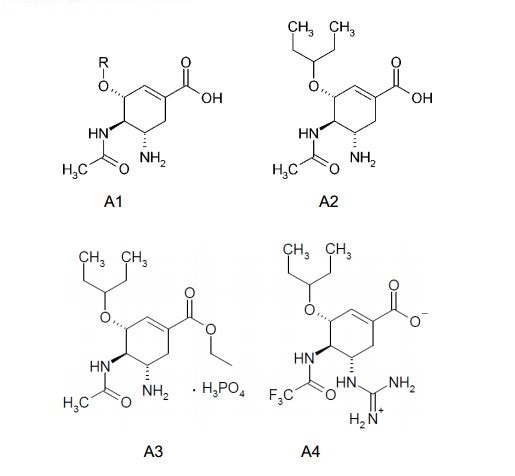
[007]Pesquisando por medicamentos altamente eficazes anti-influenza, dentre outras coisas que exibem maior atividade em direção do vírus resistentes da influenza, ainda permanece uma das maiores tendências no desenvolvimento de novos remédios farmacológicos para o tratamento da influenza. Nesse contexto, a configuração de novos ingredientes, composições farmacêuticas e medicamentos anti-influenza, assim como métodos para a preparação dos mesmos e o seu uso é de atual interesse.[007] Searching for highly effective anti-influenza drugs, among other things that exhibit greater activity towards resistant influenza viruses, still remains one of the biggest trends in the development of new pharmacological drugs for the treatment of influenza. In this context, the configuration of new ingredients, pharmaceutical compositions and anti-influenza drugs, as well as methods for their preparation and their use is of current interest.
[008]No contexto da presente invenção, os termos são em geral definidos como a seguir:[008] In the context of the present invention, the terms are generally defined as follows:
[009]"Alquenila" quer dizer uma cadeia de hidrocarboneto retilínea ou ramificada alifática, que compreendem 2-7 átomos de carbono e incluindo pelo menos uma ligação dupla carbono-carbono. Ramificado quer dizer que uma cadeia retilínea alquenila contém um ou mais grupos alquila inferiores, tais como metila, etila ou propila. Grupo alquila pode ter um ou mais substituintes, por exemplo, halogênio, alqueniloxi, cicloalquila, ciano, hidroxi, alcoxi, carboxi, alquiniloxi, aralcoxi, ariloxi, ariloxicarbonila, alquiltio, heteroaralquiloxi, heterociclila, heterociclilalquiloxi, alcoxicarbonila, aralcoxicarbonila, heteroaralquiloxicarbonila ou RkaRk+1aN-, RkaRk+1aNC(=0)-, RkaRk+1aNSO2-, onde Rka e Rk+1a independentemente um do outro representa "substituinte de grupo amino" os significados dos quais são definidos na presente seção, tais como hidrogênio, alquila, arila, aralquila, heteroaralquila, heterociclila ou heteroarila, ou Rka e Rk+1a juntos com o átomo de nitrogênio os mesmos são fixados para formar através de Rka e Rk+1a heterociclila ou heterociclenila de 4-7 membros. Os grupos alquila preferidos são metila, trifluorometila, ciclopropilmetila, ciclopentilmetila, etila, n-propila, iso-propila, n-butila, terc-butila, n-pentila, 3-pentila, metoxietila, carboximetila, metoxicarbonilmetila, benziloxicarbonilmetila e piridilmetiloxicarbonilmetila. Os grupos alquenila preferidos são etenila, propenila, n-butenila, iso-butenila, 3-metilbut-2-enila, n-pentenila e cicloexilbutenila.[009]"Alkenyl" means a straight or branched aliphatic hydrocarbon chain, comprising 2-7 carbon atoms and including at least one carbon-carbon double bond. Branched means that a straight alkenyl chain contains one or more lower alkyl groups, such as methyl, ethyl or propyl. Alkyl group may have one or more substituents, for example halogen, alkenyloxy, cycloalkyl, cyano, hydroxy, alkoxy, carboxy, alkynyloxy, aralkoxy, aryloxy, aryloxycarbonyl, alkylthio, heteroaralkyloxy, heterocyclyl, heterocyclylalkyloxy, alkoxycarbonyl, aralkoxycarbonyl, heteroaralkyloxycarbonyl or RkaRk+ 1aN-, RkaRk+1aNC(=0)-, RkaRk+1aNSO2-, where Rka and Rk+1a independently of one another represent "amino group substituent" the meanings of which are defined in this section, such as hydrogen, alkyl, aryl, aralkyl, heteroaralkyl, heterocyclyl or heteroaryl, or Rka and Rk+1a together with the nitrogen atom themselves are fixed to form through Rka and Rk+1a 4-7 membered heterocyclyl or heterocyclenyl. Preferred alkyl groups are methyl, trifluoromethyl, cyclopropylmethyl, cyclopentylmethyl, ethyl, n-propyl, iso-propyl, n-butyl, tert-butyl, n-pentyl, 3-pentyl, methoxyethyl, carboxymethyl, methoxycarbonylmethyl, benzyloxycarbonylmethyl and pyridylmethyloxycarbonylmethyl. Preferred alkenyl groups are ethenyl, propenyl, n-butenyl, iso-butenyl, 3-methylbut-2-enyl, n-pentenyl and cyclohexylbutenyl.
[010]"Alquila" quer dizer uma cadeia de hidrocarboneto alifática retilínea ou ramificada com 1-12 átomos de carbono. Ramificado quer dizer a cadeia alquila com pelo menos um ou mais substituintes de "alquila inferior". Grupo alquila pode ter um ou mais substituintes de mesma estrutura ou estrutura diferente ("substituinte alquila") incluindo halogênio, alqueniloxi, cicloalquila, arila, heteroarila, heterociclila, aroila, ciano, hidroxi, alcoxi, carboxi, alquiniloxi, aralcoxi, ariloxi, ariloxicarbonila, alquiltio, heteroariltio, aralquiltio, arilsulfonila, alquilsulfonilheteroaralquiloxi, heteroarilcicloalquenila anelada, heteroarilcicloalquila anelada, heteroarilheterociclenila anelada, heteroarilheterociclila anelada, arilcicloalquenila anelada, arilcicloalquila anelada, arilheterociclenila anelada, arilheterociclila anelada, alcoxicarbonila, aralcoxicarbonila, heteroaralquiloxicarbonila ou RkaRk+1aN-, RkaRk+1aNC(=0)-, RkaRk+1aNC(=S)-, RkaRk+1aNSO2-, onde Rka e Rk+1a independentemente um do outro representa "substituinte de grupo amino" os significados dos quais são definidos na presente seção, por exemplo, hidrogênio, alquila, arila, aralquila, heteroaralquila, heterociclila ou heteroarila, ou Rka e Rk+1a juntos com o N-átomo, os mesmos são fixados para formar através de Rka e Rk+1a heterociclila ou heterociclenila de 4-7 membros. Os grupos alquila preferidos são metila, trifluorometila, ciclopropilmetila, ciclopentilmetila, etila, n-propila, iso-propila, n-butila, terc-butila, n-pentila, 3-pentila, metoxietila, carboximetila, metoxicarbonilmetila, etoxicarbonilmetila, benziloxicarbonilmetila e piridilmetiloxicarbonilmetila. Os "alquila substituintes" preferidos são cicloalquila, arila, heteroarila, heterociclila, hidroxi, alcoxi, alcoxicarbonila, aralcoxi, ariloxi, alquiltio, heteroariltio, aralquiltio, alquilsulfonila, arilsulfonila, alcoxicarbonila, aralcoxicarbonila, heteroaralquiloxicarbonila ou RkaRk+1aN-, RkaRk+1aNC(=O)-, arilheterociclenila anelada e arilheterociclila anelada.[010]"Alkyl" means a straight or branched aliphatic hydrocarbon chain having 1-12 carbon atoms. Branched means the alkyl chain with at least one or more "lower alkyl" substituents. Alkyl group may have one or more substituents of the same or different structure ("alkyl substituent") including halogen, alkenyloxy, cycloalkyl, aryl, heteroaryl, heterocyclyl, aroyl, cyano, hydroxy, alkoxy, carboxy, alkynyloxy, aralkoxy, aryloxy, aryloxycarbonyl alkylthio, heteroarylthio, aralkylthio, arilsulfonila, alquilsulfonilheteroaralquiloxi, heteroarilcicloalquenila annular, annulated heteroarilcicloalquila, heteroarilheterociclenila annular, annulated heteroarilheterociclila, arilcicloalquenila annular, annulated arilcicloalquila, arilheterociclenila annular, annulated arilheterociclila, alkoxycarbonyl, aralcoxicarbonila, heteroaralquiloxicarbonila or RkaRk + 1aN-, RkaRk + 1aNC ( =0)-, RkaRk+1aNC(=S)-, RkaRk+1aNSO2-, where Rka and Rk+1a independently of one another represent "amino group substituent" the meanings of which are defined in this section, for example, hydrogen , alkyl, aryl, aralkyl, heteroaralkyl, heterocyclyl or heteroaryl, or Rka and Rk+1a together with the N-atom, they are fixed to form through Rka and Rk+1a 4-7 membered heterocyclyl or heterocyclenyl. Preferred alkyl groups are methyl, trifluoromethyl, cyclopropylmethyl, cyclopentylmethyl, ethyl, n-propyl, iso-propyl, n-butyl, tert-butyl, n-pentyl, 3-pentyl, methoxyethyl, carboxymethyl, methoxycarbonylmethyl, ethoxycarbonylmethyl, benzyloxycarbonylmethyl and pyridylmethyloxycarbonylmethyl . Preferred "alkyl substituents" are cycloalkyl, aryl, heteroaryl, heterocyclyl, hydroxy, alkoxy, alkoxycarbonyl, aralkoxy, aryloxy, alkylthio, heteroarylthio, aralkylthio, alkylsulfonyl, arylsulfonyl, alkoxycarbonyl, aralkoxycarbonyl, heteroaralkyloxycarbonyl or RkaRk+1aN-, RkaRk+1aNC( =O)-, ringed arylheterocyclyl and ringed arylheterocyclyl.
[011]"Alquinila" quer dizer uma cadeia de hidrocarboneto alifática retilínea ou ramificada com 2-12 átomos de carbono e incluindo pelo menos uma ligação tripla carbono-carbono. Ramificado quer dizer que cadeia retilínea de alquinila contém pelo menos um ou mais grupos alquila inferiores, tais como metila, etila ou propila. Grupo alquila pode ter um ou mais substituintes, por exemplo, halogênio, alqueniloxi, cicloalquila, ciano, hidroxi, alcoxi, alquiniloxi, aralcoxi, ariloxi, ariloxicarbonila, alquiltio, heteroaralquiloxi, heterociclila, heterociclilalquiloxi, alcoxicarbonila, aralcoxicarbonila, heteroaralquiloxicarbonila ou RkaRk+1aN-, RkaRk+1aNC(=O)-, RkaRk+1aNSO2-, onde Rka e Rk+1a independentemente um do outro representa "amino grupo substituintes", os significados dos quais são definidos na presente seção, tais como hidrogênio, alquila, arila, aralquila, heteroaralquila, heterociclila ou heteroarila, ou Rka e Rk+1a juntos com o N-átomo os mesmos são fixados para formar através de Rka e Rk+1a heterociclila ou heterociclenila de 4-7 membros. Os grupos alquila preferidos são metila, trifluorometila, ciclopropilmetila, ciclopentilmetila, etila, n-propila, iso-propila, n-butila, terc-butila, n-pentila, 3-pentila, metoxietila, carboximetila, metoxicarbonilmetila, benziloxicarbonilmetila e piridilmetiloxicarbonilmetila. Os grupos alquinila preferidos são etinila, propinila, n- butinila, iso-butinila, 3-metilbut-2-inila, n-pentinila, bute-1,3-diinila e hexa-1,3,5-triinila.[011]"Alkynyl" means a straight or branched aliphatic hydrocarbon chain having 2-12 carbon atoms and including at least one carbon-carbon triple bond. Branched means that straight alkynyl chain contains at least one or more lower alkyl groups, such as methyl, ethyl or propyl. Alkyl group may have one or more substituents, for example halogen, alkenyloxy, cycloalkyl, cyano, hydroxy, alkoxy, alkynyloxy, aralkoxy, aryloxy, aryloxycarbonyl, alkylthio, heteroaralkyloxy, heterocyclyl, heterocyclylalkyloxy, alkoxycarbonyl, aralkoxycarbonyl, heteroaralkyloxycarbonyl or RkaRk+1aN- , RkaRk+1aNC(=O)-, RkaRk+1aNSO2-, where Rka and Rk+1a independently of one another represent "amino group substituents", the meanings of which are defined in this section, such as hydrogen, alkyl, aryl, aralkyl, heteroaralkyl, heterocyclyl or heteroaryl, or Rka and Rk+1a together with the N-atom they are attached to form through Rka and Rk+1a 4-7 membered heterocyclyl or heterocyclenyl. Preferred alkyl groups are methyl, trifluoromethyl, cyclopropylmethyl, cyclopentylmethyl, ethyl, n-propyl, iso-propyl, n-butyl, tert-butyl, n-pentyl, 3-pentyl, methoxyethyl, carboxymethyl, methoxycarbonylmethyl, benzyloxycarbonylmethyl and pyridylmethyloxycarbonylmethyl. Preferred alkynyl groups are ethynyl, propynyl, n-butynyl, iso-butynyl, 3-methylbut-2-ynyl, n-pentynyl, bute-1,3-diinyl and hexa-1,3,5-triynyl.
[012]"Hidrato" quer dizer composições estequiométricas ou não estequiométricas de compostos ou dos seus sais com água.[012]"Hydrate" means stoichiometric or non-stoichiometric compositions of compounds or their salts with water.
[013]"Componente ativo" (fármaco-substância) quer dizer um composto fisiologicamente ativo de origem sintética ou de outra origem (biotecnológica, vegetal, animal, micróbio e assim por diante) que exibe atividade farmacológica que é um ingrediente ativo de composição farmacêutica empregado na produção e preparação de medicamentos.[013]"Active component" (drug-substance) means a physiologically active compound of synthetic or other origin (biotechnological, plant, animal, microbe and so on) that exhibits pharmacological activity that is an active ingredient of pharmaceutical composition used in the production and preparation of medicines.
[014]"Medicamento" - é um composto (ou uma mistura de compostos como uma composição farmacêutica) na forma de tabletes, cápsulas, injeções, unguentos, e outras formas prontas pretendidas para a restauração, aprimoramento ou modificação das funções fisiológicas em seres humanos e animais, e para o tratamento e profilaxia de doenças, para diagnósticos, anestesia, contracepção, cosmetologia e outros.[014] "Drug" - is a compound (or a mixture of compounds as a pharmaceutical composition) in the form of tablets, capsules, injections, ointments, and other ready-made forms intended for the restoration, enhancement, or modification of physiological functions in humans and animals, and for the treatment and prophylaxis of diseases, for diagnostics, anesthesia, contraception, cosmetology and others.
[015]"Neuraminidase" (sialidase, acilneuraminile hidrolase e EC 3.2.1.18) é uma enzima comum para animais e para um número de micro-organismos. A mesma representa glicohidrolase que cliva as ligações glicosídicas dos ácidos neurâmicos em glicoproteínass, glicolipídeos e oligossacarídeos. Muitos dos microorganismos que compreendem neuraminidase, são patogênicos a seres humanos e animais tais como frango, cavalos, porcos e focas. Os referidos organismos patogênicos incluem vírus da influenza. Neuraminidase é associada com a patogenicidade do vírus da influenza. Presumivelmente a mesma contribui para a elução de vírions recentemente sintetizados a partir de células infectadas e ao movimento do vírus (em virtude da sua atividade de hidrolase) através da túnica mucosa respiratória.[015]"Neuraminidase" (sialidase, acylneuraminyl hydrolase and EC 3.2.1.18) is a common enzyme for animals and a number of microorganisms. It represents glycohydrolase that cleaves the glycosidic bonds of neuramic acids into glycoproteins, glycolipids and oligosaccharides. Many of the microorganisms that comprise neuraminidase are pathogenic to humans and animals such as chicken, horses, pigs and seals. Said pathogenic organisms include influenza viruses. Neuraminidase is associated with the pathogenicity of the influenza virus. Presumably it contributes to the elution of newly synthesized virions from infected cells and the movement of the virus (by virtue of its hydrolase activity) across the respiratory mucosa.
[016]"Composição farmacêutica" quer dizer uma composição que compreende um composto de fórmula geral I e pelo menos um dos componentes selecionados a partir do grupo que consiste de elementos farmaceuticamente aceitáveis e farmacologicamente compatíveis tais como cargas, solventes, diluentes, veículos, agentes auxiliares, de distribuição e excipientes, agentes de envio, tais como conservantes, estabilizantes, cargas, desintegrantes, umectantes, emulsificantes, agentes de suspensão, espessantes, adoçantes, agentes flavorizantes, agentes aromatizantes, agentes antibacterianos, fungicidas, lubrificantes, e controladores de envio prolongado, a escolha e as proporções adequadas dos quais depende do tipo e da via de administração e da dosagem. Exemplos de agentes de suspensão adequados são álcool de isoestearila etoxilado, polioxieteno, sorbitol e éter de sorbitol, celulose microcristalina, metahidróxido de alumínio, bentonita, agar-agar e tragacanto e as suas misturas também. Proteção contra a ação de micro-organismos pode ser proporcionada por vários agentes antibacterianos e antifúngicos, tais como, por exemplo, parabenos, clorobutanola, ácido sórbico, e compostos similares. A composição pode também compreender agentes isotônicos, tais como, por exemplo, açúcar, cloreto de sódio, e compostos similares. A ação prolongada da composição pode ser alcançada por agentes que diminuem a absorção de ingrediente ativo, por exemplo, monostearato de alumínio e gelatina. Exemplos de veículos, solventes, diluentes e agentes de envio adequados incluem água, etanol, poliálcoois e as suas misturas, óleos naturais (tais como óleo de oliva) e ésteres orgânicos injetáveis (tais como oleato de etila). Exemplos de cargas são lactose, açúcar do leite, citrato de sódio, carbonato de cálcio, fosfato de cálcio e semelhante. Exemplos de desintegrantes e distribuidores são amido, ácido algínico, os seus sais, e silicatos. Exemplos de lubrificantes adequados são estearato de magnésio, lauril sulfato de sódio, talco e polietileno glicol de alto peso molecular. A composição farmacêutica para a administração peroral, sublingual, transdermal, intramuscular, intravenosa, subcutânea, local ou retal de ingrediente ativo, isoladamente ou em combinação com outro composto ativo, pode ser administrada a seres humanos e animais em uma forma de administração padrão, ou em uma mistura com veículos farmacêuticos tradicionais. Formas de administração padrão adequadas incluem as formas perorais tais como tabletes, cápsulas de gelatina, pílulas, pós, grânulos, gomas de mascar e soluções e suspensões perorais; formas de administração sublingual e transbucal; aerossóis; implantes; formas locais, transdérmicas, subcutânea, intramuscular, intravenosa, intranasal ou intraocular e as formas de administração retais.[016]"Pharmaceutical composition" means a composition comprising a compound of general formula I and at least one of the components selected from the group consisting of pharmaceutically acceptable and pharmacologically compatible elements such as fillers, solvents, diluents, vehicles, agents auxiliaries, dispensing and excipients, shipping agents such as preservatives, stabilizers, fillers, disintegrants, humectants, emulsifiers, suspending agents, thickeners, sweeteners, flavoring agents, flavoring agents, antibacterial agents, fungicides, lubricants, and shipping controllers prolonged, the choice and appropriate proportions of which depend on the type and route of administration and dosage. Examples of suitable suspending agents are ethoxylated isostearyl alcohol, polyoxyethylene, sorbitol and sorbitol ether, microcrystalline cellulose, aluminum metahydroxide, bentonite, agar-agar and tragacanth and mixtures thereof as well. Protection against the action of microorganisms can be provided by various antibacterial and antifungal agents, such as, for example, parabens, chlorobutanol, sorbic acid, and the like. The composition may also comprise isotonic agents, such as, for example, sugar, sodium chloride, and the like. Prolonged action of the composition can be achieved by agents which decrease the absorption of the active ingredient, for example, aluminum monostearate and gelatin. Examples of suitable vehicles, solvents, diluents and shipping agents include water, ethanol, polyalcohols and mixtures thereof, natural oils (such as olive oil) and injectable organic esters (such as ethyl oleate). Examples of fillers are lactose, milk sugar, sodium citrate, calcium carbonate, calcium phosphate and the like. Examples of disintegrants and dispensers are starch, alginic acid, its salts, and silicates. Examples of suitable lubricants are magnesium stearate, sodium lauryl sulfate, talc and high molecular weight polyethylene glycol. The pharmaceutical composition for the peroral, sublingual, transdermal, intramuscular, intravenous, subcutaneous, local or rectal administration of the active ingredient, alone or in combination with another active compound, can be administered to humans and animals in a standard administration form, or in a mixture with traditional pharmaceutical vehicles. Suitable standard administration forms include peroral forms such as tablets, gelatin capsules, pills, powders, granules, chewing gums, and peroral solutions and suspensions; forms of sublingual and transoral administration; aerosols; implants; local, transdermal, subcutaneous, intramuscular, intravenous, intranasal or intraocular forms and rectal administration forms.
[017]"Sais farmaceuticamente aceitáveis" querem dizer os sais relativamente não tóxicos seja orgânico e inorgânico de ácidos e bases descritos na presente invenção. Os referidos sais podem ser preparados em situ nos processos de síntese, isolamento ou purificação dos compostos ou os mesmos podem ser preparados especialmente. Em particular, os sais de bases podem ser preparados a partir de uma base purificada do composto descrito e ácido orgânico ou mineral adequados. Exemplos de sais preparados desse modo incluem hidrocloretos, hidrobrometos, sulfatos, bisulfatos, fosfatos, nitratos, acetatos, oxalatos, valeriatos, oleatos, palmitatos, stearatos, lauratos, boratos, benzoatos, lactatos, p-toluenesulfonatos, citratos, maleatos, fumaratos, succinatos, tartratos, metano sulfonatos, malonatos, salicilatos, propionatos, etano sulfonatos, benzeno sulfonatos, sulfamatos e semelhante (A descrição detalhada das referidas propriedades dos sais é dada em: Berge S.M., et al., "Pharmaceutical Salts " J.Pharm.Sci., 1977, 66: 1-19). Os sais dos ácidos descritos podem também ser preparados pela reação de ácidos purificados especialmente com bases adequadas; ademais, os sais de metal e sais de amina podem ser sintetizados também. Os sais de metal são os sais de sódio, potássio, cálcio, bário, zinco, magnésio, lítio e alumínio; os sais de sódio e potássio sendo os preferidos. Bases inorgânicas adequadas a partir das quais os sais de metal podem ser preparados são hidróxido de sódio, carbonato, bicarbonato e hidreto; hidróxido de potássio, carbonato e bicarbonato; hidróxido de lítio, hidróxido de cálcio, hidróxido de magnésio, hidróxido de zinco. Bases orgânicas adequadas para a preparação dos sais de ácido descritos são as aminas e amino ácidos de base de resistência suficiente para produzir um sal estável que é adequado para uso de fim médico (em particular, os mesmos devem ser de baixa toxicidade). As referidas aminas incluem amônia, metilamina, dimetilamina, trimetilamina, etilamina, dietilamina, trietilamina, benzilamina, dibenzilamina, dicicloexilamina, piperazina, etilpiperidina, tris(hidroximetil)aminometano e semelhante. Além disso, os sais podem ser preparados usando algum hidróxido de tetraalquilamônia, tais como holina, tetrametilamônia, tetraetilamônia, e semelhante. Lisina, ornitina e arginina podem ser usadas como os aminoácidos altamente básicos.[017]"Pharmaceutically acceptable salts" means the relatively non-toxic organic and inorganic salts of acids and bases described in the present invention. Said salts can be prepared in situ in the processes of synthesis, isolation or purification of the compounds or they can be prepared specially. In particular, base salts can be prepared from a purified base of the described compound and suitable organic or mineral acid. Examples of salts prepared in this way include hydrochlorides, hydrobromides, sulfates, bisulfates, phosphates, nitrates, acetates, oxalates, valeriates, oleates, palmitates, stearates, laurates, borates, benzoates, lactates, p-toluenesulfonates, citrates, maleates, fumarates, succinates , tartrates, methane sulfonates, malonates, salicylates, propionates, ethane sulfonates, benzene sulfonates, sulfamates and the like (Detailed description of said salt properties is given in: Berge SM, et al., "Pharmaceutical Salts" J.Pharm.Sci ., 1977, 66: 1-19). Salts of the acids described can also be prepared by reacting purified acids especially with suitable bases; moreover, metal salts and amine salts can be synthesized as well. Metal salts are the sodium, potassium, calcium, barium, zinc, magnesium, lithium and aluminum salts; the sodium and potassium salts being preferred. Suitable inorganic bases from which metal salts can be prepared are sodium hydroxide, carbonate, bicarbonate and hydride; potassium hydroxide, carbonate and bicarbonate; lithium hydroxide, calcium hydroxide, magnesium hydroxide, zinc hydroxide. Suitable organic bases for the preparation of the acid salts described are amines and base amino acids of sufficient strength to produce a stable salt which is suitable for medical use (in particular, they must be of low toxicity). Said amines include ammonia, methylamine, dimethylamine, trimethylamine, ethylamine, diethylamine, triethylamine, benzylamine, dibenzylamine, dicyclohexylamine, piperazine, ethylpiperidine, tris(hydroxymethyl)aminomethane and the like. Furthermore, salts can be prepared using some tetraalkylammonium hydroxide, such as holine, tetramethylammonium, tetraethylammonium, and the like. Lysine, ornithine and arginine can be used as the highly basic amino acids.
[018]Os autores observaram novos inibidores de neuraminidase que representam os desconhecidos anteriormente ácidos (3R, 4R, 5S)-4-acetamido-5- guanidino-3-(pentan-3-iloxi)cicloexeno-1-carboxílico e os seus ésteres de fórmula geral 1 e sais farmaceuticamente aceitáveis e/ou os hidratos dos mesmos,
[019]Em comparação com a eficácia de Oseltamivir carboxilato A2 os novos compostos de fórmula geral 1, como os autores observaram inesperadamente, são inibidores muito mais eficientes de neuraminidase de algumas outras cepas de influenza por fator de 5-259 (Tabela 1).[019] Compared to the effectiveness of Oseltamivir carboxylate A2 the new compounds of general formula 1, as the authors unexpectedly noted, are much more efficient inhibitors of neuraminidase of some other influenza strains by factor 5-259 (Table 1).
[020]Tabela 1. Atividade de anti-neuraminidase do ácido (3R, 4R, 5S)-5- guanidino-4-fluoroacetamido-3-(pentan-3-iloxi)cicloexeno-1-carboxílico 1.1 eOseltamivir carboxilato A2 em um painel de cepas do vírus da influenza.
[021] Os novos compostos da fórmula geral, conforme os autores observaram, acabaram sendo inibidores mais eficazes de neuraminidase do vírus da influenza, em comparação com o Zanamivir (Zan) conhecido (Tabela 2).[021] The new compounds of the general formula, as the authors noted, turned out to be more effective inhibitors of influenza virus neuraminidase, compared to the known Zanamivir (Zan) (Table 2).
[022]Tabela 2. Atividade de anti-neuraminidase de ácido (3R, 4R, 5S)-5- guanidino-4-fluoroacetamido-3-(pentan-3-iloxi)cicloexeno-1-carboxílico 1.1 eZanamivir (Zan) em um painel de cepas do vírus da influenza.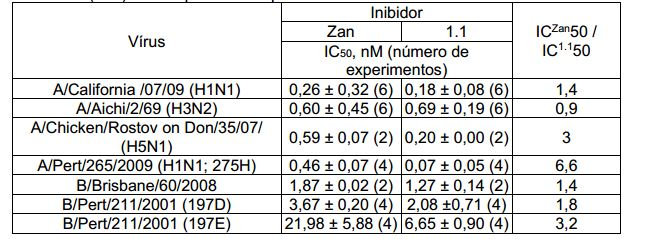
[023]Finalmente, os autores observaram que a comparação não só com Oseltamivir carboxilato mas também com Zanamivir os novos compostos são mais eficazes em cultura de células MDCK em direção do vírus das cepas de influenza Ia/Califórnia/07/09 (H1N1) e cepas altamente patogênicas Ia/pato/MN/1525/81 (H5N1) (Tabela 3). Em particular, o ácido (3R, 4R, 5S)-5-guanidino-4- fluoroacetamido-3-(pentan-3-iloxi)cicloexeno-1-carboxílico 1.1 é mais ativo do que o Oseltamivir carboxilato (A2) por um fator de 13 e Zanamivir (Zan) por um fator de 20 em direção da cepa Ia/Califórnia/07/09 (H1N1), e em direção da cepa altamente patogênica Ia/pato/MN/1525/81(H5N1) a sua atividade é maior do que aquela de Oseltamivir carboxilato e Zanamivir (Zan) em 24 e 16 vezes, respectivamente.[023]Finally, the authors observed that the comparison not only with Oseltamivir carboxylate but also with Zanamivir the new compounds are more effective in MDCK cell culture towards the virus strains of influenza Ia/California/07/09 (H1N1) and highly pathogenic strains Ia/duck/MN/1525/81 (H5N1) (Table 3). In particular, (3R, 4R, 5S)-5-guanidino-4-fluoroacetamido-3-(pentan-3-yloxy)cyclohexene-1-carboxylic acid 1.1 is more active than Oseltamivir carboxylate (A2) by a factor of 13 and Zanamivir (Zan) by a factor of 20 towards the Ia/California/07/09 (H1N1) strain, and towards the highly pathogenic strain Ia/duck/MN/1525/81(H5N1) its activity is greater than that of Oseltamivir carboxylate and Zanamivir (Zan) by 24 and 16 times, respectively.
[024]O ácido (3R, 4R, 5S)-5-Guanidino-4-(2-trifluoroacetamido)-3-(pentan-3- iloxi)cicloexeno-1-carboxílico A4 mostrou atividade de neuraminidase em direção do vírus A/Califórnia/04/09 IC5o = 80 nM, e em direção do vírus A/Vladivostok/16/09 - IC50 > 1000 nM. O ácido (3R, 4R, 5S)-5-guanidino-4-fluoroacetamido-3-(pentan-3- iloxi)cicloexeno-1-carboxílico 1.1 anteriormente desconhecido tem atividade de neuraminidase em direção do vírus A/Califórnia/04/09 de 400 vezes maior do que a atividade de A4, e em direção do vírus A/Vladivostok/16/09 - os novos ácidos 1.1 têm IC50 = 4 nM, ou seja, os mesmos são mais ativos do que o seu análogo conhecido 4-(2-trifluoroacetamido) por um fator de 250. O ácido (3R, 4R, 5S)-5- Guanidino-4-(2-difluoroacetamido)-3-(pentan-3-iloxi)cicloexeno-1-carboxílico 1.4 é também mais ativo do que o seu análogo A4: a sua atividade de neuraminidase em direção do vírus A/Califórnia/04/09 corresponde a IC50 = 0.3 nM, (ou seja, é 2.7 vezes mais ativo do que A2 e 267 vezes mais ativo do que A4 ); em direção do vírus A/Vladivostok/16/09 - os novos ácidos 1.4 exibem uma IC50 = 7 nM (em outro palavras, é mais ativo do que A2 por um fator de 118 e por um fator de 140 do que A4).[024](3R, 4R, 5S)-5-Guanidino-4-(2-trifluoroacetamido)-3-(pentan-3-yloxy)cyclohexene-1-carboxylic acid A4 showed neuraminidase activity towards virus A/ California/04/09 IC50 = 80 nM, and towards virus A/Vladivostok/16/09 - IC50 > 1000 nM. Previously unknown (3R, 4R, 5S)-5-guanidino-4-fluoroacetamido-3-(pentan-3-yloxy)cyclohexene-1-carboxylic acid 1.1 has neuraminidase activity towards A/California/04/09 virus 400 times greater than the activity of A4, and towards the virus A/Vladivostok/16/09 - the new acids 1.1 have IC50 = 4 nM, that is, they are more active than their known analogue 4- (2-trifluoroacetamido) by a factor of 250. (3R, 4R, 5S)-5-Guanidino-4-(2-difluoroacetamido)-3-(pentan-3-yloxy)cyclohexene-1-carboxylic acid 1.4 is also more active than its A4 analogue: its neuraminidase activity towards the A/California/04/09 virus corresponds to IC50 = 0.3 nM, (that is, it is 2.7 times more active than A2 and 267 times more active than than A4); towards the virus A/Vladivostok/16/09 - new acids 1.4 exhibit an IC50 = 7 nM (in other words, it is more active than A2 by a factor of 118 and by a factor of 140 than A4).
[025]Tabela 3. Atividade específica do ácido (3R, 4R, 5S)-5-guanidino-4- fluoroacetamido-3-(pentan-3-iloxi)cicloexeno-1-carboxílico 1.1 em cultura celular MDCK em direção do vírus das cepas Ia/Califórnia/07/09 (H1N1) e da cepa altamente patogênica Ia/pato/MN/1525/81 (H5N1) em comparação com Oseltamivir carboxilato (A2) e Zanamivir (Zan).
[026]De acordo com a presente invenção os compostos preferidos são os compostos de fórmula geral 1, em que R representa hidrogênio, metila ou etila.[026]According to the present invention, preferred compounds are compounds of general formula 1, wherein R represents hydrogen, methyl or ethyl.
[027]De acordo com a presente invenção os compostos mais preferidos de fórmula geral 1 são: ácido (3R, 4R, 5S)-5-guanidino-4-fluoroacetamido-3-(pentan-3- iloxi)cicloexeno-1-caboxílico 1.1 e os seus ésteres de metila 1.2 e de etila 1.3; o ácido (3R, 4R, 5S)-5-guanidino-4-difluoroacetamido-3-(pentan-3-iloxi)cicloexeno-1- carboxílico 1.4 e os seus ésteres de metila 1.5 e de etila 1.6.
[028]Os inibidores de neuraminidases dos vírus da influenza de fórmulageral 1 podem ser preparados iniciando a partir de 4-amino-5-(terc- butoxicarbonilamino)-3-(pentan-3-iloxi)cicloexeno-1-carboxilato de alquila de fórmulageral 2 de acordo com o esquema mostrado abaixo: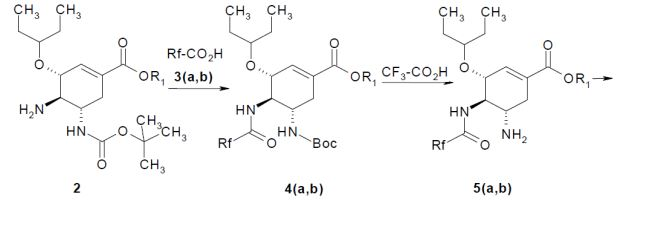
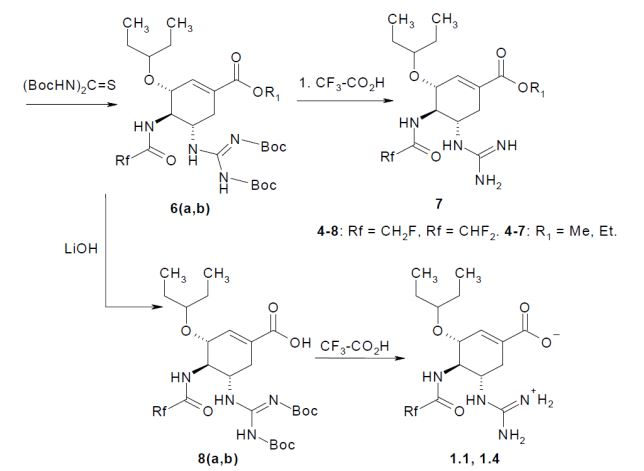
[029]Os novos inibidores de neuraminidases dos vírus da influenza que representam os anteriormente desconhecidos ácidos (3R, 4R, 5S)-4-(2- fluoroacetamido)- e ácidos (3R, 4R, 5S)-4-(2,2-difluoroacetamido)-5-guanidino-3- (pentan-3-iloxi)cicloexeno-1-carboxílico e os seus ésteres de fórmula geral 1 e sais farmaceuticamente aceitáveis dos mesmos também mostrou alta atividade antiinfluenza em modelos de animais do vírus da influenza pneumonia.[029]The new influenza virus neuraminidase inhibitors representing the previously unknown (3R, 4R, 5S)-4-(2-fluoroacetamido)- and (3R, 4R, 5S)-4-(2,2) acids -difluoroacetamido)-5-guanidino-3-(pentan-3-yloxy)cyclohexene-1-carboxylic acid and its general formula 1 esters and pharmaceutically acceptable salts thereof also showed high anti-influenza activity in animal models of influenza virus pneumonia .
[030]A atividade anti-neuraminidase dos compostos descritos foi determinada de acordo com o método descrito em [Who Collaborating Centre for Reference & Research on Influenza, Australia, Standard Operating Procedure WHO - 025. Reviewed by: Aeron Hurt, Senior Scientist Review Date: 13/3/2009].[030]The anti-neuraminidase activity of the compounds described was determined according to the method described in [Who Collaborating Center for Reference & Research on Influenza, Australia, Standard Operating Procedure WHO - 025. Reviewed by: Aeron Hurt, Senior Scientist Review Date : 3/13/2009].
[031]De acordo com a presente invenção os novos compostos de fórmula geral 1 representam um componente ativo para a preparação de composições farmacêuticas e formas de dosagem finais para a profilaxia e o tratamento de influenza em animais de sangue quente e em seres humanos.[031] According to the present invention the new compounds of general formula 1 represent an active component for the preparation of pharmaceutical compositions and final dosage forms for the prophylaxis and treatment of influenza in warm-blooded animals and in humans.
[032]O objetivo da presente invenção é uma composição farmacêutica que compreende como componente ativo os compostos de fórmula geral 1 ou os sais farmaceuticamente aceitáveis dos mesmos em uma quantidade terapeuticamente eficaz.[032] The purpose of the present invention is a pharmaceutical composition that comprises as an active component the compounds of general formula 1 or pharmaceutically acceptable salts thereof in a therapeutically effective amount.
[033]As composições farmacêuticas podem incluir excipientes farmaceuticamente aceitáveis. Excipientes farmaceuticamente aceitáveis quer dizer aplicado na esfera dos diluentes, auxiliares agentes e/ou veículos farmacêuticos. De acordo com a presente invenção a composição farmacêutica junta com um composto de fórmula geral 1 ou sal e/ou hidrato farmaceuticamente aceitável dos mesmos pode envolver outros componentes ativos incluindo os com atividade antiinfluenza, desde que os mesmos não causem efeitos indesejáveis.[033] Pharmaceutical compositions may include pharmaceutically acceptable excipients. Pharmaceutically acceptable excipients means applied in the sphere of pharmaceutical diluents, auxiliary agents and/or vehicles. According to the present invention the pharmaceutical composition together with a compound of general formula 1 or a pharmaceutically acceptable salt and/or hydrate thereof may involve other active components including those with anti-influenza activity, as long as they do not cause undesirable effects.
[034]Se necessário, de acordo com a presente invenção a composição farmacêutica pode ser usada na prática clínica em várias formas preparadas perla mistura das referidas composições com veículos farmacêuticos tradicionais.[034] If necessary, according to the present invention the pharmaceutical composition can be used in clinical practice in various forms prepared by mixing said compositions with traditional pharmaceutical carriers.
[035]De acordo com a presente invenção os veículos usados em composições farmacêuticas representam os veículos que são usados na esfera de produtos farmacêuticos para a preparação das formas comumente usadas: agentes de ligação, agentes lubrificantes, desintegrantes, solventes, diluentes, estabilizantes, agentes de suspensão, agentes incolores, aromatizantes de sabor são usados para as formas perorais; agentes antissépticos, solubilizantes, estabilizantes são usados em formas para injeções; materiais de base, diluentes, agentes lubrificantes, agentes antissépticos são usados em formas locais.[035]According to the present invention, the vehicles used in pharmaceutical compositions represent the vehicles that are used in the sphere of pharmaceuticals for the preparation of commonly used forms: binding agents, lubricating agents, disintegrants, solvents, diluents, stabilizers, agents suspending, colorless, flavoring agents are used for the peroral forms; antiseptic, solubilizing, stabilizing agents are used in injection forms; base materials, diluents, lubricating agents, antiseptic agents are used in local forms.
[036]O objetivo da presente invenção é um método para a preparação da composição farmacêutica ao se misturar a quantidade terapeuticamente eficaz de pelo menos um componente ativo de fórmula geral 1 ou do seu sal farmaceuticamente aceitável com uma carga inerte e/ou solvente.[036] The object of the present invention is a method for preparing the pharmaceutical composition by mixing the therapeutically effective amount of at least one active component of general formula 1 or its pharmaceutically acceptable salt with an inert filler and/or solvent.
[037]O objetivo da presente invenção é também um medicamento que exibe atividade anti-influenza na forma de tabletes, cápsulas ou injeções dispostas em uma embalagem farmaceuticamente aceitável e pretendida para a profilaxia e tratamento de influenza em seres humanos e animais de sangue quente e que compreendem uma quantidade terapeuticamente eficaz dos novos componentes ativos de fórmula geral 1 ou uma composição farmacêutica que compreendem os novos componentes ativos de fórmula geral 1.[037] The object of the present invention is also a medicament that exhibits anti-influenza activity in the form of tablets, capsules or injections arranged in a pharmaceutically acceptable package and intended for the prophylaxis and treatment of influenza in humans and warm-blooded animals and comprising a therapeutically effective amount of the novel active ingredients of formula 1 or a pharmaceutical composition comprising the novel active ingredients of formula 1.
[038]O objetivo da presente invenção é também kits terapêuticos para o tratamento de influenza incluindo como um dos componentes os novos medicamentos ou as novas composições farmacêuticas que compreendem como um componente ativo, pelo menos um composto de fórmula geral 1 ou sal e/ou hidrato farmaceuticamente aceitável dos mesmos.[038] The purpose of the present invention is also therapeutic kits for the treatment of influenza including as one of the components the new drugs or the new pharmaceutical compositions that comprise as an active component, at least one compound of general formula 1 or salt and/or pharmaceutically acceptable hydrate thereof.
[039]De acordo com a presente invenção, junto com os novos medicamentos o kit terapêutico para o tratamento influenza pode incluir outros medicamentos conhecidos pretendidos para o tratamento de influenza ou medicamentos que reforçam o sistema imune do paciente.[039] In accordance with the present invention, along with the new drugs the therapeutic kit for treating influenza may include other known drugs intended for the treatment of influenza or drugs that enhance the patient's immune system.
[040]De acordo com a presente invenção o método para a profilaxia e tratamento de influenza em seres humanos e animais consiste na administração dos novos medicamentos, a nova composição farmacêutica ou do novo kit terapêutico a um paciente.[040]According to the present invention, the method for the prophylaxis and treatment of influenza in humans and animals consists of administering the new drug, the new pharmaceutical composition or the new therapeutic kit to a patient.
[041]Os medicamentos descritos podem ser administrados por via peroral ou por via parenteral (por exemplo, intravenosa, subcutânea, intraperitoneal ou local) ou por meio de inalador. A dose clínica de um componente ativo de fórmula geral 1 pode ser corrida dependendo de: eficiência terapêutica e da biodisponibilidade dos ingredientes ativos no organismo do paciente, do coeficiente de sua troca e de sua remoção a partir do organismo, e da idade, do gênero, e da gravidade dos sintomas do paciente. Assim, a ingesta diária para adultos normalmente é de 10~500 mg, preferivelmente 50~300 mg. Embora a preparação de um medicamento como uma unidade de dosagem a partir da composição farmacêutica a dose eficaz acima deve ser levada em consideração, ou seja, cada unidade de dosagem do medicamento deve conter 10~500 mg, preferivelmente - 50 ~ 300 mg. Seguindo as instruções do médico ou farmacêutico, os medicamentos podem ser tomados diversas vezes em períodos de tempo especificados (preferivelmente, a partir de uma a seis vezes).[041]The drugs described may be administered perorally or parenterally (eg intravenously, subcutaneously, intraperitoneally or locally) or via an inhaler. The clinical dose of an active component of general formula 1 can be varied depending on: therapeutic efficiency and the bioavailability of the active ingredients in the patient's body, the coefficient of their exchange and their removal from the body, and age, gender , and the severity of the patient's symptoms. Thus, the daily intake for adults is normally 10~500mg, preferably 50~300mg. While preparing a medicament as a dosage unit from the pharmaceutical composition the above effective dose should be taken into account, i.e. each dosage unit of the medicament should contain 10~500mg, preferably -50~300mg. Following the doctor's or pharmacist's instructions, medications can be taken several times at specified time periods (preferably from one to six times).
[042]O objetivo da presente invenção é também um método para a inibição da atividade de neuraminidase em vivo, incluindo neuraminidase do vírus da influenza, que compreende o estágio de contato da neuraminidase com um composto de fórmula geral 1.[042] The object of the present invention is also a method for the inhibition of neuraminidase activity in vivo, including influenza virus neuraminidase, which comprises the contact stage of the neuraminidase with a compound of general formula 1.
[043]Abaixo a presente invenção é descrita por meio de exemplos específicos que ilustram, mas não limitam o âmbito da presente invenção.[043]Below the present invention is described by way of specific examples that illustrate, but do not limit the scope of the present invention.
[044]Exemplo 1. Preparação de (3R, 4R, 5S)-4-(2,2-difluoroacetamido)-5- guanidino-3-(pentan-3-iloxi)cicloexeno-1-carboxilato mesilato de etila 1.6.CH3SO3H. ácido 2,2-Difluoroacético 3b (0,624 g, 0,0065 mol, 1.2 eq) foi adicionado gota a gota a uma solução de (3R, 4R, 5S)-4-amino-5-(terc-butoxicarbonilamino)-3-(pentan-3- iloxi)cicloexeno-1-carboxilato de etila (2 g, 0,0054 mol, 1 eq.), 1H- benzo[d][1,2,3]tnazol-1-ol (0,867 g, 0,0065 mol, 1.2 eq.), A1-((etilimino)metileno)- A2,A2-dimetiletano-1,2-diamina hidrocloreto (1,239 g, 0,0065 mol, 1.2 eq.) e diisopropiletilamina (2,212 g, 0,0178 mol, 3,3 eq.) em THF (20 mL). A mistura de reação foi agitada a temperatura ambiente por 4 h. Então solventes foram evaporados em vácuo, o óleo residual foi dissolvido em acetato de etila, lavado com 5% de solução de NaHCO3, seco sobre Na2SO4, filtrado e evaporado em vácuo. Rendimento de (3R, 4R, 5S)-5-(terc-butoxicarbonilamino)-4-(2,2-difluoroacetamido)- 3-(pentan-3-iloxi)cicloexeno-1-carboxilato de etila 4b é 89% (2,15 g). LCMS (M+H): encontrado 449; calculado 448.51. O produto preparado 4b (2,15 g, 0,0048 mol) foi dissolvido em 10% de solução de ácido trifluoroacético em cloreto de metileno (20 ml) e agitada a temperatura ambiente por 12 h. Então os solventes foram evaporados em vácuo, o óleo residual foi dissolvido em acetato de etila, lavado com 5% de solução de NaHCO3, seco sobre Na2SO4, filtrado e evaporado em vácuo. Rendimento do produto é 96% (1,605 g). A purificação adicional foi realizada por meio de coluna de cromatografia com acetato de etila/THF como eluente, ou por recristalização do produto a partir de hexano. Foi proporcionado (3R, 4R, 5S)-5- amino-4-(2,2-difluoroacetamido)-3-(pentan-3-iloxi)cicloexeno-1-carboxilato de etila 5b, que foi dissolvido em cloreto de metileno e quantidade equivalente de ácido metanosulfônico foi adicionado. Em 10 min o solvente foi evaporado, o produto obtido foi lavado com hexano e seco em vácuo. O rendimento de mesilato 5b.CH3SO3H é 90%. LCMS (M+H): encontrado 349; calculado 348.39. 1H NMR (DMSOA), 400 MHz: 8.91 (d, J = 13.2 Hz, 1H), 7.83 (br, 3H), 6.74 (s, 1H), 6.22 (t, J = 54 Hz, 1H), 4.31 (d, J = 8.4 Hz, 1H), 4.16 (q, J = 7.2 Hz, 2H), 3.45 (m, 1H), 3.15 (dd, Ji = 11.2 Hz, J2 = 8.8 Hz, 1H), 2.59 (dd, Ji = 18 Hz, J2 = 6 Hz, 1H), 2.38 (m, 1H), 2.31 (s, 3H), 1.66 (m, 1H), 1.57 (m, 1H), 1.47 (m, 1H), 1.39 (m, 1H), 1.22 (t, J = 7.6 Hz, 3H), 0.891 (t, J = 7.2 Hz, 3H), 0.842 (t, J = 7.2 Hz, 3H). A uma solução de (3R, 4R, 5S)-5-amino-4-(2,2-difluoroacetamido)-3-(pentan-3-iloxi)cicloexeno-1-carboxilato de etila 5b (1,6 g; 0,004598 mol; 1eq.) em DMF (16 mL) resfriada em banho de gelo foram subsequentemente adicionados trietilamina (2.57 g; 0,0253 mol; 5.5 eq.), N,N- di-boc-tioureia (0,00505 mol; 1.35 g; 1.1eq.) e cloreto (II) de mercúrio (0,0055 mol; 1.49 g; 1.2 eq.). A mistura obtida foi agitada com resfriamento em banho de gelo por 1,5 h. após a reação ser concluída o sólido foi filtrado através de celite, DMF foi evaporado em vácuo, o óleo residual foi dissolvido em acetato de etila, lavado com 5% de solução de NaHCO3, seco sobre Na2SO4, filtrado e evaporado em vácuo. O mesmo proporcionou 1,82 g (67%) de (3R, 4R, 5S)-5-((Z)-2,3-bis(terc- butoxicarbonil)guanidino)-4-(2,2-difluoroacetamido)-3-(pentan-3-iloxi)cicloexeno-1- carboxilato de etila 6b. LCMS (M+H): encontrado 591; calculado 590,67. A solução de (3R, 4R, 5S)-5-((Z)-2,3-bis(terc-butoxicarbonil)guanidino)-4-(2,2-difluoroacetamido)-3-(pentan-3-iloxi)cicloexeno-1-carboxilato de etila 6b (1,82 g; 0,00308 mol) em 10% de solução de ácido trifluoroacético em cloreto de metileno (20 ml) foi agitada a temperatura ambiente por 12 h. Então os solventes foram evaporados em vácuo, o óleo residual foi dissolvido em acetato de etila, lavado com 5% de solução de NaHCO3, seco sobre Na2SO4, filtrado e evaporado em vácuo. O mesmo proporciona 1,1 g (92%) de (3R, 4R, 5S)-4-(2,2-difluoroacetamido)-5- guanidino-3-(pentan-3-iloxi)cicloexeno-1-carboxilato de etila1.6. A uma solução do produto preparado em cloreto de metileno em quantidade equivalente de ácido metanosulfônico foi adicionado. Em 10 min o solvente foi evaporado, o produto foi lavado com hexano e seco em vácuo. O mesmo proporciona (3R,4R,5S)-4-(2,2- difluoroacetamido)-5-guanidino-3-(pentan-3-iloxi)cicloexeno-1-carboxilato mesilato de etila 1.6-CH3SO3H, rendimento é 95%. LCMS (M+H): encontrado 391; calculado 390.43. 1H NMR (DMSOA), 400 MHz: 8.67 (d, J = 8.4 Hz, 1H), 7.63 (d, J = 9.6 Hz, 1H), 6.65 (s, 1H), 6.27 (t, J = 53.6 Hz, 1H), 4.14 (q, J = 7.2 Hz, 2H), 4.12 (m, 7H), 3.54 (m, 1H), 3.41 (m, 1H), 2.6 (m, 1H), 2.36 (s, 3H), 1.66 (m, 1H), 1.44 (m, 4H), 1.22 (t, J = 7.2 Hz, 3H), 0.856 (t, J = 7.6 Hz, 3H), 0.795 (t, J = 7.6 Hz, 3H).[044]Example 1. Preparation of (3R, 4R, 5S)-4-(2,2-difluoroacetamido)-5-guanidino-3-(pentan-3-yloxy)cyclohexene-1-carboxylate ethyl mesylate 1.6.CH3SO3H . 2,2-Difluoroacetic acid 3b (0.624 g, 0.0065 mol, 1.2 eq) was added dropwise to a solution of (3R, 4R, 5S)-4-amino-5-(tert-butoxycarbonylamino)-3- ethyl (pentan-3-yloxy)cyclohexene-1-carboxylate (2 g, 0.0054 mol, 1 eq.), 1H-benzo[d][1,2,3]tnazol-1-ol (0.867 g, 0.0065 mol, 1.2 eq.), A1-((ethylimino)methylene)-A2,A2-dimethylethane-1,2-diamine hydrochloride (1.239 g, 0.0065 mol, 1.2 eq.) and diisopropylethylamine (2.212 g, 0.0178 mol, 3.3 eq.) in THF (20 mL). The reaction mixture was stirred at room temperature for 4 h. Then solvents were evaporated in vacuo, the residual oil was dissolved in ethyl acetate, washed with 5% NaHCO3 solution, dried over Na2SO4, filtered and evaporated in vacuo. Yield of ethyl (3R, 4R, 5S)-5-(tert-butoxycarbonylamino)-4-(2,2-difluoroacetamido)-3-(pentan-3-yloxy)cyclohexene-1-carboxylate 4b is 89% (2 .15 g). LCMS (M+H): found 449; calculated 448.51. The prepared product 4b (2.15 g, 0.0048 mol) was dissolved in a 10% solution of trifluoroacetic acid in methylene chloride (20 ml) and stirred at room temperature for 12 h. Then the solvents were evaporated in vacuo, the residual oil was dissolved in ethyl acetate, washed with 5% NaHCO3 solution, dried over Na2SO4, filtered and evaporated in vacuo. Product yield is 96% (1.605 g). Further purification was carried out by column chromatography with ethyl acetate/THF as eluent, or by recrystallizing the product from hexane. Ethyl (3R, 4R, 5S)-5-amino-4-(2,2-difluoroacetamido)-3-(pentan-3-yloxy)cyclohexene-1-carboxylate 5b was provided, which was dissolved in methylene chloride and equivalent amount of methanesulfonic acid was added. In 10 min the solvent was evaporated, the product obtained was washed with hexane and dried in vacuo. The yield of mesylate 5b.CH3SO3H is 90%. LCMS (M+H): found 349; calculated 348.39. 1H NMR (DMSOA), 400 MHz: 8.91 (d, J = 13.2 Hz, 1H), 7.83 (br, 3H), 6.74 (s, 1H), 6.22 (t, J = 54 Hz, 1H), 4.31 (d , J = 8.4 Hz, 1H), 4.16 (q, J = 7.2 Hz, 2H), 3.45 (m, 1H), 3.15 (dd, Ji = 11.2 Hz, J2 = 8.8 Hz, 1H), 2.59 (dd, Ji = 18 Hz, J2 = 6 Hz, 1H), 2.38 (m, 1H), 2.31 (s, 3H), 1.66 (m, 1H), 1.57 (m, 1H), 1.47 (m, 1H), 1.39 (m , 1H), 1.22 (t, J = 7.6 Hz, 3H), 0.891 (t, J = 7.2 Hz, 3H), 0.842 (t, J = 7.2 Hz, 3H). To a solution of ethyl (3R, 4R, 5S)-5-amino-4-(2,2-difluoroacetamido)-3-(pentan-3-yloxy)cyclohexene-1-carboxylate 5b (1.6 g; 0 .004598 mol; 1eq.) in DMF (16 ml) cooled in an ice bath were subsequently added triethylamine (2.57 g; 0.0253 mol; 5.5 eq.), N,N-di-boc-thiourea (0.00505 mol ; 1.35 g; 1.1 eq.) and mercury (II) chloride (0.0055 mol; 1.49 g; 1.2 eq.). The obtained mixture was stirred with cooling in an ice bath for 1.5 h. after the reaction was complete the solid was filtered through celite, DMF was evaporated in vacuo, the residual oil was dissolved in ethyl acetate, washed with 5% NaHCO3 solution, dried over Na2SO4, filtered and evaporated in vacuo. It provided 1.82 g (67%) of (3R, 4R, 5S)-5-((Z)-2,3-bis(tert-butoxycarbonyl)guanidino)-4-(2,2-difluoroacetamido)- Ethyl 3-(pentan-3-yloxy)cyclohexene-1-carboxylate 6b. LCMS (M+H): found 591; calculated 590.67. The solution of (3R, 4R, 5S)-5-((Z)-2,3-bis(tert-butoxycarbonyl)guanidino)-4-(2,2-difluoroacetamido)-3-(pentan-3-yloxy) ethyl cyclohexene-1-carboxylate 6b (1.82 g; 0.00308 mol) in 10% solution of trifluoroacetic acid in methylene chloride (20 ml) was stirred at room temperature for 12 h. Then the solvents were evaporated in vacuo, the residual oil was dissolved in ethyl acetate, washed with 5% NaHCO3 solution, dried over Na2SO4, filtered and evaporated in vacuo. It provides 1.1 g (92%) of ethyl (3R, 4R, 5S)-4-(2,2-difluoroacetamido)-5-guanidino-3-(pentan-3-yloxy)cyclohexene-1-carboxylate1 .6. To a solution of the prepared product in methylene chloride in an equivalent amount of methanesulfonic acid was added. In 10 min the solvent was evaporated, the product was washed with hexane and dried in vacuo. It provides ethyl (3R,4R,5S)-4-(2,2-difluoroacetamido)-5-guanidino-3-(pentan-3-yloxy)cyclohexene-1-carboxylate mesylate 1,6-CH3SO3H, yield is 95% . LCMS (M+H): found 391; calculated 390.43. 1H NMR (DMSOA), 400 MHz: 8.67 (d, J = 8.4 Hz, 1H), 7.63 (d, J = 9.6 Hz, 1H), 6.65 (s, 1H), 6.27 (t, J = 53.6 Hz, 1H ), 4.14 (q, J = 7.2 Hz, 2H), 4.12 (m, 7H), 3.54 (m, 1H), 3.41 (m, 1H), 2.6 (m, 1H), 2.36 (s, 3H), 1.66 (m, 1H), 1.44 (m, 4H), 1.22 (t, J = 7.2 Hz, 3H), 0.856 (t, J = 7.6 Hz, 3H), 0.795 (t, J = 7.6 Hz, 3H).
[045]Em um modo similar ao composto 1.7 - (3R, 4R, 5S)-5-guanidino-4- (2,2-difluoroacetamido)-3-(pentan-3-iloxi)cicloexeno-1-carboxilato de alila (LCMS (M+H): encontrado 354; calculado 353.44, (em direção de A/Califórnia/04/09 vírus IC50 <1 nM) e composto 1.8 - prop-2-inila (3R, 4R, 5S)-5-guanidino-4-(2,2- difluoroacetamido)-3-(pentan-3-iloxi)cicloexeno-1-carboxilato (LCMS (M+H): encontrado 352; calculado 351,42, (em direção de A/Califórnia/04/09 vírus IC50 <1 nM), foram preparados quando como materiais de partida (como o composto 2) (3R,4R,5£)-4-amino-5-(terc-butoxicarbonilamino)-3-(pentan-3-iloxi)cicloexeno-1- carboxilato de alila e prop-2-inila (3R, 4R, 5S)--4-amino-5-(terc-butoxicarbonilamino)- 3-(pentan-3-iloxi)cicloexeno-1-carboxilato foram usados, respectivamente.[045] In a similar manner to the compound 1,7-(3R, 4R, 5S)-5-guanidino-4-(2,2-difluoroacetamido)-3-(pentan-3-yloxy)cyclohexene-1-carboxylate ( LCMS (M+H): found 354; calculated 353.44, (toward A/California/04/09 virus IC50 <1 nM) and compound 1.8 - prop-2-ynyl (3R, 4R, 5S)-5-guanidino -4-(2,2-difluoroacetamido)-3-(pentan-3-yloxy)cyclohexene-1-carboxylate (LCMS (M+H): found 352; calculated 351.42, (towards A/California/04 /09 virus IC50 <1 nM), were prepared when as starting materials (such as compound 2) (3R,4R,5E)-4-amino-5-(tert-butoxycarbonylamino)-3-(pentan-3- allyl prop-2-ynyl yloxy)cyclohexene-1-carboxylate (3R, 4R, 5S)--4-amino-5-(tert-butoxycarbonylamino)-3-(pentan-3-yloxy)cyclohexene-1-carboxylate were used, respectively.
[046]Ao se usar o correspondente (3R, 4R, 5S)-4-amino-5-(terc- butoxicarbonilamino)-3-(pentan-3-iloxi)cicloexeno-1-carboxilato como o material de partida (composto 2) os compostos a seguir foram preparados:2-cicloexila (3R, 4R, 5S)-5-guanidino-4-(2,2-difluoroacetamido)-3-(pentan-3- iloxi)cicloexeno-1-carboxilato 1.9 (LCMS (M+H): encontrado 460; calculado 459.55, IC50 <1 nM em direção de A/Califórnia/04/09 vírus;2-feniletila (3R, 4R, 5S)-5-guanidino-4-(2,2-difluoroacetamido)-3-(pentan-3- iloxi)cicloexeno-1-carboxilato 1.10 (LCMS (M+H): encontrado 454; calculado 453.51, IC50 <1 nM em direção de A/Califórnia/04/09 vírus;2-piridin-3-iletila (3R, 4R, 5S)-5-guanidino-4-(2,2-difluoroacetamido)-3- (pentan-3-iloxi)cicloexeno-1-carboxilato 1,11 (LCMS (M+H): encontrado 455; calculado 454.49, IC50 <1 nM em direção de A/Califórnia/04/09 vírus);2-metoxietila (3R, 4R, 5S)-5-guanidino-4-(2,2-difluoroacetamido)-3-(pentan- 3-iloxi)cicloexeno-1-carboxilato 1,12 (LCMS (M+H): encontrado 422; calculado 421.46, IC50 <1 nM em direção de A/Califórnia/04/09 vírus).[046]By using the corresponding (3R, 4R, 5S)-4-amino-5-(tert-butoxycarbonylamino)-3-(pentan-3-yloxy)cyclohexene-1-carboxylate as the starting material (compound 2 ) the following compounds were prepared: 2-cyclohexyl (3R, 4R, 5S)-5-guanidino-4-(2,2-difluoroacetamido)-3-(pentan-3-yloxy)cyclohexene-1-carboxylate 1.9 (LCMS (M+H): found 460; calculated 459.55, IC50 <1 nM towards A/California/04/09 virus; 2-phenylethyl (3R, 4R, 5S)-5-guanidino-4-(2,2- difluoroacetamido)-3-(pentan-3-yloxy)cyclohexene-1-carboxylate 1.10 (LCMS (M+H): found 454; calculated 453.51, IC50 <1 nM towards A/California/04/09 virus; 2- pyridin-3-ylethyl (3R, 4R, 5S)-5-guanidino-4-(2,2-difluoroacetamido)-3-(pentan-3-yloxy)cyclohexene-1-carboxylate 1,11 (LCMS (M+H ): found 455; calculated 454.49, IC50 <1 nM towards A/California/04/09 virus); 2-methoxyethyl (3R, 4R, 5S)-5-guanidino-4-(2,2-difluoroacetamido)- 3-(pentan-3-yloxy)cyclohexene-1-carboxylate 1,12 (LCMS (M+H): found 422; calculated 421. 46, IC50 <1 nM towards A/California/04/09 virus).
[047]Exemplo 2. Mesilato de etila (3R, 4R, 5S)-4-(2-fluoroacetamido)-5- guanidino-3-(pentan-3-iloxi)cicloexeno-1-carboxilato 1.3.CH3SO3H foi preparado de acordo com o procedimento dado no exemplo 1 usando ácido monofluoroacético como agente de acilação. LCMS (M+H): encontrado 373; calculado 372.44.[047]Example 2. Ethyl mesylate (3R, 4R, 5S)-4-(2-fluoroacetamido)-5-guanidino-3-(pentan-3-yloxy)cyclohexene-1-carboxylate 1.3.CH3SO3H was prepared according to with the procedure given in example 1 using monofluoroacetic acid as the acylating agent. LCMS (M+H): found 373; calculated 372.44.
[048]Exemplo 3. Ácido (3R, 4R, 5S)-4-(2,2-difluoroacetamido)-5-guanidino-3- (pentan-3-iloxi)cicloexeno-1-carboxílico 1.4. 5% de solução de hidróxido de lítio (2,5 mL) foi adicionado a uma solução de (3R, 4R, 5S)-5-((Z)-2,3-bis(terc- butoxicarbonil)guanidino-4-(2,2-difluoroacetamido)-3-(pentan-3-iloxi)cicloexeno-1- carboxilato de etila 6b (250 mg) em dioxano (5 mL) e a mistura de reação foi agitada a temperatura ambiente por 45 min. Então hidróxido de lítio foi passivado ao se adicionar ácido acético (300 mcl), e os solventes foram evaporados em vácuo. O sólido obtido foi extraído com álcool isopropílico, o extrato foi seco sobre Na2SO4 e evaporado em vácuo. O mesmo proporciona o ácido (3R,4R,5S)-5-((Z)-2,3-bis(terc- butoxicarbonil)guanidino)-4-(2,2-difluoroacetamido)-3-(pentan-3-iloxi)cicloexeno-1- carboxílico 8b (200 mg, 84%). LCMS (M+H): encontrado 563; calculado 562.62. o ácido obtido 8b (200 mg) foi dissolvido em 10% de solução de ácido trifluoroacético em cloreto de metileno (2 ml) e agitado a temperatura ambiente por 12 h. Então os solventes foram evaporados em vácuo. O ácido (3R, 4R, 5S)-4-(2,2- Difluoroacetamido)-5-guanidino-3-(pentan-3-iloxi)cicloexeno-1-carboxílico 1.4 foiseparado por método HPLC. LCMS (M+H): encontrado 363; calculado 362.28. 1H NMR (DMSOA), 400 MHz: 8.68 (d, J = 8.4 Hz, 1H), 7.6 (d, J = 10 Hz, 1H), 7.26 (br, 2H), 6.91 (br, 2H), 6.63 (s, 1H), 6.27 (t, J = 53.6 Hz, 1H), 4.18 (d, J = 8 Hz, 2H), 4.09 (m, 1H), 3.54 (q, J = 10 Hz, 1H), 3.39 (m, 2H), 2.57 (dd, Ji = 18 Hz, J2 = 6 Hz, 1H), 2.31 (m, 1H), 1.44 (m, 4H), 0.85 (t, J = 8 Hz, 3H), 0.795(t, J = 7.6 Hz, 3H).[048]Example 3. (3R, 4R, 5S)-4-(2,2-Difluoroacetamido)-5-guanidino-3-(pentan-3-yloxy)cyclohexene-1-carboxylic acid 1.4. 5% lithium hydroxide solution (2.5 mL) was added to a solution of (3R, 4R, 5S)-5-((Z)-2,3-bis(tert-butoxycarbonyl)guanidino-4-( Ethyl 2,2-difluoroacetamido)-3-(pentan-3-yloxy)cyclohexene-1-carboxylate 6b (250 mg) in dioxane (5 mL) and the reaction mixture was stirred at room temperature for 45 min. of lithium was passivated by adding acetic acid (300 mcl), and the solvents were evaporated in vacuo. The solid obtained was extracted with isopropyl alcohol, the extract was dried over Na2SO4 and evaporated in vacuo. This gives the acid (3R, 4R,5S)-5-((Z)-2,3-bis(tert-butoxycarbonyl)guanidino)-4-(2,2-difluoroacetamido)-3-(pentan-3-yloxy)cyclohexene-1-carboxylic acid 8b (200 mg, 84%) LCMS (M+H): found 563; calculated 562.62 the obtained acid 8b (200 mg) was dissolved in a 10% solution of trifluoroacetic acid in methylene chloride (2 ml) and stirred at at room temperature for 12 h. Then the solvents were evaporated in vacuo. The acid (3R, 4R, 5S)-4-(2,2-Di fluoroacetamido)-5-guanidino-3-(pentan-3-yloxy)cyclohexene-1-carboxylic acid 1.4 was separated by HPLC method. LCMS (M+H): found 363; calculated 362.28. 1H NMR (DMSOA), 400 MHz: 8.68 (d, J = 8.4 Hz, 1H), 7.6 (d, J = 10 Hz, 1H), 7.26 (br, 2H), 6.91 (br, 2H), 6.63 (s , 1H), 6.27 (t, J = 53.6 Hz, 1H), 4.18 (d, J = 8 Hz, 2H), 4.09 (m, 1H), 3.54 (q, J = 10 Hz, 1H), 3.39 (m , 2H), 2.57 (dd, Ji = 18 Hz, J2 = 6 Hz, 1H), 2.31 (m, 1H), 1.44 (m, 4H), 0.85 (t, J = 8 Hz, 3H), 0.795(t , J = 7.6 Hz, 3H).
[049]Exemplo 4. O ácido (3R, 4R, 5S)-4-(2-fluoroacetamido)-5-guanidino-3- (pentan-3-iloxi)cicloexeno-1-carboxílico 1.1 foi preparado de acordo com o procedimento dado no exemplo 3. LCMS (M+H): encontrado 345; calculado 345. 1H NMR (DMSOA), 400 MHz: 8.16 (d, J = 10 Hz, 1H), 7.56 (d, J = 9.6 Hz, 1H), 6.64 (s, 1H), 4.80 (d, J = 47.3 Hz, 2H), 4.21 (d, J = 8.4 Hz, 1H), 3.89 (q, J = 10.4 Hz, 1H), 3.71 (m, 1H), 2.67 (m, 1H), 2.25 (m, 1H), 1.42 (m, 4H), 0.85 (t, J = 7.2 Hz, 3H), 0.78 (t, J = 7.2 Hz, 3H).[049]Example 4. (3R, 4R, 5S)-4-(2-Fluoroacetamido)-5-guanidino-3-(pentan-3-yloxy)cyclohexene-1-carboxylic acid 1.1 was prepared according to the procedure given in example 3. LCMS (M+H): found 345; calculated 345. 1H NMR (DMSOA), 400 MHz: 8.16 (d, J = 10 Hz, 1H), 7.56 (d, J = 9.6 Hz, 1H), 6.64 (s, 1H), 4.80 (d, J = 47.3 Hz, 2H), 4.21 (d, J = 8.4 Hz, 1H), 3.89 (q, J = 10.4 Hz, 1H), 3.71 (m, 1H), 2.67 (m, 1H), 2.25 (m, 1H), 1.42 (m, 4H), 0.85 (t, J = 7.2 Hz, 3H), 0.78 (t, J = 7.2 Hz, 3H).
[050]Exemplo 5. Mesilato de metila (3R, 4R, 5S)-4-(2-fluoroacetamido)-5- guanidino-3-(pentan-3-iloxi)cicloexeno-1-carboxilato 1.2.CH3SO3H foi preparado de acordo com o procedimento dado no exemplo 1 usando m(3R, 4R, 5S)-4-amino-5- (terc-butoxicarbonilamino)-3-(pentan-3-iloxi)cicloexeno-1-carboxilato de etila como o material de partida e ácido monofluoroacético como o agente de acilação. LCMS (M+H): encontrado 359; calculado 358.42.[050]Example 5. Methyl (3R, 4R, 5S)-4-(2-fluoroacetamido)-5-guanidino-3-(pentan-3-yloxy)cyclohexene-1-carboxylate 1.2.CH3SO3H mesylate was prepared according to with the procedure given in example 1 using ethyl m(3R, 4R, 5S)-4-amino-5-(tert-butoxycarbonylamino)-3-(pentan-3-yloxy)cyclohexene-1-carboxylate as the starting material and monofluoroacetic acid as the acylating agent. LCMS (M+H): found 359; calculated 358.42.
[051]Exemplo 6. Mesilato de m(3R, 4R, 5S)-4-(2,2-difluoroacetamido)-5- guanidino-3-(pentan-3-iloxi)cicloexeno-1-carboxilato de etila 1.5.CH3SO3H foi preparado de acordo com o procedimento dado no exemplo 1 usando m(3R, 4R, 5S)-4-amino-5-(terc-butoxicarbonilamino)-3-(pentan-3-iloxi)cicloexeno-1-carboxilato de etila como o material de partida e ácido difluoroacético como o agente de acilação. LCMS (M+H): encontrado 373; calculado 372.44.[051]Example 6. Ethyl m(3R, 4R, 5S)-4-(2,2-difluoroacetamido)-5-guanidino-3-(pentan-3-yloxy)cyclohexene-1-carboxylate mesylate 1,5.CH3SO3H was prepared according to the procedure given in example 1 using ethyl m(3R, 4R, 5S)-4-amino-5-(tert-butoxycarbonylamino)-3-(pentan-3-yloxy)cyclohexene-1-carboxylate as the starting material and difluoroacetic acid as the acylating agent. LCMS (M+H): found 373; calculated 372.44.
[052]Exemplo 7. Preparação de composição farmacêutica na forma de tabletes.[052]Example 7. Preparation of pharmaceutical composition in the form of tablets.
[053]Amido (1600 mg), lactose triturada (1600 mg), talco (400 mg) e ácido (3R, 4R, 5S)-4-(2-fluoroacetamido)-5-guanidino-3-(pentan-3-iloxi)cicloexeno-1- carboxílico 1.1 (1000 mg) foram cuidadosamente misturados juntos e prensados em um tijolo. O tijolo preparado foi triturado em grânulos e passado através de peneiras, capturando grânulos de 14-16 de tamanho de malha. Os grânulos obtidos foram granulados em tabletes de forma adequados de 560 mg por peso cada.[053]Starch (1600mg), milled lactose (1600mg), talc (400mg) and (3R, 4R, 5S)-4-(2-fluoroacetamido)-5-guanidino-3-(pentan-3- yloxy)cyclohexene-1-carboxylic acid 1.1 (1000 mg) were carefully mixed together and pressed into a brick. The prepared brick was ground into granules and passed through sieves, capturing granules of 14-16 mesh size. The granules obtained were granulated into suitable tablets of 560 mg by weight each.
[054]Exemplo 8. Preparação de composição farmacêutica em forma de cápsula.[054]Example 8. Preparation of pharmaceutical composition in capsule form.
[055]O ácido (3R, 4R, 5S)-4-(2-fluoroacetamido)-5-guanidino-3-(pentan-3- iloxi)cicloexeno-1-carboxílico 1.1 foi cuidadosamente misturado com um pó de lactose em uma proporção de 2:1a mistura em pó preparada foi embalada em cápsulas gelatinosas de tamanho adequado por 300 mg cada .[055](3R, 4R, 5S)-4-(2-fluoroacetamido)-5-guanidino-3-(pentan-3-yloxy)cyclohexene-1-carboxylic acid 1.1 was carefully mixed with a lactose powder in a 2:1 ratio The prepared powder mixture was filled into appropriately sized softgels for 300 mg each.
[056]Exemplo 9. Preparação de composição farmacêutica em forma de injeção para injeções intramusculares, intraperitoneais ou subcutâneas. O ácido (3R, 4R, 5S)-4-(2-fluoroacetamido)-5-guanidino-3-(pentan-3-iloxi)cicloexeno-1-carboxílico 1.1 (500 mg) foi misturado com clorobutanol (300 mg), propileno glicol (2 ml) e água injetável (100 mL). A solução resultante foi filtrada e disposta em ampolas de 1 mL que foram seladas.[056]Example 9. Preparation of pharmaceutical composition in injection form for intramuscular, intraperitoneal or subcutaneous injections. (3R, 4R, 5S)-4-(2-fluoroacetamido)-5-guanidino-3-(pentan-3-yloxy)cyclohexene-1-carboxylic acid 1.1 (500 mg) was mixed with chlorobutanol (300 mg), propylene glycol (2 ml) and water for injection (100 ml). The resulting solution was filtered and poured into 1 mL ampoules that were sealed.
[057]Exemplo 10. Determinação da atividade em direção de neuraminidase do vírus da influenza para os compostos de fórmula geral 1. Em experimentos preliminares diluições para as cepas de vírus alantóicos de influenza A/Califórnia/07/09 (H1N1) e A/Aichi/2/69 (H3N2) assim como para os vírus resistentes da influenza A/Vladivostok/16/09 (H1N1) que foi preparado em cultura celular oseltamivir foram determinados. Para esse propósito em uma placa de 96 cavidades com um fundo arredondado por 60 pl de cada vírus diluído 2 vezes na mistura de tampão de reação (RBM, 50 mM MES, 5 mM CaCb, pH 6.5) foram preparados. A partir da referida placa por 50 pl de vírus diluído 2 vezes foi transferida em placas de 96 cavidades com fundo arredondado para medição de fluorescência (FluoroNunc, black, kat. No. 237105), então, um volume igual de tampão de substrato (SB, 12,5 mM de ácido 2'-(4-metilumbelliferil)-a-D-N- acetilneurâmico, Sigma, 40 mM de tampão de acetato pH = 5,8) foi adicionado aos mesmos. Como controle, foram usadas as cavidades de cada um dos quais por 50 pl de RBM foi adicionado em vez do vírus. Após a incubação da placa em agitação suave por 1 h a 37°, 100 pl de solução de interrupção (2.225 mL de 0.824M NaOH em 11,0 mL de etanol) foi adicionado a cada cavidade, que foi seguido por medição de fluorescência a Aex =360 nm e Aem= 448 nm usando o instrumento Varioskan Flach (Thermo Scientific). Para experimentos adicionais foram escolhidas as diluições de vírus, que corresponderam ao meio da seção linear da curva de influência: diluição de vírus contra valor de fluorescência. Para a determinação de atividade de anti-neuraminidase diluições dos compostos descritos e de seus análogos das fórmulas A2 e A4 (por 50 pl, preparados com RBM) foram adicionadas ás cavidades de fileiras a partir de B a H (concentrações usadas - 0,03; 0.3; 3; 30; 300; 3000; 30000 nM - cada concentração em uma fileira) em placas de 96 cavidades com fundo chato para a medição de fluorescência (FluoroNunc, black, kat. No. 237105). As cavidades da fileria A foram usadas como o controle de vírus a qual em vez do vírus o volume igual (50 pl) de RBM foi adicionado. Então às cavidades correspondentes foram adicionadas por 50 pl das diluições de trabalho escolhidas (RBM) de cada vírus. Como o controle as cavidades foram usadas às quais em vez do vírus o volume igual de RBM foi adicionado. Após agitação e incubação a temperatura ambiente por 45 min a todas as cavidades o volume igual de RBM foi adicionado. Após agitação e incubação repetida a placa a 37° por 1h solução de interrupção em uma quantidade de 100 pl foi adicionada a cada cavidade. Medição de fluorescências foi feita a Aex =360 nm e A,em=448 nm com o uso do instrumento Varioskan Flach (Thermo Scientific). Todas as determinações foram realizadas pelo menos em duplicata (duas cavidades da placa). O percentual de inibição da atividade de neuraminidase por composto testado de fórmula geral 1 foi calculado pela fórmula: inibição % = 100-(SUF experimento - SUF controle / SUF controle de vírus na ausência do composto - SUF controle), onde SUF é uma unidade padrão de fluorescência). A concentração de um composto no qual o valor SUF foi reduzido por 50% foi tido como a concentração de inibição 50 (IC50).[057]Example 10. Determination of neuraminidase-directing activity of influenza virus for compounds of general formula 1. In preliminary experiments, dilutions for influenza A/California/07/09 (H1N1) and A/ Aichi/2/69 (H3N2) as well as for the resistant influenza virus A/Vladivostok/16/09 (H1N1) which was prepared in oseltamivir cell culture were determined. For this purpose in a 96-well plate with a rounded bottom per 60 µl of each virus diluted 2-fold in the reaction buffer mixture (RBM, 50 mM MES, 5 mM CaCb, pH 6.5) were prepared. From said plate 50 µl of 2-fold diluted virus was transferred into 96 well plates with rounded bottom for fluorescence measurement (FluoroNunc, black, kat. No. 237105), then an equal volume of substrate buffer (SB , 12.5 mM 2'-(4-methylumbelliferyl)-αDN-acetylneuramic acid, Sigma, 40 mM acetate buffer pH = 5.8) was added thereto. As a control, wells from each of which 50 µl of RBM was added instead of the virus were used. After incubating the plate with gentle shaking for 1 h at 37°, 100 µl of stop solution (2,225 mL of 0.824M NaOH in 11.0 mL of ethanol) was added to each well, which was followed by fluorescence measurement at Aex =360 nm and Aem= 448 nm using the Varioskan Flach instrument (Thermo Scientific). For additional experiments, virus dilutions were chosen, which corresponded to the middle of the linear section of the influence curve: virus dilution versus fluorescence value. For the determination of anti-neuraminidase activity, dilutions of the described compounds and their analogues of formulas A2 and A4 (per 50 pl, prepared with RBM) were added to the wells of rows from B to H (concentrations used - 0.03 ; 0.3; 3; 30; 300; 3000; 30000 nM - each concentration in a row) in flat-bottomed 96-well plates for fluorescence measurement (FluoroNunc, black, kat. No. 237105). Fileria A wells were used as the virus control to which instead of virus an equal volume (50 pl) of RBM was added. Then to the corresponding wells were added 50 µl of the chosen working dilutions (RBM) of each virus. As the control wells were used to which instead of virus an equal volume of RBM was added. After shaking and incubating at room temperature for 45 min, an equal volume of RBM was added to all wells. After shaking and repeated incubation of the plate at 37° for 1 h, stop solution in an amount of 100 µl was added to each well. Fluorescence measurement was performed at Aex =360 nm and A,em = 448 nm using the Varioskan Flach instrument (Thermo Scientific). All determinations were performed at least in duplicate (two wells of the plate). The percentage of inhibition of neuraminidase activity by the tested compound of general formula 1 was calculated by the formula: inhibition % = 100-(SUF experiment - SUF control / SUF control of virus in the absence of the compound - SUF control), where SUF is a unit fluorescence pattern). The concentration of a compound at which the SUF value was reduced by 50% was taken as the 50 inhibition concentration (IC50).
[058]Exemplo 11. Investigação de atividade anti-influenza de compostos de fórmula geral 1 (1.1., 1.3., 1.4 e 1.6) no modelo de influenza pneumonia em camundongos. Camundongos pré-pesados (fêmea não linear, peso médio 12-15 g) foram infectados com vírus da influenza A/Aichi/2/69 (H3N2) (10 LD50 em 50 pl) por meio de introdução intranasal sob anestesia leve com éter. A determinação de LD50 foi realizada em um experimento preliminar por meio da titulação do vírus alontóico usando o mesmo camundongo que o posteriormente foram usados no experimento principal. O esquema de tratamento a seguir foi usado: os animais foram injetados duas vezes: 24 h e 1 h antes da infecção, em 24 h após a infecção e então 1 vez ao dia durante os próximos 5 dias. Para a administração oral lima seringa de insulina descartável com uma agulha especial (lavagem) foi usada; o efeito das doses a seguir foi investigado: 25 mg/kg/dia de cada composto em um volume de 100 pl. como um composto de referência foi usado Tamiflu em doses que variaram a partir de 5 mg/kg/dia a 30 mg/kg/dia. Houveram 10 animais no grupo de "controle de vírus", assim como em cada grupo de animais "tratados com os compostos" de fórmula geral 1 ou Tamiflu de formula A3. Os animais "tratados" e de controle foram observados diariamente; durante os primeiros 5 dias após a infecção os mesmos foram pesados a cada dia, e posteriormente - em um dia. A atividade quimioterapêutica dos compostos no modelo de influenza pneumonia em camundongos foi estimada pelo índice de proteção contra infecção viral letal e por perda de peso nos grupos de animais tratados com os compostos testados em comparação com oi peso dos animais no grupo de controle. A redução ou o aumento de peso foi calculado para cada camundongo individualmente e expressos em percentual. O peso dos animais antes a infecção foi tido como 100%. Para todos os animais de um grupo o percentual médio de perda de peso assim como o ganho de peso foi determinado.[058]Example 11. Investigation of anti-influenza activity of compounds of general formula 1 (1.1., 1.3., 1.4 and 1.6) in the mouse model of influenza pneumonia. Pre-weighed mice (non-linear female, mean weight 12-15 g) were infected with A/Aichi/2/69 (H3N2) influenza virus (10 LD50 in 50 pl) by intranasal introduction under light ether anesthesia. The determination of LD50 was carried out in a preliminary experiment by titrating the allontoic virus using the same mice that were later used in the main experiment. The following treatment schedule was used: animals were injected twice: 24 h and 1 h before infection, at 24 h after infection and then once daily for the next 5 days. For oral administration a disposable insulin syringe with a special needle (wash) was used; the effect of the following doses was investigated: 25 mg/kg/day of each compound in a volume of 100 pl. as a reference compound Tamiflu was used at doses ranging from 5 mg/kg/day to 30 mg/kg/day. There were 10 animals in the "virus control" group, as well as in each group of animals "treated with the compounds" of formula 1 or Tamiflu of formula A3. "Treated" and control animals were observed daily; during the first 5 days after infection they were weighed every day, and later - in one day. The chemotherapeutic activity of the compounds in the mouse model of influenza pneumonia was estimated by the index of protection against lethal viral infection and by weight loss in the groups of animals treated with the tested compounds compared to the weight of the animals in the control group. Weight reduction or weight gain was calculated for each mouse individually and expressed as a percentage. The weight of animals before infection was taken as 100%. For all animals in a group the average percentage of weight loss as well as weight gain was determined.
[059]Em um experimento preliminar a dose do vírus contendo 10 LD50 em volume de 100 pl foi determinada. Então todos os animais do grupo foram infectados com a referida dose. A eficácia dos compostos de fórmula geral 1 no modelo de influenza pneumonia em camundongos foi estimada pelo número de animais que sobreviveram após a infecção por vírus, pelo tempo de vida médio e pelas mudanças de peso dos animais infectados.[059] In a preliminary experiment the dose of the virus containing 10 LD50 in a volume of 100 pl was determined. Then all animals in the group were infected with said dose. The efficacy of the compounds of formula 1 in the mouse model of influenza pneumonia was estimated by the number of animals that survived after virus infection, the mean lifespan and the weight changes of infected animals.
[060]Foi observado que no 7 dia de observação todos os camundongos infectados com vírus e não tratados com os compostos testados (grupo de "controle de vírus") morreram.[060] It was observed that on the 7th day of observation all mice infected with viruses and not treated with the tested compounds ("virus control" group) died.
[061]Os experimentos mostraram que na ocasião em que o último animal do grupo de "controle de vírus" morreu os animais tratados com compostos de fórmula geral 1 e Tamiflu ("tratado com os compostos") foram completamente prevenidos.[061]Experiments showed that by the time the last animal in the "virus control" group died, the animals treated with compounds of general formula 1 and Tamiflu ("treated with the compounds") were completely prevented.
[062]A ação anti-influenza dos compostos testados de fórmula geral 1 e Tamiflu de formula A3 consiste em reduzir a perda de peso em grupos de "camundongos tratados " em comparação com o grupo de "controle de vírus". A perda de peso do animal é uma das implicações clínicas de influenza pneumonia. O curso mais severo da doença é sempre acompanhado por perda de peso preponderante do animal. A pesagem foi realizada nos dias 1, 2, 3, 4 e 5 após a infecção, então a cada dia sim dia não até o 15 dia de observação. Foi observado que os animais do grupo de “controle de vírus" a maior parte da perda de peso foi observada no 5 dia após a infecção (cerca de 10%). De modo diferente com os animais do grupo de "controle de vírus" os animais tratados com os compostos de fórmula geral 1 e Tamiflu, em média, não tiveram perda de peso. Todos os animais do "grupo tratado" extensivamente e uniformemente ganharam peso iniciando a partir do 9 dia.[062] The anti-influenza action of the tested compounds of formula 1 and Tamiflu of formula A3 is to reduce weight loss in groups of "treated mice" compared to the "virus control" group. Animal weight loss is one of the clinical implications of influenza pneumonia. The more severe course of the disease is always accompanied by preponderant weight loss of the animal. Weighing was performed on days 1, 2, 3, 4 and 5 after infection, then every other day until the 15th day of observation. It was observed that the animals in the "virus control" group most of the weight loss was observed on the 5th day after infection (about 10%). animals treated with compounds of formula 1 and Tamiflu, on average, had no weight loss All animals in the "treated group" extensively and uniformly gained weight starting from day 9.
[063]Assim, a alta eficiência dos compostos de formulas 1.1, 1.3, 1.4, e 1.6 no tratamento de influenza pneumonia em camundongos foi mostrada.[063]Thus, the high efficiency of compounds of formulas 1.1, 1.3, 1.4, and 1.6 in treating influenza pneumonia in mice was shown.
[064]A presente invenção pode ser usada na medicina e em veterinária.[064] The present invention can be used in medicine and in veterinary medicine.
Claims (8)
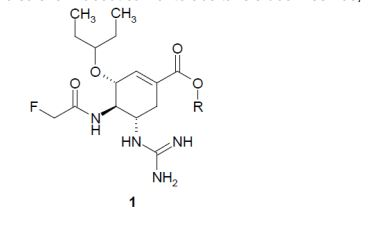
Applications Claiming Priority (3)
| Application Number | Priority Date | Filing Date | Title |
|---|---|---|---|
| RU2012119272 | 2012-05-12 | ||
| RU2012119272/04A RU2489422C1 (en) | 2012-05-12 | 2012-05-12 | Fluorine-substituted (3r,4r,5s)-5-guanidino-4-acylamino-3-(pentan-3-yloxy)cyclohexene-1-carboxylic acids, esters thereof and method of application |
| PCT/RU2013/000384 WO2013172741A2 (en) | 2012-05-12 | 2013-05-07 | Fluoro-substituted (3r, 4r, 5s)-5-guanidino-4-acylamino-3-(pentan-3-yloxy) cyclohexene-1-carboxylic acids, esters thereof and a method for the use thereof |
Publications (2)
| Publication Number | Publication Date |
|---|---|
| BR112014028362A2 BR112014028362A2 (en) | 2018-04-17 |
| BR112014028362B1 true BR112014028362B1 (en) | 2022-02-01 |
Family
ID=49159508
Family Applications (1)
| Application Number | Title | Priority Date | Filing Date |
|---|---|---|---|
| BR112014028362-1A BR112014028362B1 (en) | 2012-05-12 | 2013-05-07 | Fluorine substituted (3r, 4r, 5s)-5-guanidino-4-acetamido-3-(pentan-3-yloxy)cyclohexene-1-carboxylic acids, their esters, pharmaceutical composition and use thereof |
Country Status (17)
| Country | Link |
|---|---|
| US (1) | US8895613B2 (en) |
| EP (1) | EP2848606B1 (en) |
| JP (1) | JP6034960B2 (en) |
| KR (1) | KR101902567B1 (en) |
| CN (1) | CN104284884B (en) |
| AU (1) | AU2013263513B2 (en) |
| BR (1) | BR112014028362B1 (en) |
| CA (1) | CA2872733C (en) |
| DK (1) | DK2848606T3 (en) |
| EA (1) | EA024765B1 (en) |
| HU (1) | HUE035856T2 (en) |
| MX (1) | MX360369B (en) |
| PL (1) | PL2848606T3 (en) |
| RU (1) | RU2489422C1 (en) |
| UA (1) | UA113201C2 (en) |
| WO (1) | WO2013172741A2 (en) |
| ZA (1) | ZA201408026B (en) |
Families Citing this family (5)
| Publication number | Priority date | Publication date | Assignee | Title |
|---|---|---|---|---|
| CN103923060B (en) * | 2014-03-27 | 2016-05-25 | 山东大学 | Oseltamivir derivative and its preparation method and application |
| CN106905193B (en) * | 2017-02-15 | 2018-11-27 | 中国药科大学 | Aroyl guanidine radicals Oseltamivir carboxylic acid derivates and its preparation method and application |
| US20190081317A1 (en) * | 2017-09-11 | 2019-03-14 | Andreas Keil | Web coating and calendering system and method |
| CN110272381A (en) * | 2019-06-19 | 2019-09-24 | 五邑大学 | The Oseltamivir analog of the segment containing pyridine and its application |
| CN114057599A (en) * | 2020-07-29 | 2022-02-18 | 广州市恒诺康医药科技有限公司 | Neuraminidase inhibitor compound, pharmaceutical composition and application thereof |
Family Cites Families (6)
| Publication number | Priority date | Publication date | Assignee | Title |
|---|---|---|---|---|
| AUPM354694A0 (en) * | 1994-01-27 | 1994-02-17 | Biota Scientific Management Pty Ltd | Chemical compounds |
| US5952375A (en) * | 1995-02-27 | 1999-09-14 | Gilead Sciences, Inc. | Compounds and methods for synthesis and therapy |
| JP3233392B2 (en) * | 1998-01-22 | 2001-11-26 | 三共株式会社 | Anti-influenza drug containing neuraminic acid derivative |
| US6518048B2 (en) * | 2000-04-10 | 2003-02-11 | Hoffmann-La Roche Inc. | Stereo-specific synthesis of shimikic acid derivatives with improved efficiency |
| WO2009129305A2 (en) * | 2008-04-15 | 2009-10-22 | Tsrl, Inc. | Prodrugs of neuraminidase inhibitors |
| RU2469020C1 (en) * | 2011-11-08 | 2012-12-10 | Александр Васильевич Иващенко | (3r,4r,5s)-4-acylamino-5-amino-3-(1-ethyl-propoxy)-cyclohex-1-ene-carboxylic acids, their esters and method for using |
-
2012
- 2012-05-12 RU RU2012119272/04A patent/RU2489422C1/en active
-
2013
- 2013-04-29 US US13/872,174 patent/US8895613B2/en active Active
- 2013-05-07 EA EA201401238A patent/EA024765B1/en not_active IP Right Cessation
- 2013-05-07 PL PL13791641T patent/PL2848606T3/en unknown
- 2013-05-07 JP JP2015512601A patent/JP6034960B2/en active Active
- 2013-05-07 DK DK13791641.7T patent/DK2848606T3/en active
- 2013-05-07 HU HUE13791641A patent/HUE035856T2/en unknown
- 2013-05-07 CA CA2872733A patent/CA2872733C/en not_active Expired - Fee Related
- 2013-05-07 EP EP13791641.7A patent/EP2848606B1/en not_active Not-in-force
- 2013-05-07 AU AU2013263513A patent/AU2013263513B2/en not_active Ceased
- 2013-05-07 MX MX2014013761A patent/MX360369B/en active IP Right Grant
- 2013-05-07 WO PCT/RU2013/000384 patent/WO2013172741A2/en not_active Ceased
- 2013-05-07 KR KR1020147034876A patent/KR101902567B1/en active Active
- 2013-05-07 BR BR112014028362-1A patent/BR112014028362B1/en not_active IP Right Cessation
- 2013-05-07 CN CN201380024800.0A patent/CN104284884B/en active Active
- 2013-07-05 UA UAA201410979A patent/UA113201C2/en unknown
-
2014
- 2014-11-03 ZA ZA2014/08026A patent/ZA201408026B/en unknown
Also Published As
| Publication number | Publication date |
|---|---|
| US8895613B2 (en) | 2014-11-25 |
| CN104284884B (en) | 2016-07-13 |
| HUE035856T2 (en) | 2018-05-28 |
| PL2848606T3 (en) | 2018-01-31 |
| BR112014028362A2 (en) | 2018-04-17 |
| EP2848606A2 (en) | 2015-03-18 |
| UA113201C2 (en) | 2016-12-26 |
| AU2013263513A1 (en) | 2014-11-06 |
| AU2013263513B2 (en) | 2016-10-06 |
| CA2872733C (en) | 2017-03-21 |
| MX2014013761A (en) | 2015-02-04 |
| JP2015521186A (en) | 2015-07-27 |
| ZA201408026B (en) | 2015-11-25 |
| EA201401238A1 (en) | 2015-02-27 |
| WO2013172741A3 (en) | 2014-01-09 |
| CA2872733A1 (en) | 2013-11-21 |
| CN104284884A (en) | 2015-01-14 |
| EP2848606B1 (en) | 2017-08-30 |
| JP6034960B2 (en) | 2016-11-30 |
| KR101902567B1 (en) | 2018-09-28 |
| KR20150017734A (en) | 2015-02-17 |
| MX360369B (en) | 2018-10-29 |
| RU2489422C1 (en) | 2013-08-10 |
| EP2848606A4 (en) | 2015-12-23 |
| DK2848606T3 (en) | 2017-10-02 |
| WO2013172741A2 (en) | 2013-11-21 |
| US20130303609A1 (en) | 2013-11-14 |
| EA024765B1 (en) | 2016-10-31 |
Similar Documents
| Publication | Publication Date | Title |
|---|---|---|
| KR101422744B1 (en) | (1s,2s,3s,4r)-3-[(1s)-1-acetylamino-2-ethyl-butyl]-4-guanidino-2-hydroxy-cyclopentyl-1-carboxylic acid hydrates and pharmaceutical uses thereof | |
| TW202333743A (en) | Crystalline forms of (s)-2-ethylbutyl 2-(((s)-(((2r,3s,4r,5r)-5-(4-aminopyrrolo[2,1-f] [1,2,4]triazin-7-yl)-5-cyano-3,4-dihydroxytetrahydrofuran-2-yl)methoxy)(phenoxy) phosphoryl)amino)propanoate | |
| US20140066454A1 (en) | Antibiotic Tolerance Inhibitors | |
| JP2013536825A (en) | Deuterated analogues of pridopidine useful as dopaminergic stabilizers | |
| IL203910A (en) | Therapeutic isoxazole compounds | |
| US20110065762A1 (en) | Methods of use of antiviral compounds | |
| AU2013263513B2 (en) | Fluoro-substituted (3R, 4R, 5S)-5-guanidino-4-acylamino-3-(pentan-3-yloxy) cyclohexene-1-carboxylic acids, esters thereof and a method for the use thereof | |
| CN106957315B (en) | N- replaces benzenesulfonyl-azaindole oxybenzamide class compound and its prepares the purposes of drug | |
| CN101434595A (en) | Antifungal agent-thiochromanone condensed amino urea series | |
| JPWO2014051056A1 (en) | Crystal of glycine derivative and pharmaceutical use thereof | |
| RU2469020C1 (en) | (3r,4r,5s)-4-acylamino-5-amino-3-(1-ethyl-propoxy)-cyclohex-1-ene-carboxylic acids, their esters and method for using | |
| EA021989B1 (en) | Substituted indoles, antiviral active component, method for producing and using same | |
| WO2020125673A1 (en) | Influenza virus replication inhibitor, intermediate and use thereof | |
| JP6610793B2 (en) | Crystal of cyclic amine derivative and its pharmaceutical use | |
| RU2626003C2 (en) | 1,2,4-triazol-3-ylthioglycolic acid amide with antiviral activity or its pharmaceutically acceptable salts, pharmaceutical compositions, and their application for flu treatment and prevention | |
| RU2520836C1 (en) | (3r,4r,5s)-4-amino-5-(2,2-difluoroacetylamino)-3-(1-ethylpropoxy)-cyclohex-1-enecarboxylic acid and its ethers, method of obtaining and applying thereof | |
| US20110263713A1 (en) | Polymorphs | |
| JP2009533428A (en) | Intramuscular antiviral treatment | |
| WO2025174912A1 (en) | Alkoxy-carbonyloxy-alkyl and alkylcarbonyloxy-alkyl prodrugs of tamiflu | |
| CN107344920A (en) | A kind of Peramivir sesquialter hydrate compound | |
| EA047104B1 (en) | COMPOUNDS SUITABLE FOR TREATING INFLUENZA VIRUS INFECTIONS | |
| CN106045880A (en) | N-halogenated aryl substituted chiral amino-acid ester compound as well as preparation method and application thereof |
Legal Events
| Date | Code | Title | Description |
|---|---|---|---|
| B06F | Objections, documents and/or translations needed after an examination request according [chapter 6.6 patent gazette] | ||
| B07D | Technical examination (opinion) related to article 229 of industrial property law [chapter 7.4 patent gazette] |
Free format text: DE ACORDO COM O ARTIGO 229-C DA LEI NO 10196/2001, QUE MODIFICOU A LEI NO 9279/96, A CONCESSAO DA PATENTE ESTA CONDICIONADA A ANUENCIA PREVIA DA ANVISA. CONSIDERANDO A APROVACAO DOS TERMOS DO PARECER NO 337/PGF/EA/2010, BEM COMO A PORTARIA INTERMINISTERIAL NO 1065 DE 24/05/2012, ENCAMINHA-SE O PRESENTE PEDIDO PARA AS PROVIDENCIAS CABIVEIS. |
|
| B07E | Notification of approval relating to section 229 industrial property law [chapter 7.5 patent gazette] | ||
| B06U | Preliminary requirement: requests with searches performed by other patent offices: procedure suspended [chapter 6.21 patent gazette] | ||
| B07A | Application suspended after technical examination (opinion) [chapter 7.1 patent gazette] | ||
| B09A | Decision: intention to grant [chapter 9.1 patent gazette] | ||
| B16A | Patent or certificate of addition of invention granted [chapter 16.1 patent gazette] |
Free format text: PRAZO DE VALIDADE: 20 (VINTE) ANOS CONTADOS A PARTIR DE 07/05/2013, OBSERVADAS AS CONDICOES LEGAIS. |
|
| B21F | Lapse acc. art. 78, item iv - on non-payment of the annual fees in time |
Free format text: REFERENTE A 13A ANUIDADE. |