WO2025143000A1 - C3 rna配列に基づく新規二本鎖rna及びその利用 - Google Patents
C3 rna配列に基づく新規二本鎖rna及びその利用 Download PDFInfo
- Publication number
- WO2025143000A1 WO2025143000A1 PCT/JP2024/045859 JP2024045859W WO2025143000A1 WO 2025143000 A1 WO2025143000 A1 WO 2025143000A1 JP 2024045859 W JP2024045859 W JP 2024045859W WO 2025143000 A1 WO2025143000 A1 WO 2025143000A1
- Authority
- WO
- WIPO (PCT)
- Prior art keywords
- double
- stranded rna
- sequence
- strand
- cell
- Prior art date
- Legal status (The legal status is an assumption and is not a legal conclusion. Google has not performed a legal analysis and makes no representation as to the accuracy of the status listed.)
- Pending
Links
Images


Classifications
-
- C—CHEMISTRY; METALLURGY
- C07—ORGANIC CHEMISTRY
- C07K—PEPTIDES
- C07K14/00—Peptides having more than 20 amino acids; Gastrins; Somatostatins; Melanotropins; Derivatives thereof
- C07K14/435—Peptides having more than 20 amino acids; Gastrins; Somatostatins; Melanotropins; Derivatives thereof from animals; from humans
-
- C—CHEMISTRY; METALLURGY
- C12—BIOCHEMISTRY; BEER; SPIRITS; WINE; VINEGAR; MICROBIOLOGY; ENZYMOLOGY; MUTATION OR GENETIC ENGINEERING
- C12N—MICROORGANISMS OR ENZYMES; COMPOSITIONS THEREOF; PROPAGATING, PRESERVING, OR MAINTAINING MICROORGANISMS; MUTATION OR GENETIC ENGINEERING; CULTURE MEDIA
- C12N5/00—Undifferentiated human, animal or plant cells, e.g. cell lines; Tissues; Cultivation or maintenance thereof; Culture media therefor
- C12N5/10—Cells modified by introduction of foreign genetic material
Definitions
- the present disclosure relates to double-stranded RNA and compositions containing the double-stranded RNA, and methods of using the same. Specifically, the present disclosure relates to double-stranded RNA used to suppress or inhibit tumor cell proliferation or metastasis, and compositions comprising the double-stranded RNA.
- This application claims priority based on Japanese Patent Application No. 2023-221596, filed on December 27, 2023, the entire contents of which are incorporated herein by reference.
- the complement system is a part of the innate immune system that protects the body from infection by pathogens such as bacteria and viruses. It is made up of dozens of interacting proteins. Complement system proteins are mainly produced in the liver and circulate in the blood and extracellular fluid. Most of the complement system proteins are normally inactive, but are activated by infection with bacterial and viral pathogens. There are three complement activation pathways: the classical pathway (first pathway), the lectin pathway (mannose-binding lectin pathway), and the alternative pathway (second pathway). Activation of the complement system leads to opsonization, migration of phagocytes and lymphocytes, and elimination of pathogens by the membrane attack complex (MAC). However, excessive activation and inappropriate regulation of complement have been suggested to be involved in autoimmune diseases, inflammatory diseases, and tumor cell proliferation and metastasis.
- C3 complement component C3
- C3b binds covalently to the surface of the pathogen and attracts cleavage fragments of C2 and C4 or complement factor B, etc. to form a complex.
- the complex with C3b cleaves the late component C5 into C5a and C5b.
- the cleaved C5b binds to C6, 7, 8, and 9 to form MAC.
- C3a and C5a act alone as diffusible signals, attracting phagocytes and lymphocytes to the site of infection and promoting inflammatory reactions.
- C3 plays a central role in the complement activation pathway, and therefore pharmaceutical compositions that inhibit the activation of C3 and the expression of C3 have been disclosed.
- Published Japanese Translation of PCT International Publication No. 2004-520287 discloses an antibody pharmaceutical composition that targets C3.
- JP 2009-521234 A discloses siRNA that targets C3.
- nucleic acid drugs can be mass-produced through organic synthesis, making it easy to control the consistency of quality.
- the inventors focused on nucleic acid drugs, and in particular on the signal peptide region of C3, which plays a central role in the complement system.
- the main objective of this disclosure is to provide a technology for suppressing or inhibiting cell proliferation involving gene expression of complement component C3.
- RNA small interfering RNA
- RNAi RNA interference
- the second strand has a main sequence complementary to the first strand, and an additional sequence consisting of 2 to 4 bases added to the 3' end of the complementary main sequence.
- Such double-stranded RNA can function favorably as siRNA. This makes it possible to more reliably inhibit the proliferation of cells in which complement components are involved.
- At least three of the five bases on the 3' end of the main sequence are adenine (A) and/or uracil (U). This more fully suppresses the expression of complement component C3, thereby inhibiting the proliferation of cells in which complement components are involved.
- the base sequence encoding the complement component C3 is the following base sequence: GCCTGCTGCTCCTGCTTACT (SEQ ID NO: 1); CCTGCTGCTCCTGCTA CTA (SEQ ID NO: 2); CTGCTGCTCCTGCTACTAA (SEQ ID NO:3); CTCTGGGGAGTCCCATGTA (SEQ ID NO: 4);
- GCCTGCTGCTCCTGCTTACT SEQ ID NO: 1
- CCTGCTGCTCCTGCTA CTA SEQ ID NO: 2
- CTGCTGCTCCTGCTACTAA SEQ ID NO:3
- CTCTGGGGAGTCCCATGTA SEQ ID NO: 4
- the base sequence constituting the additional sequence is thymine-thymine (TT). This can improve the stability of the double-stranded RNA.
- the present disclosure provides a composition capable of inhibiting the proliferation of at least one type of cell.
- One embodiment of the composition disclosed herein comprises a first strand and a second strand complementary to the first strand, the first strand having a main sequence of 19 to 23 bases, the 5'-terminal base of which is guanine (G) or cytosine (C), and an additional sequence of 2 to 4 bases added to the 3'-terminal side of the main sequence.
- the main sequence is a part of a base sequence encoding complement component C3, and includes double-stranded RNA determined from a base sequence including at least a part of a base sequence encoding a signal peptide region of complement component C3.
- the cell type whose proliferation is inhibited by the composition is a tumor cell. This allows for more reliable inhibition of cell proliferation.
- the present disclosure provides a method for inhibiting the proliferation of at least one type of cell.
- One aspect of the method disclosed herein includes the steps of (1) preparing a composition disclosed herein, and (2) supplying the composition to a target cell in vitro. This makes it possible to inhibit the proliferation of cells in which complement component C3 is involved.
- the double-stranded RNA of the present disclosure is a double-stranded RNA having a first strand and a second strand complementary to the first strand.
- the first strand is referred to as a sense strand
- the second strand is referred to as an antisense strand, and will be described in detail below.
- the sense strand has a main sequence consisting of 19 to 23 bases, the 5'-terminal base of which is guanine (G) or cytosine (C), and an additional sequence consisting of 2 to 4 bases added to the 3'-terminal side of the main sequence.
- the main sequence is a part of a base sequence encoding complement component C3, and is determined from a base sequence including at least a part of a base sequence encoding a signal peptide region of complement component C3.
- the main sequence of the sense strand can be, for example, a part of the base sequence encoding the signal peptide region of C3. This allows the double-stranded RNA to function as an siRNA (small interfering RNA) targeting C3. In addition, since the base sequence of the signal peptide region of C3 is located upstream of the mRNA, when the double-stranded RNA functions as an siRNA, it can effectively suppress the expression of C3.
- RNAi RNA interference
- siRNAi is a gene silencing process that uses short double-stranded RNA such as siRNA to suppress gene expression in a sequence-specific manner.
- siRNA When siRNA is introduced into a cell, it forms a complex with intracellular proteins called RISC (RNA-induced silencing complex). RISC binds to the homologous sequence of mRNA transcribed from the target gene (here, the C3 gene) and specifically cleaves the mRNA. This inhibits translation.
- RISC RNA-induced silencing complex
- the main sequence is preferably selected from the base sequence encoding the signal peptide region of C3, but one or more bases (e.g., two bases) may be replaced with other bases, deleted, and/or added (inserted) within the scope of the effect of the present technology.
- the 5' end of the main sequence is preferably guanine or cytosine. Since guanine and cytosine have a stronger binding strength with a complementary strand than adenine and uracil, the stability of the 5' end of the sense strand (i.e., the 3' end of the antisense strand) is higher. In other words, the stability of the 5' end of the antisense strand is relatively lower. Although the details of the mechanism are not clear, RISC, which is an RNAi-related protein, tends to preferentially incorporate the strand whose 5' end is more energetically unstable between the sense strand and the antisense strand.
- the 5 bases on the 3' end of the main sequence are adenine and/or uracil, 80% or more (i.e., 4 or more), or even 100% (i.e., 5 bases).
- adenine and/or uracil 80% or more (i.e., 4 or more), or even 100% (i.e., 5 bases).
- the GC content of the entire main sequence (the total percentage of G and C in the entire base sequence constituting the main sequence) is not particularly limited, but may be, for example, 20% to 60%, preferably 30% to 50%, or may be 30% to 45%.
- the GC content is a parameter related to the binding strength between the antisense strand incorporated into RISC and RNA having the main sequence, the ease of cleavage of RNA, etc. With the above GC content, the effect of RNAi can be efficiently exerted.
- the main sequence can be selected from 19 to 23 bases starting from G or C of the gene encoding the signal peptide region of human C3.
- the main sequence can be the following base sequence: GCCUGCUGCUCUCCUGCUACU (SEQ ID NO: 18); CCUGCUGCUCUCCUGCUACUA (SEQ ID NO: 19); CUGCUGCUCCUGCUACUAA (SEQ ID NO:20); CUCUGGGGAGUCCCAUGUA (SEQ ID NO:21);
- the base sequences shown in SEQ ID NOs: 18 to 21 are all composed of RNA.
- the base sequences shown in SEQ ID NOs: 18 to 21 are all specific to the C3 gene, and can avoid the risk of inhibiting the translation of mRNA in a host cell having a base sequence similar to the target sequence (so-called off-target effect).
- double-stranded RNA having the base sequences shown in SEQ ID NOs: 18 to 21 as its main sequence significantly suppresses the proliferation of abnormally proliferating cells even at low concentrations, and can avoid non-specific expression inhibition, non-specific cell proliferation inhibition, stress on cells, and the like.
- the base sequence shown in SEQ ID NO:1 (the DNA sequence corresponding to the RNA sequence of SEQ ID NO:18) is the 23rd to 41st bases of the base sequence encoding human C3 (i.e., the sequence from the start codon to the stop codon).
- the base sequence shown in SEQ ID NO:2 (the DNA sequence corresponding to the RNA sequence of SEQ ID NO:19) is the 24th to 42nd bases of the base sequence encoding human C3.
- the base sequence shown in SEQ ID NO:3 (the DNA sequence corresponding to the RNA sequence of SEQ ID NO:20) is the 25th to 43rd bases of the base sequence encoding human C3.
- the base sequence shown in SEQ ID NO:4 (the DNA sequence corresponding to the RNA sequence of SEQ ID NO:21) is the 59th to 77th bases of the base sequence encoding human C3.
- the base sequences shown in SEQ ID NO:1 to 3 are part of the base sequence of the signal peptide region of human C3.
- the base sequence shown in SEQ ID NO:4 includes part of the base sequence of the signal peptide region of human C3.
- Double-stranded RNA composed of the main sequences shown in SEQ ID NOs: 18 to 21 can suppress or inhibit the proliferation of at least one type of cell by supplying it to the cell.
- tumor cells e.g., neuroblastoma, breast cancer, lung cancer, etc.
- C3 is expressed at low levels in normal cells other than tumor cells, but is overexpressed in tumor cells. Therefore, even if the double-stranded RNA disclosed herein is supplied to normal cells, the amount of C3 present in normal cells is relatively small, so it is considered that the double-stranded RNA will have almost no effect.
- the sense strand of the double-stranded RNA disclosed herein may have an additional sequence consisting of 2 to 4 bases added to the 5'-end or 3'-end of the main sequence.
- the additional sequence is added to the 3'-end of the main sequence.
- the additional sequence is composed of a polynucleotide (dimer, trimer, or tetramer).
- the polynucleotide constituting the additional sequence may be composed of only ribonucleotides, only deoxynucleotides, or both ribonucleotides and deoxynucleotides.
- the sense strand and the antisense strand may be entirely RNA, or may be chimeric polynucleotides of RNA and DNA.
- the additional sequence may also contain modified deoxyribonucleotides, modified ribonucleotides, other known nucleotide analogues, etc.
- the base sequence constituting the additional sequence is not particularly limited, but preferably contains at least one base, such as adenine, uracil, or thymine. From the viewpoint of improving the stability of the double-stranded RNA, it is more preferable that the base sequence constituting the additional sequence is TT (thymine-thymine).
- the sense strand may be, for example, composed of a base sequence of 21 to 27 bases, 21 to 25 bases, or 21 to 23 bases.
- the sense strand is composed of 21 bases, consisting of a 19-base main sequence and 2-base additional sequence. In such an example, RNAi can be effectively induced.
- the antisense strand has a base sequence complementary to the main sequence of the sense strand. This allows the antisense strand to hybridize with the sense strand to form a double-stranded structure.
- the base sequence of the antisense strand may also be partially complementary to the main sequence of the sense strand. That is, one or more bases (e.g., two bases) of the antisense strand may be replaced with other bases, deleted and/or added (inserted). If the sense strand and the antisense strand can hybridize at least under physiological conditions, they can function as siRNA.
- the complementary base sequence portion is typically composed of a ribonucleotide polymer (RNA).
- the sense strand or antisense strand is typically composed of chemically unmodified ribonucleotides (RNA).
- the double-stranded RNA of the present disclosure may contain DNA, chemically modified DNA or RNA, other known nucleotide analogs, etc., to the extent that the technology of the present disclosure is not significantly impaired. That is, one or more bases (e.g., two bases) of the sense strand or antisense strand may be replaced with chemically modified RNA (or DNA) such as methylated or pseudouridylated.
- chemically modified RNA include pseudouridine, N1-methylpseudouridine, 5-methylcytosine, or inosine.
- one or more bases (e.g., two bases) of uridine in the double-stranded RNA of the present disclosure may be replaced with pseudouridine.
- the antisense strand may have a main sequence complementary to the sense strand, and an additional sequence consisting of 2 to 4 bases added to the 5' or 3' end of the complementary main sequence.
- the additional sequence may be added to the 3' end of the complementary base sequence.
- the additional sequence of the antisense strand is added to the 3' end of the complementary base sequence.
- the configuration of the additional sequence in the antisense strand may be the same as the configuration of the additional sequence of the sense strand described above.
- the base sequence of the additional sequence of the antisense strand is the same as the additional sequence of the sense strand to which it hybridizes, but it may be a different base sequence.
- the antisense strand is composed of a base sequence of, for example, 21 to 27 bases, and may be composed of 21 to 25 bases, or 21 to 23 bases.
- the antisense strand is composed of a base sequence of the same length as the sense strand, and all or part of the base sequence, excluding the additional sequence, is composed of a base sequence complementary to the main sequence of the sense strand.
- the antisense strand is composed of a base sequence of the same length as the sense strand, and all of the base sequence, excluding the additional sequence, is composed of a base sequence complementary to the main sequence of the sense strand.
- the sense strand and antisense strand constituting the double-stranded RNA disclosed herein can be produced according to a general chemical synthesis method. For example, they can be synthesized using a commercially available DNA/RNA automatic synthesizer. In addition, the sense strand and antisense strand can be synthesized in vitro or in vivo based on genetic engineering techniques. In addition, the synthesized sense strand and antisense strand are preferably purified, and can be purified, for example, by HPLC or the like.
- the double-stranded RNA disclosed herein can be produced, for example, by annealing (hybridizing) a sense strand and an antisense strand.
- the annealing method may be any conventional method.
- annealing can be performed by mixing equal amounts of a sense strand and an antisense strand in a solvent, heating at 90°C for 1 to 5 minutes, and then cooling to 4°C to room temperature.
- a solvent include distilled water, pure water, ultrapure water, and buffers (e.g., HEPES-KOH buffer at pH 7.4, PBS, etc.).
- buffers e.g., HEPES-KOH buffer at pH 7.4, PBS, etc.
- composition includes the above-mentioned double-stranded RNA.
- the composition may include various medicamentally (pharmacologically) acceptable carriers depending on the form of use.
- a carrier generally used in medicine as a diluent, excipient, etc. is preferable.
- a carrier varies appropriately depending on the use and form of the composition.
- water, physiological buffer solutions, various organic solvents, etc. are included.
- such a carrier may be an aqueous solution of alcohol (ethanol, etc.) of an appropriate concentration, glycerol, a non-drying oil such as olive oil, or a liposome.
- secondary components that can be contained in the pharmaceutical composition include various fillers, extenders, binders, moisturizers, surfactants, dyes, fragrances, etc.
- the composition may include carriers used in conventionally known drug delivery systems (DDS).
- DDS drug delivery systems
- compositions disclosed herein are not particularly limited.
- typical forms of the composition include liquids, suspensions, emulsions, aerosols, foams, granules, powders, tablets, capsules, and ointments.
- the composition may be freeze-dried or granulated to be dissolved in physiological saline or an appropriate buffer solution (e.g., PBS) immediately before use to prepare a medicinal solution.
- compositions using double-stranded RNA (main component) and various carriers (secondary components) as materials may be in accordance with conventionally known methods, and such formulation methods themselves do not characterize the present disclosure, so detailed explanations are omitted.
- main component double-stranded RNA
- secondary components secondary components
- the composition disclosed herein inhibits the proliferation of at least one type of cell.
- the cells whose proliferation is inhibited are cells in which C3 expression is involved, such as tumor cells (e.g., neuroblastoma, breast cancer cells, lung cancer, lymphoma, etc.), liver cells, eye cells, etc.
- tumor cells e.g., neuroblastoma, breast cancer cells, lung cancer, lymphoma, etc.
- liver cells e.g., eye cells, etc.
- the composition disclosed herein preferably inhibits the proliferation of tumor cells.
- the double-stranded RNA and composition disclosed herein can be preferably used as an antitumor agent (anticancer agent) that suppresses the proliferation of tumor cells.
- the construct of the peptide fragment and the double-stranded RNA can be introduced into the cytoplasm.
- the number of amino acid residues of the peptide fragment is not limited as long as the cell membrane permeability is not impaired.
- linker is placed between the peptide fragment and the double-stranded RNA.
- the type of linker is not particularly limited. Typically, it is a peptidic linker, a non-peptidic linker, or the like.
- the method of binding the peptide fragment and the double-stranded RNA is not particularly limited, and can be carried out according to various scientific methods known in the art.
- composition disclosed herein includes a peptide fragment and the double-stranded RNA of the present disclosure.
- the double-stranded RNA does not have to be bound to the N-terminal or C-terminal side of the peptide fragment.
- the double-stranded RNA and the peptide fragment may form a complex, for example, by electrical or molecular interaction.
- Such a complex is easily introduced into eukaryotic cells, and therefore the double-stranded RNA may be efficiently introduced.
- Nucleic acids such as double-stranded RNA are typically negatively charged. Therefore, the peptide fragment used preferably has a high proportion of basic amino acids and is positively charged.
- the proportion of the peptide fragment in this case may be 5 to 100 times that of the double-stranded RNA in molar terms, and preferably 40 to 60 times.
- the present disclosure may provide a method for inhibiting the proliferation of at least one type of cell using the composition disclosed herein, the method comprising the steps of preparing a composition disclosed herein and delivering the composition to a cell of interest.
- the composition disclosed herein may be prepared by a conventionally known method as described above.
- the composition disclosed herein is supplied to at least one type of cell (e.g., tumor cells, etc.) in a living body (in vivo) or outside the living body (in vitro).
- the animal species of the cells to be supplied is not particularly limited, and may be, for example, mammals, birds, amphibians, reptiles, fish, etc.
- the animal species from which C3, which is the basis of the main sequence of the double-stranded RNA contained in the composition, is derived is the same as the animal species of the target cells.
- the type of the target cells is also not particularly limited, but is preferably tumor cells, more preferably neuroblastoma, breast cancer, or lung cancer. Note that, although cells other than tumor cells may be present at the destination of the composition, the composition may be supplied only to the target cells (i.e., tumor cells).
- the method of administration of the composition is not particularly limited, and may be similar to the method conventionally used for the treatment of animals.
- the composition may be used in vivo in a manner and dosage appropriate to its form and purpose.
- a liquid formulation it can be administered in a desired amount to the affected area (e.g., malignant tumor tissue, virus-infected tissue, inflammatory tissue, etc.) of a patient or an individual animal (i.e., a living body) by intravenous, intralymphatic, intramuscular, subcutaneous, intradermal, or intraperitoneal injection.
- a solid form such as a tablet or a gel or aqueous jelly such as an ointment can be administered directly to a specific tissue (e.g., an affected area such as a tissue or organ containing tumor cells, inflammatory cells, etc.).
- a solid form such as a tablet can be administered orally.
- the amount of the composition to be supplied in vivo is not particularly limited.
- the lower limit of the amount of double-stranded RNA per kg of an animal may be 0.01 mg or more, 0.05 mg or more, or 0.1 mg or more.
- the upper limit of the amount of double-stranded RNA per kg of an animal may be, for example, 10 mg or less, 5 mg or less, or 1 mg or less.
- the amount of the composition to be supplied in vitro is not particularly limited.
- the lower limit of the double-stranded RNA concentration may be, for example, 1 nM or more, 5 nM or more, or 10 nM or more.
- the upper limit of the double-stranded RNA concentration in such a culture medium may be, for example, 10 ⁇ M or less, 5 ⁇ M or less, 2 ⁇ M or less, 1 ⁇ M or less, or 100 nM or less.
- compositions disclosed herein can be delivered to the inside of target cells by known transfection methods. Examples include chemical gene transfer methods using cationic molecules (such as commercially available transfection reagents), physical transfer methods such as microinjection and electroporation, and biological gene transfer methods using viruses. As described above, the compositions may also be delivered to the inside of cells using peptide fragments that have cell membrane permeability.
- the sense strand of the double-stranded RNA of sample 5 is composed of a main sequence (a randomly artificially created sequence) consisting of SEQ ID NO: 7 and an additional sequence consisting of TT added to the 3' end of the main sequence.
- the antisense strand of each example is composed of a sequence complementary to the main sequence and an additional sequence consisting of TT added to the 3' end of the sequence.
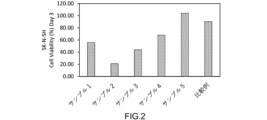
- Cell proliferation was evaluated using Cell Counting Kit-8 (CCK-8, Dojin Kagaku Kenkyusho).
- CCK-8 Cell Counting Kit-8
- siRNA siRNA
- the 96-well plate in which SK-N-SH cells had been cultured was removed, 10 ⁇ L of CCK-8 was added to each well, and the plate was incubated at 37° C. under 5% CO 2 for 1.5 hours.
- the absorbance of each well was measured at 450 nm.
- the absorbance was the average value of three wells.
- a well containing only the culture medium and CCK-8 reagent was provided as a blank. The value obtained by subtracting the absorbance of the blank from the absorbance of sample 1 was used as the measured value of sample 1.
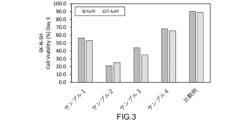
- RNA concentration test of human neuroblastoma cells using low concentrations of double-stranded RNA The double-stranded RNA used in Samples 1 to 4 shown in Table 1 was prepared. The double-stranded RNA shown in Samples 1 to 4 was dissolved in PBS so that the RNA concentration was 2 mM, and an RNA solution was prepared. The RNA solution was then further diluted 10-fold with PBS to prepare a low-concentration RNA solution with an RNA concentration of 200 ⁇ M. A test was performed in the same manner as in the cell proliferation test of human neuroblastoma cells, except that the low-concentration RNA solution was used.
- the final concentration of the double-stranded RNA added to the wells in which SK-N-SH cells were cultured was set to 0.4 ⁇ M.
- the cell viability in each test example was expressed as a percentage when the measured value of the untreated well was set to 100%.
- Figure 3 is a graph comparing the cell viability when the final concentration of added double-stranded RNA was 4.0 ⁇ M and 0.4 ⁇ M. As shown in Figure 3, the cell viability of samples 1 to 4 decreased. Furthermore, the cell viability of samples 1 to 4 was significantly lower than that of the comparative example. This shows that the double-stranded RNA of samples 1 to 4 had the function of inhibiting the proliferation of tumor cells (neuroblastoma cells) even at low concentrations. Furthermore, the double-stranded RNA of samples 1 to 4 had the same or greater cell inhibition function even at one-tenth the concentration. Therefore, the double-stranded RNA of samples 1 to 4 has a sufficient tumor cell proliferation inhibition function even at low concentrations, which can avoid non-specific expression inhibition and non-specific cell proliferation inhibition, and is fully expected to be used in clinical applications.
- ⁇ Cell proliferation test of human breast cancer cells The same procedure was used as in the cell proliferation test of human neuroblastoma cells, except that human breast cancer cells, MDA-MB-231 strain, were used as tumor cells.
- the cell viability in each test example is shown as a percentage relative to the measured value of the untreated well, which is taken as 100%, and is shown in Figure 4.
- the cell viability of samples 1 to 4 was reduced, and was significantly lower than that of the comparative example. From this, it is believed that the double-stranded RNA of samples 1 to 4 has the function of inhibiting the proliferation of tumor cells (breast cancer cells).
- ⁇ A549 strain cell proliferation test> The human lung cancer cell line A549 was used as the tumor cell.
- the cell proliferation was evaluated by removing the 96-well plate in which the A549 cells were cultured on the fourth day (two days after the addition of siRNA), adding 10 ⁇ L of CCK-8 to each well, and incubating for 2.0 hours at 37° C. under 5% CO2. The rest of the experiment was the same as in the cell proliferation test of human neuroblastoma cells.
- the cell viability in each test example is expressed as a percentage of the measured value of the untreated well, which is taken as 100%, and is shown in FIG. 5.
- sample 2 As shown in Figure 5, the cell viability of sample 2 was reduced, and was significantly lower than that of the comparative example. This suggests that the double-stranded RNA of sample 2 has the function of inhibiting the proliferation of tumor cells (lung cancer cells).
- Item 2 The double-stranded RNA according to Item 1, wherein the second strand is composed of a main sequence complementary to the first strand and an additional sequence of 2 to 4 bases added to the 3' end of the complementary main sequence.
- Item 3 The double-stranded RNA according to item 1 or 2, in which at least three of the five bases on the 3'-terminal side of the main sequence are adenine (A) and/or uracil (U).
- A adenine
- U uracil
- Item 5 The double-stranded RNA according to any one of Items 1 to 4, wherein the base sequence constituting the additional sequence is thymine-thymine (TT).
- TT thymine-thymine
- Item 7 The composition according to Item 6, wherein the cells are tumor cells.
- Item 8 The composition according to item 6 or 7, which contains a peptide fragment having cell membrane permeability that can pass through the cell membrane from the outside of the cell and introduce a foreign substance into the cytoplasm.
- Item 9 A method for inhibiting proliferation of at least one type of cell, comprising: A step of preparing a composition according to any one of items 6 to 8; and providing said composition to said cell in vitro or in vivo.
- Item 10 The method according to Item 9, wherein the biological species of the cells is the same as the biological species containing the complement component C3.
- the double-stranded RNA disclosed herein can inhibit (or suppress) cell proliferation. Therefore, by using the double-stranded RNA, it is possible to provide a composition (e.g., an antitumor agent) that inhibits the proliferation of at least one type of cell (e.g., tumor cells).
- a composition e.g., an antitumor agent
Landscapes
- Health & Medical Sciences (AREA)
- Life Sciences & Earth Sciences (AREA)
- Chemical & Material Sciences (AREA)
- Genetics & Genomics (AREA)
- Organic Chemistry (AREA)
- Engineering & Computer Science (AREA)
- Zoology (AREA)
- Biotechnology (AREA)
- Bioinformatics & Cheminformatics (AREA)
- Biomedical Technology (AREA)
- Wood Science & Technology (AREA)
- General Health & Medical Sciences (AREA)
- Biochemistry (AREA)
- Cell Biology (AREA)
- General Engineering & Computer Science (AREA)
- Microbiology (AREA)
- Toxicology (AREA)
- Gastroenterology & Hepatology (AREA)
- Biophysics (AREA)
- Medicinal Chemistry (AREA)
- Molecular Biology (AREA)
- Proteomics, Peptides & Aminoacids (AREA)
- Pharmaceuticals Containing Other Organic And Inorganic Compounds (AREA)
- Medicines That Contain Protein Lipid Enzymes And Other Medicines (AREA)
Priority Applications (1)
| Application Number | Priority Date | Filing Date | Title |
|---|---|---|---|
| JP2025567181A JPWO2025143000A1 (https=) | 2023-12-27 | 2024-12-25 |
Applications Claiming Priority (2)
| Application Number | Priority Date | Filing Date | Title |
|---|---|---|---|
| JP2023-221596 | 2023-12-27 | ||
| JP2023221596 | 2023-12-27 |
Publications (1)
| Publication Number | Publication Date |
|---|---|
| WO2025143000A1 true WO2025143000A1 (ja) | 2025-07-03 |
Family
ID=96219120
Family Applications (1)
| Application Number | Title | Priority Date | Filing Date |
|---|---|---|---|
| PCT/JP2024/045859 Pending WO2025143000A1 (ja) | 2023-12-27 | 2024-12-25 | C3 rna配列に基づく新規二本鎖rna及びその利用 |
Country Status (2)
| Country | Link |
|---|---|
| JP (1) | JPWO2025143000A1 (https=) |
| WO (1) | WO2025143000A1 (https=) |
Citations (3)
| Publication number | Priority date | Publication date | Assignee | Title |
|---|---|---|---|---|
| JP2004520287A (ja) * | 2000-11-28 | 2004-07-08 | ユニバーシティ オブ バージニア パテント ファウンデーション | 抗C3b(i)抗体を用いる癌の予防および治療方法 |
| JP2009521234A (ja) * | 2005-12-22 | 2009-06-04 | エクセジェニックス、インク.ディー/ビー/エー オプコ ヘルス、インク. | 補体系を制御する組成および方法 |
| WO2022251484A1 (en) * | 2021-05-26 | 2022-12-01 | Apellis Pharmaceuticals, Inc. | Treatment of complement-mediated disorders |
Family Cites Families (1)
| Publication number | Priority date | Publication date | Assignee | Title |
|---|---|---|---|---|
| JP2023013932A (ja) * | 2021-07-14 | 2023-01-26 | 東亞合成株式会社 | SARS-CoV-2 RNA配列に基づく新規siRNA及びその利用 |
-
2024
- 2024-12-25 JP JP2025567181A patent/JPWO2025143000A1/ja active Pending
- 2024-12-25 WO PCT/JP2024/045859 patent/WO2025143000A1/ja active Pending
Patent Citations (3)
| Publication number | Priority date | Publication date | Assignee | Title |
|---|---|---|---|---|
| JP2004520287A (ja) * | 2000-11-28 | 2004-07-08 | ユニバーシティ オブ バージニア パテント ファウンデーション | 抗C3b(i)抗体を用いる癌の予防および治療方法 |
| JP2009521234A (ja) * | 2005-12-22 | 2009-06-04 | エクセジェニックス、インク.ディー/ビー/エー オプコ ヘルス、インク. | 補体系を制御する組成および方法 |
| WO2022251484A1 (en) * | 2021-05-26 | 2022-12-01 | Apellis Pharmaceuticals, Inc. | Treatment of complement-mediated disorders |
Non-Patent Citations (2)
| Title |
|---|
| LISOWIEC-WACHNICKA JOLANTA; ZNOSKO BRENT M.; PASTERNAK ANNA: "Contribution of 3′T and 3′TT overhangs to the thermodynamic stability of model siRNA duplexes", BIOPHYSICAL CHEMISTRY, ELSEVIER, AMSTERDAM, NL, vol. 246, 1 January 1900 (1900-01-01), NL , pages 35 - 39, XP085589407, ISSN: 0301-4622, DOI: 10.1016/j.bpc.2018.12.006 * |
| TAKAHASHI TOMOKO ET AL.: "Application of RNA interference method to nucleic acid medicine (1)", JOURNAL OF NUCLEIC ACID THERAPEUTICS SOCIETY OF JAPAN, JP, vol. 21, no. 1, 1 January 2017 (2017-01-01), JP, pages 14 - 21, XP009564185 * |
Also Published As
| Publication number | Publication date |
|---|---|
| JPWO2025143000A1 (https=) | 2025-07-03 |
Similar Documents
| Publication | Publication Date | Title |
|---|---|---|
| RU2489167C2 (ru) | Модифицированная липидом двухцепочечная рнк, обладающая эффектом рнк-интерференции | |
| EP2264167B1 (en) | Double-stranded lipid-modified rna having high rna interference effect | |
| CN102753187A (zh) | 肽-dicer底物试剂及其特异性抑制基因表达的方法 | |
| JP2023013932A (ja) | SARS-CoV-2 RNA配列に基づく新規siRNA及びその利用 | |
| KR20220020378A (ko) | 종양 치료용 약물 조성물, 키트 및 방법 | |
| JP2009513487A (ja) | 細胞溶解を誘発するための二本鎖リボ核酸の使用 | |
| EP3119887B1 (en) | Improved small interfering ribonucleic acid molecules | |
| WO2009143277A2 (en) | Compositions comprising hscn9a sirna and methods of use thereof | |
| WO2025143000A1 (ja) | C3 rna配列に基づく新規二本鎖rna及びその利用 | |
| WO2025143001A1 (ja) | C5 rna配列に基づく新規二本鎖rna及びその利用 | |
| WO2025142999A1 (ja) | ペリオスチン rna配列に基づく新規二本鎖rna及びその利用 | |
| CN120659877A (zh) | 产品和组合物 | |
| WO2025159163A1 (ja) | App rna配列に基づく新規二本鎖rna及びその利用 | |
| US20100279919A1 (en) | Compositions comprising human integrin-linked kinase-sirna and methods of use thereof | |
| WO2026048822A1 (ja) | Mapt rna配列に基づく新規二本鎖rna及びその利用 | |
| WO2025254047A1 (ja) | アンドロゲン受容体 rna配列に基づく新規二本鎖rna及びその利用 | |
| WO2026028973A1 (ja) | L-pgds rna配列に基づく新規二本鎖rna及びその利用 | |
| WO2025110115A1 (ja) | Cxcl12 rna配列に基づく新規二本鎖rna及びその利用 | |
| WO2025234433A1 (ja) | Semaphorin-3a rna配列に基づく新規二本鎖rna及びその利用 | |
| WO2026048718A1 (ja) | Psapを標的とした二本鎖rna及びその利用 | |
| CN118480552B (zh) | 一种靶向CEBPA基因表达的saRNA及其用途 | |
| WO2026088997A1 (ja) | Tdp-43を標的とした二本鎖rna及びその利用 | |
| US20250129368A1 (en) | siRNA based on RNA sequence of SARS-CoV-2 and use thereof | |
| WO2024190329A1 (ja) | 組成物およびその利用 | |
| CN111154755A (zh) | 一种双链寡核苷酸dna及其应用 |
Legal Events
| Date | Code | Title | Description |
|---|---|---|---|
| 121 | Ep: the epo has been informed by wipo that ep was designated in this application |
Ref document number: 24912886 Country of ref document: EP Kind code of ref document: A1 |
|
| ENP | Entry into the national phase |
Ref document number: 2025567181 Country of ref document: JP Kind code of ref document: A |