WO2025142984A1 - 作業車両及び作業支援システム - Google Patents
作業車両及び作業支援システム Download PDFInfo
- Publication number
- WO2025142984A1 WO2025142984A1 PCT/JP2024/045822 JP2024045822W WO2025142984A1 WO 2025142984 A1 WO2025142984 A1 WO 2025142984A1 JP 2024045822 W JP2024045822 W JP 2024045822W WO 2025142984 A1 WO2025142984 A1 WO 2025142984A1
- Authority
- WO
- WIPO (PCT)
- Prior art keywords
- harvester
- work
- vehicle
- bucket
- control device
- Prior art date
- Legal status (The legal status is an assumption and is not a legal conclusion. Google has not performed a legal analysis and makes no representation as to the accuracy of the status listed.)
- Pending
Links
Images













Classifications
-
- A—HUMAN NECESSITIES
- A01—AGRICULTURE; FORESTRY; ANIMAL HUSBANDRY; HUNTING; TRAPPING; FISHING
- A01D—HARVESTING; MOWING
- A01D90/00—Vehicles for carrying harvested crops with means for selfloading or unloading
- A01D90/14—Adaptations of gearing for driving, loading or unloading means
-
- A—HUMAN NECESSITIES
- A01—AGRICULTURE; FORESTRY; ANIMAL HUSBANDRY; HUNTING; TRAPPING; FISHING
- A01D—HARVESTING; MOWING
- A01D90/00—Vehicles for carrying harvested crops with means for selfloading or unloading
- A01D90/16—Vehicles for carrying harvested crops with means for selfloading or unloading self-propelled
Definitions
- Patent Document 1 exemplifies cooperative work between a combine harvester and a tractor as moving objects, with the tractor towing a transport tank (container) for transporting the crop (grains, transport material) harvested by the combine harvester.
- the vertical positions of the container and the device that transports the transported goods do not match, making it difficult to receive the transported goods from the device.
- a work vehicle includes a vehicle body, a container capable of storing an object handed over from a device for transporting the object, and a lifting device capable of raising and lowering the container relative to the vehicle body, and the lifting device causes the object from the device for transporting the object to be stored in the container while the container is raised.
- the device for transporting the transported object may be a harvester, the transported object may be crops harvested in a field by the harvester, and the lifting device may store the crops from the harvester in the storage body while raising the storage body.
- the lifting device may be a boom attached to the front of the vehicle body so that it can swing up and down, and the container may be a bucket attached to the boom so that its position can be changed.
- the boom may face the opening of the bucket upward, and store the harvested crop from the harvester in the bucket.
- the work vehicle may be equipped with a coupling device that can couple a work implement for performing agricultural work to the vehicle body.
- the work vehicle includes a traveling device that supports the vehicle body so that it can travel, and a sensing device that senses the positional relationship between the vehicle body and the harvester, and the traveling device may travel in coordination with the harvester based on the sensing results of the sensing device.
- the traveling device may maintain a predetermined distance from the harvester based on the sensing results of the sensing device and travel in coordination with the harvester.
- the working device may perform farm work other than storing the harvested crop.
- the working device may be a tilling device for performing tilling work or a tilling device for performing tilling work.
- the work assistance system may include the work vehicle and the harvester.
- the work support system includes a transport vehicle that travels in coordination with the harvester and/or the work vehicle, and that stores the harvested product discharged from the harvester separately from the bucket and transports the harvested product.
- a transport vehicle that travels in coordination with the harvester and/or the work vehicle, and that stores the harvested product discharged from the harvester separately from the bucket and transports the harvested product.
- the transport vehicle performs the coordinated travel to receive the harvested product from the harvester, and when the remaining capacity of the transport vehicle is less than the predetermined value, the work vehicle performs the coordinated travel to receive the harvested product from the harvester in the bucket instead of the transport vehicle.
- the harvester may be a combine that harvests grain from the field.
- the above-mentioned work vehicle and work support system allow the transported goods handed over from the transporting device to be properly stored in the container.
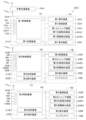
- FIG. 1 is a configuration diagram of a work support system according to a first embodiment.
- FIG. 2 is a side view showing an example of a harvester in the first embodiment.
- FIG. 2 is a plan view showing an example of a harvester in the first embodiment.
- FIG. 2 is a side view showing an example of a transporter in the first embodiment.
- FIG. 2 is a diagram showing an example of a first travel route in the first embodiment.
- 11 is a diagram showing an example in which the harvester moves to a stop position in the first embodiment.
- FIG. 11A to 11C are diagrams showing another example in which the harvester moves to a stop position in the first embodiment.
- FIG. 4 is a diagram showing an example of a second travel route in the first embodiment.
- FIG. 2 is a diagram showing an example of a road map in the first embodiment.
- 5 is a flowchart showing an example of a process for defining a guided route including a guided position, which is executed by the work assistance device in the first embodiment.
- FIG. 4 is a diagram for explaining the definition of a guide position in the first embodiment.
- 5 is a flowchart showing an example of a process for defining a waiting route including a waiting position, which is executed by the work support device in the first embodiment.
- FIG. 11 is a configuration diagram of a work support system according to a second embodiment.
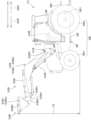
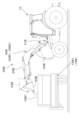
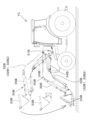
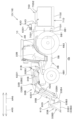
- FIG. 11 is a side view showing an example of a work vehicle according to a second embodiment.
- FIG. 11 is a side view showing an example of a work vehicle according to a second embodiment.
- FIG. 11 is a side view showing an example of a work vehicle according to a second embodiment.
- the first control device 20A is a processing circuit including one or more processors.
- the first control device 20A is a controller for the harvester 1A and performs various controls related to the harvester 1A.
- the first control device 20A is communicatively connected to various devices mounted on the harvester 1A via an on-board network N1 such as CAN, ISOBUS, LIN, or FlexRay.
- N1 such as CAN, ISOBUS, LIN, or FlexRay.
- the first control device 20A performs control processing (operation) of the prime mover 4A and the transmission 5A, etc., based on a signal (operation signal) input from the first operating device 22A.
- the first control device 20A controls the drive, stop, and rotation speed of the prime mover 4A.
- the first control device 20A controls the transmission 5A to switch the operating speed and operating direction of the traveling device 6A, change the vehicle speed of the harvester 1A (body 3A), and switch between forward and reverse movement of the harvester 1A.
- the first control device 20A includes one or more memories, various analog circuits, various digital circuits, etc.
- the one or more memories store (store) software programs and various data to be executed by one or more processors.
- the first control device 20A can read software programs from one or more memories using one or more processors, and execute various processes based on the software programs.
- the first control device 20A may also be able to execute various processes based on predetermined logic circuits using one or more processors.
- the engine 4B, the transmission 5B, or the braking device of the traveling device 6B is actuated, and the work vehicle 1C can run and stop by operating the traveling device 6B.
- the second control device 20B controls the engine 4B, the transmission 5B, and the braking device, and operates the traveling device 6B, allowing the work vehicle 1C to run and stop automatically.
- the second sensing device 24B is a device that senses the work vehicle 1C.
- the second sensing device 24B includes a second position detection device 24B1 that detects a second vehicle body position VP2 of the work vehicle 1C.
- the second sensing device 24B also includes a second distance detection device 24B2 that detects the distance between the work vehicle 1C and another object.
- the second position detection device 24B1 receives satellite signals from a satellite positioning system by a GPS antenna, and detects the second vehicle body position VP2 of the work vehicle 1C by the satellite signals.
- the second vehicle body position VP2 detected by the second position detection device 24B1 is the current position of the work vehicle 1C.
- the second vehicle body position VP2 is positioning information such as data indicated by latitude and longitude, or data indicated by coordinates (X axis, Y axis).
- the second vehicle body position VP2 is, for example, the own position of the second position detection device 24B1 or a position obtained by correcting the own position of the second position detection device 24B1 to a predetermined position (reference point) of the work vehicle 1C (or work machine 1B).
- the third storage device 102 also stores machine information related to the harvester 1A and the work vehicle 1C, and equipment information related to the implement 15B connected to the work vehicle 1C.
- the machine information related to the harvester 1A and the work vehicle 1C includes information indicating the identification information, type, dimensional information, specifications, etc. of the harvester 1A and the work vehicle 1C.
- the equipment information includes information indicating the identification information, type, dimensional information, specifications, second working width W2 (the widthwise length of the work performed by the implement 15B), etc. of each implement 15B.
- the third communication device 103 is a communication interface of the work support device 100 and includes a communication circuit.
- the third communication device 103 performs wireless communication with the harvester 1A and the work machine 1B, for example, via Wi-Fi (Wireless Fidelity, registered trademark) of the IEEE 802.11 series, which is a communication standard, a mobile phone communication network, or a data communication network.
- the third communication device 103 wirelessly communicates with the first communication device 23A and the second communication device 23B, and inputs and outputs (transmits and receives) various information, data, signals, etc.
- the third communication device 103 is an output device (output interface) that outputs the results of arithmetic processing of the third control device 101 to the outside.
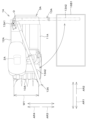
- the harvester 1A in the automatic mode when the harvester 1A in the automatic mode performs harvesting work by automatically traveling along the first traveling route R1 in the field H and moves to the stop position SP1, the working machine 1B (transporter) in the automatic mode moves to the vicinity of the stop position SP1 by automatically traveling along the second traveling route R2. Also, when the working machine 1B moves to the vicinity of the stop position SP1, the harvester 1A (first control device 20A) controls each control valve based on the sensing result of the first sensing device 24A, etc., to drive the turning motor and the hydraulic cylinder, and align the horizontal conveying section 13A2 with the second storage section 16B1 as shown in FIG. 3.
- the first control device 20A drives the vertical feed mechanism and the horizontal feed mechanism to discharge the harvested product from the vertical cylinder of the horizontal conveying section 13A2 to the second storage section 16B1.
- the first traveling route R1 and the second traveling route R2 will be described in detail below.
- FIG. 5 is a diagram showing an example of the first travel route R1 in the first embodiment.
- the first travel route R1 is defined on a map (field map M1) showing the field H, and in this embodiment, is defined by the first control device 20A.
- the first control device 20A defines the first travel route R1
- the first control device 20A only needs to be able to automatically travel the harvester 1A based on at least the first vehicle body position VP1 and the first travel route R1, and may be defined by another control device other than the first control device 20A (for example, the work support device 100 or a mobile terminal carried by the worker).
- the first control device 20A defines the first travel route R1 with the following goals: (P1) to prevent the occurrence of unworked areas where the harvester 1A does not perform harvesting work; (P2) to avoid, as much as possible, the setting of turning points that require the harvester 1A to turn; (P3) to shorten, as much as possible, the non-working distance that is the distance that the harvester 1A travels without performing harvesting work; and (P4) to shorten, as much as possible, the travel distance for the harvester 1A to move to the position (stop position SP1) where the harvester 1A discharges the harvested product (grain) in the first storage section 12A from the discharge device 13A.
- these goals are merely examples, and at least one of them is emphasized. Also, goals other than the above (P1) to (P4) may be emphasized.
- the harvester 1A first performs harvesting work (circular travel) by traveling in a region E1 (first region) on the outer periphery of the field H along the contour (boundary line) of the field H, and the first control device 20A defines the region in which harvesting work is performed by circular travel as the first region E1 based on the first vehicle body position VP1 and the first working width W1 during circular travel.
- the first control device 20A also defines the region of the field H inside the first region E1 as a second region E2 in which the harvester 1A performs harvesting work by automatic travel.
- the first travel route R1 includes a circuit line L1 along which the harvester 1A makes a circular travel and an inner line L2 defined inside the circuit line L1.
- the circuit line L1 is a route that makes one or more revolutions around the inside of the contour of the field H.
- the circuit line L1 is defined in a roughly spiral shape so that the harvester 1A makes one or more revolutions (e.g., two or three revolutions).
- first travel route R1 described above using FIG. 5 is merely an example and is not limited to this.
- the first travel route R1 may not include the circuit line L1, and the operator seated in the driver's seat 2A may manually steer the harvester 1A to travel around the field H.
- the harvester 1A stops traveling when the remaining capacity of the first storage section 12A, which stores harvested grains (harvest product), falls below a predetermined value (first threshold). Specifically, when the remaining capacity of the harvester 1A falls below the first threshold, the harvester 1A stops traveling at a location where the discharge device 13A (particularly the vertical cylinder body) is located within the road FR. In other words, when the remaining capacity of the harvester 1A falls below the first threshold, the harvester 1A stops traveling at a location where the movable range of the discharge device 13A is located within the road FR.
- first threshold a predetermined value
- the first control device 20A stops traveling at a location where the movable range of the discharge device 13A is located within the road FR, i.e., outside the field H, based on the dimensions of the harvester 1A in the machine information of the first storage device 21A and the first vehicle body position VP1.
- the first control device 20A determines whether or not grain needs to be discharged based on the remaining capacity of the first storage unit 12A, but it may also determine whether or not grain needs to be discharged based on the end of the grain stored in the first storage unit 12A.
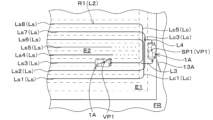
- FIG. 6B is a diagram showing another example in which the harvester 1A moves to the stop position SP1 in the first embodiment.
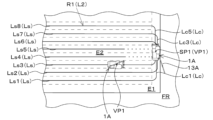
- the first control device 20A determines that it is necessary to discharge grain, it defines an exit path L3 for moving to the stop position SP1 and a return path L4 for returning from the stop position SP1 to the position where the work was interrupted, in addition to the first travel route R1.
- the first control device 20A defines, as the exit path L3 and the return path L4, paths along which the harvester 1A travels in the worked area E3 from the current first vehicle body position VP1 to the stop position SP1.
- the exit path L3 is connected to the end of the third straight path Ls3, and the return path L4 is connected to the beginning of the eighth straight path Ls8.
- the first control device 20A automatically drives the harvester 1A to the stop position SP1, but the first display device 25A displays the remaining capacity or yield of the first storage section 12A, and if the operator checks the remaining capacity, etc. displayed on the first display device 25A and determines that it is necessary to unload the grain, the operator may manually steer the harvester 1A to move it close to the outline of the field H.
- the first control device 20A determines that it is necessary to unload the grain and the harvester 1A has been stopped for a predetermined period of time or longer, or when it determines that it is necessary to unload the grain and the parking brake included in the first operating device 22A has been operated, the first control device 20A causes the first communication device 23A to transmit arrival information to the work support device 100.
- FIG. 7 is a diagram showing an example of the second travel route R2 in the first embodiment.
- the second travel route R2 is defined on a road map M2, and in this embodiment, is defined by the work support device 100 (the third control device 101).
- the third control device 101 defines a guidance position SP2 (in other words, the end point of the second travel route R2) on the road FR around the field H, which guides the work machine 1B to the vicinity of the harvester 1A.
- the third control device 101 defines a second travel route R2 (hereinafter referred to as a guidance route L5) from the current second vehicle position VP2 to the guidance position SP2 based on the guidance position SP2, the current second vehicle position VP2, and the road map M2, and outputs the second travel route R2 to the work machine 1B via the third communication device 103.
- a guidance route L5 a second travel route R2 (hereinafter referred to as a guidance route L5) from the current second vehicle position VP2 to the guidance position SP2 based on the guidance position SP2, the current second vehicle position VP2, and the road map M2, and outputs the second travel route R2 to the work machine 1B via the third communication device 103.
- the work assistance device 100 defines the guidance route L5, but the work assistance device 100 only needs to define at least the guidance position SP2, and the second control device 20B, the second display device 25B, etc. may be configured to define the guidance route L5 based on the guidance position SP2, the current second vehicle body position VP2, and the road map M2.
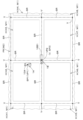
- FIG. 8 is a diagram showing an example of the road map M2 in the first embodiment.
- the road map M2 stored in the third storage device 102 defines a plurality of vertices V (nodes) based on the shape of the road FR.
- the vertices V are defined at inflection points, intersections, etc. of the road FR. Also, for example, the vertices V are defined at the center of the width direction of each road FR.
- the third storage device 102 stores a management table that associates the identification information of each vertex V with the position information of the vertex V.
- the administrator may manually define the vertices V on the road map M2 by operating a management terminal (such as a personal computer) that is communicatively connected to the work support device 100, or the third control device 101 may automatically define the vertices V based on the shape of the road FR included in the road map M2 and predetermined conditions.
- a management terminal such as a personal computer
- the road map M2 also defines a number of section routes SR that connect a number of vertices V.
- the section route SR is a straight line route with one end connected to one vertex V and the other end connected to another vertex V.
- the section route SR is also defined as a route that connects one vertex V and another vertex V on the road FR. As shown in FIG. 8, the section route SR is defined on the road FR without crossing the field H.
- the third control device 101 defines the guidance position SP2 on the road FR based on the vertex V and the stop position SP1. Specifically, the third control device 101 defines the guidance position SP2 on the section route SR based on the multiple section routes SR and the stop position SP1. The third control device 101 also defines the guidance position SP2 on a specific section route SR among the multiple section routes SR based on the positional relationship between the multiple section routes SR and the stop position SP1. The third control device 101 defines the guidance position SP2 on the section route SR that is closest to the stop position SP1 among the multiple section routes SR, and defines the guidance position SP2 at the position of the section route SR that is closest to the stop position SP1.
- FIG. 9 is a flowchart showing an example of a process for defining the guided route L5 including the guided position SP2 executed by the work assistance device 100 in the first embodiment. Each step in FIG. 9 is executed by the third control device 101 in accordance with a software program stored in the memory or the third storage device 102.
- the third control device 101 identifies (obtains) the current first vehicle body position VP1 of the harvester 1A from the arrival information, i.e., the position information of the stop position SP1 (S12).
- the third control device 101 identifies the stop position SP1 (S12)
- it requests the current second vehicle body position VP2 from the work machine 1B via the third communication device 103 and the second communication device 23B (S13).
- the third control device 101 identifies one or more section routes SR located around the first vehicle body position VP1 from the multiple section routes SR based on the map information (road map M2) in the third storage device 102 and the first vehicle body position VP1 (S15).
- the harvester 1A is located in the second field H2 of the first field H1 to the eighth field H8, so the third control device 101 identifies multiple section routes SR around the second field H2.
- the third control device 101 After calculating the judgment distance D for each perpendicular line PL (S17), the third control device 101 identifies the intersection point corresponding to the perpendicular line PL with the shortest judgment distance D, and defines the intersection point as the guidance position SP2 (S18).
- the third control device 101 When the third control device 101 defines the guided position SP2 (S18), it calculates a route from the second vehicle body position VP2 to the guided position SP2 based on the guided position SP2, the current second vehicle body position VP2, and the road map M2, and defines the guided route L5 (S19). At this time, the third control device 101 defines the guided route L5 with the following goals: (P11) shortening the travel distance and/or travel time of the work machine 1B as much as possible, and (P12) avoiding, as much as possible, setting turning sections that require turning operations of the work machine 1B. Note that these goals are only examples, and at least one of them is emphasized. Also, there are cases where goals other than the above (P11) and (P12) are emphasized.
- the third control device 101 identifies a plurality of section routes SR defined in the road map M2 as routes connecting the guided position SP2 and the current second vehicle body position VP2, and defines the guided route L5 based on the identified plurality of section routes SR. Specifically, the third control device 101 defines a route that passes through the identified plurality of section routes SR as the guided route L5 as a route connecting the guided position SP2 and the current second vehicle body position VP2.
- the third control device 101 defines, among these guided positions SP2, the route to the guided position SP2 that has the shortest travel distance and/or the shortest travel time from the current second vehicle body position VP2 as the guided route L5.
- the third control device 101 When the third control device 101 defines the guided route L5 (S19), it transmits (outputs) the guided route L5 including the guided position SP2 to the second communication device 23B via the third communication device 103 (S20).
- the work machine 1B to which the guided position SP2 (guided route L5) has been output acquires the guided route L5 that includes the guided position SP2, and the second control device 20B performs automatic driving based on the guided route L5 and the second vehicle body position VP2. Therefore, the work machine 1B can move by automatic driving from the current second vehicle body position VP2 to the guided position SP2.
- the first control device 20A controls the traveling device 6A and the discharge device 13A, or the second control device 20B controls the traveling device 6B, to align the discharge device 13A with the second storage section 16B1.
- the first control device 20A controls the discharge device 13A to start discharging grain into the second storage section 16B1.
- the third control device 101 identifies the intersection corresponding to the perpendicular line PL with the shortest judgment distance D and defines the intersection as the guidance position SP2.
- the guidance position SP2 may be defined based on the perpendicular line PL with the shortest judgment distance D, and its position is not limited to the intersection.
- the third control device 101 may correct the guidance position SP2 by shifting it in the direction in which the perpendicular line PL extends based on the machine information (movable range of the discharge device 13A, dimensions of the work vehicle 1C, etc.) stored in the third storage device 102.
- the second control device 20B' when grain is discharged from the second storage section 16B1 and the remaining capacity changes from a state where it is less than a predetermined value (fourth threshold) to a predetermined value (a fifth threshold value greater than the fourth threshold value) or more, the second control device 20B' outputs a resume signal to the work support device 100 indicating that cooperative traveling is to be resumed. At this time, the second control device 20B' moves to the vicinity of the harvester 1A while avoiding the completed work area E3 based on the first vehicle body position VP1 acquired from the work support device 100, and resumes cooperative traveling.
- the transport vehicle 1B' performs, interrupts, or resumes cooperative traveling depending on the remaining capacity of the second storage section 16B1.
- cooperative traveling may be performed, interrupted, or resumed based on the yield of the second storage section 16B1 instead of the remaining capacity of the second storage section 16B1.
- the work vehicle 1C performs second coordinated driving in which the work vehicle 1C performs work using the work device 15B2 in the work completed area E3 while traveling in coordination with the harvester 1A and/or transporter 1B' and avoids contact with the harvester 1A and transporter 1B'.
- the second control device 20B of the work vehicle 1C automatically drives and steers so as to avoid contact with the harvester 1A and transporter 1B' based on the positional relationship between the vehicle body 3B, harvester 1A, and transporter 1B' sensed by the second sensing device 24B.
- the second control device 20B automatically drives and steers with the following goals: (P41) the vehicle body 3B and the harvester 1A maintain a predetermined distance from each other and drive in coordination with the harvester 1A; (P42) the distance between the vehicle body 3B and the work vehicle 1C is maintained at a predetermined distance or more and the transporter 1B' and the work vehicle 1C do not come into contact; and (P43) the work vehicle 1C avoids driving through unworked areas where the harvester 1A is not performing harvesting work as much as possible.
- these goals are merely examples, and at least one of them is emphasized. Also, goals other than the above (P41) to (P43) may be emphasized.
- the work vehicle 1C performs the first cooperative traveling in place of the transporter 1B'.
- the work support device 100 receives an interruption signal from the transporter 1B', it starts the first cooperative traveling and outputs a switching signal to the work vehicle 1C via the third communication device 103 and the second communication device 23B, indicating an instruction to receive grain from the harvester 1A with the bucket 33B in place of the transporter 1B'.
- the second control device 20B When the second control device 20B receives the changeover signal, it switches from the second cooperative driving aimed at (P41) to (P43), etc., to the first cooperative driving aimed at (P21), (P22), etc. In other words, when the work vehicle 1C is performing work behind the transporter 1B', the work vehicle 1C that has switched to the first cooperative driving shortens the relative distance to the harvester 1A and travels closer to the harvester 1A.
- the work support device 100 outputs a first standby signal to the harvester 1A via the third communication device 103 and the first communication device 23A to have the harvester 1A wait for harvesting work.
- the first control device 20A acquires the first standby signal, it interrupts automatic driving based on the first driving route R1, and stops until the work vehicle 1C that has started the first cooperative driving approaches the vehicle body 3A and the vehicle body 3A and the work vehicle 1C are at a predetermined distance (the work vehicle 1C is located behind the vehicle body 3A, and the bucket 33B is located within the movable range of the vertical cylinder body of the discharge device 13A), and waits for the work vehicle 1C to approach.
- the work support device 100 outputs a second standby signal via the third communication device 103 and the first communication device 23A, which indicates an instruction to put the harvester 1A on standby for harvesting work.
- the first control device 20A acquires the second standby signal, it interrupts automatic driving based on the first driving route R1, and stops until the transporter 1B' that has begun cooperative driving approaches and the vehicle body 3A and the transporter 1B' are at a predetermined distance (the transporter 1B' is located behind the vehicle body 3A, and the second storage section 16B1 is located within the movable range of the vertical cylinder of the discharge device 13A), and waits for the transporter 1B' to approach.
- the cooperative driving of the work vehicle 1C, harvester 1A, and transporter 1B' in the work support system 200 described above is merely an example, and is not limited to the above example.
- the work vehicle 1C performs the first cooperative driving with the harvester 1A, and temporarily stores grain from the harvester 1A in the bucket 33B instead of the transporter 1B' that stores the grain discharged from the harvester 1A.
- the work vehicle 1C may be configured to automatically travel along a second travel route R2 dedicated to performing work with the work device 15B2, separate from the harvester 1A and the transporter 1B', and to perform the first cooperative driving when the remaining capacity of the second storage section 16B1 is less than the fourth threshold.
- the work vehicle 1C, harvester 1A, and transporter 1B' each transmit and receive vehicle body positions VP1, VP2 via the work support device 100, but the respective communication devices 23A, 23B may directly transmit and receive vehicle body positions VP1, VP2 to perform cooperative driving.
- the agricultural machine 1D of the third embodiment is a vehicle that transports grain discharged from the harvester 1A, similar to the transport vehicle 1B of the first embodiment and the work vehicle 1C of the second embodiment, but differs in that it is equipped with a transport mechanism 60D.
- FIG. 24 is a configuration diagram of a work support system 200 in the third embodiment.
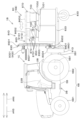
- FIGS. 25 and 26 are side views showing an example of an agricultural machine 1D in the third embodiment.
- FIG. 25 shows a state in which the lifting device 32B is lowering the container 33B
- FIG. 26 shows a state in which the lifting device 32B is raising the container 33B.
- the agricultural machine 1D is a tractor 1C equipped with a front loader 30B and a transport mechanism 60D.
- a tractor 1C equipped with a front loader 30B and a transport mechanism 60D.
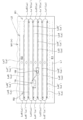
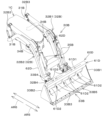
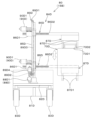
- FIG. 27 is a front perspective view showing the transport mechanism 60D and the front loader 30B.
- the agricultural machine 1D is equipped with the transport mechanism 60D and a third storage section 70D (storage section).
- the transport mechanism 60D transports grain from inside the bucket 33B to the third storage section 70D, and the third storage section 70D is capable of storing the transported grain.
- the transport mechanism 60D is supported by the boom 32B. Specifically, as shown in FIGS. 25 and 26, the transport mechanism 60D is supported by the boom 32B and the coupling device 3B1.
- the third storage section 70D is supported by the vehicle body 3B, and in this embodiment, is coupled to the coupling device 3B1.
- the conveying mechanism 60D has an introduction section 61D, a connecting pipe 62D, a pump 63D, and a discharge section 64D.
- the introduction section 61D is a duct that is attached to the bucket 33B and introduces the grain in the bucket 33B into the connecting pipe 62D.
- the introduction section 61D has a housing 61D1 with a hollow interior, an introduction hole 61D2 that connects the interior of the housing 61D1 with the interior of the bucket 33B, and a connection section 61D3 that connects the interior of the housing 61D1 with the connecting pipe 62D.
- the housing 61D1 is attached to the bucket 33B via a fixed bracket, fastening members such as bolts, or removable attachments such as clips or magnets.
- the housing 61D1 is disposed from the first side wall 33B1 to the second side wall 33B2, and in this embodiment, is attached to the top of the bucket 33B.
- the housing 61D1 protrudes upward from the bottom of the connecting wall 33B3 beyond the upper front end.
- the introduction hole 61D2 is a hole formed in the housing 61D1, and the introduction hole 61D2 is formed on the bottom side of the connecting wall 33B3 of the housing 61D1.
- the introduction hole 61D2 communicates from the bottom of the connecting wall 33B3 to the inside of the housing 61D1.
- the communicating pipe 62D is a tubular member that communicates inside the bucket 33B.
- the communicating pipe 62D is, for example, a hose made of a flexible material such as rubber or silicone, or a bellows-shaped duct hose.
- the conveying mechanism 60D has a pair of communicating pipes 62D, and one end of each of the pair of communicating pipes 62D is connected to the connection part 61D3.
- One end of the communicating pipe 62D is fixed to the connection part 61D3 by a fixing member such as a hose band.
- the other end of the communicating pipe 62D is connected to the pump 63D.
- the agricultural machine 1D performs cooperative traveling to receive grain from the harvester 1A when the remaining capacity of the third storage unit 70D is equal to or greater than a predetermined value (sixth threshold value), and when the remaining capacity falls below the predetermined value (sixth threshold value), the cooperative traveling is interrupted and the third storage unit 70D can be replaced by the transport device 80.
- the third storage unit 70D is provided with a yield sensor 70D3 that detects the amount of grain stored in the third storage unit 70D, and the yield sensor 70D3 is connected to the second control device 20B by wire or wirelessly.
- the second control device 20B calculates the remaining capacity of grain that the third storage unit 70D can store based on the detection result of the yield sensor 70D3 and a predetermined calculation formula or table stored in the second memory device 21B.
- the yield sensor 70D3 is, for example, a load cell for measuring the weight of the grain stored in the third storage unit 70D.
- the third control device 101 defines a guide position SP2 on the road FR for guiding the work vehicle 1C coupled with the transport device 80 to the vicinity of the agricultural machine 1D based on the vertex V and the stop position SP1, and outputs the guide position SP2 to the work vehicle 1C via the third communication device 103.
- the work vehicle 1C coupled with the transport device 80 moves to the guide position SP2, and the third storage section 70D of the agricultural machine 1D can be replaced by the transport device 80.
- the second control device 20B interrupts cooperative driving and replaces the third storage unit 70D using the transport device 80 depending on the remaining capacity of the third storage unit 70D.
- cooperative driving may be interrupted and the third storage unit 70D may be replaced using the transport device 80 depending on the yield of the third storage unit 70D.
- the transporting device 80 was described using the implement 15B connected to the tractor 1C as an example, but the transporting device 80 is not limited to the implement 15B as long as it can transport the third storage section 70D from the coupling device 3B1. It is also preferable that the transporting device 80 is equipped with a running device or is connected to a runnable vehicle (for example, a vehicle such as a tractor 1C or a truck) and towed.
- the transporting device 80 may also be installed in a building that stores a work vehicle 1C such as the tractor 1C or in the vicinity of the building.
- a preferred embodiment of the present invention provides a work assistance device 100, a work assistance system 200, a work assistance method, a work vehicle 1C, and an agricultural machine 1D, as described in the following items.
- the work support device 100 comprises a memory device 102 that stores map information including a road FR surrounding a field H, a calculation device 101 that defines a guidance position SP2 on the road FR based on the map information and a stopping position SP1 of the harvester 1A when the harvester 1A harvests crops in the field H stops traveling, to guide a transport vehicle 1B that transports the crops discharged from the harvester 1A to the vicinity of the harvester 1A, and an output device 103 that outputs the guidance position SP2 defined by the calculation device 101.
- the work assistance device 100 can accurately and appropriately define the guidance position SP2 with respect to the road FR.
- the map information defines a plurality of vertices V based on the shape of the road FR, and the calculation device 101 defines the guidance position SP2 on the road FR based on the vertices V and the stop position SP1.
- the work support device 100 according to item A2 can appropriately define the guidance position SP2 on the road FR according to the shape of the road FR, i.e., the shape of the field H.
- the work support device 100 according to item A3 can more appropriately define the guidance position SP2 on the road FR according to the shape of the field H.
- the work support device 100 according to item A4 can more appropriately define the guidance position SP2 on the road FR, taking into account the position of the harvester 1A that stops at the stop position SP1.
- the work support device 100 according to item A5 can define the guidance position SP2 at a position relatively close to the harvester 1A that stops at the stop position SP1.
- the work support device 100 can define the guidance position SP2 at a position closer to the harvester 1A that stops at the stop position SP1.
- the map information includes a plurality of the fields H and the roads FR surrounding the plurality of the fields H, and the calculation device 101 defines the guidance position SP2 on the roads FR surrounding the plurality of the fields H.
- the work support device 100 according to item A7 can appropriately define the guidance position SP2 even when there are multiple fields H in which the harvester 1A can perform harvesting work.
- the work support device 100 can accurately and appropriately define the position where the transport vehicle 1B waits relative to the road FR.
- the work support device 100 described in A8 cites item A7, in which the calculation device 101 preferentially defines the waiting position SP3 at the vertex V that connects to the largest number of section routes SR among the multiple vertices V based on the map information.
- the work support device 100 can define a position to which the transport vehicle 1B can be moved efficiently even when the harvester 1A is performing harvesting work in multiple fields H.
- a work support system 200 comprising the work support device 100 according to any one of items A2 to A9, the harvester 1A, and the transporter 1B.
- the work support system 200 according to item A10 can achieve the unique effects described above.
- the work support system 200 allows the transport vehicle 1B to stop appropriately on the road FR.
- the transport vehicle 1B can stop appropriately on the road FR and wait to move to the guidance position SP2.
- the harvester 1A can perform harvesting work efficiently regardless of the position of the transport vehicle 1B.
- the work support system 200 allows the harvester 1A to properly discharge the harvested product onto the transport vehicle 1B.
- the lifting device 32B raises and lowers the container 33B, so that the height of the container 33B can be changed relative to the device 1A transporting the transported goods, and the transported goods handed over from the device 1A can be appropriately stored in the container 33B.
- the lifting device 32B raises and lowers the container 33B, so that the height of the container 33B can be changed relative to the harvester 1A, and the harvested crop discharged from the harvester 1A can be appropriately stored in the container 33B.
- the work vehicle 1C according to item B8 allows the harvester 1A to perform tilling or plowing work simultaneously with the harvesting work. This allows the worker to immediately utilize the field H after the harvesting work.
- a work support system 200 comprising the work vehicle 1C described in any one of items B5 to B8 and the harvester 1A.
- the work vehicle 1C travels in coordination with the harvester 1A, and therefore can store the harvest in place of the transporter 1B when the transporter 1B is no longer able to store the harvest. This makes it possible to shorten the time during which the harvest discharged from the harvester 1A cannot be stored, and to prevent delays in the harvesting work of the harvester 1A due to the work of storing the harvest.
- the agricultural machine 1D according to item C1 can transport an object out of the bucket 33B without changing the position of the bucket 33B while storing the object in the bucket 33B. This improves the efficiency of the work of storing objects using the bucket 33B.
- the bucket 33B can be raised and lowered depending on the position to store the object, while the transport mechanism 60D can transport the object in the bucket 33B. This can further improve the efficiency of the work of storing objects using the bucket 33B.
- the agricultural machine 1D according to item C3 can appropriately transport objects from the rising and lowering bucket 33B using the transport mechanism 60D.
- the agricultural machine 1D according to item C4 has a relatively simple configuration and can supply objects inside the bucket 33B to the outside of the bucket 33B while preventing objects from leaking out of the bucket 33B.
- the communication pipe 62D can transport the object in the bucket 33B without interfering with the swinging of the boom 32B.
- (Item C6) The agricultural machine 1D according to any one of items C2 to C5, comprising a storage section 70D supported by the vehicle body 3B and capable of storing the object, wherein the transport mechanism 60D transports the object from within the bucket 33B to the storage section 70D.
- the object transported from inside the bucket 33B can be stored in the storage section 70D. Therefore, the agricultural machine 1D can transport the object stored in the storage section 70D.
- the agricultural machine 1D according to item C7 can perform agricultural work while also transporting objects conveyed from within the bucket 33B.
- the bucket 33B can store an object at the front of the vehicle body 3B, while the object inside the bucket 33B can be stored at the rear of the vehicle body 3B. This makes it possible to prevent deterioration of the front-to-rear balance caused by the bucket 33B and the storage section 70D each storing an object.
- the agricultural machine 1D according to item C9 can receive the harvested crop from the harvester 1A with the bucket 33B, while also transporting the harvested crop received by the bucket 33B (stored in the bucket 33B) to another location. This improves the operability of the harvesting operation of the harvester 1A.
- the storage section 70D can be replaced using the transport device 80, thereby improving the workability of the agricultural machine 1D.
- a work support system 200 comprising: the agricultural machine 1D according to item C10; and a transport device 80 that transports the storage unit 70D detached from the coupling device 3B1.
- the work assistance system 200 according to item C11 can achieve the unique effects described above.
Landscapes
- Life Sciences & Earth Sciences (AREA)
- Environmental Sciences (AREA)
- Guiding Agricultural Machines (AREA)
Priority Applications (1)
| Application Number | Priority Date | Filing Date | Title |
|---|---|---|---|
| JP2025567165A JPWO2025142984A1 (https=) | 2023-12-26 | 2024-12-25 |
Applications Claiming Priority (2)
| Application Number | Priority Date | Filing Date | Title |
|---|---|---|---|
| JP2023-219215 | 2023-12-26 | ||
| JP2023219215 | 2023-12-26 |
Publications (1)
| Publication Number | Publication Date |
|---|---|
| WO2025142984A1 true WO2025142984A1 (ja) | 2025-07-03 |
Family
ID=96219179
Family Applications (1)
| Application Number | Title | Priority Date | Filing Date |
|---|---|---|---|
| PCT/JP2024/045822 Pending WO2025142984A1 (ja) | 2023-12-26 | 2024-12-25 | 作業車両及び作業支援システム |
Country Status (2)
| Country | Link |
|---|---|
| JP (1) | JPWO2025142984A1 (https=) |
| WO (1) | WO2025142984A1 (https=) |
Citations (4)
| Publication number | Priority date | Publication date | Assignee | Title |
|---|---|---|---|---|
| JPS60172863U (ja) * | 1984-04-24 | 1985-11-15 | 井関農機株式会社 | 農用トラクタ−のフロント載置装置 |
| JPH0190857U (https=) * | 1987-11-30 | 1989-06-14 | ||
| JP2002186348A (ja) * | 2000-12-20 | 2002-07-02 | Yanmar Agricult Equip Co Ltd | 穀物貯蔵施設への穀物運搬システム |
| JP3427835B2 (ja) * | 2001-11-16 | 2003-07-22 | 井関農機株式会社 | 作業車 |
-
2024
- 2024-12-25 JP JP2025567165A patent/JPWO2025142984A1/ja active Pending
- 2024-12-25 WO PCT/JP2024/045822 patent/WO2025142984A1/ja active Pending
Patent Citations (4)
| Publication number | Priority date | Publication date | Assignee | Title |
|---|---|---|---|---|
| JPS60172863U (ja) * | 1984-04-24 | 1985-11-15 | 井関農機株式会社 | 農用トラクタ−のフロント載置装置 |
| JPH0190857U (https=) * | 1987-11-30 | 1989-06-14 | ||
| JP2002186348A (ja) * | 2000-12-20 | 2002-07-02 | Yanmar Agricult Equip Co Ltd | 穀物貯蔵施設への穀物運搬システム |
| JP3427835B2 (ja) * | 2001-11-16 | 2003-07-22 | 井関農機株式会社 | 作業車 |
Also Published As
| Publication number | Publication date |
|---|---|
| JPWO2025142984A1 (https=) | 2025-07-03 |
Similar Documents
| Publication | Publication Date | Title |
|---|---|---|
| US11497157B2 (en) | Agricultural work machine | |
| US11895937B2 (en) | Slip determination system, travel path generation system, and field work vehicle | |
| CN111343854B (zh) | 作业车、用于作业车的行驶路径选择系统以及行驶路径计算系统 | |
| US8155844B2 (en) | Implement lift apparatus control system position sensing | |
| US6216071B1 (en) | Apparatus and method for monitoring and coordinating the harvesting and transporting operations of an agricultural crop by multiple agricultural machines on a field | |
| JP7173858B2 (ja) | 植播系作業機、及び、植播系作業機の自動走行制御システム | |
| CN112585424A (zh) | 外形形状计算系统、外形形状计算方法、外形形状计算程序、以及记录有外形形状计算程序的记录介质、田地地图制作系统、田地地图制作程序、记录有田地地图制作程序的记录介质、以及田地地图制作方法 | |
| CN113039501A (zh) | 自动行驶控制系统、自动行驶控制程序、记录有自动行驶控制程序的记录介质、自动行驶控制方法、控制装置、控制程序、记录有控制程序的记录介质、控制方法 | |
| JP7117985B2 (ja) | 自動走行制御システム | |
| CN113015427B (zh) | 自动转向系统、自动转向方法以及自动转向程序 | |
| JP7175743B2 (ja) | 植播系作業機の自動走行制御システム | |
| CN114786463A (zh) | 作业机 | |
| JP7560412B2 (ja) | 農業支援システム、農業機械の呼び出し経路を作成する装置および方法 | |
| WO2025142984A1 (ja) | 作業車両及び作業支援システム | |
| WO2025142985A1 (ja) | 農業機械及び作業支援システム | |
| WO2025142983A1 (ja) | 作業支援装置、作業システム、及び作業支援方法 | |
| JP6694017B2 (ja) | 田植機 | |
| CN115334869A (zh) | 农作业机、农作业机控制程序、记录有农作业机控制程序的记录介质、农作业机控制方法 | |
| CN109936976A (zh) | 联合收割机、收割机、以及自动转向系统 | |
| EP4699423A1 (en) | Working vehicle | |
| JP7734843B2 (ja) | 制御システム、制御方法および運搬車 | |
| JP7660497B2 (ja) | 自動走行システム | |
| EP4581916A1 (en) | Work assistance device, working machine, and work assisting method | |
| JP7770291B2 (ja) | 作業車 | |
| US20260000001A1 (en) | Assist system for working machine and method of assisting working machine |
Legal Events
| Date | Code | Title | Description |
|---|---|---|---|
| 121 | Ep: the epo has been informed by wipo that ep was designated in this application |
Ref document number: 24912870 Country of ref document: EP Kind code of ref document: A1 |
|
| ENP | Entry into the national phase |
Ref document number: 2025567165 Country of ref document: JP Kind code of ref document: A |
|
| WWE | Wipo information: entry into national phase |
Ref document number: 2025567165 Country of ref document: JP |