WO2025142208A1 - 積層コイル部品及び積層コイル部品の製造方法 - Google Patents
積層コイル部品及び積層コイル部品の製造方法 Download PDFInfo
- Publication number
- WO2025142208A1 WO2025142208A1 PCT/JP2024/041063 JP2024041063W WO2025142208A1 WO 2025142208 A1 WO2025142208 A1 WO 2025142208A1 JP 2024041063 W JP2024041063 W JP 2024041063W WO 2025142208 A1 WO2025142208 A1 WO 2025142208A1
- Authority
- WO
- WIPO (PCT)
- Prior art keywords
- laminate
- conductor
- external electrode
- land
- coil component
- Prior art date
- Legal status (The legal status is an assumption and is not a legal conclusion. Google has not performed a legal analysis and makes no representation as to the accuracy of the status listed.)
- Pending
Links
Images







Classifications
-
- H—ELECTRICITY
- H01—ELECTRIC ELEMENTS
- H01F—MAGNETS; INDUCTANCES; TRANSFORMERS; SELECTION OF MATERIALS FOR THEIR MAGNETIC PROPERTIES
- H01F17/00—Fixed inductances of the signal type
-
- H—ELECTRICITY
- H01—ELECTRIC ELEMENTS
- H01F—MAGNETS; INDUCTANCES; TRANSFORMERS; SELECTION OF MATERIALS FOR THEIR MAGNETIC PROPERTIES
- H01F27/00—Details of transformers or inductances, in general
- H01F27/28—Coils; Windings; Conductive connections
- H01F27/29—Terminals; Tapping arrangements for signal inductances
-
- H—ELECTRICITY
- H01—ELECTRIC ELEMENTS
- H01F—MAGNETS; INDUCTANCES; TRANSFORMERS; SELECTION OF MATERIALS FOR THEIR MAGNETIC PROPERTIES
- H01F41/00—Apparatus or processes specially adapted for manufacturing or assembling magnets, inductances or transformers; Apparatus or processes specially adapted for manufacturing materials characterised by their magnetic properties
- H01F41/02—Apparatus or processes specially adapted for manufacturing or assembling magnets, inductances or transformers; Apparatus or processes specially adapted for manufacturing materials characterised by their magnetic properties for manufacturing cores, coils, or magnets
- H01F41/04—Apparatus or processes specially adapted for manufacturing or assembling magnets, inductances or transformers; Apparatus or processes specially adapted for manufacturing materials characterised by their magnetic properties for manufacturing cores, coils, or magnets for manufacturing coils
Definitions
- the present invention relates to a laminated coil component and a method for manufacturing a laminated coil component.
- the coil conductor and the terminal electrode are connected via a lead-out conductor composed of a conductor-filled through hole and a lead-out electrode.
- a lead-out conductor composed of a conductor-filled through hole and a lead-out electrode.
- the first aspect of the manufacturing method of the laminated coil component of the present invention includes a step of preparing a laminate having an internal electrode formed by stacking a plurality of insulating layers in a stacking direction, a step of performing a barrel polishing process on the laminate, and a step of forming an external electrode on the outer surface of the barrel polished laminate, the internal electrodes having a first lead conductor and a second lead conductor each extending in the stacking direction, the first lead conductor having a via conductor penetrating the insulating layer and a land provided on the insulating layer, in the step of preparing the laminate, one first end of both ends of the first lead conductor in the stacking direction is exposed from the laminate, and none of the lands of the first lead conductor separated from the first end is exposed from the laminate, in the step of performing the barrel polishing process, the laminate is polished to expose at least one first land separated from the first end from the laminate, and in the step of forming the external electrode, a first external electrode is formed so as to cover the
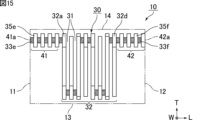
- FIG. 15 is a perspective side view that typically shows one example of the internal structure of a laminate produced in a step of preparing a laminate in the first embodiment of the manufacturing method for a coil component of the present invention.
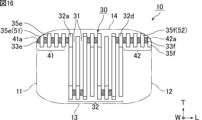
- FIG. 16 is a side view showing a schematic perspective view of an example of the internal structure of the laminate after the step of performing barrel polishing in the first embodiment of the manufacturing method of the coil component of the present invention.
- FIG. 17 is a side view showing a schematic perspective view of an example of the internal structure of the laminate after the step of forming external electrodes in the first embodiment of the manufacturing method of the coil component of the present invention has been performed.
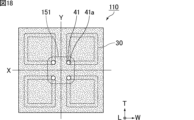
- FIG. 18 is a schematic view seen through from the lamination direction of an example of a laminate block produced in a step of preparing a laminate block in a second embodiment of the manufacturing method for a laminated coil component of the present invention.
- the internal electrode also includes a first extension conductor connected to the first external electrode 21 and a second extension conductor connected to the second external electrode 22.
- the first external electrode and the second external electrode are electrically connected to the coil by the first extension conductor and the second extension conductor, respectively.
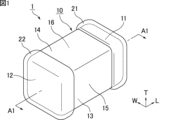
- the length direction, height direction, and width direction are defined as the L direction, T direction, and W direction in Fig. 1.
- the length direction L, the height direction T, and the width direction W are perpendicular to each other.
- the length direction L is parallel to the stacking direction.
- the laminate 10 has a first end face 11 and a second end face 12 that face the length direction L, a first main surface 13 and a second main surface 14 that face the height direction T that is perpendicular to the length direction L, and a first side surface 15 and a second side surface 16 that face the width direction W that is perpendicular to the length direction L and the height direction T.
- a substantially rectangular parallelepiped shape includes a shape in which at least one corner or ridge of the rectangular parallelepiped is rounded.
- the first external electrode 21, for example as shown in FIG. 1, covers the entire first end face 11 of the laminate 10 and extends from the first end face 11 to cover a portion of the first main face 13, a portion of the second main face 14, a portion of the first side face 15, and a portion of the second side face 16.
- the second external electrode 22 covers the entire second end surface 12 of the laminate 10, and extends from the second end surface 12 to cover a portion of the first main surface 13, a portion of the second main surface 14, a portion of the first side surface 15, and a portion of the second side surface 16, as shown in FIG. 1, for example.
- any one of the first main surface 13, the second main surface 14, the first side surface 15, and the second side surface 16 of the laminate 10 becomes the mounting surface.
- the first external electrode 21 only needs to extend from at least a portion of the first end surface 11 of the laminate 10 to the mounting surface of the laminate 10.
- the second external electrode 22 may extend from at least a portion of the second end surface 12 of the laminate 10 to the mounting surface of the laminate 10.
- the first external electrode 21 and the second external electrode 22 may each have a single-layer structure or a multi-layer structure.
- each external electrode may have, in order from the surface side of the laminate 10, for example, a base electrode layer containing Ag, a Ni-plated electrode, and a Sn-plated electrode.
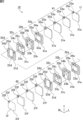
- the laminate 10 is formed by stacking a plurality of insulating layers 31a, 31b, 31c, 31d, 31e, and 31f in the stacking direction (here, the length direction L) from the first end face 11 side toward the second end face 12 side of the laminate 10.
- the insulating layers 31a, 31b, 31c, 31d, 31e, and 31f are collectively referred to as insulating layers 31.
- Insulating layers 31a, 31b, 31c, and 31d are provided with coil conductors 32a, 32b, 32c, and 32d, and via conductors 33a, 33b, 33c, and 33d, respectively.
- Insulating layer 31e is provided with via conductors 33e and lands 35e.
- Insulating layer 31f is provided with via conductors 33f and lands 35f.
- Insulating layer 31e may be a single layer or may be two or more layers.
- insulating layer 31f may be a single layer or may be two or more layers.
- coil conductors 32a, 32b, 32c, and 32d are collectively referred to as coil conductors 32.
- each coil conductor 32 has a 3/4 turn shape, and the four insulating layers 31 arranged in the order of 31a, 31b, 31c, and 31d are stacked repeatedly as one unit (3 turns).
- Lands 35e and 35f are provided directly above via conductors 33e and 33f, respectively. It is preferable that lands 35a, 35b, 35c, 35d, 35e, and 35f are slightly larger than the line width of winding portions 34a, 34b, 34c, and 34d. Hereinafter, lands 35a, 35b, 35c, 35d, 35e, and 35f are collectively referred to as land 35. Land 35 is larger than adjacent via conductors 33, and when viewed from the stacking direction (length direction L), via conductors 33 adjacent to land 35 are contained within the area of that land 35.
- each coil conductor 32 including the winding portion 34 and the land 35, and each via conductor 33 includes, for example, Ag, Au, Cu, Pd, Ni, Al, and alloys containing at least one of these metals.
- the multiple insulating layers 31a, 31b, 31c, 31d, 31e, and 31f configured as described above are stacked in the stacking direction. This forms the laminate 10, and the multiple coil conductors 32a, 32b, 32c, and 32d are electrically connected via the via conductors 33a, 33b, 33c, and 33d. As a result, a solenoid coil having a coil axis parallel to the stacking direction is formed in the laminate 10.
- the via conductor 33f and the land 35f form the second extension conductor.
- the second extension conductor is exposed at the second end surface 12 of the laminate 10. That is, the second extension conductor includes the via conductor 33f and the land 35f. As shown in FIG. 2, the land 35f is present in the portion of the second extension conductor that is exposed at the second end surface 12 of the laminate 10. As described below, the second extension conductor connects between the second external electrode 22 and the coil conductor 32d facing it within the laminate 10.
- FIG. 3 is a schematic side view showing an example of the internal structure of the laminate that constitutes the laminate coil component shown in FIG. 1.
- the laminated coil component 1 multiple insulating layers 31 are laminated in the length direction L, so the length direction L is the lamination direction.
- the lamination direction of the laminate 10 and the coil axis A of the coil 30 are parallel to the first main surface 13, the second main surface 14, the first side surface 15, or the second side surface 16, which are the mounting surfaces.
- Figures 2 and 3 illustrate a case where the number of layers of the coil conductor 32 required to form three turns of the coil 30 is four, i.e., the repeating shape is a 3/4 turn shape, but the number of layers of the coil conductor 32 required to form one turn of the coil 30 is not particularly limited.
- the number of laminations of the coil conductor 32 required to form one turn of the coil 30 may be two, that is, the repeating shape may be a 1/2 turn shape.
- the number of layers of the coil conductor 32 i.e., the total number of layers of the coil conductors 32 included in the laminate 10, is not particularly limited.
- FIG. 4 is a schematic cross-sectional view of an example of a cross section along line segment A1-A1 of the laminated coil component shown in FIG. 1.
- the cross-sectional shape of the coil conductor 32 when viewed in a cross section perpendicular to the direction in which the coil conductor 32 extends, the cross-sectional shape of the coil conductor 32 is flattened, and its longitudinal direction is perpendicular to the stacking direction (length direction L).
- the cross-sectional shape of the coil conductor 32 is an ellipse whose major axis is perpendicular to the stacking direction, but the cross-sectional shape of the coil conductor 32 is not particularly limited, and may be, for example, a rectangular shape with a pair of sides facing each other in the stacking direction having the same length, or a trapezoid with a pair of sides facing each other in the stacking direction having different lengths.
- the first lead conductor 41 will be described below with reference to Figures 2 and 3.
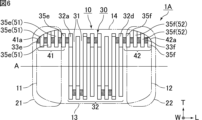
- the first extension conductor 41 extends in the stacking direction within the laminate 10 and linearly connects the first external electrode 21 provided on the first end face 11 to the coil conductor 32a facing it.
- the first extension conductor 41 has a via conductor 33e that penetrates the insulating layer 31e and a land 35e provided on the insulating layer 31e.
- the via conductors 33e constituting the first extension conductor 41 overlap each other, but the via conductors 33e constituting the first extension conductor 41 do not have to be aligned strictly in a straight line.
- the first extension conductor 41 is in direct contact with the first external electrode 21 at the first end 41a of both ends in the stacking direction.
- the via conductor 33e of the first extension conductor 41 is present at the first end 41a.
- the first external electrode 21 is in direct contact with not only the first end 41a, but also at least one first land 51 spaced from the first end 41a. Therefore, compared to when the first extension conductor 41 is connected to the first external electrode 21 only at the first end 41a, the contact area between the first external electrode 21 and the first extension conductor 41 is larger by the amount of direct contact between the first land 51 and the first external electrode 21. In the laminated coil component of the present invention, the current is also dispersed to the first land 51, so current concentration at the first end 41a can be suppressed.
- FIG. 5 shows a cross section including the first land 51.
- the first land 51 is in direct contact with the first external electrode 21 at the ridge portion of the laminate 10. As shown in FIG. 5, the first land 51 is in direct contact with the first external electrode 21 at the ridge portion formed by the second main surface 14 and the first side surface 15 of the laminate 10.
- the first land 51 may be exposed from the laminate 10 at the first main surface 13, the second main surface 14, the first side surface 15, or the second side surface 16, rather than at the ridge portion of the laminate 10, and may be in direct contact with the first external electrode 21.
- the current is dispersed to two or more second lands 52, thereby further suppressing current concentration at the second end 42a.
- the second draw-out conductor 42 has two second lands 52.
- the number of second lands 52 that the second draw-out conductor 42 has is not particularly limited, and may be two, or may be three or more.
- the two lands 35f present on the second end face 12 side are the second lands 52. Between the second end 42a and each second land 52, there is no land that does not contact the second external electrode 22.
- FIG. 7 is a schematic side view showing an example of the internal structure of a laminate constituting a second modified example of the laminate coil component of the present invention.
- the first extension conductor 41 has two or more lands 35e, and the two or more lands 35e of the first extension conductor 41 include a land 35e2 between the first end 41a and the first land 51 that does not contact the first external electrode 21.
- the distance between the first end 41a and the first land 51 will be greater. Therefore, when heat is generated due to the concentration of power at the first end 41a and the first land 51, the distance between the heat generating points will be greater, which will further prevent the conductor from becoming too hot and breaking.
- first lead conductor 41 has two or more first lands 51, there may be a land 35e2 between adjacent first lands 51 that is not exposed from the laminate 10 and is not in contact with the first external electrode 21.
- the second extension conductor 42 has two or more lands 35f, and the two or more lands 35f of the second extension conductor 42 include a land 35f2 between the second end 42a and the second land 52 that does not contact the second external electrode 22.
- the second lead conductor 42 has two or more second lands 52, there may be a land 35f2 between adjacent second lands 52 that is not exposed from the laminate 10 and does not contact the second external electrode 22.
- FIG. 8 is a schematic side view showing an example of the internal structure of a laminate constituting a third modified example of a laminate coil component of the present invention.
- the third lead-out conductor 43 has a via conductor 33 that penetrates the insulating layer 31 and a land 35 provided on the insulating layer 31.
- the first external electrode 21 is in direct contact with at least one third land 53, which is spaced from the third end 43a, among the lands 35 of the third lead conductor 43, in addition to the third end 43a.
- one third land 53 is in direct contact with the first external electrode 21, but two or more third lands 53 may be in direct contact with the first external electrode 21.
- the current flowing through the first lead conductor 41 is also dispersed to the third lead conductor 43, further suppressing current concentration at the first end 41a.
- the current is dispersed to the third land 53, so current concentration at the third end 43a can also be suppressed.
- the third extension conductor 43 may have the same configuration as the first extension conductor 41, except that the contact position with the coil conductor 32 and the first external electrode 21 is different.
- the internal electrode may have, in addition to the second extension conductor 42, a fourth extension conductor 44 that connects to the second external electrode 22.
- the fourth extension conductor 44 may have the same configuration as the second extension conductor 42, except that the contact positions with the coil conductor 32 and the second external electrode 22 are different.
- the fourth extension conductor 44 is in direct contact with the second external electrode 22 at the fourth end 44a, of both ends in the stacking direction.
- the fourth extension conductor 44 has at least one fourth land 54 that is spaced from the fourth end 44a and in contact with the second external electrode 22.
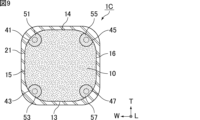
- Figure 9 is a cross-sectional view taken along line IX-IX in Figure 8.
- the internal electrodes include a fifth extension conductor 45 and a seventh extension conductor 47 that connect to the first external electrode 21, in addition to the first extension conductor 41 and the third extension conductor 43.
- the fifth extension conductor 45 is in direct contact with the first external electrode 21 at its fifth end, which is one of both ends in the stacking direction.
- the fifth extension conductor 45 has at least one fifth land 55 that is spaced apart from the fifth end and in direct contact with the first external electrode 21.
- the seventh extension conductor 47 is in direct contact with the first external electrode 21 at its seventh end, which is one of both ends in the stacking direction.
- the seventh extension conductor 47 has at least one seventh land 57 that is spaced apart from the seventh end and in contact with the first external electrode 21.
- the fifth and seventh lead conductors 45 and 47 may have the same configuration as the first and third lead conductors 41 and 43, except that the contact positions with the coil conductor 32 and the first external electrode 21 are different.
- the first extension conductor 41, the third extension conductor 43, the fifth extension conductor 45, and the seventh extension conductor 47 are connected in parallel between the coil and the first external electrode 21.
- the first extension conductor 41, the third extension conductor 43, the fifth extension conductor 45, and the seventh extension conductor 47 may be drawn out from each corner of the rectangular coil when viewed from the stacking direction.
- the first land 51, the third land 53, the fifth land 55, and the seventh land 57 may be in direct contact with the first external electrode 21 at each ridge of the laminate 10 when viewed from the stacking direction.
- the internal electrode may also have a sixth lead conductor and an eighth lead conductor that are connected to the second external electrode 22, similar to the fifth lead conductor 45 and the seventh lead conductor 47.
- the sixth and eighth extension conductors may have the same configuration as the second and fourth extension conductors 42 and 44, except that the contact positions with the coil conductor 32 and the second external electrode 22 are different. That is, the sixth extension conductor may have at least one sixth land spaced apart from the sixth end on the second external electrode 22 side and in direct contact with the second external electrode 22. The eighth extension conductor may have at least one eighth land spaced apart from the eighth end on the second external electrode 22 side and in direct contact with the second external electrode 22.
- the second extension conductor 42, the fourth extension conductor 44, the sixth extension conductor and the eighth extension conductor may be connected in parallel between the coil and the second external electrode 22.
- FIG. 10 is a perspective view that typically shows a fourth modified example of the laminated coil component of the present invention.
- FIG. 11 is a side view showing a schematic perspective view of an example of the internal structure of a laminate constituting a fourth modified example of the laminated coil component of the present invention.
- the first external electrode 21 covers a portion of the first end face 11 and a portion of the first main surface 13 of the laminate 10.
- the second external electrode 22 covers a portion of the second end face 12 and a portion of the first main surface 13 of the laminate 10.
- the first main surface 13 is the mounting surface.
- the first end 41a of the first extension conductor 41 is in direct contact with the portion of the first external electrode 21 that covers the first end surface 11 of the laminate 10.
- the first land 51 of the first extension conductor 41 is in direct contact with the portion of the first external electrode 21 that covers the first main surface 13 of the laminate 10.
- the second end 42a of the second extension conductor 42 is in direct contact with the portion of the second external electrode 22 that covers the second end surface 12 of the laminate 10.
- the second land 52 of the second extension conductor 42 is in direct contact with the portion of the second external electrode 22 that covers the first main surface 13 of the laminate 10.
- FIG. 12 is a perspective view that typically shows a fifth modified example of the laminated coil component of the present invention.
- FIG. 13 is a side view showing a schematic perspective view of an example of the internal structure of a laminate constituting a fifth modified example of the laminated coil component of the present invention.
- the laminated coil component 1E shown in Figures 12 and 13 is an example of a laminated coil component in which the lamination direction is perpendicular to the mounting surface.
- the height direction T is the stacking direction.
- the stacking direction of the laminate 10 and the coil axis A of the coil 30 are perpendicular to the first main surface 13, which is the mounting surface.
- the laminated coil component 1E has a so-called vertically wound structure.
- the first end 41a of the first extension conductor 41 is in direct contact with the portion of the first external electrode 21 that covers the first main surface 13 of the laminate 10.
- the first land 51 of the first extension conductor 41 is in direct contact with the portion of the first external electrode 21 that covers the first end surface 11 of the laminate 10.
- the second end 42a of the second extension conductor 42 is in direct contact with the portion of the second external electrode 22 that covers the first main surface 13 of the laminate 10.
- the second land 52 of the second extension conductor 42 is in direct contact with the portion of the second external electrode 22 that covers the second end surface 12 of the laminate 10.
- the first aspect of the manufacturing method of the laminated coil component of the present invention includes a step of preparing a laminate having an internal electrode formed by stacking a plurality of insulating layers in a stacking direction, a step of performing a barrel polishing process on the laminate, and a step of forming an external electrode on the outer surface of the barrel polished laminate, the internal electrodes having a first lead conductor and a second lead conductor each extending in the stacking direction, the first lead conductor having a via conductor penetrating the insulating layer and a land provided on the insulating layer, in the step of preparing the laminate, one first end of both ends of the first lead conductor in the stacking direction is exposed from the laminate, and none of the lands of the first lead conductor separated from the first end is exposed from the laminate, in the step of performing the barrel polishing process, the laminate is polished to expose at least one first land separated from the first end from the laminate, and in the step of forming the external electrode, a first external electrode is formed so as to cover the
- these weighed items and pure water are placed in a ball mill along with PSZ (partially stabilized zirconia) media, mixed, and then pulverized.
- PSZ partially stabilized zirconia
- the mixing and pulverization time is, for example, 4 hours or more and 8 hours or less.
- the resulting pulverized material is dried and then calcined.
- the calcination temperature is, for example, 700°C or higher and 800°C or lower.
- the calcination time is, for example, 2 hours or higher and 5 hours or lower.
- the ferrite material is preferably a Ni-Cu-Zn ferrite material.
- the material contains Fe in an amount of 40 mol% or more and 49.5 mol% or less in terms of Fe2O3 , Zn in an amount of 2 mol% or more and 35 mol% or less in terms of ZnO, Cu in an amount of 6 mol% or more and 13 mol% or less in terms of CuO, and Ni in an amount of 10 mol% or more and 45 mol% or less in terms of NiO.
- Ni-Cu-Zn ferrite material may further contain additives such as Co, Bi, Sn, and Mn.
- the Ni-Cu-Zn ferrite material may further contain unavoidable impurities.
- a magnetic material an organic binder such as a polyvinyl butyral resin, an organic solvent such as ethanol or toluene, and a plasticizer are mixed in a ball mill together with PSZ media, and then pulverized to prepare a slurry.
- an organic binder such as a polyvinyl butyral resin
- an organic solvent such as ethanol or toluene
- a plasticizer a plasticizer
- the slurry is formed into a sheet of a specified thickness using a doctor blade method or the like, and then punched into a specified shape to produce a green sheet.
- the thickness of the green sheet is, for example, 20 ⁇ m or more and 30 ⁇ m or less.
- the shape of the green sheet is, for example, rectangular.
- the green sheet material may be made of a non-magnetic material such as borosilicate glass, or a mixture of a magnetic material and a non-magnetic material.
- a via hole is formed by irradiating a laser onto a predetermined location of a green sheet.
- a conductive paste such as Ag paste is applied to the surface of the green sheet by screen printing or the like while filling the via holes.
- a conductor pattern for a via conductor is formed in the via holes of the green sheet, and a conductor pattern for a coil conductor connected to the conductor pattern for a via conductor is formed on the surface.
- a coil sheet is produced in which a conductor pattern for a coil conductor and a conductor pattern for a via conductor are formed on the green sheet.
- the coil sheet is formed with a conductor pattern for a coil conductor corresponding to the coil conductor 32 shown in FIG. 2 and a conductor pattern for a via conductor corresponding to the via conductor 33 shown in FIG.
- a via sheet is produced in which a conductor pattern for a via conductor corresponding to the via conductors 33e and 33f shown in FIG. 2 and a conductor pattern for a land corresponding to the lands 35e and 35f shown in FIG. 2 are formed.
- ⁇ Laminated block manufacturing process> The coil sheets and via sheets are laminated in the lamination direction (length direction L) in the order corresponding to FIG. 2, and then thermocompression-bonded to prepare a laminate block.
- the laminate block is cut into a predetermined size using a dicer or the like to produce individual chips (laminated bodies).
- the firing temperature is, for example, 900°C or higher and 920°C or lower.
- the firing time is, for example, 2 hours or higher and 4 hours or lower.
- the conductor pattern for the coil conductor, the conductor pattern for the via conductor, and the conductor pattern for the land become coil conductors, via conductors, and lands, respectively.
- a coil is produced in which multiple coil conductors stacked together with insulating layers are electrically connected through the via conductors.
- a laminate is prepared in which multiple insulating layers are stacked in the stacking direction and which has an internal electrode.
- the internal electrode has a first lead-out conductor and a second lead-out conductor that each extend in the stacking direction, and the first lead-out conductor and the second lead-out conductor have via conductors that penetrate the insulating layers and lands provided on the insulating layers.
- the step of preparing the laminate in the first aspect of the manufacturing method of the coil component may include the above-mentioned ⁇ step of preparing the magnetic material>, ⁇ step of preparing the green sheet>, ⁇ step of forming the conductor pattern>, ⁇ step of preparing the laminate block>, and ⁇ step of dividing the laminate block into individual laminates>.
- FIG. 14 is an exploded perspective view showing an example of a laminate produced in the step of preparing a laminate in the first embodiment of the manufacturing method for a coil component of the present invention.
- FIG. 15 is a perspective side view that typically shows one example of the internal structure of a laminate produced in a step of preparing a laminate in the first embodiment of the manufacturing method for a coil component of the present invention.
- one of the first ends 41a is exposed from the laminate, and of the lands 35e of the first extension conductor 41, none of the lands 35e separated from the first end 41a are exposed from the laminate 10.
- the second end 42a is exposed from the laminate, but none of the lands 35f separated from the second end 42a are exposed from the laminate 10.
- Step of subjecting laminate to barrel polishing treatment In the step of performing barrel polishing on the laminate, corners and ridges are rounded by performing barrel polishing on the laminate.
- FIG. 16 is a schematic side view showing an example of the internal structure of a laminate after a barrel polishing process has been performed in the first embodiment of the coil component manufacturing method of the present invention.
- the laminate 10 is polished to expose at least one first land 51 spaced from the first end 41a from the laminate 10. In FIG. 16, one first land 51 is exposed from the laminate 10.
- the ridges and corners of the laminate 10 may be rounded by barrel polishing, thereby exposing the first land 51 from the rounded ridges of the laminate 10.
- the first land 51 may be exposed from the laminate 10 by extending the time of the barrel polishing process from the usual time. Also, the position or size of the first land 51 itself may be adjusted so that the first land 51 is exposed from the laminate 10 during the barrel polishing process.
- At least one second land 52 spaced apart from the second end 42a of the second lead conductor 42 can also be exposed from the laminate 10 in a similar manner.
- Step of forming external electrodes In the step of forming the external electrodes, external electrodes are formed on the outer surface of the barrel-polished laminate. In the step of forming the external electrodes, a first external electrode is formed so as to cover a first end and at least one first land exposed from the laminate. Also, a second external electrode is formed so as to cover a second end and at least one second land exposed from the laminate.
- FIG. 17 is a schematic side view showing an example of the internal structure of the laminate after the step of forming the external electrodes in the first embodiment of the manufacturing method of the coil component of the present invention.
- the second lead conductor has a via conductor penetrating the insulating layer and a land provided on the insulating layer, Of both ends of the second lead conductor in the stacking direction, the one that is in direct contact with the second external electrode is defined as a second end.
- the laminated coil component according to any one of ⁇ 1> to ⁇ 3>, wherein the second external electrode is in direct contact with at least one second land, which is spaced from the second end, among the lands of the second lead conductor, in addition to the second end.
- ⁇ 11> preparing a laminate block having an internal electrode and including a plurality of insulating layers laminated in a lamination direction; a step of singulating the laminate block to form a laminate; and forming an external electrode on the laminate.
- the internal electrode has a first lead conductor and a second lead conductor each extending in the stacking direction, the first lead conductor has a via conductor penetrating the insulating layer and a land provided on the insulating layer, in the step of preparing the laminate block, one first end of the first extraction conductor in the stacking direction is exposed from the laminate block, and none of the lands of the first extraction conductor that are spaced apart from the first end are exposed from the laminate; In the step of dividing the laminate block, the laminate block is cut to expose at least one first land spaced from the first end from the laminate; In the step of forming the external electrode, a first external electrode is formed so as to cover the first end and at least one of the first lands exposed from the laminate.
Landscapes
- Engineering & Computer Science (AREA)
- Power Engineering (AREA)
- Microelectronics & Electronic Packaging (AREA)
- Manufacturing & Machinery (AREA)
- Coils Or Transformers For Communication (AREA)
Priority Applications (2)
| Application Number | Priority Date | Filing Date | Title |
|---|---|---|---|
| JP2025566340A JPWO2025142208A1 (https=) | 2023-12-28 | 2024-11-20 | |
| CN202480018132.9A CN120937094A (zh) | 2023-12-28 | 2024-11-20 | 层叠线圈部件以及层叠线圈部件的制造方法 |
Applications Claiming Priority (2)
| Application Number | Priority Date | Filing Date | Title |
|---|---|---|---|
| JP2023-222675 | 2023-12-28 | ||
| JP2023222675 | 2023-12-28 |
Publications (1)
| Publication Number | Publication Date |
|---|---|
| WO2025142208A1 true WO2025142208A1 (ja) | 2025-07-03 |
Family
ID=96217452
Family Applications (1)
| Application Number | Title | Priority Date | Filing Date |
|---|---|---|---|
| PCT/JP2024/041063 Pending WO2025142208A1 (ja) | 2023-12-28 | 2024-11-20 | 積層コイル部品及び積層コイル部品の製造方法 |
Country Status (3)
| Country | Link |
|---|---|
| JP (1) | JPWO2025142208A1 (https=) |
| CN (1) | CN120937094A (https=) |
| WO (1) | WO2025142208A1 (https=) |
Citations (4)
| Publication number | Priority date | Publication date | Assignee | Title |
|---|---|---|---|---|
| JPH08130115A (ja) * | 1994-10-31 | 1996-05-21 | Fuji Elelctrochem Co Ltd | 電子チップ部品 |
| JP2009044030A (ja) * | 2007-08-10 | 2009-02-26 | Hitachi Metals Ltd | 積層電子部品 |
| JP2013045809A (ja) * | 2011-08-22 | 2013-03-04 | Tdk Corp | コイル部品 |
| JP2023148397A (ja) * | 2022-03-30 | 2023-10-13 | 株式会社村田製作所 | 積層型コイル部品 |
-
2024
- 2024-11-20 JP JP2025566340A patent/JPWO2025142208A1/ja active Pending
- 2024-11-20 WO PCT/JP2024/041063 patent/WO2025142208A1/ja active Pending
- 2024-11-20 CN CN202480018132.9A patent/CN120937094A/zh active Pending
Patent Citations (4)
| Publication number | Priority date | Publication date | Assignee | Title |
|---|---|---|---|---|
| JPH08130115A (ja) * | 1994-10-31 | 1996-05-21 | Fuji Elelctrochem Co Ltd | 電子チップ部品 |
| JP2009044030A (ja) * | 2007-08-10 | 2009-02-26 | Hitachi Metals Ltd | 積層電子部品 |
| JP2013045809A (ja) * | 2011-08-22 | 2013-03-04 | Tdk Corp | コイル部品 |
| JP2023148397A (ja) * | 2022-03-30 | 2023-10-13 | 株式会社村田製作所 | 積層型コイル部品 |
Also Published As
| Publication number | Publication date |
|---|---|
| JPWO2025142208A1 (https=) | 2025-07-03 |
| CN120937094A (zh) | 2025-11-11 |
Similar Documents
| Publication | Publication Date | Title |
|---|---|---|
| JP5900373B2 (ja) | 電子部品 | |
| US8237528B2 (en) | Electronic component | |
| US8732939B2 (en) | Method of manufacturing an electronic component | |
| JP5807650B2 (ja) | 積層コイル及びその製造方法 | |
| US10665388B2 (en) | Method of manufacturing laminated coil component | |
| JP2015026760A (ja) | 積層コイル | |
| US9099235B2 (en) | Electronic component and method for manufacturing the same | |
| US8143988B2 (en) | Multilayer inductor | |
| KR101266307B1 (ko) | 전자 부품 및 그 제조 방법 | |
| KR20050059214A (ko) | 적층 코일 부품 및 그 제조방법 | |
| JP7444135B2 (ja) | 電子部品及び電子機器 | |
| WO2025142208A1 (ja) | 積層コイル部品及び積層コイル部品の製造方法 | |
| JP2009176829A (ja) | 電子部品 | |
| US20240006112A1 (en) | Multilayer coil component | |
| US20250218639A1 (en) | Multilayer coil component | |
| US20250218640A1 (en) | Multilayer coil component | |
| US20250292946A1 (en) | Laminated inductor | |
| JP2025104733A (ja) | 積層コイル部品 | |
| JP2025105436A (ja) | 積層コイル部品 | |
| JP2025105435A (ja) | 積層コイル部品 | |
| WO2024004484A1 (ja) | 積層コイル部品 | |
| JP2025104732A (ja) | 積層コイル部品及び積層コイル部品の製造方法 | |
| JP2010034175A (ja) | 電子部品及びその製造方法 | |
| JP2025134243A (ja) | 積層コイル部品及び積層コイル部品の製造方法 | |
| JP2020145220A (ja) | 積層型コイル部品 |
Legal Events
| Date | Code | Title | Description |
|---|---|---|---|
| 121 | Ep: the epo has been informed by wipo that ep was designated in this application |
Ref document number: 24912101 Country of ref document: EP Kind code of ref document: A1 |
|
| ENP | Entry into the national phase |
Ref document number: 2025566340 Country of ref document: JP Kind code of ref document: A |