WO2025142118A1 - 高分子膜 - Google Patents
高分子膜 Download PDFInfo
- Publication number
- WO2025142118A1 WO2025142118A1 PCT/JP2024/038954 JP2024038954W WO2025142118A1 WO 2025142118 A1 WO2025142118 A1 WO 2025142118A1 JP 2024038954 W JP2024038954 W JP 2024038954W WO 2025142118 A1 WO2025142118 A1 WO 2025142118A1
- Authority
- WO
- WIPO (PCT)
- Prior art keywords
- polymer
- pedot
- pss
- crosslinking agent
- film
- Prior art date
- Legal status (The legal status is an assumption and is not a legal conclusion. Google has not performed a legal analysis and makes no representation as to the accuracy of the status listed.)
- Pending
Links
Classifications
-
- C—CHEMISTRY; METALLURGY
- C08—ORGANIC MACROMOLECULAR COMPOUNDS; THEIR PREPARATION OR CHEMICAL WORKING-UP; COMPOSITIONS BASED THEREON
- C08K—Use of inorganic or non-macromolecular organic substances as compounding ingredients
- C08K3/00—Use of inorganic substances as compounding ingredients
- C08K3/16—Halogen-containing compounds
-
- C—CHEMISTRY; METALLURGY
- C08—ORGANIC MACROMOLECULAR COMPOUNDS; THEIR PREPARATION OR CHEMICAL WORKING-UP; COMPOSITIONS BASED THEREON
- C08L—COMPOSITIONS OF MACROMOLECULAR COMPOUNDS
- C08L25/00—Compositions of, homopolymers or copolymers of compounds having one or more unsaturated aliphatic radicals, each having only one carbon-to-carbon double bond, and at least one being terminated by an aromatic carbocyclic ring; Compositions of derivatives of such polymers
- C08L25/18—Homopolymers or copolymers of aromatic monomers containing elements other than carbon and hydrogen
-
- C—CHEMISTRY; METALLURGY
- C08—ORGANIC MACROMOLECULAR COMPOUNDS; THEIR PREPARATION OR CHEMICAL WORKING-UP; COMPOSITIONS BASED THEREON
- C08L—COMPOSITIONS OF MACROMOLECULAR COMPOUNDS
- C08L29/00—Compositions of homopolymers or copolymers of compounds having one or more unsaturated aliphatic radicals, each having only one carbon-to-carbon double bond, and at least one being terminated by an alcohol, ether, aldehydo, ketonic, acetal or ketal radical; Compositions of hydrolysed polymers of esters of unsaturated alcohols with saturated carboxylic acids; Compositions of derivatives of such polymers
- C08L29/02—Homopolymers or copolymers of unsaturated alcohols
- C08L29/04—Polyvinyl alcohol; Partially hydrolysed homopolymers or copolymers of esters of unsaturated alcohols with saturated carboxylic acids
-
- C—CHEMISTRY; METALLURGY
- C08—ORGANIC MACROMOLECULAR COMPOUNDS; THEIR PREPARATION OR CHEMICAL WORKING-UP; COMPOSITIONS BASED THEREON
- C08L—COMPOSITIONS OF MACROMOLECULAR COMPOUNDS
- C08L65/00—Compositions of macromolecular compounds obtained by reactions forming a carbon-to-carbon link in the main chain; Compositions of derivatives of such polymers
-
- H—ELECTRICITY
- H01—ELECTRIC ELEMENTS
- H01B—CABLES; CONDUCTORS; INSULATORS; SELECTION OF MATERIALS FOR THEIR CONDUCTIVE, INSULATING OR DIELECTRIC PROPERTIES
- H01B1/00—Conductors or conductive bodies characterised by the conductive materials; Selection of materials as conductors
- H01B1/06—Conductors or conductive bodies characterised by the conductive materials; Selection of materials as conductors mainly consisting of other non-metallic substances
- H01B1/12—Conductors or conductive bodies characterised by the conductive materials; Selection of materials as conductors mainly consisting of other non-metallic substances organic substances
-
- H—ELECTRICITY
- H01—ELECTRIC ELEMENTS
- H01B—CABLES; CONDUCTORS; INSULATORS; SELECTION OF MATERIALS FOR THEIR CONDUCTIVE, INSULATING OR DIELECTRIC PROPERTIES
- H01B1/00—Conductors or conductive bodies characterised by the conductive materials; Selection of materials as conductors
- H01B1/20—Conductive material dispersed in non-conductive organic material
Definitions
- Patent Document 1 describes a solid electrolytic capacitor that includes a layered structure that includes an anode, a dielectric, a cathode, and a polymer outer layer. Patent Document 1 also describes a polymer outer layer that includes polystyrene sulfonic acid and poly(3,4-ethylenedioxythiophene). Patent Document 1 also describes forming the polymer outer layer by applying a crosslinking agent to the capacitor body, then applying a dispersion of a conjugated polymer, and removing the dispersing agent.
- Polymer films formed using conventional aqueous dispersions of PEDOT/PSS have good electrical conductivity and heat resistance, but are insufficient in water resistance. For this reason, for example, polymer films formed using aqueous dispersions of PEDOT/PSS may have limited applications.
- the present invention was made in consideration of the above problems, and aims to provide a polymer membrane with good water resistance that can be produced using an aqueous dispersion of PEDOT/PSS.
- a polymer membrane according to one embodiment of the present invention includes a crosslinked polymer in which a polymer having a carbonyl group is crosslinked with a crosslinking agent made of a dihydrazide compound, and a composite of polyethylenedioxythiophene and polystyrenesulfonic acid.
- the polymer film according to one embodiment of the present invention can be produced using an aqueous dispersion of PEDOT/PSS, and has excellent electrical conductivity and heat resistance, as well as good water resistance. Therefore, the polymer film according to one embodiment of the present invention can be preferably used for a wide range of applications.
- the present inventors have conducted extensive research in order to solve the above problems and form a polymer film having good water resistance using an aqueous dispersion of PEDOT/PSS.
- a polymer film containing a crosslinked polymer having a crosslinked structure can be formed by using an aqueous dispersion of PEDOT/PSS and a specific crosslinking agent, and have arrived at the present invention.
- the present invention includes the following aspects.
- a ratio of the structural unit derived from the polymer having a carbonyl group to the total mass of the structural unit derived from the polymer having a carbonyl group forming the crosslinked polymer and the composite is 70 mass% or less;
- the polymer membrane according to [1] or [2], wherein a ratio of the structural unit derived from the crosslinking agent to a mass of the structural unit derived from the polymer having a carbonyl group is 15 mass% or less.
- a ratio of the structural unit derived from the polymer having a carbonyl group to the total mass of the structural unit derived from the polymer having a carbonyl group forming the crosslinked polymer and the composite is 30 mass% or less;
- the polymer membrane according to [1] or [2], wherein a ratio of the structural unit derived from the crosslinking agent to a mass of the structural unit derived from the polymer having a carbonyl group is 10 mass% or less.
- the composite of polyethylenedioxythiophene and polystyrenesulfonic acid includes a crosslinked polymer crosslinked by a crosslinking agent;
- the crosslinking agent comprises a salt of an amine compound containing a total of four or more groups selected from one or two types of groups selected from -NH2 groups and -NH- groups.
- the composite of polyethylenedioxythiophene and polystyrenesulfonic acid includes a crosslinked polymer crosslinked by a crosslinking agent;
- the polymer membrane, wherein the crosslinking agent is a metal salt containing a metal cation having a valence of two or more.
- the crosslinking agent is calcium chloride.
- the polymer membrane of the first embodiment includes a crosslinked polymer in which a polymer having a carbonyl group is crosslinked with a crosslinking agent made of a dihydrazide compound, and a composite of polyethylenedioxythiophene and polystyrenesulfonic acid (PEDOT/PSS) represented by the following formula (1):
- crosslinked polymer The crosslinked polymer contained in the polymer film of this embodiment is obtained by crosslinking the carbonyl group of the polymer having a carbonyl group with the dihydrazide group of the dihydrazide compound, which is a crosslinking agent, through a crosslinking reaction.
- the crosslinked polymer has a three-dimensional network structure and has excellent water resistance, and holds the PEDOT/PSS contained in the polymer film, thereby imparting water resistance to the polymer film of this embodiment.
- the polymer membrane of the present embodiment may contain only one type of crosslinked polymer, or may contain two or more types of crosslinked polymer.
- a polymer having a polyvinyl alcohol skeleton as the polymer having a carbonyl group.
- a crosslinked polymer in which a polymer having a polyvinyl alcohol skeleton is crosslinked with a crosslinking agent made of a dihydrazide compound has good water resistance. Therefore, a polymer film containing a crosslinked polymer in which a polymer having a polyvinyl alcohol skeleton is crosslinked has better water resistance.
- an aqueous solution of a polymer having a polyvinyl alcohol skeleton can be easily mixed with an aqueous dispersion of PEDOT/PSS, when a polymer film is produced by the production method described below, a polymer film can be efficiently formed.
- a modified polyvinyl alcohol represented by the following formula (2) in which a carbonyl group is bonded to a polyvinyl alcohol skeleton as the polymer having a carbonyl group. The reason is that it has good reactivity with a crosslinking agent made of a dihydrazide compound, and a polymer film having better water resistance is easily obtained.
- n and m represent the number of repeating units, and n+m is 100 to 5000.
- R is a monovalent substituent.
- the average degree of polymerization represented by n+m in formula (2) can be 100 to 5000, and preferably 300 to 3500.
- the average degree of polymerization (n+m) of modified polyvinyl alcohol represented by formula (2) is 100 or more, a crosslinked polymer having better water resistance is obtained, and a polymer film having better water resistance is obtained.
- R in formula (2) is particularly preferably a methyl group since it is a functional group having good reactivity with a dihydrazide compound, which is a crosslinking agent.
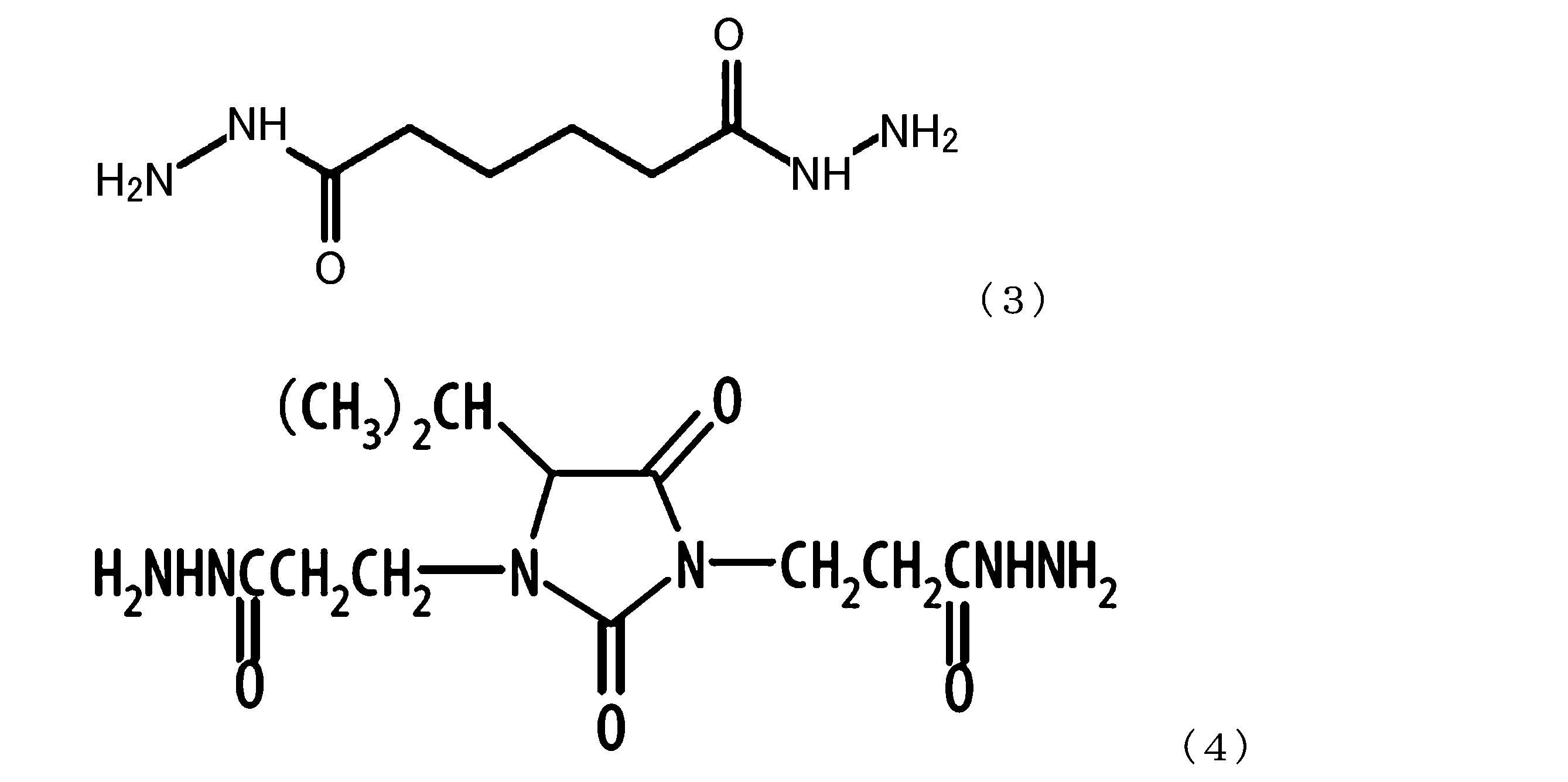
- a known dihydrazide compound can be used, for example, adipic acid dihydrazide, sebacic acid dihydrazide, isophthalic acid dihydrazide, 7,11-octadecadiene-1,18-dicarbohydrazide, etc.
- the crosslinking agent made of a dihydrazide compound it is preferable to use adipic acid dihydrazide represented by the following formula (3) and/or 7,11-octadecadiene-1,18-dicarbohydrazide represented by the following formula (4), because of its good reactivity with a polymer having a carbonyl group.
- the crosslinking agent made of a dihydrazide compound used as a material for forming a crosslinked polymer may be of one type or of two or more types.
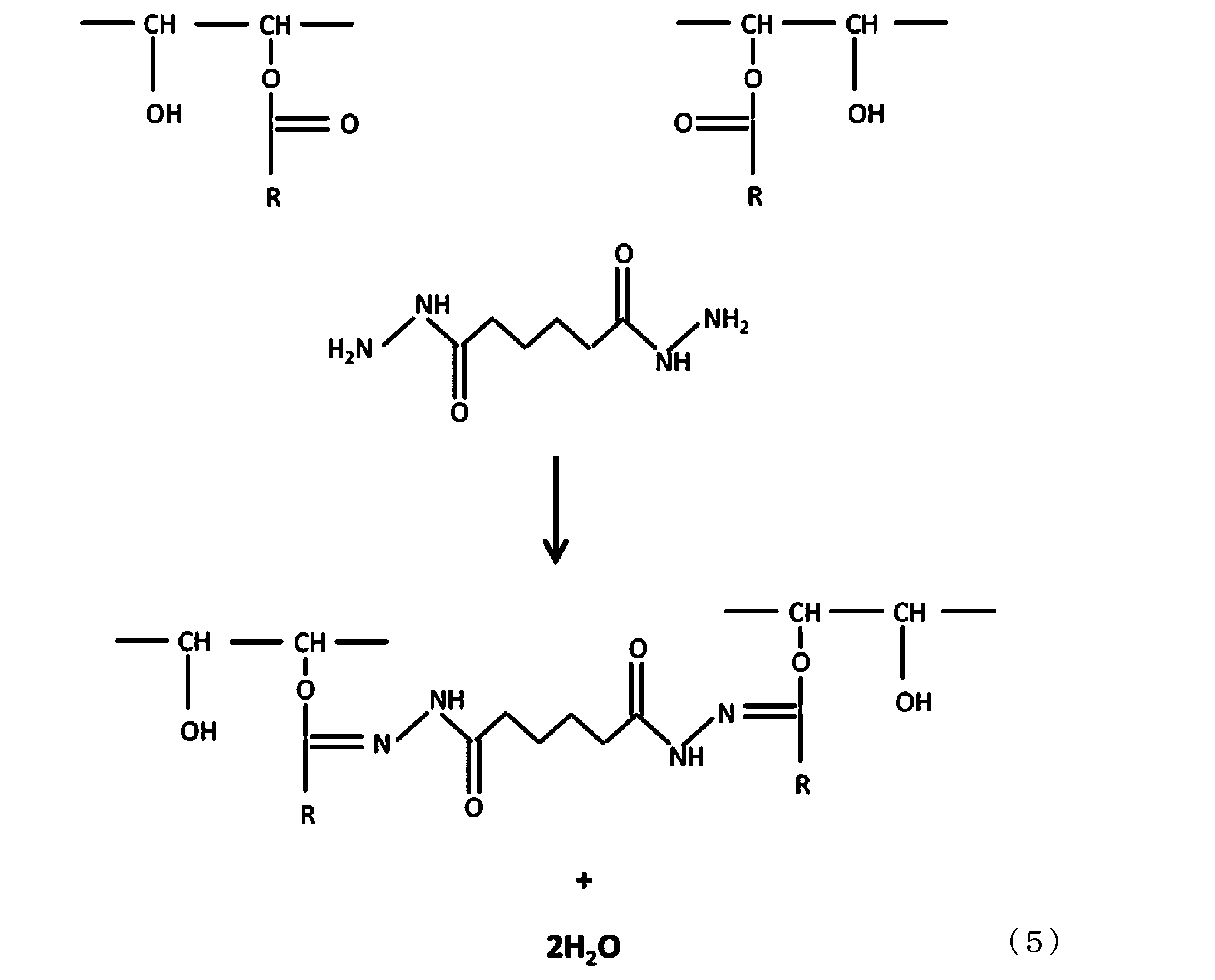
- a crosslinked polymer is formed as shown below.
- a carbonyl group of the modified polyvinyl alcohol represented by formula (2) and a dihydrazide group of the adipic acid dihydrazide represented by formula (3) undergo a crosslinking reaction, and the modified polyvinyl alcohol represented by formula (2) is crosslinked by the adipic acid dihydrazide represented by formula (3), and water and a crosslinked polymer containing a crosslinked structure represented by the following formula (5) are formed.
- the ratio of the structural units derived from the polymer having a carbonyl group to the total mass of the structural units derived from the polymer having a carbonyl group forming the crosslinked polymer and PEDOT/PSS is preferably 70% by mass or less, more preferably 30% by mass or less. If the ratio of the structural units derived from the polymer having a carbonyl group is 70% by mass or less, the conductivity of the polymer film can be prevented from being hindered by the ratio of the structural units derived from the polymer having a carbonyl group being too high.
- the ratio of structural units derived from a polymer having a carbonyl group to the above total mass is preferably 5% by mass or more, and more preferably 10% by mass or more, since this ensures the content of crosslinked polymers contained in the polymer membrane and makes it easier to obtain a polymer membrane with better water resistance.
- the ratio of the structural units derived from the polymer having a carbonyl group to the total mass is 70% by mass or less, and the ratio of the structural units derived from the crosslinking agent to the mass of the structural units derived from the polymer having a carbonyl group is 15% by mass or less. It is more preferable that the above ratio of the structural units derived from the polymer having a carbonyl group is 30% by mass or less, and the above ratio of the structural units derived from the crosslinking agent is 10% by mass or less.
- the above ratio of the structural units derived from the crosslinking agent is 15% by mass or less, it is possible to prevent the conductivity of the polymer membrane from being hindered by the presence of many structural units derived from the crosslinking agent that do not form a crosslinked structure with the structural units derived from the polymer having a carbonyl group in the polymer membrane.
- the ratio of the structural units derived from the crosslinking agent to the mass of the structural units derived from the polymer having a carbonyl group is preferably 3% by mass or more, and more preferably 5% by mass or more, since the content of the crosslinked polymer contained in the polymer membrane can be secured, and a polymer membrane with better water resistance can be obtained.
- the content of PEDOT/PSS in the polymer film of this embodiment is preferably 30% by mass or more, and more preferably 60% by mass or more. This is because a polymer film with good conductivity will be obtained if the content of PEDOT/PSS is 30% by mass or more. Furthermore, the content of PEDOT/PSS in the polymer film is preferably 85% by mass or less, and more preferably 75% by mass or less. This is because a polymer film with a sufficient amount of crosslinked polymer and good water resistance will be more easily obtained if the content of PEDOT/PSS is 85% by mass or less.
- the polymer film of the present embodiment contains the above-mentioned crosslinked polymer and PEDOT/PSS represented by formula (1), and in addition to these, may further contain one or more other components as necessary depending on the application of the polymer film, etc.
- other components include known crosslinking agents other than those made of dihydrazide compounds, known polymers not having carbonyl groups, etc.
- water-soluble or water-dispersible polymers can be preferably used, and specific examples thereof include sulfonated polyester resins.
- the polymer membrane of this embodiment can be produced, for example, by the method described below.
- An aqueous dispersion of PEDOT/PSS, an aqueous solution of a polymer having a carbonyl group, an aqueous solution of a dihydrazide compound as a crosslinking agent, and other components that may be included as necessary are mixed and stirred to prepare a resin coating material.
- the order in which the aqueous dispersion of PEDOT/PSS, the aqueous solution of the polymer having a carbonyl group, and the aqueous solution of the dihydrazide compound, which is a cross-linking agent, are mixed is not particularly limited.
- all of the materials used in the resin paint may be mixed and stirred at the same time, or the resin paint may be produced by mixing an aqueous dispersion of PEDOT/PSS and an aqueous solution of the polymer having a carbonyl group to form a mixed solution, and then mixing the mixed solution with an aqueous solution of the dihydrazide compound, which is a cross-linking agent.
- concentrations of PEDOT/PSS in the aqueous dispersion of PEDOT/PSS used in producing the resin coating in this embodiment are not particularly limited and can be concentrations that are easy to mix and stir.
- concentrations of PEDOT/PSS, the polymer having a carbonyl group, and the dihydrazide compound contained in the resin coating are concentrations that correspond to the proportion of PEDOT/PSS in the polymer film, the proportion of structural units derived from the polymer having a carbonyl group contained in the polymer film, and the proportion of structural units derived from the crosslinking agent, respectively.
- the aqueous dispersion of PEDOT/PSS used in producing the resin coating may consist of only PEDOT/PSS and water.
- the aqueous dispersion of PEDOT/PSS may contain, in addition to PEDOT/PSS and water, one or more of the other components described above.
- the aqueous dispersion of PEDOT/PSS may contain PEDOT/PSS, water, and a sulfonated polyester resin, which is a polymer that does not have a carbonyl group.
- the resin paint prepared in this manner is applied to the surface on which the film is to be formed to form a coating film.
- Methods for applying the resin paint to the surface on which the film is to be formed include known methods such as dipping, methods using various coaters, methods using various dispensers, and spraying, and can be appropriately determined depending on the shape of the surface on which the film is to be formed, the viscosity of the resin paint, etc.
- the coating film formed on the coating surface is dried to remove water from the coating film.
- This causes a reaction between the carbonyl group of the polymer having a carbonyl group and the dihydrazide group of the dihydrazide compound, which is a crosslinking agent, in the coating film to form a crosslinked polymer containing a crosslinked structure, and the polymer film of this embodiment containing PEDOT/PSS and the crosslinked polymer is formed.
- the method for removing water from the coating film can be a known method such as heat treatment at a temperature of 80° C. to 150° C., and can be appropriately determined depending on the composition of the resin coating, the thickness of the coating film, etc.
- the polymer film obtained by removing the water in the coating film may be washed.
- the washing of the polymer film can be carried out, for example, with water.
- the polymer film of this embodiment may be produced by applying the above-mentioned resin coating to form a coating film and performing the process of removing the water from the coating film only once, or may be produced by repeating the above process multiple times to form a polymer film having a predetermined thickness.
- the polymer film of this embodiment includes a crosslinked polymer in which a polymer having a carbonyl group is crosslinked with a crosslinking agent made of a dihydrazide compound, and PEDOT/PSS.
- the polymer film of this embodiment can be manufactured using an aqueous dispersion of PEDOT/PSS, and has excellent electrical conductivity and heat resistance, as well as good water resistance.
- the polymer film of the second embodiment includes a crosslinked polymer in which PEDOT/PSS represented by formula (1) is crosslinked by a crosslinking agent.
- the crosslinked polymer contained in the polymer film of this embodiment has a three-dimensional network structure resulting from the crosslinked structure between PEDOT/PSS and a crosslinking agent, and has excellent water resistance.
- the polymer membrane of the present embodiment may contain only one type of crosslinked polymer, or may contain two or more types of crosslinked polymer.
- the crosslinking agent in the polymer membrane of the second embodiment includes a salt of an amine compound containing a total of four or more of one or two groups selected from -NH2 groups and -NH- groups.
- the salt of the amine compound contains a total of four or more of one or two groups selected from -NH2 groups and -NH- groups, and therefore has four N + resulting from -NH2 groups and -NH- groups. For this reason, a crosslinked structure with PEDOT/PSS can be sufficiently formed.
- the salt of the amine compound include hydrochloride, phosphate, sulfonate, perchlorate, and salt-forming compounds with organic sulfonic acids such as paratoluenesulfonic acid, and the like.
- the salt is preferably a hydrochloride because it can be easily dispersed in water and has good reactivity.
- Such crosslinking agents include, for example, N,N'-bis(3-aminopropyl)-1,4-butanediamine tetrahydrochloride, N,N'-bis(3-aminopropyl)-1,3-propanediamine tetrahydrochloride, and N,N'-bis(2-aminoethyl)-1,3-propanediamine tetrahydrochloride, which are represented by formula (6).
- N,N'-bis(3-aminopropyl)-1,4-butanediamine tetrahydrochloride represented by formula (6) it is preferable to use N,N'-bis(3-aminopropyl)-1,4-butanediamine tetrahydrochloride represented by formula (6).
- N,N'-bis(3-aminopropyl)-1,4-butanediamine tetrahydrochloride represented by formula (6) has good reactivity with PEDOT/PSS and can form a crosslinked polymer having better water resistance.
- N,N'-bis(3-aminopropyl)-1,4-butanediamine tetrahydrochloride represented by formula (6) can be easily dispersed in water.
- the crosslinking agent for crosslinking PEDOT/PSS may be of only one type, or of two or more types.
- the polymer membrane of the present embodiment contains the above-mentioned crosslinked polymer, and in addition to the above-mentioned crosslinked polymer, may further contain one or more other components as necessary depending on the application of the polymer membrane, etc.
- other components include known resins other than PEDOT/PSS.
- a water-soluble or water-dispersible resin can be preferably used, and specifically, a sulfonated polyester resin can be used.
- the polymer membrane of the second embodiment can be produced, for example, by the method described below.
- Other components that will form the polymer film are mixed into the aqueous dispersion of PEDOT/PSS as necessary.
- the aqueous dispersion of PEDOT/PSS used in producing the coating film may be the same as the aqueous dispersion of PEDOT/PSS that can be used in the first embodiment.
- the method of applying the aqueous dispersion of PEDOT/PSS to the surface on which the film is to be formed can be, for example, a method of immersing a material having a surface on which the film is to be formed in the aqueous dispersion of PEDOT/PSS, a method using various coaters, a method using various dispensers, a spray method, or other known methods, and can be appropriately determined depending on the shape of the surface on which the film is to be formed, the viscosity of the aqueous dispersion of PEDOT/PSS, the application of the polymer film, etc.
- the coating film formed on the surface on which the film is to be formed is dried to remove the water in the coating film.
- a known method for removing the water in the coating film such as a heat treatment at a temperature of 80°C to 150°C, can be used, and the method can be appropriately determined depending on the shape of the surface on which the film is to be formed, the thickness of the coating film, etc.
- an aqueous solution of a crosslinking agent is applied onto the PEDOT/PSS film, which brings the PEDOT/PSS in the PEDOT/PSS film into contact with the crosslinking agent, starting a crosslinking reaction between the PEDOT/PSS and the N + of the amine compound that is the crosslinking agent.
- the crosslinking agent aqueous solution preferably has a crosslinking agent content in the range of 0.01 mol% to 1 mol%, and more preferably in the range of 0.03 mol% to 1 mol%. If the crosslinking agent content is 0.01 mol% or more, the effect of forming a crosslinked structure between PEDOT/PSS and the crosslinking agent can be sufficiently obtained by applying the crosslinking agent aqueous solution onto the PEDOT/PSS film and removing the water in the crosslinking agent aqueous solution. Therefore, if the crosslinking agent content is 0.01 mol% or more, a polymer film with better water resistance is likely to be obtained. In addition, if the crosslinking agent content is 1 mol% or less, the influence of the crosslinking agent remaining without forming a crosslinked structure is reduced, which is preferable.
- the method for applying the aqueous solution of the crosslinking agent onto the PEDOT/PSS film can be, for example, a method of immersing a material having a film-forming surface on which the PEDOT/PSS film is formed in the aqueous solution of the crosslinking agent, a method using various coaters, a method using various dispensers, a spray method, or other known methods, and can be appropriately determined depending on the shape of the film-forming surface and the viscosity of the aqueous solution of the crosslinking agent, etc.
- the aqueous solution of the crosslinking agent applied on the PEDOT/PSS film is dried to remove the water in the aqueous solution of the crosslinking agent.
- This further advances the crosslinking reaction between the PEDOT/PSS in the PEDOT/PSS film and the N + of the amine compound, which is the crosslinking agent.
- the crosslinking reaction is initiated by applying an aqueous solution of a crosslinking agent onto the PEDOT/PSS film.
- the density of the crosslinked structure contained in the polymer film of this embodiment changes continuously or stepwise in the thickness direction, and is higher the closer to the surface.
- the polymer film has a particularly high water resistance at the surface, and the effect of improving the water resistance of the polymer film by having a crosslinked structure is effectively obtained.
- the polymer film of this embodiment can have a larger content of PEDOT/PSS in the polymer film, and can obtain better electrical conductivity and heat resistance, compared to a polymer film in which the density of the crosslinked structure is approximately uniform and has the same water resistance.
- the polymer film of this embodiment may be produced by forming the above-mentioned PEDOT/PSS film, applying an aqueous solution of a crosslinking agent thereon, and performing the process of removing the water from the aqueous solution of the crosslinking agent only once, or by repeating the above process multiple times to form a polymer film having a predetermined thickness.
- the polymer film of this embodiment includes a crosslinked polymer in which PEDOT/PSS is crosslinked with a crosslinking agent containing a salt of an amine compound containing a total of four or more groups selected from -NH2 groups and -NH- groups.
- the polymer film of this embodiment can be produced using an aqueous dispersion of PEDOT/PSS, and has excellent electrical conductivity and heat resistance as well as good water resistance.
- the polymer film of the third embodiment contains a crosslinked polymer in which PEDOT/PSS represented by formula (1) is crosslinked by a crosslinking agent.
- the crosslinked polymer contained in the polymer film of this embodiment has a three-dimensional network structure resulting from the crosslinked structure between PEDOT/PSS and a crosslinking agent, and has excellent water resistance.
- the polymer membrane of the present embodiment may contain only one type of crosslinked polymer, or may contain two or more types of crosslinked polymer.
- the cross-linking agent in the polymer membrane of the third embodiment is a metal salt containing a metal cation with a valence of 2 or more.
- cross-linking agents include calcium chloride, magnesium chloride, and strontium chloride.
- calcium chloride is preferably used as the crosslinking agent.
- Calcium chloride is easily available, has good reactivity with PEDOT/PSS, and can form a crosslinked polymer with better water resistance. Calcium chloride can be easily dispersed in water. For this reason, it is preferable to use a method in which an aqueous solution of the crosslinking agent is applied onto the PEDOT/PSS film, which is easily soluble in water, to dissolve a part of the PEDOT/PSS film and promote the crosslinking reaction with PEDOT/PSS.
- the crosslinking agent for crosslinking PEDOT/PSS may be of only one type, or of two or more types.
- the polymer membrane of the present embodiment contains the above-mentioned crosslinked polymer, and in addition to the above-mentioned crosslinked polymer, may further contain one or more other components as necessary depending on the application of the polymer membrane, etc.
- other components include known resins other than PEDOT/PSS.
- a water-soluble or water-dispersible resin can be preferably used, and specifically, a sulfonated polyester resin can be used.
- the polymer membrane of the third embodiment can be produced, for example, by the method described below.
- Other components that will be components for forming the polymer film are mixed into the aqueous dispersion of PEDOT/PSS as necessary.
- the aqueous dispersion of PEDOT/PSS used in producing the coating film may be the same as the aqueous dispersion of PEDOT/PSS that can be used in the first and second embodiments.
- an aqueous solution of a crosslinking agent made of a metal salt containing a metal cation with a valence of 2 or more is applied onto the PEDOT/PSS film. This brings the PEDOT/PSS in the PEDOT/PSS film into contact with the crosslinking agent, initiating a crosslinking reaction between the PEDOT/PSS and the metal cations contained in the metal salt that is the crosslinking agent.
- the crosslinking agent aqueous solution preferably has a crosslinking agent content in the range of 0.01 mol% to 2 mol%, and more preferably in the range of 0.1 mol% to 1 mol%. If the crosslinking agent content is 0.01 mol% or more, the effect of forming a crosslinked structure between PEDOT/PSS and the crosslinking agent can be obtained by applying the crosslinking agent aqueous solution onto the PEDOT/PSS film and removing the water in the crosslinking agent aqueous solution. Therefore, if the crosslinking agent content is 0.01 mol% or more, a polymer film with good water resistance is likely to be obtained. In addition, if the crosslinking agent content is 2 mol% or less, the influence of the crosslinking agent remaining without forming a crosslinked structure is reduced, which is preferable.
- the method for applying the aqueous solution of the crosslinking agent onto the PEDOT/PSS film can be, for example, a method of immersing a material having a film-forming surface on which the PEDOT/PSS film is formed in the aqueous solution of the crosslinking agent, a method using various coaters, a method using various dispensers, a spray method, or other known methods, and can be appropriately determined depending on the shape of the film-forming surface and the viscosity of the aqueous solution of the crosslinking agent, etc.
- the aqueous solution of the crosslinking agent applied onto the PEDOT/PSS film is dried to remove the water in the aqueous solution of the crosslinking agent.
- This further advances the crosslinking reaction between the PEDOT/PSS in the PEDOT/PSS film and the metal cations in the metal salt that is the crosslinking agent.
- the polymer film of this embodiment is obtained, which includes a crosslinked polymer in which the PEDOT/PSS is crosslinked by the crosslinking agent.
- the method for removing the water from the aqueous solution of the crosslinking agent applied to the PEDOT/PSS film can be a known method, such as a heat treatment at a temperature of 80°C to 150°C, and can be appropriately determined depending on the shape of the surface on which the film is to be formed, the thickness of the coating film, etc.
- the crosslinking reaction is initiated by applying an aqueous solution of a crosslinking agent onto the PEDOT/PSS film.
- the density of the crosslinked structure contained in the polymer film of this embodiment changes continuously or stepwise in the thickness direction, and is higher the closer to the surface.
- the polymer film has a particularly high water resistance on the surface, and the effect of improving the water resistance of the polymer film by having a crosslinked structure is effectively obtained.
- the polymer film of this embodiment can have a larger content of PEDOT/PSS in the polymer film, and can obtain better electrical conductivity and heat resistance, compared to a polymer film in which the density of the crosslinked structure is approximately uniform and has the same water resistance.
- the polymer film of this embodiment may be produced by forming the above-mentioned PEDOT/PSS film, applying an aqueous solution of a crosslinking agent thereon, and performing the process of removing the water from the aqueous solution of the crosslinking agent only once, or by repeating the above process multiple times to form a polymer film having a predetermined thickness.
- the polymer film of this embodiment includes a crosslinked polymer in which PEDOT/PSS is crosslinked by a crosslinking agent made of a metal salt containing a metal cation with a valence of 2 or more.
- the polymer film of this embodiment can be manufactured using an aqueous dispersion of PEDOT/PSS, and has excellent electrical conductivity and heat resistance, as well as good water resistance.
- the polymer films of the first to third embodiments described above can be manufactured by a method of coating on a film formation surface, and have excellent electrical conductivity and heat resistance, as well as good water resistance. Therefore, the polymer films of the first to third embodiments can be preferably used in a wide range of applications, such as the solid electrolyte layer of a solid electrolytic capacitor and the hole injection layer of an organic electroluminescence (EL) element.
- EL organic electroluminescence
- Example 1 A 2% by mass aqueous dispersion of PEDOT/PSS represented by formula (1) was mixed with a 5% by mass aqueous solution of modified polyvinyl alcohol represented by formula (2) (n, which indicates the degree of polymerization in formula (2), was 500; R was a methyl group) to obtain a mixed solution.
- the aqueous dispersion of PEDOT/PSS used consisted of PEDOT/PSS and water only.
- the contents of PEDOT/PSS and modified polyvinyl alcohol in the resin coating were set to a solid content mass ratio of 30%:70% (PEDOT/PSS:modified polyvinyl alcohol).
- the content of the crosslinking agent in the resin coating material was 5% by mass relative to the mass of the solid content of the modified polyvinyl alcohol.
- the resin coating material thus prepared was applied to a glass plate, which was the surface on which the coating was to be formed, to form a coating film.
- the coating film formed on the glass plate was then dried by heat treatment at 120° C. for 15 minutes to remove water from the coating film, thereby obtaining a polymer film of Example 1 having a thickness of 10 ⁇ m.
- the content of PEDOT/PSS in the solid content of the polymer film (in the solid content of the resin coating material) is shown in Table 1.
- [Aqueous solution of modified polyvinyl alcohol] a An aqueous solution containing 5% by mass of modified polyvinyl alcohol represented by formula (2) (n, which indicates the degree of polymerization in formula (2), was 500, and R was a methyl group).
- [Aqueous solution of modified polyvinyl alcohol] b An aqueous solution containing 5 mass % of modified polyvinyl alcohol represented by formula (2) (n, which indicates the degree of polymerization in formula (2), was 2000, and R was a methyl group).
- [Crosslinking agent aqueous solution] II An aqueous solution containing 5% by mass of 7,11-octadecadiene-1,18-dicarbohydrazide represented by formula (4).
- the polymer films of Examples 1 to 8 contain PEDOT/PSS and a crosslinked polymer in which modified polyvinyl alcohol (modified PVA) is crosslinked with a crosslinking agent made of a dihydrazide compound. It was confirmed that the polymer films of Examples 1 to 8 have good water resistance compared to the polymer films of Comparative Examples 1 and 2 which do not contain a crosslinked polymer. Furthermore, as shown in Table 1, the polymer films of Examples 1 to 8 had sufficiently small sheet resistance.
- modified PVA modified polyvinyl alcohol
- Example 2 (Examples 11 to 20) A glass plate was immersed in an aqueous dispersion containing only PEDOT/PSS represented by formula (1) and water, and containing 2% by mass of PEDOT/PSS, to form a coating film on the glass plate. The glass plate on which the coating film was formed was then heat-treated at 120° C. for 15 minutes to dry the coating film and remove the water in the coating film, thereby obtaining a PEDOT/PSS film having a thickness of 10 ⁇ m.
- PEDOT/PSS represented by formula (1) and water, and containing 2% by mass of PEDOT/PSS
- the glass plate on which the PEDOT/PSS film was formed was immersed for 3 minutes in an aqueous solution of the crosslinking agent containing the crosslinking agent shown in Table 2 in the amount shown in Table 2.
- the aqueous solution of the crosslinking agent applied to the PEDOT/PSS film formed on the glass plate was dried by heat treatment at 80°C for 5 minutes to remove the water in the aqueous solution of the crosslinking agent, and the polymer films of Examples 11 to 20 were obtained.
- Crosslinking agents shown in Table 2 are as follows: [Crosslinking agent] A: N,N'-bis(3-aminopropyl)-1,4-butanediamine tetrahydrochloride represented by formula (6). [Crosslinking agent] B: Calcium chloride.
- the polymer film of this embodiment is suitable for a wide range of applications, such as the solid electrolyte layer of a solid electrolytic capacitor and the hole injection layer of an organic electroluminescence (EL) element.
- EL organic electroluminescence
Landscapes
- Chemical & Material Sciences (AREA)
- Health & Medical Sciences (AREA)
- Chemical Kinetics & Catalysis (AREA)
- Medicinal Chemistry (AREA)
- Polymers & Plastics (AREA)
- Organic Chemistry (AREA)
- Physics & Mathematics (AREA)
- Spectroscopy & Molecular Physics (AREA)
- Dispersion Chemistry (AREA)
- Processes Of Treating Macromolecular Substances (AREA)
Abstract
この高分子膜の一態様は、カルボニル基を有する高分子がジヒドラジド化合物からなる架橋剤によって架橋された架橋高分子と、ポリエチレンジオキシチオフェンとポリスチレンスルホン酸との複合物とを含む。カルボニル基を有する高分子が、ポリビニルアルコール骨格を有してもよい。
Description
本発明は、高分子膜に関する。
本願は、2023年12月28日に、日本に出願された特願2023-222796号に基づき優先権を主張し、その内容をここに援用する。
本願は、2023年12月28日に、日本に出願された特願2023-222796号に基づき優先権を主張し、その内容をここに援用する。
ポリエチレンジオキシチオフェンとポリスチレンスルホン酸との複合物(以下、「PEDOT/PSS」と記載する場合がある。)の水分散液を塗布することにより塗膜を形成し、次いで塗膜中の水を除去する方法により、導電性および耐熱性の良好な高分子膜を形成できる。このため、PEDOT/PSSの水分散液は、幅広い用途に用いられている。
特許文献1には、アノードと、誘電体と、カソードと、ポリマー外層とを含む層構造を含む固体電解コンデンサが記載されている。また、特許文献1には、ポリスチレンスルホン酸およびポリ(3,4-エチレンジオキシチオフェン)を含むポリマー外層が記載されている。また、特許文献1には、コンデンサ体に架橋剤を付与し、次いで共役ポリマーの分散液を付与し、分散剤を除去することにより、ポリマー外層を形成することが記載されている。
また、特許文献2には、第1の導電性高分子層を形成する第1の工程と、カルボキシル基とヒドロキシ基の両者、又は、2つのカルボキシル基を1つの分子に有する芳香族スルホン酸又はその塩から選ばれた少なくとも一種を含有する被覆溶液を第1の導電性高分子層に塗布、乾燥する第2の工程と、第2の導電性高分子層を形成する第3の工程とを順次行う固体電解コンデンサの製造方法が記載されている。
従来のPEDOT/PSSの水分散液を用いて形成した高分子膜は、導電性および耐熱性が良好であるものの、耐水性が不十分であった。このため、例えば、PEDOT/PSSの水分散液を用いて形成した高分子膜は、用途が制限されてしまう場合があった。
本発明は、上記課題に鑑みてなされたものであり、PEDOT/PSSの水分散液を用いて製造できる、耐水性の良好な高分子膜を提供することを目的とする。
上記課題を解決するため、以下の手段を提供する。
本発明の一態様に係る高分子膜は、カルボニル基を有する高分子がジヒドラジド化合物からなる架橋剤によって架橋された架橋高分子と、ポリエチレンジオキシチオフェンとポリスチレンスルホン酸との複合物とを含む。
本発明の一態様に係る高分子膜は、カルボニル基を有する高分子がジヒドラジド化合物からなる架橋剤によって架橋された架橋高分子と、ポリエチレンジオキシチオフェンとポリスチレンスルホン酸との複合物とを含む。
本発明の一態様に係る高分子膜は、PEDOT/PSSの水分散液を用いて製造できる、導電性および耐熱性に優れるものであり、しかも良好な耐水性を有する。したがって、本発明の一態様に係る高分子膜は、幅広い用途に好ましく使用できる。
本発明者らは、上記課題を解決し、PEDOT/PSSの水分散液を用いて、耐水性の良好な高分子膜を形成すべく、鋭意研究を重ねた。
その結果、PEDOT/PSSの水分散液と、特定の架橋剤とを用いて、架橋構造を有する架橋高分子を含む、高分子膜を形成すればよいことを見出し、本発明を想到した。
本発明は以下の態様を含む。
その結果、PEDOT/PSSの水分散液と、特定の架橋剤とを用いて、架橋構造を有する架橋高分子を含む、高分子膜を形成すればよいことを見出し、本発明を想到した。
本発明は以下の態様を含む。
[1] カルボニル基を有する高分子がジヒドラジド化合物からなる架橋剤によって架橋された架橋高分子と、
ポリエチレンジオキシチオフェンとポリスチレンスルホン酸との複合物とを含む、高分子膜。
[2] 前記カルボニル基を有する高分子が、ポリビニルアルコール骨格を有する、[1]に記載の高分子膜。
ポリエチレンジオキシチオフェンとポリスチレンスルホン酸との複合物とを含む、高分子膜。
[2] 前記カルボニル基を有する高分子が、ポリビニルアルコール骨格を有する、[1]に記載の高分子膜。
[3] 前記架橋高分子を形成している前記カルボニル基を有する高分子に由来する構造単位と、前記複合物との合計質量に対する、前記カルボニル基を有する高分子に由来する構造単位の割合が、70質量%以下であり、
前記カルボニル基を有する高分子に由来する構造単位の質量に対する、前記架橋剤に由来する構造単位の割合が、15質量%以下である、[1]又は[2]に記載の高分子膜。
前記カルボニル基を有する高分子に由来する構造単位の質量に対する、前記架橋剤に由来する構造単位の割合が、15質量%以下である、[1]又は[2]に記載の高分子膜。
[4] 前記架橋高分子を形成している前記カルボニル基を有する高分子に由来する構造単位と、前記複合物との合計質量に対する、前記カルボニル基を有する高分子に由来する構造単位の割合が、30質量%以下であり、
前記カルボニル基を有する高分子に由来する構造単位の質量に対する、前記架橋剤に由来する構造単位の割合が、10質量%以下である、[1]又は[2]に記載の高分子膜。
前記カルボニル基を有する高分子に由来する構造単位の質量に対する、前記架橋剤に由来する構造単位の割合が、10質量%以下である、[1]又は[2]に記載の高分子膜。
[5] ポリエチレンジオキシチオフェンとポリスチレンスルホン酸との複合物が、架橋剤によって架橋された架橋高分子を含み、
前記架橋剤が、-NH2基、-NH-基から選ばれる1種または2種の基を合計で4つ以上含むアミン化合物の塩を含む、高分子膜。
前記架橋剤が、-NH2基、-NH-基から選ばれる1種または2種の基を合計で4つ以上含むアミン化合物の塩を含む、高分子膜。
[6] ポリエチレンジオキシチオフェンとポリスチレンスルホン酸との複合物が、架橋剤によって架橋された架橋高分子を含み、
前記架橋剤が、価数2以上の金属カチオンを含む金属塩からなる、高分子膜。
[7] 前記架橋剤が、塩化カルシウムである、[6]に記載の高分子膜。
前記架橋剤が、価数2以上の金属カチオンを含む金属塩からなる、高分子膜。
[7] 前記架橋剤が、塩化カルシウムである、[6]に記載の高分子膜。
以下、本実施形態の高分子膜について、詳細に説明する。以下の説明において例示される材料、数値範囲等は一例であり、本発明はそれらに限定されるものではなく、その要件を変更しない範囲で適宜変更して実施することが可能である。
〔第1実施形態〕
第1実施形態の高分子膜は、カルボニル基を有する高分子がジヒドラジド化合物からなる架橋剤によって架橋された架橋高分子と、下記式(1)で表されるポリエチレンジオキシチオフェンとポリスチレンスルホン酸との複合物(PEDOT/PSS)とを含む。
第1実施形態の高分子膜は、カルボニル基を有する高分子がジヒドラジド化合物からなる架橋剤によって架橋された架橋高分子と、下記式(1)で表されるポリエチレンジオキシチオフェンとポリスチレンスルホン酸との複合物(PEDOT/PSS)とを含む。

(架橋高分子)
本実施形態の高分子膜に含まれる架橋高分子は、カルボニル基を有する高分子のカルボニル基と、架橋剤であるジヒドラジド化合物の有するジヒドラジド基とが架橋反応により架橋して得られたものである。架橋高分子は、三次元的な網目構造を有するものであり、優れた耐水性を有し、高分子膜中に含まれるPEDOT/PSSを保持して、本実施形態の高分子膜に耐水性を付与する。
本実施形態の高分子膜に含まれる架橋高分子は、1種のみであってもよいし、2種以上であってもよい。
本実施形態の高分子膜に含まれる架橋高分子は、カルボニル基を有する高分子のカルボニル基と、架橋剤であるジヒドラジド化合物の有するジヒドラジド基とが架橋反応により架橋して得られたものである。架橋高分子は、三次元的な網目構造を有するものであり、優れた耐水性を有し、高分子膜中に含まれるPEDOT/PSSを保持して、本実施形態の高分子膜に耐水性を付与する。
本実施形態の高分子膜に含まれる架橋高分子は、1種のみであってもよいし、2種以上であってもよい。
架橋高分子を形成する際に使用されるカルボニル基(-O-C(=O)R)を有する高分子としては、例えば、ポリビニルアルコール系樹脂、ポリアクリルアミド系樹脂、ポリエチレングリコール系樹脂、セルロース系樹脂などのカルボニル基を有する水溶性高分子を用いることができる。
これらの中でも、カルボニル基を有する高分子としては、ポリビニルアルコール骨格を有する高分子を用いることが好ましい。ポリビニルアルコール骨格を有する高分子がジヒドラジド化合物からなる架橋剤によって架橋された架橋高分子は、良好な耐水性を有する。このため、ポリビニルアルコール骨格を有する高分子が架橋された架橋高分子を含む高分子膜は、より良好な耐水性を有するものとなる。また、ポリビニルアルコール骨格を有する高分子の水溶液は、PEDOT/PSSの水分散液と容易に混合できるため、後述する製造方法により高分子膜を製造する場合に、効率よく高分子膜を形成できる。特に、カルボニル基を有する高分子として、ポリビニルアルコール骨格にカルボニル基が結合した下記式(2)で表される変性ポリビニルアルコールを用いることが好ましい。その理由は、ジヒドラジド化合物からなる架橋剤との反応性が良好であり、より良好な耐水性を有する高分子膜が得られやすいためである。
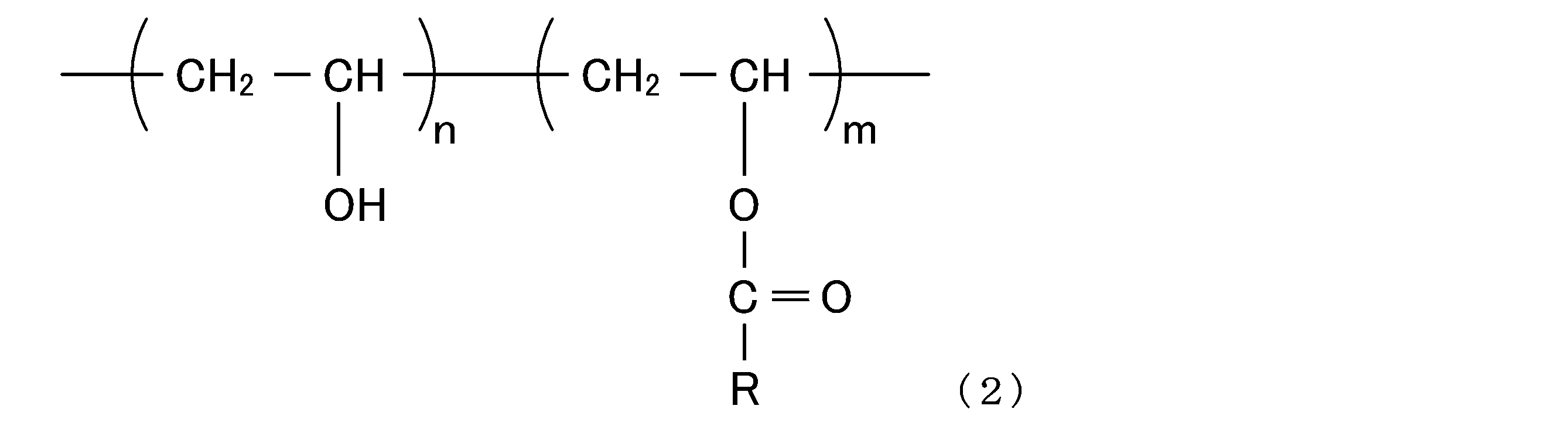
カルボニル基(-O-C(=O)R)を有する高分子として、式(2)で表される変性ポリビニルアルコールを用いる場合、式(2)においてn+mで表される平均重合度は、100~5000とすることができ、300~3500であることが好ましい。式(2)で表される変性ポリビニルアルコールの平均重合度(n+m)が100以上であると、より良好な耐水性を有する架橋高分子が得られ、より耐水性に優れる高分子膜が得られるためである。式(2)で表される変性ポリビニルアルコールの平均重合度が5000以下であると、PEDOT/PSSの水分散液と混合しやすいものとなり、後述する製造方法により高分子膜を製造する場合に、効率よく高分子膜を形成できる。
式(2)で表される変性ポリビニルアルコールのケン化度〔[n/(n+m)]×100〕は、95%~99%であることが望ましい。ケン化度が95%以上であると、式(2)で表される変性ポリビニルアルコールの親水性がより良好となり、PEDOT/PSSの水分散液と、より混合しやすい水溶液を形成できるためである。また、ケン化度が99%以下であると、式(2)で表される変性ポリビニルアルコールが-O-C(=O)R基を有することによる疎水性の向上効果が十分に得られる。その結果、より良好な耐水性を有する高分子膜が得られやすいためである。
式(2)で表される変性ポリビニルアルコールは、カルボニル基(-O-C(=O)R)として、例えば、式(2)中のRで示される一価の置換基が、炭素数1~5のアルキル基から選ばれるいずれか1種であるものを有することが好ましい。式(2)中のRは、架橋剤であるジヒドラジド化合物との反応性が良好な官能基であるため、メチル基であることが特に好ましい。
本実施形態において、架橋高分子を形成する材料として使用されるカルボニル基(-O-C(=O)R)を有する高分子は、1種のみであってもよいし、2種以上であってもよい。
本実施形態において、架橋高分子を形成する材料として使用されるカルボニル基(-O-C(=O)R)を有する高分子は、1種のみであってもよいし、2種以上であってもよい。
架橋高分子を形成する際に使用されるジヒドラジド化合物からなる架橋剤としては、公知のジヒドラジド化合物を用いることができ、例えば、アジピン酸ジヒドラジド、セバシン酸ジヒドラジド、イソフタル酸ジヒドラジド、7,11-オクタデカジエン-1,18-ジカルボヒドラジドなどを用いることができる。これらの中でも、ジヒドラジド化合物からなる架橋剤としては、カルボニル基を有する高分子との反応性が良好であるため、下記式(3)で表されるアジピン酸ジヒドラジド、および/または、下記式(4)で表される7,11-オクタデカジエン-1,18-ジカルボヒドラジドを用いることが好ましい。
本実施形態において、架橋高分子を形成する材料として使用されるジヒドラジド化合物からなる架橋剤は、1種のみであってもよいし、2種以上であってもよい。
本実施形態において、架橋高分子を形成する材料として使用されるジヒドラジド化合物からなる架橋剤は、1種のみであってもよいし、2種以上であってもよい。
本実施形態において、例えば、カルボニル基を有する高分子として、式(2)で表される変性ポリビニルアルコールを用い、ジヒドラジド化合物からなる架橋剤として、式(3)で表されるアジピン酸ジヒドラジドを用いた場合、以下に示すように、架橋高分子が形成される。
すなわち、式(2)で表される変性ポリビニルアルコールの有するカルボニル基と、式(3)で表されるアジピン酸ジヒドラジドの有するジヒドラジド基とが架橋反応し、式(2)で表される変性ポリビニルアルコールが式(3)で表されるアジピン酸ジヒドラジドによって架橋され、水と、下記式(5)で表される架橋構造を含む架橋高分子とが形成される。
すなわち、式(2)で表される変性ポリビニルアルコールの有するカルボニル基と、式(3)で表されるアジピン酸ジヒドラジドの有するジヒドラジド基とが架橋反応し、式(2)で表される変性ポリビニルアルコールが式(3)で表されるアジピン酸ジヒドラジドによって架橋され、水と、下記式(5)で表される架橋構造を含む架橋高分子とが形成される。
本実施形態の高分子膜において、架橋高分子を形成しているカルボニル基を有する高分子に由来する構造単位と、PEDOT/PSSとの合計質量に対する、カルボニル基を有する高分子に由来する構造単位の割合は、70質量%以下であることが好ましく、30質量%以下であることがより好ましい。カルボニル基を有する高分子に由来する構造単位の割合が70質量%以下であると、カルボニル基を有する高分子に由来する構造単位の割合が多すぎることによって、高分子膜の導電性に支障を来すことを防止できるためである。
上記の合計質量に対するカルボニル基を有する高分子に由来する構造単位の割合は、高分子膜に含まれる架橋高分子の含有量を確保でき、より良好な耐水性を有する高分子膜が得られやすくなるため、5質量%以上であることが好ましく、10質量%以上であることがより好ましい。
上記の合計質量に対するカルボニル基を有する高分子に由来する構造単位の割合は、高分子膜に含まれる架橋高分子の含有量を確保でき、より良好な耐水性を有する高分子膜が得られやすくなるため、5質量%以上であることが好ましく、10質量%以上であることがより好ましい。
本実施形態の高分子膜では、上記の合計質量に対するカルボニル基を有する高分子に由来する構造単位の割合が70質量%以下であって、カルボニル基を有する高分子に由来する構造単位の質量に対する、架橋剤に由来する構造単位の割合が、15質量%以下であることが好ましい。さらにカルボニル基を有する高分子に由来する構造単位の上記割合が30質量%以下であって、架橋剤に由来する構造単位の上記割合が、10質量%以下であることがより好ましい。架橋剤に由来する構造単位の上記割合が15質量%以下であると、高分子膜中に、カルボニル基を有する高分子に由来する構造単位と架橋構造を形成していない架橋剤に由来する構造単位が多く存在することによって、高分子膜の導電性に支障を来すことを防止できるためである。カルボニル基を有する高分子に由来する構造単位の質量に対する、架橋剤に由来する構造単位の割合は、高分子膜に含まれる架橋高分子の含有量を確保でき、より良好な耐水性を有する高分子膜が得られやすくなるため、3質量%以上であることが好ましく、5質量%以上であることがより好ましい。
本実施形態の高分子膜中のPEDOT/PSSの含有量は、30質量%以上であることが好ましく、60質量%以上であることがより好ましい。PEDOT/PSSの含有量が30質量%以上であると、導電性の良好な高分子膜となるためである。また、高分子膜中のPEDOT/PSSの含有量は、85質量%以下であることが好ましく、75質量%以下であることがより好ましい。PEDOT/PSSの含有量が85質量%以下であると、架橋高分子を十分に含む耐水性のより良好な高分子膜が得られやすくなるためである。
本実施形態の高分子膜は、上述した架橋高分子と、式(1)で表されるPEDOT/PSSとを含むものであり、これらに加えて、高分子膜の用途など、必要に応じてその他の成分をさらに1種または2種以上含有していてもよい。
その他の成分としては、例えば、ジヒドラジド化合物からなる架橋剤ではない公知の架橋剤、カルボニル基を有さない公知の高分子などが挙げられる。カルボニル基を有さない公知の高分子としては、水溶性または水分散性の高分子を好ましく用いることができ、具体的には、スルホン化ポリエステル樹脂などが挙げられる。
その他の成分としては、例えば、ジヒドラジド化合物からなる架橋剤ではない公知の架橋剤、カルボニル基を有さない公知の高分子などが挙げられる。カルボニル基を有さない公知の高分子としては、水溶性または水分散性の高分子を好ましく用いることができ、具体的には、スルホン化ポリエステル樹脂などが挙げられる。
(高分子膜の製造方法)
本実施形態の高分子膜は、例えば、以下に示す方法により製造できる。
PEDOT/PSSの水分散液と、カルボニル基を有する高分子の水溶液と、架橋剤であるジヒドラジド化合物の水溶液と、必要に応じて含有されるその他の成分とを混合・攪拌し、樹脂塗料とする。
本実施形態の高分子膜は、例えば、以下に示す方法により製造できる。
PEDOT/PSSの水分散液と、カルボニル基を有する高分子の水溶液と、架橋剤であるジヒドラジド化合物の水溶液と、必要に応じて含有されるその他の成分とを混合・攪拌し、樹脂塗料とする。
樹脂塗料を製造する際に、PEDOT/PSSの水分散液と、カルボニル基を有する高分子の水溶液と、架橋剤であるジヒドラジド化合物の水溶液を混合する順序は、特に限定されるものではなく、例えば、樹脂塗料に使用する材料を全て同時に混合・攪拌してもよいし、PEDOT/PSSの水分散液と、カルボニル基を有する高分子の水溶液とを混合して混合液とし、次いでこの混合液に架橋剤であるジヒドラジド化合物の水溶液を混合する方法により製造してもよい。
本実施形態において樹脂塗料を製造する際に使用するPEDOT/PSSの水分散液中のPEDOT/PSSの濃度、カルボニル基を有する高分子の水溶液中のカルボニル基を有する高分子の濃度と、ジヒドラジド化合物の水溶液中のジヒドラジド化合物の濃度は、いずれも特に限定されるものではなく、混合・攪拌しやすい濃度とすることができる。樹脂塗料中に含まれるPEDOT/PSS、カルボニル基を有する高分子、ジヒドラジド化合物の濃度は、それぞれ、高分子膜中のPEDOT/PSSの割合、高分子膜中に含まれるカルボニル基を有する高分子に由来する構造単位の割合、架橋剤に由来する構造単位の割合に対応する濃度とされる。
樹脂塗料を製造する際に使用するPEDOT/PSSの水分散液は、PEDOT/PSSと、水のみからなるものを用いることができる。PEDOT/PSSの水分散液は、PEDOT/PSSと、水に加えて、上述したその他の成分を1種または2種以上含有していてもよい。具体的には、PEDOT/PSSの水分散液は、PEDOT/PSSと、水と、カルボニル基を有さない高分子であるスルホン化ポリエステル樹脂とを含むものであってもよい。
次に、このようにして調製した樹脂塗料を、被膜形成面上に塗布し、塗膜を形成する。樹脂塗料を被膜形成面上に塗布する方法としては、例えば、ディップ法、各種コーターを用いる方法、各種ディスペンスを用いる方法、スプレー法など公知の方法を用いることができ、被膜形成面の形状、樹脂塗料の粘度などに応じて適宜決定できる。
次に、被膜形成面上に形成された塗膜を乾燥させて、塗膜中の水を除去する。これにより、塗膜中で、カルボニル基を有する高分子のカルボニル基と、架橋剤であるジヒドラジド化合物の有するジヒドラジド基との反応が進行し、架橋構造を含む架橋高分子が形成され、PEDOT/PSSと架橋高分子とを含む本実施形態の高分子膜が形成される。
塗膜中の水を除去する方法としては、例えば、80℃~150℃の温度で熱処理する方法など公知の方法を用いることができ、樹脂塗料の組成、塗膜の厚みなどに応じて適宜決定できる。
本実施形態においては、塗膜中の水を除去することによって得られた高分子膜を洗浄してもよい。高分子膜の洗浄は、例えば、水を用いて行うことができる。
本実施形態においては、塗膜中の水を除去することによって得られた高分子膜を洗浄してもよい。高分子膜の洗浄は、例えば、水を用いて行うことができる。
本実施形態の高分子膜は、上述した樹脂塗料を塗布して塗膜を形成し、塗膜中の水を除去する工程を1回のみ行うことにより製造してもよいし、所定の厚みを有する高分子膜を形成するために、上記の工程を複数回繰り返し行うことにより製造してもよい。
本実施形態の高分子膜は、カルボニル基を有する高分子がジヒドラジド化合物からなる架橋剤によって架橋された架橋高分子と、PEDOT/PSSとを含む。本実施形態の高分子膜は、PEDOT/PSSの水分散液を用いて製造でき、導電性および耐熱性に優れ、かつ良好な耐水性を有する。
〔第2実施形態〕
第2実施形態の高分子膜は、式(1)で表されるPEDOT/PSSが、架橋剤によって架橋された架橋高分子を含む。
本実施形態の高分子膜に含まれる架橋高分子は、PEDOT/PSSと架橋剤との架橋構造に起因する三次元的な網目構造を有するものであり、耐水性に優れる。
本実施形態の高分子膜に含まれる架橋高分子は、1種のみであってもよいし、2種以上であってもよい。
第2実施形態の高分子膜は、式(1)で表されるPEDOT/PSSが、架橋剤によって架橋された架橋高分子を含む。
本実施形態の高分子膜に含まれる架橋高分子は、PEDOT/PSSと架橋剤との架橋構造に起因する三次元的な網目構造を有するものであり、耐水性に優れる。
本実施形態の高分子膜に含まれる架橋高分子は、1種のみであってもよいし、2種以上であってもよい。
第2実施形態の高分子膜における架橋剤は、-NH2基、-NH-基から選ばれる1種または2種の基を合計で4つ以上含むアミン化合物の塩を含む。アミン化合物の塩は、-NH2基、-NH-基から選ばれる1種または2種の基を合計で4つ以上含むものであるため、-NH2基、-NH-基に起因する4つのN+を有する。このため、PEDOT/PSSとの架橋構造を十分に形成できる。アミン化合物の塩としては、塩酸塩、リン酸塩、スルホン酸塩、過塩素酸塩、パラトルエンスルホン酸などの有機スルホン酸との塩形成化合物などが挙げられ、容易に水に分散させることができ、かつ反応性が良好であるため、塩酸塩であることが好ましい。
このような架橋剤としては、例えば、式(6)で表されるN,N’-ビス(3-アミノプロピル)-1,4-ブタンジアミン四塩酸塩、N,N’-ビス(3-アミノプロピル)-1,3-プロパンジアミン四塩酸塩、N,N’-ビス(2-アミノエチル)-1,3-プロパンジアミン四塩酸塩などが挙げられる。
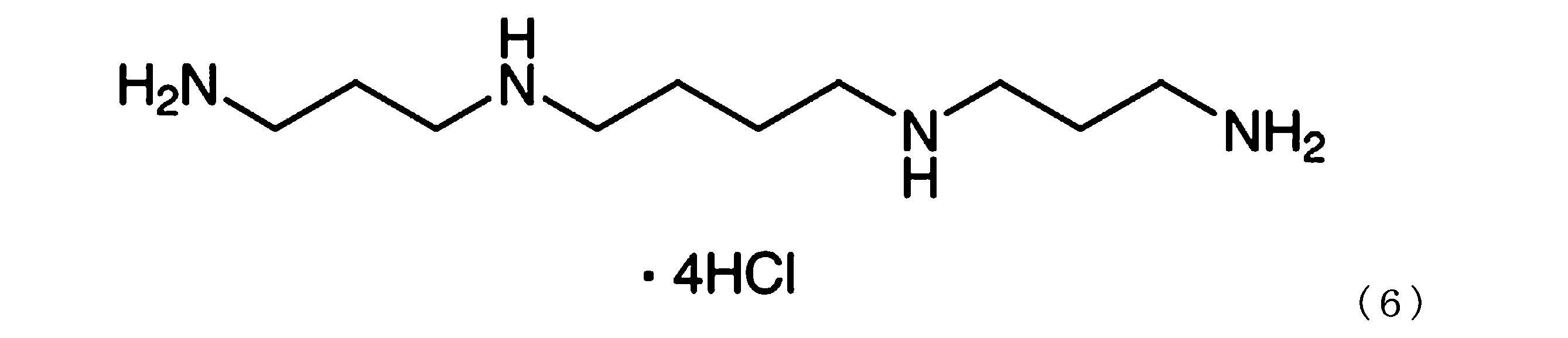
架橋剤としては、上記の中でも、式(6)で表されるN,N’-ビス(3-アミノプロピル)-1,4-ブタンジアミン四塩酸塩を用いることが好ましい。式(6)で表されるN,N’-ビス(3-アミノプロピル)-1,4-ブタンジアミン四塩酸塩は、PEDOT/PSSとの反応性が良好であるとともに、より良好な耐水性を有する架橋高分子を形成できるためである。また、式(6)で表されるN,N’-ビス(3-アミノプロピル)-1,4-ブタンジアミン四塩酸塩は、容易に水に分散させることができる。このため、架橋剤の水溶液を、水に溶解しやすいPEDOT/PSS膜上に塗布する方法によって、PEDOT/PSS膜の一部を溶解させてPEDOT/PSSとの架橋反応を促進することができ、好ましい。
第2実施形態においてPEDOT/PSSを架橋する架橋剤は、1種のみであってもよいし、2種以上であってもよい。
第2実施形態においてPEDOT/PSSを架橋する架橋剤は、1種のみであってもよいし、2種以上であってもよい。
本実施形態の高分子膜は、上述した架橋高分子を含むものであり、上述した架橋高分子に加えて、高分子膜の用途など、必要に応じてその他の成分をさらに1種または2種以上含有していてもよい。
その他の成分としては、例えば、PEDOT/PSSではない公知の樹脂などが挙げられる。PEDOT/PSSではない樹脂としては、水溶性または水分散性の樹脂を好ましく用いることができ、具体的には、スルホン化ポリエステル樹脂などが挙げられる。
その他の成分としては、例えば、PEDOT/PSSではない公知の樹脂などが挙げられる。PEDOT/PSSではない樹脂としては、水溶性または水分散性の樹脂を好ましく用いることができ、具体的には、スルホン化ポリエステル樹脂などが挙げられる。
(高分子膜の製造方法)
第2実施形態の高分子膜は、例えば、以下に示す方法により製造できる。
まず、PEDOT/PSSの水分散液を、被膜形成面上に塗布し、塗膜を形成する。PEDOT/PSSの水分散液には、必要に応じて、高分子膜を形成する成分となる、その他の成分を混合する。第2実施形態において、塗膜を製造する際に使用するPEDOT/PSSの水分散液としては、第1実施形態において使用できるPEDOT/PSSの水分散液と同様のものを用いることができる。
第2実施形態の高分子膜は、例えば、以下に示す方法により製造できる。
まず、PEDOT/PSSの水分散液を、被膜形成面上に塗布し、塗膜を形成する。PEDOT/PSSの水分散液には、必要に応じて、高分子膜を形成する成分となる、その他の成分を混合する。第2実施形態において、塗膜を製造する際に使用するPEDOT/PSSの水分散液としては、第1実施形態において使用できるPEDOT/PSSの水分散液と同様のものを用いることができる。
PEDOT/PSSの水分散液を、被膜形成面上に塗布する方法としては、例えば、PEDOT/PSSの水分散液中に被膜形成面を有する材料を浸漬させる方法、各種コーターを用いる方法、各種ディスペンスを用いる方法、スプレー法など公知の方法を用いることができ、被膜形成面の形状、PEDOT/PSSの水分散液の粘度、高分子膜の用途などに応じて適宜決定できる。
次に、被膜形成面上に形成された塗膜を乾燥させて、塗膜中の水を除去する。これにより、PEDOT/PSS膜が得られる。塗膜中の水を除去する方法としては、例えば、80℃~150℃の温度で熱処理する方法など公知の方法を用いることができ、被膜形成面の形状、塗膜の厚みなどに応じて適宜決定できる。
次に、第2実施形態では、PEDOT/PSS膜上に、架橋剤の水溶液を塗布する。これにより、PEDOT/PSS膜中のPEDOT/PSSと架橋剤とが接触し、PEDOT/PSSと、架橋剤であるアミン化合物の有するN+との架橋反応が開始される。
架橋剤の水溶液としては、架橋剤の含有量が0.01モル%~1モル%の範囲であることが好ましく、0.03モル%~1モル%の範囲であることがより好ましい。架橋剤の含有量が0.01モル%以上であると、PEDOT/PSS膜上に架橋剤の水溶液を塗布し、架橋剤の水溶液中の水を除去することにより、PEDOT/PSSと架橋剤との架橋構造を形成する効果が十分に得られる。したがって、架橋剤の含有量が0.01モル%以上であると、耐水性のより良好な高分子膜が得られやすい。また、架橋剤の含有量が1モル%以下であると、架橋構造を形成せずに残留する架橋剤の影響が少なくて済むため好ましい。
PEDOT/PSS膜上に、架橋剤の水溶液を塗布する方法としては、例えば、架橋剤の水溶液中に、PEDOT/PSS膜が形成された被膜形成面を有する材料を浸漬させる方法、各種コーターを用いる方法、各種ディスペンスを用いる方法、スプレー法など公知の方法を用いることができ、被膜形成面の形状、架橋剤の水溶液の粘度などに応じて適宜決定できる。
次に、PEDOT/PSS膜上に塗布された架橋剤の水溶液を乾燥させて、架橋剤の水溶液中の水を除去する。これにより、PEDOT/PSS膜中のPEDOT/PSSと、架橋剤であるアミン化合物の有するN+との架橋反応をさらに進行させる。以上の工程を行うことにより、PEDOT/PSSが架橋剤によって架橋された架橋高分子を含む本実施形態の高分子膜が得られる。
PEDOT/PSS膜上に塗布された架橋剤の水溶液中の水を除去する方法としては、例えば、80℃~150℃の温度で熱処理する方法など公知の方法を用いることができ、被膜形成面の形状、塗膜の厚みなどに応じて適宜決定できる。
本実施形態では、PEDOT/PSS膜上に、架橋剤の水溶液を塗布することにより、架橋反応を開始している。このため、PEDOT/PSS膜の表面に近い部分での架橋反応が促進される。その結果、本実施形態の高分子膜は、高分子膜中に含まれる架橋構造の密度が、厚み方向に連続的または段階的に変化しており、表面から近いほど高いものとされているものと推定される。その結果、表面の耐水性が特に高い高分子膜となり、架橋構造を有することによる高分子膜の耐水性が向上する効果が効果的に得られる。したがって、例えば、PEDOT/PSSと架橋剤を含む水分散液を塗布する方法により製造された、高分子膜中に含まれる架橋構造の密度が略均一であるものと比較して、架橋構造の数が少なくても十分な耐水性が得られる。よって、本実施形態の高分子膜は、架橋構造の密度が略均一で同等の耐水性を有する高分子膜と比較して、高分子膜中のPEDOT/PSSの含有量を多くでき、より良好な導電性および耐熱性が得られる。
本実施形態の高分子膜は、上述したPEDOT/PSS膜を形成し、その上に架橋剤の水溶液を塗布し、架橋剤の水溶液中の水を除去する工程を1回のみ行うことにより製造してもよいし、所定の厚みを有する高分子膜を形成するために、上記の工程を複数回繰り返し行うことにより製造してもよい。
本実施形態の高分子膜は、-NH2基、-NH-基から選ばれる1種または2種の基を合計で4つ以上含むアミン化合物の塩を含む架橋剤によって、PEDOT/PSSが架橋された架橋高分子を含む。本実施形態の高分子膜は、PEDOT/PSSの水分散液を用いて製造でき、導電性および耐熱性に優れ、かつ良好な耐水性を有する。
〔第3実施形態〕
第3実施形態の高分子膜は、第2実施形態と同様に、式(1)で表されるPEDOT/PSSが、架橋剤によって架橋された架橋高分子を含む。
本実施形態の高分子膜に含まれる架橋高分子は、PEDOT/PSSと架橋剤との架橋構造に起因する三次元的な網目構造を有するものであり、耐水性に優れる。
本実施形態の高分子膜に含まれる架橋高分子は、1種のみであってもよいし、2種以上であってもよい。
第3実施形態の高分子膜は、第2実施形態と同様に、式(1)で表されるPEDOT/PSSが、架橋剤によって架橋された架橋高分子を含む。
本実施形態の高分子膜に含まれる架橋高分子は、PEDOT/PSSと架橋剤との架橋構造に起因する三次元的な網目構造を有するものであり、耐水性に優れる。
本実施形態の高分子膜に含まれる架橋高分子は、1種のみであってもよいし、2種以上であってもよい。
第3実施形態の高分子膜における架橋剤は、価数2以上の金属カチオンを含む金属塩からなる。このような架橋剤としては、例えば、塩化カルシウム、塩化マグネシウム、塩化ストロンチウムなどが挙げられる。
架橋剤としては、上記の中でも、塩化カルシウムを用いることが好ましい。塩化カルシウムは、容易に入手でき、PEDOT/PSSとの反応性が良好であるとともに、より良好な耐水性を有する架橋高分子を形成できるためである。また、塩化カルシウムは、容易に水に分散させることができる。このため、架橋剤の水溶液を、水に溶解しやすいPEDOT/PSS膜上に塗布する方法によって、PEDOT/PSS膜の一部を溶解させてPEDOT/PSSとの架橋反応を促進することができ、好ましい。
第3実施形態においてPEDOT/PSSを架橋する架橋剤は、1種のみであってもよいし、2種以上であってもよい。
第3実施形態においてPEDOT/PSSを架橋する架橋剤は、1種のみであってもよいし、2種以上であってもよい。
本実施形態の高分子膜は、上述した架橋高分子を含むものであり、上述した架橋高分子に加えて、高分子膜の用途など、必要に応じてその他の成分をさらに1種または2種以上含有していてもよい。
その他の成分としては、例えば、PEDOT/PSSではない公知の樹脂などが挙げられる。PEDOT/PSSではない樹脂としては、水溶性または水分散性の樹脂を好ましく用いることができ、具体的には、スルホン化ポリエステル樹脂などが挙げられる。
その他の成分としては、例えば、PEDOT/PSSではない公知の樹脂などが挙げられる。PEDOT/PSSではない樹脂としては、水溶性または水分散性の樹脂を好ましく用いることができ、具体的には、スルホン化ポリエステル樹脂などが挙げられる。
(高分子膜の製造方法)
第3実施形態の高分子膜は、例えば、以下に示す方法により製造できる。
まず、第2実施形態と同様にして、PEDOT/PSSの水分散液を、被膜形成面上に塗布し、塗膜を形成する。PEDOT/PSSの水分散液には、必要に応じて、高分子膜を形成する成分となる、その他の成分を混合する。第3実施形態において、塗膜を製造する際に使用するPEDOT/PSSの水分散液としては、第1実施形態および第2実施形態において使用できるPEDOT/PSSの水分散液と同様のものを用いることができる。
第3実施形態の高分子膜は、例えば、以下に示す方法により製造できる。
まず、第2実施形態と同様にして、PEDOT/PSSの水分散液を、被膜形成面上に塗布し、塗膜を形成する。PEDOT/PSSの水分散液には、必要に応じて、高分子膜を形成する成分となる、その他の成分を混合する。第3実施形態において、塗膜を製造する際に使用するPEDOT/PSSの水分散液としては、第1実施形態および第2実施形態において使用できるPEDOT/PSSの水分散液と同様のものを用いることができる。
次に、第3実施形態では、PEDOT/PSS膜上に、価数2以上の金属カチオンを含む金属塩からなる架橋剤の水溶液を塗布する。これにより、PEDOT/PSS膜中のPEDOT/PSSと架橋剤とが接触し、PEDOT/PSSと、架橋剤である金属塩の有する金属カチオンとの架橋反応が開始される。
架橋剤の水溶液としては、架橋剤の含有量が0.01モル%~2モル%の範囲であることが好ましく、0.1モル%~1モル%の範囲であることがより好ましい。架橋剤の含有量が0.01モル%以上であると、PEDOT/PSS膜上に架橋剤の水溶液を塗布し、架橋剤の水溶液中の水を除去することにより、PEDOT/PSSと架橋剤との架橋構造を形成する効果が得られる。したがって、架橋剤の含有量が0.01モル%以上であると、耐水性の良好な高分子膜が得られやすい。また、架橋剤の含有量が2モル%以下であると、架橋構造を形成せずに残留する架橋剤の影響が少なくて済むため好ましい。
PEDOT/PSS膜上に、架橋剤の水溶液を塗布する方法としては、例えば、架橋剤の水溶液中に、PEDOT/PSS膜が形成された被膜形成面を有する材料を浸漬させる方法、各種コーターを用いる方法、各種ディスペンスを用いる方法、スプレー法など公知の方法を用いることができ、被膜形成面の形状、架橋剤の水溶液の粘度などに応じて適宜決定できる。
次に、PEDOT/PSS膜上に塗布された架橋剤の水溶液を乾燥させて、架橋剤の水溶液中の水を除去する。これにより、PEDOT/PSS膜中のPEDOT/PSSと、架橋剤である金属塩の有する金属カチオンとの架橋反応をさらに進行させる。以上の工程を行うことにより、PEDOT/PSSが架橋剤によって架橋された架橋高分子を含む本実施形態の高分子膜が得られる。
PEDOT/PSS膜上に塗布された架橋剤の水溶液中の水を除去する方法としては、例えば、80℃~150℃の温度で熱処理する方法など公知の方法を用いることができ、被膜形成面の形状、塗膜の厚みなどに応じて適宜決定できる。
本実施形態では、第2実施形態と同様に、PEDOT/PSS膜上に、架橋剤の水溶液を塗布することにより、架橋反応を開始している。このため、PEDOT/PSS膜の表面に近い部分での架橋反応が促進される。その結果、本実施形態の高分子膜は、高分子膜中に含まれる架橋構造の密度が、厚み方向に連続的または段階的に変化しており、表面から近いほど高いものとされているものと推定される。その結果、表面の耐水性が特に高い高分子膜となり、架橋構造を有することによる高分子膜の耐水性が向上する効果が効果的に得られる。したがって、例えば、PEDOT/PSSと架橋剤を含む水分散液を塗布する方法により製造された、高分子膜中に含まれる架橋構造の密度が略均一であるものと比較して、架橋構造の数が少なくても十分な耐水性が得られる。よって、本実施形態の高分子膜は、架橋構造の密度が略均一で同等の耐水性を有する高分子膜と比較して、高分子膜中のPEDOT/PSSの含有量を多くでき、より良好な導電性および耐熱性が得られる。
本実施形態の高分子膜は、上述したPEDOT/PSS膜を形成し、その上に架橋剤の水溶液を塗布し、架橋剤の水溶液中の水を除去する工程を1回のみ行うことにより製造してもよいし、所定の厚みを有する高分子膜を形成するために、上記の工程を複数回繰り返し行うことにより製造してもよい。
本実施形態の高分子膜は、PEDOT/PSSが、価数2以上の金属カチオンを含む金属塩からなる架橋剤によって架橋された架橋高分子を含む。本実施形態の高分子膜は、PEDOT/PSSの水分散液を用いて製造でき、導電性および耐熱性に優れ、かつ良好な耐水性を有する。
上述した第1実施形態~第3実施形態の高分子膜は、被膜形成面上に塗布する方法により製造でき、導電性および耐熱性に優れ、かつ良好な耐水性を有する。したがって、第1実施形態~第3実施形態の高分子膜は、例えば、固体電解コンデンサの固体電解質層、有機エレクトロルミネッセンス(EL)素子のホール注入層など、幅広い用途に好ましく使用できる。
以下、実施例および比較例を挙げて本発明の内容をより詳細に説明する。本発明は、下記の実施例に限定されるものではない。
[試験例1]
(実施例1)
式(1)で表されるPEDOT/PSSの2質量%水分散液と、式(2)で表される変性ポリビニルアルコール(式(2)における重合度を示すnは500であった。Rはメチル基であった。)の5質量%水溶液とを混合して混合液を得た。PEDOT/PSSの水分散液としては、PEDOT/PSSと、水のみからなるものを用いた。得られた混合液に、架橋剤である式(3)で表されるアジピン酸ジヒドラジドの5質量%水溶液を混合・攪拌し、樹脂塗料を得た。
(実施例1)
式(1)で表されるPEDOT/PSSの2質量%水分散液と、式(2)で表される変性ポリビニルアルコール(式(2)における重合度を示すnは500であった。Rはメチル基であった。)の5質量%水溶液とを混合して混合液を得た。PEDOT/PSSの水分散液としては、PEDOT/PSSと、水のみからなるものを用いた。得られた混合液に、架橋剤である式(3)で表されるアジピン酸ジヒドラジドの5質量%水溶液を混合・攪拌し、樹脂塗料を得た。
樹脂塗料中に含まれるPEDOT/PSSと変性ポリビニルアルコールの含有量は、固形分の質量比で30%:70%(PEDOT/PSS:変性ポリビニルアルコール)となるようにした。
また、樹脂塗料中に含まれる架橋剤の含有量は、変性ポリビニルアルコールの固形分の質量に対して、5質量%となるようにした。
このようにして調製した樹脂塗料を、被膜形成面であるガラス板上に塗布し、塗膜を形成した。その後、ガラス板上に形成された塗膜を120℃で15分間熱処理することにより乾燥させて、塗膜中の水を除去し、厚みが10μmである実施例1の高分子膜を得た。高分子膜固形分中(樹脂塗料の固形分中)のPEDOT/PSSの含有量を表1に示す。
また、樹脂塗料中に含まれる架橋剤の含有量は、変性ポリビニルアルコールの固形分の質量に対して、5質量%となるようにした。
このようにして調製した樹脂塗料を、被膜形成面であるガラス板上に塗布し、塗膜を形成した。その後、ガラス板上に形成された塗膜を120℃で15分間熱処理することにより乾燥させて、塗膜中の水を除去し、厚みが10μmである実施例1の高分子膜を得た。高分子膜固形分中(樹脂塗料の固形分中)のPEDOT/PSSの含有量を表1に示す。
(実施例2~実施例8、比較例1および比較例2)
PEDOT/PSSの水分散液の種類、変性ポリビニルアルコール(変性PVA)の水溶液の種類、架橋剤の水溶液の種類を表1に示すものとし、樹脂塗料中に含まれるPEDOT/PSSと変性ポリビニルアルコールの含有量(固形分の質量比)、樹脂塗料中に含まれる架橋剤の含有量(変性ポリビニルアルコールの固形分の質量に対する割合)を表1に示す含有量としたこと以外は、実施例1と同様にして、実施例2~実施例8、比較例1および比較例2の高分子膜を得た。高分子膜固形分中(樹脂塗料の固形分中)のPEDOT/PSSの含有量を表1に示す。
PEDOT/PSSの水分散液の種類、変性ポリビニルアルコール(変性PVA)の水溶液の種類、架橋剤の水溶液の種類を表1に示すものとし、樹脂塗料中に含まれるPEDOT/PSSと変性ポリビニルアルコールの含有量(固形分の質量比)、樹脂塗料中に含まれる架橋剤の含有量(変性ポリビニルアルコールの固形分の質量に対する割合)を表1に示す含有量としたこと以外は、実施例1と同様にして、実施例2~実施例8、比較例1および比較例2の高分子膜を得た。高分子膜固形分中(樹脂塗料の固形分中)のPEDOT/PSSの含有量を表1に示す。
表1に示すPEDOT/PSSの水分散液、変性ポリビニルアルコールの水溶液、架橋剤の水溶液は、以下に示すものである。
[PEDOT/PSS水分散液]A:式(1)で表されるPEDOT/PSSと、水のみからなり、PEDOT/PSSを2質量%含む水分散液であった。
[PEDOT/PSS水分散液]B:式(1)で表されるPEDOT/PSSと、カルボニル基を有さない高分子であるスルホン化ポリエステル樹脂と、水とからなり、PEDOT/PSSを2質量%含む水分散液であった。
[PEDOT/PSS水分散液]A:式(1)で表されるPEDOT/PSSと、水のみからなり、PEDOT/PSSを2質量%含む水分散液であった。
[PEDOT/PSS水分散液]B:式(1)で表されるPEDOT/PSSと、カルボニル基を有さない高分子であるスルホン化ポリエステル樹脂と、水とからなり、PEDOT/PSSを2質量%含む水分散液であった。
[変性ポリビニルアルコール水溶液]a:式(2)で表される変性ポリビニルアルコール(式(2)における重合度を示すnは500であった。Rはメチル基であった。)を5質量%含む水溶液であった。
[変性ポリビニルアルコール水溶液]b:式(2)で表される変性ポリビニルアルコール(式(2)における重合度を示すnは2000であった。Rはメチル基であった。)を5質量%含む水溶液であった。
[架橋剤水溶液]I:式(3)で表されるアジピン酸ジヒドラジドを5質量%含む水溶液であった。
[架橋剤水溶液]II:式(4)で表される7,11-オクタデカジエン-1,18-ジカルボヒドラジドを5質量%含む水溶液であった。
[変性ポリビニルアルコール水溶液]b:式(2)で表される変性ポリビニルアルコール(式(2)における重合度を示すnは2000であった。Rはメチル基であった。)を5質量%含む水溶液であった。
[架橋剤水溶液]I:式(3)で表されるアジピン酸ジヒドラジドを5質量%含む水溶液であった。
[架橋剤水溶液]II:式(4)で表される7,11-オクタデカジエン-1,18-ジカルボヒドラジドを5質量%含む水溶液であった。
このようにして得られた実施例1~実施例8、比較例1および比較例2の高分子膜について、以下に示す方法により耐水性を評価した。
[耐水性評価]
高分子膜が形成されたガラス板を、温度80℃の攪拌している水の中に3分間浸漬し、取り上げた。そして、ガラス板上の高分子膜の状態および浸漬させた水を目視によって観察する目視観察を行った。次に、以下に示す方法により強度観察を行った。まず、水中から取り上げたガラス板上の濡れた状態の高分子膜の表面を、先端が鋭利な金属棒で引っ掻いて変形の有無を目視により確認した。その後、高分子膜を風乾させて目視によって表面の状態を観察し、以下に示す基準により評価した。その結果を表1に示す。
[耐水性評価]
高分子膜が形成されたガラス板を、温度80℃の攪拌している水の中に3分間浸漬し、取り上げた。そして、ガラス板上の高分子膜の状態および浸漬させた水を目視によって観察する目視観察を行った。次に、以下に示す方法により強度観察を行った。まず、水中から取り上げたガラス板上の濡れた状態の高分子膜の表面を、先端が鋭利な金属棒で引っ掻いて変形の有無を目視により確認した。その後、高分子膜を風乾させて目視によって表面の状態を観察し、以下に示す基準により評価した。その結果を表1に示す。
(基準)
A(excellent):目視観察によってガラス板上からの高分子膜の脱落が確認されなかった。更に濡れた状態の高分子膜が金属棒での引っ掻きによって変形しなかった。
B(good):目視観察によってガラス板上からの高分子膜の脱落が確認されなかった。更に濡れた状態の高分子膜が金属棒での引っ掻きによって変形したが、80℃で10分間乾燥させることによって変形前の形状となった。
C(fair):目視観察によって、ガラス板上から高分子膜の一部が脱落し、浸漬させた水中に脱落した高分子膜が浮遊していることが確認された。
D(poor):目視確認によって、ガラス板上から高分子膜の全てが脱落し、浸漬させた水中に脱落した高分子膜が浮遊しているか、または浸漬させた水中に脱落した高分子膜が溶解していることが確認された。
A(excellent):目視観察によってガラス板上からの高分子膜の脱落が確認されなかった。更に濡れた状態の高分子膜が金属棒での引っ掻きによって変形しなかった。
B(good):目視観察によってガラス板上からの高分子膜の脱落が確認されなかった。更に濡れた状態の高分子膜が金属棒での引っ掻きによって変形したが、80℃で10分間乾燥させることによって変形前の形状となった。
C(fair):目視観察によって、ガラス板上から高分子膜の一部が脱落し、浸漬させた水中に脱落した高分子膜が浮遊していることが確認された。
D(poor):目視確認によって、ガラス板上から高分子膜の全てが脱落し、浸漬させた水中に脱落した高分子膜が浮遊しているか、または浸漬させた水中に脱落した高分子膜が溶解していることが確認された。
実施例2~実施例8、比較例1および比較例2の高分子膜のシート抵抗をJIS K7194に準拠した低抵抗率計を用いて測定した。その結果を表1に示す。
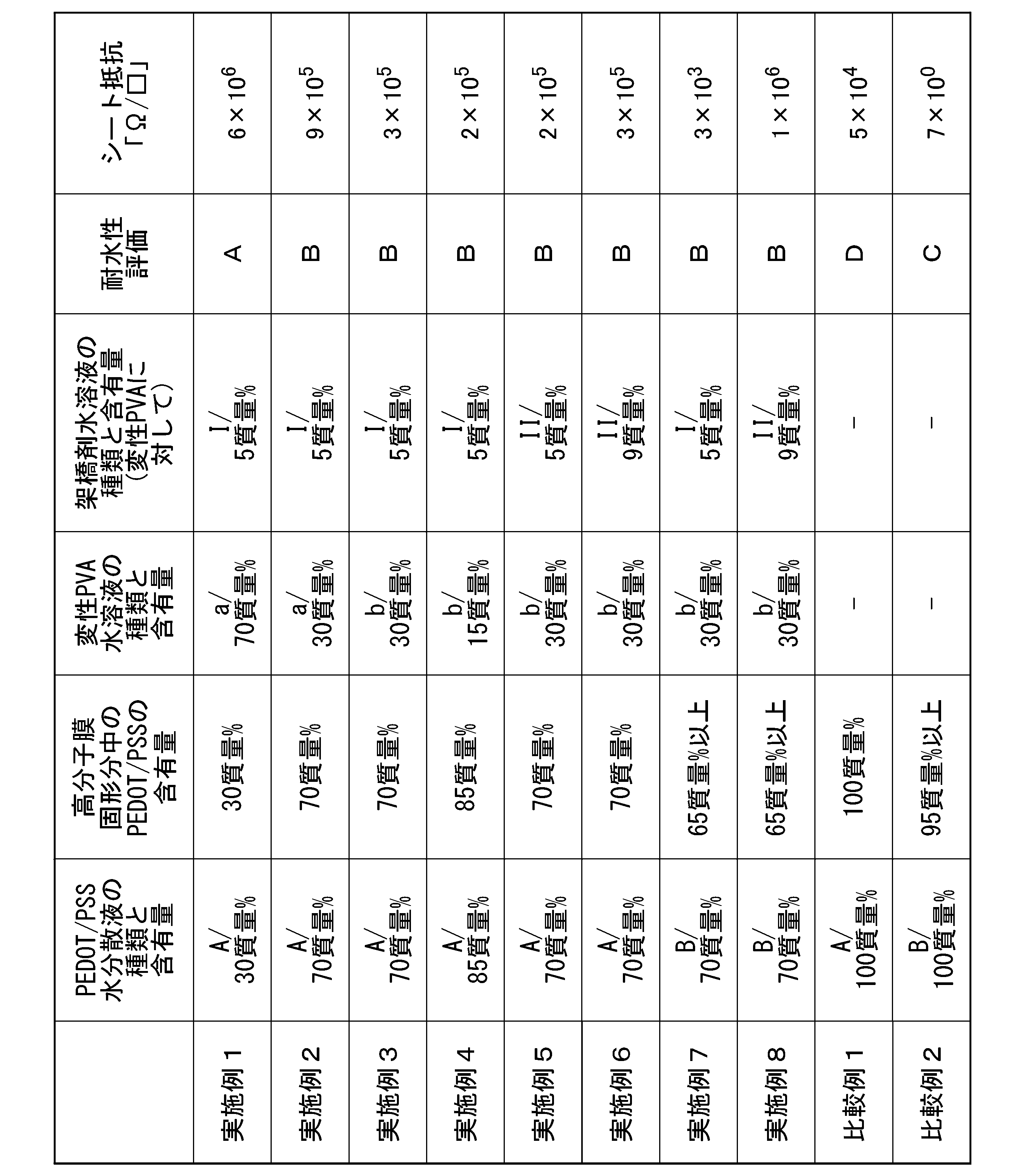
表1に示すように、実施例1~実施例8の高分子膜は、PEDOT/PSSと、変性ポリビニルアルコール(変性PVA)がジヒドラジド化合物からなる架橋剤によって架橋された架橋高分子とを含む。実施例1~実施例8の高分子膜は、架橋高分子を含まない比較例1および比較例2の高分子膜と比較して、耐水性が良好であることが確認できた。
また、表1に示すように、実施例1~実施例8の高分子膜は、シート抵抗が十分小さいものであった。
また、表1に示すように、実施例1~実施例8の高分子膜は、シート抵抗が十分小さいものであった。
[試験例2]
(実施例11~実施例20)
式(1)で表されるPEDOT/PSSと水のみからなり、PEDOT/PSSを2質量%含む水分散液中に、ガラス板を浸漬させて、ガラス板上に塗膜を形成した。その後、塗膜が形成されたガラス板を120℃で15分間熱処理することにより、塗膜を乾燥させて、塗膜中の水を除去し、厚みが10μmであるPEDOT/PSS膜を得た。
(実施例11~実施例20)
式(1)で表されるPEDOT/PSSと水のみからなり、PEDOT/PSSを2質量%含む水分散液中に、ガラス板を浸漬させて、ガラス板上に塗膜を形成した。その後、塗膜が形成されたガラス板を120℃で15分間熱処理することにより、塗膜を乾燥させて、塗膜中の水を除去し、厚みが10μmであるPEDOT/PSS膜を得た。
次に、表2に示す架橋剤を表2に示す含有量で含む架橋剤の水溶液中に、PEDOT/PSS膜が形成されたガラス板を3分間浸漬させた。次に、ガラス板上に形成したPEDOT/PSS膜上に塗布した架橋剤の水溶液を、80℃で5分間熱処理することにより乾燥させて、架橋剤の水溶液中の水を除去し、実施例11~実施例20の高分子膜を得た。
(比較例11)
実施例11の高分子膜を製造する際に形成したPEDOT/PSS膜を比較例11の高分子膜とした。
実施例11の高分子膜を製造する際に形成したPEDOT/PSS膜を比較例11の高分子膜とした。
表2に示す架橋剤は、以下に示すものである。
[架橋剤]A:式(6)で表されるN,N’-ビス(3-アミノプロピル)-1,4-ブタンジアミン四塩酸塩である。
[架橋剤]B:塩化カルシウムである。
[架橋剤]A:式(6)で表されるN,N’-ビス(3-アミノプロピル)-1,4-ブタンジアミン四塩酸塩である。
[架橋剤]B:塩化カルシウムである。
このようにして得られた実施例11~実施例20、比較例11の高分子膜について、実施例1と同様の方法および基準により耐水性を評価した。
実施例11~実施例20、比較例11の高分子膜のシート抵抗をJIS K7194に準拠した低抵抗率計を用いて測定した。その結果を表2に示す。

表2に示すように、実施例11~実施例20の高分子膜は、PEDOT/PSSが架橋剤によって架橋された架橋高分子を含む。実施例11~実施例20の高分子膜は、架橋されていないPEDOT/PSS膜である比較例11と比較して、耐水性が良好であることが確認できた。
また、表2に示すように、実施例12~実施例15、実施例18~実施例19の高分子膜は、シート抵抗が十分小さいものであった。
また、表2に示すように、実施例12~実施例15、実施例18~実施例19の高分子膜は、シート抵抗が十分小さいものであった。
本実施形態の高分子膜は、固体電解コンデンサの固体電解質層、有機エレクトロルミネッセンス(EL)素子のホール注入層などの幅広い用途に好適に用いられる。
Claims (7)
- カルボニル基を有する高分子がジヒドラジド化合物からなる架橋剤によって架橋された架橋高分子と、
ポリエチレンジオキシチオフェンとポリスチレンスルホン酸との複合物とを含む、高分子膜。 - 前記カルボニル基を有する高分子が、ポリビニルアルコール骨格を有する、請求項1に記載の高分子膜。
- 前記架橋高分子を形成している前記カルボニル基を有する高分子に由来する構造単位と、前記複合物との合計質量に対する、前記カルボニル基を有する高分子に由来する構造単位の割合が、70質量%以下であり、
前記カルボニル基を有する高分子に由来する構造単位の質量に対する、前記架橋剤に由来する構造単位の割合が、15質量%以下である、請求項1に記載の高分子膜。 - 前記架橋高分子を形成している前記カルボニル基を有する高分子に由来する構造単位と、前記複合物との合計質量に対する、前記カルボニル基を有する高分子に由来する構造単位の割合が、30質量%以下であり、
前記カルボニル基を有する高分子に由来する構造単位の質量に対する、前記架橋剤に由来する構造単位の割合が、10質量%以下である、請求項1に記載の高分子膜。 - ポリエチレンジオキシチオフェンとポリスチレンスルホン酸との複合物が、架橋剤によって架橋された架橋高分子を含み、
前記架橋剤が、-NH2基、-NH-基から選ばれる1種または2種の基を合計で4つ以上含むアミン化合物の塩を含む、高分子膜。 - ポリエチレンジオキシチオフェンとポリスチレンスルホン酸との複合物が、架橋剤によって架橋された架橋高分子を含み、
前記架橋剤が、価数2以上の金属カチオンを含む金属塩からなる、高分子膜。 - 前記架橋剤が、塩化カルシウムである、請求項6に記載の高分子膜。
Applications Claiming Priority (2)
| Application Number | Priority Date | Filing Date | Title |
|---|---|---|---|
| JP2023-222796 | 2023-12-28 | ||
| JP2023222796 | 2023-12-28 |
Publications (1)
| Publication Number | Publication Date |
|---|---|
| WO2025142118A1 true WO2025142118A1 (ja) | 2025-07-03 |
Family
ID=96218931
Family Applications (1)
| Application Number | Title | Priority Date | Filing Date |
|---|---|---|---|
| PCT/JP2024/038954 Pending WO2025142118A1 (ja) | 2023-12-28 | 2024-10-31 | 高分子膜 |
Country Status (1)
| Country | Link |
|---|---|
| WO (1) | WO2025142118A1 (ja) |
Citations (5)
| Publication number | Priority date | Publication date | Assignee | Title |
|---|---|---|---|---|
| US6482299B1 (en) * | 1998-07-09 | 2002-11-19 | Forskarpatent I Linkoping Ab | Polymer gel electrode |
| WO2008038764A1 (fr) * | 2006-09-28 | 2008-04-03 | Fujifilm Corporation | Écran à émission spontanée, procédé de fabrication d'un écran à émission spontanée, film conducteur transparent, dispositif électroluminescent, électrode transparente de cellule solaire et électrode transparente de papier électronique |
| JP2012506900A (ja) * | 2008-10-28 | 2012-03-22 | ウニベルシダーデ デ サンティアゴ デ コンポステラ | アニオン性ポリマーから調製されるナノ粒子系 |
| WO2015053342A1 (ja) * | 2013-10-09 | 2015-04-16 | 日本合成化学工業株式会社 | 架橋剤、架橋高分子及び化合物 |
| US20200363273A1 (en) * | 2019-05-15 | 2020-11-19 | The Regents Of The University Of California | Conductive polymer nanocellulose aerogels and use as strain sensor |
-
2024
- 2024-10-31 WO PCT/JP2024/038954 patent/WO2025142118A1/ja active Pending
Patent Citations (5)
| Publication number | Priority date | Publication date | Assignee | Title |
|---|---|---|---|---|
| US6482299B1 (en) * | 1998-07-09 | 2002-11-19 | Forskarpatent I Linkoping Ab | Polymer gel electrode |
| WO2008038764A1 (fr) * | 2006-09-28 | 2008-04-03 | Fujifilm Corporation | Écran à émission spontanée, procédé de fabrication d'un écran à émission spontanée, film conducteur transparent, dispositif électroluminescent, électrode transparente de cellule solaire et électrode transparente de papier électronique |
| JP2012506900A (ja) * | 2008-10-28 | 2012-03-22 | ウニベルシダーデ デ サンティアゴ デ コンポステラ | アニオン性ポリマーから調製されるナノ粒子系 |
| WO2015053342A1 (ja) * | 2013-10-09 | 2015-04-16 | 日本合成化学工業株式会社 | 架橋剤、架橋高分子及び化合物 |
| US20200363273A1 (en) * | 2019-05-15 | 2020-11-19 | The Regents Of The University Of California | Conductive polymer nanocellulose aerogels and use as strain sensor |
Similar Documents
| Publication | Publication Date | Title |
|---|---|---|
| JP4004214B2 (ja) | 帯電防止コーティング用組成物 | |
| US9761347B2 (en) | Process to improve coverage and electrical performance of solid electrolytic capacitor | |
| US9761378B2 (en) | Process to improve coverage and electrical performance of solid electrolytic capacitors | |
| JP6032781B2 (ja) | ガスバリア性フィルム及び製造方法 | |
| CN101932653A (zh) | 导电性组合物的分散液、导电性组合物以及固体电解电容器 | |
| CN1051192A (zh) | 基于环氧树脂的改进的自沉积表面涂涂料组合物,涂敷该涂料的方法和带有该涂料的制品 | |
| US5840214A (en) | Method of increasing polyaniline conductivity with ionic surfactants | |
| TW201821529A (zh) | 具粗粒徑及高pedot含量之pedot/pss | |
| JPH11500785A (ja) | 電着組成物および電着方法 | |
| DE1669249A1 (de) | Filmbildende Polyamid-Dispersion | |
| WO2013157574A1 (ja) | 自己析出型銅用表面処理剤および樹脂皮膜付き銅含有基材の製造方法 | |
| CN111690318B (zh) | 一种自修复水性聚氨酯涂料组合物和涂层 | |
| CN1203144C (zh) | 水性抗静电涂料 | |
| JP5600019B2 (ja) | 金属積層板 | |
| KR20160122100A (ko) | 대전방지용 코팅 조성물 및 이를 이용한 대전방지 폴리에스테르 필름 | |
| CN105038532B (zh) | 一种亲水pet底层涂布液及其在pet上的应用 | |
| TW200938601A (en) | Process for the preparation of coatings exhibiting increased conductivity based on polythiophene and its derivatives | |
| JP4621950B2 (ja) | 帯電防止コーティング用組成物 | |
| CN118045538A (zh) | 一种功能化微胶囊制备及其在防腐涂料中的应用 | |
| TWI728617B (zh) | 離子交換樹脂、其製備方法以及其所形成的膜材 | |
| JP2001277422A (ja) | 加工性および耐熱性に優れた樹脂被覆金属板 | |
| EP0923083A1 (en) | Polyaniline solutions with bicyclic terpene solvent | |
| JPS6148552B2 (ja) | ||
| WO2025142117A1 (ja) | 固体電解コンデンサ | |
| JP3819191B2 (ja) | 塗布性に優れた導電性被覆用組成物 |
Legal Events
| Date | Code | Title | Description |
|---|---|---|---|
| 121 | Ep: the epo has been informed by wipo that ep was designated in this application |
Ref document number: 24912011 Country of ref document: EP Kind code of ref document: A1 |
|
| ENP | Entry into the national phase |
Ref document number: 2025566287 Country of ref document: JP Kind code of ref document: A |
|
| WWE | Wipo information: entry into national phase |
Ref document number: 2025566287 Country of ref document: JP |