WO2025134586A1 - 情報処理装置および情報処理方法 - Google Patents
情報処理装置および情報処理方法 Download PDFInfo
- Publication number
- WO2025134586A1 WO2025134586A1 PCT/JP2024/039845 JP2024039845W WO2025134586A1 WO 2025134586 A1 WO2025134586 A1 WO 2025134586A1 JP 2024039845 W JP2024039845 W JP 2024039845W WO 2025134586 A1 WO2025134586 A1 WO 2025134586A1
- Authority
- WO
- WIPO (PCT)
- Prior art keywords
- abnormality
- unit
- information processing
- processing device
- data
- Prior art date
- Legal status (The legal status is an assumption and is not a legal conclusion. Google has not performed a legal analysis and makes no representation as to the accuracy of the status listed.)
- Pending
Links
Images


Classifications
-
- G—PHYSICS
- G05—CONTROLLING; REGULATING
- G05B—CONTROL OR REGULATING SYSTEMS IN GENERAL; FUNCTIONAL ELEMENTS OF SUCH SYSTEMS; MONITORING OR TESTING ARRANGEMENTS FOR SUCH SYSTEMS OR ELEMENTS
- G05B23/00—Testing or monitoring of control systems or parts thereof
- G05B23/02—Electric testing or monitoring
Definitions
- This disclosure relates to an information processing device and an information processing method.
- a large number of motors and gears are used in industrial equipment, industrial machinery, industrial robots, power generation equipment, and other facilities used in production at factories and other facilities. Sudden equipment troubles, as well as equipment abnormalities caused by aging or wear and tear, can lead to line stoppages, reducing productivity and causing accidents.
- the technical challenge in identifying not only whether equipment is normal or abnormal, but also the location and/or cause of the abnormality, is the lack of data on abnormalities.
- Some literature discloses methods to make up for this deficiency by generating abnormality data using physical simulations.
- Patent Document 1 discloses a method for improving the value of a physical parameter by comparing actual measured data under normal conditions with data generated under normal conditions and updating the parameters of a physical model to reduce the difference.
- Patent Document 2 discloses a method for improving the value of a physical parameter by comparing actual measured data under abnormal conditions with data generated under abnormal conditions and updating the parameters of a physical model to reduce the difference.
- Patent Documents 1 and 2 it is difficult to generate a sufficient amount of diverse data generated during anomalies. For this reason, it is not possible to estimate the location of an anomaly in equipment and/or the cause of the anomaly with sufficient accuracy.
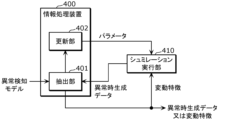
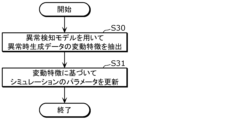
- An information processing device includes an extraction unit that extracts fluctuation characteristics of abnormality-generated data generated by simulating an abnormality in equipment using an abnormality detection model of the equipment, and an update unit that updates parameters of the simulation based on the fluctuation characteristics extracted by the extraction unit.
- the anomaly detection model learning unit 110 learns an anomaly detection model using the measured signal input from the sensor 30.
- the anomaly detection model is a model that learns normal characteristics of measured data using only measured data under normal conditions.
- a machine learning model may be used to learn the normal characteristics.
- various known algorithms such as an autoencoder using a neural network, a support vector machine or a random forest, or ensemble learning that combines these may be used.
- a rule-based method may be used for the anomaly detection model.
- a threshold value for the feature amount of a certain signal determined from measured data under normal conditions may be used as the anomaly detection model.
- the learned anomaly detection model is output to the anomaly data generation unit 120 and the anomaly detection unit 140.
- the abnormality data generation unit 120 includes a parameter determination unit 121, a simulation execution unit 122, an extraction unit 123, a storage unit 124, a calculation unit 125, and a summary unit 126.
- the parameter determination unit 121 is an example of an update unit according to the present disclosure, and updates the physical parameters based on the fluctuation features extracted by the extraction unit 123.
- the fluctuation features are information that represents the features of the data generated under abnormal conditions, and more specifically, the amount of change in the data generated under abnormal conditions relative to the features of the measured data under normal conditions that the anomaly detection model has learned.
- the parameter determination unit 121 updates the physical parameters based on the diversity calculated by the calculation unit 125.
- the diversity is the diversity of the fluctuation features extracted by the extraction unit 123.
- the parameter determination unit 121 may also update the parameters based on the summarization amount calculated by the summarization unit 126.
- the summarization amount is a summary amount of the distribution of the fluctuation features extracted by the extraction unit 123.
- the distribution of the fluctuation features has similar characteristics to the distribution of the data generated under abnormal conditions. For example, if multiple fluctuation features are distributed evenly over a wide range, multiple data generated under abnormal conditions will also be distributed evenly over a wide range, i.e., the data generated under abnormal conditions will be diverse.
- the physical parameters may be determined from a range set by the user on the display screen shown in FIG. 5, which will be described later.
- the values of the physical parameters may be determined according to the distribution of the variation features output from the summarization unit 126 and the diversity of the variation features output from the calculation unit 125. The values may be determined so as to increase the diversity of the variation features.
- the simulation execution unit 122 uses a physical model based on the physical parameters determined or updated by the parameter determination unit 121 to perform a simulation of an abnormality in the equipment 20.
- the simulation execution unit 122 generates abnormality generation data by performing a simulation.
- the physical model may be an equivalent circuit model of the equipment 20 to be diagnosed, a more detailed FEM (Finite Element Method) model, or a proxy model that has learned the input/output relationships of these.
- the extraction unit 123 is an example of an extraction unit according to the present disclosure, and extracts the fluctuation feature of the abnormality generation data generated by simulating an abnormality of the equipment 20, using an anomaly detection model of the equipment 20. Specifically, the extraction unit 123 extracts the fluctuation feature of the abnormality generation data generated by the simulation execution unit 122, using the anomaly detection model. In other words, the extraction unit 123 extracts the fluctuation feature of the abnormality generation data by evaluating the abnormality generation data using the anomaly detection model.
- the fluctuation feature is the amount of change in the abnormality generation data with respect to the feature of the normal actual measurement data learned by the anomaly detection model.
- f is an autoencoder that has learned the characteristics of the measured data under normal conditions, and is an anomaly detection model used for anomaly detection by the anomaly detection unit 140.
- xt is the anomaly generation data generated at the tth time.
- the storage unit 124 stores the variation features output from the extraction unit 123.
- the storage unit 124 also outputs all previously stored variation features to the calculation unit 125 and the summarization unit 126.
- the calculation unit 125 is an example of a calculation unit according to the present disclosure, and calculates the diversity of the variable features extracted by the extraction unit 123.
- the calculation unit 125 can also be called a diversity evaluation unit. Specifically, the calculation unit 125 calculates the diversity of the variable features output from the storage unit 124, and outputs the calculated diversity to the parameter determination unit 121.
- the diversity r t can be defined as, for example, the average of the distances between the abnormality-generated data generated by performing a simulation and each of a plurality of abnormality-generated data generated by performing a simulation in the past before the abnormality-generated data.
- the diversity r t may be defined as the average of the distances between the abnormality-generated data generated by performing a simulation in the past before the abnormality-generated data generated by performing a simulation in the past before the abnormality-generated data generated by performing a simulation in the past.
- d is a function that represents the distance between vectors, such as cosine similarity.
- the diversity r t may be defined as, for example, the average of the entropy of each dimension of the fluctuation feature extracted by the extraction unit 123.
- the diversity r t may be defined as the average of the entropy of each dimension of the fluctuation feature of a plurality of abnormality generation data generated in the past, as shown in the following formula (3).
- n is the number of dimensions of the fluctuation feature
- e t k is the k-th element of the fluctuation feature of the abnormality generated data generated in the tth time
- h is a function that approximates the entropy from the data distribution.
- the summarization unit 126 is an example of a summarization unit according to the present disclosure, and calculates a summary amount of the distribution of the fluctuation characteristics extracted by the extraction unit 123. Specifically, the summarization unit 126 calculates a summary amount of the distribution of the fluctuation characteristics of the abnormality-generated data stored in the storage unit 124, and outputs the calculated summary amount to the parameter determination unit 121.
- the distribution summary amount can be defined as a matrix including the average and variance of each of a plurality of clusters in the variation feature space, in which a plurality of abnormal generation data generated by performing a simulation are classified.
- the distribution summary amount may be defined as a matrix S t that summarizes the centroids and variances of the variation feature classes shown in the following formula (4).
- n is the number of dimensions of the variation feature.
- m is the fixed number of clusters.
- ⁇ indicates the center of gravity of the cluster.
- ⁇ indicates the variance of the cluster.
- the dimension of the distribution summary does not depend on the amount of data generated up to that point, and it becomes possible to use this as an observation for reinforcement learning.
- the summary amount of the distribution may be defined as a matrix summarizing the frequency distribution of each dimension of the variation feature extracted by the extraction unit 123.
- the summary amount of the distribution may be defined as a matrix S t summarizing the frequency distribution of each dimension of the variation feature shown in the following formula (5).
- l is the number of classes and w is the frequency.
- the dimension of the distribution summary does not depend on the amount of data generated so far, and it becomes possible to use this as an observation for reinforcement learning.
- the evaluation using the small amount of actual abnormality data may be added to the evaluation using the diversity or distribution of the fluctuation features described above to update the simulation parameters.
- the objective function of black-box optimization or the reward function of reinforcement learning may include a term for the similarity between the actual abnormality data and the data generated during abnormality, or a term for the diagnostic accuracy when a diagnostic model trained on the data generated during abnormality is evaluated using the actual abnormality data.
- Fig. 3 is a flowchart showing the learning phase processing among the processing performed by the equipment state estimation device 100 according to the present embodiment.
- step S10 the input/output unit 103 accepts input of setting information necessary for processing by the information processing unit 101.
- the setting information includes, for example, parameter values for simulating an abnormality in the equipment 20.
- step S11 the anomaly detection model learning unit 110 acquires physical quantities such as vibration and current of the equipment 20 as actual measurement signals (actual measurement data) using the sensor 30, and learns the characteristics of the acquired actual measurement data. Note that the learning phase is performed after confirming that the equipment 20 is operating normally. For this reason, all actual measurement data acquired from the sensor 30 is considered to be normal actual measurement data. In other words, the anomaly detection model learns normal characteristics using normal actual measurement data.
- step S12 the abnormality data generation unit 120 generates abnormality generation data.
- the simulation execution unit 122 generates abnormality generation data by simulating an abnormality in the equipment 20.
- the parameters of the simulation at this time are included in, for example, the setting information received in step S10.
- step S13 the extraction unit 123 extracts fluctuation characteristics of the data generated during an anomaly using the anomaly detection model.
- the extraction unit 123 stores the extracted fluctuation characteristics in the storage unit 124.
- step S14 the calculation unit 125 calculates the diversity of the extracted variation features.
- the information processing unit 101 outputs the diversity calculated by the calculation unit 125 to the input/output unit 103.
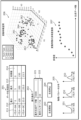
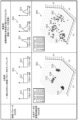
- the input/output unit 103 updates the diversity transition graph 207 (see FIG. 5 described later) based on the diversity obtained from the calculation unit 125.
- step S15 the input/output unit 103 updates the spatial distribution graph 206 (see FIG. 5 described later) based on the fluctuation characteristics of the abnormality-generated data.
- step S16 the information processing unit 101 judges whether the termination condition is satisfied.
- the termination condition is determined, for example, based on the number of abnormality-generated data generated. For example, if the number of abnormality-generated data generated exceeds the value input by the user as the termination condition via the input/output unit 103, the information processing unit 101 judges to terminate the learning phase.
- the termination condition may be determined based on an instruction from the user. For example, if the user presses the generation stop button 204 (see FIG. 5 described later), the information processing unit 101 may judge to terminate the learning phase. If the termination condition is not satisfied, the process proceeds to step S17, and if the termination condition is satisfied, the process proceeds to step S18.
- the termination condition is not limited to the above example. For example, the termination condition may be determined based on the period during which the learning phase was performed. If the period during which the learning phase was performed exceeds a predetermined period, the information processing unit 101 may judge to terminate the learning phase.
- the update unit 402 updates the simulation parameters based on the variation characteristics extracted by the extraction unit 401.
- the update unit 402 outputs the parameters updated based on the variation characteristics to the simulation execution unit 410.
Landscapes
- Physics & Mathematics (AREA)
- General Physics & Mathematics (AREA)
- Engineering & Computer Science (AREA)
- Automation & Control Theory (AREA)
- Testing And Monitoring For Control Systems (AREA)
Priority Applications (1)
| Application Number | Priority Date | Filing Date | Title |
|---|---|---|---|
| JP2025565124A JPWO2025134586A1 (https=) | 2023-12-20 | 2024-11-08 |
Applications Claiming Priority (2)
| Application Number | Priority Date | Filing Date | Title |
|---|---|---|---|
| JP2023214975 | 2023-12-20 | ||
| JP2023-214975 | 2023-12-20 |
Publications (1)
| Publication Number | Publication Date |
|---|---|
| WO2025134586A1 true WO2025134586A1 (ja) | 2025-06-26 |
Family
ID=96136696
Family Applications (1)
| Application Number | Title | Priority Date | Filing Date |
|---|---|---|---|
| PCT/JP2024/039845 Pending WO2025134586A1 (ja) | 2023-12-20 | 2024-11-08 | 情報処理装置および情報処理方法 |
Country Status (2)
| Country | Link |
|---|---|
| JP (1) | JPWO2025134586A1 (https=) |
| WO (1) | WO2025134586A1 (https=) |
Citations (3)
| Publication number | Priority date | Publication date | Assignee | Title |
|---|---|---|---|---|
| JP2019133212A (ja) * | 2018-01-29 | 2019-08-08 | 株式会社日立製作所 | 異常検知システム、異常検知方法、および、プログラム |
| JP2020030702A (ja) * | 2018-08-23 | 2020-02-27 | 日本電信電話株式会社 | 学習装置、学習方法及び学習プログラム |
| JP2023021514A (ja) * | 2021-08-02 | 2023-02-14 | 株式会社東芝 | 装置診断システムおよび装置診断方法 |
-
2024
- 2024-11-08 JP JP2025565124A patent/JPWO2025134586A1/ja active Pending
- 2024-11-08 WO PCT/JP2024/039845 patent/WO2025134586A1/ja active Pending
Patent Citations (3)
| Publication number | Priority date | Publication date | Assignee | Title |
|---|---|---|---|---|
| JP2019133212A (ja) * | 2018-01-29 | 2019-08-08 | 株式会社日立製作所 | 異常検知システム、異常検知方法、および、プログラム |
| JP2020030702A (ja) * | 2018-08-23 | 2020-02-27 | 日本電信電話株式会社 | 学習装置、学習方法及び学習プログラム |
| JP2023021514A (ja) * | 2021-08-02 | 2023-02-14 | 株式会社東芝 | 装置診断システムおよび装置診断方法 |
Also Published As
| Publication number | Publication date |
|---|---|
| JPWO2025134586A1 (https=) | 2025-06-26 |
Similar Documents
| Publication | Publication Date | Title |
|---|---|---|
| CN117826715B (zh) | 一种智能设备监控与预警系统 | |
| TWI776473B (zh) | 異常診斷方法、異常診斷裝置及異常診斷程式 | |
| CN111459700B (zh) | 设备故障的诊断方法、诊断装置、诊断设备及存储介质 | |
| JP6956028B2 (ja) | 故障診断装置及び機械学習装置 | |
| JP6810097B2 (ja) | 異常検出器 | |
| Borgi et al. | Data analytics for predictive maintenance of industrial robots | |
| CN107272586B (zh) | 机械学习装置、机械学习方法、故障预知装置及系统 | |
| CN107085415B (zh) | 过程控制网络中的规则构建器 | |
| EP3206103A1 (en) | Model based system monitoring | |
| CN108363952A (zh) | 诊断装置 | |
| KR102684101B1 (ko) | 지능형 rpa를 이용한 설비 이상징후 탐지 및 공구파손 예지 서비스 제공 시스템 | |
| JP6702297B2 (ja) | プロセスの異常状態診断方法および異常状態診断装置 | |
| JP6711323B2 (ja) | プロセスの異常状態診断方法および異常状態診断装置 | |
| EP4423582B1 (en) | System, apparatus and method for monitoring condition of an asset in technical installation | |
| KR20210006832A (ko) | 기계고장 진단 방법 및 장치 | |
| CN119722374B (zh) | 基于大模型的智能制造优化方法、装置、设备及存储介质 | |
| WO2017138238A1 (ja) | 監視装置及び監視装置の制御方法 | |
| JPWO2019016892A1 (ja) | 品質分析装置及び品質分析方法 | |
| WO2017138239A1 (ja) | 監視装置及び監視装置の制御方法 | |
| US11339763B2 (en) | Method for windmill farm monitoring | |
| WO2025134586A1 (ja) | 情報処理装置および情報処理方法 | |
| CN120541390A (zh) | 电机故障诊断方法、装置、计算机设备及存储介质 | |
| JP2023021514A (ja) | 装置診断システムおよび装置診断方法 | |
| JP2022135268A (ja) | 状態診断システム | |
| CN113168739A (zh) | 用于检查至少一台车辆的方法以及电子计算装置 |
Legal Events
| Date | Code | Title | Description |
|---|---|---|---|
| 121 | Ep: the epo has been informed by wipo that ep was designated in this application |
Ref document number: 24906974 Country of ref document: EP Kind code of ref document: A1 |
|
| ENP | Entry into the national phase |
Ref document number: 2025565124 Country of ref document: JP Kind code of ref document: A |
|
| WWE | Wipo information: entry into national phase |
Ref document number: 2025565124 Country of ref document: JP |