WO2025121277A1 - 抵抗スポット溶接部材およびその抵抗スポット溶接方法 - Google Patents
抵抗スポット溶接部材およびその抵抗スポット溶接方法 Download PDFInfo
- Publication number
- WO2025121277A1 WO2025121277A1 PCT/JP2024/042493 JP2024042493W WO2025121277A1 WO 2025121277 A1 WO2025121277 A1 WO 2025121277A1 JP 2024042493 W JP2024042493 W JP 2024042493W WO 2025121277 A1 WO2025121277 A1 WO 2025121277A1
- Authority
- WO
- WIPO (PCT)
- Prior art keywords
- welding
- sheet
- steel
- resistance spot
- current
- Prior art date
- Legal status (The legal status is an assumption and is not a legal conclusion. Google has not performed a legal analysis and makes no representation as to the accuracy of the status listed.)
- Pending
Links
Images


Classifications
-
- B—PERFORMING OPERATIONS; TRANSPORTING
- B23—MACHINE TOOLS; METAL-WORKING NOT OTHERWISE PROVIDED FOR
- B23K—SOLDERING OR UNSOLDERING; WELDING; CLADDING OR PLATING BY SOLDERING OR WELDING; CUTTING BY APPLYING HEAT LOCALLY, e.g. FLAME CUTTING; WORKING BY LASER BEAM
- B23K11/00—Resistance welding; Severing by resistance heating
- B23K11/10—Spot welding; Stitch welding
- B23K11/11—Spot welding
-
- B—PERFORMING OPERATIONS; TRANSPORTING
- B23—MACHINE TOOLS; METAL-WORKING NOT OTHERWISE PROVIDED FOR
- B23K—SOLDERING OR UNSOLDERING; WELDING; CLADDING OR PLATING BY SOLDERING OR WELDING; CUTTING BY APPLYING HEAT LOCALLY, e.g. FLAME CUTTING; WORKING BY LASER BEAM
- B23K11/00—Resistance welding; Severing by resistance heating
- B23K11/16—Resistance welding; Severing by resistance heating taking account of the properties of the material to be welded
-
- B—PERFORMING OPERATIONS; TRANSPORTING
- B23—MACHINE TOOLS; METAL-WORKING NOT OTHERWISE PROVIDED FOR
- B23K—SOLDERING OR UNSOLDERING; WELDING; CLADDING OR PLATING BY SOLDERING OR WELDING; CUTTING BY APPLYING HEAT LOCALLY, e.g. FLAME CUTTING; WORKING BY LASER BEAM
- B23K11/00—Resistance welding; Severing by resistance heating
- B23K11/24—Electric supply or control circuits therefor
-
- C—CHEMISTRY; METALLURGY
- C22—METALLURGY; FERROUS OR NON-FERROUS ALLOYS; TREATMENT OF ALLOYS OR NON-FERROUS METALS
- C22C—ALLOYS
- C22C18/00—Alloys based on zinc
-
- C—CHEMISTRY; METALLURGY
- C22—METALLURGY; FERROUS OR NON-FERROUS ALLOYS; TREATMENT OF ALLOYS OR NON-FERROUS METALS
- C22C—ALLOYS
- C22C38/00—Ferrous alloys, e.g. steel alloys
-
- C—CHEMISTRY; METALLURGY
- C22—METALLURGY; FERROUS OR NON-FERROUS ALLOYS; TREATMENT OF ALLOYS OR NON-FERROUS METALS
- C22C—ALLOYS
- C22C38/00—Ferrous alloys, e.g. steel alloys
- C22C38/60—Ferrous alloys, e.g. steel alloys containing lead, selenium, tellurium, or antimony, or more than 0.04% by weight of sulfur
-
- B—PERFORMING OPERATIONS; TRANSPORTING
- B23—MACHINE TOOLS; METAL-WORKING NOT OTHERWISE PROVIDED FOR
- B23K—SOLDERING OR UNSOLDERING; WELDING; CLADDING OR PLATING BY SOLDERING OR WELDING; CUTTING BY APPLYING HEAT LOCALLY, e.g. FLAME CUTTING; WORKING BY LASER BEAM
- B23K2103/00—Materials to be soldered, welded or cut
- B23K2103/02—Iron or ferrous alloys
- B23K2103/04—Steel or steel alloys
Definitions
- the present invention relates to a resistance spot welded component formed by resistance spot welding multiple steel plates, and in particular to a resistance spot welded component suitable for use as a component for structural parts of automobiles and the like, and a method for resistance spot welding the same.
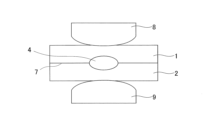
- FIG. 1 shows, as an example, a state in which two steel plates 1 and 2 are overlapped and sandwiched between welding electrodes 8 and 9.
- a point-shaped weld 4 is obtained by utilizing resistance heat generated by passing a high welding current between the welding electrodes.
- This elliptical weld 4 is called a nugget, and is the part where the two steel plates 1 and 2 melt and solidify at the contact point of the steel plates when a current is passed through the overlapping steel plates. This results in a point-shaped weld.
- TSS tensile shear test
- rust-resistant steel sheets such as zinc (Zn)-plated steel sheets (so-called “surface-treated steel sheets”) are used for parts at risk of corrosion.
- Zn-plated steel sheets so-called “surface-treated steel sheets”
- surface-treated steel sheets there is a problem that cracks may occur in the welded part during resistance spot welding of a sheet assembly in which multiple steel sheets including surface-treated steel sheets are overlapped.
- the cracks in the welded part are considered to be caused by so-called liquid metal embrittlement, in which the low-melting-point metal plating layer on the surface of the surface-treated steel sheet melts during welding, and when tensile stress due to the pressure of the welding electrode or the thermal expansion or contraction of the steel sheet is applied to the welded part, the molten low-melting-point metal penetrates the crystal grain boundaries of the base material of the surface-treated steel sheet, reducing the grain boundary strength and causing cracks (hereinafter referred to as "LME cracking").
- the location where LME cracking occurs is various, such as the surfaces of the steel sheets 1 and 2 on the sides in contact with the welding electrodes 8 and 9, as shown in Figure 7, and the surfaces of the steel sheets 1 and 2 on the sides in contact with each other.
- Patent Document 1 proposes that the composition of the steel plates in the plate assembly be set within a specific range, specifically, by weight, the composition be as follows: C: 0.003-0.01%, Mn: 0.05-0.5%, P: 0.02% or less, sol. Al: 0.1% or less, Ti: 48 x (N/14) to 48 x ((N/14) + (S/32))%, Nb: 93 x (C/12) to 0.1%, B: 0.0005-0.003%, N: 0.01% or less, Ni: 0.05% or less, with the balance being Fe and unavoidable impurities.
- Patent Document 2 proposes a spot welding method for high-strength plated steel sheet, in which spot welding is performed by setting a welding current flow time and a holding time after welding current flow so as to satisfy the following conditional expressions (A) and (B): 0.25 ⁇ (10 ⁇ t+2)/50 ⁇ WT ⁇ 0.50 ⁇ (10 ⁇ t+2)/50...(A) 300-500 ⁇ t+250 ⁇ t 2 ⁇ HT...(B)
- t is the plate thickness (mm)
- WT is the welding current flow time (ms)
- HT is the holding time after welding current flow (ms).
- Patent Document 2 also proposes performing resistance spot welding by appropriately setting the current application time and the electrode holding time after current application according to the thickness of the steel sheet, and by using a high-strength galvanized steel sheet in which the amount of alloy elements in the steel sheet is below a certain level.
- Patent Document 3 proposes a resistance spot welding method in which a current pattern is set to three or more stages, welding conditions such as current flow time and welding current are adjusted so that the appropriate current range ( ⁇ I) is 1.0 kA or more, preferably 2.0 kA or more, and a cooling time is provided between each stage.
- the appropriate current range is a current range that can stably form a nugget that is equal to or larger than the desired nugget diameter and has a molten residual thickness of 0.05 mm or more.
- Patent Document 4 proposes a technique for preventing LME cracking by removing the plating layer from the area to be welded prior to resistance spot welding.
- Patent Document 1 it is necessary to limit the amount of alloying elements in the steel plate, which creates problems such as limiting the use of steel plates that meet the required performance.
- the application of the technology in Patent Document 1 is extremely limited.
- Patent Document 2 only proposes a method for suppressing LME cracking when an excessively large welding current is set that would cause expulsion, and does not mention LME cracking in a state where expulsion does not occur.
- Patent Document 3 requires a lot of man-hours to optimize the welding conditions, and has the problem that it cannot be applied to steel plates and plate assemblies for which it is difficult to ensure an appropriate current range.
- Patent Documents 2 and 3 do not consider the effects of the welding electrode strike angle, so when considering the actual work during automobile assembly, it may be insufficient as a countermeasure.
- Patent Document 4 a step of removing the plating layer in advance is required, which increases manufacturing costs. In addition, because the plating layer is removed, it is believed that the corrosion resistance of the welded portion decreases.
- the present invention has been made in consideration of the above circumstances, and aims to provide a resistance spot welded component and a resistance spot welding method thereof that can prevent LME cracking in resistance spot welds in sheet assemblies using multiple steel sheets, particularly surface-treated steel sheets.
- LME cracks in resistance spot welds are likely to occur when excessive tensile residual stress occurs in the resistance spot weld due to construction disturbances during welding.
- LME cracks are likely to occur in areas where there is locally high tensile stress when the welding electrodes are released after the current and pressure of the resistance spot welding are applied.
- tensile stress is also likely to occur due to differences in transformation behavior during cooling.
- LME cracking occurs when tensile stress is applied to a liquid metal such as Zn in contact with a steel sheet. Therefore, by promoting the mutual diffusion of Fe and Zn between the sheets (i.e., the steel sheet mating surfaces) where the strength difference between the overlapping steel sheets becomes large, and by promoting the alloying of Fe and Zn, a Zn alloy layer with a certain Fe concentration or higher is formed near the nugget. This prevents liquid Zn from being present between the sheets when the above tensile stress is applied.
- the inventors came up with the idea that LME cracking can be prevented by using this technical concept. They also discovered that there are appropriate welding conditions for controlling the Zn alloy layer to have the above-mentioned certain Fe concentration or higher.
- the Fe concentration of the Fe-Zn alloy layer formed in the first region from a position A 300 ⁇ m away from the nugget end in the sheet width direction on the steel sheet mating surface in the first sheet set to a position B 700 ⁇ m away from the nugget end in the sheet width direction is defined as C Fe (mass%),
- a method for resistance spot welding a resistance spot welded member according to [1] or [2], A main current application process includes clamping two or more overlapping steel sheets between a pair of welding electrodes and applying current while applying pressure to form a nugget, Let I1 (kA) be the average current value in the main current application process, T1 (s) be the current application time in the main current application process, p (kN) be the average pressure of the welding electrode, THold (s) be the hold time after the end of current application, and N be the number of steel plates. a welding condition in the main current passing step satisfies formula (4).
- a post-current applying step of performing a post-heat treatment on the formed nugget after the main current applying step Let the average current value of the main current passing step be I1 (kA), the current passing time of the main current passing step be T1 (s), the average current value of the post-current passing step be I2 (kA), the current passing time of the post-current passing step be T2 (s), the number of current passings in the post-current passing step be Np (times), the current passing interval between the main current passing step and the post-current passing step be T3 (s), the average pressure of the welding electrodes be p (kN), the hold time after the end of current passing be THold (s), and the number of steel plates be N (sheets), 4.
- the present invention provides a resistance spot welded component that can prevent LME cracking in resistance spot welds, regardless of the composition of the steel sheets or the disturbances during welding, even in sheet assemblies that use multiple steel sheets, particularly surface-treated steel sheets. It also provides a resistance spot welding method for resistance spot welded components that can produce welded joints without removing the plating layer of the Zn-based plated steel sheets included in the sheet assembly in advance.
- FIG. 1 is a cross-sectional view in the plate thickness direction that typically illustrates an example of resistance spot welding.
- FIG. 2(A) is a cross-sectional view in the sheet thickness direction illustrating a resistance spot weld and its periphery in a resistance spot welded component according to an embodiment of the present invention, and a method for measuring CFe
- FIG. 2(B) is a diagram illustrating the gradient of CFe
- FIG. 3(A) is a cross-sectional view in the sheet thickness direction illustrating a resistance spot weld and its periphery in a resistance spot welded component according to another embodiment of the present invention, and a method for measuring CFe
- FIG. 3(A) is a cross-sectional view in the sheet thickness direction illustrating a resistance spot weld and its periphery in a resistance spot welded component according to another embodiment of the present invention, and a method for measuring CFe
- FIG. 3(A) is a cross-sectional view in the sheet thickness direction
- FIG. 3(B) is a diagram illustrating the gradient of CFe .
- FIG. 4 is a diagram showing the relationship between CFe , the right-hand side value of Equation (2), and the evaluation of LME cracking in the resistance spot weld of the present invention.
- FIG. 5 is a cross-sectional view in the plate thickness direction for explaining a method for measuring the inclination ( ⁇ ) of the nugget, which is a processing disturbance during resistance spot welding.
- 6A and 6B are cross-sectional views in the plate thickness direction for typically explaining a method of measuring a gap (g Sheet ) between plates, which is a construction disturbance during resistance spot welding.
- FIG. 7 is a cross-sectional view in the plate thickness direction, which shows a schematic example of crack generation during conventional resistance spot welding.
- FIGS 2(A) and 3(A) show, as an example, enlarged cross-sectional views in the sheet thickness direction of a resistance spot weld in the welded component and a portion of its surroundings. The enlarged portion is the area enclosed by a rectangular frame in Figures 2(A) and 3(A).
- the present invention is a welded member having a resistance spot weld formed by resistance spot welding two or more overlapping steel sheets. That is, the welded member of the present invention has two or more steel sheets and a resistance spot weld formed by welding the steel sheets. As described below, at least one of the overlapping steel sheets is a Zn-based plated steel sheet having a Zn-based plating on the steel sheet surface as a plating layer.
- the number of overlapping steel sheets is preferably three or more. There is no particular upper limit on the number, but it is preferably five or less.
- FIG. 2(A) is a welded member 6 formed by welding two overlapping steel sheets 1, 2, in which the lower steel sheet 2 (hereinafter sometimes referred to as the "lower sheet”) and/or the upper steel sheet 1 (hereinafter sometimes referred to as the "upper sheet”) are Zn-based plated steel sheets.
- a resistance spot weld 4 which will be described below, is formed on the steel sheet mating surface 7 where the upper sheet 1 and lower sheet 2 come into contact (i.e., the overlapping surfaces of the steel sheets).
- FIG. 3(A) shows three overlapping steel plates 1, 2, and 3 welded together.
- the steel plate 2 i.e., the lower plate
- the steel plate 1 i.e., the upper plate
- the steel plate 3 hereinafter sometimes referred to as the "middle plate" placed between them are Zn-based plated steel plates.
- the resistance spot welds 4 described below are formed to include the steel plate mating surfaces 7 (7a, 7b) where the lower plate 2 and the middle plate 3, and the middle plate 3 and the upper plate 1 meet.
- the welded member 4 shows the relationship between the Fe concentration ( CFe ) of the Fe-Zn alloy layer formed between plates in the resistance spot weld (hereinafter referred to as the "weld") of the welded member of the present invention and the right-hand side value of the formula (2) described below, and the correspondence between these and the LME crack evaluation.
- the evaluation criteria for the LME crack evaluation of the welded member welded under the plate assembly and welding conditions described in the examples described below are used.
- the "right-hand side value of the formula (2)" above is a value calculated by " ⁇ 25 x SiHigh x ( CE1 - CE2 ) ⁇ + ⁇ + (gSheet/1.2) ⁇ + [ ⁇ (SZn x dGB ) 0.5 ⁇ /30] + ⁇ 60 + ( C0Fe /3) ⁇ ".
- LME cracking occurs when tensile stress is applied when a liquid metal such as Zn is in contact with a steel plate.
- tensile stress is also more likely to occur due to differences in transformation behavior during cooling.
- a Zn alloy layer having a certain or higher Fe concentration As shown in the welded member 6 in Fig. 2(A) and Fig. 3(A), a Zn alloy layer is formed on the outside of the nugget end and between the overlapping steel plates (i.e., on the steel plate mating surface 7 side).
- the higher the Fe concentration of the Zn alloy layer the more liquid Zn is suppressed with alloying, which is effective in suppressing LME cracking. Therefore, in the present invention, the region of the Zn alloy layer formed between the plates where the Fe concentration is high is defined as an "Fe-Zn alloy layer", and the Fe concentration of the Fe-Zn alloy layer is defined as "C Fe ".
- the degree of Fe-Zn alloying can be controlled by controlling the current pattern during welding. In particular, it is effective to maintain the temperature at a high temperature for a long period of time so that the alloying of Fe-Zn progresses while the current is flowing.
- By controlling the current pattern in this way it is possible to appropriately control the Fe concentration in the Fe-Zn alloy layer according to the welded plate assembly, the strength, component composition, surface structure, plating layer, and disturbances during welding of the steel plates used in the plate assembly.
- the above-mentioned “specific region” refers to a range in the sheet width direction where the above-mentioned CFe is measured, and specifically, when the intersection point between the steel sheet mating surface 7 and the outer peripheral edge of the nugget 4a is defined as the nugget end E, a position 300 ⁇ m from the nugget end E on the steel sheet mating surface 7 in the sheet width direction (i.e., toward the base material) is defined as A, and a position 700 ⁇ m from the nugget end E on the steel sheet mating surface 7 in the sheet width direction is defined as B, the specific region refers to a region ranging from A to B. In the present invention, this region is referred to as the "first region". The first regions are formed on both end sides of the nugget 4a.
- the first region is shown only on one nugget end side, and the first region on the other nugget end side is omitted.
- This first region is a region that exists inside the welding heat affected zone 4b formed on the outer periphery of the nugget 4a.
- the rectangular frame shown in Figures 2(A) and 3(A) is shown with an appropriate length in the plate thickness direction set so as to include the Fe-Zn alloy layer 5 in the first region.
- the first region is thought to be an area where LME cracking is likely to occur during welding. The reason for this is not clear, but it is thought to be as follows. Since the maximum temperature reached during welding is higher closer to the nugget, it is thought that liquid Zn is more likely to exist. On the other hand, in areas that are more than 700 ⁇ m away from the nugget end E on the steel sheet mating surface 7 in the sheet width direction, the maximum temperature reached during welding may be below the melting point of the Zn plating, and it is thought that LME cracking is less likely to occur.
- the present invention focuses on the material properties between sheets and has found that the CFe required to suppress LME cracking varies depending on the TS difference between steel sheets, the Si content, the steel sheet surface layer structure, the Zn concentration in the Zn-based coating, the adhesion weight of the Zn-based coating, and construction disturbances, as shown in Figure 4. Furthermore, it has been found that LME cracking can be suppressed by appropriately controlling the CFe in the first region according to the material properties between sheets.
- the welded portion 4 of the present invention it is important for the welded portion 4 of the present invention to appropriately control the Fe concentration in the Fe-Zn alloy layer 5 in the first region near the nugget 4a.
- the combination with the greatest difference in tensile strength is referred to as the first sheet combination.
- the top sheet 1 and the bottom sheet 2 form the first sheet combination
- the top sheet 1 and the middle sheet 3 form the first sheet combination.
- the region from A to B on the steel sheet mating surface 7 is referred to as the first region, and the Fe concentration of the Fe-Zn alloy layer formed in this first region is represented as CFe (mass%).
- the gradient of CFe of the Fe-Zn alloy layer in the first region is represented as m.
- the Fe concentration ( CFe ) of the Fe-Zn alloy layer in this first region is controlled to satisfy all of formulas (1) to (3).
- C0Fe (mass%): Fe concentration of the steel sheet having the highest average Fe concentration in the Zn-based plating among the Zn-based plated steel sheets in the first sheet set;
- Si High (mass%): the Si concentration of the steel plate having the largest Si content in the first plate set;
- CE1 and CE2 in formula (2) represent carbon equivalents (CE), and CE can be calculated by the following formula (6).
- Carbon equivalent CE [C%] + ([Si%] / 24) + ([Mn%] / 6) + ([Ni%] / 40) + ([Cr%] / 5) + ([Mo%] / 4) + ([V%] / 14) ... (6)
- the [element symbol %] in the above formula (6) represents the content (mass %) of each element, and elements that are not contained are set to 0.
- the lower limit of CFe increases as the difference in carbon equivalent ( CE1 - CE2 ) increases.
- the reason for this is unclear, but it is thought to be as follows. It is considered that when the difference in carbon equivalent is large, the difference in transformation point and material property value also increases. When the transformation point is different, the amount of volume expansion/contraction accompanying phase transformation during welding occurs different between the plates, which may cause an increase in local tensile stress.
- the difference in material property value is large, it is considered that tensile stress occurs in the surface layer of the plate with a large carbon equivalent due to the plastic deformation of the plate with a small carbon equivalent and the friction between the plates. For this reason, the lower limit of CFe increases as the difference in carbon equivalent increases.
- the inclination ( ⁇ ) of the nugget is considered to be caused by the impact angle during welding.
- the moment generated by the impact angle during pressure application causes tensile stress in a part of the steel plate. For this reason, the lower limit of CFe increases as the inclination of the nugget increases.
- the Fe concentration ( C0Fe ) of the steel sheet with the highest average Fe concentration in the Zn-based plating increases the lower limit of CFe as C0Fe decreases.
- the reason for this is unclear, but is thought to be as follows. It is considered that if the average Fe concentration in the Zn-based plating before welding is high, the Fe concentration of the Fe-Zn alloy layer in the alloy layer after welding will be high. For this reason, the lower limit of CFe increases as the average Fe concentration decreases.
- the "Fe concentration" in the above "Fe concentration (C 0Fe ) of the steel sheet having the highest average Fe concentration in the Zn-based plating” refers to the Fe concentration in the Zn-based plating of the steel sheet.
- the Zn-based coating weight (S Zn ) of the steel sheet with the highest Zn-based coating weight among the Zn-based plated steel sheets of the first sheet set increases the lower limit of C Fe as S Zn increases.
- S Zn Zn-based coating weight
- the grain boundary density (d GB ) of the outermost layer of the base material in the steel plate with the high tensile strength in the first sheet set increases as d GB increases, and the lower limit of C Fe increases.
- LME cracking occurs due to embrittlement of grain boundaries
- the contact point between liquid Zn and the grain boundaries of the surface layer of the base material becomes the starting point of the crack. It is thought that when d GB is large, the contact points between liquid Zn and the grain boundaries of the surface layer of the base material increase, making it easier for cracks to occur. For this reason, the lower limit of C Fe increases as the grain boundary density increases.
- the Fe concentration (C Fe ) of the Fe—Zn alloy layer in the first region on the steel sheet mating surface side in the first sheet pair satisfies formula (2).
- the higher CFe the higher the melting point of the Zn alloy layer, which is effective in preventing LME cracking, so the higher CFe is, the more desirable it is.
- the upper limit of CFe must satisfy formula (1). It is preferable that the upper limit of CFe in formula (1) is 95 (mass%) or less.
- the difference in carbon equivalent is CE 1 -CE 2 ⁇ 0.7 and the grain boundary density of the outermost layer of the base material is d GB ⁇ 700.
- Si High is preferably 2.5% or less, and more preferably 2.0% or less.
- Formula (3) specifies the gradient of CFe of the Fe-Zn alloy layer in the first region.
- the gradient of CFe can be obtained from CFe at a position 300 ⁇ m from the nugget end (position A shown in FIG. 2(A) etc.) and at a position 700 ⁇ m from the nugget end (position B shown in FIG. 2(A) etc.).
- the absolute value of the gradient of the line connecting A and B is obtained.
- formula (3) is specified so that the absolute value of the gradient (
- the first regions in which the Fe concentration (C Fe ) of the Fe-Zn alloy layer satisfies all of the formulas (1) to (3) are formed on both end sides of the nugget.
- the first region formed on either side of the nugget end is the measurement target.
- the first region formed on the opposite side to the inclined side is the measurement target. Specifically, when the nugget 4a is inclined in the direction shown in FIG.
- the first region on the right side of the nugget is the measurement target.
- the first region formed at the steel sheet mating surface where the difference in TS between the abutting steel sheets is the largest is the object of measurement.
- the Si content, coating weight, Fe concentration ( CFe , C0Fe ), and grain boundary density of the outermost layer of the base material of the steel sheet can be measured by the method described in the examples below. Also, ⁇ and gSheet can be measured by the method described with reference to Figs. 5 and 6 below.
- the overlapping steel sheets i.e., the sheet set
- a Zn-based plated steel sheet may be overlapped with a steel sheet not having a metal plating layer (so-called "cold-rolled steel sheet"). In either case, the effect of the present invention can be obtained.
- Zn-based plated steel sheet refers to a steel sheet having a Zn-based plating layer, such as zinc plating represented by electrolytic galvanizing (EG), hot-dip galvanizing (GI) and alloyed hot-dip galvanizing (GA), or zinc alloy plating containing elements such as aluminum and magnesium in addition to zinc, on the surface of the base steel sheet, which is the base material.
- Zn-based plating layer such as zinc plating represented by electrolytic galvanizing (EG), hot-dip galvanizing (GI) and alloyed hot-dip galvanizing (GA), or zinc alloy plating containing elements such as aluminum and magnesium in addition to zinc, on the surface of the base steel sheet, which is the base material.
- the composition of the plating layer is not particularly limited, but since it is believed that the higher the Fe concentration, the easier it is to form an alloyed layer during welding, it is preferable that the Fe concentration in the plating layer be 5 mass% or more. Also, from the viewpoint of preventing a decrease in the powdering properties of the steel sheet, it is preferable that the Fe concentration in the plating layer be 30 mass% or less.
- the steel plates used in the plate assembly can have the following configurations as necessary.
- Si content of steel sheet it is preferable that at least one steel plate having a Si content of 0.5 mass % or more is included among the plurality of steel plates used in the plate assembly.
- Si is less than 0.5% by mass
- LME cracking may not occur regardless of disturbances or other welding conditions. The reason for this is unclear, but it is thought to be as follows. It is thought that Si has the effect of expanding the liquid-solid coexistence region in the phase diagram, and the addition of Si is thought to delay the solidification of Zn during the cooling process during welding. This prolongs the state in which liquid Zn exists, and it is thought that LME cracking is more likely to occur due to interaction with local tensile stress that occurs during holding or when the electrode is opened. If the Si content is low, interaction between liquid Zn and tensile stress is unlikely to occur, and depending on the welding conditions, LME cracking may not occur even if a method other than the welding conditions of the present invention is used.
- LME cracking is considered when the Si content is 0.5% by mass or more. Therefore, it is preferable that at least one of the steel plates used in the plate assembly is within the range of the steel plate composition described below and has a Si content of 0.5% by mass or more.
- the welding method of the present invention promotes the alloying of Zn present between all of the overlapping steel plates, so the Si content of all of the steel plates used in the plate assembly may be 0.5 mass% or more.
- the TS difference (hereinafter referred to as " ⁇ TS Max "), which is the largest difference in tensile strength between the two steel plates that are in contact in the vertical direction among the two or more overlapped steel plates, is 200 MPa or more. If ⁇ TS Max is less than 200 MPa, tensile stress associated with the difference in transformation behavior during cooling is unlikely to occur, and therefore LME cracking may not occur even when a method other than the welding conditions of the present invention is used depending on the welding conditions.
- ⁇ TS Max is preferably 2000 MPa or less, more preferably 250 MPa or more, and more preferably 1800 MPa or less.
- the tensile strength of the steel plate is preferably 3000 MPa or less.
- composition of the high-strength steel plate used in the present invention is not particularly limited as long as it can provide the above-mentioned weld configuration. From the viewpoint of applying the present invention to structural parts of automobiles, the composition of the steel plate is preferably as shown below. In the following description, the "%" designation of the composition means “mass %" unless otherwise specified.
- C 0.01-0.40% C is an element that contributes to increasing the strength of the steel plate. Therefore, the C content is preferably 0.01% or more. The C content is more preferably 0.02% or more. On the other hand, if C is added in excess, the welded portion becomes excessively hard, causing a decrease in the toughness of the welded portion. Therefore, the C content is preferably 0.40% or less. The C content is more preferably 0.38% or less.
- Si 0.02-2.50% Si is an element effective in improving the strength and elongation of steel sheet. Therefore, the Si content is preferably 0.02% or more. The Si content is more preferably 0.10% or more. On the other hand, excessive addition of Si causes a decrease in LME resistance and galvanic properties. Therefore, the Si content is preferably 2.50% or less. The Si content is more preferably 2.00% or less.
- Mn 1.0-5.0% Mn is an element that contributes to increasing the strength of steel plate. Therefore, the Mn content is preferably 1.0% or more. More preferably, the Mn content is 1.2% or more. On the other hand, excessive addition of Mn promotes solidification segregation of alloy elements in the nugget, causing a decrease in the toughness of the weld. Therefore, the Mn content is preferably 5.0% or less. More preferably, the Mn content is less than 3.5%.
- the P content is preferably 0.050% or less.
- the P content is more preferably 0.020% or less.
- the P content is preferably 0.005% or more.
- the S content is preferably 0.100% or less.
- the S content is more preferably 0.010% or less, and further preferably 0.005% or less.
- the S content is preferably 0.001% or more.
- Al 0.010-1.000%
- Al is an element necessary for deoxidation, and in order to obtain this effect, it is desirable to contain 0.010% or more of Al.
- the upper limit of the Al content is preferably 1.000%.
- the Al content is more preferably 0.800% or less.
- N 0.0100% or less Since N forms coarse nitrides, which reduces local deformability and reduces the ductility of the steel sheet, it is desirable to suppress the content. This tendency becomes more pronounced when N exceeds 0.0100%, so it is preferable to set the N content to 0.0100% or less.
- the N content is more preferably 0.0075% or less. There is no particular lower limit for the N content, but extremely low N content increases steelmaking costs. Therefore, it is preferable to set the N content to 0.0001% or more.
- the above is the basic composition, with the remainder being Fe and unavoidable impurities.
- unavoidable impurities include Co, Sn, and Zn, and the allowable ranges for their contents are Co: 0.05% or less, Sn: 0.01% or less, and Zn: 0.01% or less.
- each of the components Ti, B, Nb, Cr, Ni, Mo, Cu, Sb, V, Ca, and REM may be contained as necessary, so these components may be 0%. In other words, these components are preferably 0% or more.
- Ti 0.1% or less Ti is effective for precipitation hardening of steel sheets by forming fine carbonitrides. When Ti is contained to obtain this effect, it is preferable to contain Ti at 0.005% or more. On the other hand, if a large amount of Ti is added, elongation is significantly reduced, so the Ti content is preferably 0.1% or less. The Ti content is more preferably 0.065% or less.
- B 0.010% or less
- B is an element that improves the hardenability of steel sheets and contributes to high strength.
- B is preferable to contain 0.0002% or more of B.
- B content is preferably 0.008% or less.
- Nb 0.1% or less Nb is effective for precipitation hardening of steel sheets by forming fine carbonitrides. When Nb is contained to obtain this effect, it is preferable to contain 0.005% or more of Nb. On the other hand, if a large amount of Nb is added, not only does the elongation decrease significantly, but also slab cracks occur after continuous casting, so the Nb content is preferably 0.1% or less. The Nb content is more preferably 0.07% or less, and even more preferably 0.055% or less.
- Cr 1.0% or less Cr is an element that easily generates martensite in resistance welds, and therefore contributes to increasing the shear tensile strength. When Cr is contained to exert this effect, it is preferable to contain 0.05% or more of Cr. On the other hand, if Cr is contained in excess of 1.0%, surface defects are likely to occur, so the Cr content is preferably 1.0% or less. The Cr content is preferably 0.8% or less.
- Ni 0.50% or less
- Ni is an element that contributes to high strength through solid solution strengthening and transformation strengthening of steel sheets. When Ni is contained to exert these effects, it is preferable to contain Ni at 0.005% or more.
- Ni when Ni is added simultaneously with Cu, it is effective when Cu is added because it has the effect of suppressing surface defects caused by Cu. On the other hand, even if Ni is contained in an amount exceeding 0.50%, the effect is saturated, so it is preferable to set the Ni content to 0.50% or less.
- Mo 0.5% or less
- Mo is an element that easily generates martensite in resistance welds, and therefore contributes to increasing the shear tensile strength.
- Mo is contained to exert these effects, it is desirable to contain Mo at 0.01% or more.
- the Mo content is preferably 0.02% or more.
- the Mo content is preferably 0.5% or less.
- the Mo content is more preferably 0.42% or less.
- Cu 1.0% or less
- Cu is an element that contributes to solid solution strengthening of steel sheets. When Cu is contained to exert this effect, it is preferable to contain Cu at 0.005% or more. On the other hand, even if Cu is contained at more than 1.0%, the effect is saturated and surface defects caused by Cu are likely to occur. Therefore, it is preferable that the Cu content is 1.0% or less.
- Sb 0.20% or less
- Sb has the effect of suppressing the formation of a decarburized layer in the surface layer of the steel sheet, and therefore can suppress the reduction of martensite on the steel sheet surface.
- the Sb content is preferably 0.001% or more.
- the Sb content is preferably 0.20% or less.
- V 0.05% or less V is effective in precipitation hardening of steel sheets by forming fine carbonitrides.
- V is contained to obtain such an effect, it is preferable to contain V at a content of 0.005% or more.
- the V content be 0.05% or less.
- Ca and REM are elements that contribute to improving delayed fracture resistance by making the shape of sulfides spherical, and can be added as necessary. When contained to exert these effects, it is preferable to contain Ca and REM at 0.0005% or more. On the other hand, even if Ca and REM are contained at more than 0.05%, the effect is saturated, so it is preferable to set the content of Ca and REM at 0.05% or less.
- Resistance spot welding method An embodiment of a resistance spot welding method for producing a welded component of the present invention will be described.
- the welded member of the present invention is manufactured by resistance spot welding, in which a sheet assembly consisting of two or more overlapping steel sheets, including at least one of the above-mentioned Zn-based plated steel sheets, is clamped between a pair of welding electrodes and joined by passing an electric current through the sheet assembly while applying pressure.
- two steel sheets 1 and 2 are overlapped to form a sheet assembly.
- the sheet assembly is then clamped between a pair of welding electrodes 8 and 9 arranged on the lower and upper sides of the sheet assembly, and electricity is passed through the sheet assembly while applying pressure with the welding electrodes and controlling it to achieve the specified welding conditions.
- This forms the above-mentioned weld 4 between the steel sheets that form the steel sheet mating surfaces 7 of the steel sheets 1 and 2, thereby joining the steel sheets together.
- a sheet assembly may also be formed using a steel sheet having a Zn-based plating layer (e.g., GI steel sheet, GA steel sheet, EG steel sheet) and a steel sheet not having a plating layer (e.g., cold-rolled steel sheet).
- the sheet assembly is overlapped so that the surface having the Zn-based plating layer is in contact with the cold-rolled steel sheet.
- a welding device that can be used with the resistance spot welding method of the present invention is equipped with a pair of upper and lower welding electrodes, and can arbitrarily control the pressure and welding current during welding.
- pressure mechanisms include air cylinders and servo motors, and examples of types include stationary types and robot guns.
- types include stationary types and robot guns.
- the type of the tip of the welding electrode include DR type (dome radius type), R diameter (radius type), D type (dome type), etc. described in JIS C 9304:1999.
- the tip diameter of the welding electrode is, for example, 4 mm to 16 mm.
- the radius of curvature of the tip of the welding electrode is, for example, 10 mm to 400 mm.
- the present invention can be applied to both DC and AC welding power sources. In the case of AC, "current" means "effective current.”
- the current pattern during welding can be controlled by only the main current process, or the current pattern during welding can be controlled by the main current process and the post-current process.
- the main current process and the post-current process it becomes possible to hold the high temperature range where the alloying of Fe-Zn proceeds more stably for a long time compared to the case of only the main current process.
- the "hold time after the end of energization (T Hold )" refers to the “hold time after the end of energization in the main energization process" in the case of the first energization pattern described below, and refers to the “hold time after the end of energization in the post-energization process" in the case of the second energization pattern described below.
- the main current process refers to current application for forming the nugget
- the post-current process refers to post-current application for performing post-heat treatment after the nugget is formed.
- first current application pattern the case where the current application pattern of the present invention includes only this current application step is referred to as a “first current application pattern.”
- An embodiment of the first current application pattern will be described below.
- the average current value of the main current flow process is I1 (kA)
- the current flow time of the main current flow process is T1 (s: seconds)
- the average pressure of the welding electrode during current flow is p (kN)
- the hold time after the end of current flow is T Hold (s)
- the number of steel plates is N (sheets).
- the left side value of formula (4) is preferably equal to or greater than "the right side value of formula (4) ⁇ 1.05".
- the "right side value of formula (4)" is the value of "1.5 ⁇ C0Fe ⁇ SiHigh ⁇ p ⁇ ( ⁇ 1.8 + gSheet +c+ gAxis )+((0.05 ⁇ SZn /3)+ dGB0.5 ) +( CE1 - CE2 ) ⁇ 70 ⁇ /N".
- the upper limit of formula (4) is not particularly limited. In order to prevent significant splashing due to excessive heat input and excessive increase in takt time in the automobile manufacturing process, in addition to controlling according to formula (4), it is preferable that I1 is 15.0 kA or less and T1 is 2.0 s or less. More preferably, I1 is 3.0 kA or more and T1 is 0.2 s or more.
- the current application pattern of the present invention includes the main current application step and the post-current application step is referred to as a “second current application pattern.”
- An embodiment of the second current application pattern will be described below.
- the average current value of the main current process is I1 (kA)
- the current duration of the main current process is T1 (s)
- the average current value of the post-current process is I2 (kA)
- the current duration of the post-current process is T2 (s)
- the number of currents in the post-current process is Np (times).
- the current interval (no current duration) between the main current process and the post-current process is T3 (s)
- the average pressure of the welding electrode during current is p (kN).
- the hold time after the end of current is THold (s), and the number of steel plates is N (sheets).
- the welding conditions in the main current process and the post current process are controlled so as to satisfy the relationship of formula (5).
- the left side value of formula (5) is preferably equal to or greater than "the right side value of formula (5) ⁇ 1.05".
- the "right side value of formula (5)" above is the value of "1.5 ⁇ C0Fe ⁇ SiHigh ⁇ p ⁇ ( ⁇ 1.8 + gSheet +c+ gAxis )+((0.05 ⁇ SZn /3)+ dGB0.5 ) +( CE1 - CE2 ) ⁇ 70 ⁇ /N".
- the upper limit of formula (5) is not particularly limited.
- I1 and I2 are each 15.0 kA or less, and T1 and T2 are a total of 2.0 s or less. More preferably, I1 and I2 are each 3.0 kA or more, and T1 and T2 are a total of 0.2 s or more.
- Electrode holding time After the main current application process in the first current application pattern or the post-current application process in the second current application pattern is completed, the electrode is held for a predetermined time (i.e., hold time). This hold time is 0.02 to 1.00 seconds. By holding the welding electrode with a constant pressure after the current application is completed, the occurrence of blowholes in the nugget and an excessive increase in tact time are suppressed.
- the hold time is preferably 0.05 seconds or more, and is preferably 0.50 seconds or less.
- a non-current step in which current is stopped may be included between the main current step and the post-current step.
- the non-current step it is preferable to repeat the non-current step and the post-current step after the main current step. This is because the effect of the present invention can be obtained more effectively.
- T 3 (s) indicates the non-energization time of the non-energization step. Therefore, if there is no non-energization step, T 3 (s) in the above formula (5) is set to 0.
- N P (times) indicates the number of repetitions.
- the post-current passing step in order to promote the mutual diffusion of Fe and Zn while suppressing the expulsion due to remelting of the nugget and to increase CFe , it is effective to maintain the vicinity of the nugget within a certain temperature range after the completion of the main current passing step. Therefore, in the present invention, it is preferable to provide a no-current passing step as a current passing interval between the main current passing step and the post-current passing step.
- the post-current process When the post-current process is performed at a constant current value, if the current value of the post-current process is large, the temperature near the nugget will gradually rise, and conversely, if the current value of the post-current process is small, the temperature near the nugget will gradually fall. Even in such a state, it is believed that the desired effect can be obtained by appropriately setting the current value of the post-current process, but the amount of work required to derive the optimal conditions may increase.
- the temperature near the nugget can be kept within a relatively constant range, even if the total energization time in the post-energization process increases.
- the second current pattern of the present invention may have a de-energization step after the main current step, and the de-energization step and the post-current step may be repeated.
- This makes it possible to easily maintain the vicinity of the nugget within a constant temperature range, and also widens the appropriate current range in the post-current step, which is thought to improve robustness against welding disturbances.
- the de-energization time is too short, there is a concern that the nugget will re-melt and cause increased spattering, while if the de-energization time is too long, the desired heat treatment effect may not be obtained. Therefore, the time for the de-energization step is preferably 0.01 s or more, and 0.20 s or less.
- the de-energization process and post-energization process need to be performed at least once, and if the de-energization process and post-energization process are repeated, the number of repetitions is more preferably two or more, and even more preferably three or more. There is no particular upper limit to the number of repetitions, but generally there is an upper limit to the number of repetitions that can be set with welding equipment, and setting a repetition number exceeding the upper limit requires modification of the welding equipment. For this reason, and because it would increase equipment costs in the automobile manufacturing process, it is preferably set to 20 times or less, and even more preferably to 10 times or less.
- the present invention may have the following welding conditions.
- At least one welding point satisfies one or more of the following conditions (a) to (d) immediately before applying pressure with the welding electrode. This makes it possible to more effectively obtain the effects of the present invention.
- the impact angle between the welding electrode and the two or more overlapping steel sheets is 0.2 degrees or more.
- the impact angle means the angle at which the electrode is inclined with respect to the steel sheets, that is, the angle between the electrode pressure direction and the thickness direction of the steel sheets. If the impact angle is large, bending stress is applied to the welded part, and large compressive plastic deformation occurs locally, which increases the tensile stress after cooling.
- the nugget that is formed is also tilted, so when determining the strike angle from the cross section after welding, the inclination of the nugget is used as the strike angle.
- this "strike angle” is one of the construction disturbances when welding, but for the reasons mentioned above, the "slope of the nugget" in the component obtained after welding can be used instead as this "strike angle.”
- the " ⁇ ” indicating the "inclination of the nugget” is obtained by the method shown in FIG. 5.
- a straight line connecting the outermost parts (i.e., the boundary part where deformation due to pressure of the welding electrode is not observed) of the left and right shoulder parts on the upper plate 1 side (i.e., the steel plate side of the outermost layer of the plate assembly) is used as a reference, and the angle between the reference line and two perpendicular lines drawn from positions 500 ⁇ m away on the left and right from the center of this reference line (hereinafter referred to as the "reference line") and the lines passing through the intersections of the outermost edge of the nugget (i.e., the outer peripheral edge of the nugget 4a) is ⁇ .
- the above "two perpendicular lines” are lines parallel to the midline drawn from the center position of the reference line.
- the effect of the present invention can be effectively obtained when the impact angle is 0.2 degrees or more. If the impact angle is too large, the nugget formation becomes unstable and causes splashing, so it is preferable that the impact angle be 10.0 degrees or less.
- the impact angle is more preferably 1.0 degrees or more, and even more preferably 8.0 degrees or less.
- the "gap between the steel plates” described in (b) above is one of the construction disturbances during welding, but for the reasons described above, the "gap between the steel plates after welding" in the member obtained after welding may be substituted for this "gap between the steel plates".
- the " gSheet " indicating the "gap between steel sheets after welding” is determined by the method shown in Figures 6(A) and 6(B).
- Figure 6(A) in the case of continuous welding, the difference between the maximum thickness of the steel sheets 1, 2 between two adjacent nuggets 4a and the total sheet thickness of the overlapped steel sheets 1, 2 (i.e., sheet gap 10) is determined, and this is taken as gSheet .
- the difference between the maximum thickness of the steel sheets 1, 2 from the nugget 4a to the end of the sheet set and the total sheet thickness of the overlapped steel sheets 1, 2 is determined, and this is taken as gSheet .
- the effects of the present invention can be effectively obtained when the gap is 0.5 mm or more. If the gap is too large, the nugget formation becomes unstable and may cause splashing, so it is preferable to set the gap to 4.0 mm or less.
- the gap is more preferably 1.0 mm or more, and even more preferably 3.0 mm or less.
- the movable electrode When there is a gap between any of the welding electrodes and the steel sheet immediately before the start of pressure application, for example, when one electrode is movable (hereinafter referred to as the "movable electrode") and the other electrode is fixed (hereinafter referred to as the "fixed electrode"), when there is a gap between the fixed electrode and the steel sheet, when pressure application by the movable electrode is started, the steel sheet undergoes bending deformation, which applies bending stress to the welded portion. This makes LME cracking more likely to occur.
- the amount of the gap between the welding electrode and the steel sheet is designated as c. When the amount of this gap is 0.5 mm or more, the effect of the present invention can be effectively obtained.
- the amount of this gap is 5.0 mm or less.
- the gap is more preferably 1.0 mm or more, and even more preferably 3.0 mm or less.
- Misalignment means a state in which the central axes of the pair of welding electrodes are not aligned.
- the misalignment amount of the pair of welding electrodes is g Axis .
- the misalignment amount is 0.1 mm or more, the effect of the present invention can be effectively obtained.
- the misalignment amount is excessive, the nugget formation becomes unstable and causes expulsion, so it is preferable that the misalignment amount is 5.0 mm or less.
- the misalignment amount is more preferably 0.2 mm or more, and more preferably 3.0 mm or less.
- the pressure conditions in each process are not particularly limited. From the perspective of automotive applications, it is preferable to adjust the pressure conditions to a range of 2.0 to 8.0 kN.
- the steel plates shown in Table 1 were used to form a plate assembly, which was then welded under the welding conditions shown in Tables 2 and 3 to produce a welded joint (welded member).
- the plate assembly was overlapped with the bottom plate and top plate in this order, or the bottom plate, middle plate and top plate in this order, as shown in Table 2.
- the welding device used was a servo motor pressure type single-phase AC (50 Hz in this case) resistance welding machine attached to a welding gun.
- the pair of electrode tips used were chromium copper DR type electrodes with a tip curvature radius R of 40 mm and a tip diameter of 6 mm.
- GI refers to a steel sheet having a hot-dip galvanized layer (i.e., hot-dip galvanized steel sheet)
- GA refers to a steel sheet having a galvannealed hot-dip galvanized layer (i.e., galvannealed steel sheet)
- EG refers to a steel sheet having an electrogalvanized layer (i.e., electrogalvanized steel sheet)
- - refers to a steel sheet without a plating layer (here, cold-rolled steel sheet).
- composition of the components shown in Table 1 was measured using inductively coupled plasma (ICP) optical emission spectroscopy.
- ICP inductively coupled plasma
- the "Tensile strength” column in Table 1 shows the tensile strength (TS) (unit: MPa) measured by taking JIS No. 5 tensile test pieces from each steel plate in the rolling direction and conducting tensile tests in accordance with JIS Z 2241.
- the "grain boundary density” column in Table 1 shows the grain boundary density of the outermost layer of the base material of each steel plate.
- the grain boundary density was measured using EBSD (Electron Backscatter Diffraction).
- a high-angle grain boundary with a crystal orientation difference of 15° or more was defined as a grain boundary, and an IQ Map was created showing the grain boundaries.
- the created IQ Map the number of grain boundaries in the outermost layer of the base material was counted, and the grain boundary density of five fields of view with a size of 50 ⁇ m x 40 ⁇ m or more was measured, and the average value of the measured values of all fields of view was taken as d GB .
- d GB in Table 2, the grain boundary density (unit: pieces/mm) of the outermost layer of the base material on the steel plate side with high tensile strength in the first plate set was listed.
- N P shown in the "Welding Conditions” column in Table 3 indicates the number of times the no-current process and the post-current process are repeated. For example, in the case of "main current process only”, N P is 0 (times), and in the case of "main current process-no-current process-post-current process”, N P is 1 (times), and in the case of "main current process-no-current process (1)-post-current process (1)-no-current process (2)-post-current process (2)", N P is 2 (times). In this way, the number of no-current processes is the same as N P.
- the Fe concentration (C Fe ) of the Fe—Zn alloy layer in the Zn alloy layer was measured, and the LME cracking of the welded portion was evaluated, by the methods described below.
- the method for measuring CFe is not particularly limited as long as it can quantitatively measure the Fe concentration.
- it can be measured by EPMA or SEM-EDS.
- SEM-EDS was measured by SEM-EDS.
- the conditions for SEM-EDS were as follows. EDS conditions: A Ka radiation source is used as the radiation source of the X-rays to be irradiated, magnification: 1500 times or more, acceleration voltage: 15 kV, scan time: 1 min or more (excluding the gaps). Specifically, the thickness of the gaps is subtracted from the thickness including the gaps. If the thickness of the gaps is difficult to determine, the thickness is measured from the nearest part without gaps.
- the observation area was the region from A to B (i.e., the first region) on the steel sheet mating surface 7 where the Fe-Zn alloy layer was formed in the weld.
- the start point of the observation position is a position A 300 ⁇ m away from the nugget end E in the sheet width direction (i.e., one side of the first region perpendicular to the steel sheet mating surface 7 located on the left side of the paper in each figure), and the end point of the observation position is a position B 700 ⁇ m away from the nugget end E in the sheet width direction (i.e., one side of the first region perpendicular to the steel sheet mating surface 7 located on the right side of the paper in each figure).
- the region from the start point to the end point is observed at equal intervals, the Zn-enriched portion between the sheets in each field of view is identified as an Fe-Zn alloy layer, and the Fe concentration of the Fe-Zn alloy layer is measured.
- the "Zn-enriched portion” is determined from the contrast in the composition image (COMPO image). As shown in each figure, the Fe concentration was measured at a 1/4 position in the thickness direction of the Fe-Zn alloy layer. The average value of the values excluding the maximum and minimum values of the obtained Fe concentrations was taken as the Fe concentration (C Fe ) of the Fe-Zn alloy layer.
- observing at equal intervals refers to observing at least 10 visual fields at equal intervals.
- the visual fields may be set appropriately within the range of, for example, 11 to 100. If the measurement interval is less than 10 points, accurate values may not be obtained, so in this example, the visual field was set to 10 points.
- the following analysis method was used to measure the "Fe concentration” and "Zn concentration” above. Note that Figures 2(A) and 3(A) are schematic diagrams for explanatory purposes, and only six points are shown for ease of viewing.
- the concentration can be measured by, for example, line analysis or point analysis.
- the concentration is measured at at least five or more lines per visual field.
- the concentration in each line is measured, and the average concentration per visual field is calculated.
- the average value obtained by excluding the maximum and minimum values from the measured values in the entire visual field is taken as CFe .
- point analysis it is preferable to measure at a pitch of 1 ⁇ m or less per one location.
- the CFe portions are formed on both end sides of the nugget.
- the nugget was not tilted, the CFe on one side was measured, and when the nugget was tilted, the CFe on the side opposite to the tilted side was measured.
- ⁇ Evaluation criteria> A rating: 0/5 (i.e., 0 out of 5 pieces were found to be cracked) B rating: 1/5 (i.e., one out of five pieces was found to be cracked) C rating: 2/5 to 4/5 (i.e., 2 to 4 of the 5 bodies were found to be cracked)
Landscapes
- Chemical & Material Sciences (AREA)
- Engineering & Computer Science (AREA)
- Mechanical Engineering (AREA)
- Materials Engineering (AREA)
- Metallurgy (AREA)
- Organic Chemistry (AREA)
- Resistance Welding (AREA)
Priority Applications (1)
| Application Number | Priority Date | Filing Date | Title |
|---|---|---|---|
| JP2025540270A JP7831701B2 (ja) | 2023-12-08 | 2024-12-02 | 抵抗スポット溶接部材およびその抵抗スポット溶接方法 |
Applications Claiming Priority (2)
| Application Number | Priority Date | Filing Date | Title |
|---|---|---|---|
| JP2023207930 | 2023-12-08 | ||
| JP2023-207930 | 2023-12-08 |
Publications (1)
| Publication Number | Publication Date |
|---|---|
| WO2025121277A1 true WO2025121277A1 (ja) | 2025-06-12 |
Family
ID=95979911
Family Applications (1)
| Application Number | Title | Priority Date | Filing Date |
|---|---|---|---|
| PCT/JP2024/042493 Pending WO2025121277A1 (ja) | 2023-12-08 | 2024-12-02 | 抵抗スポット溶接部材およびその抵抗スポット溶接方法 |
Country Status (2)
| Country | Link |
|---|---|
| JP (1) | JP7831701B2 (https=) |
| WO (1) | WO2025121277A1 (https=) |
Citations (4)
| Publication number | Priority date | Publication date | Assignee | Title |
|---|---|---|---|---|
| WO2017104647A1 (ja) * | 2015-12-16 | 2017-06-22 | Jfeスチール株式会社 | 抵抗スポット溶接方法および溶接部材の製造方法 |
| WO2018159764A1 (ja) * | 2017-03-01 | 2018-09-07 | Jfeスチール株式会社 | 抵抗スポット溶接方法 |
| JP2020082102A (ja) * | 2018-11-19 | 2020-06-04 | 株式会社神戸製鋼所 | 接合構造体及び接合構造体の製造方法 |
| WO2023080076A1 (ja) * | 2021-11-02 | 2023-05-11 | Jfeスチール株式会社 | 抵抗スポット溶接部材およびその抵抗スポット溶接方法 |
-
2024
- 2024-12-02 JP JP2025540270A patent/JP7831701B2/ja active Active
- 2024-12-02 WO PCT/JP2024/042493 patent/WO2025121277A1/ja active Pending
Patent Citations (4)
| Publication number | Priority date | Publication date | Assignee | Title |
|---|---|---|---|---|
| WO2017104647A1 (ja) * | 2015-12-16 | 2017-06-22 | Jfeスチール株式会社 | 抵抗スポット溶接方法および溶接部材の製造方法 |
| WO2018159764A1 (ja) * | 2017-03-01 | 2018-09-07 | Jfeスチール株式会社 | 抵抗スポット溶接方法 |
| JP2020082102A (ja) * | 2018-11-19 | 2020-06-04 | 株式会社神戸製鋼所 | 接合構造体及び接合構造体の製造方法 |
| WO2023080076A1 (ja) * | 2021-11-02 | 2023-05-11 | Jfeスチール株式会社 | 抵抗スポット溶接部材およびその抵抗スポット溶接方法 |
Also Published As
| Publication number | Publication date |
|---|---|
| JPWO2025121277A1 (https=) | 2025-06-12 |
| JP7831701B2 (ja) | 2026-03-17 |
Similar Documents
| Publication | Publication Date | Title |
|---|---|---|
| JP7364113B2 (ja) | 抵抗スポット溶接部材およびその抵抗スポット溶接方法 | |
| JP7477061B1 (ja) | 溶接部材およびその製造方法 | |
| JP2018039019A (ja) | スポット溶接方法 | |
| JP6384603B2 (ja) | スポット溶接方法 | |
| JP7327676B2 (ja) | 抵抗スポット溶接部材およびその抵抗スポット溶接方法 | |
| JP2016032834A (ja) | 重ね溶接部材、重ね溶接部材の重ね抵抗シーム溶接方法及び重ね溶接部を備える自動車用重ね溶接部材 | |
| CN119604382A (zh) | 点焊接头的制造方法及点焊接头 | |
| JP7485242B1 (ja) | 溶接部材およびその製造方法 | |
| WO2025121277A1 (ja) | 抵抗スポット溶接部材およびその抵抗スポット溶接方法 | |
| JP7831700B2 (ja) | 抵抗スポット溶接部材およびその抵抗スポット溶接方法 | |
| JP7477059B1 (ja) | 溶接部材およびその製造方法 | |
| JP7435935B1 (ja) | 溶接部材およびその製造方法 | |
| JP7522977B2 (ja) | 抵抗スポット溶接方法 | |
| KR102948515B1 (ko) | 저항 스폿 용접 방법 | |
| KR102871622B1 (ko) | 용접 이음매, 용접 부재 및 그 제조 방법, 그리고 저항 스폿 용접 방법 | |
| JP7827230B1 (ja) | 抵抗スポット溶接継手の製造方法及びめっき層の融点予測方法 | |
| JP7648019B2 (ja) | 抵抗スポット溶接方法、並びに溶接部材の製造方法 | |
| JP7347716B1 (ja) | 抵抗スポット溶接継手および抵抗スポット溶接方法 | |
| WO2024063010A1 (ja) | 溶接部材およびその製造方法 | |
| JP7476957B2 (ja) | 抵抗スポット溶接方法 | |
| JP7355281B1 (ja) | 溶接継手、溶接部材およびその製造方法、ならびに、抵抗スポット溶接方法 | |
| WO2023139923A1 (ja) | プロジェクション溶接継手およびプロジェクション溶接方法 | |
| CN119907725A (zh) | 点焊接头、点焊接头的制造方法及汽车部件 |
Legal Events
| Date | Code | Title | Description |
|---|---|---|---|
| ENP | Entry into the national phase |
Ref document number: 2025540270 Country of ref document: JP Kind code of ref document: A |
|
| WWE | Wipo information: entry into national phase |
Ref document number: 2025540270 Country of ref document: JP |
|
| 121 | Ep: the epo has been informed by wipo that ep was designated in this application |
Ref document number: 24900571 Country of ref document: EP Kind code of ref document: A1 |