WO2025120959A1 - 粘着シートおよび積層体 - Google Patents
粘着シートおよび積層体 Download PDFInfo
- Publication number
- WO2025120959A1 WO2025120959A1 PCT/JP2024/033225 JP2024033225W WO2025120959A1 WO 2025120959 A1 WO2025120959 A1 WO 2025120959A1 JP 2024033225 W JP2024033225 W JP 2024033225W WO 2025120959 A1 WO2025120959 A1 WO 2025120959A1
- Authority
- WO
- WIPO (PCT)
- Prior art keywords
- adhesive sheet
- polyester
- sensitive adhesive
- resin
- pressure
- Prior art date
- Legal status (The legal status is an assumption and is not a legal conclusion. Google has not performed a legal analysis and makes no representation as to the accuracy of the status listed.)
- Pending
Links
Images
Classifications
-
- B—PERFORMING OPERATIONS; TRANSPORTING
- B32—LAYERED PRODUCTS
- B32B—LAYERED PRODUCTS, i.e. PRODUCTS BUILT-UP OF STRATA OF FLAT OR NON-FLAT, e.g. CELLULAR OR HONEYCOMB, FORM
- B32B27/00—Layered products comprising a layer of synthetic resin
-
- B—PERFORMING OPERATIONS; TRANSPORTING
- B32—LAYERED PRODUCTS
- B32B—LAYERED PRODUCTS, i.e. PRODUCTS BUILT-UP OF STRATA OF FLAT OR NON-FLAT, e.g. CELLULAR OR HONEYCOMB, FORM
- B32B27/00—Layered products comprising a layer of synthetic resin
- B32B27/18—Layered products comprising a layer of synthetic resin characterised by the use of special additives
- B32B27/22—Layered products comprising a layer of synthetic resin characterised by the use of special additives using plasticisers
-
- B—PERFORMING OPERATIONS; TRANSPORTING
- B32—LAYERED PRODUCTS
- B32B—LAYERED PRODUCTS, i.e. PRODUCTS BUILT-UP OF STRATA OF FLAT OR NON-FLAT, e.g. CELLULAR OR HONEYCOMB, FORM
- B32B27/00—Layered products comprising a layer of synthetic resin
- B32B27/30—Layered products comprising a layer of synthetic resin comprising vinyl (co)polymers; comprising acrylic (co)polymers
-
- C—CHEMISTRY; METALLURGY
- C08—ORGANIC MACROMOLECULAR COMPOUNDS; THEIR PREPARATION OR CHEMICAL WORKING-UP; COMPOSITIONS BASED THEREON
- C08K—Use of inorganic or non-macromolecular organic substances as compounding ingredients
- C08K5/00—Use of organic ingredients
- C08K5/04—Oxygen-containing compounds
- C08K5/10—Esters; Ether-esters
-
- C—CHEMISTRY; METALLURGY
- C08—ORGANIC MACROMOLECULAR COMPOUNDS; THEIR PREPARATION OR CHEMICAL WORKING-UP; COMPOSITIONS BASED THEREON
- C08L—COMPOSITIONS OF MACROMOLECULAR COMPOUNDS
- C08L101/00—Compositions of unspecified macromolecular compounds
-
- C—CHEMISTRY; METALLURGY
- C08—ORGANIC MACROMOLECULAR COMPOUNDS; THEIR PREPARATION OR CHEMICAL WORKING-UP; COMPOSITIONS BASED THEREON
- C08L—COMPOSITIONS OF MACROMOLECULAR COMPOUNDS
- C08L27/00—Compositions of homopolymers or copolymers of compounds having one or more unsaturated aliphatic radicals, each having only one carbon-to-carbon double bond, and at least one being terminated by a halogen; Compositions of derivatives of such polymers
- C08L27/02—Compositions of homopolymers or copolymers of compounds having one or more unsaturated aliphatic radicals, each having only one carbon-to-carbon double bond, and at least one being terminated by a halogen; Compositions of derivatives of such polymers not modified by chemical after-treatment
- C08L27/04—Compositions of homopolymers or copolymers of compounds having one or more unsaturated aliphatic radicals, each having only one carbon-to-carbon double bond, and at least one being terminated by a halogen; Compositions of derivatives of such polymers not modified by chemical after-treatment containing chlorine atoms
- C08L27/06—Homopolymers or copolymers of vinyl chloride
-
- C—CHEMISTRY; METALLURGY
- C09—DYES; PAINTS; POLISHES; NATURAL RESINS; ADHESIVES; COMPOSITIONS NOT OTHERWISE PROVIDED FOR; APPLICATIONS OF MATERIALS NOT OTHERWISE PROVIDED FOR
- C09J—ADHESIVES; NON-MECHANICAL ASPECTS OF ADHESIVE PROCESSES IN GENERAL; ADHESIVE PROCESSES NOT PROVIDED FOR ELSEWHERE; USE OF MATERIALS AS ADHESIVES
- C09J167/00—Adhesives based on polyesters obtained by reactions forming a carboxylic ester link in the main chain; Adhesives based on derivatives of such polymers
-
- C—CHEMISTRY; METALLURGY
- C09—DYES; PAINTS; POLISHES; NATURAL RESINS; ADHESIVES; COMPOSITIONS NOT OTHERWISE PROVIDED FOR; APPLICATIONS OF MATERIALS NOT OTHERWISE PROVIDED FOR
- C09J—ADHESIVES; NON-MECHANICAL ASPECTS OF ADHESIVE PROCESSES IN GENERAL; ADHESIVE PROCESSES NOT PROVIDED FOR ELSEWHERE; USE OF MATERIALS AS ADHESIVES
- C09J167/00—Adhesives based on polyesters obtained by reactions forming a carboxylic ester link in the main chain; Adhesives based on derivatives of such polymers
- C09J167/02—Polyesters derived from dicarboxylic acids and dihydroxy compounds
-
- C—CHEMISTRY; METALLURGY
- C09—DYES; PAINTS; POLISHES; NATURAL RESINS; ADHESIVES; COMPOSITIONS NOT OTHERWISE PROVIDED FOR; APPLICATIONS OF MATERIALS NOT OTHERWISE PROVIDED FOR
- C09J—ADHESIVES; NON-MECHANICAL ASPECTS OF ADHESIVE PROCESSES IN GENERAL; ADHESIVE PROCESSES NOT PROVIDED FOR ELSEWHERE; USE OF MATERIALS AS ADHESIVES
- C09J7/00—Adhesives in the form of films or foils
- C09J7/20—Adhesives in the form of films or foils characterised by their carriers
- C09J7/22—Plastics; Metallised plastics
-
- C—CHEMISTRY; METALLURGY
- C09—DYES; PAINTS; POLISHES; NATURAL RESINS; ADHESIVES; COMPOSITIONS NOT OTHERWISE PROVIDED FOR; APPLICATIONS OF MATERIALS NOT OTHERWISE PROVIDED FOR
- C09J—ADHESIVES; NON-MECHANICAL ASPECTS OF ADHESIVE PROCESSES IN GENERAL; ADHESIVE PROCESSES NOT PROVIDED FOR ELSEWHERE; USE OF MATERIALS AS ADHESIVES
- C09J7/00—Adhesives in the form of films or foils
- C09J7/30—Adhesives in the form of films or foils characterised by the adhesive composition
- C09J7/38—Pressure-sensitive adhesives [PSA]
Definitions
- This disclosure relates to adhesive sheets and laminates.
- Adhesive sheets are used in various technical fields (see, for example, Patent Document 1).
- Adhesive sheets generally have a substrate made of a resin material such as polyvinyl chloride resin, and an adhesive layer. Furthermore, when the substrate is made from polyvinyl chloride resin, the substrate contains mainly a plasticizer.
- One objective of the present disclosure is to provide an adhesive sheet that can prevent a decrease in adhesive strength even after a certain period of time has passed since it was attached to an adherend.
- the pressure-sensitive adhesive sheet according to the first aspect of the present disclosure comprises a substrate containing a resin material and a plasticizer having an SP value of 10.0 (cal/cm 3 ) 1/2 or less, and a polyester-based pressure-sensitive adhesive layer.
- the pressure-sensitive adhesive sheet of the second aspect of the present disclosure has a polyester-based pressure-sensitive adhesive layer, and is a sheet for attachment to an adherend having a portion containing a resin material and a plasticizer with an SP value of 10.0 (cal/ cm3 ) 1/2 or less, so that the polyester-based pressure-sensitive adhesive layer of the pressure-sensitive adhesive sheet contacts the portion of the adherend.
- the present disclosure provides an adhesive sheet that can suppress a decrease in adhesive strength even after a certain period of time has passed since it is attached to an adherend.
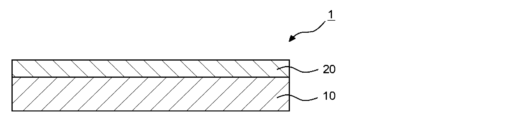
- FIG. 1 is a schematic cross-sectional view of one embodiment of a pressure-sensitive adhesive sheet.
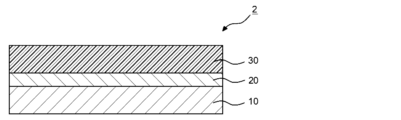
- FIG. 2 is a schematic cross-sectional view of one embodiment of a laminate.
- the terms “sheet,””film,” and “tape” are sometimes used with distinctions based on thickness, etc., but in this specification, they are used without any particular distinction.
- the term “adherend” refers to an object to which the pressure-sensitive adhesive sheet is attached.
- the numerical range n1 to n2 means n1 or more and n2 or less if n1 ⁇ n2, and means n2 or more and n1 or less if n1>n2.
- the numerical range formed by combining a value arbitrarily selected from the listed lower limit value and a value arbitrarily selected from the listed upper limit value is also considered to be listed.
- the pressure-sensitive adhesive sheet according to the first aspect of the present disclosure comprises: a base material containing a resin material and a plasticizer having an SP value of 10.0 (cal/cm 3 ) 1/2 or less; A polyester-based pressure-sensitive adhesive layer; has.
- the substrate has a first surface and a second surface opposite the first surface.
- the adhesive sheet of the first embodiment may be a single-sided adhesive sheet having a polyester-based adhesive layer on either the first or second surface of the substrate.
- the adhesive sheet of the first embodiment may be a double-sided adhesive sheet having a first polyester-based adhesive layer on the first surface of the substrate and a second polyester-based adhesive layer on the second surface of the substrate, i.e., having a first polyester-based adhesive layer, the substrate, and a second polyester-based adhesive layer in this order in the stacking direction.
- the pressure-sensitive adhesive sheet of the second embodiment of the present disclosure has a polyester-based pressure-sensitive adhesive layer, and is a sheet for attachment to an adherend having a portion containing a resin material and a plasticizer having an SP value of 10.0 (cal/ cm3 ) 1/2 or less, such that the polyester-based pressure-sensitive adhesive layer of the pressure-sensitive adhesive sheet contacts the portion of the adherend.
- the adhesive sheet of the second embodiment may be a double-sided adhesive sheet that does not have a substrate.
- the pressure-sensitive adhesive sheet of the second aspect may further include a substrate containing a resin material.
- the substrate in the pressure-sensitive adhesive sheet of the second aspect may contain a resin material and a plasticizer having an SP value of 10.0 (cal/ cm3 ) 1/2 or less.
- the adhesive sheet of the second embodiment may be a single-sided adhesive sheet having a polyester-based adhesive layer on either the first or second surface of the substrate.
- the adhesive sheet of the second embodiment may be a double-sided adhesive sheet having a first polyester-based adhesive layer on the first surface of the substrate and a second polyester-based adhesive layer on the second surface of the substrate, i.e., having a first polyester-based adhesive layer, the substrate, and a second polyester-based adhesive layer in this order in the stacking direction.
- adheresive sheet when there is no particular distinction between the adhesive sheet of the first embodiment and the adhesive sheet of the second embodiment, or when describing matters common to the adhesive sheet of the first embodiment and the adhesive sheet of the second embodiment, they will simply be referred to as "adhesive sheet.”
- the adhesive sheet of the present disclosure may have a release film on the outside of the polyester-based adhesive layer, if necessary.
- the release film protects the adhesive layer.
- the adhesive sheet may have, for example, a substrate, a polyester-based adhesive layer, and a release film in this order in the lamination direction, a first release film, a first polyester-based adhesive layer, a substrate, a second polyester-based adhesive layer, and a second release film in this order in the lamination direction, or a first release film, a polyester-based adhesive layer, and a second release film in this order in the lamination direction.
- the release film is peeled off from the adhesive layer, and the exposed adhesive layer is attached to the surface of the adherend.
- the substrate contains a resin material.
- the resin material include vinyl chloride resins such as polyvinyl chloride and vinyl chloride-vinyl acetate copolymers; other vinyl resins such as ethylene-vinyl acetate copolymers, ethylene-vinyl alcohol copolymers, and polyvinyl alcohol; polyester resins such as polyethylene terephthalate, polyethylene naphthalate, polybutylene terephthalate, and polyethylene terephthalate/isophthalate copolymers; polyolefin resins such as polyethylene, polypropylene, and polymethylpentene; cycloolefin resins; polystyrene resins; acrylonitrile-butadiene-styrene copolymers; polyvinyl fluoride, polyvinylidene fluoride, and fluorinated polyethylene; polyamide resins such as nylon 6 and nylon 6,6; cellulose resins such as cellulose triacetate and cellophan
- the substrate in the pressure-sensitive adhesive sheet of the first aspect contains a vinyl chloride resin and a plasticizer having an SP value of 10.0 (cal/ cm3 ) 1/2 or less.
- a substrate has, for example, rigidity due to the vinyl chloride resin and flexibility due to the plasticizer.
- vinyl chloride resin is a polymer having structural units derived from vinyl chloride.
- the content of structural units derived from vinyl chloride in 100% by mass of structural units derived from polymerizable monomers in vinyl chloride resin is preferably 10% by mass or more, more preferably 20% by mass or more, even more preferably 30% by mass or more, even more preferably 40% by mass or more, and particularly preferably 50% by mass or more.
- the content of each structural unit in vinyl chloride resin is measured by nuclear magnetic resonance (NMR) method.
- NMR nuclear magnetic resonance
- Examples of vinyl chloride resin include homopolymers of vinyl chloride and copolymers of vinyl chloride and comonomers.
- comonomers examples include vinylidene chloride; ⁇ -olefins such as ethylene and propylene; carboxy-containing monomers such as (meth)acrylic acid, maleic acid, and fumaric acid, and their esters or acid anhydrides; vinyl ester monomers such as vinyl acetate and vinyl propionate; styrene monomers such as styrene, ⁇ -methylstyrene, and vinyl toluene; and (meth)acrylonitrile.
- comonomers include vinylidene chloride; ⁇ -olefins such as ethylene and propylene; carboxy-containing monomers such as (meth)acrylic acid, maleic acid, and fumaric acid, and their esters or acid anhydrides; vinyl ester monomers such as vinyl acetate and vinyl propionate; styrene monomers such as styrene, ⁇ -methylstyrene, and vinyl toluene; and (meth)
- the substrate may contain one type of resin material, or two or more types.
- the content of the resin material in the substrate is preferably 50% by mass or more, more preferably 60% by mass or more, and even more preferably 70% by mass or more, based on 100% by mass of the substrate.
- the content of the resin material in the substrate of the pressure-sensitive adhesive sheet of the first embodiment is preferably 99% by mass or less, more preferably 95% by mass or less, even more preferably 91% by mass or less, and particularly preferably 87% by mass or less, based on 100% by mass of the substrate.
- the substrate may further contain additives.
- additives include antioxidants, UV absorbers, stabilizers, softeners, antistatic agents, tackifiers, plasticizers, inorganic or organic fillers, metal powders, pigments, and dyes.
- the substrate may contain one type of additive, or may contain two or more types.
- the substrate may contain a plasticizer, for example, to improve its flexibility.
- Substrates containing vinyl chloride resins preferably contain a plasticizer, for example, to improve its flexibility.
- the substrate in the pressure-sensitive adhesive sheet of the first embodiment contains a plasticizer with an SP value of 10.0 (cal/cm 3 ) 1/2 or less.
- a pressure-sensitive adhesive sheet in which such a substrate is combined with a polyester-based pressure-sensitive adhesive layer can suppress a decrease in adhesive strength even after a certain period of time has elapsed after being attached to an adherend (for example, in a high-temperature environment). The reason for this is unclear, but the present inventors speculate as follows. In the prior art, for example, a plasticizer is sometimes blended into the substrate to improve the flexibility of the substrate. The plasticizer contained in the substrate may migrate into the pressure-sensitive adhesive layer, and it is believed that the migration reduces the adhesive strength of the pressure-sensitive adhesive layer.
- a plasticizer with an SP value of 10.0 (cal/cm 3 ) 1/2 or less has low compatibility with polyester resins, as shown in the Examples section below. It is presumed that because the plasticizer contained in the substrate, which has an SP value of 10.0 (cal/ cm3 ) 1/2 or less, has low compatibility with the polyester resin contained in the adhesive layer, the plasticizer is prevented from migrating from the substrate into the adhesive layer, thereby preventing a decrease in the adhesive strength of the adhesive layer due to the plasticizer.
- the SP value of a plasticizer is a solubility parameter calculated by the Fedors method.
- the SP value of a plasticizer is a value (unit: (cal/cm 3 ) 1/2 ) calculated by using the numerical values (heat of vaporization and molar volume at 25° C. of atoms or functional groups) described on page 152 (Table. 5) of Polymer Engineering and Science, February, 1974, Vol. 14, No. 2 , pp. 147-154 , which describes the Fedors method, and the mathematical formula (28) described on page 153 of the same.
- plasticizers having an SP value of 10.0 (cal/cm 3 ) 1/2 or less include phthalate esters such as diisononyl phthalate, di-2-ethylhexyl phthalate, diheptyl phthalate, dioctyl phthalate, and diisodecyl phthalate; adipic acid esters such as dimethyl adipate, diisobutyl adipate, di-2-ethylhexyl adipate, diisononyl adipate, and diisodecyl adipate; sebacic acid esters such as dibutyl sebacate and di-2-ethylhexyl sebacate; azelaic acid esters such as di-2-ethylhexyl azelate; and trimellitic acid esters such as tri-2-ethylhexyl trimellitate, all of which have an SP value of 10.0 (cal/cm 3 ) 1/2 or
- the plasticizer is preferably a mono-, di-, or triester of a di- or tricarboxylic acid, such as phthalic acid, adipic acid, sebacic acid, azelaic acid, or trimellitic acid, and an alcohol, such as linear or branched alkyl alcohols having 1 to 10 carbon atoms, such as methyl alcohol, n-butyl alcohol, isobutyl alcohol, n-heptyl alcohol, n-octyl alcohol, 2-ethylhexyl alcohol, isononyl alcohol, and isodecyl alcohol.
- a di- or tricarboxylic acid such as phthalic acid, adipic acid, sebacic acid, azelaic acid, or trimellitic acid
- an alcohol such as linear or branched alkyl alcohols having 1 to 10 carbon atoms, such as methyl alcohol, n-butyl alcohol, isobutyl alcohol, n-heptyl alcohol,
- the SP value (unit: (cal/cm 3 ) 1/2 ) of the above plasticizer is 10.0 or less, preferably 9.8 or less, more preferably 9.6 or less, even more preferably 9.5 or less, and is preferably 8.0 or more, more preferably 8.5 or more, even more preferably 9.0 or more, for example, 8.0 to 10.0.
- the molecular weight of a plasticizer having an SP value of 10.0 (cal/ cm3 ) 1/2 or less is preferably 700 or less, more preferably 600 or less, and even more preferably 500 or less. Plasticizers with such molecular weights tend to have a more excellent plasticizing effect than so-called polymer-type plasticizers.
- the substrate in the pressure-sensitive adhesive sheet of the first embodiment contains at least one plasticizer having an SP value of 10.0 (cal/cm 3 ) 1/2 or less, and may contain two or more plasticizers having an SP value of 10.0 (cal/cm 3 ) 1/2 or less.
- the substrate in the pressure-sensitive adhesive sheet of the first embodiment only needs to contain a plasticizer having an SP value of 10.0 (cal/cm 3 ) 1/2 or less, and may further contain a plasticizer having an SP value of more than 10.0 (cal/cm 3 ) 1/2 .
- the substrate in the pressure-sensitive adhesive sheet of the first embodiment does not contain a plasticizer having an SP value of more than 10.0 (cal/cm 3 ) 1/2 .
- the content of the plasticizer having an SP value of 10.0 (cal/ cm3 ) 1/2 or less is preferably 1 part by mass or more, more preferably 5 parts by mass or more, even more preferably 10 parts by mass or more, particularly preferably 15 parts by mass or more, and is preferably 50 parts by mass or less, more preferably 45 parts by mass or less, even more preferably 40 parts by mass or less, particularly preferably 35 parts by mass or less, for example, 1 to 50 parts by mass, relative to 100 parts by mass of the resin material contained in the substrate.
- the content of plasticizer having an SP value of 10.0 (cal/ cm3 ) 1/2 or less is, from the viewpoint of suppressing the migration of the plasticizer into the polyester-based adhesive layer, preferably 70% by mass or more, more preferably 80% by mass or more, even more preferably 90% by mass or more, and particularly preferably 95% by mass or more, of the total plasticizer contained in the substrate (100% by mass).
- the substrate may contain a plasticizer having an SP value of 10.0 (cal/ cm3 ) 1/2 or less.
- the substrate may be the same substrate as the substrate in the PSA sheet of the first embodiment.
- the substrate may have a single-layer structure or a multi-layer structure of two or more layers.
- the surface of the substrate on which the polyester-based adhesive layer is provided may be subjected to a surface treatment in order to improve adhesion between the substrate and the polyester-based adhesive layer.
- surface treatments include oxidation treatments using chemical or physical methods such as corona treatment, chromate treatment, ozone exposure, flame exposure, high-voltage shock exposure, and ionizing radiation treatment.
- the thickness of the substrate is not particularly limited, but is preferably 1 to 1,000 ⁇ m, more preferably 5 to 500 ⁇ m, even more preferably 10 to 300 ⁇ m, and even more preferably 20 to 200 ⁇ m.
- the polyester-based pressure-sensitive adhesive layer is, for example, a layer formed from a pressure-sensitive adhesive composition containing a polyester resin.
- the pressure-sensitive adhesive composition may contain one type of polyester resin or may contain two or more types of polyester resin. Details of the polyester resin will be described later.
- the content of polyester resin in the solid content of the adhesive composition is preferably 50% by mass or more, more preferably 60% by mass or more, even more preferably 70% by mass or more, even more preferably 80% by mass or more, and particularly preferably 90% by mass or more.
- the adhesive composition may further contain additives.
- additives include crosslinkers, antioxidants, UV absorbers, stabilizers, softeners, antistatic agents, tackifiers, plasticizers, inorganic or organic fillers, metal powders, pigments, and dyes.
- the adhesive composition may contain one type of additive, or two or more types.
- the content of the additive is preferably 50 parts by mass or less, more preferably 40 parts by mass or less, and even more preferably 30 parts by mass or less, per 100 parts by mass of the polyester resin.
- the adhesive composition may further contain a crosslinking agent.
- crosslinking agents include isocyanate-based crosslinking agents.
- Isocyanate-based crosslinking agents are compounds that have two or more isocyanate groups in one molecule.
- the number of isocyanate groups in one molecule of the isocyanate-based crosslinking agent is preferably 2 to 8, and more preferably 2 to 6.
- isocyanate-based crosslinking agents include diisocyanate compounds that have two isocyanate groups in one molecule, and isocyanate compounds that have three or more isocyanate groups in one molecule.
- Diisocyanate compounds include, for example, aliphatic diisocyanates, alicyclic diisocyanates, and aromatic diisocyanates.
- Aliphatic diisocyanates include, for example, aliphatic diisocyanates having 4 to 30 carbon atoms, such as ethylene diisocyanate, tetramethylene diisocyanate, pentamethylene diisocyanate, hexamethylene diisocyanate, 2-methyl-1,5-pentane diisocyanate, 3-methyl-1,5-pentane diisocyanate, and 2,2,4-trimethyl-1,6-hexamethylene diisocyanate.
- alicyclic diisocyanates include alicyclic diisocyanates having 7 to 30 carbon atoms, such as isophorone diisocyanate, cyclopentyl diisocyanate, cyclohexyl diisocyanate, hydrogenated xylylene diisocyanate, hydrogenated tolylene diisocyanate, hydrogenated diphenylmethane diisocyanate, and hydrogenated tetramethylxylene diisocyanate.
- aromatic diisocyanates include aromatic diisocyanates having 8 to 30 carbon atoms, such as phenylene diisocyanate, tolylene diisocyanate, xylylene diisocyanate, naphthylene diisocyanate, diphenyl ether diisocyanate, diphenylmethane diisocyanate, and diphenylpropane diisocyanate.
- isocyanate compounds having three or more isocyanate groups in one molecule include aromatic polyisocyanates, aliphatic polyisocyanates, and alicyclic polyisocyanates, and specific examples include 2,4,6-triisocyanate toluene, 1,3,5-triisocyanate benzene, and 4,4',4"-triphenylmethane triisocyanate.
- Isocyanate-based crosslinking agents include, for example, multimers (e.g., dimers or trimers, biurets, isocyanurates), derivatives (e.g., addition reaction products of polyhydric alcohols and two or more molecules of diisocyanate compounds), and polymers of the above-mentioned isocyanate compounds having two or more isocyanate groups.
- polyhydric alcohols in the above-mentioned derivatives include low molecular weight polyhydric alcohols such as trihydric or higher alcohols, such as trimethylolpropane, glycerin, and pentaerythritol, and high molecular weight polyhydric alcohols such as polyether polyols, polyester polyols, acrylic polyols, polybutadiene polyols, and polyisoprene polyols.
- low molecular weight polyhydric alcohols such as trihydric or higher alcohols, such as trimethylolpropane, glycerin, and pentaerythritol
- high molecular weight polyhydric alcohols such as polyether polyols, polyester polyols, acrylic polyols, polybutadiene polyols, and polyisoprene polyols.
- isocyanate-based crosslinking agents examples include trimers of diphenylmethane diisocyanate, polymethylene polyphenyl polyisocyanate, biuret or isocyanurate forms of hexamethylene diisocyanate or tolylene diisocyanate, reaction products of trimethylolpropane and tolylene diisocyanate or xylylene diisocyanate (e.g., a trimole adduct of tolylene diisocyanate or xylylene diisocyanate), reaction products of trimethylolpropane and hexamethylene diisocyanate (e.g., a trimole adduct of hexamethylene diisocyanate), polyether polyisocyanate, and polyester polyisocyanate.
- trimers of diphenylmethane diisocyanate polymethylene polyphenyl polyisocyanate
- the content of the crosslinking agent is not particularly limited, but is preferably 0.05 to 10 parts by mass, and more preferably 0.1 to 5 parts by mass, per 100 parts by mass of polyester resin.
- the thickness of the polyester-based adhesive layer is not particularly limited, but is preferably 1 to 500 ⁇ m, more preferably 3 to 200 ⁇ m, even more preferably 5 to 100 ⁇ m, and even more preferably 10 to 50 ⁇ m. Such a polyester-based adhesive layer tends to have excellent adhesion to the adherend.
- the adhesive sheet has a first polyester-based adhesive layer and a second polyester-based adhesive layer, the above thickness refers to the thickness of each of the first and second polyester-based adhesive layers.
- the polyester resin is, for example, a polycondensation product of a monomer mixture containing a dicarboxylic acid component and a diol component.
- the polyester resin is obtained, for example, by polycondensing the monomer mixture.
- the polyester resin has a constitutional unit derived from the dicarboxylic acid component and a constitutional unit derived from the diol component.
- the glass transition temperature (Tg) of the polyester resin is preferably 10°C or lower, more preferably -60 to 5°C, and even more preferably -50 to 0°C.
- Tg glass transition temperature
- the Tg of the polyester resin is a value measured using a differential scanning calorimeter (DSC), and the heating rate is 10°C/min. Details of the measurement conditions are described in the Examples section.
- the weight average molecular weight (Mw) of the polyester resin is preferably 8,000 to 200,000, more preferably 15,000 to 150,000, and even more preferably 20,000 to 100,000.
- Mw is equal to or greater than the lower limit, the polyester resin tends to have excellent cohesive force as an adhesive, and excellent heat resistance and mechanical strength.
- Mw is equal to or less than the upper limit, gelation during the production of the polyester resin tends to be suppressed.
- Mw is a polystyrene-equivalent value determined by gel permeation chromatography (GPC), and details of the measurement conditions are described in the Examples section.
- the acid value of the polyester resin is preferably 10 mgKOH/g or less, more preferably 3 mgKOH/g or less, and even more preferably 1 mgKOH/g or less. If the acid value is equal to or less than the upper limit, hydrolysis of the polyester resin can be suppressed.
- the acid value is a value determined by the neutralization titration method in accordance with JIS K 0070:1992.
- dicarboxylic acid component As a raw material monomer for the polyester resin, a dicarboxylic acid component is used.
- the term “dicarboxylic acid component” is used to include dicarboxylic acids and dicarboxylic acid derivatives. That is, the term “dicarboxylic acid component” is used to mean dicarboxylic acids, dicarboxylic acid derivatives, or a mixture of dicarboxylic acids and dicarboxylic acid derivatives.
- dicarboxylic acid derivatives include dicarboxylic acid esters such as dicarboxylic acid alkyl esters, dicarboxylic acid anhydrides, dicarboxylic acid salts such as sodium salts and potassium salts, and dicarboxylic acid halides such as dicarboxylic acid chlorides.
- the number of carbon atoms in the alkyl group in the dicarboxylic acid alkyl ester is preferably 1 to 15, more preferably 1 to 10, and even more preferably 1 to 5.
- the dicarboxylic acid ester may be a dicarboxylic acid monoester or a dicarboxylic acid diester.
- the dicarboxylic acid alkyl ester may be a dicarboxylic acid monoalkyl ester or a dialkyl dicarboxylate.
- the dicarboxylic acid salt may be a monosalt or disalt of a dicarboxylic acid.
- the dicarboxylic acid halide may be a mono- or dihalide of a dicarboxylic acid.
- polyester resin In the production of polyester resin, one or more dicarboxylic acid components may be used.
- the polyester resin may have one or more dicarboxylic acid component-derived structural units.
- the dicarboxylic acid component may be a biomass component obtained using a biomass-derived raw material.
- Dicarboxylic acid components include, for example, aliphatic dicarboxylic acids and their derivatives, alicyclic dicarboxylic acids and their derivatives, and aromatic dicarboxylic acids and their derivatives.
- aliphatic dicarboxylic acids include malonic acid, succinic acid, glutaric acid, 3,3-dimethylglutaric acid, adipic acid, 2,2,4-trimethyladipic acid, pimelic acid, azelaic acid, sebacic acid, fumaric acid, maleic acid, itaconic acid, diglycolic acid, and 1,9-nonanedicarboxylic acid.
- alicyclic dicarboxylic acids examples include 1,3-cyclopentanedicarboxylic acid, 1,2-cyclohexanedicarboxylic acid, 1,3-cyclohexanedicarboxylic acid, 1,4-cyclohexanedicarboxylic acid, 2,5-norbornanedicarboxylic acid, and adamantanedicarboxylic acid.
- aromatic dicarboxylic acids examples include phthalic acid, isophthalic acid, terephthalic acid, benzylmalonic acid, diphenic acid, 4,4'-oxydibenzoic acid, 2,5-furandicarboxylic acid, naphthalenedicarboxylic acids (e.g., 1,8-naphthalenedicarboxylic acid, 2,3-naphthalenedicarboxylic acid, 2,7-naphthalenedicarboxylic acid), and sulfonate group-containing aromatic dicarboxylic acids.
- phthalic acid examples include phthalic acid, isophthalic acid, terephthalic acid, benzylmalonic acid, diphenic acid, 4,4'-oxydibenzoic acid, 2,5-furandicarboxylic acid, naphthalenedicarboxylic acids (e.g., 1,8-naphthalenedicarboxylic acid, 2,3-naphthalenedicarboxylic acid, 2,7-na
- the dicarboxylic acid component used in the production of the polyester resin preferably contains at least an aromatic dicarboxylic acid component.
- the resulting pressure-sensitive adhesive sheet can further suppress the decrease in adhesive strength after a certain time has elapsed, and also tends to have a better holding power, which will be described later.
- the ratio of the aromatic dicarboxylic acid component in 100 mol % of the dicarboxylic acid component is preferably 20 mol% or more, more preferably 30 mol% or more, even more preferably 40 mol% or more, even more preferably 50 mol% or more, particularly preferably 60 mol% or more, especially preferably 70 mol% or more, preferably 100 mol% or less, more preferably 99 mol% or less, even more preferably 95 mol% or less, especially preferably 90 mol%, for example 20 to 100 mol%.
- the content of constituent units derived from aromatic dicarboxylic acid components in 100 mol% of constituent units derived from dicarboxylic acid components is preferably 20 mol% or more, more preferably 30 mol% or more, even more preferably 40 mol% or more, even more preferably 50 mol% or more, particularly preferably 60 mol% or more, especially preferably 70 mol% or more, and preferably 100 mol% or less, more preferably 99 mol% or less, even more preferably 95 mol% or less, especially preferably 90 mol%, for example, 20 to 100 mol%.
- the content of constituent units derived from each component in the polyester resin is measured by a nuclear magnetic resonance (NMR) method.
- the dicarboxylic acid component used in the production of the polyester resin preferably contains at least a sulfonate group-containing dicarboxylic acid component.
- a polyester resin has high cohesive strength, and the resulting adhesive sheet tends to have even better holding power, as described below.
- the sulfonate group-containing dicarboxylic acid component include sulfonate group-containing dicarboxylic acids and their derivatives.
- the derivatives include mono- or diesters of dicarboxylic acids, carboxylic acid anhydrides, mono- or di-salts of dicarboxylic acids, and mono- or dihalides of dicarboxylic acids.
- the sulfonate group-containing dicarboxylic acid has two carboxy groups and a sulfonate group in the molecule.
- the sulfonate group include metal salts, ammonium salts, and organic amine salts of the sulfonate group (-SO 3 H).
- the metal atom forming the metal salt include monovalent metal atoms such as alkali metal atoms such as lithium, sodium, and potassium; and divalent metal atoms such as calcium and magnesium.
- the organic amine salt include alkanolamine salts such as ethanolamine salts, diethanolamine salts, and triethanolamine salts; and triethylamine salts.
- sulfonate group examples include sodium sulfonate salts, potassium sulfonate salts, magnesium sulfonate salts, calcium sulfonate salts, and ammonium sulfonate salts, and sodium sulfonate salts are particularly preferred.
- a sulfonate group-containing aromatic dicarboxylic acid component is preferred, an aromatic dicarboxylic acid component having a sulfonate group bonded to a benzene ring is more preferred, and phthalic acid, isophthalic acid, or terephthalic acid, which has a sulfonate group bonded to a benzene ring, is even more preferred.
- sulfonate group-containing dicarboxylic acid components include sodium 5-sulfoisophthalate, sodium dimethyl 5-sulfoisophthalate, potassium dimethyl 5-sulfoisophthalate, sodium 4-sulfoisophthalate, sodium dimethyl 4-sulfoisophthalate, potassium dimethyl 4-sulfoisophthalate, sodium 2-sulfoterephthalate, potassium 2-sulfoterephthalate, sodium dimethyl 2-sulfoterephthalate, and potassium dimethyl 2-sulfoterephthalate. Of these, sodium dimethyl 5-sulfoisophthalate is preferred.
- the ratio of the sulfonate group-containing dicarboxylic acid component to 100 mol % of the dicarboxylic acid component used in the production of the polyester resin is preferably 1 to 10 mol %, more preferably 2 to 8 mol %, and even more preferably 3 to 7 mol %.
- the content of constituent units derived from a sulfonate group-containing dicarboxylic acid component in 100 mol % of constituent units derived from a dicarboxylic acid component is preferably 1 to 10 mol %, more preferably 2 to 8 mol %, and even more preferably 3 to 7 mol %.
- a trivalent or higher polycarboxylic acid component may be further used together with the dicarboxylic acid component.
- the trivalent or higher polycarboxylic acid component include trivalent or higher polycarboxylic acids and their derivatives.
- examples of the trivalent or higher polycarboxylic acids include trimellitic acid, pyromellitic acid, adamantanetricarboxylic acid, and trimesic acid.
- the amount of trivalent or higher polycarboxylic acid component is preferably 20 mol or less, more preferably 10 mol or less, even more preferably 5 mol or less, and particularly preferably 1 mol or less, per 100 mol of dicarboxylic acid component, from the viewpoint of ease of production of the polyester resin.
- the content of constituent units derived from trivalent or higher polycarboxylic acid components per 100 mol of constituent units derived from dicarboxylic acid components is preferably 20 mol or less, more preferably 10 mol or less, even more preferably 5 mol or less, and particularly preferably 1 mol or less, from the viewpoint of ease of production of the polyester resin.
- diol component A diol component (hereinafter, also simply referred to as "diol") is used as a raw material monomer for the polyester resin.
- diol A diol component (hereinafter, also simply referred to as "diol") is used as a raw material monomer for the polyester resin.
- one type of diol may be used, or two or more types may be used.
- the polyester resin may have one type of diol-derived structural unit, or two or more types. From the viewpoint of reducing the environmental load, the diol may be a biomass component obtained using a raw material derived from biomass.
- Diols have two hydroxy groups. Examples of diols include aliphatic diols, alicyclic diols, and aromatic diols. Other diol components include fatty acid esters derived from castor oil, dimer diols derived from oleic acid or erucic acid, and glycerol monostearate.
- Aliphatic diols include, for example, linear diols such as ethylene glycol, 1,3-propanediol, 1,4-butanediol, 1,5-pentanediol, 1,6-hexanediol, 1,9-nonanediol, 1,10-decanediol, 1,12-dodecanediol, diethylene glycol, and triethylene glycol; propylene glycol, dipropylene glycol, 2-methyl-1,3-propanediol, 2,2-dimethyl-1,3-propanediol, 2,2-diethyl-1,3-propanediol, 2-methyl-2-ethyl-1,3-propanediol, 2-methyl-2-propyl-1,3-propanediol, and 2-methyl-2-propyl-1,3-propanediol.
- linear diols such as ethylene glycol, 1,3-
- branched diols such as propanediol, 2-ethyl-2-butyl-1,3-propanediol, 2-butyl-2-ethyl-1,3-propanediol, 2-methyl-2,4-pentanediol, 3-methyl-1,5-pentanediol, 2,4-diethyl-1,5-pentanediol, 1,3,5-trimethyl-1,3-pentanediol, 2-methyl-1,6-hexanediol, 2,2,4-trimethyl-1,6-hexanediol, and 2,4-dimethyl-2-ethyl-1,3-hexanediol; and ethylene oxide or propylene oxide adducts of these diols.
- alicyclic diols examples include 1,2-cyclohexanedimethanol, 1,3-cyclohexanedimethanol, 1,4-cyclohexanedimethanol, spiroglycol, tricyclodecane dimethanol, adamantanediol, and 2,2,4,4-tetramethyl-1,3-cyclobutanediol; as well as ethylene oxide or propylene oxide adducts of these diols.
- Aromatic diols include, for example, dihydroxybenzene, naphthalenediol, xylenediol, 4,4'-methylenediphenol, and 4,4'-dihydroxybiphenyl; as well as ethylene oxide or propylene oxide adducts of these diols.
- aliphatic diols are preferred, aliphatic diols having 2 to 20 carbon atoms are more preferred, and aliphatic diols having 2 to 10 carbon atoms are even more preferred.
- the proportion of the aliphatic diol in 100 mol% of the diol used to produce the polyester resin is preferably 50 mol% or more, more preferably 60 mol% or more, even more preferably 70 mol% or more, even more preferably 80 mol% or more, and particularly preferably 90 mol% or more, from the viewpoint of ease of production of the polyester resin.
- the content of aliphatic diol-derived structural units out of 100 mol% of diol-derived structural units is preferably 50 mol% or more, more preferably 60 mol% or more, even more preferably 70 mol% or more, even more preferably 80 mol% or more, and particularly preferably 90 mol% or more, from the viewpoint of ease of production of the polyester resin.
- a trivalent or higher polyol may be used together with the diol.
- the trivalent or higher polyol has three or more hydroxy groups.
- Examples of trivalent or higher polyols include pentaerythritol, dipentaerythritol, tripentaerythritol, glycerin, trimethylolpropane, trimethylolethane, 1,3,6-hexanetriol, and adamantanetriol.
- the amount of trivalent or higher polyol is preferably 20 mol or less, more preferably 10 mol or less, even more preferably 5 mol or less, and particularly preferably 1 mol or less, per 100 mol of diol, from the viewpoint of ease of production of the polyester resin.
- the content of the trivalent or higher polyol-derived structural units per 100 mol of the diol component-derived structural units is preferably 20 mol or less, more preferably 10 mol or less, even more preferably 5 mol or less, and particularly preferably 1 mol or less, from the viewpoint of ease of production of the polyester resin.
- the polyester resin can be produced, for example, by polycondensation of a dicarboxylic acid component and a diol component by a known method, optionally in the presence of a catalyst. In one embodiment, an esterification reaction is carried out, followed by a polycondensation reaction.
- the compounding ratio of the dicarboxylic acid component and the diol component in the production of the polyester resin is preferably 1 to 3 mol, and more preferably 1.1 to 2.5 mol, of the diol component per 1 mol of the dicarboxylic acid component.
- a catalyst may be used.
- the catalyst include titanium-based catalysts such as titanium tetraisopropoxide and titanium tetrabutoxide; antimony-based catalysts such as antimony trioxide; germanium-based catalysts such as germanium dioxide; and catalysts such as zinc acetate, manganese acetate, and dibutyltin oxide.
- titanium-based catalysts such as titanium tetraisopropoxide and titanium tetrabutoxide
- antimony-based catalysts such as antimony trioxide
- germanium-based catalysts such as germanium dioxide
- catalysts such as zinc acetate, manganese acetate, and dibutyltin oxide.
- One type of catalyst may be used, or two or more types may be used.
- the amount of the catalyst used is preferably 1.0 ⁇ 10 ⁇ 7 to 1.0 ⁇ 10 ⁇ 3 mol, more preferably 5.0 ⁇ 10 ⁇ 7 to 0.5 ⁇ 10 ⁇ 3 mol, and even more preferably 1.0 ⁇ 10 ⁇ 6 to 1.0 ⁇ 10 ⁇ 4 mol , relative to 1 mol of the total of the raw material monomers contained in the monomer mixture.
- the reaction temperature in the esterification reaction is preferably 150 to 280°C, more preferably 160 to 260°C, and even more preferably 170 to 240°C.
- a catalyst may be used.
- catalysts include the catalysts exemplified in the explanation of the esterification reaction.
- the reaction temperature in the polycondensation reaction is preferably 200 to 300°C, more preferably 220 to 280°C.
- the pressure of the reaction system may be gradually reduced, and the reaction may be carried out at 500 Pa or less.
- release films include films obtained by subjecting resin films formed from the resin materials exemplified as components constituting the above-mentioned substrate to a release treatment; foams such as polyurethane foam, vinyl foam, polyethylene foam, and polystyrene foam; metal foils such as aluminum foil, copper foil, stainless steel foil, iron foil, duralumin foil, tin foil, titanium foil, and gold foil; paper; woven fabric; and nonwoven fabric.
- the release treatment may be, for example, a treatment in which a release agent is applied in a layer form.
- the release agent include silicone resins, long-chain alkyl resins, fluorine resins, and phosphate ester surfactants.
- One type of release agent may be used, or two or more types may be used.
- the thickness of the release film is not particularly limited, but is preferably 1 to 1,000 ⁇ m, more preferably 5 to 500 ⁇ m, even more preferably 10 to 300 ⁇ m, and even more preferably 20 to 200 ⁇ m.
- the above thickness refers to the thickness of each of the first and second release films.
- the pressure-sensitive adhesive sheet of the second embodiment is applied to an adherend having a portion containing a resin material and a plasticizer having an SP value of 10.0 (cal/ cm3 ) 1/2 or less.
- the adherend to which the pressure-sensitive adhesive sheet of the second embodiment is applied will be described below.
- the above-mentioned portion of the adherend contains a resin material.
- the resin material include vinyl chloride resins such as polyvinyl chloride and vinyl chloride-vinyl acetate copolymer; other vinyl resins such as ethylene-vinyl acetate copolymer, ethylene-vinyl alcohol copolymer, and polyvinyl alcohol; polyester resins such as polyethylene terephthalate, polyethylene naphthalate, polybutylene terephthalate, and polyethylene terephthalate/isophthalate copolymer; polyolefin resins such as polyethylene, polypropylene, and polymethylpentene; cycloolefin resins; polystyrene resins; acrylonitrile-butadiene-styrene copolymers; polyfluorinated ethylene resins such as polyvinyl fluoride, polyvinylidene fluoride, and fluorinated polyethylene; polyamide resins such as nylon 6 and nylon 6,6
- the above-mentioned portion of the adherend contains a vinyl chloride resin and a plasticizer having an SP value of 10.0 (cal/ cm3 ) 1/2 or less.
- An adherend having such a portion has, for example, rigidity due to the vinyl chloride resin and flexibility due to the plasticizer.
- the above-mentioned portion of the adherend may contain one type of resin material, or two or more types.
- the content of the resin material in the above-mentioned portion of the adherend is preferably 50% by mass or more, more preferably 60% by mass or more, even more preferably 70% by mass or more, and is preferably 99% by mass or less, more preferably 95% by mass or less, even more preferably 91% by mass or less, and particularly preferably 87% by mass or less, for example 50 to 99% by mass, out of 100% by mass of the above-mentioned portion.
- the above-mentioned portion of the adherend may further contain an additive.
- additives include antioxidants, UV absorbers, stabilizers, softeners, antistatic agents, tackifiers, plasticizers, inorganic or organic fillers, metal powders, pigments, and dyes.
- the above-mentioned portion of the adherend may contain one type of additive, or may contain two or more types.
- the above-mentioned portion of the adherend may contain a plasticizer, for example, to improve its flexibility.
- the above-mentioned portion containing a vinyl chloride resin preferably contains a plasticizer, for example, to improve its flexibility.
- the polyester-based adhesive layer in the adhesive sheet of the second embodiment is a layer formed from an adhesive composition containing a polyester resin, and the above-mentioned portion of the adherend contains a plasticizer having an SP value of 10.0 (cal/cm 3 ) 1/2 or less.
- a plasticizer having an SP value of 10.0 (cal/cm 3 ) 1/2 or less.
- the plasticizer contained in the adherend may migrate into the adhesive layer, and it is believed that the adhesive strength of the adhesive layer decreases due to this migration.
- a plasticizer having an SP value of 10.0 (cal/cm 3 ) 1/2 or less has low compatibility with polyester resin. It is presumed that because the plasticizer contained in the adherend and having an SP value of 10.0 (cal/ cm3 ) 1/2 or less has low compatibility with the polyester resin contained in the adhesive layer, the plasticizer is prevented from migrating from the adherend into the adhesive layer, thereby preventing a decrease in the adhesive strength of the adhesive layer due to the plasticizer.
- plasticizer having an SP value of 10.0 (cal/cm 3 ) 1/2 or less eg, specific examples, SP value, and molecular weight
- the above-mentioned portion of the adherend of the pressure-sensitive adhesive sheet of the second embodiment contains at least one plasticizer having an SP value of 10.0 (cal/cm 3 ) 1/2 or less, and may contain two or more plasticizers having an SP value of 10.0 (cal/cm 3 ) 1/2 or less.
- the above-mentioned portion of the adherend of the pressure-sensitive adhesive sheet of the second embodiment only needs to contain a plasticizer having an SP value of 10.0 (cal/cm 3 ) 1/2 or less, and may further contain a plasticizer having an SP value of more than 10.0 (cal/cm 3 ) 1/2 .
- the above-mentioned portion of the adherend of the pressure-sensitive adhesive sheet of the second embodiment does not contain a plasticizer having an SP value of more than 10.0 (cal/cm 3 ) 1/2 .
- the content of the plasticizer having an SP value of 10.0 (cal/ cm3 ) 1/2 or less is preferably 1 part by mass or more, more preferably 5 parts by mass or more, even more preferably 10 parts by mass or more, particularly preferably 15 parts by mass or more, and is preferably 50 parts by mass or less, more preferably 45 parts by mass or less, even more preferably 40 parts by mass or less, particularly preferably 35 parts by mass or less, for example, 1 to 50 parts by mass, relative to 100 parts by mass of the resin material contained in the above-mentioned portion.
- the content of the plasticizer having an SP value of 10.0 (cal/ cm3 ) 1/2 or less is preferably 70% by mass or more, more preferably 80% by mass or more, even more preferably 90% by mass or more, and particularly preferably 95% by mass or more, of the total plasticizer contained in the above-mentioned portion (100% by mass), from the viewpoint of suppressing the migration of the plasticizer into the polyester-based adhesive layer.
- the pressure-sensitive adhesive sheet of the present disclosure can be produced, for example, by a conventionally known method.
- the adhesive sheet can be manufactured as follows. An adhesive composition containing a polyester resin is prepared. The adhesive composition is applied to the first surface or the second surface of a substrate and dried to form an adhesive layer, a release film is attached to the surface of the adhesive layer, and a curing treatment is performed if necessary. Alternatively, the adhesive composition is applied to the surface of a release film and dried to form an adhesive layer, a substrate is attached to the surface of the adhesive layer, and a curing treatment is performed if necessary. In this way, an adhesive sheet having a substrate, an adhesive layer, and a release film is obtained.
- an adhesive sheet can be manufactured as follows. An adhesive composition containing a polyester resin is prepared. The adhesive composition is applied to the surface of a release film and dried to form an adhesive layer. Another release film is then laminated to the surface of the adhesive layer, and curing treatment is performed if necessary. In this way, a double-sided adhesive sheet without a substrate is obtained.
- the adhesive composition may contain a solvent or a dispersion medium.
- the solvent or dispersion medium include an organic solvent (organic dispersion medium) and water.
- the adhesive composition may be in the form of, for example, a solution containing a polyester resin and a solvent, or a dispersion containing a polyester resin and a dispersion medium.
- organic solvents examples include aromatic hydrocarbons such as benzene, toluene, and xylene; aliphatic hydrocarbons such as n-pentane, n-hexane, n-heptane, and n-octane; alicyclic hydrocarbons such as cyclopentane, cyclohexane, cycloheptane, and cyclooctane; ethers such as diethyl ether, diisopropyl ether, 1,2-dimethoxyethane, dibutyl ether, tetrahydrofuran, dioxane, anisole, phenylethyl ether, and diphenyl ether; halogenated hydrocarbons such as chloroform, carbon tetrachloride, 1,2-dichloroethane, and chlorobenzene; esters such as ethyl acetate, propyl acetate,
- the content of the solvent or dispersion medium in the adhesive composition is preferably 10 to 90% by mass, more preferably 15 to 80% by mass, and even more preferably 20 to 70% by mass.
- Methods for applying the adhesive composition include, for example, spin coating, knife coating, roll coating, bar coating, blade coating, die coating, and gravure coating.
- the drying conditions after application of the adhesive composition are preferably a drying temperature of 50 to 150°C, more preferably 60 to 120°C, and a drying time of 1 to 10 minutes, more preferably 2 to 7 minutes.
- the curing treatment conditions are preferably a curing temperature of 5 to 60°C, more preferably 15 to 40°C, and a curing time of 1 to 30 days, more preferably 3 to 20 days.
- the pressure-sensitive adhesive sheet of the present disclosure can be used for various applications.
- the material of the part of the adherend to which the pressure-sensitive adhesive sheet of the first embodiment is attached is not particularly limited.
- the part of the adherend to which the pressure-sensitive adhesive sheet of the second embodiment is attached contains a resin material and a plasticizer with an SP value of 10.0 (cal/ cm3 ) 1/2 or less.
- the adhesive sheet of the present disclosure can be used, for example, as a marking film for display or decoration purposes.
- Adherends to which the marking film can be affixed include, for example, vehicles such as bicycles, motorbikes, automobiles, buses, and trains; household items such as furniture and home appliances; office supplies such as cabinets, desks, and personal computers; buildings such as houses; everyday items such as mobile phones and mobile phone covers; and exterior or interior parts of these.
- Adherends can be made of, for example, plastics, glass, and metals such as stainless steel and aluminum.
- the pressure-sensitive adhesive sheet of the present disclosure can be used, for example, as a surface protection sheet.
- Uses of the surface protection sheet include, for example, protective sheets for plastic films or glass plates, protective sheets for optical components, protective sheets for semiconductor wafers, protective sheets for electronic components and electronic devices such as electronic boards, and protective sheets for metal plates such as stainless steel and aluminum.
- substrates to which the surface protection sheet can be attached include, for example, plastic films, glass plates, optical components, semiconductor wafers, electronic components and electronic devices such as electronic boards, and metal plates such as stainless steel and aluminum.
- optical components include inorganic transparent electrode films such as ITO electrode films, organic transparent electrode films such as polythiophene, polarizing plates, retardation plates, elliptical polarizing plates, light diffusion films, optical compensation films, brightness enhancement films, electromagnetic wave shielding films, near-infrared absorbing films, anti-reflection films, and anti-glare films.
- the adhesive sheet of the present disclosure further comprises an optical member
- it can be used, for example, as an optical sheet.
- the adhesive sheet of the present disclosure can also be used as an adhesive sheet for optical members to be used for bonding the optical members.
- Preferred substrates for the adhesive sheet of the second embodiment include, for example, vehicle components such as automobiles, buses, and trains, aircraft components, ship components, and building components, and more preferably interior materials for vehicles, aircraft components, ship components, and building components.
- vehicle components such as automobiles, buses, and trains
- aircraft components ship components, and building components
- interior materials for vehicles, aircraft components, ship components, and building components.
- the adhesive sheet of the second embodiment is attached to, for example, the above-mentioned interior materials.
- the laminate of the present disclosure comprises: A first resin layer; A polyester-based pressure-sensitive adhesive layer; A second resin layer; in this order in the stacking direction.
- At least one layer selected from the first resin layer and the second resin layer is a layer (hereinafter also referred to as "layer (A)") containing a resin material and a plasticizer having an SP value of 10.0 (cal/ cm3 ) 1/2 or less.
- layer (A) contains a vinyl chloride resin and a plasticizer having an SP value of 10.0 (cal/ cm3 ) 1/2 or less. Details of the resin material, the plasticizer having an SP value of 10.0 (cal/ cm3 ) 1/2 or less, and the polyester-based pressure-sensitive adhesive layer are as described above, and will not be described here.
- the content of the resin material in layer (A) is preferably 50% by mass or more, more preferably 60% by mass or more, even more preferably 70% by mass or more, and is preferably 99% by mass or less, more preferably 95% by mass or less, even more preferably 91% by mass or less, and particularly preferably 87% by mass or less, for example, 50 to 99% by mass, based on 100% by mass of layer (A).
- Layer (A) may further contain the additives described above.
- the content of the plasticizer having an SP value of 10.0 (cal/ cm3 ) 1/2 or less is preferably 1 part by mass or more, more preferably 5 parts by mass or more, even more preferably 10 parts by mass or more, particularly preferably 15 parts by mass or more, and is preferably 50 parts by mass or less, more preferably 45 parts by mass or less, even more preferably 40 parts by mass or less, particularly preferably 35 parts by mass or less, for example, 1 to 50 parts by mass, relative to 100 parts by mass of the resin material contained in layer (A).
- the content of the plasticizer having an SP value of 10.0 (cal/ cm3 ) 1/2 or less is preferably 70% by mass or more, more preferably 80% by mass or more, even more preferably 90% by mass or more, and particularly preferably 95% by mass or more, based on 100% by mass of the total plasticizer contained in layer (A), from the viewpoint of suppressing the migration of the plasticizer into the polyester-based adhesive layer.
- the first resin layer is in contact with one side of the polyester-based adhesive layer
- the second resin layer is in contact with the other side of the polyester-based adhesive layer
- one of the first resin layer and the second resin layer is the substrate in the above-mentioned adhesive sheet, and the other is a portion of the adherend to which the above-mentioned adhesive sheet is attached that comes into contact with the above-mentioned adhesive layer.
- the adhesive sheet 1 shown in FIG. 1 has a substrate 10 and a polyester-based adhesive layer 20.
- the laminate 2 shown in FIG. 2 has, in this order, a substrate 10, a polyester-based adhesive layer 20, and an adherend 30.
- one of the first resin layer and the second resin layer is a substrate containing the resin material in the pressure-sensitive adhesive sheet of the first embodiment described above and a plasticizer having an SP value of 10.0 (cal/ cm3 ) 1/2 or less, and the other is a portion of an adherend to which the pressure-sensitive adhesive sheet is attached that comes into contact with the pressure-sensitive adhesive layer.
- one of the first resin layer and the second resin layer is a base material in the pressure-sensitive adhesive sheet of the second embodiment described above, and the other is a portion of an adherend to which the pressure-sensitive adhesive sheet is attached that contains a resin material and a plasticizer having an SP value of 10.0 (cal/ cm3 ) 1/2 or less.
- a pressure-sensitive adhesive sheet comprising a substrate containing a resin material and a plasticizer having an SP value of 10.0 (cal/cm 3 ) 1/2 or less, and a polyester-based pressure-sensitive adhesive layer.
- the base material contains at least a vinyl chloride resin as the resin material.
- An adhesive sheet having a polyester-based adhesive layer the adhesive sheet being a sheet for attachment to an adherend having a portion containing a resin material and a plasticizer having an SP value of 10.0 (cal/ cm3 ) 1/2 or less, such that the polyester-based adhesive layer of the adhesive sheet is in contact with the portion of the adherend.
- the polyester-based pressure-sensitive adhesive layer is a layer formed from a pressure-sensitive adhesive composition containing a polyester resin having a glass transition temperature of 10° C. or lower.
- the polyester-based pressure-sensitive adhesive layer is a layer formed from a pressure-sensitive adhesive composition containing a polyester resin which is a polycondensate of a monomer mixture containing a dicarboxylic acid component and a diol component, and the polyester resin contains 50 to 100 mol % of structural units derived from an aromatic dicarboxylic acid component, per 100 mol % of structural units derived from the dicarboxylic acid component.
- a laminate comprising a first resin layer, a polyester-based pressure-sensitive adhesive layer, and a second resin layer in that order in the lamination direction, and at least one layer selected from the first resin layer and the second resin layer contains a resin material and a plasticizer having an SP value of 10.0 (cal/ cm3 ) 1/2 or less.
- the laminate according to [10] wherein at least one layer selected from the first resin layer and the second resin layer contains at least a vinyl chloride resin as the resin material, and the SP value of the plasticizer is 8.0 to 9.6 (cal/ cm3 ) 1/2 .
- the adhesive sheet of the present disclosure will be described in more detail below based on manufacturing examples, but the adhesive sheet of the present disclosure is in no way limited to these manufacturing examples.
- Tg Glass transition temperature of polyester resin
- the polyester resin was placed in a simple sealed pan and measured using a differential scanning calorimeter (DSC). The temperature was raised from -60°C to 200°C at 10°C/min under a nitrogen gas flow, and the thermal change was measured to draw a DSC curve of "amount of heat absorbed and released" and "temperature.” The temperature of the characteristic inflection point observed at this time was taken as Tg. The value obtained from the DSC curve by the midpoint method was used as Tg.
- DSC differential scanning calorimeter
- Mobile phase solvent Tetrahydrofuran, standard polystyrene equivalent
- the polyester resin obtained in the following manufacturing example was prepared.
- DOP di-2-ethylhexyl phthalate
- DEP diethyl phthalate
- 100 parts by mass of polyester resin and 20 parts by mass of DOP were dissolved in tetrahydrofuran (THF) to prepare a solution with a solid content concentration of 30% by mass.
- THF tetrahydrofuran
- 100 parts by mass of polyester resin and 20 parts by mass of DEP were dissolved in THF to prepare a solution with a solid content concentration of 30% by mass.
- Each of the obtained solutions was applied to a polyethylene terephthalate (PET) film with a thickness of 50 ⁇ m so that the thickness after drying was 20 ⁇ m, and the film was dried in a 100° C. environment for 2 minutes to remove the solvent, forming a pressure-sensitive adhesive layer.
- PET polyethylene terephthalate
- the pressure-sensitive adhesive layer after the solvent removal was visually confirmed and evaluated according to the following criteria.
- A The pressure-sensitive adhesive layer becomes turbid or bleeds out. This indicates that the compatibility between the polyester resin and the plasticizer is low. In this case, it is considered that migration of the plasticizer from the layer containing the plasticizer into the polyester-based pressure-sensitive adhesive layer can be effectively suppressed.
- B Slight turbidity was observed in the adhesive layer.
- C The pressure-sensitive adhesive layer is not cloudy and no bleeding out is observed. This indicates that the compatibility between the polyester resin and the plasticizer is high. In this case, it is considered that the migration of the plasticizer from the layer containing the plasticizer into the polyester-based pressure-sensitive adhesive layer cannot be sufficiently suppressed.
- polyester resin (1) was obtained.
- the glass transition temperature of the polyester resin (1) was -5 ° C., and the weight average molecular weight was 40,000.
- Polyester resins (2) to (5) were produced in the same manner as in Production Example A1, except that the amounts of raw material monomers charged were changed as shown in Table 1.
- IPA Isophthalic acid SebA: Sebacic acid
- SIPM Sodium dimethyl 5-sulfoisophthalate
- DEG Diethylene glycol MPD: 3-methyl-1,5-pentanediol
- DOP Di-2-ethylhexyl phthalate
- DEP Diethyl phthalate
- Polyester resin (1) and THF were charged into a sample bottle to prepare a solution with a solid content concentration of polyester resin (1) of 30% by mass.
- the obtained solution was applied to a PET film having a thickness of 50 ⁇ m so that the thickness after drying was 20 ⁇ m, and the solution was dried in a 100 ° C environment for 2 minutes to remove the solvent, forming an adhesive layer.
- a release-treated PET film was attached to the surface of the adhesive layer opposite to the surface in contact with the PET film. In this way, an adhesive sheet having a PET film having a thickness of 50 ⁇ m, an adhesive layer having a thickness of 20 ⁇ m, and a release-treated PET film was obtained.
- Polyvinyl chloride (PVC) was mixed with di-2-ethylhexyl phthalate (DOP) as a plasticizer having an SP value of 9.5 (cal/ cm3 ) 1/2 , and the resulting mixture was then calendered at 170°C to produce a polyvinyl chloride resin film containing 23% by mass of DOP (hereinafter also referred to as "polyvinyl chloride resin film (1)").
- DOP di-2-ethylhexyl phthalate
- a polyvinyl chloride resin film (hereinafter also referred to as “polyvinyl chloride resin film (2)”) was produced in the same manner as above, except that diethyl phthalate (DEP) having an SP value of 10.5 (cal/cm 3 ) 1/2 was used as the plasticizer.
- DEP diethyl phthalate
- the adhesive sheet was cut to a size of 20 mm x 100 mm, and the release-treated PET film was peeled off from the adhesive layer.
- the exposed adhesive layer was attached to polyvinyl chloride resin film (1) or (2), and a 2 kg roller was rolled back and forth three times to prepare a test piece. Two test pieces were prepared for each test.
- One test piece was left in a 23°C and 50% RH environment for 20 minutes (referred to as “initial” in Table 2), and the other test piece was left in a 60°C environment for 24 hours (referred to as “60°C x 24 hrs” in Table 2), after which the edge of the adhesive sheet was pulled at a speed of 300 mm/min in a 180° direction relative to the surface of the polyvinyl chloride resin film to measure the adhesive strength.
- Adhesive sheet 2 Laminate 10: Substrate 20: Polyester-based adhesive layer 30: Adherend
Landscapes
- Chemical & Material Sciences (AREA)
- Organic Chemistry (AREA)
- Chemical Kinetics & Catalysis (AREA)
- Health & Medical Sciences (AREA)
- Medicinal Chemistry (AREA)
- Polymers & Plastics (AREA)
- Laminated Bodies (AREA)
Abstract
少なくとも、樹脂材料およびSP値が10.0(cal/cm3)1/2以下の可塑剤を含有する樹脂層と、ポリエステル系粘着剤層とを有する粘着シート。
Description
本開示は、粘着シートおよび積層体に関する。
種々の技術分野において、粘着シートが用いられている(例えば、特許文献1参照)。粘着シートは、一般的に、塩化ビニル系樹脂などの樹脂材料からなる基材と、粘着剤層と、を有する。また、塩化ビニル系樹脂から基材を作製する場合には、基材には、専ら可塑剤が含有される。
粘着シートを被着体に貼り合わせて一定時間経過すると、被着体から粘着シートが剥がれやすくなるなど、粘着力が低下することがある。本開示の一つの目的は、被着体に貼り合わせて一定時間経過した後においても、粘着力の低下を抑制できる粘着シートを提供することにある。
本開示の第1の態様の粘着シートは、樹脂材料およびSP値が10.0(cal/cm3)1/2以下の可塑剤を含有する基材と、ポリエステル系粘着剤層と、を有する。
本開示の第2の態様の粘着シートは、ポリエステル系粘着剤層を有し、該粘着シートは、樹脂材料およびSP値が10.0(cal/cm3)1/2以下の可塑剤を含有する部位を有する被着体に、該粘着シートのポリエステル系粘着剤層と被着体の該部位とが接するように貼付するためのシートである。
本開示の第2の態様の粘着シートは、ポリエステル系粘着剤層を有し、該粘着シートは、樹脂材料およびSP値が10.0(cal/cm3)1/2以下の可塑剤を含有する部位を有する被着体に、該粘着シートのポリエステル系粘着剤層と被着体の該部位とが接するように貼付するためのシートである。
本開示によれば、被着体に貼り合わせて一定時間経過した後においても、粘着力の低下を抑制できる粘着シートが提供される。
一般的に「シート」、「フィルム」および「テープ」という用語を厚さ等により区別して用いる場合があるが、本明細書ではこれらを特に区別せずに用いる。
本明細書において、「被着体」とは、粘着シートが貼付される対象を意味する。
本明細書において、「被着体」とは、粘着シートが貼付される対象を意味する。
本明細書中で説明する各成分は、それぞれ1種または2種以上用いることができる。
本明細書において、数値範囲n1~n2は、n1<n2である場合はn1以上n2以下を意味し、n1>n2である場合はn2以上n1以下を意味する。本明細書において、ある要素の説明で下限値および上限値がそれぞれ複数記載されている場合は、記載された下限値から任意に選ばれる値と、記載された上限値から任意に選ばれる値と、を組み合わせてなる数値範囲もまた、記載されているものとする。
[粘着シート]
本開示の第1の態様の粘着シートは、
樹脂材料およびSP値が10.0(cal/cm3)1/2以下の可塑剤を含有する基材と、
ポリエステル系粘着剤層と、
を有する。
本開示の第1の態様の粘着シートは、
樹脂材料およびSP値が10.0(cal/cm3)1/2以下の可塑剤を含有する基材と、
ポリエステル系粘着剤層と、
を有する。
基材は、第1の面と、該第1の面に対向する第2の面と、を有する。
第1の態様の粘着シートは、上記基材の第1の面または第2の面のいずれかの面上にポリエステル系粘着剤層を有する片面粘着型シートでもよい。第1の態様の粘着シートは、上記基材の第1の面上に第1のポリエステル系粘着剤層を有し、上記基材の第2の面上に第2のポリエステル系粘着剤層を有する両面粘着型シートでもよく、すなわち、第1のポリエステル系粘着剤層と、上記基材と、第2のポリエステル系粘着剤層と、を積層方向にこの順に有してもよい。
本開示の第2の態様の粘着シートは、ポリエステル系粘着剤層を有する。第2の態様の粘着シートは、樹脂材料およびSP値が10.0(cal/cm3)1/2以下の可塑剤を含有する部位を有する被着体に、粘着シートのポリエステル系粘着剤層と被着体の該部位とが接するように貼付するためのシートである。
第2の態様の粘着シートは、基材を有しない両面粘着型シートでもよい。
第2の態様の粘着シートは、樹脂材料を含有する基材をさらに有してもよい。第2の態様の粘着シートにおける基材は、一実施形態において、樹脂材料およびSP値が10.0(cal/cm3)1/2以下の可塑剤を含有してもよい。
第2の態様の粘着シートは、上記基材の第1の面または第2の面のいずれかの面上にポリエステル系粘着剤層を有する片面粘着型シートでもよい。第2の態様の粘着シートは、上記基材の第1の面上に第1のポリエステル系粘着剤層を有し、上記基材の第2の面上に第2のポリエステル系粘着剤層を有する両面粘着型シートでもよく、すなわち、第1のポリエステル系粘着剤層と、上記基材と、第2のポリエステル系粘着剤層と、を積層方向にこの順に有してもよい。
以下、第1の態様の粘着シートおよび第2の態様の粘着シートを特に区別しない場合、あるいは、第1の態様の粘着シートおよび第2の態様の粘着シートにおいて共通する事項について説明する場合は、単に「粘着シート」と記載する。
本開示の粘着シートは、必要に応じて、ポリエステル系粘着剤層の外側に離型フィルムを有してもよい。離型フィルムは、粘着剤層を保護する。上記粘着シートは、例えば、基材と、ポリエステル系粘着剤層と、離型フィルムと、を積層方向にこの順に有してもよく、第1の離型フィルムと、第1のポリエステル系粘着剤層と、基材と、第2のポリエステル系粘着剤層と、第2の離型フィルムと、を積層方向にこの順に有してもよく、第1の離型フィルムと、ポリエステル系粘着剤層と、第2の離型フィルムと、を積層方向にこの順に有してもよい。粘着シートの使用時には、例えば、離型フィルムを粘着剤層から剥離して、露出した粘着剤層を被着体の表面に貼り合わせる。
<基材>
基材は、樹脂材料を含有する。樹脂材料としては、例えば、ポリ塩化ビニル、および塩化ビニル-酢酸ビニル共重合体などの塩化ビニル系樹脂;エチレン-酢酸ビニル共重合体、エチレン-ビニルアルコール共重合体、およびポリビニルアルコール等の他のビニル樹脂;ポリエチレンテレフタレート、ポリエチレンナフタート、ボリブチレンテレフタレート、およびポリエチレンテレフタレート/イソフタレート共重合体等のポリエステル樹脂;ポリエチレン、ポリプロピレン、およびポリメチルペンテン等のポリオレフィン樹脂;シクロオレフィン樹脂;ポリスチレン樹脂;アクリロニトリル-ブタジエン-スチレン共重合体;ポリフッ化ビニル、ポリフッ化ビニリデン、およびフッ化ポリエチレン等のポリフッ化エチレン系樹脂;ナイロン6、およびナイロン6,6等のポリアミド樹脂;三酢酸セルロース、およびセロファン等のセルロース樹脂;ポリ(メタ)アクリル酸メチル、ポリ(メタ)アクリル酸エチル、およびポリ(メタ)アクリル酸ブチル等の(メタ)アクリル樹脂;ポリカーボネート樹脂;ポリアリレート樹脂;ならびにポリイミド樹脂が挙げられる。これらの中でもポリエステル樹脂および塩化ビニル系樹脂が好ましく、ポリエチレンテレフタレートおよびポリ塩化ビニルがより好ましい。樹脂材料は、環境負荷の低減という観点から、バイオマス由来の原料を用いて得られたバイオマス材料でもよい。
基材は、樹脂材料を含有する。樹脂材料としては、例えば、ポリ塩化ビニル、および塩化ビニル-酢酸ビニル共重合体などの塩化ビニル系樹脂;エチレン-酢酸ビニル共重合体、エチレン-ビニルアルコール共重合体、およびポリビニルアルコール等の他のビニル樹脂;ポリエチレンテレフタレート、ポリエチレンナフタート、ボリブチレンテレフタレート、およびポリエチレンテレフタレート/イソフタレート共重合体等のポリエステル樹脂;ポリエチレン、ポリプロピレン、およびポリメチルペンテン等のポリオレフィン樹脂;シクロオレフィン樹脂;ポリスチレン樹脂;アクリロニトリル-ブタジエン-スチレン共重合体;ポリフッ化ビニル、ポリフッ化ビニリデン、およびフッ化ポリエチレン等のポリフッ化エチレン系樹脂;ナイロン6、およびナイロン6,6等のポリアミド樹脂;三酢酸セルロース、およびセロファン等のセルロース樹脂;ポリ(メタ)アクリル酸メチル、ポリ(メタ)アクリル酸エチル、およびポリ(メタ)アクリル酸ブチル等の(メタ)アクリル樹脂;ポリカーボネート樹脂;ポリアリレート樹脂;ならびにポリイミド樹脂が挙げられる。これらの中でもポリエステル樹脂および塩化ビニル系樹脂が好ましく、ポリエチレンテレフタレートおよびポリ塩化ビニルがより好ましい。樹脂材料は、環境負荷の低減という観点から、バイオマス由来の原料を用いて得られたバイオマス材料でもよい。
第1の態様の粘着シートにおける基材は、一実施形態において、塩化ビニル系樹脂と、SP値が10.0(cal/cm3)1/2以下の可塑剤と、を含有する。このような基材は、例えば、塩化ビニル系樹脂に起因する剛性と、可塑剤に起因する柔軟性と、を有する。
本明細書において、塩化ビニル系樹脂とは、塩化ビニル由来の構成単位を有する重合体である。塩化ビニル系樹脂の、重合性モノマー由来の構成単位100質量%中における、塩化ビニル由来の構成単位の含有割合は、好ましくは10質量%以上、より好ましくは20質量%以上、さらに好ましくは30質量%以上、よりさらに好ましくは40質量%以上、特に好ましくは50質量%以上である。本明細書において、塩化ビニル系樹脂における各構成単位の含有割合は、核磁気共鳴(NMR)法により測定される。塩化ビニル系樹脂としては、例えば、塩化ビニルの単独重合体、および、塩化ビニルとコモノマーとの共重合体が挙げられる。
コモノマーとしては、例えば、塩化ビニリデン;エチレン、およびプロピレン等のα-オレフィン;(メタ)アクリル酸、マレイン酸、およびフマル酸等のカルボキシ基含有モノマー、およびそのエステルまたは酸無水物;酢酸ビニル、およびプロピオン酸ビニル等のビニルエステル系モノマー;スチレン、α-メチルスチレン、およびビニルトルエン等のスチレン系モノマー;ならびに(メタ)アクリロニトリルが挙げられる。コモノマーは、1種用いてもよく、2種以上用いてもよい。
基材は、樹脂材料を1種含有してもよく、2種以上含有してもよい。
基材における樹脂材料の含有割合は、基材100質量%中、好ましくは50質量%以上、より好ましくは60質量%以上、さらに好ましくは70質量%以上である。第1の態様の粘着シートの基材における樹脂材料の含有割合は、基材100質量%中、好ましくは99質量%以下、より好ましくは95質量%以下、さらに好ましくは91質量%以下、特に好ましくは87質量%以下である。
基材は、添加剤をさらに含有してもよい。添加剤としては、例えば、酸化防止剤、紫外線吸収剤、安定剤、軟化剤、帯電防止剤、粘着付与剤、可塑剤、無機または有機の充填剤、金属粉、顔料、および染料が挙げられる。基材は、添加剤を1種含有してもよく、2種以上含有してもよい。基材は、例えばその柔軟性を向上させるために、可塑剤を含有してもよい。塩化ビニル系樹脂を含有する基材は、例えばその柔軟性を向上させるために、可塑剤を含有することが好ましい。
第1の態様の粘着シートにおける基材は、SP値が10.0(cal/cm3)1/2以下の可塑剤を含有する。このような基材をポリエステル系粘着剤層と組み合わせた粘着シートは、被着体に貼り合わせて(例えば高温環境下で)一定時間経過した後においても、粘着力の低下を抑制できる。この理由は定かではないが、本発明者らは以下の通り推測している。従来技術において、例えば基材の柔軟性を向上させるために、基材中に可塑剤が配合されることがある。基材に含まれる可塑剤は、粘着剤層中に移行することがあり、該移行により粘着剤層の粘着力が低下すると考えられる。SP値が10.0(cal/cm3)1/2以下の可塑剤は、後述する実施例欄において示すように、ポリエステル樹脂との相溶性が低い。基材に含まれるSP値が10.0(cal/cm3)1/2以下の可塑剤と粘着剤層に含まれるポリエステル樹脂との相溶性が低いことから、上記可塑剤が基材から粘着剤層中に移行することが抑制され、したがって粘着剤層の粘着力が可塑剤により低下することが抑制されたものと推測される。
本明細書において、可塑剤のSP値とは、Fedors法により算出される溶解度パラメータである。可塑剤のSP値は、具体的には、Fedors法について記載された文献Polymer Engineering and Science,February,1974,Vol.14、No.2、P147~154の152頁(Table.5)に記載の数値(原子または官能基の25℃における蒸発熱およびモル体積)を用いて、同153頁に記載の数式(28)により算出される値(単位:(cal/cm3)1/2)である。
SP値が10.0(cal/cm3)1/2以下の可塑剤としては、例えば、ジイソノニルフタレート、ジ-2-エチルヘキシルフタレート、ジヘプチルフタレート、ジオクチルフタレート、およびジイソデシルフタレート等のフタル酸エステル;ジメチルアジペート、ジイソブチルアジペート、ジ-2-エチルヘキシルアジペート、ジイソノニルアジペート、およびジイソデシルアジペート等のアジピン酸エステル;ジブチルセバケート、およびジ-2-エチルヘキシルセバケート等のセバシン酸エステル;ジ-2-エチルヘキシルアゼレート等のアゼライン酸エステル;トリ-2-エチルヘキシルトリメリテート等のトリメリット酸エステル;であって、SP値が10.0(cal/cm3)1/2以下の化合物が挙げられる。上記可塑剤は、フタル酸、アジピン酸、セバシン酸、アゼライン酸またはトリメリット酸などのジまたはトリカルボン酸と、アルコールと、のモノ-、ジ-またはトリエステルであることが好ましい。上記アルコールとしては、例えば、メチルアルコール、n-ブチルアルコール、イソブチルアルコール、n-ヘプチルアルコール、n-オクチルアルオール、2-エチルヘキシルアルコール、イソノニルアルコール、およびイソデシルアルコール等の、直鎖状のまたは分岐を有する炭素数1~10のアルキルアルコールが挙げられる。
上記可塑剤のSP値(単位:(cal/cm3)1/2)は、10.0以下であり、好ましくは9.8以下、より好ましくは9.6以下、さらに好ましくは9.5以下であり、好ましくは8.0以上、より好ましくは8.5以上、さらに好ましくは9.0以上であり、例えば8.0~10.0である。
SP値が10.0(cal/cm3)1/2以下の可塑剤の分子量は、好ましくは700以下、より好ましくは600以下、さらに好ましくは500以下である。このような分子量の可塑剤は、いわゆる高分子タイプの可塑剤と比べて、可塑化効果がより優れる傾向にある。
第1の態様の粘着シートにおける基材は、SP値が10.0(cal/cm3)1/2以下の可塑剤を少なくとも1種含有し、SP値が10.0(cal/cm3)1/2以下の可塑剤を2種以上含有してもよい。第1の態様の粘着シートにおける基材は、SP値が10.0(cal/cm3)1/2以下の可塑剤を含有していればよく、SP値が10.0(cal/cm3)1/2超の可塑剤をさらに含有してもよい。第1の態様の粘着シートにおける基材は、ポリエステル系粘着剤層への可塑剤の上記移行を抑制するという観点から、SP値が10.0(cal/cm3)1/2超の可塑剤を含有しないことが好ましい。
第1の態様の粘着シートの基材において、SP値が10.0(cal/cm3)1/2以下の可塑剤の含有量は、基材に含まれる樹脂材料100質量部に対して、好ましくは1質量部以上、より好ましくは5質量部以上、さらに好ましくは10質量部以上、特に好ましくは15質量部以上であり、好ましくは50質量部以下、より好ましくは45質量部以下、さらに好ましくは40質量部以下、特に好ましくは35質量部以下であり、例えば1~50質量部である。
第1の態様の粘着シートの基材において、SP値が10.0(cal/cm3)1/2以下の可塑剤の含有割合は、ポリエステル系粘着剤層への可塑剤の上記移行を抑制するという観点から、基材に含まれる全可塑剤100質量%中、好ましくは70質量%以上、より好ましくは80質量%以上、さらに好ましくは90質量%以上、特に好ましくは95質量%以上である。
第2の態様の粘着シートが基材を有する場合は、該基材は、SP値が10.0(cal/cm3)1/2以下の可塑剤を含有してもよい。該基材は、第1の態様の粘着シートにおける基材と同じ基材でもよい。
基材は、単層構造を有してもよく、2層以上の多層構造を有してもよい。
基材におけるポリエステル系粘着剤層が設けられる面には、基材とポリエステル系粘着剤層との密着性を向上させるという観点から、表面処理が施されていてもよい。表面処理としては、例えば、コロナ処理、クロム酸処理、オゾン暴露、火炎暴露、高圧電撃暴露、およびイオン化放射線処理等の、化学的または物理的方法による酸化処理が挙げられる。
基材の厚さは、特に限定されないが、好ましくは1~1,000μm、より好ましくは5~500μm、さらに好ましくは10~300μm、よりさらに好ましくは20~200μmである。
<ポリエステル系粘着剤層>
ポリエステル系粘着剤層は、例えば、ポリエステル樹脂を含有する粘着剤組成物より形成された層である。粘着剤組成物は、ポリエステル樹脂を1種含有してもよく、2種以上含有してもよい。ポリエステル樹脂の詳細は、後述する。
ポリエステル系粘着剤層は、例えば、ポリエステル樹脂を含有する粘着剤組成物より形成された層である。粘着剤組成物は、ポリエステル樹脂を1種含有してもよく、2種以上含有してもよい。ポリエステル樹脂の詳細は、後述する。
粘着剤組成物の固形分中におけるポリエステル樹脂の含有割合は、好ましくは50質量%以上、より好ましくは60質量%以上、さらに好ましくは70質量%以上、よりさらに好ましくは80質量%以上、特に好ましくは90質量%以上である。
粘着剤組成物は、添加剤をさらに含有してもよい。添加剤としては、例えば、架橋剤、酸化防止剤、紫外線吸収剤、安定剤、軟化剤、帯電防止剤、粘着付与剤、可塑剤、無機または有機の充填剤、金属粉、顔料、および染料が挙げられる。粘着剤組成物は、添加剤を1種含有してもよく、2種以上含有してもよい。
粘着剤組成物が添加剤を含有する場合における添加剤の含有量は、ポリエステル樹脂100質量部に対して、好ましくは50質量部以下、より好ましくは40質量部以下、さらに好ましくは30質量部以下である。
粘着剤組成物は、架橋剤をさらに含有してもよい。架橋剤としては、例えば、イソシアネート系架橋剤が挙げられる。イソシアネート系架橋剤は、1分子中にイソシアネート基を2個以上有する化合物である。イソシアネート系架橋剤の1分子中のイソシアネート基数は、好ましくは2~8であり、より好ましくは2~6である。イソシアネート系架橋剤としては、例えば、1分子中にイソシアネート基を2個有するジイソシアネート化合物、および、1分子中にイソシアネート基を3個以上有するイソシアネート化合物が挙げられる。
ジイソシアネート化合物としては、例えば、脂肪族ジイソシアネート、脂環族ジイソシアネート、および芳香族ジイソシアネートが挙げられる。脂肪族ジイソシアネートとしては、例えば、エチレンジイソシアネート、テトラメチレンジイソシアネート、ペンタメチレンジイソシアネート、ヘキサメチレンジイソシアネート、2-メチル-1,5-ペンタンジイソシアネート、3-メチル-1,5-ペンタンジイソシアネート、および2,2,4-トリメチル-1,6-ヘキサメチレンジイソシアネート等の炭素数4~30の脂肪族ジイソシアネートが挙げられる。脂環族ジイソシアネートとしては、例えば、イソホロンジイソシアネート、シクロペンチルジイソシアネート、シクロヘキシルジイソシアネート、水素添加キシリレンジイソシアネート、水素添加トリレンジイソシアネート、水素添加ジフェニルメタンジイソシアネート、および水素添加テトラメチルキシレンジイソシアネート等の炭素数7~30の脂環族ジイソシアネートが挙げられる。芳香族ジイソシアネートとしては、例えば、フェニレンジイソシアネート、トリレンジイソシアネート、キシリレンジイソシアネート、ナフチレンジイソシアネート、ジフェニルエーテルジイソシアネート、ジフェニルメタンジイソシアネート、およびジフェニルプロパンジイソシアネート等の炭素数8~30の芳香族ジイソシアネートが挙げられる。
1分子中にイソシアネート基を3個以上有するイソシアネート化合物としては、例えば、芳香族ポリイソシアネート、脂肪族ポリイソシアネート、および脂環族ポリイソシアネートが挙げられ、具体的には、2,4,6-トリイソシアネートトルエン、1,3,5-トリイソシアネートベンゼン、および4,4',4"-トリフェニルメタントリイソシアネートが挙げられる。
イソシアネート系架橋剤としては、例えば、イソシアネート基を2個または3個以上有する上記イソシアネート化合物の、多量体(例えば2量体または3量体、ビウレット体、イソシアヌレート体)、誘導体(例えば、多価アルコールと2分子以上のジイソシアネート化合物との付加反応生成物)、および重合物を挙げることもできる。上記誘導体における多価アルコールとしては、低分子量多価アルコールとして、例えば、トリメチロールプロパン、グリセリン、およびペンタエリトリトール等の3価以上のアルコールが挙げられ、高分子量多価アルコールとして、例えば、ポリエーテルポリオール、ポリエステルポリオール、アクリルポリオール、ポリブタジエンポリオール、およびポリイソプレンポリオールが挙げられる。このようなイソシアネート系架橋剤としては、例えば、ジフェニルメタンジイソシアネートの3量体、ポリメチレンポリフェニルポリイソシアネート、ヘキサメチレンジイソシアネートまたはトリレンジイソシアネートのビウレット体またはイソシアヌレート体、トリメチロールプロパンとトリレンジイソシアネートまたはキシリレンジイソシアネートとの反応生成物(例えばトリレンジイソシアネートまたはキシリレンジイソシアネートの3分子付加物)、トリメチロールプロパンとヘキサメチレンジイソシアネートとの反応生成物(例えばヘキサメチレンジイソシアネートの3分子付加物)、ポリエーテルポリイソシアネート、およびポリエステルポリイソシアネートが挙げられる。
粘着剤組成物が架橋剤を含有する場合における架橋剤の含有量は、特に限定されないが、ポリエステル樹脂100質量部に対して、好ましくは0.05~10質量部、より好ましくは0.1~5質量部である。
ポリエステル系粘着剤層の厚さは、特に限定されないが、好ましくは1~500μm、より好ましくは3~200μm、さらに好ましくは5~100μm、よりさらに好ましくは10~50μmである。このようなポリエステル系粘着剤層は、被着体に対する粘着性に優れる傾向にある。粘着シートが第1のポリエステル系粘着剤層および第2のポリエステル系粘着剤層を有する場合は、上記厚さは、第1および第2のポリエステル系粘着剤層それぞれの厚さを意味する。
≪ポリエステル樹脂≫
ポリエステル樹脂は、例えば、ジカルボン酸成分とジオール成分とを含む単量体混合物の重縮合体である。ポリエステル樹脂は、例えば、単量体混合物を重縮合することにより得られる。ポリエステル樹脂は、ジカルボン酸成分由来の構成単位と、ジオール成分由来の構成単位と、を有する。
ポリエステル樹脂は、例えば、ジカルボン酸成分とジオール成分とを含む単量体混合物の重縮合体である。ポリエステル樹脂は、例えば、単量体混合物を重縮合することにより得られる。ポリエステル樹脂は、ジカルボン酸成分由来の構成単位と、ジオール成分由来の構成単位と、を有する。
ポリエステル樹脂のガラス転移温度(Tg)は、好ましくは10℃以下、より好ましくは-60~5℃、さらに好ましくは-50~0℃である。Tgが上記上限値以下であると、粘着剤層は粘着性および柔軟性に優れる傾向にある。Tgが上記下限値以上であると、ポリエステル樹脂は凝集力に優れる傾向にある。ポリエステル樹脂のTgは、示差走査熱量計(DSC)を用いて測定される値であり、昇温速度は10℃/minであり、測定条件の詳細は実施例欄に記載する。
ポリエステル樹脂の重量平均分子量(Mw)は、好ましくは8,000~200,000、より好ましくは15,000~150,000、さらに好ましくは20,000~100,000である。Mwが上記下限値以上であると、ポリエステル樹脂は粘着剤としての凝集力に優れ、耐熱性および機械的強度に優れる傾向にある。Mwが上記上限値以下であると、ポリエステル樹脂の製造時にゲル化が抑制される傾向にある。Mwは、ゲルパーミエーションクロマトグラフィー法(GPC法)により求められる、ポリスチレン換算の値であり、測定条件の詳細は実施例欄に記載する。
ポリスエテル樹脂の酸価は、好ましくは10mgKOH/g以下、より好ましくは3mgKOH/g以下、さらには好ましくは1mgKOH/g以下である。酸価が上記上限値以下であると、ポリエステル樹脂の加水分解を抑制することができる。酸価は、JIS K 0070:1992に準拠した中和滴定法により求められる値である。
(ジカルボン酸成分)
ポリエステル樹脂の原料モノマーとして、ジカルボン酸成分が用いられる。
本明細書において、「ジカルボン酸成分」という用語は、ジカルボン酸およびジカルボン酸誘導体を包含する意味で用いる。すなわち「ジカルボン酸成分」という用語は、ジカルボン酸でもよく、ジカルボン酸誘導体でもよく、ジカルボン酸およびジカルボン酸誘導体の混合物でもよい意味で用いる。ジカルボン酸誘導体としては、例えば、ジカルボン酸アルキルエステルなどのジカルボン酸エステル、ジカルボン酸無水物、ナトリウム塩およびカリウム塩などのジカルボン酸塩、ならびにジカルボン酸クロライドなどのジカルボン酸ハロゲン化物が挙げられる。ジカルボン酸アルキルエステルにおけるアルキル基の炭素数は、好ましくは1~15、より好ましくは1~10、さらに好ましくは1~5である。ジカルボン酸エステルは、ジカルボン酸モノエステルでもよく、ジカルボン酸ジエステルでもよい。ジカルボン酸アルキルエステルは、ジカルボン酸モノアルキルエステルでもよく、ジカルボン酸ジアルキルエステルでもよい。ジカルボン酸塩は、ジカルボン酸のモノ塩またはジ塩でもよい。ジカルボン酸ハロゲン化物は、ジカルボン酸のモノまたはジハロゲン化物でもよい。
ポリエステル樹脂の原料モノマーとして、ジカルボン酸成分が用いられる。
本明細書において、「ジカルボン酸成分」という用語は、ジカルボン酸およびジカルボン酸誘導体を包含する意味で用いる。すなわち「ジカルボン酸成分」という用語は、ジカルボン酸でもよく、ジカルボン酸誘導体でもよく、ジカルボン酸およびジカルボン酸誘導体の混合物でもよい意味で用いる。ジカルボン酸誘導体としては、例えば、ジカルボン酸アルキルエステルなどのジカルボン酸エステル、ジカルボン酸無水物、ナトリウム塩およびカリウム塩などのジカルボン酸塩、ならびにジカルボン酸クロライドなどのジカルボン酸ハロゲン化物が挙げられる。ジカルボン酸アルキルエステルにおけるアルキル基の炭素数は、好ましくは1~15、より好ましくは1~10、さらに好ましくは1~5である。ジカルボン酸エステルは、ジカルボン酸モノエステルでもよく、ジカルボン酸ジエステルでもよい。ジカルボン酸アルキルエステルは、ジカルボン酸モノアルキルエステルでもよく、ジカルボン酸ジアルキルエステルでもよい。ジカルボン酸塩は、ジカルボン酸のモノ塩またはジ塩でもよい。ジカルボン酸ハロゲン化物は、ジカルボン酸のモノまたはジハロゲン化物でもよい。
ポリエステル樹脂の製造において、ジカルボン酸成分は、1種用いてもよく、2種以上用いてもよい。ポリエステル樹脂は、ジカルボン酸成分由来の構成単位を1種有してもよく、2種以上有してもよい。ジカルボン酸成分は、環境負荷の低減という観点から、バイオマス由来の原料を用いて得られたバイオマス成分でもよい。
ジカルボン酸成分としては、例えば、脂肪族ジカルボン酸およびその誘導体、脂環族ジカルボン酸およびその誘導体、ならびに芳香族ジカルボン酸およびその誘導体が挙げられる。
脂肪族ジカルボン酸としては、例えば、マロン酸、コハク酸、グルタル酸、3,3-ジメチルグルタル酸、アジピン酸、2,2,4-トリメチルアジピン酸、ピメリン酸、アゼライン酸、セバシン酸、フマル酸、マレイン酸、イタコン酸、ジグリコール酸、および1,9-ノナンジカルボン酸が挙げられる。
脂環族ジカルボン酸としては、例えば、1,3-シクロペンタンジカルボン酸、1,2-シクロヘキサンジカルボン酸、1,3-シクロヘキサンジカルボン酸、1,4-シクロヘキサンジカルボン酸、2,5-ノルボルナンジカルボン酸、およびアダマンタンジカルボン酸が挙げられる。
芳香族ジカルボン酸としては、例えば、フタル酸、イソフタル酸、テレフタル酸、ベンジルマロン酸、ジフェン酸、4,4'-オキシジ安息香酸、2,5-フランジカルボン酸、ナフタレンジカルボン酸(例:1,8-ナフタレンジカルボン酸、2,3-ナフタレンジカルボン酸、2,7-ナフタレンジカルボン酸)、およびスルホン酸塩基含有芳香族ジカルボン酸が挙げられる。
脂環族ジカルボン酸としては、例えば、1,3-シクロペンタンジカルボン酸、1,2-シクロヘキサンジカルボン酸、1,3-シクロヘキサンジカルボン酸、1,4-シクロヘキサンジカルボン酸、2,5-ノルボルナンジカルボン酸、およびアダマンタンジカルボン酸が挙げられる。
芳香族ジカルボン酸としては、例えば、フタル酸、イソフタル酸、テレフタル酸、ベンジルマロン酸、ジフェン酸、4,4'-オキシジ安息香酸、2,5-フランジカルボン酸、ナフタレンジカルボン酸(例:1,8-ナフタレンジカルボン酸、2,3-ナフタレンジカルボン酸、2,7-ナフタレンジカルボン酸)、およびスルホン酸塩基含有芳香族ジカルボン酸が挙げられる。
ポリエステル樹脂の製造に用いられるジカルボン酸成分は、芳香族ジカルボン酸成分を少なくとも含むことが好ましい。このような態様のポリエステル樹脂を用いた場合、得られる粘着シートは、一定時間経過後の粘着力の低下をさらに抑制でき、また後述する保持力にさらに優れる傾向にある。上記単量体混合物において、ジカルボン酸成分100mol%中、芳香族ジカルボン酸成分の割合は、SP値が10.0(cal/cm3)1/2以下の可塑剤との相溶性が低いポリエステル樹脂となり、一定時間経過後の粘着力の低下をより抑制でき、また後述する保持力にさらに優れるという観点から、好ましくは20mol%以上、より好ましくは30mol%以上、さらに好ましくは40mol%以上、よりさらに好ましくは50mol%以上、とりわけ好ましくは60mol%以上、特に好ましくは70mol%以上であり、好ましくは100mol%以下、より好ましくは99mol%以下、さらに好ましくは95mol%以下、特に好ましくは90mol%であり、例えば20~100mol%である。
ポリエステル樹脂において、ジカルボン酸成分由来の構成単位100mol%中、芳香族ジカルボン酸成分由来の構成単位の含有割合は、好ましくは20mol%以上、より好ましくは30mol%以上、さらに好ましくは40mol%以上、よりさらに好ましくは50mol%以上、とりわけ好ましくは60mol%以上、特に好ましくは70mol%以上であり、好ましくは100mol%以下、より好ましくは99mol%以下、さらに好ましくは95mol%以下、特に好ましくは90mol%であり、例えば20~100mol%である。本明細書において、ポリエステル樹脂における各成分由来の構成単位の含有割合は、核磁気共鳴(NMR)法により測定される。
ポリエステル樹脂の製造に用いられるジカルボン酸成分は、スルホン酸塩基含有ジカルボン酸成分を少なくとも含むことが好ましい。このような態様のポリエステル樹脂は凝集力が高く、得られる粘着シートは後述する保持力にさらに優れる傾向にある。スルホン酸塩基含有ジカルボン酸成分としては、例えば、スルホン酸塩基含有ジカルボン酸およびその誘導体が挙げられる。該誘導体としては、例えば、ジカルボン酸のモノまたはジエステル、カルボン酸無水物、ジカルボン酸のモノ塩またはジ塩、およびジカルボン酸のモノまたはジハロゲン化物が挙げられる。
スルホン酸塩基含有ジカルボン酸は、2つのカルボキシ基と、スルホン酸塩基と、を分子内に有する。スルホン酸塩基としては、例えば、スルホン酸基(-SO3H)の、金属塩、アンモニウム塩、または有機アミン塩が挙げられる。金属塩を形成する金属原子としては、例えば、リチウム、ナトリウム、およびカリウム等のアルカリ金属原子等の1価の金属原子;ならびに、カルシウム、およびマグネシウム等の2価の金属原子が挙げられる。有機アミン塩としては、例えば、エタノールアミン塩、ジエタノールアミン塩、およびトリエタノールアミン塩等のアルカノールアミン塩;ならびにトリエチルアミン塩が挙げられる。スルホン酸塩基としては、例えば、スルホン酸ナトリウム塩基、スルホン酸カリウム塩基、スルホン酸マグネシウム塩基、スルホン酸カルシウム塩基、およびスルホン酸アンモニウム塩基が好ましく、スルホン酸ナトリウム塩基が特に好ましい。
スルホン酸塩基含有ジカルボン酸成分としては、スルホン酸塩基含有芳香族ジカルボン酸成分が好ましく、ベンゼン環に結合したスルホン酸塩基を有する芳香族ジカルボン酸成分がより好ましく、ベンゼン環に結合したスルホン酸塩基を有する、フタル酸、イソフタル酸またはテレフタル酸がさらに好ましい。
スルホン酸塩基含有ジカルボン酸成分としては、例えば、5-スルホイソフタル酸ナトリウム、5-スルホイソフタル酸ジメチルナトリウム、5-スルホイソフタル酸ジメチルカリウム、4-スルホイソフタル酸ナトリウム、4-スルホイソフタル酸ジメチルナトリウム、4-スルホイソフタル酸ジメチルカリウム、2-スルホテレフタル酸ナトリウム、2-スルホテレフタル酸カリウム、2-スルホテレフタル酸ジメチルナトリウム、および2-スルホテレフタル酸ジメチルカリウムが挙げられる。これらの中でも、5-スルホイソフタル酸ジメチルナトリウムが好ましい。
上記単量体混合物において、ポリエステル樹脂の製造に用いられるジカルボン酸成分100mol%中、スルホン酸塩基含有ジカルボン酸成分の割合は、好ましくは1~10mol%、より好ましくは2~8mol%、さらに好ましくは3~7mol%である。
ポリエステル樹脂において、ジカルボン酸成分由来の構成単位100mol%中、スルホン酸塩基含有ジカルボン酸成分由来の構成単位の含有割合は、好ましくは1~10mol%、より好ましくは2~8mol%、さらに好ましくは3~7mol%である。
ポリエステル樹脂の原料モノマーとして、ジカルボン酸成分とともに、三価以上のポリカルボン酸成分をさらに用いてもよい。三価以上のポリカルボン酸成分としては、例えば、三価以上のポリカルボン酸およびその誘導体が挙げられる。三価以上のポリカルボン酸としては、例えば、トリメリット酸、ピロメリット酸、アダマンタントリカルボン酸、およびトリメシン酸が挙げられる。三価以上のポリカルボン酸成分を用いることにより、例えば、ポリエステル樹脂に分岐点を導入できる。
上記単量体混合物において、三価以上のポリカルボン酸成分の量は、ジカルボン酸成分100molに対して、ポリエステル樹脂の製造容易性という観点から、好ましくは20mol以下、より好ましくは10mol以下、さらに好ましくは5mol以下、特に好ましくは1mol以下である。
ポリエステル樹脂において、三価以上のポリカルボン酸成分由来の構成単位の含有量は、ジカルボン酸成分由来の構成単位100molに対して、ポリエステル樹脂の製造容易性という観点から、好ましくは20mol以下、より好ましくは10mol以下、さらに好ましくは5mol以下、特に好ましくは1mol以下である。
(ジオール成分)
ポリエステル樹脂の原料モノマーとして、ジオール成分(以下、単に「ジオール」ともいう)が用いられる。ポリエステル樹脂の製造において、ジオールは、1種用いてもよく、2種以上用いてもよい。ポリエステル樹脂は、ジオール由来の構成単位を1種有してもよく、2種以上有してもよい。ジオールは、環境負荷の低減という観点から、バイオマス由来の原料を用いて得られたバイオマス成分でもよい。
ポリエステル樹脂の原料モノマーとして、ジオール成分(以下、単に「ジオール」ともいう)が用いられる。ポリエステル樹脂の製造において、ジオールは、1種用いてもよく、2種以上用いてもよい。ポリエステル樹脂は、ジオール由来の構成単位を1種有してもよく、2種以上有してもよい。ジオールは、環境負荷の低減という観点から、バイオマス由来の原料を用いて得られたバイオマス成分でもよい。
ジオールは、ヒドロキシ基を2つ有する。ジオールとしては、例えば、脂肪族ジオール、脂環族ジオール、および芳香族ジオールが挙げられる。ジオール成分としては、その他、ヒマシ油から誘導される脂肪酸エステル、オレイン酸またはエルカ酸等から誘導されるダイマージオール、およびグリセロールモノステアレートが挙げられる。
脂肪族ジオールとしては、例えば、エチレングリコール、1,3-プロパンジオール、1,4-ブタンジオール、1,5-ペンタンジオール、1,6-ヘキサンジオール、1,9-ノナンジオール、1,10-デカンジオール、1,12-ドデカンジオール、ジエチレングリコール、およびトリエチレングリコールなどの直鎖状ジオール;プロピレングリコール、ジプロピレングリコール、2-メチル-1,3-プロパンジオール、2,2-ジメチル-1,3-プロパンジオール、2,2-ジエチル-1,3-プロパンジオール、2-メチル-2-エチル-1,3-プロパンジオール、2-メチル-2-プロピル-1,3-プロパンジオール、2-エチル-2-ブチル-1,3-プロパンジオール、2-ブチル-2-エチル-1,3-プロパンジオール、2-メチル-2,4-ペンタンジオール、3-メチル-1,5-ペンタンジオール、2,4-ジエチル-1,5-ペンタンジオール、1,3,5-トリメチル-1,3-ペンタンジオール、2-メチル-1,6-ヘキサンジオール、2,2,4-トリメチル-1,6-ヘキサンジオール、および2,4-ジメチル-2-エチル-1,3-ヘキサンジオールなどの分岐を有するジオール;ならびに、これらのジオールに対するエチレンオキサイド付加体またはプロピレンオキサイド付加体が挙げられる。
脂環族ジオールとしては、例えば、1,2-シクロヘキサンジメタノール、1,3-シクロヘキサンジメタノール、1,4-シクロヘキサンジメタノール、スピログリコール、トリシクロデカンジメタノール、アダマンタンジオール、および2,2,4,4-テトラメチル-1,3-シクロブタンジオール;ならびに、これらのジオールに対するエチレンオキサイド付加体またはプロピレンオキサイド付加体が挙げられる。
芳香族ジオールとしては、例えば、ジヒドロキシベンゼン、ナフタレンジオール、キシレンジオール、4,4'-メチレンジフェノール、および4,4'-ジヒドロキシビフェニル;ならびに、これらのジオールに対するエチレンオキサイド付加体またはプロピレンオキサイド付加体が挙げられる。
ジオールの中でも、ポリエステル樹脂の製造における反応性という観点から、脂肪族ジオールが好ましく、炭素数2~20の脂肪族ジオールがより好ましく、炭素数2~10の脂肪族ジオールがさらに好ましい。
上記単量体混合物において、ポリエステル樹脂の製造に用いられるジオール100mol%中、脂肪族ジオールの割合は、ポリエステル樹脂の製造容易性という観点から、好ましくは50mol%以上、より好ましくは60mol%以上、さらに好ましくは70mol%以上、よりさらに好ましくは80mol%以上、特に好ましくは90mol%以上である。
ポリエステル樹脂において、ジオール由来の構成単位100mol%中、脂肪族ジオール由来の構成単位の含有割合は、ポリエステル樹脂の製造容易性という観点から、好ましくは50mol%以上、より好ましくは60mol%以上、さらに好ましくは70mol%以上、よりさらに好ましくは80mol%以上、特に好ましくは90mol%以上である。
ポリエステル樹脂の原料モノマーとして、ジオールとともに、三価以上のポリオールをさらに用いてもよい。三価以上のポリオールは、ヒドロキシ基を3つ以上有する。三価以上のポリオールとしては、例えば、ペンタエリスリトール、ジペンタエリスリトール、トリペンタエリスリトール、グリセリン、トリメチロールプロパン、トリメチロールエタン、1,3,6-ヘキサントリオール、およびアダマンタントリオールが挙げられる。
上記単量体混合物において、三価以上のポリオールの量は、ジオール100molに対して、ポリエステル樹脂の製造容易性という観点から、好ましくは20mol以下、より好ましくは10mol以下、さらに好ましくは5mol以下、特に好ましくは1mol以下である。
ポリエステル樹脂において、三価以上のポリオール由来の構成単位の含有量は、ジオール成分由来の構成単位100molに対して、ポリエステル樹脂の製造容易性という観点から、好ましくは20mol以下、より好ましくは10mol以下、さらに好ましくは5mol以下、特に好ましくは1mol以下である。
(ポリエステル樹脂の製造)
ポリエステル樹脂は、例えば、ジカルボン酸成分とジオール成分とを、必要に応じて触媒の存在下、公知の方法により重縮合反応させることにより製造できる。一実施形態において、エステル化反応が行われた後、重縮合反応が行われる。
ポリエステル樹脂は、例えば、ジカルボン酸成分とジオール成分とを、必要に応じて触媒の存在下、公知の方法により重縮合反応させることにより製造できる。一実施形態において、エステル化反応が行われた後、重縮合反応が行われる。
ポリエステル樹脂の製造におけるジカルボン酸成分およびジオール成分の配合比としては、ジカルボン酸成分1molに対して、ジオール成分の量が好ましくは1~3mol、より好ましくは1.1~2.5molである。
エステル化反応において、触媒を用いてもよい。触媒としては、例えば、チタンテトライソプロポキシド、およびチタンテトラブトキシド等のチタン系触媒;三酸化アンチモン等のアンチモン系触媒;二酸化ゲルマニウム等のゲルマニウム系触媒;酢酸亜鉛、酢酸マンガン、およびジブチル錫オキサイド等の触媒が挙げられる。触媒は、1種用いてもよく、2種以上用いてもよい。触媒の使用量は、単量体混合物中に含まれる原料モノマーの合計1molに対して、好ましくは1.0×10⁻⁷~1.0×10⁻³mol、より好ましくは5.0×10⁻⁷~0.5×10⁻³mol、さらに好ましくは1.0×10⁻⁶~1.0×10⁻⁴molである。
エステル化反応における反応温度は、好ましくは150~280℃、より好ましくは160~260℃、さらに好ましくは170~240℃である。
重縮合反応において、触媒を用いてもよい。触媒としては、例えば、エステル化反応の説明で例示した触媒が挙げられる。重縮合反応における反応温度は、好ましくは200~300℃、より好ましくは220~280℃である。重縮合反応において、反応系を徐々に減圧して最終的には500Pa以下で反応させてもよい。
<離型フィルム>
離型フィルムとしては、例えば、上記基材を構成する成分として例示した樹脂材料から形成された樹脂フィルムに剥離処理が施されたフィルム;ポリウレタンフォーム、ビニールフォーム、ポリエチレンフォーム、およびポリスチレンフォームなどの発泡体;アルミニウム箔、銅箔、ステンレス箔、鉄箔、ジュラルミン箔、錫箔、チタン箔、および金箔などの金属箔;紙;織布;ならびに不織布が挙げられる。
離型フィルムとしては、例えば、上記基材を構成する成分として例示した樹脂材料から形成された樹脂フィルムに剥離処理が施されたフィルム;ポリウレタンフォーム、ビニールフォーム、ポリエチレンフォーム、およびポリスチレンフォームなどの発泡体;アルミニウム箔、銅箔、ステンレス箔、鉄箔、ジュラルミン箔、錫箔、チタン箔、および金箔などの金属箔;紙;織布;ならびに不織布が挙げられる。
剥離処理としては、例えば、離型剤を層状に塗布する処理が挙げられる。離型剤としては、例えば、シリコーン系樹脂、長鎖アルキル系樹脂、フッ素系樹脂、およびリン酸エステル系界面活性剤が挙げられる。離型剤は、1種用いてもよく、2種以上用いてもよい。
離型フィルムの厚さは、特に限定されないが、好ましくは1~1,000μm、より好ましくは5~500μm、さらに好ましくは10~300μm、よりさらに好ましくは20~200μmである。粘着シートが第1の離型フィルムおよび第2の離型フィルムを有する場合は、上記厚さは、第1および第2の離型フィルムそれぞれの厚さを意味する。
<第2の態様の粘着シートの貼付対象(被着体)>
第2の態様の粘着シートは、樹脂材料およびSP値が10.0(cal/cm3)1/2以下の可塑剤を含有する部位を有する被着体に貼付される。以下、第2の態様の粘着シートが貼付される被着体について説明する。
第2の態様の粘着シートは、樹脂材料およびSP値が10.0(cal/cm3)1/2以下の可塑剤を含有する部位を有する被着体に貼付される。以下、第2の態様の粘着シートが貼付される被着体について説明する。
被着体の上記部位は、樹脂材料を含有する。樹脂材料としては、例えば、ポリ塩化ビニル、および塩化ビニル-酢酸ビニル共重合体などの塩化ビニル系樹脂;エチレン-酢酸ビニル共重合体、エチレン-ビニルアルコール共重合体、およびポリビニルアルコール等の他のビニル樹脂;ポリエチレンテレフタレート、ポリエチレンナフタート、ボリブチレンテレフタレート、およびポリエチレンテレフタレート/イソフタレート共重合体等のポリエステル樹脂;ポリエチレン、ポリプロピレン、およびポリメチルペンテン等のポリオレフィン樹脂;シクロオレフィン樹脂;ポリスチレン樹脂;アクリロニトリル-ブタジエン-スチレン共重合体;ポリフッ化ビニル、ポリフッ化ビニリデン、およびフッ化ポリエチレン等のポリフッ化エチレン系樹脂;ナイロン6、およびナイロン6,6等のポリアミド樹脂;三酢酸セルロース、およびセロファン等のセルロース樹脂;ポリ(メタ)アクリル酸メチル、ポリ(メタ)アクリル酸エチル、およびポリ(メタ)アクリル酸ブチル等の(メタ)アクリル樹脂;ポリカーボネート樹脂;ポリアリレート樹脂;ならびにポリイミド樹脂が挙げられる。これらの中でもポリエステル樹脂および塩化ビニル系樹脂が好ましく、ポリエチレンテレフタレートおよびポリ塩化ビニルがより好ましい。樹脂材料は、環境負荷の低減という観点から、バイオマス由来の原料を用いて得られたバイオマス材料でもよい。
被着体の上記部位は、一実施形態において、塩化ビニル系樹脂と、SP値が10.0(cal/cm3)1/2以下の可塑剤と、を含有する。このような部位を有する被着体は、例えば、塩化ビニル系樹脂に起因する剛性と、可塑剤に起因する柔軟性と、を有する。
被着体の上記部位は、樹脂材料を1種含有してもよく、2種以上含有してもよい。
被着体の上記部位における樹脂材料の含有割合は、上記部位100質量%中、好ましくは50質量%以上、より好ましくは60質量%以上、さらに好ましくは70質量%以上であり、好ましくは99質量%以下、より好ましくは95質量%以下、さらに好ましくは91質量%以下、特に好ましくは87質量%以下であり、例えば50~99質量%である。
被着体の上記部位は、添加剤をさらに含有してもよい。添加剤としては、例えば、酸化防止剤、紫外線吸収剤、安定剤、軟化剤、帯電防止剤、粘着付与剤、可塑剤、無機または有機の充填剤、金属粉、顔料、および染料が挙げられる。被着体の上記部位は、添加剤を1種含有してもよく、2種以上含有してもよい。被着体の上記部位は、例えばその柔軟性を向上させるために、可塑剤を含有してもよい。塩化ビニル系樹脂を含有する上記部位は、例えばその柔軟性を向上させるために、可塑剤を含有することが好ましい。
第2の態様の粘着シートにおけるポリエステル系粘着剤層は、ポリエステル樹脂を含有する粘着剤組成物より形成された層であり、その被着体の上記部位は、SP値が10.0(cal/cm3)1/2以下の可塑剤を含有する。このような粘着シートは、被着体に貼り合わせて(例えば高温環境下で)一定時間経過した後においても、粘着力の低下を抑制できる。この理由は定かではないが、本発明者らは以下の通り推測している。従来技術において、例えば被着体の上記部位の柔軟性を向上させるために、上記部位中に可塑剤が配合されることがある。被着体に含まれる可塑剤は、粘着剤層中に移行することがあり、該移行により粘着剤層の粘着力が低下すると考えられる。SP値が10.0(cal/cm3)1/2以下の可塑剤は、後述する実施例欄において示すように、ポリエステル樹脂との相溶性が低い。被着体に含まれるSP値が10.0(cal/cm3)1/2以下の可塑剤と粘着剤層に含まれるポリエステル樹脂との相溶性が低いことから、上記可塑剤が被着体から粘着剤層中に移行することが抑制され、したがって粘着剤層の粘着力が可塑剤により低下することが抑制されたものと推測される。
SP値が10.0(cal/cm3)1/2以下の可塑剤の詳細(例えば、具体例、SP値、および分子量)は上述したとおりであり、本欄での説明は省略する。
第2の態様の粘着シートの被着体における上記部位は、SP値が10.0(cal/cm3)1/2以下の可塑剤を少なくとも1種含有し、SP値が10.0(cal/cm3)1/2以下の可塑剤を2種以上含有してもよい。第2の態様の粘着シートの被着体における上記部位は、SP値が10.0(cal/cm3)1/2以下の可塑剤を含有していればよく、SP値が10.0(cal/cm3)1/2超の可塑剤をさらに含有してもよい。第2の態様の粘着シートの被着体における上記部位は、ポリエステル系粘着剤層への可塑剤の上記移行を抑制するという観点から、SP値が10.0(cal/cm3)1/2超の可塑剤を含有しないことが好ましい。
上記被着体の上記部位において、SP値が10.0(cal/cm3)1/2以下の可塑剤の含有量は、上記部位に含まれる樹脂材料100質量部に対して、好ましくは1質量部以上、より好ましくは5質量部以上、さらに好ましくは10質量部以上、特に好ましくは15質量部以上であり、好ましくは50質量部以下、より好ましくは45質量部以下、さらに好ましくは40質量部以下、特に好ましくは35質量部以下であり、例えば1~50質量部である。
上記被着体の上記部位において、SP値が10.0(cal/cm3)1/2以下の可塑剤の含有割合は、ポリエステル系粘着剤層への可塑剤の上記移行を抑制するという観点から、上記部位に含まれる全可塑剤100質量%中、好ましくは70質量%以上、より好ましくは80質量%以上、さらに好ましくは90質量%以上、特に好ましくは95質量%以上である。
<粘着シートの製造>
本開示の粘着シートは、例えば、従来公知の方法により製造できる。
例えば、以下のようにして、粘着シートを製造できる。ポリエステル樹脂を含有する粘着剤組成物を準備する。基材の第1の面または第2の面に、粘着剤組成物を塗布および乾燥して、粘着剤層を形成し、粘着剤層の表面に離型フィルムを貼り合わせ、必要により養生処理を行う。あるいは、離型フィルムの表面に、粘着剤組成物を塗布および乾燥して、粘着剤層を形成し、粘着剤層の表面に基材を貼り合わせ、必要により養生処理を行う。このようにして、基材、粘着剤層および離型フィルムを有する粘着シートが得られる。
本開示の粘着シートは、例えば、従来公知の方法により製造できる。
例えば、以下のようにして、粘着シートを製造できる。ポリエステル樹脂を含有する粘着剤組成物を準備する。基材の第1の面または第2の面に、粘着剤組成物を塗布および乾燥して、粘着剤層を形成し、粘着剤層の表面に離型フィルムを貼り合わせ、必要により養生処理を行う。あるいは、離型フィルムの表面に、粘着剤組成物を塗布および乾燥して、粘着剤層を形成し、粘着剤層の表面に基材を貼り合わせ、必要により養生処理を行う。このようにして、基材、粘着剤層および離型フィルムを有する粘着シートが得られる。
例えば、以下のようにして、粘着シートを製造できる。ポリエステル樹脂を含有する粘着剤組成物を準備する。離型フィルムの表面に、粘着剤組成物を塗布および乾燥して、粘着剤層を形成し、粘着剤層の表面に別の離型フィルムを貼り合わせ、必要により養生処理を行う。このようにして、基材を有しない両面粘着型シートが得られる。
粘着剤組成物は、溶媒または分散媒を含有してもよい。溶媒または分散媒としては、例えば、有機溶媒(有機分散媒)および水が挙げられる。粘着剤組成物の形態は、例えば、ポリエステル樹脂および溶媒を含む溶液でもよく、ポリエステル樹脂および分散媒を含む分散液でもよい。
有機溶媒(有機分散媒)としては、例えば、ベンゼン、トルエン、およびキシレン等の芳香族炭化水素;n-ペンタン、n-ヘキサン、n-ヘプタン、およびn-オクタン等の脂肪族炭化水素;シクロペンタン、シクロヘキサン、シクロヘプタン、シクロオクタン等の脂環式炭化水素;ジエチルエーテル、ジイソプロピルエーテル、1,2-ジメトキシエタン、ジブチルエーテル、テトラヒドロフラン、ジオキサン、アニソール、フェニルエチルエーテル、およびジフェニルエーテル等のエーテル;クロロホルム、四塩化炭素、1,2-ジクロロエタン、およびクロロベンゼン等のハロゲン化炭化水素;酢酸エチル、酢酸プロピル、酢酸ブチル、およびプロピオン酸メチル等のエステル;アセトン、メチルエチルケトン、ジエチルケトン、メチルイソブチルケトン、およびシクロヘキサノン等のケトン;N,N-ジメチルホルムアミド、N,N-ジメチルアセタミド、およびN-メチルピロリドン等のアミド;アセトニトリル、およびベンゾニトリル等のニトリル;ジメチルスルホキシド、およびスルホラン等のスルホキシドが挙げられる。
水としては、例えば、水道水、脱イオン水、およびイオン交換水が挙げられる。
粘着剤組成物は、溶媒または分散媒を1種含有してもよく、2種以上含有してもよい。
水としては、例えば、水道水、脱イオン水、およびイオン交換水が挙げられる。
粘着剤組成物は、溶媒または分散媒を1種含有してもよく、2種以上含有してもよい。
粘着剤組成物における溶媒または分散媒の含有割合は、好ましくは10~90質量%、より好ましくは15~80質量%、さらに好ましくは20~70質量%である。
粘着剤組成物の塗布方法としては、例えば、スピンコート法、ナイフコート法、ロールコート法、バーコート法、ブレードコート法、ダイコート法、およびグラビアコート法が挙げられる。
粘着剤組成物を塗布した後の乾燥条件としては、乾燥温度が好ましくは50~150℃、より好ましくは60~120℃であり、乾燥時間が好ましくは1~10分間、より好ましくは2~7分間である。養生処理の条件としては、養生温度が好ましくは5~60℃、より好ましくは15~40℃であり、養生時間が好ましくは1~30日間、より好ましくは3~20日間である。
<粘着シートの用途>
本開示の粘着シートは、種々の用途に用いることができる。第1の態様の粘着シートが貼付される、被着体の部位の材質は、特に限定されない。第2の態様の粘着シートが貼付される、被着体の部位は、樹脂材料およびSP値が10.0(cal/cm3)1/2以下の可塑剤を含有する。
本開示の粘着シートは、種々の用途に用いることができる。第1の態様の粘着シートが貼付される、被着体の部位の材質は、特に限定されない。第2の態様の粘着シートが貼付される、被着体の部位は、樹脂材料およびSP値が10.0(cal/cm3)1/2以下の可塑剤を含有する。
本開示の粘着シートは、例えば、表示または装飾を目的とするマーキングフィルムとして用いることができる。マーキングフィルムが貼付される被着体としては、例えば、自転車、バイク、自動車、バス、および電車等の車両;家具、および家電製品等の家庭用品;キャビネット、事務机、およびパソコン等のオフィス用品;住宅等の建造物;携帯電話、および携帯電話のカバー等の日用品;ならびに、これらの外装部品または内装部品が挙げられる。被着体の材質としては、例えば、プラスチック、ガラス、ならびに、ステンレスおよびアルミニウム等の金属が挙げられる。
本開示の粘着シートは、例えば、表面保護シートとして用いることができる。表面保護シートの用途としては、例えば、プラスチックフィルムまたはガラス板の保護シート、光学部材の保護シート、半導体ウェハの保護シート、電子基板等の電子部品・電子機器の保護シート、ならびに、ステンレスおよびアルミニウム等の金属板の保護シートが挙げられる。したがって、表面保護シートの貼付対象である被着体としては、例えば、プラスチックフィルム、ガラス板、光学部材、半導体ウェハ、電子基板等の電子部品・電子機器、ならびに、ステンレスおよびアルミニウム等の金属板が挙げられる。
光学部材としては、例えば、ITO電極膜等の無機系透明電極膜、ポリチオフェン等の有機系透明電極膜、偏光板、位相差板、楕円偏光板、光拡散フィルム、光学補償フィルム、輝度向上フィルム、電磁波シールドフィルム、近赤外線吸収フィルム、反射防止フィルム、および防眩フィルムが挙げられる。
本開示の粘着シートは、光学部材をさらに有する場合は、例えば、光学シートとして用いることができる。本開示の粘着シートは、また、上記光学部材の貼り合わせに用いる光学部材用粘着シートとして用いることができる。
第2の態様の粘着シートの被着体としては、例えば、自動車、バス、および電車等の車両用部材、航空機用部材、船舶用部材、ならびに建築物用部材が好ましく、車両用内装材、航空機用内装材、船舶用内装材、および建築物用内装材がより好ましい。第2の態様の粘着シートは、例えば、上記内装材に貼付される。
[積層体]
本開示の積層体は、
第1の樹脂層と、
ポリエステル系粘着剤層と、
第2の樹脂層と、
を積層方向にこの順に有する。
本開示の積層体は、
第1の樹脂層と、
ポリエステル系粘着剤層と、
第2の樹脂層と、
を積層方向にこの順に有する。
第1の樹脂層および第2の樹脂層から選択される少なくとも一つの層は、樹脂材料と、SP値が10.0(cal/cm3)1/2以下の可塑剤と、を含有する層(以下「層(A)」ともいう)である。層(A)は、一実施形態において、塩化ビニル系樹脂と、SP値が10.0(cal/cm3)1/2以下の可塑剤と、を含有する。樹脂材料、SP値が10.0(cal/cm3)1/2以下の可塑剤、およびポリエステル系粘着剤層の詳細についてはそれぞれ上述したとおりであり、本欄での説明は省略する。
層(A)における樹脂材料の含有割合は、層(A)100質量%中、好ましくは50質量%以上、より好ましくは60質量%以上、さらに好ましくは70質量%以上であり、好ましくは99質量%以下、より好ましくは95質量%以下、さらに好ましくは91質量%以下、特に好ましくは87質量%以下であり、例えば50~99質量%である。
層(A)は、上述した添加剤をさらに含有してもよい。
層(A)において、SP値が10.0(cal/cm3)1/2以下の可塑剤の含有量は、層(A)に含まれる樹脂材料100質量部に対して、好ましくは1質量部以上、より好ましくは5質量部以上、さらに好ましくは10質量部以上、特に好ましくは15質量部以上であり、好ましくは50質量部以下、より好ましくは45質量部以下、さらに好ましくは40質量部以下、特に好ましくは35質量部以下であり、例えば1~50質量部である。
層(A)において、SP値が10.0(cal/cm3)1/2以下の可塑剤の含有割合は、ポリエステル系粘着剤層への可塑剤の上記移行を抑制するという観点から、層(A)に含まれる全可塑剤100質量%中、好ましくは70質量%以上、より好ましくは80質量%以上、さらに好ましくは90質量%以上、特に好ましくは95質量%以上である。
積層体の一実施形態において、第1の樹脂層はポリエステル系粘着剤層の一方の面と接しており、第2の樹脂層はポリエステル系粘着剤層の他方の面と接している。
積層体の一実施形態において、第1の樹脂層および第2の樹脂層のいずれか一方が、上述した粘着シートにおける基材であり、他方が、上述した粘着シートが貼付される被着体の、上記粘着剤層と接する部位である。図1に示す粘着シート1は、基材10と、ポリエステル系粘着剤層20と、を有する。図2に示す積層体2は、基材10と、ポリエステル系粘着剤層20と、被着体30と、をこの順に有する。
例えば、第1の樹脂層および第2の樹脂層のいずれか一方が、上述した第1の態様の粘着シートにおける樹脂材料およびSP値が10.0(cal/cm3)1/2以下の可塑剤を含有する基材であり、他方が、上述した粘着シートが貼付される被着体の、上記粘着剤層と接する部位である。
例えば、第1の樹脂層および第2の樹脂層のいずれか一方が、上述した第2の態様の粘着シートにおける基材であり、他方が、上述した粘着シートが貼付される被着体の、樹脂材料およびSP値が10.0(cal/cm3)1/2以下の可塑剤を含有する部位である。
例えば、第1の樹脂層および第2の樹脂層のいずれか一方が、上述した第2の態様の粘着シートにおける基材であり、他方が、上述した粘着シートが貼付される被着体の、樹脂材料およびSP値が10.0(cal/cm3)1/2以下の可塑剤を含有する部位である。
[態様例]
本開示は、例えば以下の[1]~[11]に関する。
[1]樹脂材料およびSP値が10.0(cal/cm3)1/2以下の可塑剤を含有する基材と、ポリエステル系粘着剤層と、を有する粘着シート。
[2]前記基材が、前記樹脂材料として塩化ビニル系樹脂を少なくとも含有する、前記[1]に記載の粘着シート。
[3]ポリエステル系粘着剤層を有する粘着シートであり、前記粘着シートは、樹脂材料およびSP値が10.0(cal/cm3)1/2以下の可塑剤を含有する部位を有する被着体に、前記粘着シートの前記ポリエステル系粘着剤層と前記被着体の前記部位とが接するように貼付するためのシートである、粘着シート。
[4]前記被着体における前記部位が、前記樹脂材料として塩化ビニル系樹脂を少なくとも含有する、前記[3]に記載の粘着シート。
[5]前記ポリエステル系粘着剤層が、10℃以下のガラス転移温度を有するポリエステル樹脂を含有する粘着剤組成物より形成された層である、前記[1]~[4]のいずれかに記載の粘着シート。
[6]前記可塑剤の前記SP値が、8.0~9.6(cal/cm3)1/2である、前記[1]~[5]のいずれかに記載の粘着シート。
[7]前記ポリエステル系粘着剤層が、ジカルボン酸成分とジオール成分とを含む単量体混合物の重縮合体であるポリエステル樹脂を含有する粘着剤組成物より形成された層であり、前記ポリエステル樹脂が、前記ジカルボン酸成分由来の構成単位100mol%中、芳香族ジカルボン酸成分由来の構成単位を50~100mol%含む、前記[1]~[6]のいずれかに記載の粘着シート。
[8]前記ポリエステル樹脂が、前記ジカルボン酸成分由来の構成単位100mol%中、スルホン酸塩基含有ジカルボン酸成分由来の構成単位を1~10mol%含む、前記[7]に記載の粘着シート。
[9]前記可塑剤が、フタル酸エステル、アジピン酸エステル、セバシン酸エステル、アゼライン酸エステル、およびトリメリット酸エステルから選択される少なくとも1種であり、かつSP値が10.0(cal/cm3)1/2以下の化合物である、前記[1]~[8]のいずれかに記載の粘着シート。
[10]積層体であって、前記積層体は、第1の樹脂層と、ポリエステル系粘着剤層と、第2の樹脂層と、を積層方向にこの順に有し、前記第1の樹脂層および前記第2の樹脂層から選択される少なくとも一つの層が、樹脂材料と、SP値が10.0(cal/cm3)1/2以下の可塑剤と、を含有する、積層体。
[11]前記第1の樹脂層および前記第2の樹脂層から選択される少なくとも一つの層が、前記樹脂材料として、塩化ビニル系樹脂を少なくとも含有し、前記可塑剤の前記SP値が、8.0~9.6(cal/cm3)1/2である、前記[10]に記載の積層体。
本開示は、例えば以下の[1]~[11]に関する。
[1]樹脂材料およびSP値が10.0(cal/cm3)1/2以下の可塑剤を含有する基材と、ポリエステル系粘着剤層と、を有する粘着シート。
[2]前記基材が、前記樹脂材料として塩化ビニル系樹脂を少なくとも含有する、前記[1]に記載の粘着シート。
[3]ポリエステル系粘着剤層を有する粘着シートであり、前記粘着シートは、樹脂材料およびSP値が10.0(cal/cm3)1/2以下の可塑剤を含有する部位を有する被着体に、前記粘着シートの前記ポリエステル系粘着剤層と前記被着体の前記部位とが接するように貼付するためのシートである、粘着シート。
[4]前記被着体における前記部位が、前記樹脂材料として塩化ビニル系樹脂を少なくとも含有する、前記[3]に記載の粘着シート。
[5]前記ポリエステル系粘着剤層が、10℃以下のガラス転移温度を有するポリエステル樹脂を含有する粘着剤組成物より形成された層である、前記[1]~[4]のいずれかに記載の粘着シート。
[6]前記可塑剤の前記SP値が、8.0~9.6(cal/cm3)1/2である、前記[1]~[5]のいずれかに記載の粘着シート。
[7]前記ポリエステル系粘着剤層が、ジカルボン酸成分とジオール成分とを含む単量体混合物の重縮合体であるポリエステル樹脂を含有する粘着剤組成物より形成された層であり、前記ポリエステル樹脂が、前記ジカルボン酸成分由来の構成単位100mol%中、芳香族ジカルボン酸成分由来の構成単位を50~100mol%含む、前記[1]~[6]のいずれかに記載の粘着シート。
[8]前記ポリエステル樹脂が、前記ジカルボン酸成分由来の構成単位100mol%中、スルホン酸塩基含有ジカルボン酸成分由来の構成単位を1~10mol%含む、前記[7]に記載の粘着シート。
[9]前記可塑剤が、フタル酸エステル、アジピン酸エステル、セバシン酸エステル、アゼライン酸エステル、およびトリメリット酸エステルから選択される少なくとも1種であり、かつSP値が10.0(cal/cm3)1/2以下の化合物である、前記[1]~[8]のいずれかに記載の粘着シート。
[10]積層体であって、前記積層体は、第1の樹脂層と、ポリエステル系粘着剤層と、第2の樹脂層と、を積層方向にこの順に有し、前記第1の樹脂層および前記第2の樹脂層から選択される少なくとも一つの層が、樹脂材料と、SP値が10.0(cal/cm3)1/2以下の可塑剤と、を含有する、積層体。
[11]前記第1の樹脂層および前記第2の樹脂層から選択される少なくとも一つの層が、前記樹脂材料として、塩化ビニル系樹脂を少なくとも含有し、前記可塑剤の前記SP値が、8.0~9.6(cal/cm3)1/2である、前記[10]に記載の積層体。
以下、製造例に基づいて本開示の粘着シートをより具体的に説明するが、本開示の粘着シートはこれら製造例に何ら限定されるものではない。
[各種物性等の測定方法]
<ポリエステル樹脂の構成単位の含有量>
ポリエステル樹脂における各原料モノマー由来の構成単位の含有割合(構成単位量)は、下記条件で核磁気共鳴(NMR)法により算出した。
・測定装置:ECZL-500G(日本電子製)
・測定法:1H-NMR
・積算回数:16
・サンプル濃度:10mg/ml
・希釈溶媒:ジメチルスルホキシド(DMSO)-d6
<ポリエステル樹脂の構成単位の含有量>
ポリエステル樹脂における各原料モノマー由来の構成単位の含有割合(構成単位量)は、下記条件で核磁気共鳴(NMR)法により算出した。
・測定装置:ECZL-500G(日本電子製)
・測定法:1H-NMR
・積算回数:16
・サンプル濃度:10mg/ml
・希釈溶媒:ジメチルスルホキシド(DMSO)-d6
<ポリエステル樹脂のガラス転移温度(Tg)>
ポリエステル樹脂を簡易密閉パンに封入し、示差走査熱量計(DSC)を用いて測定を行った。測定は、窒素気流下、-60℃から200℃まで10℃/minで昇温して熱変化を測定して、「吸発熱量」と「温度」とのDSC曲線を描き、このとき観測される特徴的な変曲点の温度をTgとした。なお、Tgは、DSC曲線からミッドポイント法によって得た値を使用した。
ポリエステル樹脂を簡易密閉パンに封入し、示差走査熱量計(DSC)を用いて測定を行った。測定は、窒素気流下、-60℃から200℃まで10℃/minで昇温して熱変化を測定して、「吸発熱量」と「温度」とのDSC曲線を描き、このとき観測される特徴的な変曲点の温度をTgとした。なお、Tgは、DSC曲線からミッドポイント法によって得た値を使用した。
<ポリエステル樹脂の重量平均分子量(Mw)>
ゲルパーミエーションクロマトグラフィー法(GPC法)により、下記条件で、ポリエステル樹脂のポリスチレン換算の重量平均分子量(Mw)を求めた。
・測定装置:HLC-8320GPC(東ソー製)
・GPCカラム構成:以下の4連カラム(すべて東ソー製)
(1)TSKgel HxL-H(ガードカラム)
(2)TSKgel GMHxL
(3)TSKgel GMHxL
(4)TSKgel G2500HxL
・流速:1.0mL/min
・カラム温度:40℃
・サンプル濃度:1.5%(w/v)(テトラヒドロフランで希釈)
・移動相溶媒:テトラヒドロフラン
・標準ポリスチレン換算
ゲルパーミエーションクロマトグラフィー法(GPC法)により、下記条件で、ポリエステル樹脂のポリスチレン換算の重量平均分子量(Mw)を求めた。
・測定装置:HLC-8320GPC(東ソー製)
・GPCカラム構成:以下の4連カラム(すべて東ソー製)
(1)TSKgel HxL-H(ガードカラム)
(2)TSKgel GMHxL
(3)TSKgel GMHxL
(4)TSKgel G2500HxL
・流速:1.0mL/min
・カラム温度:40℃
・サンプル濃度:1.5%(w/v)(テトラヒドロフランで希釈)
・移動相溶媒:テトラヒドロフラン
・標準ポリスチレン換算
<相溶性>
下記製造例で得られたポリエステル樹脂を用意した。可塑剤として、SP値が9.5(cal/cm3)1/2のジ-2-エチルヘキシルフタレート(DOP)およびSP値が10.5(cal/cm3)1/2のジエチルフタレート(DEP)を用意した。100質量部のポリエステル樹脂と20質量部のDOPとをテトラヒドロフラン(THF)に溶解し、固形分濃度30質量%の溶液を調製した。同様に、100質量部のポリエステル樹脂と20質量部のDEPとをTHFに溶解し、固形分濃度30質量%の溶液を調製した。得られた溶液をそれぞれ、厚さ50μmのポリエチレンテレフタレート(PET)フィルムに乾燥後の厚さが20μmとなるように塗布し、100℃環境下で2分間乾燥させ溶媒を除去して、粘着剤層を形成した。溶媒除去後の粘着剤層を目視で確認し、以下の基準で評価した。
下記製造例で得られたポリエステル樹脂を用意した。可塑剤として、SP値が9.5(cal/cm3)1/2のジ-2-エチルヘキシルフタレート(DOP)およびSP値が10.5(cal/cm3)1/2のジエチルフタレート(DEP)を用意した。100質量部のポリエステル樹脂と20質量部のDOPとをテトラヒドロフラン(THF)に溶解し、固形分濃度30質量%の溶液を調製した。同様に、100質量部のポリエステル樹脂と20質量部のDEPとをTHFに溶解し、固形分濃度30質量%の溶液を調製した。得られた溶液をそれぞれ、厚さ50μmのポリエチレンテレフタレート(PET)フィルムに乾燥後の厚さが20μmとなるように塗布し、100℃環境下で2分間乾燥させ溶媒を除去して、粘着剤層を形成した。溶媒除去後の粘着剤層を目視で確認し、以下の基準で評価した。
A:粘着剤層に濁り、または、ブリードアウトが確認される。これは、ポリエステル樹脂と上記可塑剤との相溶性が低いことを示している。この場合、上記可塑剤を含有する層からのポリエステル系粘着剤層中への可塑剤移行を良好に抑制できると考えられる。
B:粘着剤層に僅かな濁りが確認される。
C:粘着剤層に濁りが無く、ブリードアウトも確認されない。これは、ポリエステル樹脂と上記可塑剤との相溶性が高いことを示している。この場合、上記可塑剤を含有する層からのポリエステル系粘着剤層中への可塑剤移行は充分に抑制できないと考えられる。
B:粘着剤層に僅かな濁りが確認される。
C:粘着剤層に濁りが無く、ブリードアウトも確認されない。これは、ポリエステル樹脂と上記可塑剤との相溶性が高いことを示している。この場合、上記可塑剤を含有する層からのポリエステル系粘着剤層中への可塑剤移行は充分に抑制できないと考えられる。
[製造例A1]
加熱装置、温度計、撹拌機、精留塔、窒素導入管および真空装置の付いたフラスコに、0.75molのイソフタル酸(IPA)、0.2molのセバシン酸(SebA)、0.05molの5-スルホイソフタル酸ジメチルナトリウム(SIPM)、2molのジエチレングリコール(DEG)、重合触媒として0.000035molのオルガチックスTA-8(チタンテトライソプロポキシド、マツモトファインケミカル製)を仕込み、窒素を導入しながらフラスコ内の温度を200℃まで徐々に上げ、エステル化反応を3時間行った。その後、フラスコ内の温度を250℃まで上げ、かつ、100Paまで減圧して、重縮合反応を3時間行った。このようにして、ポリエステル樹脂(1)を得た。ポリエステル樹脂(1)のガラス転移温度は-5℃であり、重量平均分子量は40,000であった。
加熱装置、温度計、撹拌機、精留塔、窒素導入管および真空装置の付いたフラスコに、0.75molのイソフタル酸(IPA)、0.2molのセバシン酸(SebA)、0.05molの5-スルホイソフタル酸ジメチルナトリウム(SIPM)、2molのジエチレングリコール(DEG)、重合触媒として0.000035molのオルガチックスTA-8(チタンテトライソプロポキシド、マツモトファインケミカル製)を仕込み、窒素を導入しながらフラスコ内の温度を200℃まで徐々に上げ、エステル化反応を3時間行った。その後、フラスコ内の温度を250℃まで上げ、かつ、100Paまで減圧して、重縮合反応を3時間行った。このようにして、ポリエステル樹脂(1)を得た。ポリエステル樹脂(1)のガラス転移温度は-5℃であり、重量平均分子量は40,000であった。
[製造例A2~A5]
原料モノマーの仕込み量を表1に記載したとおりに変更したこと以外は製造例A1と同様にして、ポリエステル樹脂(2)~(5)を製造した。
原料モノマーの仕込み量を表1に記載したとおりに変更したこと以外は製造例A1と同様にして、ポリエステル樹脂(2)~(5)を製造した。

IPA :イソフタル酸
SebA:セバシン酸
SIPM:5-スルホイソフタル酸ジメチルナトリウム
DEG :ジエチレングリコール
MPD :3-メチル-1,5-ペンタンジオール
DOP :ジ-2-エチルヘキシルフタレート
DEP :ジエチルフタレート
SebA:セバシン酸
SIPM:5-スルホイソフタル酸ジメチルナトリウム
DEG :ジエチレングリコール
MPD :3-メチル-1,5-ペンタンジオール
DOP :ジ-2-エチルヘキシルフタレート
DEP :ジエチルフタレート
[製造例B1]
サンプル瓶にポリエステル樹脂(1)およびTHFを仕込み、ポリエステル樹脂(1)の固形分濃度が30質量%の溶液を調製した。得られた溶液を、厚さ50μmのPETフィルムに乾燥後の厚さが20μmとなるように塗布し、100℃環境下で2分間乾燥させて溶媒を除去して、粘着剤層を形成した。粘着剤層におけるPETフィルムと接している面とは反対の面に、剥離処理されたPETフィルムを貼り合わせた。このようにして、厚さ50μmのPETフィルムと、厚さ20μmの粘着剤層と、剥離処理されたPETフィルムと、を有する粘着シートを得た。
サンプル瓶にポリエステル樹脂(1)およびTHFを仕込み、ポリエステル樹脂(1)の固形分濃度が30質量%の溶液を調製した。得られた溶液を、厚さ50μmのPETフィルムに乾燥後の厚さが20μmとなるように塗布し、100℃環境下で2分間乾燥させて溶媒を除去して、粘着剤層を形成した。粘着剤層におけるPETフィルムと接している面とは反対の面に、剥離処理されたPETフィルムを貼り合わせた。このようにして、厚さ50μmのPETフィルムと、厚さ20μmの粘着剤層と、剥離処理されたPETフィルムと、を有する粘着シートを得た。
[製造例B2~B5]
ポリエステル樹脂(1)を表2に記載したポリエステル樹脂(2)~(5)のいずれかに変更したこと以外は製造例B1と同様にして、粘着シートを製造した。
ポリエステル樹脂(1)を表2に記載したポリエステル樹脂(2)~(5)のいずれかに変更したこと以外は製造例B1と同様にして、粘着シートを製造した。
[評価]
<粘着力>
ポリ塩化ビニル(PVC)と、可塑剤としてのSP値が9.5(cal/cm3)1/2のジ-2-エチルヘキシルフタレート(DOP)と、を混合した後、得られた混合物を用いた170℃でのカレンダー成型により、DOPを23質量%含有するポリ塩化ビニル樹脂フィルム(以下「ポリ塩化ビニル樹脂フィルム(1)」とも記載する)を製造した。
<粘着力>
ポリ塩化ビニル(PVC)と、可塑剤としてのSP値が9.5(cal/cm3)1/2のジ-2-エチルヘキシルフタレート(DOP)と、を混合した後、得られた混合物を用いた170℃でのカレンダー成型により、DOPを23質量%含有するポリ塩化ビニル樹脂フィルム(以下「ポリ塩化ビニル樹脂フィルム(1)」とも記載する)を製造した。
可塑剤としてSP値が10.5(cal/cm3)1/2のジエチルフタレート(DEP)を用いたこと以外は上記と同様にして、ポリ塩化ビニル樹脂フィルム(以下「ポリ塩化ビニル樹脂フィルム(2)」とも記載する)を製造した。
上記粘着シートを20mm×100mmのサイズに裁断した後、上記粘着剤層から剥離処理されたPETフィルムを剥がした。露出した粘着剤層を、ポリ塩化ビニル樹脂フィルム(1)または(2)に貼り合わせ、2kgのローラーを3往復させる圧着処理を行い、試験片を作製した。それぞれの試験において試験片を2つ作製した。一方の試験片は23℃かつ50%RH環境下に20分放置した後(表2において「初期」と記載する)、他方の試験片は60℃環境下に24時間放置した後(表2において「60℃×24hr後」と記載する)、ポリ塩化ビニル樹脂フィルムの表面に対して180°方向に300mm/minの速度で粘着シートの端部を引っ張り、粘着力を測定した。初期の粘着力に対する60℃×24hr後の粘着力の比が大きいほど、粘着力が低下しにくいことを示す。
<保持力>
23℃かつ50%RH条件下で、上記粘着シートにおける剥離処理されたPETフィルムを剥がし、露出した粘着剤層をSUS板に貼り合わせ、2kgのローラーを3往復させる圧着処理を行った。貼付面積は25mm×25mmとした。貼付から20分経過後、40℃かつ乾燥条件下で500gの荷重を粘着剤層面と平行方向にかけ、もとの位置からの1時間後の粘着シートのズレの距離(mm)を測定した。粘着シートのズレの距離が小さいほど、粘着シートの保持力は高い。
23℃かつ50%RH条件下で、上記粘着シートにおける剥離処理されたPETフィルムを剥がし、露出した粘着剤層をSUS板に貼り合わせ、2kgのローラーを3往復させる圧着処理を行った。貼付面積は25mm×25mmとした。貼付から20分経過後、40℃かつ乾燥条件下で500gの荷重を粘着剤層面と平行方向にかけ、もとの位置からの1時間後の粘着シートのズレの距離(mm)を測定した。粘着シートのズレの距離が小さいほど、粘着シートの保持力は高い。
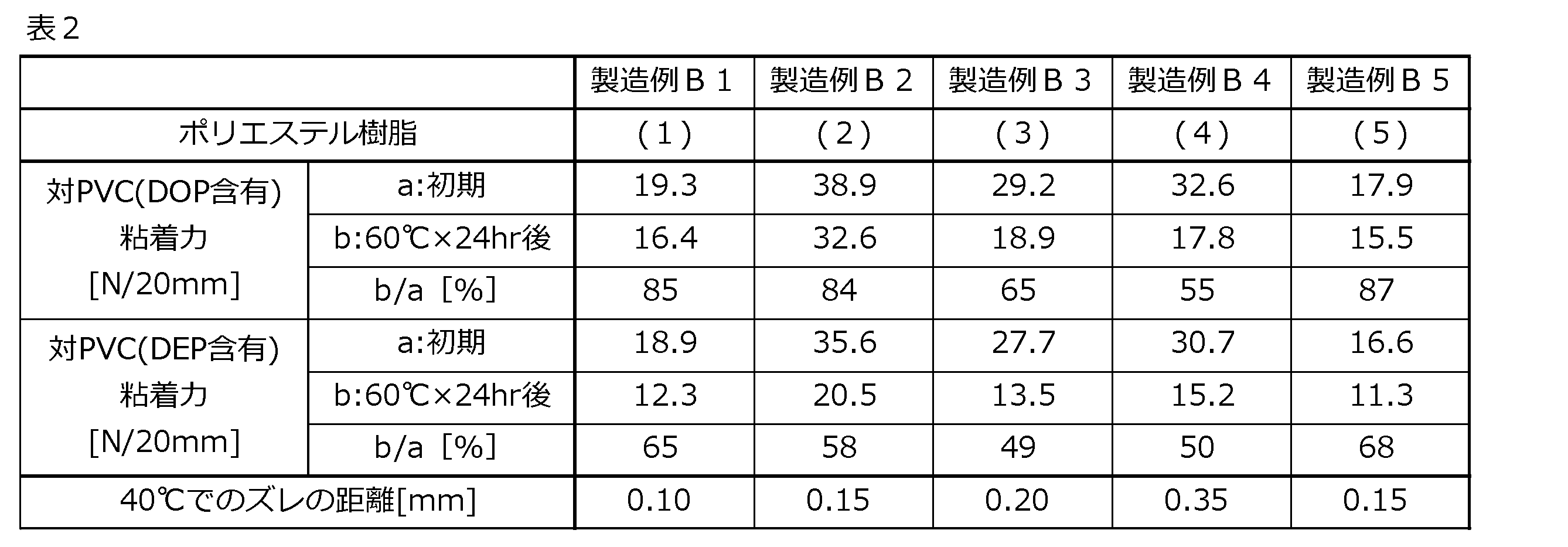
1 …粘着シート
2 …積層体
10…基材
20…ポリエステル系粘着剤層
30…被着体
2 …積層体
10…基材
20…ポリエステル系粘着剤層
30…被着体
Claims (11)
- 樹脂材料およびSP値が10.0(cal/cm3)1/2以下の可塑剤を含有する基材と、
ポリエステル系粘着剤層と、
を有する粘着シート。 - 前記基材が、前記樹脂材料として塩化ビニル系樹脂を少なくとも含有する、請求項1に記載の粘着シート。
- ポリエステル系粘着剤層を有する粘着シートであり、
前記粘着シートは、樹脂材料およびSP値が10.0(cal/cm3)1/2以下の可塑剤を含有する部位を有する被着体に、前記粘着シートの前記ポリエステル系粘着剤層と前記被着体の前記部位とが接するように貼付するためのシートである、
粘着シート。 - 前記被着体における前記部位が、前記樹脂材料として塩化ビニル系樹脂を少なくとも含有する、請求項3に記載の粘着シート。
- 前記ポリエステル系粘着剤層が、10℃以下のガラス転移温度を有するポリエステル樹脂を含有する粘着剤組成物より形成された層である、請求項1~4のいずれか一項に記載の粘着シート。
- 前記可塑剤の前記SP値が、8.0~9.6(cal/cm3)1/2である、請求項1~4のいずれか一項に記載の粘着シート。
- 前記ポリエステル系粘着剤層が、ジカルボン酸成分とジオール成分とを含む単量体混合物の重縮合体であるポリエステル樹脂を含有する粘着剤組成物より形成された層であり、
前記ポリエステル樹脂が、前記ジカルボン酸成分由来の構成単位100mol%中、芳香族ジカルボン酸成分由来の構成単位を50~100mol%含む、請求項1~4のいずれか一項に記載の粘着シート。 - 前記ポリエステル樹脂が、前記ジカルボン酸成分由来の構成単位100mol%中、スルホン酸塩基含有ジカルボン酸成分由来の構成単位を1~10mol%含む、請求項7に記載の粘着シート。
- 前記可塑剤が、フタル酸エステル、アジピン酸エステル、セバシン酸エステル、アゼライン酸エステル、およびトリメリット酸エステルから選択される少なくとも1種であり、かつSP値が10.0(cal/cm3)1/2以下の化合物である、請求項1または3に記載の粘着シート。
- 積層体であって、
前記積層体は、
第1の樹脂層と、
ポリエステル系粘着剤層と、
第2の樹脂層と、
を積層方向にこの順に有し、
前記第1の樹脂層および前記第2の樹脂層から選択される少なくとも一つの層が、樹脂材料と、SP値が10.0(cal/cm3)1/2以下の可塑剤と、を含有する、
積層体。 - 前記第1の樹脂層および前記第2の樹脂層から選択される少なくとも一つの層が、前記樹脂材料として、塩化ビニル系樹脂を少なくとも含有し、
前記可塑剤の前記SP値が、8.0~9.6(cal/cm3)1/2である、
請求項10に記載の積層体。
Applications Claiming Priority (2)
| Application Number | Priority Date | Filing Date | Title |
|---|---|---|---|
| JP2023207067 | 2023-12-07 | ||
| JP2023-207067 | 2023-12-07 |
Publications (1)
| Publication Number | Publication Date |
|---|---|
| WO2025120959A1 true WO2025120959A1 (ja) | 2025-06-12 |
Family
ID=95979599
Family Applications (1)
| Application Number | Title | Priority Date | Filing Date |
|---|---|---|---|
| PCT/JP2024/033225 Pending WO2025120959A1 (ja) | 2023-12-07 | 2024-09-18 | 粘着シートおよび積層体 |
Country Status (2)
| Country | Link |
|---|---|
| TW (1) | TW202538033A (ja) |
| WO (1) | WO2025120959A1 (ja) |
Citations (4)
| Publication number | Priority date | Publication date | Assignee | Title |
|---|---|---|---|---|
| JP2014065887A (ja) * | 2012-09-10 | 2014-04-17 | Toyobo Co Ltd | 光学用易接着性ポリエステルフィルム |
| JP2018197292A (ja) * | 2017-05-23 | 2018-12-13 | 三菱ケミカル株式会社 | ポリ塩化ビニル系熱収縮性チューブ、該チューブを被覆してなる電線、巻線、及びケーブル |
| JP2022133787A (ja) * | 2021-03-02 | 2022-09-14 | リンテック株式会社 | ワーク加工用シート |
| JP2023152753A (ja) * | 2022-03-30 | 2023-10-17 | キヤノン株式会社 | トナー |
-
2024
- 2024-09-18 WO PCT/JP2024/033225 patent/WO2025120959A1/ja active Pending
- 2024-09-23 TW TW113136022A patent/TW202538033A/zh unknown
Patent Citations (4)
| Publication number | Priority date | Publication date | Assignee | Title |
|---|---|---|---|---|
| JP2014065887A (ja) * | 2012-09-10 | 2014-04-17 | Toyobo Co Ltd | 光学用易接着性ポリエステルフィルム |
| JP2018197292A (ja) * | 2017-05-23 | 2018-12-13 | 三菱ケミカル株式会社 | ポリ塩化ビニル系熱収縮性チューブ、該チューブを被覆してなる電線、巻線、及びケーブル |
| JP2022133787A (ja) * | 2021-03-02 | 2022-09-14 | リンテック株式会社 | ワーク加工用シート |
| JP2023152753A (ja) * | 2022-03-30 | 2023-10-17 | キヤノン株式会社 | トナー |
Also Published As
| Publication number | Publication date |
|---|---|
| TW202538033A (zh) | 2025-10-01 |
Similar Documents
| Publication | Publication Date | Title |
|---|---|---|
| JP7404997B2 (ja) | ポリエステル系粘着剤組成物、ポリエステル系粘着剤、光学部材用粘着シート、光学部材用基材レス両面粘着シート、粘着剤層付き光学部材、光学積層体 | |
| JP5615140B2 (ja) | ポリエステル系粘着剤組成物、およびポリエステル系粘着剤、ならびにそれを用いてなる粘着シート | |
| US10696880B2 (en) | Polyester adhesive composition and adhesive sheet | |
| CN103443237B (zh) | 耐候性粘合剂组合物 | |
| JP7067038B2 (ja) | ポリエステル系粘着剤組成物、ポリエステル系粘着剤、粘着シート及び粘着剤層付き光学部材 | |
| WO2014136767A1 (ja) | 両面粘着テープ | |
| JP7334762B2 (ja) | 粘接着シート | |
| JP7528999B2 (ja) | ポリエステル系粘着剤組成物、ポリエステル系粘着剤、粘着フィルム、耐熱粘着フィルム用粘着剤組成物、マスキング用耐熱粘着フィルム、マスキング用耐熱粘着フィルムの使用方法 | |
| CN111108170B (zh) | 聚酯系粘合剂组合物、聚酯系粘合剂、粘合片及带有粘合剂层的光学构件 | |
| JP7130947B2 (ja) | ポリエステル系粘着剤組成物、ポリエステル系粘着剤、粘着シート及び粘着剤層付き光学部材 | |
| JP2014159176A (ja) | 易接着性ポリエステルフィルム | |
| WO2025120959A1 (ja) | 粘着シートおよび積層体 | |
| WO2025197195A1 (ja) | 粘着剤組成物および粘着シート | |
| KR102460457B1 (ko) | 폴리에스테르계 점착제 조성물, 폴리에스테르계 점착제, 점착 시트 및 점착제층 부착 광학 부재 | |
| WO2025239066A1 (ja) | 粘着剤組成物および粘着シート | |
| JP6192511B2 (ja) | ポリエステル系接着剤、フラットケーブル形成用接着剤、およびフラットケーブル | |
| JP7530156B2 (ja) | ポリエステル系粘着剤組成物、ポリエステル系粘着剤、粘着シートおよび粘着剤層付き光学部材 | |
| JP2020172625A (ja) | ポリエステル系粘着剤組成物、ポリエステル系粘着剤及び粘着シート | |
| CN119570422A (zh) | 聚酯系粘合剂组合物、聚酯系粘合剂、粘合片和带有粘合剂层的光学构件 | |
| WO2025239067A1 (ja) | 粘着剤組成物および粘着シート | |
| TWI780099B (zh) | 聚酯系黏著劑組成物、聚酯系黏著劑、黏著片及附設黏著劑層之光學構件 | |
| JP7619000B2 (ja) | 粘着剤、光学部材またはウィンドウフィルム貼り合わせ用粘着剤、粘着シートおよび粘着シートの製造方法 | |
| JP7823682B2 (ja) | ポリエステル系樹脂組成物、接着剤組成物、感圧接着剤組成物、感圧接着剤、感圧接着シートおよび感圧接着剤層付き光学部材 | |
| JP7247738B2 (ja) | ポリエステル系粘着剤組成物、粘着剤、粘着シートおよび粘着剤層付き光学部材 | |
| JP2023168487A (ja) | 粘着剤層及び粘着シート |
Legal Events
| Date | Code | Title | Description |
|---|---|---|---|
| 121 | Ep: the epo has been informed by wipo that ep was designated in this application |
Ref document number: 24900256 Country of ref document: EP Kind code of ref document: A1 |