WO2025115607A1 - 不織布およびその製造方法ならびに積層不織布 - Google Patents
不織布およびその製造方法ならびに積層不織布 Download PDFInfo
- Publication number
- WO2025115607A1 WO2025115607A1 PCT/JP2024/040263 JP2024040263W WO2025115607A1 WO 2025115607 A1 WO2025115607 A1 WO 2025115607A1 JP 2024040263 W JP2024040263 W JP 2024040263W WO 2025115607 A1 WO2025115607 A1 WO 2025115607A1
- Authority
- WO
- WIPO (PCT)
- Prior art keywords
- nonwoven fabric
- propylene
- less
- based resin
- hollow
- Prior art date
- Legal status (The legal status is an assumption and is not a legal conclusion. Google has not performed a legal analysis and makes no representation as to the accuracy of the status listed.)
- Pending
Links
Images

Classifications
-
- D—TEXTILES; PAPER
- D04—BRAIDING; LACE-MAKING; KNITTING; TRIMMINGS; NON-WOVEN FABRICS
- D04H—MAKING TEXTILE FABRICS, e.g. FROM FIBRES OR FILAMENTARY MATERIAL; FABRICS MADE BY SUCH PROCESSES OR APPARATUS, e.g. FELTS, NON-WOVEN FABRICS; COTTON-WOOL; WADDING ; NON-WOVEN FABRICS FROM STAPLE FIBRES, FILAMENTS OR YARNS, BONDED WITH AT LEAST ONE WEB-LIKE MATERIAL DURING THEIR CONSOLIDATION
- D04H3/00—Non-woven fabrics formed wholly or mainly of yarns or like filamentary material of substantial length
- D04H3/005—Synthetic yarns or filaments
- D04H3/007—Addition polymers
-
- D—TEXTILES; PAPER
- D04—BRAIDING; LACE-MAKING; KNITTING; TRIMMINGS; NON-WOVEN FABRICS
- D04H—MAKING TEXTILE FABRICS, e.g. FROM FIBRES OR FILAMENTARY MATERIAL; FABRICS MADE BY SUCH PROCESSES OR APPARATUS, e.g. FELTS, NON-WOVEN FABRICS; COTTON-WOOL; WADDING ; NON-WOVEN FABRICS FROM STAPLE FIBRES, FILAMENTS OR YARNS, BONDED WITH AT LEAST ONE WEB-LIKE MATERIAL DURING THEIR CONSOLIDATION
- D04H3/00—Non-woven fabrics formed wholly or mainly of yarns or like filamentary material of substantial length
- D04H3/018—Non-woven fabrics formed wholly or mainly of yarns or like filamentary material of substantial length characterised by the shape
-
- D—TEXTILES; PAPER
- D04—BRAIDING; LACE-MAKING; KNITTING; TRIMMINGS; NON-WOVEN FABRICS
- D04H—MAKING TEXTILE FABRICS, e.g. FROM FIBRES OR FILAMENTARY MATERIAL; FABRICS MADE BY SUCH PROCESSES OR APPARATUS, e.g. FELTS, NON-WOVEN FABRICS; COTTON-WOOL; WADDING ; NON-WOVEN FABRICS FROM STAPLE FIBRES, FILAMENTS OR YARNS, BONDED WITH AT LEAST ONE WEB-LIKE MATERIAL DURING THEIR CONSOLIDATION
- D04H3/00—Non-woven fabrics formed wholly or mainly of yarns or like filamentary material of substantial length
- D04H3/08—Non-woven fabrics formed wholly or mainly of yarns or like filamentary material of substantial length characterised by the method of strengthening or consolidating
- D04H3/14—Non-woven fabrics formed wholly or mainly of yarns or like filamentary material of substantial length characterised by the method of strengthening or consolidating with bonds between thermoplastic yarns or filaments produced by welding
-
- D—TEXTILES; PAPER
- D04—BRAIDING; LACE-MAKING; KNITTING; TRIMMINGS; NON-WOVEN FABRICS
- D04H—MAKING TEXTILE FABRICS, e.g. FROM FIBRES OR FILAMENTARY MATERIAL; FABRICS MADE BY SUCH PROCESSES OR APPARATUS, e.g. FELTS, NON-WOVEN FABRICS; COTTON-WOOL; WADDING ; NON-WOVEN FABRICS FROM STAPLE FIBRES, FILAMENTS OR YARNS, BONDED WITH AT LEAST ONE WEB-LIKE MATERIAL DURING THEIR CONSOLIDATION
- D04H3/00—Non-woven fabrics formed wholly or mainly of yarns or like filamentary material of substantial length
- D04H3/08—Non-woven fabrics formed wholly or mainly of yarns or like filamentary material of substantial length characterised by the method of strengthening or consolidating
- D04H3/16—Non-woven fabrics formed wholly or mainly of yarns or like filamentary material of substantial length characterised by the method of strengthening or consolidating with bonds between thermoplastic filaments produced in association with filament formation, e.g. immediately following extrusion
Definitions
- the present invention relates to nonwoven fabrics.
- Nonwoven fabrics made from polyolefin resins are low cost and have excellent processability and flexibility, so they are widely used, primarily for sanitary material applications.
- Patent Document 1 proposes a long-fiber nonwoven fabric made of hollow fibers of a propylene-based polymer in which the ratio of Z-average molecular weight Mz to weight-average molecular weight Mw (Mz/Mw) is within a specific range.
- This invention describes that a nonwoven fabric can be obtained that has higher fiber strength, particularly single-yarn strength, compared to conventional hollow fiber nonwoven fabrics, and has a high hollow ratio even when the fiber diameter of the propylene-based polymer fibers that form the nonwoven fabric is reduced.
- Patent Document 2 also proposes a spunbond nonwoven fabric made of hollow fibers of a propylene-based polymer with a specific range of C-axis orientation, average fiber diameter, and average hollowness. It also describes that, according to this invention, even with a low basis weight, the resulting nonwoven fabric has high uniformity, strength, and flexibility, and furthermore, because sufficient strength can be ensured even with a lower basis weight than before, it is possible to reduce the weight.
- Patent Document 1 makes it possible to obtain a nonwoven fabric with a relatively high hollow ratio and a certain strength by controlling the molecular weight, but there are still issues with the rigidity of the nonwoven fabric.
- Patent Document 2 uses hollow fibers with a high molecular orientation to produce a nonwoven fabric that is relatively strong and flexible, but the rigidity is still insufficient and there are issues with handling.
- nonwoven fabrics using hollow fibers made of propylene-based resins can have high strength depending on the manufacturing conditions, but the nonwoven fabric tends to be soft and have low rigidity. This makes the nonwoven fabric difficult to handle and unsuitable for applications that require high rigidity, primarily industrial material applications. Therefore, the object of the present invention is to provide a nonwoven fabric that combines excellent strength and rigidity.
- the present invention aims to solve the above problems, and provides the following inventions:
- the propylene-based resin is The ratio of the Z-average molecular weight Mz to the weight-average molecular weight Mw (Mz/Mw) is 2.0 or more and 6.0 or less
- the hollow fiber is The average single fiber diameter is 5.0 ⁇ m or more and 50.0 ⁇ m or less, and the average hollow ratio is 31.0% or more and 60.0% or less
- the nonwoven fabric is A nonwoven fabric having a melt mass flow rate of 16 g/10 min or more and 55 g/10 min or less.
- the present invention makes it possible to obtain a nonwoven fabric that combines excellent strength and rigidity.
- FIG. 1 is a conceptual diagram showing an example of a hollow die hole in the method for producing a nonwoven fabric of the present invention.
- the nonwoven fabric of the present invention is a nonwoven fabric composed of hollow fibers whose main component is a propylene-based resin, and the propylene-based resin has a ratio (Mz/Mw) of Z-average molecular weight Mz to weight-average molecular weight Mw of 2.0 or more and 6.0 or less, the hollow fibers have an average single fiber diameter of 5.0 ⁇ m or more and 50.0 ⁇ m or less and an average hollow ratio of 31.0% or more and 60.0% or less, and the nonwoven fabric has a melt mass flow rate of 16 g/10 min or more and 55 g/10 min or less.
- "hollow fibers whose main component is a propylene-based resin” refers to hollow fibers in which the mass ratio of the propylene-based resin described below to the components constituting the hollow fibers exceeds 50 mass%.
- nonwoven fabric of the present invention is described in detail below, but the present invention is not limited to the scope described below as long as it does not exceed the gist of the invention, and various modifications are possible without departing from the gist of the invention.
- the nonwoven fabric of the present invention is composed of hollow fibers mainly composed of a propylene-based resin.
- a propylene-based resin By using a propylene-based resin, a low-cost nonwoven fabric having excellent strength can be obtained.
- the propylene-based resin is a resin with a propylene fraction of 50% or more, as described below.
- Specific examples include propylene homopolymers, as well as copolymers of propylene and ethylene, and copolymers of propylene and various ⁇ -olefins.
- ⁇ -olefins refer to hydrocarbons with a double bond at the ⁇ -position, such as 1-butene, 1-pentene, 1-hexene, 1-heptene, 1-octene, 1-decene, 1-dodecene, 1-hexadecene, and 4-methyl-1-pentene.
- the propylene-based resin used in the present invention preferably has a propylene fraction of 94% or more and 100% or less.
- the propylene fraction of the propylene-based resin be preferably 94% or more, more preferably 96% or more, and even more preferably 98% or more, the tensile strength of the fibers is increased, resulting in a nonwoven fabric with excellent strength.
- the upper limit of the propylene fraction of the propylene-based resin that can be achieved in the present invention is 100%.
- the propylene fraction (%) of the propylene-based resin referred to here is a value measured and calculated by the following procedure.
- Propylene-based resin which is the raw material for the fibers, is weighed out so that the sample concentration is 8 mass/v%, and added to orthodichlorobenzene-d 4 (orthodichlorobenzene in which hydrogen has been replaced with deuterium), and heated to 135° C. to dissolve.
- the propylene fraction of the propylene-based resin used in the present invention can be controlled, for example, by the composition of the raw material monomers. Specifically, the propylene fraction of the propylene-based resin can be increased by increasing the propylene ratio of the raw material monomers used in the polymerization of the propylene-based resin.
- the propylene-based resin according to the present invention has a ratio (Mz/Mw) of Z-average molecular weight Mz to weight-average molecular weight Mw of 2.0 or more and 6.0 or less.
- Mz/Mw of the propylene-based resin be 2.0 or more, preferably 2.2 or more, and more preferably 2.3 or more, the molecular orientation is not excessively high and the adhesiveness is improved, resulting in a nonwoven fabric with excellent strength.
- the Mz/Mw of the propylene-based resin be 6.0 or less, preferably 5.0 or less, and more preferably 4.0 or less, thread breakage during spinning can be suppressed, resulting in a nonwoven fabric with fewer defects caused by the inclusion of extremely thick fibers or polymer lumps.
- the propylene-based resin preferably has a ratio (Mw/Mn) of weight average molecular weight Mw to number average molecular weight Mn of 3.0 or more and 10.0 or less.
- Mw/Mn of the propylene-based resin be preferably 3.0 or more, more preferably 4.0 or more, and even more preferably 4.5 or more, the molecular orientation is not excessively high and the adhesiveness is improved, resulting in a nonwoven fabric with excellent strength.
- the Mw/Mn of the propylene-based resin be preferably 10.0 or less, more preferably 9.0 or less, and even more preferably 8.0 or less, thread breakage during spinning can be suppressed, resulting in a nonwoven fabric with fewer defects caused by the inclusion of extremely thick fibers or polymer lumps.
- the Mz/Mw and Mw/Mn of the propylene-based resin are values measured and calculated by the following procedure.
- (1) Take 5 mg of the propylene-based resin that is the raw material for the fiber. When measuring from a nonwoven fabric, take a 5 mg test piece.
- (2) 5 mL of 1,2,4-trichlorobenzene is added to 5 mg of the collected propylene-based resin or test piece, and the mixture is heated at 165° C. for 20 minutes to dissolve the propylene-based resin, thereby obtaining a propylene-based resin solution.
- the obtained propylene-based resin solution is filtered using a PTFE filter (for example, "T010A (pore size: 0.45 ⁇ m)" manufactured by Advantec Toyo Co., Ltd.) to prepare a sample solution.
- a PTFE filter for example, "T010A (pore size: 0.45 ⁇ m)" manufactured by Advantec Toyo Co., Ltd.
- the prepared sample solution is introduced into a high-temperature GPC apparatus (e.g., "PL-220” manufactured by Polymer Laboratories, etc.) and measurement is performed at a column temperature of 145°C.
- the GPC discharge curve is analyzed to determine the Z-average molecular weight Mz, the weight-average molecular weight Mw, and the number-average molecular weight Mn, and Mz/Mn and Mw/Mn are calculated.
- the Mz/Mw and Mw/Mn of the propylene-based resin can be controlled, for example, by a polymerization catalyst. Specifically, by using a Ziegler-Natta catalyst, the Mz/Mw and Mw/Mn of the propylene-based resin can be increased compared to when a metallocene catalyst is used.
- the hollow fibers based on the propylene-based resin according to the present invention may contain additives such as commonly used antioxidants, weathering stabilizers, light stabilizers, heat stabilizers, antistatic agents, antistatic assistants, spinning agents, antiblocking agents, lubricants including polyethylene wax, crystal nucleating agents, and pigments, or other polymers as necessary to further enhance the effects of the present invention or to impart other properties, within the scope of the invention not impairing its effects.
- additives such as commonly used antioxidants, weathering stabilizers, light stabilizers, heat stabilizers, antistatic agents, antistatic assistants, spinning agents, antiblocking agents, lubricants including polyethylene wax, crystal nucleating agents, and pigments, or other polymers as necessary to further enhance the effects of the present invention or to impart other properties, within the scope of the invention not impairing its effects.
- the propylene-based resin used in the present invention preferably has a melt mass flow rate of 16 g/10 min or more and 55 g/10 min or less.
- the propylene-based resin have a melt mass flow rate of preferably 16 g/10 min or more, more preferably 20 g/10 min or more, even more preferably 25 g/10 min or more, and most preferably 30 g/10 min or more, the stability during spinning is improved, resulting in a nonwoven fabric with excellent quality.
- the propylene-based resin have a melt mass flow rate of preferably 55 g/10 min or less, more preferably 50 g/10 min or less, and even more preferably 45 g/10 min or less, the tensile strength of the fiber is increased and the adhesive joints are less likely to break, resulting in a nonwoven fabric with excellent strength.
- the melt mass flow rate (g/10 min) of the propylene-based resin referred to here is a value measured and calculated by the following procedure in accordance with ASTM D1238 (Method A). According to this standard, the melt mass flow rate of the propylene-based resin is measured under a load of 2.16 kg and at a temperature of 230° C. (1) 20 g of propylene-based resin, which is the raw material for the fibers, is collected.
- the sampled propylene-based resin is placed in a melt mass flow rate measuring device (such as "MELT INDEXER F-F01" manufactured by Toyo Seiki Seisakusho Co., Ltd.) heated to 230°C, and measurement is performed under conditions of a load of 2.16 kg and a temperature of 230°C.
- a melt mass flow rate measuring device such as "MELT INDEXER F-F01” manufactured by Toyo Seiki Seisakusho Co., Ltd.
- the above steps (1) and (2) are carried out five times, and the five measured values obtained are arithmetically averaged.
- the value (g/10 min) obtained by rounding off to the nearest tenth place is regarded as the melt mass flow rate (g/10 min) of the propylene-based resin.
- the melt mass flow rate of the propylene-based resin used in the present invention can be controlled, for example, by the molecular weight of the propylene-based resin or the ratio of the Z-average molecular weight Mz to the weight-average molecular weight Mw (Mz/Mw). Specifically, the melt mass flow rate of the propylene-based resin can be reduced by increasing the molecular weight of the propylene-based resin and decreasing Mz/Mw.
- the propylene-based resin according to the present invention preferably contains 0.01% by mass or more and 5.0% by mass or less of a fatty acid amide compound in order to improve the slipperiness of the nonwoven fabric.
- a fatty acid amide compound is preferably 0.01% by mass or more, more preferably 0.05% by mass or more, and even more preferably 0.1% by mass or more, the fatty acid amide compound acts as a lubricant on the fiber surface, resulting in a nonwoven fabric with excellent tactile feel.
- the content of the fatty acid amide compound is preferably 5.0% by mass or less, more preferably 4.0% by mass or less, and even more preferably 3.5% by mass or less, the degree of crystallinity of the fibers can be increased, resulting in a nonwoven fabric with excellent strength and rigidity.
- the nonwoven fabric of the present invention is composed of hollow fibers containing the above-mentioned propylene-based resin as a main component. By using hollow fibers, the nonwoven fabric has excellent strength.
- the hollow fiber according to the present invention may be a composite fiber in which two or more types of resins are combined.
- the composite form is not particularly limited as long as it does not impair the effects of the present invention, and can be appropriately selected from a core-sheath type, an island-in-the-sea type, a side-by-side type, a blend type, etc.
- the hollow fibers used in the nonwoven fabric of the present invention have an average single fiber diameter of 5.0 ⁇ m or more and 50.0 ⁇ m or less.
- an average single fiber diameter of 5.0 ⁇ m or more preferably 8.0 ⁇ m or more, and more preferably 10.0 ⁇ m or more
- the bending moment of the fibers is large, resulting in a nonwoven fabric with excellent rigidity.
- an average single fiber diameter of 50.0 ⁇ m or less, preferably 40.0 ⁇ m or less, and more preferably 35.0 ⁇ m or less the number of fibers is increased when compared at the same basis weight, resulting in a nonwoven fabric with excellent uniformity of texture.
- the average single fiber diameter ( ⁇ m) of the hollow fibers is a value measured and calculated by the following procedure.
- (1) Take a test piece of 5 mm x 5 mm from the nonwoven fabric.
- (2) For non-bonded areas on the surface of the nonwoven fabric where the fibers are not bonded to each other, images are taken using a scanning electron microscope (e.g., "SU1510" manufactured by Hitachi High-Technologies Corporation) at a magnification that allows the sides of 10 or more fibers to be observed.
- a scanning electron microscope e.g., "SU1510" manufactured by Hitachi High-Technologies Corporation
- 3 From the captured image, 10 fibers are randomly selected from the fibers that make up the nonwoven fabric, and their fiber diameters ( ⁇ m) are measured.
- (4) For each level, the above steps (1) to (3) are repeated 10 times, with the test pieces being collected from different locations, and the resulting fiber diameters of 100 fibers are averaged.
- the average single fiber diameter ( ⁇ m) is determined by rounding off to
- the "surface of the nonwoven fabric” refers to the surface facing the observation direction when observed from the thickness direction of the nonwoven fabric, and when observation is possible from both sides, it refers to the surfaces facing both observation directions.
- the average single fiber diameter of the hollow fibers according to the present invention can be controlled by, for example, the melt mass flow rate of the propylene-based resin, the average hollow ratio of the hollow fibers, the spinning temperature in the manufacturing process, the single-hole output, the spinning speed, etc.
- the average single fiber diameter of the hollow fibers can be reduced by reducing the melt mass flow rate of the propylene-based resin, lowering the average hollow ratio, increasing the spinning temperature, lowering the single-hole output, and increasing the spinning speed.
- the hollow fibers according to the present invention have an average hollow ratio of 31.0% or more and 60.0% or less.
- an average hollow ratio of 31.0% or more preferably 33.0% or more, more preferably 35.0% or more, and even more preferably 37.0% or more, the bonded parts are less likely to break, and the bending moment of the fibers in the non-bonded parts is increased, resulting in a nonwoven fabric with excellent strength and rigidity.
- the decrease in bending moment caused by cross-sectional deformation (deformation from approximately circular to approximately elliptical) that occurs when the fibers are bent can be suppressed, resulting in a nonwoven fabric with excellent rigidity.
- the average hollow ratio (%) of hollow fibers is a value measured and calculated according to the following procedure.
- (1) Take a test piece of 5 mm x 5 mm from the nonwoven fabric.
- (2) On the surface of a nonwoven fabric, non-bonded fibers that are located at a distance of 10% or more from a bonded portion relative to the distance between adjacent bonded portions are embedded in an embedding agent such as epoxy resin, and the fibers are cut using a razor in a direction perpendicular to the fiber axis to expose the fiber cross-sections. Images are then taken using a scanning electron microscope (e.g., "SU1510" manufactured by Hitachi High-Technologies Corporation) at a magnification that allows observation of 10 or more fiber cross-sections.
- a scanning electron microscope e.g., "SU1510” manufactured by Hitachi High-Technologies Corporation
- the average hollow ratio of the hollow fibers according to the present invention can be controlled by, for example, the melt mass flow rate of the propylene-based resin, the shape of the hollow nozzle hole in the manufacturing process, the spinning temperature, the single-hole output rate, the cooling conditions, etc. Specifically, the average hollow ratio of the hollow fibers can be increased by decreasing the melt mass flow rate of the propylene-based resin, increasing the minimum circumscribed circle diameter of the hollow nozzle hole, increasing the number of slits in the hollow nozzle hole, lowering the spinning temperature, lowering the single-hole output rate, and lowering the temperature of the cooling air.
- the hollow fibers of the present invention preferably have a fiber length of 30 mm or more.
- a fiber length of preferably 30 mm or more, more preferably 40 mm or more, and even more preferably 45 mm or more the number of entanglement points per fiber increases, resulting in a nonwoven fabric with excellent strength.
- There is no particular upper limit on the fiber length and for example, long fibers with almost no fiber ends can be used.
- nonwoven fabric The nonwoven fabric of the present invention is made of the hollow fibers.
- nonwoven fabric made of hollow fibers does not only refer to nonwoven fabrics made only of hollow fibers, but also includes nonwoven fabrics made of hollow fibers and other fibers, in which the proportion of hollow fibers in the number of fibers is 60% or more.
- the percentage (%) of the number of hollow fibers is a value measured and calculated according to the following procedure.
- (1) Take a test piece of 5 mm x 5 mm from the nonwoven fabric.
- (2) On the surface of a nonwoven fabric, non-bonded fibers that are located at a distance of 10% or more from a bonded portion relative to the distance between adjacent bonded portions are embedded in an embedding agent such as epoxy resin, the nonwoven fabric is cut with a razor to expose the fiber cross sections, and then an image is taken with a scanning electron microscope (e.g., "SU1510" manufactured by Hitachi High-Technologies Corporation) at a magnification such that 10 to 50 fiber cross sections can be observed.
- a scanning electron microscope e.g., "SU1510” manufactured by Hitachi High-Technologies Corporation
- the nonwoven fabric of the present invention may be a long fiber nonwoven fabric such as a spunbonded nonwoven fabric or a meltblown nonwoven fabric, or a short fiber nonwoven fabric such as a needle punched nonwoven fabric or a papermaking nonwoven fabric.
- a long fiber nonwoven fabric is preferred from the viewpoint of excellent productivity and strength, and a spunbonded nonwoven fabric is more preferred because it is easy to reduce the basis weight and easily achieve both excellent strength and rigidity.
- the nonwoven fabric of the present invention may be a single-layer nonwoven fabric consisting of only a layer of nonwoven fabric described below, i.e., a nonwoven fabric consisting of multiple layers of the same type of nonwoven fabric.
- the term "same type of nonwoven fabric” used here refers to nonwoven fabrics consisting of fibers whose main component is a propylene-based resin.
- the nonwoven fabric of the present invention has a fiber layer of a different type from the layer of the nonwoven fabric of the present invention, for example, if the nonwoven fabric of the present invention is a spunbond nonwoven fabric, a layer of meltblown nonwoven fabric, a layer of papermaking nonwoven fabric, or a layer of woven fabric or knitted fabric, it is considered to be a laminated nonwoven fabric described below.
- the nonwoven fabric of the present invention has a melt mass flow rate of 16 g/10 min or more and 55 g/10 min or less.
- a melt mass flow rate of 16 g/10 min or more preferably 20 g/10 min or more, more preferably 25 g/10 min or more, and even more preferably 30 g/10 min or more
- the stability during spinning is improved, resulting in a nonwoven fabric with excellent quality and improved adhesiveness, and therefore excellent strength.
- a melt mass flow rate of 55 g/10 min or less, preferably 50 g/10 min or less, and more preferably 45 g/10 min or less the tensile strength of the fibers is increased and the adhesive joints are less likely to break, resulting in a nonwoven fabric with excellent strength.
- the melt mass flow rate (g/10 min) of the nonwoven fabric is a value measured and calculated according to the following procedure in accordance with ASTM D1238 (Method A).
- (1) Take a 20 g test piece from the nonwoven fabric.
- (2) The collected test piece is placed in a melt mass flow rate measuring device (such as "MELT INDEXER F-F01" manufactured by Toyo Seiki Seisaku-sho, Ltd.) heated to 230°C, and measurement is performed under conditions of a load of 2.16 kg and a temperature of 230°C.
- a melt mass flow rate measuring device such as "MELT INDEXER F-F01" manufactured by Toyo Seiki Seisaku-sho, Ltd.
- measurement is performed under conditions of a load of 2.16 kg and a temperature of 230°C.
- (3) For each level, the above steps (1) and (2) are repeated five times, and the five measured values obtained are arithmetically averaged.
- the melt mass flow rate of the nonwoven fabric of the present invention can be controlled, for example, by selecting the melt mass flow rate of the raw material propylene-based resin. Specifically, by selecting a propylene-based resin with a low melt mass flow rate, the melt mass flow rate of the nonwoven fabric can be reduced.
- the nonwoven fabric of the present invention preferably has a crystalline heat of fusion of 80 J/g or more and 120 J/g or less.
- the crystalline heat of fusion of the nonwoven fabric of 80 J/g or more preferably 85 J/g or more, and more preferably 88 J/g or more, the degree of crystallization of the nonwoven fabric can be appropriately increased, resulting in a nonwoven fabric with excellent strength and rigidity.
- the upper limit of the crystalline heat of fusion of the nonwoven fabric that can be achieved by the present invention is about 120 J/g.
- the heat of crystalline fusion (J/g) of the nonwoven fabric is a value measured and calculated by the following procedure.
- a 2.0 mg test piece is taken from the nonwoven fabric and set in a differential scanning calorimeter (for example, "Q2000" manufactured by TA Instruments).
- Differential scanning calorimetry (1st DSC) is carried out under nitrogen at a heating rate of 16°C/min and a measurement temperature range of 50°C to 230°C, followed by rapid cooling at a heating rate of 100°C/min and then differential scanning calorimetry (2nd DSC) again under nitrogen at a heating rate of 16°C/min and a measurement temperature range of 50°C to 230°C.
- the heat of crystalline fusion of the nonwoven fabric of the present invention can be controlled, for example, by the propylene fraction of the propylene-based resin. Specifically, the heat of crystalline fusion of the nonwoven fabric can be increased by increasing the propylene fraction of the propylene-based resin.
- the nonwoven fabric of the present invention preferably has a basis weight of 5 g/m 2 or more and 300 g/m 2 or less.
- a basis weight of preferably 5 g/m 2 or more, more preferably 10 g/m 2 or more, and even more preferably 12 g/m 2 or more the nonwoven fabric has a uniform texture and excellent strength.
- a basis weight of preferably 300 g/m 2 or less, more preferably 250 g/m 2 or less, and even more preferably 200 g/m 2 or less fluffing due to insufficient adhesion is suppressed, resulting in a nonwoven fabric with excellent quality.
- the basis weight (g/m 2 ) of a nonwoven fabric is a value measured and calculated by the following procedure in accordance with "6.2 Mass per unit area (ISO method)" of JIS L1913:2010 "General nonwoven fabric testing methods.”
- (1) Take a test piece measuring 20 cm x 25 cm from the nonwoven fabric. However, if a test piece measuring 20 cm x 25 cm cannot be taken, take multiple test pieces from the nonwoven fabric so that the total area of the test pieces is 500 cm2 .
- For the sampled test piece measure the mass (g) under standard conditions and convert it into mass per square meter of area (g/m 2 ).
- the basis weight of the nonwoven fabric of the present invention can be controlled, for example, by the single-hole discharge amount, the number of die holes, the conveying speed of the fiber web, etc. in the manufacturing process. Specifically, the basis weight of the nonwoven fabric can be increased by increasing the single-hole discharge amount, increasing the number of die holes, and decreasing the conveying speed.
- the nonwoven fabric of the present invention preferably has a tensile strength per unit area of 1.40 (N/25 mm)/(g/ m2 ) or more and 3.00 (N/25 mm)/(g/ m2 ) or less.
- the tensile strength per unit area is preferably 1.40 (N/25 mm)/(g/ m2 ) or more, more preferably 1.50 (N/25 mm)/(g/ m2 ) or more, resulting in a nonwoven fabric with excellent strength.
- the upper limit of the tensile strength per unit area of the nonwoven fabric that can be achieved by the present invention is about 3.00 (N/25 mm)/(g/ m2 ).
- the tensile strength per unit area of a nonwoven fabric ((N/25 mm)/(g/ m2 )) is a value measured and calculated by the following procedure in accordance with "6.3 Tensile strength and elongation (ISO method)" of JIS L1913:2010 "General nonwoven fabric testing methods.”
- Test pieces measuring 25 mm x 40 mm are taken from a nonwoven fabric in both the longitudinal (lengthwise) and transverse (widthwise) directions of the nonwoven fabric.
- the long side direction (40 mm) of the collected test piece is set as the tensile direction, and the test piece is set in a tensile testing machine (for example, "RTC-1210A” manufactured by A&D Co., Ltd.) with a gripping distance of 20 mm.
- a tensile testing machine for example, "RTC-1210A” manufactured by A&D Co., Ltd.
- a tensile test is carried out at a tensile speed of 20 mm/min, and the maximum point load (N/25 mm) is measured.
- the test pieces are taken from different locations and steps (1) to (3) are repeated five times in both the vertical and horizontal directions. A total of 10 maximum point load measurements are averaged, and this value is rounded off to two decimal places to obtain the average maximum point load (N/25 mm).
- the tensile strength per unit area of the nonwoven fabric of the present invention can be controlled by, for example, the propylene fraction of the propylene-based resin, the average hollow ratio of the hollow fibers, the melt mass flow rate of the nonwoven fabric, Mz/Mw, Mw/Mn, heat of crystalline fusion, and the bonding conditions in the manufacturing process (bonding rate, temperature, line pressure, etc.).
- the tensile strength per unit area of the nonwoven fabric can be increased by increasing the propylene fraction of the propylene-based resin, increasing the average hollow ratio of the hollow fibers, decreasing the melt mass flow rate of the nonwoven fabric, increasing Mz/Mw, increasing Mw/Mn, increasing the heat of crystalline fusion, and adjusting the bonding rate, temperature, and pressure during bonding in the manufacturing process.
- the nonwoven fabric of the present invention preferably has a bending resistance of 35 mm or more and 300 mm or less.
- a bending resistance of preferably 35 mm or more, more preferably 40 mm or more excellent rigidity is exhibited, resulting in a nonwoven fabric with excellent handleability.
- a bending resistance of preferably 300 mm or less, more preferably 250 mm or less the nonwoven fabric has excellent processability.
- the bending resistance (mm) of a nonwoven fabric is determined by measuring the nonwoven fabric three times in each of the longitudinal direction (length direction of the nonwoven fabric) and transverse direction (width direction of the nonwoven fabric) in accordance with JIS L1913:2010 "General nonwoven fabric testing methods” "6.7 Bending resistance (JIS method and ISO method)” "6.7.3 41.5° cantilever method", and then calculating the arithmetic average of all six measured values in the longitudinal and transverse directions, rounding off to the first decimal place to obtain the value (mm) to the nearest tenth.
- the bending resistance of the nonwoven fabric of the present invention can be controlled by, for example, the propylene fraction of the propylene-based resin, the average single fiber diameter of the hollow fibers, the average hollow ratio, the melt mass flow rate, heat of crystalline fusion, and basis weight of the nonwoven fabric, and the bonding conditions in the manufacturing process (bonding ratio, temperature, line pressure, etc.).
- the bending resistance of the nonwoven fabric can be increased by increasing the propylene fraction of the propylene-based resin, increasing the average single fiber diameter of the hollow fibers, setting the average hollow ratio within a specific range, decreasing the melt mass flow rate of the nonwoven fabric, increasing the heat of crystalline fusion, increasing the basis weight, and adjusting the bonding ratio, temperature, and pressure during bonding in the manufacturing process.
- the nonwoven fabric of the present invention can be used for a wide range of applications, including medical and sanitary materials, daily living materials, and industrial materials, but because it has excellent strength and rigidity, it is particularly suitable for use as industrial materials.
- industrial materials referred to here refer to materials used as part of industrial equipment or in the civil engineering and agricultural fields, including filters, transpiration materials, embankment reinforcement materials, revetment sheets, drainage materials, weed control sheets, agricultural mulch, cheesecloth, and the like, and also include the components thereof.
- a method for producing a nonwoven fabric having a melt mass flow rate of 16 g/10 min or more and 55 g/10 min or less comprising the steps of: a step of melting a propylene-based resin having a ratio (Mz/Mw) of Z-average molecular weight Mz to weight-average molecular weight Mw of 2.0 or more and 6.0 or less, and discharging the propylene-based resin from a hollow spinneret hole having a minimum circumscribed circle diameter of 1.2 mm or more and 5.0 mm or less to form hollow fibers having an average single fiber diameter of 5.0 ⁇ m or more and 50.0 ⁇ m or less and an average hollow ratio of 31.0% or more and 60.0% or less; depositing the hollow fibers to form a fiber web comprising the hollow fibers; and a step of thermally bonding the fiber web.
- a nonwoven fabric having a melt mass flow rate of 16 g/10 min or more and 55 g/10 min or less comprising the steps of: a step of melting a
- a propylene-based resin having a ratio (Mz/Mw) of Z-average molecular weight Mz to weight-average molecular weight Mw of 2.0 to 6.0 is melted and extruded from a hollow nozzle hole having a minimum circumscribed circle diameter of 1.2 mm to 5.0 mm. This produces a nonwoven fabric having both excellent strength and rigidity.
- the propylene-based resin is basically the propylene-based resin described above, and preferably has the properties described in [Propylene-based resin], such as the propylene fraction, the ratio of weight-average molecular weight Mw to number-average molecular weight Mn (Mw/Mn), and melt mass flow rate.
- the propylene-based resin has a ratio (Mz/Mw) of Z-average molecular weight Mz to weight-average molecular weight Mw of 2.0 or more and 6.0 or less, as described above.
- Mz/Mw of the propylene-based resin be 2.0 or more, preferably 2.2 or more, and more preferably 2.3 or more, the molecular orientation is not excessively high, and adhesion is facilitated, and adhesion is improved, resulting in a nonwoven fabric with excellent strength.
- the Mz/Mw of the propylene-based resin be 6.0 or less, preferably 5.0 or less, and more preferably 4.0 or less, thread breakage during spinning can be suppressed, resulting in a nonwoven fabric with fewer defects caused by the inclusion of extremely thick fibers or polymer lumps.
- the propylene-based resin is preferably a propylene-based resin made using a Ziegler-Natta catalyst as a polymerization catalyst.
- the propylene-based resin is a propylene-based resin made using a Ziegler-Natta catalyst, the propylene-based resin tends to have a larger Mz/Mw and Mw/Mn than a propylene-based resin made using a metallocene catalyst, and this improves adhesion, resulting in a nonwoven fabric with excellent strength.
- the method of obtaining hollow fibers can be the melt spinning method using an extruder such as a pressure melter type, or a single-screw or twin-screw extruder type.
- the molten and extruded propylene resin passes through piping, is metered by a metering device such as a gear pump, passes through a filter to remove foreign matter, and is then guided to a spinneret.
- the temperature from the resin pipe to the spinneret is preferably 180°C or higher and 280°C or lower.
- the spinneret discharge hole used for discharge is a hollow nozzle hole having a minimum circumscribing circle diameter of 1.2 mm or more and 5.0 mm or less.
- the minimum circumscribing circle diameter of the hollow nozzle hole be preferably 1.2 mm or more, more preferably 1.5 mm or more, hollow fibers with a high hollow ratio can be obtained.
- the minimum circumscribing circle diameter of the hollow nozzle hole be preferably 5.0 mm or less, more preferably 4.5 mm or less, thread breakage during spinning can be suppressed, resulting in a nonwoven fabric with fewer defects caused by the inclusion of extremely thick fibers or polymer lumps, etc.
- the minimum circumscribing circle diameter (mm) of the hollow nozzle hole refers to the diameter (4) of the smallest circle (1) that can contain all the nozzle holes (2) required to form a single fiber when viewed from the nozzle outlet surface of the spinneret, as shown in Figure 1.
- the hollow nozzle hole preferably has a number of slits of 5 or more and 12 or less.
- the number of slits in the hollow nozzle hole preferably 5 or more, more preferably 6 or more, and even more preferably 7 or more, it becomes easier to incorporate air into the fiber, resulting in hollow fibers with a high hollow ratio.
- the number of slits in the hollow nozzle hole preferably 12 or less, more preferably 11 or less, and even more preferably 10 or less, it becomes possible to suppress thread breakage during spinning, resulting in a nonwoven fabric with fewer defects caused by the inclusion of extremely thick fibers or polymer lumps, etc.
- the number of slits in the hollow nozzle hole refers to the number of discharge holes (2) required to form a single fiber in the spinneret when viewed from the nozzle discharge surface, as shown in Figure 1.
- the number of slits in the hollow nozzle hole is 8.
- the slit width of the hollow nozzle hole is preferably 0.02 mm or more and 0.40 mm or less.
- the slit width of the hollow nozzle hole is preferably 0.02 mm or more, more preferably 0.04 mm or more, and even more preferably 0.05 mm or more, discharge defects caused by clogging of the nozzle hole with foreign matter can be suppressed, improving stability during spinning and resulting in a nonwoven fabric with fewer defects caused by the inclusion of extremely thick fibers or polymer lumps.
- the slit width of the hollow nozzle hole preferably 0.40 mm or less, more preferably 0.30 mm or less, and even more preferably 0.25 mm or less, the metering ability at the spinneret hole can be improved, resulting in a nonwoven fabric with excellent uniformity.
- the slit width (mm) of the hollow nozzle hole refers to the width (3) of the nozzle hole required to form a single fiber when viewed from the nozzle outlet surface in the spinneret, as shown in FIG. 1.
- the arithmetic average value is within the above range.
- the land length of the hollow nozzle hole is preferably 0.1 mm or more and 5.0 mm or less.
- the land length of the hollow nozzle hole is preferably 0.1 mm or more, more preferably 0.2 mm or more, and even more preferably 0.3 mm or more.
- the metering ability at the hollow nozzle hole can be improved, and a nonwoven fabric with excellent uniformity can be obtained.
- the land length of the hollow nozzle hole preferably 5.0 mm or less, more preferably 4.0 mm or less, and even more preferably 3.5 mm or less, excessive pressure rise can be suppressed, and stable spinning for long periods of time is possible.
- the land length (mm) of the hollow nozzle hole refers to the length of the straight tube section in the spinneret that has the same cross section as the nozzle hole shape when viewed from the nozzle discharge surface.
- the propylene-based resin spun out from the spinneret is preferably then cooled.
- Methods for cooling the propylene-based resin discharged from the spinneret include, for example, forcibly blowing cold air onto the propylene-based resin, or allowing it to cool naturally at the ambient temperature around the propylene-based resin discharged from the spinneret, or a combination of these methods can be used.
- the temperature of the cooling air can be determined in consideration of the balance with the cooling air speed from the viewpoint of cooling efficiency, but it is preferably 30°C or less.
- the upper limit of the cooling air temperature is preferably 30°C or less, more preferably 20°C or less, and even more preferably 15°C or less, the cooling efficiency of the propylene-based resin discharged from the spinneret is increased, and spinnability can be improved.
- the lower limit of the cooling air temperature is preferably 0°C or more from the viewpoint of the cooling cost of the air and from the viewpoint of preventing moisture from adhering to the fibers due to cooling.
- the cooling air is preferably blown almost perpendicularly to the propylene resin discharged from the spinneret (when the fibers are running vertically, this refers to a direction parallel to the ground).
- the speed of the cooling air is preferably 10 m/min or more from the viewpoint of cooling efficiency and uniformity of fineness, and is preferably 100 m/min or less from the viewpoint of spinning stability.
- the lower limit of the distance from the spinneret to the start of cooling preferably 0 mm or more, more preferably 5 mm, it is possible to stabilize discharge without causing a drop in the nozzle surface temperature.
- the upper limit of the distance from the spinneret to the start of cooling at preferably 300 mm or less, more preferably 100 mm or less, it is possible to stabilize the thinning behavior of the hollow fibers and improve spinnability.
- the cooled and solidified yarn is stretched.
- the yarn made by cooling and solidifying the propylene resin discharged from the spinneret is not wound up, but is pulled and stretched by compressed air sprayed from an ejector installed below the spinneret.
- various shapes such as round and rectangular spinnerets and ejectors can be used.
- the distance from the spinneret to the ejector inlet is 400 mm or more and 3000 mm or less.
- the distance from the spinneret to the ejector inlet preferably 400 mm or more, the hollow fibers enter the ejector after being cooled and solidified, thereby obtaining excellent spinning stability.
- the spinning stress does not become excessively high, thereby suppressing thread breakage, and a nonwoven fabric with fewer defects caused by the inclusion of extremely thick fibers or polymer lumps, etc., can be obtained.
- the yarn that enters the ejector is accelerated by the accelerating air flow, and the spinning speed, which is the running speed of the yarn, also reaches a speed close to the air flow speed.
- the spinning speed is preferably 1.5 km/min or more and 6.0 km/min or less.
- the spinning speed is preferably 1.5 km/min or more, more preferably 1.8 km/min or more, and even more preferably 2.0 km/min or more.
- the average single fiber diameter becomes thinner, so that a nonwoven fabric with excellent texture uniformity can be obtained.
- the spinning speed is set to 6.0 km/min or less, thread breakage during spinning can be suppressed, and spinning stability can be improved.
- the spinning speed referred to here is a value measured and calculated by the following procedure.
- (1) In the same manner as in the procedure described in the above "Method of measuring and calculating the average hollow ratio of hollow fibers", calculate the areas A in ( ⁇ m 2 ) and A out ( ⁇ m 2 ) of the perfect circles that are the same as the outer circumferential length L in ( ⁇ m) of the approximately circular portion formed by the hollow portion of the yarn and the outer circumferential length L out ( ⁇ m ) of the approximately circular portion formed by the outside of the resin portion.
- (2) The propylene-based resin discharged from the spinneret is sampled for 1 minute and weighed, and the value obtained is regarded as the discharge rate (g/min).
- hollow fibers can be formed with an average single fiber diameter of 5.0 ⁇ m or more and 50.0 ⁇ m or less and an average hollow ratio of 31.0% or more and 60.0% or less.
- Step of forming a fiber web the hollow fibers obtained in the previous step are piled up to form a fiber web composed of the hollow fibers. Specifically, for example, the hollow fibers are opened by passing through a fiber opening part where the surrounding air flow speed is reduced, and then the hollow fibers are landed on a net conveyer that sucks air from the back side, and collected as a fiber web.
- the collected fiber web is preferably transported at a transport speed of 5 m/min or more and 1200 m/min or less.
- the material of the net used for collection includes metal nets such as stainless steel, iron, and nickel, as well as resin nets made of polyester or fluororesin, and rubber nets. Of these, it is preferable to use a resin net from the standpoint of collection properties and releasability from the conveyor.
- the method of forming the fiber web can be selected from known manufacturing methods such as the meltblowing method and the short fiber carding method in addition to the spunbonding method described above, but it is preferable to use the spunbonding method because of its excellent productivity.
- the spunbonding method is excellent in productivity and mechanical strength, and can suppress the fuzzing and fiber dropout that are likely to occur in short fiber nonwoven fabrics.
- by laminating the collected spunbonded nonwoven fiber web or heat-bonded spunbonded nonwoven fabric (both are written as S) in multiple layers of SS, SSS, and SSSS productivity and uniformity of texture are improved. Note that even if multiple layers of spunbonded nonwoven fabric are laminated here, if all of the layers are made of the same type of resin, they are treated as single-layer nonwoven fabric in the present invention as described above.
- the thermal bonding method is not particularly limited, but examples thereof include a method of thermally fusing the fibers using various rolls such as a thermal embossing roll having engraved (uneven portions) on each of a pair of upper and lower roll surfaces, a thermal embossing roll consisting of a combination of a roll with one flat (smooth) surface and a roll with engraved (uneven portions) on the other surface, and a thermal calendar roll consisting of a combination of a pair of upper and lower flat (smooth) rolls, a method of thermally fusing the fibers using ultrasonic vibrations of a horn, and a method of softening or melting the surface of the islands-in-the-sea type composite fibers by passing hot air through the nonwoven fiber web to thermally fuse the fiber intersections.
- various rolls such as a thermal embossing roll having engraved (uneven portions) on each of a pair of upper and lower roll surfaces, a thermal embossing roll consisting of a
- thermal embossing roll having engraved (uneven portions) on each of a pair of upper and lower roll surfaces, or a thermal embossing roll consisting of a combination of a roll with one flat (smooth) surface and a roll with engraved (uneven portions) on the other surface.
- This not only increases productivity, but also provides bonded parts that improve the strength of the nonwoven fabric and non-bonded parts that improve the texture and breathability of the fabric.
- the adhesion rate during thermal bonding is preferably 5% or more and 30% or less.
- an adhesion rate of preferably 5% or more, more preferably 10% or more a nonwoven fabric with excellent strength and rigidity can be obtained.
- an adhesion rate of preferably 30% or less, more preferably 20% or less a nonwoven fabric with excellent breathability and processability can be obtained.
- the adhesion rate here refers to the area ratio of the adhesive part to the entire nonwoven fabric.
- thermal bonding when thermal bonding is performed using a pair of uneven rolls, it refers to the area ratio of the entire nonwoven fabric where the convex parts of the upper roll and the convex parts of the lower roll overlap and come into contact with the nonwoven fiber web (adhesive part).
- thermal bonding is performed using an uneven roll and a flat roll, it refers to the area ratio of the entire nonwoven fabric where the convex parts of the uneven roll come into contact with the nonwoven fiber web (adhesive part).
- ultrasonic bonding it refers to the area ratio of the part thermally bonded by ultrasonic processing (adhesive part) to the entire nonwoven fabric.
- the shape of the bonded area formed by the hot embossing roll or ultrasonic bonding is not particularly limited, but for example, a circle, ellipse, square, rectangle, parallelogram, rhombus, regular hexagon, and regular octagon can be used. It is also preferable that the bonded areas are uniformly spaced at regular intervals in both the longitudinal direction (transport direction) and width direction of the nonwoven fabric. This can reduce variation in the strength of the nonwoven fabric.
- the surface temperature of the hot embossing roll during thermal bonding is preferably 100°C or higher and 150°C or lower.
- the surface temperature of the hot embossing roll be preferably 100°C or higher, more preferably 110°C or higher, it is possible to achieve moderate thermal bonding, and therefore a nonwoven fabric with excellent strength and rigidity can be obtained.
- the surface temperature of the hot embossing roll be preferably 150°C or lower, more preferably 145°C or lower, it is possible to suppress a decrease in strength due to excessive thermal bonding, and therefore a nonwoven fabric with excellent strength can be obtained.
- the linear pressure of the hot embossing roll during thermal bonding is preferably 10 N/mm or more and 200 N/mm or less.
- the linear pressure of the hot embossing roll is preferably 10 N/mm or more, more preferably 20 N/mm or more, and even more preferably 30 N/mm or more.
- sufficient thermal bonding can be achieved, resulting in a nonwoven fabric with excellent strength and rigidity.
- setting the linear pressure of the hot embossing roll to preferably 200 N/mm or less, more preferably 150 N/mm or less, and even more preferably 100 N/mm or less, reduction in strength due to excessive thermal bonding can be suppressed, resulting in a nonwoven fabric with excellent strength.
- thermal compression bonding can be further performed by a thermal calendar roll consisting of a pair of upper and lower flat rolls.
- a pair of upper and lower flat rolls refers to a metal roll or an elastic roll with no irregularities on the roll surface, and a pair of metal rolls or a pair of metal rolls and an elastic roll can be used.
- an elastic roll refers to a roll made of a material that has elasticity compared to a metal roll.
- elastic rolls include so-called paper rolls made of paper, cotton, aramid paper, etc., and resin rolls made of urethane resin, epoxy resin, silicon resin, polyester resin, hard rubber, and mixtures of these.
- the spunbond nonwoven fabric of the present invention can be post-processed to the extent that the effect of the present invention is not impaired.
- post-processing include physical processing such as drilling and rubbing, and chemical processing such as hydrophilization and electrostatic charging.
- the nonwoven fabric of the present invention can be used as it is, but it is also preferable to form it into a laminated nonwoven fabric having a layer of the nonwoven fabric and a layer of a fiber different from the layer of the nonwoven fabric and/or a film layer.
- a fiber layer of a type different from the nonwoven fabric layer refers to a fiber layer whose main component is not a propylene-based resin, or a fiber layer manufactured by a different method.
- the nonwoven fabric is a spunbond nonwoven fabric
- fiber layers manufactured by a different method include a melt-blown nonwoven fabric layer formed by the melt-blowing method, a staple fiber nonwoven fabric layer formed by a papermaking method, or a woven or knitted layer made of long fibers or spun yarn.
- the laminated nonwoven fabric of the present invention has a laminated structure in which at least one layer of the nonwoven fabric of the present invention is laminated. By laminating at least one layer of the nonwoven fabric, the nonwoven fabric acts as a reinforcing material, resulting in a laminated nonwoven fabric with excellent strength.
- the method for producing the laminated nonwoven fabric of the present invention is not particularly limited, but examples include a method in which the nonwoven fabric of the present invention is layered on a fiber layer or film layer of a different type from the nonwoven fabric layer without bonding, or a method in which a part or the whole of the layers are integrated with an adhesive or thermal bonding process.
- the resin that constitutes the structure other than the nonwoven fabric of the present invention is not particularly limited, but it is preferably made of a propylene-based resin because it is easy to adhere.
- the laminated nonwoven fabric of the present invention can be used for medical and sanitary materials, daily living materials, industrial materials, etc. depending on the type of layers to be laminated, but since it has excellent strength and rigidity, it is particularly suitable for use in industrial materials. For example, since the collection performance can be improved by laminating melt-blown layers, it is suitable for use in various filters.
- melt Mass Flow Rate (MFR) of Propylene-Based Resin and Nonwoven Fabric The melt mass flow rate was measured as described above using a "MELT INDEXER F-F01" manufactured by Toyo Seiki Seisakusho Co., Ltd., in accordance with ASTM D1238 (Method A).
- Basis Weight The basis weight was measured as described above in accordance with "6.2 Mass per unit area” of JIS L1913:2010 "General nonwoven fabric testing methods.”
- the number of defects due to yarn breakage was measured over a length of 1000 m or more, and the number of defects due to yarn breakage per 1000 m was calculated.
- the number of defects due to yarn breakage was evaluated as A when the number of defects was 3 or less per 1000 m, B when the number of defects was more than 3 or more per 1000 m and 8 or less per 1000 m, and C when the number of defects was more than 8 or more per 1000 m.
- propylene-based resin The propylene-based resins used in the examples of the present invention are as follows:
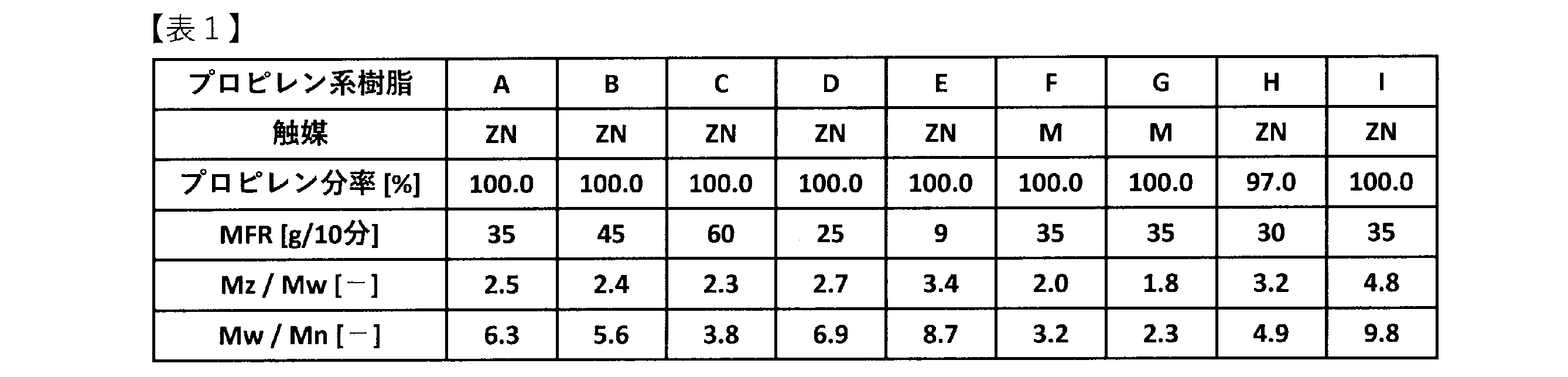
- Propylene-based resin A It is a propylene homopolymer obtained using a Ziegler-Natta catalyst (denoted as "ZN" in Table 1).
- the propylene fraction of this propylene-based resin A is 100.0%, the MFR is 35 g/10 min, the Mz/Mw is 2.5, and the Mw/Mn is 6.3.
- Propylene-based resin B This is a propylene homopolymer obtained using a Ziegler-Natta catalyst.
- the propylene fraction of this propylene-based resin B is 100.0%, the MFR is 45 g/10 min, the Mz/Mw is 2.4, and the Mw/Mn is 5.6.
- Propylene-based resin C This is a propylene homopolymer obtained using a Ziegler-Natta catalyst.
- the propylene fraction of this propylene-based resin C is 100.0%, the MFR is 60 g/10 min, the Mz/Mw is 2.3, and the Mw/Mn is 3.8.
- Propylene-based resin D This is a propylene homopolymer obtained using a Ziegler-Natta catalyst.
- the propylene fraction of this propylene-based resin D is 100.0%, the MFR is 25 g/10 min, the Mz/Mw is 2.7, and the Mw/Mn is 6.9.
- Propylene-based resin E This is a propylene homopolymer obtained using a Ziegler-Natta catalyst.
- the propylene fraction of this propylene-based resin E is 100.0%, the MFR is 9 g/10 min, the Mz/Mw is 3.4, and the Mw/Mn is 8.7.
- Propylene-based resin F It is a propylene homopolymer obtained using a metallocene catalyst (denoted as "M” in Table 1). This propylene-based resin F has a propylene fraction of 100.0%, an MFR of 35 g/10 min, an Mz/Mw of 2.0, and an Mw/Mn of 3.2.
- Propylene-based resin G This is a propylene homopolymer obtained using a metallocene catalyst.
- the propylene fraction of this propylene-based resin G is 100.0%, the MFR is 35 g/10 min, the Mz/Mw is 1.8, and the Mw/Mn is 2.3.
- Propylene-based resin H This is an ethylene-propylene copolymer obtained using a Ziegler-Natta catalyst.
- the propylene fraction of this propylene-based resin H is 97.0%, the MFR is 30 g/10 min, the Mz/Mw is 3.2, and the Mw/Mn is 4.9.
- Propylene-based resin I This is a propylene homopolymer obtained using a Ziegler-Natta catalyst.
- the propylene fraction of this propylene-based resin I is 100.0%, the MFR is 35 g/10 min, the Mz/Mw is 4.8, and the Mw/Mn is 9.8.
- Example 1 (a) Step of forming hollow fibers Propylene-based resin A was melt-extruded by a single-screw extruder and supplied to a rectangular spinneret while being metered by a gear pump. At this time, the melt extrusion temperature was set to 230° C., and the propylene-based resin A was extruded from the hollow nozzle hole having a minimum circumscribed circle diameter of 2.0 mm, 8 slits, a slit width of 0.08 mm, and a land length of 0.3 mm at a single-hole extrusion rate of 0.60 g/min.
- the extruded fibrous resin was cooled and solidified by applying cooling air at a temperature of 10°C and a speed of 18 m/min from the outside, and then pulled by an air flow using a rectangular ejector to obtain fibers.
- the distance from the spinneret to the ejector inlet was set to 550 mm.
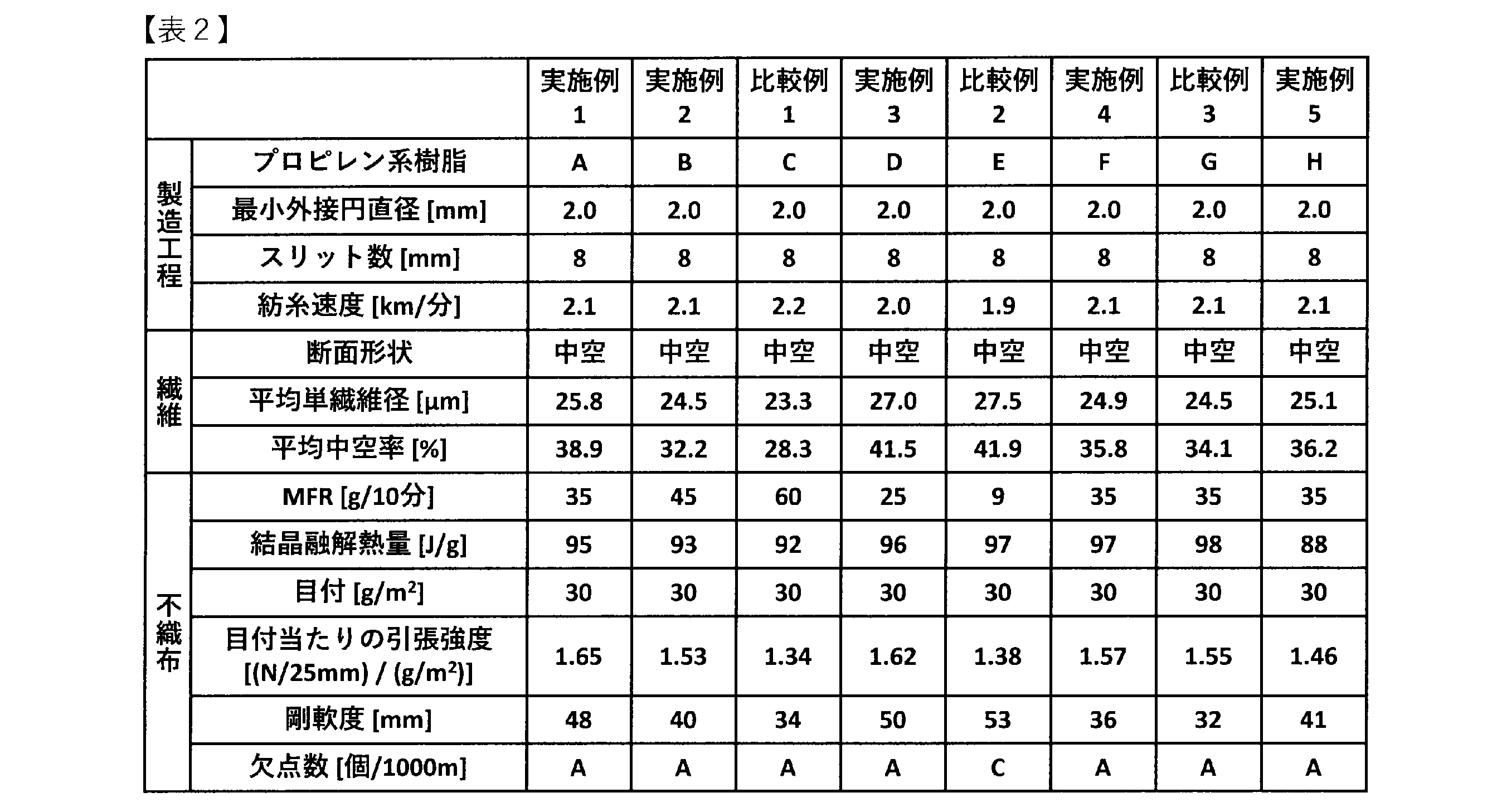
- Example 10 [Examples 2 to 5, Comparative Examples 1 to 3, Example 10] (a) In the step of forming fibers, the propylene-based resin was changed from propylene-based resin A to propylene-based resin B in Example 2, propylene-based resin C in Comparative Example 1, propylene-based resin D in Example 3, propylene-based resin E in Comparative Example 2, propylene-based resin F in Example 4, propylene-based resin G in Comparative Example 3, propylene-based resin H in Example 5, and propylene-based resin I in Example 10, except that nonwoven fabrics were obtained in the same manner as in Example 1. The evaluation results of the obtained nonwoven fabrics are shown in Table 2.
- Examples 6 and 7, Comparative Examples 4 and 5 (a) In the step of forming the fibers, the minimum circumscribing circle diameter of the hollow die hole was changed from 2.0 mm to 1.0 mm in Comparative Example 4, 1.5 mm in Example 6, 3.0 mm in Example 7, and 4.8 mm in Comparative Example 5.
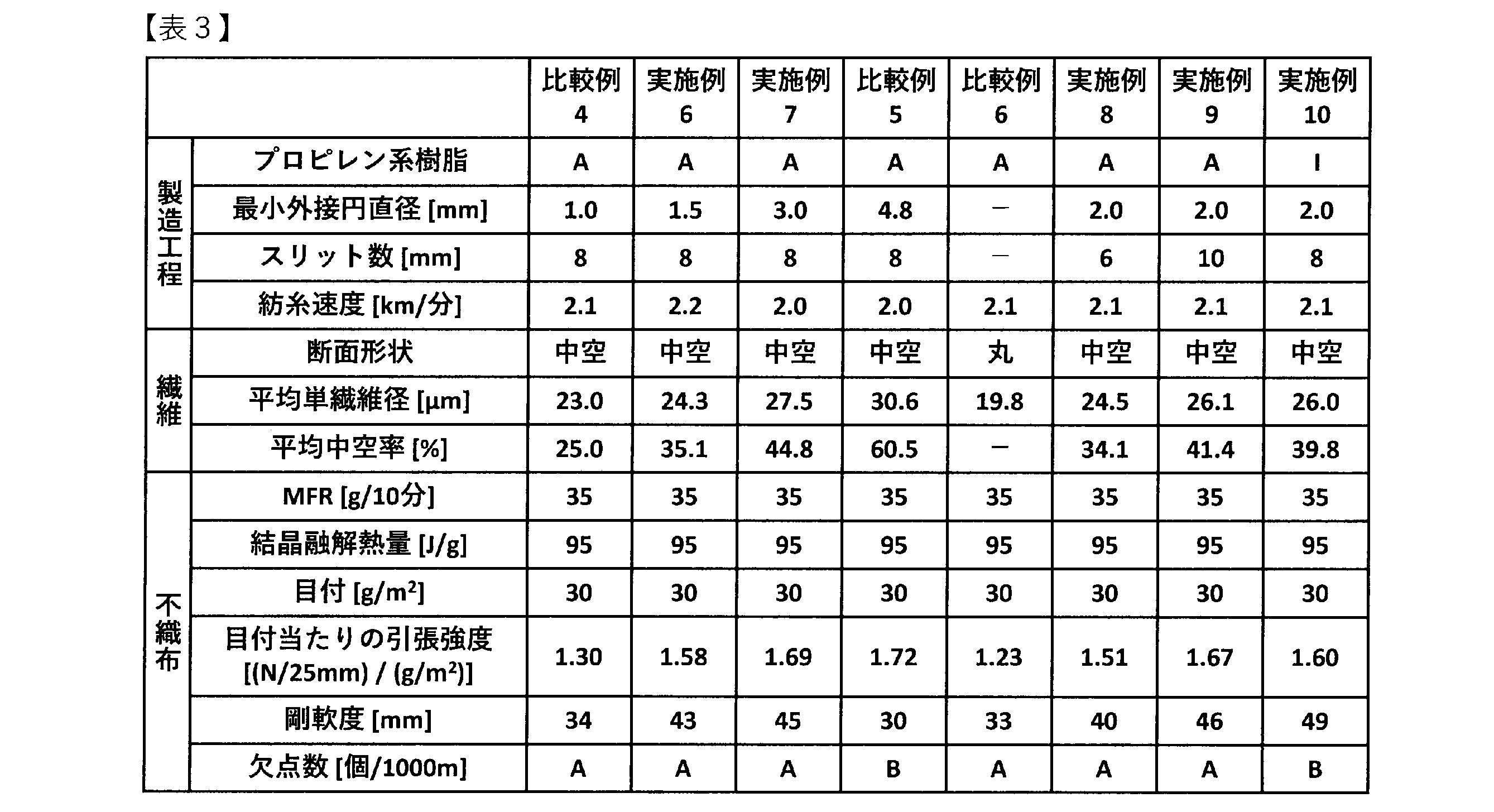
- Nonwoven fabrics were obtained in the same manner as in Example 1, except that the diameter was changed from 2.0 mm to 1.0 mm in Comparative Example 4, 1.5 mm in Example 6, 3.0 mm in Example 7, and 4.8 mm in Comparative Example 5. The evaluation results of the obtained nonwoven fabrics are shown in Table 3.
- Example 8 and 9 (a) In the step of forming the fibers, nonwoven fabrics were obtained in the same manner as in Example 1, except that the number of slits in the hollow die hole was changed from 8 to 6 in Example 8 and 10 in Example 9. The evaluation results of the obtained nonwoven fabrics are shown in Table 3.
- the nonwoven fabrics of Examples 1 to 10 are nonwoven fabrics composed of hollow fibers whose main component is a propylene-based resin, and the hollow fibers have an average single fiber diameter of 5.0 ⁇ m to 50.0 ⁇ m and an average hollow ratio of 31.0% to 60.0%.
- the nonwoven fabrics have a melt mass flow rate of 16 g/10 min to 55 g/10 min and an Mz/Mw of 2.0 to 6.0, which indicates that the nonwoven fabrics have excellent strength and rigidity.
- the nonwoven fabric of Comparative Example 1 had a low hollow ratio and a high melt mass flow rate, while the nonwoven fabrics of Comparative Examples 4 and 6 had low hollow ratios, so all of them had poor tensile strength and bending resistance per unit weight. Furthermore, the nonwoven fabric of Comparative Example 2 had a low melt mass flow rate, so in addition to having low tensile strength per unit weight, it also had many defects. Furthermore, the nonwoven fabric of Comparative Example 3 had a small Mz/Mw, and the nonwoven fabric of Comparative Example 5 had a high hollow ratio, so it had poor bending resistance.
Landscapes
- Engineering & Computer Science (AREA)
- Textile Engineering (AREA)
- Nonwoven Fabrics (AREA)
- Laminated Bodies (AREA)
Abstract
Description
前記プロピレン系樹脂は、
Z平均分子量Mzと重量平均分子量Mwの比(Mz/Mw)が2.0以上6.0以下であり、
前記中空繊維は、
平均単繊維径が5.0μm以上50.0μm以下、かつ
平均中空率が31.0%以上60.0%以下であり、
前記不織布は、
メルトマスフローレートが16g/10分以上55g/10分以下である、不織布。
Z平均分子量Mzと重量平均分子量Mwとの比(Mz/Mw)が2.0以上6.0以下のプロピレン系樹脂を溶融し、該プロピレン系樹脂を紡糸口金の最小外接円直径が1.2mm以上5.0mm以下の中空口金孔から吐出して、平均単繊維径が5.0μm以上50.0μm以下、かつ、平均中空率が31.0%以上60.0%以下の中空繊維を形成する工程と、
前記中空繊維を堆積させ、該中空繊維によって構成されてなる繊維ウェブを形成する工程と、
前記繊維ウェブを熱接着する工程と、を有する、不織布の製造方法。
該不織布の層とは異なる繊維層、および/または、フィルム層と、を有する、積層不織布。
本発明の不織布は、プロピレン系樹脂を主成分とする中空繊維によって構成されてなる。プロピレン系樹脂を用いることにより、低コストであり、かつ、強度に優れた不織布となる。
(1)試料濃度8mass/v%となるように、繊維の原料となるプロピレン系樹脂を秤量し、オルトジクロロベンゼン-d4(オルトジクロロベンゼンの水素が重水素に置換されたもの)に加え、135℃に加温して溶解する。
(2)得られた溶液を試料とし、核磁気共鳴装置(例えば、JEOL RESONANCE製「ECZ-600」など)を用いて13C-NMR測定を行い、プロピレン単位に起因するピーク面積と、エチレン単位およびα-オレフィン単位に起因するピーク面積とを、NMRスペクトルの積分値として取得する。
(3)プロピレン単位、エチレン単位、およびα-オレフィン単位に対応するピーク面積の総和AAPに対するプロピレン単位に対応するピーク面積APPの比率(APP/AAP)を百分率で求める。
(4)1水準につき上記(1)~(3)を3回行い、得られた3つの(APP/AAP)の値を算術平均し、小数点以下第2位を四捨五入して小数点第1位まで求めた値を、プロピレン系樹脂のプロピレン分率(%)とする。
(1)繊維の原料となるプロピレン系樹脂を5mg採取する。不織布から測定する場合には、試験片を5mg採取する。
(2)採取したプロピレン系樹脂または試験片5mgに対して、1,2,4-トリクロロベンゼン5mLを加え、を165℃で20分間加熱してプロピレン系樹脂を溶解させてプロピレン系樹脂溶液を得る。
(3)得られたプロピレン系樹脂溶液を、PTFEフィルター(例えば、アドバンテック東洋株式会社製「T010A(孔径:0.45μm)」など)を用いて濾過し、試料溶液を作製する。
(4)作製した試料溶液を、高温GPC装置(例えば、Polymer Laboratories製「PL-220」など)に投入して、カラム温度145℃で測定を実施し、GPC排出曲線について解析を行うことで、Z平均分子量Mz、重量平均分子量Mw、数平均分子量Mnを求め、Mz/MnおよびMw/Mnを算出する。
(5)1水準につき上記(1)~(4)を3回行い、得られたMz/MnおよびMw/Mnの値を算術平均し、小数点以下第2位を四捨五入して小数点第1位まで求めた値を、プロピレン系樹脂のMz/Mw(単位なし)およびMw/Mn(単位なし)とする。
(1)繊維の原料となるプロピレン系樹脂を20g採取する。
(2)採取したプロピレン系樹脂を、230℃に熱したメルトマスフローレート測定装置(例えば、株式会社東洋精機製作所製「MELT INDEXER F-F01」など)に投入し、荷重2.16kg、温度230℃の条件で測定する。
(3)1水準につき上記(1)~(2)を5回行い、得られた5つの測定値を算術平均し、小数点以下第1位を四捨五入して1の桁まで求めた値(g/10分)を、プロピレン系樹脂のメルトマスフローレート(g/10分)とする。
本発明の不織布は、前記プロピレン系樹脂を主成分とする中空繊維によって構成されてなる。中空繊維とすることにより、優れた強度を有する不織布となる。
(1)不織布より、5mm×5mmの試験片を採取する。
(2)不織布の表面における繊維同士が接着していない非接着部について、走査型電子顕微鏡(例えば、株式会社日立ハイテクノロジーズ製「SU1510」など)で10本以上の繊維側面が観察できる倍率にて画像を撮影する。
(3)撮影した画像より、不織布を構成する繊維から10本を無作為に選び、その繊維径(μm)を計測する。
(4)1水準につき、試験片の採取箇所を変更して上記(1)~(3)を10回行い、得られた計100本の繊維径を算術平均し、小数点以下第2位を四捨五入して小数点第1位まで求めた値を、平均単繊維径(μm)とする。
(1)不織布より、5mm×5mmの試験片を採取する。
(2)不織布の表面において、隣り合った接着部間の距離に対して接着部から10%以上離れた位置に存在する非接着部の繊維をエポキシ樹脂等の包埋剤にて包埋し、カミソリを用いて繊維軸垂直方向に繊維を切断して繊維断面を露出させた後、走査型電子顕微鏡(例えば、株式会社日立ハイテクノロジーズ製「SU1510」など)で10本以上の繊維断面が観察できる倍率にて画像を撮影する。
(3)撮影した画像より、画像解析ソフト(例えば、三谷商事株式会社製「WinROOF2015」など)を用いて、中空繊維の中空部が形成する略円形部の外周長Lin(μm)と、樹脂部外側が形成する略円形部の外周長Lout(μm)を計測し、次の式により、外周部がLinおよびLoutと同一になる真円の面積Ain(μm2)およびAout(μm2)、中空率H(%)を算出する
Ain(μm2)=Lin 2÷4π
Aout(μm2)=Lout 2÷4π
H(%)=Ain/Aout×100
(式中、πは円周率を表す)。
(4)1水準につき、試験片の採取箇所を変更して上記(1)~(3)を10回行い、得られた計100本の中空率H(%)を算術平均し、小数点以下第2位を四捨五入して小数点第1位まで求めた値を、平均中空率(%)とする。
本発明の不織布は、前記の中空繊維によって構成されてなる。ここで、「中空繊維によって構成されてなる不織布」とは、中空繊維のみからなる不織布だけを指すものではなく、中空繊維とその他の繊維とからなる不織布であって、中空繊維の本数割合が60%以上の不織布も含むものである。
(1)不織布より、5mm×5mmの試験片を採取する。
(2)不織布の表面において、隣り合った接着部間の距離に対して接着部から10%以上離れた位置に存在する非接着部の繊維をエポキシ樹脂等の包埋剤にて包埋し、カミソリを用いて不織布を切断して繊維断面を露出させた後、走査型電子顕微鏡(例えば、株式会社日立ハイテクノロジーズ製「SU1510」など)で10本以上50本以下の繊維断面が観察できる倍率にて画像を撮影する。
(3)1水準につき、試験片の採取箇所を変更しながら上記(1)~(2)を計200本の繊維断面を撮影するまで繰り返し、撮影した画像より繊維内部に中空部を有する繊維の本数を数える。
(4)中空繊維の本数を、観察した繊維の本数(200本)で割った商を百分率で表し、小数点以下第2位を四捨五入して小数点第1位まで求めた値を、中空繊維の本数割合(%)とする。
(1)不織布より試験片を20g採取する。
(2)採取した試験片を、230℃に熱したメルトマスフローレート測定装置(例えば、株式会社東洋精機製作所製「MELT INDEXER F-F01」など)に投入し、荷重2.16kg、温度230℃の条件で測定する。
(3)1水準につき上記(1)~(2)を5回行い、得られた5つの測定値を算術平均し、小数点以下第1位を四捨五入して1の桁まで求めた値(g/10分)を、不織布のメルトマスフローレート(g/10分)としする。
(1)不織布より試験片を2.0mg採取し、示差走査熱量計(例えば、TA Instruments製「Q2000」)にセットする。
(2)窒素下、昇温速度16℃/分、測定温度範囲50℃~230℃の条件で示差走査熱量測定(1stDSC)を実施した後、降温速度100℃/分にて急冷後、再度窒素下、昇温速度16℃/分、測定温度範囲50℃~230℃の条件で示差走査熱量測定(2ndDSC)を実施する。
(3)2ndDSCのDSC曲線において、最も大きい吸熱ピークの吸熱量(J/g)を算出する。
(4)1水準につき、試験片の採取箇所を変更して上記(1)~(3)を3回行い、得られた3つの吸熱量を算術平均し、小数点以下第1位を四捨五入して1の桁まで求めた値(J/g)を、結晶融解熱量(J/g)とする。
(1)不織布より、20cm×25cmの試験片を採取する。ただし、20cm×25cmの試験片が採取できない場合には、試験片の合計面積が500cm2となるように不織布から試験片を複数枚採取する。
(2)採取した試験片について、標準状態における質量(g)を測定し、面積1m2当たりの質量(g/m2)に換算する。
(3)1水準につき、試験片の採取箇所を変更して上記(1)~(2)を3回行い、得られた3つの質量を算術平均し、小数点以下第1位を四捨五入して1の桁まで求めた値(g/m2)を、目付(g/m2)とする。
(1)不織布より、不織布の縦方向(長手方向)と横方向(幅方向)それぞれの向きで、25mm×40mmの試験片を採取する。
(2)採取した試験片の長辺方向(40mm)を引張方向とし、つかみ間隔20mmで引張試験機(例えば、株式会社エー・アンド・デイ製「RTC-1210A」など)にセットする。
(3)引張速度20mm/分で引張試験を実施し、最大点荷重(N/25mm)を測定する。
(4)1水準につき、試験片の採取箇所を変更して上記(1)~(3)を縦方向と横方向の両方でそれぞれ5回ずつ行い、計10の最大点荷重の測定値を算術平均し、小数点第3位を四捨五入して小数点第2位まで求めた値を、平均最大点荷重(N/25mm)とし、下式を用いて目付当たりの引張強度((N/25mm)/(g/m2))を算出する
目付当たりの引張強度((N/25mm)/(g/m2))=最大点荷重(N/25mm)/目付(g/m2) ・・・(式)。
次に、本発明の不織布の製造方法について、説明する。本発明の不織布の製造方法は、
メルトマスフローレートが16g/10分以上55g/10分以下の不織布の製造方法であって、
Z平均分子量Mzと重量平均分子量Mwとの比(Mz/Mw)が2.0以上6.0以下のプロピレン系樹脂を溶融し、該プロピレン系樹脂を紡糸口金の最小外接円直径が1.2mm以上5.0mm以下の中空口金孔から吐出して、平均単繊維径が5.0μm以上50.0μm以下、かつ、平均中空率が31.0%以上60.0%以下の中空繊維を形成する工程と、
前記中空繊維を堆積させ、該中空繊維によって構成されてなる繊維ウェブを形成する工程と、
前記繊維ウェブを熱接着する工程と、を有する。このような製造方法とすることにより、優れた強度と剛性とを両立する不織布が、安定して得られる。以下に、各工程について、さらに詳細を説明する。
まず、この工程では、Z平均分子量Mzと重量平均分子量Mwとの比(Mz/Mw)が2.0以上6.0以下のプロピレン系樹脂を溶融し、該プロピレン系樹脂を紡糸口金の最小外接円直径が1.2mm以上5.0mm以下の中空口金孔から吐出する。このようにすることで、優れた強度と剛性を両立する不織布が得られる。
(1)前記の「中空繊維の平均中空率の測定、算出方法」に記載した手順と同様にして、糸条の中空部が形成する略円形部の外周長Lin(μm)および樹脂部外側が形成する略円形部の外周長Lout(μm)と同一になる真円の面積Ain(μm2)およびAout(μm2)を算出する。
(2)紡糸口金から吐出された前記のプロピレン系樹脂を1分間採取して秤量をし、これにより得られた値を吐出量(g/分)とする。この操作を3回実施し、算術平均値を口金孔数で除した値を、単孔吐出量Q(g/分)として採用する。
(3)次の式により、小数点以下第2位を四捨五入して小数点第1位まで求めた値を、紡糸速度とする
紡糸速度(km/分)=Q×1000/((Aout-Ain)×0.91) ・・・(式)。
この工程では、前記工程にて得られた中空繊維を堆積させ、該中空繊維によって構成されてなる繊維ウェブを形成する。具体的には、例えば、前記の中空繊維は、周囲の空気流速が減じられるような開繊部を通過することにより開繊され、その後、裏面から空気吸引されるネットコンベアー上に着地させ、繊維ウェブとして捕集される方法が挙げられる。
この工程では、前記工程にて得られた繊維ウェブを熱接着する。熱接着の方法は特に制限されないが、例えば、上下一対のロール表面にそれぞれ彫刻(凹凸部)が施された熱エンボスロール、片方のロール表面がフラット(平滑)なロールと他方のロール表面に彫刻(凹凸部)が施されたロールとの組み合わせからなる熱エンボスロール、および上下一対のフラット(平滑)ロールの組み合わせからなる熱カレンダーロールなど、各種ロールにより熱融着させる方法、ホーンの超音波振動により熱融着させる方法、および不織繊維ウェブに熱風を貫通させて海島型複合繊維の表面を軟化または融解させ、繊維交点同士を熱融着させるなどの方法が挙げられる。中でも、上下一対のロール表面にそれぞれ彫刻(凹凸部)が施された熱エンボスロール、または片方のロール表面がフラット(平滑)なロールと他方のロール表面に彫刻(凹凸部)が施されたロールとの組み合わせからなる熱エンボスロールを用いることが好ましい。このようにすることで、生産性を高めることができるだけでなく、不織布の強度を向上させる接着部と、風合いや通気性を向上させる非接着部と、を設けることもできる。
本発明のスパンボンド不織布は、本発明の効果を損なわない範囲で、後加工することができる。後加工としては、穴あけ加工やラビング加工といった物理的な加工や、親水化処理や帯電処理といった化学的な加工などが挙げられる。
本発明の不織布は、そのままの状態で用いることもできるが、前記不織布の層と、該不織布の層とは異なる種類の繊維層、および/または、フィルム層と、を有する、積層不織布とすることも好ましい。
実施例中の各特性値は、次の方法で求めた。なお、特段の記載がない事項については、前記の方法に従って測定を実施したものである。
核磁気共鳴装置としてJEOL RESONANCE製「ECZ-600」を用い、以下の条件にて、前述の通り測定を行った。
・測定方法:single 13C pulse with inverse gated 1H decoupling
・観測核:13C
・観測周波数:150.9MHz
・化学シフト基準:オルトジクロロベンゼン-d4(133.0ppm)
・測定温度:135℃ 。
高温GPC装置としてPolymer Laboratories製「PL-220」を用い、以下の条件にて、前述の通り測定を行った。
・標準試料:東ソー株式会社製単分散ポリスチレン、東京化成工業株式会社製ジベンジル
・注入量:0.200mL
・流速:1.0mL/分
・ガードカラム:昭和電工株式会社製Shodex HT-G
・カラム:昭和電工株式会社製Shodex HT-806M(2本)
・検出器:示差屈折率検出器RI 。
メルトマスフローレート測定装置として株式会社東洋精機製作所製「MELT INDEXER F-F01」を用い、ASTM D1238(A法)に準じて、前述の通り測定を行った。
走査型電子顕微鏡として株式会社日立ハイテクノロジーズ製の走査型電子顕微鏡「SU1510」、画像解析ソフトとして三谷商事株式会社製「WinROOF2015」を用い、前述の通り測定を行った。
示差走査熱量計としてTA Instruments製「DSC Q2000」を用い、前述の通り測定を行った。
JIS L1913:2010「一般不織布試験方法」の「6.2 単位面積当たりの質量」に準じて、前述の通り測定を行った。
引張試験機として株式会社エー・アンド・デイ製「RTC-1210A」を用い、JIS L1913:2010「一般不織布試験方法」の「6.3 引張強さ及び伸び率(ISO法)」に準じて、前述の通り測定を行った。
JIS L1913:2010「一般不織布試験方法」の「6.7 剛軟度(JIS法及びISO法)」の「6.7.3 41.5°カンチレバー法」に準じて、前述の通り測定を行った。
実施例にて得られた幅の不織布において、1000m以上の長さに渡って、糸切れによる欠点の数を計測し、1000m当たりの糸切れによる欠点の数を算出し、欠点が3個/1000m以下のものをA、欠点が3個/1000mを超え8個/1000m以下のものをB、8個/1000mを超えるものをCとして評価した。
本発明の実勢例にて使用したプロピレン系樹脂は、以下の通りである。
チーグラー・ナッタ触媒(表1では、「ZN」と表記した)を用いて得られたプロピレン単独重合体である。このプロピレン系樹脂Aのプロピレン分率は100.0%、MFRは35g/10分、Mz/Mwは2.5、Mw/Mnは6.3である。
チーグラー・ナッタ触媒を用いて得られたプロピレン単独重合体である。このプロピレン系樹脂Bのプロピレン分率は100.0%、MFRは45g/10分、Mz/Mwは2.4、Mw/Mnは5.6である。
チーグラー・ナッタ触媒を用いて得られたプロピレン単独重合体である。このプロピレン系樹脂Cのプロピレン分率は100.0%、MFRは60g/10分、Mz/Mwは2.3、Mw/Mnは3.8である。
チーグラー・ナッタ触媒を用いて得られたプロピレン単独重合体である。このプロピレン系樹脂Dのプロピレン分率は100.0%、MFRは25g/10分、Mz/Mwは2.7、Mw/Mnは6.9である。
チーグラー・ナッタ触媒を用いて得られたプロピレン単独重合体である。このプロピレン系樹脂Eのプロピレン分率は100.0%、MFRは9g/10分、Mz/Mwは3.4、Mw/Mnは8.7である。
メタロセン触媒(表1では、「M」と表記した)を用いて得られたプロピレン単独重合体である。このプロピレン系樹脂Fのプロピレン分率は100.0%、MFRは35g/10分、Mz/Mwは2.0、Mw/Mnは3.2である。
メタロセン触媒を用いて得られたプロピレン単独重合体である。このプロピレン系樹脂Gのプロピレン分率は100.0%、MFRは35g/10分、Mz/Mwは1.8、Mw/Mnは2.3である。
チーグラー・ナッタ触媒を用いて得られたエチレン-プロピレン共重合体である。このプロピレン系樹脂Hのプロピレン分率は97.0%、MFRは30g/10分、Mz/Mwは3.2、Mw/Mnは4.9である。
チーグラー・ナッタ触媒を用いて得られたプロピレン単独重合体である。このプロピレン系樹脂Iのプロピレン分率は100.0%、MFRは35g/10分、Mz/Mwは4.8、Mw/Mnは9.8である。
(a)中空繊維を形成する工程
プロピレン系樹脂Aを単軸エクストルーダーによって溶融押し出しし、ギアーポンプで計量しつつ、矩形の紡糸口金に供給した。このとき、溶融押し出し温度は230℃とし、中空口金孔の最小外接円直径が2.0mm、スリット数が8、スリット幅が0.08mm、ランド長が0.3mmである中空口金孔から、単孔吐出量0.60g/分の条件でプロピレン系樹脂Aを吐出させた。
続いて、前記で得られた繊維を、周囲の空気流速が減じられるような開繊部を通過することにより開繊され、その後、裏面から空気吸引されるネットコンベアー上に着地させ、複合繊維からなる繊維ウェブを得た。この後、捕集された繊維ウェブは、10m/分の速度で搬送した。
引き続き、上記のようにして得られた複合繊維からなる繊維ウェブを、上ロールに金属製で水玉柄の彫刻がなされた接着面積率11%のエンボスロールを、下ロールに金属製フラットロールで構成される上下一対の熱エンボスロールを用いて、表面温度135℃、線圧50N/mmで熱接着し、幅20cmの不織布を得た。得られた不織布の評価結果を表2に示す。
(a)繊維を形成する工程において、プロピレン系樹脂がプロピレン系樹脂Aであったところを、実施例2はプロピレン系樹脂B、比較例1はプロピレン系樹脂C、実施例3はプロピレン系樹脂D、比較例2はプロピレン系樹脂E、実施例4はプロピレン系樹脂F、比較例3はプロピレン系樹脂G、実施例5はプロピレン系樹脂H、実施例10はプロピレン系樹脂Iとした以外は、実施例1と同じ方法で不織布を得た。得られた不織布の評価結果を表2に示す。
(a)繊維を形成する工程において、中空口金孔の最小外接円直径が2.0mmであったところを、比較例4は1.0mm、実施例6は1.5mm、実施例7は3.0mm、比較例5は4.8mmとした以外は、実施例1と同じ方法で不織布を得た。得られた不織布の評価結果を表3に示す。
(a)繊維を形成する工程において、紡糸口金孔が中空口金孔であったところを、口金孔径が0.3mm、ランド長が0.3mmの丸孔口金とした以外は、実施例1と同じ方法で不織布を得た。得られた不織布の評価結果を表3に示す。
(a)繊維を形成する工程において、中空口金孔のスリット数が8であったところを、実施例8は6、実施例9は10とした以外は、実施例1と同じ方法で不織布を得た。得られた不織布の評価結果を表3に示す。
2: スリット(吐出孔)
3: スリット幅
4: 最小外接円の直径
Claims (7)
- プロピレン系樹脂を主成分とする中空繊維によって構成されてなる不織布であって、
前記プロピレン系樹脂は、
Z平均分子量Mzと重量平均分子量Mwの比(Mz/Mw)が2.0以上6.0以下であり、
前記中空繊維は、
平均単繊維径が5.0μm以上50.0μm以下、かつ
平均中空率が31.0%以上60.0%以下であり、
前記不織布は、
メルトマスフローレートが16g/10分以上55g/10分以下である、不織布。 - 前記プロピレン系樹脂が、さらに、重量平均分子量Mwと数平均分子量Mnの比(Mw/Mn)が3.0以上10.0以下である、請求項1に記載の不織布。
- 前記不織布の結晶融解熱量が80J/g以上120J/g以下である、請求項1または2に記載の不織布。
- 前記不織布がスパンボンド不織布である、請求項1または2に記載の不織布。
- メルトマスフローレートが16g/10分以上55g/10分以下の不織布の製造方法であって、
Z平均分子量Mzと重量平均分子量Mwとの比(Mz/Mw)が2.0以上6.0以下のプロピレン系樹脂を溶融し、該プロピレン系樹脂を紡糸口金の最小外接円直径が1.2mm以上5.0mm以下の中空口金孔から吐出して、平均単繊維径が5.0μm以上50.0μm以下、かつ、平均中空率が31.0%以上60.0%以下の中空繊維を形成する工程と、
前記中空繊維を堆積させ、該中空繊維によって構成されてなる繊維ウェブを形成する工程と、
前記繊維ウェブを熱接着する工程と、を有する、不織布の製造方法。 - 前記中空口金孔のスリット数が5以上12以下である、請求項5に記載の不織布の製造方法。
- 請求項1または2に記載の不織布の層と、
該不織布の層とは異なる繊維層、および/または、フィルム層と、を有する、積層不織布。
Priority Applications (2)
| Application Number | Priority Date | Filing Date | Title |
|---|---|---|---|
| KR1020267014542A KR20260118406A (ko) | 2023-11-29 | 2024-11-13 | 부직포 및 그 제조 방법, 그리고 적층 부직포 |
| CN202480072046.6A CN122228371A (zh) | 2023-11-29 | 2024-11-13 | 无纺布及其制造方法以及层叠无纺布 |
Applications Claiming Priority (2)
| Application Number | Priority Date | Filing Date | Title |
|---|---|---|---|
| JP2023201215 | 2023-11-29 | ||
| JP2023-201215 | 2023-11-29 |
Publications (1)
| Publication Number | Publication Date |
|---|---|
| WO2025115607A1 true WO2025115607A1 (ja) | 2025-06-05 |
Family
ID=95896474
Family Applications (1)
| Application Number | Title | Priority Date | Filing Date |
|---|---|---|---|
| PCT/JP2024/040263 Pending WO2025115607A1 (ja) | 2023-11-29 | 2024-11-13 | 不織布およびその製造方法ならびに積層不織布 |
Country Status (4)
| Country | Link |
|---|---|
| KR (1) | KR20260118406A (ja) |
| CN (1) | CN122228371A (ja) |
| TW (1) | TW202538124A (ja) |
| WO (1) | WO2025115607A1 (ja) |
Citations (7)
| Publication number | Priority date | Publication date | Assignee | Title |
|---|---|---|---|---|
| JPS55107507A (en) * | 1979-02-13 | 1980-08-18 | Celanese Corp | Production of hollow microporous polypropylene fiber |
| US6368990B1 (en) * | 1997-08-04 | 2002-04-09 | Bba Nonwovens Sweden Ab | Fabrics formed of hollow filaments and fibers and methods of making the same |
| WO2011122657A1 (ja) * | 2010-03-30 | 2011-10-06 | ダイワボウホールディングス株式会社 | ポリオレフィン系分割型複合繊維とこれを用いた繊維集合物及び電池セパレータ、並びにその製造方法 |
| WO2012111723A1 (ja) * | 2011-02-15 | 2012-08-23 | 三井化学株式会社 | スパンボンド不織布 |
| WO2019065836A1 (ja) * | 2017-09-28 | 2019-04-04 | 東レ株式会社 | スパンボンド不織布 |
| WO2020196663A1 (ja) * | 2019-03-27 | 2020-10-01 | 三井化学株式会社 | 不織布積層体及び衛生用品 |
| WO2022113711A1 (ja) * | 2020-11-27 | 2022-06-02 | 東レ株式会社 | スパンボンド不織布およびこれを具備してなる衛生材料 |
-
2024
- 2024-11-13 WO PCT/JP2024/040263 patent/WO2025115607A1/ja active Pending
- 2024-11-13 CN CN202480072046.6A patent/CN122228371A/zh active Pending
- 2024-11-13 KR KR1020267014542A patent/KR20260118406A/ko active Pending
- 2024-11-19 TW TW113144343A patent/TW202538124A/zh unknown
Patent Citations (7)
| Publication number | Priority date | Publication date | Assignee | Title |
|---|---|---|---|---|
| JPS55107507A (en) * | 1979-02-13 | 1980-08-18 | Celanese Corp | Production of hollow microporous polypropylene fiber |
| US6368990B1 (en) * | 1997-08-04 | 2002-04-09 | Bba Nonwovens Sweden Ab | Fabrics formed of hollow filaments and fibers and methods of making the same |
| WO2011122657A1 (ja) * | 2010-03-30 | 2011-10-06 | ダイワボウホールディングス株式会社 | ポリオレフィン系分割型複合繊維とこれを用いた繊維集合物及び電池セパレータ、並びにその製造方法 |
| WO2012111723A1 (ja) * | 2011-02-15 | 2012-08-23 | 三井化学株式会社 | スパンボンド不織布 |
| WO2019065836A1 (ja) * | 2017-09-28 | 2019-04-04 | 東レ株式会社 | スパンボンド不織布 |
| WO2020196663A1 (ja) * | 2019-03-27 | 2020-10-01 | 三井化学株式会社 | 不織布積層体及び衛生用品 |
| WO2022113711A1 (ja) * | 2020-11-27 | 2022-06-02 | 東レ株式会社 | スパンボンド不織布およびこれを具備してなる衛生材料 |
Also Published As
| Publication number | Publication date |
|---|---|
| CN122228371A (zh) | 2026-06-16 |
| TW202538124A (zh) | 2025-10-01 |
| KR20260118406A (ko) | 2026-07-30 |
Similar Documents
| Publication | Publication Date | Title |
|---|---|---|
| JP7787846B2 (ja) | 不織布積層体、並びに、伸縮性不織布積層体、繊維製品、吸収性物品及び衛生マスク | |
| KR101280682B1 (ko) | 기계적 특성이 개선된 메탈로센 폴리프로필렌 섬유 및 부직포 | |
| US11702779B2 (en) | Spunbonded non-woven fabric, sanitary material, and method of manufacturing spunbonded non-woven fabric | |
| CN113677516B (zh) | 无纺布层叠体及卫生用品 | |
| US20110183568A1 (en) | Fibers and nonwovens with increased surface roughness | |
| CN113348277B (zh) | 纺粘无纺布、纺粘无纺布的制造方法、压纹辊 | |
| JP7013486B2 (ja) | スパンボンド不織布、衛生材料、及びスパンボンド不織布の製造方法 | |
| US20200255994A1 (en) | Spunbonded nonwoven fabric | |
| CN111133142A (zh) | 纺粘无纺布 | |
| EP3779016B1 (en) | Non-woven fabric laminate, stretchable non-woven fabric laminate, and textile product | |
| TW202538124A (zh) | 不織布及其製造方法以及積層不織布 | |
| JP2026028363A (ja) | 不織布およびその製造方法ならびに積層不織布、衛生材料 | |
| JP7666742B2 (ja) | 不織布、および、その製造方法、ならびに、積層不織布、衛生材料 | |
| JP6753254B2 (ja) | ポリエチレンスパンボンド不織布 | |
| WO2025177860A1 (ja) | 不織布およびその製造方法 | |
| JP2019007112A (ja) | 伸縮性不織布およびその製造方法 | |
| JP2026060705A (ja) | 不織布積層体、伸縮性不織布積層体、繊維製品、吸収性物品及びマスク | |
| JP2024042784A (ja) | スパンボンド不織布、ならびに、これを用いてなる衛生材料 | |
| CN121646660A (zh) | 芯鞘型复合纤维、包含所述复合纤维的无纺布及包含所述无纺布的制品 | |
| WO2020095947A1 (ja) | 不織布及びその製造方法 |
Legal Events
| Date | Code | Title | Description |
|---|---|---|---|
| ENP | Entry into the national phase |
Ref document number: 2024568221 Country of ref document: JP Kind code of ref document: A |
|
| WWE | Wipo information: entry into national phase |
Ref document number: 2024568221 Country of ref document: JP |
|
| 121 | Ep: the epo has been informed by wipo that ep was designated in this application |
Ref document number: 24897294 Country of ref document: EP Kind code of ref document: A1 |
|
| WWE | Wipo information: entry into national phase |
Ref document number: 2601003594 Country of ref document: TH |
|
| WWE | Wipo information: entry into national phase |
Ref document number: 202647070892 Country of ref document: IN |
|
| WWP | Wipo information: published in national office |
Ref document number: 202647070892 Country of ref document: IN |
|
| NENP | Non-entry into the national phase |
Ref country code: DE |