WO2025115388A1 - ユニット - Google Patents
ユニット Download PDFInfo
- Publication number
- WO2025115388A1 WO2025115388A1 PCT/JP2024/035125 JP2024035125W WO2025115388A1 WO 2025115388 A1 WO2025115388 A1 WO 2025115388A1 JP 2024035125 W JP2024035125 W JP 2024035125W WO 2025115388 A1 WO2025115388 A1 WO 2025115388A1
- Authority
- WO
- WIPO (PCT)
- Prior art keywords
- motor
- unit
- speed change
- carrier
- gear
- Prior art date
- Legal status (The legal status is an assumption and is not a legal conclusion. Google has not performed a legal analysis and makes no representation as to the accuracy of the status listed.)
- Pending
Links
Images






Classifications
-
- B—PERFORMING OPERATIONS; TRANSPORTING
- B62—LAND VEHICLES FOR TRAVELLING OTHERWISE THAN ON RAILS
- B62M—RIDER PROPULSION OF WHEELED VEHICLES OR SLEDGES; POWERED PROPULSION OF SLEDGES OR SINGLE-TRACK CYCLES; TRANSMISSIONS SPECIALLY ADAPTED FOR SUCH VEHICLES
- B62M11/00—Transmissions characterised by the use of interengaging toothed wheels or frictionally-engaging wheels
- B62M11/04—Transmissions characterised by the use of interengaging toothed wheels or frictionally-engaging wheels of changeable ratio
- B62M11/14—Transmissions characterised by the use of interengaging toothed wheels or frictionally-engaging wheels of changeable ratio with planetary gears
- B62M11/16—Transmissions characterised by the use of interengaging toothed wheels or frictionally-engaging wheels of changeable ratio with planetary gears built in, or adjacent to, the ground-wheel hub
-
- B—PERFORMING OPERATIONS; TRANSPORTING
- B62—LAND VEHICLES FOR TRAVELLING OTHERWISE THAN ON RAILS
- B62M—RIDER PROPULSION OF WHEELED VEHICLES OR SLEDGES; POWERED PROPULSION OF SLEDGES OR SINGLE-TRACK CYCLES; TRANSMISSIONS SPECIALLY ADAPTED FOR SUCH VEHICLES
- B62M6/00—Rider propulsion of wheeled vehicles with additional source of power, e.g. combustion engine or electric motor
- B62M6/40—Rider propelled cycles with auxiliary electric motor
- B62M6/60—Rider propelled cycles with auxiliary electric motor power-driven at axle parts
Definitions
- the present invention relates to a unit.
- Patent documents 1 to 3 disclose drive units for electrically assisted bicycles that have a motor and a planetary gear reduction mechanism. These drive units have a fixed shaft at the center and output power from a hub at the outermost periphery.
- the unit comprises a fixed shaft, a reduction mechanism having a portion located on the outer periphery of the fixed shaft, a speed change mechanism having a portion located on the outer periphery of the fixed shaft, a motor having a portion located on the outer periphery of the fixed shaft, and a hub having a portion located on the outer periphery of the motor, the motor being connected to the hub via the reduction mechanism, the speed change mechanism being connected to the hub without the reduction mechanism, and the speed change mechanism having a portion that overlaps with the motor when viewed radially.
- a power transmission-independent speed change mechanism that does not directly transmit the power of the motor is overlapped radially with the motor, making it possible to reduce the axial size of a unit that has a fixed shaft at the center and outputs power from the outermost hub.
- FIG. 1 is a configuration diagram illustrating an outline of an electrically assisted bicycle to which a unit according to an embodiment of the present invention is applied.
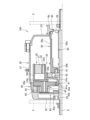
- FIG. 2 is a cross-sectional view of the unit.
- FIG. 3 is a collinear diagram of the reduction mechanism.
- FIG. 4 is a cross-sectional view of a unit according to a first comparative example.
- FIG. 5 is a cross-sectional view of a unit according to a second comparative example.
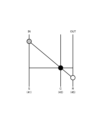
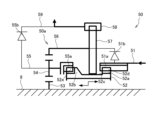
- FIG. 6A is a skeleton diagram of the transmission mechanism in the unit, showing the state in which it is switched to the first speed.
- FIG. 6B is a collinear diagram of the transmission mechanism in the unit, showing the state in which the transmission mechanism is switched to the first speed.
- FIG. 6A is a skeleton diagram of the transmission mechanism in the unit, showing the state in which it is switched to the first speed.
- FIG. 6B is a collinear diagram of the transmission mechanism in the unit, showing the state in which the transmission mechanism is
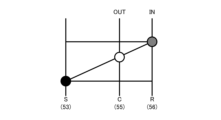
- FIG. 7 is a skeleton diagram of the transmission mechanism in the unit, showing the state in which the transmission is switched to the second speed.
- FIG. 8A is a skeleton diagram of the transmission mechanism in the unit, showing the state in which it is switched to the third speed.
- FIG. 8B is a collinear diagram of the transmission mechanism in the unit, showing a state in which the transmission mechanism is switched to the third speed.
- FIG. 9 is a conceptual diagram for explaining the cam.
- the “unit” is also called a motor unit (a unit having at least a motor), a power transmission device (a device having at least a power transmission mechanism (e.g., a gear mechanism and/or a differential gear mechanism, etc.)), etc.
- a device (unit) having a motor and a power transmission mechanism belongs to the concepts of both a motor unit and a power transmission device.
- a "motor” is a rotating electric machine that has a motor function and/or a generator function.
- Element B (part, part, etc.) connected to element A (part, section, etc.)", “element B (part, part, etc.) connected downstream of element A (part, part, etc.)", and “element B (part, part, etc.) connected upstream of element A (part, part, etc.)” mean that element A and element B are connected so that power can be transmitted, with the power input side being upstream and the power output side being downstream.
- Element A and element B may also be connected via other parts, parts, etc. (for example, other clutches, other gear mechanisms, etc.).
- “Overlapping when viewed in a specified direction” means that multiple elements are lined up in a specified direction (e.g., axial direction, radial direction, gravity direction, vehicle travel direction (vehicle forward direction, vehicle reverse direction), etc.), and is synonymous with "overlapping in a specified direction.”
- a specified direction e.g., axial direction, radial direction, gravity direction, vehicle travel direction (vehicle forward direction, vehicle reverse direction), etc.
- Not overlapping when viewed in a specified direction and “offset when viewed in a specified direction” mean that multiple elements are not lined up in a specified direction (e.g., axial direction, radial direction, gravity direction, vehicle travel direction (vehicle forward direction, vehicle reverse direction), etc.), and are synonymous with "not overlapping in a specified direction” and "offset in a specified direction.”
- a drawing shows that multiple elements (parts, parts, etc.) are not lined up in a specified direction, the description in the specification may be deemed to include a sentence explaining that they are not overlapping when viewed in a specified direction.
- element A When viewed in a specified direction, element A (part, section, etc.) is located between element B (part, section, etc.) and element C (part, section, etc.)" means that when observed from a specified direction (e.g., axial direction, radial direction, gravity direction, etc.), element A can be observed to be between element B and element C. For example, if elements B, A, and C are lined up in that order along the axial direction, element A can be said to be located between elements B and C when viewed in the radial direction. If a drawing shows that element A is between elements B and C when viewed in a specified direction, it may be assumed that the description in the specification contains a sentence explaining that element A is between elements B and C when viewed in the specified direction.
- a specified direction e.g., axial direction, radial direction, gravity direction, etc.
- Axial direction means the axial direction of the rotating shaft of the parts that make up the unit.
- Parts include, for example, a motor, a reduction mechanism, a speed change mechanism, etc.
- FIG. 1 is a schematic diagram illustrating an overview of a bicycle 1 to which an electric assist unit 100 is applied.
- the bicycle 1 includes a frame 2, a front wheel 3a, a rear wheel 3b as a driving wheel, a handlebar 4, a saddle 5, a driving sprocket 6a, a driven sprocket 6b, a chain 6c, a pair of pedals 7, a pair of crank arms 7b as a crank portion, a crankshaft 7c, a support shaft 8 as a fixed shaft, a controller 9a, a power storage unit 9b, and an electric assist unit 100.
- the bicycle 1 is ridden by a rider who sits astride the saddle 5 and pedals the crank arm 7b via the pedals 7.
- the bicycle 1 drives the rear wheel 3b with the pedal force (driving torque) transmitted from the crank arm 7b to the crankshaft 7c and the driving force (assist torque) of the electric assist unit 100, whose magnitude corresponds to the pedal force.
- the frame 2 is a so-called diamond frame that is roughly parallelogram-shaped when viewed from the side.
- a front wheel 3a and a rear wheel 3b are rotatably attached to the frame 2.
- the frame 2 has a front fork 2a that supports the front wheel 3a.
- the front wheel 3a is steered left and right by rotating the front fork 2a through the driver's operation of the handlebars 4.
- the rear wheel 3b rotates around the support shaft 8.
- a driven sprocket 6b and an electric assist unit 100 are attached to the rear wheel 3b.
- the driving torque is transmitted to the driven sprocket 6b via a chain 6c that is looped between the driven sprocket 6b and the driving sprocket 6a, to which the driving force is input from the crank arm 7b.
- the electric assist unit 100 generates an assist torque that assists the pedaling force applied by the driver.
- the electric assist unit 100 will be described in detail later with reference to Figures 2 to 5.
- the pedal 7 is used by the driver to input driving torque.
- the pedal 7 is connected to the crankshaft 7c via the crank arm 7b.
- the support shaft 8 is attached to the frame 2.
- the support shaft 8 is arranged so as not to rotate relative to the frame 2.
- the controller 9a is composed of a microcomputer equipped with a CPU, RAM, ROM, an input/output interface, etc.
- the controller 9a can also be composed of multiple microcomputers.
- the controller 9a performs various processes by having the CPU read and execute programs stored in the ROM. Specifically, the controller 9a calculates the assist torque based on an electrical signal corresponding to the magnitude of the pedaling force input from a torque sensor (not shown) described below, and outputs a command signal so that the motor 30 generates the assist torque.
- the power storage unit 9b is a rechargeable secondary battery such as a nickel-metal hydride battery or a lithium-ion battery.
- the power storage unit 9b is provided so as to be removable from the frame 2.
- FIG. 2 is a cross-sectional view of the electric assist unit 100.
- FIG. 3 is a nomographic diagram of the reduction mechanism 40.
- FIG. 4 is a cross-sectional view of the electric assist unit 100 according to a first comparative example.
- FIG. 5 is a cross-sectional view of the electric assist unit 100 according to a second comparative example. In FIGS. 2, 4, and 5, only the portion above the central axis of the electric assist unit 100, which is a rotating body that rotates around the central axis (support shaft 8), is shown.
- the electric assist unit 100 includes a support shaft 8, a case 20 as a hub, a motor 30, a torque sensor (not shown), a reduction mechanism 40, a speed change mechanism 50, a bearing 61 as a first bearing, and a bearing 62 as a second bearing.
- the electric assist unit 100 can be switched between three speeds, a first speed (lowest speed), a second speed, and a third speed (highest speed), by the speed change mechanism 50.
- the case 20 supports the rear wheel 3b so that it can rotate freely relative to the support shaft 8.
- the case 20 transmits at least one of the pedal force and the driving force to the rear wheel 3b.
- the case 20 rotates together with the rear wheel 3b around the support shaft 8.
- the case 20 has an outer peripheral portion 21 and a pair of side walls 22, 23.
- the case 20 is divided into two parts in the axial direction: a portion where the side wall portion 22 is provided and a portion where the side wall portion 23 is provided, and these are fixed together by bolting.
- the outer peripheral portion 21 is formed in a substantially cylindrical shape.
- the outer peripheral portion 21 covers at least a portion of the outer periphery of the motor 30, the reduction mechanism 40, and the speed change mechanism 50.
- the outer peripheral portion 21 has a portion that is located on the outer periphery of the motor 30.
- the rear wheel 3b is attached to the outer peripheral portion 21 via spokes (not shown).
- the side wall portion 22 is provided at one axial end of the outer circumferential portion 21.
- the side wall portion 22 is provided in the shape of an annular plate, and closes one open end of the outer circumferential portion 21.
- the side wall portion 22 is rotatably supported on the support shaft 8 via a bearing 63. In other words, the side wall portion 22 is rotatably supported with respect to the support shaft 8.
- the side wall portion 23 is provided at the other axial end of the outer circumferential portion 21.
- the side wall portion 23 is provided in the shape of an annular plate, and closes the other open end of the outer circumferential portion 21.
- the side wall portion 23 is connected downstream of a power transmission member 59 (described later) of the speed change mechanism 50.
- the side wall portion 23 rotates around the support shaft 8 together with the power transmission member 59.
- the motor 30 assists the driving force according to the pedal force applied by the driver.
- the motor 30 is driven by commands from the controller 9a (see Figure 1).
- the motor 30 generates an assist torque using electricity supplied from the power storage unit 9b (see Figure 1).
- the motor 30 is connected to the case 20 via a reduction gear mechanism 40.
- the motor 30 has a stator 31, a rotor 32, a support member 33, and wiring 34.
- the stator 31 is supported by the carrier 43 of the reduction gear mechanism 40 so that it cannot rotate relative to the support shaft 8.
- the rotor 32 is provided on the inner periphery of the stator 31 and rotates relative to the stator 31.
- a sun gear 41 (described later) of the reduction mechanism 40 is attached to the rotor 32 via a support member 33. The rotor 32 rotates together with the sun gear 41.
- the support member 33 has a support portion 33a and a power transmission portion 33b.
- the support portion 33a is formed in a generally cylindrical shape and extends in the axial direction.
- the support portion 33a is rotatably supported on the outer periphery of the power transmission member 59 of the speed change mechanism 50 via a pair of bearings 62.
- the power transmission part 33b is formed in an annular plate shape extending in the radial direction.
- the power transmission part 33b is provided integrally with the support part 33a at one axial end of the support part 33a.
- the outer peripheral surface of the power transmission part 33b is fixed to the rotor 32 of the motor 30.
- the one axial end face of the power transmission part 33b is fixed to the sun gear 41 of the reduction mechanism 40.
- the wiring 34 electrically connects the controller 9a and the stator 31, enabling the controller 9a to control the motor 30.
- the wiring 34 connects the power storage unit 9b and the stator 31, allowing power to be supplied from the power storage unit 9b to the stator 31.
- the wiring 34 is configured to pass through a carrier 43 (described later) of the reduction gear mechanism 40.
- the motor 30 has a portion located on the outer periphery of the support shaft 8.
- the motor 30 is disposed radially sandwiched between the power transmission member 59 (described later) of the speed change mechanism 50 and the case 20.
- This configuration is advantageous in that the electric assist unit 100 would expand in the axial direction if a partition wall were provided between the motor 30 and the planetary gear mechanism 50a (described later) of the speed change mechanism 50 in the axial direction.
- the torque sensor detects the driving torque that is generated when the driver pedals the crank arm 7b via the pedal 7 and transmitted to the crankshaft 7c.
- the torque sensor is, for example, a non-contact torque sensor that detects torque based on the torsion of the crankshaft 7c measured magnetically.
- the reduction mechanism 40 has a planetary reduction mechanism 40a and a one-way clutch 45. That is, the reduction mechanism 40 is configured to include the planetary reduction mechanism 40a.
- the planetary reduction mechanism 40a has a sun gear 41, a planetary gear 42, a carrier 43, and a ring gear 44.
- the reduction mechanism 40 has a fixed carrier 43 of the planetary reduction mechanism 40a, which reduces the assist force input from the motor 30 via the sun gear 41 and outputs it from the ring gear 44.
- the sun gear 41 is attached to the rotor 32 of the motor 30 via a support member 33.
- the sun gear 41 has a gear portion 41a and a power transmission portion 41b.
- the gear portion 41a is formed in a generally cylindrical shape extending in the axial direction.
- the gear portions 41a face each other at a distance so as to surround the outer periphery of the support shaft 8.
- the outer periphery of the gear portion 41a is formed with a tooth surface that meshes with the planetary gear 42.
- the power transmission part 41b is formed in an annular plate shape extending in the radial direction. One end of the power transmission part 41b is fixed to one axial end of the gear part 41a. The other end of the power transmission part 41b is fixed to the support member 33 of the motor 30.
- the planetary gear 42 is supported by the carrier 43.
- the planetary gear 42 rotates about a central axis.
- the carrier 43 is fixed so that it cannot rotate, as described below, the planetary gear 42 does not revolve around the outer periphery of the sun gear 41.
- the planetary gear 42 has a large diameter portion 42a that meshes with the sun gear 41 and a small diameter portion 42b that meshes with the ring gear 44.
- the large diameter portion 42a is formed in a generally cylindrical shape.
- a tooth surface that meshes with the sun gear 41 is formed on the outer periphery of the large diameter portion 42a.
- the small diameter portion 42b is arranged coaxially with the large diameter portion 42a.
- the small diameter portion 42b is formed in a generally cylindrical shape with a smaller diameter than the large diameter portion 42a.
- a tooth surface that meshes with the ring gear 44 is formed on the outer periphery of the small diameter portion 42b. In other words, multiple tooth surfaces are arranged coaxially with each other to form the planetary gear 42.
- the carrier 43 has a fixed portion 43a, a connecting portion 43b, an extension portion 43c, and a support portion 43d.
- the fixed portion 43a is formed in an annular plate shape extending in the radial direction.
- the fixed portion 43a is fixed to the outer periphery of the support shaft 8.
- the carrier 43 is fixed to the support shaft 8 so that it cannot rotate.
- the fixed portion 43a is provided so as to be adjacent to the small diameter portion 42b of the planetary gear 42 in the axial direction.
- the fixed portion 43a supports the planetary gear 42 so that it can rotate on its axis.
- the connecting portion 43b extends in the axial direction from multiple circumferential points on the fixed portion 43a.
- the connecting portion 43b is disposed between multiple planetary gears 42 in the circumferential direction, i.e., at a position where no planetary gear 42 is provided.
- the connecting portion 43b connects the fixed portion 43a and the extending portion 43c.
- the wiring 34 is configured to pass through the connecting portion 43b. Alternatively, the wiring 34 may be fixed so as to follow the outer surface of the connecting portion 43b.
- the extension portion 43c is formed in an annular plate shape extending in the radial direction.
- the extension portion 43c is formed with a larger diameter than the fixed portion 43a.
- the extension portion 43c is provided so as to be adjacent to the large diameter portion 42a of the planetary gear 42 in the axial direction.
- the extension portion 43c supports the planetary gear 42 so that it can rotate on its axis. In other words, the extension portion 43c supports the planetary gear 42 rotatably between itself and the fixed portion 43a.
- the support portion 43d is formed in a generally cylindrical shape so as to extend in the axial direction from the radial end of the extension portion 43c.
- the stator 31 of the motor 30 is attached to the inner circumference of the support portion 43d. In other words, the stator 31 of the motor 30 is supported by the carrier 43. As a result, the stator 31 is arranged non-rotatably with respect to the support shaft 8 via the carrier 43.
- the carrier 43 can be given the function of fixing the stator 31, so that a separate member for fixing the stator 31 can be omitted, which contributes to the miniaturization of the electric assist unit 100.
- the ring gear 44 is provided on the outer periphery of the small diameter portion 42b of the planetary gear 42.
- the outer periphery of the ring gear 44 is attached to the one-way clutch 45.
- the inner periphery of the ring gear 44 is formed with a tooth surface that meshes with the tooth surface of the small diameter portion 42b.
- the one-way clutch 45 is provided between the outer periphery of the ring gear 44 and the inner surface of the side wall portion 22 of the case 20.
- the one-way clutch 45 switches between a state in which the assist force of the motor 30 is transmitted to the case 20 via the reduction mechanism 40, and a state in which the rotation of the case 20 is not transmitted to the motor 30.
- the reduction mechanism 40 has a portion located on the outer periphery of the support shaft 8.
- the reduction mechanism 40 has a portion that overlaps with the transmission mechanism 50 when viewed in the axial direction.
- the speed change mechanism 50 has a planetary gear mechanism 50a as a gear section and a power transmission member 59 as an output wall.
- the planetary gear mechanism 50a will be described in detail later with reference to Figures 6A to 9.
- the power transmission member 59 is connected downstream of the planetary gear mechanism 50a.
- the power transmission member 59 functions as a partition wall separating the speed change mechanism 50 chamber and the motor 30 chamber within the case 20.
- the bearing 61 is disposed between the power transmission member 59 and the support shaft 8.
- the bearing 62 is disposed between the power transmission member 59 and the motor 30.
- the motor 30 is supported on the support shaft 8 via the bearing 61, the power transmission member 59, and the bearing 62.
- the electric assist unit 100 would expand in the axial direction or in the radial direction. Specifically, if a bearing 62 is provided in line with the bearing 61 in the axial direction as in the first comparative example shown in FIG. 4, the electric assist unit 100 would expand in the axial direction by the size of the bearing 62. Also, if the bearing 62 is provided to support the sun gear 41 on the support shaft 8 as in the second comparative example shown in FIG. 5, the planetary reduction mechanism 40a needs to be moved radially toward the outer periphery by the size of the bearing 62, so the electric assist unit 100 would expand in the radial direction.
- this embodiment of the present invention can be said to be a preferred support embodiment.
- the electric assist unit 100 will become larger by the size of the partition wall.
- the power transmission member 59 functions as a partition wall, which contributes to miniaturization.
- the speed change mechanism 50 has a portion located on the outer periphery of the support shaft 8.
- the speed change mechanism 50 has a portion that overlaps with the motor 30 when viewed from the radial direction.
- the electric assist unit 100 which has the support shaft 8 at its center and outputs power from the outermost case 20, can be made smaller in the axial direction.
- the planetary gear mechanism 50a has a portion that overlaps with the motor 30 when viewed radially. This allows for miniaturization when at least the power transmission member 59, which is part of the speed change mechanism 50, overlaps radially with the motor 30, but further miniaturization in the axial direction is possible when the planetary gear mechanism 50a overlaps radially with the motor 30.
- FIG. 6A is a skeleton diagram of the speed change mechanism 50 in the electric assist unit 100, showing the state when switched to the first speed.
- FIG. 6B is a nomographic diagram of the speed change mechanism 50 in the electric assist unit 100, showing the state when switched to the first speed.
- FIG. 7 is a skeleton diagram of the speed change mechanism 50 in the electric assist unit 100, showing the state when switched to the second speed.
- FIG. 8A is a skeleton diagram of the speed change mechanism 50 in the electric assist unit 100, showing the state when switched to the third speed.
- FIG. 8B is a nomographic diagram of the speed change mechanism 50 in the electric assist unit 100, showing the state when switched to the third speed.
- FIG. 9 is a conceptual diagram for explaining the cam 57.
- the speed change mechanism 50 has a planetary gear mechanism 50a, a power input member 51, a speed change shaft 52, a cam 57, an engagement member 58, and a power transmission member 59.
- the speed change mechanism 50 is connected to the case 20 without passing through the reduction mechanism 40.
- the planetary gear mechanism 50a has a sun gear 53, a planetary gear 54, a carrier 55, and a ring gear 56.
- the power input member 51 inputs a power different from the power of the motor 30 (e.g., human power, etc.).
- the driving torque generated when the rider pedals the crank arm 7b via the pedal 7 is transmitted and input from the power input member 51 via the driving sprocket 6a, the chain 6c, and the driven sprocket 6b.
- the power input member 51 is connected to the ring gear 56 via a one-way clutch 51b.
- the power input member 51 has a meshing portion 51a.
- the meshing portion 51a is provided on the inner circumference of the power input member 51.
- the meshing portion 51a is formed long in the axial direction.
- the meshing portion 51a meshes with the speed change shaft 52 to transmit power.
- the one-way clutch 51b switches between a state in which the driving torque input to the power input member 51 is transmitted to the ring gear 56 and a state in which the rotation of the ring gear 56 is not transmitted to the power input member 51.
- the shift shaft 52 can move axially around the outer circumference of the support shaft 8, and switches between three gear stages: first, second, and third, depending on the axial position.
- the axial position of the shift shaft 52 can be changed based on the rider's operation. This allows the rider to change gear stages by operating a lever or the like at hand, for example, in the same way as with shifting on a normal bicycle.
- the shift shaft 52 has a first large diameter portion 52a, a second large diameter portion 52b, and a small diameter portion 52c.
- the first large diameter portion 52a is provided on the outer periphery of the speed change shaft 52.
- the first large diameter portion 52a has a first meshing portion 52d that meshes with the meshing portion 51a of the power input member 51.
- the first meshing portion 52d is provided on the outer periphery of the first large diameter portion 52a.
- the first meshing portion 52d is formed shorter in the axial direction than the meshing portion 51a of the power input member 51.
- the first meshing portion 52d meshes with the meshing portion 51a of the power input member 51 in all gear stages. In other words, power is transmitted from the power input member 51 to the transmission shaft 52 in all gear stages.
- the second large diameter portion 52b is provided on the outer periphery of the speed change shaft 52.
- the second large diameter portion 52b is provided axially spaced apart from the first large diameter portion 52a.
- the second large diameter portion 52b has a second meshing portion 52e that can mesh with a meshing portion 55a of the carrier 55, which will be described later.
- the second meshing portion 52e is provided on the outer periphery of the second large diameter portion 52b.
- the second meshing portion 52e is formed with the same outer diameter as the first meshing portion 52d.
- the small diameter portion 52c is provided between the first large diameter portion 52a and the second large diameter portion 52b in the axial direction.
- the small diameter portion 52c is formed to have a smaller diameter than the first large diameter portion 52a and the second large diameter portion 52b.
- the planetary gear mechanism 50a is rotatably supported on the support shaft 8 via a bearing 64 (see FIG. 2).
- the planetary gear mechanism 50a rotatably supports the power transmission member 59 via a bearing 65 (see FIG. 2).
- the sun gear 53 is fixed to the outer periphery of the support shaft 8. In other words, the sun gear 53 does not rotate.
- Planetary gears 54 are provided in multiple numbers and are supported by carrier 55. Planetary gears 54 are provided on the outer periphery of sun gear 53 and mesh with sun gear 53. Planetary gears 54 are provided on the inner periphery of ring gear 56 and mesh with ring gear 56. Planetary gears 54 rotate about the central axis and revolve around the outer periphery of sun gear 53.
- the carrier 55 rotates around the support shaft 8 as the planetary gear 54 revolves.
- the carrier 55 has a meshing portion 55a.
- the carrier 55 is connected to a power transmission member 59 via a one-way clutch 55b.
- the meshing portion 55a meshes with the second meshing portion 52e when the speed-change shaft 52 moves axially and the speed-change stage is switched to the third stage (the state shown in FIG. 8A).
- the one-way clutch 55b switches between a state in which the power output from the carrier 55 is transmitted to the power transmission member 59 and a state in which the rotation of the power transmission member 59 is not transmitted to the carrier 55.
- the ring gear 56 is provided on the outer periphery of the planetary gear 54 and meshes with the planetary gear 54.
- the ring gear 56 is connected to the power input member 51 via a one-way clutch 51b.
- the rotation shaft of the cam 57 is inserted into the ring gear 56.
- multiple cams 57 are provided on the outer periphery of the speed change shaft 52.
- the cams 57 revolve around the outer periphery of the speed change shaft 52 as the ring gear 56 rotates.
- the angle of the cam 57 changes depending on whether the second large diameter portion 52b is located on the inner periphery or the small diameter portion 52c is located on the inner periphery.
- the engagement member 58 is connected to a power transmission member 59.
- power is transmitted from the power input member 51 via the cam 57.
- the speed change shaft 52 is located in a first axial position.
- variable speed shaft 52 meshes with the meshing portion 51a of the power input member 51, but does not mesh with the meshing portion 55a of the carrier 55.
- the second large diameter portion 52b of the variable speed shaft 52 abuts against the cam 57.
- the power input from the power input member 51 is transmitted to the ring gear 56 via the one-way clutch 51b.
- the power transmitted to the ring gear 56 is then transmitted to the planetary gear 54 and output as the rotation of the carrier 55.
- the rotation of the carrier 55 is transmitted to the power transmission member 59 via the one-way clutch 55b.
- the transmission mechanism 50 reduces the speed of the power input from the power input member 51 via the ring gear 56 and outputs it from the carrier 55.
- variable speed shaft 52 meshes with the meshing portion 51a of the power input member 51, but does not mesh with the meshing portion 55a of the carrier 55.
- the small diameter portion 52c of the variable speed shaft 52 abuts against the cam 57. Therefore, the cam 57 engages with the engagement member 58.
- the power input from the power input member 51 is transmitted to the cam 57 via the one-way clutch 51b.
- the power transmitted to the cam 57 is transmitted to the power transmission member 59 via the engagement member 58.
- the transmission mechanism 50 is in a state where the power input member 51 and the ring gear 56 are directly connected, and the power input from the power input member 51 is output from the ring gear 56 at a constant speed.
- the speed change shaft 52 is located in the third axial position.
- variable speed shaft 52 meshes with the meshing portion 51a of the power input member 51, and also meshes with the meshing portion 55a of the carrier 55.
- the small diameter portion 52c of the variable speed shaft 52 abuts against the cam 57. Therefore, the cam 57 engages with the engagement member 58.
- the power input from the power input member 51 is transmitted to the carrier 55 via the speed change shaft 52.
- the power transmitted to the carrier 55 is transmitted to the power transmission member 59 via the ring gear 56, the cam 57, and the engagement member 58.
- the transmission mechanism 50 accelerates the power input from the power input member 51 via the carrier 55 and outputs it from the ring gear 56.
- the transmission mechanism 50 can be switched between three gear stages: first, second, and third.
- the configuration of the transmission mechanism 50 is merely an example, and other transmission mechanisms may be provided.
- a transmission mechanism that can switch between two or four or more gear stages instead of three gear stages may be provided.
- the electric assist unit 100 includes a support shaft 8, a reduction mechanism 40 having a portion located on the outer periphery of the support shaft 8, a speed change mechanism 50 having a portion located on the outer periphery of the support shaft 8, a motor 30 having a portion located on the outer periphery of the support shaft 8, and a case 20 having a portion located on the outer periphery of the motor 30, the motor 30 being connected to the case 20 via the reduction mechanism 40, the speed change mechanism 50 being connected to the case 20 without the reduction mechanism 40, and the speed change mechanism 50 having a portion that overlaps with the motor 30 when viewed radially.
- the speed change mechanism 50 which is independent in terms of power transmission and does not directly transmit the power of the motor 30, overlaps radially with the motor 30, making it possible to reduce the axial size of the electric assist unit 100, which has a support shaft 8 at the center and outputs power from the outermost case 20.
- the reduction mechanism 40 When viewed in the axial direction, the reduction mechanism 40 has a portion that overlaps with the transmission mechanism 50.
- the speed change mechanism 50 has a planetary gear mechanism 50a and a power transmission member 59 connected downstream of the planetary gear mechanism 50a, and the motor 30 is positioned radially between the power transmission member 59 and the case 20.
- This configuration is advantageous in that providing a partition wall between the motor 30 and the planetary gear mechanism 50a of the transmission mechanism 50 in the axial direction would cause the electric assist unit 100 to expand in the axial direction.
- the electric assist unit 100 will become larger by the size of the partition wall.
- the power transmission member 59 functions as a partition wall, which contributes to miniaturization.
- the transmission mechanism 50 has a planetary gear mechanism 50a and a power transmission member 59 connected downstream of the planetary gear mechanism 50a, and the case 20 is connected downstream of the power transmission member 59.
- the planetary gear mechanism 50a has a portion that overlaps with the motor 30.
- the electric assist unit 100 further includes a bearing 61 and a bearing 62.
- the speed change mechanism 50 includes a planetary gear mechanism 50a and a power transmission member 59 connected downstream of the planetary gear mechanism 50a.
- the bearing 61 is disposed between the power transmission member 59 and the support shaft 8, and the bearing 62 is disposed between the power transmission member 59 and the motor 30.
- the motor 30 is supported on the support shaft 8 via the bearing 61, the power transmission member 59, and the bearing 62. If the motor 30 were to be directly supported on the support shaft 8 only by the bearing 61 on the transmission mechanism 50 side, the electric assist unit 100 would expand in the axial direction or the radial direction. Furthermore, if the motor 30 were to be directly supported on the support shaft 8 only by the bearing 61, the support stability of the motor 30 would be reduced compared to one aspect of the present invention. Therefore, one aspect of the present invention can be said to be a preferred support aspect.
- the reduction mechanism 40 includes a planetary reduction mechanism 40a, the carrier 43 of which is fixed to the support shaft 8, and the stator 31 of the motor 30 is supported by the carrier 43.
- the planetary reduction mechanism 40a is fixed to the carrier 43, and the carrier 43 can be given the function of fixing the stator 31, so that a separate member for fixing the stator 31 can be omitted, which contributes to the miniaturization of the electric assist unit 100.
- the wiring 34 connected to the stator 31 is configured to pass through the carrier 43.
- the wiring 34 can be taken out by providing a hollow shaft in the carrier 43 or by forming a through hole in part of the carrier 43.
- the planetary reduction mechanism 40a is fixed to the carrier 43, and the carrier 43 does not rotate, so wiring can be arranged so that the wiring 34 does not get caught in the rotation.
- the electric assist unit 100 is attached to the rear wheel 3b side together with the driven sprocket 6b.
- the electric assist unit 100 may also be attached to the crankshaft 7c side together with the driving sprocket 6a.
- the rider may pedal the crank arm 7b via the pedal 7, and the pedaling force (driving torque) transmitted from the crank arm 7b to the crankshaft 7c may be input to the sun gear 53.
- the output of the electric assist unit 100 may also be transmitted to the driving sprocket 6a via the case 20, and then to the driven sprocket 6b via the chain 6c looped between the driving sprocket 6a, causing the rear wheel 3b to rotate.
- the rotor 32 is a so-called inner rotor that is provided on the inner circumference of the stator 31.
- the stator may be provided on the inner circumference side, and the rotor may rotate on the outer circumference of the stator, forming a so-called outer rotor.
- Electric assist unit (unit) 8 Support shaft (fixed shaft) 20 Case (hub) 30 Motor 31 Stator 32 Rotor 34 Wiring 40 Speed reduction mechanism 40a Planetary speed reduction mechanism 43 Carrier 50 Speed change mechanism 50a Planetary gear mechanism (gear section) 59 Power transmission member (output wall) 61 Bearing (first bearing) 62 Bearing (second bearing)
Landscapes
- Engineering & Computer Science (AREA)
- Chemical & Material Sciences (AREA)
- Combustion & Propulsion (AREA)
- Transportation (AREA)
- Mechanical Engineering (AREA)
- Retarders (AREA)
Priority Applications (2)
| Application Number | Priority Date | Filing Date | Title |
|---|---|---|---|
| JP2025560863A JPWO2025115388A1 (https=) | 2023-11-29 | 2024-10-01 | |
| CN202480039371.2A CN121358654A (zh) | 2023-11-29 | 2024-10-01 | 组件 |
Applications Claiming Priority (2)
| Application Number | Priority Date | Filing Date | Title |
|---|---|---|---|
| JP2023-201653 | 2023-11-29 | ||
| JP2023201653 | 2023-11-29 |
Publications (1)
| Publication Number | Publication Date |
|---|---|
| WO2025115388A1 true WO2025115388A1 (ja) | 2025-06-05 |
Family
ID=95897396
Family Applications (1)
| Application Number | Title | Priority Date | Filing Date |
|---|---|---|---|
| PCT/JP2024/035125 Pending WO2025115388A1 (ja) | 2023-11-29 | 2024-10-01 | ユニット |
Country Status (3)
| Country | Link |
|---|---|
| JP (1) | JPWO2025115388A1 (https=) |
| CN (1) | CN121358654A (https=) |
| WO (1) | WO2025115388A1 (https=) |
Citations (6)
| Publication number | Priority date | Publication date | Assignee | Title |
|---|---|---|---|---|
| JP2002220078A (ja) * | 2001-01-24 | 2002-08-06 | Sanyo Electric Co Ltd | 補助動力付き車両 |
| JP2002362467A (ja) * | 1998-05-29 | 2002-12-18 | Sanyo Electric Co Ltd | 電動車 |
| JP2005335535A (ja) | 2004-05-27 | 2005-12-08 | Sanyo Electric Co Ltd | 電動車輪用ハブユニット及び該ハブユニットを具えた乗物 |
| JP2011189877A (ja) * | 2010-03-16 | 2011-09-29 | Ntn Corp | 回生機構を備えた電動補助自転車 |
| JP2012121337A (ja) | 2010-12-06 | 2012-06-28 | Panasonic Corp | 電動用ハブ装置および電動自転車 |
| WO2018001021A1 (zh) | 2016-07-01 | 2018-01-04 | 武汉千斤智能科技有限公司 | 自行车用中置电机及电动助力自行车 |
-
2024
- 2024-10-01 CN CN202480039371.2A patent/CN121358654A/zh active Pending
- 2024-10-01 WO PCT/JP2024/035125 patent/WO2025115388A1/ja active Pending
- 2024-10-01 JP JP2025560863A patent/JPWO2025115388A1/ja active Pending
Patent Citations (6)
| Publication number | Priority date | Publication date | Assignee | Title |
|---|---|---|---|---|
| JP2002362467A (ja) * | 1998-05-29 | 2002-12-18 | Sanyo Electric Co Ltd | 電動車 |
| JP2002220078A (ja) * | 2001-01-24 | 2002-08-06 | Sanyo Electric Co Ltd | 補助動力付き車両 |
| JP2005335535A (ja) | 2004-05-27 | 2005-12-08 | Sanyo Electric Co Ltd | 電動車輪用ハブユニット及び該ハブユニットを具えた乗物 |
| JP2011189877A (ja) * | 2010-03-16 | 2011-09-29 | Ntn Corp | 回生機構を備えた電動補助自転車 |
| JP2012121337A (ja) | 2010-12-06 | 2012-06-28 | Panasonic Corp | 電動用ハブ装置および電動自転車 |
| WO2018001021A1 (zh) | 2016-07-01 | 2018-01-04 | 武汉千斤智能科技有限公司 | 自行车用中置电机及电动助力自行车 |
Also Published As
| Publication number | Publication date |
|---|---|
| JPWO2025115388A1 (https=) | 2025-06-05 |
| CN121358654A (zh) | 2026-01-16 |
Similar Documents
| Publication | Publication Date | Title |
|---|---|---|
| JP5561586B2 (ja) | 電動補助自転車 | |
| JP5523636B1 (ja) | 電動アシスト自転車 | |
| TWI506944B (zh) | 馬達單元、馬達驅動裝置及踏板驅動裝置 | |
| JP7730422B2 (ja) | 自転車の電動アシストユニット及び電動アシスト自転車 | |
| JP7692159B2 (ja) | 駆動ユニットおよび電動アシスト自転車 | |
| JP6485653B2 (ja) | 電動アシスト自転車 | |
| TW201836910A (zh) | 電動輔助車輛用動力單元 | |
| CN110770114A (zh) | 具有功率分流的电动自行车 | |
| CN107406118A (zh) | 电动自行车及电动自行车用轮毂装置 | |
| WO2016143303A1 (ja) | 電動自転車 | |
| JP2017019445A (ja) | 駆動ユニットおよび電動アシスト自転車 | |
| JP6705740B2 (ja) | 自転車用変速機および自転車用内装変速ハブ | |
| US20250178693A1 (en) | Power-split hybrid driveline for an electric bicycle | |
| JP6756640B2 (ja) | 自転車用変速機およびこれを備える自転車用アシストシステム | |
| WO2025115388A1 (ja) | ユニット | |
| JP2016153286A (ja) | 電動補助人力車両用ハブユニット | |
| EP2373538A1 (en) | Transmission unit for a bicycle | |
| JP7494055B2 (ja) | 人力駆動車用の内装変速機および人力駆動車用の変速システム | |
| JP2013139242A (ja) | 電動補助人力車両用ハブユニットおよび電動補助人力車両 | |
| JP7842875B2 (ja) | 自転車の電動アシストユニット及び電動アシスト自転車 | |
| TW201836911A (zh) | 電動車輛用動力單元 | |
| WO2025173321A1 (ja) | クラッチ機構及びユニット | |
| JPH08244673A (ja) | 補助動力アシスト式自転車 | |
| JP2024094155A (ja) | 人力駆動車用のドライブユニット | |
| WO2013105434A1 (ja) | ペダル踏み込み型駆動力伝達機構を備えた自転車 |
Legal Events
| Date | Code | Title | Description |
|---|---|---|---|
| 121 | Ep: the epo has been informed by wipo that ep was designated in this application |
Ref document number: 24897078 Country of ref document: EP Kind code of ref document: A1 |
|
| ENP | Entry into the national phase |
Ref document number: 2025560863 Country of ref document: JP Kind code of ref document: A |
|
| WWE | Wipo information: entry into national phase |
Ref document number: 2024897078 Country of ref document: EP |