WO2025115192A1 - ビールテイストノンアルコール飲料 - Google Patents
ビールテイストノンアルコール飲料 Download PDFInfo
- Publication number
- WO2025115192A1 WO2025115192A1 PCT/JP2023/042977 JP2023042977W WO2025115192A1 WO 2025115192 A1 WO2025115192 A1 WO 2025115192A1 JP 2023042977 W JP2023042977 W JP 2023042977W WO 2025115192 A1 WO2025115192 A1 WO 2025115192A1
- Authority
- WO
- WIPO (PCT)
- Prior art keywords
- beer
- beverage
- less
- alcoholic
- flavored
- Prior art date
- Legal status (The legal status is an assumption and is not a legal conclusion. Google has not performed a legal analysis and makes no representation as to the accuracy of the status listed.)
- Pending
Links
Images
Classifications
-
- A—HUMAN NECESSITIES
- A23—FOODS OR FOODSTUFFS; TREATMENT THEREOF, NOT COVERED BY OTHER CLASSES
- A23L—FOODS, FOODSTUFFS OR NON-ALCOHOLIC BEVERAGES, NOT OTHERWISE PROVIDED FOR; PREPARATION OR TREATMENT THEREOF
- A23L2/00—Non-alcoholic beverages; Dry compositions or concentrates therefor; Preparation or treatment thereof
Definitions
- the present invention relates to a beer-flavored non-alcoholic beverage.
- Non-alcoholic beer-flavored beverages In addition to the growing health consciousness in recent years, the demand for non-alcoholic beer-flavored beverages is increasing year by year due to the diversification of drinking occasions and consumer preferences. In the field of non-alcoholic beer-flavored beverages, various technologies have been developed to allow non-alcoholic beverages to have the distinctive taste and aroma of beer (Patent Documents 1 and 2). However, in light of the increasing level of consumer preferences, it can be said that there is still a demand for flavor improvements in non-alcoholic beer-flavored beverages.
- beer-flavored non-alcoholic beverages have a problem in that they tend to have a sweeter flavor than regular beer due to the residual sugar that tends to remain during production.
- the objective of the present invention is to provide a novel beer-flavored non-alcoholic beverage that has a suppressed sweet taste and aroma and achieves a beer-like balance.
- the inventors have discovered that by incorporating a peptide with a molecular weight of 800 to 4600 Da in a non-alcoholic beer-flavored beverage so that the concentration of the peptide falls within a specified numerical range, the non-alcoholic beer-flavored beverage can achieve a beer-like balance while suppressing the overly sweet taste and aroma.
- the present invention is based on this finding.
- a beer-flavored non-alcoholic beverage made at least in part from malt, in which the concentration of peptides with molecular weights of 800 to 4,600 Da (HPLC analysis gel filtration method) in the beverage fractionated by HPLC analysis gel filtration method is 0.25 mg/mL or more and 3.00 mg/mL or less.
- a method for producing a beer-taste non-alcoholic beverage using malt as at least a part of a raw material comprising a step of incorporating peptides having a molecular weight of 800 to 4,600 Da (HPLC analytical gel filtration method) in the beverage fractionated by HPLC analytical gel filtration method so that the concentration of the peptides is 0.25 mg/mL or more and 3.00 mg/mL or less.
- a method for improving the flavor of a beer-taste non-alcoholic beverage that uses malt as at least a part of an ingredient comprising, in a production process for the beverage, a step of incorporating peptides having a molecular weight of 800 to 4,600 Da (gel filtration for HPLC analysis) in the beverage fractionated by gel filtration for HPLC analysis so that the concentration of the peptides in the beverage is 0.25 mg/mL or more and 3.00 mg/mL or less.
- peptides with molecular weights of 800 to 4600 Da in a beer-flavored non-alcoholic beverage so that the concentration of said peptides falls within a specified numerical range, it is possible to provide a beer-flavored non-alcoholic beverage that suppresses the cloying sweet taste and aroma and achieves a beer-like balance, which is advantageous in that it can meet the diverse tastes and needs of consumers.
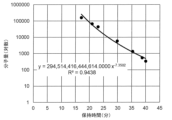
- FIG. 1 shows a calibration curve prepared from retention times and molecular weights of known substances in a gel filtration method for HPLC analysis carried out in Example 1 of the Examples.
- non-alcoholic beer-flavored beverage refers to a beverage that has a beer-like flavor, and is used to include both beverages that contain no alcohol at all, i.e., beverages with an ethanol concentration of 0.00 v/v%, and beverages with an ethanol concentration between 0.00 v/v% and less than 1 v/v%.
- Non-alcoholic beer-flavored beverages include fermented non-alcoholic beer-flavored beverages and non-fermented non-alcoholic beer-flavored beverages.
- Fermented non-alcoholic beer-flavored beverages refer to beer-flavored non-alcoholic beverages that have undergone a fermentation process using yeast, and include beverages produced by removing the alcoholic components generated during the fermentation process after the fermentation process (sometimes referred to as "de-alcoholized beverages” in this specification), and beverages produced by stopping the fermentation process at a stage where the ethanol concentration is less than 1 v/v%.
- the upper limit of the alcohol (ethanol) concentration is 0.99% (v/v), 0.98% (v/v), 0.97% (v/v), 0.96% (v/v), 0.95% (v/v), 0.94% (v/v), 0.93% (v/v), 0.92% (v/v), 0.91% (v/v), 0.90% (v/v), 0.89% (v/v), % (v/v), 0.88% (v/v), 0.87% (v/v), 0.86% (v/v), 0.85% (v/v), 0.84% (v/v), 0.83% (v/v), 0.82% (v/v), 0.81% (v/v), 0.80% (v/v), 0.79% (v/v), 0.78% (v/v), 0.77% (v/v), 0.76% (v/v), 0.75% (v/v), 0.74% (v/ v), 0.73% (v/v), 0.83% (v/v), 0.83% (v/v), 0.82% (v/
- the alcohol concentration (ethanol concentration) in a beverage can be measured by gas chromatography (GC) with an FID detector.
- GC gas chromatography
- FID detector FID detector
- a calibration curve created based on the measured values of several control samples with known concentrations. It is preferable that these control samples with known concentrations are in the same range as the concentration to be measured. It is also preferable to use an internal standard substance, and an example of an internal standard substance is 2-propanol.
- the beer-flavored non-alcoholic beverage of the present invention uses malt as at least a part of the raw material, and preferably uses at least one or both of barley malt and wheat malt as the barley-derived raw material.
- the proportion of barley malt (mass) in the raw material malt (mass) can be, for example, 40% or more, 50% or more, 60% or more, 70% or more, 80% or more, 90% or more, or 100%
- the proportion of wheat malt (mass) in the raw material malt (mass) can be, for example, 40% or more, 50% or more, 60% or more, 70% or more, 80% or more, 90% or more, or 100%.
- malt that has been made into an extract i.e., malt extract
- "or more" can be changed to "exceeding".
- the beer-flavored non-alcoholic beverage of the present invention can suppress sweet taste and aroma and achieve a beer-like balance regardless of the malt usage ratio, and the malt usage ratio in this case can be, for example, 10% or less, 10% or more, 15% or less, 15% or more, 20% or less, 20% or more, 25% or less, 25% or more, 30% or less, 30% or more, 40% or less, 40% or more, 50% or less, 50% or more, 55% or less, 55% or more, 60% or less, 60% or more, 65% or less, 65% or more, 70% or less, 70% or more, 75% or less, 75% or more, 80% or less, 80% or more, 85% or less, 85% or more, 90% or less, 90% or more, 95% or less, 95% or more, or 100%, and "less than” can be "less than” and "more than” can be "greater than”. These upper and lower limits can be combined arbitrarily.
- the "malt usage ratio” refers to the ratio of the mass of malt to the mass of all
- ungerminated wheat species such as ungerminated barley (including extracts) and ungerminated wheat (including extracts) can be used as raw materials.
- the non-alcoholic beer-flavored beverage of the present invention is characterized in that the concentration of peptides with a molecular weight of 800 to 4600 Da (gel filtration for HPLC analysis) in the beverage fractionated by gel filtration for HPLC analysis is within a predetermined numerical range.
- the peptides with a molecular weight of 800 to 4600 Da are derived from a beer-flavored beverage that uses malt as at least a part of the raw material, and are preferably derived from a fermented malt beverage (or fermented wort liquid).
- the lower limit (or more than or exceeding) of the concentration of peptides with molecular weights of 800 to 4600 Da (gel filtration method for HPLC analysis) in the beverage is 0.25 mg/mL, but the lower limit (or more than or exceeding) of the concentration of peptides with molecular weights of 800 to 4600 Da (gel filtration method for HPLC analysis) in the beverage is 0.26 mg/mL, 0.27 mg/mL, 0.28 mg/mL, 0.29 mg/mL, 0.30 mg/mL, 0.31 mg/mL, 0.32 mg/mL, 0.33 mg/mL, 0.34 mg/mL, 0.35 mg/mL, 0.36 mg/mL, 0.37 mg/mL, 0.38 mg/mL, 0.39 mg/mL, 0.40 mg/mL, 0.41 mg/mL, 0.42 mg/mL, 0.43 mg/mL, 0.44 mg/mL, 0.45 mg/mL, 0.46 mg/m
- the upper limit (or less than) is 3.00 mg/mL, but the following values are also acceptable: 2.99 mg/mL, 2.98 mg/mL, 2.97 mg/mL, 2.96 mg/mL, 2.95 mg/mL, 2.94 mg/mL, 2.93 mg/mL, 2.92 mg/mL, 2.91 mg/mL, 2.90 mg/mL, 2.89 mg/mL, 2.88 mg/mL, 2.87 mg/mL, 2.86 mg/mL, 2.85 mg/mL, 2.84 mg/mL, 2.83 mg/mL, 2.82 mg/mL, 2.81 mg/mL, 2.80 mg/mL, 2.79 mg/mL, 2.78 mg/mL, 2.77 mg/mL, 2.76mg/mL, 2.75mg/mL, 2.74
- the concentration of peptides having a molecular weight of 800 to 4,600 Da (gel filtration method for HPLC analysis) in the beer-taste non-alcoholic beverage of the present invention may be, for example, 0.25 mg/mL or more and 3.00 mg/mL or less, 0.30 mg/mL or more and 3.00 mg/mL or less, 0.35 mg/mL or more and 3.00 mg/mL or less, 0.40 mg/mL or more and 3.00 mg/mL or less, 0.45 mg/mL or more and 3.00 mg/mL or less, 0.50 mg/mL or more and 3.00 mg/mL or less, 0.60 mg/mL or more and 3.00 mg/mL or less, 0.70 mg/mL or more and 3.00 mg/mL or less, 0.80 mg/mL or more and 3.00 mg/mL or less, /mL or more and 3.00mg/mL or less, 0.90mg/mL or more and 3.00
- It can be 40 mg/mL or more and 2.40 mg/mL or less, 0.45 mg/mL or more and 2.40 mg/mL or less, 0.50 mg/mL or more and 2.40 mg/mL or less, 0.60 mg/mL or more and 2.40 mg/mL or less, 0.70 mg/mL or more and 2.40 mg/mL or less, 0.80 mg/mL or more and 2.40 mg/mL or less, 0.90 mg/mL or more and 2.40 mg/mL or less, 1.00 mg/mL or more and 2.40 mg/mL or less, 1.10 mg/mL or more and 2.40 mg/mL or less, 1.20 mg/mL or more and 2.40 mg/mL or less, 1.30 mg/mL or more and 2.40 mg/mL or less, or 1.40 mg/mL or more and 2.40 mg/mL or less.
- the beer-flavored non-alcoholic beverage of the present invention is characterized in that the ratio (percentage) of the mass of peptides in the beverage with a molecular weight of 800 to 4600 Da (gel filtration for HPLC analysis) to the mass of all peptides derived from the beverage fractionated by gel filtration for HPLC analysis is within a predetermined numerical range.
- This ratio can be calculated by dividing the concentration (mg/mL) of peptides in the beverage with a molecular weight of 800 to 4600 Da (gel filtration for HPLC analysis) by the concentration (mg/mL) of all peptides derived from the beverage fractionated by gel filtration for HPLC analysis.
- the lower limit of the peptide ratio (greater than or equal to) is 25.0%, but may be any of the following: 25.1%, 25.2%, 25.3%, 25.4%, 25.5%, 25.6%, 25.7%, 25.8%, 25.9%, 26.0%, 26.1%, 26.2%, 26.3%, 26.4%, 26.5%, 26.6%, 26.7%, 26.8%, 26.9%, 27.0, 27.1%, 27.2%, 27.3%, 27.4%, 27.5%, 27.6%, 27.7%, 27.8% ,27.9%,28.0%,28.1%,28.2%,28.3%,28.4%,28.5%,28.6%,28.7%,28.8%,28.9%,29.0%,29.1%,29.2%,29.3%,29.4%,29.5%,29.6%,29.7%,29.8%,29.9%,30.0%,30.1%,30.2%,30.3%,30.4%,30.5%,30.5%,
- the upper limit (less than or equal to) is 50.0%, but the following are also acceptable: 49.9%, 49.8%, 49.7%, 49.6%, 49.5%, 49.4%, 49.3%, 49.2%, 49.1%, 49.0%, 48.9%, 48.8%, 48.7%, 48.6%, 48.5%, 48.4%, 48.3%, 48.4%, 48.5%, 48.5%, 48.6%, 48.7 ...
- the peptide ratio in the beer-flavored non-alcoholic beverage of the present invention can be in the range of, for example, 25.0% or more and 50.0% or less, 30.0% or more and 50.0% or less, 31.0% or more and 50.0% or less, 32.0% or more and 50.0% or less, 33.0% or more and 50.0% or less, 34.0% or more and 50.0% or less, 35.0% or more and 50.0% or less, 36.0% or more and 50.0% or less, 37.0% or more and 50.0% or less, 38.0% or more and 39.0% or more and 40.0% or less, 50.0% or less, 30.0% to 45.0%, 31.0% to 45.0%, 32.0% to 45.0%, 33.0% to 45.0%, 34.0% to 45.0%, 35.0% to 45.0%, 36.0% to 45.0% 37.0% to 45.0%, 38.0% to 45.0%, 30.0% to 44.0%, 31.
- the molecular weight of peptides in beverages is measured by gel filtration using high performance liquid chromatography (sometimes referred to as "gel filtration for HPLC analysis" in this specification). Specifically, the molecular weight is calculated from the retention time using a calibration curve for gel filtration for HPLC analysis (see, for example, Example 1(1)A(vi) and Figure 1 in the Examples below), and samples with different molecular weights can be separated according to the retention time.
- a calibration curve for gel filtration for HPLC analysis see, for example, Example 1(1)A(iii) to (vi) in the Examples below.
- peptides can be quantified by the Lowry method.
- the non-alcoholic beer-flavored beverage of the present invention is characterized by having a suppressed sweet taste and aroma and a beer-like balance, despite being a non-alcoholic beverage.
- Problems with non-alcoholic beer-flavored beverages include a strong sweet taste and aroma and a poor beer-like balance due to the fact that they are non-alcoholic and the special method of adjusting them to be non-alcoholic.
- the non-alcoholic beer-flavored beverage of the present invention has a suppressed sweet taste and aroma and a beer-like balance, thereby solving the above problems with non-alcoholic beer-flavored beverages.
- sweet taste and aroma refers to a flavor in which the sweetness of the taste and aroma is strong, and the sweetness lingers even after swallowing, resulting in a lack of sharpness aftertaste.
- beer-like balance refers to a flavor in which none of the taste elements that make up the natural taste of beer (sweetness, bitterness, sourness, umami, etc.) stand out, and the flavor is well-rounded and beer-like.
- the non-alcoholic beer-flavored beverage of the present invention can be produced according to normal manufacturing procedures for non-alcoholic beer-flavored beverages, so long as the peptides are contained so that the concentration of the 800-4600 Da peptides in the beverage falls within a specified numerical range.
- the non-alcoholic beer-flavored beverage of the present invention can be produced, for example, by preparing a brewing liquid from malt, hops, water, and other ingredients, removing solids from the brewing liquid by leaving it to stand, and then filtering the liquid.
- the other ingredients may be used as ingredients for the brewing liquid, or may be mixed into the prepared brewing liquid. With this method, the content of the 800-4600 Da peptides can be adjusted at any stage.
- the preparation of the brewing liquid can be carried out according to a conventional method, for example, by sequentially carrying out the steps of (a) saccharifying a mixture of water and raw materials containing malt, filtering the mixture to obtain wort, (b) adding hops to the obtained wort and then boiling the wort, and (c) cooling the boiled wort.
- wort can also be produced by adding commercially available enzyme preparations during the saccharification process.
- protease preparations can be used for protein degradation, ⁇ -amylase preparations, glucoamylase preparations, pullulanase preparations, etc. for carbohydrate degradation, and ⁇ -glucanase preparations, cellulose decomposition enzyme preparations, etc. for cellulose degradation, or a mixture of these preparations can also be used.
- malt with high endoprotease activity and/or an enzyme preparation having endoprotease activity can be used to promote proteolysis, and malt with low endoprotease activity can be used to inhibit proteolysis.
- concentration of peptides with a molecular weight of 800 to 4600 Da (gel filtration method for HPLC analysis) contained in the beer-flavored non-alcoholic beverage can be adjusted to within a specified numerical range, and thus a beer-flavored non-alcoholic beverage can be produced that, despite being a non-alcoholic beverage, has a suppressed sweet taste and aroma and achieves a beer-like balance.
- the glycation temperature can be, for example, 35°C to 100°C, and from the viewpoint of adjusting the content of 800 to 4600 Da peptides to a predetermined numerical range, it can be preferably 35°C to 100°C, more preferably 40°C to 100°C, and even more preferably 45°C to 100°C.
- the glycation time can be set appropriately taking into account the glycation temperature, and can be, for example, 5 minutes to 120 minutes, and when the glycation temperature is 45°C to 100°C, it can be preferably 10 minutes to 120 minutes (more preferably 30 minutes to 120 minutes).
- the boiling conditions can be set according to conventional methods.
- the beer-flavored non-alcoholic beverage of the present invention can also be produced, for example, by a method in which a fermented malt beverage such as beer is produced and then alcohol is removed from the resulting fermented malt beverage, or by a method in which fermentation is stopped at a stage in the fermentation process (corresponding to process (III) described below) in the production of a fermented malt beverage where the ethanol concentration is less than 1 v/v%.
- a fermented malt beverage such as beer is produced and then alcohol is removed from the resulting fermented malt beverage
- fermentation is stopped at a stage in the fermentation process (corresponding to process (III) described below) in the production of a fermented malt beverage where the ethanol concentration is less than 1 v/v%.
- the content of 800-4600 Da peptides can be adjusted at any stage in the production process.
- the fermented malt beverage that is the raw material for the beer-flavored non-alcoholic beverage of the present invention can be produced according to normal production procedures.
- a fermented malt beverage can be produced by sequentially carrying out the following steps: (I) saccharifying a mixture of malt-containing raw materials and warm water, filtering the mixture to obtain wort, (II) adding hops to the obtained wort and then boiling the wort, (III) cooling the boiled wort, (IV) adding yeast to the cooled wort and fermenting the wort, and (V) storing the obtained wort fermentation liquid at low temperature and then removing the yeast by filtration.
- a commercially available enzyme preparation can be added during the saccharification step to produce wort.
- the saccharification conditions can be set to the same conditions as described above, and the boiling conditions, fermentation conditions, and storage conditions can be set according to normal methods.
- Methods for removing alcohol from the above-mentioned fermented malt beverages include, for example, (i) a method for removing alcohol and low-boiling point components by distillation at reduced or normal pressure, (ii) a method for removing alcohol and low molecular weight components using a reverse osmosis (RO) membrane, and (iii) a method for removing volatile components by adsorbing them into steam using centrifugal force.
- a method for removing alcohol and low-boiling point components by distillation at reduced or normal pressure a method for removing alcohol and low molecular weight components using a reverse osmosis (RO) membrane
- RO reverse osmosis
- the beer-flavored non-alcoholic beverage of the present invention in addition to malt and ungerminated wheat and barley, rice, corn, soybeans, koryan, potatoes, starch, sugars (e.g., liquid sugar), fruits (e.g., fruit juice, concentrated fruit juice), coriander or its seeds, spices or their raw materials (e.g., pepper, cinnamon, cloves, Japanese pepper), herbs (e.g., chamomile, sage, basil, lemongrass), vegetables (e.g., sweet potato, pumpkin), buckwheat or sesame, carbohydrate-containing substances (e.g., honey, brown sugar), salt, miso, flowers, tea, coffee, cocoa (tea, coffee, and cocoa include preparations thereof), seafood (e.g.,
- the raw materials that can be used include other additives such as oysters, kelp, wakame seaweed, and dried bonito), nitrogen sources such as protein hydrolysates and yeast extracts, hops or hop products (e.g.,
- any one or more of the above-mentioned ingredients can be used as raw materials for producing the fermented malt beverage in addition to malt and hops.
- any one or more of the above-mentioned ingredients can be blended during the production process of the fermented malt beverage, or any one or more of the above-mentioned ingredients can be blended before or after the removal of alcohol after the production of the fermented malt beverage.
- any one or more of the above-mentioned ingredients can be used as raw materials for producing wort in addition to malt and hops.
- any one or more of the above-mentioned ingredients can be blended during the wort production process, or any one or more of the above-mentioned ingredients can be blended after the wort is produced.
- the concentration of peptides with a molecular weight of 800 to 4600 Da in the beverage can be adjusted to within a predetermined range, making it possible to produce a non-alcoholic beer-taste beverage that has a suppressed sweet taste and aroma and a beer-like balance.
- a method for producing a non-alcoholic beer-taste beverage which comprises preparing a fraction containing peptides with a molecular weight of 800 to 4600 Da (gel filtration method for HPLC analysis) from malt and adding this fraction to a non-alcoholic beer-taste beverage.
- the peptide fraction can be added to the non-alcoholic beer-taste beverage during the production process (e.g., the blending process) of the beverage.
- the present invention also provides a method for producing a beer-tasting non-alcoholic beverage, which comprises producing a fermented malt beverage using malt as at least a part of the raw material, preparing a fraction from the beverage containing peptides with a molecular weight of 800 to 4600 Da, and adding the fraction to a beer-tasting non-alcoholic beverage, thereby adjusting the concentration of peptides with a molecular weight of 800 to 4600 Da in the beverage to within a predetermined numerical range, thereby producing a beer-tasting non-alcoholic beverage in which the sweet taste and aroma are suppressed and a beer-like balance is achieved.
- the present invention provides a method for producing a beer-tasting non-alcoholic beverage, which comprises producing a fermented malt beverage using malt as at least a part of the raw material, then preparing a fraction from the beverage containing peptides with a molecular weight of 800 to 4600 Da (gel filtration method for HPLC analysis), and adding the fraction to a beer-tasting non-alcoholic beverage.
- the present invention also provides a method for producing a non-alcoholic beer-taste beverage, which comprises preparing a fraction containing peptides with a molecular weight of 800 to 4600 Da (gel filtration method for HPLC analysis) from a fermented malt beverage that uses malt as at least a part of the raw material, and adding the fraction to a non-alcoholic beer-taste beverage.
- the peptide fraction can be added to the non-alcoholic beer-taste beverage during the production process (e.g., the blending process) of the beverage.
- the present invention also provides a beer-flavored non-alcoholic beverage containing one or more peptides with a molecular weight of 800 to 4600 Da derived from a fermented malt beverage that uses malt as at least a part of the raw material, and this beverage is part of the beer-flavored non-alcoholic beverage of the present invention.
- the beverage containing the peptide has an improved or enhanced flavor as a beer-flavored non-alcoholic beverage, specifically, it is a beverage that has a suppressed sweet taste and aroma and achieves a beer-like balance.
- the carbohydrate concentration of the beer-flavored non-alcoholic beverage of the present invention is not particularly limited, but the lower limit (not less than or exceeding) can be 0.5 g/100 mL or 1.0 g/100 mL, and the upper limit (not more than or less than) can be 7.0 g/100 mL, 6.95 g/100 mL, 6.9 g/100 mL, 6.85 g/100 mL, 6.8 g/100 mL, 6.75 g/100 mL.
- 6.7 g/100 mL 6.65 g/100 mL, 6.6 g/100 mL, 6.55 g/100 mL, 6.5 g/100 mL, 6.4 g/100 mL, 6.3 g/100 mL, 6.2 g/100 mL, 6.1 g/100 mL, 6.0 g/100 mL, 5.5 g/100 mL or less than 5.0 g/100 mL, and these upper and lower limits can be combined in any way.
- the carbohydrate concentration can be measured by known methods, and can be calculated by subtracting the amount of water, protein, fat, ash and dietary fiber from the mass of the sample being measured (see the Nutrition Labeling Standards (Partially revised by Consumer Affairs Agency Notification No. 9 of December 16, 2009)).
- the true (authentic) extract concentration of the beer-flavored non-alcoholic beverage of the present invention is not limited, but the lower limit (or more than or exceeding) is 0.3 w/w%, 0.4 w/w%, 0.5 w/w%, 0.6 w/w%, 0.7 w/w%, 0.8 w/w%, 0.9 w/w%, 1.0 w/w%, 1.1 w/w%, 1.2 w/w%, 1.3 w/w%, 1.4 w/w%, 1.5 w/w%, 1.6 w/w%, 1.7 w/w%, 1.8 w/w%, 1.9 w/w%, 2.0 w/w%, 2.5 w/w%, 2.6 w/w%, 2.7 w/w%, 2.8 w/w%, 2.9 ...
- the pH (measured at 25°C) of the non-alcoholic beer-taste beverage of the present invention is not limited, but the lower limit (not less than or equal to) can be 3.5, 3.6, 3.7 or 3.8, and the upper limit (not more than or equal to) can be 4.6, 4.5, 4.4, 4.35 or 4.3. These lower and upper limits can be combined in any way, for example, 3.5 or more and 4.6 or less, 3.5 or more and 4.5 or less, 3.5 or more and 4.4 or less, or 3.5 or more and less than 4.4.
- the pH of the non-alcoholic beer-taste beverage of the present invention can be adjusted using a pH adjuster.
- the pH of the non-alcoholic beer-taste beverage can be measured using a commercially available pH meter (e.g., a tabletop pH meter, Horiba, Ltd.).
- the EBC color of the beer-flavored non-alcoholic beverage of the present invention is not limited, but the lower limit (not less than or exceeding) can be 4.0EBC, 4.5EBC, 5.0EBC, 5.5EBC, or 6.0EBC, and the upper limit (not more than or less than) can be 10.0EBC, 9.9EBC, 9.8EBC, 9.7EBC, 9.6EBC, 9.5EBC, 9.4EBC, 9.3EBC, 9.4EBC, 9.5 ...
- the EBC color of the beer-flavored non-alcoholic beverage of the present invention can be measured using "Revised BCOJ Beer Analysis Method 4.3.8, compiled by the International Technical Committee (Analysis Committee) of the Brewing Association of Japan, Brewing Society of Japan Foundation.”
- the bitterness value (BU) of the beer-flavored non-alcoholic beverage of the present invention is not limited, but the lower limit (not less than or exceeding) can be 2.0, 2.5, 3.0, 3.5, 4.0, 4.5, 5.0, 5.5, or 6.0, and the upper limit (not more than or less than) can be 23.0, 22.9, 22.8, 22.7, 22.6, 22.5, 22.4, 22.3, 22.2, 22.1, 22.0, 21.9, 21.8, 21.7, 22.8, 22.9, 22.8, 22.9, 22.6, 22.5, 22.4, 22.3, 22.2, 22.1, 22.0, 21.9, 21.8, 21.7, 22.8 ...
- bitterness value refers to a value measured according to the bitterness value method described in "8.15" of the BCOJ Beer Analysis Method (revised and expanded in 2013). Specifically, after adding acid to a sample beverage, it is extracted with isooctane, the absorbance (275 nm) of the isooctane layer is measured, and the measured value is multiplied by 50 to obtain the bitterness value.
- the beverage provided by the present invention can be provided as a bottled beverage after being subjected to a process of adding carbon dioxide gas, and further processes such as a filling process and a sterilization process. Sterilization can be performed either before or after filling into the container.
- the non-alcoholic beer-flavored beverage of the present invention can be provided as a carbonated beverage.
- the carbon dioxide pressure (gas pressure at 20°C) of the non-alcoholic beer-flavored beverage of the present invention is not limited, but the lower limit (greater than or equal to) can be 0.05 MPa, 0.06 MPa, 0.07 MPa, 0.08 MPa, 0.09 MPa, or 0.1 MPa, and the upper limit (less than or equal to) can be 0.4 MPa, 0.39 MPa, 0.38 MPa, 0.37 MPa, 0.36 MPa, or 0.35 MPa. These upper and lower limits can be combined in any manner, and can be, for example, 0.05 MPa or more and 0.4 MPa or less, 0.07 MPa or more and 0.38 MPa or less, or 0.1 MPa or more and 0.35 MPa or less.
- the containers used for the beverages of the present invention may be any container normally used for filling beverages, such as metal cans, barrel containers, plastic bottles (e.g., PET bottles, cups), paper containers, bottles, pouch containers, etc., but metal cans/barrel containers, plastic bottles (e.g., PET bottles), and bottles are preferred.
- a method for producing a flavor-improved non-alcoholic beer-taste beverage made at least in part from malt comprising the step of incorporating peptides with molecular weights of 800 to 4600 Da (gel filtration for HPLC analysis) in the beverage such that the concentration of said peptides in the beverage is 0.25 mg/mL or more and 3.00 mg/mL or less, as fractionated by gel filtration for HPLC analysis.
- "improved flavor” or "improved flavor” of a non-alcoholic beer-taste beverage means that the non-alcoholic beer-taste beverage has a beer-like balance while suppressing its sweet taste and aroma.
- a flavor improver for a non-alcoholic beer-taste beverage comprising as an active ingredient a peptide with a molecular weight of 800 to 4600 Da (gel filtration method for HPLC analysis) contained in a beer-taste beverage (preferably a fermented malt beverage) that uses malt as at least a part of its raw material.
- the flavor improver of the present invention can be produced in accordance with the description of the non-alcoholic beer-taste beverage of the present invention and the method for producing the same.
- a method for improving the flavor of a non-alcoholic beer-taste beverage that uses malt as one ingredient can be carried out by, in a method for producing a non-alcoholic beer-taste beverage that uses malt as at least one ingredient, a step of incorporating peptides such that the concentration of peptides with a molecular weight of 800 to 4600 Da (gel filtration for HPLC analysis) in the beverage fractionated by gel filtration for HPLC analysis is 0.25 mg/mL or more and 3.00 mg/mL or less.
- the flavor improving method of the present invention can be carried out in accordance with the description relating to the non-alcoholic beer-taste beverage and its production method of the present invention.
- Measurement of alcohol concentration Measurement of the alcohol concentration (ethanol concentration) in the beverage was performed using a gas chromatograph (GC) equipped with an FID detector (Agient). A calibration curve was prepared based on the concentration of the target samples in the range of 0.000 to 0.05 v/v%.
- Example 1 Preparation and evaluation of non-alcoholic beer-taste beverages
- test samples of non-alcoholic beer-taste beverages were prepared and evaluation tests were carried out for each sample.
- the resulting mixture was transferred to another tank and aged for 7 days, and then cooled to about -1°C and stabilized for 14 days.
- the resulting mixture was then diluted with degassed water and filtered to obtain a wort fermentation liquid.
- the mixture was sprayed into a degassing tank to remove carbon dioxide, and then heated to about 50°C. Thereafter, the mixture was brought into contact with steam heated to approximately 50°C in a reduced pressure column at approximately 60 mbar, the volatile components were adsorbed by the steam, the alcohol and volatile components were removed, and carbon dioxide gas was added to obtain a dealcoholized wort fermentation liquid (dealcoholized wort fermentation liquid) with an alcohol concentration of 0.001 v/v% (malt usage ratio 100%).
- test sample for Test Plot 1 was prepared by mixing the dealcoholized wort fermentation liquid obtained in (i) above with the wort obtained in (ii) above, diluting with water, and adding a liquid sugar mainly composed of non-assimilable sugars, so as to obtain the peptide concentrations shown in Table 3.
- test samples for Test Plots 2 to 9 were prepared by adding the peptide fraction obtained in (iv) above (peptides of 800-4600 Da) to the test sample for Test Plot 1, so as to obtain the respective peptide concentrations shown in Table 3.
- sweet taste and aroma refers to a flavor in which the degree of sweetness of the taste and aroma is strong, and the sweetness remains even after drinking, and the aftertaste is not sharp, and the higher the score, the more suppressed the sweet taste and aroma.
- Beer-like balance refers to a flavor in which each of the taste elements (sweetness, bitterness, sourness, umami, etc.) that constitute the natural taste of beer is not prominent, and the higher the score, the more beer-like balance is achieved.
- the score for each evaluation item of test plot 1 was set to 3.0, and test plots 2 to 9 were evaluated based on the sensory evaluation of test plot 1.
- ⁇ indicates a score of 5.5 or more and 9 or less
- ⁇ indicates a score of 3.5 or more and less than 5.5
- ⁇ indicates a score of 1 or more and less than 3.5.
- ⁇ indicates that both evaluation items are ⁇
- ⁇ indicates that the evaluation items are ⁇ or ⁇
- ⁇ indicates that one of the evaluation items is ⁇ .
- Example 2 Production and evaluation of beer-flavored non-alcoholic beverages
- test samples of beer-flavored non-alcoholic beverages with various malt usage ratios were produced, and evaluation tests were carried out on each sample.
- Test area 1 The test sample for Test Area 1 was prepared in the same manner as in Example 1(1)A.
- Test area 10 The test sample of test area 10 was produced as a dealcoholic beverage with a malt usage ratio of 100%. Specifically, barley malt, enzymes and hot water were put into a brewing tank, and saccharification was performed at a temperature of 60°C to 78°C. This saccharified liquid was filtered, transferred to a boiling kettle, hops were added, and boiled for 70 minutes. After boiling, the evaporated hot water was added to the obtained mixture, trub was removed in a whirlpool tank, and then cooled to 10°C to obtain cold wort. Beer yeast was added to this wort, fermented at about 10°C for 7 days, and then the beer yeast was removed.
- the obtained mixture was transferred to another tank and aged for 7 days, then cooled to about -1°C and stabilized for 14 days. Thereafter, the obtained mixture was diluted with degassed water and filtered to obtain a wort fermentation liquid. Next, the mixture was sprayed into a degassing tank to remove carbon dioxide, and then heated to about 50°C. Thereafter, the mixture was brought into contact with water vapor heated to approximately 50°C in a reduced pressure column at approximately 60 mbar, the volatile components were adsorbed by the water vapor, the alcohol and volatile components were removed, and carbon dioxide gas was added to obtain a test sample for test area 10 with an alcohol concentration of 0.001 v/v%.
- Test area 11 The test sample of test area 11 was produced as a dealcoholic beverage with a malt usage ratio of 75%. Specifically, barley malt, rice, corn starch, and corn grits were used as raw materials in a brewing tank and saccharification was performed. The saccharified liquid was filtered, transferred to a boiling kettle, hops were added, and boiled for 90 minutes. After boiling, the evaporated warm water was added to the obtained mixture, and the heat trub was removed in a whirlpool tank, and then cooled to 9 ° C. to obtain cold wort. Brewer's yeast was added to this wort, and fermented at about 10 ° C. for 7 days, after which the brewer's yeast was removed.
- the obtained mixture was transferred to another tank and aged for 7 days, and then cooled to about -1 ° C. and stabilized for 14 days. Thereafter, the obtained mixture was diluted with degassed water and filtered to obtain a wort fermentation liquid. Next, the mixture was sprayed into a degassing tank to remove carbon dioxide, and then heated to about 50 ° C. Thereafter, the mixture was brought into contact with water vapor heated to approximately 50°C in a reduced pressure column at approximately 60 mbar, the volatile components were adsorbed by the water vapor, the alcohol and volatile components were removed, and carbon dioxide gas was added to obtain a test sample of test area 11 with an alcohol concentration of 0.001 v/v%.
- Evaluation test Evaluation tests were conducted in the same manner as described in Example 1 (1) (a) and compared with Test Plot 1 of Example 1.
- ⁇ indicates a score of 5.5 or more and 9 or less
- ⁇ indicates a score of 3.5 or more and less than 5.5
- ⁇ indicates a score of 1 or more and less than 3.5.
- ⁇ indicates that both evaluation items are ⁇
- ⁇ indicates that the evaluation item is ⁇ or ⁇
- ⁇ indicates that any one of the evaluation items is ⁇ .
Landscapes
- Health & Medical Sciences (AREA)
- Nutrition Science (AREA)
- Life Sciences & Earth Sciences (AREA)
- Chemical & Material Sciences (AREA)
- Engineering & Computer Science (AREA)
- Food Science & Technology (AREA)
- Polymers & Plastics (AREA)
- Non-Alcoholic Beverages (AREA)
Priority Applications (4)
| Application Number | Priority Date | Filing Date | Title |
|---|---|---|---|
| PCT/JP2023/042977 WO2025115192A1 (ja) | 2023-11-30 | 2023-11-30 | ビールテイストノンアルコール飲料 |
| JP2024572415A JP7731515B1 (ja) | 2023-11-30 | 2024-10-31 | ビールテイストノンアルコール飲料 |
| PCT/JP2024/038850 WO2025115507A1 (ja) | 2023-11-30 | 2024-10-31 | ビールテイストノンアルコール飲料 |
| JP2025135670A JP2025166206A (ja) | 2023-11-30 | 2025-08-18 | ビールテイストノンアルコール飲料 |
Applications Claiming Priority (1)
| Application Number | Priority Date | Filing Date | Title |
|---|---|---|---|
| PCT/JP2023/042977 WO2025115192A1 (ja) | 2023-11-30 | 2023-11-30 | ビールテイストノンアルコール飲料 |
Publications (1)
| Publication Number | Publication Date |
|---|---|
| WO2025115192A1 true WO2025115192A1 (ja) | 2025-06-05 |
Family
ID=95896359
Family Applications (2)
| Application Number | Title | Priority Date | Filing Date |
|---|---|---|---|
| PCT/JP2023/042977 Pending WO2025115192A1 (ja) | 2023-11-30 | 2023-11-30 | ビールテイストノンアルコール飲料 |
| PCT/JP2024/038850 Pending WO2025115507A1 (ja) | 2023-11-30 | 2024-10-31 | ビールテイストノンアルコール飲料 |
Family Applications After (1)
| Application Number | Title | Priority Date | Filing Date |
|---|---|---|---|
| PCT/JP2024/038850 Pending WO2025115507A1 (ja) | 2023-11-30 | 2024-10-31 | ビールテイストノンアルコール飲料 |
Country Status (2)
| Country | Link |
|---|---|
| JP (2) | JP7731515B1 (https=) |
| WO (2) | WO2025115192A1 (https=) |
Citations (3)
| Publication number | Priority date | Publication date | Assignee | Title |
|---|---|---|---|---|
| JP2019154317A (ja) * | 2018-03-13 | 2019-09-19 | キリン株式会社 | ビールテイストノンアルコール飲料 |
| WO2022210108A1 (ja) * | 2021-04-02 | 2022-10-06 | アサヒグループホールディングス株式会社 | ノンアルコールビールテイスト飲料 |
| JP2023091244A (ja) * | 2021-12-20 | 2023-06-30 | サッポロビール株式会社 | ビールテイスト飲料及びその製造方法 |
-
2023
- 2023-11-30 WO PCT/JP2023/042977 patent/WO2025115192A1/ja active Pending
-
2024
- 2024-10-31 JP JP2024572415A patent/JP7731515B1/ja active Active
- 2024-10-31 WO PCT/JP2024/038850 patent/WO2025115507A1/ja active Pending
-
2025
- 2025-08-18 JP JP2025135670A patent/JP2025166206A/ja active Pending
Patent Citations (3)
| Publication number | Priority date | Publication date | Assignee | Title |
|---|---|---|---|---|
| JP2019154317A (ja) * | 2018-03-13 | 2019-09-19 | キリン株式会社 | ビールテイストノンアルコール飲料 |
| WO2022210108A1 (ja) * | 2021-04-02 | 2022-10-06 | アサヒグループホールディングス株式会社 | ノンアルコールビールテイスト飲料 |
| JP2023091244A (ja) * | 2021-12-20 | 2023-06-30 | サッポロビール株式会社 | ビールテイスト飲料及びその製造方法 |
Also Published As
| Publication number | Publication date |
|---|---|
| WO2025115507A1 (ja) | 2025-06-05 |
| JP7731515B1 (ja) | 2025-08-29 |
| JP2025166206A (ja) | 2025-11-05 |
| JPWO2025115507A1 (https=) | 2025-06-05 |
Similar Documents
| Publication | Publication Date | Title |
|---|---|---|
| JP7460720B2 (ja) | 飲み応えが付与されたビールテイスト発酵アルコール飲料およびその製造方法 | |
| JP6831442B1 (ja) | 発酵ビールテイスト飲料 | |
| JP7692981B2 (ja) | 糖質ゼロのビールテイスト発酵アルコール飲料 | |
| WO2019035439A1 (ja) | 非甘味性飲料 | |
| JPWO2019130468A1 (ja) | ビールテイスト飲料およびその製造方法 | |
| JP7557512B2 (ja) | ビールテイストノンアルコール飲料 | |
| JP2026042932A (ja) | 低アルコールビールテイスト飲料及びその製造方法 | |
| WO2025115192A1 (ja) | ビールテイストノンアルコール飲料 | |
| TWI911419B (zh) | 低酒精啤酒風味飲料及其製造方法 | |
| TW202342718A (zh) | 啤酒風味飲料 | |
| JP7731526B1 (ja) | ビールテイストノンアルコール飲料およびその製造方法 | |
| JP7757571B1 (ja) | ビールテイストノンアルコール飲料およびその製造方法 | |
| JP7594054B1 (ja) | プリン体濃度が低減されたビールテイスト飲料およびその製造方法 | |
| JP7346696B1 (ja) | ビールテイスト飲料 | |
| JP7595224B1 (ja) | 味の強度が増強された非アルコールビールテイスト飲料 | |
| JP7303364B1 (ja) | ビールテイスト飲料 | |
| JP2024001889A (ja) | ビールテイスト飲料 | |
| WO2026048034A1 (ja) | ビールテイストノンアルコール飲料およびその製造方法 | |
| JP2025089530A (ja) | ビールテイスト飲料 | |
| JP2026010124A (ja) | ビールテイストノンアルコール飲料およびその製造方法 | |
| TW202342717A (zh) | 啤酒風味飲料 | |
| CN121358839A (zh) | 啤酒味发酵酒精饮料及其制造方法 | |
| TW202342719A (zh) | 低酒精啤酒風味飲料及其製造方法 | |
| TW202405154A (zh) | 啤酒風味飲料 | |
| WO2026048033A1 (ja) | ビールテイストノンアルコール飲料およびその製造方法 |
Legal Events
| Date | Code | Title | Description |
|---|---|---|---|
| 121 | Ep: the epo has been informed by wipo that ep was designated in this application |
Ref document number: 23960209 Country of ref document: EP Kind code of ref document: A1 |