WO2025110233A1 - 摩擦材 - Google Patents
摩擦材 Download PDFInfo
- Publication number
- WO2025110233A1 WO2025110233A1 PCT/JP2024/041414 JP2024041414W WO2025110233A1 WO 2025110233 A1 WO2025110233 A1 WO 2025110233A1 JP 2024041414 W JP2024041414 W JP 2024041414W WO 2025110233 A1 WO2025110233 A1 WO 2025110233A1
- Authority
- WO
- WIPO (PCT)
- Prior art keywords
- friction
- friction material
- mass
- fibers
- tungsten powder
- Prior art date
- Legal status (The legal status is an assumption and is not a legal conclusion. Google has not performed a legal analysis and makes no representation as to the accuracy of the status listed.)
- Pending
Links
Classifications
-
- C—CHEMISTRY; METALLURGY
- C09—DYES; PAINTS; POLISHES; NATURAL RESINS; ADHESIVES; COMPOSITIONS NOT OTHERWISE PROVIDED FOR; APPLICATIONS OF MATERIALS NOT OTHERWISE PROVIDED FOR
- C09K—MATERIALS FOR MISCELLANEOUS APPLICATIONS, NOT PROVIDED FOR ELSEWHERE
- C09K3/00—Materials not provided for elsewhere
- C09K3/14—Anti-slip materials; Abrasives
-
- F—MECHANICAL ENGINEERING; LIGHTING; HEATING; WEAPONS; BLASTING
- F16—ENGINEERING ELEMENTS AND UNITS; GENERAL MEASURES FOR PRODUCING AND MAINTAINING EFFECTIVE FUNCTIONING OF MACHINES OR INSTALLATIONS; THERMAL INSULATION IN GENERAL
- F16D—COUPLINGS FOR TRANSMITTING ROTATION; CLUTCHES; BRAKES
- F16D69/00—Friction linings; Attachment thereof; Selection of coacting friction substances or surfaces
- F16D69/02—Composition of linings ; Methods of manufacturing
Definitions
- the present invention relates to friction materials used in brake pads, brake linings, clutch facings, etc. for automobiles, railway vehicles, industrial machinery, etc.
- Friction materials are made up of raw materials such as a fiber base material that acts as a reinforcement, a friction modifier that provides friction and adjusts the friction performance, and a binder that binds these components together. Copper, which has been used as one of the raw materials, spreads on the friction surface and forms a film, which can contribute to the stability of the friction coefficient during high-speed braking and fading before heat history. However, in light of recent environmental measures, there is a demand for friction materials that are essentially copper-free.
- Patent Document 1 describes a friction material that contains a specific amount of steel fibers and is substantially free of copper.
- Patent Document 1 has room for improvement in terms of fade resistance. Also, from the viewpoint of suppressing the phenomenon of metal from the mating material (rotor) adhering to the sliding surface of the friction material, known as metal catch, there is a demand for friction materials that are less aggressive to the mating material.
- the objective of the present invention is to provide a friction material that has excellent friction performance, particularly fade resistance, and is also less aggressive to mating materials.
- the present inventors have discovered that the above problems can be solved by including a specific amount of steel fibers and a specific amount of tungsten powder. That is, the present invention is as follows.
- a friction material comprising a friction modifier, a fiber base material and a binder,
- the friction modifier contains tungsten powder,
- the content of the tungsten powder is 0.5 to 10.0 mass %
- the fiber base material contains steel fibers,
- the content of the steel fibers is 1.0 to 30.0% by mass
- a friction material that does not contain copper is as follows.
- the present invention provides a friction material that has good fade resistance and low attack on mating materials.
- the friction material according to an embodiment of the present invention is a friction material that includes a friction modifier, a binder, and a fiber base material, and contains 0.5 to 10.0 mass% tungsten powder as the friction modifier, 1.0 to 30.0 mass% steel fibers as the fiber base material, and does not contain any copper components.
- the fiber base material is used for reinforcing the friction material.
- the fibrous substrate include organic fibers, inorganic fibers, metal fibers, etc.
- the fibrous substrates may be used alone or in combination of two or more kinds.
- the friction material according to this embodiment contains 1.0 to 30.0% by mass of steel fibers. By including steel fibers in this range, it is easy to obtain a friction material with a good balance of friction characteristics, and in particular, one that maintains the friction coefficient during high-speed braking.
- the steel fiber content is preferably 5.0 to 30.0% by mass, and more preferably 5.0 to 28.0% by mass.
- the average fiber length of the steel fibers is preferably 0.5 to 30 mm, more preferably 0.5 to 20 mm, and even more preferably 0.5 to 10 mm.
- the average fiber length of the steel fibers is 0.5 mm or more, the strength of the friction material can be ensured.
- the average fiber length of the steel fibers is 30 mm or less, the deterioration of the attacking property of the counter material can be suppressed.
- the average fiber diameter of the steel fibers is preferably 10 to 600 ⁇ m, more preferably 30 to 500 ⁇ m, and even more preferably 50 to 400 ⁇ m.
- the average fiber diameter of the steel fibers is 10 ⁇ m or more, the strength of the friction material can be ensured.
- the average fiber diameter of the steel fibers is 600 ⁇ m or less, the deterioration of the attacking property of the counter material can be suppressed.
- the average fiber length and average fiber diameter of steel fibers can be measured by observing them with a microscope, etc.
- the friction material according to this embodiment may contain metal fibers other than steel fibers, but it is preferable not to use copper fibers or bronze fibers that contain copper components.
- organic fibers examples include aromatic polyamide (aramid) fibers and flame-resistant acrylic fibers.
- inorganic fibers include biosoluble inorganic fibers, ceramic fibers, glass fibers, carbon fibers, rock wool, etc.
- biosoluble inorganic fibers include biosoluble ceramic fibers such as SiO 2 -CaO-MgO fibers, SiO 2 -CaO-MgO-Al 2 O 3 fibers, and SiO 2 -MgO-SrO fibers, and biosoluble rock wool.
- the friction material according to this embodiment preferably contains biosoluble inorganic fibers from the viewpoints of preventing metal catch and ensuring the strength of the friction material. This makes it easier to obtain a friction material that is less aggressive to the mating material.
- the content of biosoluble inorganic fibers in the friction material is preferably 1 to 10 mass %, and more preferably 3 to 7 mass %.
- the content of the fiber base material in the friction material is preferably 10 to 50 mass % of the total amount of the fiber base material, and more preferably 20 to 40 mass %, from the viewpoint of ensuring the strength of the friction material.
- Friction modifiers are used to impart desired friction characteristics, such as wear resistance, heat resistance, and fade resistance, to the friction material.
- friction modifiers include inorganic fillers, organic fillers, abrasives, solid lubricants, and metal powders.
- the friction material according to this embodiment contains 0.5 to 10.0 mass% tungsten powder. By including tungsten powder in this range, it is easy to obtain a friction material that has excellent fade resistance and low attack on the mating material.
- the tungsten powder content is preferably 1.0 to 5.0 mass%.
- the average particle size of the tungsten powder is preferably 1 to 50 ⁇ m, and more preferably 1 to 40 ⁇ m. When the average particle size of the tungsten powder is in this range, a friction material with excellent fade resistance is easily obtained.
- the average particle size can be determined from the particle size (D50) corresponding to a cumulative percentage of 50% on a volume basis measured using a laser diffraction particle size distribution analyzer.
- the friction material according to this embodiment may contain metal powders other than tungsten powder.
- metal powders include powders of aluminum, tin, zinc, etc.
- the friction material does not contain copper powder. These may be used alone or in combination of two or more types.
- the content of metal powder in the friction material is preferably 1 to 20 mass% of the total amount of metal powder, and more preferably 3 to 15 mass%.
- inorganic fillers examples include titanates such as potassium titanate, lithium titanate, lithium potassium titanate, sodium titanate, calcium titanate, magnesium titanate, and magnesium potassium titanate, as well as inorganic materials such as barium sulfate, calcium carbonate, calcium hydroxide, calcium silicate, vermiculite, and mica. These may be used alone or in combination of two or more.
- organic fillers examples include various rubber powders (raw rubber powder, tire powder, etc.), rubber dust, resin dust, cashew dust, tire tread, melamine dust, etc. These can be used alone or in combination of two or more types.
- the content of organic filler in the friction material is preferably 1 to 15 mass %, and more preferably 1 to 10 mass %.
- the abrasive content in the friction material is preferably 1 to 35 mass %, and more preferably 3 to 30 mass %.
- the content of solid lubricant in the friction material is preferably 1 to 25 mass %, and more preferably 3 to 20 mass %.
- the binder is used to bind the fibrous base material and the friction modifier contained in the friction material together.
- various binders that are commonly used can be used. Specific examples include straight phenolic resin, various modified phenolic resins with elastomers, and thermosetting resins such as melamine resin, epoxy resin, and polyimide resin.
- elastomer-modified phenolic resins include acrylic rubber-modified phenolic resin, silicone rubber-modified phenolic resin, and nitrile rubber (NBR)-modified phenolic resin.
- NBR nitrile rubber
- the friction material of the present invention does not contain copper components.
- "does not contain copper components” means that copper components are not contained as an active component for realizing functions such as wear resistance, and does not mean, for example, that copper components are not contained as impurities, etc., which are inevitably contained in small amounts in the friction material. From the viewpoint of environmental burden, it is preferable that the amount of copper components mixed in as impurities, etc. is 0.5 mass % or less.
- the method can be carried out by a known production process.
- the above-mentioned components are blended, and the blend is subjected to processes such as preforming, thermoforming, heating, and polishing according to a conventional production method to produce the friction material.
- the general steps in manufacturing brake pads with friction material are as follows: (a) forming a pressure plate into a predetermined shape by a sheet metal press; (b) subjecting the pressure plate to a degreasing treatment, a chemical conversion treatment and a primer treatment, and applying an adhesive thereto; (c) A process of blending raw materials such as a fiber base material, a friction modifier, and a binder, thoroughly homogenizing the mixture by mixing, and molding the mixture at room temperature under a predetermined pressure to prepare a preform; (d) a thermoforming process in which the preform and a pressure plate coated with an adhesive are bonded together by applying a predetermined temperature and pressure (forming temperature: 130 to 180° C., forming pressure: 30 to 80 MPa, forming time: 2 to 10 minutes); (e) A process of performing an after-cure (150 to 300° C., 1 to 5 hours) and finally performing finishing treatments such as polishing, scorching, and painting.
- a friction material comprising a friction modifier, a fiber base material and a binder,
- the friction modifier contains tungsten powder, The content of the tungsten powder is 0.5 to 10.0 mass %,
- the fiber base material contains steel fibers, The content of the steel fibers is 1.0 to 30.0% by mass,
- the friction material according to [1], wherein the average particle size of the tungsten powder is 1 to 50 ⁇ m.
- the friction material according to [1] or [2], wherein the fibrous base material contains biosoluble inorganic fibers.
- the friction material according to [3], wherein the content of the biosoluble inorganic fibers is 1 to 10 mass %.
- thermoforming This preform was placed in a thermoforming mold, and a metal plate (pressure plate) to which an adhesive had been applied was placed on top of it, followed by heat and pressure forming at 160° C. and 50 MPa for 5 minutes.
- Heat Treatment, Scorch The hot-pressed molded product was subjected to a heat treatment at 250° C. for 3 hours, and then the surface was polished. Next, the surface of this hot-pressed molded product was subjected to a scorch treatment and a finish coating was applied to obtain a friction material.
- Tungsten powder (average particle size 30 ⁇ m): manufactured by Nippon Shin Kinzoku Co., Ltd.
- Tungsten powder (average particle size 5 ⁇ m): manufactured by Nippon Shin Kinzoku Co., Ltd.
- Molybdenum powder (average particle size 3.5 ⁇ m): manufactured by Nippon Shin Kinzoku Co., Ltd.
- the obtained friction materials were subjected to a fade test under the conditions shown in Table 1, and the friction performance was evaluated.
- the evaluation criteria were as follows: A or B was judged to be good.
- attack on mating material A: Rotor wear amount is less than 2.5 g
- Rotor wear amount is 6.0 g or more
- the friction materials of Examples 1 to 5 which contain a specific amount of steel fiber and a specific amount of tungsten powder, do not decrease in average friction coefficient even during high-speed braking, and have excellent fade resistance.
- the rotor wear amount is small and the attacking property of the mating material is also low.
- the friction material of Comparative Example 1 which contained a specific amount of steel fibers but no tungsten powder, had low fade resistance and was highly aggressive to the mating material.
- the friction material of Comparative Example 2 which contained a specific amount of steel fibers but no tungsten powder and contained molybdenum powder, resulted in high attacking of the mating material.
- the friction material of Comparative Example 3 which contains a specific amount of tungsten powder but has a high content of steel fibers, resulted in low fade resistance.
Landscapes
- Engineering & Computer Science (AREA)
- General Engineering & Computer Science (AREA)
- Chemical & Material Sciences (AREA)
- Mechanical Engineering (AREA)
- Materials Engineering (AREA)
- Organic Chemistry (AREA)
- Braking Arrangements (AREA)
Abstract
本発明は、摩擦調整材、繊維基材及び結合材を含む摩擦材であって、前記摩擦調整材はタングステン粉末を含有し、前記タングステン粉末の含有量が0.5~10.0質量%であり、前記繊維基材はスチール繊維を含有し、前記スチール繊維の含有量が1.0~30.0質量%であり、銅成分を含有しない、摩擦材に関する。
Description
本発明は、自動車、鉄道車両、産業機械等のブレーキパッド、ブレーキライニング、クラッチフェーシング等に用いられる摩擦材に関する。
摩擦材は、ディスクブレーキやドラムブレーキなどのブレーキ、あるいはクラッチ等に使用され、ディスクブレーキ等の相手材と摩擦することにより制動の役割を果たしている。摩擦材に求められる特性としては、例えば、摩擦係数が高いこと、高負荷時に摩擦係数が低下しにくいこと(フェード特性)、相手材攻撃性が低いこと等が挙げられる。
摩擦材は、補強作用をする繊維基材、摩擦作用を与えかつその摩擦性能を調整する摩擦調整材、これらの成分を一体化する結合材などの原材料からなっている。原材料の一つとして用いられてきた銅は、摩擦表面で延びて皮膜を形成するため、熱履歴前における高速制動時およびフェード時における摩擦係数の安定性に寄与しうる。ただし近年の環境対策の観点から、銅を実質的に含まない摩擦材が求められている。
ここで、スチール繊維の割合が一定以下である摩擦材(ロースチール材)は、摩擦特性のバランスが良好であるため、特に高速制動時の摩擦係数の確保が要求される欧州で広く用いられている。
特許文献1には、特定量のスチール繊維を含み、銅を実質的に含まない摩擦材が記載されている。
特許文献1には、特定量のスチール繊維を含み、銅を実質的に含まない摩擦材が記載されている。
しかしながら、特許文献1に記載の摩擦材は、耐フェード特性の点で改善の余地があった。
また、摩擦材摺動面への相手材(ロータ)由来の金属が付着する現象、いわゆるメタルキャッチを抑制する観点から、相手材攻撃性が低い摩擦材が求められている。
また、摩擦材摺動面への相手材(ロータ)由来の金属が付着する現象、いわゆるメタルキャッチを抑制する観点から、相手材攻撃性が低い摩擦材が求められている。
本発明は、摩擦性能のなかでも特に耐フェード特性が良好であり、かつ、相手材攻撃性が低い摩擦材を提供することを目的とする。
本発明者らは、特定量のスチール繊維と、特定量のタングステン粉末を含むことで上記課題を解決できることを見出した。
すなわち本発明は以下のとおりのものである。
摩擦調整材、繊維基材及び結合材を含む摩擦材であって、
前記摩擦調整材はタングステン粉末を含有し、
前記タングステン粉末の含有量が0.5~10.0質量%であり、
前記繊維基材はスチール繊維を含有し、
前記スチール繊維の含有量が1.0~30.0質量%であり、
銅成分を含有しない、摩擦材。
すなわち本発明は以下のとおりのものである。
摩擦調整材、繊維基材及び結合材を含む摩擦材であって、
前記摩擦調整材はタングステン粉末を含有し、
前記タングステン粉末の含有量が0.5~10.0質量%であり、
前記繊維基材はスチール繊維を含有し、
前記スチール繊維の含有量が1.0~30.0質量%であり、
銅成分を含有しない、摩擦材。
本発明によれば、耐フェード特性が良好であり、かつ、相手材攻撃性が低い摩擦材を提供できる。
以下、本発明の摩擦材について詳細に説明する。
本発明の実施形態に係る(以下、本実施形態に係る、とも記載する。)摩擦材は、摩擦調整材、結合材及び繊維基材を含む摩擦材であって、摩擦調整材として、タングステン粉末を0.5~10.0質量%含有し、繊維基材として、スチール繊維を1.0~30.0質量%含有し、銅成分を含有しない。
<繊維基材>
繊維基材は摩擦材としたときの補強用に用いられる。
繊維基材としては、有機繊維、無機繊維、金属繊維等が挙げられる。繊維基材は各々単独で、または2種以上組み合わせて用いられる。
繊維基材は摩擦材としたときの補強用に用いられる。
繊維基材としては、有機繊維、無機繊維、金属繊維等が挙げられる。繊維基材は各々単独で、または2種以上組み合わせて用いられる。
本実施形態に係る摩擦材は、スチール繊維を1.0~30.0質量%含有する。スチール繊維をかかる範囲で含むことで、摩擦特性のバランスが良好であり、特に高速制動時の摩擦係数が維持された摩擦材が得られやすい。スチール繊維の含有量は好ましくは5.0~30.0質量%、より好ましくは5.0~28.0質量%である。
スチール繊維の平均繊維長は0.5~30mmであることが好ましく、0.5~20mmであることがより好ましく、0.5~10mmであることがさらに好ましい。
スチール繊維の平均繊維長が0.5mm以上であれば、摩擦材の強度を確保することができる。スチール繊維の平均繊維長が30mm以下であれば、相手材攻撃性の悪化を抑制することができる。
スチール繊維の平均繊維長が0.5mm以上であれば、摩擦材の強度を確保することができる。スチール繊維の平均繊維長が30mm以下であれば、相手材攻撃性の悪化を抑制することができる。
スチール繊維の平均繊維径は10~600μmであることが好ましく、30~500μmであることがより好ましく、50~400μmであることがさらに好ましい。
スチール繊維の平均繊維径が10μm以上であれば、摩擦材の強度を確保することができる。スチール繊維の平均繊維径が600μm以下であれば、相手材攻撃性の悪化を抑制することができる。
スチール繊維の平均繊維径が10μm以上であれば、摩擦材の強度を確保することができる。スチール繊維の平均繊維径が600μm以下であれば、相手材攻撃性の悪化を抑制することができる。
なお、スチール繊維の平均繊維長及び平均繊維径は、マイクロスコープ等により観察することによって測定できる。
本実施形態に係る摩擦材は、スチール繊維以外の金属繊維を含んでもよいが、銅成分を含む銅繊維や青銅繊維は使用しないことが好ましい。
有機繊維としては、例えば、芳香族ポリアミド(アラミド)繊維、耐炎性アクリル繊維等が挙げられる。
無機繊維としては、例えば、生体溶解性無機繊維、セラミック繊維、ガラス繊維、カーボン繊維、ロックウール等が挙げられる。生体溶解性無機繊維としては、例えば、SiO2-CaO-MgO系繊維、SiO2-CaO-MgO-Al2O3系繊維、SiO2-MgO-SrO系繊維等の生体溶解性セラミック繊維や生体溶解性ロックウール等が挙げられる。
本実施形態に係る摩擦材は、メタルキャッチ防止や摩擦材の強度確保の観点から、生体溶解性無機繊維を含むことが好ましい。これにより相手材攻撃性が低い摩擦材が得られやすい。摩擦材における生体溶解性無機繊維の含有量は、1~10質量%が好ましく、3~7質量%がより好ましい。
摩擦材における繊維基材の含有量は、摩擦材の強度確保の観点から、繊維基材全量で10~50質量%が好ましく、20~40質量%がより好ましい。
<摩擦調整材>
摩擦調整材は、耐摩耗性、耐熱性、耐フェード性等の所望の摩擦特性を摩擦材に付与するために用いられる。
摩擦調整材としては、例えば、無機充填材、有機充填材、研削材、固体潤滑材、金属粉末等を挙げることができる。
摩擦調整材は、耐摩耗性、耐熱性、耐フェード性等の所望の摩擦特性を摩擦材に付与するために用いられる。
摩擦調整材としては、例えば、無機充填材、有機充填材、研削材、固体潤滑材、金属粉末等を挙げることができる。
本実施形態に係る摩擦材は、タングステン粉末を0.5~10.0質量%含有する。タングステン粉末をかかる範囲で含むことで、耐フェード性に優れ、相手材攻撃性が小さい摩擦材が得られやすい。タングステン粉末の含有量は1.0~5.0質量%が好ましい。
タングステン粉末の平均粒子径は、好ましくは1~50μm、より好ましくは1~40μmである。タングステン粉末の平均粒子径がかかる範囲であることで、耐フェード性に優れた摩擦材が得られやすい。
平均粒子径は、レーザー回折式粒度分布測定装置で測定した体積基準の累積百分率50%相当粒子径(D50)の値により求めることができる。
平均粒子径は、レーザー回折式粒度分布測定装置で測定した体積基準の累積百分率50%相当粒子径(D50)の値により求めることができる。
本実施形態に係る摩擦材は、タングステン粉末以外の他の金属粉末を含んでもよい。他の金属粉末としては、例えば、アルミニウム、スズ、亜鉛等の粉末が挙げられる。ただし銅粉末は含まないことが好ましい。これらは各々単独、または2種以上組み合わせて用いられる。
摩擦材における金属粉末の含有量は、金属粉末全量で1~20質量%が好ましく、3~15質量%がより好ましい。
無機充填材としては、例えば、チタン酸カリウム、チタン酸リチウム、チタン酸リチウムカリウム、チタン酸ナトリウム、チタン酸カルシウム、チタン酸マグネシウム、チタン酸マグネシウムカリウム等のチタン酸塩、硫酸バリウム、炭酸カルシウム、水酸化カルシウム、ケイ酸カルシウム、バーミキュライト、マイカ等の無機材料が挙げられる。これらは各々単独で、または2種以上組み合わせて用いられる。
摩擦材における無機充填材の含有量は、好ましくは1~30質量%、より好ましくは3~20質量%である。
有機充填材としては、例えば、各種ゴム粉末(生ゴム粉末、タイヤ粉末等)、ゴムダスト、レジンダスト、カシューダスト、タイヤトレッド、メラミンダスト等が挙げられる。これらは各々単独で、または2種以上組み合わせて用いられる。
摩擦材における有機充填材の含有量は、好ましくは1~15質量%、より好ましくは1~10質量%である。
研削材としては、例えば、酸化ジルコニウム、酸化アルミニウム、シリカ、酸化マグネシウム、ジルコニア、ケイ酸ジルコニウム、酸化クロム、四三酸化鉄(Fe3O4)、クロマイト等が挙げられる。これらは各々単独で、または2種以上組み合わせて用いられる。
摩擦材における研削材の含有量は、好ましくは1~35質量%、より好ましくは3~30質量%である。
固体潤滑材としては、例えば、黒鉛(グラファイト)、コークス、三硫化アンチモン、二硫化モリブデン、硫化スズ、ポリテトラフルオロエチレン(PTFE)等が挙げられる。これらは各々単独で、または2種以上組み合わせて用いられる。
摩擦材における固体潤滑材の含有量は、好ましくは1~25質量%、より好ましくは3~20質量%である。
<結合材>
結合材は摩擦材に含まれる繊維基材及び摩擦調整材を一体化するために用いられる。
結合材としては、通常用いられる種々の結合材を用いることができる。具体的には、ストレートフェノール樹脂、エラストマー等による各種変性フェノール樹脂、メラミン樹脂、エポキシ樹脂、ポリイミド樹脂等の熱硬化性樹脂が挙げられる。エラストマー変性フェノール樹脂としては、アクリルゴム変性フェノール樹脂やシリコーンゴム変性フェノール樹脂、ニトリルゴム(NBR)変性フェノール樹脂等が挙げられる。なお、これらの結合材は単独または2種以上組み合わせて用いることができる。
摩擦材における結合材の含有量は、好ましくは1~20質量%、より好ましくは3~15質量%である。
結合材は摩擦材に含まれる繊維基材及び摩擦調整材を一体化するために用いられる。
結合材としては、通常用いられる種々の結合材を用いることができる。具体的には、ストレートフェノール樹脂、エラストマー等による各種変性フェノール樹脂、メラミン樹脂、エポキシ樹脂、ポリイミド樹脂等の熱硬化性樹脂が挙げられる。エラストマー変性フェノール樹脂としては、アクリルゴム変性フェノール樹脂やシリコーンゴム変性フェノール樹脂、ニトリルゴム(NBR)変性フェノール樹脂等が挙げられる。なお、これらの結合材は単独または2種以上組み合わせて用いることができる。
摩擦材における結合材の含有量は、好ましくは1~20質量%、より好ましくは3~15質量%である。
本発明の摩擦材は銅成分を含有しない。ここで、「銅成分を含有しない」とは、銅成分を、耐摩耗性などの機能を発現させるための有効成分としては含有しないという意味であり、例えば、摩擦材中に不可避的にわずかに含まれる不純物等としての銅成分をも含まないことまでを意味するものではない。なお、環境負荷の観点から不純物等として混入する銅成分は0.5質量%以下であることが好ましい。
本実施形態に係る摩擦材の製造方法の具体的な態様としては、公知の製造工程により行うことができ、例えば、上記各成分を配合し、その配合物を通常の製法に従って予備成形、熱成形、加熱、研摩等の工程を経て摩擦材を作製することができる。
摩擦材を備えたブレーキパッドの製造における一般的な工程を以下に示す。
(a)板金プレスによりプレッシャプレートを所定の形状に成形する工程、
(b)上記プレッシャプレートに脱脂処理、化成処理及びプライマー処理を施し、接着剤を塗布する工程、
(c)繊維基材、摩擦調整材、及び結合材等の原料を配合し、混合により十分に均質化して、常温にて所定の圧力で成形して予備成形体を作製する工程、
(d)上記予備成形体と接着剤が塗布されたプレッシャプレートとを、所定の温度及び圧力を加えて両部材を一体に固着する熱成形工程(成形温度130~180℃、成形圧力30~80MPa、成形時間2~10分間)、
(e)アフターキュア(150~300℃、1~5時間)を行って、最終的に研摩、スコーチ、及び塗装等の仕上げ処理を施す工程。
摩擦材を備えたブレーキパッドの製造における一般的な工程を以下に示す。
(a)板金プレスによりプレッシャプレートを所定の形状に成形する工程、
(b)上記プレッシャプレートに脱脂処理、化成処理及びプライマー処理を施し、接着剤を塗布する工程、
(c)繊維基材、摩擦調整材、及び結合材等の原料を配合し、混合により十分に均質化して、常温にて所定の圧力で成形して予備成形体を作製する工程、
(d)上記予備成形体と接着剤が塗布されたプレッシャプレートとを、所定の温度及び圧力を加えて両部材を一体に固着する熱成形工程(成形温度130~180℃、成形圧力30~80MPa、成形時間2~10分間)、
(e)アフターキュア(150~300℃、1~5時間)を行って、最終的に研摩、スコーチ、及び塗装等の仕上げ処理を施す工程。
以上より、本明細書は以下の摩擦材を開示する。
〔1〕摩擦調整材、繊維基材及び結合材を含む摩擦材であって、
前記摩擦調整材はタングステン粉末を含有し、
前記タングステン粉末の含有量が0.5~10.0質量%であり、
前記繊維基材はスチール繊維を含有し、
前記スチール繊維の含有量が1.0~30.0質量%であり、
銅成分を含有しない、摩擦材。
〔2〕前記タングステン粉末の平均粒子径が1~50μmである、〔1〕に記載の摩擦材。
〔3〕前記繊維基材は生体溶解性無機繊維を含む、〔1〕または〔2〕に記載の摩擦材。
〔4〕前記生体溶解性無機繊維の含有量が1~10質量%である、〔3〕に記載の摩擦材。
〔1〕摩擦調整材、繊維基材及び結合材を含む摩擦材であって、
前記摩擦調整材はタングステン粉末を含有し、
前記タングステン粉末の含有量が0.5~10.0質量%であり、
前記繊維基材はスチール繊維を含有し、
前記スチール繊維の含有量が1.0~30.0質量%であり、
銅成分を含有しない、摩擦材。
〔2〕前記タングステン粉末の平均粒子径が1~50μmである、〔1〕に記載の摩擦材。
〔3〕前記繊維基材は生体溶解性無機繊維を含む、〔1〕または〔2〕に記載の摩擦材。
〔4〕前記生体溶解性無機繊維の含有量が1~10質量%である、〔3〕に記載の摩擦材。
以下、実施例及び比較例により本発明をさらに説明するが、本発明は下記例に制限されない。
<摩擦材の製造>
(実施例1~5、比較例1~3)
表2に示す配合材料(質量%)を、混合撹拌機に投入し、常温で4分間混合し、摩擦材組成物を得た。その後、得られた摩擦材組成物を以下の(i)予備成形、(ii)熱成形、(iii)熱処理及びスコーチの工程を経て、摩擦材を備えたブレーキパッドを作製した。
(i)予備成形
混合物を予備成形プレスの金型に投入し、常温にて10MPaで10秒間成形を行い、予備成形体を作製した。
(ii)熱成形
この予備成形体を熱成形型に投入し、予め接着剤を塗布した金属板(プレッシャプレート)を重ね、160℃、50MPaで5分間の加熱加圧成形を行った。
(iii)熱処理、スコーチ
この加熱加圧成形体に、250℃、3時間の熱処理を実施した後、表面を研摩した。
次いで、この加熱加圧成形体の表面にスコーチ処理を施し、仕上げ塗装を行い、摩擦材を得た。
(実施例1~5、比較例1~3)
表2に示す配合材料(質量%)を、混合撹拌機に投入し、常温で4分間混合し、摩擦材組成物を得た。その後、得られた摩擦材組成物を以下の(i)予備成形、(ii)熱成形、(iii)熱処理及びスコーチの工程を経て、摩擦材を備えたブレーキパッドを作製した。
(i)予備成形
混合物を予備成形プレスの金型に投入し、常温にて10MPaで10秒間成形を行い、予備成形体を作製した。
(ii)熱成形
この予備成形体を熱成形型に投入し、予め接着剤を塗布した金属板(プレッシャプレート)を重ね、160℃、50MPaで5分間の加熱加圧成形を行った。
(iii)熱処理、スコーチ
この加熱加圧成形体に、250℃、3時間の熱処理を実施した後、表面を研摩した。
次いで、この加熱加圧成形体の表面にスコーチ処理を施し、仕上げ塗装を行い、摩擦材を得た。
タングステン粉末(平均粒子径30μm):日本新金属(株)製
タングステン粉末(平均粒子径5μm):日本新金属(株)製
モリブデン粉末(平均粒子径3.5μm):日本新金属(株)製
タングステン粉末(平均粒子径5μm):日本新金属(株)製
モリブデン粉末(平均粒子径3.5μm):日本新金属(株)製
得られた摩擦材に対して表1に示す条件でフェード試験を実施し、摩擦性能の評価を行った。
評価基準は以下のとおりである。AまたはBであれば良好であると判断した。
・フェードμ
A:平均摩擦係数が0.29以上
B:平均摩擦係数が0.25以上0.29未満
C:平均摩擦係数が0.25未満
・相手材攻撃性
A:ロータ摩耗量が2.5g未満
B:ロータ摩耗量が2.5g以上6.0g未満
C:ロータ摩耗量が6.0g以上
評価基準は以下のとおりである。AまたはBであれば良好であると判断した。
・フェードμ
A:平均摩擦係数が0.29以上
B:平均摩擦係数が0.25以上0.29未満
C:平均摩擦係数が0.25未満
・相手材攻撃性
A:ロータ摩耗量が2.5g未満
B:ロータ摩耗量が2.5g以上6.0g未満
C:ロータ摩耗量が6.0g以上

試験の結果を表2に示す。
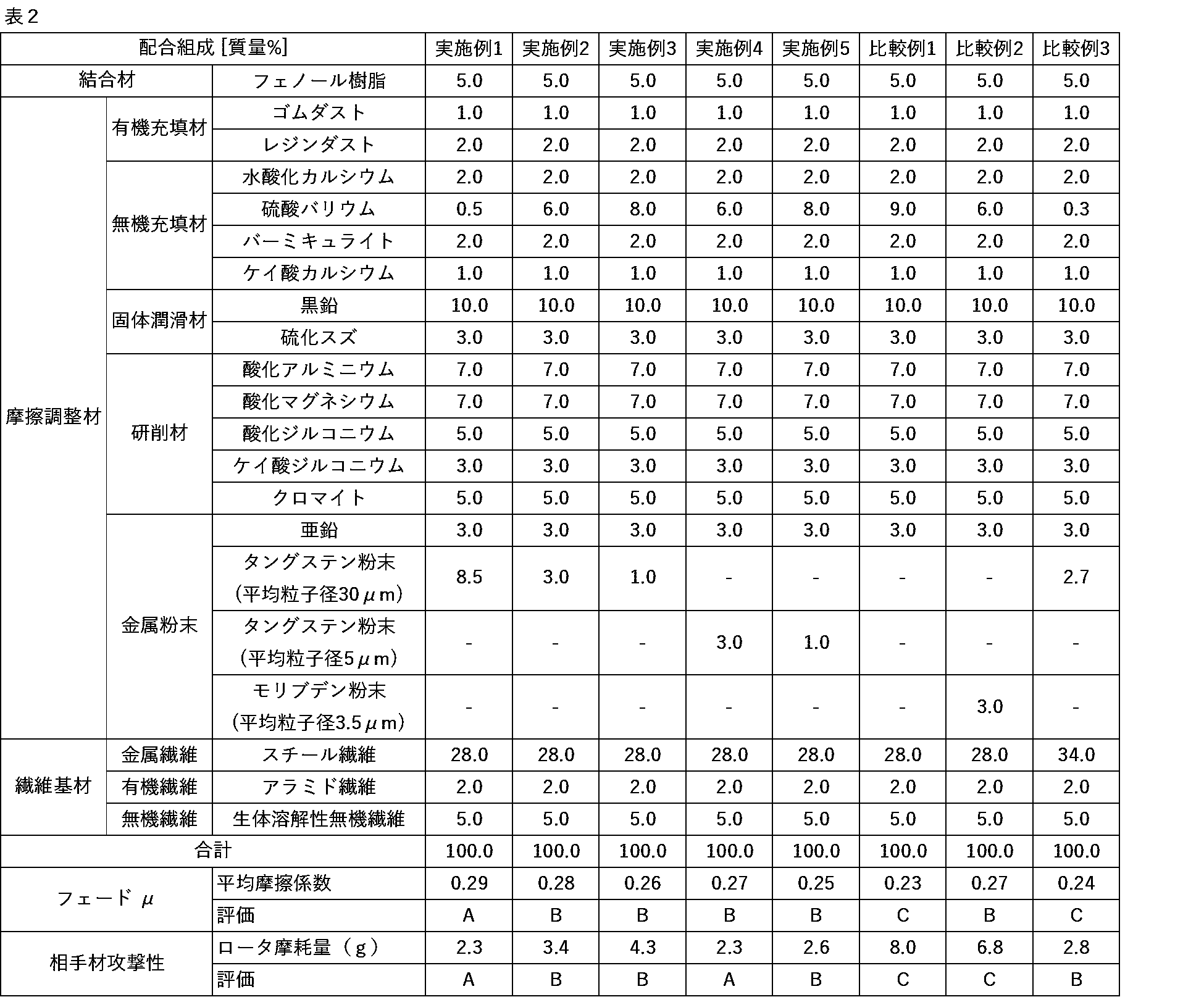
上記結果より、特定量のスチール繊維と、特定量のタングステン粉末を含有する実施例1~5の摩擦材は、高速制動時でも平均摩擦係数が低下せず、耐フェード性に優れることが示された。また、ロータ摩耗量が小さく相手材攻撃性も低いことが示された。
これに対し、特定量のスチール繊維を含有するがタングステン粉末を含有しない比較例1の摩擦材は、耐フェード性が低く、相手材攻撃性が高い結果となった。
特定量のスチール繊維を含有するがタングステン粉末を含有せずモリブデン粉末を含有する比較例2の摩擦材は、相手材攻撃性が高い結果となった。
特定量のタングステン粉末を含有するが、スチール繊維の含有量が多い比較例3の摩擦材は、耐フェード性が低い結果となった。
これに対し、特定量のスチール繊維を含有するがタングステン粉末を含有しない比較例1の摩擦材は、耐フェード性が低く、相手材攻撃性が高い結果となった。
特定量のスチール繊維を含有するがタングステン粉末を含有せずモリブデン粉末を含有する比較例2の摩擦材は、相手材攻撃性が高い結果となった。
特定量のタングステン粉末を含有するが、スチール繊維の含有量が多い比較例3の摩擦材は、耐フェード性が低い結果となった。
本発明を詳細にまた特定の実施態様を参照して説明したが、本発明の精神と範囲を逸脱することなく様々な変更や修正を加えることができることは当業者にとって明らかである。本出願は2023年11月22日出願の日本特許出願(特願2023-198268)に基づくものであり、その内容はここに参照として取り込まれる。
Claims (4)
- 摩擦調整材、繊維基材及び結合材を含む摩擦材であって、
前記摩擦調整材はタングステン粉末を含有し、
前記タングステン粉末の含有量が0.5~10.0質量%であり、
前記繊維基材はスチール繊維を含有し、
前記スチール繊維の含有量が1.0~30.0質量%であり、
銅成分を含有しない、摩擦材。 - 前記タングステン粉末の平均粒子径が1~50μmである、請求項1に記載の摩擦材。
- 前記繊維基材は生体溶解性無機繊維を含む、請求項1または2に記載の摩擦材。
- 前記生体溶解性無機繊維の含有量が1~10質量%である、請求項3に記載の摩擦材。
Applications Claiming Priority (2)
| Application Number | Priority Date | Filing Date | Title |
|---|---|---|---|
| JP2023198268 | 2023-11-22 | ||
| JP2023-198268 | 2023-11-22 |
Publications (1)
| Publication Number | Publication Date |
|---|---|
| WO2025110233A1 true WO2025110233A1 (ja) | 2025-05-30 |
Family
ID=95826753
Family Applications (1)
| Application Number | Title | Priority Date | Filing Date |
|---|---|---|---|
| PCT/JP2024/041414 Pending WO2025110233A1 (ja) | 2023-11-22 | 2024-11-22 | 摩擦材 |
Country Status (1)
| Country | Link |
|---|---|
| WO (1) | WO2025110233A1 (ja) |
Citations (6)
| Publication number | Priority date | Publication date | Assignee | Title |
|---|---|---|---|---|
| JPS53126458A (en) * | 1977-04-12 | 1978-11-04 | Uedasa Chuzosho Co Ltd | Friction material with high resistance to wear* cold*and snow and manufacturing method thereof |
| JP2011016877A (ja) * | 2009-07-07 | 2011-01-27 | East Japan Railway Co | 摩擦材及びブレーキ装置の制輪子 |
| JP2017014369A (ja) * | 2015-06-30 | 2017-01-19 | 株式会社アドヴィックス | 摩擦材 |
| JP2020076064A (ja) * | 2018-10-31 | 2020-05-21 | 曙ブレーキ工業株式会社 | 焼結摩擦材及び焼結摩擦材の製造方法 |
| JP2022124363A (ja) * | 2021-02-15 | 2022-08-25 | 東海カーボン株式会社 | ブレーキ用摩擦材及びブレーキパッド |
| WO2023189977A1 (ja) * | 2022-03-29 | 2023-10-05 | 曙ブレーキ工業株式会社 | 摩擦材 |
-
2024
- 2024-11-22 WO PCT/JP2024/041414 patent/WO2025110233A1/ja active Pending
Patent Citations (6)
| Publication number | Priority date | Publication date | Assignee | Title |
|---|---|---|---|---|
| JPS53126458A (en) * | 1977-04-12 | 1978-11-04 | Uedasa Chuzosho Co Ltd | Friction material with high resistance to wear* cold*and snow and manufacturing method thereof |
| JP2011016877A (ja) * | 2009-07-07 | 2011-01-27 | East Japan Railway Co | 摩擦材及びブレーキ装置の制輪子 |
| JP2017014369A (ja) * | 2015-06-30 | 2017-01-19 | 株式会社アドヴィックス | 摩擦材 |
| JP2020076064A (ja) * | 2018-10-31 | 2020-05-21 | 曙ブレーキ工業株式会社 | 焼結摩擦材及び焼結摩擦材の製造方法 |
| JP2022124363A (ja) * | 2021-02-15 | 2022-08-25 | 東海カーボン株式会社 | ブレーキ用摩擦材及びブレーキパッド |
| WO2023189977A1 (ja) * | 2022-03-29 | 2023-10-05 | 曙ブレーキ工業株式会社 | 摩擦材 |
Similar Documents
| Publication | Publication Date | Title |
|---|---|---|
| KR101904546B1 (ko) | 마찰재 | |
| JP6235217B2 (ja) | 摩擦材 | |
| WO2014098215A1 (ja) | 摩擦材 | |
| JP6157108B2 (ja) | 摩擦材 | |
| KR20020063817A (ko) | 비석면계 마찰재 | |
| WO2019031557A1 (ja) | 摩擦材 | |
| JP7651475B2 (ja) | 摩擦材 | |
| JP7677904B2 (ja) | 摩擦材 | |
| JP2018070833A (ja) | 摩擦材組成物及び摩擦材 | |
| JP6254424B2 (ja) | 摩擦材 | |
| WO2025110233A1 (ja) | 摩擦材 | |
| JP2024089630A (ja) | 摩擦材 | |
| CN107207946B (zh) | 摩擦材料 | |
| WO2024010054A1 (ja) | 摩擦材 | |
| WO2023189977A1 (ja) | 摩擦材 | |
| JP7651343B2 (ja) | 摩擦材 | |
| WO2025169964A1 (ja) | 摩擦材 | |
| JP7578437B2 (ja) | ディスクブレーキパッド用摩擦材及びその製造方法 | |
| WO2023189976A1 (ja) | 摩擦材 | |
| CN115698219B (zh) | 摩擦副 | |
| WO2025192680A1 (ja) | 摩擦材 | |
| JP6370421B2 (ja) | 摩擦材 | |
| JP2026014580A (ja) | 摩擦材 | |
| JP2026014581A (ja) | 摩擦材 | |
| WO2023085286A1 (ja) | 摩擦材 |
Legal Events
| Date | Code | Title | Description |
|---|---|---|---|
| 121 | Ep: the epo has been informed by wipo that ep was designated in this application |
Ref document number: 24894223 Country of ref document: EP Kind code of ref document: A1 |