WO2025100535A1 - 冷却構造体およびバッテリーユニット - Google Patents
冷却構造体およびバッテリーユニット Download PDFInfo
- Publication number
- WO2025100535A1 WO2025100535A1 PCT/JP2024/039858 JP2024039858W WO2025100535A1 WO 2025100535 A1 WO2025100535 A1 WO 2025100535A1 JP 2024039858 W JP2024039858 W JP 2024039858W WO 2025100535 A1 WO2025100535 A1 WO 2025100535A1
- Authority
- WO
- WIPO (PCT)
- Prior art keywords
- flow path
- cooling structure
- plated steel
- coating
- steel sheet
- Prior art date
- Legal status (The legal status is an assumption and is not a legal conclusion. Google has not performed a legal analysis and makes no representation as to the accuracy of the status listed.)
- Pending
Links
Images

Classifications
-
- C—CHEMISTRY; METALLURGY
- C23—COATING METALLIC MATERIAL; COATING MATERIAL WITH METALLIC MATERIAL; CHEMICAL SURFACE TREATMENT; DIFFUSION TREATMENT OF METALLIC MATERIAL; COATING BY VACUUM EVAPORATION, BY SPUTTERING, BY ION IMPLANTATION OR BY CHEMICAL VAPOUR DEPOSITION, IN GENERAL; INHIBITING CORROSION OF METALLIC MATERIAL OR INCRUSTATION IN GENERAL
- C23C—COATING METALLIC MATERIAL; COATING MATERIAL WITH METALLIC MATERIAL; SURFACE TREATMENT OF METALLIC MATERIAL BY DIFFUSION INTO THE SURFACE, BY CHEMICAL CONVERSION OR SUBSTITUTION; COATING BY VACUUM EVAPORATION, BY SPUTTERING, BY ION IMPLANTATION OR BY CHEMICAL VAPOUR DEPOSITION, IN GENERAL
- C23C2/00—Hot-dipping or immersion processes for applying the coating material in the molten state without affecting the shape; Apparatus therefor
- C23C2/04—Hot-dipping or immersion processes for applying the coating material in the molten state without affecting the shape; Apparatus therefor characterised by the coating material
- C23C2/12—Aluminium or alloys based thereon
-
- C—CHEMISTRY; METALLURGY
- C23—COATING METALLIC MATERIAL; COATING MATERIAL WITH METALLIC MATERIAL; CHEMICAL SURFACE TREATMENT; DIFFUSION TREATMENT OF METALLIC MATERIAL; COATING BY VACUUM EVAPORATION, BY SPUTTERING, BY ION IMPLANTATION OR BY CHEMICAL VAPOUR DEPOSITION, IN GENERAL; INHIBITING CORROSION OF METALLIC MATERIAL OR INCRUSTATION IN GENERAL
- C23C—COATING METALLIC MATERIAL; COATING MATERIAL WITH METALLIC MATERIAL; SURFACE TREATMENT OF METALLIC MATERIAL BY DIFFUSION INTO THE SURFACE, BY CHEMICAL CONVERSION OR SUBSTITUTION; COATING BY VACUUM EVAPORATION, BY SPUTTERING, BY ION IMPLANTATION OR BY CHEMICAL VAPOUR DEPOSITION, IN GENERAL
- C23C2/00—Hot-dipping or immersion processes for applying the coating material in the molten state without affecting the shape; Apparatus therefor
- C23C2/26—After-treatment
-
- C—CHEMISTRY; METALLURGY
- C23—COATING METALLIC MATERIAL; COATING MATERIAL WITH METALLIC MATERIAL; CHEMICAL SURFACE TREATMENT; DIFFUSION TREATMENT OF METALLIC MATERIAL; COATING BY VACUUM EVAPORATION, BY SPUTTERING, BY ION IMPLANTATION OR BY CHEMICAL VAPOUR DEPOSITION, IN GENERAL; INHIBITING CORROSION OF METALLIC MATERIAL OR INCRUSTATION IN GENERAL
- C23C—COATING METALLIC MATERIAL; COATING MATERIAL WITH METALLIC MATERIAL; SURFACE TREATMENT OF METALLIC MATERIAL BY DIFFUSION INTO THE SURFACE, BY CHEMICAL CONVERSION OR SUBSTITUTION; COATING BY VACUUM EVAPORATION, BY SPUTTERING, BY ION IMPLANTATION OR BY CHEMICAL VAPOUR DEPOSITION, IN GENERAL
- C23C22/00—Chemical surface treatment of metallic material by reaction of the surface with a reactive liquid, leaving reaction products of surface material in the coating, e.g. conversion coatings, passivation of metals
- C23C22/05—Chemical surface treatment of metallic material by reaction of the surface with a reactive liquid, leaving reaction products of surface material in the coating, e.g. conversion coatings, passivation of metals using aqueous solutions
- C23C22/06—Chemical surface treatment of metallic material by reaction of the surface with a reactive liquid, leaving reaction products of surface material in the coating, e.g. conversion coatings, passivation of metals using aqueous solutions using aqueous acidic solutions with pH less than 6
- C23C22/40—Chemical surface treatment of metallic material by reaction of the surface with a reactive liquid, leaving reaction products of surface material in the coating, e.g. conversion coatings, passivation of metals using aqueous solutions using aqueous acidic solutions with pH less than 6 containing molybdates, tungstates or vanadates
-
- C—CHEMISTRY; METALLURGY
- C23—COATING METALLIC MATERIAL; COATING MATERIAL WITH METALLIC MATERIAL; CHEMICAL SURFACE TREATMENT; DIFFUSION TREATMENT OF METALLIC MATERIAL; COATING BY VACUUM EVAPORATION, BY SPUTTERING, BY ION IMPLANTATION OR BY CHEMICAL VAPOUR DEPOSITION, IN GENERAL; INHIBITING CORROSION OF METALLIC MATERIAL OR INCRUSTATION IN GENERAL
- C23C—COATING METALLIC MATERIAL; COATING MATERIAL WITH METALLIC MATERIAL; SURFACE TREATMENT OF METALLIC MATERIAL BY DIFFUSION INTO THE SURFACE, BY CHEMICAL CONVERSION OR SUBSTITUTION; COATING BY VACUUM EVAPORATION, BY SPUTTERING, BY ION IMPLANTATION OR BY CHEMICAL VAPOUR DEPOSITION, IN GENERAL
- C23C22/00—Chemical surface treatment of metallic material by reaction of the surface with a reactive liquid, leaving reaction products of surface material in the coating, e.g. conversion coatings, passivation of metals
- C23C22/05—Chemical surface treatment of metallic material by reaction of the surface with a reactive liquid, leaving reaction products of surface material in the coating, e.g. conversion coatings, passivation of metals using aqueous solutions
- C23C22/06—Chemical surface treatment of metallic material by reaction of the surface with a reactive liquid, leaving reaction products of surface material in the coating, e.g. conversion coatings, passivation of metals using aqueous solutions using aqueous acidic solutions with pH less than 6
- C23C22/48—Chemical surface treatment of metallic material by reaction of the surface with a reactive liquid, leaving reaction products of surface material in the coating, e.g. conversion coatings, passivation of metals using aqueous solutions using aqueous acidic solutions with pH less than 6 not containing phosphates, hexavalent chromium compounds, fluorides or complex fluorides, molybdates, tungstates, vanadates or oxalates
- C23C22/53—Treatment of zinc or alloys based thereon
-
- C—CHEMISTRY; METALLURGY
- C23—COATING METALLIC MATERIAL; COATING MATERIAL WITH METALLIC MATERIAL; CHEMICAL SURFACE TREATMENT; DIFFUSION TREATMENT OF METALLIC MATERIAL; COATING BY VACUUM EVAPORATION, BY SPUTTERING, BY ION IMPLANTATION OR BY CHEMICAL VAPOUR DEPOSITION, IN GENERAL; INHIBITING CORROSION OF METALLIC MATERIAL OR INCRUSTATION IN GENERAL
- C23C—COATING METALLIC MATERIAL; COATING MATERIAL WITH METALLIC MATERIAL; SURFACE TREATMENT OF METALLIC MATERIAL BY DIFFUSION INTO THE SURFACE, BY CHEMICAL CONVERSION OR SUBSTITUTION; COATING BY VACUUM EVAPORATION, BY SPUTTERING, BY ION IMPLANTATION OR BY CHEMICAL VAPOUR DEPOSITION, IN GENERAL
- C23C22/00—Chemical surface treatment of metallic material by reaction of the surface with a reactive liquid, leaving reaction products of surface material in the coating, e.g. conversion coatings, passivation of metals
- C23C22/05—Chemical surface treatment of metallic material by reaction of the surface with a reactive liquid, leaving reaction products of surface material in the coating, e.g. conversion coatings, passivation of metals using aqueous solutions
- C23C22/06—Chemical surface treatment of metallic material by reaction of the surface with a reactive liquid, leaving reaction products of surface material in the coating, e.g. conversion coatings, passivation of metals using aqueous solutions using aqueous acidic solutions with pH less than 6
- C23C22/48—Chemical surface treatment of metallic material by reaction of the surface with a reactive liquid, leaving reaction products of surface material in the coating, e.g. conversion coatings, passivation of metals using aqueous solutions using aqueous acidic solutions with pH less than 6 not containing phosphates, hexavalent chromium compounds, fluorides or complex fluorides, molybdates, tungstates, vanadates or oxalates
- C23C22/56—Treatment of aluminium or alloys based thereon
-
- C—CHEMISTRY; METALLURGY
- C23—COATING METALLIC MATERIAL; COATING MATERIAL WITH METALLIC MATERIAL; CHEMICAL SURFACE TREATMENT; DIFFUSION TREATMENT OF METALLIC MATERIAL; COATING BY VACUUM EVAPORATION, BY SPUTTERING, BY ION IMPLANTATION OR BY CHEMICAL VAPOUR DEPOSITION, IN GENERAL; INHIBITING CORROSION OF METALLIC MATERIAL OR INCRUSTATION IN GENERAL
- C23C—COATING METALLIC MATERIAL; COATING MATERIAL WITH METALLIC MATERIAL; SURFACE TREATMENT OF METALLIC MATERIAL BY DIFFUSION INTO THE SURFACE, BY CHEMICAL CONVERSION OR SUBSTITUTION; COATING BY VACUUM EVAPORATION, BY SPUTTERING, BY ION IMPLANTATION OR BY CHEMICAL VAPOUR DEPOSITION, IN GENERAL
- C23C26/00—Coating not provided for in groups C23C2/00 - C23C24/00
-
- H—ELECTRICITY
- H01—ELECTRIC ELEMENTS
- H01M—PROCESSES OR MEANS, e.g. BATTERIES, FOR THE DIRECT CONVERSION OF CHEMICAL ENERGY INTO ELECTRICAL ENERGY
- H01M10/00—Secondary cells; Manufacture thereof
- H01M10/60—Heating or cooling; Temperature control
- H01M10/61—Types of temperature control
- H01M10/613—Cooling or keeping cold
-
- H—ELECTRICITY
- H01—ELECTRIC ELEMENTS
- H01M—PROCESSES OR MEANS, e.g. BATTERIES, FOR THE DIRECT CONVERSION OF CHEMICAL ENERGY INTO ELECTRICAL ENERGY
- H01M10/00—Secondary cells; Manufacture thereof
- H01M10/60—Heating or cooling; Temperature control
- H01M10/65—Means for temperature control structurally associated with the cells
- H01M10/651—Means for temperature control structurally associated with the cells characterised by parameters specified by a numeric value or mathematical formula, e.g. ratios, sizes or concentrations
-
- H—ELECTRICITY
- H01—ELECTRIC ELEMENTS
- H01M—PROCESSES OR MEANS, e.g. BATTERIES, FOR THE DIRECT CONVERSION OF CHEMICAL ENERGY INTO ELECTRICAL ENERGY
- H01M10/00—Secondary cells; Manufacture thereof
- H01M10/60—Heating or cooling; Temperature control
- H01M10/65—Means for temperature control structurally associated with the cells
- H01M10/655—Solid structures for heat exchange or heat conduction
-
- H—ELECTRICITY
- H01—ELECTRIC ELEMENTS
- H01M—PROCESSES OR MEANS, e.g. BATTERIES, FOR THE DIRECT CONVERSION OF CHEMICAL ENERGY INTO ELECTRICAL ENERGY
- H01M10/00—Secondary cells; Manufacture thereof
- H01M10/60—Heating or cooling; Temperature control
- H01M10/65—Means for temperature control structurally associated with the cells
- H01M10/655—Solid structures for heat exchange or heat conduction
- H01M10/6556—Solid parts with flow channel passages or pipes for heat exchange
-
- H—ELECTRICITY
- H01—ELECTRIC ELEMENTS
- H01M—PROCESSES OR MEANS, e.g. BATTERIES, FOR THE DIRECT CONVERSION OF CHEMICAL ENERGY INTO ELECTRICAL ENERGY
- H01M10/00—Secondary cells; Manufacture thereof
- H01M10/60—Heating or cooling; Temperature control
- H01M10/65—Means for temperature control structurally associated with the cells
- H01M10/656—Means for temperature control structurally associated with the cells characterised by the type of heat-exchange fluid
- H01M10/6567—Liquids
- H01M10/6568—Liquids characterised by flow circuits, e.g. loops, located externally to the cells or cell casings
-
- Y—GENERAL TAGGING OF NEW TECHNOLOGICAL DEVELOPMENTS; GENERAL TAGGING OF CROSS-SECTIONAL TECHNOLOGIES SPANNING OVER SEVERAL SECTIONS OF THE IPC; TECHNICAL SUBJECTS COVERED BY FORMER USPC CROSS-REFERENCE ART COLLECTIONS [XRACs] AND DIGESTS
- Y02—TECHNOLOGIES OR APPLICATIONS FOR MITIGATION OR ADAPTATION AGAINST CLIMATE CHANGE
- Y02E—REDUCTION OF GREENHOUSE GAS [GHG] EMISSIONS, RELATED TO ENERGY GENERATION, TRANSMISSION OR DISTRIBUTION
- Y02E60/00—Enabling technologies; Technologies with a potential or indirect contribution to GHG emissions mitigation
- Y02E60/10—Energy storage using batteries
Definitions
- the present invention relates to a cooling structure and a battery unit.
- This disclosure claims priority based on Japanese Patent Application No. 2023-191328, filed in Japan on November 9, 2023, the contents of which are incorporated herein by reference.
- Patent Document 1 discloses the use of adhesives to bond aluminum cooling plates.
- Iron is superior to aluminum in terms of strength and cost, but is inferior in corrosion resistance.
- a flow path that combines iron and aluminum can provide a cooling flow path that has the strength and cost advantages of iron and the high corrosion resistance of aluminum.
- issues arise at the contact points between the iron and aluminum, such as contact corrosion due to the dissimilar metals and distortion due to differences in thermal expansion coefficients.
- the inside of the flow path is an environment where a water refrigerant such as a coolant flows, in addition to strength at the joints, erosion resistance is also required.
- the present invention was made in consideration of the above problems, and aims to provide a cooling structure that has excellent strength and erosion resistance at the joints between dissimilar metals.
- a cooling structure is a cooling structure having a water refrigerant flow path formed to contact a bottom surface portion of a battery pack, the cooling structure having a flow path forming portion constituting a part of the water refrigerant flow path, the flow path forming portion being joined to a joined member by an adhesive portion, the joined member being either the bottom surface portion or a flow path top cover covering the flow path forming portion, the joined member being made of a steel plate having an inorganic coating or a resin coating formed as a chemical conversion coating on an Al-based plated steel plate or a Zn-based plated steel plate, the flow path forming portion being made of an aluminum alloy, the adhesive portion having a thickness of 0.0005 mm or more, the adhesive portion protruding 0.1 mm or more into the water refrigerant flow path side, a flow path spacing between the water refrigerant flow paths is 20 mm or less, and the water refriger
- the plating layer of the Al-based plated steel sheet may contain Si.
- the Si content of the plating layer of the Al-based plated steel sheet may be 2.0 mass % or more and 15 mass % or less.
- a coating containing a Zr-based component, a Ti-based component, or a Si-based component as a main component may be formed on the surface of the Al-based plated steel sheet as a chemical conversion coating.
- the inorganic coating on the surface of the Zn-based plated steel sheet may contain a Si-based component or a Zr-based component as a main component.
- the inorganic coating on the surface of the Zn-based plated steel sheet may contain at least one of a V component, a P component, and a Co component as an anti-rust component.
- the rust-preventive component may be one or more of vanadium oxide, phosphoric acid, and cobalt nitrate.
- the inorganic coating on the surface of the Zn-based plated steel sheet may be composed of a compound phase containing one or more of Si—O bonds, Si—C bonds, and Si—OH bonds.
- the inorganic coating may have a thickness of more than 0 ⁇ m and not more than 1.5 ⁇ m.
- the inorganic coating or the resin coating may be electrically conductive.
- the resin coating may contain a resin, an anti-rust pigment, and a conductive pigment.
- the resin coating contains at least one of metal particles, intermetallic compound particles, conductive oxide particles, and conductive non-oxide ceramic particles as the conductive pigment, and the conductive pigment has a powder resistivity of 7.0 ⁇ 10 ⁇ cm or less at 23 to 27°C and may contain at least one element selected from the group consisting of Zn, Si, Zr, V, Cr, Mo, Mn, Fe, and W.
- the resin film may contain the conductive pigment in a proportion of 1.0 mass % or more and 30 mass % or less.
- the adhesive portion may contain 10% or more of any one of an epoxy resin, a silicone resin, an acrylic resin, and a urethane resin.
- the adhesive portion may have a hardness of A15 or more and D90 or less.
- a battery unit according to one aspect of the present disclosure is characterized in that it includes the cooling structure described in (1) or (2) above and a battery pack.
- the above aspects of the present invention make it possible to provide a cooling structure that has excellent strength and erosion resistance at the joints between dissimilar metals.
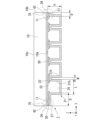
- FIG. 2 is a schematic cross-sectional view illustrating a cooling structure according to an embodiment of the present disclosure.
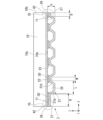
- 11 is a schematic cross-sectional view showing another example of the cooling structure according to the embodiment.
- FIG. 11 is a schematic cross-sectional view showing another example of the cooling structure according to the embodiment.
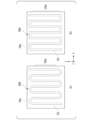
- FIG. 4 is a schematic plan view for explaining the shape of a water coolant flow path of the cooling structure according to the embodiment.
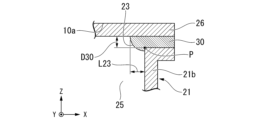
- FIG. 2 is a schematic cross-sectional view for explaining one end of the cooling structure of FIG. 1 .
- the direction perpendicular to the paper surface is the Y direction
- the direction in which multiple flow path forming parts 21 (described later) are arranged is the X direction
- the direction perpendicular to both the X direction and the Y direction is the Z direction.
- a numerical range expressed using “ ⁇ ” means a range that includes the numerical values written before and after " ⁇ " as the lower and upper limits. Numerical values indicated as “greater than” or “less than” are not included in the numerical range.
- Fig. 1 is a cross-sectional view (a cross-sectional view perpendicular to a bottom surface portion 10a of a battery pack 10) showing an overview of the cooling structure 1 according to this embodiment.
- the cooling structure 1 is provided, for example, on the outside (below) of the bottom surface of the automobile. Since an aqueous LLC (long life coolant) solution containing organic components flows as the coolant (water coolant) in the water coolant flow path 25 of the cooling structure 1, the cooling structure 1 is required to have high coolant corrosion resistance. Furthermore, the cooling structure 1 is required to improve the cooling capacity by narrowing the flow path spacing of the water coolant flow path 25 to increase the liquid area.
- the cooling structure 1 has a water coolant flow path 25.
- the cooling liquid flowing through the water coolant flow path 25 cools the battery pack 10 by contacting the bottom surface 10a of the battery pack 10 directly or through a flow path top cover 26 described below.
- Battery cells (not shown) are housed in the battery pack 10. Inside the battery pack 10, the battery cells are arranged in close contact with the bottom surface 10a.
- the cooling structure 1 has a flow path forming portion 21.
- a plurality of water coolant flow paths 25 appear to be lined up in a cross-sectional view as shown in FIG. 1.
- the flow path forming portion 21, together with the joined members described later, forms a plurality of water coolant flow paths 25 extending in the Y direction.
- adjacent water coolant flow paths 25 are connected to each other via the joints 22 of the flow path forming portion 21.
- the joints 22 are the portions between adjacent water coolant flow paths 25.
- the flow path forming portion 21 is joined to a joined member by an adhesive portion 30.
- the joined member is either the bottom surface portion 10a of the battery pack 10 or the flow path upper lid 26 covering the flow path forming portion 21.
- Either the bottom surface portion 10a of the battery pack 10 or the flow path upper lid 26 covering the flow path forming portion 21 is joined to the flow path forming portion 21 by the adhesive portion 30.
- the flow path upper cover 26 covering the flow path forming portion 21 means that the flow path upper cover 26 is arranged on the battery pack 10 side at least in the part of the flow path forming portion 21 that constitutes the water coolant flow path 25.
- the joined member when the cooling structure 1 has the flow passage upper lid 26, the joined member is the flow passage upper lid 26, and the flow passage forming portion 21 and the flow passage upper lid 26 are joined by the adhesive portion 30.
- the joined member When the cooling structure 1 does not have the flow passage upper lid 26, the joined member is the bottom surface portion 10a of the battery pack 10, and the flow passage forming portion 21 and the bottom surface portion 10a of the battery pack 10 are joined by the adhesive portion 30.
- the joint portion 22 is joined to the bottom surface portion 10a of the battery pack 10 or the flow passage upper lid 26 via the adhesive portion 30.
- the adhesive portion 30 joins the flow passage upper lid 26 that covers at least the water coolant flow passage 25 and the flow passage forming portion 21.
- the flow passage upper lid 26 is joined by the joint portion 22 and the adhesive portion 30.
- the water coolant flow path 25 is a space that is rectangular when viewed from the Y direction, as shown in Figure 1.
- the cooling structure 1 has a flow path upper cover 26 that covers the upper part of the flow path forming part 21.
- the flow path upper cover 26 is disposed between the flow path forming part 21 and the battery pack 10.
- the battery pack 10 is provided on the opposite side of the flow path upper cover 26 from the flow path forming part 21.
- the flow passage top cover 26 is made of a steel plate on which an inorganic film or a resin film is formed as a chemical conversion coating on an Al (aluminum)-plated steel plate or a Zn (zinc)-plated steel plate.
- steel plate on which an inorganic film or a resin film is formed as a chemical conversion coating may be referred to as "chemically treated steel plate.”
- the bottom surface 10a of the battery pack 10 is joined to the flow path forming part 21, and the water coolant flow path 25 is formed by a part of the bottom surface 10a of the battery pack 10 and a part of the flow path forming part 21.
- the water coolant flow path 25 is in direct contact with the bottom surface 10a of the battery pack 10.
- the bottom surface portion 10a of the battery pack 10 is made of a steel plate having an inorganic coating or a resin coating formed as a chemical conversion coating on an Al-based plated steel plate or a Zn-based plated steel plate.
- the bottom surface portion 10a does not necessarily have to be made of an Al-based plated steel plate or a Zn-based plated steel plate that has been chemically treated. This is because the bottom surface portion 10a does not come into contact with the coolant.
- An example of an Al-based plated steel sheet is an Al-9% Si-based plated steel sheet.
- Zn-based plated steel sheets are Zn-0.2% Al-based plated steel sheets, Zn-0.09% Al-based plated steel sheets, Zn-6% Al-3% Mg-based plated steel sheets, and Zn-11% Al-3% Mg-0.2% Si-based plated steel sheets.
- a particularly preferred material is a zinc (Zn)-aluminum (Al)-magnesium (Mg)-based alloy plated steel sheet.
- Al-based plated steel sheets and Zn-based plated steel sheets that have been chemically treated have high corrosion resistance to coolants.
- Al-based plated steel sheets and Zn-based plated steel sheets that have been chemically treated have excellent corrosion resistance to LLC aqueous solutions.
- the shape of the cross section perpendicular to the extension direction of the water coolant flow path 25 is not limited to a rectangular shape, but may be, for example, a trapezoidal shape as shown in FIG. 2, a semicircular shape as shown in FIG. 3, or other shapes.
- the water coolant flow passage 25 extends in the Y direction (for example, a direction parallel to or perpendicular to the longitudinal direction of the bottom surface portion 10a of the battery pack 10).
- the extension direction of the water coolant flow passage 25 is not limited to this example, and may extend in the X direction.
- the water coolant flow path 25 may have not only straight portions but also curved portions when viewed in a plane perpendicular to the surface of the bottom portion 10a.
- the water coolant flow path 25 may have a U-shaped portion or the like when viewed in a plane perpendicular to the plate surface of the bottom portion 10a.
- the U-shaped portion may be provided to fold back the straight portion, and for example, adjacent straight portions may be connected by these portions.
- FIG. 4(a) illustrates a schematic shape of the water coolant flow path 25 in which a straight portion 25a extending in the Y direction is folded back at a U-shaped folded portion 25b.
- FIG. 4(b) illustrates a schematic shape of an example water coolant flow path 25 in which a similar straight portion 25a is folded back at a U-shaped folded portion 25b.
- the water refrigerant flow path 25 is connected to a circulation path (not shown).
- a flow path of a supply pipe (not shown) that supplies the water refrigerant and a flow path of a drain pipe (not shown) that drains the water refrigerant are connected to the water refrigerant flow path 25.
- the supply pipe and the drain pipe may be connected to the flow path forming portion 21 at approximately both ends of the water refrigerant flow path 25.
- the supply pipe may be positioned approximately in the middle of the water refrigerant flow path 25, and multiple or more drain pipes may be provided at both ends of the water refrigerant flow path 25, and the arrangement may be based on a cooling design.
- the water refrigerant supplied from the supply pipe flows through the water refrigerant flow path 25 and is drained from the drain pipe, and the water refrigerant is cooled by a cooling device (not shown) and then supplied again from the supply pipe to the water refrigerant flow path 25.
- the cooling liquid which is the water refrigerant
- the cooling liquid flows through the circulation path and the water refrigerant flow path 25.
- the cooling liquid flows through the water refrigerant flow path 25.
- the cooling liquid absorbs heat from the battery pack 10 while flowing through the water refrigerant flow path 25.
- the cooling liquid is then introduced back into the circulation path. That is, the cooling liquid repeatedly absorbs heat from the battery pack 10 by repeatedly flowing through the circulation path and the water refrigerant flow path 25.
- the material of the flow path forming portion 21 that forms the water coolant flow path 25 is required to have corrosion resistance to the coolant.
- the flow path forming portion 21 is made of an aluminum alloy.
- the aluminum alloy it is a 3000 series or 6000 series aluminum alloy. Since the flow path forming portion 21 is made of an aluminum alloy, it is possible to obtain a cooling structure 1 that has high corrosion resistance to the coolant and is lighter than a cooling structure that employs a steel flow path.
- the flow passage forming portion 21 may be an Al alloy plate having the same composition as the above-mentioned plating layer.
- the flow path forming part 21 is joined to the flow path upper lid 26 by an adhesive part 30. If the cooling structure 1 does not have a flow path upper lid 26, the flow path forming part 21 is joined to the bottom surface part 10a of the battery pack 10 by an adhesive part 30.
- the thickness (length in the Z direction) D30 of the adhesive part 30 formed by the above-mentioned joining is 0.0005 mm or more.
- the thickness D30 of the adhesive portion 30 is the distance in a direction perpendicular to the surface of the joined member between the opposing surfaces of the joined member, the flow path upper cover 26, and the joint portion 22 of the flow path forming portion 21 (Z direction in the example of FIG. 5). If the cooling structure 1 does not have the flow path upper cover 26, the thickness D30 of the adhesive portion 30 is the distance in a direction perpendicular to the surface of the joined member between the opposing surfaces of the joined member, the bottom surface portion 10a of the battery pack 10, and the joint portion 22 of the flow path forming portion 21 (Z direction in the example of FIG. 5).
- the distance (D30) between the flow path forming portion 21 and the joined member is ensured to be 0.0005 mm or more, even in the joining of dissimilar metals between the joined member made of an Al-based plated steel sheet or a Zn-based plated steel sheet that has been chemically treated and the flow path forming portion 21 made of an aluminum alloy, contact corrosion caused by dissimilar metals and distortion caused by differences in thermal expansion coefficients can be suppressed. If the thickness D30 of the adhesive portion 30 is too large, the joining strength decreases, so it is preferably 10 mm or less, more preferably 5 mm or less.
- the thickness D30 of the adhesive portion 30 can be controlled by including a filler or spacer in the adhesive that becomes the adhesive portion 30. Common materials can be used as the filler or spacer. There are no particular restrictions on the particle size of the filler or spacer, and it may be equal to or smaller than the desired thickness D30.
- the thickness D30 of the adhesive portion 30 can be measured as follows. A sample is prepared by cutting out the flow path forming portion 21 along the Z direction so as to include the adhesive portion 30. The sample is observed using an optical microscope or a SEM (scanning electron microscope), and the thickness D30 of the adhesive portion 30 in the direction perpendicular to the surface of the joined members is measured from the captured image (photograph) and a scale bar. In this case, the arithmetic average value of five points obtained from five visual fields is defined as the thickness D30.
- the adhesive is applied within the width (X direction) of the joint 22.
- the adhesive is applied so as not to protrude from the joint 22.
- the adhesive protruding increases the amount of adhesive used, resulting in increased costs.
- the protruding portion 23 is a portion (cured portion of adhesive) formed by hardening of the adhesive, similar to the adhesive portion 30 , and therefore has the same chemical composition as the adhesive portion 30 .
- the material constituting the protruding portion 23 is in contact with the joined members, but is not in contact with other members on the water coolant flow path 25 side.
- the protruding portion 23 there are some portions that are not in contact with the joined members but are in contact with the flow path forming portion 21. Therefore, the protruding portion 23 does not have the function of bonding other members together.
- FIG. 5 shows an example of the shape of the protruding portion 23.
- the protruding portion 23 protruding toward the water coolant flow path 25 has a rounded shape.
- the protruding length L23 is the distance between the point P (the boundary between the water coolant flow path 25 and the joint 22) that is closest to the joint 22 on the inner surface of the side portion 21b of the flow path forming portion 21 (the surface that constitutes the water coolant flow path 25) in the width direction of the water coolant flow path 25 (the X direction in the example of FIG. 5) and the end of the protruding portion 23, the protruding length L23 is 0.1 mm or more.
- the protruding length L23 is preferably 0.2 mm or more. If the overhang length L23 is too large, it will hinder heat exchange between the water coolant and the bottom surface of the battery pack, resulting in a decrease in cooling performance and no significant improvement in bonding strength. Therefore, the overhang length L23 is preferably 1 mm or less, and more preferably 0.8 mm or less.
- the end of the protruding portion 23 means the point on the interface between the protruding portion 23 and the member to be joined that is farthest from the above-mentioned point P along the width direction of the water coolant flow path 25 (X direction in the example of Figure 5).
- the protruding length L23 can be measured as follows. A sample is prepared by cutting out the flow passage forming portion 21 at a cross section including the adhesive portion 30 and perpendicular to the extension direction (the Y direction) of the water coolant flow passage 25. The sample is observed using an optical microscope, and the protrusion length L23 is measured from the captured image (photograph) and the scale bar. The arithmetic average value of five points obtained from five visual fields is defined as the protrusion length L23.
- the means for applying the adhesive that constitutes the adhesive portion 30 and the protruding portion 23 is not particularly limited, and it is preferable to apply the adhesive so that there is no unevenness in the amount of adhesive applied.
- a method that can apply a constant amount and at a constant speed for example, a method in which a robot dispenses adhesive from a gun while moving
- the adhesive portion 30 be present.
- a high-temperature treatment such as spot welding or brazing is performed on an Al-based plated steel sheet or a Zn-based plated steel sheet on which an inorganic film or a resin film is formed as a chemical conversion coating
- the plated layer, the inorganic film, or the resin film may be damaged.
- bonding using an adhesive as in the cooling structure 1 according to the present embodiment such damage problems do not occur, and erosion resistance can be ensured.
- the passage interval w between the water refrigerant flow paths 25 is 20 mm or less.
- the passage interval w is the distance between the ends of adjacent water refrigerant flow paths 25 in the width direction (X direction).
- the cross-sectional shape of the water refrigerant flow paths 25 is rectangular, so the distance between the ends (passage interval) w in the width direction of the water refrigerant flow paths 25 is the distance between the side portions 21b of the flow path forming portions 21 that form adjacent water refrigerant flow paths 25.
- the boundary portion between the water refrigerant flow paths 25 and the joint portion 22 is the end of the water refrigerant flow path 25 in the width direction.
- a joining surface of a certain area is required to provide a spot weld.
- the cooling structure according to the present embodiment is to be fabricated using spot welding instead of the adhesive portion 30, the spot weld will exceed the flow passage interval, making it impossible to achieve proper joining.
- the flow passage interval is ensured in order to properly form the spot weld, the flow passage width described below will be narrowed, which is undesirable.
- the flow passage upper cover 26 or the bottom surface portion 10a of the battery pack 10 is made of a steel plate that has been chemically treated to be an Al-based plated steel plate or a Zn-based plated steel plate.
- the heat transfer characteristics of the Al-based plated steel plate or the Zn-based plated steel plate that has been chemically treated include that the heat of the part of the flow passage upper cover 26 or the bottom surface portion 10a of the battery pack 10 directly above the part that is in contact with the coolant is easily absorbed by the coolant. Therefore, by increasing the contact area between the coolant and the flow passage upper cover 26 or the battery pack 10, the part to which heat is transferred can be increased, and thus the cooling efficiency can be improved.
- the material of the side surface portion 10b and the top surface portion 10c of the battery pack 10 are preferably made of an Al-based plated steel sheet or a Zn-based plated steel sheet that has been subjected to a chemical conversion treatment, similar to the bottom surface portion 10a.
- the side surface portion 10b is exposed to the external environment, it is preferably made of an Al-based plated steel sheet or a Zn-based plated steel sheet that has been subjected to a chemical conversion treatment, similar to the bottom surface portion 10a.
- the passage interval w between the water coolant passages 25 is preferably 1 mm or more, and is preferably 15 mm or less.
- the passage interval w between the water coolant passages 25 1 mm or more, the width (length in the X direction) of the joint 22 can be ensured, and it becomes easy to ensure the joint strength with the bottom surface portion 10a of the battery pack 10 or the passage upper cover 26.
- the passage interval w between the water coolant passages 25 15 mm or less the contact area between the coolant and the battery pack 10 can be made wider, and the cooling efficiency can be further improved.
- the flow path interval w in the water coolant flow path 25 is measured using a vernier caliper.
- the flow path interval w is obtained by cutting out any 10 locations of the flow path forming portion 21, measuring the flow path interval w at the cut-out locations using a vernier caliper, and calculating the average of the maximum and minimum values of the measured values at the 10 locations.
- the flow path interval w refers to the flow path interval w in the range where a plurality of water coolant flow paths 25 are arranged and joints 22 are provided between the water coolant flow paths 25. Therefore, as described above, turning points of the flow paths that are U-shaped, V-shaped, C-shaped, etc. when viewed in a plan view in a direction perpendicular to the plate surface of the bottom surface portion 10a are excluded from the measurement positions of the flow path interval w.
- the ratio of the area occupied by the water coolant flow passage 25 to the area of the bottom surface portion 10a is preferably 0.23 or more, and more preferably 0.40 or more. This allows the contact area between the coolant and the battery pack 10 to be widened, and thus the cooling efficiency of the battery pack 10 can be improved.
- the upper limit of the ratio is not particularly limited, but since it is preferable to ensure a certain degree of bonding strength between the joint portion 22 and the bottom surface portion 10a, it may be 0.80. From the perspective of the balance between bonding strength and cooling efficiency, it is more preferable that the ratio is 0.23 to 0.71. In other words, the cooling performance of the cooling structure 1 improves as the ratio increases, but it is also preferable to consider the bonding strength with the battery pack 10. From this perspective, the ratio is preferably 0.23 to 0.71.
- the ratio of the area occupied by the water coolant flow path 25 to the area of the bottom surface portion 10a can be increased by enlarging the flow path width L.
- the flow path width L is the length of the water coolant flow path 25 in the X direction, that is, the distance between the outer surfaces of the side portions 21b of the flow path forming portion 21 that form the water coolant flow path 25.
- the boundary portion between the flow path forming portion 21 and the joint portion 22 becomes the end portion in the width direction of the flow path forming portion 21, and the flow path width L is the distance between the end portions in the width direction of the water coolant flow path 25 for the water coolant.
- the flow path width L is 60 mm or less.
- the lower limit of the flow path width is preferably 6 mm or more as a range in which the cooling liquid can flow stably.
- the flow path width L is more preferably 6 mm or more and 30 mm or less, and even more preferably 6 mm or more and 20 mm or less.
- the flow path width L of the water coolant flow path 25 is measured using a vernier caliper.
- the flow path width L is obtained by cutting out any 10 locations of the flow path forming part 21, measuring the flow path width L of the cut-out locations using a vernier caliper, and calculating the average of the maximum and minimum values of the measured values at the 10 locations.
- the turning points of the flow path that form a U-shape, V-shape, C-shape, etc. are excluded from the measurement positions of the flow path width L.
- the distance D is the distance in the width direction of the water coolant flow path 25 from the end of the water coolant flow path 25 to the nearest water coolant flow path 25. Specifically, the distance is 10 mm or less, more preferably 7.5 mm or less.
- a vernier caliper is used to measure the distance D from the end of the flow path forming portion 21 to the start of the cavity in the nearest water coolant flow path 25.
- the distance D is determined by cutting out any 10 locations including the outer edge 27 of the flow path forming portion 21 and the water coolant flow path 25 nearest to the outer edge 27, measuring the distance D in the width direction of the water coolant flow path 25 at the cut-out locations using a vernier caliper, and calculating the average of the maximum and minimum values measured at the 10 locations.
- the height of the water coolant flow path 25, i.e., the distance h in the thickness direction (Z direction) of the water coolant flow path 25 from the bottom surface portion 21a of the flow path forming portion 21 (the lower end portion 21a-1 of the flow path forming portion 21 in the example of FIG. 3) to the joint portion 22, is not particularly limited, but is preferably 1 mm to 10 mm from the viewpoint of the cooling efficiency of the battery pack 10. From the viewpoint of processability for flow path formation, the upper limit of the distance h is preferably 8 mm. By setting the height (distance h) of the water coolant flow path 25 to 1 mm to 8 mm, it is possible to achieve a better balance between the cooling efficiency of the battery pack 10 and processability for flow path formation.
- the distance h is measured using a vernier caliper.
- the distance h is obtained by cutting out any 10 locations of the flow path forming portion 21, measuring the distance h at the cut-out locations using a vernier caliper, and calculating the average of the maximum and minimum values of the measured values at the 10 locations.
- the resin main component of the adhesive portion 30 is preferably any one of epoxy resin, silicone resin, acrylic resin, and urethane resin.
- the adhesive portion 30 preferably contains any one of these resin main components at 10% or more, more preferably 20% or more.
- the adhesive portion 30 having such a main component can suppress deterioration of the adhesive portion 30 and corrosion of the joint portion 22 caused by the water coolant, and ensure watertightness.
- the content of the resin main component in the adhesive portion 30 is measured by a thermogravimetric analyzer.
- the flow path forming portion 21 is also joined to the joined member by the adhesive portion 30. Specifically, the outer edge 27 of the flow path forming portion 21 is joined to the outer edge 42 of the flow path upper lid 26 by the adhesive portion 30. The outer edge 27 of the flow path forming portion 21 and the outer edge 42 of the flow path upper lid 26 are joined (watertightly joined) to form a watertight joint 70.
- a watertight joint is a joint in which water is sealed and does not leak even when water pressure is applied.
- the outer edge 11 of the bottom surface portion 10a of the battery pack 10 is joined to the outer edge 42 of the flow path upper lid 26 by the adhesive portion 30 to form a watertight joint 70. In this way, by watertightly joining the outer edge of the cooling structure 1, leakage of the cooling liquid can be prevented and watertightness can be ensured.
- the flow passage forming portion 21 is manufactured, for example, by processing (for example, bending, drawing, casting, etc.) a sheet of aluminum alloy.
- the thickness of the aluminum alloy constituting the flow passage forming portion 21 is not particularly limited, but is preferably, for example, 0.4 mm or more and 10.0 mm or less, and more preferably 0.4 mm or more and 5.0 mm or less. In this case, the strength of the flow passage forming portion 21 can be increased.
- the manufacturing method of the flow passage forming portion 21 is not limited to this example.
- the flow passage forming portion 21 may be manufactured using a die casting method.
- the thickness of the aluminum alloy is determined by cutting out a portion of the flow path forming portion 21, measuring the thickness of the cut-out portion at 10 points using a vernier caliper, and calculating the average of the maximum and minimum measured values at the 10 points.
- the thickness of the steel plate constituting the bottom surface portion 10a of the battery pack 10 is not particularly limited, but is preferably, for example, 0.4 mm to 1.2 mm, and more preferably 0.4 mm to 1.0 mm.
- the bottom surface portion 10a of the battery pack 10 can be formed thin while maintaining the strength of the bottom surface portion 10a. Therefore, the distance between the coolant and the battery cells in the battery pack 10 can be narrowed, and the cooling efficiency of the battery pack 10 can be improved, and the cooling responsiveness of the battery pack 10 can be improved.
- the thickness of the flow path upper cover 26 is not particularly limited, but is preferably, for example, 0.4 mm or more and 1.2 mm or less, and more preferably 0.4 mm or more and 1.0 mm or less.
- the thickness of the above steel plate is determined by cutting out a portion of the bottom surface 10a or the flow path upper cover 26 of the battery pack 10, measuring the plate thickness of the cut-out portion at 10 points using a vernier caliper, and calculating the average of the maximum and minimum measured values at the 10 points.
- the members to be joined are made of Al-based plated steel sheet or Zn-based plated steel sheet that has been chemically treated, and flow path forming portion 21 is made of an aluminum alloy.
- These different types of metals are joined with adhesive portion 30, and the thickness of adhesive portion 30 formed by joining is 0.0005 mm or more, so that contact corrosion due to dissimilar metals and distortion due to differences in thermal expansion coefficients can be suppressed.
- protruding portion 23 is configured to protrude 0.1 mm or more toward the water coolant flow path 25 side, a scraping allowance for adhesive portion 30 due to erosion can be secured, improving the joining strength.
- the hardness of the adhesive portion 30 is preferably A15 or more and D90 or less.
- the hardness of the adhesive portion 30 refers to the hardness of the adhesive portion 30 after the adhesive constituting the adhesive portion 30 has hardened. This prevents the adhesive from wearing away in an environment where cooling water circulates, and provides high erosion resistance.
- the hardness of the adhesive portion 30 is measured with a durometer hardness tester. Specifically, ten random locations are cut out, the hardness of the cut out locations is measured based on JIS K 7215 "Durometer hardness testing method for plastics", and the average of the maximum and minimum measured values at the ten locations is calculated.
- the cooling structure 1 may be provided inside (above) the bottom surface of the automobile battery unit.
- the cooling structure 1 is stored inside the battery pack 10 together with the battery cells, and the battery cells are disposed above the cooling structure 1.
- the Al-based plated steel sheet is a steel sheet on which a plating layer containing Al is formed.
- the plating layer of the Al-based plated steel sheet preferably contains Si.
- the Si content is, for example, 2.0 mass% or more and 15 mass% or less.
- the plating layer of the Al-based plated steel sheet is preferably a two-component or multi-component plating with an Al content of 70 mass% or more, an Al content of 70 to 98 mass%, and a Si content of 2.0 mass% or more and 15 mass% or less.
- a more preferable range of the Si content is 3.0 mass% or more and 15 mass% or less.
- the chemical composition of the plating layer may contain, in addition to Al and Si, 15 mass% or less of Zn, 5 mass% or less of Mg, and the balance may be Fe.
- the plating layer may be formed on only one side of the steel sheet, but is preferably formed on both sides.
- trace amounts of Fe, Ni, Co, etc. may be present as impurity elements in the plating layer.
- Mg, Sn, misch metal, Sb, Zn, Cr, W, V, Mo, etc. may be added as necessary.
- hot-dip flux plating, hot-dip plating using the Sendzimir method, all-radiant method, etc., electroplating, and vapor deposition plating are preferred.
- a film containing a Zr-based component, a Ti-based component, or a Si-based component as a main component is formed as a chemical conversion coating on the surface of the Al-based plated steel sheet (which may be on one side only, but preferably on both sides).
- the film may also contain an organic component.
- the first example of the chemical conversion coating is an example of a coating containing Zr-based components as the main component, consisting only of Zr, F, P, C, O, N, and H, and containing no organic matter with a number average molecular weight of 200 or more.
- the components are adjusted so that the mass ratio Zr/F of Zr to F among the constituent elements of the chemical conversion coating is 1.0 to 10.0, the mass ratio Zr/P of Zr to P is 8.5 to 18.0, and the Zr content in the chemical conversion coating is 23.0 mass% to 48.0 mass%.
- the supply source of each component of the chemical conversion coating consists of one or more inorganic acids and/or ammonium salts thereof selected from the group consisting of carbonic acid, phosphoric acid, and hydrofluoric acid, and zirconium-containing complex compounds excluding zirconium hydrofluoric acid.
- the second example of the chemical conversion coating is an example of a coating containing a Zr-based component as the main component, and contains (A) at least one of titanium compounds and zirconium compounds, (B) at least one of 2-6 bond phosphate esters of myo-inositol and their alkali metal salts, alkaline earth metal salts, and ammonium salts, and (C) silica.
- the mass ratio of the metal equivalent amount of (A) (Zr+Ti):(B):(C) is 1:0.2-1.7:0.2-5.
- Titanium compounds include, for example, potassium titanium oxalate, titanyl sulfate, titanium chloride, titanium lactate, titanium isopropoxide, isopropyl titanate, titanium ethoxide, titanium 2-ethyl-1-hexanolate, tetraisopropyl titanate, tetra-n-butyl titanate, titania sol, etc.
- zirconium compounds include zirconyl nitrate, zirconyl acetate, zirconyl sulfate, ammonium zirconyl carbonate, potassium zirconium carbonate, sodium zirconium carbonate, and zirconium acetate.
- Examples of 2-6 bond phosphate esters of myo-inositol include myo-inositol diphosphate ester, myo-inositol triphosphate ester, myo-inositol tetraphosphate ester, myo-inositol pentane phosphate ester, and myo-inositol hexane phosphate ester.
- silica examples include water-dispersible silica compounds.
- Water-dispersible silica compounds include liquid-phase colloidal silica and gas-phase silica.
- liquid-phase colloidal silica examples include, but are not limited to, Snowtex C, Snowtex O, Snowtex N, Snowtex S, Snowtex UP, Snowtex PS-M, Snowtex PS-L, Snowtex 20, Snowtex 30, and Snowtex 40 (all manufactured by Nissan Chemical Industries), Adelite AT-20N, Adelite AT-20A, and Adelite AT-20Q (all manufactured by Asahi Denka Kogyo).
- gas-phase silica examples include, but are not limited to, Aerosil 50, Aerosil 130, Aerosil 200, Aerosil 300, Aerosil 380, Aerosil TT600, Aerosil MOX80, and Aerosil MOX170 (all manufactured by Nippon Aerosil).
- the third example of the chemical conversion coating is an example of a coating containing a Zr-based component as a main component, and is a composite coating made of a zirconium compound, a vanadium compound, a silica compound, a phosphate compound, and an organic compound having at least one functional group selected from the group consisting of a hydroxyl group, a carbonyl group, and a carboxyl group.
- This chemical conversion coating contains 2 to 1200 mg/ m2 of zirconium, 0.1 to 300 mg/ m2 of vanadium, and 0.3 to 450 mg/ m2 of phosphate compound calculated as PO4 per side of the Al-based plated steel sheet.
- the content of chromium or chromium compounds in the chemical conversion coating is 0.1 mg/ m2 or less in terms of chromium, and the content of fluorine or fluorine compounds is 0.1 mg/ m2 or less in terms of fluorine.
- zirconium compounds include zirconyl nitrate, zirconyl acetate, zirconyl sulfate, ammonium zirconyl carbonate, potassium zirconium carbonate, sodium zirconium carbonate, and zirconium acetate.
- vanadium compounds include vanadium pentoxide, metavanadic acid, ammonium metavanadate, sodium metavanadate, vanadium oxytrichloride, vanadium trioxide, vanadium dioxide, vanadium oxysulfate, vanadium oxyacetylacetonate, vanadium acetylacetonate, vanadium trichloride, vanadium phosphomolybdic acid, vanadium sulfate, vanadium dichloride, vanadium oxide, etc.
- silica compounds include water-dispersible silica compounds.
- water-dispersible silica compounds include colloidal silica and gas-phase silica.
- colloidal silica include, but are not limited to, Snowtex C, Snowtex O, Snowtex N, Snowtex S, Snowtex UP, Snowtex PS-M, Snowtex PS-L, Snowtex 20, Snowtex 30, and Snowtex 40 (all manufactured by Nissan Chemical Industries), Adelite AT-20N, Adelite AT-20A, and Adelite AT-20Q (all manufactured by Asahi Denka Kogyo).
- gas-phase silica examples include, but are not limited to, Aerosil 50, Aerosil 130, Aerosil 200, Aerosil 300, Aerosil 380, Aerosil TT600, Aerosil MOX80, and Aerosil MOX170 (all manufactured by Nippon Aerosil).
- the phosphate compound may contain phosphate ions.
- phosphate compounds that can be used include orthophosphoric acid (phosphoric acid), metaphosphoric acid, pyrophosphoric acid, and salts of these substances in which some or all of the hydrogen ions have been replaced, such as ammonium salts, sodium salts, calcium salts, and potassium salts, either alone or in combination.
- organic compounds having at least one of the functional groups hydroxyl, carbonyl, and carboxyl include alcohols such as methanol, ethanol, isopropanol, and ethylene glycol; carbonyl compounds such as formaldehyde, acetaldehyde, furfural, acetylacetone, ethyl acetoacetate, dipivaloylmethane, and 3-methylpentanedione; organic acids such as formic acid, acetic acid, propionic acid, tartaric acid, ascorbic acid, gluconic acid, citric acid, and malic acid; monosaccharides such as glucose, mannose, and galactose; oligosaccharides such as maltose and sucrose; natural polysaccharides such as starch and cellulose; aromatic compounds such as tannic acid, humic acid, lignin sulfonic acid, and polyphenols; and synthetic polymers such as polyvinyl alcohol, polyethylene glycol, polyacryl
- the chemical conversion coating may contain, as an additional component, a lubricity-imparting component consisting of at least one of polyolefin-based wax and paraffin-based wax.
- the fourth example of the chemical conversion coating is an example of a coating containing a Ti-based component as the main component, and is a coating in which an oxide or hydroxide of a valve metal and a fluoride coexist.
- valve metals include Ti and V.
- a tetravalent compound of Ti is preferred because it is a stable compound and can form a coating with excellent properties.
- coatings containing a Ti-based component as the main component include a coating in which an oxide [TiO 2 ] or a hydroxide [Ti(OH) 4 ] is combined.
- the fifth example of the chemical conversion coating is an example of a coating containing a silicon-based component as the main component, and is a chemical conversion coating containing an organosilicon compound (silane coupling agent) as the main component.
- the organosilicon compound is obtained by mixing a silane coupling agent (A) containing one amino group in the molecule with a silane coupling agent (B) containing one glycidyl group in the molecule in a solid content mass ratio [(A)/(B)] of 0.5 to 1.7.
- the organosilicon compound contains two or more functional groups (a) represented by the formula -SiR1R2R3 (wherein R1, R2, and R3 each independently represent an alkoxy group or a hydroxyl group, and at least one represents an alkoxy group) in the molecule, and one or more hydrophilic functional groups (b) selected from a hydroxyl group (separate from those that may be contained in the functional group (a)) and an amino group, and has an average molecular weight of 1,000 to 10,000.
- the sixth example of a chemical conversion coating is an example of a coating that contains a silicon-based component as its main component, and is a chemical conversion coating that contains an organosilicon compound (silane coupling agent) as its main component.
- the organosilicon compound has a cyclic siloxane structure in its structure.
- cyclic siloxane bond refers to a ring structure that has a structure in which Si-O-Si bonds are continuous, is composed only of Si and O bonds, and has 3 to 8 Si-O repeats.
- the organosilicon compound is obtained by blending a silane coupling agent (A) containing at least one amino group in the molecule with a silane coupling agent (B) containing at least one glycidyl group in the molecule in a solid content mass ratio [(A)/(B)] of 0.5 to 1.7.
- the organosilicon compound (W) thus obtained preferably contains in the molecule two or more functional groups (a) represented by the formula -SiR1R2R3 (wherein R1, R2 and R3 each independently represent an alkoxy group or a hydroxyl group, and at least one of R1, R2 and R3 represents an alkoxy group), one or more hydrophilic functional groups (b) selected from the group consisting of a hydroxyl group (however, if the functional group (a) contains a hydroxyl group, it is separate from the hydroxyl group) and an amino group, and has an average molecular weight of 1,000 to 10,000.
- a represented by the formula -SiR1R2R3 (wherein R1, R2 and R3 each independently represent an alkoxy group or a hydroxyl group, and at least one of R1, R2 and R3 represents an alkoxy group
- the method for forming the above-mentioned chemical conversion coating is not particularly limited, and a chemical conversion solution (coating solution) corresponding to each of the above compositions may be applied to an Al-based plated steel sheet by a known method, followed by baking and drying.
- Zn-based plated steel sheets are steel sheets on which a plating layer containing Zn is formed.
- the plating layer may be formed on only one side of the steel sheet, but it is preferable that it is formed on both sides.
- Zn-based plated steel sheets include zinc-plated steel sheets, zinc-nickel-plated steel sheets, zinc-iron-plated steel sheets, zinc-chromium-plated steel sheets, zinc-aluminum-plated steel sheets, zinc-titanium-plated steel sheets, zinc-magnesium-plated steel sheets, zinc-manganese-plated steel sheets, zinc-aluminum (Al)-magnesium (Mg)-plated steel sheets, and zinc-aluminum-magnesium-silicon-plated steel sheets.
- Zn-based plated steel sheets containing small amounts of different metal elements or impurities such as cobalt, molybdenum, tungsten, nickel, titanium, chromium, aluminum, manganese, iron, magnesium, lead, bismuth, antimony, tin, copper, cadmium, and arsenic in these plating layers
- Zn-based plated steel sheets with inorganic substances such as silica, alumina, and titania dispersed therein
- the above plating can be combined with other types of plating, for example, multi-layer plating in combination with iron plating, iron-phosphorus plating, nickel plating, cobalt plating, etc. is also applicable.
- the plating method is not particularly limited, and any of the known methods such as electroplating, hot-dip plating, vapor deposition plating, dispersion plating, and vacuum plating can be used.
- an inorganic film or a resin film is formed as a chemical conversion coating on the surface of the Zn-based plated steel sheet (may be on only one side, but preferably on both sides).
- the inorganic film contains a Si-based component or a Zr-based component as the main component (e.g., 50 mass% or more by mass).
- the inorganic film may also contain an organic component.
- the inorganic film or resin film is preferably conductive.
- the electrocoatability of the Zn-based plated steel sheet can be improved.
- the inorganic film is preferably composed of a compound phase containing one or more of Si-O bonds, Si-C bonds, and Si-OH bonds.
- the compound phase contains an acrylic resin, which will be described later.
- the adhesion of the chemical conversion coating can be improved, so that the external corrosion resistance and coolant corrosion resistance of the processed part of the Zn-based plated steel sheet can be improved.
- the inorganic film contains at least one of V, P, and Co components as a rust-preventive component.
- the rust-preventive component of the inorganic film is preferably one or more of vanadium oxide, phosphoric acid, and Co nitrate.
- the thickness of the inorganic film is preferably more than 0 ⁇ m and 1.5 ⁇ m or less. In this case, the conductivity or adhesion of the above-mentioned chemical conversion coating can be further improved.
- the resin film preferably contains a resin, an anti-rust pigment, and a conductive pigment. Furthermore, the resin film preferably contains at least one of metal particles, intermetallic compound particles, conductive oxide particles, and conductive non-oxide ceramic particles as a conductive pigment.
- the conductive pigment preferably has a powder resistivity of 7.0 ⁇ 107 ⁇ cm or less at 23 to 27°C and contains at least one element selected from the group consisting of Zn, Si, Zr, V, Cr, Mo, Mn, Fe, and W.
- the resin film preferably contains the conductive pigment in a ratio of 1.0 mass% to 30 mass%.
- the average thickness of the resin film is preferably 1.0 ⁇ m to 15 ⁇ m.
- the average particle size of the conductive pigment is preferably 0.5 to 1.5 times the average thickness of the resin film. When any one or more of these requirements are satisfied, the external corrosion resistance and coolant corrosion resistance of the Zn-based plated steel sheet can be further improved.
- Examples of chemical conversion coatings are given in, for example, Japanese Patent No. 4776458, Japanese Patent No. 5336002, Japanese Patent No. 6191806, Japanese Patent No. 6263278, International Publication No. 2020/202461, and Japanese Patent No. 4084702. Therefore, the chemical conversion coatings given in these publications can be suitably used as the chemical conversion coating of this embodiment. Here, an overview of the chemical conversion coating is given.
- the first example of the chemical conversion coating is an example of an inorganic coating, and is a chemical conversion coating containing an organosilicon compound (silane coupling agent) as the main component.
- the organosilicon compound is obtained by mixing a silane coupling agent (A) containing one amino group in the molecule with a silane coupling agent (B) containing one glycidyl group in the molecule in a solid content mass ratio [(A)/(B)] of 0.5 to 1.7.
- the organosilicon compound contains two or more functional groups (a) represented by the formula -SiR1R2R3 (wherein R1, R2, and R3 each independently represent an alkoxy group or a hydroxyl group, and at least one represents an alkoxy group) in the molecule, and one or more hydrophilic functional groups (b) selected from a hydroxyl group (separate from those that may be contained in the functional group (a)) and an amino group, and has an average molecular weight of 1,000 to 10,000.
- the Zr-based component is contained in the chemical conversion coating as zirconium hydrofluoric acid
- the V component is a vanadium compound
- the P component is phosphoric acid
- the Co component is at least one selected from the group consisting of cobalt sulfate, cobalt nitrate, and cobalt carbonate.
- pentavalent vanadium compounds reduced to tetravalent to divalent vanadium compounds by an organic compound having at least one functional group selected from the group consisting of a hydroxyl group, a carbonyl group, a carboxyl group, a primary to tertiary amino group, an amide group, a phosphoric acid group, and a phosphonic acid group.
- the second example of a chemical conversion coating is an example of an inorganic coating, which is a chemical conversion coating containing an organosilicon compound (silane coupling agent) as the main component.
- An organosilicon compound has a cyclic siloxane structure in its structure.
- cyclic siloxane bond refers to a ring structure having a structure in which Si-O-Si bonds are continuous, and which is composed only of Si and O bonds, with 3 to 8 Si-O repeats.
- the organosilicon compound is obtained by blending a silane coupling agent (A) containing at least one amino group in the molecule with a silane coupling agent (B) containing at least one glycidyl group in the molecule in a solid content mass ratio [(A)/(B)] of 0.5 to 1.7.
- the organosilicon compound (W) thus obtained preferably contains in the molecule two or more functional groups (a) represented by the formula -SiR1R2R3 (wherein R1, R2 and R3 each independently represent an alkoxy group or a hydroxyl group, and at least one of R1, R2 and R3 represents an alkoxy group), one or more hydrophilic functional groups (b) selected from the group consisting of a hydroxyl group (however, if the functional group (a) contains a hydroxyl group, it is separate from the hydroxyl group) and an amino group, and has an average molecular weight of 1,000 to 10,000.
- a represented by the formula -SiR1R2R3 (wherein R1, R2 and R3 each independently represent an alkoxy group or a hydroxyl group, and at least one of R1, R2 and R3 represents an alkoxy group
- the Zr-based component is included in the chemical conversion coating as a zirconium compound.
- zirconium compounds include zirconium hydrofluoric acid, zirconium ammonium fluoride, zirconium sulfate, zirconium oxychloride, zirconium nitrate, and zirconium acetate. Of these, zirconium compounds are more preferably zirconium hydrofluoric acid. When zirconium hydrofluoric acid is used, better corrosion resistance and paintability can be obtained.
- the V component is a vanadium compound
- the P component is a phosphate compound
- the Co component is at least one selected from the group consisting of cobalt sulfate, cobalt nitrate, and cobalt carbonate , and is contained in the chemical conversion coating.
- phosphate compounds include phosphoric acid, ammonium phosphate, potassium phosphate, and sodium phosphate. Of these, phosphoric acid is more preferable as the phosphate compound. When phosphoric acid is used, better corrosion resistance can be obtained.
- the third example of the chemical conversion coating is an example of an inorganic coating, and contains acrylic resin, zirconium, vanadium, phosphorus, and cobalt. More specifically, the chemical conversion coating contains particulate acrylic resin (resin particles) and an inhibitor phase.
- the acrylic resin is preferably a resin containing a polymer of (meth)acrylic acid alkyl ester, and may be a polymer obtained by polymerizing only (meth)acrylic acid alkyl ester, or may be a copolymer obtained by polymerizing (meth)acrylic acid alkyl ester and other monomers.
- “(Meth)acrylic” means "acrylic" or "methacrylic”.
- the inhibitor phase contains zirconium, vanadium, phosphorus, and cobalt. The zirconium forms a cross-linked structure with the acrylic resin.
- the fourth example of the chemical conversion coating is an example of an inorganic coating, and contains a zirconium carbonate compound, an acrylic resin, a vanadium compound, a phosphorus compound, and a cobalt compound.
- zirconium carbonate compounds include zirconium carbonate, ammonium zirconium carbonate, potassium zirconium carbonate, and sodium zirconium carbonate, and one or more of these can be used. Among these, zirconium carbonate and ammonium zirconium carbonate are preferred because of their excellent corrosion resistance.
- the acrylic resin is a resin obtained by copolymerizing monomer components including at least styrene (b1), (meth)acrylic acid (b2), (meth)acrylic acid alkyl ester (b3), and acrylonitrile (d4), in which the amount of acrylonitrile (b4) is 20 to 38 mass% based on the solid mass of all monomer components of the resin, and which is a water-soluble resin and water-based emulsion resin with a glass transition temperature of -12 to 15°C.
- the acrylic resin exists in the form of resin particles in the chemical conversion coating.
- Examples of phosphorus compounds include inorganic acid anions having an acid group containing phosphorus, and organic acid anions having an acid group containing phosphorus.
- Examples of inorganic acid anions having an acid group containing phosphorus include inorganic acid anions in which at least one hydrogen atom of inorganic acids such as orthophosphoric acid, metaphosphoric acid, condensed phosphoric acid, pyrophosphoric acid, tripolyphosphoric acid, tetraphosphoric acid, and hexametaphosphoric acid is liberated, and salts thereof.
- organic acid anions having an acid group containing phosphorus include organic acid anions with at least one free hydrogen, such as 1-hydroxymethane-1,1-diphosphonic acid, 1-hydroxyethane-1,1-diphosphonic acid, 1-hydroxypropane-1,1-diphosphonic acid, 1-hydroxyethylene-1,1-diphosphonic acid, 2-hydroxyphosphonoacetic acid, aminotri(methylenephosphonic acid), ethylenediamine-N,N,N',N'-tetra(methylenephosphonic acid), hexamethylenediamine-N,N,N',N'-tetra(methylenephosphonic acid), diethylenetriamine-N,N,N',N',N'-penta(methylenephosphonic acid), 2-phosphonic acid butane-1,2,4-tricarboxylic acid, inositol hexaphosphonic acid, and organic phosphonic acids such as phytic acid, and organic phosphoric acid, and their salts.
- cobalt compounds examples include cobalt sulfate, cobalt nitrate, and cobalt carbonate.
- a fifth example of the chemical conversion coating is an example of a resin coating, and contains at least one of metal particles, intermetallic compound particles, conductive oxide particles, and conductive non-oxide ceramic particles as a conductive pigment.
- the conductive pigment has a powder resistivity of 7.0 ⁇ 10 ⁇ cm or less at 23 to 27° C., and contains at least one element selected from the group consisting of Zn, Si, Zr, V, Cr, Mo, Mn, Fe, and W.
- Intermetallic compounds include, for example, ferrosilicon and ferromanganese.
- conductive oxide particles for example, a material having conductivity due to doping impurities into the crystal lattice of the oxide (doped conductive oxide) or a type of oxide surface modified with a conductive material can be used.
- metal oxides doped with one or more metal elements selected from Al, Nb, Ga, Sn, etc. for example, Al-doped zinc oxide, Nb-doped zinc oxide, Ga-doped zinc oxide, Sn-doped zinc oxide, etc.
- zinc oxide modified with SnO2 having conductivity in the oxide or silica can be used.
- the conductive oxide doped conductive oxides are preferable, and as the doped conductive oxide, Al-doped zinc oxide is preferable.
- the conductive non-oxide ceramic particles are composed of ceramics made of elements or compounds that do not contain oxygen.
- Examples of the conductive non-oxide ceramic particles include boride ceramics, carbide ceramics, nitride ceramics, and silicide ceramics.
- boride ceramics, carbide ceramics, nitride ceramics, and silicide ceramics are non-oxide ceramics that have boron (B), carbon (C), nitrogen (N), and silicon (Si) as major non-metallic constituent elements, respectively, and these generally known non-oxide ceramics that contain one or more selected from the group consisting of Zn, Si, Zr, V, Cr, Mo, Mn, and W can be used.
- the non-oxide ceramic particles are more preferably the non-oxide ceramics exemplified below in terms of the presence or absence of industrial products, stable distribution in domestic and overseas markets, price, electrical resistivity, and the like.
- the sixth example of the chemical conversion coating is an example of a resin coating, which includes a resin having urethane bonds and conductive particles (conductive pigments).
- the resin having urethane bonds is an organic resin obtained from a film-forming resin raw material that includes (a) a polyester polyol having at least three functional groups, and (b) a blocked product of an organic polyisocyanate or a blocked product of a prepolymer having NCO groups at its terminals, which is obtained by reacting an organic polyisocyanate with an active hydrogen compound.
- Polyester polyols having a functionality of at least 3 can be obtained by esterifying dicarboxylic acids, glycols, and polyols having at least 3 OH groups.
- Dicarboxylic acids used in the production of polyester polyols include aliphatic dicarboxylic acids such as succinic acid, succinic anhydride, adipic acid, azelaic acid, sebacic acid, dodecanoic diacid, maleic acid, maleic anhydride, fumaric acid, itaconic acid, and dimer acid, as well as aromatic and alicyclic dicarboxylic acids such as phthalic acid, phthalic anhydride, isophthalic acid, isophthalic acid dimethyl ester, terephthalic acid, terephthalic acid dimethyl ester, 2,6-naphthalenedicarboxylic acid, hexahydrophthalic anhydride, tetrahydrophthalic anhydride, cyclohexanedicarboxylic acid, cyclohexanedicarboxylic acid dimethyl ester, methylhexahydrophthalic anhydride, himic anhydride, and methylhimic anhydride
- glycols include ethylene glycol, diethylene glycol, propylene glycol, 1,3-butylene glycol, 1,4-butylene glycol, dipropylene glycol, 1,5-pentanediol, 1,6-hexanediol, neopentyl glycol, neopentyl glycol ester of hydroxydivalanic acid, triethylene glycol, 1,9-nonanediol, 3-methyl-1,5-pentanediol, 2,2,4-trimethyl-1,3-pentanediol, 2-ethyl-1,3-hexanediol, 2,4-diethyl-1,5-pentanediol, polycaprolactone diol, and polypropylene glycol.
- polyphenols examples include aliphatic polyphenols such as glycol, polytetramethylene ether glycol, polycarbonate diol, 2-n-butyl-2-ethyl-1,3-propanediol, and 2,2-diethyl-1,3-propanediol, and aliphatic or aromatic polyphenols such as cyclohexanedimethanol, cyclohexanediol, 2-methyl-1,1-cyclohexanedimethanol, xylylene glycol, bishydroxyethyl terephthalate, 1,4-bis(2-hydroxyethoxy)benzene, hydrogenated bisphenol A, ethylene oxide adduct of bisphenol A, and propylene oxide adduct of bisphenol A.
- aliphatic polyphenols such as glycol, polytetramethylene ether glycol, polycarbonate diol, 2-n-butyl-2-ethyl-1,3-propanediol, and 2,
- polyols having at least three OH groups examples include glycerin, trimethylolpropane, trimethylolethane, 1,2,6-hexanetriol, pentaerythritol, diglycerin, and ethylene oxide adducts, propionate adducts, or ⁇ -caprolactone adducts using these polyols as initiators.
- Examples of the blocked compounds include compounds having at least two NCO groups, such as aliphatic diisocyanates such as trimethylene diisocyanate, tetramethylene diisocyanate, hexamethylene diisocyanate, pentamethylene diisocyanate, 1,2-propylene diisocyanate, 2,3-butylene diisocyanate, 1,3-butylene diisocyanate, 2,4,4- or 2,2,4-trimethylhexamethylene diisocyanate, dodecamethylene diisocyanate, and 2,6-diisocyanatomethyl caproate, as well as 1,3-cyclopentane diisocyanate, 1,4-cyclohexane diisocyanate, and 1,3-cyclohexane diisocyanate.
- NCO groups such as trimethylene diisocyanate, tetramethylene diisocyanate, hexamethylene diisocyanate, pentamethylene diisocyanate, 1,2-propylene diis
- blocked compounds include triisocyanates such as cyanate benzene, 2,4,6-triisocyanate toluene, and ⁇ -isocyanate ethyl-2,6-diisocyanate caproate, and tetraisocyanates such as 4,4'-diphenylmethylmethane-2,2',5,5'-tetraisocyanate, and blocked compounds of derivatives of isocyanate compounds such as dimers, trimers, biuret, allophanates, carbodiimides, polymethylene polyphenyl polyisocyanates (crude MDI, c-MDI, polymeric MDI), and crude TDI, as well as blocked compounds of prepolymers having NCO groups at the terminals obtained by reacting these compounds with active hydrogen compounds.
- triisocyanates such as cyanate benzene, 2,4,6-triisocyanate toluene, and ⁇ -isocyanate ethyl-2,6-diisocyanate
- the conductive particles are corrosion-resistant particles that are alloys or compounds containing 50% or more by mass of Si, or composites of these.
- the conductive particles are preferably ferrosilicon.
- Anti-rust pigments may also be added to the chemical conversion coating.
- Anti-rust pigments include well-known anti-rust pigments, such as hexavalent chromates, such as strontium chromate and calcium chromate. If it is desired to avoid using hexavalent chromium compounds as anti-rust agents, it is possible to use ones that release one or more of silicate ions, phosphate ions, and vanadate ions.
- the method for forming the above-mentioned chemical conversion coating is not particularly limited, and a chemical conversion solution (coating solution) corresponding to each of the above compositions may be applied to a Zn-based plated steel sheet by a known method, followed by baking and drying.
- a chemical conversion solution coating solution
- One example of a preferred combination of a Zn-based plated steel sheet and a chemical conversion coating is a combination of a Zn-Al-Mg plated steel sheet and an inorganic coating containing a Si-based component as the main component.
- ⁇ Preparing materials> A steel having the steel composition shown in Table 1 as an extremely low carbon steel with excellent workability (the balance being iron and impurities) was hot-rolled, pickled, and cold-rolled to prepare a cold-rolled steel sheet with a thickness of 0.6 mm. The cold-rolled steel sheet was then subjected to hot-dip Al plating in a non-oxidation furnace type continuous hot-dip plating line to obtain an Al-based plated steel sheet. A non-oxidation furnace-reducing furnace type plating line was used, and annealing was also performed in this hot-dip plating line. The annealing temperature was 850°C.
- the plating thickness was adjusted to about 40 g/m 2 on both sides by a gas wiping method.
- the bath temperature of the plating bath during hot-dip plating was 660° C.
- As the plating bath a molten Al bath with Si added as necessary was used.
- a steel sheet plated in a molten Al bath with no Si added is also called “pure Al plated steel sheet”
- a steel sheet plated in a molten Al bath with 2 mass% Si added is also called “Al-2% Si plated steel sheet”
- a steel sheet plated in a molten Al bath with 9 mass% Si added is also called “Al-9% Si plated steel sheet”
- a steel sheet plated in a molten Al bath with 15 mass% Si added is also called “Al-15% Si plated steel sheet”
- a steel sheet plated in a molten Al bath with 20 mass% Si added is also called “Al-20% Si plated steel sheet”.
- the surface of the Al-based plated steel sheet was coated with a chemical conversion treatment liquid using a roll coater as necessary.
- the amount of the chemical conversion treatment liquid attached was adjusted by adjusting the rotation speed of the roll coater and the pressure between the rolls (generally called nip pressure).
- the amount of the attached chemical conversion treatment liquid was 500 mg/ m2 per side in terms of dry weight.
- the chemical conversion treatment liquid was dried in a hot air furnace under conditions such that the ultimate sheet temperature was 80°C. The chemical conversion treatment was performed on both sides of the Al-based plated steel sheet.
- the chemical conversion treatment solutions used for painting were three types: an aqueous solution containing 2.5 g/L of gamma-aminopropyltriethoxysilane, which is a Si-based chemical conversion treatment solution; an aqueous solution containing 3 g/L of ammonium zirconium carbonate, which is a Zr-based chemical conversion treatment solution; and an aqueous solution containing 40 g/L of ammonium titanium (IV) fluoride, which is a Ti-based chemical conversion treatment solution.
- Table 4 Details of the Al-based plated steel sheets that were created are shown in Table 4.
- the cold-rolled steel sheet that had undergone the above-mentioned steps up to cold rolling was annealed under conditions where the maximum sheet temperature reached was 820°C using a continuous hot-dip plating apparatus capable of annealing, and then hot-dip galvanized to prepare a hot-dip galvanized steel sheet (Zn-based plated steel sheet).
- the gas atmosphere in the annealing furnace in the annealing step was an N2 atmosphere containing 1.0% by volume of H2 .
- Zn-0.2 mass% Al hereinafter also referred to as "GI”
- Zn-0.09 mass% Al hereinafter also referred to as "GA”
- Zn-6 mass% Al-3 mass% Mg hereinafter also referred to as "Zn-Al-Mg”
- Zn-11 mass% Al-3 mass% Mg-0.2 mass% Si hereinafter also referred to as "Zn-Al-Mg-Si”
- alloyed hot-dip galvanizing was performed by the following steps. That is, the steel sheet was immersed in the hot-dip galvanizing bath. Next, while pulling the steel sheet out of the plating bath, N2 gas was sprayed from a slit nozzle to perform gas wiping, thereby adjusting the adhesion amount. Next, the steel sheet was alloyed by heating it at a sheet temperature of 480 ° C. with an induction heater, and Fe in the steel sheet was diffused into the plating layer.
- the coating weight of the plated steel sheets was 45 g/m 2 per side of the steel sheet for GA and 60 g/m 2 for platings other than GA.
- cold-rolled steel sheets that were not plated but only annealed in a continuous annealing line were also prepared.
- a chemical conversion treatment liquid (film treatment liquid) was applied to the surface of the Zn-based plated steel sheet prepared in the above process using a roll coater as necessary.
- the amount of chemical conversion treatment liquid applied i.e. the film thickness of the chemical conversion treatment film
- the chemical conversion coating when the chemical conversion coating is an inorganic coating, the chemical conversion coating solution was applied and then dried in a hot air oven under conditions where the plate temperature reached was 80°C.
- the chemical conversion coating is a resin coating
- Palcoat E200 Chemical Conversion Coating Co., Ltd., manufactured by Nippon Parkerizing Co., Ltd. was applied to the plated steel sheet with a roll coater as a pretreatment to improve adhesion to the plated steel sheet, and then dried in a hot air oven under conditions where the plate temperature reached was 80°C.
- the chemical conversion coating solution was applied to a specified thickness with a roll coater, and then dried in a hot air oven under conditions where the plate temperature reached was 200°C.
- the chemical conversion coating was applied to both sides of the plated steel sheet.
- the thickness of the coating after coating and drying was measured by embedding the coated steel sheet in resin and polishing it so that the vertical cross section could be observed, and observing it with a scanning electron microscope. The magnification of the observation with the scanning electron microscope was appropriately selected as appropriate according to the thickness of the coating.
- An inorganic conversion treatment liquid (chemical conversion treatment liquid for forming an inorganic coating) was prepared by the following process. That is, an aqueous solution containing 10 g/L of ⁇ -aminopropyltriethoxysilane was prepared as an inorganic conversion treatment liquid containing a Si-based component as the main component. Furthermore, 1.3 g/L of vanadium oxide, 0.7 g/L of phosphoric acid, and 0.5 g/L of Co nitrate were added to the prepared aqueous solution of ⁇ -aminopropyltriethoxysilane as necessary to prepare an inorganic conversion treatment liquid.
- an aqueous solution containing 3.0 g/L of ammonium zirconium carbonate was prepared as an inorganic conversion treatment liquid containing Zr-based components as the main component. Furthermore, 1.3 g/L of vanadium oxide, 0.7 g/L of phosphoric acid, and 0.5 g/L of cobalt nitrate were added to the prepared aqueous solution of ammonium zirconium carbonate as required to prepare an inorganic conversion treatment liquid. Details of the prepared inorganic conversion treatment liquid are shown in Table 2.
- an aqueous solution was prepared by mixing 40 g/L of ammonium titanium (IV) fluoride, a Ti-based chemical conversion treatment liquid. Furthermore, 1.3 g/L of vanadium oxide, 0.7 g/L of phosphoric acid, and 0.5 g/L of cobalt nitrate were mixed into the prepared aqueous solution of ammonium zirconium carbonate as necessary to prepare an inorganic chemical conversion treatment liquid. Details of the inorganic chemical conversion treatment liquid prepared are shown in Table 2.
- the inorganic coating was confirmed to contain Si-O bonds or the like by the following method. That is, the prepared inorganic conversion treatment solution was applied to any of the plated steel sheets prepared above using a wire bar, and dried under conditions where the ultimate sheet temperature was 80°C. In this way, an inorganic coating was formed on the plated steel sheet. Next, the surface of the coating was measured using an IRT-5200 manufactured by JASCO Corporation, and it was determined whether the inorganic coating contained one or more of Si-O bonds, Si-C bonds, and Si-OH bonds based on the attribution of observed peaks derived from resin components in the infrared absorption spectrum of the obtained inorganic coating.
- the inorganic coating contained one or more of Si-O bonds, Si-C bonds, and Si-OH bonds.
- the determination results are shown in Table 2.
- a resin-based chemical conversion treatment liquid (chemical conversion treatment liquid for forming a resin film) was prepared in the following steps. That is, a polyester resin "Vylon (R) 300" manufactured by Toyobo Co., Ltd. was dissolved in cyclohexanone as a solvent at 30 mass %, and 20 mass parts of melamine resin "CYMEL (R) 303" manufactured by Allnex Co., Ltd. were added and mixed with 100 mass parts of solid content of this solution. In addition, 5 mass % of hardening catalyst "CYCAT (R) 600” manufactured by Allnex Co., Ltd. was added and mixed with the total solid content of the prepared mixed liquid. In this way, a base treatment liquid for obtaining a resin film was prepared.
- the particles shown below were mixed into the prepared base treatment liquid to prepare a resin-based chemical conversion treatment liquid.
- the amount of particles added was adjusted by the following method. That is, the solid mass ratio in the resin film of the particles added to the base treatment liquid (mass ratio to the solid content other than the particles) was determined, and the volume ratio was calculated from the specific gravity of the solid content in the resin film and the specific gravity of the particles. Next, the amount of particles added was adjusted so that the calculated volume ratio became the volume ratio shown in Table 3. The specific gravity was taken from the catalog value or literature value for each substance. Details of the resin-based treatment liquid are shown in Table 3.
- Vanadium boride "VB 2 -O" manufactured by Japan New Metals Co., Ltd. was sieved to obtain a mean particle size of 3.1 ⁇ m. Hereinafter, this will also be referred to as “VB 2 ".
- the mean particle size was calculated based on the mass percentage of each classified particle size fraction.
- Al-doped zinc oxide Conductive zinc oxide (Al-doped ZnO) "23-K” manufactured by Hakusui Tech Co., Ltd., with a primary particle size of 120 to 250 nm (catalog value) was used. Hereinafter, this is also referred to as "Al-ZnO".
- Metallic zinc Reagent zinc particles were classified using a sieve to have an average particle size of 10 ⁇ m.
- Ferrosilicon Ferrosilicon manufactured by Marubeni Tetsugen Co., Ltd. was crushed into fine particles using a crusher and classified using a sieve to obtain particles with an average particle size of 3.5 ⁇ m.
- Fe-Si Ferromanganese: Ferro-silicon manufactured by Marubeni Tetsugen Co., Ltd. was crushed into fine particles using a crusher and classified using a sieve to obtain an average particle size of 3.5 ⁇ m.
- Zirconium boride “ZrB 2 -O” manufactured by Nippon Shinkinzoku Co., Ltd. was classified with a sieve to have an average particle size of 2 ⁇ m.
- this is also referred to as “ZrB 2 ".
- Molybdenum silicide “MoSi 2 -F” manufactured by Nippon Shin Kinzoku Co., Ltd. was classified with a sieve to have an average particle size of 3.5 ⁇ m.
- MoSi 2 Chromium boride: “CrB 2 -O” manufactured by Nippon Shin Kinzoku Co., Ltd.
- Conductive titanium oxide Sn-doped titanium oxide "ET-500W” manufactured by Ishihara Sangyo Kaisha, Ltd., with an average particle size of 2 to 3 ⁇ m (catalog value) was used. Hereinafter, this is also referred to as "conductive Ti”.
- Alumina Showa Denko Co., Ltd. fine alumina "A-42-2" with an average particle size (median particle size distribution) of 4.7 ⁇ m (catalog value) was used. Hereinafter, this is also referred to as "alumina”. Titanium oxide: “Tipaque® CR-95” manufactured by Ishihara Sangyo Kaisha, Ltd., with an average particle size of 0.28 ⁇ m (catalog value) was used.
- Aluminum nitride Tokuyama Corporation's aluminum nitride powder for filler, particle size 1 ⁇ m (catalog value), was used. Hereinafter, this will also be referred to as "AlN.”
- the powder resistivity of the particles in Table 3 was determined as the resistance value when each powder was compressed to 10 MPa at 25°C using a powder resistivity measurement system MCP-PD51 manufactured by Mitsubishi Chemical Analytech Co., Ltd.
- the prepared steel sheets were used in the cooling structure (cooling device) of a battery unit to investigate the corrosion resistance of the coolant. Specifically, the prepared Al-based plated steel sheets and Zn-based plated steel sheets were processed by Erichsen to prepare a cylindrical cup-shaped product with a diameter of 50 mm and a drawing height of 40 mm. 30 mL of coolant was added to the inside of the cylindrical product, and then the product was sealed with a lid.
- the coolant used was an aqueous solution of Nissan Motor Co., Ltd.'s long-life coolant solution diluted with water to 30% by mass.
- the evaluation of the coolant corrosion resistance in Tables 4 and 5 is as follows. 5 points: No change in appearance. 4 points: Discolored black or spots of white rust. 3 points: White rust was observed, but the area of the part immersed in the coolant where the white rust was observed was less than 20% of the total area immersed in the coolant. 2 points: The rate of white rust occurrence is 20% or more and less than 80%. 1 point: White rust occurrence rate is 80% or more, or red rust is observed.
- the prepared steel plate was cut into pieces measuring 70 mm wide x 150 mm long, which were then degreased, surface-conditioned, and zinc phosphate-treated before being electrocoated.
- the pieces were degreased by immersing them in Nippon Parkerizing's degreaser Fine Cleaner E6408 for 5 minutes at 60°C.
- the degreased pieces were then immersed in Nippon Parkerizing's Preparen X for 5 minutes at 40°C for surface conditioning.
- the pieces were then immersed in Nippon Parkerizing's zinc phosphate conversion agent Palbond L3065 for 3 minutes at 35°C for zinc phosphate treatment. After zinc phosphate treatment, the pieces were washed with water and dried in an oven at 150°C.
- the steel pieces were then electrocoated with Nippon Paint's "Power Float 1200" electrocoating paint to a thickness of 15 ⁇ m on each side, and baked in an oven at 170°C for 20 minutes.
- the electrocoated steel pieces created by the above process were cut with a cutter knife to prepare test pieces.
- a cyclic corrosion test was conducted using the test specimens that were created.
- the CCT mode was conducted in accordance with the JASO-M609 automotive industry standard.
- the surface with cut scratches in the electrocoat coating was used as the evaluation surface, and the specimen was placed in a testing machine so that salt water was sprayed on the evaluation surface, and a cyclic corrosion test was conducted.
- the test was carried out for 120 cycles (1 cycle for 8 hours), and the state of corrosion from the cut portion was observed and the external corrosion resistance was evaluated according to the following criteria.
- the results are shown in Tables 4 and 5.
- the external corrosion resistance in Tables 4 and 5 is evaluated as follows: 5 points: The paint film bulge width from the cut part is within 15 mm and no red rust occurs. 4 points: When the paint film blister width from the cut part is more than 15 mm and less than 20 mm, and red rust does not occur. 3 points: When the paint film blister width from the cut part is more than 20 mm, and red rust does not occur. 2 points: A small amount of red rust was observed from the cut area. 1 point: Red rust has developed on the entire cut surface.
- a battery unit was produced using the prepared steel sheet (steel sheet No. 4 in Table 4) and A6063 aluminum alloy. Specifically, the flat plate material cut from this steel sheet was used as the case top cover (top surface) 10c of the battery pack and the above-mentioned flow path top cover 26. A steel sheet prepared separately from this was deep-drawn into a square cylinder using a press machine, and the flange portion was cut after processing to produce the other parts (bottom surface and side surface) of the battery pack. In addition, the bottom surface of the battery pack was processed to have a width of 375 mm and a length of 1060 mm. During processing, rust-preventive oil was applied to the Al-based plated steel sheet, and the oil was removed by alkaline degreasing after processing.
- the cooling structure was fabricated by die-casting A6063 aluminum to form the flow passages.
- the cooling structure was fabricated so that the number of flow passages, the flow passage width (L), and the distance between the flow passages (w) were as shown in Tables 7 and 8.
- the adhesive was applied to the joint of the cooling structure, and the cooling structure and the upper cover of the flow path were overlapped.
- the adhesives used were "ThreeBond 2249G” (manufactured by ThreeBond Fine Chemical Co., Ltd.) for the epoxy adhesive, "ThreeBond 1207B” (manufactured by ThreeBond Fine Chemical Co., Ltd.) for the silicone adhesive, "Metal Grip” (manufactured by 3M Japan Ltd.) for the acrylic adhesive, and "ThreeBond 1539” (manufactured by ThreeBond Fine Chemical Co., Ltd.) for the urethane adhesive.
- the adhesive was applied and bonded to the thickness (D30) and overhang length (L23) shown in Tables 7 and 8.
- the adhesive was then cured according to the curing conditions of each adhesive.
- Table 6 shows the main resin content of each adhesive and its hardness after curing.
- the battery pack was heated by passing a current through the rubber heater of the battery pack.
- the current value at which the surface temperature of the rubber heater reached 50° C. was previously determined, and the current value was set as a fixed value and passed through the rubber heater.
- the cooling liquid was passed through the water coolant flow path.
- As the cooling liquid an aqueous solution obtained by diluting Nissan Motor's long-life coolant liquid with water to 30% by mass was used.
- a hose, a pump, and a chiller were attached to the ends of the flow paths on both sides of the cooling structure to form a circulation path, and the cooling liquid was circulated within this circulation path.
- the chiller was controlled so that the temperature of the cooling water was 25 to 30°C.
- the examples of the present invention that meet the requirements of this embodiment achieved excellent results in all evaluation items. Therefore, it was found that the cooling structure according to this embodiment has excellent strength and erosion resistance at the joints between dissimilar metals.
- the cooling structure and battery unit disclosed herein can provide a cooling structure with excellent strength and erosion resistance at the joints between dissimilar metals, making it extremely useful in industry.
- Cooling structure 10 Battery pack 21 Flow path forming portion 22 Joint portion 23 Protruding portion 25 Water coolant flow path 26 Flow path upper cover 30 Adhesive portion
Landscapes
- Chemical & Material Sciences (AREA)
- Chemical Kinetics & Catalysis (AREA)
- Engineering & Computer Science (AREA)
- General Chemical & Material Sciences (AREA)
- Materials Engineering (AREA)
- Organic Chemistry (AREA)
- Metallurgy (AREA)
- Mechanical Engineering (AREA)
- Electrochemistry (AREA)
- Manufacturing & Machinery (AREA)
- Mathematical Analysis (AREA)
- Mathematical Optimization (AREA)
- Pure & Applied Mathematics (AREA)
- General Physics & Mathematics (AREA)
- Algebra (AREA)
- Physics & Mathematics (AREA)
- Sealing Battery Cases Or Jackets (AREA)
- Battery Mounting, Suspending (AREA)
Priority Applications (1)
| Application Number | Priority Date | Filing Date | Title |
|---|---|---|---|
| JP2025556480A JP7836029B2 (ja) | 2023-11-09 | 2024-11-08 | 冷却構造体およびバッテリーユニット |
Applications Claiming Priority (2)
| Application Number | Priority Date | Filing Date | Title |
|---|---|---|---|
| JP2023-191328 | 2023-11-09 | ||
| JP2023191328 | 2023-11-09 |
Publications (1)
| Publication Number | Publication Date |
|---|---|
| WO2025100535A1 true WO2025100535A1 (ja) | 2025-05-15 |
Family
ID=95696013
Family Applications (1)
| Application Number | Title | Priority Date | Filing Date |
|---|---|---|---|
| PCT/JP2024/039858 Pending WO2025100535A1 (ja) | 2023-11-09 | 2024-11-08 | 冷却構造体およびバッテリーユニット |
Country Status (2)
| Country | Link |
|---|---|
| JP (1) | JP7836029B2 (https=) |
| WO (1) | WO2025100535A1 (https=) |
Citations (3)
| Publication number | Priority date | Publication date | Assignee | Title |
|---|---|---|---|---|
| WO2020027299A1 (ja) * | 2018-08-03 | 2020-02-06 | 三井化学株式会社 | 冷却プレートおよび電池構造体 |
| WO2022185849A1 (ja) * | 2021-03-01 | 2022-09-09 | 日本製鉄株式会社 | バッテリーユニット |
| WO2022185840A1 (ja) * | 2021-03-01 | 2022-09-09 | 日本製鉄株式会社 | バッテリーユニット |
-
2024
- 2024-11-08 WO PCT/JP2024/039858 patent/WO2025100535A1/ja active Pending
- 2024-11-08 JP JP2025556480A patent/JP7836029B2/ja active Active
Patent Citations (3)
| Publication number | Priority date | Publication date | Assignee | Title |
|---|---|---|---|---|
| WO2020027299A1 (ja) * | 2018-08-03 | 2020-02-06 | 三井化学株式会社 | 冷却プレートおよび電池構造体 |
| WO2022185849A1 (ja) * | 2021-03-01 | 2022-09-09 | 日本製鉄株式会社 | バッテリーユニット |
| WO2022185840A1 (ja) * | 2021-03-01 | 2022-09-09 | 日本製鉄株式会社 | バッテリーユニット |
Also Published As
| Publication number | Publication date |
|---|---|
| JPWO2025100535A1 (https=) | 2025-05-15 |
| JP7836029B2 (ja) | 2026-03-26 |
Similar Documents
| Publication | Publication Date | Title |
|---|---|---|
| KR102002238B1 (ko) | 용융 아연계 도금 강판 | |
| EP3305944B1 (en) | Surface treatment liquid for plated steel sheet to be hot-pressed | |
| CN107923048B (zh) | 燃料罐用表面处理钢板 | |
| TWI604088B (zh) | Zinc plating steel | |
| JP7583934B2 (ja) | 溶融Al-Zn系めっき鋼板、その製造方法、表面処理鋼板及び塗装鋼板 | |
| KR20170118845A (ko) | 아연계 도금 강판 | |
| JP7587183B2 (ja) | バッテリーユニット | |
| JP6044711B2 (ja) | 塗装後耐食性に優れるAl系合金めっき鋼材およびその製造方法。 | |
| KR102899413B1 (ko) | 냉각 구조, 배터리 유닛, 및 냉각 구조의 제조 방법 | |
| JP2011252184A (ja) | 表面処理金属材およびその製造方法 | |
| JP5638191B2 (ja) | 化成処理金属板およびその製造方法 | |
| JP7836029B2 (ja) | 冷却構造体およびバッテリーユニット | |
| JP2025078966A (ja) | 冷却構造体 | |
| JP2025078965A (ja) | 冷却構造体 | |
| US20240154208A1 (en) | Battery unit | |
| JP7712539B2 (ja) | 表面処理鋼板 | |
| CN116918142A (zh) | 电池装置 | |
| JP7712538B2 (ja) | 表面処理鋼板 | |
| JP7791484B2 (ja) | 表面処理鋼板、及び、部品の製造方法 | |
| JP4291204B2 (ja) | 耐食性に優れたクロメートフリー表面処理Al−Zn系合金めっき鋼板及びその製造方法 | |
| JP7817549B2 (ja) | 表面処理鋼板 | |
| CN116918141A (zh) | 蓄电池装置 | |
| JP2017160499A (ja) | 燃料タンク用表面処理鋼板 |
Legal Events
| Date | Code | Title | Description |
|---|---|---|---|
| 121 | Ep: the epo has been informed by wipo that ep was designated in this application |
Ref document number: 24888826 Country of ref document: EP Kind code of ref document: A1 |
|
| ENP | Entry into the national phase |
Ref document number: 2025556480 Country of ref document: JP Kind code of ref document: A |