WO2025100415A1 - 環状オレフィン開環重合体、環状オレフィン開環重合体水素化物、樹脂組成物、および樹脂成形体 - Google Patents
環状オレフィン開環重合体、環状オレフィン開環重合体水素化物、樹脂組成物、および樹脂成形体 Download PDFInfo
- Publication number
- WO2025100415A1 WO2025100415A1 PCT/JP2024/039328 JP2024039328W WO2025100415A1 WO 2025100415 A1 WO2025100415 A1 WO 2025100415A1 JP 2024039328 W JP2024039328 W JP 2024039328W WO 2025100415 A1 WO2025100415 A1 WO 2025100415A1
- Authority
- WO
- WIPO (PCT)
- Prior art keywords
- cyclic olefin
- ring
- opening polymer
- group
- olefin ring
- Prior art date
- Legal status (The legal status is an assumption and is not a legal conclusion. Google has not performed a legal analysis and makes no representation as to the accuracy of the status listed.)
- Pending
Links
Classifications
-
- C—CHEMISTRY; METALLURGY
- C08—ORGANIC MACROMOLECULAR COMPOUNDS; THEIR PREPARATION OR CHEMICAL WORKING-UP; COMPOSITIONS BASED THEREON
- C08G—MACROMOLECULAR COMPOUNDS OBTAINED OTHERWISE THAN BY REACTIONS ONLY INVOLVING UNSATURATED CARBON-TO-CARBON BONDS
- C08G61/00—Macromolecular compounds obtained by reactions forming a carbon-to-carbon link in the main chain of the macromolecule
- C08G61/02—Macromolecular compounds containing only carbon atoms in the main chain of the macromolecule, e.g. polyxylylenes
- C08G61/04—Macromolecular compounds containing only carbon atoms in the main chain of the macromolecule, e.g. polyxylylenes only aliphatic carbon atoms
- C08G61/06—Macromolecular compounds containing only carbon atoms in the main chain of the macromolecule, e.g. polyxylylenes only aliphatic carbon atoms prepared by ring-opening of carbocyclic compounds
- C08G61/08—Macromolecular compounds containing only carbon atoms in the main chain of the macromolecule, e.g. polyxylylenes only aliphatic carbon atoms prepared by ring-opening of carbocyclic compounds of carbocyclic compounds containing one or more carbon-to-carbon double bonds in the ring
Definitions
- the present invention relates to a cyclic olefin ring-opening polymer, a hydrogenated cyclic olefin ring-opening polymer, a resin composition, and a resin molded article.
- Hydrogenated cyclic olefin ring-opening polymers which are obtained by ring-opening polymerization of cyclic olefin monomers and then hydrogenating the resulting cyclic olefin ring-opening polymers, are widely used as molding materials for optical elements such as optical lenses because of their excellent transparency, low moisture absorption, heat resistance, insulating properties, and chemical resistance.
- various proposals have been made to improve the physical properties of hydrogenated cyclic olefin ring-opening polymers.
- Patent Document 1 discloses a copolymer obtained by copolymerizing one or more cyclic olefin monomers with one or more chain olefin monomers, or a copolymer obtained by copolymerizing two or more cyclic olefin monomers, which has a glass transition temperature of 100°C or higher, a refractive index of 1.545 or higher, and an Abbe number of 50 or higher, a hydrogenated product of the copolymer, a molding material containing the copolymer or the hydrogenated copolymer, and a resin molded product obtained by molding the molding material.
- an object of the present invention is to provide a hydrogenated cyclic olefin ring-opening polymer having both an appropriate Abbe number and a low birefringence, and a raw material thereof.
- Another object of the present invention is to provide a resin composition that can be advantageously used as a material for various molded articles such as optical elements, and a resin molded article formed using the resin composition.
- the present inventors have conducted extensive research with the aim of solving the above problems. As a result, the present inventors have newly discovered that a hydrogenated cyclic olefin ring-opening polymer obtained by hydrogenating a cyclic olefin ring-opening polymer containing a structural unit derived from deltacyclene and a structural unit derived from a cyclic olefin monomer having an aromatic ring structure can achieve both a moderately large Abbe number and reduced birefringence, and have completed the present invention.
- the present invention aims to advantageously solve the above problems, and the present invention is [1] a cyclic olefin ring-opening polymer containing a structural unit (A) derived from deltacyclene and a structural unit (B) derived from a cyclic olefin monomer having an aromatic ring structure.
- a cyclic olefin ring-opening polymer containing a structural unit (A) derived from deltacyclene and a structural unit (B) derived from a cyclic olefin monomer having an aromatic ring structure can be advantageously used as a raw material for a hydrogenated cyclic olefin ring-opening polymer that can achieve both a moderate Abbe number (e.g., 35 or more and less than 50) and a reduced birefringence.
- a moderate Abbe number e.g. 35 or more and less than 50
- the structural unit (B) is preferably a structural unit derived from a monomer represented by the following formula (1):
- R 1 to R 5 each independently represent a hydrogen atom, a halogen atom, a hydroxyl group, a cyano group, a nitro group, an optionally substituted alkyl group, an optionally substituted cycloalkyl group, an optionally substituted alkenyl group, an optionally substituted alkynyl group, an optionally substituted alkoxy group, an optionally substituted aromatic hydrocarbon ring group, or an optionally substituted aromatic heterocyclic group, and two or more of R 1 to R 5 may be bonded to form a ring.
- the structural unit (B) is a structural unit derived from the above-mentioned specified monomer, the birefringence of the obtained hydrogenated cyclic olefin ring-opening polymer can be
- the present invention also aims to advantageously solve the above problems, and provides [3] a hydrogenated cyclic olefin ring-opening polymer obtained by hydrogenating the above-mentioned [1] or [2] cyclic olefin ring-opening polymer.
- the hydrogenated cyclic olefin ring-opening polymer obtained by hydrogenating the above-mentioned cyclic olefin ring-opening polymer has both an appropriate Abbe number and a low birefringence.
- the aromatic carbon-carbon unsaturated bonds present in the hydrogenated cyclic olefin ring-opening polymer are not hydrogenated. If the aromatic carbon-carbon unsaturated bonds present in the hydrogenated cyclic olefin ring-opening polymer are not hydrogenated, the birefringence can be further reduced while maintaining an appropriate Abbe number.
- the hydrogenated cyclic olefin ring-opening polymer of the above [3] or [4] preferably has an Abbe number of less than 50.
- the hydrogenated cyclic olefin ring-opening polymer can be suitably used for purposes other than optical element applications having a high Abbe number.
- the "Abbe number" can be measured by the method described in the Examples.
- the hydrogenated cyclic olefin ring-opening polymer of any one of the above [3] to [5] preferably has a glass transition temperature of 120° C. or higher.
- the glass transition temperature is 120° C. or higher, deterioration of optical properties due to thermal deformation or the like of a resin molded product formed using the hydrogenated cyclic olefin ring-opening polymer can be suppressed.
- the "glass transition temperature" can be measured by the method described in the Examples.
- the present invention also aims to advantageously solve the above problems, and the present invention is [7] a resin composition containing any of the above-mentioned [3] to [6] cyclic olefin ring-opening polymer hydrogenates.
- a resin composition containing any of the above-mentioned cyclic olefin ring-opening polymer hydrogenates can be advantageously used as a material for various molded articles such as optical elements.
- the present invention also aims to advantageously solve the above problems, and the present invention is [8] a resin molded body obtained by molding the resin composition of [7] above.
- the resin molded body formed using the above-mentioned resin composition can exhibit excellent performance.
- a hydrogenated cyclic olefin ring-opening polymer having both an appropriate Abbe number and a low birefringence, and a raw material thereof. Furthermore, according to the present invention, it is possible to provide a resin composition that can be advantageously used as a material for various molded articles such as optical elements, and a resin molded article formed using the resin composition.
- the cyclic olefin ring-opening polymer of the present invention can be suitably used as a raw material for the hydrogenated cyclic olefin ring-opening polymer of the present invention, for example.
- the hydrogenated cyclic olefin ring-opening polymer of the present invention has an appropriate Abbe number and low birefringence, and can be suitably used as a material for various molded articles such as optical elements.
- the resin composition of the present invention can be suitably used as a material for producing the resin molded article of the present invention, for example.
- the resin molded article of the present invention can be suitably used as an optical element such as an optical film, a lens for a photographing device such as a camera, or a lens for a mobile terminal such as a mobile phone or a smartphone.
- the cyclic olefin ring-opening polymer of the present invention can be obtained, for example, by ring-opening polymerization of a monomer composition containing a predetermined cyclic olefin compound (monomer) in the presence of a polymerization catalyst.
- the cyclic olefin ring-opening polymer of the present invention contains a structural unit (A) derived from deltacyclene and a structural unit (B) derived from a cyclic olefin monomer having an aromatic ring structure, and optionally further contains other structural units. Each structural unit will be described below.
- the structural unit (A) derived from deltacyclene (hereinafter sometimes abbreviated as structural unit (A)) is a structural unit derived from deltacyclene represented by the following formula (2).
- the content of the structural unit (A) is preferably 10% by mass or more, more preferably 15% by mass or more, even more preferably 20% by mass or more, and preferably 90% by mass or less, more preferably 75% by mass or less, even more preferably 60% by mass or less, and particularly preferably 50% by mass or less, when the content of all repeating units contained in the cyclic olefin ring-opening polymer is taken as 100% by mass. If the content of the structural unit (A) is equal to or less than the upper limit, the cyclic olefin ring-opening polymer can be prevented from precipitating after synthesis of the cyclic olefin ring-opening polymer.
- the glass transition temperature of the resulting hydrogenated cyclic olefin ring-opening polymer can be prevented from becoming too high.
- the "content ratio of structural units” can be measured by a nuclear magnetic resonance (NMR) method such as 1 H-NMR or 13 C-NMR.
- the cyclic olefin monomer having an aromatic ring structure that can form the structural unit (B) (hereinafter sometimes abbreviated as structural unit (B)) derived from the cyclic olefin monomer having an aromatic ring structure is not particularly limited, and examples thereof include norbornene compounds having an aromatic ring structure and non-norbornene compounds having an aromatic ring structure.
- the cyclic olefin monomer having an aromatic ring structure that can form the structural unit (B) is a norbornene compound having an aromatic ring structure.
- the aromatic ring structure is not particularly limited, and examples thereof include an aromatic hydrocarbon ring and an aromatic heterocycle.
- the aromatic hydrocarbon ring is not particularly limited, and examples thereof include aromatic hydrocarbon rings having 6 to 30 carbon atoms, such as a benzene ring, a naphthalene ring, an anthracene ring, etc. Of these, a benzene ring is preferable.
- the aromatic heterocycle is not particularly limited, and examples thereof include aromatic heterocycles having 2 to 30 carbon atoms, such as a furan ring, a benzofuran ring, a pyrrole ring, an indole ring, a thiophene ring, a benzothiophene ring, a pyridine ring, a pyrazine ring, a pyrimidine ring, a triazole ring, a triazine ring, a pyrroline ring, an imidazole ring, a pyrazole ring, a thiazole ring, a benzothiazole ring, a thienothiazole ring, an oxazole ring, and a benzoxazole ring.
- aromatic heterocycles having 2 to 30 carbon atoms, such as a furan ring, a benzofuran ring, a pyrrole ring, an indole ring,
- the aromatic ring structure may be a monocyclic structure or a polycyclic structure formed by condensing at least one ring selected from the group consisting of the aromatic hydrocarbon rings and aromatic heterocycles described above.
- the aromatic ring structure may have a substituent.
- substituents include halogen atoms such as chlorine atom, fluorine atom, bromine atom, iodine atom, etc.; cyano group; nitro group; unsubstituted alkyl group having 1 to 10 carbon atoms such as methyl group, ethyl group, propyl group, etc.; unsubstituted alkenyl group having 2 to 6 carbon atoms such as vinyl group, allyl group, etc.; alkyl group having 1 to 10 carbon atoms in which one or more hydrogen atoms such as trifluoromethyl group are substituted with halogen atoms such as fluorine atom, etc.; alkoxy group having 1 to 10 carbon atoms such as methoxy group, ethoxy group, isopropoxy group, etc.; and the like.
- the number of the substituents may be one or more. When the compound has a plurality of substituents, the substituents, the
- the aromatic ring structure is an aromatic hydrocarbon ring.
- Examples of norbornene compounds having an aromatic ring structure include compounds having one or more aromatic ring structures and one or more norbornene rings in the molecule.
- the aromatic ring structure and the norbornene ring may exist separately or may form a condensed ring.
- norbornene compounds having an aromatic ring structure examples include phenylnorbornenes such as 5-phenyl-2-norbornene, 5-methyl-5-phenyl-bicyclo[2.2.1]hept-2-ene, 5-benzyl-bicyclo[2.2.1]hept-2-ene, 5-tolyl-bicyclo[2.2.1]hept-2-ene [i.e., 5-(4-methylphenyl)-2-norbornene], 5-(ethylphenyl)-bicyclo[2.2.1]hept-2-ene, 5-(isopropylphenyl)-bicyclo[2.2.1]hept-2-ene, 5-methyl-5-carboxybenzylbicyclo[2.2.1]hept-2-ene, and 8-phenyl-tetracyclo[4.4.0.1 2,5 .
- phenylnorbornenes such as 5-phenyl-2-norbornene, 5-methyl-5-phenyl-bicyclo[2.2.1]hept-2
- the derivative refers to one having a substituent in the ring structure.
- the substituent that may be present in the ring structure is not particularly limited, and examples thereof include an alkyl group, an alkylene group, a vinyl group, an alkoxycarbonyl group, and an alkylidene group.
- the ring structure of the derivative may have one type of these substituents, or two or more types of these substituents.
- R 1 to R 5 each independently represent a hydrogen atom, a halogen atom, a hydroxyl group, a cyano group, a nitro group, an optionally substituted alkyl group, an optionally substituted cycloalkyl group, an optionally substituted alkenyl group, an optionally substituted alkynyl group, an optionally substituted alkoxy group, an optionally substituted aromatic hydrocarbon ring group, or an optionally substituted aromatic heterocyclic group, and two or more of R 1 to R 5 may be bonded to form a ring.
- halogen atoms which can constitute R 1 to R 5 are not particularly limited, and examples thereof include a chlorine atom, a fluorine atom, a bromine atom, and an iodine atom.
- the alkyl group which may have a substituent and which may constitute R 1 to R 5 is not particularly limited, and examples thereof include alkyl groups having 1 to 10 carbon atoms which may have a substituent.
- the alkyl group having 1 to 10 carbon atoms in the "alkyl group having 1 to 10 carbon atoms which may have a substituent" may be either linear or branched, and examples thereof include alkyl groups such as methyl group, ethyl group, n-propyl group, isopropyl group, n-butyl group, isobutyl group, tert-butyl group, n-pentyl group, neopentyl group, hexyl group, octyl group, nonyl group, and decyl group.
- a methyl group is preferable.
- substituent of the "alkyl group having 1 to 10 carbon atoms which may have a substituent” include the same as the substituent that the aromatic ring structure described above may have.
- the number of the substituent may be one or more. When multiple substituents are present, they may be the same or different.
- the cycloalkyl group which may have a substituent and which may constitute R 1 to R 5 is not particularly limited, and examples thereof include cycloalkyl groups having from 3 to 12 carbon atoms which may have a substituent.
- Examples of the cycloalkyl group having from 3 to 12 carbon atoms in the "cycloalkyl group having from 3 to 12 carbon atoms which may have a substituent" include a cyclopropyl group, a cyclobutyl group, a cyclopentyl group, a cyclohexyl group, and a cyclooctyl group.
- substituent of the "cycloalkyl group having 3 to 12 carbon atoms which may have a substituent” include the same as the substituent that the aromatic ring structure described above may have.
- the number of the substituent may be one or more. When multiple substituents are present, they may be the same as or different from each other.
- the alkenyl group which may have a substituent and which may constitute R 1 to R 5 is not particularly limited, and examples thereof include alkenyl groups having from 2 to 10 carbon atoms which may have a substituent.
- the alkenyl group having from 2 to 10 carbon atoms in the "alkenyl group having from 2 to 10 carbon atoms which may have a substituent" may be either linear or branched, and examples thereof include a vinyl group, a propenyl group, an isopropenyl group, a butenyl group, an isobutenyl group, a pentenyl group, a hexenyl group, a heptenyl group, an octenyl group, and a decenyl group.
- substituent of the "alkenyl group having 2 to 10 carbon atoms which may have a substituent” include the same as the substituent that the aromatic ring structure may have.
- the number of the substituent may be one or more. When multiple substituents are present, they may be the same as or different from each other.
- substituent of the "alkynyl group having 2 to 10 carbon atoms which may have a substituent” include the same as the substituent that the aromatic ring structure may have.
- the number of the substituent may be one or more. When multiple substituents are present, they may be the same or different.
- the alkoxy group which may have a substituent and which may constitute R 1 to R 5 is not particularly limited, and examples thereof include alkoxy groups having from 1 to 10 carbon atoms which may have a substituent.
- the alkoxy group having from 1 to 10 carbon atoms in the "alkoxy group having from 1 to 10 carbon atoms which may have a substituent" may be either linear or branched, and examples thereof include a methoxy group, an ethoxy group, a propoxy group, an isopropoxy group, a butoxy group, and an octoxy group.
- Specific examples of the substituent of the "alkoxy group having 1 to 10 carbon atoms which may have a substituent” include the same as the substituent that the aromatic ring structure may have.
- the number of the substituent may be one or more. When multiple substituents are present, they may be the same or different.
- the aromatic hydrocarbon ring group which may have a substituent and which may constitute R 1 to R 5 is not particularly limited, and examples thereof include aromatic hydrocarbon ring groups having from 6 to 30 carbon atoms which may have a substituent.
- Examples of the aromatic hydrocarbon ring group having from 6 to 30 carbon atoms which may have a substituent include a phenyl group, a naphthyl group, an anthracenyl group, etc.
- Specific examples of the substituent of the "aromatic hydrocarbon ring group having 6 to 30 carbon atoms which may have a substituent" include the same as the substituent that the aromatic ring structure described above may have.
- the number of the substituent may be one or more. When multiple substituents are present, they may be the same or different.
- the aromatic heterocyclic group which may have a substituent and which may constitute R 1 to R 5 is not particularly limited, and examples thereof include aromatic heterocyclic groups having from 6 to 30 carbon atoms which may have a substituent.
- Examples of the aromatic hydrocarbon ring group having from 6 to 30 carbon atoms in the "aromatic heterocyclic group having from 6 to 30 carbon atoms which may have a substituent" include a furanyl group, a 1-benzofuranyl group, a 2-benzofuranyl group, a pyrrolyl group, an indolyl group, a thienyl group, a benzo[c]thienyl group, a benzo[b]thienyl group, a pyridyl group, a pyrazinyl group, a pyrimidinyl group, a triazolyl group, a triazinyl group, a pyrrolyl group, an imidazolyl group, a pyrazolyl group,
- substituent of the "aromatic heterocyclic group having 6 to 30 carbon atoms which may have a substituent” include the same as the substituent that the aromatic ring structure described above may have.
- the number of the substituent may be one or more. When multiple substituents are present, they may be the same or different.
- the ring formed by combining two or more of R 1 to R 5 may be a monocyclic ring or a polycyclic ring.
- the ring formed by combining two or more of R 1 to R 5 is not particularly limited, and examples thereof include an aromatic hydrocarbon ring, an aromatic heterocyclic ring, a non-aromatic hydrocarbon ring, and a polycyclic fused ring formed by condensing two or more of these rings.
- Specific examples of the aromatic hydrocarbon ring and aromatic heterocycle include those similar to the above-mentioned "aromatic ring structure".
- non-aromatic hydrocarbon ring examples include cycloalkyl rings having 3 to 12 carbon atoms, such as a cyclopropyl ring, a cyclobutyl ring, a cyclopentyl ring, a cyclohexyl ring, and a cyclooctyl ring.
- the compound represented by formula (1) is preferably a compound in which one or more of R 1 to R 5 in formula (1) are alkyl groups having 1 to 10 carbon atoms which may have a substituent, and the remainder are hydrogen atoms, and more preferably a compound in which two of R 1 to R 5 are alkyl groups having 1 to 10 carbon atoms which may have a substituent, and the remainder are hydrogen atoms.
- the compound represented by formula (1) is preferably a compound in which one or more of R 1 to R 5 in formula (1) are methyl groups and the remainder are hydrogen atoms, more preferably a compound in which two of R 1 to R 5 are methyl groups and the remainder are hydrogen atoms, still more preferably a compound in which R 1 or R 5 in formula (1) are methyl groups and the remainder are hydrogen atoms (i.e., N-2-methylphenyl-bicyclo[2.2.1]hept-5-ene-2,3-dicarboximide), and still more preferably a compound in which R 1 and R 5 in formula (1) are methyl groups and the remainder are hydrogen atoms (i.e., N-2,6-dimethylphenyl-bicyclo[2.2.1]hept-5-ene-2,3-dicarboximide).
- the norbornene compound having an aromatic ring structure is preferably 1,4-methano-1,4,4a,9a-tetrahydrofluorene, 5,5A,6,9,9A,10,10A,11-octahydro-4bh-5,10,6,9-dimethano-benzo[B]fluorene, or a compound represented by formula (1), and more preferably a compound represented by formula (1).
- the norbornene compounds having the aromatic ring structure described above may be used alone or in combination of two or more.
- Non-norbornene compound having an aromatic ring structure The non-norbornene compound having an aromatic ring structure is not particularly limited, and examples thereof include the above-mentioned cycloalkenes having an aromatic ring structure.
- Specific examples of the cycloalkenes of the "cycloalkenes having an aromatic ring structure” include cyclobutene, cyclopentene, cyclohexene, cycloheptene, cyclooctene, 1,4-cyclooctadiene, cyclodecene, etc.
- non-norbornene compounds having an aromatic ring structure include 1-phenylcyclopentene, 1-phenylcyclohexene, and 5-phenylcyclooctene.
- non-norbornene compounds having the aromatic ring structure described above may be used alone or in combination of two or more.
- the content of the structural unit (B) is preferably 10% by mass or more, more preferably 25% by mass or more, even more preferably 40% by mass or more, particularly preferably 50% by mass or more, and preferably 90% by mass or less, more preferably 85% by mass or less, and even more preferably 80% by mass or less, when the content of all repeating units contained in the cyclic olefin ring-opening polymer is taken as 100% by mass. If the content of the structural unit (B) is the above lower limit or more, the glass transition temperature of the hydrogenated cyclic olefin ring-opening polymer is low, and the molded body can be prevented from being thermally deformed.
- the content of the structural unit (B) is the above upper limit or less, the precipitation of the cyclic olefin ring-opening polymer after synthesis of the cyclic olefin ring-opening polymer can be prevented.
- the other structural units that the cyclic olefin ring-opening polymer may optionally contain are not particularly limited as long as they are other than the above-mentioned structural unit (A) and structural unit (B), and examples thereof include structural units derived from a cyclic olefin compound that does not have an aromatic ring structure.
- Cyclic olefin compounds that do not have an aromatic ring structure and that can form structural units derived from cyclic olefin compounds that do not have an aromatic ring structure are not particularly limited, and examples thereof include norbornene compounds that do not have an aromatic ring structure and non-norbornene compounds that do not have an aromatic ring structure.
- the norbornene compound having no aromatic ring structure is not particularly limited, and examples thereof include tetracyclo[6.2.1.1 3,6 . 0 2,7 ]dodec-4-ene (common name: tetracyclododecene), 2-ethylidene-1,2,3,4,4a,5,8,8a-octahydro-1,4:5,8-dimethanonaphthalene (common name: ethylidenetetracyclododecene), tricyclo[5.2.1.0 2,6 ]deca-3,8-diene (trivial name: dicyclopentadiene), 5-ethylidenebicyclo[2.2.1]hept-2-ene (trivial name: ethylidenenorbornene), bicyclo[2.2.1]hept-2-ene (also called "norbornene"), 5-ethyl-bicyclo[2.2.1]hept-2-ene, 5-butyl-bicyclo
- the derivative refers to a compound having a substituent in the ring structure.
- the substituent that may be present in the ring structure is not particularly limited as long as it does not have an aromatic ring structure, and examples of the substituent include an alkyl group, an alkylene group, a vinyl group, an alkoxycarbonyl group, and an alkylidene group.
- the ring structure of the derivative may have one or more of these substituents.
- non-norbornene compounds that do not have an aromatic ring structure are not particularly limited, and examples include cycloalkenes such as cyclobutene, cyclopentene, cyclohexene, cycloheptene, cyclooctene, 1,4-cyclooctadiene, and cyclodecene.
- cyclic olefin compounds not having an aromatic ring structure may be used alone or in combination of two or more.
- the mass ratio of the structural unit (A) to the structural unit (B) in the cyclic olefin ring-opening polymer is preferably 10/90 or more, more preferably 25/75 or more, and is preferably 90/10 or less, more preferably 75/25 or less.
- the cyclic olefin ring-opening polymer can be obtained by ring-opening polymerization of a monomer composition (mixture) containing the various monomers described above in the section "cyclic olefin ring-opening polymer".
- the cyclic olefin ring-opening polymer can be prepared by ring-opening polymerization of the above-mentioned monomer composition using a known ring-opening polymerization method such as ring-opening polymerization using a metathesis polymerization catalyst.
- the metathesis polymerization catalyst is not particularly limited, and a known one can be used. Specifically, for example, a catalyst system consisting of a halide, nitrate, or acetylacetone compound of a metal selected from ruthenium, rhodium, palladium, osmium, iridium, platinum, etc., and a reducing agent; a catalyst system consisting of a halide or acetylacetone compound of a metal selected from titanium, vanadium, zirconium, tungsten, and molybdenum, and an organoaluminum compound as a co-catalyst; or a catalyst system described in JP-A-7-179575, J. Am. Chem.
- the above catalyst system can further contain a polar compound to enhance the polymerization activity and the selectivity of ring-opening polymerization.
- polar compounds include molecular oxygen, alcohols, ethers, peroxides, carboxylic acids, acid anhydrides, acid chlorides, esters, ketones, nitrogen-containing compounds, sulfur-containing compounds, halogen-containing compounds, molecular iodine, and other Lewis acids.
- the nitrogen-containing compounds are preferably aliphatic or aromatic tertiary amines, and specific examples include triethylamine, dimethylaniline, tri-n-butylamine, pyridine, and ⁇ -picoline. These polar compounds are used alone or in combination of two or more.
- the amount of the polar compounds used is appropriately selected, but the ratio to the metal in the catalyst, i.e., the polar compound/metal ratio (molar ratio), is usually in the range of 1 to 100,000, and preferably 5 to 10,000.
- the polymerization reaction may be carried out by bulk polymerization without using a solvent, or in a solvent such as an organic solvent.
- a solvent such as an organic solvent.
- the solvent includes aromatic hydrocarbons such as benzene, toluene, and xylene; aliphatic hydrocarbons such as n-pentane, hexane, and heptane; alicyclic hydrocarbons such as cyclohexane; halogenated hydrocarbons such as styrene dichloride, dichloroethane, dichloroethylene, tetrachloroethane, chlorobenzene, dichlorobenzene, and trichlorobenzene; nitrogen-containing hydrocarbons such as nitromethane, nitrobenzene, acetonitrile, and benzonitrile; and ether solvents such as tetrahydrofuran and ethylene glycol dimethyl ether.
- Polymerization conditions such as polymerization temperature, polymerization pressure, and polymerization time can be adjusted as appropriate.
- the hydrogenated cyclic olefin ring-opening polymer of the present invention is obtained by hydrogenating the above-mentioned cyclic olefin ring-opening polymer of the present invention as a raw material, and has both an appropriate Abbe number and a low birefringence.
- the hydrogenation of the cyclic olefin ring-opening polymer can be carried out using hydrogen and a hydrogenation catalyst.
- the hydrogenation of the cyclic olefin ring-opening polymer can be carried out using any hydrogenation catalyst and hydrogenation conditions as long as the non-aromatic carbon-carbon unsaturated bonds, such as olefinic double bonds, present in the cyclic olefin ring-opening polymer can be hydrogenated.
- the hydrogenation of the cyclic olefin ring-opening polymer is carried out so that the hydrogenation rate of the non-aromatic carbon-carbon unsaturated bonds such as olefinic double bonds present in the cyclic olefin ring-opening polymer (the proportion of hydrogenated non-aromatic carbon-carbon unsaturated bonds in the cyclic olefin ring-opening polymer) is usually 90% or more, preferably 95% or more, and more preferably 99% or more.
- the hydrogenation rate of the non-aromatic carbon-carbon unsaturated bonds such as olefinic double bonds contained in the cyclic olefin ring-opening polymer is equal to or higher than the above lower limit, yellowing due to oxidative deterioration of the resin during molding, etc. can be suppressed.
- the carbon-carbon unsaturated bonds (aromatic carbon-carbon unsaturated bonds) of the aromatic ring structure (aromatic ring and/or aromatic heterocycle) present in the hydrogenated cyclic olefin ring-opening polymer may be hydrogenated, but from the viewpoint of further reducing the birefringence while maintaining an appropriate Abbe number, it is preferable that they are not hydrogenated.
- the hydrogenation rate of the aromatic carbon-carbon unsaturated bonds in the hydrogenated cyclic olefin ring-opening polymer is preferably 20% or less, more preferably 10% or less, and particularly preferably 0% (i.e., not hydrogenated).
- the hydrogenation rates of the non-aromatic carbon-carbon unsaturated bonds and the aromatic carbon-carbon unsaturated bonds can be measured by the method described in the Examples.
- the hydrogenation rates of non-aromatic carbon-carbon unsaturated bonds and aromatic carbon-carbon unsaturated bonds can be adjusted by, for example, changing the type or amount of the hydrogenation catalyst and/or the hydrogenation reaction conditions (e.g., reaction temperature).
- hydrogenation catalysts examples include hydrogenation catalysts consisting of dicyclopentadienyl titanium halides, organic nickel carboxylates, organic cobalt carboxylates, etc., and organometallic compounds of Groups 1 to 3 of the periodic table; metal catalysts such as nickel, platinum, palladium, ruthenium, rhenium, and rhodium metal catalysts supported on carbon, silica, diatomaceous earth, etc., and metal catalysts such as cobalt, nickel, rhodium, and ruthenium complexes; and hydrogenation compounds such as lithium aluminum hydride and p-toluenesulfonyl hydrazide.
- ruthenium compounds are preferred as hydrogenation catalysts, from the viewpoint of obtaining the target product in good yield without isomerization.
- ruthenium compounds include RuHCl(CO)( PPh3 ) 3 , RuHCl(CO)[P(p-Me-Ph) 3 ] 3 , RuHCl(CO)( PCy3 ) 2 , RuHCl(CO)[P(n-Bu) 3 ] 3 , RuHCl(CO)[P(i-Pr) 3 ] 2 , RuH2 (CO)( PPh3 ) 3 , RuH2 (CO)[P(p-Me-Ph) 3 ] 3 , RuH2 (CO)( PCy3 ) 3 , RuH2 (CO)[P(n-Bu) 3 ] 3 , and RuH( OCOCH3 )(CO)( PPh3 ) 2.
- the hydrogenation reaction of the cyclic olefin ring-opening polymer can usually be carried out in an inert organic solvent.
- inert organic solvents include aromatic hydrocarbon solvents such as benzene, toluene, and xylene; aliphatic hydrocarbon solvents such as pentane and hexane; alicyclic hydrocarbon solvents such as cyclohexane and decahydronaphthalene; and ether solvents such as tetrahydrofuran and ethylene glycol dimethyl ether.
- the reaction temperature when hydrogen is added to a system in which a cyclic olefin ring-opening polymer and a hydrogenation catalyst are present to hydrogenate the cyclic olefin ring-opening polymer varies depending on the hydrogenation catalyst used, but is usually ⁇ 20° C. to 250° C., preferably ⁇ 10° C. to 220° C., and more preferably 0° C. to 200° C. If the reaction temperature is too low, the hydrogenation rate may become too slow, and if the reaction temperature is too high, side reactions may occur.
- the hydrogen pressure is usually 0.01 to 20 MPa, preferably 0.05 to 15 MPa, and more preferably 0.1 to 10 MPa.
- the reaction time varies depending on the reaction scale, but is usually 0.1 to 10 hours.
- the resulting hydrogenated cyclic olefin ring-opening polymer can be recovered in a conventional manner.
- catalyst residues can be removed by filtration or other methods.
- the structural unit (A) in the hydrogenated cyclic olefin ring-opening polymer may include a structural unit obtained by ring-opening polymerization of deltacyclene and a structural unit obtained by hydrogenating the structural unit.
- the structural unit (B) in the hydrogenated cyclic olefin ring-opening polymer may include a structural unit obtained by ring-opening polymerization of a cyclic olefin monomer having an aromatic ring structure and a structural unit obtained by hydrogenating the structural unit.
- other structural units optionally contained in the hydrogenated cyclic olefin ring-opening polymer may include a structural unit obtained by ring-opening polymerization of a cyclic olefin compound capable of forming other structural units and a structural unit obtained by hydrogenating the structural unit.
- the "structural unit obtained by ring-opening polymerization of deltacyclene” the "structural unit obtained by ring-opening polymerization of a cyclic olefin monomer having an aromatic ring structure”
- the "structural unit obtained by ring-opening polymerization of a cyclic olefin compound capable of forming other structural units” are all unhydrogenated structural units (repeating units) that were not hydrogenated during the hydrogenation of the cyclic olefin ring-opening polymer.
- the content ratio of the structural unit (A) in the hydrogenated cyclic olefin ring-opening polymer is the same as the preferred content ratio of the structural unit (A) in the cyclic olefin ring-opening polymer described above in the section "Cyclic Olefin Ring-Opening Polymer".
- the content ratio of the structural unit (B) in the hydrogenated cyclic olefin ring-opening polymer is the same as the preferred content ratio of the structural unit (B) in the cyclic olefin ring-opening polymer described above in the section "Cyclic Olefin Ring-Opening Polymer".
- the content ratio of other structural units optionally contained in the hydrogenated cyclic olefin ring-opening polymer is the same as the preferred content ratio of other structural units in the cyclic olefin ring-opening polymer described above in the section "Cyclic olefin ring-opening polymer".
- the preferred mass ratio of the structural unit (A) to the structural unit (B) in the hydrogenated cyclic olefin ring-opening polymer is the same as the preferred content ratio described above in the section "cyclic olefin ring-opening polymer.”
- the hydrogenated cyclic olefin ring-opening polymer of the present invention preferably has a weight average molecular weight of 10,000 or more, more preferably 15,000 or more, even more preferably 20,000 or more, particularly preferably 40,000 or more, and preferably 160,000 or less, more preferably 80,000 or less, and even more preferably 70,000 or less. If the weight average molecular weight of the hydrogenated cyclic olefin ring-opening polymer is the above lower limit or more, it is possible to suppress a decrease in strength of a resin molded product obtained using the hydrogenated cyclic olefin ring-opening polymer.
- the weight average molecular weight of the hydrogenated cyclic olefin ring-opening polymer is the above upper limit or less, it is possible to suppress the occurrence of molding defects caused by deterioration of fluidity during molding of the hydrogenated cyclic olefin ring-opening polymer.
- the "weight average molecular weight" can be measured by the method described in the Examples.
- the weight average molecular weight of the hydrogenated cyclic olefin ring-opening polymer can be adjusted, for example, by changing the type and/or amount of the monomer used in preparing the cyclic olefin ring-opening polymer, or the type and/or amount of the molecular weight regulator (chain transfer agent) used.
- the hydrogenated cyclic olefin ring-opening polymer of the present invention preferably has a glass transition temperature of 120° C. or higher, more preferably 125° C. or higher, and even more preferably 130° C. or higher, and preferably 200° C. or lower, more preferably 190° C. or lower, and even more preferably 180° C. or lower.
- a glass transition temperature of the hydrogenated cyclic olefin ring-opening polymer is equal to or higher than the above lower limit, deterioration of heat resistance and deterioration of optical properties due to thermal deformation or the like can be suppressed.
- the glass transition temperature of the hydrogenated cyclic olefin ring-opening polymer is equal to or lower than the above upper limit, oxidation degradation of the hydrogenated cyclic olefin ring-opening polymer caused by an excessively high processing temperature when molding the hydrogenated cyclic olefin ring-opening polymer can be suppressed.
- the glass transition temperature of the hydrogenated cyclic olefin ring-opening polymer can be adjusted, for example, by changing the type and/or amount of the monomer used in preparing the cyclic olefin ring-opening polymer.
- the hydrogenated cyclic olefin ring-opening polymer of the present invention preferably has an Abbe number (vd) of less than 50, more preferably 46 or less, even more preferably 45 or less, even more preferably 43 or less, and particularly preferably 42 or less. If the Abbe number of the hydrogenated cyclic olefin ring-opening polymer is less than the above upper limit, the hydrogenated cyclic olefin ring-opening polymer can be suitably used for applications other than optical elements having a high Abbe number.
- the lower limit of the Abbe number is not particularly limited, but is usually about 20.
- the hydrogenated cyclic olefin ring-opening polymer of the present invention preferably has a birefringence of 300 or less, more preferably 200 or less, even more preferably 100 or less, even more preferably 90 or less, and particularly preferably 85 or less.
- the birefringence of the hydrogenated cyclic olefin ring-opening polymer is equal to or less than the above upper limit, the optical properties of the resulting resin molded article as an optical element can be improved.
- the "birefringence" can be measured by the method described in the Examples.
- the hydrogenated cyclic olefin ring-opening polymer of the present invention preferably has a refractive index of 1.5 or more, more preferably 1.52 or more, and even more preferably 1.54 or more.
- the refractive index of the hydrogenated cyclic olefin ring-opening polymer is equal to or more than the above lower limit, the degree of freedom in designing the obtained resin molded article as an optical element can be increased.
- the "refractive index" can be measured by the method described in the Examples.
- the resin composition of the present invention contains the above-mentioned hydrogenated cyclic olefin ring-opening polymer of the present invention, and optionally further contains polymer materials other than the hydrogenated cyclic olefin ring-opening polymer of the present invention and/or various additives.
- the polymeric materials and additives that may be contained in the resin composition are not particularly limited, and examples thereof include the polymeric materials and additives described in JP-A-10-139865.
- the resin composition contains an antioxidant such as a phenol-based antioxidant, a phosphorus-based antioxidant, or a sulfur-based antioxidant.
- an antioxidant such as a phenol-based antioxidant, a phosphorus-based antioxidant, or a sulfur-based antioxidant.
- the polymeric material and the additives can be mixed with the hydrogenated cyclic olefin ring-opening polymer by any method without any particular limitation as long as they can be sufficiently dispersed in the hydrogenated cyclic olefin ring-opening polymer.
- the polymeric material and the additives may be added at any stage during the preparation of the hydrogenated cyclic olefin ring-opening polymer, may be kneaded with the hydrogenated cyclic olefin ring-opening polymer by using a kneader, or may be mixed with the hydrogenated cyclic olefin ring-opening polymer in a molding device.
- the amounts of the polymer material and the additives to be blended are not particularly limited as long as the effects of the present invention are not impaired.
- the amounts can be 0.01 parts by mass or more and 2.0 parts by mass or less per 100 parts by mass of the hydrogenated cyclic olefin ring-opening polymer.
- the amount of the antioxidant to be added is not particularly limited as long as the effects of the present invention are not impaired.
- the amount of the antioxidant to be added can be 0.01 parts by mass or more and 2.0 parts by mass or less per 100 parts by mass of the hydrogenated cyclic olefin ring-opening polymer.
- the resin molded article of the present invention is obtained by molding the above-mentioned resin composition of the present invention into an arbitrary shape. Since the resin molded article of the present invention contains the above-mentioned hydrogenated cyclic olefin ring-opening polymer of the present invention, it can exhibit excellent performance.
- the molding method is not particularly limited as long as it can mold the resin composition, and examples that can be used include injection molding, extrusion blow molding, injection blow molding, two-stage blow molding, multi-layer blow molding, connection blow molding, stretch blow molding, rotational molding, vacuum molding, extrusion molding, calendar molding, solution casting, heat press molding, and inflation. Of these, extrusion molding is preferred.
- the resin molded article of the present invention is preferably an optical element, and more preferably a lens.
- the lens is not particularly limited, and can be obtained, for example, by uniformly heating and melting the resin composition of the present invention to form a preform, then pouring the preform into a mold, and then cooling it.
- the present invention will be specifically described below based on examples, but the present invention is not limited to these examples.
- the amounts of "%" and “parts” are based on mass unless otherwise specified.
- the proportion of a structural unit formed by polymerizing a certain monomer in the polymer usually coincides with the ratio (feed ratio) of that certain monomer to the total monomers used in the polymerization of the polymer, unless otherwise specified.
- the weight average molecular weight (Mw) of the cyclic olefin ring-opening polymer was calculated in terms of polystyrene using gel permeation chromatography (a combination of three types of columns, "HLC-8020", TSKgel Super H2000, TSKgel Super H4000, and TSKgel Super H5000, manufactured by Tosoh Corporation). Tetrahydrofuran (THF) was used as the developing solvent.
- the glass transition temperature (Tg) of the hydrogenated cyclic olefin ring-opening polymer was measured using a differential scanning calorimeter (manufactured by SII Nano Technology, "DSC6220") at a temperature rise rate of 10°C/min according to JIS K7121.
- Tg glass transition temperature
- DSC6220 differential scanning calorimeter
- the retardation values of the obtained resin molded body in the direction perpendicular to the resin flow direction at a position 10 mm from the gate of the resin molded body were measured by a birefringence meter (Photonic Lattice, product name: WPA-200(-L)) using light with a wavelength of 543 nm. The maximum value among the measured values was taken as the birefringence.
- Table 1 shows the refractive index (n d ) for light with a wavelength of 587.6 nm.
- the Abbe number ( ⁇ d ) was calculated according to the following formula (1) using the refractive indices ( nd , nC , nF ) at 25°C obtained by the refractive index measurement.
- Example 1 40 parts of 1,2,3,3a,4,6a-hexahydro-1,2,4-methenopentalene (deltacyclene; hereinafter sometimes abbreviated as "DCL”), 60 parts of N-2-methylphenyl-bicyclo[2.2.1]hept-5-ene-2,3-dicarboximide (hereinafter sometimes abbreviated as "NBTI”) as a cyclic olefin monomer having an aromatic ring structure, 3 parts of 1-hexene as a chain transfer agent, and 1,2,3,4-methenopentalene (deltacyclene; hereinafter sometimes abbreviated as "DCL”) as a polymerization catalyst.
- DCL 1,2,3,3a,4,6a-hexahydro-1,2,4-methenopentalene
- the resulting polymerization reaction solution was then placed in an autoclave and stirred at 150° C. under a hydrogen pressure of 4.5 MPa for 6 hours to carry out a hydrogenation reaction.
- the solution was filtered through a radiolite-precoated funnel and vacuum-dried at 150° C. for 24 hours to obtain a hydrogenated cyclic olefin ring-opening polymer.
- the hydrogenation rate of non-aromatic carbon-carbon unsaturated bonds in the obtained hydrogenated cyclic olefin ring-opening polymer was 90.0% or more, and the hydrogenation rate of aromatic carbon-carbon unsaturated bonds in the obtained hydrogenated cyclic olefin ring-opening polymer was 0%.
- the resin composition was then hot-melt extruded using the twin-screw extruder to form a strand-shaped molded body.
- the molded body was chopped with a strand cutter to obtain resin pellets.
- the operating conditions of the twin-screw extruder were as follows. ⁇ Barrel temperature setting: 270°C ⁇ 280°C Die setting temperature: 250°C
- Example 2 A cyclic olefin ring-opening polymer, a hydrogenated cyclic olefin ring-opening polymer, and a resin molded article were produced in the same manner as in Example 1, except that the amount of DCL was changed from 40 parts to 20 parts, and 80 parts of N-2,6-dimethylphenyl-bicyclo[2.2.1]hept-5-ene-2,3-dicarboximide (hereinafter sometimes abbreviated as "NBXI”) was used as a cyclic olefin monomer having an aromatic ring structure instead of 60 parts of NBTI. Then, various measurements and evaluations were performed. The results are shown in Table 1.
- NBXI N-2,6-dimethylphenyl-bicyclo[2.2.1]hept-5-ene-2,3-dicarboximide
- Example 3 In Example 2, the amount of DCL was changed from 20 parts to 50 parts, the amount of NBXI was changed from 80 parts to 50 parts, and the amount of 1-hexene as a chain transfer agent was changed from 3 parts to 2.5 parts, but the same procedures were followed as in Example 2 to produce a cyclic olefin ring-opening polymer, a hydrogenated cyclic olefin ring-opening polymer, and a resin molded article. Various measurements and evaluations were then performed. The results are shown in Table 1.
- Example 4 In Example 3, the amount of DCL was changed from 50 parts to 37 parts, and 50 parts of NBXI was replaced with 63 parts of 5,5A,6,9,9A,10,10A,11-octahydro-4bh-5,10,6,9-dimethano-benzo[B]fluorene (hereinafter sometimes abbreviated as "HNT") as a cyclic olefin monomer having an aromatic ring structure.
- HNT 5,5A,6,9,9A,10,10A,11-octahydro-4bh-5,10,6,9-dimethano-benzo[B]fluorene
- Example 5 In Example 3, the amount of DCL was changed from 50 parts to 20 parts, 60 parts of NBTI was used as a cyclic olefin monomer having an aromatic ring structure instead of 50 parts of NBXI, and 20 parts of 2-ethylidene-1,2,3,4,4a,5,8,8a-octahydro-1,4:5,8-dimethanonaphthalene (hereinafter sometimes abbreviated as "ETD”), which is a cyclic olefin monomer not having an aromatic ring structure, were further used in the same manner as in Example 3, except that a cyclic olefin ring-opening polymer, a hydrogenated cyclic olefin ring-opening polymer, and a resin molded article were produced. Then, various measurements and evaluations were performed. The results are shown in Table 1.
- ETD 2-ethylidene-1,2,3,4,4a,5,8,8a-octahydro-1,4:5,8-
- Example 6 A cyclic olefin ring-opening polymer, a hydrogenated cyclic olefin ring-opening polymer, and a resin molded article were produced in the same manner as in Example 2, except that the amount of DCL was changed from 20 parts to 40 parts, the amount of NBXI was changed from 80 parts to 60 parts, and the amount of 1-hexene as a chain transfer agent was changed from 3 parts to 0.5 parts. Various measurements and evaluations were then carried out. The results are shown in Table 1.
- Example 7 A cyclic olefin ring-opening polymer, a hydrogenated cyclic olefin ring-opening polymer, and a resin molded article were produced in the same manner as in Example 2, except that the amount of DCL was changed from 20 parts to 40 parts, the amount of NBXI was changed from 80 parts to 60 parts, and the amount of 1-hexene as a chain transfer agent was changed from 3 parts to 0.25 parts. Various measurements and evaluations were then carried out. The results are shown in Table 1.
- Example 8 A cyclic olefin ring-opening polymer, a hydrogenated cyclic olefin ring-opening polymer, and a resin molded article were produced in the same manner as in Example 2, except that the amount of DCL was changed from 20 parts to 44 parts, the amount of NBXI was changed from 80 parts to 56 parts, and the amount of 1-hexene as a chain transfer agent was changed from 3 parts to 0.24 parts. Various measurements and evaluations were then carried out. The results are shown in Table 1.
- Example 9 In Example 2, the amount of DCL was changed from 20 parts to 44 parts, the amount of NBXI was changed from 80 parts to 56 parts, and the amount of 1-hexene as a chain transfer agent was changed from 3 parts to 0.18 parts, but the same procedures were followed as in Example 2 to produce a cyclic olefin ring-opening polymer, a hydrogenated cyclic olefin ring-opening polymer, and a resin molded article. Various measurements and evaluations were then performed. The results are shown in Table 1.
- Example 10 A cyclic olefin ring-opening polymer, a hydrogenated cyclic olefin ring-opening polymer, and a resin molded article were produced in the same manner as in Example 2, except that the amount of DCL was changed from 20 parts to 44 parts, the amount of NBXI was changed from 80 parts to 56 parts, and the amount of 1-hexene as a chain transfer agent was changed from 3 parts to 0.1 parts. Various measurements and evaluations were then carried out. The results are shown in Table 1.
- Example 3 (Comparative Example 1) In Example 3, the amount of DCL was changed from 50 parts to 100 parts, and NBXI was not added as a cyclic olefin monomer having an aromatic ring structure. A cyclic olefin ring-opening polymer was produced in the same manner as in Example 3. Since the polymerization reaction solution containing the cyclic olefin ring-opening polymer contained precipitates, it was not possible to measure the weight average molecular weight or to hydrogenate the cyclic olefin ring-opening polymer. Therefore, it was not possible to produce a hydrogenated cyclic olefin ring-opening polymer and a resin molded body, and various measurements and evaluations could not be performed.
- Table 1 also shows that the hydrogenated cyclic olefin ring-opening polymer of Comparative Example 3, which contains the structural unit (A) derived from deltacyclene but does not contain the structural unit (B) derived from a cyclic olefin monomer having an aromatic ring structure, has an excessively large Abbe number.
- a hydrogenated cyclic olefin ring-opening polymer having both an appropriate Abbe number and a low birefringence, and a raw material thereof. Furthermore, according to the present invention, it is possible to provide a resin composition that can be advantageously used as a material for various molded articles such as optical elements, and a resin molded article formed using the resin composition.
Landscapes
- Chemical & Material Sciences (AREA)
- Health & Medical Sciences (AREA)
- Chemical Kinetics & Catalysis (AREA)
- Medicinal Chemistry (AREA)
- Polymers & Plastics (AREA)
- Organic Chemistry (AREA)
- Polyoxymethylene Polymers And Polymers With Carbon-To-Carbon Bonds (AREA)
Abstract
本発明は、適度な大きさのアッベ数と、低い複屈折率との両方を有する環状オレフィン開環重合体水素化物およびその原料を提供することを目的とする。本発明の環状オレフィン開環重合体は、デルタサイクレンに由来する構造単位(A)と、芳香環構造を有する環状オレフィン単量体に由来する構造単位(B)とを含むことを特徴とする。また、本発明の環状オレフィン開環重合体水素化物は、本発明の環状オレフィン開環重合体を水素化してなることを特徴とする。
Description
本発明は、環状オレフィン開環重合体、環状オレフィン開環重合体水素化物、樹脂組成物、および樹脂成形体に関する。
環状オレフィン単量体を開環重合して得た環状オレフィン開環重合体を水素化してなる環状オレフィン開環重合体水素化物は、透明性、低吸湿性、耐熱性、絶縁性、耐薬品性等に優れるため、光学レンズ等の光学素子の成形材料として広く用いられている。そこで近年、環状オレフィン開環重合体水素化物の物性を向上させるべく、種々提案がなされている。
例えば、特許文献1には、1または2種以上の環状オレフィン単量体と、1または2種以上の鎖状オレフィン単量体とを共重合して得られる共重合体、または、2種以上の環状オレフィン単量体を共重合して得られる共重合体であって、ガラス転移温度が100℃以上、屈折率が1.545以上、かつ、アッベ数が50以上である共重合体、該共重合体の水素化物、該共重合体または該共重合体水素化物を含む成形材料、および、該成形材料を成形して得られる樹脂成形体が開示されている。
ここで近年、光学レンズ等の光学素子の性能の向上に伴い、光学素子を製造するための成形材料として用いられる環状オレフィン開環重合体水素化物の複屈折率を低減することが一層求められている。また近年、光学設計の自由度を高める観点等から、光学素子用の成形材料として、高アッベ数(例えば、50以上)の環状オレフィン開環重合体水素化物のみならず、低~中程度(例えば、35以上50未満)の適度な大きさのアッベ数を有する環状オレフィン開環重合体水素化物を開発することも求められている。
しかし、上記従来技術の環状オレフィン開環重合体水素化物は、適度な大きさのアッベ数と、低い複屈折率とを同時に有するものではなかった。
しかし、上記従来技術の環状オレフィン開環重合体水素化物は、適度な大きさのアッベ数と、低い複屈折率とを同時に有するものではなかった。
そこで、本発明は、適度な大きさのアッベ数と、低い複屈折率との両方を有する環状オレフィン開環重合体水素化物およびその原料を提供することを目的とする。
また本発明は、光学素子等の各種成形体の材料として有利に使用し得る樹脂組成物、および、該樹脂組成物を用いて形成した樹脂成形体を提供することを目的とする。
また本発明は、光学素子等の各種成形体の材料として有利に使用し得る樹脂組成物、および、該樹脂組成物を用いて形成した樹脂成形体を提供することを目的とする。
本発明者らは、上記課題を解決することを目的として鋭意検討を行った。そして、本発明者らは、デルタサイクレンに由来する構造単位と、芳香環構造を有する環状オレフィン単量体に由来する構造単位とを含む環状オレフィン開環重合体を水素化してなる環状オレフィン開環重合体水素化物が、適度な大きさのアッベ数と複屈折率の低減とを両立し得ることを新たに見出し、本発明を完成させた。
即ち、この発明は、上記課題を有利に解決することを目的とするものであり、本発明は、[1]デルタサイクレンに由来する構造単位(A)と、芳香環構造を有する環状オレフィン単量体に由来する構造単位(B)とを含む環状オレフィン開環重合体である。デルタサイクレンに由来する構造単位(A)と、芳香環構造を有する環状オレフィン単量体に由来する構造単位(B)とを含む環状オレフィン開環重合体は、適度な大きさのアッベ数(例えば、35以上50未満)と、複屈折率の低減を両立することができる環状オレフィン開環重合体水素化物の原料として有利に使用し得る。
[2]上記[1]の環状オレフィン開環重合体において、前記構造単位(B)は、下記式(1)で表される単量体に由来する構造単位であることが好ましい。

(式(1)中、R1~R5は、それぞれ独立して、水素原子、ハロゲン原子、水酸基、シアノ基、ニトロ基、置換基を有していてもよいアルキル基、置換基を有していてもよいシクロアルキル基、置換基を有していてもよいアルケニル基、置換基を有していてもよいアルキニル基、置換基を有していてもよいアルコキシ基、置換基を有していてもよい芳香族炭化水素環基、または置換基を有していてもよい芳香族複素環基を表し、R1~R5は、それらの2つ以上が結合して環を形成してもよい。)
構造単位(B)が上記所定の単量体に由来する構造単位であれば、得られる環状オレフィン開環重合体水素化物のアッベ数を適度な大きさにしつつ、複屈折率を一層低減することができる。
構造単位(B)が上記所定の単量体に由来する構造単位であれば、得られる環状オレフィン開環重合体水素化物のアッベ数を適度な大きさにしつつ、複屈折率を一層低減することができる。
また、この発明は、上記課題を有利に解決することを目的とするものであり、本発明は、[3]上記[1]または[2]の環状オレフィン開環重合体を水素化してなる環状オレフィン開環重合体水素化物である。上記環状オレフィン開環重合体を水素化してなる環状オレフィン開環重合体水素化物は、適度な大きさのアッベ数と、低い複屈折率との両方を有する。
[4]上記[3]の環状オレフィン開環重合体水素化物は、前記環状オレフィン開環重合体水素化物中に存在する芳香族性の炭素-炭素不飽和結合が水素化されていないことが好ましい。環状オレフィン開環重合体水素化物中に存在する芳香族性の炭素-炭素不飽和結合が水素化されていなければ、アッベ数を適度な大きさにしつつ、複屈折率を一層低減することができる。
[5]上記[3]または[4]の環状オレフィン開環重合体水素化物は、アッベ数が50未満であることが好ましい。アッベ数が50未満であれば、環状オレフィン開環重合体水素化物を高アッベ数の光学素子用途以外に好適に用いることができる。
なお、本発明において、「アッベ数」は実施例に記載の方法により測定することができる。
なお、本発明において、「アッベ数」は実施例に記載の方法により測定することができる。
[6]上記[3]~[5]のいずれかの環状オレフィン開環重合体水素化物は、ガラス転移温度が120℃以上であることが好ましい。ガラス転移温度が120℃以上であれば、環状オレフィン開環重合体水素化物を用いて形成した樹脂成形体の熱変形等による光学特性の悪化を抑制することができる。
なお、本発明において、「ガラス転移温度」は実施例に記載の方法により測定することができる。
なお、本発明において、「ガラス転移温度」は実施例に記載の方法により測定することができる。
また、この発明は、上記課題を有利に解決することを目的とするものであり、本発明は、[7]上記[3]~[6]のいずれかの環状オレフィン開環重合体水素化物を含む樹脂組成物である。上述したいずれかの環状オレフィン開環重合体水素化物を含む樹脂組成物は、光学素子等の各種成形体の材料として有利に使用し得る。
また、この発明は、上記課題を有利に解決することを目的とするものであり、本発明は、[8]上記[7]の樹脂組成物を成形してなる樹脂成形体である。上述した樹脂組成物を用いて形成した樹脂成形体は、優れた性能を発揮し得る。
本発明によれば、適度な大きさのアッベ数と、低い複屈折率との両方を有する環状オレフィン開環重合体水素化物およびその原料を提供することができる。
また本発明によれば、光学素子等の各種成形体の材料として有利に使用し得る樹脂組成物、および、該樹脂組成物を用いて形成した樹脂成形体を提供することができる。
また本発明によれば、光学素子等の各種成形体の材料として有利に使用し得る樹脂組成物、および、該樹脂組成物を用いて形成した樹脂成形体を提供することができる。
以下、本発明の実施形態について詳細に説明する。
ここで、本発明の環状オレフィン開環重合体は、例えば、本発明の環状オレフィン開環重合体水素化物の原料として好適に用いることができる。本発明の環状オレフィン開環重合体水素化物は、適度な大きさのアッベ数と低い複屈折率とを有しており、光学素子等の各種成形体の材料等として好適に用いることができる。本発明の樹脂組成物は、例えば、本発明の樹脂成形体を製造するための材料として好適に用いることができる。本発明の樹脂成形体は、例えば、光学フィルムや、カメラ等の撮影装置のレンズ、携帯電話やスマートフォン等の携帯端末のレンズ等の光学素子として好適に用いることができる。
ここで、本発明の環状オレフィン開環重合体は、例えば、本発明の環状オレフィン開環重合体水素化物の原料として好適に用いることができる。本発明の環状オレフィン開環重合体水素化物は、適度な大きさのアッベ数と低い複屈折率とを有しており、光学素子等の各種成形体の材料等として好適に用いることができる。本発明の樹脂組成物は、例えば、本発明の樹脂成形体を製造するための材料として好適に用いることができる。本発明の樹脂成形体は、例えば、光学フィルムや、カメラ等の撮影装置のレンズ、携帯電話やスマートフォン等の携帯端末のレンズ等の光学素子として好適に用いることができる。
(環状オレフィン開環重合体)
本発明の環状オレフィン開環重合体は、例えば、重合触媒の存在下で、所定の環状オレフィン化合物(単量体)を含む単量体組成物を開環重合することにより得ることができる。
そして、本発明の環状オレフィン開環重合体は、デルタサイクレンに由来する構造単位(A)と、芳香環構造を有する環状オレフィン単量体に由来する構造単位(B)とを含み、任意に、その他の構造単位を更に含む。以下、各構造単位について説明する。
本発明の環状オレフィン開環重合体は、例えば、重合触媒の存在下で、所定の環状オレフィン化合物(単量体)を含む単量体組成物を開環重合することにより得ることができる。
そして、本発明の環状オレフィン開環重合体は、デルタサイクレンに由来する構造単位(A)と、芳香環構造を有する環状オレフィン単量体に由来する構造単位(B)とを含み、任意に、その他の構造単位を更に含む。以下、各構造単位について説明する。
<デルタサイクレンに由来する構造単位(A)>
デルタサイクレンに由来する構造単位(A)(以下、構造単位(A)と略すことがある。)は下記式(2)で表されるデルタサイクレンに由来する構造単位である。
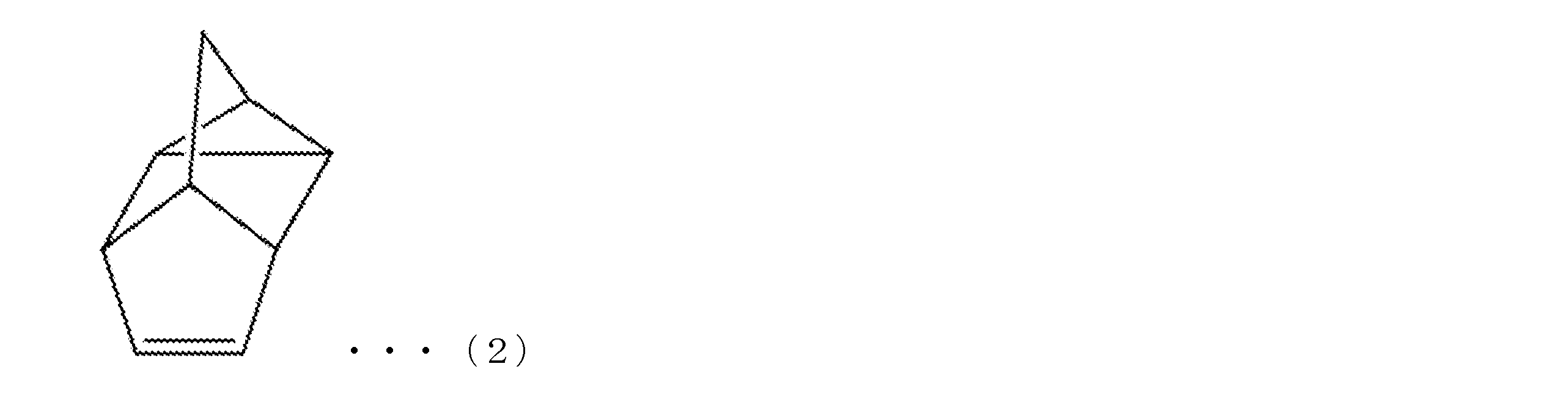
デルタサイクレンに由来する構造単位(A)(以下、構造単位(A)と略すことがある。)は下記式(2)で表されるデルタサイクレンに由来する構造単位である。
[含有割合]
そして、構造単位(A)の含有割合は、環状オレフィン開環重合体に含まれる全繰り返し単位の含有割合を100質量%としたとき、10質量%以上であることが好ましく、15質量%以上であることがより好ましく、20質量%以上であることが更に好ましく、また、90質量%以下であることが好ましく、75質量%以下であることがより好ましく、60質量%以下であることが更に好ましく、50質量%以下であることが特に好ましい。構造単位(A)の含有割合が上記上限値以下であれば、環状オレフィン開環重合体の合成後に環状オレフィン開環重合体が沈殿することを抑制することができる。また、構造単位(A)の含有割合が上記下限値以上であれば、得られる環状オレフィン開環重合体水素化物のガラス転移温度が高くなり過ぎることを抑制することができる。
なお、本発明において、「構造単位の含有割合」は、1H-NMRや13C-NMRなどの核磁気共鳴(NMR)法を用いて測定することができる。
そして、構造単位(A)の含有割合は、環状オレフィン開環重合体に含まれる全繰り返し単位の含有割合を100質量%としたとき、10質量%以上であることが好ましく、15質量%以上であることがより好ましく、20質量%以上であることが更に好ましく、また、90質量%以下であることが好ましく、75質量%以下であることがより好ましく、60質量%以下であることが更に好ましく、50質量%以下であることが特に好ましい。構造単位(A)の含有割合が上記上限値以下であれば、環状オレフィン開環重合体の合成後に環状オレフィン開環重合体が沈殿することを抑制することができる。また、構造単位(A)の含有割合が上記下限値以上であれば、得られる環状オレフィン開環重合体水素化物のガラス転移温度が高くなり過ぎることを抑制することができる。
なお、本発明において、「構造単位の含有割合」は、1H-NMRや13C-NMRなどの核磁気共鳴(NMR)法を用いて測定することができる。
<芳香環構造を有する環状オレフィン単量体に由来する構造単位(B)>
芳香環構造を有する環状オレフィン単量体に由来する構造単位(B)(以下、構造単位(B)と略すことがある。)を形成し得る芳香環構造を有する環状オレフィン単量体としては、特に限定されず、例えば、芳香環構造を有するノルボルネン化合物、および、芳香環構造を有する非ノルボルネン化合物が挙げられる。これらは組み合わせて用いてもよいが、得られる環状オレフィン開環重合体水素化物に適度な大きさのアッベ数を付与しつつ、複屈折率を一層低減させる観点からは、構造単位(B)を形成し得る芳香環構造を有する環状オレフィン単量体は、芳香環構造を有するノルボルネン化合物であることが好ましい。
芳香環構造を有する環状オレフィン単量体に由来する構造単位(B)(以下、構造単位(B)と略すことがある。)を形成し得る芳香環構造を有する環状オレフィン単量体としては、特に限定されず、例えば、芳香環構造を有するノルボルネン化合物、および、芳香環構造を有する非ノルボルネン化合物が挙げられる。これらは組み合わせて用いてもよいが、得られる環状オレフィン開環重合体水素化物に適度な大きさのアッベ数を付与しつつ、複屈折率を一層低減させる観点からは、構造単位(B)を形成し得る芳香環構造を有する環状オレフィン単量体は、芳香環構造を有するノルボルネン化合物であることが好ましい。
ここで、芳香環構造としては、特に限定されることなく、芳香族炭化水素環、および、芳香族複素環が挙げられる。
芳香族炭化水素環としては、特に限定されず、ベンゼン環、ナフタレン環、アントラセン環等の炭素数6~30の芳香族炭化水素環が挙げられる。中でも、ベンゼン環が好ましい。
また、芳香族複素環としては、特に限定されず、フラン環、ベンゾフラン環、ピロール環、インドール環、チオフェン環、ベンゾチオフェン環、ピリジン環、ピラジン環、ピリミジン環、トリアゾール環、トリアジン環、ピロリン環、イミダゾール環、ピラゾール環、チアゾール環、ベンゾチアゾール環、チエノチアゾール環、オキサゾール環、およびベンゾオキサゾール環等の炭素数2~30の芳香族複素環が挙げられる。
芳香族炭化水素環としては、特に限定されず、ベンゼン環、ナフタレン環、アントラセン環等の炭素数6~30の芳香族炭化水素環が挙げられる。中でも、ベンゼン環が好ましい。
また、芳香族複素環としては、特に限定されず、フラン環、ベンゾフラン環、ピロール環、インドール環、チオフェン環、ベンゾチオフェン環、ピリジン環、ピラジン環、ピリミジン環、トリアゾール環、トリアジン環、ピロリン環、イミダゾール環、ピラゾール環、チアゾール環、ベンゾチアゾール環、チエノチアゾール環、オキサゾール環、およびベンゾオキサゾール環等の炭素数2~30の芳香族複素環が挙げられる。
上記芳香環構造は、単環構造であってもよいし、上述した芳香族炭化水素環および芳香族複素環からなる群から選択される少なくとも1種の環が縮合してなる多環構造であってもよい。
また、上記芳香環構造は置換基を有していてもよい。置換基の具体例としては、例えば、塩素原子、フッ素原子、臭素原子、ヨウ素原子等のハロゲン原子;シアノ基;ニトロ基;メチル基、エチル基、プロピル基等の炭素数1以上10以下の無置換のアルキル基;ビニル基、アリル基等の炭素数2以上6以下の無置換のアルケニル基;トリフルオロメチル基等の1個以上の水素原子がフッ素原子等のハロゲン原子で置換された炭素数1以上10以下のアルキル基;メトキシ基、エトキシ基、イソプロポキシ基等の炭素数1以上10以下のアルコキシ基;等が挙げられる。
置換基の数は、一つでもよいし、複数でもよい。複数の置換基を有する場合、それらは互いに同一であってもよいし、異なっていてもよい。
置換基の数は、一つでもよいし、複数でもよい。複数の置換基を有する場合、それらは互いに同一であってもよいし、異なっていてもよい。
これらの中でも、得られる環状オレフィン開環重合体水素化物に適度な大きさのアッベ数を付与しつつ、複屈折率を一層低減させる観点からは、上記芳香環構造は、芳香族炭化水素環であることが好ましい。
[芳香環構造を有するノルボルネン化合物]
芳香環構造を有するノルボルネン化合物としては、例えば、分子内に1つ以上の芳香環構造と1つ以上のノルボルネン環とを有する化合物が挙げられる。なお、芳香環構造とノルボルネン環とは、それぞれ単独で別々に存在していてもよいし、縮合環を形成していてもよい。
芳香環構造を有するノルボルネン化合物としては、例えば、分子内に1つ以上の芳香環構造と1つ以上のノルボルネン環とを有する化合物が挙げられる。なお、芳香環構造とノルボルネン環とは、それぞれ単独で別々に存在していてもよいし、縮合環を形成していてもよい。
芳香環構造を有するノルボルネン化合物としては、例えば、5-フェニル-2-ノルボルネン等のフェニルノルボルネン、5-メチル-5-フェニル-ビシクロ[2.2.1]ヘプト-2-エン、5-ベンジル-ビシクロ[2.2.1]ヘプト-2-エン、5-トリル-ビシクロ[2.2.1]ヘプト-2-エン〔即ち、5-(4-メチルフェニル)-2-ノルボルネン〕、5-(エチルフェニル)-ビシクロ[2.2.1]ヘプト-2-エン、5-(イソプロピルフェニル)-ビシクロ[2.2.1]ヘプト-2-エン、5-メチル-5-カルボキシベンジルビシクロ[2.2.1]ヘプト-2-エン、8-フェニル-テトラシクロ[4.4.0.12,5.17,10]-3-ドデセン、8-メチル-8-フェニル-テトラシクロ[4.4.0.12,5.17,10]-3-ドデセン、8-ベンジル-テトラシクロ[4.4.0.12,5.17,10]-3-ドデセン、8-トリル-テトラシクロ[4.4.0.12,5.17,10]-3-ドデセン、8-(エチルフェニル)-テトラシクロ[4.4.0.12,5.17,10]-3-ドデセン、8-(イソプロピルフェニル)-テトラシクロ[4.4.0.12,5.17,10]-3-ドデセン、8,9-ジフェニル-テトラシクロ[4.4.0.12,5.17,10]-3-ドデセン、8-(ビフェニル)-テトラシクロ[4.4.0.12,5.17,10]-3-ドデセン、8-(β-ナフチル)-テトラシクロ[4.4.0.12,5.17,10]-3-ドデセン、8-(α-ナフチル)-テトラシクロ[4.4.0.12,5.17,10]-3-ドデセン、8-(アントラセニル)-テトラシクロ[4.4.0.12,5.17,10]-3-ドデセン、11-フェニル-ヘキサシクロ[6.6.1.13,6.110,13.02,7.09,14]-4-ヘプタデセン、6-(α-ナフチル)-ビシクロ[2.2.1]-ヘプト-2-エン、5-(アントラセニル)-ビシクロ[2.2.1]-ヘプト-2-エン、5-(ビフェニル)-ビシクロ[2.2.1]-ヘプト-2-エン、5-(β-ナフチル)-ビシクロ[2.2.1]-ヘプト-2-エン、5,6-ジフェニル-ビシクロ[2.2.1]-ヘプト-2-エン、9-(2-ノルボルネン-5-イル)-カルバゾール、1,4-メタノ-1,4,4a,4b,5,8,8a,9a-オクタヒドロフルオレン、1,4-メタノ-1,4,4a,9a-テトラヒドロフルオレン、1,4-メタノ-8-メチル-1,4,4a,9a-テトラヒドロフルオレン、1,4-メタノ-8-クロロ-1,4,4a,9a-テトラヒドロフルオレン、1,4-メタノ-8-ブロモ-1,4,4a,9a-テトラヒドロフルオレン、1,4-メタノ-1,4,4a,9a-テトラヒドロジベンゾフラン、1,4-メタノ-1,4,4a,9a-テトラヒドロカルバゾール、1,4-メタノ-9-フェニル-1,4,4a,9a-テトラヒドロカルバゾール、1,4-メタノ-1,4,4a,5,10,10a-ヘキサヒドロアントラセン、7,10-メタノ-6b,7,10,10a-テトラヒドロフルオランセン、シクロペンタジエン-アセナフチレン付加物、シクロペンタジエン-アセナフチレン付加物にシクロペンタジエンをさらに付加した化合物、11,12-ベンゾ-ペンタシクロ[6.5.1.13,6.02,7.09,13]-4-ペンタデセン、11,12-ベンゾ-ペンタシクロ[6.6.1.13,6.02,7.09,14]-4-ヘキサデセン、14,15-ベンゾ-ヘプタシクロ[8.7.0.12,9.14,7.111,17.03,8.012,16]-5-エイコセン、5,5A,6,9,9A,10,10A,11-オクタヒドロ-4bh-5,10,6,9-ジメタノ-ベンゾ[B]フルオレン、およびこれらの誘導体、並びに、下記式(1)で表される化合物が挙げられる。なお、誘導体とは、環構造中に置換基を有するものを指す。そして、環構造中に有し得る置換基としては、特に限定されず、例えば、アルキル基、アルキレン基、ビニル基、アルコキシカルボニル基、アルキリデン基が挙げられる。そして、誘導体の環構造は、これら置換基を1種有していてもよく、2種以上有していてもよい。
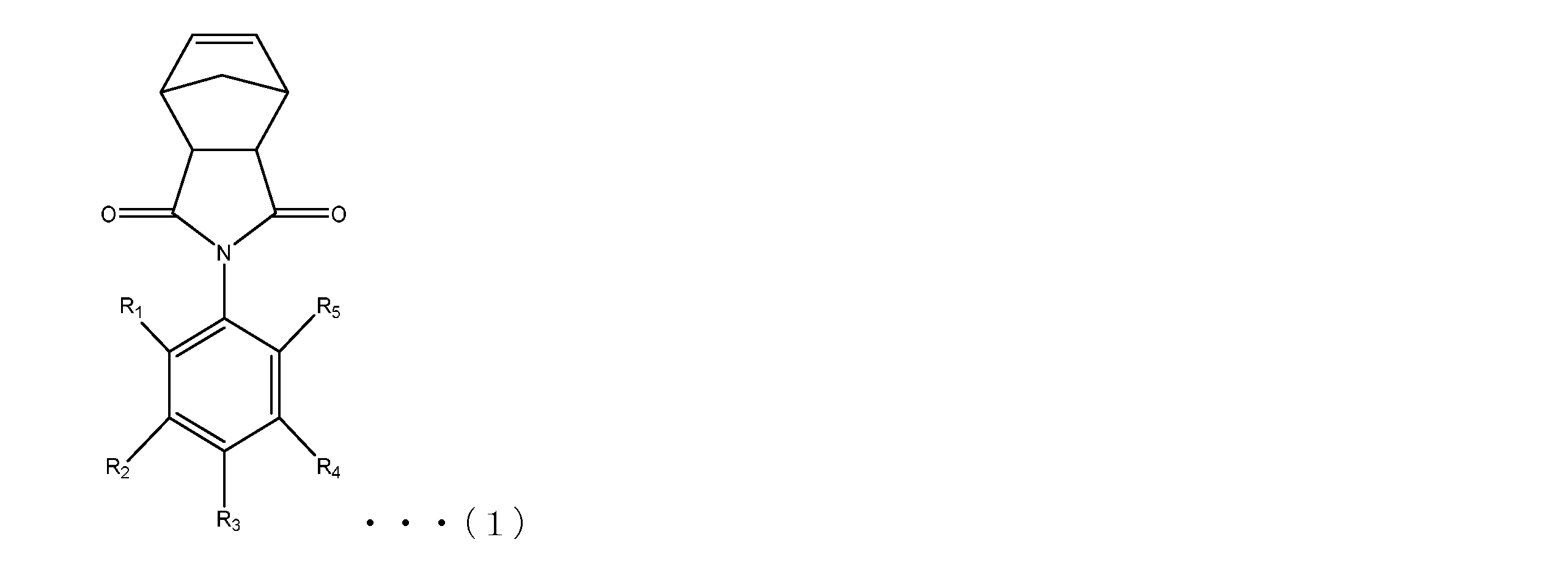
(式(1)中、R1~R5は、それぞれ独立して、水素原子、ハロゲン原子、水酸基、シアノ基、ニトロ基、置換基を有していてもよいアルキル基、置換基を有していてもよいシクロアルキル基、置換基を有していてもよいアルケニル基、置換基を有していてもよいアルキニル基、置換基を有していてもよいアルコキシ基、置換基を有していてもよい芳香族炭化水素環基、または置換基を有していてもよい芳香族複素環基を表し、R1~R5は、それらの2つ以上が結合して環を形成してもよい。)
ここで、R1~R5を構成し得るハロゲン原子としては、特に限定されず、塩素原子、フッ素原子、臭素原子、ヨウ素原子等が挙げられる。
R1~R5を構成し得る置換基を有していてもよいアルキル基としては、特に限定されず、置換基を有していてもよい炭素数1以上10以下のアルキル基が挙げられる。「置換基を有していてもよい炭素数1以上10以下のアルキル基」の炭素数1以上10以下のアルキル基としては、直鎖状、分岐鎖状のいずれでもよく、例えば、メチル基、エチル基、n-プロピル基、イソプロピル基、n-ブチル基、イソブチル基、tert-ブチル基、n-ペンチル基、ネオペンチル基、ヘキシル基、オクチル基、ノニル基、デシル基などのアルキル基が挙げられる。中でも、メチル基が好ましい。
「置換基を有していてもよい炭素数1以上10以下のアルキル基」の置換基の具体例としては、上述した芳香環構造が有し得る置換基と同じものが挙げられる。置換基の数は、一つでもよいし、複数でもよい。複数の置換基を有する場合、それらは互いに同一であってもよいし、異なっていてもよい。
「置換基を有していてもよい炭素数1以上10以下のアルキル基」の置換基の具体例としては、上述した芳香環構造が有し得る置換基と同じものが挙げられる。置換基の数は、一つでもよいし、複数でもよい。複数の置換基を有する場合、それらは互いに同一であってもよいし、異なっていてもよい。
R1~R5を構成し得る置換基を有していてもよいシクロアルキル基としては、特に限定されず、置換基を有していてもよい炭素数3以上12以下のシクロアルキル基が挙げられる。「置換基を有していてもよい炭素数3以上12以下のシクロアルキル基」の炭素数3以上12以下のシクロアルキル基としては、例えば、シクロプロピル基、シクロブチル基、シクロペンチル基、シクロヘキシル基、シクロオクチル基などが挙げられる。
「置換基を有していてもよい炭素数3以上12以下のシクロアルキル基」の置換基の具体例としては、上述した芳香環構造が有し得る置換基と同じものが挙げられる。置換基の数は、一つでもよいし、複数でもよい。複数の置換基を有する場合、それらは互いに同一であってもよいし、異なっていてもよい。
「置換基を有していてもよい炭素数3以上12以下のシクロアルキル基」の置換基の具体例としては、上述した芳香環構造が有し得る置換基と同じものが挙げられる。置換基の数は、一つでもよいし、複数でもよい。複数の置換基を有する場合、それらは互いに同一であってもよいし、異なっていてもよい。
R1~R5を構成し得る置換基を有していてもよいアルケニル基としては、特に限定されず、置換基を有していてもよい炭素数2以上10以下のアルケニル基が挙げられる。「置換基を有していてもよい炭素数2以上10以下のアルケニル基」の炭素数2以上10以下のアルケニル基としては、直鎖状、分岐鎖状のいずれでもよく、例えば、ビニル基、プロペニル基、イソプロペニル基、ブテニル基、イソブテニル基、ペンテニル基、ヘキセニル基、ヘプテニル基、オクテニル基、デセニル基などが挙げられる。
「置換基を有していてもよい炭素数2以上10以下のアルケニル基」の置換基の具体例としては、上述した芳香環構造が有し得る置換基と同じものが挙げられる。置換基の数は、一つでもよいし、複数でもよい。複数の置換基を有する場合、それらは互いに同一であってもよいし、異なっていてもよい。
「置換基を有していてもよい炭素数2以上10以下のアルケニル基」の置換基の具体例としては、上述した芳香環構造が有し得る置換基と同じものが挙げられる。置換基の数は、一つでもよいし、複数でもよい。複数の置換基を有する場合、それらは互いに同一であってもよいし、異なっていてもよい。
R1~R5を構成し得る置換基を有していてもよいアルキニル基としては、特に限定されず、置換基を有していてもよい炭素数2以上10以下のアルキニル基が挙げられる。「置換基を有していてもよい炭素数2以上10以下のアルキニル基」の炭素数2以上10以下のアルキニル基としては、直鎖状、分岐鎖状のいずれでもよく、例えば、エチニル基、プロピニル基、2-プロピニル基(プロパルギル基)、ブチニル基、2-ブチニル基、3-ブチニル基、ペンチニル基、2-ペンチニル基、ヘキシニル基、5-ヘキシニル基、ヘプチニル基、オクチニル基、2-オクチニル基、ノナニル基、デカニル基、7-デカニル基などが挙げられる。
「置換基を有していてもよい炭素数2以上10以下のアルキニル基」の置換基の具体例としては、上述した芳香環構造が有し得る置換基と同じものが挙げられる。置換基の数は、一つでもよいし、複数でもよい。複数の置換基を有する場合、それらは互いに同一であってもよいし、異なっていてもよい。
「置換基を有していてもよい炭素数2以上10以下のアルキニル基」の置換基の具体例としては、上述した芳香環構造が有し得る置換基と同じものが挙げられる。置換基の数は、一つでもよいし、複数でもよい。複数の置換基を有する場合、それらは互いに同一であってもよいし、異なっていてもよい。
R1~R5を構成し得る構成し得る置換基を有していてもよいアルコキシ基としては、特に限定されず、置換基を有していてもよい炭素数1以上10以下のアルコキシ基が挙げられる。「置換基を有していてもよい炭素数1以上10以下のアルコキシ基」の炭素数1以上10以下のアルコキシ基としては、直鎖状、分岐鎖状のいずれでもよく、例えば、メトキシ基、エトキシ基、プロポキシ基、イソプロポキシ基、ブトキシ基、オクトキシ基等が挙げられる。
「置換基を有していてもよい炭素数1以上10以下のアルコキシ基」の置換基の具体例としては、上述した芳香環構造が有し得る置換基と同じものが挙げられる。置換基の数は、一つでもよいし、複数でもよい。複数の置換基を有する場合、それらは互いに同一であってもよいし、異なっていてもよい。
「置換基を有していてもよい炭素数1以上10以下のアルコキシ基」の置換基の具体例としては、上述した芳香環構造が有し得る置換基と同じものが挙げられる。置換基の数は、一つでもよいし、複数でもよい。複数の置換基を有する場合、それらは互いに同一であってもよいし、異なっていてもよい。
R1~R5を構成し得る構成し得る置換基を有していてもよい芳香族炭化水素環基としては、特に限定されず、置換基を有していてもよい炭素数6以上30以下の芳香族炭化水素環基が挙げられる。「置換基を有していてもよい炭素数6以上30以下の芳香族炭化水素環基」の炭素数6以上30以下の芳香族炭化水素環基としては、フェニル基、ナフチル基、アントラセニル基などが挙げられる。
「置換基を有していてもよい炭素数6以上30以下の芳香族炭化水素環基」の置換基の具体例としては、上述した芳香環構造が有し得る置換基と同じものが挙げられる。置換基の数は、一つでもよいし、複数でもよい。複数の置換基を有する場合、それらは互いに同一であってもよいし、異なっていてもよい。
「置換基を有していてもよい炭素数6以上30以下の芳香族炭化水素環基」の置換基の具体例としては、上述した芳香環構造が有し得る置換基と同じものが挙げられる。置換基の数は、一つでもよいし、複数でもよい。複数の置換基を有する場合、それらは互いに同一であってもよいし、異なっていてもよい。
R1~R5を構成し得る構成し得る置換基を有していてもよい芳香族複素環基としては、特に限定されず、置換基を有していてもよい炭素数6以上30以下の芳香族複素環基が挙げられる。「置換基を有していてもよい炭素数6以上30以下の芳香族複素環基」の炭素数6以上30以下の芳香族炭化水素環基としては、例えば、フラニル基、1-ベンゾフラニル基、2-ベンゾフラニル基、ピロリル基、インドリル基、チエニル基、ベンゾ[c]チエニル基、ベンゾ[b]チエニル基、ピリジル基、ピラジニル基、ピリミジニル基、トリアゾリル基、トリアジニル基、ピロリル基、イミダゾリル基、ピラゾリル基、チアゾリル基、ベンゾチアゾリル基、オキサゾリル基、および、ベンゾオキサゾリル基などが挙げられる。
「置換基を有していてもよい炭素数6以上30以下の芳香族複素環基」の置換基の具体例としては、上述した芳香環構造が有し得る置換基と同じものが挙げられる。置換基の数は、一つでもよいし、複数でもよい。複数の置換基を有する場合、それらは互いに同一であってもよいし、異なっていてもよい。
「置換基を有していてもよい炭素数6以上30以下の芳香族複素環基」の置換基の具体例としては、上述した芳香環構造が有し得る置換基と同じものが挙げられる。置換基の数は、一つでもよいし、複数でもよい。複数の置換基を有する場合、それらは互いに同一であってもよいし、異なっていてもよい。
R1~R5の2つ以上が結合して形成される環は単環であっても多環でもよい。R1~R5の2つ以上が結合して形成される環としては、特に限定されず、芳香族炭化水素環、芳香族複素環、非芳香族炭化水素環、および、これらの環が2つ以上縮合してなる多環縮合環が挙げられる。
上記芳香族炭化水素環および芳香族複素環の具体例としては、上述した「芳香環構造」と同様のものが挙げられる。また、非芳香族炭化水素環の具体例としては、シクロプロピル環、シクロブチル環、シクロペンチル環、シクロヘキシル環、シクロオクチル環等の炭素数3以上12以下のシクロアルキル環が挙げられる。
上記芳香族炭化水素環および芳香族複素環の具体例としては、上述した「芳香環構造」と同様のものが挙げられる。また、非芳香族炭化水素環の具体例としては、シクロプロピル環、シクロブチル環、シクロペンチル環、シクロヘキシル環、シクロオクチル環等の炭素数3以上12以下のシクロアルキル環が挙げられる。
中でも、得られる環状オレフィン開環重合体水素化物に適度な大きさのアッベ数を付与しつつ、複屈折率を一層低減させる観点からは、式(1)で表される化合物としては、式(1)中のR1~R5のうちの1つ以上が置換基を有していてもよい炭素数1以上10以下のアルキル基であり、残りが水素原子である化合物が好ましく、R1~R5のうちの2つが置換基を有していてもよい炭素数1以上10以下のアルキル基であり、残りが水素原子である化合物がより好ましい。
また、得られる環状オレフィン開環重合体水素化物に適度な大きさのアッベ数を付与しつつ、複屈折率をより一層低減させる観点からは、式(1)で表される化合物としては、式(1)中のR1~R5のうちの1つ以上がメチル基であり、残りが水素原子である化合物が好ましく、R1~R5のうちの2つがメチル基であり、残りが水素原子である化合物がより好ましく、式(1)中のR1またはR5がメチル基であり、残りが水素原子である化合物(すなわち、N-2-メチルフェニル-ビシクロ[2.2.1]ヘプト-5-エン-2,3-ジカルボキシイミド)が更に好ましく、式(1)中のR1およびR5がメチル基であり、残りが水素原子である化合物(すなわち、N-2,6-ジメチルフェニル-ビシクロ[2.2.1]ヘプト-5-エン-2,3-ジカルボキシイミド)が一層更に好ましい。
また、得られる環状オレフィン開環重合体水素化物に適度な大きさのアッベ数を付与しつつ、複屈折率をより一層低減させる観点からは、式(1)で表される化合物としては、式(1)中のR1~R5のうちの1つ以上がメチル基であり、残りが水素原子である化合物が好ましく、R1~R5のうちの2つがメチル基であり、残りが水素原子である化合物がより好ましく、式(1)中のR1またはR5がメチル基であり、残りが水素原子である化合物(すなわち、N-2-メチルフェニル-ビシクロ[2.2.1]ヘプト-5-エン-2,3-ジカルボキシイミド)が更に好ましく、式(1)中のR1およびR5がメチル基であり、残りが水素原子である化合物(すなわち、N-2,6-ジメチルフェニル-ビシクロ[2.2.1]ヘプト-5-エン-2,3-ジカルボキシイミド)が一層更に好ましい。
そして、これらの芳香環構造を有するノルボルネン化合物の中でも、得られる環状オレフィン開環重合体水素化物に適度な大きさのアッベ数を付与しつつ、複屈折率を一層低減させる観点からは、芳香環構造を有するノルボルネン化合物は、1,4-メタノ-1,4,4a,9a-テトラヒドロフルオレン、5,5A,6,9,9A,10,10A,11-オクタヒドロ-4bh-5,10,6,9-ジメタノ-ベンゾ[B]フルオレン、式(1)で表される化合物であることが好ましく、式(1)で表される化合物であることがより好ましい。
上述した芳香環構造を有するノルボルネン化合物は、1種を単独で用いてもよいし、2種以上を組み合わせて用いることもできる。
[芳香環構造を有する非ノルボルネン化合物]
芳香環構造を有する非ノルボルネン化合物としては、特に限定されず、例えば、上述した芳香環構造を有するシクロアルケン類が挙げられる。「芳香環構造を有するシクロアルケン類」のシクロアルケン類の具体例としては、シクロブテン、シクロペンテン、シクロヘキセン、シクロヘプテン、シクロオクテン、1,4-シクロオクタジエン、シクロデセンなどが挙げられる。
芳香環構造を有する非ノルボルネン化合物としては、特に限定されず、例えば、上述した芳香環構造を有するシクロアルケン類が挙げられる。「芳香環構造を有するシクロアルケン類」のシクロアルケン類の具体例としては、シクロブテン、シクロペンテン、シクロヘキセン、シクロヘプテン、シクロオクテン、1,4-シクロオクタジエン、シクロデセンなどが挙げられる。
そして、芳香環構造を有する非ノルボルネン化合物の具体例としては、1-フェニルシクロペンテン、1-フェニルシクロヘキセン、5-フェニルシクロオクテンなどが挙げられる。
上述した芳香環構造を有する非ノルボルネン化合物は、1種を単独で用いてもよいし、2種以上を組み合わせて用いることもできる。
[含有割合]
構造単位(B)の含有割合は、環状オレフィン開環重合体に含まれる全繰り返し単位の含有割合を100質量%としたとき、10質量%以上であることが好ましく、25質量%以上であることがより好ましく、40質量%以上であることが更に好ましく、50質量%以上であることが特に好ましく、また、90質量%以下であることが好ましく、85質量%以下であることがより好ましく、80質量%以下であることが更に好ましい。構造単位(B)の含有割合が上記下限値以上であれば、環状オレフィン開環重合体水素化物のガラス転移温度が低く成形体が熱変形してしまうことを抑制することができる。また、構造単位(B)の含有割合が上記上限値以下であれば、環状オレフィン開環重合体の合成後に環状オレフィン開環重合体が沈殿することを抑制することができる。
構造単位(B)の含有割合は、環状オレフィン開環重合体に含まれる全繰り返し単位の含有割合を100質量%としたとき、10質量%以上であることが好ましく、25質量%以上であることがより好ましく、40質量%以上であることが更に好ましく、50質量%以上であることが特に好ましく、また、90質量%以下であることが好ましく、85質量%以下であることがより好ましく、80質量%以下であることが更に好ましい。構造単位(B)の含有割合が上記下限値以上であれば、環状オレフィン開環重合体水素化物のガラス転移温度が低く成形体が熱変形してしまうことを抑制することができる。また、構造単位(B)の含有割合が上記上限値以下であれば、環状オレフィン開環重合体の合成後に環状オレフィン開環重合体が沈殿することを抑制することができる。
<その他の構造単位>
環状オレフィン開環重合体が任意に含み得るその他の構造単位としては、上述した構造単位(A)および構造単位(B)以外であれば特に限定されず、芳香環構造を有さない環状オレフィン化合物に由来する構造単位が挙げられる。
環状オレフィン開環重合体が任意に含み得るその他の構造単位としては、上述した構造単位(A)および構造単位(B)以外であれば特に限定されず、芳香環構造を有さない環状オレフィン化合物に由来する構造単位が挙げられる。
芳香環構造を有さない環状オレフィン化合物に由来する構造単位を形成し得る、芳香環構造を有さない環状オレフィン化合物としては、特に限定されず、例えば、芳香環構造を有さないノルボルネン化合物、および、芳香環構造を有さない非ノルボルネン化合物などが挙げられる。
芳香環構造を有さないノルボルネン化合物としては、特に限定されず、例えば、テトラシクロ[6.2.1.13,6.02,7]ドデカ-4-エン(慣用名:テトラシクロドデセン)、2-エチリデン-1,2,3,4,4a,5,8,8a-オクタヒドロ-1,4:5,8-ジメタノナフタレン(慣用名:エチリデンテトラシクロドデセン)、トリシクロ[5.2.1.02,6]デカ-3,8-ジエン(慣用名:ジシクロペンタジエン)、5-エチリデンビシクロ[2.2.1]ヘプト-2-エン(慣用名:エチリデンノルボルネン)、ビシクロ[2.2.1]ヘプト-2-エン(「ノルボルネン」ともいう)、5-エチル-ビシクロ[2.2.1]ヘプト-2-エン、5-ブチル-ビシクロ[2.2.1]ヘプト-2-エン、5-メチリデン-ビシクロ[2.2.1]ヘプト-2-エン、5-ビニル-ビシクロ[2.2.1]ヘプト-2-エン、テトラシクロ[10.2.1.02,11.04,9]ペンタデカ-4,6,8,13-テトラエン、9-メチル-テトラシクロ[6.2.1.13,6.02,7]ドデカ-4-エン、9-エチル-テトラシクロ[6.2.1.13,6.02,7]ドデカ-4-エン、9-メチリデン-テトラシクロ[6.2.1.13,6.02,7]ドデカ-4-エン、9-エチリデン-テトラシクロ[6.2.1.13,6.02,7]ドデカ-4-エン、9-ビニル-テトラシクロ[6.2.1.13,6.02,7]ドデカ-4-エン、9-プロペニル-テトラシクロ[6.2.1.13,6.02,7]ドデカ-4-エン、ペンタシクロ[9.2.1.13,9.02,10.04,8]ペンタデカ-5,12-ジエン、テトラシクロ[9.2.1.02,10.03,8]テトラデカ-3,5,7,12-テトラエン、ペンタシクロ[9.2.1.13,9.02,10.04,8]ペンタデカ-12-エン、およびこれらの誘導体などが挙げられる。なお、誘導体とは、環構造中に置換基を有するものを指す。そして、環構造中に有し得る置換基としては、芳香環構造を有さないものであれば特に限定されず、例えば、アルキル基、アルキレン基、ビニル基、アルコキシカルボニル基、アルキリデン基が挙げられる。そして、誘導体の環構造は、これら置換基を1種有していてもよく、2種以上有していてもよい。
また、芳香環構造を有さない非ノルボルネン化合物としては、特に限定されず、例えば、シクロブテン、シクロペンテン、シクロヘキセン、シクロヘプテン、シクロオクテン、1,4-シクロオクタジエン、シクロデセン等のシクロアルケン類が挙げられる。
上述した芳香環構造を有さない環状オレフィン化合物は、1種を単独で用いてもよいし、2種以上を組み合わせて用いてもよい。
[含有割合]
そして、環状オレフィン開環重合体が有する全構造単位(100質量%)中でその他の構造単位が占める割合(その他の構造単位の合計割合)は、通常、0質量%以上60質量%以下である。
そして、環状オレフィン開環重合体が有する全構造単位(100質量%)中でその他の構造単位が占める割合(その他の構造単位の合計割合)は、通常、0質量%以上60質量%以下である。
<構造単位(A)と構造単位(B)との質量比>
得られる環状オレフィン開環重合体水素化物に適度な大きさのアッベ数を付与しつつ、複屈折率を一層低減させる観点からは、環状オレフィン開環重合体中における構造単位(A)と構造単位(B)との質量比(構造単位(A)/構造単位(B))は、10/90以上であることが好ましく、25/75以上であることがより好ましく、また、90/10以下であることが好ましく、75/25以下であることがより好ましい。
得られる環状オレフィン開環重合体水素化物に適度な大きさのアッベ数を付与しつつ、複屈折率を一層低減させる観点からは、環状オレフィン開環重合体中における構造単位(A)と構造単位(B)との質量比(構造単位(A)/構造単位(B))は、10/90以上であることが好ましく、25/75以上であることがより好ましく、また、90/10以下であることが好ましく、75/25以下であることがより好ましい。
<環状オレフィン開環重合体の製造方法>
環状オレフィン開環重合体は、「環状オレフィン開環重合体」の項で上述した各種単量体を含む単量体組成物(混合物)を開環重合することにより得ることができる。具体的には、例えば、環状オレフィン開環重合体は、メタセシス重合触媒を用いた開環重合などの公知の開環重合方法を用いて、上記単量体組成物を開環重合することにより調製することができる。
なお、開環重合を行うことにより、上述した各単量体が有する環の数は少なくとも1つ減少する。
環状オレフィン開環重合体は、「環状オレフィン開環重合体」の項で上述した各種単量体を含む単量体組成物(混合物)を開環重合することにより得ることができる。具体的には、例えば、環状オレフィン開環重合体は、メタセシス重合触媒を用いた開環重合などの公知の開環重合方法を用いて、上記単量体組成物を開環重合することにより調製することができる。
なお、開環重合を行うことにより、上述した各単量体が有する環の数は少なくとも1つ減少する。
ここで、メタセシス重合触媒としては、特に限定はなく公知のものが用いられる。具体的には、例えば、ルテニウム、ロジウム、パラジウム、オスミウム、イリジウムおよび白金などから選ばれる金属のハロゲン化物、硝酸塩またはアセチルアセトン化合物と、還元剤とからなる触媒系;チタン、バナジウム、ジルコニウム、タングステンおよびモリブデンから選ばれる金属のハロゲン化物またはアセチルアセトン化合物と、助触媒の有機アルミニウム化合物とからなる触媒系;あるいは、特開平7-179575号公報、J.Am.Chem.Soc.,1986,108,733、J.Am.Chem.Soc.,1993,115,9858、および、J.Am.Chem.Soc.,1996,118,100などに開示されている公知のシュロック型やグラッブス型のリビング開環メタセシス触媒などを用いることができる。これらの触媒は、それぞれ単独で、あるいは2種以上を組み合わせて用いられる。触媒の使用量は、重合条件等により適宜選択すればよい。
なお、上記触媒系には、更に極性化合物を加えて、重合活性や開環重合の選択性を高めることができる。極性化合物としては、例えば、分子状酸素、アルコール、エーテル、過酸化物、カルボン酸、酸無水物、酸クロリド、エステル、ケトン、含窒素化合物、含硫黄化合物、含ハロゲン化合物、分子状ヨウ素、その他のルイス酸などが挙げられる。含窒素化合物としては、脂肪族または芳香族第三級アミンが好ましく、具体例としては、トリエチルアミン、ジメチルアニリン、トリ-n-ブチルアミン、ピリジン、α-ピコリンなどが挙げられる。これらの極性化合物は、それぞれ単独で、あるいは2種以上を組み合わせて用いられる。そして、その使用量は、適宜選択されるが、上記触媒中の金属との比、すなわち、極性化合物/金属の比(モル比)で、通常1~100,000、好ましくは5~10,000の範囲である。
重合反応は、溶媒を用いずに塊状重合で行ってもよいし、有機溶媒等の溶媒中で行ってもよい。溶媒としては、重合反応に不活性なものであれば格別な制限はないが、例えば、ベンゼン、トルエン、キシレンなどの芳香族炭化水素類;n-ペンタン、ヘキサン、ヘプタンなどの脂肪族炭化水素類;シクロヘキサンなどの脂環式炭化水素;スチレンジクロリド、ジクロルエタン、ジクロルエチレン、テトラクロルエタン、クロルベンゼン、ジクロルベンゼン、トリクロルベンゼンなどのハロゲン化炭化水素類;ニトロメタン、ニトロベンゼン、アセトニトリル、ベンゾニトリルなどの含窒素炭化水素類;テトラヒドロフラン、エチレングリコールジメチルエーテル等のエーテル系溶媒などが挙げられる。
重合温度、重合圧力、重合時間などの重合条件は、適宜調整することができる。
(環状オレフィン開環重合体水素化物)
本発明の環状オレフィン開環重合体水素化物は、原料としての上述した本発明の環状オレフィン開環重合体を水素化してなるものである。そして、本発明の環状オレフィン開環重合体水素化物は、適度な大きさのアッベ数と、低い複屈折率との両方を有する。
ここで、環状オレフィン開環重合体の水素化は、水素と水素化触媒とを用いて行うことができる。環状オレフィン開環重合体の水素化は、環状オレフィン開環重合体中に存在するオレフィン性二重結合などの非芳香族性の炭素-炭素不飽和結合を水素化することができれば、任意の水素化触媒および水素化条件を用いて行うことができる。
本発明の環状オレフィン開環重合体水素化物は、原料としての上述した本発明の環状オレフィン開環重合体を水素化してなるものである。そして、本発明の環状オレフィン開環重合体水素化物は、適度な大きさのアッベ数と、低い複屈折率との両方を有する。
ここで、環状オレフィン開環重合体の水素化は、水素と水素化触媒とを用いて行うことができる。環状オレフィン開環重合体の水素化は、環状オレフィン開環重合体中に存在するオレフィン性二重結合などの非芳香族性の炭素-炭素不飽和結合を水素化することができれば、任意の水素化触媒および水素化条件を用いて行うことができる。
環状オレフィン開環重合体の水素化は、環状オレフィン開環重合体中に存在するオレフィン性二重結合などの非芳香族性の炭素-炭素不飽和結合の水素化率(環状オレフィン開環重合体における非芳香族性の炭素-炭素不飽和結合に占める水素化されたものの割合)が、通常、90%以上となるように行われ、95%以上となるように行われることが好ましく、99%以上となるように行われることがより好ましい。環状オレフィン開環重合体中に含まれていたオレフィン性二重結合などの非芳香族性の炭素-炭素不飽和結合の水素化率が上記下限値以上であれば、成形時等での樹脂酸化劣化由来の黄変を抑制できる。
環状オレフィン開環重合体水素化物中に存在する芳香環構造(芳香環および/または芳香族複素環)が有する炭素-炭素不飽和結合(芳香族性の炭素-炭素不飽和結合)は水素化されていてもよいが、アッベ数を適度な大きさにしつつ、複屈折率を一層低減する観点からは、水素化されていないことが好ましい。具体的には、環状オレフィン開環重合体水素化物中における芳香族性の炭素-炭素不飽和結合の水素化率(環状オレフィン開環重合体における芳香族性の炭素-炭素不飽和結合に占める水素化されたものの割合)は、20%以下であることが好ましく、10%以下であることがより好ましく、0%(すなわち、水素化されていない)であることが特に好ましい。
なお、本発明において、非芳香族性の炭素-炭素不飽和結合および芳香族性の炭素-炭素不飽和結合の水素化率は、実施例に記載の方法により測定することができる。
また、非芳香族性の炭素-炭素不飽和結合および芳香族性の炭素-炭素不飽和結合の水素化率は、例えば、水素化触媒の種類や量、および/または、水素添加反応の条件(反応温度等)を変更することで調節することができる。
なお、本発明において、非芳香族性の炭素-炭素不飽和結合および芳香族性の炭素-炭素不飽和結合の水素化率は、実施例に記載の方法により測定することができる。
また、非芳香族性の炭素-炭素不飽和結合および芳香族性の炭素-炭素不飽和結合の水素化率は、例えば、水素化触媒の種類や量、および/または、水素添加反応の条件(反応温度等)を変更することで調節することができる。
水素化触媒としては、例えば、ジシクロペンタジエニルチタンハライド、有機カルボン酸ニッケル、有機カルボン酸コバルト等と周期律表第1~3族の有機金属化合物とからなる水素化触媒;カーボン、シリカ、ケイソウ土等で担持されたニッケル、白金、パラジウム、ルテニウム、レニウム、ロジウム金属触媒、コバルト、ニッケル、ロジウム、ルテニウム錯体等の金属触媒;リチウムアルミニウムハイドライド、p-トルエンスルホニルヒドラジド等の水素化化合物;などを用いることができる。これらの中でも、水素化触媒としては、異性化がなく収率よく目的物が得られる観点から、ルテニウム化合物が好ましい。
ルテニウム化合物としては、例えば、RuHCl(CO)(PPh3)3、RuHCl(CO)[P(p-Me-Ph)3]3、RuHCl(CO)(PCy3)2、RuHCl(CO)[P(n-Bu)3]3、RuHCl(CO)[P(i-Pr)3]2、RuH2(CO)(PPh3)3、RuH2(CO)[P(p-Me-Ph)3]3、RuH2(CO)(PCy3)3、RuH2(CO)[P(n-Bu)3]3、RuH(OCOCH3)(CO)(PPh3)2、RuH(OCOPh)(CO)(PPh3)2、RuH(OCOPh-CH3)(CO)(PPh3)2、RuH(OCOPh-OCH3)(CO)(PPh3)2、RuH(OCOPh)(CO)(PCy3)2等が挙げられる。
また、環状オレフィン開環重合体の水素化反応は、通常、不活性有機溶媒中で行うことができる。不活性有機溶媒としては、ベンゼン、トルエン、キシレン等の芳香族炭化水素系溶媒;ペンタン、ヘキサン等の脂肪族炭化水素系溶媒;シクロヘキサン、デカヒドロナフタレン等の脂環族炭化水素系溶媒;テトラヒドロフラン、エチレングリコールジメチルエーテル等のエーテル系溶媒;などが挙げられる。
そして、環状オレフィン開環重合体および水素化触媒が存在している系に水素を添加して環状オレフィン開環重合体を水素化する際の反応温度は、使用する水素化触媒によって異なるが、通常、-20℃~250℃、好ましくは-10℃~220℃、より好ましくは0℃~200℃である。反応温度が低すぎると水素化速度が遅くなりすぎる場合があり、高すぎると副反応が起こる場合がある。
また、水素の圧力は、通常0.01~20MPa、好ましくは0.05~15MPa、より好ましくは0.1~10MPaである。水素圧力が低すぎると水素化速度が遅くなりすぎる場合があり、高すぎると高耐圧反応装置が必要となる点において装置上の制約が生じる。
更に、反応時間は反応規模にもよるが、通常、0.1~10時間である。
また、水素の圧力は、通常0.01~20MPa、好ましくは0.05~15MPa、より好ましくは0.1~10MPaである。水素圧力が低すぎると水素化速度が遅くなりすぎる場合があり、高すぎると高耐圧反応装置が必要となる点において装置上の制約が生じる。
更に、反応時間は反応規模にもよるが、通常、0.1~10時間である。
なお、水素化反応後は、得られた環状オレフィン開環重合体水素化物を常法に従って回収すればよく、水素化物の回収にあたっては、ろ過等の手法により、触媒残渣を除去することができる。
<構造単位>
ここで、環状オレフィン開環重合体水素化物中の構造単位(A)には、デルタサイクレンを開環重合した際に得られる構造単位と、当該構造単位を水素化してなる構造単位とが含まれ得る。同様に、環状オレフィン開環重合体水素化物中の構造単位(B)には、芳香環構造を有する環状オレフィン単量体を開環重合した際に得られる構造単位と、当該構造単位を水素化してなる構造単位とが含まれ得る。さらに、同様に、環状オレフィン開環重合体水素化物中に任意に含まれるその他の構造単位には、その他の構造単位を形成し得る環状オレフィン化合物を開環重合した際に得られる構造単位と、当該構造単位を水素化してなる構造単位とが含まれ得る。
なお、環状オレフィン開環重合体水素化物における「デルタサイクレンを開環重合した際に得られる構造単位」、「芳香環構造を有する環状オレフィン単量体を開環重合した際に得られる構造単位」、および「その他の構造単位を形成し得る環状オレフィン化合物を開環重合した際に得られる構造単位」は、いずれも、環状オレフィン開環重合体の水素化時に水素化されなかった未水添の構造単位(繰り返し単位)である。
ここで、環状オレフィン開環重合体水素化物中の構造単位(A)には、デルタサイクレンを開環重合した際に得られる構造単位と、当該構造単位を水素化してなる構造単位とが含まれ得る。同様に、環状オレフィン開環重合体水素化物中の構造単位(B)には、芳香環構造を有する環状オレフィン単量体を開環重合した際に得られる構造単位と、当該構造単位を水素化してなる構造単位とが含まれ得る。さらに、同様に、環状オレフィン開環重合体水素化物中に任意に含まれるその他の構造単位には、その他の構造単位を形成し得る環状オレフィン化合物を開環重合した際に得られる構造単位と、当該構造単位を水素化してなる構造単位とが含まれ得る。
なお、環状オレフィン開環重合体水素化物における「デルタサイクレンを開環重合した際に得られる構造単位」、「芳香環構造を有する環状オレフィン単量体を開環重合した際に得られる構造単位」、および「その他の構造単位を形成し得る環状オレフィン化合物を開環重合した際に得られる構造単位」は、いずれも、環状オレフィン開環重合体の水素化時に水素化されなかった未水添の構造単位(繰り返し単位)である。
そして、環状オレフィン開環重合体水素化物中における構造単位(A)の含有割合(デルタサイクレンを開環重合した際に得られる構造単位と、当該構造単位を水素化してなる構造単位との合計割合)は、「環状オレフィン開環重合体」の項目で上述した環状オレフィン開環重合体中の構造単位(A)の好ましい含有割合と同様である。また、環状オレフィン開環重合体水素化物中における構造単位(B)の含有割合(芳香環構造を有する環状オレフィン単量体を開環重合した際に得られる構造単位と、当該構造単位を水素化してなる構造単位との合計割合)は、「環状オレフィン開環重合体」の項目で上述した環状オレフィン開環重合体中の構造単位(B)の好ましい含有割合と同様である。さらに、環状オレフィン開環重合体水素化物中に任意に含まれるその他の構造単位の含有割合(その他の構造単位を形成し得る環状オレフィン化合物を開環重合した際に得られる構造単位と、当該構造単位を水素化してなる構造単位との合計割合)は、「環状オレフィン開環重合体」の項目で上述した環状オレフィン開環重合体中のその他の構造単位の好ましい含有割合と同様である。
また、環状オレフィン開環重合体水素化物中における構造単位(A)と構造単位(B)との好ましい質量比も、「環状オレフィン開環重合体」の項目で上述した好ましい含有割合と同様である。
また、環状オレフィン開環重合体水素化物中における構造単位(A)と構造単位(B)との好ましい質量比も、「環状オレフィン開環重合体」の項目で上述した好ましい含有割合と同様である。
<重量平均分子量>
本発明の環状オレフィン開環重合体水素化物は、重量平均分子量が10000以上であることが好ましく、15000以上であることがより好ましく、20000以上であることが更に好ましく、40000以上であることが特に好ましく、また、160000以下であることが好ましく、80000以下であることがより好ましく、70000以下であることが更に好ましい。環状オレフィン開環重合体水素化物の重量平均分子量が上記下限値以上であれば、環状オレフィン開環重合体水素化物を用いて得られる樹脂成形体の強度の低下を抑制することができる。また、環状オレフィン開環重合体水素化物の重量平均分子量が上記上限値以下であれば、環状オレフィン開環重合体水素化物の成形時に流動性が悪化することに起因する成形不良の発生を抑制することができる。
なお、本発明において、「重量平均分子量」は、実施例に記載の方法により測定することができる。
また、環状オレフィン開環重合体水素化物の重量平均分子量は、例えば、環状オレフィン開環重合体を調製する際に用いられる単量体の種類および/または量、分子量調節剤(連鎖移動剤)の種類および/または配合量を変更することにより、調節することができる。
本発明の環状オレフィン開環重合体水素化物は、重量平均分子量が10000以上であることが好ましく、15000以上であることがより好ましく、20000以上であることが更に好ましく、40000以上であることが特に好ましく、また、160000以下であることが好ましく、80000以下であることがより好ましく、70000以下であることが更に好ましい。環状オレフィン開環重合体水素化物の重量平均分子量が上記下限値以上であれば、環状オレフィン開環重合体水素化物を用いて得られる樹脂成形体の強度の低下を抑制することができる。また、環状オレフィン開環重合体水素化物の重量平均分子量が上記上限値以下であれば、環状オレフィン開環重合体水素化物の成形時に流動性が悪化することに起因する成形不良の発生を抑制することができる。
なお、本発明において、「重量平均分子量」は、実施例に記載の方法により測定することができる。
また、環状オレフィン開環重合体水素化物の重量平均分子量は、例えば、環状オレフィン開環重合体を調製する際に用いられる単量体の種類および/または量、分子量調節剤(連鎖移動剤)の種類および/または配合量を変更することにより、調節することができる。
<ガラス転移温度>
本発明の環状オレフィン開環重合体水素化物は、ガラス転移温度が120℃以上であることが好ましく、125℃以上であることがより好ましく、130℃以上であることが更に好ましく、また、200℃以下であることが好ましく、190℃以下であることがより好ましく、180℃以下であることが更に好ましい。環状オレフィン開環重合体水素化物のガラス転移温度が上記下限値以上であれば、耐熱性が悪化して熱変形等により光学特性が悪化することを抑制することができる。また、環状オレフィン開環重合体水素化物のガラス転移温度が上記上限値以下であれば、環状オレフィン開環重合体水素化物を成形する際の加工温度が高くなりすぎることに起因する環状オレフィン開環重合体水素化物の酸化劣化の発生を抑制することができる。
環状オレフィン開環重合体水素化物のガラス転移温度は、例えば、環状オレフィン開環重合体を調製する際に用いられる単量体の種類および/または量を変更することにより調節することができる。
本発明の環状オレフィン開環重合体水素化物は、ガラス転移温度が120℃以上であることが好ましく、125℃以上であることがより好ましく、130℃以上であることが更に好ましく、また、200℃以下であることが好ましく、190℃以下であることがより好ましく、180℃以下であることが更に好ましい。環状オレフィン開環重合体水素化物のガラス転移温度が上記下限値以上であれば、耐熱性が悪化して熱変形等により光学特性が悪化することを抑制することができる。また、環状オレフィン開環重合体水素化物のガラス転移温度が上記上限値以下であれば、環状オレフィン開環重合体水素化物を成形する際の加工温度が高くなりすぎることに起因する環状オレフィン開環重合体水素化物の酸化劣化の発生を抑制することができる。
環状オレフィン開環重合体水素化物のガラス転移温度は、例えば、環状オレフィン開環重合体を調製する際に用いられる単量体の種類および/または量を変更することにより調節することができる。
<アッベ数>
本発明の環状オレフィン開環重合体水素化物は、アッベ数(vd)が50未満であることが好ましく、46以下であることがより好ましく、45以下であることが更に好ましく、43以下であることが一層更に好ましく、42以下であることが特に好ましい。環状オレフィン開環重合体水素化物のアッベ数が上記上限値未満であれば、環状オレフィン開環重合体水素化物を高アッベ数の光学素子用途以外に好適に用いることができる。なお、アッベ数の下限値は、特に限定されないが、通常、20程度である。
本発明の環状オレフィン開環重合体水素化物は、アッベ数(vd)が50未満であることが好ましく、46以下であることがより好ましく、45以下であることが更に好ましく、43以下であることが一層更に好ましく、42以下であることが特に好ましい。環状オレフィン開環重合体水素化物のアッベ数が上記上限値未満であれば、環状オレフィン開環重合体水素化物を高アッベ数の光学素子用途以外に好適に用いることができる。なお、アッベ数の下限値は、特に限定されないが、通常、20程度である。
<複屈折率>
本発明の環状オレフィン開環重合体水素化物は、複屈折率が300以下であることが好ましく、200以下であることがより好ましく、100以下であることが更に好ましく、90以下であることが一層更に好ましく、85以下であることが特に好ましい。環状オレフィン開環重合体水素化物の複屈折率が上記上限値以下であれば、得られる樹脂成形体の光学素子としての光学特性を向上させることができる。
なお、本発明において、「複屈折率」は、実施例に記載の方法により測定することができる。
本発明の環状オレフィン開環重合体水素化物は、複屈折率が300以下であることが好ましく、200以下であることがより好ましく、100以下であることが更に好ましく、90以下であることが一層更に好ましく、85以下であることが特に好ましい。環状オレフィン開環重合体水素化物の複屈折率が上記上限値以下であれば、得られる樹脂成形体の光学素子としての光学特性を向上させることができる。
なお、本発明において、「複屈折率」は、実施例に記載の方法により測定することができる。
<屈折率>
本発明の環状オレフィン開環重合体水素化物は、屈折率が1.5以上であることが好ましく、1.52以上であることがより好ましく、1.54以上であることが更に好ましい。環状オレフィン開環重合体水素化物の屈折率が上記下限値以上であれば、得られる樹脂成形体の光学素子としての設計自由度を高めることができる。
なお、本発明において、「屈折率」は、実施例に記載の方法により測定することができる。
本発明の環状オレフィン開環重合体水素化物は、屈折率が1.5以上であることが好ましく、1.52以上であることがより好ましく、1.54以上であることが更に好ましい。環状オレフィン開環重合体水素化物の屈折率が上記下限値以上であれば、得られる樹脂成形体の光学素子としての設計自由度を高めることができる。
なお、本発明において、「屈折率」は、実施例に記載の方法により測定することができる。
(樹脂組成物)
本発明の樹脂組成物は、上述した本発明の環状オレフィン開環重合体水素化物を含み、任意に、本発明の環状オレフィン開環重合体水素化物以外の高分子材料および/または各種添加剤を更に含む。
本発明の樹脂組成物は、上述した本発明の環状オレフィン開環重合体水素化物を含み、任意に、本発明の環状オレフィン開環重合体水素化物以外の高分子材料および/または各種添加剤を更に含む。
樹脂組成物が含有し得る高分子材料および添加剤としては、特に限定されることなく、例えば、特開平10-139865号公報に記載の高分子材料および添加剤が挙げられる。
中でも、樹脂組成物は、フェノール系酸化防止剤、リン系酸化防止剤、イオウ系酸化防止剤等の酸化防止剤を含有していることが好ましい。
高分子材料および添加剤は、環状オレフィン開環重合体水素化物中で十分に分散させることが可能であれば特に限定されることなく、任意の方法を用いて環状オレフィン開環重合体水素化物と混合することができる。具体的には、高分子材料および添加剤は、環状オレフィン開環重合体水素化物の調製中の任意の過程で添加してもよいし、混練機を用いて環状オレフィン開環重合体水素化物と混練してもよいし、成形装置内で環状オレフィン開環重合体水素化物と混合してもよい。
高分子材料および添加剤の配合量は、本発明の効果が損なわれない限り特に限定されないが、例えば、環状オレフィン開環重合体水素化物100質量部に対して、0.01質量部以上2.0質量部以下とすることができる。
また、酸化防止剤の配合量は、本発明の効果が損なわれない限り特に限定されないが、例えば、環状オレフィン開環重合体水素化物100質量部に対して、0.01質量部以上2.0質量部以下とすることができる。
高分子材料および添加剤の配合量は、本発明の効果が損なわれない限り特に限定されないが、例えば、環状オレフィン開環重合体水素化物100質量部に対して、0.01質量部以上2.0質量部以下とすることができる。
また、酸化防止剤の配合量は、本発明の効果が損なわれない限り特に限定されないが、例えば、環状オレフィン開環重合体水素化物100質量部に対して、0.01質量部以上2.0質量部以下とすることができる。
(樹脂成形体)
本発明の樹脂成形体は、上述した本発明の樹脂組成物を任意の形状に成形してなるものである。そして、本発明の樹脂成形体は、上述した本発明の環状オレフィン開環重合体水素化物を含んでいるため、優れた性能を発揮し得る。
本発明の樹脂成形体は、上述した本発明の樹脂組成物を任意の形状に成形してなるものである。そして、本発明の樹脂成形体は、上述した本発明の環状オレフィン開環重合体水素化物を含んでいるため、優れた性能を発揮し得る。
ここで、成形方法としては、樹脂組成物を成形することができる限り特に限定されず、例えば、射出成形法、エクストルージョンブロー成形法、インジェクションブロー成形法、二段ブロー成形法、多層ブロー成形法、コネクションブロー成形法、延伸ブロー成形法、回転成形法、真空成形法、押出成形法、カレンダー成形法、溶液流延法、熱プレス成形法、インフレーション法などを用いることができる。中でも、押出成形法が好ましい。
本発明の樹脂成形体は、光学素子であることが好ましく、レンズであることがより好ましい。
そして、レンズは、特に限定されることなく、例えば、本発明の樹脂組成物を均一に加熱溶解して予備成形体とし、次いで予備成形体を金型内に流入し、その後冷却することにより得ることができる。
そして、レンズは、特に限定されることなく、例えば、本発明の樹脂組成物を均一に加熱溶解して予備成形体とし、次いで予備成形体を金型内に流入し、その後冷却することにより得ることができる。
以下、本発明について実施例に基づき具体的に説明するが、本発明はこれら実施例に限定されるものではない。なお、以下の説明において、量を表す「%」および「部」は、特に断らない限り、質量基準である。また、複数種類の単量体を共重合して製造される重合体において、ある単量体を重合して形成される構造単位の前記重合体における割合は、別に断らない限り、通常は、その重合体の重合に用いる全単量体に占める当該ある単量体の比率(仕込み比)と一致する。
<重合転化率>
重合反応終了後、ガスクロマトグラフィーを用いて反応溶液中の単量体の残存量を測定し、その値より算出した。
<水素転化率>
1H-NMRスペクトルにより、水素添加された炭素-炭素二重結合モル数を測定し、水素添加前の炭素-炭素二重結合モル数に対する割合を算出することにより、環状オレフィン開環重合体水素化物中の非芳香族性の炭素-炭素不飽和結合の水素化率、および、芳香族性の炭素-炭素不飽和結合の水素添加率を求めた。
<重量平均分子量>
環状オレフィン開環重合体の重量平均分子量(Mw)は、ゲル・パーミエーション・クロマトグラフィー(東ソー社製、「HLC-8020」、TSKgel SuperH2000、TSKgel SuperH4000、TSKgel SuperH5000の3種類のカラムを組み合わせて使用)を用い、ポリスチレン換算で算出した。なお、展開溶媒としては、テトラヒドロフラン(THF)を用いた。
<ガラス転移温度>
環状オレフィン開環重合体水素化物のガラス転移温度(Tg)は、示差走査熱量分析計(SIIナノテクノロジー社製、「DSC6220」)を用いて、JIS K7121に基づき昇温速度10℃/分の条件で測定した。
<複屈折率>
得られた樹脂成形体について、波長が543nmの光における、樹脂成形体のゲートから10mmの箇所における樹脂流れ方向と垂直方向のレタデーション値を、複屈折計(フォトニックラティス製、製品名:WPA-200(-L))を用いてライン測定した。そして、測定値中の最大値を複屈折率とした。
<屈折率>
得られた樹脂成形体を、環状オレフィン開環重合体水素化物のガラス転移温度よりも15℃低い温度(=Tg-15℃)の雰囲気下に20時間放置したものを測定試料とした。
得られた測定試料について、精密屈折計(島津製作所社製、製品名:KPR-3000、光源=Heランプ(587.6nm)、H2ランプ(656.3nm、486.1nm)を用いて、25℃における屈折率(nd、nC、nF)を測定した。なお、表1では波長587.6nmの光における屈折率(nd)を示す。
<アッベ数>
上記屈折率測定により得られた、25℃における屈折率(nd、nC、nF)を用いて、下記式(1)に従ってアッベ数(νd)を算出した。

重合反応終了後、ガスクロマトグラフィーを用いて反応溶液中の単量体の残存量を測定し、その値より算出した。
<水素転化率>
1H-NMRスペクトルにより、水素添加された炭素-炭素二重結合モル数を測定し、水素添加前の炭素-炭素二重結合モル数に対する割合を算出することにより、環状オレフィン開環重合体水素化物中の非芳香族性の炭素-炭素不飽和結合の水素化率、および、芳香族性の炭素-炭素不飽和結合の水素添加率を求めた。
<重量平均分子量>
環状オレフィン開環重合体の重量平均分子量(Mw)は、ゲル・パーミエーション・クロマトグラフィー(東ソー社製、「HLC-8020」、TSKgel SuperH2000、TSKgel SuperH4000、TSKgel SuperH5000の3種類のカラムを組み合わせて使用)を用い、ポリスチレン換算で算出した。なお、展開溶媒としては、テトラヒドロフラン(THF)を用いた。
<ガラス転移温度>
環状オレフィン開環重合体水素化物のガラス転移温度(Tg)は、示差走査熱量分析計(SIIナノテクノロジー社製、「DSC6220」)を用いて、JIS K7121に基づき昇温速度10℃/分の条件で測定した。
<複屈折率>
得られた樹脂成形体について、波長が543nmの光における、樹脂成形体のゲートから10mmの箇所における樹脂流れ方向と垂直方向のレタデーション値を、複屈折計(フォトニックラティス製、製品名:WPA-200(-L))を用いてライン測定した。そして、測定値中の最大値を複屈折率とした。
<屈折率>
得られた樹脂成形体を、環状オレフィン開環重合体水素化物のガラス転移温度よりも15℃低い温度(=Tg-15℃)の雰囲気下に20時間放置したものを測定試料とした。
得られた測定試料について、精密屈折計(島津製作所社製、製品名:KPR-3000、光源=Heランプ(587.6nm)、H2ランプ(656.3nm、486.1nm)を用いて、25℃における屈折率(nd、nC、nF)を測定した。なお、表1では波長587.6nmの光における屈折率(nd)を示す。
<アッベ数>
上記屈折率測定により得られた、25℃における屈折率(nd、nC、nF)を用いて、下記式(1)に従ってアッベ数(νd)を算出した。
(実施例1)
1,2,3,3a,4,6a-ヘキサハイドロ-1,2,4-メテノペンタレン(デルタサイクレン;以下、「DCL」と略すことがある。)40部、芳香環構造を有する環状オレフィン単量体としてのN-2-メチルフェニル-ビシクロ[2.2.1]ヘプト-5-エン-2,3-ジカルボキシイミド(以下、「NBTI」と略すことがある。)60部、連鎖移動剤としての1-ヘキセン3部、重合触媒としての二塩化1,3-ビス(2,4,6-トリメチルフェニル)-4,5-ジヒドロイミダゾール-2-イリデン[2-(イソプロポキシ)-5-(N,N-ジメチルアミノスルホニル)フェニル]メチレンルテニウム(II)0.025部、および、溶媒としてのテトラヒドロフラン1000部を、窒素置換したガラス製耐圧反応器に仕込み、全容を65℃にて3時間撹拌することにより、開環重合を行った。得られた開環重合体の重合転化率は98%、得られた環状オレフィン開環重合体の重量平均分子量は16,100であった。
次いで、得られた重合反応液をオートクレーブに入れ、150℃、水素圧4.5MPaで6時間攪拌して水素化反応を行なった。この溶液を、ラヂオライトをプリコートした漏斗でろ過し、150℃で24時間真空乾燥することにより、環状オレフィン開環重合体水素化物を得た。
得られた環状オレフィン開環重合体水素化物の非芳香族性の炭素-炭素不飽和結合の水素化率は90.0%以上であった。また、得られた環状オレフィン開環重合体水素化物の芳香族性の炭素-炭素不飽和結合の水素化率は0%であった。
次いで、環状オレフィン開環重合体水素化物100部に、酸化防止剤(テトラキス〔メチレン-3-(3’,5’-ジ-t-ブチル-4’-ヒドロキシフェニル)プロピオネート〕メタン;BASFジャパン社製「イルガノックス(登録商標)1010」)1部を混合して、環状オレフィン開環重合体水素化物を含む樹脂組成物を得た。
その後、得られた樹脂組成物を、内径3mmのダイ穴を4つ備えた二軸押出機(東芝機械社製「TEM-37B」)に投入した。そして、二軸押出機を用いて、樹脂組成物を熱溶融押出成形してストランド状の成形体に成形した。この成形体をストランドカッターにて細断して、樹脂のペレットを得た。二軸押出機の運転条件は下記のとおりである。
・バレル設定温度:270℃~280℃
・ダイ設定温度:250℃
そして、上記で得られた乾燥ペレットを、射出成形装置(ファナック社製、製品番号α-100B)を用いて、樹脂温度:樹脂組成物のガラス転移温度よりも20℃低い温度(=Tg-20℃)、金型温度:樹脂組成物のガラス転移温度よりも130℃低い温度(=Tg-130℃)、サイクルタイム1分間の条件で射出成形し、80mm×10mm×4mmの平板状の樹脂成形体を得た。
1,2,3,3a,4,6a-ヘキサハイドロ-1,2,4-メテノペンタレン(デルタサイクレン;以下、「DCL」と略すことがある。)40部、芳香環構造を有する環状オレフィン単量体としてのN-2-メチルフェニル-ビシクロ[2.2.1]ヘプト-5-エン-2,3-ジカルボキシイミド(以下、「NBTI」と略すことがある。)60部、連鎖移動剤としての1-ヘキセン3部、重合触媒としての二塩化1,3-ビス(2,4,6-トリメチルフェニル)-4,5-ジヒドロイミダゾール-2-イリデン[2-(イソプロポキシ)-5-(N,N-ジメチルアミノスルホニル)フェニル]メチレンルテニウム(II)0.025部、および、溶媒としてのテトラヒドロフラン1000部を、窒素置換したガラス製耐圧反応器に仕込み、全容を65℃にて3時間撹拌することにより、開環重合を行った。得られた開環重合体の重合転化率は98%、得られた環状オレフィン開環重合体の重量平均分子量は16,100であった。
次いで、得られた重合反応液をオートクレーブに入れ、150℃、水素圧4.5MPaで6時間攪拌して水素化反応を行なった。この溶液を、ラヂオライトをプリコートした漏斗でろ過し、150℃で24時間真空乾燥することにより、環状オレフィン開環重合体水素化物を得た。
得られた環状オレフィン開環重合体水素化物の非芳香族性の炭素-炭素不飽和結合の水素化率は90.0%以上であった。また、得られた環状オレフィン開環重合体水素化物の芳香族性の炭素-炭素不飽和結合の水素化率は0%であった。
次いで、環状オレフィン開環重合体水素化物100部に、酸化防止剤(テトラキス〔メチレン-3-(3’,5’-ジ-t-ブチル-4’-ヒドロキシフェニル)プロピオネート〕メタン;BASFジャパン社製「イルガノックス(登録商標)1010」)1部を混合して、環状オレフィン開環重合体水素化物を含む樹脂組成物を得た。
その後、得られた樹脂組成物を、内径3mmのダイ穴を4つ備えた二軸押出機(東芝機械社製「TEM-37B」)に投入した。そして、二軸押出機を用いて、樹脂組成物を熱溶融押出成形してストランド状の成形体に成形した。この成形体をストランドカッターにて細断して、樹脂のペレットを得た。二軸押出機の運転条件は下記のとおりである。
・バレル設定温度:270℃~280℃
・ダイ設定温度:250℃
そして、上記で得られた乾燥ペレットを、射出成形装置(ファナック社製、製品番号α-100B)を用いて、樹脂温度:樹脂組成物のガラス転移温度よりも20℃低い温度(=Tg-20℃)、金型温度:樹脂組成物のガラス転移温度よりも130℃低い温度(=Tg-130℃)、サイクルタイム1分間の条件で射出成形し、80mm×10mm×4mmの平板状の樹脂成形体を得た。
(実施例2)
実施例1において、DCLの配合量を40部から20部に変更し、かつ、NBTI60部に代えて、芳香環構造を有する環状オレフィン単量体として、N-2,6-ジメチルフェニル-ビシクロ[2.2.1]ヘプト-5-エン-2,3-ジカルボキシイミド(以下、「NBXI」と略すことがある。)80部を用いた以外は、実施例1と同様にして、環状オレフィン開環重合体、環状オレフィン開環重合体水素化物、樹脂成形体を製造した。そして、各種測定および評価を行った。結果を表1に示す。
実施例1において、DCLの配合量を40部から20部に変更し、かつ、NBTI60部に代えて、芳香環構造を有する環状オレフィン単量体として、N-2,6-ジメチルフェニル-ビシクロ[2.2.1]ヘプト-5-エン-2,3-ジカルボキシイミド(以下、「NBXI」と略すことがある。)80部を用いた以外は、実施例1と同様にして、環状オレフィン開環重合体、環状オレフィン開環重合体水素化物、樹脂成形体を製造した。そして、各種測定および評価を行った。結果を表1に示す。
(実施例3)
実施例2において、DCLの配合量を20部から50部に変更し、NBXIの配合量を80部から50部に変更し、かつ、連鎖移動剤としての1-ヘキセンの配合量を3部から2.5部に変更した以外は、実施例2と同様にして、環状オレフィン開環重合体、環状オレフィン開環重合体水素化物、樹脂成形体を製造した。そして、各種測定および評価を行った。結果を表1に示す。
実施例2において、DCLの配合量を20部から50部に変更し、NBXIの配合量を80部から50部に変更し、かつ、連鎖移動剤としての1-ヘキセンの配合量を3部から2.5部に変更した以外は、実施例2と同様にして、環状オレフィン開環重合体、環状オレフィン開環重合体水素化物、樹脂成形体を製造した。そして、各種測定および評価を行った。結果を表1に示す。
(実施例4)
実施例3において、DCLの配合量を50部から37部に変更し、かつ、NBXI50部に代えて、芳香環構造を有する環状オレフィン単量体として、5,5A,6,9,9A,10,10A,11-オクタヒドロ-4bh-5,10,6,9-ジメタノ-ベンゾ[B]フルオレン(以下、「HNT」と略すことがある。)63部を用いた以外は実施例3と同様にして、環状オレフィン開環重合体、環状オレフィン開環重合体水素化物、樹脂成形体を製造した。そして、各種測定および評価を行った。結果を表1に示す。
実施例3において、DCLの配合量を50部から37部に変更し、かつ、NBXI50部に代えて、芳香環構造を有する環状オレフィン単量体として、5,5A,6,9,9A,10,10A,11-オクタヒドロ-4bh-5,10,6,9-ジメタノ-ベンゾ[B]フルオレン(以下、「HNT」と略すことがある。)63部を用いた以外は実施例3と同様にして、環状オレフィン開環重合体、環状オレフィン開環重合体水素化物、樹脂成形体を製造した。そして、各種測定および評価を行った。結果を表1に示す。
(実施例5)
実施例3において、DCLの配合量を50部から20部に変更し、NBXI50部に代えて、芳香環構造を有する環状オレフィン単量体としてのNBTI60部を用い、かつ、芳香環構造を有さない環状オレフィン単量体である2-エチリデン-1,2,3,4,4a,5,8,8a-オクタヒドロ-1,4:5,8-ジメタノナフタレン(以下、「ETD」と略すことがある。)20部を更に用いた以外は実施例3と同様にして、環状オレフィン開環重合体、環状オレフィン開環重合体水素化物、樹脂成形体を製造した。そして、各種測定および評価を行った。結果を表1に示す。
実施例3において、DCLの配合量を50部から20部に変更し、NBXI50部に代えて、芳香環構造を有する環状オレフィン単量体としてのNBTI60部を用い、かつ、芳香環構造を有さない環状オレフィン単量体である2-エチリデン-1,2,3,4,4a,5,8,8a-オクタヒドロ-1,4:5,8-ジメタノナフタレン(以下、「ETD」と略すことがある。)20部を更に用いた以外は実施例3と同様にして、環状オレフィン開環重合体、環状オレフィン開環重合体水素化物、樹脂成形体を製造した。そして、各種測定および評価を行った。結果を表1に示す。
(実施例6)
実施例2において、DCLの配合量を20部から40部に変更し、NBXIの配合量を80部から60部に変更し、かつ、連鎖移動剤としての1-ヘキセンの配合量を3部から0.5部に変更した以外は、実施例2と同様にして、環状オレフィン開環重合体、環状オレフィン開環重合体水素化物、樹脂成形体を製造した。そして、各種測定および評価を行った。結果を表1に示す。
実施例2において、DCLの配合量を20部から40部に変更し、NBXIの配合量を80部から60部に変更し、かつ、連鎖移動剤としての1-ヘキセンの配合量を3部から0.5部に変更した以外は、実施例2と同様にして、環状オレフィン開環重合体、環状オレフィン開環重合体水素化物、樹脂成形体を製造した。そして、各種測定および評価を行った。結果を表1に示す。
(実施例7)
実施例2において、DCLの配合量を20部から40部に変更し、NBXIの配合量を80部から60部に変更し、かつ、連鎖移動剤としての1-ヘキセンの配合量を3部から0.25部に変更した以外は、実施例2と同様にして、環状オレフィン開環重合体、環状オレフィン開環重合体水素化物、樹脂成形体を製造した。そして、各種測定および評価を行った。結果を表1に示す。
実施例2において、DCLの配合量を20部から40部に変更し、NBXIの配合量を80部から60部に変更し、かつ、連鎖移動剤としての1-ヘキセンの配合量を3部から0.25部に変更した以外は、実施例2と同様にして、環状オレフィン開環重合体、環状オレフィン開環重合体水素化物、樹脂成形体を製造した。そして、各種測定および評価を行った。結果を表1に示す。
(実施例8)
実施例2において、DCLの配合量を20部から44部に変更し、NBXIの配合量を80部から56部に変更し、かつ、連鎖移動剤としての1-ヘキセンの配合量を3部から0.24部に変更した以外は、実施例2と同様にして、環状オレフィン開環重合体、環状オレフィン開環重合体水素化物、樹脂成形体を製造した。そして、各種測定および評価を行った。結果を表1に示す。
実施例2において、DCLの配合量を20部から44部に変更し、NBXIの配合量を80部から56部に変更し、かつ、連鎖移動剤としての1-ヘキセンの配合量を3部から0.24部に変更した以外は、実施例2と同様にして、環状オレフィン開環重合体、環状オレフィン開環重合体水素化物、樹脂成形体を製造した。そして、各種測定および評価を行った。結果を表1に示す。
(実施例9)
実施例2において、DCLの配合量を20部から44部に変更し、NBXIの配合量を80部から56部に変更し、かつ、連鎖移動剤としての1-ヘキセンの配合量を3部から0.18部に変更した以外は、実施例2と同様にして、環状オレフィン開環重合体、環状オレフィン開環重合体水素化物、樹脂成形体を製造した。そして、各種測定および評価を行った。結果を表1に示す。
実施例2において、DCLの配合量を20部から44部に変更し、NBXIの配合量を80部から56部に変更し、かつ、連鎖移動剤としての1-ヘキセンの配合量を3部から0.18部に変更した以外は、実施例2と同様にして、環状オレフィン開環重合体、環状オレフィン開環重合体水素化物、樹脂成形体を製造した。そして、各種測定および評価を行った。結果を表1に示す。
(実施例10)
実施例2において、DCLの配合量を20部から44部に変更し、NBXIの配合量を80部から56部に変更し、かつ、連鎖移動剤としての1-ヘキセンの配合量を3部から0.1部に変更した以外は、実施例2と同様にして、環状オレフィン開環重合体、環状オレフィン開環重合体水素化物、樹脂成形体を製造した。そして、各種測定および評価を行った。結果を表1に示す。
実施例2において、DCLの配合量を20部から44部に変更し、NBXIの配合量を80部から56部に変更し、かつ、連鎖移動剤としての1-ヘキセンの配合量を3部から0.1部に変更した以外は、実施例2と同様にして、環状オレフィン開環重合体、環状オレフィン開環重合体水素化物、樹脂成形体を製造した。そして、各種測定および評価を行った。結果を表1に示す。
(比較例1)
実施例3において、DCLの配合量を50部から100部に変更し、かつ、芳香環構造を有する環状オレフィン単量体としてのNBXIを配合しなかった以外は実施例3と同様にして、環状オレフィン開環重合体を製造した。なお、環状オレフィン開環重合体を含む重合反応液が沈殿物を含んでいたため、重量平均分子量の測定や、環状オレフィン開環重合体の水素化を行うことができなかった。そのため、環状オレフィン開環重合体水素化物および樹脂成形体を製造することができず、各種測定および評価は行うことができなかった。
実施例3において、DCLの配合量を50部から100部に変更し、かつ、芳香環構造を有する環状オレフィン単量体としてのNBXIを配合しなかった以外は実施例3と同様にして、環状オレフィン開環重合体を製造した。なお、環状オレフィン開環重合体を含む重合反応液が沈殿物を含んでいたため、重量平均分子量の測定や、環状オレフィン開環重合体の水素化を行うことができなかった。そのため、環状オレフィン開環重合体水素化物および樹脂成形体を製造することができず、各種測定および評価は行うことができなかった。
(比較例2)
実施例3において、DCLを配合せず、かつ、NBXI50部に代えて、芳香環構造を有する環状オレフィン単量体として、1,4-メタノ-1,4,4a,9a-テトラヒドロフルオレン(以下、「MTF」と略すことがある。)100部を配合した以外は実施例3と同様にして、環状オレフィン開環重合体、環状オレフィン開環重合体水素化物、樹脂成形体を製造した。そして、各種測定および評価を行った。結果を表1に示す。
実施例3において、DCLを配合せず、かつ、NBXI50部に代えて、芳香環構造を有する環状オレフィン単量体として、1,4-メタノ-1,4,4a,9a-テトラヒドロフルオレン(以下、「MTF」と略すことがある。)100部を配合した以外は実施例3と同様にして、環状オレフィン開環重合体、環状オレフィン開環重合体水素化物、樹脂成形体を製造した。そして、各種測定および評価を行った。結果を表1に示す。
(比較例3)
実施例3において、NBXI50部に代えて、芳香環構造を有さない環状オレフィン単量体としてのテトラシクロ[6.2.1.13,6.02,7]ドデカ-4-エン(以下、「TCD」略すことがある。)50部を配合した以外は実施例3と同様にして、環状オレフィン開環重合体、環状オレフィン開環重合体水素化物、樹脂成形体を製造した。そして、各種測定および評価を行った。結果を表1に示す。

実施例3において、NBXI50部に代えて、芳香環構造を有さない環状オレフィン単量体としてのテトラシクロ[6.2.1.13,6.02,7]ドデカ-4-エン(以下、「TCD」略すことがある。)50部を配合した以外は実施例3と同様にして、環状オレフィン開環重合体、環状オレフィン開環重合体水素化物、樹脂成形体を製造した。そして、各種測定および評価を行った。結果を表1に示す。
表1より、デルタサイクレンに由来する構造単位(A)と、芳香環構造を有する環状オレフィン単量体に由来する構造単位(B)とを含む実施例1~10の環状オレフィン開環重合体水素化物は、適度な大きさのアッベ数と、低い複屈折率との両方を有していることがわかる。
一方、表1より、芳香環構造を有する環状オレフィン単量体に由来する構造単位(B)を含むが、デルタサイクレンに由来する構造単位(A)を含まない比較例2の環状オレフィン開環重合体水素化物は、複屈折率が高いことがわかる。また表1より、デルタサイクレンに由来する構造単位(A)を含むが、芳香環構造を有する環状オレフィン単量体に由来する構造単位(B)を含まない比較例3の環状オレフィン開環重合体水素化物は、アッベ数が過度に大きいことがわかる。
一方、表1より、芳香環構造を有する環状オレフィン単量体に由来する構造単位(B)を含むが、デルタサイクレンに由来する構造単位(A)を含まない比較例2の環状オレフィン開環重合体水素化物は、複屈折率が高いことがわかる。また表1より、デルタサイクレンに由来する構造単位(A)を含むが、芳香環構造を有する環状オレフィン単量体に由来する構造単位(B)を含まない比較例3の環状オレフィン開環重合体水素化物は、アッベ数が過度に大きいことがわかる。
本発明によれば、適度な大きさのアッベ数と、低い複屈折率との両方を有する環状オレフィン開環重合体水素化物およびその原料を提供することができる。
また本発明によれば、光学素子等の各種成形体の材料として有利に使用し得る樹脂組成物、および、該樹脂組成物を用いて形成した樹脂成形体を提供することができる。
また本発明によれば、光学素子等の各種成形体の材料として有利に使用し得る樹脂組成物、および、該樹脂組成物を用いて形成した樹脂成形体を提供することができる。
Claims (8)
- デルタサイクレンに由来する構造単位(A)と、芳香環構造を有する環状オレフィン単量体に由来する構造単位(B)とを含む、環状オレフィン開環重合体。
- 前記構造単位(B)が、下記式(1)で表される単量体に由来する構造単位である、請求項1に記載の環状オレフィン開環重合体。

- 請求項1に記載の環状オレフィン開環重合体を水素化してなる、環状オレフィン開環重合体水素化物。
- 前記環状オレフィン開環重合体水素化物中に存在する芳香族性の炭素-炭素不飽和結合が水素化されていない、請求項3に記載の環状オレフィン開環重合体水素化物。
- アッベ数が50未満である、請求項3に記載の環状オレフィン開環重合体水素化物。
- ガラス転移温度が120℃以上である、請求項3に記載の環状オレフィン開環重合体水素化物。
- 請求項3~6のいずれか一項に記載の環状オレフィン開環重合体水素化物を含む、樹脂組成物。
- 請求項7に記載の樹脂組成物を成形してなる、樹脂成形体。
Applications Claiming Priority (2)
| Application Number | Priority Date | Filing Date | Title |
|---|---|---|---|
| JP2023-191851 | 2023-11-09 | ||
| JP2023191851 | 2023-11-09 |
Publications (1)
| Publication Number | Publication Date |
|---|---|
| WO2025100415A1 true WO2025100415A1 (ja) | 2025-05-15 |
Family
ID=95695566
Family Applications (1)
| Application Number | Title | Priority Date | Filing Date |
|---|---|---|---|
| PCT/JP2024/039328 Pending WO2025100415A1 (ja) | 2023-11-09 | 2024-11-05 | 環状オレフィン開環重合体、環状オレフィン開環重合体水素化物、樹脂組成物、および樹脂成形体 |
Country Status (2)
| Country | Link |
|---|---|
| TW (1) | TW202528421A (ja) |
| WO (1) | WO2025100415A1 (ja) |
Citations (3)
| Publication number | Priority date | Publication date | Assignee | Title |
|---|---|---|---|---|
| JP2006052326A (ja) * | 2004-08-12 | 2006-02-23 | Nippon Zeon Co Ltd | 脂環式構造重合体および該重合体を含む樹脂組成物並びにこれを用いた光学材料 |
| WO2016163371A1 (ja) * | 2015-04-06 | 2016-10-13 | 日本ゼオン株式会社 | 共重合体、重合体、成形材料及び樹脂成形体 |
| WO2017199980A1 (ja) * | 2016-05-16 | 2017-11-23 | 日本ゼオン株式会社 | 水素化重合体、成形材料および樹脂成形体 |
-
2024
- 2024-11-05 WO PCT/JP2024/039328 patent/WO2025100415A1/ja active Pending
- 2024-11-06 TW TW113142587A patent/TW202528421A/zh unknown
Patent Citations (3)
| Publication number | Priority date | Publication date | Assignee | Title |
|---|---|---|---|---|
| JP2006052326A (ja) * | 2004-08-12 | 2006-02-23 | Nippon Zeon Co Ltd | 脂環式構造重合体および該重合体を含む樹脂組成物並びにこれを用いた光学材料 |
| WO2016163371A1 (ja) * | 2015-04-06 | 2016-10-13 | 日本ゼオン株式会社 | 共重合体、重合体、成形材料及び樹脂成形体 |
| WO2017199980A1 (ja) * | 2016-05-16 | 2017-11-23 | 日本ゼオン株式会社 | 水素化重合体、成形材料および樹脂成形体 |
Non-Patent Citations (2)
| Title |
|---|
| LAUTENS MARK, ABD‐EL‐AZIZ ALAA S., CRUDDEN CATHLEEN M.: "Synthesis and characterization of the ring‐opened copolymers of deltacyclene, 5‐siloxydeltacyclene, and norbornene", JOURNAL OF POLYMER SCIENCE PART A: POLYMER CHEMISTRY, JOHN WILEY & SONS, INC., US, vol. 31, no. 2, 1 February 1993 (1993-02-01), US , pages 569 - 574, XP093313945, ISSN: 0887-624X, DOI: 10.1002/pola.1993.080310230 * |
| MISUMI, Y. MAEKAWA, T. MASUDA, T. HIGASHIMURA, T. LAUTENS, M.: "Metathesis copolymerization of phenylacetylene with cycloolefins catalysed by WCl"6-n-Bu"4Sn", POLYMER, ELSEVIER, AMSTERDAM, NL, vol. 39, no. 8-9, 1 April 1998 (1998-04-01), AMSTERDAM, NL, pages 1663 - 1667, XP004101284, ISSN: 0032-3861, DOI: 10.1016/S0032-3861(97)00453-9 * |
Also Published As
| Publication number | Publication date |
|---|---|
| TW202528421A (zh) | 2025-07-16 |
Similar Documents
| Publication | Publication Date | Title |
|---|---|---|
| TWI507431B (zh) | A cyclic olefin ring-opening polymer, a hydride thereof and the hydride composition, and tricyclopentadiene | |
| CN114651026B (zh) | 环状烯烃聚合物及其制造方法以及光学元件 | |
| WO2025087320A1 (zh) | 一种光学材料 | |
| JP6256353B2 (ja) | 光学用重合体及びそれを成形してなる光学素子 | |
| KR102650418B1 (ko) | 환상 올레핀계 수지 조성물, 성형체 및 광학 부품 | |
| CN116867832B (zh) | 环状烯烃共聚物及其氢化物、以及光学元件 | |
| WO2025100416A1 (ja) | 環状オレフィン開環重合体、環状オレフィン開環重合体水素化物、樹脂組成物、および樹脂成形体 | |
| TW200940640A (en) | Method for producing molding body and optical injection molding body | |
| JP2020066683A (ja) | ノルボルネン系開環重合体水素化物、樹脂組成物および成形体 | |
| JP2015124282A (ja) | 脂環構造含有重合体組成物及びその利用 | |
| TW202528421A (zh) | 環烯烴開環聚合物、環烯烴開環聚合物氫化物、樹脂組成物及樹脂成形體 | |
| JP2010150443A (ja) | ノルボルネン系開環重合体水素添加物及びその利用 | |
| JP2025143066A (ja) | 精製方法、単量体組成物、重合体組成物、樹脂組成物、樹脂成形体、および樹脂成形体の製造方法 | |
| JP2006052326A (ja) | 脂環式構造重合体および該重合体を含む樹脂組成物並びにこれを用いた光学材料 | |
| CN118638302A (zh) | 一种环烯烃单体组合物及环烯烃开环聚合物氢化物和光学材料 | |
| JP5080878B2 (ja) | 位相差フィルム及びそれを用いた液晶表示装置 | |
| JP2023133776A (ja) | シクロオレフィンポリマー、その製造方法、及びその用途 | |
| CN116496446B (zh) | 一种降冰片烯类氢化开环聚合物及其制备方法和光学材料 | |
| JP2010082849A (ja) | 樹脂組成物、樹脂型及び当該樹脂型を使用する成形体の製造方法 | |
| WO2024127881A1 (ja) | 環状オレフィン開環重合体水素化物、樹脂組成物、およびフィルム | |
| KR101150218B1 (ko) | 황함유 환상 올레핀 수지 및 그 제조방법 | |
| CN106905483B (zh) | 一种环烯烃共聚物及其制备方法 | |
| WO2023189775A1 (ja) | 樹脂組成物、成形体及び光学素子 | |
| JP3120459B2 (ja) | 改質された熱可塑性ノルボルネン系ポリマーの製造方法 | |
| JP5396763B2 (ja) | ノルボルネン系樹脂フィルム |
Legal Events
| Date | Code | Title | Description |
|---|---|---|---|
| 121 | Ep: the epo has been informed by wipo that ep was designated in this application |
Ref document number: 24888710 Country of ref document: EP Kind code of ref document: A1 |
|
| ENP | Entry into the national phase |
Ref document number: 2025556402 Country of ref document: JP Kind code of ref document: A |