WO2025100366A1 - マレイミド樹脂の製造方法 - Google Patents
マレイミド樹脂の製造方法 Download PDFInfo
- Publication number
- WO2025100366A1 WO2025100366A1 PCT/JP2024/039119 JP2024039119W WO2025100366A1 WO 2025100366 A1 WO2025100366 A1 WO 2025100366A1 JP 2024039119 W JP2024039119 W JP 2024039119W WO 2025100366 A1 WO2025100366 A1 WO 2025100366A1
- Authority
- WO
- WIPO (PCT)
- Prior art keywords
- maleimide resin
- amine
- producing
- bis
- carbon
- Prior art date
- Legal status (The legal status is an assumption and is not a legal conclusion. Google has not performed a legal analysis and makes no representation as to the accuracy of the status listed.)
- Pending
Links
Images


Classifications
-
- C—CHEMISTRY; METALLURGY
- C08—ORGANIC MACROMOLECULAR COMPOUNDS; THEIR PREPARATION OR CHEMICAL WORKING-UP; COMPOSITIONS BASED THEREON
- C08G—MACROMOLECULAR COMPOUNDS OBTAINED OTHERWISE THAN BY REACTIONS ONLY INVOLVING UNSATURATED CARBON-TO-CARBON BONDS
- C08G73/00—Macromolecular compounds obtained by reactions forming a linkage containing nitrogen with or without oxygen or carbon in the main chain of the macromolecule, not provided for in groups C08G12/00 - C08G71/00
- C08G73/06—Polycondensates having nitrogen-containing heterocyclic rings in the main chain of the macromolecule
- C08G73/10—Polyimides; Polyester-imides; Polyamide-imides; Polyamide acids or similar polyimide precursors
- C08G73/12—Unsaturated polyimide precursors
Definitions
- This disclosure relates to a method for producing maleimide resin.
- Printed wiring boards and multilayer wiring boards that use them are used in products such as mobile communication devices such as mobile phones and smartphones, their base station equipment, network-related electronic devices such as servers and routers, and large computers.
- Patent Documents 1 to 3 As the insulating material, the epoxy resin compositions disclosed in Patent Documents 1 to 3 are known.
- Patent Document 1 discloses that an epoxy resin composition containing an epoxy resin, an active ester compound, and a triazine-containing cresol novolac resin is effective in reducing the dielectric tangent.
- Patent Documents 2 and 3 disclose that a resin composition containing an epoxy resin and an active ester compound as essential components can form a cured product with a low dielectric tangent, and is useful as an insulating material.
- these epoxy resin compositions are not satisfactory for high frequency band applications.
- Patent Document 4 reports that a resin film made of a resin composition containing a bismaleimide resin having a long-chain alkyl group as a non-epoxy material and a curing agent has excellent dielectric properties (low relative dielectric constant and low dielectric tangent).
- problems with bismaleimide resins made only of long-chain alkyldiamines include a low Tg and a low elastic modulus.
- the inventors are investigating maleimide resins obtained by using dimer diamine and other amines as amines, as maleimide resins capable of forming cured products with high elastic modulus and high Tg while adequately maintaining low dielectric constant and low dielectric tangent.
- the present disclosure aims to provide a new manufacturing method for producing a specific maleimide resin.
- the present disclosure aims to provide a manufacturing method for producing a maleimide resin that can improve the storage stability of the resin composition.
- tetracarboxylic dianhydride (a1) is at least one of 1,3,3a,4,5,9b-hexahydro-5-(tetrahydro-2,5-dioxo-3-furanyl)naphtho[1,2-c]furan-1,3-dione, 9,9-bis(3,4-dicarboxyphenyl)fluorene dianhydride, 9,9-bis[4-(3,4-dicarboxyphenoxy)phenyl]fluorene dianhydride, and 3,3',4,4'-biphenyltetracarboxylic dianhydride.
- formulas (1) and (2) have a structure in which the number of hydrogen atoms bonded to each carbon atom constituting the carbon-carbon double bond is reduced by one from the number shown in formulas (1) and (2)]
- [6] The method for producing the maleimide resin according to any one of the above [1] to [5], which comprises reacting 0.30 to 1.00 mol of the tetracarboxylic dianhydride (a1) with 1.00 mol of the amine (a2).
- a new manufacturing method for producing a specific maleimide resin can be provided.
- a manufacturing method for producing a maleimide resin capable of improving the storage stability of a resin composition can be provided.
- the maleimide resin produced by the manufacturing method for a maleimide resin of the present disclosure, and a resin composition (adhesive composition) using the same can reduce both the dielectric constant and the dielectric loss tangent (hereinafter, both may be collectively referred to as "dielectric characteristics"), and can form a cured product that has excellent low dielectric characteristics, particularly in the high frequency band, and has a high elastic modulus and a high Tg.
- the above resin composition is useful not only as an adhesive used in the manufacture of printed circuit boards (build-up boards, flexible printed wiring boards, etc.) and copper-clad boards for printed wiring boards, but also as an insulating film such as a rewiring layer, a semiconductor interlayer material, a coating agent, a resist ink, a conductive paste, etc.
- Example 1 is an IR spectrum of the maleimide resin (A-1) synthesized in Example 1.
- A-2) is an IR spectrum of the maleimide resin (A-2) synthesized in Example 2.
- a numerical range indicated using “ ⁇ ” indicates a range including the numerical values before and after " ⁇ " as the minimum and maximum values, respectively.
- the upper or lower limit of a numerical range in a certain stage can be arbitrarily combined with the upper or lower limit of a numerical range in another stage.
- the upper or lower limit of the numerical range may be replaced with a value shown in the examples.
- “A or B” may include either A or B, or may include both. Unless otherwise specified, the materials exemplified in this specification may be used alone or in combination of two or more types.
- solid content refers to the non-volatile content excluding volatile substances (water, solvent, etc.) contained in the resin composition, and also includes components that are liquid, syrup-like, or waxy at room temperature (around 25°C).
- the method for producing a maleimide resin according to the present embodiment is a method for producing a maleimide resin obtained by reacting a tetracarboxylic dianhydride (a1) (hereinafter also referred to as “component (a1)”), an amine (a2) (hereinafter also referred to as “component (a2)”), and maleic anhydride (a3) (hereinafter also referred to as “component (a3)”), and includes a step of adding the amine (a2) to the tetracarboxylic dianhydride (a1) in the presence of an organic solvent to obtain a polyimide resin, and a step of adding the maleic anhydride (a3) to the polyimide resin to obtain a maleimide resin.
- the organic solvent contains at least one of ⁇ -butyrolactone and N-ethyl-2-pyrrolidone.
- the amine (a2) contains a dimer diamine and a second amine
- Component (a1) Tetracarboxylic acid dianhydride
- component (a1) those known as raw materials for polyimides can be used.
- the component (a1) include pyromellitic anhydride, 4,4'-(hexafluoroisopropylidene)diphthalic anhydride, 1,3,3a,4,5,9b-hexahydro-5-(tetrahydro-2,5-dioxo-3-furanyl)naphtho[1,2-c]furan-1,3-dione, 4,4'-oxydiphthalic dianhydride, 3,3',4,4'-diphenylsulfonetetracarboxylic dianhydride, 3,3',4,4'-biphenyltetracarboxylic dianhydride, 3,3',4,4'-diphenylsulfone ...
- the (a1) component is selected from the group consisting of 1,3,3a,4,5,9b-hexahydro-5-(tetrahydro-2,5-dioxo-3-furanyl)naphtho[1,2-c]furan-1,3-dione, 9,9-bis(3,4-dicarboxyphenyl)fluorene dianhydride, 3,3',4,4'-biphenyltetracarboxylic dianhydride, 4,4'-(4,4'-isopropylidenediphenoxy)diphthalic anhydride, 4,4'-(hexafluoroisopropylidene)diphthalic anhydride, 5-(2,5-dioxo-1,2-diphenyl)tetrahydrofuran dian ...
- the fluorene dianhydride contains at least one of the following: 1,3,3a,4,5,9b-hexahydro-5-(tetrahydro-2,5-dioxo-3-furanyl)naphtho[1,2-c]furan-1,3-dione, 9,9-bis(3,4-dicarboxyphenyl)fluorene dianhydride, 4,4'-(4,4'-isopropylidenediphenoxy)di
- the compound contains at least one selected from the group consisting of tetracarboxylic acid dianhydrides, and even more preferable that the compound contains at least one of 1,3,3a,4,5,9b-hexahydro-5-(tetrahydro-2,5-dioxo-3-furanyl)naphtho[1,2-c]furan-1,3-dione, 9,9-bis(3,4-dicarboxyphenyl)fluorene dianhydride, 9,9-bis[4-(3,4-dicarboxyphenoxy)phenyl]fluorene dianhydride, and 3,3',4,4'-biphenyltetracarboxylic acid dianhydride.
- the (a2) component contains a dimer diamine (first amine) and a second amine other than the dimer diamine.
- Dimer diamine is a compound derived from dimer acid, which is a dimer of unsaturated fatty acids such as oleic acid, as described in JP-A-9-12712, for example.
- dimer diamine as component (a2), the dielectric properties of the cured product can be reduced.
- any known dimer diamine can be used without any particular restrictions.
- the dimer diamine preferably contains at least one of the compounds represented by the following general formula (1) and the compounds represented by the following general formula (2).
- the bond shown by a dashed line is a carbon-carbon double bond
- formulas (1) and (2) have a structure in which the number of hydrogen atoms bonded to each carbon atom constituting the carbon-carbon double bond is reduced by one from the number shown in formulas (1) and (2)]
- dimer diamines include, for example, PRIAMINE 1075 and PRIAMINE 1074 (both manufactured by Croda Japan Co., Ltd.). These can be used alone or in combination of two or more.
- the second amine is an amine that does not fall under the above-mentioned dimer diamine.
- the second amine may be a diamine or triamine, or may be a diamine.
- an alicyclic diamine as the second amine, the dielectric constant can be made lower.
- an aromatic diamine as the second amine, the elastic modulus, Tg, and CTE of the cured product are improved.
- examples of the diamine include 1,3-diaminopropane, norbornane diamine, 4,4'-methylenedianiline, 1,3-bis[2-(4-aminophenyl)-2-propyl]benzene, 4,4'-diamino-2,2'-bis(trifluoromethyl)biphenyl, 2,2-bis[4-(4-aminophenoxy)phenyl]hexafluoropropane, 9,9-bis(4-aminophenyl)fluorene, 9,9-bis[3-fluoro-4-aminophenyl]fluorene, 9,9-bis[4-(4-aminophenoxy)phenyl]fluorene, 1,3-bis(aminomethyl)cyclohexane, 1,4-bis(aminomethyl)cyclohexane, bis(aminomethyl)norbornane, 4,4'-(hexafluorois
- examples of the triamine include tris(aminomethyl)amine, tris(2-aminoethyl)amine, tris(2-aminopropyl)amine, 2-(aminomethyl)-2-methyl-1,3-propanediamine, trimertriamine, 3,4,4'-triaminodiphenylether, 1,2,4-triaminobenzene, 1,3,5-triaminobenzene, 1,2,3-triaminobenzene, 1,3,5-triazine-2,4,6-triamine, 2,4,6-triaminopyrimidine, 1,3,5-tris(4-aminophenyl)benzene, 1,3,5-tris(4-aminophenoxy)benzene, etc.
- aliphatic triamines are preferred from the viewpoint of the solubility of the synthesized maleimide resin in organic solvents, and tris(aminomethyl)amine and tris(2-aminoethyl)amine, which have a small number of carbon atoms, are more preferred from the viewpoint of achieving a high Tg.
- the second amine may include one or both of the diamines and triamines described above.
- the second amine may also include an amine other than the diamines and triamines.
- the second amine contains at least one of norbornanediamine, 9,9-bis[4-(4-aminophenoxy)phenyl]fluorene and 9,9-bis(4-aminophenyl)fluorene.
- the molar ratio of the second amine to the total amount of amines may be 70 mol% or less, or may be 50 mol% or less. If this ratio is 70 mol% or less, the dielectric properties of the cured product can be further reduced.
- the molar ratio of the diamine in the second amine to the total amount of diamine in component (a2) may be 70 mol% or less, or may be 50 mol% or less. When this ratio is 70 mol% or less, the dielectric properties of the cured product can be further reduced.
- dimer diamine As the diamine, the dielectric properties of the cured product can be lowered. On the other hand, if only dimer diamine is used as the amine, the elastic modulus and Tg of the cured product will decrease. In contrast, by using a second amine, particularly a diamine other than dimer diamine, in combination with dimer diamine, the elastic modulus and Tg of the cured product can be improved while maintaining the dielectric properties.
- At least one of the above-mentioned (a1) and (a2) components may contain a compound having a fluorene skeleton.
- the cured product obtained using the maleimide resin has a high elastic modulus, a high Tg, and a low CTE while adequately maintaining a low dielectric constant and a low dielectric tangent.
- both of the above-mentioned (a1) and (a2) components may contain a compound having a fluorene skeleton.
- Maleimide resins can be produced by the following method. For example, first, the (a1) and (a2) components are subjected to a polyaddition reaction at a temperature of about 60 to 120°C, preferably 70 to 90°C, for usually about 0.1 to 2 hours, preferably 0.1 to 1.0 hours. Next, the obtained polyaddition product is subjected to an imidization reaction, i.e., a dehydration ring-closing reaction, at a temperature of about 80 to 250°C, preferably 100 to 200°C, for about 0.5 to 30 hours, preferably 0.5 to 10 hours (imidization step).
- a polyaddition reaction i.e., a dehydration ring-closing reaction
- the above imidization step is carried out in the presence of an organic solvent containing at least one of ⁇ -butyrolactone and N-ethyl-2-pyrrolidone.
- a maleimidization reaction i.e., a dehydration ring-closing reaction
- the polyaddition reaction, imidization, and maleimide reaction may be carried out under atmospheric pressure (normal pressure), reduced pressure, or pressurized pressure.
- the organic solvent used in this embodiment contains at least one of ⁇ -butyrolactone and N-ethyl-2-pyrrolidone.
- ⁇ -butyrolactone and N-ethyl-2-pyrrolidone By using at least one of ⁇ -butyrolactone and N-ethyl-2-pyrrolidone, it is possible to produce a maleimide resin that can improve the storage stability of the resin composition.
- the reason that the storage stability of the resin composition can be improved is that by using the above organic solvent, a maleimide resin with a low amine value can be obtained, which makes it possible to suppress reactions in the resin composition.
- the content of ⁇ -butyrolactone and N-ethyl-2-pyrrolidone in the organic solvent is preferably 5% by mass or more, more preferably 8 to 40% by mass, and particularly preferably 8 to 25% by mass, based on the total amount of the organic solvent.
- the organic solvent may be a mixed solvent consisting of a plurality of organic solvents, and the mixed solvent may contain an organic solvent other than ⁇ -butyrolactone and N-ethyl-2-pyrrolidone.
- the mixed solvent preferably contains an aromatic hydrocarbon having a boiling point of 150°C or more, from the viewpoint of easily dissolving the (a1) and (a2) components in the mixed solvent, shortening the reaction time of the dehydration ring-closing reaction in the imidization step and the maleimide step, and enabling the synthesis of the maleimide resin in a short time.
- the mixed solvent preferably contains an alcohol having a boiling point of 100°C or less, from the viewpoint of half-esterifying the (a1) component.
- the (a1) component By half-esterifying the (a1) component, the (a1) component is easily dissolved in the mixed solvent, and the dehydration ring-closing reaction in the imidization step can be promoted and side reactions can be suppressed.
- an alcohol having a temperature of 100°C or less the alcohol component is easily eliminated during the dehydration ring-closing reaction in the imidization step, and the ring-closing rate of imidization can be improved and the reaction time can be shortened.
- the boiling point refers to the boiling point under atmospheric pressure (1013 hPa).
- Aromatic hydrocarbons with a boiling point of 150°C or higher include, for example, solvent naphtha, mesitylene, 1,2,3-trimethylbenzene, 1,2,4-trimethylbenzene (pseudocumene), tetralin, etc.
- solvent naphtha, mesitylene, and pseudocumene are preferred from the viewpoint of boiling point. These can be used alone or in combination of two or more.
- the boiling point of the aromatic hydrocarbon is 150°C or higher, but from the viewpoint of synthesizing efficiently in a shorter time, it may be 155°C or higher, or 160°C or higher. On the other hand, from the viewpoint of further reducing the amount of solvent remaining in the synthesized maleimide resin, the boiling point of the aromatic hydrocarbon may be 210°C or lower, 200°C or lower, or 180°C or lower.
- Examples of alcohols with a boiling point of 100°C or less include methanol, ethanol, 1-propanol, and isopropanol. These can be used alone or in combination of two or more. Among these, methanol and ethanol are particularly preferred from the viewpoint of ease of elimination during imide ring closure.
- the ease of hydrolysis of an ester generally depends on the number of carbon atoms (boiling point) of the alcohol, and the lower the boiling point of the alcohol, the higher the elimination ability and the easier it is to be eliminated during imide ring closure. For this reason, methanol and ethanol are preferred as alcohols.
- the mixed solvent may contain other solvents in addition to those mentioned above.
- other solvents include methyl ethyl ketone, methyl isobutyl ketone, toluene, xylene, ethylene glycol monomethyl ether, N,N'-dimethylformamide, N-methylcaprolactam, methyl triglyme, methyl diglyme, 1-butanol, benzyl alcohol, cresol, propylene glycol monomethyl ether, methyl isobutyl carbinol, 1-propoxy-2-propanol, cyclopentanone, cyclohexanone, and methylcyclohexane. These may be used alone or in combination of two or more. The content of these other solvents may be 10 mass% or less based on the total amount of the mixed solvent.
- reaction catalysts include aliphatic tertiary amines such as triethylamine, aromatic tertiary amines such as dimethylaniline, heterocyclic tertiary amines such as pyridine, picoline, isoquinoline, and organic acids such as methanesulfonic acid and paratoluenesulfonic acid monohydrate. These can be used alone or in combination of two or more.
- dehydrating agents include aliphatic acid anhydrides such as acetic anhydride, and aromatic acid anhydrides such as benzoic anhydride. These can be used alone or in combination of two or more.
- the manufacturing method of this embodiment may include a water washing step in which the maleimide resin obtained after the maleimide conversion step is washed with water to purify it.
- the water washing can be performed by adding the maleimide resin obtained together with an organic solvent to water and stirring, separating the mixed solution after stirring into an aqueous layer and an oil layer (organic layer), and removing the aqueous layer. This series of operations may be repeated two or more times.
- the water washing may be performed at a liquid temperature of 50 to 100°C. By performing the water washing step, ionic impurities can be removed.
- the oil layer containing the recovered maleimide resin can be heated to remove water.
- the maleimide resin after removing the water can be heated to remove the solvent. This solvent removal may be performed under reduced pressure.
- the degree of reduction in pressure is 0.06 to 0.10 MPa from atmospheric pressure, and heating at a temperature of 80 to 150°C for 0.2 to 10.0 hours.
- the maleimide resin obtained by the manufacturing method of this embodiment may have multiple maleimide groups in the molecule.
- the maleimide resin may be a bismaleimide resin.
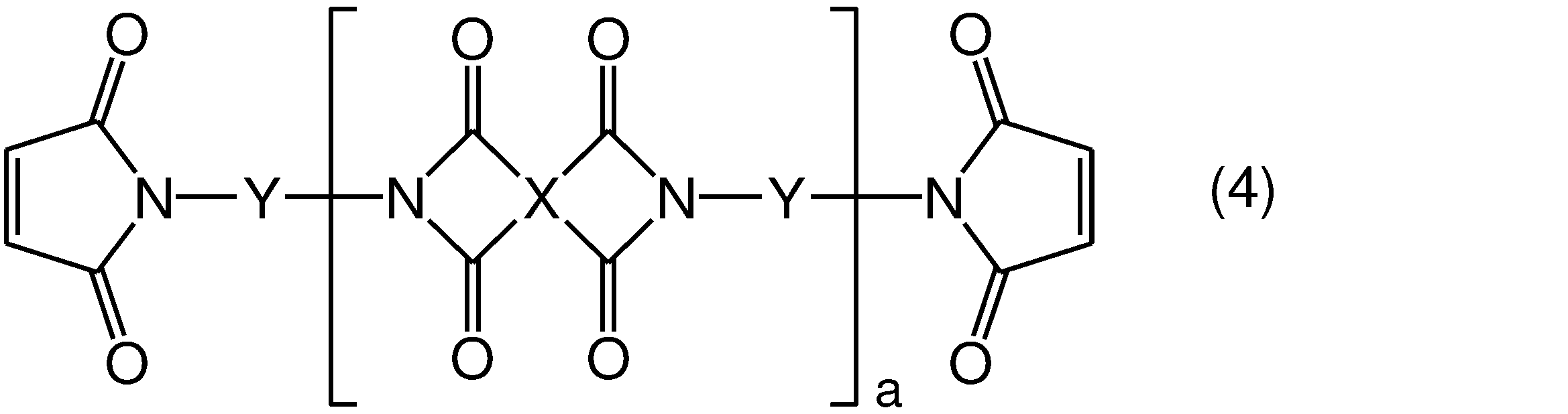
- the assumed structure of the maleimide resin produced by the above method is shown in the following general formula (4).
- General formula (4) assumes the case where the second amine is a diamine.
- the molecular weight of the maleimide resin can be controlled by the number of moles of the (a1) component and the (a2) component, and the smaller the number of moles of the (a1) component is compared to the number of moles of the (a2) component, the smaller the molecular weight can be.
- the number of moles of the (a1) component per 1.00 mole of the (a2) component i.e., [number of moles of the (a1) component]/[number of moles of the (a2) component]
- the molecular weight of the maleimide resin is preferably a weight average molecular weight (Mw) of 3,000 to 30,000, more preferably 3,000 to 25,000, even more preferably 5,000 to 23,000, and particularly preferably 7,000 to 20,000. If the weight average molecular weight is 30,000 or less, the solubility in organic solvents is good, and if it is 3,000 or more, the effect of improving heat resistance tends to be sufficient. Mw can be measured by gel permeation chromatography (GPC) and converted using a calibration curve of standard polystyrene.
- GPC gel permeation chromatography
- the amine value of the maleimide resin is preferably 1.5 mgKOH/g or less, more preferably 1.0 mgKOH/g or less, and particularly preferably 0.6 mgKOH/g or less.
- the manufacturing method of this embodiment makes it possible to manufacture a maleimide resin with a reduced amine value.
- the maleimide resin can be used as a resin composition.
- the resin composition may be a photosensitive resin composition.
- the photosensitive resin composition is applied onto a substrate and dried to form a resin film, which is then exposed to light and developed to obtain a patterned resin film (a resin film having a pattern).
- the patterned resin film is then heated and cured to form a patterned cured film (a cured film having a pattern), which can be used as an insulating film.
- the resin composition is a photosensitive resin composition.
- the photosensitive resin composition contains the maleimide resin (hereinafter also referred to as "component (A)").
- the maleimide resin may be used alone or in combination of two or more.
- the photosensitive resin composition may further contain a crosslinking agent and a photopolymerization initiator.
- the photosensitive resin composition may further contain a thermal polymerization initiator, a coupling agent, a rust inhibitor, a polymerization inhibitor, etc., as necessary.
- the photosensitive resin composition according to this embodiment is a negative-type photosensitive resin composition, and the cured product of the photosensitive resin composition can be suitably used as an insulating film for a rewiring layer. Each component used in the photosensitive resin composition of this embodiment will be described in more detail below.
- the crosslinking agent (hereinafter also referred to as "component (B)") may be a polymerizable crosslinking agent.
- the polymerizable group may be a photopolymerizable group or a thermally polymerizable group. Examples of the polymerizable group include a (meth)acryloyl group, an allyl group, and a vinyl group.
- the component (B) may be a polyfunctional compound having two or more polymerizable groups.
- the component (B) can crosslink not only with each other but also with the component (A) during exposure of the resin composition.
- the component (B) can crosslink with the polymerizable crosslinking agents during heating of the resin film after pattern formation.
- the component (B) can be used alone or in combination of two or more types.
- the resin composition according to this embodiment may contain a polymerizable crosslinking agent having a (meth)acryloyl group as a crosslinking agent from the viewpoint of dielectric properties.
- the polymerizable crosslinking agent having a (meth)acryloyl group can crosslink not only with itself but also with component (A) when the photosensitive layer is exposed to light.
- the polymerizable crosslinking agent having a (meth)acryloyl group may be an acrylate compound or a methacrylate compound.
- Component (B) may contain a methacrylate compound from the viewpoint of dielectric properties.
- polymerizable crosslinking agents having a (meth)acryloyl group include tricyclodecane dimethanol di(meth)acrylate, tris-(2-(meth)acryloyloxyethyl)isocyanurate, dioxane glycol di(meth)acrylate, alkoxylated glycerin tri(meth)acrylate, trimethylolpropane tri(meth)acrylate, alkoxylated trimethylolpropane tri(meth)acrylate, pentaerythritol tri(meth)acrylate, pentaerythritol tetra(meth)acrylate, alkoxylated pentaerythritol tetra(meth)acrylate, 1,6-hexane
- diol di(meth)acrylate include diol di(meth)acrylate, 1,9-nonanediol di(meth)acrylate, 1,10-decanediol
- the polymerizable crosslinking agent having a (meth)acryloyl group may contain at least one selected from the group consisting of tricyclodecane dimethanol di(meth)acrylate, tris-(2-(meth)acryloyloxyethyl)isocyanurate, and dioxane glycol di(meth)acrylate from the viewpoints of heat resistance, dielectric properties, and fine processability, and may contain tris-(2-(meth)acryloyloxyethyl)isocyanurate from the viewpoints of heat resistance and dielectric properties.
- the resin composition according to this embodiment may contain a polymerizable crosslinking agent having an allyl group or a vinyl group as a crosslinking agent from the viewpoint of dielectric properties and heat resistance.
- the polymerizable crosslinking agent having an allyl group or a vinyl group can crosslink with itself when the resin film is heated after pattern formation.
- polymerizable crosslinking agents having an allyl group examples include 1,3,4,6-tetraallyl glycoluril, triallyl isocyanurate, diallyl monoglycidyl isocyanurate, diallyl monomethyl isocyanurate, diallyl isocyanurate, triallyl trimellitate, and triallyl orthoformate.
- polymerizable crosslinking agents having vinyl groups examples include polyvinylbenzyl compounds and polyvinylbenzyl ether compounds.
- the polymerizable crosslinking agent having an allyl group or a vinyl group may contain at least one selected from the group consisting of 1,3,4,6-tetraallyl glycoluril, triallyl isocyanurate, diallyl isocyanurate, and polyvinyl benzyl ether compounds, from the viewpoint of dielectric properties and microfabrication, and may also contain triallyl isocyanurate.
- the content of component (B) is preferably less than 50 parts by mass when the total amount of components (A) and (B) is taken as 100 parts by mass, and may be 1 to 45 parts by mass, 5 to 40 parts by mass, 8 to 30 parts by mass, or 10 to 20 parts by mass.
- the photopolymerization initiator (hereinafter also referred to as “component (C)”) is not particularly limited as long as it is a compound that initiates polymerization upon irradiation with actinic rays (ultraviolet rays, etc.); examples of the photopolymerization initiator include alkylphenone-based photopolymerization initiators, acylphosphine oxide-based photopolymerization initiators, intramolecular hydrogen abstraction photopolymerization initiators, and oxime ester-based photopolymerization initiators.
- Alkylphenone-based photopolymerization initiators are available, for example, from IGM Resins B.V. as Omnirad 651, Omnirad 184, Omnirad 1173, Omnirad 2959, Omnirad 127, Omnirad 907, Omnirad 369, Omnirad 379EG, etc.
- Acylphosphine oxide-based photopolymerization initiators are available, for example, from IGM Resins B.V. as Omnirad 819, Omnirad TPO H, etc.
- Intramolecular hydrogen abstraction photopolymerization initiators are available, for example, from IGM Resins B.V. Omnirad MBF, Omnirad 754, etc. manufactured by BASF Japan Co., Ltd.
- Oxime ester photopolymerization initiators can be purchased, for example, as Irgacure OXE01, Irgacure OXE02, etc. manufactured by BASF Japan Co., Ltd.
- a titanocene photopolymerization initiator for example, Irgacure 784 manufactured by BASF Japan Co., Ltd.
- Irgacure 784 manufactured by BASF Japan Co., Ltd.
- the content of component (C) may be 0.1 to 10 parts by mass, 0.5 to 8 parts by mass, or 1 to 5 parts by mass per 100 parts by mass of the total amount of components (A) and (B), since this makes it easier to obtain excellent micro-machining properties.
- the photosensitive resin composition according to the present embodiment may further contain a thermal polymerization initiator as component (D) from the viewpoint of promoting the polymerization reaction of the thermally polymerizable crosslinking agent.
- a thermal polymerization initiator as component (D) from the viewpoint of promoting the polymerization reaction of the thermally polymerizable crosslinking agent.
- the component (D) a compound that decomposes by heating during curing to generate radicals and promote the polymerization reaction of the components (A) and (B) is preferable.
- an organic peroxide can be mentioned.
- organic peroxides include methyl ethyl ketone peroxide, methylcyclohexanone peroxide, methyl acetoacetate peroxide, acetylacetone peroxide, 1,1-bis(t-butylperoxy)-3,3,5-trimethylcyclohexane, 1,1-bis(t-hexylperoxy)cyclohexane, 1,1-bis(t-hexylperoxy)-3,3,5-trimethylcyclohexane, 1,1-bis(t-butylperoxy)cyclohexane, 2,2-bis(4,4-di-t-butylperoxycyclohexyl)propane, 1,1-bis(t-butylperoxy)cyclododecane, n-butyl-4,4-bis(t-butylperoxy)valerate, 2,2-bis(t-butylperoxy)butane, 1,1-bis(t-butylperoxy)-2-
- dropyroperoxide 1,1,3,3-tetramethylbutyl hydroperoxide, t-hexyl hydroperoxide, dicumyl peroxide, 2,5-dimethyl-2,5-bis(t-butylperoxy)hexane, ⁇ , ⁇ '-bis(t-butylperoxy)diisopropylbenzene, t-butylcumyl peroxide, di-t-butyl peroxide, 2,5-dimethyl-2,5-bis(t-butylperoxy)hexyne-3, isobutyryl peroxide, 3,5,5-trimethylhexanoyl peroxide, octanoyl peroxide, lauroyl peroxide, cinnamic acid peroxide, m-toluoyl peroxide, benzoyl peroxide, diisopropyl peroxydicarbonate, bis(4-t-butylcyclohexyl)peroxy
- the amount of component (D) is not particularly limited, but may be 0.1 to 10.0 parts by mass, 0.5 to 5.0 parts by mass, or 0.7 to 3.0 parts by mass per 100 parts by mass of the total amount of components (A) and (B).
- the photosensitive resin composition according to the present embodiment may further contain a coupling agent from the viewpoint of improving the adhesion of the cured product of the photosensitive resin composition.
- the coupling agent may be a silane coupling agent.
- the silane coupling agent may have, for example, a vinyl group, an epoxy group, a styryl group, an acryloyl group, a methacryloyl group, an amino group, a ureido group, an isocyanate group, an isocyanurate group, a mercapto group, or the like.
- silane coupling agents having a vinyl group examples include KBM-1003 and KBE-1003 (product names manufactured by Shin-Etsu Chemical Co., Ltd.; the same applies below).
- Examples of silane coupling agents having an epoxy group include KBM-303, 402, 403, KBE-402, 403, X-12-981S, X-12-984S, etc.
- Examples of silane coupling agents having a styryl group include KBM-1403, etc.
- Examples of silane coupling agents having a methacryloyl group examples include KBM-502, 503, KBE-502, 503, etc.
- silane coupling agents having an acryloyl group examples include KBM-5103, X-12-1048, X-12-1050, etc.
- silane coupling agents having an amino group examples include KBM-602, 603, 903, 573, 575, KBE-903, 9103P, and X-12-972F.
- Examples of silane coupling agents having a ureido group include KBE-585.
- Examples of silane coupling agents having an isocyanate group include KBE-9007 and X-12-1159L.
- Examples of silane coupling agents having an isocyanurate group include KBM-9659.
- Examples of silane coupling agents having a mercapto group examples include KBM-802, 803, X-12-1154, and X-12-1156.
- the silane coupling agent may be a silane coupling agent having a methacryloyl group.
- the silane coupling agents may be used alone or in combination of two or more.
- the content of the silane coupling agent may be 0.01 to 10 parts by mass, 0.1 to 8 parts by mass, or 0.5 to 5 parts by mass, per 100 parts by mass of the total amount of components (A) and (B).
- the photosensitive resin composition according to the present embodiment may further contain a rust inhibitor from the viewpoint of suppressing corrosion or preventing discoloration of copper wiring.
- a rust inhibitor examples include triazole derivatives such as benzotriazole, and tetrazole derivatives.
- the rust inhibitor may be used alone or in combination of two or more.
- the content of the rust inhibitor may be 0.01 to 10 parts by mass, 0.1 to 5 parts by mass, or 0.5 to 3 parts by mass per 100 parts by mass of the total amount of components (A) and (B).
- the photosensitive resin composition according to this embodiment may further contain a polymerization inhibitor from the viewpoint of storage stability.
- polymerization inhibitors examples include 4-tert-butylcatechol, 4-hydroxy-2,2,6,6-tetramethylpiperidine-1-oxy radical, p-methoxyphenol, diphenyl-p-benzoquinone, benzoquinone, hydroquinone, pyrogallol, phenothiazine, resorcinol, orthodinitrobenzene, paradinitrobenzene, metadinitrobenzene, phenanthraquinone, N-phenyl-2-naphthylamine, cupferron, 2,5-toluquinone, tannic acid, parabenzylaminophenol, tris(4-tert-butyl-3-hydroxy-2,6-dimethylbenzyl)isocyanuric acid, and nitrosamines.
- Polymerization inhibitors may be used alone or in combination of two or more.
- the content of the polymerization inhibitor may be 0.01 to 10 parts by mass, 0.05 to 5 parts by mass, or 0.10 to 2 parts by mass per 100 parts by mass of the total amount of the (A) component and the (B) component.
- the photosensitive resin composition of the present disclosure may further contain a sensitizer from the viewpoint of maintaining both the remaining film rate over a wide range of exposure doses and good resolution.
- Sensitizer components include Michler's ketone, benzoin, 2-methylbenzoin, benzoin methyl ether, benzoin ethyl ether, benzoin isopropyl ether, benzoin butyl ether, 2-t-butylanthraquinone, 1,2-benzo-9,10-anthraquinone, anthraquinone, methylanthraquinone, 4,4'-bis(diethylamino)benzophenone, acetophenone, benzophenone, thioxanthone, 1,5-acenaphthene, 2,2-dimethoxy-2-phenylacetophenone, 1-hydroxycyclohexyl phenyl ketone, 2-methyl-[4-(methylthio)phenyl]-2-morpholino-1-propanone, diacetyl benzyl, benzil dimethyl ketal, benzil
- the sensitizer component include phenyl diethyl
- the amount of the sensitizer component is preferably 0.1 to 2.0 parts by mass, and more preferably 0.2 to 1.5 parts by mass, per 100 parts by mass of component (A).
- the photosensitive resin composition according to the present embodiment contains a solvent for dissolving and dispersing each component, which makes it easy to apply the composition to a substrate and forms a coating film of uniform thickness.
- the solvent may be used alone or in combination of two or more kinds.
- the solvent examples include ketones such as methyl ethyl ketone, cyclohexanone, and cyclopentanone; aromatic hydrocarbons such as toluene, xylene, tetramethylbenzene, and pseudocumene; glycol ethers such as methyl cellosolve, butyl cellosolve, methyl carbitol, butyl carbitol, propylene glycol monomethyl ether, dipropylene glycol monoethyl ether, dipropylene glycol dimethyl ether, dipropylene glycol diethyl ether, and triethylene glycol monoethyl ether; esters such as ethyl acetate, butyl acetate, butyl cellosolve acetate, carbitol acetate, and ⁇ -butyrolactone; and nitrogen-containing compounds such as mesitylene, N,N-dimethylformamide, N,N-dimethylacetamide, N-methyl-2-pyrrol
- the amount of solvent used is not particularly limited, but may be an amount that results in a solid content of 5 to 60 mass %, 10 to 50 mass %, or 15 to 40 mass % in the photosensitive resin composition.
- the means and conditions for preparing the photosensitive resin composition are not particularly limited.
- the main components are thoroughly and uniformly stirred and mixed in the prescribed amounts using a mixer or the like, and then kneaded using a mixing roll, extruder, kneader, roll, extruder, or the like.
- the kneading method is not particularly limited.
- the dielectric constant at 10 GHz of the cured product of the photosensitive resin composition according to this embodiment may be 2.80 or less, 2.75 or less, or 2.70 or less.
- the dielectric tangent at 10 GHz of the cured product of the photosensitive resin composition may be 0.0060 or less, 0.0050 or less, 0.0045 or less, or 0.0040 or less.
- the dielectric constant and dielectric tangent can be measured by the method described in the examples using a cured film of the photosensitive resin composition.
- the photosensitive resin composition according to this embodiment is capable of forming a fine pattern.
- the photosensitive resin composition according to this embodiment is capable of forming an insulating film that exhibits low dielectric properties and has excellent insulating reliability.
- a semiconductor element having an interlayer insulating layer formed from the cured product of the above-mentioned photosensitive resin composition, and an electronic device including the semiconductor element can be produced.
- the semiconductor element can improve high-frequency characteristics by having a rewiring layer including the cured product of the photosensitive resin composition according to this embodiment.
- the semiconductor element may be, for example, a memory, a package, etc. having a multilayer wiring structure, a rewiring structure, etc. Examples of electronic devices include mobile phones, smartphones, tablet terminals, personal computers, and hard disk suspensions.
- Example 1 Into a 1 L flask equipped with a cooler, a nitrogen inlet tube, a thermocouple, a stirrer, and a vacuum pump, 9,9-bis(3,4-dicarboxyphenyl)fluorene dianhydride (manufactured by JFE Chemical Corporation, trade name "BPAF”), pseudocumene (manufactured by Toyo Gosei Co., Ltd.), Solmix A-11 (trade name, manufactured by Japan Alcohol Sales Co., Ltd., an alcohol-based solvent mainly composed of ethanol), and ⁇ -butyrolactone (manufactured by Fujifilm Wako Pure Chemical Industries, Ltd.) were added.
- BPAF 9,9-bis(3,4-dicarboxyphenyl)fluorene dianhydride
- pseudocumene manufactured by Toyo Gosei Co., Ltd.
- Solmix A-11 trade name, manufactured by Japan Alcohol Sales Co., Ltd., an alcohol-based solvent mainly composed of ethanol
- the pressure inside the reaction vessel was returned to atmospheric pressure, and the obtained polyimide resin was cooled to 130°C, maleic anhydride (manufactured by Fuso Chemical Co., Ltd.) was added, and the temperature was raised to 160°C, and a dehydration ring-closing reaction was carried out at a state reduced by 0.03 MPa from atmospheric pressure and 160°C for 4 hours, to remove water in the reaction liquid, and a maleimide resin was obtained (maleimide formation step).
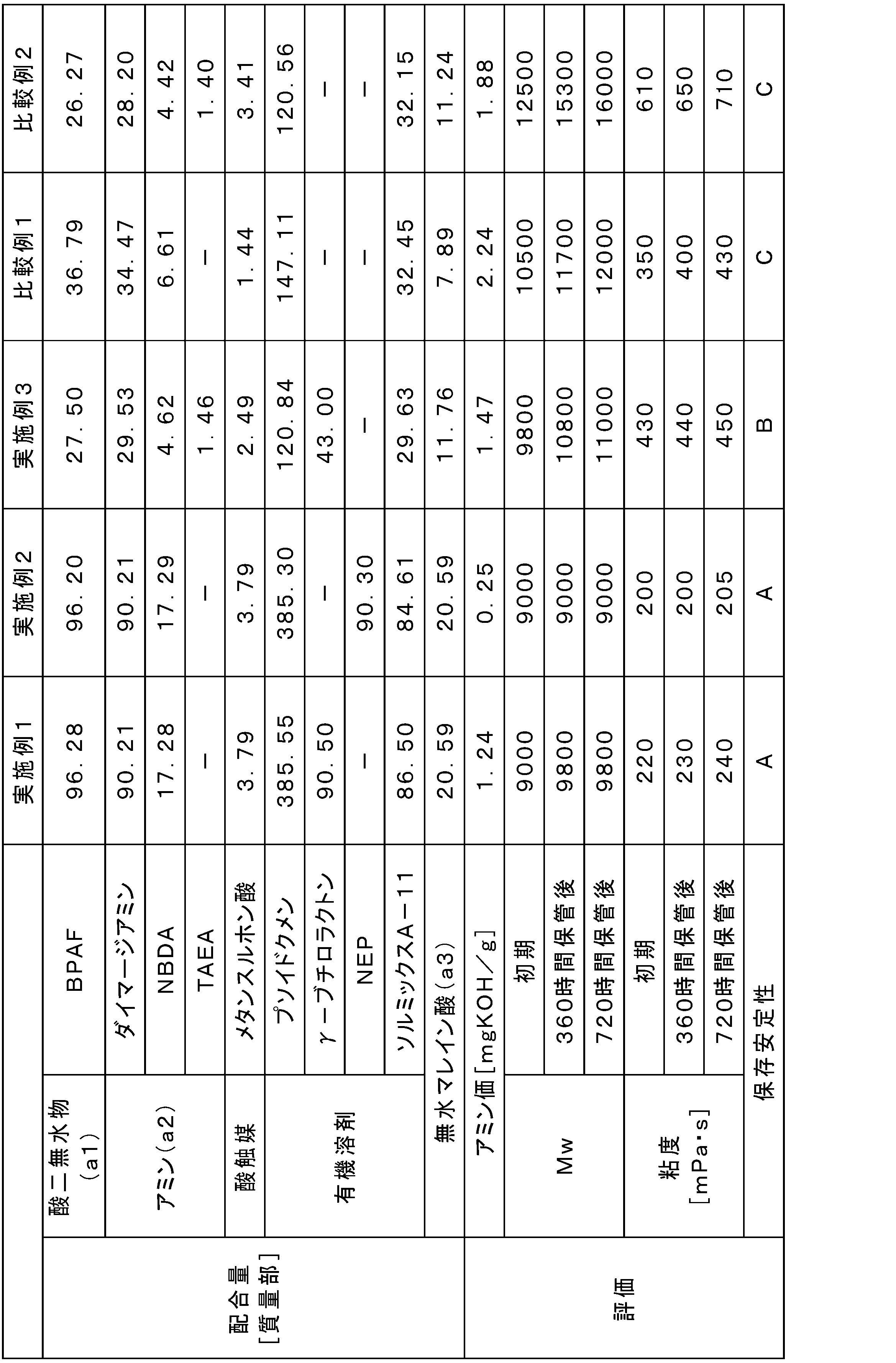
- the blending amount (unit: parts by mass) of each component is shown in Table 1. In Table 1, the blending amount of non-volatile components other than the organic solvent is shown.
- the obtained maleimide resin was placed in a separatory funnel, 500 parts by mass of pure water was added, the separatory funnel was shaken, and the mixture was allowed to stand. After standing, the aqueous layer and the organic layer were separated, and only the organic layer was collected.
- the collected organic layer was placed in a 0.3 L glass vessel equipped with a cooler, a nitrogen inlet tube, a thermocouple, a stirrer, and a vacuum pump, and heated to 88-93°C. After removing the water, the vessel was heated to 100°C and the solvent was partially removed for 0.5 hours under a reduced pressure of 0.1 MPa from atmospheric pressure, to obtain a solution of maleimide resin (A-1) (non-volatile content 40% by mass), which is component (A).
- maleimide resin (A-1) was subjected to IR measurement, and it was confirmed that maleimide resin was produced.
- the IR spectrum of maleimide resin (A-1) is shown in Figure 1. The IR spectrum was measured by drying the maleimide resin solution at 130°C for 30 minutes, and then setting the resulting resin solid in an FT-IR measuring device (manufactured by Bruker, product name "AlphaII Platinum-ATR") and measuring it.
- Example 2 A solution of maleimide resin (A-2), component (A) (non-volatile content: 40% by mass), was obtained in the same manner as in Example 1, except that N-ethyl-2-pyrrolidone (NEP) was used instead of ⁇ -butyrolactone and the amounts of each component were changed to those shown in Table 1.
- IR measurement of the obtained maleimide resin (A-2) was performed in the same manner as in Example 1, and it was confirmed that a maleimide resin was formed.
- the IR spectrum of maleimide resin (A-2) is shown in FIG.
- Example 3 A solution of maleimide resin (A-3) (non-volatile content 40% by mass) which is component (A) was obtained in the same manner as in Example 1, except that norbornanediamine (NBDA) and tris(2-aminoethyl)amine (TAEA) were used as the amines and the amounts of each component were changed to those shown in Table 1.
- the obtained maleimide resin (A-3) was subjected to IR measurement in the same manner as in Example 1, and it was confirmed that a maleimide resin was formed.
- Example 1 A solution of maleimide resin (A-4), which is component (A) (non-volatile content: 40% by mass), was obtained in the same manner as in Example 1, except that ⁇ -butyrolactone was not used as the organic solvent and the amounts of each component were changed to those shown in Table 1.
- the obtained maleimide resin (A-4) was subjected to IR measurement in the same manner as in Example 1, and it was confirmed that a maleimide resin was formed.
- Example 2 A solution of maleimide resin (A-5), which is component (A) (non-volatile content: 40% by mass), was obtained in the same manner as in Example 3, except that ⁇ -butyrolactone was not used as the organic solvent and the amounts of each component were changed to those shown in Table 1.
- the obtained maleimide resin (A-5) was subjected to IR measurement in the same manner as in Example 1, and it was confirmed that a maleimide resin was formed.
- the weight average molecular weight (Mw) of the maleimide resin obtained in the examples and comparative examples was measured by GPC (gel permeation chromatography).
- a sample in which the maleimide resin was dissolved in tetrahydrofuran (THF) to a concentration of 3% by mass was injected in an amount of 50 ⁇ L into a column (GL-R420 x 1, GL-R430 x 1, GL-R440 x 1 (all manufactured by Hitachi High-Tech Fielding Corporation)) heated to 30° C., and measurement was performed using THF as the developing solvent and at a flow rate of 1.6 mL/min.
- THF tetrahydrofuran
- A-9300 Tris-(2-acryloyloxyethyl)isocyanurate (manufactured by Shin-Nakamura Chemical Co., Ltd., product name "A-9300", number of acryloyl groups: 3)
- TAIC Triallyl isocyanurate (manufactured by Mitsubishi Chemical Corporation, product name "TAIC", number of allyl groups: 3)
- OXE01 Oxime ester photopolymerization initiator (manufactured by BASF Japan Ltd., product name "Irgacure OXE01”
- OXE02 Oxime ester photopolymerization initiator (manufactured by BASF Japan Ltd., product name "Irgacure OXE02”
- Perbutyl P ⁇ , ⁇ '-bis(t-butylperoxy)diisopropylbenzene (manufactured by NOF Corporation, product name "Perbutyl P")
- KBM-503 3-methacrylate
- B Not corresponding to the evaluation of A, and in the change in the measured value after 720 hours of storage from the initial value, the increase in Mw is less than 1500 or the increase in viscosity is less than 40 mPa ⁇ s.
- C In the change in measured value after 720 hours of storage from the initial value, the increase in Mw is 1,500 or more and the increase in viscosity is 40 mPa ⁇ s or more.
Landscapes
- Chemical & Material Sciences (AREA)
- Health & Medical Sciences (AREA)
- Chemical Kinetics & Catalysis (AREA)
- Medicinal Chemistry (AREA)
- Polymers & Plastics (AREA)
- Organic Chemistry (AREA)
- Macromolecular Compounds Obtained By Forming Nitrogen-Containing Linkages In General (AREA)
Abstract
テトラカルボン酸二無水物(a1)、アミン(a2)及び無水マレイン酸(a3)を反応させてなるマレイミド樹脂の製造方法であって、有機溶剤の存在下、テトラカルボン酸二無水物(a1)にアミン(a2)を添加してポリイミド樹脂を得る工程と、ポリイミド樹脂に無水マレイン酸(a3)を添加してマレイミド樹脂を得る工程と、を有し、有機溶剤が、γ-ブチロラクトン及びN-エチル-2-ピロリドンの少なくとも一方を含み、アミン(a2)が、ダイマージアミンと、ダイマージアミン以外の第2のアミンとを含む、マレイミド樹脂の製造方法。
Description
本開示は、マレイミド樹脂の製造方法に関する。
プリント配線板及びそれを用いた多層配線板は、携帯電話、スマートフォン等のモバイル型通信機器、その基地局装置、サーバー・ルーター等のネットワーク関連電子機器、大型コンピュータ等の製品で使用されている。
近年、それらの製品においては、大容量の情報を高速で伝送・処理するために高周波の電気信号が使用されているが、高周波信号は非常に減衰し易いため、伝送損失を抑えるために、上記プリント配線板及び多層配線板等に用いられる絶縁材料として、誘電特性の優れた絶縁材料が求められる。
上記絶縁材料としては、特許文献1~3に開示されたエポキシ樹脂組成物が知られている。この特許文献1には、エポキシ樹脂、活性エステル化合物及びトリアジン含有クレゾールノボラック樹脂を含有するエポキシ樹脂組成物が低誘電正接化に有効であることが開示されている。また、特許文献2及び3には、エポキシ樹脂及び活性エステル化合物を必須成分とする樹脂組成物が、誘電正接が低い硬化物を形成でき、絶縁材料として有用であることが開示されている。しかしながら、これらのエポキシ樹脂組成物は、高周波帯用途として満足できないことがわかってきた。
一方、特許文献4では、非エポキシ系の材料として長鎖アルキル基を有するビスマレイミド樹脂及び硬化剤を含有する樹脂組成物からなる樹脂フィルムが、誘電特性に優れる(低比誘電率且つ低誘電正接である)ことが報告されている。しかし、長鎖アルキルジアミンのみからなるビスマレイミド樹脂では、Tgが低いこと及び弾性率が低いことが問題であった。
本発明者らは、低誘電率及び低誘電正接が十分に維持されつつ、高弾性率化及び高Tg化された硬化物を形成可能なマレイミド樹脂として、アミンとしてダイマージアミンと他のアミンとを用いて得られるマレイミド樹脂を検討している。
本開示は、特定のマレイミド樹脂を製造するための新規な製造方法を提供することを目的とする。本開示は特に、樹脂組成物の保存安定性を良好にできるマレイミド樹脂を製造するための製造方法を提供することを目的とする。
上記目的を達成するために、本開示は、以下のマレイミド樹脂の製造方法を提供する。
[1]テトラカルボン酸二無水物(a1)、アミン(a2)及び無水マレイン酸(a3)を反応させてなるマレイミド樹脂の製造方法であって、有機溶剤の存在下、上記テトラカルボン酸二無水物(a1)に上記アミン(a2)を添加してポリイミド樹脂を得る工程と、上記ポリイミド樹脂に上記無水マレイン酸(a3)を添加してマレイミド樹脂を得る工程と、を有し、上記有機溶剤が、γ-ブチロラクトン及びN-エチル-2-ピロリドンの少なくとも一方を含み、上記アミン(a2)が、ダイマージアミンと、ダイマージアミン以外の第2のアミンとを含む、マレイミド樹脂の製造方法。
[2]上記テトラカルボン酸二無水物(a1)及び上記アミン(a2)の少なくとも一方が、フルオレン骨格を有する化合物を含む、上記[1]に記載のマレイミド樹脂の製造方法。
[3]上記テトラカルボン酸二無水物(a1)が、1,3,3a,4,5,9b-ヘキサヒドロ-5-(テトラヒドロ-2,5-ジオキソ-3-フラニル)ナフト[1,2-c]フラン-1,3-ジオン、9,9-ビス(3,4-ジカルボキシフェニル)フルオレン二無水物、9,9-ビス[4-(3,4-ジカルボキシフェノキシ)フェニル]フルオレン二無水物、及び、3,3’,4,4’-ビフェニルテトラカルボン酸二無水物のうちの少なくとも一種を含む、上記[1]又は[2]に記載のマレイミド樹脂の製造方法。
[4]上記第2のアミンが、ノルボルナンジアミン、9,9-ビス[4-(4-アミノフェノキシ)フェニル]フルオレン、及び、9,9-ビス(4-アミノフェニル)フルオレンのうちの少なくとも一種を含有する、上記[1]~[3]のいずれかに記載のマレイミド樹脂の製造方法。
[5]上記ダイマージアミンが、下記一般式(1)で表される化合物及び下記一般式(2)で表される化合物のうちの少なくとも一種を含有する、上記[1]~[4]のいずれかに記載のマレイミド樹脂の製造方法。
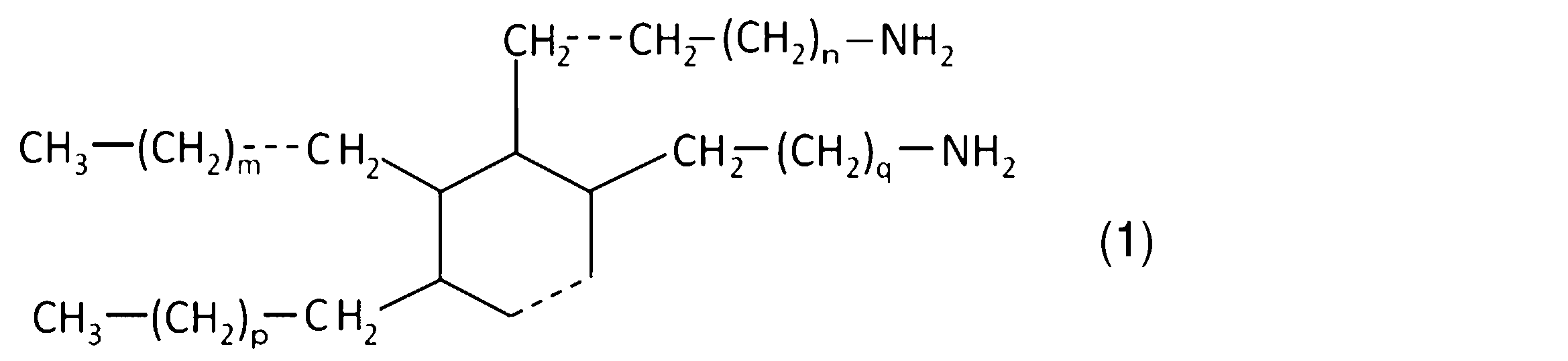

[式(1)及び(2)中、m、n、p及びqはそれぞれ、m+n=6~17、p+q=8~19となるように選ばれる1以上の整数を表し、破線で示した結合は、炭素-炭素単結合又は炭素-炭素二重結合を意味する。但し、破線で示した結合が炭素-炭素二重結合である場合、式(1)及び(2)は、炭素-炭素二重結合を構成する各炭素原子に結合する水素原子の数を、式(1)及び(2)に示した数から1つ減じた構造となる。]
[6]上記アミン(a2)を1.00モルに対し、上記テトラカルボン酸二無水物(a1)を0.30~1.00モル反応させてなる、上記[1]~[5]のいずれかに記載のマレイミド樹脂の製造方法。
[7]上記有機溶剤が、沸点150℃以上の芳香族炭化水素を更に含む、上記[1]~[6]のいずれかに記載のマレイミド樹脂の製造方法。
[8]上記有機溶剤が、沸点100℃以下のアルコールを更に含む、上記[1]~[7]のいずれかに記載のマレイミド樹脂の製造方法。
[9]上記有機溶剤中の上記γ-ブチロラクトン及びN-エチル-2-ピロリドンの含有量が、有機溶剤全量を基準として5~40質量%である、上記[1]~[8]のいずれかに記載のマレイミド樹脂の製造方法。
[1]テトラカルボン酸二無水物(a1)、アミン(a2)及び無水マレイン酸(a3)を反応させてなるマレイミド樹脂の製造方法であって、有機溶剤の存在下、上記テトラカルボン酸二無水物(a1)に上記アミン(a2)を添加してポリイミド樹脂を得る工程と、上記ポリイミド樹脂に上記無水マレイン酸(a3)を添加してマレイミド樹脂を得る工程と、を有し、上記有機溶剤が、γ-ブチロラクトン及びN-エチル-2-ピロリドンの少なくとも一方を含み、上記アミン(a2)が、ダイマージアミンと、ダイマージアミン以外の第2のアミンとを含む、マレイミド樹脂の製造方法。
[2]上記テトラカルボン酸二無水物(a1)及び上記アミン(a2)の少なくとも一方が、フルオレン骨格を有する化合物を含む、上記[1]に記載のマレイミド樹脂の製造方法。
[3]上記テトラカルボン酸二無水物(a1)が、1,3,3a,4,5,9b-ヘキサヒドロ-5-(テトラヒドロ-2,5-ジオキソ-3-フラニル)ナフト[1,2-c]フラン-1,3-ジオン、9,9-ビス(3,4-ジカルボキシフェニル)フルオレン二無水物、9,9-ビス[4-(3,4-ジカルボキシフェノキシ)フェニル]フルオレン二無水物、及び、3,3’,4,4’-ビフェニルテトラカルボン酸二無水物のうちの少なくとも一種を含む、上記[1]又は[2]に記載のマレイミド樹脂の製造方法。
[4]上記第2のアミンが、ノルボルナンジアミン、9,9-ビス[4-(4-アミノフェノキシ)フェニル]フルオレン、及び、9,9-ビス(4-アミノフェニル)フルオレンのうちの少なくとも一種を含有する、上記[1]~[3]のいずれかに記載のマレイミド樹脂の製造方法。
[5]上記ダイマージアミンが、下記一般式(1)で表される化合物及び下記一般式(2)で表される化合物のうちの少なくとも一種を含有する、上記[1]~[4]のいずれかに記載のマレイミド樹脂の製造方法。
[6]上記アミン(a2)を1.00モルに対し、上記テトラカルボン酸二無水物(a1)を0.30~1.00モル反応させてなる、上記[1]~[5]のいずれかに記載のマレイミド樹脂の製造方法。
[7]上記有機溶剤が、沸点150℃以上の芳香族炭化水素を更に含む、上記[1]~[6]のいずれかに記載のマレイミド樹脂の製造方法。
[8]上記有機溶剤が、沸点100℃以下のアルコールを更に含む、上記[1]~[7]のいずれかに記載のマレイミド樹脂の製造方法。
[9]上記有機溶剤中の上記γ-ブチロラクトン及びN-エチル-2-ピロリドンの含有量が、有機溶剤全量を基準として5~40質量%である、上記[1]~[8]のいずれかに記載のマレイミド樹脂の製造方法。
本開示によれば、特定のマレイミド樹脂を製造するための新規な製造方法を提供することができる。特に、本開示によれば、樹脂組成物の保存安定性を良好にできるマレイミド樹脂を製造するための製造方法を提供することができる。また、本開示のマレイミド樹脂の製造方法により製造されたマレイミド樹脂、及びそれを用いた樹脂組成物(接着剤組成物)は、誘電率及び誘電正接(以下、両者を「誘電特性」と総称することがある。)を共に低減でき、特に高周波帯の低誘電特性に優れると共に、高弾性率化及び高Tg化された硬化物を形成可能である。上記樹脂組成物より得られる硬化物(接着剤層)は弾性率及びTgが高いため、上記樹脂組成物は、プリント回路基板(ビルドアップ基板、フレキシブルプリント配線板等)及びプリント配線板用銅張り板の製造に用いる接着剤としてのみならず、再配線層等の絶縁膜、半導体層間材料、コーティング剤、レジストインキ、導電ペーストなどとしても有用である。
以下、本開示の好適な実施形態について詳細に説明する。ただし、本開示は以下の実施形態に限定されるものではなく、その要旨の範囲内で種々変形して実施することができる。
本明細書において、「~」を用いて示された数値範囲は、「~」の前後に記載される数値をそれぞれ最小値及び最大値として含む範囲を示す。本明細書に段階的に記載されている数値範囲において、ある段階の数値範囲の上限値又は下限値は、他の段階の数値範囲の上限値又は下限値と任意に組み合わせることができる。本明細書に記載されている数値範囲において、その数値範囲の上限値又は下限値は、実施例に示されている値に置き換えてもよい。「A又はB」とは、A及びBのどちらか一方を含んでいればよく、両方とも含んでいてもよい。本明細書に例示する材料は、特に断らない限り、1種を単独で又は2種以上を組み合わせて用いることができる。組成物中の各成分の含有量は、組成物中に各成分に該当する物質が複数存在する場合、特に断らない限り、組成物中に存在する当該複数の物質の合計量を意味する。本明細書において、「固形分」とは、樹脂組成物に含まれる揮発する物質(水、溶剤等)を除いた不揮発分を指し、室温(25℃付近)で液状、水飴状、又はワックス状の成分も含む。
<マレイミド樹脂の製造方法>
本実施形態のマレイミド樹脂の製造方法は、テトラカルボン酸二無水物(a1)(以下、「(a1)成分」ともいう。)、アミン(a2)(以下、「(a2)成分」ともいう。)、及び、無水マレイン酸(a3)(以下、「(a3)成分」ともいう。)を反応させてなるマレイミド樹脂の製造方法であって、有機溶剤の存在下、上記テトラカルボン酸二無水物(a1)に上記アミン(a2)を添加してポリイミド樹脂を得る工程と、上記ポリイミド樹脂に上記無水マレイン酸(a3)を添加してマレイミド樹脂を得る工程と、を有する。ここで、上記有機溶剤は、γ-ブチロラクトン及びN-エチル-2-ピロリドンの少なくとも一方を含む。また、上記アミン(a2)は、ダイマージアミンと、ダイマージアミン以外の第2のアミンとを含む。
本実施形態のマレイミド樹脂の製造方法は、テトラカルボン酸二無水物(a1)(以下、「(a1)成分」ともいう。)、アミン(a2)(以下、「(a2)成分」ともいう。)、及び、無水マレイン酸(a3)(以下、「(a3)成分」ともいう。)を反応させてなるマレイミド樹脂の製造方法であって、有機溶剤の存在下、上記テトラカルボン酸二無水物(a1)に上記アミン(a2)を添加してポリイミド樹脂を得る工程と、上記ポリイミド樹脂に上記無水マレイン酸(a3)を添加してマレイミド樹脂を得る工程と、を有する。ここで、上記有機溶剤は、γ-ブチロラクトン及びN-エチル-2-ピロリドンの少なくとも一方を含む。また、上記アミン(a2)は、ダイマージアミンと、ダイマージアミン以外の第2のアミンとを含む。
((a1)成分:テトラカルボン酸二無水物)
(a1)成分のテトラカルボン酸二無水物としてはポリイミドの原料として公知のものを使用できる。(a1)成分としては、例えば、無水ピロメリット酸、4,4’-(ヘキサフルオロイソプロピリデン)ジフタル酸無水物、1,3,3a,4,5,9b-ヘキサヒドロ-5-(テトラヒドロ-2,5-ジオキソ-3-フラニル)ナフト[1,2-c]フラン-1,3-ジオン、4,4’-オキシジフタル酸二無水物、3,3’,4,4’-ジフェニルスルホンテトラカルボン酸二無水物、3,3’,4,4’-ビフェニルテトラカルボン酸二無水物、3,3’,4,4’-ベンゾフェノンテトラカルボン酸二無水物、4,4’-(4,4’-イソプロピリデンジフェノキシ)ジフタル酸無水物、1,2,3,4-ブタンテトラカルボン酸二無水物、1,2,3,4-シクロブタンテトラカルボン酸二無水物、1,2,3,4-シクロペンタンテトラカルボン酸二無水物、1,2,3,4-テトラメチル-1,2,3,4-シクロブタンテトラカルボン酸二無水物、ビシクロ[2.2.2]オクト-7-エン-2,3,5,6-テトラカルボン酸二無水物、ビス(1,3-ジオキソ-1,3-ジヒドロイソベンゾフラン-5-カルボン酸)1,4-フェニレン、9,9-ビス(3,4-ジカルボキシフェニル)フルオレン二無水物、4,4’-(エチン-1,2-ジイル)ジフタル酸無水物、5-(2,5-ジオキソテトラヒドロフリル)-3-メチル-3-シクロヘキセン-1,2-ジカルボン酸無水物、ジシクロヘキシル-3,4,3’,4’-テトラカルボン酸二無水物、3,4’-オキシジフタル酸無水物、3,4’-ビフタル酸無水物、ノルボルナン-2-スピロ-α-シクロペンタノン-α’-スピロ-2’’-ノルボルナン-5,5’’,6,6’’-テトラカルボン酸二無水物、5,5’-ビス-2-ノルボルネン-5,5’,6,6’-テトラカルボン酸-5,5’,6,6’-二無水物、9,9-ビス[4-(3,4-ジカルボキシフェノキシ)フェニル]フルオレン二無水物等が挙げられる。これらは1種単独で又は2種以上を組み合わせて用いることができる。
(a1)成分のテトラカルボン酸二無水物としてはポリイミドの原料として公知のものを使用できる。(a1)成分としては、例えば、無水ピロメリット酸、4,4’-(ヘキサフルオロイソプロピリデン)ジフタル酸無水物、1,3,3a,4,5,9b-ヘキサヒドロ-5-(テトラヒドロ-2,5-ジオキソ-3-フラニル)ナフト[1,2-c]フラン-1,3-ジオン、4,4’-オキシジフタル酸二無水物、3,3’,4,4’-ジフェニルスルホンテトラカルボン酸二無水物、3,3’,4,4’-ビフェニルテトラカルボン酸二無水物、3,3’,4,4’-ベンゾフェノンテトラカルボン酸二無水物、4,4’-(4,4’-イソプロピリデンジフェノキシ)ジフタル酸無水物、1,2,3,4-ブタンテトラカルボン酸二無水物、1,2,3,4-シクロブタンテトラカルボン酸二無水物、1,2,3,4-シクロペンタンテトラカルボン酸二無水物、1,2,3,4-テトラメチル-1,2,3,4-シクロブタンテトラカルボン酸二無水物、ビシクロ[2.2.2]オクト-7-エン-2,3,5,6-テトラカルボン酸二無水物、ビス(1,3-ジオキソ-1,3-ジヒドロイソベンゾフラン-5-カルボン酸)1,4-フェニレン、9,9-ビス(3,4-ジカルボキシフェニル)フルオレン二無水物、4,4’-(エチン-1,2-ジイル)ジフタル酸無水物、5-(2,5-ジオキソテトラヒドロフリル)-3-メチル-3-シクロヘキセン-1,2-ジカルボン酸無水物、ジシクロヘキシル-3,4,3’,4’-テトラカルボン酸二無水物、3,4’-オキシジフタル酸無水物、3,4’-ビフタル酸無水物、ノルボルナン-2-スピロ-α-シクロペンタノン-α’-スピロ-2’’-ノルボルナン-5,5’’,6,6’’-テトラカルボン酸二無水物、5,5’-ビス-2-ノルボルネン-5,5’,6,6’-テトラカルボン酸-5,5’,6,6’-二無水物、9,9-ビス[4-(3,4-ジカルボキシフェノキシ)フェニル]フルオレン二無水物等が挙げられる。これらは1種単独で又は2種以上を組み合わせて用いることができる。
低誘電特性、高Tg又は低線膨張係数(CTE)の観点から、(a1)成分は、1,3,3a,4,5,9b-ヘキサヒドロ-5-(テトラヒドロ-2,5-ジオキソ-3-フラニル)ナフト[1,2-c]フラン-1,3-ジオン、9,9-ビス(3,4-ジカルボキシフェニル)フルオレン二無水物、3,3’,4,4’-ビフェニルテトラカルボン酸二無水物、4,4’-(4,4’-イソプロピリデンジフェノキシ)ジフタル酸無水物、4,4’-(ヘキサフルオロイソプロピリデン)ジフタル酸無水物、5-(2,5-ジオキソテトラヒドロフリル)-3-メチル-3-シクロヘキセン-1,2-ジカルボン酸無水物、ジシクロヘキシル-3,4,3’,4’-テトラカルボン酸二無水物、ビシクロ[2.2.2]オクタン-2,3,5,6-テトラカルボン酸2,3:5,6-二無水物、5,5’-ビス-2-ノルボルネン-5,5’,6,6’-テトラカルボン酸-5,5’,6,6’-二無水物、3,4’-ビフタル酸無水物、及び9,9-ビス[4-(3,4-ジカルボキシフェノキシ)フェニル]フルオレン二無水物からなる群より選ばれる少なくとも一種を含有することが好ましく、1,3,3a,4,5,9b-ヘキサヒドロ-5-(テトラヒドロ-2,5-ジオキソ-3-フラニル)ナフト[1,2-c]フラン-1,3-ジオン、9,9-ビス(3,4-ジカルボキシフェニル)フルオレン二無水物、4,4’-(4,4’-イソプロピリデンジフェノキシ)ジフタル酸無水物、4,4’-(ヘキサフルオロイソプロピリデン)ジフタル酸無水物、9,9-ビス[4-(3,4-ジカルボキシフェノキシ)フェニル]フルオレン二無水物、及び3,3’,4,4’-ビフェニルテトラカルボン酸二無水物からなる群より選ばれる少なくとも一種を含有することがより好ましく、1,3,3a,4,5,9b-ヘキサヒドロ-5-(テトラヒドロ-2,5-ジオキソ-3-フラニル)ナフト[1,2-c]フラン-1,3-ジオン、9,9-ビス(3,4-ジカルボキシフェニル)フルオレン二無水物、9,9-ビス[4-(3,4-ジカルボキシフェノキシ)フェニル]フルオレン二無水物、及び3,3’,4,4’-ビフェニルテトラカルボン酸二無水物のうちの少なくとも一種を含有することが更に好ましい。
(a2)成分は、ダイマージアミン(第1のアミン)と、ダイマージアミン以外の第2のアミンとを含有する。
ダイマージアミンは、例えば、特開平9-12712号公報に記載されているように、オレイン酸等の不飽和脂肪酸の二量体であるダイマー酸から誘導される化合物である。(a2)成分としてダイマージアミンを用いることで、硬化物の誘電特性を低くすることができる。本実施形態では、公知のダイマージアミンを特に制限なく使用できる。ダイマージアミンは、例えば下記一般式(1)で表される化合物及び下記一般式(2)で表される化合物のうちの少なくとも一種を含むことが好ましい。


ダイマージアミンとしては、有機溶剤への溶解性、耐熱性、耐熱接着性、低粘度等の観点より、上記一般式(2)で表されるものであってよく、特に下記式(3)で表される化合物であってよい。

ダイマージアミンの市販品としては、例えば、PRIAMINE1075、PRIAMINE1074(いずれもクローダジャパン(株)製)等が挙げられる。これらは1種単独で又は2種以上を組み合わせて用いることができる。
第2のアミンは、上述したダイマージアミンに該当しないアミンである。第2のアミンは、ジアミン又はトリアミンであってもよく、ジアミンであってもよい。第2のアミンとして脂環式ジアミンを使用することで、誘電率をより低くすることができる。第2のアミンとして芳香族ジアミンを使用することで、硬化物の弾性率、Tg及びCTEが良好になる。
第2のアミンがジアミンである場合、当該ジアミンとしては、例えば、1,3-ジアミノプロパン、ノルボルナンジアミン、4,4’-メチレンジアニリン、1,3-ビス[2-(4-アミノフェニル)-2-プロピル]ベンゼン、4,4’-ジアミノ-2,2’-ビス(トリフルオロメチル)ビフェニル、2,2-ビス[4-(4-アミノフェノキシ)フェニル]ヘキサフルオロプロパン、9,9-ビス(4-アミノフェニル)フルオレン、9,9-ビス[3-フルオロ-4-アミノフェニル]フルオレン、9,9-ビス[4-(4-アミノフェノキシ)フェニル]フルオレン、1,3-ビス(アミノメチル)シクロヘキサン、1,4-ビス(アミノメチル)シクロヘキサン、ビス(アミノメチル)ノルボルナン、4,4’-(ヘキサフルオロイソプロピリデン)ジアニリン、3(4),8(9)-ビス(アミノメチル)トリシクロ[5.2.1.02,6]デカン、1,3-シクロヘキサンジアミン、1,4-シクロヘキサンジアミン、イソホロンジアミン、4,4’-メチレンビス(シクロヘキシルアミン)、4,4’-メチレンビス(2-メチルシクロヘキシルアミン)、1,1-ビス(4-アミノフェニル)シクロヘキサン、2,7-ジアミノフルオレン、4,4’-エチレンジアニリン、4,4’-メチレンビス(2,6-ジエチルアニリン)、4,4’-メチレンビス(2-エチル-6-メチルアニリン)、2,2-ビス[4-(4-アミノフェノキシ)フェニル]プロパン、ビス[4-(4-アミノフェノキシ)フェニル]メタン、4,4’-ビス(4-アミノフェノキシ)ビフェニル、ビス[4-(4-アミノフェノキシ)フェニル]エーテル、ビス[4-(4-アミノフェノキシ)フェニル]ケトン、1,3-ビス(4-アミノフェノキシ)ベンゼン、1,4-ビス(4-アミノフェノキシ)ベンゼン、2,2’-ジメチルビフェニル-4,4’-ジアミン、(4,4’-ジアミノ)ジフェニルエーテル、(3,3’-ジアミノ)ジフェニルエーテ、パラフェニレンジアミン、オルトフェニレンジアミン、メタフェニレンジアミン、2,2’-ジメチルビフェニル-4,4’-ジアミン、ビス[4-(3-アミノフェノキシ)フェニル]スルホン、ビス[4-(4-アミノフェノキシ)フェニル]スルホン等が挙げられる。これらは1種単独で又は2種以上を組み合わせて用いることができる。
第2のアミンがトリアミンである場合、当該トリアミンとしては、例えば、トリス(アミノメチル)アミン、トリス(2-アミノエチル)アミン、トリス(2-アミノプロピル)アミン、2-(アミノメチル)-2-メチル-1,3-プロパンジアミン、トリマートリアミン、3,4,4’-トリアミノジフェニルエーテル、1,2,4-トリアミノベンゼン、1,3,5-トリアミノベンゼン、1,2,3-トリアミノベンゼン、1,3,5-トリアジン-2,4,6-トリアミン、2,4,6-トリアミノピリミジン、1,3,5-トリス(4-アミノフェニル)ベンゼン、1,3,5-トリス(4-アミノフェノキシ)ベンゼン等が挙げられる。これらは1種単独で又は2種以上を組み合わせて用いることができる。これらの内、合成したマレイミド樹脂の有機溶剤への溶解性の観点から、脂肪族のトリアミンが好ましく、更に、炭素数が少ないトリス(アミノメチル)アミン、トリス(2-アミノエチル)アミンが高Tg化の観点でより好ましい。
第2のアミンは上述したジアミン及びトリアミンの一方を含んでいてもよく、両方を含んでいてもよい。また、第2のアミンは、ジアミン及びトリアミン以外のアミンを含んでいてもよい。
高Tg、高弾性率及び低CTEの観点から、第2のアミンは、ノルボルナンジアミン、9,9-ビス[4-(4-アミノフェノキシ)フェニル]フルオレン、及び、9,9-ビス(4-アミノフェニル)フルオレンのうちの少なくとも一種を含有することが好ましい。
(a2)成分中、アミン全量に対する第2のアミンのモル比(第2のアミンのモル数/(ダイマージアミンのモル数+第2のアミンのモル数))は、70モル%以下であってもよく、50モル%以下であってもよい。この比が70モル%以下であると、硬化物の誘電特性をより低くすることができる。
第2のアミンがジアミンを含む場合、(a2)成分中、ジアミン全量に対する第2のアミン中のジアミンのモル比(第2のアミン中のジアミンのモル数/(ダイマージアミンのモル数+第2のアミン中のジアミンのモル数))は、70モル%以下であってもよく、50モル%以下であってもよい。この比が70モル%以下であると、硬化物の誘電特性をより低くすることができる。
ジアミンとしてダイマージアミンを用いることで、硬化物の誘電特性を低くすることができる。一方で、アミンとしてダイマージアミンのみを用いた場合、硬化物の弾性率及びTgが低下することとなる。これに対し、第2のアミン、特にダイマージアミン以外のジアミンをダイマージアミンと併用することで、硬化物の誘電特性を維持したまま弾性率及びTgを向上させることができる。
上述した(a1)成分及び(a2)成分の少なくとも一方は、フルオレン骨格を有する化合物を含んでいてもよい。マレイミド樹脂を構成する(a1)成分及び(a2)成分の少なくとも一方がフルオレン骨格を有する化合物を含むことで、当該マレイミド樹脂を用いて得られる硬化物は、低誘電率及び低誘電正接が十分に維持されつつ、高弾性率化、高Tg化及び低CTE化されたものとなる。硬化物の弾性率及びTgをより高めるとともにCTEを低下させる観点から、上述した(a1)成分及び(a2)成分の両方が、フルオレン骨格を有する化合物を含んでいてもよい。
マレイミド樹脂は、以下の方法で製造できる。例えば、先ず、(a1)成分、及び(a2)成分を60~120℃程度、好ましくは70~90℃の温度において、通常0.1~2時間程度、好ましくは0.1~1.0時間重付加反応させる。次いで、得られた重付加物を更に80~250℃程度、好ましくは100~200℃の温度において、0.5~30時間程度、好ましくは0.5~10時間イミド化反応、即ち脱水閉環反応させる(イミド化工程)。上記イミド化工程は、γ-ブチロラクトン及びN-エチル-2-ピロリドンの少なくとも一方を含む有機溶剤の存在下で行われる。続いて、脱水閉環反応させた物と(a3)成分とを60~250℃程度、好ましくは80~200℃の温度において、0.5~30時間程度、好ましくは0.5~10時間マレイミド化反応、即ち脱水閉環反応させる(マレイミド化工程)。これにより、目的とするマレイミド樹脂が得られる。重付加反応、イミド化及びマレイミド化反応は、大気圧(常圧)下、減圧下、又は加圧下のいずれの条件下で行ってもよい。
本実施形態で用いる有機溶剤は、γ-ブチロラクトン及びN-エチル-2-ピロリドンの少なくとも一方を含む。γ-ブチロラクトン及びN-エチル-2-ピロリドンの少なくとも一方を用いることで、樹脂組成物の保存安定性を良好にできるマレイミド樹脂を製造することができる。ここで、樹脂組成物の保存安定性を良好にできるのは、上記有機溶剤を用いることで、アミン価が低いマレイミド樹脂を得ることができ、それによって樹脂組成物中での反応を抑制できるためであると考えられる。
樹脂組成物の保存安定性をより良好にできる観点から、有機溶剤中のγ-ブチロラクトン及びN-エチル-2-ピロリドンの含有量(γ-ブチロラクトン及びN-エチル-2-ピロリドンの両方を含む場合には合計の含有量)は、有機溶剤全量を基準として5質量%以上であることが好ましく、8~40質量%であることがより好ましく、8~25質量%であることが特に好ましい。
有機溶剤は、複数の有機溶剤からなる混合溶剤であってよく、混合溶剤は、γ-ブチロラクトン及びN-エチル-2-ピロリドン以外の有機溶剤を含んでいてもよい。混合溶剤は、(a1)成分及び(a2)成分を混合溶剤に溶解させやすく、且つ、イミド化工程及びマレイミド化工程において脱水閉環反応の反応時間を短くすることができ、マレイミド樹脂を短時間で合成することが可能となる観点から、沸点150℃以上の芳香族炭化水素を含むことが好ましい。また、混合溶剤は、(a1)成分をハーフエステル化することができる観点から、沸点100℃以下のアルコールを含むことが好ましい。(a1)成分をハーフエステル化すると、(a1)成分を混合溶剤に溶解させやすく、イミド化工程において脱水閉環反応を促進できると共に、副反応を抑制することができる。また、100℃以下のアルコールを使用することで、イミド化工程における脱水閉環反応の際にアルコール成分が脱離しやすく、イミド化の閉環率を向上できるとともに反応時間も短縮することができる。なお、本明細書における沸点とは、大気圧(1013hPa)下における沸点を意味する。
沸点150℃以上の芳香族炭化水素としては、例えば、ソルベントナフサ、メシチレン、1,2,3-トリメチルベンゼン、1,2,4-トリメチルベンゼン(プソイドクメン)、テトラリン等が挙げられる。これらの中でも、沸点の観点から、ソルベントナフサ、メシチレン、プソイドクメンが好ましい。これらは1種を単独で又は2種以上を組み合わせて用いることができる。
上記芳香族炭化水素の沸点は150℃以上であるが、より短時間で効率良く合成を行う観点から、155℃以上であってもよく、160℃以上であってもよい。一方、合成したマレイミド樹脂に残留する溶剤の量をより低減する観点から、上記芳香族炭化水素の沸点は210℃以下であってもよく、200℃以下であってもよく、180℃以下であってもよい。
沸点100℃以下のアルコールとしては、メタノール、エタノール、1-プロパノール、イソプロパノール等が挙げられる。これらは1種を単独で又は2種以上を組み合わせて用いることができる。これらの中でも、イミド閉環時の脱離のし易さの観点から、メタノール及びエタノールが特に好ましい。ここで、エステルの加水分解のし易さは、一般にアルコールの炭素数(沸点)に依存しており、沸点が低いアルコールほど、脱離能が高くイミド閉環時に脱離し易い。そのため、アルコール類としては、メタノール及びエタノールが好ましい。
混合溶剤は、上記以外の他の溶剤を含んでいてもよい。他の溶剤としては、メチルエチルケトン、メチルイソブチルケトン、トルエン、キシレン、エチレングリコールモノメチルエーテル、N,N’-ジメチルホルムアミド、N-メチルカプロラクタム、メチルトリグライム、メチルジグライム、1-ブタノール、ベンジルアルコール、クレゾール、プロピレングリコールモノメチルエーテル、メチルイソブチルカルビノール、1-プロポキシ-2-プロパノール、シクロペンタノン、シクロヘキサノン、メチルシクロヘキサン等が挙げられる。これらは1種を単独で又は2種以上を組み合わせて用いることができる。これら他の溶剤の含有量は、混合溶剤全量を基準として、10質量%以下であってよい。
イミド化反応又はマレイミド化反応において、各種公知の反応触媒、脱水剤等を使用できる。反応触媒としては、トリエチルアミン等の脂肪族第3級アミン類、ジメチルアニリン等の芳香族第3級アミン類、ピリジン、ピコリン、イソキノリン等の複素環式第3級アミン類、又はメタンスルホン酸、パラトルエンスルホン酸一水和物等の有機酸などが挙げられる。これらは1種単独で又は2種以上を組み合わせて用いることができる。脱水剤としては、例えば無水酢酸等の脂肪族酸無水物、及び、無水安息香酸等の芳香族酸無水物などが挙げられる。これらは1種単独で又は2種以上を組み合わせて用いることができる。
本実施形態の製造方法は、マレイミド化工程後、得られたマレイミド樹脂を水洗して精製する水洗工程を含んでいてもよい。水洗は、得られたマレイミド樹脂を有機溶剤と共に水の中に添加して攪拌し、攪拌後の混合溶液を水層と油層(有機層)とに分離して、水層を除去することにより行うことができる。この一連の操作は、2回以上繰り返し行ってもよい。また、水洗は、50~100℃の液温で行ってもよい。水洗工程を行うことにより、イオン性不純物を除去することができる。回収したマレイミド樹脂を含む油層は、加熱して水を除去することができる。水を除去した後のマレイミド樹脂は、加熱して溶剤を除去することができる。この溶剤を除去する際に減圧下で行ってもよい。減圧度としては、大気圧から0.06~0.10MPa減圧した状態で、80~150℃の温度で0.2~10.0時間加熱することで行うことができる。
本実施形態の製造方法で得られるマレイミド樹脂は、分子内に複数のマレイミド基を有していてよい。マレイミド樹脂は、ビスマレイミド樹脂であってよい。上記方法により製造されるマレイミド樹脂の想定される構造を下記一般式(4)に示す。一般式(4)は、第2のアミンがジアミンである場合を想定したものである。
マレイミド樹脂の分子量は、(a1)成分と(a2)成分のモル数で制御することができ、(a1)成分のモル数が(a2)成分のモル数より小さいほど、分子量を小さくすることができる。本開示の効果を達成し易くする目的において、通常、(a2)成分1.00モルに対する(a1)成分のモル数、すなわち〔(a1)成分のモル数〕/〔(a2)成分のモル数〕が、0.30~1.00程度、好ましくは0.30~0.95、より好ましくは0.30~0.90、更に好ましくは0.50~0.80の範囲がよい。
マレイミド樹脂の分子量としては、溶剤への溶解性及び耐熱性の観点から、重量平均分子量(Mw)で3000~30000が好ましく、3000~25000がより好ましく、5000~23000が更に好ましく、7000~20000が特に好ましい。重量平均分子量が30000以下であると有機溶剤への溶解性が良好となり、3000以上であると、耐熱性を向上させる効果が十分に得られる傾向がある。Mwは、ゲルパーミエーションクロマトグラフィー(GPC)によって測定し、標準ポリスチレンの検量線を用いて換算することができる。
マレイミド樹脂のアミン価は、当該マレイミド樹脂を含む樹脂組成物の保存安定性を高める観点から、1.5mgKOH/g以下であることが好ましく、1.0mgKOH/g以下であることがより好ましく、0.6mgKOH/g以下であることが特に好ましい。本実施形態の製造方法により、アミン価が低減されたマレイミド樹脂を製造することができる。
<樹脂組成物>
マレイミド樹脂は、樹脂組成物として用いることができる。樹脂組成物は、感光性樹脂組成物であってもよい。この場合、感光性樹脂組成物を基板上に塗布及び乾燥して樹脂膜を形成し、該樹脂膜を露光及び現像することでパターン樹脂膜(パターン形成された樹脂膜)が得られる。そして、上記パターン樹脂膜を加熱硬化することでパターン硬化膜(パターン形成された硬化膜)を形成でき、該パターン硬化膜は絶縁膜として用いることができる。以下、樹脂組成物が感光性樹脂組成物である場合について説明する。
マレイミド樹脂は、樹脂組成物として用いることができる。樹脂組成物は、感光性樹脂組成物であってもよい。この場合、感光性樹脂組成物を基板上に塗布及び乾燥して樹脂膜を形成し、該樹脂膜を露光及び現像することでパターン樹脂膜(パターン形成された樹脂膜)が得られる。そして、上記パターン樹脂膜を加熱硬化することでパターン硬化膜(パターン形成された硬化膜)を形成でき、該パターン硬化膜は絶縁膜として用いることができる。以下、樹脂組成物が感光性樹脂組成物である場合について説明する。
感光性樹脂組成物は、上記マレイミド樹脂(以下、「(A)成分」ともいう。)を含む。感光性樹脂組成物において、マレイミド樹脂は、1種単独で又は2種以上を組み合わせて用いることができる。感光性樹脂組成物は、更に架橋剤と、光重合開始剤とを含んでもよい。また、感光性樹脂組成物は、必要に応じて、熱重合開始剤、カップリング剤、防錆剤、重合禁止剤等を更に含有してもよい。本実施形態に係る感光性樹脂組成物は、ネガ型の感光性樹脂組成物であり、感光性樹脂組成物の硬化物は、再配線層用の絶縁膜として好適に用いることができる。以下、本実施形態の感光性樹脂組成物で用いられる各成分についてより詳細に説明する。
(架橋剤)
架橋剤(以下、「(B)成分」ともいう。)は、重合性架橋剤であってよい。重合性基は、光重合性基であってもよく、熱重合性基であってもよい。重合性基としては、例えば、(メタ)アクリロイル基、アリル基、及びビニル基が挙げられる。(B)成分は、重合性基を2以上有する多官能化合物であってよい。また、(B)成分は、例えば、樹脂組成物の露光時に架橋剤同士だけでなく、(A)成分とも架橋することができる。また、(B)成分は、例えば、パターン形成後の樹脂膜の加熱時に重合性架橋剤同士で架橋することができる。(B)成分は1種単独で又は2種以上を組み合わせて用いることができる。
架橋剤(以下、「(B)成分」ともいう。)は、重合性架橋剤であってよい。重合性基は、光重合性基であってもよく、熱重合性基であってもよい。重合性基としては、例えば、(メタ)アクリロイル基、アリル基、及びビニル基が挙げられる。(B)成分は、重合性基を2以上有する多官能化合物であってよい。また、(B)成分は、例えば、樹脂組成物の露光時に架橋剤同士だけでなく、(A)成分とも架橋することができる。また、(B)成分は、例えば、パターン形成後の樹脂膜の加熱時に重合性架橋剤同士で架橋することができる。(B)成分は1種単独で又は2種以上を組み合わせて用いることができる。
本実施形態に係る樹脂組成物は、誘電特性の観点から、架橋剤として(メタ)アクリロイル基を有する重合性架橋剤を含有してもよい。(メタ)アクリロイル基を有する重合性架橋剤は、感光層の露光時に架橋剤同士だけでなく、(A)成分とも架橋することができる。(メタ)アクリロイル基を有する重合性架橋剤は、アクリレート化合物又はメタクリレート化合物であってもよい。(B)成分は、誘電特性の観点から、メタクリレート化合物を含んでもよい。
(メタ)アクリロイル基を有する重合性架橋剤としては、例えば、トリシクロデカンジメタノールジ(メタ)アクリレート、トリス-(2-(メタ)アクリロイルオキシエチル)イソシアヌレート、ジオキサングリコールジ(メタ)アクリレート、アルコキシ化グリセリントリ(メタ)アクリレート、トリメチロールプロパントリ(メタ)アクリレート、アルコキシ化トリメチロールプロパントリ(メタ)アクリレート、ペンタエリスリトールトリ(メタ)アクリレート、ペンタエリスリトールテトラ(メタ)アクリレート、アルコキシ化ペンタエリスリトールテトラ(メタ)アクリレート、1,6-ヘキサンジオールジ(メタ)アクリレート、1,9-ノナンジオールジ(メタ)アクリレート、1,10-デカンジオールジ(メタ)アクリレート、ネオペンチルグリコールジ(メタ)アクリレート、エトキシ化ビスフェノールAジ(メタ)アクリレート、プロポキシ化エトキシ化ビスフェノールA(メタ)アクリレート、ジペンタエリスリトールポリ(メタ)アクリレート、アルコキシ化ジペンタエリスリトールポリ(メタ)アクリレート、エトキシ化イソシアヌル酸トリ(メタ)アクリレート、及びポリエチレングリコールジ(メタ)アクリレート、ポリプロピレングリコールジ(メタ)アクリレートが挙げられる。
(メタ)アクリロイル基を有する重合性架橋剤は、耐熱性、誘電特性、及び微細加工性の観点から、トリシクロデカンジメタノールジ(メタ)アクリレート、トリス-(2-(メタ)アクリロイルオキシエチル)イソシアヌレート、及びジオキサングリコールジ(メタ)アクリレートからなる群より選ばれる少なくとも一種を含んでもよく、耐熱性及び誘電特性の観点から、トリス-(2-(メタ)アクリロイルオキシエチル)イソシアヌレートを含んでもよい。
本実施形態に係る樹脂組成物は、架橋剤として、誘電特性及び耐熱性の観点から、アリル基又はビニル基を有する重合性架橋剤を含有してもよい。アリル基又はビニル基を有する重合性架橋剤は、パターン形成後の樹脂膜の加熱時に重合性架橋剤同士で架橋することができる。
アリル基を有する重合性架橋剤としては、例えば、1,3,4,6-テトラアリルグリコールウリル、トリアリルイソシアヌレート、ジアリルモノグリシジルイソシアヌレート、ジアリルモノメチルイソシアヌレート、ジアリルイソシアヌレート、トリアリルトリメリテート、及びオルトギ酸トリアリルが挙げられる。
ビニル基を有する重合性架橋剤としては、例えば、ポリビニルベンジル化合物及びポリビニルベンジルエーテル化合物が挙げられる。
アリル基又はビニル基を有する重合性架橋剤は、誘電特性及び微細加工性の観点から、1,3,4,6-テトラアリルグリコールウリル、トリアリルイソシアヌレート、ジアリルイソシアヌレート、及びポリビニルベンジルエーテル化合物からなる群より選ばれる少なくとも一種を含んでもよく、トリアリルイソシアヌレートを含んでもよい。
低誘電特性と微細加工性とのバランスをより高める観点から、(B)成分の含有量は、(A)成分及び(B)成分の総量を100質量部としたときに、50質量部未満が好ましく、1~45質量部、5~40質量部、8~30質量部、又は10~20質量部であってもよい。
(光重合開始剤)
光重合開始剤(以下、「(C)成分」ともいう。)としては、活性光線(紫外線等)の照射によって重合を開始させる化合物であれば特に制限はないが、例えば、アルキルフェノン系光重合開始剤、アシルホスフィンオキサイド系光重合開始剤、分子内水素引き抜き型光重合開始剤、及びオキシムエステル系光重合開始剤が挙げられる。
光重合開始剤(以下、「(C)成分」ともいう。)としては、活性光線(紫外線等)の照射によって重合を開始させる化合物であれば特に制限はないが、例えば、アルキルフェノン系光重合開始剤、アシルホスフィンオキサイド系光重合開始剤、分子内水素引き抜き型光重合開始剤、及びオキシムエステル系光重合開始剤が挙げられる。
アルキルフェノン系光重合開始剤は、例えば、IGM Resins B.V.製のOmnirad 651、Omnirad 184、Omnirad 1173、Omnirad 2959、Omnirad 127、Omnirad 907、Omnirad 369、Omnirad 379EG等として購入可能である。アシルホスフィンオキサイド系光重合開始剤は、例えば、IGM Resins B.V.製のOmnirad 819、Omnirad TPO H等として購入可能である。分子内水素引き抜き型光重合開始剤は、例えば、IGM Resins B.V.製のOmnirad MBF、Omnirad 754等として購入可能である。オキシムエステル系光重合開始剤は、例えば、BASFジャパン株式会社製のIrgacure OXE01、Irgacure OXE02等として購入可能である。光反応を促進するために、チタノセン系の光重合開始剤(例えば、BASFジャパン株式会社製のIrgacure 784)を併用してもよい。
(C)成分の含有量は、優れた微細加工性が得られ易いことから、(A)成分及び(B)成分の総量100質量部に対して0.1~10質量部、0.5~8質量部、又は1~5質量部であってもよい。
(熱重合開始剤)
本実施形態に係る感光性樹脂組成物は、熱重合性架橋剤の重合反応を促進する観点から、(D)成分として熱重合開始剤を更に含有してもよい。(D)成分としては、硬化時の加熱により分解してラジカルを発生し、(A)成分及び(B)成分の重合反応を促進する化合物が好ましい。(D)成分として、例えば、有機過酸化物が挙げられる。
本実施形態に係る感光性樹脂組成物は、熱重合性架橋剤の重合反応を促進する観点から、(D)成分として熱重合開始剤を更に含有してもよい。(D)成分としては、硬化時の加熱により分解してラジカルを発生し、(A)成分及び(B)成分の重合反応を促進する化合物が好ましい。(D)成分として、例えば、有機過酸化物が挙げられる。
有機過酸化物としては、例えば、メチルエチルケトンパーオキサイド、メチルシクロヘキサノンパーオキサイド、メチルアセトアセテートパーオキサイド、アセチルアセトンパーオキサイド、1,1-ビス(t-ブチルパーオキシ)-3,3,5-トリメチルシクロヘキサン、1,1-ビス(t-ヘキシルパーオキシ)シクロヘキサン、1,1-ビス(t-ヘキシルパーオキシ)-3,3,5-トリメチルシクロヘキサン、1,1-ビス(t-ブチルパーオキシ)シクロヘキサン、2,2-ビス(4,4-ジ-t-ブチルパーオキシシクロヘキシル)プロパン、1,1-ビス(t-ブチルパーオキシ)シクロドデカン、n-ブチル-4,4-ビス(t-ブチルパーオキシ)バレレート、2,2-ビス(t-ブチルパーオキシ)ブタン、1,1-ビス(t-ブチルパーオキシ)-2-メチルシクロヘキサン、t-ブチルハイドロパーオキサイド、p-メンタンハイドロパーオキサイド、1,1,3,3-テトラメチルブチルハイドロパーオキサイド、t-ヘキシルハイドロパーオキサイド、ジクミルパーオキサイド、2,5-ジメチル-2,5-ビス(t-ブチルパーオキシ)ヘキサン、α,α’-ビス(t-ブチルパーオキシ)ジイソプロピルベンゼン、t-ブチルクミルパーオキサイド、ジ-t-ブチルパーオキサイド、2,5-ジメチル-2,5-ビス(t-ブチルパーオキシ)ヘキシン-3、イソブチリルパーオキサイド、3,5,5-トリメチルヘキサノイルパーオキサイド、オクタノイルパーオキサイド、ラウロイルパーオキサイド、桂皮酸パーオキサイド、m-トルオイルパーオキサイド、ベンゾイルパーオキサイド、ジイソプロピルパーオキシジカーボネート、ビス(4-t-ブチルシクロヘキシル)パーオキシジカーボネート、ジ-3-メトキシブチルパーオキシジカーボネート、ジ-2-エチルヘキシルパーオキシジカーボネート、ジ-sec-ブチルパーオキシジカーボネート、ジ(3-メチル-3-メトキシブチル)パーオキシジカーボネート、ジ(4-t-ブチルシクロヘキシル)パーオキシジカーボネート、α,α’-ビス(ネオデカノイルパーオキシ)ジイソプロピルベンゼン、クミルパーオキシネオデカノエート、1,1,3,3,-テトラメチルブチルパーオキシネオデカノエート、1-シクロヘキシル-1-メチルエチルパーオキシネオデカノエート、t-ヘキシルパーオキシネオデカノエート、t-ブチルパーオキシネオデカノエート、t-ヘキシルパーオキシピバレート、t-ブチルパーオキシピバレート、2,5-ジメチル-2,5-ビス(2-エチルヘキサノイルパーオキシ)ヘキサン、1,1,3,3-テトラメチルブチルパーオキシ-2-エチルへキサノエート、1-シクロヘキシル-1-メチルエチルパーオキシ-2-エチルヘキサノエート、t-ヘキシルパーオキシ-2-エチルヘキサノエート、t-ブチルパーオキシ-2-エチルヘキサノエート、t-ブチルパーオキシイソブチレート、t-ブチルパーオキシマレイックアシッド、t-ブチルパーオキシラウレート、t-ブチルパーオキシ-3,5,5-トリメチルヘキサノエート、t-ブチルパーオキシイソプロピルモノカーボネート、t-ブチルパーオキシ-2-エチルヘキシルモノカーボネート、2,5-ジメチル-2,5-ビス(ベンゾイルパーオキシ)ヘキサン、t-ブチルパーオキシアセテート、t-ヘキシルパーオキシベンゾエート、t-ブチルパーオキシ-m-トルオイルベンゾエート、t-ブチルパーオキシベンゾエート、ビス(t-ブチルパーオキシ)イソフタレート、t-ブチルパーオキシアリルモノカーボネート、及び3,3’,4,4’-テトラ(t-ブチルパーオキシカルボニル)ベンゾフェノンが挙げられる。
(D)成分の含有量は、特に限定されないが、(A)成分及び(B)成分の総量100質量部に対して、0.1~10.0質量部、0.5~5.0質量部、又は0.7~3.0質量部であってもよい。
(カップリング剤)
本実施形態に係る感光性樹脂組成物は、感光性樹脂組成物の硬化物の密着性を向上する観点から、カップリング剤を更に含有してもよい。カップリング剤は、シランカップリング剤であってよい。シランカップリング剤は、例えば、ビニル基、エポキシ基、スチリル基、アクリロイル基、メタクリロイル基、アミノ基、ウレイド基、イソシアネート基、イソシアヌレート基、メルカプト基等の基を有していてよい。
本実施形態に係る感光性樹脂組成物は、感光性樹脂組成物の硬化物の密着性を向上する観点から、カップリング剤を更に含有してもよい。カップリング剤は、シランカップリング剤であってよい。シランカップリング剤は、例えば、ビニル基、エポキシ基、スチリル基、アクリロイル基、メタクリロイル基、アミノ基、ウレイド基、イソシアネート基、イソシアヌレート基、メルカプト基等の基を有していてよい。
ビニル基を有するシランカップリング剤としては、KBM-1003、KBE-1003(信越化学工業株式会社製の商品名。以下同様。)等が挙げられる。エポキシ基を有するシランカップリング剤としては、KBM-303、402、403、KBE-402、403、X-12-981S、X-12-984S等が挙げられる。スチリル基を有するシランカップリング剤としては、KBM-1403等が挙げられる。メタクリロイル基を有するシランカップリング剤としては、KBM-502、503、KBE-502、503等が挙げられる。アクリロイル基を有するシランカップリング剤としては、KBM-5103、X-12-1048、X-12-1050等が挙げられる。アミノ基を有するシランカップリング剤としては、KBM-602、603、903、573、575、KBE-903、9103P、X-12-972F等が挙げられる。ウレイド基を有するシランカップリング剤としては、KBE-585等が挙げられる。イソシアネート基を有するシランカップリング剤としては、KBE-9007、X-12-1159L等が挙げられる。イソシアヌレート基を有するシランカップリング剤としては、KBM-9659等が挙げられる。メルカプト基を有するシランカップリング剤としては、KBM-802、803、X-12-1154、X-12-1156等が挙げられる。シランカップリング剤は、メタクリロイル基を有するシランカップリング剤であってもよい。シランカップリング剤は、1種単独で又は2種以上を組み合わせて用いることができる。
シランカップリング剤の含有量は、(A)成分及び(B)成分の総量100質量部に対して、0.01~10質量部、0.1~8質量部、又は0.5~5質量部であってもよい。
(防錆剤)
本実施形態に係る感光性樹脂組成物は、銅配線の腐食を抑制又は変色を防止する観点から、防錆剤を更に含有してもよい。防錆剤としては、例えば、ベンゾトリアゾール等のトリアゾール誘導体、テトラゾール誘導体などが挙げられる。防錆剤は1種単独で用いてもよく、2種以上を組み合わせてもよい。
本実施形態に係る感光性樹脂組成物は、銅配線の腐食を抑制又は変色を防止する観点から、防錆剤を更に含有してもよい。防錆剤としては、例えば、ベンゾトリアゾール等のトリアゾール誘導体、テトラゾール誘導体などが挙げられる。防錆剤は1種単独で用いてもよく、2種以上を組み合わせてもよい。
防錆剤の含有量は、(A)成分及び(B)成分の総量100質量部に対して、0.01~10質量部、0.1~5質量部、又は0.5~3質量部であってよい。
(重合禁止剤)
本実施形態に係る感光性樹脂組成物は、保存安定性の観点から、重合禁止剤を更に含有してもよい。
本実施形態に係る感光性樹脂組成物は、保存安定性の観点から、重合禁止剤を更に含有してもよい。
重合禁止剤としては、例えば、4-tert-ブチルカテコール、4-ヒドロキシ-2,2,6,6-テトラメチルピペリジン-1-オキシラジカル、p-メトキシフェノール、ジフェニル-p-ベンゾキノン、ベンゾキノン、ハイドロキノン、ピロガロール、フェノチアジン、レゾルシノール、オルトジニトロベンゼン、パラジニトロベンゼン、メタジニトロベンゼン、フェナントラキノン、N-フェニル-2-ナフチルアミン、クペロン、2,5-トルキノン、タンニン酸、パラベンジルアミノフェノール、トリス(4-tert-ブチル-3-ヒドロキシ-2,6-ジメチルベンジル)イソシアヌル酸、及びニトロソアミン類が挙げられる。重合禁止剤は1種単独で用いてもよく、2種以上を組み合わせてもよい。
重合禁止剤の含有量は、(A)成分及び(B)成分の総量100質量部に対して、0.01~10質量部、0.05~5質量部、又は0.10~2質量部であってもよい。
(増感剤)
本開示の感光性樹脂組成物は、広範囲の露光量における残膜率の維持と良好な解像性との両立の観点から、さらに、増感剤を含んでもよい。
本開示の感光性樹脂組成物は、広範囲の露光量における残膜率の維持と良好な解像性との両立の観点から、さらに、増感剤を含んでもよい。
増感剤成分としては、ミヒラーズケトン、ベンゾイン、2-メチルベンゾイン、ベンゾインメチルエーテル、ベンゾインエチルエーテル、ベンゾインイソプロピルエーテル、ベンゾインブチルエーテル、2-t-ブチルアントラキノン、1,2-ベンゾ-9,10-アントラキノン、アントラキノン、メチルアントラキノン、4,4’-ビス(ジエチルアミノ)ベンゾフェノン、アセトフェノン、ベンゾフェノン、チオキサントン、1,5-アセナフテン、2,2-ジメトキシ-2-フェニルアセトフェノン、1-ヒドロキシシクロヘキシルフェニルケトン、2-メチル-[4-(メチルチオ)フェニル]-2-モルフォリノ-1-プロパノン、ジアセチルベンジル、ベンジルジメチルケタール、ベンジルジエチルケタール、ジフェニルジスルフィド、アントラセン、フェナンスレンキノン、リボフラビンテトラブチレート、アクリジンオレンジ、エリスロシン、フェナンスレンキノン、2-イソプロピルチオキサントン、2,6-ビス(p-ジエチルアミノベンジリデン)-4-メチル-4-アザシクロヘキサノン、6-ビス(p-ジメチルアミノベンジリデン)-シクロペンタノン、2,6-ビス(p-ジエチルアミノベンジリデン)-4-フェニルシクロヘキサノン、アミノスチリルケトン、3-ケトクマリン化合物、ビスクマリン化合物、N-フェニルグリシン、N-フェニルジエタノールアミン、3,3’,4,4’-テトラ(t-ブチルパーオキシカルボニル)ベンゾフェノン等が挙げられる。増感剤成分は、1種を単独で用いても、2種以上を組み合わせてもよい。
増感剤成分を含有する場合、その配合量は、(A)成分100質量部に対して、0.1~2.0質量部が好ましく、0.2~1.5質量部がより好ましい。
(溶剤)
本実施形態に係る感光性樹脂組成物は、各成分を溶解・分散させるための溶剤を含有することにより、基板上への塗布を容易にし、均一な厚さの塗膜を形成できる。溶剤は1種単独で用いてもよく、2種以上を組み合わせてもよい。
本実施形態に係る感光性樹脂組成物は、各成分を溶解・分散させるための溶剤を含有することにより、基板上への塗布を容易にし、均一な厚さの塗膜を形成できる。溶剤は1種単独で用いてもよく、2種以上を組み合わせてもよい。
溶剤としては、例えば、メチルエチルケトン、シクロヘキサノン、シクロペンタノン等のケトン;トルエン、キシレン、テトラメチルベンゼン、プソイドクメン等の芳香族炭化水素;メチルセロソルブ、ブチルセロソルブ、メチルカルビトール、ブチルカルビトール、プロピレングリコールモノメチルエーテル、ジプロピレングリコールモノエチルエーテル、ジプロピレングリコールジメチルエーテル、ジプロピレングリコールジエチルエーテル、トリエチレングリコールモノエチルエーテル等のグリコールエーテル;酢酸エチル、酢酸ブチル、ブチルセロソルブアセテート、カルビトールアセテート、γ-ブチロラクトン等のエステル;及びメシチレン、N,N-ジメチルホルムアミド、N,N-ジメチルアセトアミド、N-メチル-2-ピロリドン、N-エチル-2-ピロリドン、3-メトキシ-N,N-ジメチルプロパンアミド、3-ブトキシ-N,N-ジメチルプロパンアミド等の含窒素化合物が挙げられる。
溶剤の配合量は、特に限定されないが、感光性樹脂組成物中の固形分量が5~60質量%、10~50質量%、又は15~40質量%となるような量であってもよい。
感光性樹脂組成物の調製手段、条件等は、特に限定されない。例えば、所定配合量の各主成分をミキサー等によって十分に均一に撹拌及び混合した後、ミキシングロール、押出機、ニーダー、ロール、エクストルーダー等を用いて混練する方法が挙げられる。混練方法は、特に限定されない。
本実施形態に係る感光性樹脂組成物の硬化物の10GHzでの比誘電率は、2.80以下、2.75以下、又は2.70以下であってもよい。感光性樹脂組成物の硬化物の10GHzでの誘電正接は、0.0060以下、0.0050以下、0.0045以下、又は0.0040以下であってもよい。比誘電率及び誘電正接は、感光性樹脂組成物の硬化膜を用いて、実施例に記載の方法で測定することができる。
本実施形態に係る感光性樹脂組成物は、微細なパターンを形成することが可能である。本実施形態に係る感光性樹脂組成物は、低誘電特性を示すと共に絶縁信頼性に優れる絶縁膜を形成可能である。上述の感光性樹脂組成物の硬化物から形成された層間絶縁層を備える半導体素子、該半導体素子を含む電子デバイスを作製することができる。半導体素子は、本実施形態に係る感光性樹脂組成物の硬化物を含む再配線層を有することで、高周波特性を向上することができる。半導体素子は、例えば、多層配線構造、再配線構造等を有する、メモリ、パッケージ等であってよい。電子デバイスとしては、例えば、携帯電話、スマートフォン、タブレット型端末、パソコン、及びハードディスクサスペンションが挙げられる。本実施形態の感光性樹脂組成物により形成されるパターン硬化膜を備えることで、信頼性に優れた半導体素子及び電子デバイスを提供することができる。
以下、本開示を実施例によって具体的に説明するが、本開示はこれらに限定されるものではない。
<マレイミド樹脂の合成>
(実施例1)
冷却器、窒素導入管、熱伝対、攪拌機、及び真空ポンプを備えた1Lのフラスコ容器に、9,9-ビス(3,4-ジカルボキシフェニル)フルオレン二無水物(JFEケミカル株式会社製、商品名「BPAF」)、プソイドクメン(東洋合成工業株式会社製)、及びソルミックスA-11(商品名、日本アルコール販売株式会社製、エタノールを主剤としたアルコール系溶剤)、及びγ-ブチロラクトン(富士フイルム和光純薬株式会社製)を投入した。投入後、80℃に昇温し、0.5時間保温し、ダイマージアミン(DDA)(商品名「PRIAMINE1075」、クローダジャパン株式会社製)を滴下した。滴下後、ノルボルナンジアミン(NBDA)(三井化学ファイン株式会社製)を滴下した。その後、80℃で0.25時間程度保温した。保温後、メタンスルホン酸水溶液(BASF社製、商品名「Lutropur MSA」)を加えた。その後160℃に昇温した。昇温後、大気圧から0.03MPa減圧した状態まで減圧し、減圧状態且つ160℃で2時間脱水閉環反応を行い、反応液中の水とアルコールを除去し、中間体のポリイミド樹脂を得た(イミド化工程)。続いて、反応容器内を大気圧にし、得られたポリイミド樹脂を130℃に冷却し、無水マレイン酸(扶桑化学工業株式会社製)を加え、160℃に昇温し、大気圧から0.03MPa減圧した状態且つ160℃で4時間脱水閉環反応を行い、反応液中の水を除去し、マレイミド樹脂を得た(マレイミド化工程)。なお、各成分の配合量(単位:質量部)は表1に示す。表1中、有機溶剤以外は不揮発分の配合量を示す。
(実施例1)
冷却器、窒素導入管、熱伝対、攪拌機、及び真空ポンプを備えた1Lのフラスコ容器に、9,9-ビス(3,4-ジカルボキシフェニル)フルオレン二無水物(JFEケミカル株式会社製、商品名「BPAF」)、プソイドクメン(東洋合成工業株式会社製)、及びソルミックスA-11(商品名、日本アルコール販売株式会社製、エタノールを主剤としたアルコール系溶剤)、及びγ-ブチロラクトン(富士フイルム和光純薬株式会社製)を投入した。投入後、80℃に昇温し、0.5時間保温し、ダイマージアミン(DDA)(商品名「PRIAMINE1075」、クローダジャパン株式会社製)を滴下した。滴下後、ノルボルナンジアミン(NBDA)(三井化学ファイン株式会社製)を滴下した。その後、80℃で0.25時間程度保温した。保温後、メタンスルホン酸水溶液(BASF社製、商品名「Lutropur MSA」)を加えた。その後160℃に昇温した。昇温後、大気圧から0.03MPa減圧した状態まで減圧し、減圧状態且つ160℃で2時間脱水閉環反応を行い、反応液中の水とアルコールを除去し、中間体のポリイミド樹脂を得た(イミド化工程)。続いて、反応容器内を大気圧にし、得られたポリイミド樹脂を130℃に冷却し、無水マレイン酸(扶桑化学工業株式会社製)を加え、160℃に昇温し、大気圧から0.03MPa減圧した状態且つ160℃で4時間脱水閉環反応を行い、反応液中の水を除去し、マレイミド樹脂を得た(マレイミド化工程)。なお、各成分の配合量(単位:質量部)は表1に示す。表1中、有機溶剤以外は不揮発分の配合量を示す。
得られたマレイミド樹脂を分液ロートに入れ、純水500質量部を投入し、分液ロートを振り混ぜ、静置させた。静置後、水層と有機層が分離した後、有機層のみを回収した。回収した有機層を冷却器、窒素導入管、熱伝対、攪拌機、真空ポンプを備えた0.3Lのガラス製容器に投入し、88~93℃に昇温し、水を除去した後、100℃に昇温し、大気圧から0.1MPa減圧した状態で0.5時間溶剤を一部除去し、(A)成分であるマレイミド樹脂(A-1)の溶液(不揮発分40質量%)を得た。得られたマレイミド樹脂(A-1)について、IR測定を行い、マレイミド樹脂が生成していることを確認した。マレイミド樹脂(A-1)のIRスペクトルを図1に示す。IRスペクトルの測定は、マレイミド樹脂の溶液を130℃で30分間乾燥させて得た樹脂固形分を、FT-IR測定装置(Bruker製、商品名「AlphaII Platinum-ATR」)にセットし測定を行うことで実施した。
(実施例2)
γ-ブチロラクトンに代えてN-エチル-2-ピロリドン(NEP)を使用し、各成分の配合量を表1に示す量に変更したこと以外は実施例1と同様にして、(A)成分であるマレイミド樹脂(A-2)の溶液(不揮発分40質量%)を得た。得られたマレイミド樹脂(A-2)について、実施例1と同様の方法でIR測定を行い、マレイミド樹脂が生成していることを確認した。マレイミド樹脂(A-2)のIRスペクトルを図2に示す。
γ-ブチロラクトンに代えてN-エチル-2-ピロリドン(NEP)を使用し、各成分の配合量を表1に示す量に変更したこと以外は実施例1と同様にして、(A)成分であるマレイミド樹脂(A-2)の溶液(不揮発分40質量%)を得た。得られたマレイミド樹脂(A-2)について、実施例1と同様の方法でIR測定を行い、マレイミド樹脂が生成していることを確認した。マレイミド樹脂(A-2)のIRスペクトルを図2に示す。
(実施例3)
アミンとして、ノルボルナンジアミン(NBDA)と共にトリス(2-アミノエチル)アミン(TAEA)を使用し、各成分の配合量を表1に示す量に変更したこと以外は実施例1と同様にして、(A)成分であるマレイミド樹脂(A-3)の溶液(不揮発分40質量%)を得た。得られたマレイミド樹脂(A-3)について、実施例1と同様の方法でIR測定を行い、マレイミド樹脂が生成していることを確認した。
アミンとして、ノルボルナンジアミン(NBDA)と共にトリス(2-アミノエチル)アミン(TAEA)を使用し、各成分の配合量を表1に示す量に変更したこと以外は実施例1と同様にして、(A)成分であるマレイミド樹脂(A-3)の溶液(不揮発分40質量%)を得た。得られたマレイミド樹脂(A-3)について、実施例1と同様の方法でIR測定を行い、マレイミド樹脂が生成していることを確認した。
(比較例1)
有機溶剤としてγ-ブチロラクトンを使用せず、各成分の配合量を表1に示す量に変更したこと以外は実施例1と同様にして、(A)成分であるマレイミド樹脂(A-4)の溶液(不揮発分40質量%)を得た。得られたマレイミド樹脂(A-4)について、実施例1と同様の方法でIR測定を行い、マレイミド樹脂が生成していることを確認した。
有機溶剤としてγ-ブチロラクトンを使用せず、各成分の配合量を表1に示す量に変更したこと以外は実施例1と同様にして、(A)成分であるマレイミド樹脂(A-4)の溶液(不揮発分40質量%)を得た。得られたマレイミド樹脂(A-4)について、実施例1と同様の方法でIR測定を行い、マレイミド樹脂が生成していることを確認した。
(比較例2)
有機溶剤としてγ-ブチロラクトンを使用せず、各成分の配合量を表1に示す量に変更したこと以外は実施例3と同様にして、(A)成分であるマレイミド樹脂(A-5)の溶液(不揮発分40質量%)を得た。得られたマレイミド樹脂(A-5)について、実施例1と同様の方法でIR測定を行い、マレイミド樹脂が生成していることを確認した。
有機溶剤としてγ-ブチロラクトンを使用せず、各成分の配合量を表1に示す量に変更したこと以外は実施例3と同様にして、(A)成分であるマレイミド樹脂(A-5)の溶液(不揮発分40質量%)を得た。得られたマレイミド樹脂(A-5)について、実施例1と同様の方法でIR測定を行い、マレイミド樹脂が生成していることを確認した。
<アミン価の測定>
実施例及び比較例で得られたマレイミド樹脂を、濃度11質量%となるように溶剤(トルエンとイソプロピルアルコール(IPA)の混合溶媒(体積比で2:1))に溶解し、アミン価測定用のサンプルを調製した。得られたサンプルを電位差自動滴定装置(京都電子工業株式会社製、商品名「AT-710」)にセットし、0.05mol/L塩酸によって電位差滴定を行った。滴定曲線から滴定量を求め、以下の式によりアミン価を算出した。結果を表1に示す。
アミン価(mgKOH/g)=0.05×f×V×56.11×1000/W
f:塩酸のファクター
V:滴定量(L)
W:マレイミド樹脂の固形分(2.5g)
実施例及び比較例で得られたマレイミド樹脂を、濃度11質量%となるように溶剤(トルエンとイソプロピルアルコール(IPA)の混合溶媒(体積比で2:1))に溶解し、アミン価測定用のサンプルを調製した。得られたサンプルを電位差自動滴定装置(京都電子工業株式会社製、商品名「AT-710」)にセットし、0.05mol/L塩酸によって電位差滴定を行った。滴定曲線から滴定量を求め、以下の式によりアミン価を算出した。結果を表1に示す。
アミン価(mgKOH/g)=0.05×f×V×56.11×1000/W
f:塩酸のファクター
V:滴定量(L)
W:マレイミド樹脂の固形分(2.5g)
<重量平均分子量(Mw)の測定>
実施例及び比較例で得られたマレイミド樹脂の重量平均分子量(Mw)を、GPC(ゲルパーミエーションクロマトグラフィー)により測定した。テトラヒドロフラン(THF)にマレイミド樹脂を濃度3質量%となるように溶解させたサンプルを、30℃に加温されたカラム(GL-R420×1本、GL-R430×1本、GL-R440×1本(いずれも株式会社日立ハイテクフィールディング製))に50μL注入し、展開溶媒としてTHFを用い、流速1.6mL/minの条件で測定を行った。なお、検出器には、L-3350 RI検出器(株式会社日立製作所製)を用い、溶出時間から標準ポリスチレン(東ソー株式会社製)を用いて作成した分子量/溶出時間曲線によりMwを換算した。結果を、初期のMwとして表1に示す。
実施例及び比較例で得られたマレイミド樹脂の重量平均分子量(Mw)を、GPC(ゲルパーミエーションクロマトグラフィー)により測定した。テトラヒドロフラン(THF)にマレイミド樹脂を濃度3質量%となるように溶解させたサンプルを、30℃に加温されたカラム(GL-R420×1本、GL-R430×1本、GL-R440×1本(いずれも株式会社日立ハイテクフィールディング製))に50μL注入し、展開溶媒としてTHFを用い、流速1.6mL/minの条件で測定を行った。なお、検出器には、L-3350 RI検出器(株式会社日立製作所製)を用い、溶出時間から標準ポリスチレン(東ソー株式会社製)を用いて作成した分子量/溶出時間曲線によりMwを換算した。結果を、初期のMwとして表1に示す。
<樹脂組成物の調製>
実施例及び比較例で得られたマレイミド樹脂の溶液(不揮発分40質量%)85質量部に、A-9300(架橋剤)5質量部、TAIC(架橋剤)10質量部、OXE01(光開始剤)3質量部、OXE02(光開始剤)2質量部、パーブチルP(熱開始剤)1.7質量部、KBM-503(シランカップリング剤)1.7質量部、BT-120G(防錆剤)1.7質量部、TEMPOL(重合禁止剤)0.25質量部を加えて混合し、不揮発分が40質量%となるようにシクロペンタノンを加え、樹脂組成物を得た。各成分の詳細は以下の通りである。
A-9300:トリス-(2-アクリロイルオキシエチル)イソシアヌレート(新中村化学工業株式会社製、商品名「A-9300」、アクリロイル基の数:3)
TAIC:トリアリルイソシアヌレート(三菱ケミカル株式会社製、商品名「TAIC」、アリル基の数:3)
OXE01:オキシムエステル系光重合開始剤(BASFジャパン株式会社製、商品名「Irgacure OXE01」
OXE02:オキシムエステル系光重合開始剤(BASFジャパン株式会社製、商品名「Irgacure OXE02」
パーブチルP:α,α’-ビス(t-ブチルパーオキシ)ジイソプロピルベンゼン(日油株式会社製、商品名「パーブチルP」)
KBM-503:3-メタクリロキシプロピルトリメトキシシラン(信越化学工業株式会社社製、商品名「KBM-503」)
BT-120G:1,2,3-ベンゾトリアゾール(城北化学工業株式会社製、商品名「BT-120G」)
TEMPOL:4-ヒドロキシ-2,2,6,6-テトラメチルピペリジン-1-オキシラジカル(東京化成工業株式会社製)
実施例及び比較例で得られたマレイミド樹脂の溶液(不揮発分40質量%)85質量部に、A-9300(架橋剤)5質量部、TAIC(架橋剤)10質量部、OXE01(光開始剤)3質量部、OXE02(光開始剤)2質量部、パーブチルP(熱開始剤)1.7質量部、KBM-503(シランカップリング剤)1.7質量部、BT-120G(防錆剤)1.7質量部、TEMPOL(重合禁止剤)0.25質量部を加えて混合し、不揮発分が40質量%となるようにシクロペンタノンを加え、樹脂組成物を得た。各成分の詳細は以下の通りである。
A-9300:トリス-(2-アクリロイルオキシエチル)イソシアヌレート(新中村化学工業株式会社製、商品名「A-9300」、アクリロイル基の数:3)
TAIC:トリアリルイソシアヌレート(三菱ケミカル株式会社製、商品名「TAIC」、アリル基の数:3)
OXE01:オキシムエステル系光重合開始剤(BASFジャパン株式会社製、商品名「Irgacure OXE01」
OXE02:オキシムエステル系光重合開始剤(BASFジャパン株式会社製、商品名「Irgacure OXE02」
パーブチルP:α,α’-ビス(t-ブチルパーオキシ)ジイソプロピルベンゼン(日油株式会社製、商品名「パーブチルP」)
KBM-503:3-メタクリロキシプロピルトリメトキシシラン(信越化学工業株式会社社製、商品名「KBM-503」)
BT-120G:1,2,3-ベンゾトリアゾール(城北化学工業株式会社製、商品名「BT-120G」)
TEMPOL:4-ヒドロキシ-2,2,6,6-テトラメチルピペリジン-1-オキシラジカル(東京化成工業株式会社製)
<粘度の測定>
25℃±0.2℃に調整されたE型粘度計(東機産業株式会社製、商品名「RE-85」)のサンプルホルダーに、上記で作製した樹脂組成物を1mL入れ、粘度を測定した。結果を、初期の粘度として表1に示す。
25℃±0.2℃に調整されたE型粘度計(東機産業株式会社製、商品名「RE-85」)のサンプルホルダーに、上記で作製した樹脂組成物を1mL入れ、粘度を測定した。結果を、初期の粘度として表1に示す。
<保存安定性の評価>
上記で作製した樹脂組成物を25℃の暗所下で保管した。360時間保管後及び720時間保管後の樹脂組成物について、マレイミド樹脂のMw及び樹脂組成物の粘度を、上記と同様の方法で測定した。また、得られた結果から、以下の判定基準に基づいて保存安定性を評価した。結果を表1に示す。
(判定基準)
A:初期に対する720時間保管後の測定値の変化において、Mw増加が1000未満且つ粘度増加が25mPa・s未満である。
B:A判定に該当せず、且つ、初期に対する720時間保管後の測定値の変化において、Mw増加が1500未満又は粘度増加が40mPa・s未満である。
C:初期に対する720時間保管後の測定値の変化において、Mw増加が1500以上且つ粘度増加が40mPa・s以上である。
上記で作製した樹脂組成物を25℃の暗所下で保管した。360時間保管後及び720時間保管後の樹脂組成物について、マレイミド樹脂のMw及び樹脂組成物の粘度を、上記と同様の方法で測定した。また、得られた結果から、以下の判定基準に基づいて保存安定性を評価した。結果を表1に示す。
(判定基準)
A:初期に対する720時間保管後の測定値の変化において、Mw増加が1000未満且つ粘度増加が25mPa・s未満である。
B:A判定に該当せず、且つ、初期に対する720時間保管後の測定値の変化において、Mw増加が1500未満又は粘度増加が40mPa・s未満である。
C:初期に対する720時間保管後の測定値の変化において、Mw増加が1500以上且つ粘度増加が40mPa・s以上である。
Claims (9)
- テトラカルボン酸二無水物(a1)、アミン(a2)及び無水マレイン酸(a3)を反応させてなるマレイミド樹脂の製造方法であって、
有機溶剤の存在下、前記テトラカルボン酸二無水物(a1)に前記アミン(a2)を添加してポリイミド樹脂を得る工程と、
前記ポリイミド樹脂に前記無水マレイン酸(a3)を添加してマレイミド樹脂を得る工程と、
を有し、
前記有機溶剤が、γ-ブチロラクトン及びN-エチル-2-ピロリドンの少なくとも一方を含み、
前記アミン(a2)が、ダイマージアミンと、ダイマージアミン以外の第2のアミンとを含む、マレイミド樹脂の製造方法。 - 前記テトラカルボン酸二無水物(a1)及び前記アミン(a2)の少なくとも一方が、フルオレン骨格を有する化合物を含む、請求項1に記載のマレイミド樹脂の製造方法。
- 前記テトラカルボン酸二無水物(a1)が、1,3,3a,4,5,9b-ヘキサヒドロ-5-(テトラヒドロ-2,5-ジオキソ-3-フラニル)ナフト[1,2-c]フラン-1,3-ジオン、9,9-ビス(3,4-ジカルボキシフェニル)フルオレン二無水物、9,9-ビス[4-(3,4-ジカルボキシフェノキシ)フェニル]フルオレン二無水物、及び、3,3’,4,4’-ビフェニルテトラカルボン酸二無水物のうちの少なくとも一種を含む、請求項1に記載のマレイミド樹脂の製造方法。
- 前記第2のアミンが、ノルボルナンジアミン、9,9-ビス[4-(4-アミノフェノキシ)フェニル]フルオレン、及び、9,9-ビス(4-アミノフェニル)フルオレンのうちの少なくとも一種を含有する、請求項1に記載のマレイミド樹脂の製造方法。
- 前記ダイマージアミンが、下記一般式(1)で表される化合物及び下記一般式(2)で表される化合物のうちの少なくとも一種を含有する、請求項1に記載のマレイミド樹脂の製造方法。


- 前記アミン(a2)を1.00モルに対し、前記テトラカルボン酸二無水物(a1)を0.30~1.00モル反応させてなる、請求項1に記載のマレイミド樹脂の製造方法。
- 前記有機溶剤が、沸点150℃以上の芳香族炭化水素を更に含む、請求項1に記載のマレイミド樹脂の製造方法。
- 前記有機溶剤が、沸点100℃以下のアルコールを更に含む、請求項1に記載のマレイミド樹脂の製造方法。
- 前記有機溶剤中の前記γ-ブチロラクトン及びN-エチル-2-ピロリドンの含有量が、有機溶剤全量を基準として5~40質量%である、請求項1に記載のマレイミド樹脂の製造方法。
Applications Claiming Priority (2)
| Application Number | Priority Date | Filing Date | Title |
|---|---|---|---|
| JP2023189498 | 2023-11-06 | ||
| JP2023-189498 | 2023-11-06 |
Publications (1)
| Publication Number | Publication Date |
|---|---|
| WO2025100366A1 true WO2025100366A1 (ja) | 2025-05-15 |
Family
ID=95695676
Family Applications (1)
| Application Number | Title | Priority Date | Filing Date |
|---|---|---|---|
| PCT/JP2024/039119 Pending WO2025100366A1 (ja) | 2023-11-06 | 2024-11-01 | マレイミド樹脂の製造方法 |
Country Status (2)
| Country | Link |
|---|---|
| TW (1) | TW202528447A (ja) |
| WO (1) | WO2025100366A1 (ja) |
Citations (5)
| Publication number | Priority date | Publication date | Assignee | Title |
|---|---|---|---|---|
| WO2015072554A1 (ja) * | 2013-11-15 | 2015-05-21 | 日産化学工業株式会社 | 液晶配向剤及びそれを用いた液晶表示素子 |
| WO2021205675A1 (ja) * | 2020-04-06 | 2021-10-14 | 昭和電工マテリアルズ株式会社 | ビスマレイミド系接着剤組成物、硬化物、接着シート及びフレキシブルプリント配線板 |
| US20230143643A1 (en) * | 2019-12-04 | 2023-05-11 | Designer Molecules, Inc. | Low dk copper clad laminate compositions |
| WO2023106108A1 (ja) * | 2021-12-09 | 2023-06-15 | 日産化学株式会社 | 感光性樹脂組成物 |
| WO2023106104A1 (ja) * | 2021-12-09 | 2023-06-15 | 日産化学株式会社 | 感光性樹脂組成物 |
-
2024
- 2024-11-01 WO PCT/JP2024/039119 patent/WO2025100366A1/ja active Pending
- 2024-11-04 TW TW113142057A patent/TW202528447A/zh unknown
Patent Citations (5)
| Publication number | Priority date | Publication date | Assignee | Title |
|---|---|---|---|---|
| WO2015072554A1 (ja) * | 2013-11-15 | 2015-05-21 | 日産化学工業株式会社 | 液晶配向剤及びそれを用いた液晶表示素子 |
| US20230143643A1 (en) * | 2019-12-04 | 2023-05-11 | Designer Molecules, Inc. | Low dk copper clad laminate compositions |
| WO2021205675A1 (ja) * | 2020-04-06 | 2021-10-14 | 昭和電工マテリアルズ株式会社 | ビスマレイミド系接着剤組成物、硬化物、接着シート及びフレキシブルプリント配線板 |
| WO2023106108A1 (ja) * | 2021-12-09 | 2023-06-15 | 日産化学株式会社 | 感光性樹脂組成物 |
| WO2023106104A1 (ja) * | 2021-12-09 | 2023-06-15 | 日産化学株式会社 | 感光性樹脂組成物 |
Also Published As
| Publication number | Publication date |
|---|---|
| TW202528447A (zh) | 2025-07-16 |
Similar Documents
| Publication | Publication Date | Title |
|---|---|---|
| WO2024101358A1 (ja) | 感光性樹脂組成物、硬化物、及び半導体素子 | |
| JP7131557B2 (ja) | 感光性樹脂組成物 | |
| JP4498382B2 (ja) | アミン酸エステルオリゴマー、それを含有するポリイミド樹脂のための前駆体組成物、及び使用 | |
| JP2010155987A (ja) | ポリイミドのための前駆体組成物及びその使用 | |
| WO2024154780A1 (ja) | 感光性樹脂組成物、硬化物、及び半導体素子 | |
| JP2023039241A (ja) | ポリイミド樹脂、該ポリイミド樹脂含有する樹脂組成物及びその硬化物 | |
| TW202332992A (zh) | 感光性樹脂組成物 | |
| WO2024210133A1 (ja) | 感光性樹脂組成物、硬化物、及び半導体素子 | |
| TWI892019B (zh) | 聚醯亞胺樹脂、含有該聚醯亞胺樹脂之樹脂組成物及其硬化物 | |
| WO2024154779A1 (ja) | 感光性樹脂組成物、硬化物、及び半導体素子 | |
| JP2024147881A (ja) | 感光性樹脂組成物、硬化物、及び半導体素子 | |
| TW202028864A (zh) | 感光性樹脂組成物、圖案硬化膜的製造方法、硬化膜、層間絕緣膜、覆蓋塗層、表面保護膜及電子零件 | |
| CN114502617B (zh) | 聚酰亚胺前体、感光性树脂组合物、层间绝缘膜、覆盖涂层、表面保护膜和电子部件 | |
| WO2025100368A1 (ja) | 感光性樹脂組成物、硬化物、及び半導体素子 | |
| WO2025159122A1 (ja) | 感光性樹脂組成物、硬化物、及び半導体素子 | |
| TW202528447A (zh) | 順丁烯二醯亞胺樹脂之製造方法 | |
| WO2025134897A1 (ja) | 感光性樹脂組成物、硬化物及び半導体素子 | |
| WO2025234333A1 (ja) | 感光性樹脂組成物、硬化物、及び半導体素子 | |
| WO2025121288A1 (ja) | 絶縁膜の形成方法及び感光性樹脂組成物 | |
| WO2025121286A1 (ja) | 感光性樹脂組成物、硬化物、及び半導体素子 | |
| TW202615976A (zh) | 感光性樹脂組成物、固化物及半導體元件 | |
| WO2024075744A1 (ja) | 樹脂組成物及びその製造方法、並びに樹脂組成物の硬化物 | |
| WO2025183117A1 (ja) | ネガ型感光性樹脂組成物及び硬化レリーフパターンの製造方法 |
Legal Events
| Date | Code | Title | Description |
|---|---|---|---|
| 121 | Ep: the epo has been informed by wipo that ep was designated in this application |
Ref document number: 24888662 Country of ref document: EP Kind code of ref document: A1 |
|
| ENP | Entry into the national phase |
Ref document number: 2025556379 Country of ref document: JP Kind code of ref document: A |
|
| WWE | Wipo information: entry into national phase |
Ref document number: 2025556379 Country of ref document: JP |