WO2025094365A1 - ユーザ装置、ノード、及び通信方法 - Google Patents
ユーザ装置、ノード、及び通信方法 Download PDFInfo
- Publication number
- WO2025094365A1 WO2025094365A1 PCT/JP2023/039644 JP2023039644W WO2025094365A1 WO 2025094365 A1 WO2025094365 A1 WO 2025094365A1 JP 2023039644 W JP2023039644 W JP 2023039644W WO 2025094365 A1 WO2025094365 A1 WO 2025094365A1
- Authority
- WO
- WIPO (PCT)
- Prior art keywords
- node
- layers
- precoder
- reference signal
- information
- Prior art date
- Legal status (The legal status is an assumption and is not a legal conclusion. Google has not performed a legal analysis and makes no representation as to the accuracy of the status listed.)
- Pending
Links
Images








Classifications
-
- H—ELECTRICITY
- H04—ELECTRIC COMMUNICATION TECHNIQUE
- H04B—TRANSMISSION
- H04B7/00—Radio transmission systems, i.e. using radiation field
- H04B7/02—Diversity systems; Multi-antenna system, i.e. transmission or reception using multiple antennas
- H04B7/04—Diversity systems; Multi-antenna system, i.e. transmission or reception using multiple antennas using two or more spaced independent antennas
- H04B7/0413—MIMO systems
- H04B7/0456—Selection of precoding matrices or codebooks, e.g. using matrices antenna weighting
-
- H—ELECTRICITY
- H04—ELECTRIC COMMUNICATION TECHNIQUE
- H04B—TRANSMISSION
- H04B7/00—Radio transmission systems, i.e. using radiation field
- H04B7/02—Diversity systems; Multi-antenna system, i.e. transmission or reception using multiple antennas
- H04B7/04—Diversity systems; Multi-antenna system, i.e. transmission or reception using multiple antennas using two or more spaced independent antennas
- H04B7/0404—Diversity systems; Multi-antenna system, i.e. transmission or reception using multiple antennas using two or more spaced independent antennas the mobile station comprising multiple antennas, e.g. to provide uplink diversity
-
- H—ELECTRICITY
- H04—ELECTRIC COMMUNICATION TECHNIQUE
- H04L—TRANSMISSION OF DIGITAL INFORMATION, e.g. TELEGRAPHIC COMMUNICATION
- H04L25/00—Baseband systems
- H04L25/02—Details ; arrangements for supplying electrical power along data transmission lines
- H04L25/0202—Channel estimation
- H04L25/0224—Channel estimation using sounding signals
Definitions
- the present invention relates to a user device, a node, and a communication method.
- NR New Radio
- 5G fifth-generation
- 3GPP Third Generation Partnership Project
- PUSCH physical uplink shared channel
- non-codebook transmission methods The problem with non-codebook transmission methods is that it takes a long time for the precoder to be applied to the PUSCH.
- a node also simply called a "node”
- UE user equipment
- the propagation channel may fluctuate significantly between the time the precoder is calculated and the time the precoder is applied, resulting in a non-optimal precoder.
- environments where the propagation channel fluctuates significantly include an environment where the UE moves at high speed, or an environment where wireless communication using high frequency bands such as millimeter waves or sub-terahertz waves is used. In wireless communication using the latter high frequency bands, the beam is sharper than in low frequency bands, so even a slight change in the environment can cause larger channel fluctuations. If the precoder is no longer optimal, inter-stream interference in the received signal increases, degrading modulation accuracy and reducing throughput.
- a user equipment is a user equipment that performs wireless communication with a node in a mobile communication system, and includes a receiving unit that receives a first reference signal transmitted by the node, a control unit that measures a resource of the first reference signal, calculates a precoder to be used for transmitting a physical uplink shared channel based on the measurement of the resource of the first reference signal, and applies the precoder to the physical uplink shared channel, and a transmitting unit that transmits the physical uplink shared channel to which the precoder has been applied to the node.
- the node according to the second aspect is a node that performs wireless communication with a user device in a mobile communication system, and includes a transmitter that transmits a first reference signal to the user device, and a receiver that receives from the user device the physical uplink shared channel that has been transmitted by the user device and to which a precoder calculated based on a measurement of the resource of the first reference signal has been applied.
- the communication method is a communication method used by a user device that performs wireless communication with a node in a mobile communication system, and includes the steps of receiving a first reference signal transmitted by the node, measuring a resource of the first reference signal, calculating a precoder to be used for transmitting a physical uplink shared channel based on the measurement of the resource of the first reference signal, applying the precoder to the physical uplink shared channel, and transmitting the physical uplink shared channel to which the precoder has been applied to the node.
- the communication method according to the fourth aspect is a communication method used in a node that performs wireless communication with a user device in a mobile communication system, and includes the steps of transmitting a first reference signal to the user device, and receiving from the user device the physical uplink shared channel that has been transmitted with a precoder calculated based on a measurement of the resource of the first reference signal.
- FIG. 1 is a diagram illustrating a configuration example of a mobile communication system according to an embodiment.
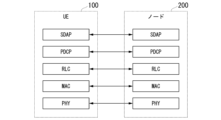
- FIG. 2 is a diagram showing an example of the configuration of a protocol stack of a U-plane radio interface that handles data.
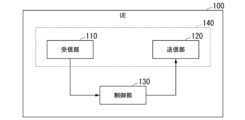
- FIG. 2 is a diagram illustrating a configuration example of a UE (user equipment) according to an embodiment.
- FIG. 2 is a diagram illustrating an example of the configuration of a node according to the embodiment.
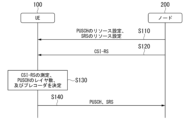
- FIG. 2 is a diagram illustrating an example of a system operation according to the first embodiment.
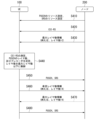
- FIG. 11 is a diagram illustrating an example of a system operation according to a modified example of the first embodiment.
- FIG. 11 is a diagram illustrating an example of a system operation according to the second embodiment.
- FIG. 13 is a diagram illustrating an example of a system operation according to the third embodiment.
- FIG. 13 is a diagram illustrating an example of a system operation according to the fourth embodiment.
- FIG. 13 is a diagram illustrating an example of a system operation according to the fifth embodiment.
- FIG. 13 is a diagram illustrating an example of a system operation according to a modified example of the fifth embodiment.
- FIG. 1 is a diagram showing a configuration example of a mobile communication system according to an embodiment.
- the mobile communication system according to the embodiment is a system conforming to the 3GPP standard.
- the mobile communication system according to the embodiment may be a fifth generation (5G) system or a sixth generation (6G) system.
- the mobile communication system includes a network (NW) 1 and a user equipment (UE) 100.
- the UE 100 is a mobile communication device that performs wireless communication with the NW 1.
- the UE 100 may be any device used by a user, and may be, for example, a mobile phone terminal (including a smartphone) or a tablet terminal, a notebook PC (Personal Computer), a communication module (including a communication card or chipset), a sensor or a device provided in a sensor, a vehicle or a device provided in a vehicle (Vehicle UE), or an aircraft or a device provided in an aircraft (Aerial UE).
- NW1 includes a radio access network (RAN) 10 and a core network (CN) 20.
- RAN radio access network
- CN core network
- the RAN 10 is called NG-RAN (Next Generation Radio Access Network) and the CN 20 is called 5GC (5G Core Network).
- 5GS 5th Generation System
- NG-RAN Next Generation Radio Access Network
- 5GC 5G Core Network
- RAN 10 includes a plurality of nodes 200 (nodes 200a to 200c in the illustrated example).
- the nodes 200 are connected to each other via inter-node interfaces.
- the nodes 200 are also referred to as base stations.
- the nodes 200 are composed of a CU (Central Unit) and a DU (Distributed Unit) (i.e., functionally divided), and the two units may be connected by a fronthaul interface.
- the nodes 200 are referred to as gNBs
- the inter-node interface is referred to as an Xn interface
- the fronthaul interface is referred to as an F1 interface.
- Each node 200 manages one or more cells.
- the node 200 performs wireless communication with the UE 100 that has established a connection with its own cell.
- Each node 200 has a radio resource management (RRM) function, a routing function for user data (also simply called “data”), a measurement control function for mobility control and scheduling, etc.
- RRM radio resource management
- “cell” is used as a term indicating the smallest unit of a wireless communication area.
- Cell is also used as a term indicating a function or resource for performing wireless communication with the UE 100.
- One cell belongs to one carrier frequency (also simply called "frequency").
- CN 20 includes CN device 300.
- CN device 300 may include a C-plane device corresponding to the control plane (C-plane) and a U-plane device corresponding to the user plane (U-plane).
- the C-plane device performs various mobility controls and paging for UE 100.
- the C-plane device communicates with UE 100 using NAS (Non-Access Stratum) signaling.
- the U-plane device controls data transfer.
- AMF Access and Mobility Management Function
- UPF User Plane Function
- the interface between node 200 and CN device 300 is called NG interface.
- Figure 2 shows an example of the protocol stack configuration for the U-plane radio interface that handles data.
- the U-plane radio interface protocol includes, for example, a physical (PHY) layer, a medium access control (MAC) layer, a radio link control (RLC) layer, a packet data convergence protocol (PDCP) layer, and a service data adaptation protocol (SDAP) layer.
- PHY physical
- MAC medium access control
- RLC radio link control
- PDCP packet data convergence protocol
- SDAP service data adaptation protocol
- the PHY layer performs encoding/decoding, modulation/demodulation, antenna mapping/demapping, and resource mapping/demapping. Data and control information are transmitted between the PHY layer of UE100 and the PHY layer of node 200 via a physical channel.
- the PHY layer of UE100 receives downlink control information (DCI) transmitted from node 200 on a physical downlink control channel (PDCCH).
- DCI downlink control information
- PDCCH physical downlink control channel
- RNTI radio network temporary identifier
- the DCI transmitted from node 200 has CRC parity bits scrambled by the RNTI added.
- the MAC layer performs data priority control and retransmission processing using Hybrid ARQ (HARQ). Data and control information are transmitted between the MAC layer of UE100 and the MAC layer of node 200 via a transport channel.
- the MAC layer of node 200 includes a scheduler. The scheduler determines the uplink and downlink transport format (transport block size, modulation and coding scheme (MCS)) and the resources to be allocated to UE100.
- MCS modulation and coding scheme
- the RLC layer uses the functions of the MAC layer and PHY layer to transmit data to the RLC layer on the receiving side. Data and control information are transmitted between the RLC layer of UE 100 and the RLC layer of node 200 via logical channels.
- the PDCP layer performs header compression/decompression, encryption/decryption, etc.
- the SDAP layer maps IP flows, which are the units for QoS control by the CN 20, to radio bearers, which are the units for QoS control by the AS (Access Stratum). Note that if the RAN is connected to the EPC, SDAP is not necessary.
- Figure 3 shows an example of the protocol stack configuration for the C-plane wireless interface that handles signaling (control signals).
- the protocol stack of the C-plane radio interface has, for example, an RRC (Radio Resource Control) layer and a NAS (Non-Access Stratum) layer instead of the SDAP layer shown in Figure 2.
- RRC Radio Resource Control
- NAS Non-Access Stratum
- RRC signaling for various settings is transmitted between the RRC layer of UE100 and the RRC layer of node 200.
- the RRC layer controls logical channels, transport channels, and physical channels in response to the establishment, re-establishment, and release of radio bearers.
- RRC connection connection between the RRC of UE100 and the RRC of node 200
- UE100 is in an RRC connected state.
- RRC connection no connection between the RRC of UE100 and the RRC of node 200
- UE100 is in an RRC idle state.
- UE100 is in an RRC inactive state.
- the NAS layer (also simply referred to as "NAS"), which is located above the RRC layer, performs session management, mobility management, etc.
- NAS signaling is transmitted between the NAS layer of UE100 and the NAS layer of CN device 300.
- UE100 also has an application layer, etc.
- AS layer also simply referred to as "AS”.
- Figure 4 shows the general procedure for transmitting a physical uplink shared channel (PUSCH) using the non-codebook method.
- PUSCH physical uplink shared channel
- step S10 node 200 transmits a resource setting for SRS (sounding reference signal) to UE 100.
- UE 100 receives the resource setting for SRS.
- This resource setting sets the resources (frequency, time, antenna port) for SRS.
- step S20 node 200 transmits the CSI-RS to UE 100.
- UE 100 receives the CSI-RS.
- step S30 UE 100 measures the resource of the CSI-RS transmitted in step S20. Based on the measurement of the resource of the CSI-RS, UE 100 calculates the precoder to be used for transmitting the SRS.
- step S40 the UE 100 applies the calculated precoder and transmits up to four SRSs to the node 200.
- the SRS resources set by the resource configuration received in step S10 are used to transmit these SRSs.
- one SRS antenna port is set for the SRS resources of each SRS.
- step S50 node 200 determines one or more SRIs (SRS Resource Indicators) corresponding to the precoder to be used for transmitting the PUSCH based on the received SRS.
- SRIs SRS Resource Indicators
- step S60 node 200 transmits the determined SRI or SRIs to UE 100.
- the SRI or SRIs are transmitted included in downlink control information (DCI) transmitted on the physical downlink control channel (PDCCH).
- DCI downlink control information
- PDCCH physical downlink control channel
- the SRI or SRIs are stored in an SRS resource indicator area included in the DCI.
- UE 100 receives the SRI or SRIs.
- node 200 does not notify TRI (Transmit Rank Indicator), but UE 100 determines the TRI from the number of SRIs.
- step S70 UE 100 transmits the PUSCH to node 200 using the same antenna port as the antenna port of the SRS.
- the antenna port of the SRS is indicated by one or more received SRIs.
- the same precoder as that of the SRS of the SRS resource indicated by the received SRI is applied to the transmission of the PUSCH.
- FIG. 5 is a diagram showing a configuration example of the UE 100 (user equipment) according to the embodiment.
- the UE 100 has a receiving unit 110, a transmitting unit 120, and a control unit 130.
- the receiving unit 110 and the transmitting unit 120 constitute a wireless communication unit 140 that performs wireless communication with node 200.
- the receiving unit 110 performs various receptions under the control of the control unit 130.
- the receiving unit 110 includes an antenna and a receiver.
- the receiver converts the radio signal received by the antenna into a baseband signal (received signal) and outputs it to the control unit 130.
- the transmitting unit 120 performs various transmissions under the control of the control unit 130.
- the transmitting unit 120 includes an antenna and a transmitter.
- the transmitter converts the baseband signal (transmitted signal) output by the control unit 130 into a radio signal and transmits it from the antenna.
- the control unit 130 performs various controls and processes in the UE 100.
- the operations of the UE 100 described above and below may be operations under the control of the control unit 130.
- the control unit 130 includes at least one processor and at least one memory.
- the memory stores programs executed by the processor and information used in the processing by the processor.
- the processor may include a baseband processor and a CPU (Central Processing Unit).
- the baseband processor performs modulation/demodulation and encoding/decoding of baseband signals.
- the CPU executes programs stored in the memory to perform various processes.
- the UE 100 configured in this manner performs wireless communication with the node 200 in the mobile communication system.
- the receiver 110 receives a first reference signal transmitted by the node 200.
- the controller 130 measures the resource of the first reference signal, calculates a precoder to be used for transmitting the PUSCH based on the measurement of the resource of the first reference signal, and applies the precoder to the PUSCH.
- the transmitter 120 transmits the PUSCH to which the precoder has been applied to the node 200.
- the first reference signal is a downlink reference signal used to calculate a precoder to be applied to the transmission of PUSCH.
- the first reference signal is, for example, CSI-RS in 3GPP, but may be other reference signals such as DM-RS, PT-RS, and new reference signals introduced in the sixth generation. Below, an example of the case where the first reference signal is CSI-RS is described.
- UE 100 can transmit PUSCH with fewer round trips in communication than in the procedure of FIG. 4.
- UE 100 can prevent a decrease in throughput due to increased inter-stream interference and deterioration in modulation accuracy, even in an environment where the propagation channel fluctuates drastically.
- control unit 130 determines the number of layers of the PUSCH based on the measurement of the resource of the first reference signal. Also, in this embodiment, the control unit 130 calculates the precoder to be used for transmitting the second reference signal based on the measurement of the resource of the first reference signal, selects an antenna port for the determined number of layers of the PUSCH from the antenna ports of the second reference signal, and uses the selected antenna port for the number of layers for transmitting the PUSCH. As a result, the part of the precoder applied to the transmission of the second reference signal that is used for the second reference signal of the selected antenna port is used for transmitting the PUSCH.
- the second reference signal is an uplink reference signal used by node 200 to receive PUSCH.
- the second reference signal is, for example, a sounding reference signal (SRS) in 3GPP, but may be other reference signals such as DM-RS, PT-RS, or new reference signals introduced in the sixth generation.
- SRS sounding reference signal
- FIG. 6 is a diagram illustrating a configuration example of a node 200 (base station, gNB) according to an embodiment.
- the node 200 has a transmitting unit 210, a receiving unit 220, a control unit 230, and a NW communication unit 240.
- the transmitting unit 210 and the receiving unit 220 constitute a wireless communication unit 250 that performs wireless communication with the UE 100.
- the transmitting unit 210 performs various transmissions under the control of the control unit 230.
- the transmitting unit 210 includes an antenna and a transmitter.
- the transmitter converts a baseband signal (transmission signal) output by the control unit 230 into a radio signal and transmits it from the antenna.
- the receiving unit 220 performs various receptions under the control of the control unit 230.
- the receiving unit 220 includes an antenna and a receiver. The receiver converts a radio signal received by the antenna into a baseband signal (received signal) and outputs it to the control unit 230.
- the control unit 230 performs various controls and processes in the node 200.
- the operations of the node 200 described above and below may be operations under the control of the control unit 230.
- the control unit 230 includes at least one processor and at least one memory.
- the memory stores programs executed by the processor and information used in the processing by the processor.
- the processor may include a baseband processor and a CPU.
- the baseband processor performs modulation/demodulation and encoding/decoding of baseband signals.
- the CPU executes programs stored in the memory to perform various processes.
- the NW communication unit 240 is connected to adjacent nodes via an inter-node interface.
- the NW communication unit 240 is connected to the CN device 300 via a node-CN interface.
- the node 200 configured in this manner performs wireless communication with the UE 100 in a mobile communication system.
- the transmitter 210 transmits a first reference signal to the UE 100.
- the receiver 220 receives a PUSCH from the UE 100.
- the PUSCH is a PUSCH transmitted by the UE 100 by applying a precoder calculated based on the measurement of the resource of the first reference signal.
- FIG. 7 is a diagram showing a system operation example according to the first embodiment.
- the system operation according to the first embodiment is a method of transmitting a PUSCH to which a UE-determined precoder is applied, that is, a method of transmitting a PUSCH to which a precoder determined by the UE 100 is applied. Note that a duplicated description of the same operation as in Figure 4 is omitted.
- node 200 transmits the PUSCH resource setting and the SRS resource setting to UE 100.
- Node 200 transmits the resource setting to UE 100, for example, at the RRC layer.
- node 200 may transmit the resource setting to UE 100 at the MAC layer, or may transmit the resource setting to UE 100 by including it in DCI.
- UE 100 receives the PUSCH resource setting and the SRS resource setting.
- step S120 the node 200 transmits the CSI-RS to the UE 100.
- the UE 100 receives the CSI-RS.
- the node 200 may transmit the CSI-RS to the UE 100. That is, the order in which the process of step S120 and the process of step S110 are executed may be reversed from the order shown in FIG.
- step S130 UE 100 measures the CSI-RS resource transmitted in step S120. Based on the measurement of the CSI-RS resource, UE 100 calculates a precoder to be applied to the transmission of PUSCH and SRS. Based on the measurement of the CSI-RS resource, UE 100 determines the number of layers of PUSCH.
- the method of calculating the precoder applied to the transmission of PUSCH and SRS by the UE 100 based on the measurement of the resource of the CSI-RS is, for example, a method based on singular value decomposition.
- the UE 100 expresses the result of the measurement of the resource of the CSI-RS as a matrix having rows of the number of antenna ports of the node 200 and columns of the number of antenna ports of the UE 100 (maximum number of layers of PUSCH).
- the UE 100 performs singular value decomposition on the matrix.
- the UE 100 determines whether the magnitude of the singular value obtained by the singular value decomposition is greater than a predetermined threshold.
- the UE 100 determines that the beam is transmittable.
- the eigenvector corresponding to the singular value determined to be transmittable corresponds to the weight of the precoder of the beam (layer) determined to be transmittable, and the number of the eigenvectors corresponds to the number of layers that can be transmitted.
- the method by which UE 100 calculates a precoder to be applied to the transmission of PUSCH based on the measurement of the CSI-RS resource is not limited to a method based on singular value decomposition, and other methods may be used.
- step S140 UE 100 transmits the PUSCH to which the calculated precoder has been applied to node 200.
- Node 200 receives the PUSCH. Note that the time when UE 100 transmits the PUSCH to node 200 is scheduled, for example, by DCI. Also, UE 100 transmits the PUSCH to node 200 using the resources set in the PUSCH resource setting received from node 200 in step S110.
- UE 100 may transmit an SRS to node 200 before transmitting a PUSCH to node 200.
- UE 100 transmits an SRS to node 200 using SRS resources for at least the number of layers mentioned above.
- UE 100 selects an antenna port for the determined number of layers of the PUSCH from the antenna ports for the SRS, and uses the selected antenna port for transmitting the PUSCH.
- the PUSCH for the above number of layers is transmitted to node 200 by applying the same precoder as that used for transmitting the SRS from the selected antenna port.
- the PUSCH transmission method applying the UE-determined precoder shown in FIG. 7, i.e., the PUSCH transmission method applying the precoder determined by UE 100 also assumes TDD (Time Division Duplex).
- UE 100 can measure the CSI-RS received from node 200 (i.e., channel estimation is possible).
- UE 100 uses channel reciprocity due to TDD to calculate the precoder to be used for PUSCH transmission based on the measurement of CSI-RS, and also determines the number of layers of PUSCH. In other words, UE 100 has the ability to determine the precoder (beam) to be used for PUSCH transmission.
- the advantage of the PUSCH transmission method applying the UE-determined precoder is that the precoder to be used for transmission can be calculated from the received signal using channel reciprocity due to TDD. In other words, by executing a series of controls for transmitting the PUSCH in the UE 100 without communicating with the node 200, the precoder can be determined in a shorter time than in the conventional procedure shown in FIG. 4.
- UE 100 determines the number of layers of the PUSCH based on the measurement of the resources of the first reference signal (CSI-RS), but this is not limiting.
- the number of layers of the PUSCH does not have to be determined by UE 100.
- node 200 determines the number of layers of the PUSCH, and node 200 notifies UE 100 of the determined number of layers.
- the number of layers of the PUSCH may be determined in advance, and UE 100 may store the number of layers in advance.
- UE 100 (control unit 130) calculates a precoder to be used for transmitting a second reference signal (SRS) based on the measurement of resources of the first reference signal (CSI-RS), selects an antenna port for the determined number of layers of the PUSCH from the antenna ports of the second reference signal (SRS), and transmits the PUSCH using the selected antenna port, but this is not limited to this.
- UE 100 may transmit the PUSCH using an antenna port other than the antenna port of the second reference signal (SRS).
- the transmitter 120 transmits the PUSCH by a PUSCH transmission method to which a UE-determined precoder is applied. That is, when the receiver 110 receives the first information from the node 200, the transmitter 120 applies a precoder calculated by the controller 130 based on the measurement of the resource of the first reference signal to the transmission of the PUSCH.
- the first information is information indicating that a PUSCH transmission method to which a UE-determined precoder is applied is used to transmit the PUSCH.
- FIG. 8 is a diagram showing an example of system operation according to a modified example of the first embodiment. Note that the processes in steps S210, S230, and S240 are similar to those in steps S110, S130, and S140 in FIG. 7, and therefore will not be described.
- step S220 node 200 transmits CSI-RS to UE 100.
- the first information is included in the CSI-RS.
- the first information being included in the CSI-RS means that CSI-RS based on a sequence corresponding to the use of a PUSCH transmission method to which a UE-determined precoder is applied for the transmission of PUSCH is transmitted. That is, there are two types of CSI-RS: CSI-RS indicating the use of a PUSCH transmission method to which a UE-determined precoder is applied, and CSI-RS indicating that a PUSCH transmission method to which a UE-determined precoder is applied is not used. These two types of CSI-RS have different sequences for generating CSI-RS.
- UE100 When UE100 receives the first type of CSI-RS, it determines that it will use a PUSCH transmission method to which a UE-determined precoder is applied for PUSCH transmission, i.e., that the precoder determined by UE100 will be applied. On the other hand, when UE100 receives the second type of CSI-RS, it determines that it will not use a PUSCH transmission method to which a UE-determined precoder is applied for PUSCH transmission, i.e., that the general non-codebook type transmission method as shown in FIG. 4 will be used.
- UE100 determines that the CSI-RS contains the first information, it executes the processes of steps S230 and S240. On the other hand, if UE100 determines that the CSI-RS does not contain the first information, it executes the subsequent processes based on a general procedure (the processes after step S30 in FIG. 4) in which a precoder determined in the non-codebook type is applied and PUSCH is transmitted.
- the first information may be included in the DCI transmitted from the node 200 to the UE 100, or may be transmitted in the RRC layer. In addition, the first information may be transmitted for all subsequent PUSCH transmissions, or may be transmitted for one PUSCH transmission.
- control unit 130 may use a PUSCH transmission method that applies a UE-determined precoder.
- the control unit 130 determines whether the channel reciprocity is satisfied, for example, as follows. For example, the control unit 130 determines that the channel reciprocity is satisfied when Time Division Duplex (TDD) is used as the communication method and the frequencies of the uplink and the downlink are the same or the difference is within a threshold. As another example, the control unit 130 determines that the channel reciprocity is satisfied when the moving speed of the UE 100 is slow enough to realize the channel model reciprocity.
- TDD Time Division Duplex
- the control unit 130 may also determine whether to use time division duplex based on the frequency band to which the component carrier used by the UE 100 to communicate with the node 200 belongs.
- the second embodiment will be described mainly with respect to differences from the first embodiment.
- the number of layers of the PUSCH transmitted by the UE 100 is not shared between the node 200 and the UE 100. Therefore, the node 200 must perform reception processing assuming the maximum number of layers. In other words, the node 200 must perform blind decoding.
- the node 200 knows the number of antenna ports of the node 200 itself, or the number of antenna ports of the UE 100, or the maximum number of layers in the capacity of the UE 100. However, the node 200 does not know the number of layers determined by the UE 100.
- the node 200 must perform reception processing based on the number of antenna ports of the node 200 itself, or the number of antenna ports of the UE 100, or the maximum number of layers in the capacity of the UE 100. For example, even if the number of layers is 1 and transmission is performed by the UE 100, the node 200 must perform reception processing assuming the number of layers to be 8. This poses a problem that power consumption may worsen compared to a case in which the node 200 knows the number of layers.
- the receiver 110 receives maximum layer number information from the node 200.
- the maximum layer number information is information indicating the maximum number of layers of the PUSCH transmitted by the transmitter 120.
- the controller 130 controls the number of layers of the PUSCH to be equal to or less than the maximum value indicated by the maximum layer number information.
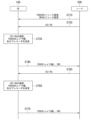
- FIG. 9 is a diagram showing a system operation example according to the second embodiment. Note that the processes of steps S310, S320, and S350 are similar to the processes of steps S110, S120, and S140 in Fig. 7, and therefore will not be described.
- node 200 transmits maximum layer number information to UE 100.
- the maximum value of the number of layers indicated by the maximum layer number information is, for example, 2.
- Node 200 transmits the maximum layer number information to UE 100, for example, by including it in DCI.
- node 200 transmits the maximum layer number information to UE 100 using a specified area in a specified format of DCI.
- this area is not used. Therefore, even in the transmission method of PUSCH to which a UE-determined precoder is applied, the maximum layer number information is transmitted using this area, thereby making effective use of DCI resources.
- the maximum number of layers information may also be transmitted in the MAC layer.
- the maximum number of layers information may also be transmitted in the RRC layer.
- the maximum layer number information is transmitted after the CSI-RS is transmitted, but this is not limited to the above.
- the maximum layer number information may be transmitted before the CSI-RS is transmitted.
- the process of step S330 may be performed before the process of step S320.
- the UE 100 may use a PUSCH transmission method to which a UE-determined precoder is applied to transmit the PUSCH. In other words, the UE 100 may use the maximum number of layers information as the above-mentioned first information.
- step S340 UE 100 executes the process of step S130 described above while controlling the number of layers of the PUSCH to be equal to or less than the maximum value indicated by the maximum layer number information.
- UE100 controls the number of layers of the PUSCH to be equal to or less than the maximum value indicated by the maximum layer number information, for example, as follows. For example, if all four singular values obtained as a result of singular value decomposition are greater than a predetermined threshold, the number of layers is four. If the result of singular value decomposition indicates that the number of layers is four, but the maximum value indicated by the maximum layer number information is two, UE100 sets the number of layers to two, selects the two largest singular values out of the four singular values, and selects the eigenvectors corresponding to the selected singular values.
- node 200 When receiving PUSCH in step S350, node 200 performs the reception process assuming the maximum number of layers indicated by the maximum layer number information as the number of layers.
- the third embodiment will be described mainly with respect to differences from the second embodiment.
- the node 200 reduces deterioration of power consumption in the reception process by transmitting maximum layer number information to the UE 100.
- the control of the second embodiment even if the amount of data of the PUSCH that the UE 100 is to transmit increases, the number of layers cannot be made larger than the maximum value indicated by the maximum layer number information even if the uplink channel condition improves. For example, even in a situation in which the number of layers is actually 6 and the PUSCH can be transmitted, if the maximum value indicated by the maximum layer number information is 4, the number of layers can only be transmitted as 4. As a result, the control of the second embodiment has a problem that the channel capacity cannot be fully utilized.
- the transmitter 120 transmits desired number of layers information to the node 200.
- the desired number of layers information is information indicating the desired number of layers, which is the maximum number of layers desired by the UE 100.
- the transmitter 120 transmits the desired number of layers information to the node 200 when the desired number of layers is greater than the maximum value indicated by the maximum number of layers information.
- FIG. 10 is a diagram showing the system operation example according to the third embodiment. Note that the processes of steps S410, S420, S430, S440, and S450 are similar to the processes of steps S310, S320, S330, S340, and S350 in Fig. 9, and therefore will not be described.
- step S460 UE 100 transmits desired number of layers information to node 200.
- the desired number of layers indicated by the desired number of layers information is, for example, 4.
- UE 100 determines the desired number of layers, for example, as follows:
- UE100 determines that the amount of data (buffer amount) to be transmitted using PUSCH has reached a predetermined amount of data or more, it determines the desired number of layers to be a number greater than the current number of layers. In another example, UE100 may determine the number of layers of PUSCH determined based on measurement of CSI-RS resources as the desired number of layers. In another example, when UE100 determines that the amount of data (buffer amount) to be transmitted using PUSCH has reached a predetermined amount of data or more, it may determine the number of layers of PUSCH determined based on measurement of CSI-RS resources as the desired number of layers.
- node 200 transmits the maximum number of layers information again to UE 100.
- the maximum value of the number of layers indicated by the maximum number of layers information is, for example, 4.
- node 200 determines the maximum number of layers based on the desired number of layers information received from UE 100.
- Node 200 transmits maximum number of layers information indicating the determined maximum number of layers to UE 100.
- node 200 may transmit a response (ACK) to UE 100 indicating that the desired number of layers indicated by the desired number of layers information is permitted as the maximum number of layers.
- ACK response
- step S460 instead of transmitting the desired number of layers, UE 100 may transmit to node 200 a request to increase the maximum number of layers or to indicate the amount of increase.
- steps S460 and S470 may be performed before the process of step S440, or before the process of step S450.
- step S480 UE100 determines the number of layers based on the maximum number of layers information retransmitted from node 200 or the desired number of layers, and transmits PUSCH and SRS to node 200. If the maximum number of layers information is transmitted from node 200 to UE100 in step S470, UE100 determines the number of layers based on the maximum number of layers information. If a response indicating that the desired number of layers indicated by the desired number of layers information is permitted is transmitted to UE100 in step S470, UE100 determines the desired number of layers as the maximum number of layers. Note that, similar to step S450 (step S140), UE100 transmits SRS to node 200 before transmitting PUSCH to node 200.
- Node 200 performs reception processing assuming the number of layers to be the maximum value indicated by the retransmitted maximum layer number information or the desired number of layers indicated by the desired layer number information received from UE 100.
- node 200 may retransmit CSI-RS to UE 100.
- UE 100 may determine the number of layers of the PUSCH determined based on the measurement of the resources of the retransmitted CSI-RS as the desired number of layers.
- the fourth embodiment will be described mainly with respect to differences from the second embodiment.
- the node 200 transmits maximum layer number information to the UE 100 to reduce deterioration of power consumption in the reception process.
- the control of the second embodiment even if the amount of data of the PUSCH that the UE 100 is to transmit is reduced, or the channel state of the uplink is deteriorated, the node 200 must perform the reception process assuming the maximum value indicated by the maximum layer number information as the number of layers. As a result, the control of the second embodiment has a problem that unnecessary power consumption may occur.
- the transmitter 120 transmits the desired number of layers information to the node 200 if the desired number of layers is smaller than the maximum value indicated by the maximum number of layers information.
- FIG. 11 is a diagram showing the system operation example according to the fourth embodiment. Note that the processes of steps S510, S520, S530, S540, and S550 are similar to the processes of steps S310, S320, S330, S340, and S350 in Fig. 9, and therefore will not be described.
- step S560 UE 100 transmits desired number of layers information to node 200.
- the desired number of layers indicated by the desired number of layers information is, for example, 1.
- UE 100 determines the desired number of layers, for example, as follows:
- UE100 determines that the amount of data (buffer amount) to be transmitted using PUSCH is equal to or less than a predetermined amount of data, it determines the desired number of layers to be a number smaller than the current number of layers. In another example, UE100 may determine the number of layers of PUSCH determined based on measurement of CSI-RS resources as the desired number of layers. In another example, when UE100 determines that the amount of data (buffer amount) to be transmitted using PUSCH is equal to or less than a predetermined amount of data, it may determine the number of layers of PUSCH determined based on measurement of CSI-RS resources as the desired number of layers.
- node 200 transmits the maximum number of layers information again to UE 100.
- the maximum value of the number of layers indicated by the maximum number of layers information is, for example, 1.
- node 200 determines the maximum number of layers based on the desired number of layers information received from UE 100.
- Node 200 transmits maximum number of layers information indicating the determined maximum number of layers to UE 100.
- node 200 may transmit a response (ACK) to UE 100 indicating that the desired number of layers indicated by the desired number of layers information is permitted as the maximum number of layers.
- ACK response
- step S560 instead of transmitting the desired number of layers, UE 100 may transmit to node 200 a request to reduce the maximum number of layers or to indicate the amount of reduction.
- steps S560 and S570 may be performed before the process of step S540, or before the process of step S550.
- step S580 UE100 determines the number of layers based on the maximum number of layers information retransmitted from node 200 or the desired number of layers, and transmits PUSCH and SRS to node 200. If the maximum number of layers information is transmitted from node 200 to UE100 in step S570, UE100 determines the number of layers based on the maximum number of layers information. If a response indicating that the desired number of layers indicated by the desired number of layers information is permitted is transmitted to UE100 in step S570, UE100 determines the desired number of layers as the maximum number of layers. Note that, similar to step S550 (step S140), UE100 transmits SRS to node 200 before transmitting PUSCH to node 200.
- Node 200 performs reception processing assuming the number of layers to be the maximum value indicated by the retransmitted maximum layer number information or the desired number of layers indicated by the desired layer number information received from UE 100.
- node 200 may retransmit CSI-RS to UE 100.
- UE 100 may determine the number of layers of the PUSCH determined based on the measurement of the resources of the retransmitted CSI-RS as the desired number of layers.
- the fifth embodiment With reference to Fig. 12, the fifth embodiment will be described, focusing mainly on the differences from the second embodiment.
- the node 200 reduces the deterioration of power consumption in the reception process by transmitting maximum layer number information to the UE 100.
- the control of the second embodiment there is a problem that the number of layers cannot be dynamically changed.
- the transmitter 120 transmits layer number information indicating the number of layers of the PUSCH to the node 200.
- the UE 100 dynamically changing the number of layers, it is possible to increase the system capacity and reduce the power consumption of the node 200 even when the channel conditions change suddenly in an environment where wireless communication using high frequency bands such as millimeter waves or sub-terahertz waves is used.
- FIG. 12 is a diagram showing a system operation example according to the fifth embodiment. Note that the processes of steps S610, S620, S630, and S660 are similar to the processes of steps S310, S320, S340, and S350 in Fig. 9, and therefore will not be described.
- step S640 UE 100 transmits the number of layers information to node 200.
- Node 200 receives the number of layers information.
- UE 100 determines the number of layers of the PUSCH determined based on, for example, the measurement of CSI-RS resources as the number of layers indicated by the number of layers information.
- step S650 node 200 transmits a response (ACK) to UE 100 indicating that the layer number information has been received. For example, node 200 may transmit the response by including it in DCI. Note that, if node 200 does not receive layer number information in step S640, node 200 may determine that the number of layers indicated by the layer number information last received from UE 100 is still being used for transmitting the PUSCH.
- steps S670, S680, S690, S6100, and S6110 are similar to those in steps S620, S630, S640, S650, and S660, and therefore will not be described. Thereafter, the processes in steps S670, S680, S690, S6100, and S6110 are repeatedly executed.
- step S660 an example has been described in which the process consisting of steps S640 and S650 is executed once for one processing of step S660.
- steps S640 and S650 may be executed once for multiple processing of step S660.
- the transmitter 120 transmits a PUSCH to the node 200, including layer number information indicating the number of layers of the PUSCH to be transmitted next.
- FIG. 13 is a diagram showing an example of system operation according to a modification of the fifth embodiment. Note that the processes of steps S710, S720, S730, S750, and S760 are similar to the processes of steps S610, S620, S630, S670, and S680 in Fig. 12, and therefore descriptions thereof will be omitted.
- step S740 the UE 100 transmits layer number information indicating the number of layers of the PUSCH to be transmitted next, to the node 200, including the layer number information in the transmission of the PUSCH.
- the PUSCH to be transmitted next is the PUSCH transmitted by the UE 100 in step S770.
- UE 100 transmits SRS to node 200 before transmitting PUSCH to node 200.
- step S770 is similar to the process of step S740, so a description thereof will be omitted. Thereafter, the processes of steps S750, S760, and S770 described above are repeatedly executed.
- UE 100 may transmit to node 200 layer number information indicating the number of layers of the PUSCH to be transmitted next by including it in the PUCCH transmission.
- a program may be provided that causes a computer (UE 100, node 200) to execute the operations according to the above-described embodiments.
- the program may be recorded on a computer-readable medium.
- the computer-readable medium on which the program is recorded may be a non-transient recording medium.
- the non-transient recording medium is not particularly limited, and may be, for example, a recording medium such as a CD-ROM or DVD-ROM.
Landscapes
- Engineering & Computer Science (AREA)
- Signal Processing (AREA)
- Computer Networks & Wireless Communication (AREA)
- Mobile Radio Communication Systems (AREA)
Priority Applications (6)
| Application Number | Priority Date | Filing Date | Title |
|---|---|---|---|
| PCT/JP2023/039644 WO2025094365A1 (ja) | 2023-11-02 | 2023-11-02 | ユーザ装置、ノード、及び通信方法 |
| US19/152,000 US20260122634A1 (en) | 2023-11-02 | 2023-11-02 | User equipment, node, and communication method |
| EP23957691.1A EP4645931A4 (en) | 2023-11-02 | 2023-11-02 | USER EQUIPMENT, NODE, AND COMMUNICATION METHOD |
| JP2024564482A JP7648858B1 (ja) | 2023-11-02 | 2023-11-02 | ユーザ装置、ノード、及び通信方法 |
| JP2025033101A JP7671933B1 (ja) | 2023-11-02 | 2025-03-03 | ユーザ装置、ノード、及び通信方法 |
| JP2025068105A JP2025106091A (ja) | 2023-11-02 | 2025-04-17 | ユーザ装置 |
Applications Claiming Priority (1)
| Application Number | Priority Date | Filing Date | Title |
|---|---|---|---|
| PCT/JP2023/039644 WO2025094365A1 (ja) | 2023-11-02 | 2023-11-02 | ユーザ装置、ノード、及び通信方法 |
Publications (1)
| Publication Number | Publication Date |
|---|---|
| WO2025094365A1 true WO2025094365A1 (ja) | 2025-05-08 |
Family
ID=95019407
Family Applications (1)
| Application Number | Title | Priority Date | Filing Date |
|---|---|---|---|
| PCT/JP2023/039644 Pending WO2025094365A1 (ja) | 2023-11-02 | 2023-11-02 | ユーザ装置、ノード、及び通信方法 |
Country Status (4)
| Country | Link |
|---|---|
| US (1) | US20260122634A1 (https=) |
| EP (1) | EP4645931A4 (https=) |
| JP (3) | JP7648858B1 (https=) |
| WO (1) | WO2025094365A1 (https=) |
Families Citing this family (1)
| Publication number | Priority date | Publication date | Assignee | Title |
|---|---|---|---|---|
| JP7841172B1 (ja) * | 2025-10-31 | 2026-04-06 | 京セラ株式会社 | ノード、ユーザ装置、通信システム、及び通信方法 |
Citations (3)
| Publication number | Priority date | Publication date | Assignee | Title |
|---|---|---|---|---|
| US20180262242A1 (en) * | 2017-03-13 | 2018-09-13 | Qualcomm Incorporated | Techniques and apparatuses for uplink precoder determination using downlink reference signals or downlink precoder determination using uplink reference signals |
| US20200091978A1 (en) * | 2017-03-23 | 2020-03-19 | Samsung Electronics Co., Ltd. | Device and method for transmitting data in wireless communication system |
| JP2021177643A (ja) * | 2017-05-12 | 2021-11-11 | 株式会社Nttドコモ | 端末、無線通信方法、基地局及びシステム |
Family Cites Families (4)
| Publication number | Priority date | Publication date | Assignee | Title |
|---|---|---|---|---|
| US10567048B2 (en) * | 2016-09-23 | 2020-02-18 | Qualcomm Incorporated | Techniques for determining uplink precoding matrix for a user equipment |
| JP7039618B2 (ja) | 2017-12-27 | 2022-03-22 | 株式会社Nttドコモ | 端末、無線通信方法、基地局及びシステム |
| US12369149B2 (en) * | 2020-07-20 | 2025-07-22 | Qualcomm Incorporated | Uplink rank adaptation for MIMO communication |
| US20230081552A1 (en) * | 2021-09-13 | 2023-03-16 | Mediatek Inc. | Uplink multi-antenna transmission in wireless communication system |
-
2023
- 2023-11-02 US US19/152,000 patent/US20260122634A1/en active Pending
- 2023-11-02 WO PCT/JP2023/039644 patent/WO2025094365A1/ja active Pending
- 2023-11-02 EP EP23957691.1A patent/EP4645931A4/en active Pending
- 2023-11-02 JP JP2024564482A patent/JP7648858B1/ja active Active
-
2025
- 2025-03-03 JP JP2025033101A patent/JP7671933B1/ja active Active
- 2025-04-17 JP JP2025068105A patent/JP2025106091A/ja active Pending
Patent Citations (3)
| Publication number | Priority date | Publication date | Assignee | Title |
|---|---|---|---|---|
| US20180262242A1 (en) * | 2017-03-13 | 2018-09-13 | Qualcomm Incorporated | Techniques and apparatuses for uplink precoder determination using downlink reference signals or downlink precoder determination using uplink reference signals |
| US20200091978A1 (en) * | 2017-03-23 | 2020-03-19 | Samsung Electronics Co., Ltd. | Device and method for transmitting data in wireless communication system |
| JP2021177643A (ja) * | 2017-05-12 | 2021-11-11 | 株式会社Nttドコモ | 端末、無線通信方法、基地局及びシステム |
Non-Patent Citations (2)
| Title |
|---|
| 3GPP TECHNICAL SPECIFICATION: TS 38.214 V18.0.0, September 2023 (2023-09-01) |
| See also references of EP4645931A4 |
Also Published As
| Publication number | Publication date |
|---|---|
| JPWO2025094365A1 (https=) | 2025-05-08 |
| EP4645931A4 (en) | 2026-03-25 |
| JP2025106091A (ja) | 2025-07-11 |
| JP7648858B1 (ja) | 2025-03-18 |
| US20260122634A1 (en) | 2026-04-30 |
| JP7671933B1 (ja) | 2025-05-02 |
| JP2025084940A (ja) | 2025-06-03 |
| EP4645931A1 (en) | 2025-11-05 |
Similar Documents
| Publication | Publication Date | Title |
|---|---|---|
| CN111615805B (zh) | 无线通信系统中的用户装置 | |
| EP3352381B1 (en) | Electronic device in wireless communication system, and wireless communication method | |
| KR20190040978A (ko) | 무선 통신 시스템에서의 전자 디바이스 및 방법, 및 무선 통신 시스템 | |
| US10368325B2 (en) | System and method for beam adaptation in a beam-based communications system | |
| JP5918387B2 (ja) | 移動通信システム、ユーザ端末及びプロセッサ | |
| CN106470096A (zh) | 用于无线通信的基站侧和用户设备侧的装置及方法 | |
| US12512945B2 (en) | Indication information transmission method and communication device | |
| US20190190641A1 (en) | Reciprocal Beamforming | |
| JP6101544B2 (ja) | 基地局、通信制御方法、及びプロセッサ | |
| US20250311037A1 (en) | Method and user equipment | |
| WO2015046266A1 (ja) | ネットワーク装置及びユーザ端末 | |
| JP7671933B1 (ja) | ユーザ装置、ノード、及び通信方法 | |
| JP2024169404A (ja) | 無線通信システムにおけるユーザ機器及び基地局によって実行される方法並びにユーザ機器 | |
| JP6453760B2 (ja) | 通信制御方法及び基地局 | |
| WO2016107330A1 (en) | Transmission control methods and transmission control apparatus | |
| CN115668795A (zh) | 无线通信中的波束状态更新 | |
| WO2025163814A1 (ja) | ユーザ装置、ノード、及び通信方法 | |
| JP6101580B2 (ja) | 移動通信システム、ユーザ端末、及び通信制御方法 | |
| US9888447B2 (en) | Base station | |
| CN118282571A (zh) | 一种通信方法、通信设备、介质及程序产品 | |
| WO2025163808A1 (ja) | ユーザ装置、ノード、及び通信方法 | |
| JP2022544504A (ja) | リリース16のタイプiiチャネル状態情報(csi)用の物理上りリンク制御チャネル(pucch)リソースを決定するための方法 | |
| US20240357521A1 (en) | Electronic device, communication method and computer program product | |
| WO2025087136A1 (zh) | 信息传输的方法和通信装置 | |
| WO2018035866A1 (zh) | 一种数据发送方法及装置 |
Legal Events
| Date | Code | Title | Description |
|---|---|---|---|
| ENP | Entry into the national phase |
Ref document number: 2024564482 Country of ref document: JP Kind code of ref document: A |
|
| WWE | Wipo information: entry into national phase |
Ref document number: 2024564482 Country of ref document: JP |
|
| 121 | Ep: the epo has been informed by wipo that ep was designated in this application |
Ref document number: 23957691 Country of ref document: EP Kind code of ref document: A1 |
|
| WWE | Wipo information: entry into national phase |
Ref document number: 2023957691 Country of ref document: EP |
|
| ENP | Entry into the national phase |
Ref document number: 2023957691 Country of ref document: EP Effective date: 20250729 |
|
| ENP | Entry into the national phase |
Ref document number: 2023957691 Country of ref document: EP Effective date: 20250729 |
|
| WWP | Wipo information: published in national office |
Ref document number: 2023957691 Country of ref document: EP |